• Skip to main content
  • Skip to footer

Personal Finance for PhDs

Live a financially balanced life - no Real Job required

  • Blog
  • Podcast
  • Tax Center
  • PhD Home Loans
  • Work with Emily
  • About Emily Roberts

frugality

This PhD’s Money Mindset from Childhood Has Served Her Well Through Multiple Phases

July 12, 2021 by Meryem Ok

In this episode, Emily interviews Dr. Judy Chan, a PhD and staff member at the University of British Columbia. As a child of immigrants to Canada, Judy learned early on the virtues of hard work, saving, and the value of a dollar. She applied these principles consistently while she earned her PhD, started her business, and became a parent—to great effect.

Links Mentioned in This Episode

  • Dr. Chan’s Twitter (@judycchan)
  • Dr. Chan’s LinkedIn
  • PF for PhDs: Wealthy PhD Workshop Registration
  • Get Good with Money (Book by Tiffany ‘The Budgetnista’ Aliche) 
  • E-mail Emily (for Book Giveaway)
  • PF for PhDs: Podcast Hub
  • PhD Posters
  • The Academic Society (Emily’s Affiliate Link)
  • The House Hacking Strategy (Book by Craig Curelop)
  • Reading Town (Franchise)
  • PF for PhDs: Subscribe to Mailing List

Teaser

00:00 Judy: And it was hard. I do feel that I have more advanced knowledge than my average colleague or my friend, and even going to the bank, they didn’t really take me seriously when I asked them questions. Or they assigned a very junior financial advisor to me when I actually knew all the answers myself. But I didn’t have enough money to get more experience. I don’t know. Is it just my money, my net worth, or my look, or my age, but I was never able to talk to someone who’s more experienced. So I had to do a lot of my own learning.

Introduction

00:49 Emily: Welcome to the Personal Finance for PhDs Podcast: A Higher Education in Personal Finance. I’m your host, Dr. Emily Roberts. This is Season 9, Episode 5, and today my guest is Dr. Judy Chan, a PhD and staff member at the University of British Columbia. As a child of immigrants to Canada, Judy learned early on the virtues of hard work, saving, and the value of a dollar. She applied these principles consistently while she earned her PhD, started her business, and became a parent—to great effect. We have a special event coming up on Sunday, July 18, 2021! It’s the second installment of my Wealthy PhD Workshop series, and it’s on everyone’s favorite subject: investing! This workshop is for you if you want to learn how to start investing, particularly if you are a grad student or postdoc who is not covered by a workplace-based retirement plan like a 401(k) or 403(b). I will also teach you about passive investing, which is the most effective, least expensive, and most time-efficient manner of investing. Even if you’re not a novice investor, you can use this workshop to double-check that your current investing strategy is appropriate for your goals. Furthermore, we will discuss the relative merits of discount brokerage firms, roboadvisors, and microinvesting platforms. This is going to be a value-packed session, so please join us on July 18th. You can register at PFforPhDs.com/WPhDinvest/. That’s PF for PhDs dot com slash W for Wealthy P H D I N V E S T. By the way, after you register, you’ll be asked if you want to upgrade into a membership in the Personal Finance for PhDs Community. I do recommend this upgrade because you will have access to the recording of the previous workshop in the Wealthy PhD series, among other things. That workshop on financial goals will help you figure out if now is the right time to start investing or whether you should instead be focusing on saving up cash or paying down debt. Again, please go to PFforPhDs.com/WPhDinvest to register for the workshop this coming Sunday.

Book Giveaway Contest

03:19 Emily: Now onto the book giveaway contest! In July 2021 I’m giving away one copy of Get Good with Money: Ten Simple Steps to Becoming Financially Whole by Tiffany ‘The Budgetnista’ Aliche, which is the Personal Finance for PhDs Community Book Club selection for September 2021. Everyone who enters the contest during July will have a chance to win a copy of this book. Over the last year or so, I’ve become quite a fan of Tiffany’s. I am a loyal listener of her podcast, Brown Ambition, which she co-hosts with Mandi Woodruff, and we read one of her self-published books last September in the Book Club. I was thrilled when her first traditionally published book became a runaway bestseller this past spring, and I knew I had to schedule it into the Book Club. I hope you will join us inside the Community in September to follow The Budgetnista’s plan to become financially whole. If you would like to enter the giveaway contest, please rate AND REVIEW this podcast on Apple Podcasts, take a screenshot of your review, and email it to me at emily at PFforPhDs dot com. I’ll choose a winner at the end of July from all the entries. You can find full instructions at PFforPhDs.com/podcast. Without further ado, here’s my interview with Dr. Judy Chan.

Will You Please Introduce Yourself Further?

04:43 Emily: I have joining me on the podcast today, Dr. Judy Chan. She’s a staff member at the University of British Columbia, and she is going to kind of tell us about her life through a financial lens. So we’re going to start with her childhood, we’re going to go all the way up to now. It’s a real pleasure for me to speak with Judy today because, you know, I interview a lot of grad students and recent PhDs on the podcast, and I love it, but I also love getting to hear from people who are more than a few years removed from that because they have a perspective on, you know, the post-PhD stages as well. So I’m really happy to welcome Judy to the podcast. Judy, will you please introduce yourself a little bit further for the audience?

05:20 Judy: So my name is Judy. I am a staff member at my university, UBC, and I have a side business and I am also a busy mom of two kids. Parents around in the city, so yes, busy, and that’s me.

05:38 Emily: Yeah. Great. Well, we’re going to hear your kind of whole life story coming up and we’re going to insert some financial advice for anyone, you know, coming up on that stage as we go through. So Judy, as everyone in therapy will do, let’s start with your childhood. You know, tell us about your childhood and how it, you know, helped you develop a money mindset.

06:00 Judy: I think I grew up in a very hardworking household. My dad was a restaurant owner back in Hong Kong and I remember him. We would hardly see him. He worked 18 hours a day. I remember him sleeping in the back storage area. But he worked really hard. And we didn’t see him. He doesn’t take days off. I remember we are the only business that opened on Chinese New Year day in the whole entire street. We can go in the middle of the road and play. So that’s how I grew up. I remember not spending any time off meaning that I was actually helping early in the restaurant throughout the Chinese New Year.

Childhood Memories and Life Lessons in Canada

06:45 Emily: Yeah. Tell us about what happened upon your parents immigrating to Canada.

06:49 Judy: I think I also learned big lessons because we are very fortunate that growing up, like we were able to move to Canada in a pretty good, solid financial stage. I remember we got a house. In Hong Kong, we lived in apartments, so we got a house here. Everything was good. My parents, my dad was telling us that he’s retired now. So looking back, it was like he worked really, really hard for 15, 20 years, and then he was able to enjoy his retirement in Canada. He also opened a restaurant for a very short amount of time. We helped out. But it was all very good and fun memories. It’s hardworking, but it was a really good memory for us. Every time when I see people who, other people who also grew up in the restaurant, I think we have some shared memory there.

07:41 Emily: I see. However, you did not take that route in your own life. So I’m wondering, you know, looking back on your childhood, I’m glad you have such positive memories, but what have you taken from that about how, you know, you’re raising your own children?

07:56 Judy: Raising my own children, we just have to work really hard and be very sensitive to money. I remember back then getting wholesale, on average, is actually more expensive than trying to get your cans of pops from the super market, from the big retail supermarket, where the retail price is lower than the wholesale price. So my dad would take us to the big supermarket and we would be loading, like hand carry, trays and trays of pops and juice to bring it back to the restaurant. So my dad got us helping all the time and he would tell us, this is how much we are buying. This is how much we are selling, and this is the price difference. And this is how we mark up, or he doesn’t say it, he just said, look, this is how people do business.

08:49 Judy: And people might pay $10 for a burger, but it may only cost us a dollar. But if we can find ways to cut the cost down to 80 cents, that’s an extra 20 cents for us, for the family. So when we go out, my kids are very lucky. They grew up, I think they are in a very privileged space, but we will continue to remind them that things that we get, there’s a huge markup out there. And we may be able to make it on our own, or like clothings or other things, at a lower cost. So telling them the value of the product that we are getting every day.

09:31 Emily: Yeah. So, it sounds like you had some real, you know, organic lessons around cost and value and the value of the dollar and what, you know, what you can add to the situation because you grew up in that entrepreneurial family, and that’s also something that you’re instilling in your children.

Funding During Grad School

09:47 Emily: So let’s move on to your university days. You were at UBC for undergrad and grad school. Tell us about your funding situation during grad school.

09:56 Judy: Oh, grad school was amazing. I didn’t know that there’s so much funding available for grad students. There’s scholarship and fellowship and TA ship. There’s also a lots of smaller scholarship that I never realized. I think in the way, undergraduate in order to get scholarship and fellowship it’s very competitive. My experience is that grad school is so much easier. And so there’s funding and scholarship everywhere, just apply to them and start saving. So again, in my situation, I was lucky enough that I started as early as six years old, I was able to continue to see the numbers in my bank book, bank account, grow. But I do feel that for most grad students that, hopefully, you will get enough fellowship and scholarship for your basic needs. And there are other source of income around campus. Like I work at UBC now. So I see there’s actually a lots of employment opportunities out there and use them to start building your own wealth, your own saving. Those are extra income that you don’t need now. The basics should be covered by your fellowship, scholarship, and the extra money should go towards the savings, if possible.

11:24 Emily: Yeah, I totally agree that probably there’s going to be a lot of work in the life of a graduate student. You know, there’s going to be your work and your dissertation. There may be an assistantship that you’re performing. Hopefully you’re applying for fellowships and winning some of them on top of that. Maybe you have a side job. There’s a lot of different opportunities. Now, some of those opportunities might be restricted by the, you know, the rules of where you’re living. So one, you know, in the U.S., international students, they’re not going to be allowed to have those side jobs, right? It’s only the, you know, 20 hours per week on campus that they’ve been granted. That’s it. Another thing would be like, if your university, or rather your department, restricts outside work in some manner. So you of course have to check into your, you know, specific situation there. But yes, there are a lot of opportunities in theory for graduate students. I also want to ask you, so did you continue to live with your parents during graduate school, or did you get your own place?

12:16 Judy: I continue to live with my parents.

12:19 Emily: So I ask this because I know that Vancouver is an incredibly high cost-of-living city, and that a grad student stipend may not be enough to support someone if they are living independently. And so that’s a real boon to your finances that you stayed in the same city, I’m sure it was partially by design that you did that. Yes. And you had that opportunity. So that’s wonderful. So you were able to work and save and, you know, live with your parents and yeah. Any advice that you have for a current graduate student or an entering graduate student aside from just apply, apply, apply?

12:56 Judy: I also worked really hard. Like I did my research during the daytime, and then I definitely carved out time to do my teaching assistantship, of the fellowship. There are times that I was doing more hours than what my department allowed. But I did work six days a week, seven to seven sometimes or later into the evening. And I was very disciplined. Any money that I earned on the side, I would spend it, you know, let’s go out for a drink, but they would go straight into my savings account.

Side Business as a Franchisee

13:34 Emily: I also understand that, you know, you mentioned during your college years, you were doing a lot of tutoring as a side job, but you also started a business during graduate school as a tutor. Can you tell us about that and why you decided to take that on?

13:46 Judy: Everything is luck, but then it’s also an opportunity. Like I was doing a lot of tutoring, and I noticed there’s a gap and there’s something that is not available here. And a friend introduced me to a franchise, and I think my friend actually asked me, wanted me, was asking me to be a manager to help him out. But I looked at the franchise, I love it. I like it. I really, I really felt the gap that I noticed myself. So I started a franchise, and at that time with my boyfriend then, he always wanted his own business. It doesn’t matter what it is. That boyfriend is now my husband. So, it worked out quite well. And to be honest, now that I look back, I take risks, but it’s all very calculated risk. Running a tutoring center has minimal cost. There’s no inventory. You just need to rent a space, very minimal decoration and renovation. So, I started a tutoring center when I was in the middle of my PhD.

15:00 Emily: Wow. And, you know, you said that a friend initially approached you about this opportunity. Was that a friend who was also in grad school or somebody from another, oh, wow. Okay. So, did he also have a tutoring center locally?

15:12 Judy: So he started, he looked into the franchise and then he started, he became a franchisee. So, then I asked him, well, how can I be one too? So he was also a grad student at that time.

15:27 Emily: Wow. This is a fascinating idea. I’ve never thought about people becoming franchisees during graduate school, except I’m now remembering that I actually knew someone who did that in a different business. So when I was in graduate school, I was friends with someone who was a franchisee for PhD Posters. I don’t know if they’re still in existence, but they had multiple locations around the U.S. And it’s a poster printing service. And so it wouldn’t be, you know, it would be grad students usually affiliated with the university and they would, you know, drop off posters that people ordered to the various lab spaces. And anyway, it seemed like a great kind of business model for a grad student wanting to run a side business. And it sounds like your business was also, you know, in a similar way, a little bit of overhead for the space, but I’m imagining you paid contractors, right? To do the tutoring. So that’s not any, you know, serious payroll costs. Yeah. Interesting.

Investing and Self-Learning Personal Finance

16:17 Emily: Okay. So when, you know, you’re getting to the end of graduate school, it sounds like you had a healthy savings account at that point. Do you want to tell us, you know, what your net worth was? Or were you doing any, like investing, or was it strictly just cash savings?

16:31 Judy: It was, oh, whoa. I started looking into mutual funds. Someone introduced me to the idea of mutual funds. My dad did a lot of stock trading. So I understand the buy low sell high idea. But he only knows about the trademark that’s in Hong Kong. He has no idea how the Canadian or the American system work. So I wasn’t able to get any support from him. Like, he doesn’t understand the system. And he’s, I don’t know, he doesn’t share much about how he managed his finances. So I had to learn everything on my own. And it was hard. I think, I do feel that I have more advanced knowledge than my average colleague or my friend, and even going to the bank, they didn’t really take me seriously when I asked them questions.

17:23 Judy: Or they assigned a very junior financial advisor to me when I actually knew all the answers myself. But I didn’t have enough money to get like more experience. I don’t know if it’s just my money, my net worth, or my look, or my age, but I was never able to talk to someone who’s more experienced. So I had to do a lot of my own learning. But I was lucky during our grad years, one of our technicians in the lab, he’s a very advanced investor. So there were a few of us, we would spend our afternoon tea time. Oh, by the way, I studied food science. So we would spend our ice cream time talking about finance. So there are a few of us who would exchange ideas on what can we do with our money, stocks, mutual funds. But I had to do a lot of my own learning.

18:30 Emily: And so that process did start during graduate school.

18:33 Judy: Yes. Officially start in graduate school. I’ve always been curious and interested about trading, buying stocks, but I just didn’t have enough confidence as a high schooler. I think in high school, I was already keen to know more, but it was, no, I would say I started in undergrad, in college, that I wanted to know more.

18:57 Emily: Yeah. That’s a really kind of interesting combination of like, seeing an example from your parent and getting some of the mindset of the importance of investing from your parent, yet not being able to receive the practical help because of being in a different context. I hadn’t heard of that before, but yeah. So it’s actually for you maybe a little bit the best of both worlds, because you got to be inspired by your parents, but still had to do all the legwork on your own to figure it out. Which of course means you really internalize what you’re learning.

19:25 Judy: I also learned how to do my own income tax when I was in high school. I had to help my parents because English is not their first language. My parents actually relied on me to look for an accountant. And I am someone who loves numbers and money. And so actually read into personal income tax when I was in high school. And so yeah, I had to do all that education on my own. So till today I still do my own income tax.

19:52 Emily: Yeah. They certainly, you were forced to grow up, and it’s benefited you. Right?

19:57 Judy: Thank you. Yes.

Commercial

20:00 Emily: Emily here for a brief interlude! This announcement is for prospective and first-year graduate students. My colleague, Dr. Toyin Alli of The Academic Society, offers a fantastic course just for you called Grad School Prep. The course teaches you Toyin’s 4-step Gradboss Method, which is to uncover grad school secrets, transform your mindset, uplevel your productivity, and master time management. I contributed a very comprehensive webinar to the course, titled “Set Yourself Up for Financial Success in Graduate School.” It explores the financial norms of grad school and the financial secrets of grad school. I also give you a plan for what to focus on in your finances in each season of the year that you apply to and into your first year of grad school. If this all sounds great to you, please register at theacademicsociety.com/emily for Toyin’s free masterclass on what to expect in your first semester of grad school and the three big mistakes that keep grad students stuck in a cycle of anxiety, overwhelm, and procrastination. You’ll also learn more about how to join Grad School Prep if you’d like to go a step further. Again, that’s the academic society dot com slash e m i l y for my affiliate link for the course. Now back to our interview.

Finances Post-PhD: Real Estate Advenures

21:27 Emily: Okay. Let’s talk about the post-PhD phase. But we’re not going to quite get to kids yet. So let’s talk about your finances, you know, after you finished grad school.

21:37 Judy: Yes. So it was time to get married. Looking back, my boyfriend then, my husband now, he said I was crazy. Because we just started a new business. We were still very young, and before we got married, because we were in a very stable relationship, we knew we were going to get married. It’s just a matter of Judy finishing her PhD. Everything was on hold until I was able to finish my PhD, and my choice.

22:06 Emily: I think that’s a common story.

22:09 Judy : And then sometime around that, after the business, before my PhD, before we got married, I said, “Let’s get an apartment. We need to get into the real estate market.” The real estate market in Vancouver has been crazy for the last 15, 20 years. It’s been always up with a little dip, a little dip, but it’s always up. So I said let’s go buy our first apartment. So we got our first apartment, and one of my criteria is we need to have a tenant in the apartment. It will be a bonus if there’s an existing tenant in the apartment. We would just carry over the rental lease. So we did that before my PhD was done, before we got married.

22:58 Emily: Wow. So I’ve learned that this, this term is house hacking. Buy a property, live in it with your tenant. And whether that is, you know, in an apartment where you’re sort of, it’s a roommate situation. That could also be like a multi-family if you went that route. But yeah, really glad to hear that you used that strategy. It’s one I’m very excited about, learning more about this spring. We did a focus on, well, I’m not sure when this will be published, so it’s either in the past or upcoming, but in March, 2021, we are reading The House Hacking Strategy in our book club, inside the Personal Finance for PhDs Community. So if that hasn’t happened yet, listeners check that out if this strategy interests you. I’d like to know some of the numbers on that. Like how much did having a tenant there help you out? You know, was it worthwhile to sacrifice, you know, the privacy and so forth?

23:47 Judy: Yes!

23:48 Emily: And how many years did you do that for?

23:50 Judy: So we had the tenant for less than a year, and then we got married. So we moved into, we asked the tenant to leave because we need to get into, that’s our place. So that’s when I officially moved out from my, our parents, same for him. He was living with his parents. And then, so we got married, I finished my PhD. Finished PhD, got married, and you know, all those orders are important in Chinese culture. So, and then I was pregnant. And then when I was pregnant, I was in the elevator in the apartment, and I go, no, I don’t want my kids to grow up in an apartment. I want my kids to grow in a house. You know, this is why we come to North America. We want to live in a house. And then I did like very quick, it wasn’t too hard to find out that we can actually afford a house. If we rent out the basement, that fits into what you just told us now, the house hacking, because the tenant will basically be able to pay for the difference that we have to pay in our mortgage. That’s it? Why not? Right? We got to sell our apartment, get a bigger house. The rental that we can get from our basement will pay for the difference. So it was a very logical change or purchase for us, for me.

From House Hacking to House Upgrading

25:14 Emily: Yeah. It enabled you to upgrade your housing situation, get more space and so forth without having the full, full burden of the cost solely on your incomes. And so how long did you stay in that arrangement?

25:26 Judy: We stayed in that arrangement for about four years. That was after my second kid was born. And, again, I’m so lucky. I have a girl and a son. A girl and a boy. And then at that time I had that illusion, because I came to Vancouver, Canada when I was 14 and my parents put us in the basement. I was happy. Like my sister and I, we were just happy to be in the basement. So I had that illusion that I can put my kids in the basement. So we can ask our tenant to leave. They can go into the basement. But I forgot that in between five years old and 12 years old, I cannot put them in the basement. So we, at that time in the main floor, we had two bedrooms. So, we really need a third bedroom, because you know, two kids. So, and then we were really lucky again. We were looking for, it was about time to upgrade, oh, by the way, my money advice, any extra money we have, we put it into our mortgage. So, when I shop for mortgage, I really look for a very flexible repayment method. So any extra money goes in, we actually, every month we pay more than we need to. And then at the end of the year, we also put all the savings into the house.

26:51 Emily: That’s on top of investing though. Right? Because you’re still, were you doing any like retirement stuff through your work?

26:57 Judy: Yes, yes, yes, yes, yes. Retirement stuff. Take advantage of the retirement pension plan at work and then putting any extra money into the mortgage. So we were able to, four years into the house, we were able to upgrade to a bigger house.

27:17 Emily: So that strategy, it sounds like is because you knew that you would be not in that house for decades, you knew you’d be changing. And so you get the mortgage paid down. So you have a lot of equity to go into your next property. Is that the idea?

27:29 Judy: No, no. We didn’t know that. Like, when I purchased the house with the, I call that a smaller house with the two bedroom in the main floor and two bedroom in the basement, I really thought that my kids would grow up in the basement because I enjoyed it as a teenager, but I forgot about that “in the middle” time. And so, when it was time, when I needed to have two bedrooms, one bedroom for my son and one for my daughter, I felt that we need, to upgrade the house. And having so much of the mortgage that’s been paid down, helped us upgrade our house.

28:06 Emily: Gotcha.

28:07 Judy: I paid it then, what was the reason, I just don’t want to own that much money. I have extra money, then just pay down the mortgage because everything that I pay then will go straight to the principal, and then I don’t have to pay interest on them.

28:24 Emily: Yeah, absolutely. I’m inquiring about this because, you know, we are in a super low interest rate environment right now.

28:32 Judy: Yes.

28:33 Emily: What was your interest rate at that time?

28:36 Judy: 2.5. It was super low. Yeah. It was super low. Yeah.

28:40 Emily: So this was really about you, as you just said, not being comfortable with holding that much debt and as you know, I’m tracking through your story, this is the first debt that you’ve actually taken out, right?

28:50 Judy: Yeah.

28:50 Emily: Yeah. So you’re just, you’re just a naturally debt-averse person. And this is part of that.

28:58 Judy: But at the same time, it doesn’t matter. Okay. Let’s say just pick a number. 3%. 3% is pretty low. I see where you’re going, why don’t I put the money into the stock market? I have to earn 6% return because I have to pay tax on that return in order for me to earn that 3%. And so to me, and the stock market is known to be volatile. It’s not a guarantee. So on one hand I feel that I am getting that guaranteed 3% saving instead of putting the money in a stock market that I need at least just like rough number. Right. I need at least 6% because I have to pay tax on my, on my earning. And I don’t want to do that calculation. I don’t want to worry about that.

Business Updates and Additional Family Expenses

29:53 Emily: Yeah, no, the guaranteed return on debt repayment is very attractive. I agree. So we’ve talked about, you know, real estate changes. Let’s get an update on your business, you know, from that time period.

30:08 Judy: Business was going well. It was going well, we were happy, word of mouth. We were able to generate the money that we forecast. It was going well. Until the pandemic. I have to admit, pandemic has a huge impact on our finance right now. But it’s okay because I do have a stable job at the university.

30:30 Emily: Yeah. So you have your full-time position. Was your husband’s full-time job the business, or did he have a job in addition to that?

30:35 Judy: No, very soon once we made the decision to go into the franchise, and as we were doing our renovations and as we’re getting the prep work going, he had a full-time job at that time. He felt that he needed to dedicate, and he wanted to. And I said, sure. Because I knew he always wanted to be a business owner, and I was doing my PhD. So it made sense that there’s a dedicated person at the business. So he’s full-time there.

31:06 Emily: Gotcha. And let’s talk then about the addition of the children. And you’ve already mentioned that that’s caused some real estate, you know upheavals, but you know, how else have your finances changed upon having children?

How Have Your Finances Changed Upon Having Children?

31:20 Judy: A lot. A lot. Children are very expensive for financial life. Yeah. It’s like daycare. Daycare is expensive in Canada. You know, every month is one TV, right? Every month is one iPhone, if you have to compare it to material. Also because, in Canada, the illusion is we can get a whole year off, but the whole year off for me also means a significant pay cut, right? Yes. Legally, we can get the time off, and then we will go back to having a job, but there’s a difference in income. So, that was okay. Because I think the business was doing well, and I have enough savings. I never need to worry about that. But I have to say that every month that the childcare, the daycare fee, was hard to swallow in the beginning. Whoa, that’s another iPhone. That’s another TV. So, it’s expensive to have kids.

32:26 Emily: So then what happened with your finances overall? Does that translate to a lower savings rate or, you know, did you change your lifestyle during that period?

32:36 Judy: I think we had to change our saving strategy. Like we just have to put more expenses, and less saving. Yes.

32:45 Emily: Yeah. So I have two children, they’re ages four and two. Of course, pandemic year is a weird year, and we’re not paying for childcare right now, but I am looking forward to my daughter turning five and starting kindergarten. And maybe there’ll be some, you know, before or aftercare, I don’t know, but I’m really looking forward to that state-sponsored childcare that’s coming. I’ll still have to pay for the little one for another, you know, few years, but yeah, it’s a really, really significant bite. And so it’s kind of a, you know, it’s a phase of life, right? When you have to pay for childcare, it’s a phase of life you have to accept. Yeah. Your savings rate is going to be lower than it would have been, but Hey, once the expense goes away, you just can put all that money back into savings and your rate will shoot up.

33:28 Judy: Oh, Emily, I don’t know when that will be, when we can get into that stage. Because when they are four and two is the daycare. When they are five to nine is all the extra curriculum activities. My daughter, she dances. Her first dance dress that she needs for her performance was more expensive than my wedding dress. That’s it. That’s it. That’s expensive.

33:57 Emily: Yeah. I’ve heard that too. Both about expenses with kids, is that, yeah, the daycare is a lot of the beginning, but also just shifts later on to being other things. And then also, you know, the intensity of the parenting is much more like it’s physical when they’re young, but it’s very emotional when they’re older and you just have different kind of roles to play as they age. And how old are your children now?

34:18 Judy: They are 10 and 12.

Financial Advice for First-Time Parents

34:19 Emily: Okay. And so what is your advice for someone, you know, anticipating the birth of their first child or who has young children, you know, financial advice for that person?

34:30 Judy: For kids stuff? I would say, I feel a lot of people, they would like to invest into one thing like a car seat, a stroller. I would say, go ahead, buy that luxurious thing that you really want for your kids. But everything else, get hand-me-downs. Get it from your friend. Because they grow up so fast. They grow up so fast. They don’t need all these fancy little cute dresses. And by the time you actually can fit into the dress, we live in Vancouver. So the summer time we only have three sunny days ever. Like hot sunny days. I mean, I remember we had so many cute little dressed that we really couldn’t use them. So, hand-me-downs. Get hand-me-downs.

35:11 Emily: Yeah. I think we followed your advice for our children. The one big, nice expensive thing that we bought was a Bob stroller. Right. Jogging stroller. And then everything else, we did buy new cribs, but we bought like Ikea, like bottom of the line, like so simple, stripped down Ikea cribs and tons and tons of used clothes. We were so fortunate to be, you know, sort of passed used clothes and then we pass them on to the next family afterwards. That’s exactly it worked. Yeah. Yeah. It’s a wonderful boon, if you can get into a parenting community that does that sort of thing. But yeah, I do think we followed your advice. We picked one thing that we wanted and everything else was just really just as cheap as we could get it.

35:49 Judy: And then the other one advice, well, for me that works really well, is I told my kids that I would pay for their education, for their readings, and everything. Because I think my mom was really frugal to a point that looking back, there are moments I go, mom, you know, you could have spent a little bit more money on my education. Because I think we have PhDs. So we care about education. So I really wanted to let my kids know. I am willing to spend money on things that are important to me. And the thing that is important to me is your education. So they know, they know that they can go into the local bookstore, we call it the bookstore. They can buy almost anything in the bookstore, including toys, you know, the bookstore has so many other gadgets. But they take advantage of it. And I actually allow them to, you know, as a bookstore, we will buy something educational. So I don’t, when it comes to book, I have no limit for my kids. Yes.

36:52 Emily: And is there any other advice that you want to add in at this stage for new parents or parents of littles?

36:59 Judy: The phone is a very attractive thing. You know, it’s just one phone. You have so many toys in there, but stay away from it as much as possible. Get your toys from your friends. Get your free toys from your friends. That costs very little money. And, for me before the pandemic, I’ve been strictly using cash in front of my kids. I carry cash. I really want to show them the exchange of money. But during the pandemic it was a lot harder, but they are older now. I think they understand the money, they have some understanding of money, but before the pandemic, I strictly used cash, especially in front of the kids.

37:44 Emily: Yeah. I think that’s a really good tip. Actually, so I mentioned, my daughter is four, she turned four during the pandemic. And at four we were like, okay, we’re going to start really teaching her about money. Like, what is this concept? You know? But because it was during the pandemic, there was no way that we wanted to handle cash coins, anything. So we did get a toy that, you know, represents money, but it’s something that I feel she’s missing out on a little bit now. And I want to somehow, you know, establish that for her later.

38:11 Judy: Well, four is still young. Right? So you still have a lot of time. There’s no hurry. And yeah. She still has a whole lifetime to learn about money.

Best Financial Advice for Another Early-Career PhD

38:22 Emily: Yes. So Judy, thank you so much for this interview. I loved hearing about kind of your journey and your advice. To wrap up my interviews, I always ask my guests, what is your best financial advice for another early-career PhD? It could something that we haven’t mentioned so far in the interview or something you just want to circle back to and emphasize.

38:40 Judy: You don’t really need to spend money on things that you need to impress other people. You know, just really know what is important to you and what you need. Really understand what you need and what you want, the difference between the two. I mean, I’m not saying that you cannot get the thing you want, but knowing that this purchase is what I need, and this is a purchase that is what I want. And have that differentiation in your head, in your mind. I think that’s already a very good start.

39:11 Emily: Yeah. I think that’s an incredible insight. Especially, to me, I always think about this when it comes to recurring expenses like recurring, fixed expenses. So, you know, we talked about housing a bit earlier. So what in your housing cost is a need, and what is an upgrade to that, a want? And I think it’s important just to keep in mind in case you ever come upon a situation where, you know, you want to cut back, you’ll know, okay, well, you know what, the house actually is bigger than what we needed at this point, or the car, or whatever it is. Like if you differentiate between, okay, well, I could have this, I can afford this, you know, more of a want thing right now, but just to keep in mind. Yeah. There is a way that I can scale this down, you know, should it come to it in the future. Like you said, to differentiate in your mind, I really like that advice. And will you let us know, you know, about your business and you said, you know, it’s a little bit on the skids during the pandemic, give us kind of an update on that and where people can find you if they’re interested in learning more about it?

40:06 Judy: Well, my business is more catered to kids. And so it’s a reading center, we specialize in fostering reading and writing. We have lots of books. Good levels from the state. And so it’s called Reading Town, it’s a franchise and, and I love reading with kids. And we have programs that are good from Kindergarten all the way to grade 12. Lots of readings. Yes.

40:38 Emily: Yeah. Thank you so much for letting me know about that. And thank you so much for joining me today.

40:41 Judy: Thank you, Emily.

Outtro

40:43 Emily: Listeners, thank you for joining me for this episode! pfforphds.com/podcast/ is the hub for the Personal Finance for PhDs podcast. On that page are links to all the episodes’ show notes, which include full transcripts and videos of the interviews. There is also a form to volunteer to be interviewed on the podcast and instructions for entering the book giveaway contest. I’d love for you to check it out and get more involved! If you’ve been enjoying the podcast, here are 4 ways you can help it grow: 1. Subscribe to the podcast and rate and review it on Apple Podcasts, Stitcher, or whatever platform you use. If you leave a review, be sure to send it to me! 2. Share an episode you found particularly valuable on social media, with a email list-serv, or as a link from your website. 3. Recommend me as a speaker to your university or association. My seminars cover the personal finance topics PhDs are most interested in, like investing, debt repayment, and effective budgeting. I also license pre-recorded workshops on taxes. 4. Subscribe to my mailing list at PFforPhDs.com/subscribe/. Through that list, you’ll keep up with all the new content and special opportunities for Personal Finance for PhDs. See you in the next episode, and remember: You don’t have to have a PhD to succeed with personal finance… but it helps! The music is “Stages of Awakening” by Podington Bear from the Free Music Archive and is shared under CC by NC. Podcast editing and show notes creation by Meryem Ok.

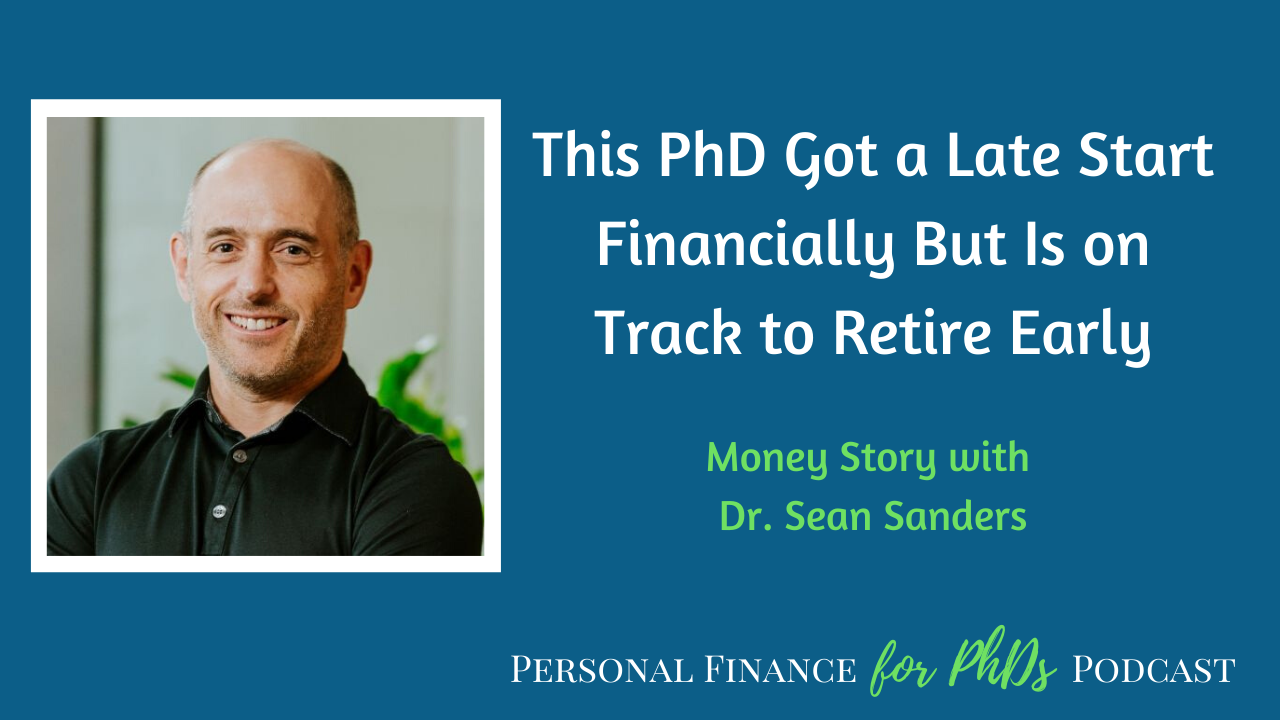
This PhD Got a Late Start Financially But Is on Track to Retire Early

June 22, 2020 by Lourdes Bobbio

In this episode, Emily interview Dr. Sean Sanders, Director and Senior Editor for Custom Publishing for the journal Science and Program Director for Outreach. Sean came to the US for a postdoc position with little savings. Living in the DC area on a postdoc salary was financially challenging; he didn’t start to make real progress with his finances until he left his postdoc for an industry job, which more than doubled his salary. Sean and Emily discuss the strategies he has used to build wealth in the last decade, from moving to reduce housing expenses to retirement investing to purchasing real estate. They go into great detail about Sean’s passive investing strategy and the mistakes he made in the past. Sean lists his favorite books and podcasts on personal finance that he has used to improve his knowledge over the years.

This is post contains affiliate links. Thank you for supporting PF for PhDs!

Links Mentioned

  • Find Dr. Sean Sanders on LinkedIn
  • Fiscal Fitness for Scientists
  • The Stock Series by JL Collins
  • The Simple Path to Wealth by JL Collins
  • A Random Walk down Wall Street by Burton Malkiel
  • The Four Pillars of Investing by William Bernstein
  • The Seven Habits of Highly Effective People by Stephen Covey
  • Afford Anything Podcast
  • Financial Independence Podcast with the Mad Fientist
  • The White Coat Investor Podcast
  • Planet Money from NPR
  • The Indicator Podcast
  • ChooseFI Podcast
  • So Money Podcast
  • Personal Finance for PhDs: Financial Coaching
  • Personal Finance for PhDs: Podcast Hub
  • Personal Finance for PhDs: Subscribe to the mailing list
PhD early retirement

Teaser

00:00 Sean: When I was thinking about being a scientist, I always had the impression that scientists are poor. We never make money, and that you did research because you loved it. You know, when I moved over to the USA, I really didn’t have much in savings, so I didn’t really think about it very much. I had to learn from scratch once I moved to the US and once I had a little bit of income to invest, that’s really when I started thinking about what I wanted to do with it.

Introduction

00:33 Emily: Welcome to the Personal Finance for PhDs podcast, a higher education in personal finance. I’m your host, Dr. Emily Roberts. This is season six, episode eight, and today my guest is Dr. Sean Sanders, director and senior editor for custom publishing for the journal Science and program director for outreach. Sean came to the US for a postdoc position with little savings. Living in the DC area on a postdoc salary was financially challenging. He didn’t start to make real progress with his finances until he left his postdoc for an industry job, which more than doubled his salary. Sean and I discuss the strategies. He is used to build wealth in the last decade or so, from moving to reduce housing expenses, to retirement investing, to purchasing real estate. We have a particularly involved and enjoyable discussion of Sean’s passive investing strategy and the mistakes he made in the past. We also swap recommendations of personal finance websites, books, and podcasts. Sean is now on track to retire early, and I’m sure his story will give hope to other PhDs who have, or will enter their thirties without any appreciable savings. Without further ado, here’s my interview with Dr. Sean Sanders.

Will You Please Introduce Yourself Further?

01:50 Emily: I’m delighted to have joining me on the podcast today, Dr. Sean Sanders. Sean works for AAAS and actually we met recently and did an event together at the end of 2019, Fiscal Fitness for Scientists. We’ll link it up from the show notes is a great event that Sean moderated and I was part of the panel. That’s how we first connected, but as we talked more and more at that event, I realized that Sean has an amazing story of his own to tell with respect to his own personal finances, so that’s what we’re going to be discussing today. Sort of how his career has evolved and also his finances, alongside those. Sean it’s really a pleasure to have you joining me here, and will you please introduce yourself further for the audience?

02:29 Sean: Hi, Emily. Thank you so much for inviting me, for the opportunity to talk to your audience. It really is a great pleasure for me to be here. I think we had some fantastic conversations when we met and I’m so pleased to share a little bit more of my story. I’m currently the director and senior editor for custom publishing at Science, here in Washington, DC. I’ve been in this position about 13 years now, but I actually started out as a research scientist. To give you a very overview of my career arc is I started my studies in South Africa. I grew up in Cape Town. I did my undergrad at the University of Cape Town. I then did a one year what we call an honors degree, which is equivalent to a one year masters. I took a break for a while and then I did a PhD actually at University of Cambridge in the UK. I was very fortunate to get in there. Following that, I moved over to the US to do a postdoc at national institutes of health, doing cancer research. I then moved on to a second postdoc at Georgetown University. I was there for about a year and a half, and then a few things happened, which we’ll probably get into a little bit later in the podcast, and I ended up moving into industry, into a small biotech company where I was for about three and a half years. Then got laid off from that, and that’s another story in itself. Then I moved into publishing and I joined the journal BioTechniques for a couple of years. Then, I finally got an offer at Science and I’ve been here for 13 years now. It’s quite a convoluted journey, but it’s been really interesting. And obviously I’ve learned a lot of things along the way.

Early Career Money Mindset

04:09 Emily: Yeah, love it. We’ll be hearing about a few of those as we go forward. Going back to your days in training during your PhD and your postdoc, was your plan to stay in academia and that changed during that second post doc. And then alongside that, with your plan to be in academia, how were you handling your finances at that time? And what was your view of finances generally?

04:29 Sean: When I was thinking about being a scientist, I always had the impression that scientists are poor. We never make money and that you did research because you loved it. And that’s what I wanted to do. I really had just a great passion for research. I really enjoyed investigating. So that’s what I wanted to do. When I was doing my undergraduate, I didn’t really think about finances. I didn’t have much money, even when I moved over to the US I, I really didn’t have much in savings. I didn’t really think about it very much. I had to learn from scratch once I moved to the US and once I had a little bit of income to invest, that’s really when I started thinking about what I wanted to do with it.

05:15 Emily: You’re referencing your move to the US, is that a thing in and of itself, your move to the US, or is it more that you were just advancing in your career and it was a later stage and you were earning more money?

05:26 Sean: I think it was a little bit of both. I was a student through the time that I was in the UK at Cambridge University. As a student, I had a very generous scholarship from the Welcome trust, and I actually managed to save a little bit of money to bring over to the US, but it wasn’t more than a few thousand dollars, so I really was starting from scratch. I didn’t have any income to save and at that point, I didn’t even know what a retirement account was.

05:54 Emily: Yeah. I mean, the transition to the US also comes getting used to a whole other financial system, which I think we’ll talk about more in a moment. So your view was that scientists are always poor. That was your plan. Did you think that would even be the case once you got the tenure track job? You just really thought that was going to be your whole life?

06:13 Sean: Yeah. I didn’t think that scientists earned more than like $70,0000 or $80,000. And, you did it for the love of it. You were working off grants, so you never really made a lot of money. I didn’t ever think that I would be able to retire any time before 65, 70.

Changes in Finances Leads to Changes in Money Mindset

06:31 Emily: Got it. But you mentioned earlier that sometime during your second postdoc, something happened, something changed. Can you tell that story please?

06:38 Sean: Sure. As I said, I was at NIH for about three and a half years, and then I moved to Georgetown University. One thing that I should share with everyone is coming from South Africa, when I moved to NIH, I was on a J-1 visa. I’m not sure if your audience are familiar with this, some probably are, but it’s a training visa. While you’re on a training visa, you’re essentially like a student. You don’t pay taxes like a worker does, and you don’t pay social security. You don’t pay Medicare. Any of that. Now, the advantage of that is there’s more money in your pocket. The disadvantage is you don’t have that social safety net. When I moved to Georgetown University, I got into an H visa, which is what I wanted, because that’s a working visa and enabled me to stay in the country for longer and also progress to a green card, which I eventually did. But what comes along with that is all these other taxes. I had to pay federal tax. I had to pay state tax. I even had to pay county tax in Montgomery County, which was a huge surprise. When I was thinking about this job and looking at the finances and seeing what they would pay me, I didn’t even think about all these additional taxes and I didn’t do my due diligence, and that really came back to bite me.

07:53 Emily: I want to add in there that this is not even necessarily a story that’s unique to someone switching visa types or anything, or becoming a resident. This is something that can happen. I think even moving from graduate school to the postdoc level, or postdoc to another type of job. The reason is not regarding income tax, but regarding payroll tax. As graduate students, generally speaking students, don’t pay payroll ta, that is for social security and Medicare. They have a student exemption. Also anyone who’s not receiving wages, so anyone on fellowship, non W2, they also aren’t paying payroll tax. So getting out of those kinds of training stages, that payroll tax can be, it’s like 7.65% on the employee side, so if you weren’t expecting that, it can be a shock. For you the shock was bigger, because it is not only payroll, but it’s also income taxes and other things, but just wanted to point out like other people need a little heads up about this as well.

08:45 Sean: Right. I wasn’t completely ignorant to the federal taxes I’d had have to pay, but it was just everything at the same time. On top of that, I found out that I had to pay for parking on campus, which I didn’t know about and that was an extra hundred dollars a month or something. All of these things sort of piled on top of each other and then I’d been there for about a year and I read a story in the local paper about what garbage collectors or sanitation engineers, I guess they call them, were being paid, and it was actually a couple of thousand dollars more than I was being paid as a postdoc. Not to take anything away from any kind of employment, it’s all honest work, but I felt that with all the work that I put in to get these higher degrees, I really wasn’t doing myself any justice by being in a position where I wasn’t getting paid, what I thought I was worth.

09:39 Sean: I made a decision at that point to start looking around and I started doing a search for a job in industry, and I was very fortunate to find something up in Massachusetts. The thing is it’s something that probably affects a lot of your listeners is that you can’t always make easy moves, geographically. Some people have families, they have kids, they have spouses. I was in the fortunate position that I could, so I looked very broadly around the country. I looked on the West Coast, I looked up in New England, and I found a great position in Massachusetts, and almost instantaneously I’m more than doubled my salary. I’ve heard of some people calling this geographic arbitrage where you’re willing to move to a different place for our highest salary, and that’s what I did. And although I didn’t love living in Massachusetts, the snow was horrendous, but it was worthwhile for me, and it really set me off on a new financial path, where I could actually save some money and invest in my future.

Making Lifestyle Changes to Increase Savings

10:38 Emily: Yeah. Please elaborate on that. What were the changes that you started making in that time with the higher salary?

10:45 Sean: Well, I think probably the biggest thing was just starting to put away money in savings. As I’m sure you’ve talked about, the first thing I did is I started an emergency fund. I brought up about three months of savings. I also put money into my company’s 401k, immediately. It was as soon as I could, I think it was six months before I could vest. There were also some stock options, which ended up not being worth anything because the company to go under, but it was, it was things that I needed to think about and learn.

11:18 Sean: I started really focusing on living below my means because actually when I was at Georgetown University, I actually found that from the numbers that I looked at, I was actually losing money. So I was spending more than I was earning. Part of that was living in Montgomery County, which was expensive.

11:37 Emily: If you don’t mind, just how were you financing that. If you were actually losing money, was it savings previously built up that you’re drawing down or were you accumulating consumer net?

11:47 Sean: No, it wasn’t debt. I just couldn’t come out on what I was earning. At the time was paying about $800 or $900 a month in rent and that was about 40% or 50% of my income. I didn’t go out that much, but you want a little bit of spending money and I was paying all these other things. I was paying for parking. And I was managing to save a little bit, but really not much. It just made it clear to me that I needed to find some way to focus a bit more on my financial future and get the kind of position where I could actually save and have something in retirement.

12:27 Emily: Yeah. One thing that I discuss during the seminars that I give at universities, one of the points I try to make is that there’s a lot that you can do within your finances while in training, regarding frugality and finding the low rent place to live or what have you. But ultimately, the best thing you can do for your career is to finish that training, be out of graduate school, be out of the post doc, and get that your full salary. The point that I’m trying to make is, although I love to talk about frugal strategies and I love to talk about side hustling and all that stuff, none of that should distract you from just progressing in your career and moving on and getting that higher salary. When you did that, when you achieved that, and you decided, okay, we’re ending this postdoc, I’m getting another type of position, you said that you were focusing on living beneath your means, but I wonder how that compared to your lifestyle when you were at Georgetown. When you got the new job, did you consciously increase your lifestyle in any way, yet still live beneath your means, or were you trying to keep it pretty much feeling like you had during your postdoc?

13:30 Sean: No, I was very focused on saving as much as I could because, at that point I was in my thirties already and I really had very little savings to speak of, and I knew that I really had to start doing something, because I didn’t want to reach 35 or 40 and not have any savings. I’ve always focused on living beneath my means. I can tell you, just an interesting story. When I was up in Massachusetts, I had a coworker who I remember was talking about leasing a car with her husband, and they turned in their previous car. They were paying something like $500 a month or something exorbitant like that. They turned in the car and they could’ve got a cheaper car, but instead they got a better car, a fancier car for the same payment. And that made absolutely no sense to me. Why wouldn’t you get the same car or similar car that’s cheaper and pay $350 a month. That was a mentality that I never understood and I didn’t want to fall into that trap. The way I looked at it is I’m going to get the cheapest car I can. I buy a second hand car, drive it into the ground. I’m going to spend as little as possible on rent. And in fact, what I did is I moved three times in five years while I was up in Massachusetts, both to get closer to work, so my commute was shorter, but also to save on rent. The one move that I made was into a new condo unit that had just been refurbished and they were giving a special for the year and two months of free rent. I stayed there for the year and then I moved. Again, if you’re able to do something like that, you can save quite a lot of money. And I mean, it probably saved me about $5,000.

15:08 Emily: Yeah. This is a strategy that I also try to mention because it’s one I used during graduate school. For example, I moved a couple of times specifically because okay, our rent is increasing, we know what else is around, that’s available. Can you talk about how you actually executed that though? Because it is a really daunting thing to both research a new place to live and then actually execute the move, and it can be expensive too. How did you do this, and still come out ahead financially?

15:32 Sean: As far as moving, you just got to have very patient friends who are willing to help you move. And I always depended on them. I tapped into my network and I’d hire a U-Haul and throw everything in there and move to the next place. Actually, just to add a little bit to the story, once I I’d been at this company for about three and a half years, the company ran out of funding, we were venture capitalist funded, and I got laid off along with the rest of most of the rest of the business. I decided I’d have to move. I couldn’t afford the apartment that I was in. I moved from a two bedroom apartment to a one bedroom, a little bit away from the main part of the city, so it was cheaper. The commute was a little bit longer, but it was definitely worthwhile. Again, I saved quite a lot of money that way. To your question about how I did it, I would just always be keeping a lookout for new places. Both as I drove around and online, I’d constantly be researching, see if there were any deals. And to this day, I do things like that with for instance, CD rates. I look every couple of months just to see where the certificate of deposit rates are, see if I can get a better deal some way. If there’s a good savings account that I can move my money into, my emergency fund, just to get maybe a half a percent or percent more.

16:55 Emily: Yeah. It sounds like you’re just kind of keeping a pulse on the market. Whatever markets you’re involved in, you’re keeping an eye on it to see if there’s a better deal available.

New Financial Goals

17:03 Emily: Okay, so when you increased your salary, you moved to Boston, eventually, of course, you found yourself back in the DC area, you mentioned using the 401k available to you through work, you mentioned living beneath your means consciously. It sounds like you didn’t have any debt or no significant debt to work on. Were there any other financial goals that you’ve set for yourself, with this higher salary?

17:31 Sean: Not really. I’m not much of a goal setter, and that’s probably one of my downfalls. I don’t have a budget. I feel that I just spend as little as possible. I would do things like I would eat out very seldom. I’d rather get takeout or cook at. I was not married, I didn’t have kids, and I know that definitely adds complications to everyone’s stories. I was very fortunate, from that point of view. And I really just wanted to build up as much savings as I could and put the maximum into whatever retirement funds that I could, just to really build up a nest egg for myself in retirement. And also, my parents were aging at that point and I wanted to make sure that if necessary, I could provide for them.

18:20 Sean: Then the other thing that I had in mind is that I did eventually want to buy a property to live in. That was sort of one of my goals. I wasn’t saving consciously towards that as in, I didn’t set aside a separate bank account and put in money for a down payment, which some people say is a good way to do it, sort of use the bucket mentality. I was thinking about the future, but not in any specific way, but I did know that eventually I wanted to be a homeowner and have a place that I could call my own, that I knew I couldn’t get kicked out of because somebody wanted to raise the rent.

18:57 Emily: And has that happened? Have you purchased a home?

18:59 Sean: I did. When I moved back to Washington to my, my position at Science and AAAS, I decided…well, actually my thought process was, I think you’re old enough now you should get a place of your own, so I bought a condo in an area called Columbia Heights, which is an up and coming area in DC. I was quite strategic in doing that. I wanted an area that had recently been revitalized and that was not too expensive, but that I saw some opportunity. Also DC, as you probably know, is a city that will always have people coming to live there. It’s a huge itinerant population that are coming to work for government, for law firms, et cetera. I thought having a place there would be good because when I eventually upgraded or got married or moved out, I’d be able to rent it. That’s actually what I’m doing. I lived in the unit for eight years and I’ve been renting it now for five years, and basically my rent covers my mortgage payment and the condo fees with a little bit of extra. It’s worked out really well.

20:01 Emily: Nice. Have you bought another property or are you renting again your primary residence?

20:05 Sean: No, I actually, I got married, and I moved into my now wife’s house, up here in Silver Spring. I’m looking to possibly buy another rental property, an investment property, but this area is really, really expensive and you need to find just the right place to make it worthwhile, and it’s really tough. I’ve been looking for over a year now and it’s very difficult.

Commercial

20:34 Emily: Hey, social distancers, Emily here. I hope you’re doing okay. It took a few weeks, but I think I have my bearings about me in my new normal. There is a lot of uncertainty and fear right now about our public and personal health and our economy. I would like to help you feel more secure in your personal finances and plan and prepare for whatever financial future may come. You can schedule a free 15 minute call with me at PFforPhDs.com/coaching to determine if financial coaching with me is right for you at this time, I hope you will reach out, if only to speak with someone new for a few minutes. Take care. Now back to our interview.

Financial Strategies and Advice

21:20 Emily: Okay. Yeah. So I think we’ve gotten a good landscape of the goals that you had — saving cash, using your 401k, buying property, and some of the strategies that you use, but were there any other strategies that you’d like to throw out there for the audience? Anything you’ve tried and found works really well for you?

21:37 Sean: As I mentioned, I’m as frugal as I can be. I try to live below my means and save as much as I can. The other thing that I learned in the last few years is that…Well, let me take a step back. When I moved to the NIH and I started investing, I had a little bit of extra money, I got advice from the banker who was at the local Crest Star branch, which is, I think became SunTrust eventually. There was a little bank at the NIH and he recommended some stocks that I could invest in, some mutual funds, and I didn’t know any better, so I put some money into that, but I learned over the years about what kind of fees are involved, especially with mutual funds.

22:21 Sean: I started reading and listening to podcasts, and my strategy now really is all index fund investing. I invest in ETFs, exchange traded funds. They have very low expense ratios, usually less than 1%, and I have no doubt on your show, you’ve talked about the power of compounding. If you start early and save, by the time you get to retirement, you’ll have a good nest egg. The same applies for expenses, sort of in reverse. If you have very high expenses on your investments, you’re going to lose a lot of that money. I recognized that I had not done my due diligence on the type of funds that I was investing in. There’s a few people that I follow that I’ll maybe mention some of the podcasts that I listened to who talk about index fund investing and how much more efficient it is than investing in especially managed mutual funds, where you’re paying 1%, 2%, sometimes 3% or 4% in the expense ratio.

Investing Strategies and Tips

23:22 Emily: Yeah. I do want to elaborate on that because investing and the specifics, like this, are not something that we talk about on the podcast, as much as I would like to, because I love the subject. Expense ratios, for those who don’t know, it’s just kind of a catch all number representing how expensive it is to own that fund. And basically whatever amount of return you’re getting, you have to subtract those fees, those expenses right off of it. So if over the long-term, you might expect like an 8% average annual rate of return, if you have a 1% fee that you’re paying, it knocks you down to 7%. And while that doesn’t necessarily sound like a lot, like 1% doesn’t necessarily strike you as very high, I’ve seen calculations on this, where it can result in a net worth decrease over the decades of hundreds of thousands of dollars ,for just paying something like a 1% fee, where you could have gotten with an ETF or an index fund, maybe 0.1%, maybe 0.05%, maybe 0% in some cases. So there are much less expensive funds out there, and the expense of owning an actively managed mutual fund is one of the reasons why index funds and ETFs are actually, in the long-term, better investments in the sense that you end up with more money in your pocket, usually, when you invest in those kinds of vehicles, rather than actively managed mutual funds. Expenses are one of the big reasons why that is the case. Do you agree, would you like to elaborate at all?

24:40 Sean: Absolutely. I think we’re singing from the same hymnal. I completely agree and for the scientists out there, as much of your audience is, there is a lot of good research that shows that investing in managed mutual funds is not beneficial to you. You actually end up making less money than if you invest in exchange traded funds. The reason is that the management of the funds will sometimes be good for a few years, but then they always going to have downtimes, and the success of the fund really has very little to do with the manager. There are very few people in this world who actually know how to invest well in the stock market, and maybe just a few people like Warren Buffet and Jack Bogle are ones that maybe it would come to mind. But really for the majority of us, we don’t have the time or the resources to really understand every single stock that we invest in.

25:39 Sean: Just to talk a little bit more about ETFs, essentially what you’re doing with an ETF is similar to a mutual fund, where you are investing in a basket of companies. So instead of just investing in a single stock, so say I buy Amazon or Apple, I invest in the broad market. Say I have a Vanguard total stock market ETF, and that basically encapsulate the entire stock market, and that way it protects you against volatility and risk. You’re not going to make the same returns as if you invested say in Facebook 10 years ago, and now it’s worth 20 times as much as it was, but slow and steady wins the race as far as I’m concerned. You’re not going to lose your pants by investing all your money in a company, or in Bitcoin, or something scary like that.

26:27 Emily: Yeah. Lots of good long-term investing principles and philosophies that we’re throwing out there. Anything more that you’d like to say about investing or other strategies you’ve been using?

26:37 Sean: Maybe I’ll just talk a little bit about some of the other ETFs invest in. I will mention before the end of the podcast, a few resources that I really like. But from the advice that I’ve read, really the methodology that I follow is to get broad market funds. I invest in the total stock markets. Then I have a little bit of money in small cap and medium cap ETFs, or mid cap ETFs. Then I also have some in an international equity ETF, and all of these actually are through Vanguard. I did want to mention this because you did mention that there are some expense ratios that are zero, and there are companies now, including Vanguard and Fidelity that are offering some of their ETFs at a zero expense ratio, which is fantastic. And a lot of them also offer free investing so that there’s no charge to purchase these ETFs, and I think that’s a great deal.

27:37 Sean: Then the other two areas of the market that I do invest in are a total bond market ETF, as well as a REIT which is a real estate investment ETF. Basically, it’s very similar to the other ETFs that invest in companies that are invested in real real estate. And the reason I do that is just to diversify. Generally, REITs don’t move with as much volatility as the rest of the markets, so they’re a little bit more stable, but they’re not quite as as low return as bonds are. They’re kind of between stocks and bonds. I have it a little bit, maybe about 10 or 15% of my portfolio in that.

29:19 Emily: I think what you’re describing, it might for the uninitiated listener, sound a little bit complicated. You’ve thrown out maybe five, half a dozen different ETFs you’re invested in, but to my ear, what this is, is a well diversified and an appropriate asset allocation for you and your investing goals. And you need a few different ones of these buckets to make those two things happen. But the actual investments that you’re in are all in themselves well-diversified and across market sectors. You are not for example, picking individual stocks. As you mentioned, you had done that in the past, or your advisor was telling you how to do that in the past. You’re also not picking market sectors. I didn’t hear you say, Oh, well, I’m invested in a special biotech ETF, or a special some other one. You’re going for something that’s representative of full market sectors. You are really avoiding the kind of psychological traps that we can easily fall into around investing, of thinking we know where the market’s going or one segment of the market, so I appreciate that approach. Are those kinds of things that you’ve done in the past and that you’ve learned from and changed your approach, or did you avoid some of those pitfalls entirely?

29:23 Sean: I think it’s been an evolution over the years that I’ve sort of moved more and more towards ETFs as I’ve become more comfortable with them. Really, I went from investing in individual stocks to investing in mutual funds and then into ETFs. I did want to make the point though, that I don’t want to tell you shouldn’t invest in individual funds or in more narrow market ETFs, but just do your due diligence. And also, one of my mantras is I don’t invest money that I can’t afford to lose. If there is money that I need say in the next couple of years, that is not money that’s going to be in the stock market. I’m investing long-term. In fact, in my investment account, I’ve sold very few of my stocks. I’ve sold some of the original ones that were high expense ratios and some of the individual stocks, but I really haven’t sold much except to rebalance. I’m investing for the long-term. I’m putting money in, I’m not taking much money out. If you think you’re going to need to buy a house in the next five years, that money shouldn’t be in the stock market, that should be in something safer.

30:30 Emily: Yeah, I totally agree with you. You mentioned earlier using your 401k — are all of your investments inside that 401k, or do you use other kinds of vehicles as well, like an IRA or a taxable investment account?

30:42 Sean: I try to max out my 401k. I actually have a 403b, which is essentially the nonprofit version of a 401k because I work for a nonprofit, AAAA. I do also put as much money as I can, as I’m allowed, into a traditional IRA. There’s also a Roth IRA that’s available to some people. There is a cap on your income where you can no longer invest in a Roth IRA, but if you are able to I’d recommend that as well. And then I also have just a straight brokerage account where I put in after tax money. Anything that’s left over goes into that.

31:24 Emily: I do want to mention, because this is a conversation about investing, at least it’s part of it, that earlier, 2019 and prior, graduate students and postdocs who are on fellowship, who did not have W-2 income, they were not able to contribute that non-W-2 fellowship income to IRAs, but starting in 2020, that law has changed and you are now able to contribute non-W-2 fellowship income to IRA. So anyone who had learned about that old system, but hadn’t yet heard about the update, I want to throw that out there for them, that you are able to now use that kind of vehicle, even if you have non-W-2 fellowship would come during graduate school or your post doc.

32:01 Sean: That is great news.

Financial Literacy Resources

32:03 Emily: What we’ve come to, I think is kind of a very…I don’t necessarily want to see sophisticated because it’s also simple, but a well-tuned practice of your personal finances. You’ve mentioned a couple of times, maybe you can take a little bit more time now to say, how did you actually come to this point? How did you learn about all these different strategies and start to implement them? Because it’s not something that many of us would get from our mother’s knee, for example.

32:33 Sean: When I moved to this country, I was very fortunate to meet somebody who already worked at the NIH, who kind set me on the right path. His name is Chi Kang and he’s still a good friend of mine. We’ve known each other for more years than I can count. He gave me some really great advice to start off. One that I remember is as soon as you come to the country, start building up a credit history. Even if you don’t need credit, take out a small loan for a car or something like that, because you really need that later on in life, if you plan to stay in the country.

33:03 Sean: Really, I just enjoyed reading articles, online reading books. I’m something of an autodidact, so I like to learn myself. I don’t necessarily like being taught things. I just love to read as widely as possible. I kind of got into a little bit of the wrong track early on when I started reading magazines like Money. They used to make my head spin because they’re always jumping around from the latest thing to the next latest thing that you need to invest in. And I realized when I learned a bit more, that they’re really just selling a magazine. I don’t think there’s really good information there. Once more articles started getting online and more podcasts became available, that really became my primary source. There’s a really fantastic series that it gets quite deep into the weeds, but you can take away what you want from it. But there’s a guy named J.L. Collins who you’ve probably heard of, Jim Collins, who did a fantastic series on stocks, it’s called the stock series and it’s available at jlcollinsnh.com and I’m sure you’ll link to that in the show notes.

34:10 Emily: I will. It’s a very famous, very well-known stock series.

34:13 Sean: Yeah. I’m probably about three quarters of the way through that, and it is quite dense, but you get so much information from that. It’s really amazing. That could be your single resource for investing for the rest of your life, and you’d probably be just fine. He actually has a couple of really nice, different types of investment portfolios from a single ETF through to, I think, a seven or nine ETF portfolio. And that’s actually one of the portfolios that I followed. I sort of took the four stock portfolio and I’ve based my investing on that. I didn’t come up with all of this myself, just so that everybody knows. As I think Einstein said, “we stand on the shoulders of giants.”

34:55 Emily: Just to add, J.L. Collins published a book based on that stock series called The Simple Path to Wealth in either 2018 or 2019. We’ll link to that as well in the show notes, if you prefer book over blog post form.

35:08 Sean: Yep, that’s a great one as well. And then a few other books that your listeners might be interested in is The Four Pillars of Investing, that I’m sure you’ve heard of, that’s William Bernstein, and A Random Walk Down Wall Street, which is also a really great book. Right now I’m actually reading for the first time in my life, The Seven Habits of Highly Effective People by Stephen Covey, which isn’t necessarily about investing, but it’s a really great book about how to think about your life and how you’d like to be in your life. It definitely can be applied to your investment strategy.

35:45 Sean: Then if I can, I’d love to mention some podcasts that I listened to.

35:50 Emily: Of course, I am a great podcast lover!

35:54 Sean: Of course. I’m sure you’ve heard of, of a number of these. One of my favorites at the moment is Afford Anything with Paula Pant. She covers quite a broad range of investments and investment strategies, but what I like about it is it’s just very accessible. The way she talks about these things, she explains things really well. Every other week, she has a guest and on the alternate week, she answers questions from her audience. I always come away from every single podcast with some nugget of information that I can apply. Another one that I like is the Mad FIentist. That’s like scientists with an F instead of the S-C. It’s called the Financial Independence Podcast. I haven’t seen any new podcasts since October last year, but I think he’s still going.

36:44 Emily: He has an irregular publishing schedule, but what he does is everything he publishes is so high quality. It’s fantastic. Yes.

36:53 Sean: Yeah, no, he’s great. And I also love the graphic that he has for his podcast. It’s a crazy guy in a lab coat. Then the other one is The White Coat Investor with Dr. Jim Dahle. Now this is actually specifically for medical doctors, but I think a lot of what he talks about is applicable to everybody and also specifically to scientists. And then of course there’s Planet Money and The Indicator from NPR, which I think are just really great podcasts about the broader macro economic principles and really very interesting, accessible content that can help you learn about sort of how the financial world more broadly works.

37:32 Emily: I like those two. They’re not exactly well, The Indicator more so, but they’re not exactly like breaking news, but it sort of keeps me up to date on what’s going on the economy more broadly without being overwhelmed by daily content. I used to listen to Marketplace, for example, when I had more time, and I liked it, but it’s a lot every day to take all that information. Not all shakes out to be really that important in the long run, so I really like Planet Money and The Indicator for that.

37:59 Sean: And I like the way that they sometimes take a different look at the economy, or they’ll take something that you think has nothing to do with the economy and apply economic principles.

38:10 Emily: I think I cut you off a little bit, but I think you were going to mention ChooseFI, as well.

38:15 Sean: Yes. ChooseFI was the last one. So this is a new one to me. I haven’t really had much of a chance to listen to it. I’ve binged on a few episodes. I find that I have too many podcasts that I want to listen to, but I get to it when I can. They also really have some fantastic information and if folks don’t know this FI term refers to financial independence. Some people call it the FIRE movement, financial independence retire early, and this is something I’ve only started learning about it in the last few years, but it really resonates with me. Sort of harking back to what I said previously about thinking that I would just have a straight career path and retire when I was 65 or 70, this really gave me some insight into how I can change up that story, and I’m actually on the path and intending to retire hopefully within the next five years. So I’m hoping by the age of 55, which will give you a clue to how old I am. It gave me some confidence to look at my finances and say, you know, maybe I can do this.

39:21 Emily: Yeah, I’m glad you mentioned the FIRE movement, because as you were talking and telling your story, I could tell that you would find a home within that movement, if you hadn’t already, which it sounds like you have, as it’s become more popular. You were on this path before it really exploded. I also really love ChooseFI. We’re recording this in March 2020, and I just a couple of weeks ago, finished listening through their entire archive, which was like an eight month project as I was, of course, listening to new episodes as well. It was a big thing to tackle, but I think it was really worthwhile. Even though I don’t necessarily consider myself part of that movement, I got a ton out of all of that content. And actually what you said earlier reminded me of one of the hosts, Brad Barrett’s little mantras, which was, he basically says he doesn’t keep a budget either. He just says, “well, I just default to not spending money. I’m just going to save a hundred percent until I decide that something is worth spending on.” So that reminded me of sort of your philosophy as well.

40:16 Sean: Yeah, absolutely.

40:16 Emily: Since we’re swapping podcast recommendations, I will add one more, which is So Money with Farnoosh Torabi. She does three episodes a week. Her Friday episodes are Q&A’s ,and then she has guests on Mondays and Wednesdays. She has a little bit more of a women in money and women in entrepreneurship spin on the personal finance content, but still very strong in personal finance. So I really love that one, as well.

Final Words of Advice

40:38 Emily: I think we’re now down to our last question, which is what is your best financial advice for another early career PhD?

40:46 Sean: I think we’ve probably touched on all of these. I would say that the top four that I have is, remember the awesome power of compounding. Start early, save as much as you can. I know there’s, there’s plenty of calculators out there that you can play with online and see if you save even $20 a month, or $50 a month, when you you’re doing a PhD, and I know it sounds like a lot, but if you just save whatever you can, when you get to retirement age, you will have a good nest egg.

41:19 Emily: The way that I like to phrase that in my seminars is never discount whatever small amount of money it is that you can put towards investing when you’re early on in your twenties or your thirties. Never discount that because it will add up and compound being just a startling amount of money.

41:36 Sean: Yeah, absolutely. And I completely agree. The other one is educate yourself and do your homework. We all make mistakes. I certainly made my share, but I guess I’ll add to that, one of my other mantras, which is that the perfect can be the enemy of the good. There’s never going to be a perfect investment strategy. Things are going to change. You’re going to learn as you go, but just start, do something, start investing, even if it’s very small. There’s plenty of apps out there now, like Robinhood is a really great way to just start investing in small amounts of money. So yeah, start now. Don’t wait until you know everything.

42:14 Sean: Then the last one is really just live below your means. It’s kind of like if you’re trying to lose weight, you’ve got to take in fewer calories than you expend, and your body will lose the weight. It’s the same — if you spend less money than you bring in, you will save. It’ll be automatic.

42:32 Emily: Yeah. And I like to turn that on its head a little bit. I think this is probably a strategy you use, although we haven’t articulated it, is to pay yourself first. That old personal finance chestnut, but to live beneath your means, give yourself less means. Save first, give yourself less means to live on, if you are tempted to spend your checking account down to zero, as I am. What I have to do is get that money out of my checking account, out of my mind first, and then I know that I can safely spend the rest if I want to.

43:03 Sean: Right. And there’s so many ways to do that now. Even my bank will do automatic sweeps from my checking account into a savings account. I just set the amount and it does it automatically every month, so you don’t even see the money.

43:14 Emily: Absolutely. Well, Sean, I enjoyed this conversation so much and I think the listeners will have gotten a lot out of it, especially our discussion about investing, so thank you so much for joining me.

43:22 Sean: Oh, it’s such a pleasure. I really appreciate the invite and hopefully we’ll stay in touch and swap some more podcasts

Outtro

43:30 Emily: Listeners, thank you for joining me for this episode. PFforPhDs.com/podcast is the hub for the personal finance for PhDs podcast. There you can find links to all the episode show notes, and a form to volunteer to be interviewed. I’d love for you to check it out and get more involved. If you’ve been enjoying the podcast, please consider joining my mailing list for my behind the scenes commentary about each episode. Register at PFforPhDs.com/subscribe. See you in the next episode, and remember, you don’t have to have a PhD to succeed with personal finance, but it helps. The music is stages of awakening by Poddington Bear from the Free Music Archive and is shared under CC by NC. Podcast editing and show notes creation by Lourdes Bobbio.

How to Improve Your Finances While Social Distancing

April 11, 2020 by Emily

Now that we’re a few weeks into our new normal of social distancing / isolation / quarantine, you may find yourself with the time, ability, and willingness to work on your personal finances*. Below are my top suggestions of activities you can engage in while social distancing that are highly likely to improve your finances in the short or long term, helping you to save money, pay off debt, and invest more money.

*If this sounds preposterous to you, this article isn’t for you right now! Keep taking care of yourself, your loved ones, and your community. If you want to know how I’m getting on without my regular childcare, listen to this podcast episode.

This is post contains affiliate links. Thank you for supporting PF for PhDs!

social distancing finances

Read a Personal Finance Book

Reading (or listening to) a book is the most time-efficient way to consume high-quality, curated personal finance content. I started my personal finance journey with a few cornerstone books (some of which appear on the list below) before moving on to blogs and podcasts. Reading a book is a great way to get a firm foundation—if you choose the right book.

In normal times, I would suggest that you check your local or university library first for the books you are interested in before considering purchasing. Personally, I know my local library branches are closed, but ebooks are still an option.

The list below includes some of my personal favorites and suggestions I received in response to a Twitter prompt. The knowledge you’ll glean from any one of these books is worth incalculably more than you would pay for them if you do decide to purchase!

  • A Random Walk Down Wall Street by Burton G. Malkiel
  • Broke Millennial by Erin Lowry
  • I Will Teach You to Be Rich by Ramit Sethi
  • The Automatic Millionaire: A Powerful One-Step Plan to Live and Finish Rich by David Bach
  • The Laws of Wealth by Daniel Crosby
  • The Millionaire Next Door by Thomas J. Stanley and William D. Danko
  • The One-Page Financial Plan: A Simple Way to Be Smart About Your Money by Carl Richards
  • The Simple Path to Wealth by JL Collins
  • The Two-Income Trap: Why Middle-Class Parents Are (Still) Going Broke by Elizabeth Warren and Amelia Warren Tyagi
  • You Need a Budget by Jesse Mecham
  • Your Money or Your Life by Vicki Robin and Joe Dominguez

Catch Up on a Podcast

For fascinating interviews with financially successful people and in-depth discussions of particular financial strategies, I turn to podcasts. (Podcasts are the one thing I have more of in my current life than I do in my regular life!)

Personally, I am a Completionist, so I prefer to listen through the full archives of most podcasts that I decide to subscribe to. Now that you have the time, here are a few of my favorite personal finance podcasts and other popular ones in the space. Listen to a couple of the recent episodes; maybe you’ll decide to commit to the archive!

  • Bad with Money
  • Choose FI
  • Gradblogger
  • How to Money
  • Journey to Launch
  • Personal Finance for PhDs (I course I have to include my own!)
  • So Money
  • The Fairer Cents
  • The Mad FIentist

File Your Tax Return

I am a major tax return procrastinator. My husband and I usually start working on our tax return in April and submit it barely under the deadline. Confession: This year, with the filing deadline extension to 7/15, we haven’t even started yet.

I do think that preparing your tax return is a good social distancing activity if you have the capacity. You can put an evening or two’s worth of uninterrupted time blocks to work with your tax software or even manually prepare your return (that’s our preferred method).

If you are expecting a refund, file ASAP to receive your refund ASAP. It’s your money! It should be working for you, either by paying expenses if you’ve experienced an income drop or going into savings, debt repayment, or investing if you income has stayed steady.

My tax workshop, How to Complete Your PhD Tax Return (and Understand It, Too!), comprises videos, worksheet(s), and live Q&A calls. Please consider joining through the appropriate link:

  • Grad student version
  • Postdoc version
  • Postbac version

Network

One of the upsides of physical social distancing for some people is the chance to connect remotely with a different set of people than usual. (I am highly envious of this! I had high hopes to reconnect with old friends during this time… My children’s insistence on derailing all adult conversations has dashed those hopes.)

Instead of limiting your Facetime/Zoom calls to your family and friends, consider reaching out to people in your professional network.

In a general sense you should be networking like this all the time, but the motivation intensifies if you are coming up on an expected transition point in your PhD career or you think your job/position is at risk and you might need to look for another soon.

An excellent, low-risk group to network with right now is people who graduated from (or otherwise left) your PhD program in recent years. You can reach out over email to see what they’re up to and schedule a call if that is mutually agreeable.

If you reach out to someone and don’t receive a response, don’t take it personally! People are dealing with a lot right now. Just cast a wide net, and appreciate the people who are able to give you some of their time right now.

Oh, and always ask at the end of an interesting conversation if the other person can recommend one or more people for you to connect with next!

Explore Career Options

As a spin off of networking, right now is also an incredible time to work on exploring your career options. Yes, the academic job market looks abysmal right now, but—upside?—it’s been trending that way for decades, so there are lots and lots of PhDs established in non-academic careers that might be of interest to you.

A great first place to go for resources is your university’s career center. (Check on this even as an alum—you may have access to resources from all the universities/colleges you’ve graduated from.) The robustness of their resources for PhDs in particular might be strong or weak, but some of their resources for undergrads will still be helpful.

The career center may have assessment tools, instructional resources for job seekers, recordings of past live events, and opportunities to meet one-on-one with staff. If you know they have a resource that is not currently available online, submit a request that it is made available.

Two platforms for PhD job seekers in particular are Beyond the Professoriate (Aurora) and Versatile PhD. If your institution has a subscription, access the platform through its login mechanism, but if not you can sign up as an individual. Beyond the Professoriate has an upcoming online career conference as well.

To combine networking with exploring career options, set up informational interviews with people in careers you’d like to learn more about. From my experience on both sides of informational interviews, they can be quite enjoyable and beneficial for both parties!

Invest in a Frugal Strategy

Most of us are practicing forced frugality these days in a few areas of our budget. I’d wager that your discretionary spending was down in March from where it was February and that April will be lower than March. There are lots of possible uses for that freed-up cash flow, but consider one more: investing in a frugal strategy.

One of the major, legitimate complaints about frugal practices is that they take some capital to get started with. I’ve heard “Frugality is only for the rich,” for example. This is not the case for every frugal strategy, but it is for some. Well, now that you have some capital, what frugal strategies can you ‘invest’ in that you know will pay off with decreased spending over the long term?

I’ll give you one tiny example: Last December, I ‘fessed up—to myself—that my family (which includes two tiny children, one of whom is still in a high chair) was consuming paper towels at a positively alarming rate. We were buying the huge packs from Costco for $20 each half a dozen times per year. This didn’t sit well with me from a financial or an environmental perspective, so I purchased these microfiber cloths (12 for $12—now I wish I had doubled it!). They work far better than paper towels, our paper towel consumption rate dropped like a rock (we’ve probably made up for that initial investment twice over by now), and they haven’t substantially added to our laundry load. (Again, two tiny children—we already do a ton of laundry, including cloth diapers.) These towels were absolutely a frugal investment. Bonus: Not having the pressure right now of needing to buy this particular paper product before we run out when it is in short supply is a load off my mind!

Ask yourself: Are there any frugal strategies I’ve wanted to try but haven’t yet because of the up-front investment of capital? Can I use my newfound cash flow right now to establish one of the strategies? And if it wasn’t money but rather time was your limiting factor before: What frugal strategy did you never have time to initiate, but you can put in the time now to make it a habit?

Here are a few ideas for similar frugal/environmental investments, gleaned from this Twitter thread:

  • Bee’s Wrap as an alternative to plastic wrap
  • Silicone Reusable Food Bag as an alternative to sandwich bags
  • Silicone Baking Mats as an alternative to parchment paper/foil/cooking spray
  • Reusable Facial Cleansing Pads as an alternative to disposable cotton pads
  • Wire Mesh Coffee Filter as an alternative to paper coffee filters
  • Wool Dryer Balls as an alternative to dryer sheets

Sign Up for More Awesome Content

I'll send you my 2,500-word "Five Ways to Improve Your Finances TODAY as a Graduate Student or Postdoc."

Success! Now check your email to confirm your subscription.

There was an error submitting your subscription. Please try again.

We won't send you spam. Unsubscribe at any time. Powered by Kit

Clear Out Your Closets, Etc.

My mother, a retired empty nester, has undertaken as her social distancing project clearing out the basement storage area of the home my parents have lived in for 30 years. It’s a massive project, and it is made more difficult by the closure of some of the places you might normally go to resell, donate, recycle, or trash your old possessions.

I do think a spring cleaning/clearing out is a good activity for right now. This might positively affect your finances if you are willing to hold on to the valuable items long enough to resell them. (You might be able to resell currently, but I suspect the demand will be relatively low.) If nothing else, it will benefit your mental health and will reduce the amount of work you’ll need to do leading up to your next move.

Close Old Financial Accounts (and Open New Ones?)

Spring cleaning can apply to your finances as well as your home!

You may very well have old banking or credit accounts that you no longer use or have need for. If you can close the old bank accounts without going anywhere in person, do so! Some people like to keep old credit card accounts open because length of credit history and utilization ratio play into your credit score. However, if you have a high credit score already, you should consider closing the accounts you don’t need; maybe just keep the single oldest account open. The suggestion to close old accounts goes quintuple for any accounts that charge you a fee.

In the same vein, now is a great time to join (aspects of) your financial accounts with your spouse or partner if you have decided to keep joint money. My husband and I decided to join as much as we could after we got married, and the months-long process involved researching and opening new accounts, waiting for money to transfer, and closing old accounts. Again, it’s a great social distancing activity as long as you don’t have to go anywhere in person. (Another reason online-only banks are my preferred institutions!)

If you’ve never looked into it before, you could put your free time into figuring out how to generate extra income from credit card or banking rewards. Please keep in mind that offers might be somewhat different during social distancing than they were before (or will be again). Before you open any new accounts, triple-check that you can meet the minimum spending requirements or transfer amounts given your (presumed) lower level of current spending.

Further Listening: How to Make Money without Working: Credit Card Rewards and 529s

Plumb Your Values/Dream

If you’ve been able and willing to slow down and reflect, this pandemic might have granted you new insight into what you want for your life. I don’t think you should be making any life-altering decisions in this stressful period, but lean into your different perspective and deepen your introspection.

What is truly important to you? What are the aspects of your life that make you feel fulfilled? What can you change about how you manage your finances to better support those aspects?

Further Reading: Determining Your Values and Financial Goals While in Graduate School

Get Coaching, Take a Course, or Join a Community

One way you can invest in yourself right now is to establish a relationship with a coach, join a community, or take a course focused on an area of personal or professional development. Spending money on this kind of endeavor makes it much more likely that you will actually take the necessary steps to ensure your financial success.

If your chosen area is finances, consider how you and I could work together. I offer one-on-one financial coaching, and I am also going to open up the doors to my program, The Wealthy PhD, in May 2020. Through both avenues, you will have individualized access to actionable knowledge, inspiration, and accountability. If you feel confident in your income security, this is the perfect time to firm up your financial plans and even take advantage of the unique opportunities this period affords.

If finances aren’t your preferred area of focus right now, I also recommend checking out the services offered by my colleagues:

  • Dr. Jen Polk coaches PhDs on their careers
  • Dr. Katy Peplin’s community Thrive PhD supports graduate students around the mechanics of graduate school and their mental health
  • Dr. Katie Linder offers podcasts with actionable tips, coaching and courses for academics on productivity and related topics
  • Dr. Echo Rivera offers courses and coaching on effective presentation design & presenting with data for academics, scientists, and researchers (grad students through PhDs)

If you do commit to working on your professional or personal development in one of these other areas, I’m confident that there will be an indirect positive effect on your net worth! Perhaps at that point you’ll be ready to directly work on your finances with me.

How have you improved your finances while social distancing?

Combatting Climate Change with Your Finances, Individually and Collectively

March 30, 2020 by Lourdes Bobbio

In this episode, Emily interviews Jewel Tomasula, a graduate student at Georgetown University in biology, specifically ecology and evolutionary biology. Jewel participates in climate change collective action through the Sunrise Movement, through 500 Women Scientists, and at her university. Emily and Jewel discuss how people can combat climate change as individuals and collectively through the lens of personal finance, covering frugal and environmental strategies, socially responsible investing, and leveraging our affiliations with universities. You do not need to be a homeowner or in command of massive capital to explore the advice in this episode.

Links Mentioned in This Episode

  • Find Jewel Tomasula on Twitter, Instagram, and on her website
  • “What We Should Really Do For Climate” by Samuel McDonald
  • “I work in the environmental movement. I don’t care if you recycle” by Mary Annaise Hegler
  • “Scientists Must Speak Up for the Green New Deal” by 500 Women Scientists Leadership
  • Personal Finance for PhDs: Tax Center
  • Personal Finance for PhDs: Podcast Hub
  • Personal Finance for PhDs: Subscribe to the mailing list

climate change investing

Teaser

00:00 Jewel: I think people are maybe a little quick to discount the power that you have as an individual in these collective action movements and just being a body that’s part of this protest really makes an impression on the people who are making the decisions. People we’ve elected can’t ignore you when you were physically sitting in their office or physically outside the building and you’re part of a mass group of people.

Introduction

00:28 Emily: Welcome to the personal finance for PhDs podcast, a higher education in personal finance. I’m your host, Dr. Emily Roberts. This is season five episode thirteen, and today my guest is Jewel Tomasula, a graduate student at Georgetown University in biology, specifically ecology and evolutionary biology. Jewel participates in climate change collective action through the Sunrise Movement, through 500 Women Scientists, and at her university. We discuss how people can combat climate change as individuals and collectively, through the lens of personal finance, covering frugal and environmental strategies, socially responsible investing, and leveraging our affiliations with universities. Listen on for actionable strategies that do not require you to be a homeowner or in command of significant capital. Without further ado, here’s my interview with Jewel Tomasula.

Will You Please Introduce Yourself Further?

01:24 Emily: I am so happy that Jewel Tomasula is joining me on the podcast today. This is a really special one for me because Jewel was the person who worked with me on editing the podcast and creating the show notes in the first three seasons, so really happy to have her back on now as a guest even though she’s moved on from the editor role. And today we are actually talking about kind of one of Jewel’s areas of special interest, which is climate change and climate change collective action. And we will get into how this intersects with personal finance momentarily. But before we do, Jewel, would you please introduce yourself to the audience?

01:50 Jewel: Hi. Thanks Emily. So I am a PhD student at Georgetown University. I’m working on a biology PhD and more specifically my discipline is ecology and evolutionary biology. The ecosystem that I focus on is the salt marshes. And they’re an ecosystem that is really affected by human activities, as well as really important for us adapting to climate change in dealing with sea level rise and salt marshes are important for carbon storage. I look at the resilience of this ecosystem and so I have a very ecology perspective, but I also think about climate change a lot because of the setting of my research.

02:47 Emily: Yeah, that’s perfect. So very strong professional connection as well. What is it that you’re doing outside of your professional capacity in terms of climate change collective action?

02:57 Jewel: I would call myself an active participant in the Sunrise Movement, and also a mobilizer of the 500 Women Scientists network. I wouldn’t say that I’m like a big leader in any sorts, but I’m someone who closely follows along and participates when I can. With the sunrise movement, I participated in a December 2018 action, where we visited out members of Congress and talk to them about supporting a Green New Deal resolution, which hadn’t been formally introduced yet, but it was an initial talking about ramping up climate action and taking on more stringent goals than just the Paris agreement and saying we want a stronger plan for climate action. And then it was a sit in of Nancy Pelosi and Steny Hoyer and McGovern — representatives of the top Democrat offices. That was a really powerful experience, just to be one of hundreds of people that joined together and are taking this action and really showing our representatives that people care about this. And they can’t avoid it when we’re all sitting in the hallway or sitting outside their offices.

04:18 Jewel: I’ve tried to keep up with Sunrise Movement and participate when I can, not that often because I’m doing my PhD work as well. Then with 500 Women Scientists, with other leaders in that organization, we wrote an op ed for Scientific American called “Scientists Must Speak Up for the Green New Deal” and we outlined why scientists should be interested in this resolution and should take it seriously and advocate for it. And then that’s the group that when I go to, and just participating in in strikes or protests, that I usually kind of group up the DC pod of 500 Women Scientists to go together to these actions and support the leaders. And I try to amplify in my offline and online networks what the leaders of the youth climate strikes…their message, and the Sunrise Movement message as well.

05:24 Emily: Yeah, I think you have this interesting crossover identity that you are, identity-wise, compatible with these various friend groups. And it’s nice that you can be an intersection point between them and be, as you were just saying, amplifying messages from one to the other. And back and forth. So that’s great. Thank you for detailing that.

Climate Change and Personal Finance

05:50 Emily: I think that now we’ll get to the point where I want to say a couple of words about why we’re even talking about climate change on a personal finance podcast. Because maybe, you know, you say, well, Emily, this isn’t a good fit. This is about money, why are you talking about this? Or like, Emily, this is too political, why are you covering this topic? You don’t usually cover politics. And that’s not at all my intention, but the reason that I think about climate change in the way that it intersects with my business is because within personal finance and what I do a lot is thinking about the long-term — in my own life and the lives of my clients. When I talk about like investing and the power of common interest, I’m throwing out 50 years as a timeline that we should be looking over to think about our money. And over 50 years, over many decades — as you said, we’re already seeing effects of climate change and certainly over to 2030 and beyond that point, this is something that I think should be factored into our financial plans. As well as whatever motivation you might have to care about this as a human being specifically, it intersects our finances in this longterm planning aspect and also short-term planning.

06:56 Emily: There is this wonderful sort of synergy between frugality and conservation, or environmentalism and minimalism. A lot of the strategies that you might use to reduce your carbon footprint or be more environmentally focused in general are also ones that dovetail really, really well with being frugal in general or being a minimalist in general and not consuming so much. And so I just think whether you’re focusing first on reducing your carbon footprint or focusing first on frugality, you’re going to end up probably doing a lot of things that will benefit both facets, just naturally by the choices that you make. Because, as we’ll go through in a few minutes, there are a lot of things you can do that are good for your wallet and good for the planet. That’s kind of why I wanted to bring this up because there’s just this wonderful overlap. Not only should you be thinking about your own finances and what’s best for you in the long term. Maybe you can also direct your finances and your life choices in a way that’s compatible with being more sustainable long-term, as well. Jewel, can you just start, just make a couple of comments here — what can people do as individuals to reduce their carbon footprint?

08:13 Jewel: I think you outlined that so well about how we have to think about our personal finances in the long-term and that’s good for us, that’s a healthy thing, but if we’re going to be doing that, we also need to be thinking about the state of our environment and how sustainable our economy is as a whole and how that might be changing over the long term. I would hope that our economy is going to look really different in 50 years, that’s what my big hope is. And so this question of the individual carbon footprint and your responsibility there, it really centers on the power you have as a consumer. That’s often what you see in articles. If you can just Google how to go green and you can find lots of options and lots of suggestions, but I feel like they hardly ever take into account what power you actually have as a consumer and your dollar. If you’re someone with a constrained income and you only have a few hundred dollars of discretionary spending every month, if even that, it looks really different than somebody who has a lot of discretionary income, and the power you have with that.

09:33 Emily: Can I just jump in to ask — something I see for example in these how to go green suggestions is make your home more energy efficient. And so I’m thinking, okay, well I’m a renter, I have absolutely no influence over this. When I become a homeowner, I would love to think about that, but it’s not something for me in the here and now. Is that the kind of thing that you’re talking about that people just have differing degrees of influence over their own lives in terms of especially how much discretionary income they really have?

09:58 Jewel: Yeah, exactly. I live in the state of Virginia and there’s essentially a monopoly with Dominion Energy and you don’t have very much choice over where your power comes from. You see a lot of these lists and it’s like install solar panels or make your home energy efficient. And I’m like, I live in an apartment. But it is really empowering to think about, even if you have a constraint income, where you do have power in your budget and your spending and trying to direct that as much as you can towards the way we want the world to look like — a more ethical world with healthier and safer communities. I think part of that is if you are living in an apartment, there’s only so much you can do, but maybe you can live closer to work and you can take out that transportation part of the carbon footprint because you’re walking or you’re taking public transit.

The Impact of Individual’s Choices

10:58 Jewel: With individuals, the big things I think for anyone are your diet and transportation. If there’s ways that you can alter those to have a smaller impact, a smaller footprint, then those are two big things. Meal planning is one that I’ve been engaging with more recently, especially since starting grad school. My partner and I found that that’s also part of frugality and really making a difference in our personal finance wellness. Meal planning makes a difference and also really reduces our food waste. It made a big difference in how much for wasting, not just in food but also in the plastic that comes with food. If you’re not having take out all the time or just getting pre-prepared meals, there’s like a lot of packaging waste that’s produced there.

11:52 Jewel: I guess something that I care about with having that zero waste is that I have really minimized how much I use. That’s kind of in that minimalism that you talked about. Kind of that buy nothing new or going to thrift shops or just holding onto things and repairing them if they break. There’s still clothing alteration shops and shoe repair shops out there and so that’s something that I utilize. Those things aren’t always the most frugal, necessarily. Sometimes it is cheaper to just buy a new pair of shoes, but if I have a pair of shoes that I can get fixed, then that’s more in the mindset. Just because it is just as cheap to get a new pair, they are still a good pair of shoes. Those kinds of things I’ve really built into my budget and I think a lot of PhD’s could think in those terms as well and just rejecting our disposable consumer system that we have. Those are some of like the individual actions I think people could look towards.

13:02 Emily: Let me jump in there because I have a couple of comments about what you just said, which I thought was great. In terms of like the food that you eat, you’re talking about reducing waste, which is awesome. I think I read, years and years ago, I think there’s a book called American Wasteland*, which is about food waste. And I think it said that 50% of food is wasted, like that we grow in America doesn’t get into people’s stomachs. Most of that does not happen in your refrigerator, it happens prior to that point. Again, not something you necessarily have influence on, although I guess we can choose where we source our food from. So maybe getting it more from like local farmers or something rather than conventionally grown agriculture.

[* This is an affiliate link. Thank you for supporting PF for PhDs!]

Emily: And also, I guess I’ve been seeing these advertisements for ugly produce and like similar sorts of services like that where it’s food that wouldn’t make it to the grocery store, you can still buy that and eat it because it’s perfectly good. It just doesn’t look pretty enough to be in the grocery store. There’s different sourcing things you can do around that as well, and you were just saying about packaging. That also reduces packaging, all that kind of stuff. You didn’t mentioned what you eat, but I know that one of the major things that you can do is reduce your consumption of meat and dairy, particularly beef. I think beef is one of those big offenders in terms of greenhouse gas emissions. Food selection can also go into that. And it’s really difficult to change your diet, I know that. There’s all kinds of things that influence why you eat what you eat, but to the degree that you’re able to, think about addressing that in terms of less beef, lamb consumption, and dairy.

14:35 Jewel: It’s a really personal thing, that’s something that I’ve experienced. I would say I’ve spent the last 10 years of my life trying to be vegetarian. And it’s a really personal and often a cultural thing too. Food is how you connect with your family often. I get really excited with plant based diets. I have a special spot in my heart for plants and so I think it’s so cool what we can do with plants. I have like a personal excitement about plant based diets and then from the frugal side, meat is often more expensive, especially beef. When we do have beef every now and then, it’s always what’s on sale. If we’re getting it on sale, it’s not really part of the driving demand for beef, in a way.

15:30 Emily: I see what you’re saying.

15:31 Jewel: Right. That’s thinking about what’s the power of your dollar here and having beef is part of it. I have looked into what they say the average American consumption of beef is and it’s a little absurd. It’s not healthy for us as a culture to be eating that much beef, for our own bodies, as well as for our environment. That’s very justified and that’s one of the first things to cede. But if you’re someone really constrained in your income then you’re probably not eating very much meat anyway and I know there are calls for meatless Mondays and stuff. When we do meal planning — and this is me and my partner — my partner is environmentally minded, he still has the attachment to meat and that cultural element that we’re kind of working through.

Jewel: I’ll just be honest there, I’m the one that pushes more for plant-based foods and he’s still like, “Oh, but the meat, it tastes good. And it’s part of how I know how to cook.” That’s just the expectation that your plate has like a meat and then a veggie and a potato. It’s like a very ingrained American conception. But we’ve been looking at our weekly meal plans and it’s only meat for one meal a day typically and often the meat is a small part of the meal. That is something that has changed as we’ve started being more intentional with our meal planning. If you just think meatless Mondays, that’s three meals out of your week that don’t have mea. I would say for everyone, if you can have two meals a day without meat, that’s kind of a big win right there and you’re probably a lot less than the average American. We definitely do need to change this expectation that every meal should have meat in it.

17:39 Emily: Yeah. And I don’t actually think that’s a historically accurate view of the American diet. But anyway, you’re right in that it is sort of in the cultural zeitgeist. A larger point that I wanted to make about what you were just saying is that, as you were just saying earlier, as a consumer and especially if we’re talking to graduate students and postdocs and people who have a smaller degree of control over their finances and their lives — make the changes that you can and that you’re willing to and do what you can. It’s okay if for the time being you cannot change your diet because of whatever else is going on in your life, or you cannot change where you live to start taking public transit. Maybe you can choose one of these areas to make a big shift in and worry about the other ones later. It’s good like to make even a small change, like you were just saying with meatless Mondays or having two meals a day that are meaningless or whatever. It’s not that you have to become completely vegan or completely vegetarian to make an adjustment from where you are today. It’s just about making some degree of progress in that area. Were there any other individual actions that you wanted to discuss?

Being Mindful with Where You Keep Your Money

18:47 Jewel: Yeah, I have one more that I’ve been exploring recently, but I do want to mention two articles that I’ve found can really be like light bulb awakening for the nuance of this issue. One of them is titled “What We Should Really Do for Climate” by Samuel Miller McDonald and that’s published in The Trouble. The other is “I Work in the Environmental Movement. I Don’t Care If You Rrecycle” by Mary Annaise Hegler.

19:16 Emily: I think actually read that one.

19:17 Jewel: Yeah. And honestly, anything by Mary Hegler is on point. That one’s in Vox. Those are two I think that are really helping to increase awareness and making you understand how constrained this can be and how to feel that individual responsibility but also to channel it and grapple it with it better and understand how income plays in and how we kind of just need the whole system to change. How trapped you can feel, but also what personal empowerment you can find in it. Along those lines, something I’ve been looking at just this summer that kind of just slipped by me before was where my money is actually kept in my bank — who I’m letting have my money while I’m waiting to use it. And also looking into investing and trying not to be a typical like 20-something grad student who just puts off investing.

Jewel: I have been using Wells Fargo just because that’s the bank that my parents set up for me and I never really thought about it. Even when I was learning about how Wells Fargo is funding oil pipelines and doing other shady stuff, I just didn’t think about it and didn’t think about taking my money out of there. That’s something I’ve like just done and I’m transitioning to using a bank called Aspiration. They are an online bank that tries to make themselves an accessible option that’s not using any of the money for fossil fuels or gun manufacturing either. Those are two of their big things and building that social awareness into their whole model. It’s nice to have a bank that’s like thinking about this ethically. They also have sustainable investing options. I have $2,000 in there now, but I put in $1,500 and so over two years — I think it’s a little over $1,500 that I put in, so it’s grown like a few hundred dollars over two years. And you actually get to set your own fee for that. They have what’s called a pay what’s fair fee. I had it set pretty low and so over two years I’ve only paid just under $10 in the fees and you could set it to zero actually, if that’s something you really need to do, just to start trying investing.

21:52 Emily: That’s interesting. I hadn’t heard about that model before. And even Wells Fargo’s actions that you just mentioned — I know that they’re sort of blacklisted because of their like consumer protection fails, but I didn’t think before about the way that they’re using just the cash you have with them at any point. I’ll have to take a look at my bank and see how they’re ranking on this metric.

Commercial

22:21 Emily:

Emily here for a brief interlude. Tax season is upon us and while no one loves this time of year, it’s particularly difficult for post-bac fellows, funded grad students, and postdoc fellows. Even professional tax preparers are often thrown for a loop by our unique tax situation. And don’t get me started on tax software. I provide tons of support at this time of year for PhD trainees preparing their tax returns. From free articles and videos, to paid at-your-own-pace workshops, to live seminars and webinars for universities and research institutes. The best place to go to check out all of this material is pfforphds.com/tax that’s P F F O R P H D dot com slash T A X. Don’t struggle through tax season on your own. Visit my website for the exact information you need in the most efficient form available. Now back to the interview.

Socially Responsible Investing

23:24 Emily: Okay, great. So you thought about where your cash is. I know we also wanted to talk a bit about investing, about what’s called socially responsible investing or SRI. This is something that you’re learning about, that I’m learning about right now, so can you start making a couple of comments about that?

23:41 Jewel: My understanding is that there’s a spectrum. Maybe it’s with typical investing group like Fidelity or Vanguard and they just have options that are more socially minded and you can pick those options as well, but it’s still focused on growing your money. And then —

23:59 Emily: Oh, we should say more generally that socially responsible investing is not just about these environmental causes. It could be about like social justice or working conditions or the sort of sin areas, like tobacco and firearms and those kinds of areas. Depending on your exact social preferences, you can make different choices within these groups. But continue, I just wanted to say that SRIs they cover more categories than we’re talking about today. But yeah, go on.

24:31 Jewel: Yeah, kind of this overall ethical minded. Like “Is what I’m investing in doing harm to other people that I’m not necessarily seeing every day? Is there harm or sketchy things being done out in the world with where I’m investing my money?” And that empowerment say, “no, l want my money to be supporting the things that do good in the world and not the things that are doing harm.” And that’s bigger or more encompassing than just environment or carbon emissions. It’s about how the people are treated as well. There’s someone more typical — I guess I don’t know if that’s more typical options, like through Fidelity or Vanguard. They’re big investing options. But then there’s kind of the filter out options since that’s what I have, where it’s still performing pretty well.

Jewel: Through Aspiration, they have these pretty accessible investing options. The deposit you have to make is pretty low, they have where you can set your own fee. I think for someone starting out in investing it’s something accessible, and it’s also passive, like you’re not having to pick out each stock that you want to invest in. It’s a diversified portfolio already, but they do have, I think I was looking at it, Amazon and Facebook are part of their portfolio. Some people might think that those companies are a little sketchy, but then what they do have filtered out are anything with fossil fuels and gun manufacturing and some of these other big sin stocks, as you had mentioned before. And then with socially responsible investing, there is the option to pick out the specifics stocks, but then it’s not passive anymore, and that’s something that I don’t have any experience with and it’s a little like out of my realm at this stage in my life that I would look into.

26:38 Emily: Yeah. Long time listeners definitely know that I teach the strategy of passive investing versus active investing. And so when we’re talking about getting into the socially responsible realm, it is a bit more active, because you’ve decided, you the consumer, and also the person running the fund or whatever, have to look into, okay, it’s not just a strict definition on what are the biggest companies in the US, it’s more like, okay, we have some criteria that we’re evaluating these companies on and some are not going to make the cut. So it’s a little bit more active in that sense, but it can still be a fairly passive approach if you go with a managed fund, because their criteria can be rather fixed.

Emily: And again, they’re not trying to market time and they’re not like picking and choosing necessarily individual companies that are in or out based on whims. It’s all based on sort of an investing plan that’s been laid out in advance. So it can still be a fairly passive strategy, in terms of the important aspects of passive investing, like being well-diversified and not trying to market time and so forth. It’s a little bit more active than like classic passive investing strategies, but still fairly passive overall, or at least it can be. And really I think that it’s so difficult as an individual to do all the research that is necessary to pick individual stocks when you’re trying to evaluate them on these metrics that we’re talking about, that SRIs care about. So I do think it’s a really good idea to go in with a larger fund where there’s a professional, a set of professionals doing that kind of research for you. And as long as you are selective about which fund you go into and make sure that it matches up with your values, then you should be good to go and it’ll be fairly passive on your end.

28:18 Jewel: Yeah, and I’ve been trying to think in terms of like, I really appreciate that Aspiration just has a whole values model behind what they’re doing, as opposed to just being a bank that’s all about the money, no matter who or where is getting hurt, or just what’s good for business.I feel like it’s part of that system change. Let’s have institutions that are actually accountable, and that care about the well-being of communities instead of institutions that are about the bottom line with profit.

28:57 Emily: Before we started recording this episode, I sent you another podcast episode that I had listened to from “How to Money,” which is another great personal finance podcast that I’d definitely recommend. Episode 97, “Socially Responsible Investing” is where they went over this model that I was really learning about for the first time, that there are gradations within social responsible investing. And I think you’ve already covered two of them — what’s called ESG, environmental, social and governance, and then also SRI, socially responsible investing. Those are more about…They’re pretty similar to like your classic like mutual fund where it is largely driven by what’s going to be best in terms of like the profit and bottom line for the investor, with differing degrees of sensitivity towards these social issues that you might care about. And then the final category was impact investing where the goal of impact investing is not necessarily get a great return, although maybe that will happen, but the goal is really to influence the world through with the companies that you invest in. The profit thing is secondary to the mission. Do you do any impact investing at this point?

30:07 Jewel: No. It’s a little out of my realm, as someone who’s at the grad student stage, where I’m just trying to actually invest instead of not investing in. I could bring up here that if you go into the real job that offers the 401k, that’s a great plan and you need to do it, but I am trying to take this time in my life where I don’t have that option, where I don’t have employer match, I don’t have the 401k option and it opens me up to try other investing options. I’m trying to look at it that way, but still with that passive investing, where I can just pick a managed fund and make contributions to it. That impact investing is interesting and I don’t know if I would manage to get there in the future, because you have to really pay attention and do research.

31:06 Emily: Well I think there could still be impact investing funds that you go into. It’s just that they’re going to be composed differently than like the SRI or the ESG types of funds. But I totally agree with you, I think that’s an amazing point that when you have an employer and you’re being provided a 401k or 403b, especially if there’s a match involved, you really do need to use that in terms of your own personal finances. That is the best place for your retirement money to be. But when you have an IRA, either because you don’t currently have access to a 401k, or you haven’t in the past, but any IRA money that you have is completely self-directed. So if you want to invest inside SRIs with your IRA money and do whatever is offered to you through your 401k, that’s a really good balance that you can strike as an individual. And as graduate students, postdocs, we start out probably only having access to an IRA. So the core and the part of your investments that are growing the most over time because you started them the earliest, those are the ones where you can have like the most discretion over where they go. And every time you leave a job, you close out your 401k or 403b, you can roll that money into your IRA and still have that total discretion over how it’s invested. I really love that you made that point.

Collective Action

32:15 Emily: We’ve kind of moved from talking about individual actions and diet and transportation and so forth to now we’re talking about investing, which is something you can do as an individual, but you’re really banding together with other individuals when you go into these funds and you choose SRIs over conventional investments. What are some other things that we can do as individuals but that is joining together with other people for this collective action around climate change?

32:40 Jewel: With collective action, I think the understanding there is that there are some decisions made at the collective level with the idea that they’re accountable to you as an individual. We have voted people in that should be accountable to us as voters or there are people working on behalf of the community that should be accountable to the community members. Whether it’s elected officials or a board of trustees at university or at another institution that you are associated with, those people are making the decisions on behalf of everyone else, but they should be accountable to you and you have power in holding them accountable. That’s where you as an individual have the chance to use your voice and to pay attention.

Jewel: Maybe starting with, since we were talking about investing, there’s also the question with universities and where they have their investments and their endowments. If you’re a PhD, you have an association within a university, whether you’re currently there or you’re an alumni and you have power in influencing how the university is using their money. Especially I think when you’re an alumni, when you can say, I’m not going to donate to you. Or you can contact the university, or be part of a movement. I think people are maybe a little quick to discount the power that you have as an individual in these collective action movements. Just being a body that’s part of this protest really makes an impression on the people who are making the decisions. The people we’ve elected like can’t ignore you when you are physically sitting in their office or physically outside the building and you’re part of like a mass group of people. Paying attention to those and joining anyone you can and just even voicing support and talking about it amongst your coworkers and your family is an important thing. If you have the right to vote, where you are able to use your vote, in the US, paying attention to what kind of plans the candidates have and how firm they are in their belief and voting for those candidates and then not stopping at voting. Actually realizing that you have power as a constituent to go and meet with them and join as a group to go meet with them.

Jewel: I mentioned being part of the Sunrise Movement action in December. That started with us going to our representatives office. I went with a group of people who are Northern Virginians to representative Tom Steyer’s office and we talked with the staff there. Then about a month later we got an email that our representative had changed his attitude towards the green new deal because of what we had come and said to him. You can all see more immediate change and impact just by like stepping up a little and using your voice and being part of movements. But you could also look in your communities and see what kind of like actions are happening there and any time that you can like hold systems accountable or change systems and think about how can your community be more resilient. I think it’s part of that power that is a little under utilized by people in their 20s. It’s definitely growing. And that’s really exciting to me but I think we could use more people. We could always use more people at least paying attention.

36:34 Emily: I like what you brought up there and it goes back to what we said near the beginning of the episode of like you as an individual can be part of groups at different levels. You’re a voter and you have representatives at both the national and also the state and the local levels and you vote for the people that you want to be in office. But then also once they’re in office, you still have influence with them, to some degree, over the decisions that they’re making once in office. They’re still supposed to be representing you. And then not only are you a voter, but you’re also a member of an academic community with your university, maybe multiple different universities. And then you also are a person who lives in your community and like you, you’re using your identity in terms of what age you are, to be affiliated with one movement. And also like you’re a scientist, you’re affiliated with another movement. I think we can all think about the various facets of our identity, and where we live and so forth, and the different groups that intersects with, and to see, as you were just saying, sort of see what’s going on in our own communities at these various levels and start participating as you feel comfortable, or as you see there’s something to participate in to make your voice heard. I really appreciate that. It’s not something I’ve been involved with personally to this point, but I’m definitely now going to be looking for more of those opportunities.

37:50 Jewel: I think just following your representative on social media or signing up for their email is really enlightening and just like a way to see what are they actually saying about these issues or what kind of bills are they introducing? That’s a really simple way that raises your awareness by a lot and shows you the opportunities to go to a town hall or to call them up. That’s one really simple thing.

38:18 Emily: The larger point around a lot of the discussion we’ve had today is you can evaluate where you are now and what you’ve been doing and you don’t have to keep doing the same thing. You don’t have to give into inertia of “well, I’ve always eaten this way” or “I’ve always lived in this place” or “I’ve always kept my money here.” Now that you are aware, if you weren’t already, that these various different areas impact how sustainable your lifestyle is or where you’re putting your money and what it’s doing in the world, now that you have a little bit heightened awareness about that, you can reconsider and make changes where you’re able to.

38:52 Emily: Jewel, thank you so much for coming on the podcast today. This is a real treat for me.

38:57 Jewel: Yeah. Thank you Emily.

Outtro

38:59 Emily: Listeners, thank you for joining me for this episode. PFforPphDs.com/podcast is the hub for the Personal Finance for PhDs podcast. There, you can find links to all the episode show notes and a form to volunteer to be interviewed. I’d love for you to check it out and get more involved. If you’ve been enjoying the podcast, here are four ways you can help it grow. One, subscribe to the podcast and rate and review it on Apple podcast, Stitcher, or whatever platform you use. Two, share an episode you found particularly valuable on social media or with your PhD peers. Three, recommend me as a speaker to your university or association. My seminars covered the personal finance topics PhDs are most interested in, like investing, debt repayment, and taxes. Four, subscribe to my mailing list at PFforPhDs.com/subscribe. Through that list, you’ll keep up with all the new content and special opportunities for Personal Finance for PhDs. See you in the next episode, and remember, you don’t have to have a PhD to succeed with personal finance, but it helps. The music is Stages of Awakening by Podington Bear from the Free Music Archive and is shared under CC by NC. Podcast editing and show notes creation by Lourdes Bobbio.

Learn From This Poor Kid-Turned-PhD Student’s Different Perspective on Frugality and Debt (Part 2)

March 16, 2020 by Lourdes Bobbio

In this episode, Emily interview ZW Taylor (Zach), a PhD student in Educational Leadership and Policy at the University of Texas at Austin. As a child, Zach identified as a “poor kid” and never thought higher education was for him. His upbringing and winding path through community college and his bachelor’s and master’s degrees taught him lessons about money that he has carried into his life as a PhD student – for better and for worse. In this second half of the conversation, Zach gives detailed and unique financial advice to prospective and rising graduate students on evaluating stipend offer letters and selecting housing. He was determined to not go into debt during his PhD, so he thoroughly investigated his stipend offer letter and the socioeconomic layout of his new city before accepting the offer. Finally, Zach shares his vision for the future of his finances once he’s done with his PhD and earning a significantly higher paycheck.

Links Mentioned in This Episode

  • Part 1 of the Interview
  • Find ZW Taylor on Google Scholar
  • Decipher Your PhD Program Offer Letter
  • How to Draft Your Budget from a Distance
  • How Far Will My New Stipend or Salary Go?
  • How to Read Your PhD Program Offer Letter
  • Website: PhDstipends.com
  • Website: PostDocSalaries.com
  • Personal Finance for PhDs: Tax Center
  • Personal Finance for PhDs: Podcast Hub
  • Personal Finance for PhDs: Subscribe to the mailing list

PhD research housing

Teaser

00:00 Zach: If they want you and they offer funding, then in a different side of the same coin, they should be able to tell you specifically what you’re getting, because how can you budget, how can you plan without knowing what your income is? I mean, it’s incredibly important. So to your point, encouraging PhD students to be their own best friends and their own advocates and be very clear about what you’re getting before you go.

Introductions

00:29 Emily: Welcome to the Personal Finance for PhDs podcast, higher education in personal finance. I’m your host, Dr. Emily Roberts. This is season five episode eleven and today my guest is Zach Taylor, a PhD student in educational leadership and policy at the University of Texas at Austin. Zach has such a unique perspective and so much wonderful advice that I’ve split our interview into two episodes, last week’s and this one. In this episode, Zach gives detailed and unique financial advice to prospective and rising graduate students on evaluating stipend, offer letters and selecting housing. He was determined to not go into debt during his PhD, so he thoroughly investigated his stipend offer letter and the socioeconomic layout of his new city before accepting the offer. At the end of the episode, Zach shares his vision for the future of his finances once he’s done with his PhD and earning a significantly higher paycheck. Without further ado, here’s the second part of my interview with Zach Taylor.

Financial Advice for Early Career PhDs

01:30 Zach: You know, in terms of advice for other early career PhDs, in terms of saving money and thinking about going to grad school, especially with the kind of frugal mindset is I was not going to go to grad school one, if I had any debt. That was just something that I had always thought to myself that if I’m going, again another childhood lesson, if I’m going to pay for it, I’m going to pay for it in cash and I’m not going to take out a loan. My best advice for early career folks who are thinking about the PhD is if you can work before you go to grad school and pay down any undergrad debt you might have. I know it’s not possible for some folks, but try your best to get some work experience and pay down that debt.

Further reading:

  • Financial Reasons to Work Before Starting Your PhD
  • Eliminate Debt Before You Start Graduate School

02:18 Zach: And then when you’re thinking about doing the PhD, do some of the same leg work that I did. Investigate the city — where is public transportation? Where are groceries? How can you get around? Talk with other folks who have been there for a couple of years. You know, one reason I came to UT Austin is that everyone was eager to give me their perspective. I mean, when I asked people how do you like living? How much do you spend? Where do you live? How do you get to school? No one held information back from me. Everyone was so willing to share because I think you want to help other folks out. So ask questions and be inquisitive and see where you can make it work financially. But then when you make that choice, I made the choice that I was going to go to a funded PhD program. I was going to work through. I wasn’t expecting just to not have to have an assistantship. I’ve worked all the way through, but I’m also not gonna have to take out any loans. And I think if you have the right combination of work experience and academic experience in certain fields, you can find those programs that are very, very low cost or no cost and be able to work through.

03:27 Emily: I just want to add a couple of comments on those pieces of advice, starting with your most recent one. So in the STEM fields and engineering, where I’m coming from, there’s this advice I guess, that people sometimes say to a prospective graduate students, which is that an acceptance without funding is a tacit rejection. Like if you are not offered funding along with your offer of admission, they don’t really want you there. And that’s typical in those kinds of fields. And at a certain, I’ll say tier of university. Not every graduate students — I mean some people do either take, you know, fully pay for their PhDs on their own, like there’s no funding package offered or they go into a situation where they know, okay, sometimes there’s going to be funding, sometimes there’s not going to be, or okay I’m going to have funding to a degree but I’m also going to have to do X, Y, Z to make up the deficit.

Emily: It’s really hard for me to ever say something as blanket as don’t go to a PhD program if you have to take out debt, because I just, I want to allow for individual situations. But I mean it sounds like from your perspective, even being in a totally different field than I’m coming from, you were still determined, I’m not going to go to graduate school if I have to take out debt. It’s just not going to happen under those circumstances. So you were very selective about where you applied slash the programs that you were actually considering going to, to make sure that you could make it happen in that way, even though it did in your case involve outside work as well.

What to Research When Choosing a Program

04:59 Zach: Absolutely. And one thing that I really insisted upon before I came and I don’t, know of too many other young PhD prospective PhD students who do this, but you really have to push the graduate coordinator or someone in financial aid. Know exactly what you’re getting. It’s really easy to say you’ll have an assistantship and it’ll provide a stipend. After taxes and benefits, how many specific dollars am I getting? When in the month am I being paid? Am I being paid biweekly or monthly? Am I paid over the summer? What are the opportunities for employment over the summer? As someone who is going to embark on a five or six year journey, they owe that to you. They have the information, they can provide that to you.

Zach: Before I came I was very, very explicit in saying, if I’m going to leave this job that I know that I like and I’m going to forego wages for five years and give up a salary and not be able to save any money, what am I specifically getting? What are the specific opportunities? And then matching them up with the area and saying, okay, I can make this sacrifice for four or five years. Yes, I’m going to forego wages and a savings, but I’m also not going to be in so over my head or I’m going to feel pressured to make choices that I wouldn’t normally make. And you know, Emily, to your point, it’s absolutely been the case in my experiences and other classmates that there have been times where they’re unclear about their funding package because it wasn’t made specifically clear when they were admitted. Kind of that tacitly, if you’re not fully funded, we don’t fully want you. If they want you and they offer funding, then in a different side of the same coin, they should be able to tell you specifically what you’re getting, because how can you budget, how can you plan without knowing what your income is? I mean, it’s incredibly important. So to your point, encouraging PhD students to be their own best friends and their own advocates and be very clear about what you’re getting before you go.

07:10 Emily: Oh my gosh, I’m so glad that you made this point even more explicit because it’s one that I talk about frequently during admission season. Check the show notes, if you are a prospective graduate student because there will be links there to further articles and workshops and resources that I have on that exact topic of figuring out exactly what your offer letter is saying to you and asking questions when there’s a lapse in information in the offer letter. And I mean, to your point, pay frequency. I mean that’s not even something that you would necessarily think about, but it’s really important once you’re actually on the ground and doing that budgeting. I’m super glad you brought that up.

Further reading/listening/watching:

  • Decipher Your PhD Program Offer Letter
  • How to Draft Your Budget from a Distance


Emily: But to go back to one earlier point would you mentioned which was paying off debt and working potentially before starting graduate school. I totally have to concur on this because, now student loans I’ll put in one basket, okay, because student loans can be deferred while you’re in graduate school, but other kinds of debt — credit card debt, car debt, any other kind of debt that you have to be making payments on during graduate school — do everything within your power I would say to clear that before getting into graduate school because the stipend is already so meager, you don’t want to have ongoing payments that you don’t have to, once you’re in that situation. And then of course the student loans in another basket, if it’s at all possible to pay down part or all of them are maybe the ones that the highest interest rate or just to make some kind of progress on that student loan debt, if you’re carrying a lot of it, before you start graduate school. It’s an amazing step to take. It’s a gift to yourself. Me personally, I had some student loans coming out of undergrad. I was sure to pay off all of the unsubsidized student loans before I started graduate school. The subsidized student loans, they’re not going to garner interest during that time. At that point, wasn’t caring about that so much, but I got the unsubsidized ones wiped off before I started graduate school. Just wanted to emphasize that point as well. Please go on with your other other advice for early career PhDs.

08:59 Zach: Yes. So this is more about where you’re planning to study and how you can kind of network beforehand. You brought up a great point that I want to hit on again about where you’re living and how much you’re paying and understanding kind of the socioeconomic context of not the university, but the city. Austin, like you said, is really rapidly growing and I applied across the country. I applied to Indiana, Vanderbilt, Stanford, Michigan, Princeton, Cornell, all over the place. But I was really specific about researching Austin when I got in because I knew how rapidly Austin was growing. And to give you an idea of the cost of living increase and how much graduate students are actually paid, I moved into this current one bedroom apartment back in the spring of 2017 for $960 a month and I am a one hour commute from campus. So I’m one hour away for $960, with utilities it’s about $1200 a month. That was a sacrifice I made. However, these apartments now go for $1310. So they have increased almost $400 in two years. And I’m still one hour from campus. If I was arriving to Austin today and having to sign a lease today, I would pay almost $400 more than I would have paid just two years ago. Now you had talked a 10% increase — 30% increase, 40% increase. And these are not….we don’t have a garage. We don’t have a private yard. We don’t have too many amenities. It’s a pretty standard one bedroom apartment with air conditioning, but it’s also an hour away from campus.

10:53 Zach: I always host PhD students in the spring who are prospective students. And I always, when I show them apartments, I ask not only for the current rent because a lot of major cities have market rent, which means it changes, with the ebbs and flows of moving season throughout the year. Don’t only ask for the rent now and move in, but ask for it three years prior because they have records of all the leasing contracts and all of the, um, leasing and rental agreements. So you can see how rent has changed and gone up or gone down in a certain area. And actually I just helped a friend from Michigan move in just the other week and he and his partner made a very specific decision to go to a certain complex and neighborhood because the rent had been somewhat stable over the past three years and had only gone up about $180 over three years. Whereas my neighborhood is in a different kind of more developing area of Austin and it is growing like crazy.

Zach: Especially when you’re moving into a new city, getting an idea of historical trends and then do the exact same thing for the stipend. How much was the living stipend, how much was the assistantship five years ago? What does it now and do you anticipate a cost of living increase and is that going to be compensated by the university? Something that UT Austin recently did was dedicate new money to try to keep up with cost of living and try to develop some new graduate student housing, which we haven’t really talked about, but always inquire about graduate student and subsidized housing because some universities still do have it. Even though in a very landlocked, city locked university like UT Austin, there’s not a lot of room for expansion anymore, but always ask about the cost of living increases in historical rent in the city, how that relates to the stipend from the university and then what the university is going to do to keep up with that cost of living. I couldn’t agree more.

12:56 Emily: Yeah. I’m so glad you made that point.

Commercial

13:02 Emily: Emily here for a brief interlude. Tax season is upon us and while no one loves this time of year, it’s particularly difficult for post-bac fellows, funded grad students, and postdoc fellows. Even professional tax preparers are often thrown for a loop by our unique tax situation. And don’t get me started on tax software. I provide tons of support at this time of year for PhD trainees preparing their tax returns. From free articles and videos, to paid at-your-own-pace workshops, to live seminars and webinars for universities and research institutes. The best place to go to check out all of this material is pfforphds.com/tax that’s P F F O R P H D dot com slash T A X. Don’t struggle through tax season on your own. Visit my website for the exact information you need in the most efficient form available. Now back to the interview.

Understanding The Role of Cost of Living Increases

14:05 Emily: Really, a new idea for me is actually asking about those historical rents and seeing the increases. This might be a silly question, but does Austin have any rent protection in place? Like increases can only be a certain amount over time, like in terms of laws in place?

14:21 Zach: Not that I am aware of and it doesn’t seem to have translated to people who have actually been into leases and stayed multiple years. Our rent has only gone up $60 in two years, but for the same apartment, for new leases, it’s that new elevated price. However, and this to me was just absolutely ridiculous, I was actually outraged by this, that we have a valet trash fee that is mandated. That we have to pay $14 a month to have somebody pick up our trashcan outside the door and take it to the dumpster. Now the dumpster is a half a block away and I don’t want to pay for valet trash, but I have to because it’s part of the lease and it’s an industry that Austin supports. So there are some fees — you know I’ve heard a lot about the fee creep and higher education where you might have a tuition freeze, but you can keep charging student fees and those add up. The same thing happens with amenities and fees in Austin. The trash fee has gone up, water has gone up, electricity has gone up. It used to be that we would come in a close to $100 over the summertime for air conditioning. Now it’s closer to $140 or $150, and it’s a dramatic increase. So not only understanding the rent, but really understanding what fees you have to pay, what are mandatory, what are optional, and then how those feeds are going to be adjusted over time, because in some big cities they’re just mandated and you just have to bite the bullet and pay for them even if you don’t want to. But those really add up just in fees. We pay an extra $95 or $100 a month just in fees.

16:09 Emily: Yeah. What I’m getting from this part of our discussion is just the importance of interrogating every single component of your offer, of what your living expenses are going to be. And all the time that you put into researching these different components before you actually move to the city that your graduate school is in, or after graduate school, same story, it’s really going to be worth it. It’s going to pay off when you do this research, because the less you have to learn on the ground once you’re there and make changes, the easier it’s going to be. If you can find a place you want to live for several years right from the beginning, it’s a lot easier for you. I did want to go back to make one other point from what you said earlier about asking about the historical stipends. I definitely think you should and can ask a graduate program that, but I wanted to plug my own website, which is PhDstipends.com and also I have another one for postdocs, postdocsalaries.com. PhD Stipends has been around for five years now, I think. And people enter which academic year, the stipend their listing is for. So if your university has enough data in there, you definitely can look back, even potentially at your own department and see what they were paying five years back to compare it to what’s in your offer letter.

17:24 Zach: Yeah, absolutely. And to your point about having that access to data and actually seeking that out, now that you mentioned that, I don’t know anyone else who did that when they came. A lot of folks were really excited just to be able to come to Austin and to be in a PhD program. It’s a very highly ranked program. It’s very prestigious around the country, so a lot of folks were just happy to be there. But then down the road they really kind of regretted not understanding where they were going to live, how much they were going to make. Also the time crunch in making a decision. I had to make my decision in a series of three or four weeks. I mean really in graduate student visits when I was admitted to PhD programs, I the beginning of February really until about mid-March to visit places, do my research. So also understanding how that’s going to affect whatever job you have at the time.

Zach: When you’re exploring PhD programs, it is a serious time commitment. I mean just finding a PhD program in a city that fits you and your budget and that you can continue to maintain your expectation of living whatever that is, is like a full time job. It’s like being on the job market and people should take it with the same seriousness and explore all of those resources that they can because like you said, I have been very, very fortunate. It was some good planning, but I’ve been very, very fortunate not to have to move every year, not to have to sublet. That means my computer workstation has stayed the same. I have a routine. I’ve been able to write. I’ve been able to travel because I haven’t had to worry about where I’m going to live, how much money I’m going to make. It’s all very budgeted, all very meticulous and I think that has really made the PhD program a much more fulfilling experience, because like you said, I have gone through those hoops initially to make sure that I was in a place that I could afford and I would feel comfortable in.

Final Words of Advice

19:24 Emily: Yeah, absolutely. I’m so glad that you brought up that point as well. Any final advice for other early career PhDs?

19:31 Zach: Yes, so I guess lastly, and it’s kind of more of a philosophical point, is I did make the choice not to go to a PhD program that wasn’t going to financially support me. And I think, most people who pursue a PhD, it’s right in the prime of their earning potential, right? So you’re talking early twenties to anywhere in the late thirties like that 10 to 15 year period, you can make a lot of money during that time of your life and pay down a lot of debt. You have to understand that going and getting a PhD, you’re going to forego wages and you might take on debt. It’s such a double edged sword because you’re losing money on one hand, and you’re kind of having to borrow more money. So really, really committing and making that sacrifice, because understanding how many hundreds and thousands of dollars you may be foregoing in the future, and having to pay back debt, and having lost wages.

Zach: The sacrifices I made were having a very compromised social life and a very kind of frugal living down here because I knew it’s going to be four or five years of just extreme sacrifice. I am not going to go out. I am not going to go out to eat very often, I have only gone out for drinks three times in three and a half years and all three times were for professional networking, and to work on projects. I just don’t do it. A margarita is $12 and that’s my food budget for almost an entire week. I have made that kind of level of commitment to stay out of debt and to do it frugally. Not everyone can do that, but if you can commit to doing that, you can get out without debt or with very low debt and 10 or 15 years down the road, you’ll really thank yourself, and you’ll look back and you’ll realize, you know what? I think that sacrifice was worth it.

21:27 Emily: Yeah, I think so. I mean your point about opportunity cost is a very, very important one and not something that people, I think think about enough going into PhD program. For me, it’s another reason to work before you go into a PhD program because you have a better idea of what you are giving up on the one hand in terms of salary potential during that time. And you also have more context for your PhD work. What is this going to do for me on the career side?

Financial Plans After Grad School

21:51 Emily: I’m gonna surprise you with one last question, Zach. This is not what I prepared you with, but what do you think you’re going to be doing with your finances once you’re done with the PhD? And hopefully, you have a job you enjoy that pays you much better than whar you’re being paid right now. Do you see yourself shedding some of these mindsets and habits that you’ve carried with you to this point? And if so, how? How can you even step away from this since it’s been going on for so long in your life now?

22:22 Zach: Yes. It is such a lifestyle. I cannot emphasize that enough. I have thought about what I want to do with my money when I graduate and get a job and now I don’t have debt and the money is mine to spend. I don’t want a larger than two bedroom house because I’ve never lived in a place larger than that. I wouldn’t feel comfortable in a four bedroom house in the suburbs. That’s just not me. I would not feel at home there or comfortable. I could never buy a new car. I could never do that. I would not feel comfortable driving in a 2019 anything. I’ve always bought used cars. I wouldn’t even feel comfortable doing that. If you remember actually from HEFWA, though, what is really, really important to me is donating. I wanted to stay out of debt and get a PhD and have the earning potential to donate to certain programs that I was a part of as a kid and that really helped me out. I think when people are asked about “why do you save money?” I saved so I can give more. Since I’ve been a PhD student, I have been able to donate about $700 to my alma mater and a mentoring program that they have going that I was a part of when I was there. For me, that is such a better use of the money instead of going downtown a couple of weekends and having drinks. I feel so much better about it.

Zach: I think having an understanding of the kind of money I will make when I’m done and then how I’ve grown up, it’s going to allow me to do a lot more good and amplify a lot of the philanthropy that I’ve started doing, and that is really how I’m going to be spending a lot of my expendable income as you could say. I’m going to start a savings account. I’m going to start a 403B or a 401k or some employer sponsored a savings account. If there’s a state pension program, I’ll participate in that. But it’s really going to free me up to spend money where I think it needs to be spent, which is education and low income kids. And like I said, I’m going to look back on my time at UT and Austin and say, maybe I was able to send some kid to community college because I didn’t go out. I was able to help some kid get their associate’s degree because I made those sacrifices and I will trade that any day of the week.

24:56 Emily: I’m so glad to have that incredible perspective from you on the podcast today. It sounds like a really bright future and happy for you that you’ll be finished quite soon, and you’ll get there before too long. Zach, it’s been an absolute delight to have you on the podcast today. Thank you so much for joining me.

25:16 Zach: Absolutely. Thanks Emily.

Outtro

25:18 Emily: Listeners, thank you for joining me for this episode. PFforPphDs.com/podcast is the hub for the Personal Finance for PhDs podcast. There, you can find links to all the episode show notes and a form to volunteer to be interviewed. I’d love for you to check it out and get more involved. If you’ve been enjoying the podcast, here are four ways you can help it grow. One, subscribe to the podcast and rate and review it on Apple podcast, Stitcher, or whatever platform you use. Two, share an episode you found particularly valuable on social media or with your PhD peers. Three, recommend me as a speaker to your university or association. My seminars covered the personal finance topics PhDs are most interested in, like investing, debt repayment, and taxes. Four, subscribe to my mailing list at PFforPhDs.com/subscribe. Through that list, you’ll keep up with all the new content and special opportunities for Personal Finance for PhDs. See you in the next episode, and remember, you don’t have to have a PhD to succeed with personal finance, but it helps. The music is Stages of Awakening by Podington Bear from the Free Music Archive and is shared under CC by NC. Podcast editing and show notes creation by Lourdes Bobbio.

Learn From This Poor Kid-Turned-PhD Student’s Different Perspective on Frugality and Debt (Part 1)

March 9, 2020 by Lourdes Bobbio

In this episode, Emily interview ZW Taylor (Zach), a PhD student in Educational Leadership and Policy at the University of Texas at Austin. As a child, Zach identified as a “poor kid” and never thought higher education was for him. His upbringing and winding path through community college and his bachelor’s and master’s degrees taught him lessons about money that he has carried into his life as a PhD student – for better and for worse. In this first half of the conversation, Zach shares the financial struggles his family experienced when he was a child and how he finally committed to higher education – without debt – as a way out. Living in Austin, Texas, with its rapidly inflating cost of living, has its own challenges, and Zach still employs some extreme frugal strategies that he developed earlier in his life.

Links Mentioned in This Episode

  • Part 2 of the Interview
  • Find ZW Taylor on Google Scholar
  • Personal Finance for PhDs: Tax Center
  • Personal Finance for PhDs: Podcast Hub
  • Personal Finance for PhDs: Subscribe to the mailing list

poor kid PhD frugality

Teaser

00:00 Zach: Whenever I submit to a conference, I will email the conference chair and try to arrange some sort of email conversation or phone call and ask to volunteer in exchange registration feeds. So there are probably 25 conferences that I’ve gone to in state and out of state. I have never been turned away.

Introduction

00:25 Emily: Welcome to the Personal Finance for PhDs podcast, higher education in personal finance. I’m your host, Dr. Emily Roberts. This is season five episode ten, and today my guest is Zach Taylor, a PhD student in Educational Leadership and Policy at the University of Texas at Austin. Zach has such a unique perspective and so much wonderful advice that I’ve split our interview into two episodes, this one and next week’s. In this episode, Zach shares the financial struggles his family experienced when he was a child and how he finally committed to higher education, without debt, as a way out. Living in Austin, Texas with its rapidly inflating cost of living has its own challenges and Zach still employs some extreme frugal strategies that he developed earlier in his life. Without further ado, here’s the first part of my interview with Zach Taylor.

Will You Please Introduce Yourself Further?

01:20 Emily: I have joining me on the podcast today Zach Taylor, and this is a really special episode for me because we’re recording this in August, 2019 and Zach and I actually met at a conference just last month. We were both at the Higher Education Financial Wellness Summit and Zach was a keynote speaker. And he had just this incredibly compelling story to tell during that keynote, which he’ll tell us a shortened version of that during this podcast, of his own personal story. And then during that keynote he also talked a lot about his academic work and we’re not going to get into that so much in this interview, but rather how Zach’s upbringing and the money mindsets and lessons he learned as a child have affected how he handles his finances as a graduate student. And also some tips for other graduate students who may find themselves in a similar financial situation to Zach. Zach, I’m so happy to have you on the podcast today. Will you please introduce yourself a little bit further to the audience?

02:17 Zach: Absolutely. Thanks Emily. Zach Taylor. At this point, I’m a PhD candidate at UT Austin in Higher Education Leadership. I have done a lot of things in education. I’ve been an admissions reader, college instructor, high school English instructor, youth coordinator, mentoring program coordinator. I’ve kind o, been in education my entire life. I really appreciate the opportunity to be here and be talking about this because so many of my life lessons in living an educational life. My mom was also a teacher. It’s been constantly learning new things and ways to save money. I’m so excited to be able to share it today.

Early Childhood and Living in Poverty

02:58 Emily: Yeah. Perfect. So let’s go back to your childhood, your pre-college days and tell us what was going on with you around that time, what was going on with your family?

03:09 Zach: I grew up very low income in the Midwest. Kind of grew up all over the place. My dad had a really hard time holding a job and it came to a head when I was about seven or eight years old. I think my mom realized that she couldn’t just take care of my brother and I, she needed to work, because my dad just couldn’t do it. She became a teacher, and we lived on that teacher salary pretty much my entire adolescence until I was 13. Something kind of tragic happened in my family at that point, so my mom and I decided to leave and go make a life on our own. And if any listeners out there are children of divorce, you can know how financially crippling that is, especially on a teacher’s salary. My mom paid child support to my dad. We were very, very poor. We split a apartment together. She became kind of more than a mom to me. She was kind of my roommate and my best friend and someone who split expenses with me.

Zach: And that was happening during high school. I was an athlete in high school and I quit most all sports by junior year because I needed to work. I needed to make money. I wasn’t able to buy food and pay for transportation and feel like I could save any kind of money at all. And that mindset growing up, coming from the family, I came from — loved going to the library because the library was free. I loved riding the bus because the bus was free. It didn’t cost anything. It was always reliable. It was always there for me. And so as I was growing up, having lived with my mom and having worked really, really early on, a lot of those behaviors really carried into college. I still, to this day, I love a good library. I love a good bus ride. I love having roommates. I’ve never really lived on my own because I’m so used to splitting expenses and living as frugally as possible. I’ve kind of foregone a lot of privacy in my life for that reason. I’m happy to share a lot of those experiences, and how they’ve translated in my college life because I’m again surprised how many habits were formed when I was a young kid that actually, I still practice to this day.

Path to the PhD

05:39 Emily: Yeah, we will definitely get into that in a moment. I also wondered if you could share for the listeners a little bit of your nontraditional path to the PhD. Because there may be some people in the audience who are thinking, well, they have some degree of imposter syndrome as many people do, but maybe a higher degree than others because of not going directly to college after high school or starting in a community college like you did. So can you talk about how you got to where you are now educationally?

06:08 Zach: Yes. I was not a good high school student. Like I said, kind of a broken home, working a lot. I never wanted to go to college. I actually didn’t think about going to college until my stepdad — I was living in my mom and stepdad’s basement working at a gas station and he had said, you’re a smart kid, you can probably go to community college. I was actually not fully admitted to community college. I had to take remedial courses. I had not taken even Algebra II at high school. I didn’t even pass Geometry. I was really credit deficient. I had no AP classes. I barely graduated when I did. And part of the reason I graduated was because my mom was a teacher and kind of helped me out doing summer school and getting and making up credits. I was extremely credit deficient coming in. Took the remedial coursework at my community college the first semester. I joked during the keynote that tuition at the time was $150 per class, but to me that was like food for months. That seemed so unaffordable. $150 per class was unaffordable to me and was initially a deterrent.

07:21 Zach: But I slowly came to realize that education was a way out of working at that gas station and being a poor kid. It was a a way out in many ways. I eventually finished about 18 credits or 21 credits at the community college. Got some really good academic momentum going. I applied to the cheapest in state public school that I could. I wasn’t looking at academic programs, wasn’t looking at what I was going to do. I solely looked at the tuition rates and I said, what can I afford to do as a part time student working part time so I don’t take out any loans? I was very debt averse and one of those things from childhood was if you couldn’t pay for it in cash, you didn’t buy it. And the same attitude translated to college. If I could not pay for tuition in cash, if I could not afford to support myself, I was not going to go. There were a couple of times then throughout undergrad where I stopped out and took a semester off and saved money and came back the next semester. I remember professors telling me, I hope I see you in the spring because they knew I wasn’t going to be there in the fall because I was going to take a a gap semester and make some money.

08:44 Zach: After seven years, I eventually finished. I transferred a few times trying to save money. My parents lost a lot of money in the housing collapse in 2008 so I ended up stopping out again and going back to work. But I was very persistent and also, another lesson from childhood was no waste. Don’t waste anything. And I had already had 80 or 90 credits. I didn’t want to waste those. I wanted to finish. So that was something that really propelled me forward was this investment. I already knew how many sacrifices, how much money, how much time I had already put into this thing, and I really wanted to finish.

09:24 Zach: I eventually did finish. Got a job as a mentoring program coordinator and teacher. I paid for master’s degrees with cash. I didn’t take out any debt. Granted, it took me five years to earn those degrees, but I didn’t accrue any debt because I paid as I was being paid. I was never able to save any money. To this day I have not had a savings account over a thousand dollars. however, I don’t have any debt. I don’t have any credit card debt. I don’t have any college student loan debt, specifically because I paid as I went. Now, that is not going to sound like how a lot of students do it. A lot of students go right from high school to college. They take off those loans, they get that degree as soon as they can. I took a much different path, but in looking back on it and hearing some of the stories that I hear from some classmates, some of them are a little envious of how I did it. And granted there were lots of sacrifices along the way, but being 33 years old, being in a really great PhD program, almost to the finish line and not having any debt is something I’m really proud of.

10:37 Emily: It’s a truly incredible story. And I hope that anybody who can relate to your path in any way, either about growing up as you said, as a poor kid and having some of the mindsets that come with that, or taking this sort of longer term route to get to the PhD to get to where you are now. But by the way, being 33 and being almost done with your PhD doesn’t sound too far behind to me. I hope that they’ll be able to follow up with you if they have anything that they want to you know, talk with you further about or learn from you about.

Carrying Forward Financial from Growing Up Poor

11:08 Emily: What I wanted to ask you about now is some of the attitudes or mindsets that you have carried from your childhood that are, that you’re carrying forward. Whether they are mindsets that you think help you or whether there are mindsets that you think kind of hurt you. You’ve already mentioned a couple of them. One is you being extremely frugal. We’ll get into more of that in a few minutes. Being extremely frugal, not wanting to waste anything. The other one is debt aversion, which I learned at this conference that we both attended is a very common thing for people who grow up in lower income families is having debt aversion, which can be very helpful in some situations and can also, as you were just saying mean that it takes you more time to do certain things like finish your education. If you’re not taking out student loans, there are just trade offs. Are there any other mindsets that you can see from your childhood that are carrying over?

11:58 Zach: I’ll start with the positives. Having the work experience and the education has been so helpful in interpersonal communication and just professionalism. I waited tables and I stocked shelves at gas stations and grocery stores and that kind of manual labor. And working with other people, working your body, you’re really just kind of come to an understanding that there are a lot of different kinds of work out there, about the different kinds of people out there, and to respect all professions and be able to communicate with folks from lots of different professions. In a positive, feeling like I needed to avoid that debt and work my entire way through, I’ve got to meet a lot of people I would never get to meet. I’ve got to develop my communication skills to a degree where I feel as comfortable on a public bus or a shelter or a church or a tier one research institution. Talking with senior level administrators, same level of comfort because I’ve been around and lived amongst all those kinds of folks. So that has really, really helped me in terms of the negatives.

13:13 Zach: Growing up, never went out to eat, never vacationed. The longest vacation we actually ever took was a weekend trip to Minneapolis when I was, I think eight or nine years old and that was it. That was the only vacation. Never left my home town. My first plane ride was at age 30, coming and visiting UT Austin. We never took vacations, kind of with the idea that if you can’t pay for it in cash you are not going to pay for it. And then thrifting almost everything. In prepping for this podcast, I was trying to remember going school shopping and I don’t think I ever did. I don’t think we ever went school clothes shopping. It was either hand me downs from older kids in our neighborhood and cousins or it was going to St. Vincent DePaul and getting used clothes. And to this day when I need something, a chair, shorts, shoes — I just bought a really great pair of used shoes — I still go thrifting for a ton of stuff. That has stuck with me, for better or for worse. To this day, I also just seek out free stuff even if I don’t feel like I belong, like free food on campus. There are speaking events that I go to that if they fit in my schedule, I’ll go for the food and for the socializing, which is totally free sponsored by the university. Also though, with having a really kind of frugal mindset, I had still made some really bad choices. I still tend to eat spoiled food and expired food. It’s just a bad habit to break. It’s kind of the no waste. I buy in bulk as much as I can and then if it goes bad, I still eat it. I still, for better or worse, shop at Walmart. A lot of my classmates are hard on me for shopping at Walmart, but it was the only grocery store in my hometown. It is consistently the cheapest. They always have discounted poultry and meat and bakery. I always freeze things and can things when I can. Some people have thought that I’m kind of weird for doing that. Like buying day old bread and buying day old meat and freezing expired food to kind of stretch the eatability and the usability of the food.

15:42 Zach: That has actually been a little socially stigmatizing. I find myself kind of gravitating toward other folks who grew up poor and just understood that that loaf of bread should last you a week and a jar of peanut butter should last you two weeks. And those can be meals, every single meal if you need them to be. It’s also been a little stigmatizing being an Austin because there’s so much money in this town. There’s so much technology and a lot of folks do come from money and going out to eat twice a week. Living downtown in a $2,500 a month apartment isn’t anything out of the ordinary. It’s so foreign to me and it’s been hard to relate to some folks who grew up that way, especially if we’re in the same PhD program, because I just don’t have those experiences. I don’t feel good about doing those things. So there are some positives than, as you said, there’s obviously some negatives too.

16:43 Emily: Yeah. I’m so glad that you’re telling this story here. It’s really good for me to get your perspective because I did grow up very differently, and most people who I know grew up more middle-class like I did. Or maybe if they had a background more similar to yours, maybe they were sort of concealing that. It sounds like you don’t do that, at least not all the time.

Commercial

17:12 Emily: Emily here for a brief interlude. Tax season is upon us and while no one loves this time of year, it’s particularly difficult for post-bac fellows, funded grad students, and postdoc fellows. Even professional tax preparers are often thrown for a loop by our unique tax situation. And don’t get me started on tax software. I provide tons of support at this time of year for PhD trainees preparing their tax returns. From free articles and videos, to paid at-your-own-pace workshops, to live seminars and webinars for universities and research institutes. The best place to go to check out all of this material is pfforphds.com/tax that’s P F F O R P H D dot com slash T A X. Don’t struggle through tax season on your own. Visit my website for the exact information you need in the most efficient form available. Now back to the interview.

Finances During Grad School

18:16 Emily: Okay. My question is around sort of the PhD program being kind of an equalizer in terms of income. Not that every PhD student or every PhD student at UT Austin makes the same amount of money, but more that you know, you’re kind of put on, let’s say within a factor of two, within your university, of one another. Now, some people coming into that situation are used to living a lifestyle that is higher than what they can afford on their PhD stipends. You, maybe, I don’t know, we’ll get into it, this may be have been a lifestyle increase to be able to have the stipend that you have, based on where you were coming from before that. But everyone has a choice to make when they hear the stipend that they’re receiving. They can choose to live within their means, at least semester by semester, sometimes funding changes, but they can choose to attempt to live within their means. Or they can choose to take on outside work or take out student loans perhaps and augment that stipend income with other sources of income or debt. I was wondering, maybe you could speak a little bit about what your finances are like right now — what is the stipend that you get at UT Austin and how did that compare is really briefly to cost of living? And whether or not you’re able to save on that or does anybody save on that?

19:35 Zach: In the college of education and most social sciences, the typical graduate research assistant or assistantship stipend is between $1,400 and $1,700 a month.

19:46 Emily: Not generous.

19:48 Zach: Not generous. And if you look around Austin, the typical one bedroom, entry-level, we’re talking no amenities, no garage, you might not have central air conditioning, you may have a box air conditioner, $1,500 a month, $1,700 a month, and if you want to live downtown and not have a car, it’s going to double and sometimes triple. It’s pretty ridiculous. The living stipend does not let you live comfortably whatsoever. And even really for my standard of living, you know, trying to find a one bedroom apartment on $1,500 a month, it’s incredibly hard to do and so incredible that I have had roommates my entire time here because there is no way that it would have been able to work. And in talking with other grad students in my program and, and in social work, and in psychology, sociology, linguistics, I don’t know anyone who lives on their own. They either live with family or they have roommates. Really in Austin there’s no other way to do it.

20:56 Zach: In terms of saving, there has been no saving. It has been avoiding debt. I’ve not had to take out any debt, but I’ve also not been able to save anything. And that’s common almost across the board. It’s just kind of four or five years of “I’m going to sacrifice earnings. I’m going to do my best to say at a debt, but I know I’m not going to save anything on the stipend”. Now at UT Austin, we do have healthcare paid for, so that is really great. It’s a great healthcare system. It’s really has really great coverage. There are other student benefits. We get to ride the bus for free. We get discounted food on campus. I mean there are lots of other perks of being a student. You are paid in other ways than just monetarily, but that money does not stretch far, that is for sure. In terms of being able to make ends meet and making enough money to be able to afford this town, I’ve picked up several other jobs, so I do work more than my assistantship for sure. I generally put in between 60 and 70 hour weeks. I also am an admissions reader. I teach courses part time at a nearby university. I edit dissertations part-time for about $75 an hour. And that has helped me make rent and pay for food some months. I also take automated surveys on Amazon Mechanical Turk during my bus rides. I’m a little bit car sick, so I can’t read a book and I can’t study, but I can be on my phone and take surveys. And through Amazon Mechanical Turk I can usually make $8 or $10 per commute, so I will drive my car to my park and ride for about 15 minutes. I’ll have about a 45 minute bus ride in, but in those 45 minutes I can make between $8 or $10 and that could be my food for a couple of days. I’ve been able to really stretch that out, but as you kind of alluded to debt aversion, but no savings whatsoever.

22:58 Emily: Yeah. Well I’d like to get now into more how you make it work. You mentioned what the stipend is at UT Austin, which I mean Austin is a rapidly increasing cost of living city, so I think what’s common in those cities is that the stipends that graduate students are paid and probably other people, the university, their salaries are not indexed at all to what the cost of living is increasing by. It’s a really tough situation to be in, especially as a graduate student, as you mentioned. Coming in and having maybe a five plus year path to the PhD, I mean in that five years, the cost of living can go up tens of percentage points, but your stipend is going to increase very little. So the situation that you sign on dotted line for when you start graduate school is not necessarily the situation that you’re in by the time you finish because your stipend is not going to be keeping up with cost of living. Just a word of warning there for prospective graduate students.

Frugal Strategies as a PhD

23:55 Emily: Now I would really love to talk about how how you make those ends meet. What are the frugal strategies? You mentioned extra income, which is fantastic, but on the side of being frugal, what are the strategies that you’re using that maybe you carried over from these mindsets from your childhood that you think are a little bit unusual? We already mentioned roommates. Okay. A lot of people have roommates. It’s kind of a necessity in most places. What are some other things that you’re doing that maybe other students wouldn’t think of? The idea behind this question is just so they can get some more ideas for other ways that they might be able to cut expenses. And also, with each tip or some of the tips, maybe say what you’re sacrificing to do things that way because there is always a trade off.

24:36 Zach: Absolutely. So, when I looked at moving here, I first and foremost looked at where the fastest public transportation was located and on which streets. In Austin, the big buses run on Congress and Lamar, so I knew I wanted to live off of those streets because I also understood that transportation was free with my student ID. First and foremost, before I even moved here, it was a very strategic move of I need to live on public transport and I also need to live near a grocery store because Austin is kind of known for having these food deserts and other major cities do as well, where there might be an entire swaths of the city where there is not a grocery store within walking distance or on public transport. Before I moved it was getting on transportation and getting on food and specifically living near a Walmart because I knew how much money I could save. Just being kind of a Walmart shopper, already having my budget from where I was moving from, I knew roughly how much I would spend so I could really budget my money really well.

25:48 Emily: With the first part, I just want to add that the selection, the location where you live determines so much about what you’re going to be spending during graduate school. You obviously are more highly aware, maybe then most students coming into graduate school. I really think this is something that other, you know, example that other people should follow.

26:05 Zach: And to your point about sacrifices, I do not live where the bars are or where the entertainment district is. I live miles and miles away from that. Right now, if I wanted to get to some place that had the live music venue, it’s a 12 mile bus ride. I do not live where all the action is in Austin and that’s a sacrifice. I lived on the bus line, I reserve myself to a 45 minute, one hour bus ride that was free. So those are are part of the tradeoffs. But I also went a step further specifically with Walmart and some thrift stores. And I asked, first of all, I would call the location and say to Walmart, when do you discount bakery? When do you discount meat? What day of the week do you put that out? And they’re happy to tell you like bakery and my Walmart is Mondays and the meat is Thursdays. So I know that I go Thursday morning, try to do grocery shopping on Monday and save a ton of money that way. And we’re talking, you know, ground beef that might be $12 is down to $4 and it’s the same amount of meat and you can still freeze it. So stuff like that.

27:14 Zach: Also thrift stores — when do you inventory and when do you give things away? A lot of folks who don’t shop at thrift stores don’t know that thrift stores throw out about 25% of the things that they get in donations and they tend to save those. So they’ll load everything in the back, they’ll sort through what is salable and then they’ll actually throw away everything that they don’t think is salable. A lot of good stuff is still in there though, so you ask thrift stores, down here it’s Goodwill. There’s lots of Goodwills and they are different in different places, but they’ll tell you when they’re going to chuck stuff and you can go on that day and not pay anything. You can go through and get good chairs, good tables. And especially in grad school, if you’re only going to be in a place for four to five years, a lot of that furniture can be just a rental, a four year rental. You go get a free set of kitchen table and chairs for free from a Goodwill, use them for a couple of years, and then give them away. Going the extra mile, especially knowing where I was going to live, but then the social services I was going to use — how could I maximize those? So that when I got here, it wasn’t a huge culture shock. I was doing a lot of same things back home that I had been doing here.

28:29 Emily: Yeah, I really love that combo, those first two tips of it’s not only where you shop, but when you shop. And I don’t think that second step when you shop is something that necessarily occurs to people right away. Thank you for that insight. What’s another tip that you have?

28:47 Zach: this is more along the academic side. in being a PhD student, there’s always pressure to publish and go to conferences and be an academic. But I have found that I am able to save quite a bit of money and do a lot of travel that I would never be able to do by one, when I do go to conferences, be extremely outgoing and friendly and —

29:11 Emily: I can attest to this, you are extremely outgoing and friendly. Yes.

29:14 Zach: And specifically try to meet people that are not from your state and those people become your friend network and those become people who have couches and floors that you can sleep on. So I have gone to a ton of conferences and not paid for a hotel or an Airbnb at all, just knowing someone in that spot. I’m going to Portland in the fall. I’m staying with someone. I’m going to San Francisco next spring. In San Francisco, the group hotel rates were $190 per night. I’m staying for free with a friend who I met at a conference and I have them return that favor. People who are coming to conferences in Austin, I always put them up, I keep a spare mattress, we throw it in the living room and they sleep on a mattress in the living room floor. That’s saving them hundreds and hundreds of dollars of conference hotels.

30:08 Zach: And then actually attending the conferences — I heard a lot of folks tell me they could never do this, but whenever I submit to a conference I will email the conference chair and try to arrange some sort of email conversation or phone call and ask to volunteer in exchange registration fees. So there are probably 25 conferences that I’ve gone to in state and out of state where I know when I will arrive and I’ll say, I can give you eight hours of my time before my presentation. I’ll help you at 5:00 AM and I’ll get the conference room set up. I’ll set up tables, I’ll put up projectors. TACAC is the admissions conference here in Texas and I have done check-in for the past three years in exchange for registration. I will happily volunteer a few hours of labor for a $200 registration fee that I don’t have to pay. And it also doubles as great networking, because they see a grad student who is eager to volunteer and help out and chip in, and I have never been turned away. I’ve never had anyone say, “no, we can’t support you in some way.” It’s not only saving the money in your personal everyday life, but in your academic life, there’s also some ways you can save some serious money and that money adds up over time. I’ve saved at this point over three years, thousands of dollars by doing those things.

31:34 Emily: Yeah, that’s a really incredible and powerful tip that I’m so glad you shared because I hear all the time, um, about how conference expenses are such a limiting factor in a grad student’s ability to network, ability to get their research out there and so forth and those fees and so forth are real barrier. Even if your department or your funding agency or whoever pays for part or all of it, it still is hard to have that money up front and what you’ve come to here is just a really brilliant solution, and I hope that a lot more people will start following your example. I mean the fact that you’ve never been turned down like when given that offer is just incredible. Well, I hope not too many people start doing it or else maybe you’ll have some competition for the volunteer jobs, but it’s a great, great idea and such an actual tip. Thank you.

Outtro

32:25 Emily: Listeners, thank you for joining me for this episode. PFforPphDs.com/podcast is the hub for the Personal Finance for PhDs podcast. There, you can find links to all the episode show notes and a form to volunteer to be interviewed. I’d love for you to check it out and get more involved. If you’ve been enjoying the podcast, here are four ways you can help it grow. One, subscribe to the podcast and rate and review it on Apple podcast, Stitcher, or whatever platform you use. Two, share an episode you found particularly valuable on social media or with your PhD peers. Three, recommend me as a speaker to your university or association. My seminars covered the personal finance topics PhDs are most interested in, like investing, debt repayment, and taxes. Four, subscribe to my mailing list at PFforPhDs.com/subscribe. Through that list, you’ll keep up with all the new content and special opportunities for Personal Finance for PhDs. See you in the next episode, and remember, you don’t have to have a PhD to succeed with personal finance, but it helps. The music is Stages of Awakening by Podington Bear from the Free Music Archive and is shared under CC by NC. Podcast editing and show notes creation by Lourdes Bobbio.

  • « Go to Previous Page
  • Go to page 1
  • Go to page 2
  • Go to page 3
  • Go to page 4
  • Interim pages omitted …
  • Go to page 9
  • Go to Next Page »

Footer

Sign Up for More Awesome Content

I'll send you my 2,500-word "Five Ways to Improve Your Finances TODAY as a Graduate Student or Postdoc."

Success! Now check your email to confirm your subscription.

There was an error submitting your subscription. Please try again.

We won't send you spam. Unsubscribe at any time. Powered by Kit

Copyright © 2026 · Atmosphere Pro on Genesis Framework · WordPress · Log in

  • About Emily Roberts
  • Disclaimer
  • Privacy Policy
  • Contact