• Skip to main content
  • Skip to footer

Personal Finance for PhDs

Live a financially balanced life - no Real Job required

  • Blog
  • Podcast
  • Beyond the Broke Graduate Student
  • Tax Center
  • PhD Home Loans
  • Work with Emily
  • About Emily Roberts

Budgeting

How to Financially Manage a Once-Per-Term Fellowship Paycheck

June 24, 2020 by Emily

In some PhD programs, graduate students on fellowship are paid only once per semester or trimester, between 2 and 4 times per year. This pay frequency engenders unique challenges and opportunities for those PhD students. The less frequent your pay, the more dire the consequences can be if you don’t manage it satisfactorily. This article will walk you through all the areas of financial management that you need to consider when you only receive one fellowship paycheck every three to six months.

financially manage once per semester trimester fellowship

The Good News

Fellowship (and training grant) income is different from most income. I call it “awarded income” as it is technically not given in exchange for work. On the other hand, “employee income” is what you receive for work, such as research (a research assistantship) or teaching (a teaching assistantship).

Some universities use these terms differently, but at the end of the day the way to differentiate them is by what tax form you do or do not receive at tax time. Employee income is reported on a Form W-2, and awarded income is not.

In a typical employer-employee relationship, the employee works and then receives their pay after the pay period has ended, whether that is weekly, biweekly, semimonthly, or monthly.

Because fellowship income is awarded and does not have to follow a period of work, it can be awarded at any time.

Since your fellowship income is awarded once per term, the good news is that you’re receiving that income up front, in a sense. You receive the income near the start of the multi-month period that it is intended to fund, which I’ll call the budgeting period in this post.

That’s the good news: You receive your income at the start of your budgeting period in a sense, instead of at the end of a pay period. That makes the transition onto fellowship income much easier since you do receive a lump sum up front. However, the corollary is that coming off of this type of income can be very difficult—more on that later.

When Exactly Will Your Paychecks Arrive?

As soon as you find out that you are switching to a once-per-term pay frequency, you should inquire about the date on or by which you can expect to receive your paycheck and whether you have to do anything to trigger its payout.

Often, the answer will be vague, for instance a range of a couple weeks or even a month. If it is specific, ask if fellowship pay has ever been doled out late—this is a good question to ask the administration as well as your fellow PhD students.

Then, no matter the information you are given, build into your plans that the pay might come at the end of the stated range or some time after the stated date.

I have heard horror stories from graduate students whose once-per-term fellowship income arrived weeks later than the date they were told, and sometimes that the student had to request a “refund” from the Bursar’s office before it was paid (of which they were not informed in advance).

It’s quite unlikely that an employer would issue their employee’s paychecks late. But again, this is awarded income, so the same rules are necessarily in place.

When it comes to your paycheck dates, play “offense” by being proactive about finding out the above information and taking any steps you are supposed to, but also play “defense” by reserving within your own finances the ability to pay for your expenses for an extra few weeks or month in case your next paycheck does arrive after you expected it to.

In What Amount(s) Will the Paychecks Be?

When you found out that you won your fellowship, you were certainly told its value, i.e., how much money you would be paid over the course of a year.

However, your fellowship award might not be distributed to you evenly throughout the year. If nothing else, it’s common for the summer term to be paid at a lower (even zero!) or higher level than the academic year.

Another consideration is whether you are responsible for paying any fees or similar out of your pocket. In the case of fellowship income, those fees might be automatically deducted from your award before it is distributed to you, which can be jarring if you are not expecting it.

Income Tax

With this type of once-per-term fellowship income chances are good that your university/institute is not withholding income tax on your behalf. (If it is, you can disregard this section!)

If no income tax is withheld from your fellowship paychecks, you have two important money management tasks to accomplish:

  1. Calculate and set aside the right amount of money to pay your eventual income tax bills.
  2. Determine if you are required to pay quarterly estimated tax.

Basically, in step 1, you’re estimating the amount of tax you’ll have to pay, and in step 2, you’re figuring out when you have to pay it (quarterly or yearly).

The best way to accomplish both with respect to your federal tax (you may also be responsible for paying state tax!) is to fill out the Estimated Tax Worksheet on p. 8 of Form 1040-ES. If that seems intimidating to you at all, please check out my resources to assist you and provide workarounds:

Step 1: Estimate Your Tax Bill

Sign up below to receive by email a spreadsheet that helps you with estimating your federal tax due for the year and how much you should save from each of your paychecks. You’ll receive follow-up emails explaining more about how taxes work for fellowships and then be subscribed to my mailing list!

Step 2: Determine If You Must Pay Quarterly Estimated Tax

It’s very common for fellowship recipients, if they are on fellowship for a full calendar year, to be required to pay quarterly estimated tax. Basically, instead of your employer (if you had one) sending the IRS a slice of each of your paychecks automatically, you receive your full pay and have to make manual payments to the IRS.

The Estimated Tax Worksheet on p. 8 of Form 1040-ES will definitively tell you if you are required to pay your estimated tax quarterly or if you can pay your full bill when you file your annual tax return.

If this is daunting to you, I recommend that you sign up for my workshop, which assists fellows in exactly your situation. It walks you through how to fill out every single line of the Estimated Tax Worksheet and covers several special scenarios that are common to PhD students, such as what to do when you switch on or off of fellowship midway through the calendar year. I even outline a shortcut method that allows you to skip filling out most of the form and still avoid being penalized by the IRS!

How to Manage Spending

The most common question I hear regarding once-per-semester or once-per-trimester fellowship income is, “How do I budget with this infrequent income?”

Yes, it is a good thing that this money is paid in a lump sum up front, but it does put a lot more responsibility on the graduate student than they may have bargained for.

Budgeting Regular Expenses

A robust budget is even more vital for a fellow in this situation than it is for a person receiving more frequent paychecks. While Americans living paycheck-to-paycheck might experience a few days of austerity when it turns out there is “more month than money,” in your case overspending could require weeks of austerity, which is rather infeasible.

What I mean by a budget in this case is to predict very well the expenses you will incur over the course of your budgeting period plus an extra few weeks or month.

Those expenses include all your regular and necessary fixed expenses (e.g., rent, fixed-rate utilities, insurance premiums, subscriptions) and variable expenses (e.g., groceries, utilities billed by usage). They also include what you project that your regular discretionary expenses will be (e.g., eating out, entertainment, shopping).

Budgeting Irregular Expenses

Irregular expenses are expenses that you incur once per year or a few times per year.

Examples of irregular expense categories are:

  • University bills, e.g., tuition, fees, health insurance premium, textbooks, parking permits
  • Insurance premiums paid yearly or every six months
  • Car maintenance/repairs
  • Travel
  • Electronics
  • Moving expenses
  • Household furnishings
  • Tax

Irregular expenses end to trip up graduate students for two reasons:

  1. The expenses tend to be large relative to a graduate student’s cash flow.
  2. Graduate students are often relatively new to budgeting and managing money, so they don’t have past experience to rely on to predict these expenses.

If a graduate student identifies this kind of expense as a budgeting issue, I recommend that they create a system of targeted savings accounts to help predict and save up in advance for the irregular expenses in their life.

You can read more about how to create this type of system in this podcast episode: How to Solve the Problem of Irregular Expenses.

Essentially, you create a unique savings account for each category of expenses and save regularly into that account, pulling money from it only when you incur a related expense.

The advantage that you have in receiving your income for several months up front is that you can also fund your targeted savings accounts up front, at least for the several-month period that your paycheck covers.

Account Structure

I really believe in setting up checking and savings accounts to serve your needs, not simply following the crowd—hence the system of targeted savings accounts I just reviewed.

While I imagine some people can keep all of their fellowship income in their checking account and draw it down over the course of the semester or trimester without running out of money or making sub-optimal financial decisions… I wouldn’t risk it!

Many graduate students I speak with who have once-per-term fellowship income use a separate savings account to hold the bulk of their paycheck and pay themselves a salary of sorts with a once-per-month automated transfer.

While this system simulates a monthly paycheck, it doesn’t take advantage of the unique property of receiving the large paycheck up front.

Instead, what I would do is set up several accounts (you might need to use two banks for this!):

  • One checking account for your monthly expenses that are fixed or only vary slightly with usage, e.g., rent, utilities, subscriptions. You should set up auto-drafts to pay these bills directly from this account.
  • One checking account for your variable and discretionary spending, e.g., groceries, eating out, entertainment, shopping. You can spend directly from this account and/or use it to pay your credit cards.
  • One savings account that holds the part of your fellowship paycheck that you will draw down.
  • Your set of targeted savings accounts.

Here is how I propose that you use this set of accounts:

  1. When you receive your fellowship paycheck, deposit it into your ‘monthly bills’ checking account.
  2. Calculate using your budget the amount of money you will spend on those necessary monthly expenses throughout your budgeting period; round up or leave some buffer. This amount will stay in this checking account, and all those monthly bills will be paid from this account.
  3. Transfer the rest of the income to the savings account for holding it over the budgeting period.
  4. Fund your targeted savings accounts according to your calculations for your irregular expenses.
  5. Above a certain buffer amount of money, divide the balance in your holding account by the number of weeks in your budgeting period. Set up an auto-transfer to move this amount of money from savings to your variable and discretionary spending checking account. That is the amount of money you can spend that week on the categories it covers.
  6. Pull money from your targeted savings accounts into your checking account as needed to cover your planned-for irregular expenses.
  7. Repeat every time you receive a fellowship paycheck.

While somewhat complex, the advantage of this system is that it helps you make spending decisions across three time frames: yearly (for the targeted savings), monthly (for the monthly bills), and weekly (for the variable and discretionary spending), which are otherwise difficult to synthesize.

Reaching Long-Term Financial Goals

In the budgeting exercise I outlined above, I did not include any line items for saving or repaying debt. While these steps are out of reach for graduate students who are paid only enough to survive (or not even that much), as a fellowship recipient, you might have more financial wherewithal.

If you are being paid above the local living wage or more than your peers who are not on fellowship, I encourage you to set a monetary financial goal so that you come out of graduate school with more money to your name than you went in with.

If you don’t yet have any emergency savings, make a ‘starter’ emergency fund your #1 goal! Open up yet another savings account and nickname it ‘Emergency Fund.’ Contribute money to it until you reach at least $1,000 and perhaps up to two months of expenses. When you are just getting started with savings, this Emergency Fund can double as your in-case-my-paycheck-is-late fund, but as you create more financial wherewithal, they should add on top of each other.

After that, your goal might be to increase your emergency fund to 3-6 months of expenses, pay off debt, or invest for retirement or other goals.

You can still accomplish these goals with infrequent fellowship income. As you catalog your expenses, write in a savings goal to your budget as well. You can put money from your paycheck toward this goal shortly after you receive it if you’re confident you won’t overspend the money you keep in cash. Alternatively, you can put the money toward your goal near the end of your budgeting period once you’re sure you won’t run out of funds! A combination of the two might be even better: contribute a minimum amount first and set aside another amount as a stretch goal that you can contribute once you near the end of the budgeting period.

Switching Off of Fellowship Income

Just as you looked into the dates of your expected paychecks when you switched onto infrequent fellowship income, you need to ask about the frequency and pay dates of the assistantship or other type of income that you are switching onto when your fellowship ends.

Again, you can expect to be paid at the end of or after the pay period rather than at the beginning. That means you will have to pay for your living expenses for an extra couple of weeks or a month off of your fellowship income before your assistantship income arrives.

For example, if your fellowship was for an academic year and summer, September through August, and you switched onto assistantship pay at the start of the following September, it would be typical for your first assistantship paycheck to come at the end of September or beginning of October. That’s 13 months of living expenses that your fellowship needs to fund, not 12.

Our Lives and Finances Under Social Distancing: A Self-Employed PhD and a Grad Student

March 28, 2020 by Emily

In this episode, Emily and Lourdes discuss their lives and finances during the coronavirus pandemic. Emily is balancing running her business with caring for her two small children (while her husband also works full-time), and Lourdes is adjusting to working on her PhD remotely and virtually never interacting with other people face-to-face.

If you would like to work (remotely!) with Emily in any of the following ways, please email her:

  • Webinars
  • Coaching
  • Annual Tax Workshop
    • Grad Student
    • Postdoc
    • Postbac
  • Quarterly Estimated Tax Workshop
  • The Wealthy PhD (Community)

Lourdes’s previous budget breakdown podcast episode: This NDSEG Fellow Prioritizes Housing and Saving for Mid- and Long-Term Goals

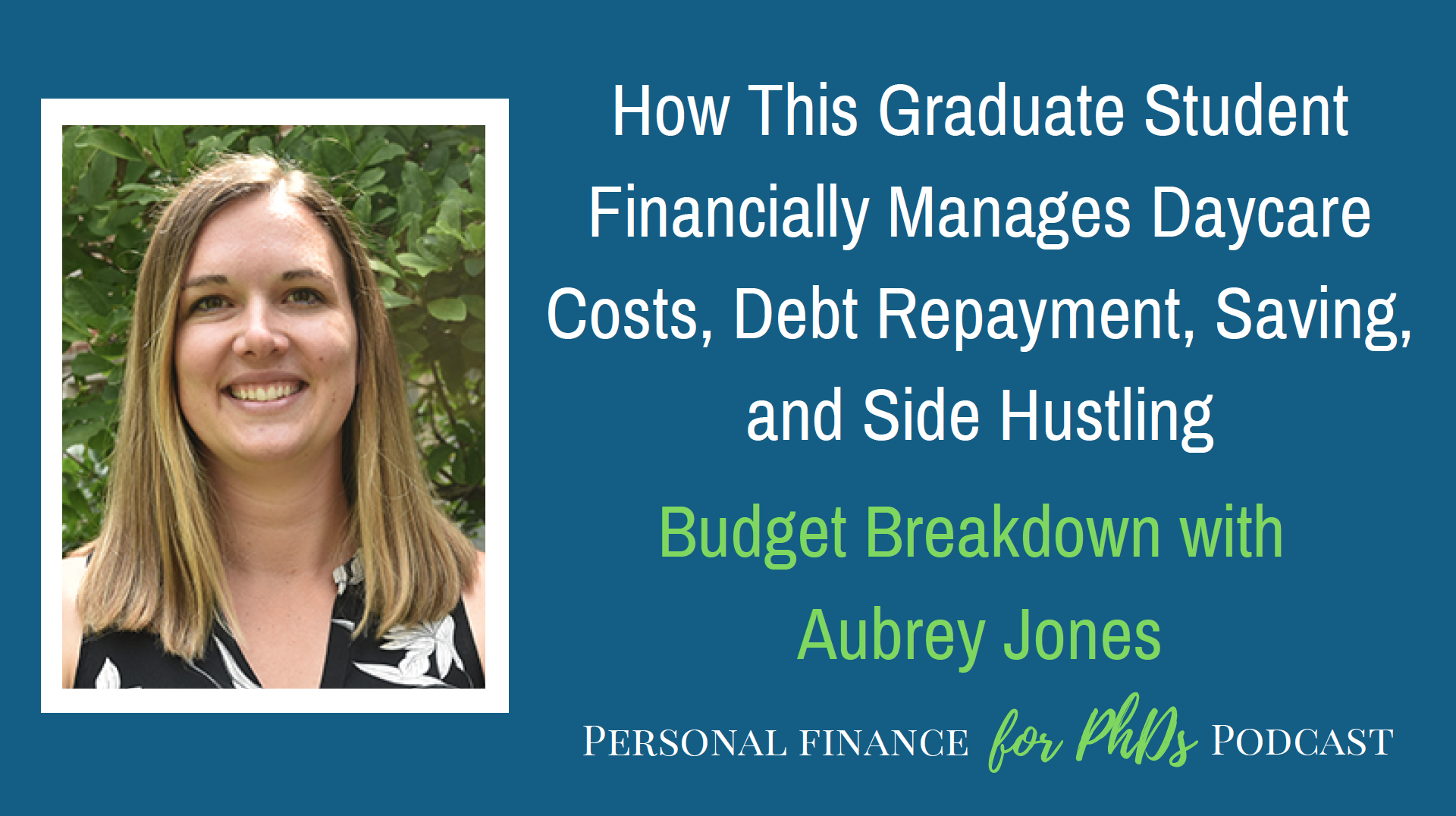
How This Graduate Student Financially Manages Daycare Costs, Debt Repayment, Saving, and Side Hustling

December 16, 2019 by Meryem Ok

In this episode, Emily interviews Aubrey Jones, a PhD candidate in social work who lives in Tennessee. Aubrey is married and has a 3-year-old and a 1-year-old, which means childcare is their household’s largest expense. They discuss how Aubrey’s family found a great deal on their housing and how to minimize food waste with littles. Aubrey and her husband both have variable incomes, which play into their savings and debt repayment strategy; Aubrey’s main side hustle is a very popular and accessible one for graduate students. Aubrey and her husband have set their debt repayment and savings goals so that they can buy a home about a year after moving for Aubrey’s first post-PhD job.

Links Mentioned in the Episode

  • VIPKid Website
  • Qkids Website
  • Personal Finance for PhDs: Personal Finance Coaching Sign-Up
  • Personal Finance for PhDs: The Wealthy PhDs Group Program Sign-Up
  • Personal Finance for PhDs: Podcast Hub
  • Personal Finance for PhDs: Subscribe to Mailing List

grad student daycare cost

Teaser

00:00 Aubrey: You’ll find the money for things that you prioritize, and I think that’s so true. In the past, we didn’t necessarily prioritize our savings, and so it was hard to find money for that. And now suddenly, we’re prioritizing it and prioritizing extra payments, and it’s because we figured out where we can cut and what we don’t need to do.

Intro

00:26 Emily: Welcome to the Personal Finance for PhDs podcast, a higher education in personal finance. I’m your host, Dr. Emily Roberts. This is season four, episode 18, and today my guest for this budget breakdown episode is Aubrey Jones, a PhD candidate in social work who lives in Tennessee. Aubrey is married and has two small children, which means childcare is their household’s largest expense. We discuss how their family found a great deal on their housing and how to minimize food waste with littles. Aubrey and her husband both have variable incomes which play into their savings and debt repayment strategy, and Aubrey’s main side hustle is a very popular and accessible one for graduate students. Aubrey and her husband have set their debt repayment and savings goals so they can buy a home about a year after moving for Aubrey’s first post-PhD job. Don’t miss Aubrey’s spot-on financial advice at the end of the episode. Without further ado, here’s my interview with Aubrey Jones.

Will You Please Introduce Yourself Further?

01:25 Emily: I am delighted to welcome to the podcast today Aubrey Jones who is going to be doing a budget breakdown episode for us and she’s got some really interesting elements in here. So, I’m really looking forward to this conversation. Aubrey, will you please introduce yourself, your career, and your family?

01:43 Aubrey: Sure. So, My name’s Aubrey Jones, and I have a husband, Josh. And then we have two little kids. We’ve got a three-year-old and a one-year-old, Madison and Simon. And basically, I started the PhD program with a seven-month-old, and when I finished my PhD program, I will have a four-year-old and a two-year-old. And I am getting my PhD in hopes to become a research professor, hopefully in R1, in the near future.

02:17 Emily: And what is your field?

02:18 Aubrey: My field is social work.

02:22 Emily: It sounded like you’re about a year away from finishing, hopefully?

02:27 Aubrey: Yes, I am a year away from finishing. I was able to take an extra year because I was awarded an extra GRA position for the fourth year. So, I was able to do that, which was nice.

Aubrey’s Household Income

02:41 Emily: All right, well we are actually in a very similar spot. My two children are the same ages, roughly, as your two. So, I’m sure many of your expenses will sound very similar to me. So, please tell me about your household income, your income as a doctoral student, and other sources of income in your household.

02:58 Aubrey: Sure. So, as a doctoral student, I received a stipend throughout my entire program, and it’s fluctuated from year to year, but it’s on average about $15,000 a year. And then it’s covered my health insurance also. And then my husband works in a job in which sometimes he will get additional money. So he’s a recruiter and he works on a draw system, and once he’s caught up, then any additional money that he gets goes straight to him. So, our household income fluctuates as well. So, usually anywhere from about $55,000 on the low end to $75,000 on the high end is where we fluctuate. And then, I recently just started teaching with VIPKid. I had been hearing about it, I have friends who’ve done it, and I finally jumped in to do it just to supplement some costs in our household because the hours are so flexible. And then as a doctoral student, I’ve also just picked up other side work with professors who had funding and were able to pay me to do stuff like that during the summer or in addition to get the extra experience and also the extra income.

04:18 Emily: So, the $15K stipend that you mentioned, is that just during the academic year or is that 12 months?

04:26 Aubrey: It is 12 months. So, you’re required to do about 10 hours of graduate research assistantship work, and then they break it out throughout the year as your payments.

04:40 Emily: Okay. So the additional work you’ve taken on within your academic role or to the side of it–you said during the summer, but that’s not because you’re not being paid during the summer–it’s just because you have some different time allocations or something?

04:52 Aubrey: Yes, correct.

Side Hustle: What is VIPKid?

04:54 Emily: Gotcha. So, I want to hear a little bit more about VIPKid because, similarly to you, I have been hearing that name a lot and I don’t know how new it is, but it feels new to me. So, can you say–maybe for someone else who’s interested in this kind of side hustle–what you’re doing exactly and what kind of the advantages are that you see?

05:13 Aubrey: Sure. So, I really love it. I actually just started this month, and there’s a fluctuation in pay. It ranges from $14 an hour to, I believe, $22 an hour. And the way that they do it is you teach a 25-minute class to kids in China and you’re teaching them English. So, you don’t have to know any Chinese. You just have to take some TESOL certificates that the company actually offers you for free and go through some mock interviews so they can see that you’re using props in your classroom that you’re using, it’s shortened TPR [Total Physical Response], but basically they want to see lots of hand gestures and pointing at your mouth and telling the kids, you know, listen. So, the 25-minute class is what you teach, and they pay you by 25 minutes. So, most people start out at about $8 per 25-minute class.

06:25 Aubrey: And then, assuming you get another class, that’s where it turns into that hourly pay of $14 to $22. But essentially you teach a 25-minute class, you get half of that $14 to $22 an hour. And you open up the schedule and you choose when you’re available. So, they tell you what the peak times are and you’re running on Beijing time. So, for people who are in Eastern Standard Time, I almost think that they’ve got it the best because the peak times are between 7:00 AM and 9:00 AM and then in the evenings on Friday and Saturdays from about 8:00 PM to 11:00 PM. You can teach all through the night, and I know some people do. I do not. So, I teach in the mornings from about 6:00 to 7:00 AM. Mostly because my kids are still sleeping, and sometimes I get the full time booked. Sometimes I don’t.

07:26 Aubrey: So, like I said, this is my first month doing it and I’ve made–well it’s not even the whole month yet. So just in the month of July, I’ll make about at least a hundred dollars, assuming I get no others classes booked.

VIPKid: Teaching English to Kids in China

07:40 Emily: I was a little bit confused about this. So, you said that you’re teaching in English. Are you teaching English or what is the subject matter that you’re teaching?

07:50 Aubrey: Yeah. So, the goal of VIPKid, the reason that parents in China sign their kids up for it is to help their kids learn how to be more comfortable talking to native English speakers. So, you are teaching English, but the whole class is also in English. And so, by proxy, you’re having a conversation in English, you’re trying to teach them certain things in English, and so you might be teaching them different vocabulary words that day.

08:18 Aubrey: So, this week I was teaching a kid “stamp,” so I had an envelope and I had some stamps and we talked about the word stamp and you say “stamp” and you make them repeat it twice so that they’re learning the word and then they’re learning in context. I teach primarily older kids who are already fluent in English. So, it’s more of making them comfortable having that conversation as opposed to teaching them new things. Now, some people teach younger kids–like three, four years old. So, they really are teaching them English words and what that means. And so, they might say “happy, sad” and have them repeat it back. So, it just depends. But VIPKid already has the lessons prepared for you. So, you go through it with the student and the older kids read most of it. The goal is to have them talking about 75% of the time.

09:14 Emily: Gotcha. And I think I’m picking up that this is a one-on-one interaction?

VIPKid versus Qkids

09:18 Aubrey: It is a one-on-one interaction. Yes. And there’s another company called Qkids which is similar, and they do anywhere from one to four kids in the classroom. And they actually schedule for you. Whereas VIPKid, the parents choose you as a teacher. So, it’s a lot more competitive to make a savvy profile that parents want to choose you.

09:44 Emily: I see. Well yeah, I can definitely see why this is an attractive, exploding side hustle. At any rate, as of July, 2019. So, thanks for telling us about your experience with that. Do you like doing this so far? Do you imagine continuing? And how many hours are you devoting to it per week?

10:04 Aubrey: Okay. Yeah, so I do, I really like it. It’s a lot of fun. It’s different than anything I’ve done in the past, and I will definitely keep doing it for the foreseeable future. Right now, the summer months are kind of slow so I’ve been able to just open up more slots knowing that I wasn’t going to see as many kids. But in the future, primarily in the fall, I will be finishing my dissertation so I won’t be devoting nearly as much time to it. But after I’m done dissertating, probably five to 10 hours a week.

10:41 Emily: I’m really glad that you brought this up because I can see how, for someone who wants a side hustle, this is a really, really accessible one. It sounds like you’re able to get started pretty fast too.

10:52 Aubrey: Yeah, it took me about two weeks to go through the whole process.

10:57 Emily: Yeah. Excellent. Okay, so let’s dive into the budget breakdown, right? So, we’re going to talk through your top five expenses. And I don’t remember if you mentioned, but where do you live?

11:09 Aubrey: We live in Tennessee.

Budget Breakdown: Top Expense = Daycare

11:11 Emily: Okay, great. So, top expense.

11:15 Aubrey: Our top expense is daycare.

11:18 Emily: Ah, new and different because usually this is rent, but I am not surprised that daycare is at the top of your list with two children. So, how much are you spending?

11:27 Aubrey: Yes. So, daycare is about $1,000 a month for both kids to be in daycare full-time. And so, our youngest kid was not in daycare the whole time. He actually just started going to daycare more recently. And that’s because, as a graduate student, I was really lucky to have such a flexible schedule where he could essentially just home with me. I wasn’t taking classes, I was working on my dissertation, and when I had to work on my dissertation or do extra work for my GRA position, I was able to do so in the evenings or on the weekends when my husband was home. But now that I’m in the final stretch of my dissertation, I need the distractions out of the house so that I can work all the time. So again, that’s new. When it was just our daughter, it was closer to like $600 a month, I want to say, for her. So, obviously not greater than our rent at that point.

12:27 Emily: Yeah. I’ve had a similar approach. I am the primary caregiver for our children and so we mix in childcare maybe as needed and it kind of fluctuates. It really changes a lot with how old your children are and kind of what type of kids they are. Whether or not they give you time that you can be doing other things or whether they require a lot of hands-on attention, and that changes with age. So yeah, I definitely feel you on what you were trying to do in the past and also your decision to put them both in daycare full-time now. Is there anything else, any other comments you want to make on that daycare expense?

13:05 Aubrey: So another way that we reduced the cost of daycare too was our daughter was in daycare full-time when we first started, and I was a full-time student. And then once my classes started slowing down and they were online, I was able to transition her to a “Mother’s Day Out” program, which is just a part-time daycare, essentially. And so that drastically reduced our cost. It was like $80 a week to have her in that three days a week and they fed her and everything. So that was great. And then in the summers we’re able to take them both out and just pay about half the cost to keep their spots if we need to or if we want to so they can go part-time and full-time in the summer for a reduced rate, essentially.

Does Your University Aid with Childcare Expenses?

13:58 Emily: And does your university help at all with childcare expenses?

14:03 Aubrey: They do not. I will say that my professors and department have been incredibly supportive of me having kids and just understanding that. There was one time I had to bring my daughter to class with me because there was like a nasty flu outbreak happening at her school and I wasn’t about to let her get it, let alone really let myself get it. So, one of my professors let me bring her, and I was so thankful. And she just hung out and loved it. So they’re like emotionally supportive of that. But financially, no.

14:44 Emily: Yeah. They help you to a degree, but not as much as maybe we would like. Okay. Number one expense: childcare. What’s that second expense?

Budget Breakdown: 2nd Expense = Rent

14:55 Aubrey: Rent. So, we pay just a little over $907 a month, so I rounded it up to $908. And we actually pay below market value for where we live. We have a two-bedroom condo, we’ve got a garage, we’ve got a backyard, two bath. And I think our neighbors rent for about $1200 a month. When we first moved here, we actually only paid $875 a month and we were living across the street. And then our landlords decided to sell. And so we already knew the neighborhood. We really loved the neighborhood. This might sound silly, but we knew our mailman and to us, that was just so great. Like, we really know this place. And we had some friends who lived across the street and they happened to be moving out and going somewhere else. And we told them, “Hey, our landlords are selling, can we rent from you because we know you’re not ready to sell yet?” And they said, “Yeah, sure you can just cover our mortgage and our HOA fees.” And so that’s how it bumped up to $908, but still below market value for this area. So we’ve been really fortunate in that.

16:17 Emily: That is an amazing deal. I have to say, not the best financial decision for them, but really great for you.

16:27 Aubrey: Yeah.

16:28 Emily: Yeah. And of course, you know, I actually talked about this with another episode I did in season three. I interviewed a landlord who was renting to people he knew from his program. You know, they were his roommates at first. Then when he moved out it was people he had known from that graduate program, and he just talked about what like peace of mind it gave him to know his tenants and trust them. And so, yeah. Maybe they’re giving you a good deal on this rent, but they probably also have a lot less stress.

16:58 Aubrey: Yeah, absolutely. Yeah. And some of it too, like we do have to take care of some things on our own just because they weren’t really prepared to be landlords. So, like we have to pay to have someone come out and fix our dishwasher, which isn’t a big deal to us, but there are just a couple of trade-offs to it. But again, it’s better than having to go out and move all of our stuff and pay. I mean, that would be a large amount of money to increase that we just weren’t prepared for or ready for.

17:34 Emily: Yeah. Well, yeah, it sounds like a really good situation that you’re in. And I guess the tip that may be applicable to other people is get to know some homeowners who are ahead of you. Yeah. I actually also rented a private residence from a former graduate student who was then in a postdoc somewhere else when I was in graduate school, I did not know her personally so I don’t think we got any rental discount, but yeah, you know it happens. People buy, and then they move on.

Commercial

18:03 Emily: Emily here for a brief interlude. As a listener of this podcast, every week you hear strategies that another PhD has used to improve their financial picture. But listening and learning does not automatically translate into action in your own financial life. If you are ready to change how you think about and handle your money but need some help getting started, I can be of service. There are two main ways you can work with me to create and implement a financial plan tailored for you. First, I offer one-on-one financial coaching, either as a single session or a series as you make changes over the longterm. You can find out more at pfforphds.com/coaching. Second, I offer a group program called The Wealthy PhD that is part-coaching, part-course, and part-community. You can find out more and join the waitlist for the next time I open the program at pfforphds.com/wealthyPhD. I believe it’s possible to succeed with your finances at every stage of PhD training and throughout your career. Let’s figure out together how to make that happen for you. Now, back to the interview.

Budget Breakdown: 3rd Expense = Food

19:18 Emily: Okay. So, really good deal on rent. Excellent job on that. What’s that third expense?

19:23 Aubrey: This would be food. So, we are not super great at keeping our food costs down. That ranges anywhere from $800 to $1,000 dollars a month right now. And $1,000 is pretty rare. But, I was going through prepping for this and I felt like, “Well, let’s be honest, we’ve hit $1,000 before.” So, it doesn’t normally happen. We keep it closer to $800, and we’re pretty strict on that. So, we are feeding two kids. Our one-year-old, I swear, is just a garbage disposal. He just consumes everything and anything right now. And I was nursing him for about eight months, and then his appetite exploded. So, we switched him over to formula. So, we’re weaning off formula. So, that should start decreasing.

20:22 Aubrey: And then it also has a lot of our household stuff too, like diapers and pull-ups. We potty trained our oldest before our second was born because there was no way we were paying for two kids in diapers, and that was the best thing we ever did. She took to it really easily. I’m a little nervous the second time around that it may not go quite as well. And then we keep tons and tons of fresh produce in the house. But other ways that I do try to reduce the cost, things that we’ve been thinking about a lot more lately, especially once we started keeping track of our expenses, is food waste. And so that always seemed to really obvious to me. I would hear people talk about that and I would think, well, I don’t waste food. What are you talking about?

Strategies to Avoid Food Waste with Littles

21:09 Aubrey: And now I’m so much more cognizant of it. And my three-year-old will take two bites of something and say, “I’m done.” And in the past I used to think, “Okay, whatever.” And I would just toss it. And now, “What are you doing?” So, I just put it in the fridge and when she gets hungry later I put it back out on the table and say, “You can finish this if you’re that hungry.” And most of the time she doesn’t want to finish it because she’s not actually hungry. She’s just fishing around to see what I’ll give her. And then we’re really big on right now food exposure and trying to make sure that they’re constantly being exposed to vegetables. So, I’ve been buying a lot of frozen vegetables, which is really helping, so I’m not wasting the fresh vegetables. But I’m still able to make sure that they’re at least, even if they’re not eating it, they’re seeing it on their plate. So, that’s how we’ve decreased it. We don’t eat out. We cook almost all of our meals at home. My husband gets to eat out a little more for work. But yeah, I don’t see it going down much more, to be honest.

22:23 Emily: Yeah. I have to say, there’s again a lot of similarities in spending patterns between the two of us in this area because our one-year-old is also like eating everything in sight right now. She’s going through some kind of crazy growth spurt, which is actually great because that means that food that other people don’t want to finish, we can give to her, and she’ll finish it. So, that’s working out well. I also do the same thing. If my three-year-old doesn’t finish something, I may pack it back into the fridge because, like you, when it was just me and my husband, I was like, “Yeah, we don’t really waste that much food. Like we’re pretty on top of food consumption. But then you have a child who throws food on the floor, and like there’s a lot more waste that happens. So, we try to reduce it where we’re able to.

23:05 Aubrey: Yes, exactly.

23:05 Emily: And yeah, same thing about formula, which I hope is not a forever expense for us, but it’s pretty expensive in the meantime. So, yeah. Thank you for that insight. Oh, and the diaper situation. Yes. We also potty trained before our second was born so that we would not have two in diapers at the same time. Although we cloth diaper. So, for us it was more about not having to buy more cloth diapers to add to the stash. Right? Which is kind of the most expensive part of that whole process. So, yeah. All right. Thank you for your insight into that category. So what is your fourth largest expense?

Budget Breakdown: 4th Expense = Car Debt

23:39 Aubrey: So, that would be my husband’s car payment, which is $300 a month. And then we usually throw extra money at that. And that is one of the fewer pieces of debt that we have. And we plan to have that paid off by the end of the year, actually. Because he does do recruiting and he sometimes gets those bonus paychecks, we have just been able to throw that at debt. So, like last month we were able to throw an extra $1,000 at his car that wasn’t in the budget. So, that is always really nice. But we actually just had to get him a car because he had a 2000 Subaru and it finally just died while he was driving one day with our three-year-old. And so, it was time for him to get a car.

24:33 Emily: So, you’ve really taken that drive-it-into-the-ground advice to heart. You know, mostly when I talk to people about cars or I think about cars, it’s like we think about that long period, the almost two-decade period when you’re driving that single car. I don’t know when he bought it exactly, but the many years. And people are a little nervous about the endpoint. So, can you talk to me about when it broke down with your three-year-old in the car and how you handled that? It seems that it was okay, right?

24:59 Aubrey: It was a traumatizing week for her because my car, which is actually only three years old, broke down two days before, and she was in the car and we had to call my classmate to come pick us up. And then she was driving with dad and they were actually stopping to get her a treat because she had been such a good big sister. So, they stopped at Starbucks and they were in the drive-through and it just died in the drive-through line. And he had to push it. And so, twice in one week, this poor kid was in a car that broke down. So, that was a little traumatic. And she still talks about it. And this was three months ago, maybe. So, he had to get out and just push it by himself. And she did this cute little reenactment of him doing it. And I had to come pick them up, so I had to get the baby woken up from his nap and then go get them. And his car sat at Starbucks for three days until we could get a tow truck out there. And our insurance luckily covers the tow truck expenses. And so, he tried to put it on Facebook Marketplace to see if anyone was good at fixing cars or needed parts, and he didn’t get any bites. And so finally he just went to I think like an impound lot or something. But yeah, we had one car for like a month, so I was driving him to work and that’s across town. And so we had to really navigate our schedules. And then I tried to convince him to just have one car because we were making it work, but he wasn’t going for it. So, that’s how we ended up with a car payment.

26:51 Emily: Yeah, thanks for that story because we are also currently driving a car into the ground. And I do think about when that final end-point is going to be and what exactly is going to happen. But usually it’s okay. It’s a little difficult in the short-term, but it’s kind of worth it, right? To keep a car for a long time.

27:09 Aubrey: Absolutely.

27:10 Emily: So, what is the fifth expense on your list?

Budget Breakdown: 5th Expense = Husband’s Student Loan

27:12 Aubrey: That fifth one is my husband’s student loan. And that is $219 a month. And that should hopefully be paid off by the end of the year also.

27:22 Emily: Yeah. Let’s talk about that next and sort of under the category of financial goals. So, you’ve mentioned two types of debt so far. And so, what is your strategy with repaying debt?

27:35 Aubrey: Yes. So, the car and his student loan and my student loans are the only debt that we have. And so, right now, his student loan is bigger than his car payment. So, the car is our first thing that we’re trying to prioritize. So, any of the VIPKid money that I get is going to the car. Basically, we’re doing that snowball [method].

28:00 Emily: Yeah, I think it’s that snowball method. I was just going to say, you live in Tennessee, so this is Dave Country. [Do you follow Dave Ramsey?]

28:07 Aubrey: It is Dave Country. I don’t, but I do follow a lot of debt-free, financial independence people who have done Dave Ramsey. So, that’s where I’ve picked up some of our ideas and stuff. So, we’re really just attacking that car payment, putting anything extra that he gets to it. We’ve got a lot of financial goals, and this is why we’re not exactly Dave Ramsey because we’re also trying to save for a house at the same time. And so, our goal is to be debt-free from car payments and his student loans by the time we’re ready to purchase a house. And then my student loans are just kind of this whole other thing that right now we’re just unfortunately avoiding because I’m still in school. And we’ve limited using any student loans while I’ve been in my program except for one year when the baby was born and we just wanted to have that extra cushion just in case we knew that he would probably go to daycare. And we just weren’t sure, because my husband’s income fluctuates so much, if we’d be able to afford it every month or not.

29:18 Aubrey: So, the months that he gets a bonus check, we pay daycare out-of-pocket. And we pay most of daycare out-of-pocket and then supplement with those student loans. And then everything else goes to debt that’s not covering daycare. And then like I said, the VIPKid or any babysitting that I do or like I adjunct sometimes also, so that money goes straight to the car. So yeah, that’s our goal. Again, we think we’ll have that tackled by the end of this year just with where his business is at.

Importance of Prioritizing Your Financial Goals

29:52 Emily: I really love the strategy that you’re using. And I’ll make it explicit again. So, you’ve decided what your priorities are–car, husband student loan, your student loan–and you’re making whatever minimum payments are necessary on those and throwing all your money that you come up within a given month to that top-priority debt. That includes side hustle money. And this is very “Dave” like to have this clear prioritization and to throw everything you can at your top priority. And the reason that it works really well–and then I’m really glad you’re using this–is because it does keep you motivated to earn extra money in whatever ways you can fit into your schedule. As opposed to just like, “Oh, I think I should be side hustling in general. My budget could use some more padding.”

30:43 Emily: It’s much better to tie it to a specific goal. In your case, it’s debt repayment. And so, it really keeps your motivation high for pushing yourself because it is hard to be a parent and be in a PhD program and have the work associated with that. So, you’re doing a lot obviously, but it’s clear that you know exactly why, right? And you know, it’s a limited-term thing. As Dave says, “Live like no one else. So later you can live like no one else.” Which means, live like no one else right now. You’re hustling. You’re throwing everything you can at the debt. And then later, living like no one else is when you are wealthy and comfortable and the picture is rosy. So, it’s like a short-term period of sacrifice to really turbocharge and get ahead. I wanted to ask about your house downpayment goal. So, am I right in assuming that you guys will be moving wherever you get a job?

31:37 Aubrey: Yes, we will be moving wherever I get a job. So, our goal is to hopefully purchase a house about a year after. Just so we can get a feel for that area first before just showing up and buying a house and then realizing we chose the worst area to be. So, we do have money in our budget dedicated to savings. Which was something that we hadn’t always done. We used to kind of just, “Oh, okay, we have $10 left over this month, let’s put that in savings.” Where now we dedicate at least $200 goes to savings every month. So, that is obviously for emergencies or for this house if we can. And then, once his car and student loan get paid off, then the rest of his paychecks and stuff will start going to that down payment. And again, we hope that we’ll have probably $10,000 to $15,000 by the time we’re ready to move, is kind of our goal.

32:38 Emily: Yeah, that sounds really good. I think you’re really, again, on the right track by planning on renting for a year, wherever you move to. Because I totally agree. It’s really difficult to make such an important decision like where you’re going to live, especially in your case. You guys already have kids, so you know your kids are going to be in school, and like there’s just a lot of considerations there–to take that time to really get to know the area. And of course, continue to save up more money, for the down payment or whatever, before jumping into that purchase. So, final question here. What is your best financial advice for one of your peers? Maybe another parent in a graduate program?

Best Financial Advice for One of Your Peers?

33:17 Aubrey: Yeah, so I think my best advice would be to just remember why you’re doing it. Because we have tried many times to live like this and it’s always just become, “Ah, whatever we don’t want to.” And now we’re very motivated, I think, because of our children. Like we want to give them a house and like a nice life. So that’s my “why” of why we’re doing it. Why am I waking up at 5:00 AM to teach kids in Beijing English? It’s so that we can have this hopefully financial independence and teach our kids what to do with money. And then my husband has a good saying that he’s told his friends who are just starting out having kids and they’re freaking out about not being able to afford things. And he tells them, “You’ll find the money for things that you prioritize.” And I think that’s so true. In the past, we didn’t necessarily prioritize our savings and so it was hard to find money for that. And now suddenly we’re prioritizing it, and we’re prioritizing extra payments. And it’s because we figured out where we can cut and what we don’t need to do.

34:35 Emily: I think you are so exactly right with those comments, and they’re so insightful. I totally agree that you have to establish the “why” for why you care about personal finance at all, why you should care about your own finances. And then, once you know the “why,” that tells you your priorities, right? Top, second, et cetera. So like, it does make it so much easier when you know clearly what your motivation is, I think. Yeah. You and your husband–I think you guys are doing great. Really. Like, yeah, it sounds really good. I mean, I’m so glad you’re on a clear plan and there’s like a timeline on it, and yeah. It seems like it’ll all coalesce within the next one to two years with, you know. Hopefully, you’ll have the job you want and be in an okay place to live. Not much choice on that necessarily, but hopefully you’ll enjoy it, and the debt will be done, and you’ll be taking out a mortgage, and that’ll be a whole other ball game, and yeah. Sounds delightful, actually.

35:29 Aubrey: Yeah. And I will say, we’re very fortunate with his job that allows him to get bonuses and stuff that lets us pay things off, which is why it’s kind of variable and all over the place. But it wouldn’t be possible without his job, so we’re super thankful for that.

35:48 Emily: Yeah, of course. Well, best of luck to you and your family. And thank you so much for joining me today.

35:54 Aubrey: Yeah, thank you for having me.

Outtro

35:56 Emily: Listeners, thank you for joining me for this episode. Pfforphds.com/podcast is the hub for the Personal Finance for PhDs podcast. There, you can find links to all the episode show notes and a form to volunteer to be interviewed. I’d love for you to check it out and get more involved. If you’ve been enjoying the podcast, here are four ways you can help it grow. One, subscribe to the podcast and rate and review it on Apple podcast, Stitcher, or whatever platform you use. Two, share an episode you found particularly valuable on social media or with your PhD peers. Three, recommend me as a speaker to your university or association. My seminars cover the personal finance topics PhDs are most interested in like investing, debt repayment, and taxes. Four, subscribe to my mailing list at pfforphds.com/subscribe. Through that list, you’ll keep up with all the new content and special opportunities for Personal Finance for PhDs. See you in the next episode! And remember, you don’t have to have a PhD to succeed with personal finance, but it helps. The music is Stages of Awakening by Podington Bear from the free music archive and is shared under CC by NC. Podcast editing and show notes creation by Meryem Ok.

This Higher Ed Career Coach Worked Her Way Out of Financial Ruin Caused by the Great Recession

November 4, 2019 by Meryem Ok

In this episode, Emily interviews Beth Moser, a certified career coach specializing in higher education clients pursuing career change. Beth was All But Dissertation and pregnant with her first child when the Great Recession hit Phoenix and she was laid off from her museum job, so she and her husband lived on his graduate student stipend and the money she earned from odd jobs. Their home also lost enough value so as to go underwater, which tied them to Phoenix long-term while the value recovered. These events brought them to “financial ruin,” and they spent the next several years digging themselves out of that hole. Beth and her husband pursued several strategies to improve their finances over the coming years, including a career change for Beth, slashing household expenses, better financial management, and working with a financial advisor. Beth concludes with excellent money mindset advice for younger PhD trainees. You can find Beth at Academics at Work.

Links Mentioned in the Episode

  • Personal Finance for PhDs: Personal Finance Coaching Sign-Up
  • Personal Finance for PhDs: The Wealthy PhDs Group Program Sign-Up
  • Solve Your Irregular Expenses Problem with Targeted Savings Accounts
  • How Finances During Grad School Affected This PhD’s Career Path
  • Beth Moser’s Website: Academics at Work
  • Personal Finance for PhDs: Podcast Hub
  • Personal Finance for PhDs: Subscribe to Mailing List

grad student recession

Teaser

00:00 Beth: I don’t have a dime to save. What are you talking about? There’s no point. And now I’m like, now having seen the power of stashing away $5 here, $10 there over time. I’m like, huh, what actually could I have saved? What might have been?

Introduction

00:23 Emily: Welcome to the Personal Finance for PhDs podcast, a higher education in personal finance. I’m your host, Dr. Emily Roberts. This is season four, episode 12, and today my guest is Beth Moser, a certified career coach and the founder of Academics at Work. Beth was ABD (all but dissertation), married to another grad student, and pregnant with their first child when the great recession hit Phoenix. She was laid off from her museum job at the same time their house went underwater, which brought them to what she calls “financial ruin.” Beth and her husband lived on his graduate student stipend and the money she earned from odd jobs while she reevaluated and eventually changed her career objectives. To climb out of that hole, they slashed their household expenses, implemented basic and advanced budgeting techniques, and worked with a financial advisor. Listen through the end of the episode to hear Beth’s excellent advice for PhD trainees regarding money mindset. Without further ado, here’s my interview with Beth Moser.

Will You Please Introduce Yourself Further?

01:26 Emily: I have joining me on the podcast today Beth Moser who has, well, quite a story for us, quite a financial story from her own personal life relating to her family and pursuing a PhD and having children and the great recession. So I’m really excited to dive into this story. Beth, would you please introduce yourself to us a little bit further? Tell us about your family and your career to date.

01:51 Beth: Sure. Thank you so much for having me, Emily. So my name is Beth Moser. I’m a certified career coach and I specialize in coaching higher ed clients who need career change. As part of that, I am a training manager who does professional development workshops for graduate colleges, for graduate students, postdocs and faculty on why they need to be incorporating this into their own lives and into their curricula. So I work in higher ed as well. I am married, I have a spouse who is an academic, and I have two children. But when this financial journey that we’re going to be talking about today started, I didn’t have children. So that was some time ago. And I live here in Tempe, Arizona.

What Led to Your “Financial Ruin”?

02:48 Emily: Yeah. Excellent. So let’s go back because what we’re going to be talking through here is kind of a perfect storm of events that brought you to–what you described to me when we talked for this episode–you described this to me as “financial ruin.” A sequence of events that brought you and your husband and your family to financial ruin in the midst of, you know, pursuing degrees and so forth. So, let’s find out what that was. What was the sequence of events here?

03:20 Beth: Sure. Yes, so some of this is unique to us and our circumstances and the timing. And some of it I think a lot of your listeners and readers can relate to. So, I went to get my PhD to go into what’s called an alternative academic or “alt-ac” career. I went to get my PhD so I could get a job in museums. And so, when I came out of working through my coursework and was in the midst of my dissertation, I landed a full-time job in the museum’s field, which was my ultimate goal. As you might surmise, it’s not a very well-paying field. Museums are of course, nonprofits. And so, when I started my first full-time job in 2006, I was making about $36,000 a year with no benefits. So, when I went to work full-time, my husband and I switched off.

04:25 Beth: He had wanted to get his PhD as well. So, since I had landed a full-time job and my career, he quit his full-time job to go start his PhD program. So, he got a stipend of making about $12,000 a year. So, total, I mean, for the two of us, for a single couple in their thirties, we were making about $48,000 a year in the Phoenix metropolitan area. So, not great, but not horrible either, especially when you’re considering we didn’t have children at that time when we moved here. For his PhD program, we bought a home because we thought, you know, well we can and that will keep our costs lower than rent. And so, we were fortunate in that respect, at least at the start. So, for the first three years of my full time career, I was not making more than about $36,000 a year.

05:26 Beth: But within three years with position increases and promotions, I eventually was making $50,000 a year plus benefits. I finally was making benefits, but that’s the first time. In my mid-thirties was the first time I started getting any employer retirement plan of any sort, including any employer match of any kind. So, I got started on saving for retirement relatively late into my career. Okay. So, in the midst of that I finally got pregnant. We had wanted to have children. I was three months pregnant when the recession had started hitting and I got laid off from the museum that I was working on. At that time, we spent four months surviving only on my husband’s graduate school stipend and me taking odd jobs here and there. You know, babysitting, working an office job for people for, you know, 12 bucks an hour, but nothing steady.

Aftereffects of the Great Recession in Pheonix, AZ

06:31 Beth: And then, when I was seven months pregnant, I finally landed a full-time benefits-eligible permanent job at a higher ed institution. But I only had two months of paychecks there before I gave birth and then had eight weeks of unpaid leave. So, during that summer in 2011, you know, we had already had three months of me not having an income. Of us surviving on my husband’s pretty paltry stipend, and then having the enormous cost of diapers and you know, cribs and strollers and car seats and all of that with no income on my part. So, in the midst of all of that, our lives were changing financially. They were changing personally. They were changing in ways big and small. In ways that were amazing and incredible, but also incredibly challenging as you can imagine. So, what finally led to what I call financial ruin is the aftereffects of the recession hit particularly hard here in the Phoenix area, and the home that we were living in lost over 50% of its value.

07:48 Beth: So we could not consider moving to downsize our living expenses because we were what’s called “underwater.” That meant that our home was worth far more than what we owed on it. And we did not qualify for state or federal programs to offset that or alleviate that to get out from under that because we were, and this is a great irony, too far underwater to qualify for that program to help us. So we found ourselves, you know, in the first year of our first child’s life, really relying on credit cards, unfortunately, relying on piecing together unemployment in odd jobs for several months, falling behind on monthly bills, and then finally starting to catch up once I was back at work full-time after parental leave. But it was really, really difficult to climb out of that over the next several years. So, that’s what I wanted to talk with you about today.

08:56 Emily: Yeah. Beth, thank you so much for that introduction. Oh man, it’s taken me back. I didn’t personally experience hardship during the great recession, but it’s taken me back to all the media coverage and everything because I was very involved in the personal finance, you know, sphere at that time. Just a terrible situation that so many people were in. You were not alone in being so far underwater, especially in your particular area. And wow, I’m really glad to have the opportunity to talk with you to get the second half that story. Right? Because we know that so many families were hit so hard by the recession. And of course with you personally, it ended up coinciding with, as you said, a wonderful time of life but also a particularly challenging time of life, especially financially challenging that is having your first child. So, I’m really glad to hear how you ended up climbing out of that because I think that’s the part of the story that we don’t hear so much. And especially how, you know, you did that as a person who was in higher ed, is working in higher ed and also your husband still pursuing his PhD at the time that we’re, you know, picking this up. Is that right?

09:57 Beth: Yes.

Strategies for Financial Recovery

09:58 Emily: Yeah. So, thank you so much for sharing that with us. So, okay. The strategies that you were using to climb out of the financial ruin and it’s taken, what, we’re going on eight years, it sounds like? Since this point you identify as like the low point?

10:12 Beth: Right.

Recovery Strategy #1/4: Increasing Income

10:13 Emily: So, it’s been quite a while. You’ve probably tried a lot of different things. So, we’re going to break down your strategies into three main categories and then kind of a catch-all. And so, the first one there is regarding increasing income. So, how did you do that? Aside from, as you just said, you landed a job. You actually weren’t out of work for too long, relatively, that’s not so bad. So, aside from that, again, a full-time job with full-time pay, what else were you two doing to increase your income?

10:41 Beth: So, when I was laid off from museums, I decided that that was the end of that career, unfortunately. I mean, that had been the goal of me going to graduate school. That had been the focus of my dissertation work. It was my passion. But when reality hits you, and especially when your life changes and your marriage becomes more of a priority or your partnership and having a family or children and other things outside of yourself that you have to consider financially, it just became really real that it was time for me to grow up, perhaps. I don’t really like to use that phrase, but to really get real with myself about what my financial needs were and what ours were in providing for, you know, a tiny child who was going to grow over the course of our lifetime. So, strategy number one was to accept and work through that difficult decision to close down one career and change directions.

Recovery Strategy #2/4: Decreasing Household Expenses

11:47 Beth: So, that helped me prioritize. I need something that pays at least a livable wage for myself and has great benefits including retirement plans and matching and of course, great health insurance in order to just, you know, close that chapter and move forward. So I targeted my job search exclusively to sectors and employers where my skills would transfer, but that was my priority. Finding employers that would pay a much better wage and that would provide those benefits. So, that was strategy number one in increasing my income: being really targeted with what sectors I was applying for and networking in and going after. The second strategy was to decrease our household expenses. Now, as I alluded to, we weren’t able to decrease our housing expenses. So, while our neighbors were scooping up the exact quality of homes at literally 50% of what we were paying for our mortgage monthly, we could not address that one. We tried to qualify for a program, a HARP program was what it was called and we didn’t. So, that was a fixed expense.

Did You Consider Taking the Foreclosure Hit?

13:11 Emily: I want to jump in there with a question because I do remember at the time a lot of people were walking away from their homes that were too far underwater, taking the foreclosure hit to their credit and just saying it’s too far gone. So you guys didn’t go that route. Did you think about it?

13:25 Beth: I did think about it and I consulted with others who had done it and people who had not done it. I decided not to do it because I held my credit score tightly at value. So I knew that we were going to come out of this someday (our financial circumstances). And I didn’t want to also have to tackle just a really horrible credit score because that can take years to repair as well.

13:52 Emily: Yeah, it sounded like it didn’t get to the point where you had to walk away. There may have been a point that it could have gone that direction, but because it sounded like you did an amazing job searching for and networking for the new job, it didn’t get to that point where it was a necessity.

14:07 Beth: Correct. Yes. And so, we sat down and we looked at what can we downsize on as far as our monthly expenses. So, we went down to sharing one vehicle. That way we didn’t have to carry insurance on the other car. We wouldn’t have gas expenses on the other car. We live within walking distance to grocery stores and coffee shops and so forth. So, we started walking to the grocery store decreasing mileage and usage of our vehicle and gas expenses. So, we would coordinate going to and from work together so that we had that only one vehicle expense. We used my husband’s vehicle because he did not have to pay for parking at his work, but I did at mine. So, he would drop me off, drive off to his job, park for free. He would come back and get me at the end of the day.

15:09 Beth: And then we really cut down on all like entertainment expenses. We got really lean and mean about it. So we dropped streaming services of all types. We didn’t even have the Netflix DVD service, which existed back in that day still. We didn’t do any movie rentals. We wouldn’t go out to movies. We cut down on eating out. And I mean, like by cut down, I mean, we did not do it. So, we got really disciplined about what expenses are necessary and which ones would be nice to have again in the future, but that we can’t afford right now. We made huge use of our libraries. We would rent DVDs and movies and streaming there all the time. But it just meant that we did not have the luxury of having, you know, just flip on the TV and whatever’s on tonight is what we’re going to be able to watch.

Decreasing Expenses while Starting a Family

16:05 Emily: How did this effort in decreasing expenses play with you having a baby for the first time? Because I think there’s an idea in our culture that babies need a lot of stuff and you have to provide a level of care for children. I don’t know. So, how were you handling applying the decreasing expenses mindset to your first baby?

16:30 Beth: So, one of the things that we did was I sat down with women friends of mine who had recently had babies and said, okay, you know, you go to the baby websites and you go to the stores and they give you this like, you know, flip book of all the things you need. Okay. What are the absolute essentials that I must have? And so for instance, people were saying, okay, yes, they’re going to tell you you need a pack and play. But really here’s my bassinet. My baby doesn’t even fit in it anymore. Use it for the first three months. And then when she needs to grow into a crib, we can go, you know, get you a crib at Target or whatever. You don’t need, you know, this, that or the other. You don’t need toys yet. She’s too little.

17:19 Beth: So it really helped me focus in on like: these are the absolute bare bones essentials that you need to have a baby. And just having, you know, that critical mindset about what we consume. Right? And I mean, if you think about it from the “this is a first-world problem” perspective. Like thinking about, okay, well families who live in tiny apartments in giant cities around the world or in smaller, more humble circumstances, they don’t need these things for their babies and their babies grow up healthy and beautiful too. So, just really being critical about the buying, what we could borrow from friends. Using secondhand stores for buying baby onesies and that sort of thing. And then luckily I was able to nurse so I didn’t have the expense of formula. I say, luckily I was able to, because there’s also this cultural presumption that, “just nurse and you’ll be fine.” But that is not always an expense that can be eliminated. I know many women who have been either physically unable to nurse or their baby can’t nurse and formula is no joke. It is really expensive. So, I do recognize that that was something we lucked out on.

18:38 Emily: Yeah. Thanks for those comments. I want to jump in here with some comments of my own as I have two children that are fairly young. So, it’s a recent thing for me. The first is, this is kind of weird, but my husband and I watched the documentary, which was available on Netflix, maybe it still is called “Babies.” It’s like a no-narration documentary just following these four babies in different countries through their first years of life. And so, it’s a really fun, funny kind of documentary. But what we took away from that is babies thrive in all kinds of different situations. Like, they’re good, they’re gonna develop, no matter if you have this, you know, doodad or this gadget or you do this thing this way or that way. You know, babies are very adaptable and, you know, robust and so it’s going to be fine.

Any Other Strategies to Decrease Expenses?

19:23 Emily: You know, no matter what you choose, it’s going to be okay. So, we enjoyed that and I’d recommend that to someone who is looking forward to becoming a parent. I really liked what you did in talking with multiple, other new mothers or recent mothers or recent parents to get their perspectives on what you actually need. I say multiple because babies are also very individual. And so, what was essential to one parent might not have been essential to another parent, might not be essential to you. And so it’s great to get an idea of from several different people. “Okay, that one person said that one thing was essential, but I didn’t hear that from, you know, so and so and so and so. So maybe I’ll hold off on that.” And I just think the idea of, as you said, like babies don’t need all the stuff from their first two years of life upon their birth. Right? You can acquire these things slowly as you determine that they actually make sense for you. So, it doesn’t have to be a buying binge like right at the beginning. So, Please continue on. Were there any other ways that you decreased your expenses during that period?

20:23 Beth: I mean that was the main thing, the main categories. We couldn’t, you know, decrease utilities or we couldn’t drop Wi-Fi. So those were the main things, like any entertainment sort of things. And then the other thing, you touched upon this earlier, are these like cultural messages that we receive as new parents. And one of the big ones especially that I see is like date night and how important it is to remain committed to your partner. Yes, that is of course important. But for the first six months of your baby’s life, you are so tired that even if someone had come and offered us date night, we would have been like, where’s the closest place where we can go take a nap? You know, so that was not something that we had any interest in spending money on anyway. But we really didn’t use a sitter. We didn’t go out for that sort of thing, honestly, for the first year at all. I mean for like birthday dinner out or something like that, we had a friend watch the baby. We would trade off and say like, “Hey, the baby’s very calm during mornings, so let’s go out and have a leisurely brunch together and bring the baby.” Right? Like you don’t have to buy into this messaging about how much children have to cost.

21:46 Emily: Yeah. Great, great point.

Commercial

21:51 Emily: Emily here for a brief interlude. As a listener of this podcast, every week you hear strategies that another PhD has used to improve their financial picture. But listening and learning does not automatically translate into action in your own financial life. If you are ready to change how you think about and handle your money but need some help getting started, I can be of service. There are two main ways you can work with me to create and implement a financial plan tailored for you. First, I offer one-on-one financial coaching, either as a single session or a series as you make changes over the longterm. You can find out more at pfforphds.com/coaching. Second, I offer a group program called The Wealthy PhD that is part-coaching, part-course, and part-community. You can find out more and join the waitlist for the next time I open the program at pfforphds/wealthyphd. I believe it’s possible to succeed with your finances at every stage of PhD training and throughout your career. Let’s figure out together how to make that happen for you. Now, back to the interview.

Recovery Strategy #3/4: Sticking to a Budget

23:06 Emily: Okay, so the third kind of category that we want to talk about is financial strategies or financial management. So what, aside from increasing income and decreasing expenses, could you do with your finances to help you through this period?

23:19 Beth: Okay. So, one of the things that we did was, and this is not going to be eye-opening to you, but it really was to us, was to finally follow the adulting advice of creating and sticking to a budget. I know how insane that sounds for people in their thirties to finally like “adult up” and sit down with an Excel spreadsheet and say okay, how much is Wi-Fi, how much is our utilities, how much is our car insurance, how much is our mortgage? But we started looking at that and sticking to it. So, that was first and foremost was getting real about these are our expenses.

24:07 Beth: Burying your head in the sand and pretending like, “Oh, you mean I have to pay my cell phone bill every month?” That’s not a viable strategy. So, actually facing the reality and the facts was another strategy that really helped us. You know, I think as academics in particular, you get a lot of messaging and a lot of training in your self-worth and therefore perhaps your, you know, financial value being wrapped up in your job title and what you tell people you do. But you cannot ignore the financial realities of what you have to provide for yourself and your family. And I don’t think there’s enough about that in graduate school for any of us. And I think for those of us who aren’t in graduate school in MBA programs or accounting or finance, like it’s just, you know, sort of back of the mind consideration. And so we finally decided to get real about that.

25:12 Emily: Yup. Classic advice, but always perennially good. And I kind of feel like, I guess I feel like some people can get away without budgeting if they make a lot of money or if they have very, very, very, very, very simple lives and simple desires. But 97% of the population I feel like would benefit from keeping a regular budget. So, it sounded like it took you a little bit longer to get there, but when the need was high enough, you did and you found it to be a useful tool.

Maintaining Your Budget for Continued Savings

25:44 Beth: Yes. And so, one of the ways we use that tool was even as we started to catch up on the backlog of expenses that we had been tacking onto credit cards out of necessity. So, we started to tackle debt. But then as my income rose over several years–because I stayed in this full-time role, I found a new career, I was doing good work, so I was getting promotions and increases over time–we maintained our budget. So, we could use that extra income not to like restore all the streaming services, and sign back up for the premium whatever, and start doing date night once a month, but to focus on getting rid of that debt and then start to tack away even tiny amounts for savings.

26:35 Emily: Yeah, you really had a large hole that you had to dig yourselves out of first before you could even consider increasing things on the lifestyle side. And again this is not, I mean, none of this was like your fault, right? Like this is all just what happened like nationally and in your housing market in particular that caused this. And I’m sure that, you know, it took so many years of sacrifice to do this and it must be frustrating that like you were kind of just generally a victim of what was going on, like more generally. So anyway, it must have been frustrating and difficult, but I really admire that you stuck at it and you stuck with it for so many years to ultimately get ahead.

The Benefits of a Financial Manager

27:14 Beth: Yeah. And so, one thing we did was we decided to add on one strategic expense and it was a huge expense to us at the time, but we met with a financial manager two times. So, I can’t quote this for sure, but I believe each session–I know each session was an hour–but I believe it was $150 an hour. And that was a huge add on for us at the time. But the knowledge and the toolkit that we came away with like has paid off in spades for years to come. So one of the things she did was she took our budget and she tried to convince us–and the first session, it was a little hard for us to hear this–that we did have spare room in our budget to start saving. And we were like, no, we really don’t.

28:10 Beth: But she actually did the math and she did some forecasting with us and she showed us that if you make your savings automatic and you start putting that away before you can even see it in your checking account so it’s not there for you to spend or consider spending, then you can honestly start to build up savings. And so she taught us about, we used a tool called Capital One 360. It’s an online bank and within that particular bank it’s free to set up an account and you can set up as many accounts as you need. So we set one up, for instance, for future child activities, like day camps during the summer or sports lessons or whatever. We set up one for travel with, I mean, we weren’t traveling at the time, but we were like, “Hey, maybe we’re going to want to take a big beach vacation, a weekend trip to San Diego one of these days.”

29:10 Beth: So we set up these little goal buckets in Capital One. And I’m telling you, like five bucks out of that paycheck and 10 bucks out of this paycheck, and what seems like a coffee here or a lunch there. Really small amounts. We were so skeptical that this strategy was going to work, but she had seen it work before and she had the expertise to back it up. So we said, we’ll give it a shot. And I have been continuously blown away by this, and I still use it to this day. So, within our first year of trying this, even with our really modest higher ed incomes–and my husband had finished his graduate school programming at that time but was on the job market, which as we know is problematic. So he was adjuncting only so we were not living large.

30:04 Beth: We were not high on the hog. We had climbed out of this debt and so forth, but we were not like, you know, going on extravagant vacations or anything like that–but in the first year we were able to save about $5,000. And then the second year, $10,000 on top of that. So, it completely blew me away that like five bucks here, 10 bucks there. Oh, I have a few extra dollars left over from grocery shopping. Okay. Tuck that away. We’re actually going to go put that in the ATM and transfer it over to the Capital One 360 funds and then we’re not going to touch those funds. They’re there for those goals. Just leave it and forget it. And they’re not making huge interest. Right? Like we are not talking about anything more than the interest rate you’d get at your bank or credit union. So, it’s not like this is some investment strategy. It’s literally just set it and forget it but don’t touch it. So that was a huge eye-opener for us.

Financial Advising Tip #1: Targeted Savings Accounts

31:08 Emily: I really love that you brought up this strategy because it’s one of my favorite ones. Especially for, you know, grad students and postdocs, people with lower cashflows, but I talk about this very, very frequently. I call it targeted savings accounts. Other people call it sinking funds. I’m not sure what term your advisor used, but it’s exactly what you described. Putting away a small savings rate with every single pay period. And then pulling the money back out when you have those, you know, a reason for it. If you want to take a trip or maybe you have car repairs or whatever the buckets are that you’ve set up. I also have seen this work in my own life and other people’s lives. And it is amazing that there’s actually a difference between saving in theory and saving in reality.

31:51 Emily: Like you might tell yourself, “I never have money, you know, I never have $5, $10 leftover at the end of the month. How could I possibly be saving anything?” Or like, “Oh yeah, I’m saving but my savings are just sitting in my checking account and oops, I actually kind of spend them from time to time without thinking about it.” It’s amazing what a difference it makes to actually sequester the money away from your general cashflow. And I really love that you particularly use Capital One 360. My husband and I currently bank with Ally, which has the same kind of structure, but I used to bank with Capital One 360 and it was totally great and you know, no big reason for the change, but I also set up targeted savings funds there. So, if anyone’s looking to implement this strategy, using an online bank like Capital One 360 or Ally is a really good choice because some of the larger brick and mortar banks might charge you fees for having accounts open or maybe they’ll charge you a fee if your balance drops below a certain amount.

32:45 Emily: And when we’re talking about these accounts, the balance might be $5. That’s all that might be in there at one point or another when you’re starting out or if you’ve just depleted it. So, it’s really important to have an account that has no minimums, and Ally and Capital One 360 both offer those kinds of accounts. So, really good tip to check those out. In particular, if you like this strategy, and I’ll link in the show notes some more writing I’ve done about this strategy. But thank you so much for describing it Beth.

Financial Advising Tip #2: Use Cash for Day-to-Day Expenses

33:09 Beth: Yeah, I mean it’s been huge for us. So, the other strategy that our financial advisor had us use was to use cash for all of our day-to-day expenses. And I’m not talking about the complicated, here’s the envelope for groceries and here’s the envelope for eating out and like figure all of that. No, just take a lump sum of cash out of each paycheck. And it sounds like a lot, like maybe it’s $400, maybe it’s $800. That, you would have to consult with somebody on, but use it for all your groceries, your cleaning supplies, your coffee shop runs, your lunches out, the beer happy hour after work, whatever it is. And the reason for that is, for whatever psychological reason, whatever behavioral economists call this, you really do think twice about that purchase when you’re using cash, much more than you would with your debit card. So, it has been incredibly powerful and honestly, I get a charge now at the end of every two-week pay cycle where I’m like, “Haha, I still have 40 bucks left over, and I’m actually going to shove that into my Capital One 360, because I actually do want to do like a trip to Denver next year and go have some amazing food and beer. And that’s going to be way more fun for me than using this 40 bucks to go out to lunch a couple of times this week.”

34:39 Emily: What I really love is with your leftover money that you saved it. You weren’t like, “Oh, leftover money. Yeah, great. I’m going to blow it. Like it’s already been accounted for.” You’re like, “No, I’m actually weighing like should I use it for this purpose in the here and now or should I use it for this purpose? Maybe it’s a longer term thing that I’m saving for.” And sounds like much of the time you said, “Nope, I have this other goal, I know exactly where this money is going to go, it’s going to give me more pleasure, more satisfaction to put it over here. Even though it’s, you know, saving in the meantime but it’s saving to spend in the short term.” So, I really love that you actually followed through on that because that’s the part that a lot of people don’t do is the last final step of actually saving the money that they have available to save.

Recovery Strategy #4/4: Research Your Resources

35:18 Beth: Yup. And the final strategy, which I’ll just touch on briefly, is it’s a lot of hard work and it’s a lot of discipline, and that can get tiring over time, but it pays off. So for instance, in 2013 when we had our second child, okay, childcare expenses are about to skyrocket. Like you wouldn’t believe. Well, okay, so let’s take the time and do a lot of research and homework and find a childcare share situation. So for that, we were able to find a place that during the academic year we had part-time childcare and we could take summers off but still hold our place for the next academic year. So that way during summers when my husband was adjuncting only online courses, he would watch the children at no childcare expense to us. So, it’s really hard to find that sort of circumstance, but you might have something equivalent in your life that it’s going be hard to find, but it’s going to be worth the effort to find.

Were There Any Other Strategies You Used?

36:23 Emily: Yeah, it just shows the creativity and the resource in terms of the time you were willing to put into researching certain things is not easy, as you said. But when you can apply those things, you can come up with financially pretty frugal solutions that still work for you. Okay. Were there any other strategies you want to get to that you were using during the period of those years?

Curate Social Media Exposure, Find Your Support System

36:47 Beth: I think a lot of it was trying as much as possible to curate what we looked at and saw. So like staying off of some social media sites where everybody’s flaunting their amazing vacations and you’re like, “Oh, I’m missing out on that.” Or you know, I started reading a blog for instance, about a woman who decided to see how much she could save by bringing her lunch to work every single day for an entire year. So just seeking out where you could that support system, whether it’s virtual or in real life, being really mindful about not going to those after-work happy hours where you know, “Okay, sure. One beer. Well, now I’m hungry, I’m also going to get an appetizer.” So really just being mindful about surrounding yourself with the support system you need to stay on track.

37:45 Emily: Yeah, and I think within an academic setting, I would imagine you can find those other people. Those frugal friends, the classmates who are living on the same kind of income that you are. I’m sure you can find other people who are living above their means in some way or another. So it’s not necessarily everyone in that setting, but you can definitely find that support system. And I did, I know during graduate school because I happened to be very open about talking about money. Other people who were open to talking about money realized that about me and we became friends around that common interest, I would say. So they exist. You might have to sniff them out, but the support systems do exist. Okay. Beth, I think we’ve gotten through the strategies you used to recover from the financial ruin on as you’ve been doing over those several years and since then. So, is there any advice that you would give your past self? You know, anything that you wish you had considered or wish you could have done differently during that time? Given that again, a lot of these forces were completely out of your control.

Final Financial Advice to Oneself

38:49 Beth: Yes. Yeah. So yes, I have two really key takeaways that I wish my younger self would have known. The first one is I wish I had had the ability to more critically consider my future financial needs when it came to choosing a career. So my initial career I was dead set on working in museums and even knowing the realities of the job market and the pay and, you know, how long it takes to get a livable wage in that industry with benefits. I still chose to do it. And it’s not that I regret that at all. It was an amazing experience. But if I could have somehow talked myself into considering like, “Hey, you probably do want to get married someday, you probably do want children. It may be that you’re going to have changes in your life that shift around your personal priorities and some of those are going to cost a lot of money.” I wish that I could have taken that into consideration when making my career choice more deliberately and not tossed finances to the wind as if like, “Well, you know, we’ll figure out how to make it work with whatever this industry pays.”

40:07 Emily: Yeah. It sounds like you were forced to do that, right? When you were laid off from your museum job and you totally did this reevaluation and had gotten to your new career path. That was when it had happened, but maybe you could’ve done that a little bit earlier. And if you go to the show notes, I’ll link from this episode a whole other discussion I had in season three, I believe it was episode six with Scott Kennedy. And we talked again about that same subject of how the reality of “he wanted to have a family, have children” and how did that affect his career decisions in terms of which career paths will pay enough to support a family versus others. Because there are plenty of things you can do because you have a great passion for it that might support a single person but probably not a family. So in that episode, he also grappled with the tough thing of closing a door to a career path that was very attractive to him and turning to something that was also attractive but going to pay quite a bit better. So thank you for that point. What was the other one you wanted to make?

Learn to Critically Examine Your Self-Talk

41:10 Beth: So the second is I would tell my younger self to really hear what you tell yourself and that are truths and beliefs that you have about your money. Because they may not turn out to be true at all. That is the case in my instance. So now, you know, knowing how much I’ve been able to save by this sort of, I forget the term that you use, but this automatic savings out of my paycheck into these Capital One 360 accounts. I wish I had tried that a long time ago. Because I’m sure–in fact I know–I was telling myself in my twenties and before all of this happened, like “I don’t have a dime to save. What are you talking about? There’s no point.” And now I’m like, now having seen the power of stashing away $5 here, $10 there over time, I’m like, “huh, what actually could I have saved? What might have been?” So I really wish I had been able to critically examine that self-talk.

42:17 Emily: Yeah. Thank you so much for making that point. And I think it’s a really common one among graduate students or PhD trainees in general. You know, “I’m meant to be living close to the bone during these years. I’m not meant to be paying off debt. I’m not meant to be saving. I’m not meant to be investing.” That’s a story that academia tells us. Is it actually true? For some people it is. They definitely don’t make enough money to do anything else. Other people, it is possible. So it’s more of a matter of what are your priorities. So thank you so much for bringing that up. And as we wrap up here Beth, could you tell us a little bit more about your business and how people can find you?

Beth’s Website: Academics at Work

42:52 Beth: Yeah, thanks, Emily. So I’m a career coach. You can find me at academicsatwork.com. I have a blog there where I share all kinds of tips about changing careers or making the one that you’re working at now thriving in that to advance and what you need to think through in terms of networking, your resume, your cover letter and career-changing. And aligning your career with your needs, which change over time. So that’s where you can find me. You can also reach me at [email protected]. And I really, really appreciate your blog, Emily. I have started nerding out about paying more attention to my finances as a result of this, you know, climbing out of this hole that I had. And so that’s how I found your blog. And I just think it’s such an incredible tool that everyone should know about and be using. So I’m so glad you’re doing this podcast. You’ve got the blog. And I really appreciate you having me today.

43:52 Emily: Aw, thank you so much for saying that Beth. And I’m really glad that we got to hear your origin story, kind of view yourself as your first client in terms of a career coach and how that worked out for you. It’s clear that you made that transition very well and rather quickly, finding another job within only three months. So I’m excited to see more about what you do for other people now that that’s your business. So again, thank you so much for joining me and it was really a pleasure to talk with you.

44:17 Beth: Thank you so much!

Outtro

44:19 Emily: Listeners, thank you for joining me for this episode. Pfforphds.com/podcast is the hub for the Personal Finance for PhDs podcast. There, you can find links to all the episode show notes and a form to volunteer to be interviewed. I’d love for you to check it out and get more involved. If you’ve been enjoying the podcast, here are four ways you can help it grow. One, subscribe to the podcast and rate and review it on Apple podcast, Stitcher, or whatever platform you use. Two, share an episode you found particularly valuable on social media or with your PhD peers. Three, recommend me as a speaker to your university or association. My seminars cover the personal finance topics PhDs are most interested in like investing, debt repayment, and taxes. Four, subscribe to my mailing list at pfforphds.com/subscribe. Through that list, you’ll keep up with all the new content and special opportunities for Personal Finance for PhDs. See you in the next episode! And remember, you don’t have to have a PhD to succeed with personal finance, but it helps. The music is stages of awakening by Podington Bear from the free music archive and is shared under CC by NC. Podcast editing and show notes creation by Meryem Ok.

How Far Will My New Stipend or Salary Go?

May 6, 2019 by Emily

Virtually every PhD will experience this at one point (if not multiple points): You’re looking at an offer letter, whether for grad school, a postdoc, or a Real Job and you’re not sure what to think about the stipend or salary. Because you’ll have to move to a new city to accept the position, you don’t have any context for understanding if it is reasonable or generous or stingy. Your personal finances as well as the local cost of living play heavily into the determination you have to make. Will you be able to survive (or thrive – or neither) on this salary? How far will your new stipend or salary go toward paying your living expenses and getting ahead financially?

new salary new city

This isn’t at all a trivial question, especially for:

  • Graduate students and postdocs who unfortunately can’t assume they will be paid enough to live comfortably.
  • PhDs who are responsible for the well-being of others, e.g., spouse and/or children.
  • International scholars who are prohibited by their visas from working to earn extra money.

You can attempt to answer this question with little or much research, depending on how invested you are in the outcome and what your initial inquiries turn up.

Further reading:

  • How to Start Grad School on the Right Financial Foot
  • How to Put Your New Postdoc Salary in Context
  • How Far Will My Stipend Go?
  • Moving to a High Cost-of-Living City on a Postdoc Salary

Find Answers on the Internet

You can find a first-pass, non-personalized answer to “How far will my new stipend or salary go?” at any time over the internet.

Stipend and Salary Databases for PhDs-in-Training

If your offer is for a graduate program, go to PhDStipends.com and search for stipend entries for your university and other universities in your city, if any. Not only will this data tell you what other graduate students are being paid so you can compare your stipend offer, some of the entries contain subjective comments on how possible it is to live on that stipend. The stipends will also be normalized to the local living wage for the county the university is in (the LW Ratio) – more on that in a moment.

Similarly, if your offer is for a postdoc, use postdocsalaries.com.

The Living Wage

For graduate students and possibly postdocs, a well-researched, insightful database is the Living Wage Calculator. For each county in the US, this resource shows you the minimum your necessities will cost (on average) based on your family size. It calculates the “living wage” needed to support one adult, two adults, adults with children, etc. and breaks it down into its constituent categories: food, child care, medical, housing, transportation, other expenses, and taxes.

As graduate students are likely to be paid close to a living wage (perhaps above or below by up to 50%), this database will give you a starting point on what you can expect to spend in your various necessary budget categories. Postdocs who are paid close to the living wage can also utilize this resource. Higher earners and homeowners will not find the calculations as relevant.

Cost of Living Calculators

If you know what you spend on your expenses in your current city, you can use a cost of living comparison calculator to translate that amount of money into an amount of money in your new city based on the differences in the cost of living.

Some of the prominent cost of living comparison calculators are provided by:

  • CNN
  • PayScale
  • NerdWallet

These cost of living comparisons also break down into sub-categories of spending such as housing, utilities, food, transportation, etc. However, be warned that the housing data come from a mix of renters and owners, so you may find you own housing costs differ dramatically from the expected increase or decrease.

Find Answers from Your Peers

I think the best way to get an accurate answer to “How far will my new stipend or salary go?” is to survey people currently living on it in your new city, i.e., your future peers and co-workers.

This is trickier for PhDs starting Real Jobs because of the (damaging but firm) culture in most workplaces of not disclosing your salary. However, graduate students and postdocs are usually paid on a set schedule, so you can assume that someone already in the position you have accepted (e.g., within your same department or funded by the same source) does have the same or a similar salary to yours.

Simply ask an open-ended question such as “Are you able to make ends meet on the stipend?” or “Do you live more or less comfortably on the salary?” and see what it elicits. Be sure to ask several different people because you one person’s perspective may not be representative.

Find Individualized Answers through Research

If you are willing to dig into some financial weeds, the ultimate way to obtain an individualized answer to “How far will my new stipend or salary go?” is to draft a budget.

After all, your finances are unique, and looking to average data or asking a few peers will not directly speak to your specific obligations, lifestyle, and preferences.

If you already track your spending and keep a budget, you can use that as a starting point, or you can download a fresh template. There are plenty of templates available online, and I’ve also created one specifically for this purpose, which is available below.

Loading…

Some line items on your budget will need major overhauls due to your career and geographic transition:

  • Tax: If you’re changing salary and/or state (or making changes to your household), your income tax bill will need to adjust. Some early-career PhDs might also start or stop paying FICA tax or be excused from paying state income tax depending on the exact type of paycheck they will receive in the new position. My favorite calculator for estimating income and FICA taxes is from Smart Asset.
  • Employee/student benefits: With a change in university and/or employer comes different benefits that you may or may not have to pay for out of pocket. If the amount of money you are responsible for paying is not clearly delineated in your offer letter, it is worth inquiring about as you draft your budget. Examples of these types of payments are premiums (and copays/coinsurance) for your health, vision, and dental insurance; life and/or disability insurance premiums; and tuition and/or fees.
  • Student loans: If you are entering graduate school and have decided to defer your student loans, you’ll need to update your minimum required student loan payments to $0. Conversely, if you are exiting deferment for a postdoc or Real Job, you’ll need to know how much your payments will be. Your loan servicer should be able to tell you your minimum payments. If you have federal loans and are considering an income-driven repayment program, you can use the Repayment Estimator from studentloans.gov to compare your payments under different plans.
  • Living expenses: Obviously, if you are changing cities, many of your living expenses will shift. But the ‘major overhaul’ here is if you need to add or subtract whole budget categories, such car ownership, daycare, and travel to visit family, a partner, and/or friends.

As for your living expenses, you can use one or more of the methods detailed in the first two sections of this article to start putting numbers into each budget category. Some living expenses may stay more or less constant even when you change cities (e.g., cell phone bill, cost of electronics) while others will be subject to the cost of living (e.g., housing, utilities, food).

The most important budget categories to get right from a distance are your large, fixed expenses, e.g., housing, transportation (if you own a car), and childcare. The Living Wage calculator and the cost of living comparisons can help here, but it’s going to be even better for you to do your own research and determine your individualized expenses.

The two best ways to research your housing and childcare costs from a distance (and jump-start your housing search) are to ask your peers what they pay and monitor prices online for at least several weeks before you commit to your expense. (Knowing when to sign a lease/pay a deposit is part of familiarizing yourself with a market!)

Drafting a budget will help you decide how much you can afford to spend on these large fixed expenses, so it will be most beneficial to start drafting this budget before you commit to any expenses. Your ability to reach financial goals in your first year in your new position will likely hinge on getting these large, fixed expenses set at an appropriate level, so it’s worth quite a bit of time and research. Variable expenses can be changed more or less on a dime and small expenses aren’t so impactful, so it (literally) pays to focus your effort on the large fixed expenses.

If you would like some additional help with drafting your new budget at a distance, please purchase my previously recorded webinar ($24.99) below. The 30-minute “Draft Your Budget from a Distance” webinar also includes the budget template spreadsheet described above.

The objective of the webinar is to help you draft a complete budget for your new position (in a new city) so that you can set your large, fixed expenses at a reasonable level for your income and determine in advance what financial goals you might set for the next phase in your career.

Sign Up for “Draft Your Budget at a Distance”

The final answer to “How far will my new stipend or salary go?” will only come once you’re living in your new city. But you can start getting approximations on that answer immediately from online sources and your future peers. These initial answers may prompt you to create a more detailed draft budget before you move if it looks like you will experience a financial challenge or reaching financial goals is important to you. This budget will help you determine how much you can afford to spend on the expenses that are generally fixed prior to or upon your move. It will also help you decide how much money you can put toward your financial goals during your next position.

Working Hard and Playing Hard as a Grad Student in NYC

November 26, 2018 by Emily

On this episode, Emily interviews Nicholas Giangreco, a bioinformatics graduate student at the Columbia University Medical Center. Nick’s expenses in Manhattan are relatively high – such as spending over 50% of his net income on rent – but his stipend still allows him to spend on his priorities and still save money consistently. Nick lived very frugally while he was paying off his student loans prior to grad school, and now applies his thoughtful budgeting skills to enjoying life in Manhattan without breaking the bank or detracting from his research.

Links mentioned in episode

  • Personal Finance for PhDs Membership Community
  • Volunteer as a Guest for the Podcast

PhD_NYC_playing_hard

0:00 Introduction

1:15 Q1: Please Introduce Yourself

Nick Giangreco is a bioinformatics graduate research assistant at Columbia University Medical Center in New York City. He started his program in August 2016. His post-taxes pay is approximately $1,300 biweekly.

2:58 Q2: What are your five largest expenses each month?

Nick’s top expense categories are rent, health, transportation, and food. His miscellaneous and entertainment expenses are considerably low. He uses a spreadsheet to monitor his spending.

3:38 #1 Expense: Rent

Nick lives in a studio apartment located on-campus and managed by the university. He pays $1,200 for his studio, which is lower than nearby off campus studio apartments that are $1,500 to $1,600 rent. Nick recognizes that he could find housing options near campus for less than $1,200 monthly rent. He mentions his friends who share four bedroom apartments and each pay $600 for their room. Finding a place in New York City is challenging. If you don’t find somewhere on Craig’s List, you may need a broker and to pay the broker fee.

Nick says the majority of graduate students live on-campus. To accommodate the demand for on-campus housing, the university has three tiers of priority consideration for housing applicants. The first priority tier is international students, the second tier is students from outside the New York – New Jersey – Connecticut Tri-State area, and the third tier is students from within the Tri-State area.

According to Nick, living on-campus makes graduate student life easier. Nick has a 15 minute walk to work, and he avoids commuting on the subway. The university gives current residents the first priority to renew leases. Nick plans to renew his lease for his on-campus apartment.

11:38 #2 Expense: Health

Nick spends a few hundred dollars per month for pilates sessions. He sees a personal pilates trainer in the West Village and pays $100 per session. He goes to physical therapy and rehabilitation at the hospital at Columbia. The copay is $20, which adds up since he has an appointment every week.

Nick’s health insurance does not cover his pilates session, but he likes his personal trainer and gets value out of the sessions. He first tried going to pilates classes at the university’s gym for no charge, but he was dissatisfied with the generalized approach of group classes. He wanted something personalized for his needs, so it is his priority to budget for pilates classes.

14:23 #3 Expense: Transportation

Nick estimates that he spends $200 to $300 per month on transportation and travel, or as little as $100 in a month if he doesn’t leave New York City. He puts $20 on his subway card and adds as needed. Additionally, he takes taxis and Ubers to get around Manhattan. Though taking a taxi to the JFK airport can be expensive ($70), the subway takes two hours. He uses Amtrak to go to his hometown, but those tickets add up. He also looks for cheap tickets from Megabus.

18:55 #4 Expense: Food

Nick spends less than $200 per week on food. In his studio apartment, he has a kitchenette which has a stove but no oven. He doesn’t buy groceries that require baking. He buys non-perishables and items that keep well. Some of his go-to items are sweet potatoes, oatmeal, and popcorn. He takes out $20 per week in cash for use at the food trucks, which only accept cash. He buys gyros for $5 and coffee for $1 from the food trucks. He goes to restaurants or diners once or twice a week.

Nick looks for free food from graduate school events. He is part of a Slack group for graduate students in the department, where people share information about free food. He eats food at seminars, lectures when alumni are invited, and club events.

Nick’s kitchenette does change how he approaches his food budget. When he lived in Washington, DC, he lived in a house with a kitchen. He used to batch cook on the weekend and set aside portions of leftovers for the week. He would host friends for meals. In New York City, he doesn’t have room to host anyone and can’t cook very much. He microwaves sweet potatoes and makes rice and beans on the stove. He keeps leftovers from events. He doesn’t plan his food for the whole week, instead he plans by the day. Nick thinks he could plan better, but right now he needs to focus on his PhD work so he needs the convenience.

30:35 Low Entertainment Expenses

Nick says there is a lot to do in New York City. He doesn’t spend much money on entertainment because he does a few cheap activities. He goes to clubs and university events. He sees plays for $10 on the Columbia Medical Center campus. He saw Spongebob the Musical for $30. Though Nick has friends who go out for drinks every day, Nick doesn’t buy much alcohol.

33:30 Q3: What are you currently doing to further your financial goals?

Nick recently paid off all his student loans. Before starting his PhD, Nick lived in DC for two years. He lived a very frugal lifestyle, and took two and a half years to pay off his student loans. Now, Nick is working on his rainy day fund so he can create a financial cushion in his budget. He spends about $2,300 per month of his $2,600 monthly income, so he puts the rest to savings.

Nick keeps a budget in google sheets to log his expenses. He wants to become conscious of his spending habits. He is looking into passive investing approaches and learning about retirement. Columbia Medical Center provides graduate students the option to invest with Vanguard. Though there is no matching offer, he determine an amount to withhold out of his biweekly check. He called the financial office and asked explicitly about this retirement program applicability to graduate students, and he is considering it.

Nick tries to save $100 to $200 per month for his rainy day fund, and wants to increase this to $300 to $500 per month.

39:14 Q4: What don’t you spend money on that might surprise people?

Nick doesn’t spend much money on entertainment or alcohol. He takes it seriously that he is in New York City for graduate school, so he prioritizes his studies and his work. He doesn’t go to Brooklyn or the East Side, instead he goes to Central Park for free and finds cheap shows at comedy clubs. He uses the subway because this transit option is $20 to $30 less than taxis and Ubers. He will listen to podcasts while he’s on the subway.

43:07 Q5: What are you happy with in your spending and what would you like to change?

Nick is happy with his food spending and his entertainment spending. He has a social life and indulges in brunch with friends on the weekends. He wishes he could save more on rent, but he doesn’t want the responsibilities that come with living in a house. Landlord, roommates, and housing infrastructure problems add extra stress that he doesn’t want to deal with. He wants to concentrate on graduate school, and his studio apartment helps him focus. He also appreciates the security in his building, the community and the convenience. He lives on-campus and one block away from the subway. Ultimately, the convenience of the location is worth the high rent.

46:42 Q6: What is your best advice for someone new to your city who is budget-conscious?

Nick recommends living on-campus. He thinks the Columbia Medical Center bioinformatics graduate program pays well. He says the initial payment for first years is nearly $20,000 as a lump sum, which needs to be budgeted carefully. The Columbia Marketplace Facebook group is useful to find free and cheap items. The Grad Talk list-serve helps you find out about free and cheap items as well.

Nick says to enjoy yourself without going crazy, and to be mindful. Anyone considering New York City for a PhD program should know that grad school can be intense, New York City can be intense, but this is a time to work really hard while making good friends and good memories. Nick coordinates a Meetup group and leads an NYC chapter of an international organization. New York gives you access to broader networks and opportunities.

51:38 How do you budget your biweekly pay? How does it compare to other pay structures?

Nick used to work at the National Institute of Health in DC, where he monthly check. The biweekly pay does not change how he budgets, instead he enters his income twice a month into a spreadsheet instead of once a month. He had enough cushion money in his account to manage expenses, and knows that he will get another paycheck in two weeks. His spreadsheet helps him keep track.

55:41 Q7: Would you like to make any other comments on what it takes to get by where you live on what you earn?

Nick says it’s a great time to be a graduate student in New York City. So many people like to visit New York City, so it’s great for spontaneous reunions with friends. It’s easy to get out of the city if you want. New York City offers many opportunities, and you’ll interact with people from multiple universities, companies, and form a broad network.

57:48 Conclusion

  • « Go to Previous Page
  • Go to page 1
  • Go to page 2
  • Go to page 3
  • Go to page 4
  • Go to page 5
  • Go to Next Page »

Footer

Sign Up for More Awesome Content

I'll send you my 2,500-word "Five Ways to Improve Your Finances TODAY as a Graduate Student or Postdoc."

Success! Now check your email to confirm your subscription.

There was an error submitting your subscription. Please try again.

We won't send you spam. Unsubscribe at any time. Powered by Kit

Copyright © 2026 · Atmosphere Pro on Genesis Framework · WordPress · Log in

  • About Emily Roberts
  • Disclaimer
  • Privacy Policy
  • Contact