• Skip to main content
  • Skip to footer

Personal Finance for PhDs

Live a financially balanced life - no Real Job required

  • Blog
  • Podcast
  • Tax Center
  • PhD Home Loans
  • Work with Emily
  • About Emily Roberts

Blog

Give Yourself a Raise: Prepare Your Own Food Even with a Busy Schedule

April 30, 2018 by Emily

Grad students and postdocs typically spend a significant portion of their income on groceries and restaurant food; these budget categories are often targeted by trainees who want to cut back on their spending in favor of reaching other financial goals. Forming new habits around cooking and eating is challenging but certainly not impossible, even for busy researchers.

prepare food busy schedule

A version of this article was originally published on GradHacker.

If you are looking to “give yourself a raise” by reducing your spending on food, the go-to suggestions are to:

  • Reduce the number of meals you eat in restaurants or as take-out.
  • Prepare food from base rather than pre-processed ingredients; shop the perimeter of the grocery store.
  • Buy food in season.
  • Don’t waste food.
  • Buy in bulk.
  • Plan your menus.
  • Stick to your shopping list.
  • Patronize alternative food retailers.

Sometimes trainees justify their high food spending by citing long hours on campus and variable schedules. They tell themselves they don’t have time to plan, shop, or cook or they can’t commit to being home by dinnertime. They are often inexperienced in the kitchen, which means they rarely cook or are slow when they do.

Early on in my grad school career, I fell into some of these high spending patterns. I ate out with classmates because I wanted to bond with my peers. I wasn’t very capable in the kitchen, subsisting largely on sandwiches, fruit, salads, and canned goods. When I did cook, I picked rather involved recipes from cookbooks with several ingredients I wouldn’t use again, and making each meal took a large investment of time. I often stayed late on campus, and I ate far too many meals at Panda Express because I hadn’t planned ahead.

Over the course of my grad school career, I slowly improved both my time management and food preparation skills to the point that I was able to reduce the amount of money I spent on food while still feeling satisfied with what and with whom I was eating. My health also improved in parallel with my nutrition.

Sometimes the stumbling block in our efforts to reduce our spending is not that we don’t know how to spend less but rather that we don’t understand how to adjust our lifestyles to meet our new goals. The remainder of this post will not focus on how to spend less money, but how to make typical strategies for spending less money on food more palatable to a grad student or postdoc.

Think ‘Food Assembly’ or ‘Food Preparation’ Rather than ‘Cooking’

Novices in the kitchen may be intimidated out of preparing much of their own meals because they don’t know how to replicate, especially in a time-efficient fashion, the meals they are accustomed to eating in their parents’ homes, dining halls, or restaurants. But feeding yourself doesn’t have to involve skilled or elaborate cooking; you can reframe it as food assembly or food preparation.

Identify a few simple (components of) meals that you like that have only a single or a small number of ingredients and may or may not involve ‘cooking.’ You’re the only one you need to please with your meal, so don’t worry about whether it would be worthy to bring to a potluck.

Some of my favorite meals during grad school that involved little to no cooking were spinach salads loaded with vegetables and hardboiled eggs or ham, curry tuna salad paired with fruit, tuna mashed with avocado, a taco bowl, and a bunless cheeseburger with steamed broccoli.

Get into a Groove

Repetition is an amazing time-saver when it comes to eating out of your own kitchen. You don’t have to master every cooking technique out there; you just have to become competent at preparing a small number of meals that you like. Rotate through each meal in your wheelhouse at whatever frequency you need to keep from getting bored; add in new foods and techniques slowly so you don’t become overwhelmed.

Some personalities are more amenable to this strategy than others. My husband has eaten virtually the same breakfast and lunch nearly every weekday for years, and before we were married he only ever cooked a handful of different dinners; this amount of variety is satisfying to him and certainly has cost him very little in terms of time and money. Disabusing myself of the idea that I needed (or wanted) a different meal every day of the week was one of my big breakthroughs in committing to preparing my own food while pursuing my PhD.

Establishing patterns in your weekly or monthly meals also makes grocery shopping much easier; you don’t have to spend much time making a list or running to the store for forgotten items.

Acknowledge Your True Schedule

I didn’t have many peers in graduate school who seemed to keep a fixed work schedule, and I don’t remember any non-parents doing so. On top of the large number of hours many researchers put in each week, the nature of research often demands time flexibility. I frequently found myself staying on campus well past what my body told me was dinner hour to finish up labwork, meet up with classmates for a study session, or knock out some administrative tasks.

Early on in grad school, I didn’t plan ahead for these evening workday extensions; while I was quite consistent in bringing lunch to campus daily, I was ‘forced’ to buy dinner on campus if I wanted to stay late. Once I acknowledged that I would be eating dinner on campus from time to time, even if I didn’t know exactly on which days of the week that would occur, I started to plan for it. I prepared a few refrigerator-stable, microwavable, single-serving meals each week to keep in my office for the late nights, replenishing my supply as needed.

My favorite microwavable dinners to keep on campus were chili, split pea soup, flaxseed meal pizza, Mexican lasagna, and pasta with sauce. Full meals aren’t even needed in many cases to help you resist the convenience food available on campus; there’s really no reason to not keep some snacks around to tide you over. Easy room-temperature or refrigerator snacks to keep in your office are instant oatmeal, nuts or nut butters, yogurt, hardboiled eggs, cheese, raw vegetables, and fruit.

Don’t Allow Yourself to Get Too Hungry

‘Never go to the grocery store hungry’ is great advice; hunger can sap our willpower to stick with our eating plan, causing us to overbuy expensive, unhealthy, or unnecessary food. As a graduate student working sometimes long and late hours, I realized that allowing myself to become quite hungry caused me to make poor eating choices on campus and at home in addition to at the grocery store. It’s pretty difficult to arrive home hungry and take the time needed to prepare a meal, especially for a slow cook.

I started flipping my schedule around; nearly every weekday evening, I ate a pre-prepared dinner (or snack) right when I arrived home, and then cooked subsequent days’ meals later in the evening when my hunger was already satisfied. An alternative is to do as much food preparation as possible in advance (washing, chopping, saucing, etc.) so that finishing your meal when you arrive home takes a minimal amount of time.

Batch Cook

Acquiring a slow cooker halfway through grad school absolutely revolutionized how I prepared food; it was my introduction to batch cooking. Batch cooking is preparing multiple meals at once to freeze or refrigerate until they are consumed. Slow cookers are not the only way to batch cook, but they are an incredible tool for preparing large quantities of food at once with relatively little active work or skill needed. Batch cooking usually doesn’t take any or much more time than preparing a single meal, so it’s perfect for a busy trainee. A single person can prepare a meal of 4 or 8 servings and eat for a week off that one-time effort!

Socialize Economically

The connections you make in graduate school are very important for your career; I would not suggest that you skip chances to engage socially with your peers simply because you are trying to spend less money on food. You can, however, often socialize in a manner that limits the damage to your budget. For example:

  • Say ‘yes’ to free food and drink on campus
  • Meet up with friends for lunch on campus instead of off-campus so you can brown-bag it
  • Order judiciously in restaurants and bars
  • Encourage low-cost gatherings, such as house parties or attending free events
  • Find common interest groups that meet between mealtimes

Changing your eating habits is certainly not easy. However, by overcoming the challenges to eating out of your own kitchen while you are still a student or postdoc, you can effectively give yourself a raise both during your training and throughout the rest of your life.

How have you kept your food spending low as a graduate student or postdoc?

Filed Under: Frugality Tagged With: budgeting, food, frugality, give yourself a raise, groceries, time management

How to Start Investing with Just Five Dollars per Month

April 23, 2018 by Emily

In the last several years, we’ve seen an explosion of “fintech,” aka financial technology. One of those new areas is “microinvesting;” there’s never been a better time to be a beginning investor with only a small amount of cash flow available to invest. No longer must you have thousands of dollars to open an investment account or millions of dollars to receive professional investment advice. While of course it is preferable to invest a large amount of money each month for your retirement or other investing goals, sometimes that’s simply not possible. Often it’s not possible for graduate students and postdocs, yet these groups are just as intensely interested in investing as anyone else – more so, I’d wager. This post details how to start investing with just five dollars per month (or whatever amount of money you can spare right now).

invest just five dollars per month

Free Email Course: Investing for Early-Career PhDs

Sign up for the mailing list to receive the free 10,000-word email course designed for graduate students, postdocs, and PhDs in their first Real Jobs.

Success! Now check your email to confirm your subscription.

There was an error submitting your subscription. Please try again.

We won't send you spam. Unsubscribe at any time. Powered by Kit

Why It’s Beneficial to Invest Just Five Dollars per Month

Thanks to the power of compound interest, a small amount of money given a long amount of time can turn into a large amount of money. That means that any amount of money you can put away when you are younger is going to make a significant difference to your wealth in retirement. It’s much, much, much better to invest $5/month than $0/month when you have decades to let it grow.

Now, you’re not going to fund your entire retirement with just a few dollars per month. But starting small is perfectly acceptable when your income is suppressed during your PhD training or you are otherwise in a financially challenging circumstance. Get started now with whatever amount you can, and increase your savings rate when your income increases and/or expenses decrease.

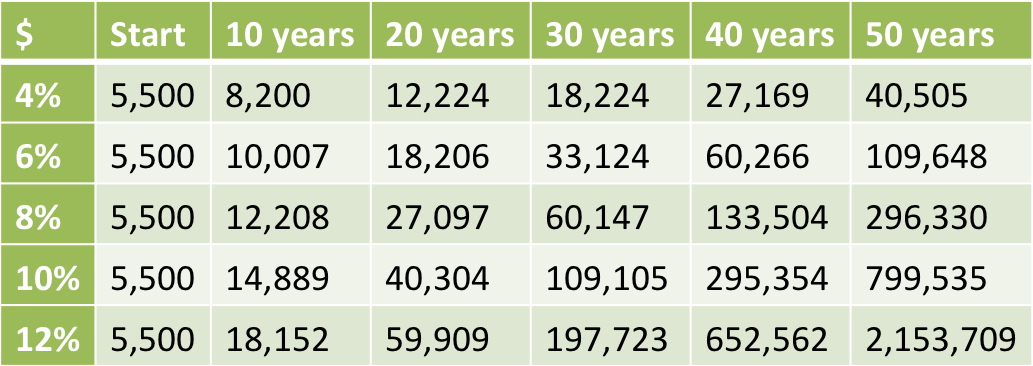
For example, if you contributed $5/month to an investment account over 5 years and received an 8% average annual rate of return, you’d end that time period with $367. Leave that $367 invested with an 8% rate of return for 50 years, and your ending balance is just shy of $20,000. I won’t sugar-coat it: That amount of money isn’t going to get you too far in your old age. But it is $20k better than taking no action.

Further reading:

  • Why You Should Invest During Graduate School
  • Whether You Save during Grad School Can Have a $1,000,000 Effect on Your Retirement
  • Compound Interest

In addition to the money itself, I see two compelling reasons to start investing even with only five dollars per month:

1) Committing to an investment plan creates a habit and changes your self-identity. If you invest five dollars per month, you become an “investor.” It’s part of who you are. The positive financial habit of committing to a monthly savings rate is a very powerful one to cultivate early on in life.

2) Once you get started, it’s easy to increase. The biggest hurdle is going from investing $0/month to $5/month, not from $5/month to $100/month. If you self-identify as an investor, you are naturally going to look for ways to increase your rate of investment. When you complete your training and move into a better-paid position, you will be ready and raring to save more each month, and you’ll already have the infrastructure in place. You’ll only be a few clicks away from investing serious money each month instead of having to wrestle with all the decisions and setting everything up at the same time that you’re dealing with a job transition.

Why It’s Challenging to Invest Just Five Dollars per Month

Until a few years ago, the only way to invest a small amount of money each month and be well-diversified was to use a mutual fund. Unfortunately, to open a brokerage account in which you could buy mutual funds usually took at least $1,000 if not several thousand dollars. Even the brokerage firms that waived their minimum balances usually required an ongoing investment commitment on the order of $50 or $100/month. That barrier can seem prohibitively high to some people; instead of saving up cash for months or years to meet the minimum balance, I imagine many people gave up on the idea of investing.

Further reading: Brokerage and IRA Account Minimums

Now, however, several investing platforms use fractional ETF shares to solve this issue. The platform buys whole shares of ETFs but sells fractions to its users. In this way, a user can purchase one or more ETFs in whatever increments she likes, and there is often no minimum balance required to open the account.

(I have only included in my list below microinvesting platforms that use ETFs. Robinhood is another investing platform that I ran across many times while researching this article because it is a fee-free platform. However, it is designed for investing in individual stocks. You have to invest a lot of money to create a diversified stock portfolio through buying individual stocks. You can buy ETFs through Robinhood but not fractional shares, so that is not compatible with investing just $5 per month. I’ve decided to exclude Robinhood from my list below because it inherently encourages active investing. Of course, if that’s your preferred investing strategy and/or you have a larger amount of money to invest, Robinhood is well worth considering.)

Free Email Course: Investing for Early-Career PhDs

Sign up for the mailing list to receive the free 10,000-word email course designed for graduate students, postdocs, and PhDs in their first Real Jobs.

Success! Now check your email to confirm your subscription.

There was an error submitting your subscription. Please try again.

We won't send you spam. Unsubscribe at any time. Powered by Kit

The Best Platforms For Investing Just Five Dollars per Month

I reviewed a number of fintech microinvesting platforms for this article, though I do not claim that it is comprehensive. I am not a customer/don’t have a relationship with any of these platforms, so I’ve drawn this information from the company websites and reviews rather than personal experience or communications.

Acorns

Acorns is probably the best-known microinvesting platform. Its concept is to round up each of your purchases to the next whole dollar and invest the change. You can also set up a recurring investment.

Fee structure: $1/month for under $5,000 (free for students for 4 years) + ETF expense ratios
IRA option: Coming “early 2018”
Portfolio creation: Suggests a portfolio of ETFs after receiving user input

WiseBanyan

WiseBanyan calls itself the “first free financial advisor.” (They earn money through upselling products and services to their clients.) The service asks you a few questions and uses Modern Portfolio Theory to construct a passive portfolio appropriate for you.

Fee structure: Only the expense ratios of the underlying funds
IRA option: Yes
Portfolio creation: Uses low-fee index ETFs according to Modern Portfolio Theory after you input data for its investor profile

Stash

Stash allows the user to choose among low-cost ETFs to create her own portfolio. The expense ratios on the ETFs are low, and Stash can recommend certain “themed” combinations of ETFs.

Fee structure: $1/month + ETF expense ratios
IRA option: In beta ($2/mo)
Portfolio creation: The user creates his own portfolio from among 40 pre-selected ETFs

Clink

Clink bills itself as more a savings app than an investing app. There is no minimum investment, but if you want to use the scheduler the minimum is $1/day. Clink invests your money in Vanguard ETFs according to Modern Portfolio Theory (a passive strategy).

Fee structure: $1/mo when balance is under $5,000 + ETF expense ratios
IRA option: No
Portfolio creation: Combines your risk tolerance with Modern Portfolio Theory to create an asset allocation of six Vanguard ETFs

In addition to these companies that are explicitly designed for microinvesting, you could also consider other brokerage firms that have wider array of financial services that includes microinvesting. For example, Betterment is a roboadvisor and has no account size minimums. If you do have a lump sum available to invest, though only $5 per month on an ongoing basis to contribute, you could consider other traditional low-cost brokerage firms like Vanguard, Fidelity, or Charles Schwab (and look around for one that will waive its minimum).

What Are the Downsides to Using a Microinvesting Platform?

The microinvesting platforms I listed above are providing a great service to a previously underserved population, and they are to be commended for that. But in order to make it possible, they have engaged in several trade-offs that wouldn’t be necessary with larger investment balances.

1) The Investment Choices Are Severely Limited

The platforms diversify your money into ETFs, but they offer only a small number of ETFs, and I suspect only a few ultimate combinations of those ETFs depending on the user’s input. This is not necessarily a bad thing. If you simply want a generally appropriate asset allocation and are not too concerned with the exact underlying funds used or the exact percentages, having those limited choices might even be advantageous. But if you want to design your own asset allocation or choose among the other thousands of funds possible, you probably won’t be too happy with these platforms.

2) The Fees Are Sky-High

There are two types of fees typically associated with owning investments. The first is due to the cost owning and transacting the investments themselves. When we are talking about an ETF, this fee is called the expense ratio and is expressed as a percentage of your investment balance. Each of the four platforms above have this fee, and it is typically quite low, approximately 0.1%. If you ever see an expense ratio that is around 1%, this is considered high and a red flag that the fund is actively managed.

The second type of fee is for administering the plan or platform itself. For reference, a full-service fee-only human financial advisor charges approximately 1%.

Three of the microinvesting platforms in my list above charge at least a $1 per month fee of the second kind. That doesn’t sound like a lot of money in absolute terms, but the whole reason we’re talking about microinvesting is because small amounts of money are worth paying attention to. If you are investing just five dollars per month, a one dollar per month fee is a staggering 20% of your savings rate. This kind of fee absolutely cripples your investing efforts. I would not be at all surprised if you lost money overall almost every year if you were investing just five dollars per month because the long-term average annual return of the stock market is approximately 10%.

Of course, you can mitigate this problem by using WiseBanyan or another platform that doesn’t charge a fee (e.g., if you are a student and can have the fee waived) or by investing more money each month.

3) They May Not Offer an IRA

Only one of the above platforms currently offers an IRA investing option to all its users. While it is great to invest outside of an IRA, if you are saving for retirement using an IRA is optimal. Plus, your IRA contribution room disappears every year. If you use a microinvesting platform for a few years as a means to save enough to open an IRA with a larger lump sum, keep in mind that your contribution room disappears with each year. It would be better to contribute to an IRA all along instead of doing it in one lump sum at the end because it would use up so much of your contribution room in the last year.

Further reading:

  • Everything You Need to Know about Roth IRAs in Graduate School
  • Why the Roth IRA is the Ideal Long-Term Savings Vehicle for a Grad Student
  • Fellowship Recipients Can Save for Retirement Outside an IRA
  • Roth vs. Traditional

4) You May Develop a Sense of Complacency

I’m trying to thread a needle here: I want to encourage you to invest any small amount of money you can right now while emphasizing that to reach financial independence or retire someday $5 per month is not nearly a high enough investing rate long-term.

If investing just five dollars per month is truly all you can do right now, go for it. But do not allow yourself to think you can keep your savings rate that low when your financial circumstances change. I want you to jump that rate up by about two orders of magnitude as soon as you are able!

Doing something is better than doing nothing, but over time you must move from doing something to doing the best thing or the sufficient thing.

Further listening: Ask Dave: Micro-Investing Apps?

How to Invest When You Have More Money

As of now, I do not think that microinvesting platforms are on par with other brokerage firms and investing platforms that require lump sums to open accounts or higher ongoing investment rates. It’s fine to start out investing with a microinvesting platform, depending on your goals, but as soon as you are able, I think you should switch to a brokerage firm that offers a wider array of investments, lower fees, and IRAs. All of the advantages of the microinvesting platforms (aside from the zero minimums) – low-cost ETF investing, asset allocation recommendations – can be found at a brokerage like Vanguard, Fidelity, or Charles Schwab. Plus, start-ups like these fin tech platforms often change their business models or fold, so even if you like your solution right now it might not be around forever.

When you do make that switch, be sure to choose a diversified, passive, low-cost strategy appropriate to your goals. And increase your savings rate!

If I were in a position to invest only five dollars per month, among the microinvesting platforms I looked at I would sign up for WiseBanyan. Because it doesn’t charge a platform fee on top of the ETF expense ratings and it offers IRAs, I think it gives you the best chance at actually readying you to invest for the long-term. But you also have to consider that it uses a freemium model, which has not yet been proven sustainable in the financial sector.

Filed Under: Investing Tagged With: investing, microinvesting

Don’t Make These Investing Mistakes

April 16, 2018 by Emily

Just as useful as knowing what to do with respect to investing is knowing what not to do. In fact, some of the core investing principles that I teach involve pitfalls to avoid: don’t pay high fees, don’t jump in and out of the market, don’t delay, etc. This article details 11 common investor behaviors and choices that are detrimental. Don’t make these investing mistakes!

investing mistakes

Wait to Get Started

There’s a common aphorism on investing: “It’s not timing the market, it’s time in the market.” We’ll get to market timing as an investing mistake later in this post; for now focus on the time in the market.

Once you are financially and mentally ready to invest, get in the game! Do not wait on the sidelines for months or years on end! On average, waiting means you’ll miss out on gains. The math of the power of compound interest show you just how damaging it is to miss out on even a year of returns.

Remember my example showing how the investments you make just during graduate school can translate to $1,000,000 in retirement? Instead, let’s say that you invested over your final four years of grad school instead of five. Your ending balance drops by $225,000!

Further reading:

  • Are You Ready to Invest Your Grad Student Stipend?
  • Whether You Save During Grad School Can Have a $1,000,000 Effect on Your Retirement

And on that note, one particular mistake that might cause you to wait to get started is that you…

Get Stuck in Analysis Paralysis

I’ve made this mistake more than once with my investments! Investing is an intimidating subject to approach for a novice. But investing isn’t complicated! (Some people like to make it (seem) complicated, but that isn’t better than a simple approach.) I’ll boil it down for a long-term goal like retirement: Buy a stock index fund and hold it until you need the money in retirement.

OK maybe you want a little more detail on that, but you don’t need much more before you get started! Really, you can learn all you need to know about investing in a couple hours. (If you’re super interested, keep going, of course, but you don’t have to.) After that, just start! You can refine and improve your strategy along the way if you want to as you learn more.

Free Email Course: Investing for Early-Career PhDs

Sign up for the mailing list to receive the free 10,000-word email course designed for graduate students, postdocs, and PhDs in their first Real Jobs.

Success! Now check your email to confirm your subscription.

There was an error submitting your subscription. Please try again.

We won't send you spam. Unsubscribe at any time. Powered by Kit

Think You (or Your Broker) Knows Better than the Market

Think you can beat the market or place your money with the person who can? Think again. After costs are taken into account, in a given year the vast majority of both individual investors and professional fund managers fail to even match the returns of the broad market sector they’re invested in. And to beat it year after year after year? Vanishingly rare.

The Efficient Market Hypothesis (EMH) states that it’s impossible to beat the market because share prices always account for all known information about each investment. There are no market inefficiencies to exploit through market timing or precise selection of individual investments.

The EMH is a theory and up for debate, but there is little evidence that contradicts it. Even the most well-known investor in our time to consistently beat the market, Warren Buffet, recommends the S&P 500 index fund, which simply tries to represent the market sector of large-capitalization stocks (source).

This is good news for those prone to the previous mistakes: there is little analysis needed to invest in index funds, and therefore you can skip the paralysis and jump right in.

Loading…

Save Too Little

According to the EMH, you can’t control your investment outcome; the best you can do is match your (sub-)asset class of choice. What you can dial in are costs (more on that later) and your savings rate.

Given a certain rate of return on your investments, what’s the best way to double the amount of money you have in retirement? Save twice as much. Your savings rate is a linear scaling factor in the math of compound interest.

If your goal is to fund your retirement/become financially independent, you need to build up a very large nest egg. It takes decades to save what you need and to allow compound interest to work its magic. So in addition to starting early, save at a very healthy clip: 10% of your gross income is a great goal if you start in your 20s, more if you start in your 30s.

Bonus: The higher your savings rate, the smaller your goal savings amount. If you want to reach financial independence, you should save up approximately 25 times your yearly living expenses (following the 4% safe withdrawal rate). The more you reduce your living expenses, the smaller the nest egg is that you require to retire and the faster you’re able to save up to reach it. For example (given certain assumptions), increasing your retirement savings rate from 15 to 20% means that you can reach financial independence 6 years sooner. Jumping your savings rate up to 30% shaves an additional 9 years.

Further reading: The Shockingly Simple Math Behind Early Retirement

I know a retirement savings rate of 10-15% a big ask while you’re in grad school or a postdoc. If starting early and saving only a little have to play off against each other, start early with whatever rate you can. Just know that you’ll need to jump it up when your income increases.

Get Sucked in by Gimmicky Fintech

One of the great advances in personal finance in the last several years is the explosion of “fintech” or financial technology. Fintech has enabled small investors to access some services and benefits that were only previously available to higher net worth investors because financial advisors have been able to scale their services.

These fintech platforms are now heavily advertising to their new potential clients, i.e., you. While more choices for regular people with respect to investing is a good thing, this heavy advertising environment for the new technology has perhaps crowded out the choices that were and are still available for those same investors, which may in fact be the more appropriate.

For example, the rise of microinvesting platforms that enable people to invest as little as a few dollars per month might give the impression that 1) those platforms are the only ones available for beginning investors or 2) it is sufficient to invest only a few dollars per month. Believing either of those premises is detrimental to the investor.

Another example is roboadvising services. Roboadvisors are a lower-cost, lower-touch substitute for full-service human financial advisors. While they might represent a less expensive but sufficient alternative for a person who would otherwise use a financial advisor, they are a more expensive (i.e., possibly wasteful) alternative for someone who could manage his own investments just fine (the DIY approach) if he knew it was an option. (It’s an option! An easy one! Your brokerage firm will almost certainly make an asset allocation recommendation to you for free if that’s all you’re looking for.)

Pay Too Much or Too Little Attention

On the spectrum of how much attention you should pay to your investments, there is a wide range of what is appropriate. Only the extremes will get you into trouble.

You don’t need to pay a whole lot of attention to your long-term investments. If it stresses you out to see your balance fluctuate daily due to a choppy stock market – and especially if paying that close attention will cause you to try to time the market – force yourself to tune out. You don’t need to check your account balances or investment news daily.

On the other hand, you shouldn’t go years between check-ins, either. You do need to make sure that your investments are doing basically what you expected they would and that they are still appropriate for your goals. A quarterly check-in is sufficient for long-term investments.

Time the Market

One of the gravest investing mistakes that I’ve already hinted at is market timing, which is when you attempt to jump in or out of a market at just the right time to make a killing or avoid a staggering loss.

Guess what? It’s a super ineffective strategy, way worse than just staying invested or steadily adding to your investments. This again relates to the EMH. Any insight you might think you have about an impending skyrocketing or plummeting of the market has already occurred to a zillion other people and been priced in.

You might think you’re buying low and selling high or being fearful when others are greedy and greedy when others are fearful, but most of the time you’re probably just doing yourself a disservice. Besides, even if you guess right once and get out at the right time or in at the right time, you have to be right again to get back in/out!

Free Email Course: Investing for Early-Career PhDs

Sign up for the mailing list to receive the free 10,000-word email course designed for graduate students, postdocs, and PhDs in their first Real Jobs.

Success! Now check your email to confirm your subscription.

There was an error submitting your subscription. Please try again.

We won't send you spam. Unsubscribe at any time. Powered by Kit

Be Undiversified

One of the core tenants of modern portfolio theory is diversification. This means that instead of owning one investment of a type, e.g., one stock, you should own a collection of that type of investment. It’s the basic principle of not putting all your eggs in one basket. You never know which stock is going to be a huge winner and which will go to zero. Instead of picking only one or a handful, own a few tens or a few hundreds and spread out the risk.

One of the sneaky ways to become undiversified is through employer stock that you are given or able to purchase at a discount. If you have a high percentage of your portfolio (e.g., > 10%) tied up in employer stock, then not only is your job at risk if the company falters but much of your savings as well!

Pay Too Much in Fees

Fees, just like taxes, are a drag on your rate of return on investment. Instead of getting a 8% average annual rate of return, for example, fees or taxes might knock you down to 7.5, 7, or even 6%! That makes an enormous difference over the decades – to the tune of hundreds of thousands of dollars!

If we use tax-advantaged retirement accounts to avoid taxes on our retirement savings, doesn’t it also make sense that we should minimize our fees?

Sure, it would be worthwhile to pay higher fees if you actually got better investment returns, but, after accounting for fees, approximately 80% of actively managed funds underperform similar passively managed funds.

The way that you can keep an eye on fees is through a fund’s expense ratio. That’s a single number that expresses the all-in costs of owning the fund in terms of a percentage. A very high-fee fund will have an expense ratio of 1% or even higher, whereas a low-fee fund would have an expense ratio of a couple tenths of a percent or even below 0.1%.

Mix Investing with Insurance

A very expensive investing mistake is to mix investing with insurance though a whole life or universal life insurance policy. The selling point is that you build up money in an investment product as you pay your insurance premiums.

However, what you might not realize as you are being pitched such a product is that your premiums are several times or even an order of magnitude higher than they would be for the same amount of term life insurance, and the investment product doesn’t give you great returns, either.

It’s much less expensive to buy term life insurance (the same sort you have on your car – expiring after a set length of time) and invest the rest of the money you would have spent on the premium on your own. It’s very likely that you’ll end up with more money after decades of using that method.

After all, you don’t actually need life insurance for your whole life – just until you reach financial independence. And that day will come a lot faster if you don’t mix insurance with investing.

Basically, the only people who recommend mixing investing with insurance are those who sell that kind of product. Speaking of which…

Blindly Take the Recommendation of Someone Earning a Commission

I’ve met a few graduate students with no need for life insurance at all who own whole/universal life insurance policies. And it was easy for me to correctly guess why: a family or friend had started selling those products.

There are three types of financial advisers, differentiated by how they are paid.

With two of them, it’s transparent how they are paid. One type charges you straight up for their time and will help you create a financial plan. The other type charges you a percentage of your portfolio to manage your money for you. These two types are usually held to a fiduciary standard, which means they are ethically bound to give you the best financial advice for your situation.

The kind that will meet with you for free is likely to make their money through commissions on the products they sell you. They are not fiduciaries. That’s not to say that they will behave unethically, just that they are not required to be objective in their recommendations. They are permitted to pitch you the product that earns them the highest commission as long as it’s “suitable.” And that’s how a grad student with no need for life insurance ends up with a whole/universal life policy.

The caution against blindly taking the advice of someone earning a commission applies to more than just financial advisors. Affiliate advertising is incredibly widespread right now. You may learn about a product from a content creator (e.g., website, podcast) whom you respect. It’s quite likely that the person will earn money if you buy it through their link/promo code. (I used to be an affiliate myself for a few products through a prior website.) Again, earning a commission doesn’t necessarily mean the person is pushing a bad product or is behaving unethically, but you just have to recognize that it is a form of advertising and you should be a savvy consumer. It’s very difficult to claim to be completely objective when there is a commission in the line.

Filed Under: Protect and Grow Wealth Tagged With: investing

Stack Frugal Strategies for Long-Term Savings

April 9, 2018 by Emily

Have you ever thought that only rich people can afford to be frugal? Many frugal strategies don’t help you spend less today; in fact, some instruct you to spend more today so that you can spend less long-term. But how do you go from being completely strapped for cash to being able to frugally plan your spending over the course of a year or longer? The answer is to stack frugal strategies.

stack frugal strategies

Stacking frugal strategies (a term that might be original to me!) means cutting your spending radically in the short term to free up money to put toward long-term frugal strategies. The short-term strategies may feel painful and sacrificial, but you won’t have to maintain them once you put in place at least one long-term strategy (unless you want to). The short-term strategies are cuts to your variable expenses, which take willpower and effort to maintain, but the long-term strategies are cuts to your fixed expenses, which take no willpower or effort to maintain.

Further reading:

  • The Best Kind of Frugality for a Busy Grad Student
  • Give Yourself a Raise: Re-Evaluate Your Fixed Expenses
  • A Dozen Frugal Tips for Graduate Students
  • Your Most Important Budget Line Item and Why You Need to Re-Evaluate It

Frugal Strategies for Today

These frugal strategies form the base layer of your stack. Implementing them slows down or stops your spending in these areas immediately so you end the week/month with some money in your pocket. They aren’t usually sustainable for the long term, at least not in their most extreme form, but if you keep them up for a month or two can leave you with a healthy amount of cash that you normally would have spent. If you try out a lot of them, you might even find a few you’re willing to maintain as new habits.

  1. Eat down your pantry. Eat everything you have in your fridge/pantry before doing much grocery shopping. That might mean a few meals in a row of canned tuna or buttered pasta! Only allow yourself minimal shopping to enable you to eat what you already have.
  2. Don’t drive your car unless absolutely necessary. Walk or bike everywhere you can. Set up a carpool (but contribute gas money – don’t mooch!). If you have access to free public transit such as on your university’s campus or through a university-subsidized pass, use that to the greatest extent possible.
  3. Don’t go out with friends (except for free). Pass on restaurant, bar, and entertainment invitations from friends just for a short period of time. Search out free activities that you can suggest for outings.
  4. Substitute free coffee/alcohol. If buying coffee or alcohol is part of your routine, break it. Source free coffee and alcohol on campus, or make/drink it at home.
  5. Fast from shopping. No new clothes, no new household purchases, no new electronics. Delay every possible purchase.

Overall, the idea is to halt or at least seriously reconsider any spending that requires you to pull out your wallet (or click ‘Purchase’). Make do with what you have already to the greatest extent possible.

Frugal Strategies for Next Month

This set of frugal strategies forms the intermediate layer of your stack. Implementing them will pay off not immediately but in a month or two. However, they are more easily turned into habits for long-term maintenance.

  1. Use less electricity/gas. Turn down the temperature regulation in your home (use less heat/air conditioning). Use less hot water, including showering on campus instead of at home if possible (e.g., at the gym). Keep your lights turned off as much as possible. Track down sources of vampire power and unplug those appliances. Spend less time at home if you don’t mind.
  2. Switch utility providers when possible. For example, switch your internet or cell service, if you’re not under contract, to a less expensive provider, or downgrade the plan you have with your existing provider.
  3. Cancel subscriptions. Re-evaluate every subscription service you currently use (e.g., streaming video, streaming music, Amazon Prime, periodicals). If you don’t use it much, can get the same content elsewhere for less, or don’t mind a fast, cancel.
  4. Meal plan and shop strategically. Meal planning is the foundation of many frugal tips relating to food spending. Your meal plan enables you to buy in bulk, stock up on sale items, and batch cook, all of which save you time and money in the long run.

These frugal strategies usually take slightly more research and planning, but they are more sustainable than the shortest-term strategies.

Frugal Strategies for This Year

This set of frugal strategies forms the top layer of your stack. Implementing them requires an up-front investment of money, time, and/or research. Often, it takes months of concerted effort before you can implement the frugal strategy. However, once implemented, they have the biggest payoff potential for the least ongoing effort.

  1. Pay off debt. In the short-term, you have to accelerate your debt repayment amounts, but then the payment disappears!
  2. Reduce your spending on rent/mortgage. This is my #1 suggestion for a long-term way to reduce spending. It’s challenging to execute a move or adjust to having a roommate, but it’s worthwhile if you can reduce such a large expense by a significant fraction!
  3. Go car-free/downgrade your car. Cars are a huge money suck, and expensive/new/financed cars are the biggest money sucks. If you can live without a car, do so. If you can share a car with your spouse/partner/roommate, do so. If you can sell your expensive car and buy a cheap one, do so. Think of all the money you won’t have to spend on purchasing/paying for the car, insuring the car, fueling the car, maintaining/repairing the car, paying tax on the car, etc.
  4. Shop around for insurance. Re-evaluate both your insurance provider and level of coverage to see if you can get a better deal on all of your existing policies.
  5. Travel hack. When you plan your travel well in advance, you can research possible rewards systems that may defray some of the cost of the trip, such as credit cards that offer sign-up bonuses or rewards for ongoing spending. It may take several months or a year for a lower spender to accumulate the necessary points (if ever).

These are the frugal strategies worth keeping around for the long term – the ones that will help you reach your financial goals!

Always start your frugal stack with at least one long-term strategy in mind. You can go whole hog for one month with the short-term strategies; at the end you’ll have made deep cuts that radically changed your lifestyle over the short term, and you’ll have some extra money in your pocket. But you can’t do that month after month. You need to use that extra money to ladder up to mid- and long-term frugal strategies that pay off every single month in perpetuity.

Join the Mailing List to Download Frugal Tips for PhDs-in-Training

The download includes 30+ frugal tips for PhDs-in-Training with links to video and additional written content.

You'll receive 1-2 emails per week to help you make the most of your money during your PhD training.

Success! Now check your email to confirm your subscription.

There was an error submitting your subscription. Please try again.

We won't send you spam. Unsubscribe at any time. Powered by Kit

An Illustration of a Frugal Stack

Rachel’s starting point is that she is essentially living paycheck-to-paycheck. In occasional months, she accumulates a bit more credit card debt, on which she pays a high interest rate. She lives alone in a 1BR place and is willing to live with a roommate in a 2BR place, but doesn’t have the money for the expenses associated with the move or the security deposit (her current place didn’t require one).

The ultimate goal of Rachel’s frugal stack is to save up enough money to move once her lease is up. She estimates that she’ll spend $250/month less on rent and utilities once she completes the move, but she needs $800 in cash for the moving expenses and fees.

Rachel goes scorched earth on her short-term spending over the course of one month. It’s not sustainable, but for one month she virtually never pulls out her wallet. She eats down her pantry, drinks the free drip coffee available on campus, declines invitations from friends that would require spending (and plans a couple free activities to see them at other times), walks everywhere possible, and doesn’t do any shopping that could reasonably be put off. It’s a crazy ascetic month, but she ends the month with a few hundred more dollars in her bank account than she usually has. She keeps part of the money around for frugal investment and puts part of it toward her credit card debt, knocking down the balance significantly.

In that first month as well, Rachel implements some of the strategies that will take a month or more to pay off. She turns the temperature control in her home way down, unplugs everything at home that she’s not actively using, and spends a lot more time on campus, even showering at the university gym instead of at home on the days she works out there. She goes through her fixed spending with a fine-toothed comb; she switches one of her utility services to a lower-cost option and finds a couple superfluous subscriptions to cancel.

In the second month, Rachel has to restock her depleted pantry, so her food spending jumps up, but since she’s able to buy some items in bulk and is committed to cooking instead of eating out for convenience, she ends the month with about the same amount of grocery spending as was typical before and less money spent on the go. Her ongoing food spending settles out to about $50/month less than it had been before, even including a few meals/drinks out with friends each month. Rachel also eases off the gas pedal in some other areas like entertainment and using her car, but her spending never returns to where it had been.

Meanwhile, the changes Rachel made to her fixed expenses start paying off, and in total she is spending about $50 less per month on those services, as well as a slightly lower electricity bill.

Her first priority is to pay off her credit card debt completely, which she does in a few months, eliminating the interest she had been paying on it. After that, she saves up for her move, and within about six months she has enough money available to move without accumulating any credit card debt.

Rachel’s new reduced rent pays for the moving expenses she incurred within about a month (as she’ll get the security deposit back when she moves out), and with the $250/month reduction in rent and utilities she feels comfortable increasing her variable spending approximately back to where it had been, though she keeps her new grocery shopping and cooking habits. She pays off her credit cards completely every month and is now able to save money regularly. It took one month of intense sacrifice and a half-dozen or so more months of moderate sacrifice, and now Rachel is able to live a comfortable lifestyle while still saving money every single month.

Filed Under: Frugality Tagged With: frugality

Eliminate Debt Before You Start Graduate School

March 19, 2018 by Emily

Here’s the thing about debt: When you have a low income, you think that you have to use debt to purchase the things that you/need want. Buy now and spread your payments out over time! But here’s the thing about having a low income: you can’t afford to tie up your limited income with debt payments. If you are about to enter graduate school, which for most people is an unambiguous period of low income, you should do everything in your power to avoid taking on debt and eliminate the problematic debt you already have.

eliminate debt grad school

The Trouble with Debt Payments during Graduate School

The stipend you receive in graduate school isn’t intended to be remunerative. I like to say that the universities expect us to research for free, so they pay us just enough to keep us from taking outside jobs. (That is, for the graduate students who even receive a living wage – many don’t.)

If you’re lucky, your stipend is commensurate with or slightly above the living wage for your county. That is, you hopefully will be able to pay rent, eat (in), and get around town, and perhaps you can afford another modest expenditure like visiting your family, saving a little, entertainment, or some shopping. Have you ever heard the old joke about college: “Sleep, study, socialize: Pick two.”? Well, apply that to your finances in graduate school. “Basic living expenses, a splurge here and there, and saving/debt repayment: Pick 1-2.”

I’m being slightly hyperbolic; there is obviously a range of financial situations in graduate school, but you will almost certainly be in one of these (assuming you aren’t being supported by someone else):

  • Your stipend isn’t enough to cover basic living expenses, let alone debt payments – you’re going further into debt or spending some time working an outside job.
  • Your stipend can give you an okay lifestyle as long as you don’t have debt payments.
  • You could afford debt payments on your stipend if pressed, but there are a lot of other things you’d rather do with it (e.g., lifestyle upgrades, saving).

Knock Out Your Debt Before You Matriculate

If you are planning to start graduate school next year or soon, take the next few months to eliminate your debt or at least reduce it as much as you can.

If you can’t eliminate all of your debt in that time frame, you have to triage! Sort your various debts by priority level and work on them from highest priority to lowest priority. (This method is a hybrid of the snowball and avalanche methods of debt repayment.) The objective is to minimize the debt payments you need to make during graduate school, which means eliminating certain kinds of debts entirely if possible.

With this method, you will pay the minimum balance on all of your debts and throw as much money as you can scratch up toward the top priority debt. Once you have eliminated that debt completely, you move to the next top priority debt and throw everything you can at it. Concentrating your efforts like this gives you the best chance of paying off a single debt completely, therefore eliminating its minimum monthly payment and lowering the total amount of money you are required to pay monthly toward your debt once you start graduate school.

Low-Balance Debt: Higher Priority

The easiest debts to eliminate completely are those with low balances. If you have any debt balances under $1,000 or a few thousand dollars, those should become a high priority because they are possible to eliminate completely in just a few months.

High-Interest Rate Debt: Higher Priority

Also a high priority is high-interest rate debt because that is the debt that is growing the fastest and costing you the most money overall. For example, if you have two debts both with balances of approximately $1,000, you should prioritize the one at the higher interest rate.

Deferrable Student Loans: Lower Priority

Check with your lender to be sure, but student loans should have the option to be deferred while you are in graduate school. Since there would be no minimum payment due on these loans once you matriculate, they are a lower priority to pay off before you start graduate school.

However, that does not mean that you should ignore them completely prior to or during deferment. Unsubsidized student loans accrue interest even in deferment, and it is common for student loans to have a moderate to high interest rate.

If you eliminate your higher-priority debt and can start paying your student loans down before graduate school, definitely do so, starting with the highest interest rate loan.

Mortgage: Zero Priority

If you’re near the start of your home ownership journey, I’m betting there’s no chance you can pay off your mortgage in just a few months. (If that assumption is wrong, go for it!) Mortgage debt will therefore be in your life during graduate school, so prioritize paying off basically any other debt before you start making higher-than-the-minimum mortgage payments. However, if you do own a home, you need to check that you will still be able to afford the payment once you switch to living on your stipend. Selling your home, renting out your home, and renting out bedrooms in your home are all good options if you can’t afford it on your stipend.

Dump Collateralized Debt that You Can’t Afford

You may discover, as you look at your stipend offer letter and add up your minimum monthly debt payments (taking into consideration what you can eliminate before you start graduate school), that you either can’t afford all of your remaining payments or that maintaining all of them would financially paralyze you during graduate school (no fun, no saving).

Your best option in this case is to eliminate your collateralized debt, which is your debt that is against a specific asset that you own, such as your home or car. A very accessible scenario is if you bought a car and took out a car loan based on your previous higher salary, and now that car payment is far too high for your lower stipend. A simple fix is to sell your car, pay off your car loan, and buy a less expensive car (ideally without debt). You may “lose money” by doing this because you owned the car over a period of steep depreciation, but that consequence doesn’t change your inability to afford the payment on your stipend.

“But I Don’t Have a High Income Now to Pay Off My Debt!”

The advice in this article applies to practically anyone who is about to start graduate school and not currently in graduate school, even college students.

Certainly, if you have a higher-than-a-stipend salary right now, start cutting back your lifestyle to what it will be during graduate school and use the cash flow you generate to pay off your debt. You have to do it pretty soon anyway, so you might as well make your transition to graduate school less of a shock by acclimating yourself to the necessary frugality and eliminating as many minimum payments as you can.

However, even if you have a low-to-non-existent income right now, e.g., you are in college, you still have time on your side. Yes, you need to keep your grades up until graduation. Yes, you should enjoy your last few months with your college friends. But you still almost certainly have more free time now (and especially over the summer!) than you will once you start graduate school. That time can be used to generate a side income that you can immediately apply to debt repayment. Bonus points if you can establish a side income that you can continue during graduate school (time permitting), such as online freelance work or passive income.

Increase Your Income

Join the mailing list to receive our 7-part video series, "How to Increase Your Income as a Graduate Student," including side hustles and passive income.

Success! Now check your email to confirm your subscription.

There was an error submitting your subscription. Please try again.

We won't send you spam. Unsubscribe at any time. Powered by Kit

Don’t Forget to Save

One caveat: Don’t become so focused on debt repayment that you forget to save up some cash. It’s very helpful to have a small amount of savings available to you during your transition to graduate school, particularly if you have to move. There are a lot of expenses involved with moving and establishing a new residence and possibly fees to be paid to your university, plus most graduate students have to wait rather a long time (over a month) before their first paycheck arrives. It does you no good to work so hard to eliminate your problematic debt only to turn to a credit card because you have no savings for the transition.

Further reading: Bring Savings to Grad School

How intense you need to be in your debt repayment relates to how much high-priority debt you have and your ability to repay debt during graduate school. The more debt you have that is possible to eliminate entirely and the lower your stipend relative to the local cost of living, the more essential this process is to complete prior to matriculation.

Filed Under: Stretch that Stipend Tagged With: debt, prospective grad student

What to Do with Your Tax Refund

March 12, 2018 by Emily

You’ve just received your tax refund for the year and it’s burning a hole in your pocket! Whether your tax refund is a couple hundred or a few thousand dollars, there are many possibilities for the money that can further your financial goals and increase your life satisfaction.

Fund Your Upcoming Cash Needs

Before you consider investing or paying down debt with your tax refund, I want you to think about your upcoming year and ask yourself how much cash you should have on hand.

Is your emergency fund a bit anemic? Do you want to make any large purchases in the next year but are not sure yet how you will pay for them? Are you coming up on an employment transition, during which it is very helpful to have cash on hand? Are you facing an un/under-funded summer or term? A yes answer to any of these questions is an indication that you should use your tax refund to beef up your cash savings.

I particularly like the idea of using a tax refund to jump-start a system of targeted savings accounts. I think targeted savings accounts are an amazing solution to the problem of irregular expenses. The really difficult part about implementing them is that at the beginning you both have to cash flow your current large irregular expenses and save up for future ones. That can put a big strain on your budget. But if you use your tax refund as the start to your targeted savings accounts, you can make the process a bit easier.

Further Reading: Targeted Savings Accounts for Irregular Expenses

Grow Your Wealth

If you have sufficient cash flow and/or savings for all your desired purchases in the upcoming year, it’s time to consider using your tax refund to increase your net worth. With a sizeable lump sum, you can make a big leap forward with any of your current financial goals.

If you currently have any bothersome debt, throw your tax return at your top priority debt. Following the debt avalanche method, you would prioritize paying down your smallest debt first. How amazing would it be to eliminate one debt completely with your tax refund! Following the debt avalanche method, you would prioritize paying down your highest interest rate debt first. This is the debt that costs you the most on a daily basis.

Further Reading: Options for Paying Down Debt during Grad School

If you are currently saving for retirement or would like to start, you can make a lump sum contribution to an Individual Retirement Arrangement (IRA). (You can also increase your contribution to a workplace-based retirement account, but that involves more paperwork.) If you receive your tax refund before tax day, you can even contribute to last year’s IRA if you still have contribution room!

Further Reading: Why You Should Contribute to Last Year’s Roth IRA

There are other possible savings/investment goals that you can use your tax refund for, such as taxable investments, a down payment for a home, and a 529 account.

Free Email Course: Investing for Early-Career PhDs

Sign up for the mailing list to receive the free 10,000-word email course designed for graduate students, postdocs, and PhDs in their first Real Jobs.

Success! Now check your email to confirm your subscription.

There was an error submitting your subscription. Please try again.

We won't send you spam. Unsubscribe at any time. Powered by Kit

Invest in Your Success

Another way to invest your tax refund is in your own personal or career development. I know this is an unfamiliar concept for many PhDs, so hear me out!

As far as personal development goes, you could put part of your tax refund toward receiving coaching. I offer financial coaching, and some of my colleagues in the Self-Employed PhD network offer other types. For example, Katy Peplin offers grad student wellness and productivity coaching and a membership community and Caitlin Faas offers productivity coaching. And these examples are only the tip of the iceberg when it comes to personal development!

I also am launching a video course on investing for early career PhDs next month. If you sign up during the pre-launch period, your receive a discount and a free Q&A call with me once the course.

Another great investment would be in your career. You can explore career options outside of academia through Beyond the Professoriate, a new membership site from Jen Polk and Maren Wood. Jen also offers career coaching. If you’re currently applying for jobs or gearing up for it, Heidi Giusto offers application consulting services. Attending a conference to expand your network and horizons is another perfect use for your tax refund.

Live a Little

You know what they say about all work and no play… If you don’t have any pressing financial goals, why not do something fun with your tax refund? Sometimes you look at a lump sum of discretionary money differently from a small amount each month.

Could you take a vacation (or staycation)? Have you been eyeing a certain purchase? Do you want to upgrade your wardrobe or home furnishings? How about making a donation?

Change Your W-4

This last idea is not about what to do with your tax refund but rather what to do about your tax refund.

Did you like receiving a refund or would you rather keep more cash from your paycheck each month? If 2018 looks similar to 2017 for you financially, you’re probably on track to receive another refund.

If you’d rather receive a smaller refund or maybe even owe a little at year end, you can file another W-4 with your employer. You can fill out the worksheet again that helps you estimate the number of allowances you should have and hope that it is more accurate this time around. Alternatively, if you want to dig into the numbers more, you can calculate the amount of money you would like to have withheld from each paycheck and then figure out the number of allowances to claim to get to that amount of withholding.

That way, next year you can have your preference: a nice refund at tax time or more money in your pocket throughout the year!

How My Husband and I Are Using Our Tax Refund

This year, my husband and I are using our tax “refund” (technically it’s the amount of money we oversaved for taxes in our own dedicated savings account) for an upcoming cash need.

I’m due with our second child in a few months. My husband’s employer offers parental leave at half pay, so we’re saving up to help pay for our expenses during his leave since we’ll have lower cash flow. We haven’t yet learned how much time he’ll be approved to take off, so we’re squirreling away as much cash as we can in case he’s permitted to take a longer leave. We don’t want money to be the limiting factor driving him back to work.

It’s a very happy purpose for this money, and I’m looking forward to having some special time as a newly expanded family!

Filed Under: Stretch that Stipend Tagged With: tax refund

  • « Go to Previous Page
  • Go to page 1
  • Interim pages omitted …
  • Go to page 52
  • Go to page 53
  • Go to page 54
  • Go to page 55
  • Go to page 56
  • Interim pages omitted …
  • Go to page 80
  • Go to Next Page »

Footer

Sign Up for More Awesome Content

I'll send you my 2,500-word "Five Ways to Improve Your Finances TODAY as a Graduate Student or Postdoc."

Success! Now check your email to confirm your subscription.

There was an error submitting your subscription. Please try again.

We won't send you spam. Unsubscribe at any time. Powered by Kit

Copyright © 2026 · Atmosphere Pro on Genesis Framework · WordPress · Log in

  • About Emily Roberts
  • Disclaimer
  • Privacy Policy
  • Contact