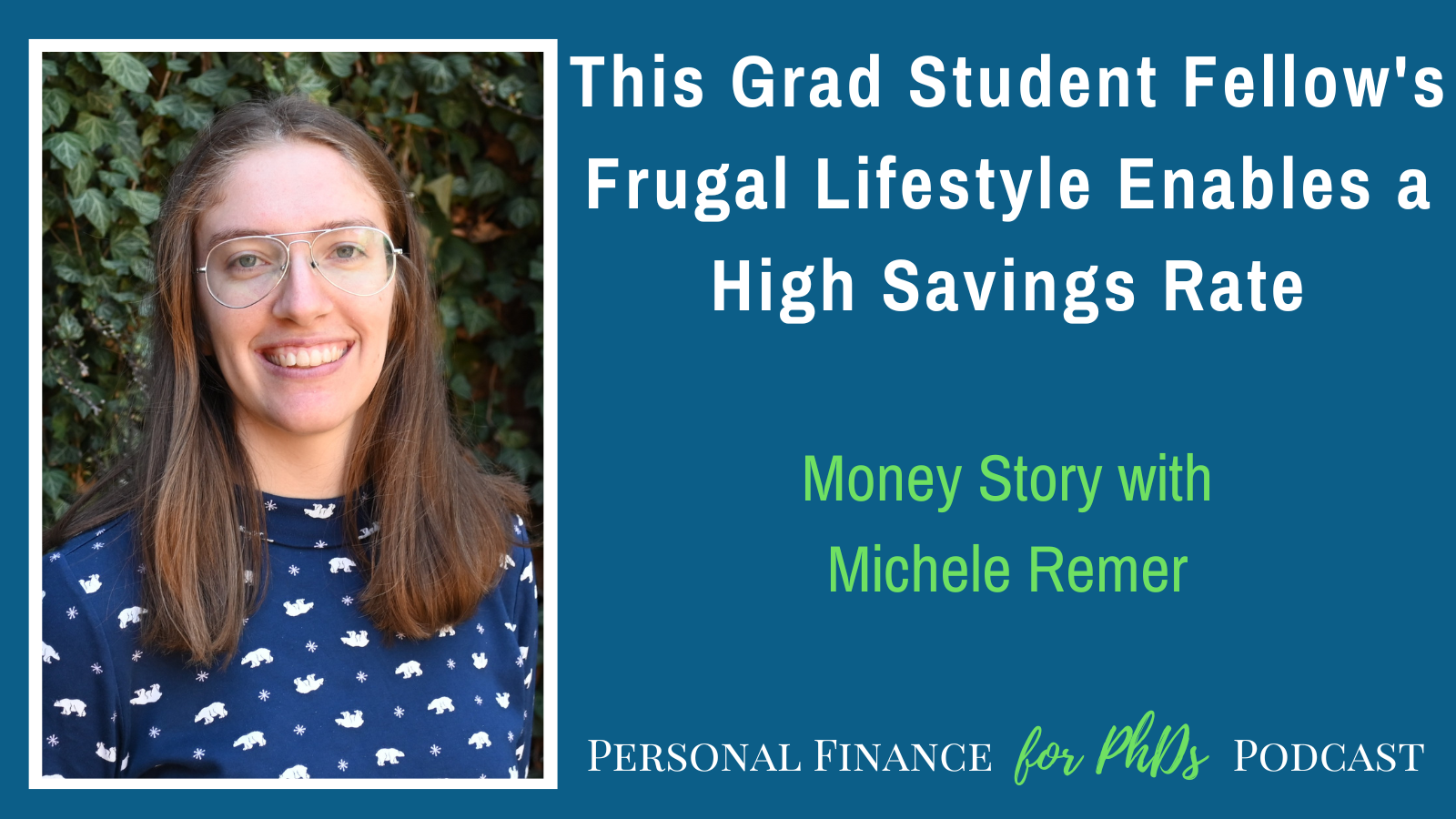
In this episode, Emily interviews Michele Remer, a 4th-year PhD candidate at Michigan State University and repeat podcast guest. Michele breaks down her budget, detailing her top five largest expenses: rent, groceries, utilities, restaurants and social events, and transportation. During grad school, she has found ways to decrease her spending on some necessary expenses, which has allowed her to intentionally increase her spending in other areas of higher value. Due to her frugality and her National Science Foundation graduate research fellowship award, Michele has maintained a very high savings rate, which she puts toward her Roth IRA, taxable brokerage account, and student loans.
Links mentioned in the Episode
- PF for PhDs Subscribe to Mailing List
- PF for PhDs S13E8: This First-Year PhD Student Prioritizes Investing While on Fellowship
- PF for PhDs S8E13: Can I Make Extra Money as a Funded Graduate Student on an F-1 Visa?
- Host a PF for PhDs Seminar at Your Institution
- Emily’s E-mail Address
- PF for PhDs Podcast Hub
Teaser
Michele (00:00): I’m just like, okay, I send my money here to, uh, pay off the debt, or I send to my savings account to save up, to pay off debt, or I’m sending it to my investment accounts. And so it’s not super exciting once you’ve got it set up, but I think that’s a good thing because then you just kind of get to live your life while it’s all happening in the background. So as long as you kind of have your expenses figured out, which is really nice.
Introduction
Emily (00:34): Welcome to the Personal Finance for PhDs Podcast: A Higher Education in Personal Finance. This podcast is for PhDs and PhDs-to-be who want to explore the hidden curriculum of finances to learn the best practices for money management, career advancement, and advocacy for yourself and others. I’m your host, Dr. Emily Roberts, a financial educator specializing in early-career PhDs and founder of Personal Finance for PhDs.
Emily (01:03): This is Season 24, Episode 2, and today my guest is Michele Remer, a 4th-year PhD candidate at Michigan State University and repeat podcast guest. Michele breaks down her budget, detailing her top five largest expenses: rent, groceries, utilities, restaurants and social events, and transportation. During grad school, she has found ways to decrease her spending on some necessary expenses, which has allowed her to intentionally increase her spending in other areas of higher value. Due to her frugality and her National Science Foundation Graduate Research Fellowship award, Michele has maintained a very high savings rate, which she puts toward her Roth IRA, taxable brokerage account, and student loans.
Emily (01:49): You’re probably listening to this podcast because you’re interested in improving your own practice of personal finance, and you want to learn the best PhD-specific strategies. Well, you don’t have to listen through the entire episode archive to do so. Instead, go to PFforPhDs.com/advice/ and enter your name and email there. You’ll receive a document that contains short summaries of all the answers ever given on the podcast to my final question regarding my guests’ best financial advice. The document is updated with each new episode release. Plus, you’ll be subscribed to my mailing list to receive all the latest updates there. Again, that URL was PFforPhDs.com/advice/. You can find the show notes for this episode at PFforPhDs.com/s24e2/. Without further ado, here’s my interview with Michele Remer.
Will You Please Introduce Yourself Further?
Emily (02:59): I am delighted to have back on the podcast today, Michele Remer. We, she first gave an interview for us in season 13, episode 8, published in 2022. At that time, Michele had just started graduate school at Michigan State University. She’s now finishing up her fourth year. During today’s interview, we’re gonna do a budget breakdown episode. So we’re gonna get to hear about Michele top five expenses, some other things she has going on in her finances, and we’re also gonna talk about how those certain expenses and so forth have changed over the last few years. And so it’ll be really interesting if you wanna go back and listen to that earlier episode to get that time point, to get the time point right now to get the um, how Michele summarizes that things have changed over that period of time. So Michele, thank you so much for volunteering to come back on the podcast. It’s great to have you. And will you please introduce yourself a little bit further for the audience?
Michele (03:47): Yeah, I can. Hi everyone. Um, like Emily said, I am doing my PhD and so I’m doing it at Michigan State University and I’m now a PhD candidate after passing my comps last semester. So officially went from student to candidate. Um, my undergrad degree was in environmental biology and now in my PhD I am in the Fisheries and Wildlife Department. And then, um, before starting my PhD, I worked a few seasonal jobs, one of which was volunteering with AmeriCorps, which I talked about in the previous episode. So that kind of gave me some good experience for learning how to save money and, um, knowing that going into this field I wouldn’t necessarily be making a ton of money.
Current Fellowship Income, Additional Income, and Household Size
Emily (04:31): Well, again, it’s wonderful to have you back. Um, okay, so let’s talk about today. Uh, you’re at Michigan State. Tell us a little bit about yourself, your household, if there are any other people or beings involved with that. Um, and you have an assistantship, do you have a fellowship? What’s going on with your income?
Michele (04:49): Yeah, so I, like I said, I go to school at Michigan State University, so that’s located in East Lansing. I actually live in the Lansing area as that is a bit more affordable, not living like super close to campus, relatively. Um, and then I’m also on fellowship currently and have been throughout my time at Michigan State. And I currently have one roommate in a shared house that I’ve lived in since the beginning of grad school. But this has changed from when I first started since originally we had three grad students in this house, but we’ve gone down to having only two people now.
Emily (05:26): Yes, I remember, I mean, your interview has really stood out for me over these years as you having this like ace in the hole with how much your, how much your rent was at that time <laugh>. So we’re gonna talk about the rent amount when we get there. Actually we’ll talk about the roommate situation too when we get to talking about rent. But good to know you’re living with one other person in a house in Lansing. Um, can you tell us what is your stipend income, your, your fellowship income, and then do you supplement your income in any way?
Michele (05:50): Yeah, so I was very lucky. I was fortunate to receive the GRFP and I was also lucky in the sense that I received it after the stipend increase went up from $34,000 up to $37,000, which in Lansing is very nice income to have. Um, and then, so I’m currently at the last year of the GRFP and that’ll be transitioning back into a university fellowship. So my income will actually go down, um, starting in September, but I will be supplementing that with another job over the summer helping out, uh, one of my committee members with some field work. And so it’s not quite making up the difference, but it’s getting me a little bit closer, which is nice.
Emily (06:32): So you’re anticipating coming off the GRFP, you’ve taken these measures to try to supplement your income currently, but in the past several years, have there been any points when you’ve made additional income?
Michele (06:43): Yeah, so throughout my time in grad school I’ve had what I call several small little side hustles that I’ve had. So that’s included opening, um, bank accounts to get the bonuses. Chase had one, I think last year that you got additi- an additional $900 if you open the checking and the savings account with them. And to, you just have to, to avoid having a fee, you just have to make sure you have direct deposit set up with them. And then I also did that for our local credit union at MSU. They had a similar thing when I first started grad school, so I think I got like an extra $100 from that. And then another thing that I’ve done is I open credit cards when I know that I have a big expense coming up. So in order to get like those travel bonuses, so like for my health insurance for instance, when I, I have to pay that with a credit card and so then that way I’m not spending my own money on trying to get these travel rewards.
Michele (07:36): And so that’s been also really nice. I haven’t done it too many times, probably just, uh, like twice maybe. But it has been nice to get a little bit more like travel points in that sense and then to cover various research projects or other professional development opportunities like conferences. I’ve applied and gotten some smaller fellowships through the university and I’ve also like volunteered at a conference to get lower registration before in the past. So just a few different ways to kind of, even though like with conferences it’s kind of sometimes a gray area between like who’s gonna cover it, it, it’s helpful for making sure that you have that and it looks nice in your CV, so.
Emily (08:14): Yeah, I love that you mentioned those specific avenues. Um, because they’re available to everybody. Like I don’t wanna speak out of return about visa regulations and so forth. So always international students need to be careful about what kinds of, um, avenues they pursue for earning additional income. But go back to my previous episode with um, Frank Alvillar and Sheena Connell about whether or not credit card rewards and those kinds of things, banking bonuses would be okay or not typically. Um, so go check that out. But none of these are gonna violate like the terms of your fellowship. They’re not going to, you know, rub your advisor the wrong way to be, you know, pursuing a credit card or like volunteering at a a conference. Those are absolutely very, very accessible ways for people to supplement your income and not ones that take hardly any time. I would classify those as passive, um, pursuits for increasing your income. So I love those suggestions. I hope that people um, take them to heart if they are looking for a little like marginal ways to either decrease some expenses or increase their income a little bit. When you were last on the podcast, I know we talked about your Roth IRA, so I wanna hear an update on what your current financial goals are, um, and how they’ve changed over the past few years.
Current Financial Goals, a 20% Savings Rate, and Debt Repayment
Michele (09:25): Yeah, so for the investing side of it, the Roth IRA, I’ve continued to focus on maxing it out. Um, even with the increases in the, I guess the floor for the Roth IRA, I think now you can do up to $625 a month, um, which is really nice that I’ve, with the GRFP been able to afford investing that. Um, and so that’s something that I try to prioritize when I can. If there’s like certain months where I’m not able to, then obviously I wouldn’t invest it. But that’s something that I’ve continued to prioritize.
Emily (09:59): Yeah, I think we’re up to $7,500 on an annual basis in 2026. I think that’s correct. And so with your income of $37,000 you’re looking at, that’s just about a 20% investing rate off of your gross income rate. So that’s pretty high for a graduate student. I know you’re about to say you’re working towards other goals as well. So just wanna put that touch point in there of like, okay, already like you have a relatively like very high savings rate for your current position. That’s awesome. Okay. You’ve got the Roth IRA, you’ve maxed it out even with the increases along the way. What else?
Michele (10:32): Yeah, so then with, if I do have like extra money at the end of the month, besides on top of the Roth IRA, I’ve been doing the a taxable brokerage, um, which that’s just obviously not as tax advantaged as a Roth IRA, but it still is helpful, especially for me. I’m not planning on buying a house anytime soon. The market is <laugh> not the best and I don’t know exactly where I’ll be. So I don’t really have a plan of purchasing a house in the next like five years or so and so, and I’m probably gonna continue renting. And so for me, I think it makes more sense for me to put additional money into, uh, investing rather than leaving it in a savings account. And then, um, the other thing that I did wanna mention that I just recently got a Fidelity credit card. This one don’t worry, no annual fee involved, but you, it gives you extra rewards if you, uh, invest in their Fidelity account, which can be your Roth IRA or a taxable brokerage. Um, and it’s also really nice if you charge any of your reimbursements for conferences or like I said was saying health insurance on there, you can get a pretty sizable percentage back or I think it’s like 2%, but when you’re paying that much, it’s a pretty big chunk of money, um, which is nice. So.
Emily (11:49): I love that idea as like, ’cause you mentioned opening credit cards for like, like signup bonuses. Um, I love the idea of having a baseline amazing cash back in a sense card like this Fidelity card is.
Michele (12:01): Yeah, I’ll say amazing is kind of a relative term, but <laugh>, it’s,
Emily (12:05): Yeah, but, but 2% for cashback card
Michele (12:07): Even $100 extra is so nice. So.
Emily (12:08): Yes. It is awesome. And then when you’re not working on a signup bonus, falling back and like always using that 2% cards great plan.
Michele (12:15): Yeah. Uh, which is really nice because I’ve found after doing a few of the annual fee cards, it’s, it gets to be kind of annoying to deal with and like having to remember to cancel it eventually if like you don’t, aren’t getting the enough rewards to kind of cover the cost.
Emily (12:31): Okay. So we talked about your Fidelity relationship and that’s great. Um, what else have you been working towards?
Michele (12:37): Yeah, so besides the investing, I’ve been working towards debt repayment. So I had a sizable chunk of student loan debt from my undergrad university since I went to, um, a private like liberal arts school. And so for that I, I borrowed from the federal government and then I also borrowed from a few family members who luckily had money saved up for me to go to school. And so as of right now, and I think in about three months I’ll have repaid my debt to my family members, which is awesome because I did not want to have to like owe them money anymore.
Emily (13:16): That’s incredible. And actually it’s particularly incredible that you’ve accomplished this during graduate school. So can I ask about, I don’t know, whatever you’d like to share, like either the starting balance or um, how much you’ve been paying on a monthly basis? Has it been regular or irregular? Like how has that relation-, that repayment relationship worked?
Michele (13:35): Yeah, so for this relationship, so it’s my parents, I, um, send them the money through, we have like a shared checking account kind of set up or I guess it’s like a shared bank account set up for this. So I send them like a set amount every month. And then also what I was doing at the beginning of grad school when I, I had extra money too because I just like didn’t want to owe them all this money. I think it probably started out at around like maybe 8 or $9,000. And so I was sending them like extra money as like I saved it up. And then I also, um, was just doing like a base of like a hundred dollars a month, um, just because I didn’t want to have to pay them back this money and I wanted them to have it back as soon as possible. And so that’s been really nice to basically by the end of grad school have, have that debt paid. And then for my other debt that’s through the federal government, I only took out the subsidized loans that I was offered. So that means like I didn’t pay any interest during grad school. And so for that I put it into like a kind of like a CD ladder when I had the, the rates were good, I would put it into a CD. And so then that way I’ve saved up like a large chunk of money to hopefully pay back, if not all of it, by the time the interest payments like come due, then I’m gonna be pretty close to paying off the debt. So I’m excited for that too. <laugh>.
Emily (15:05): Yeah. That’s incredible and I love that you’re introducing this idea of a CD ladder to the audience. It’s not something that, I don’t know that I’ve ever discussed on the podcast before. Um, but basically I love this approach because as you said, when we’re dealing with subsidized loans, not accruing any interest, you do not need to take any action and like your money is gonna be doing better for you literally in a savings account or a CD ladder or you know, money market account. I, I like that you’re not investing it. Right. I like that you’re not taking a lot of risk with it because you know, yes, this is gonna come due. Yes, I do wanna make these payments, um, pay it off quickly once you know it’s back in repayment. So I love that you’re not taking risk with it, but you’re doing as best as you can in terms of the interest rate, um, in the meantime. So wonderful approach. And another point of congratulations of wow, like look at all that you’ve accomplished financially during graduate school, like maxing out the IRA yearly, you know, getting ready or almost completely repay your student loan debt. Like that’s a lot to do as a graduate student.
Michele (16:07): Yeah, I’ve been really fortunate just the way everything lined up with the GRFP and um, also just, I mean we’ll get into my expenses, but I’ve also been able to keep my expenses relatively low as well, which is a good thing to be able to meet all these goals. And I will also say that I became a big fan of Mr. Money Mustache in <laugh>, uh, during grad school. And his approach really helped me be like, okay, how do I lower my expenses as much as possible, um, and kind of make sure my money is going to the right avenues. So.
Emily (16:43): Um, I’m not a big follow of follower of Mr. Money Mustache, obviously I have listened to him plenty of times and quite familiar with him, but, um, what I like about his approach is it’s really about finding satisfaction in a lower spending lifestyle. So it’s not about staying in your mind in a, um, a state of deprivation. It’s really about finding joy in simplicity and a low spending lifestyle. And I do think it’s quite compatible with the situation that graduate students are forced to be in, at least for a period of time. So I’m glad you found something that kind of like helped you with your overall, you know, disposition towards this financial stuff during graduate school. Um, is there anything you’d like to add about these, um, various goals that you’ve had or how they’ve shifted over the course of graduate school?
Michele (17:29): That’s the other thing is that it’s pretty boring when you’re doing like your finances in a, like a healthy way, I guess. Just like, okay, I send my money here to uh, pay off the debt or I send to my savings account to save up to pay off debt or I’m sending it to my investment accounts. And so it’s not super exciting once you’ve got it set up, but I think that’s a good thing because then you just kind of get to live your life while it’s all happening in the background. So as long as you kind of have your expenses figured out, which is really nice,
Emily (18:01): I think that’s very insightful. Healthy finances are boring. Like once you get it sorted out, you put everything on autopilot. Um, they’re boring, but that’s a good thing. Like you said, you can shift your attention away from those financial elements. You don’t have to pay a lot of attention to it once you have your decisions made and your system set up and then you’re free to <laugh> do anything else with your mind and your time. Um, so I think that’s very insightful. It’s not something that has to consume you continually, forever and ever and it shouldn’t, it shouldn’t be exciting, honestly, like you said, I mean I find it nice over time, you know, check the investment balance periodically, especially if things are going well, you know, in the market. Yeah, go ahead and check it. If things are not going well, don’t check it. <laugh> don’t look, you don’t need to know.
Michele (18:41): Yeah, it’s, it’s kind of crazy too just when, when you do get to like a stable place and you’re able to invest regularly, just looking back at my account over the past five years, it’s like, wow, like I didn’t think that this would add up to this much, you know, with the compound interest and this payments that I’m making. So yeah, it’s very satisfying. I will say once, I know not every grad student is able to contribute as much as I am, but even like if you can’t contribute until you graduate, like just starting out now is also, um, still gonna be help people out in the future.
Budget Breakdown: Housing
Emily (19:20): Okay. Let’s dive into those five, those top five expenses. Um, and feel free also to share how they’ve changed over the course of time in graduate school. Um, and I know number one is gonna be housing, it’s always housing for everybody. Um, so share about the rent payment that you’re making and share about how you only have one roommate now instead of two, like before. What’s going on with that?
Michele (19:42): Yeah, so basically when I started, um, the rent was probably, I mean I couldn’t really have gotten cheaper rent somewhere else, but it was $375 a month, which is insane <laugh>. Um, but it was $375 a month because we had three grad students living in a shared house with like one bathroom, one kitchen. And so that’s kind of why we decided. We had one roommate who graduated and moved out and she lived in like the top floor, which she was a trooper for living up there because it, it was like an A frame and so it’s not like a super great spot if you’re tall like me, I have to kind of lean when I go up there. Um, and so we were, my other roommate and I were still living here. We were deciding if we wanted to have someone else on the lease, but our other roommate had graduated and moved out. So we had the summer to our ourselves and during that time we were like, well, it’s really nice like sharing the bathroom with one less person, not having as much, um, to think about like the kitchen space as much. Like we still kind of had to plan around like our meal prepping around each other, but it wasn’t quite as bad as it was with three people since we didn’t do like a, we didn’t like cook together, we all cooked individually. So that was also a challenge. And so based on that and we both, my roommate, uh, who I lived with for the past three years was also on the GRFP, so we decided okay, we could probably swing to having just two of us. So that meant that our rent, it’s gone up slightly more since then, but currently it’s at $600 a month. So it’s still very affordable compared to other places around us as well and like living by ourselves would’ve been.
Emily (21:22): So your, the whole house is $1200 a month and you and your roommate are each playing paying half.
Michele (21:29): Yep. And so that roommate that I mentioned, she graduated in December, so she moved out and then, um, we, I think technically she’s my current roommate is like subletting her portion of the lease, but we’re gonna resign it in for the next year and then that’s gonna go up slightly to 630 a month each. So it’s going up by $60, which my landlord apologized, but I was like, it’s really not that much compared to like other places because he had like his property tax go up in his like rental fee. So.
Emily (22:00): Sure. And I’m also doing some quick mental math, um, that’s around 20%, right? Maybe a little over 20% of your gross income a little bit higher if we’re talking about net income, but really quite again, quite manageable. Like nobody is feeling rent burdened right on 20%.
Michele (22:17): No, no, it’s been, it’s a pretty affordable rent I would say. I know that, um, like some of my friends who live alone, they’re paying around like, um, eight to 900 a month for theirs. And so then there are other grad students though who are in like a shared housing situation. I think that’s pretty common for Michigan State at least.
Emily (22:42): Yeah, well I can see that even though you’ve elected to pay more in rent than you absolutely could have, um, still seems super affordable. Hopefully you’re getting use out of the space and you like only sharing with another person, like you said. Um, anything else you wanna talk about in terms of your rent expense?
Michele (22:57): It helps that, I’ve had great roommates who like, I think living with other grad students is really helpful ’cause you know, they’re all gonna be like respectful and um, kind of respecting your time. And also like that you’re also like both maybe working from home sometimes if you need to. So I think it, it’s really nice when you have like great roommates and I, I, I also prefer that because it helps you save money in other ways too if you’re, if we’re talking about like the financial side of it, but also like, I think the emotional side of it is great too to have someone like living with you. But um, it’s also nice like, you know, you can have your roommates like give you a ride to the airport if needed or pick you up from somewhere or like, just like take care, water your plants. My previous roommate had a cat and she never had to pay for a cat sitter ’cause I would always take care of her cat for her. So yeah, it’s just things like that, it’s just very useful to have a roommate I think. And I, I enjoy living with roommates. So.
Commercial
Emily (23:56): Emily here for a brief interlude. Would you like to learn directly from me on a personal finance topic, such as taxes, goal-setting, investing, budgeting, or designing your financial life, each tailored specifically for graduate students and postdocs? I offer live workshops, asynchronous online courses, and cohort-based programs on these topics, and I’m now booking for the 2026-2027 academic year. If you would like to bring my content to your institution, would you please recommend me as a speaker or facilitator to your university, graduate school, graduate student association, medical school, postdoc office, or postdoc association? My workshops are usually slated as professional development or personal wellness. Orientations, postdoc appreciation week, or close to the start of the academic year would be a perfect time for tax education or general personal finance content. Ask the potential host to go to PFforPhDs.com/financial-education/ or simply email me at [email protected] to start the process. I really appreciate these recommendations, which are the best way for me to start a conversation with a potential host. The paid work I do with universities and institutions enables me to keep producing this podcast and all my other free resources. Thank you in advance if you decide to issue a recommendation! Now back to our interview.
Budget Breakdown: Groceries
Emily (25:28): Let’s talk about your grocery expense. I know that’s number two on your list. Um, so tell us about your grocery spending.
Michele (25:35): Yeah, so I just looked at it for the last month, which it came up to $250. I would say that’s pretty average for me. I did go to a conference in like the beginning or at the end of April. And so like that was all covered by like a travel award. So I think it’s usually ranges between like $250 and $350 a month depending on like how much I’m spending or like if I have to do like a restock or something like that. And I will say I’m vegetarian so that also helps me save a lot of money too ’cause I’m not buying meat. So yeah.
Emily (26:08): Definitely. What do you find are other ways? ’cause I know yes meat is expensive, but so is dairy, so are nuts. So are, you know, other things, there are categories there that are expensive as well. Can you share anything about the way that you eat? Like do you have certain go-to meals or do you uh, batch prepare things? How does that work?
Michele (26:27): Yeah, so I guess I’m trying to think about like my day. So like for breakfast I usually just have the same thing. I have like two eggs with toast, so it’s pretty basic and I kind of know where to get like cheap, the cheap bread now, well I’d say cheap bread. Cheaper bread. I like don’t wanna get the like just tiny squares of white bread. I like to get good stuff. But um, yeah, like Trader Joe’s, we just got one of those in East Lansing, so I usually go there for that. Um, and then for lunch and dinner it’s usually like I will cook like on the weekends and then also like maybe on like Wednesdays or if I have time during the week and then I’ll just have my leftovers for both lunch and dinner. And then I also do what I call my bridge meals. So I’ll get like something like gnocchi at Trader Joe’s or some other frozen meal that if I’m like traveling or coming back and I don’t wanna make sure that I’m not ordering like takeout or something like that, I’ll have that ready to go. Um, and then that helps me too. And then as for the meals that I’m cooking, they’re usually, uh, pretty basic, some variety of having like beans or lentils with veggies and so those are all pretty cheap. Um, I do also do protein shakes, so that’s a little bit more just because I’m getting like protein powder and Greek yogurt and things like that. But, um, another way that I’ve saved some money on groceries too is I, I wish that I’d realized this sooner, but one of the grocery stores near me has a 10% off like discount for students. So you, with your student id, you can get um, 10% off groceries, which is really nice.
Emily (28:06): I hadn’t heard of that before actually. That’s amazing. Is it like a co-op or like locally owned or?
Michele (28:10): It’s actually one of the Meijers, but it’s like oh, the downtown location. And I think that maybe they were having issues like getting people to go there because it’s a little bit of the way for some people maybe, but yeah, I think, I’m not sure why they’re offering it, but I saw the sign and I was like, I have my student ID.
Emily (28:29): I was just gonna ask how you found out about it. So it wasn’t like another student who gave you that tip, you just saw a sign at the store?
Michele (28:34): Yeah, I literally just saw a sign at the store, so now I’ve been telling all my friends like, you guys should go here and get this 10% off with your student Id <laugh>.
Emily (28:41): Yeah, that’s amazing. What a good, I mean it’s a good idea for them, um, because yeah, most people don’t, I mean if you’re really frugal you would shop at multiple different places, but most people don’t shop that way. And so it makes sense to try to capture like people’s, you know, become the primary shopping destination for more people.
Michele (28:58): Yeah. And then the other way I save money on, on groceries, well is kind of getting into transportation, but I like to bike to go to the store <laugh>, so ah, um, that also saves you money because then you’re not buying anything that’s really bulky. So like, I’m not buying like pop or I guess, sorry, soda, um, Midwestern coming out, but um, things like that or, uh, any other like seltzer water, things like that I’m usually not purchasing. So.
Emily (29:27): Um, I would imagine also cuts down on impulse purchases if you’re looking at your, your backpack or your bags or whatever you’re using to carry the groceries. Um, I have a strategy that I now use, which is like, I very rarely physically go into grocery stores. I do all online ordering and then do pickup, um, which keeps like the impulse purchases at a minimum.
Michele (29:46): Yeah, <laugh>. I will say that I, I’m not always going to the store with my bike so I, there is times where the impulse purchases still do come through, but it’s also just like a very enjoyable way to spend like a Saturday morning or afternoon even though the stores are kind of busy at that time, but it’s like a nice little bike ride to get there. So at least for me when I’m going to certain stores it’s like, um, like a nice trail. So
Budget Breakdown: Utilities
Emily (30:14): Yeah, I love to hear about that. Your next expense you told me is utilities. Lots of different utilities under that umbrella. Tell us about those expenses. Um, what they amount to typically and how they’ve changed.
Michele (30:25): Yeah, so those have gone up obviously since we have one less person. That was kind of when we were deciding if we wanted to have only two people live, the utilities, that was our sticking point because those can get quite pricey. So I looked at my past month and it came up to around $200, so that’s with electricity, water heating, cooling, internet, trash. And I also include my phone bill in that. So for like the first, obviously the phone bill I’m paying on my own, but everything else is split between my roommate and I and those are pretty variable just because, well I guess like the electricity and the water usually stays pretty, um, similar but like the heating and cooling, it’s more expensive in the winter here in Michigan to heat the house. And then we usually try not to use the AC unless it’s like super hot outside in the summer. And then the internet and the trash are also like pretty affordable. Um, I’ve actually managed to save money on utilities for the internet by switching from like a different provider. And then I also lowered the internet speed because most of the time, unless you’re like playing a lot of video games or something, you don’t need the speed that they give you as like the baseline. So yeah, that’s my utility bill.
Emily (31:49): Yeah, I love that you were, you know, conscious of that evaluating it because stuff like internet bills, they’re not the biggest things in your budget, but as fixed expenses, if you can just put in the like 30 minutes of effort or whatever it’s gonna take to like research it and, and call the company or chat with them or what have you, um, then you can sometimes get that bill lowered and very little effort, very long payoff like throughout the course of at least the next year. So that’s awesome. Have there been any other ways that you’ve decreased your spending on utilities over time?
Michele (32:23): Yes. So some of these people might not wanna do because they do take a little bit of extra time, but some ways that I’ve been able to lower my utility bills has been um, I line dry my clothes, which is obviously a lot easier when you’re in the house, but the dryer is kind of an energy hog.
Emily (32:41): I did that too during grad school.
Michele (32:42): Yeah, I actually, um, yeah, I have some like hanging up downstairs right now, but yeah, I just gotta, gotta time it if you like, need your like clothes at a certain time, like you gotta do like a day in advance, but it’s pretty easy. And then the other thing, um, my roommate who moved in probably doesn’t know what she’s getting herself into, but uh, I layer up in the winter, so kind of try to reduce heating bills by lowering the thermostat. Um, I think that’s a pretty obvious one. But then also in the summer, like running fans and keeping the blinds closed, um, like I said also the internet, but then my other thing I did was in Lansing at least the trash is you pay dependent on like the size of your trash and so I switch it to like the smallest size possible that only comes every other week. So that’s another way that I save money,
Emily (33:33): Another fixed expense that you managed to lower and as long as you’re confident you can like meet those, you know, those limits then that’s great.
Michele (33:41): Yeah. And then the last thing that just happened recently that I’m super excited about, I don’t actually know it’s gonna affect my energy bills at all, but, uh, I kept kind of pestering my landlord about our dishwasher and we just got a new one. And so even if it’s to save us money, it’s, it’s better because it’s a lot quieter so, and I don’t have to try to clean it as often. So yeah, that’s some ways to that I’ve done that. Well then I guess also the, um, for electricity, I don’t know if this is the case, like if it’s the same hours in other places, but our utility provider has like, uh, off peak and on peak hours, so we try to run like our bigger stuff like the dishwasher and the washing machine during those off peak hours.
Budget Breakdown: Restaurants & Social Activities
Emily (34:27): Definitely. Alright, then let’s move on. What is your fourth largest expense each month?
Michele (34:33): Yeah, so this one, the next two are kind of variable, but for this past month it was, um, $160 for restaurants and other social activities. So like this past semester I was the social chair and so I, I hosted some like department happy hours or I guess co-chair. And so that was, you know, we , would go out to like some bars and get like a drink or two and then also just going out to eat with friends as well.
Emily (35:03): And has that changed over the course of time?
Michele (35:05): Yeah, I would say that I, when I first started grad school I was a lot more frugal with those like kinds of social activities. I tried to limit them a little bit more, like tried to have people over at my house rather than going out as much. But now I’ve been that I feel like I’m in a better financial position. I have been going out to eat more often. Um, and then I guess another thing that I’ve started doing is I’ve been doing some sports leagues, so do like, um, adult volleyball or um, sand volleyball as well. So those have like higher costs to them as well, but they’re pretty affordable I would say, especially spread over the like the weeks that you’re participating in them.
Emily (35:50): I just love this that, you know, getting this picture of you at the beginning of graduate school and now four years in, like you’ve found ways to spend less in certain areas. You’ve also decided that it’s worthwhile to spend more in certain areas and still along the way you’ve done all this investing in debt repayment and it’s absolutely wonderful. So I’m very glad to hear that, you know, you’re putting your dollars where you value them.
Michele (36:10): Yeah, it’s, it is definitely like an adjustment because I feel like for so long, like you, like I said, I, I volunteered for AmeriCorps and then in undergrad I was like just saving money all the time and so it’s been nice to be like, okay, I have a little bit of breathing room now and kind of let loose a little bit more with some of my like, like I can go out to eat more often now. So it’s been nice.
Emily (36:36): I think we should do another follow up interview in another four years when you have a proper salary <laugh>, like, we’ll see, we’ll see where you are then. Are you, like, are you still very low spending or have you managed to, you know, moderate with the newer income or are you going crazy with investing? Like, yeah, we’ll let’s put a pin in that and, and return to it. Um, okay, your fifth, uh, highest expense in your budget? What’s that?
Budget Breakdown: Transportation
Michele (36:57): Yeah, so this one was also higher for this month because I went on a trip but, or kind of a trip I went home to visit family. Um, the transportation was $125 and so this usually is closer to $70 for car insurance and gas. But like I said, I like to bike a lot, so my gas is usually pretty low, which is also good for the current gas prices.
Emily (37:23): So it sounds like you have a paid off car, right? Can you tell us about your car?
Michele (37:28): Yeah. Okay. So for the car, it’s basically the same one that I’ve been driving since high school and like I said, my parents are very generous and so they made sure that me and my siblings each had a car. Um, and yeah, I basically don’t put any miles on it. I just use the car basically for like big trips and then if I do need to, like I’m going to those volleyball leagues that are kind of further away from campus then I’m driving to those things. But I, I try to keep my driving to minimum, which also is, is the money, but also because I’m really cognizant about my carbon footprint being in the Fish & Wildlife department. So I, I try not to drive as much as I can.
Emily (38:07): I see. And another way that you have found a kindred spirit in Mr. Money mustache because he definitely writes a lot about not owning a car or minimizing your car usage. So how do you commute to campus?
Michele (38:19): Yeah, I, I bike to campus so I have, the way I do it, I have like, um, a mountain bike that I put like a rack on the back and then I have two like bike bags that I attach. So it’s plenty of room for like my laptop and any other things I need to bring like books or um, like a change of clothes if I’m going to like work out or something like that. So yeah.
Emily (38:42): Have you thought about getting rid of the car entirely and if so, what, why are you keeping it?
Michele (38:48): I have thought about getting rid of my car, but I don’t want to because it’s very hard to live in the US without a car. Um, just like I said for those times where I am doing like a trip or something. And then also for those times where I’m traveling a bit further on to the outskirts of town, it’s basically if I just like worked and stayed at home, I wouldn’t need it. But since I do value those social activities then I do still need the car.
Emily (39:20): It is great. I feel like for something like this where it’s like, yeah, I get some marginal utility out of it. It’s not like a daily thing. It’s good that it’s falling to number five on your list and it sounds like some months it might be even lower, right? ‘Cause in particular you had a trip that you took this month, so in some months it might even be outside of the top five. Um, and that’s about the right size for something that is like, yes, this enhances my life in some, some way. It’s not totally essential. So it’s good that it, you know, that it is a paid off car and that the insurance doesn’t sound like it’s too expensive and, and you’re not using it that much. So the, the operating costs are not very high.
Michele (39:54): Yeah, I will say I did use it more this past semester than I have in the past just ’cause it was a particularly intense Michigan winter um, so I drove to campus a bit more than I usually do and um, just kind of had it on retainer a bit more than I usually do. But yeah, I’ve been usually like biking through the winter too. So.
Emily (40:17): How do you park on campus when you do drive?
Michele (40:20): My office is kind of on the outskirts so um, it’s kind of far away and so it’s not like, um, as big of a deal for me to park over there than it would be so I kind of just risk it on getting a ticket <laugh>. Um, and usually I, so far I’ve been fortunate but for my office parking, but if I am going on further onto campus, I pay, there’s like a pay by plate option so I’ll pay like five bucks or whatever it is for however long I’ll be on campus.
Emily (40:51): Gotcha. So once again, the car comes into use and these like occasional, okay the weather’s particularly bad occasional scenarios. Um, great. So that’s your backup plan for getting to campus is you have your car and you can <laugh>, um, skirt the parking regulations since there don’t seem to be any consequences <laugh>.
Michele (41:10): Yeah, well there is, um, there’s tickets but I somehow have avoided the parking attendants, um, just because it’s kind of for off the beaten path for them. But yeah, ’cause I think it wouldn’t really be too much, but um, the grad students are always doing that calculation like, how many tickets <laugh> would I need to get before getting a parking pass? So, so far it’s kind of the math that’s worked out for me.
Best Financial Advice for Another Early-Career PhD
Emily (41:35): Gotcha. Well we’ve run through your top five expenses. I mean, I’m just so pleased that like you’ve, you know, honed in what’s, what’s of value to you over time that you’ve obviously had these great financial accomplishments, you know, especially coming up in another year, whatever the timeframe is on your graduation, you can really say, wow, look at all these things I accomplished financially during graduate school. It’s incredible. We will wrap up with the question that I ask all of my guests and I know I asked it of you before, but what is your best financial advice for another early career PhD? And it could be something that we’ve touched on today already or it could be something completely new.
Michele (42:11): Yeah, so I have a few things. When I was thinking about what my best financial advice would be, the first thing is to track your spending as I think it’s really helpful to plug any holes where you don’t realize where you’re spending more money. Like for me, I’ve been spending more recently on going out to eat than I have in the past. And so the way that I’ve done that is I’ve mentioned Fidelity a lot because I use them for basically everything, but um, they have this really nice thing where you can connect all your credit cards to one location and so that way you can kind of automate the tracking. Um, and like if you, you could also probably add in like if you’re Venmo people or using cash for something, then you could track it that way as well. And then another thing that I probably, I think that was my last, last time I was on, I talked about the Roth IRA, but I recommend not only sending money to your Roth IRA but making sure that you’re depositing funds into a, some sort of fund because I, I have talked to people in the past who have only put it into the account and not invested in it. And so just gotta make sure that you realize that it’s not a normal bank account and you need to invest the money. So those are my two big pieces of advice.
Emily (43:24): Yeah, so mistake I literally made with Fidelity with the first IRA that I opened, I don’t know, hopefully their interface has changed <laugh> in the intervening time, but I for sure made that mistake. Also, I’ll say that at the time mutual funds were the thing to invest in and there were higher minimums. Now we have ETFs and it’s a little bit more flexible. So another thing to look out for to make sure that you know, you’re investing appropriately and that your money is not just sitting in a money market account.
Michele (43:50): Yeah, yeah. I’ve helped, um, multiple people like set up their Roth IRAs, so I’m always like, okay, make sure you have to pick one of these funds now. And I try to, I think people get overwhelmed by choosing, so I’m just okay if here pick one of these three <laugh>, they’re all basically the same though. So
Emily (44:07): Yeah, definitely. Um, I list this when I teach about getting started with investing, I list this as like a separate step. Like one send over the money, two, make sure it’s inve- like a few days later. Like make sure that it’s actually invested where you intended for it to go. And it’s not just randomly like you missed a step there. It’s a whole other thing you have to consider. Um, absolutely. Well Michele, it’s been so great to have you back in the podcast. I’m so delighted by this update and thank you again for volunteering. It’s been great to speak with you.
Michele (44:36): Yes. And thank you for having me on again. I appreciate it and thank you for all of the great work that you do with this podcast and helping everyone out with learning how to <laugh> navigate finances as a grad student.
Emily (44:46): Yeah. Thank you for saying that.
Outro
Emily (44:58): Listeners, thank you for joining me for this episode! I have a gift for you! You know that final question I ask of all my guests regarding their best financial advice? My team has collected short summaries of all the answers ever given on the podcast into a document that is updated with each new episode release. You can gain access to it by registering for my mailing list at PFforPhDs.com/advice/. Would you like to access transcripts or videos of each episode? I link the show notes for each episode from PFforPhDs.com/podcast/. See you in the next episode, and remember: You don’t have to have a PhD to succeed with personal finance… but it helps! Nothing you hear on this podcast should be taken as financial, tax, or legal advice for any individual. The music is “Stages of Awakening” by Podington Bear from the Free Music Archive and is shared under CC by NC. Podcast editing by me and show notes creation by Dr. Jill Hoffman.
Join Our Phinancially Distinct Community

Receive 1-2 emails per week to help you take the next step with your finances.

Leave a Reply