• Skip to main content
  • Skip to footer

Personal Finance for PhDs

Live a financially balanced life - no Real Job required

  • Blog
  • Podcast
  • Beyond the Broke Graduate Student
  • Tax Center
  • PhD Home Loans
  • Work with Emily
  • About Emily Roberts

debt repayment

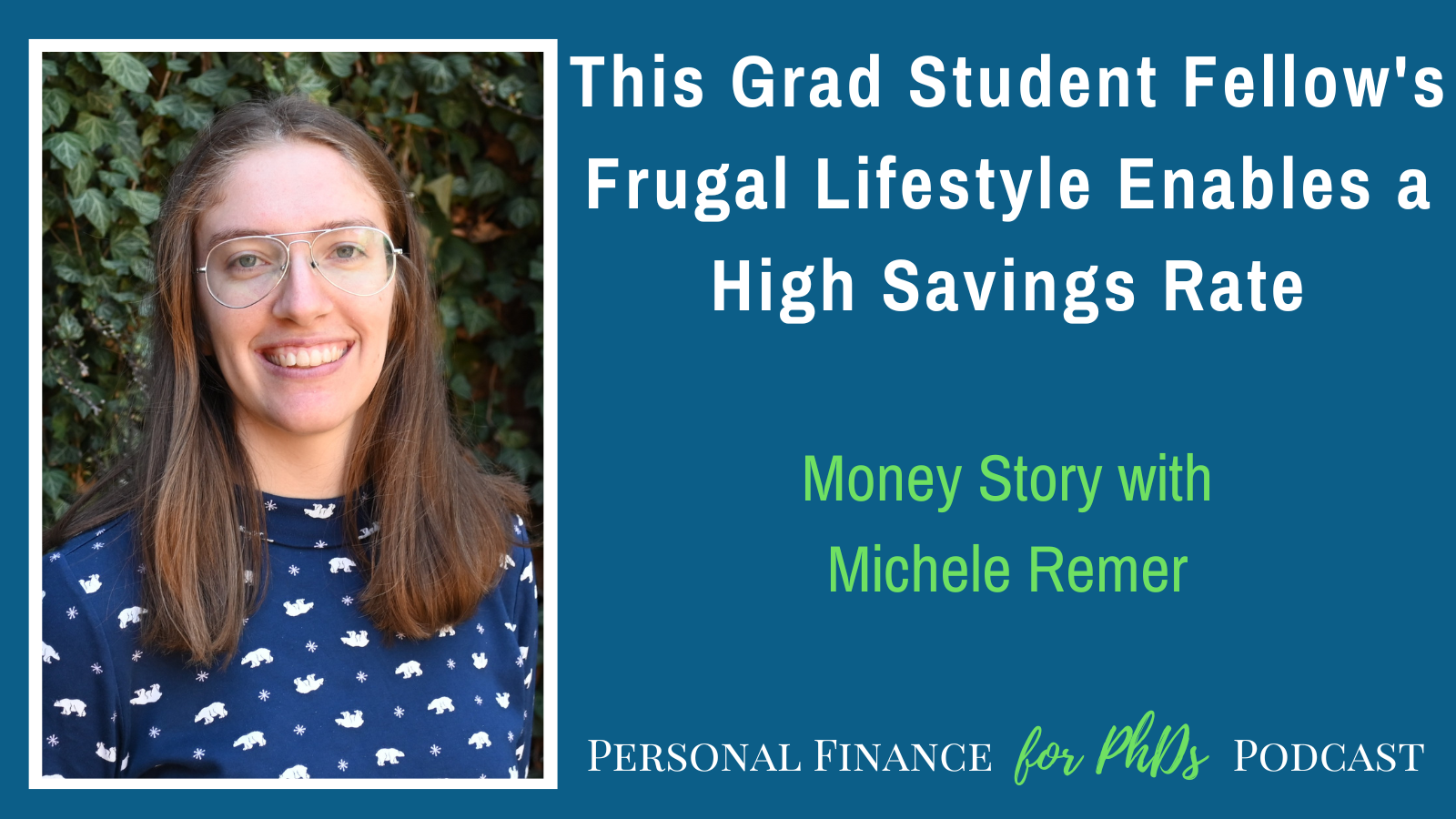
This Grad Student Fellow’s Frugal Lifestyle Enables a High Savings Rate

June 29, 2026 by Jill Hoffman Leave a Comment

In this episode, Emily interviews Michele Remer, a 4th-year PhD candidate at Michigan State University and repeat podcast guest. Michele breaks down her budget, detailing her top five largest expenses: rent, groceries, utilities, restaurants and social events, and transportation. During grad school, she has found ways to decrease her spending on some necessary expenses, which has allowed her to intentionally increase her spending in other areas of higher value. Due to her frugality and her National Science Foundation graduate research fellowship award, Michele has maintained a very high savings rate, which she puts toward her Roth IRA, taxable brokerage account, and student loans.

Links mentioned in the Episode

  • PF for PhDs Subscribe to Mailing List
  • PF for PhDs S13E8: This First-Year PhD Student Prioritizes Investing While on Fellowship
  • PF for PhDs S8E13: Can I Make Extra Money as a Funded Graduate Student on an F-1 Visa?
  • Host a PF for PhDs Seminar at Your Institution
  • Emily’s E-mail Address
  • PF for PhDs Podcast Hub
This Grad Student Fellow's Frugal Lifestyle Enables a High Savings Rate

Teaser

Michele (00:00): I’m just like, okay, I send my money here to, uh, pay off the debt, or I send to my savings account to save up, to pay off debt, or I’m sending it to my investment accounts. And so it’s not super exciting once you’ve got it set up, but I think that’s a good thing because then you just kind of get to live your life while it’s all happening in the background. So as long as you kind of have your expenses figured out, which is really nice.

Introduction

Emily (00:34): Welcome to the Personal Finance for PhDs Podcast: A Higher Education in Personal Finance. This podcast is for PhDs and PhDs-to-be who want to explore the hidden curriculum of finances to learn the best practices for money management, career advancement, and advocacy for yourself and others. I’m your host, Dr. Emily Roberts, a financial educator specializing in early-career PhDs and founder of Personal Finance for PhDs.

Emily (01:03): This is Season 24, Episode 2, and today my guest is Michele Remer, a 4th-year PhD candidate at Michigan State University and repeat podcast guest. Michele breaks down her budget, detailing her top five largest expenses: rent, groceries, utilities, restaurants and social events, and transportation. During grad school, she has found ways to decrease her spending on some necessary expenses, which has allowed her to intentionally increase her spending in other areas of higher value. Due to her frugality and her National Science Foundation Graduate Research Fellowship award, Michele has maintained a very high savings rate, which she puts toward her Roth IRA, taxable brokerage account, and student loans.

Emily (01:49): You’re probably listening to this podcast because you’re interested in improving your own practice of personal finance, and you want to learn the best PhD-specific strategies. Well, you don’t have to listen through the entire episode archive to do so. Instead, go to PFforPhDs.com/advice/ and enter your name and email there. You’ll receive a document that contains short summaries of all the answers ever given on the podcast to my final question regarding my guests’ best financial advice. The document is updated with each new episode release. Plus, you’ll be subscribed to my mailing list to receive all the latest updates there. Again, that URL was PFforPhDs.com/advice/. You can find the show notes for this episode at PFforPhDs.com/s24e2/. Without further ado, here’s my interview with Michele Remer.

Will You Please Introduce Yourself Further?

Emily (02:59): I am delighted to have back on the podcast today, Michele Remer. We, she first gave an interview for us in season 13, episode 8, published in 2022. At that time, Michele had just started graduate school at Michigan State University. She’s now finishing up her fourth year. During today’s interview, we’re gonna do a budget breakdown episode. So we’re gonna get to hear about Michele top five expenses, some other things she has going on in her finances, and we’re also gonna talk about how those certain expenses and so forth have changed over the last few years. And so it’ll be really interesting if you wanna go back and listen to that earlier episode to get that time point, to get the time point right now to get the um, how Michele summarizes that things have changed over that period of time. So Michele, thank you so much for volunteering to come back on the podcast. It’s great to have you. And will you please introduce yourself a little bit further for the audience?

Michele (03:47): Yeah, I can. Hi everyone. Um, like Emily said, I am doing my PhD and so I’m doing it at Michigan State University and I’m now a PhD candidate after passing my comps last semester. So officially went from student to candidate. Um, my undergrad degree was in environmental biology and now in my PhD I am in the Fisheries and Wildlife Department. And then, um, before starting my PhD, I worked a few seasonal jobs, one of which was volunteering with AmeriCorps, which I talked about in the previous episode. So that kind of gave me some good experience for learning how to save money and, um, knowing that going into this field I wouldn’t necessarily be making a ton of money.

Current Fellowship Income, Additional Income, and Household Size

Emily (04:31): Well, again, it’s wonderful to have you back. Um, okay, so let’s talk about today. Uh, you’re at Michigan State. Tell us a little bit about yourself, your household, if there are any other people or beings involved with that. Um, and you have an assistantship, do you have a fellowship? What’s going on with your income?

Michele (04:49): Yeah, so I, like I said, I go to school at Michigan State University, so that’s located in East Lansing. I actually live in the Lansing area as that is a bit more affordable, not living like super close to campus, relatively. Um, and then I’m also on fellowship currently and have been throughout my time at Michigan State. And I currently have one roommate in a shared house that I’ve lived in since the beginning of grad school. But this has changed from when I first started since originally we had three grad students in this house, but we’ve gone down to having only two people now.

Emily (05:26): Yes, I remember, I mean, your interview has really stood out for me over these years as you having this like ace in the hole with how much your, how much your rent was at that time <laugh>. So we’re gonna talk about the rent amount when we get there. Actually we’ll talk about the roommate situation too when we get to talking about rent. But good to know you’re living with one other person in a house in Lansing. Um, can you tell us what is your stipend income, your, your fellowship income, and then do you supplement your income in any way?

Michele (05:50): Yeah, so I was very lucky. I was fortunate to receive the GRFP and I was also lucky in the sense that I received it after the stipend increase went up from $34,000 up to $37,000, which in Lansing is very nice income to have. Um, and then, so I’m currently at the last year of the GRFP and that’ll be transitioning back into a university fellowship. So my income will actually go down, um, starting in September, but I will be supplementing that with another job over the summer helping out, uh, one of my committee members with some field work. And so it’s not quite making up the difference, but it’s getting me a little bit closer, which is nice.

Emily (06:32): So you’re anticipating coming off the GRFP, you’ve taken these measures to try to supplement your income currently, but in the past several years, have there been any points when you’ve made additional income?

Michele (06:43): Yeah, so throughout my time in grad school I’ve had what I call several small little side hustles that I’ve had. So that’s included opening, um, bank accounts to get the bonuses. Chase had one, I think last year that you got additi- an additional $900 if you open the checking and the savings account with them. And to, you just have to, to avoid having a fee, you just have to make sure you have direct deposit set up with them. And then I also did that for our local credit union at MSU. They had a similar thing when I first started grad school, so I think I got like an extra $100 from that. And then another thing that I’ve done is I open credit cards when I know that I have a big expense coming up. So in order to get like those travel bonuses, so like for my health insurance for instance, when I, I have to pay that with a credit card and so then that way I’m not spending my own money on trying to get these travel rewards.

Michele (07:36): And so that’s been also really nice. I haven’t done it too many times, probably just, uh, like twice maybe. But it has been nice to get a little bit more like travel points in that sense and then to cover various research projects or other professional development opportunities like conferences. I’ve applied and gotten some smaller fellowships through the university and I’ve also like volunteered at a conference to get lower registration before in the past. So just a few different ways to kind of, even though like with conferences it’s kind of sometimes a gray area between like who’s gonna cover it, it, it’s helpful for making sure that you have that and it looks nice in your CV, so.

Emily (08:14): Yeah, I love that you mentioned those specific avenues. Um, because they’re available to everybody. Like I don’t wanna speak out of return about visa regulations and so forth. So always international students need to be careful about what kinds of, um, avenues they pursue for earning additional income. But go back to my previous episode with um, Frank Alvillar and Sheena Connell about whether or not credit card rewards and those kinds of things, banking bonuses would be okay or not typically. Um, so go check that out. But none of these are gonna violate like the terms of your fellowship. They’re not going to, you know, rub your advisor the wrong way to be, you know, pursuing a credit card or like volunteering at a a conference. Those are absolutely very, very accessible ways for people to supplement your income and not ones that take hardly any time. I would classify those as passive, um, pursuits for increasing your income. So I love those suggestions. I hope that people um, take them to heart if they are looking for a little like marginal ways to either decrease some expenses or increase their income a little bit. When you were last on the podcast, I know we talked about your Roth IRA, so I wanna hear an update on what your current financial goals are, um, and how they’ve changed over the past few years.

Current Financial Goals, a 20% Savings Rate, and Debt Repayment

Michele (09:25): Yeah, so for the investing side of it, the Roth IRA, I’ve continued to focus on maxing it out. Um, even with the increases in the, I guess the floor for the Roth IRA, I think now you can do up to $625 a month, um, which is really nice that I’ve, with the GRFP been able to afford investing that. Um, and so that’s something that I try to prioritize when I can. If there’s like certain months where I’m not able to, then obviously I wouldn’t invest it. But that’s something that I’ve continued to prioritize.

Emily (09:59): Yeah, I think we’re up to $7,500 on an annual basis in 2026. I think that’s correct. And so with your income of $37,000 you’re looking at, that’s just about a 20% investing rate off of your gross income rate. So that’s pretty high for a graduate student. I know you’re about to say you’re working towards other goals as well. So just wanna put that touch point in there of like, okay, already like you have a relatively like very high savings rate for your current position. That’s awesome. Okay. You’ve got the Roth IRA, you’ve maxed it out even with the increases along the way. What else?

Michele (10:32): Yeah, so then with, if I do have like extra money at the end of the month, besides on top of the Roth IRA, I’ve been doing the a taxable brokerage, um, which that’s just obviously not as tax advantaged as a Roth IRA, but it still is helpful, especially for me. I’m not planning on buying a house anytime soon. The market is <laugh> not the best and I don’t know exactly where I’ll be. So I don’t really have a plan of purchasing a house in the next like five years or so and so, and I’m probably gonna continue renting. And so for me, I think it makes more sense for me to put additional money into, uh, investing rather than leaving it in a savings account. And then, um, the other thing that I did wanna mention that I just recently got a Fidelity credit card. This one don’t worry, no annual fee involved, but you, it gives you extra rewards if you, uh, invest in their Fidelity account, which can be your Roth IRA or a taxable brokerage. Um, and it’s also really nice if you charge any of your reimbursements for conferences or like I said was saying health insurance on there, you can get a pretty sizable percentage back or I think it’s like 2%, but when you’re paying that much, it’s a pretty big chunk of money, um, which is nice. So.

Emily (11:49): I love that idea as like, ’cause you mentioned opening credit cards for like, like signup bonuses. Um, I love the idea of having a baseline amazing cash back in a sense card like this Fidelity card is.

Michele (12:01): Yeah, I’ll say amazing is kind of a relative term, but <laugh>, it’s,

Emily (12:05): Yeah, but, but 2% for cashback card

Michele (12:07): Even $100 extra is so nice. So.

Emily (12:08): Yes. It is awesome. And then when you’re not working on a signup bonus, falling back and like always using that 2% cards great plan.

Michele (12:15): Yeah. Uh, which is really nice because I’ve found after doing a few of the annual fee cards, it’s, it gets to be kind of annoying to deal with and like having to remember to cancel it eventually if like you don’t, aren’t getting the enough rewards to kind of cover the cost.

Emily (12:31): Okay. So we talked about your Fidelity relationship and that’s great. Um, what else have you been working towards?

Michele (12:37): Yeah, so besides the investing, I’ve been working towards debt repayment. So I had a sizable chunk of student loan debt from my undergrad university since I went to, um, a private like liberal arts school. And so for that I, I borrowed from the federal government and then I also borrowed from a few family members who luckily had money saved up for me to go to school. And so as of right now, and I think in about three months I’ll have repaid my debt to my family members, which is awesome because I did not want to have to like owe them money anymore.

Emily (13:16): That’s incredible. And actually it’s particularly incredible that you’ve accomplished this during graduate school. So can I ask about, I don’t know, whatever you’d like to share, like either the starting balance or um, how much you’ve been paying on a monthly basis? Has it been regular or irregular? Like how has that relation-, that repayment relationship worked?

Michele (13:35): Yeah, so for this relationship, so it’s my parents, I, um, send them the money through, we have like a shared checking account kind of set up or I guess it’s like a shared bank account set up for this. So I send them like a set amount every month. And then also what I was doing at the beginning of grad school when I, I had extra money too because I just like didn’t want to owe them all this money. I think it probably started out at around like maybe 8 or $9,000. And so I was sending them like extra money as like I saved it up. And then I also, um, was just doing like a base of like a hundred dollars a month, um, just because I didn’t want to have to pay them back this money and I wanted them to have it back as soon as possible. And so that’s been really nice to basically by the end of grad school have, have that debt paid. And then for my other debt that’s through the federal government, I only took out the subsidized loans that I was offered. So that means like I didn’t pay any interest during grad school. And so for that I put it into like a kind of like a CD ladder when I had the, the rates were good, I would put it into a CD. And so then that way I’ve saved up like a large chunk of money to hopefully pay back, if not all of it, by the time the interest payments like come due, then I’m gonna be pretty close to paying off the debt. So I’m excited for that too. <laugh>.

Emily (15:05): Yeah. That’s incredible and I love that you’re introducing this idea of a CD ladder to the audience. It’s not something that, I don’t know that I’ve ever discussed on the podcast before. Um, but basically I love this approach because as you said, when we’re dealing with subsidized loans, not accruing any interest, you do not need to take any action and like your money is gonna be doing better for you literally in a savings account or a CD ladder or you know, money market account. I, I like that you’re not investing it. Right. I like that you’re not taking a lot of risk with it because you know, yes, this is gonna come due. Yes, I do wanna make these payments, um, pay it off quickly once you know it’s back in repayment. So I love that you’re not taking risk with it, but you’re doing as best as you can in terms of the interest rate, um, in the meantime. So wonderful approach. And another point of congratulations of wow, like look at all that you’ve accomplished financially during graduate school, like maxing out the IRA yearly, you know, getting ready or almost completely repay your student loan debt. Like that’s a lot to do as a graduate student.

Michele (16:07): Yeah, I’ve been really fortunate just the way everything lined up with the GRFP and um, also just, I mean we’ll get into my expenses, but I’ve also been able to keep my expenses relatively low as well, which is a good thing to be able to meet all these goals. And I will also say that I became a big fan of Mr. Money Mustache in <laugh>, uh, during grad school. And his approach really helped me be like, okay, how do I lower my expenses as much as possible, um, and kind of make sure my money is going to the right avenues. So.

Emily (16:43): Um, I’m not a big follow of follower of Mr. Money Mustache, obviously I have listened to him plenty of times and quite familiar with him, but, um, what I like about his approach is it’s really about finding satisfaction in a lower spending lifestyle. So it’s not about staying in your mind in a, um, a state of deprivation. It’s really about finding joy in simplicity and a low spending lifestyle. And I do think it’s quite compatible with the situation that graduate students are forced to be in, at least for a period of time. So I’m glad you found something that kind of like helped you with your overall, you know, disposition towards this financial stuff during graduate school. Um, is there anything you’d like to add about these, um, various goals that you’ve had or how they’ve shifted over the course of graduate school?

Michele (17:29): That’s the other thing is that it’s pretty boring when you’re doing like your finances in a, like a healthy way, I guess. Just like, okay, I send my money here to uh, pay off the debt or I send to my savings account to save up to pay off debt or I’m sending it to my investment accounts. And so it’s not super exciting once you’ve got it set up, but I think that’s a good thing because then you just kind of get to live your life while it’s all happening in the background. So as long as you kind of have your expenses figured out, which is really nice,

Emily (18:01): I think that’s very insightful. Healthy finances are boring. Like once you get it sorted out, you put everything on autopilot. Um, they’re boring, but that’s a good thing. Like you said, you can shift your attention away from those financial elements. You don’t have to pay a lot of attention to it once you have your decisions made and your system set up and then you’re free to <laugh> do anything else with your mind and your time. Um, so I think that’s very insightful. It’s not something that has to consume you continually, forever and ever and it shouldn’t, it shouldn’t be exciting, honestly, like you said, I mean I find it nice over time, you know, check the investment balance periodically, especially if things are going well, you know, in the market. Yeah, go ahead and check it. If things are not going well, don’t check it. <laugh> don’t look, you don’t need to know.

Michele (18:41): Yeah, it’s, it’s kind of crazy too just when, when you do get to like a stable place and you’re able to invest regularly, just looking back at my account over the past five years, it’s like, wow, like I didn’t think that this would add up to this much, you know, with the compound interest and this payments that I’m making. So yeah, it’s very satisfying. I will say once, I know not every grad student is able to contribute as much as I am, but even like if you can’t contribute until you graduate, like just starting out now is also, um, still gonna be help people out in the future.

Budget Breakdown: Housing

Emily (19:20): Okay. Let’s dive into those five, those top five expenses. Um, and feel free also to share how they’ve changed over the course of time in graduate school. Um, and I know number one is gonna be housing, it’s always housing for everybody. Um, so share about the rent payment that you’re making and share about how you only have one roommate now instead of two, like before. What’s going on with that?

Michele (19:42): Yeah, so basically when I started, um, the rent was probably, I mean I couldn’t really have gotten cheaper rent somewhere else, but it was $375 a month, which is insane <laugh>. Um, but it was $375 a month because we had three grad students living in a shared house with like one bathroom, one kitchen. And so that’s kind of why we decided. We had one roommate who graduated and moved out and she lived in like the top floor, which she was a trooper for living up there because it, it was like an A frame and so it’s not like a super great spot if you’re tall like me, I have to kind of lean when I go up there. Um, and so we were, my other roommate and I were still living here. We were deciding if we wanted to have someone else on the lease, but our other roommate had graduated and moved out. So we had the summer to our ourselves and during that time we were like, well, it’s really nice like sharing the bathroom with one less person, not having as much, um, to think about like the kitchen space as much. Like we still kind of had to plan around like our meal prepping around each other, but it wasn’t quite as bad as it was with three people since we didn’t do like a, we didn’t like cook together, we all cooked individually. So that was also a challenge. And so based on that and we both, my roommate, uh, who I lived with for the past three years was also on the GRFP, so we decided okay, we could probably swing to having just two of us. So that meant that our rent, it’s gone up slightly more since then, but currently it’s at $600 a month. So it’s still very affordable compared to other places around us as well and like living by ourselves would’ve been.

Emily (21:22): So your, the whole house is $1200 a month and you and your roommate are each playing paying half.

Michele (21:29): Yep. And so that roommate that I mentioned, she graduated in December, so she moved out and then, um, we, I think technically she’s my current roommate is like subletting her portion of the lease, but we’re gonna resign it in for the next year and then that’s gonna go up slightly to 630 a month each. So it’s going up by $60, which my landlord apologized, but I was like, it’s really not that much compared to like other places because he had like his property tax go up in his like rental fee. So.

Emily (22:00): Sure. And I’m also doing some quick mental math, um, that’s around 20%, right? Maybe a little over 20% of your gross income a little bit higher if we’re talking about net income, but really quite again, quite manageable. Like nobody is feeling rent burdened right on 20%.

Michele (22:17): No, no, it’s been, it’s a pretty affordable rent I would say. I know that, um, like some of my friends who live alone, they’re paying around like, um, eight to 900 a month for theirs. And so then there are other grad students though who are in like a shared housing situation. I think that’s pretty common for Michigan State at least.

Emily (22:42): Yeah, well I can see that even though you’ve elected to pay more in rent than you absolutely could have, um, still seems super affordable. Hopefully you’re getting use out of the space and you like only sharing with another person, like you said. Um, anything else you wanna talk about in terms of your rent expense?

Michele (22:57): It helps that, I’ve had great roommates who like, I think living with other grad students is really helpful ’cause you know, they’re all gonna be like respectful and um, kind of respecting your time. And also like that you’re also like both maybe working from home sometimes if you need to. So I think it, it’s really nice when you have like great roommates and I, I, I also prefer that because it helps you save money in other ways too if you’re, if we’re talking about like the financial side of it, but also like, I think the emotional side of it is great too to have someone like living with you. But um, it’s also nice like, you know, you can have your roommates like give you a ride to the airport if needed or pick you up from somewhere or like, just like take care, water your plants. My previous roommate had a cat and she never had to pay for a cat sitter ’cause I would always take care of her cat for her. So yeah, it’s just things like that, it’s just very useful to have a roommate I think. And I, I enjoy living with roommates. So.

Commercial

Emily (23:56): Emily here for a brief interlude. Would you like to learn directly from me on a personal finance topic, such as taxes, goal-setting, investing, budgeting, or designing your financial life, each tailored specifically for graduate students and postdocs? I offer live workshops, asynchronous online courses, and cohort-based programs on these topics, and I’m now booking for the 2026-2027 academic year. If you would like to bring my content to your institution, would you please recommend me as a speaker or facilitator to your university, graduate school, graduate student association, medical school, postdoc office, or postdoc association? My workshops are usually slated as professional development or personal wellness. Orientations, postdoc appreciation week, or close to the start of the academic year would be a perfect time for tax education or general personal finance content. Ask the potential host to go to PFforPhDs.com/financial-education/ or simply email me at [email protected] to start the process. I really appreciate these recommendations, which are the best way for me to start a conversation with a potential host. The paid work I do with universities and institutions enables me to keep producing this podcast and all my other free resources. Thank you in advance if you decide to issue a recommendation! Now back to our interview.

Budget Breakdown: Groceries

Emily (25:28): Let’s talk about your grocery expense. I know that’s number two on your list. Um, so tell us about your grocery spending.

Michele (25:35): Yeah, so I just looked at it for the last month, which it came up to $250. I would say that’s pretty average for me. I did go to a conference in like the beginning or at the end of April. And so like that was all covered by like a travel award. So I think it’s usually ranges between like $250 and $350 a month depending on like how much I’m spending or like if I have to do like a restock or something like that. And I will say I’m vegetarian so that also helps me save a lot of money too ’cause I’m not buying meat. So yeah.

Emily (26:08): Definitely. What do you find are other ways? ’cause I know yes meat is expensive, but so is dairy, so are nuts. So are, you know, other things, there are categories there that are expensive as well. Can you share anything about the way that you eat? Like do you have certain go-to meals or do you uh, batch prepare things? How does that work?

Michele (26:27): Yeah, so I guess I’m trying to think about like my day. So like for breakfast I usually just have the same thing. I have like two eggs with toast, so it’s pretty basic and I kind of know where to get like cheap, the cheap bread now, well I’d say cheap bread. Cheaper bread. I like don’t wanna get the like just tiny squares of white bread. I like to get good stuff. But um, yeah, like Trader Joe’s, we just got one of those in East Lansing, so I usually go there for that. Um, and then for lunch and dinner it’s usually like I will cook like on the weekends and then also like maybe on like Wednesdays or if I have time during the week and then I’ll just have my leftovers for both lunch and dinner. And then I also do what I call my bridge meals. So I’ll get like something like gnocchi at Trader Joe’s or some other frozen meal that if I’m like traveling or coming back and I don’t wanna make sure that I’m not ordering like takeout or something like that, I’ll have that ready to go. Um, and then that helps me too. And then as for the meals that I’m cooking, they’re usually, uh, pretty basic, some variety of having like beans or lentils with veggies and so those are all pretty cheap. Um, I do also do protein shakes, so that’s a little bit more just because I’m getting like protein powder and Greek yogurt and things like that. But, um, another way that I’ve saved some money on groceries too is I, I wish that I’d realized this sooner, but one of the grocery stores near me has a 10% off like discount for students. So you, with your student id, you can get um, 10% off groceries, which is really nice.

Emily (28:06): I hadn’t heard of that before actually. That’s amazing. Is it like a co-op or like locally owned or?

Michele (28:10): It’s actually one of the Meijers, but it’s like oh, the downtown location. And I think that maybe they were having issues like getting people to go there because it’s a little bit of the way for some people maybe, but yeah, I think, I’m not sure why they’re offering it, but I saw the sign and I was like, I have my student ID.

Emily (28:29): I was just gonna ask how you found out about it. So it wasn’t like another student who gave you that tip, you just saw a sign at the store?

Michele (28:34): Yeah, I literally just saw a sign at the store, so now I’ve been telling all my friends like, you guys should go here and get this 10% off with your student Id <laugh>.

Emily (28:41): Yeah, that’s amazing. What a good, I mean it’s a good idea for them, um, because yeah, most people don’t, I mean if you’re really frugal you would shop at multiple different places, but most people don’t shop that way. And so it makes sense to try to capture like people’s, you know, become the primary shopping destination for more people.

Michele (28:58): Yeah. And then the other way I save money on, on groceries, well is kind of getting into transportation, but I like to bike to go to the store <laugh>, so ah, um, that also saves you money because then you’re not buying anything that’s really bulky. So like, I’m not buying like pop or I guess, sorry, soda, um, Midwestern coming out, but um, things like that or, uh, any other like seltzer water, things like that I’m usually not purchasing. So.

Emily (29:27): Um, I would imagine also cuts down on impulse purchases if you’re looking at your, your backpack or your bags or whatever you’re using to carry the groceries. Um, I have a strategy that I now use, which is like, I very rarely physically go into grocery stores. I do all online ordering and then do pickup, um, which keeps like the impulse purchases at a minimum. 

Michele (29:46): Yeah, <laugh>. I will say that I, I’m not always going to the store with my bike so I, there is times where the impulse purchases still do come through, but it’s also just like a very enjoyable way to spend like a Saturday morning or afternoon even though the stores are kind of busy at that time, but it’s like a nice little bike ride to get there. So at least for me when I’m going to certain stores it’s like, um, like a nice trail. So

Budget Breakdown: Utilities

Emily (30:14): Yeah, I love to hear about that. Your next expense you told me is utilities. Lots of different utilities under that umbrella. Tell us about those expenses. Um, what they amount to typically and how they’ve changed.

Michele (30:25): Yeah, so those have gone up obviously since we have one less person. That was kind of when we were deciding if we wanted to have only two people live, the utilities, that was our sticking point because those can get quite pricey. So I looked at my past month and it came up to around $200, so that’s with electricity, water heating, cooling, internet, trash. And I also include my phone bill in that. So for like the first, obviously the phone bill I’m paying on my own, but everything else is split between my roommate and I and those are pretty variable just because, well I guess like the electricity and the water usually stays pretty, um, similar but like the heating and cooling, it’s more expensive in the winter here in Michigan to heat the house. And then we usually try not to use the AC unless it’s like super hot outside in the summer. And then the internet and the trash are also like pretty affordable. Um, I’ve actually managed to save money on utilities for the internet by switching from like a different provider. And then I also lowered the internet speed because most of the time, unless you’re like playing a lot of video games or something, you don’t need the speed that they give you as like the baseline. So yeah, that’s my utility bill.

Emily (31:49): Yeah, I love that you were, you know, conscious of that evaluating it because stuff like internet bills, they’re not the biggest things in your budget, but as fixed expenses, if you can just put in the like 30 minutes of effort or whatever it’s gonna take to like research it and, and call the company or chat with them or what have you, um, then you can sometimes get that bill lowered and very little effort, very long payoff like throughout the course of at least the next year. So that’s awesome. Have there been any other ways that you’ve decreased your spending on utilities over time?

Michele (32:23): Yes. So some of these people might not wanna do because they do take a little bit of extra time, but some ways that I’ve been able to lower my utility bills has been um, I line dry my clothes, which is obviously a lot easier when you’re in the house, but the dryer is kind of an energy hog.

Emily (32:41): I did that too during grad school.

Michele (32:42): Yeah, I actually, um, yeah, I have some like hanging up downstairs right now, but yeah, I just gotta, gotta time it if you like, need your like clothes at a certain time, like you gotta do like a day in advance, but it’s pretty easy. And then the other thing, um, my roommate who moved in probably doesn’t know what she’s getting herself into, but uh, I layer up in the winter, so kind of try to reduce heating bills by lowering the thermostat. Um, I think that’s a pretty obvious one. But then also in the summer, like running fans and keeping the blinds closed, um, like I said also the internet, but then my other thing I did was in Lansing at least the trash is you pay dependent on like the size of your trash and so I switch it to like the smallest size possible that only comes every other week. So that’s another way that I save money,

Emily (33:33): Another fixed expense that you managed to lower and as long as you’re confident you can like meet those, you know, those limits then that’s great.

Michele (33:41): Yeah. And then the last thing that just happened recently that I’m super excited about, I don’t actually know it’s gonna affect my energy bills at all, but, uh, I kept kind of pestering my landlord about our dishwasher and we just got a new one. And so even if it’s to save us money, it’s, it’s better because it’s a lot quieter so, and I don’t have to try to clean it as often. So yeah, that’s some ways to that I’ve done that. Well then I guess also the, um, for electricity, I don’t know if this is the case, like if it’s the same hours in other places, but our utility provider has like, uh, off peak and on peak hours, so we try to run like our bigger stuff like the dishwasher and the washing machine during those off peak hours.

Budget Breakdown: Restaurants & Social Activities

Emily (34:27): Definitely. Alright, then let’s move on. What is your fourth largest expense each month?

Michele (34:33): Yeah, so this one, the next two are kind of variable, but for this past month it was, um, $160 for restaurants and other social activities. So like this past semester I was the social chair and so I, I hosted some like department happy hours or I guess co-chair. And so that was, you know, we , would go out to like some bars and get like a drink or two and then also just going out to eat with friends as well.

Emily (35:03): And has that changed over the course of time?

Michele (35:05): Yeah, I would say that I, when I first started grad school I was a lot more frugal with those like kinds of social activities. I tried to limit them a little bit more, like tried to have people over at my house rather than going out as much. But now I’ve been that I feel like I’m in a better financial position. I have been going out to eat more often. Um, and then I guess another thing that I’ve started doing is I’ve been doing some sports leagues, so do like, um, adult volleyball or um, sand volleyball as well. So those have like higher costs to them as well, but they’re pretty affordable I would say, especially spread over the like the weeks that you’re participating in them.

Emily (35:50): I just love this that, you know, getting this picture of you at the beginning of graduate school and now four years in, like you’ve found ways to spend less in certain areas. You’ve also decided that it’s worthwhile to spend more in certain areas and still along the way you’ve done all this investing in debt repayment and it’s absolutely wonderful. So I’m very glad to hear that, you know, you’re putting your dollars where you value them.

Michele (36:10): Yeah, it’s, it is definitely like an adjustment because I feel like for so long, like you, like I said, I, I volunteered for AmeriCorps and then in undergrad I was like just saving money all the time and so it’s been nice to be like, okay, I have a little bit of breathing room now and kind of let loose a little bit more with some of my like, like I can go out to eat more often now. So it’s been nice.

Emily (36:36): I think we should do another follow up interview in another four years when you have a proper salary <laugh>, like, we’ll see, we’ll see where you are then. Are you, like, are you still very low spending or have you managed to, you know, moderate with the newer income or are you going crazy with investing? Like, yeah, we’ll let’s put a pin in that and, and return to it. Um, okay, your fifth, uh, highest expense in your budget? What’s that?

Budget Breakdown: Transportation

Michele (36:57): Yeah, so this one was also higher for this month because I went on a trip but, or kind of a trip I went home to visit family. Um, the transportation was $125 and so this usually is closer to $70 for car insurance and gas. But like I said, I like to bike a lot, so my gas is usually pretty low, which is also good for the current gas prices.

Emily (37:23): So it sounds like you have a paid off car, right? Can you tell us about your car?

Michele (37:28): Yeah. Okay. So for the car, it’s basically the same one that I’ve been driving since high school and like I said, my parents are very generous and so they made sure that me and my siblings each had a car. Um, and yeah, I basically don’t put any miles on it. I just use the car basically for like big trips and then if I do need to, like I’m going to those volleyball leagues that are kind of further away from campus then I’m driving to those things. But I, I try to keep my driving to minimum, which also is, is the money, but also because I’m really cognizant about my carbon footprint being in the Fish & Wildlife department. So I, I try not to drive as much as I can.

Emily (38:07): I see. And another way that you have found a kindred spirit in Mr. Money mustache because he definitely writes a lot about not owning a car or minimizing your car usage. So how do you commute to campus?

Michele (38:19): Yeah, I, I bike to campus so I have, the way I do it, I have like, um, a mountain bike that I put like a rack on the back and then I have two like bike bags that I attach. So it’s plenty of room for like my laptop and any other things I need to bring like books or um, like a change of clothes if I’m going to like work out or something like that. So yeah.

Emily (38:42): Have you thought about getting rid of the car entirely and if so, what, why are you keeping it?

Michele (38:48): I have thought about getting rid of my car, but I don’t want to because it’s very hard to live in the US without a car. Um, just like I said for those times where I am doing like a trip or something. And then also for those times where I’m traveling a bit further on to the outskirts of town, it’s basically if I just like worked and stayed at home, I wouldn’t need it. But since I do value those social activities then I do still need the car.

Emily (39:20): It is great. I feel like for something like this where it’s like, yeah, I get some marginal utility out of it. It’s not like a daily thing. It’s good that it’s falling to number five on your list and it sounds like some months it might be even lower, right? ‘Cause in particular you had a trip that you took this month, so in some months it might even be outside of the top five. Um, and that’s about the right size for something that is like, yes, this enhances my life in some, some way. It’s not totally essential. So it’s good that it, you know, that it is a paid off car and that the insurance doesn’t sound like it’s too expensive and, and you’re not using it that much. So the, the operating costs are not very high.

Michele (39:54): Yeah, I will say I did use it more this past semester than I have in the past just ’cause it was a particularly intense Michigan winter um, so I drove to campus a bit more than I usually do and um, just kind of had it on retainer a bit more than I usually do. But yeah, I’ve been usually like biking through the winter too. So.

Emily (40:17): How do you park on campus when you do drive?

Michele (40:20): My office is kind of on the outskirts so um, it’s kind of far away and so it’s not like, um, as big of a deal for me to park over there than it would be so I kind of just risk it on getting a ticket <laugh>. Um, and usually I, so far I’ve been fortunate but for my office parking, but if I am going on further onto campus, I pay, there’s like a pay by plate option so I’ll pay like five bucks or whatever it is for however long I’ll be on campus.

Emily (40:51): Gotcha. So once again, the car comes into use and these like occasional, okay the weather’s particularly bad occasional scenarios. Um, great. So that’s your backup plan for getting to campus is you have your car and you can <laugh>, um, skirt the parking regulations since there don’t seem to be any consequences <laugh>.

Michele (41:10): Yeah, well there is, um, there’s tickets but I somehow have avoided the parking attendants, um, just because it’s kind of for off the beaten path for them. But yeah, ’cause I think it wouldn’t really be too much, but um, the grad students are always doing that calculation like, how many tickets <laugh> would I need to get before getting a parking pass? So, so far it’s kind of the math that’s worked out for me.

Best Financial Advice for Another Early-Career PhD

Emily (41:35): Gotcha. Well we’ve run through your top five expenses. I mean, I’m just so pleased that like you’ve, you know, honed in what’s, what’s of value to you over time that you’ve obviously had these great financial accomplishments, you know, especially coming up in another year, whatever the timeframe is on your graduation, you can really say, wow, look at all these things I accomplished financially during graduate school. It’s incredible. We will wrap up with the question that I ask all of my guests and I know I asked it of you before, but what is your best financial advice for another early career PhD? And it could be something that we’ve touched on today already or it could be something completely new.

Michele (42:11): Yeah, so I have a few things. When I was thinking about what my best financial advice would be, the first thing is to track your spending as I think it’s really helpful to plug any holes where you don’t realize where you’re spending more money. Like for me, I’ve been spending more recently on going out to eat than I have in the past. And so the way that I’ve done that is I’ve mentioned Fidelity a lot because I use them for basically everything, but um, they have this really nice thing where you can connect all your credit cards to one location and so that way you can kind of automate the tracking. Um, and like if you, you could also probably add in like if you’re Venmo people or using cash for something, then you could track it that way as well. And then another thing that I probably, I think that was my last, last time I was on, I talked about the Roth IRA, but I recommend not only sending money to your Roth IRA but making sure that you’re depositing funds into a, some sort of fund because I, I have talked to people in the past who have only put it into the account and not invested in it. And so just gotta make sure that you realize that it’s not a normal bank account and you need to invest the money. So those are my two big pieces of advice.

Emily (43:24): Yeah, so mistake I literally made with Fidelity with the first IRA that I opened, I don’t know, hopefully their interface has changed <laugh> in the intervening time, but I for sure made that mistake. Also, I’ll say that at the time mutual funds were the thing to invest in and there were higher minimums. Now we have ETFs and it’s a little bit more flexible. So another thing to look out for to make sure that you know, you’re investing appropriately and that your money is not just sitting in a money market account.

Michele (43:50): Yeah, yeah. I’ve helped, um, multiple people like set up their Roth IRAs, so I’m always like, okay, make sure you have to pick one of these funds now. And I try to, I think people get overwhelmed by choosing, so I’m just okay if here pick one of these three <laugh>, they’re all basically the same though. So

Emily (44:07): Yeah, definitely. Um, I list this when I teach about getting started with investing, I list this as like a separate step. Like one send over the money, two, make sure it’s inve- like a few days later. Like make sure that it’s actually invested where you intended for it to go. And it’s not just randomly like you missed a step there. It’s a whole other thing you have to consider. Um, absolutely. Well Michele, it’s been so great to have you back in the podcast. I’m so delighted by this update and thank you again for volunteering. It’s been great to speak with you.

Michele (44:36): Yes. And thank you for having me on again. I appreciate it and thank you for all of the great work that you do with this podcast and helping everyone out with learning how to <laugh> navigate finances as a grad student.

Emily (44:46): Yeah. Thank you for saying that.

Outro

Emily (44:58): Listeners, thank you for joining me for this episode! I have a gift for you! You know that final question I ask of all my guests regarding their best financial advice? My team has collected short summaries of all the answers ever given on the podcast into a document that is updated with each new episode release. You can gain access to it by registering for my mailing list at PFforPhDs.com/advice/. Would you like to access transcripts or videos of each episode? I link the show notes for each episode from PFforPhDs.com/podcast/. See you in the next episode, and remember: You don’t have to have a PhD to succeed with personal finance… but it helps! Nothing you hear on this podcast should be taken as financial, tax, or legal advice for any individual. The music is “Stages of Awakening” by Podington Bear from the Free Music Archive and is shared under CC by NC. Podcast editing by me and show notes creation by Dr. Jill Hoffman.
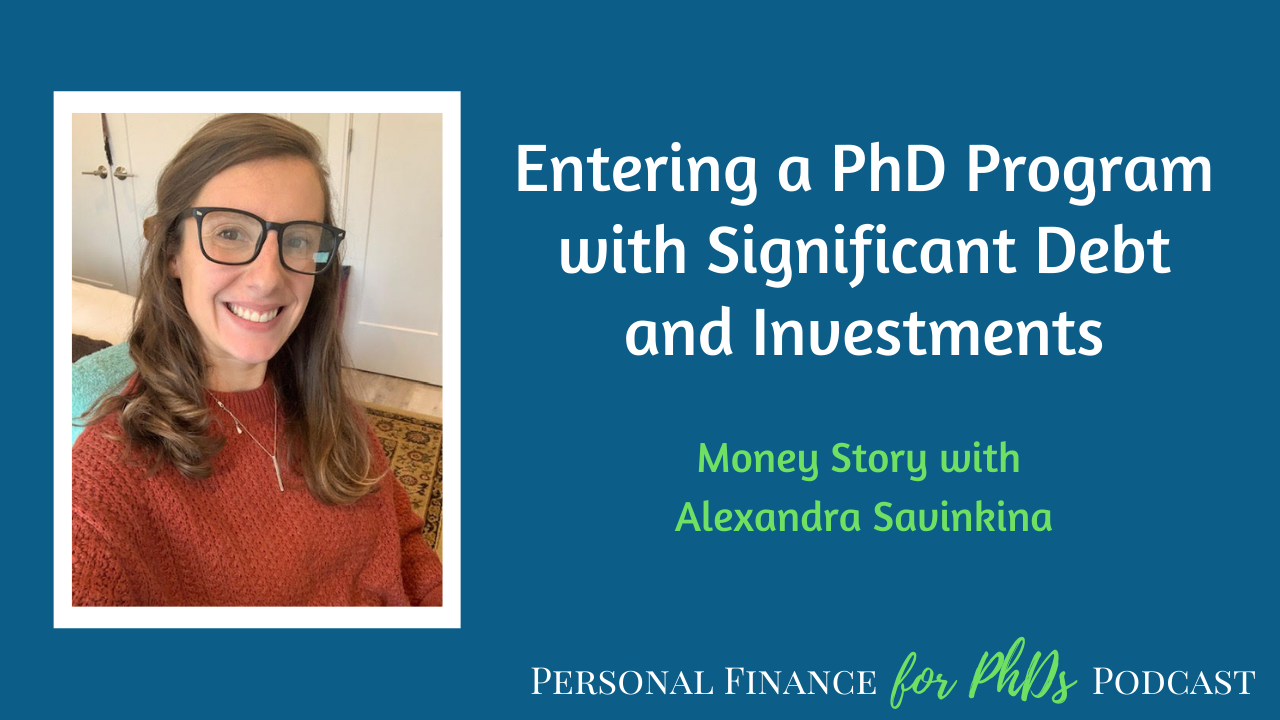
Entering a PhD Program with Significant Debt and Investments

September 6, 2021 by Meryem Ok

In this episode, Emily interviews Alexandra Savinkina, who is starting a PhD program at Yale University after completing a master’s degree and working for several years. She has spent the last few years pursuing Public Service Loan Forgiveness while contributing to retirement accounts and saving and is therefore entering her PhD with significant student loan debt and significant assets. Alexandra and Emily discuss Alexandra’s financial goals during her PhD, including how much to spend on rent, financing a car vs. purchasing it with cash, whether to defer student loans or stay in an income-driven repayment plan, and how to continue to invest for retirement while in grad school.

Links Mentioned in the Episode

  • PF for PhDs S10E2: What to Do at the Start of the Academic Year to Make Next Tax Season Easier (Expert Discourse with Dr. Emily Roberts) 
  • PF for PhDs: Quarterly Estimated Tax Workshop
  • PF for PhDs S7E13: How to Handle Your Student Loans During Grad School and Following (Expert Interview with Meagan Landress) 
  • PF for PhDs S7E8: This Grad Student Travels for Free by Churning Credit Cards (Money Story with Julie Chang) 
  • PF for PhDs S4 Bonus Episode 1: Fellowship Income Is Now Eligible to Be Contributed to an IRA! (Expert Discourse with Dr. Emily Roberts) 
  • PF for PhDs S2E5: Purchasing a Home as a Graduate Student with Fellowship Income (Money Story with Jonathan Sun) 
  • PF for PhDs: Podcast Hub
  • PF for PhDs: Subscribe to Mailing List 
PhD debt and investments

Teaser

00:00 Alexandra: Yeah, I think it will definitely be a lifestyle decrease. A lot of my spending, not in the last year, has gone to things like travel. And I also think that the longer that I’ve had a salary and have, you know, my social circle has been people with salaries.

Introduction

00:20 Emily: Welcome to the Personal Finance for PhDs Podcast: A Higher Education in Personal Finance. I’m your host, Dr. Emily Roberts. This is season 10, episode five, and today my guest is Alexandra Savinkina, who is starting a PhD program at Yale University after completing a master’s degree and working for several years. Alexandra spent the last few years pursuing public service loan forgiveness while contributing to retirement accounts and saving, and is therefore entering her PhD with significant student loan debt and significant assets. We discuss Alexandra’s financial goals during her PhD, including how much is spent on rent, financing a car versus purchasing it with cash, whether to defer student loans or stay in an income-driven repayment plan, and how to continue to invest for retirement while in grad school. This episode will be instructive for anyone anticipating or in the midst of a career transition or financial crossroads.

00:34 Emily: At the start of a new academic year, I always like to bring up tax considerations, especially for new graduate students. If you haven’t yet, go back and listen to season 10 episode two of this podcast titled, “What to Do at the Start of the Academic Year to Make Next Tax Season Easier.” If you have already started or switched onto fellowship funding for your stipend or salary, please take note of the upcoming quarterly estimated tax deadline of September 15th, 2021. To determine whether you are required to pay estimated tax, fill out the estimated tax worksheet on page eight of form 1040ES. If you need any help with the worksheet, consider joining my workshop at PFforPhDs.com/QETax. The live Q&A call for this quarter is this coming Sunday, September 12th. This is the best time to join this workshop to definitively answer whether you are required to pay estimated tax and how much income tax you can expect to pay in 2021. Again, if you’d like my help with figuring this out, the best place to go is P F F O R P H D s.com/Q for quarterly, E for estimated, T A X. Without further ado, here’s my interview with Alexandra Savinkina.

Will You Please Introduce Yourself Further?

02:46 Emily: I have joining me on the podcast today, Alexandra Savinkina. Our topic today is starting a PhD at a slightly older age. So Alexandra is 30 and she’s starting her PhD this upcoming fall in epidemiology. So I’m really excited to have her on. And Alexandra, would you please introduce yourself a little bit further to the audience?

03:04 Alexandra: Sure! Hi, I’m Alexandra. As you know, I’ll be starting my PhD this fall. I’m really excited about it. I got my bachelor’s degree back in 2013 in biology, and then during that time was working in an HIV virology lab and thinking about graduate school, but knew I wanted to go into the sciences. I was pretty sure I didn’t want to do bench work forever, and so instead of making that decision right away, I did a year abroad teaching in the South Pacific. And experiences there as well as past experiences kind of brought me to public health. So I did my Masters in Public Health at Emory University, right after getting back from the south Pacific. And then I worked at the Centers for Disease Control and Prevention for three years. And at that point started thinking more seriously about a PhD, but instead pivoted a little bit, moved to Boston, and have been working in academia for the last couple of years before really making that decision to pursue that PhD program now.

Why is Now the Right Time for the PhD?

04:14 Emily: I love that you’ve been out of undergrad, out of your masters for several years now. You have a really solid start to a career, actually. So why is it that you decided that this was the right time for the PhD?

04:25 Alexandra: Yeah, so I actually did apply to PhD programs to be totally transparent. Two years ago, I got into some programs, I didn’t get into other programs. And when I was weighing my options at that point, there wasn’t really any program that was a perfect fit in terms of both something that financially I was comfortable with in terms of stipend and really excited about the program itself. At the same time, my partner matched into a medical residency program in Boston. And when I was kind of weighing my options in that way, I hadn’t been accepted to any programs on the east coast, but I realized all of the programs I was really excited about were in the Northeast. So I started looking at jobs and ended up just accidentally finding something that when I read the job description was like exactly what I wanted to do.

05:22 Alexandra: But while working in this job and being like very solidly in academia, I think I’ve been able to realize that every single piece of the job that I really like is a piece that if I want to continue that as a career, I’m going to need a higher degree for. And so I think that’s really what’s led me to be like, okay, I definitely want to do this. And the upside is that during the last two years, I’ve really been able to grow my network, grow my skillset, and I was able to get into my first choice PhD program both from two years ago and from applying this around.

05:59 Emily: Amazing! What restraint you have, I feel like, for that application cycle from two years ago to get into some places, but then just to say, no, ultimately. Like, I just feel like you feel you’re so committed to that point, right? To the idea of going to graduate school, that I really commend you for holding out for what you really wanted in and you got it and that’s amazing. Congratulations!

06:21 Alexandra: Thank you. Yeah, it was very scary. It was a scary decision to make. So on this side of it, I’m pretty happy, but when I was kind of waiting to hear back from programs this time around, I think there was kind of that anxiety hanging over me of like, what if I don’t get in anywhere? And I did get in places two years ago, so I’m glad it worked out the way it did.

Tell Us About Your Balance Sheet: Assets and Liabilities

06:43 Emily: Yeah. I really can’t imagine that anybody would be a weaker candidate having, you know, another two years of work experience. Plus, you know, I think we could hear the clarity in what you were just saying about, you know, your career plans at this point. Maybe you didn’t have that or had that to a lesser degree, you know, two years before, but that’s amazing. Again, congratulations. So let’s talk about your money. You have money, and not money, at this point in your life. Your balance sheet is a little bit more complex than maybe when you’re coming right out of undergrad. So yeah. Tell us about, just give us a quick overview of your balance sheet, your assets, your liabilities, then we’ll talk a little bit more about each of them.

07:20 Alexandra: Yeah, so right now my one big liability are my graduate school loans from my master’s program. Yeah. That’s kind of the one big thing hanging over my head. I don’t really have any other debt right now. And then on the asset side, my assets are split mostly between my retirement savings, both from the 403(b) that I have from my current position. And then I’ve maxed out my Roth IRA every year that I’ve been able to. So for the last three years. And then the other half is sort of in standard savings as well as a long-term investment account and a little bit in short-term, like swing investment, which is just kind of fun money at the moment. But I’m living in Boston right now. I’m moving to New Haven. So my one new big liability is going to be a car that I’m going to need to purchase.

08:17 Emily: Gotcha. Okay, well, let’s start on the liability side. So it makes sense to me that you have student loan debt from a master’s in public health degree. And that is that just from the graduate degree or also from undergrad?

08:32 Alexandra: I had a tiny bit of loans from undergrad, but I’ve paid all of those off. So at this point, it’s just the graduate degree.

Paying Off Student Loan Debt

08:41 Emily: So let’s take this out of the context of you’re heading into graduate school just for a second and talk about, okay. You’ve been in the workforce for several years post-master’s degree. Have you been aggressively trying to pay down that student loan debt, or are you using public service loan forgiveness? Or what has been your plan for that debt?

08:59 Alexandra: Yeah, not aggressively paying it off. The first couple of years, I wish that I’d put a little bit more thought into it. I didn’t, I think at that point, my thinking was I’ll pay it off, but without any kind of really exact plan. For the last few years, I’ve really focused that more. And I am going for public service loan forgiveness. My job at the CDC did not qualify because it was a fellowship position, but my current job does. And so I’m about two years in, and I’ve gone through the paperwork. I’ve kind of stayed vigilant with that. And so I’m really hoping, I’m almost certain that any job I’ll take post-PhD will qualify. So I’m really trying to go down that path.

09:46 Emily: Yeah. This makes sense to me with your career plans for, ideally, it sounds like staying in academia, or if not, it seems like there’ll be plenty of nonprofit type work for you after that point. Sorry, did you say you were going to stay in academia? Or planning to?

10:01 Alexandra: Great question. I think right now that’s the plan. I want to kind of use this time in PhD to see if that’s really the course I want to be on. But I do love kind of the freedom that academia offers. I need to see if I’m any good at writing grants.

10:18 Emily: Gotcha. Okay. So plan A, academia, otherwise, probably a PSLF qualifying employer. And did you say approximately what that student loan balance was?

10:29 Alexandra: No, it’s right around $80,000.

10:32 Emily: Yeah. Okay. So I did an episode a season or two ago with Meagan Landress who’s a certified student loan professional. And so she shared with us her rule of thumb that she does with her consulting, which is around one and a half times your full income. So post-PhD income, your expected income. If your student loan debt balances one and a half times or higher, then that, again, it’s a rule of thumb, not super precise, but makes you a good candidate for income-driven repayment programs with forgiveness. Even down to about one times your income would be, if you had an opportunity to use PSLF, that could also be a great option versus paying them off aggressively. And since of course, you know, your ultimate career several years away, you probably don’t have necessarily a good handle on what that salary is going to be. And certainly in the intervening time, your salary is not going to be high during the PhD. So that decision makes sense. And obviously PSLF has a really popular program with academics.

Retirement Contributions, Investing, and Savings

11:30 Emily: Okay. So we have the student loan debt balance, but instead of paying that down aggressively, you’ve instead, it sounds like, been focusing on building up the assets side of the balance sheet. So you mentioned, you know, some retirement with your employer, Roth IRA contributions, and also taxable investments and cash savings, which sounds like a great sort of mix to have at this point. Is there anything that you want to share with us about how you’ve built that up or why you focused on that in the meantime?

11:57 Alexandra: Yeah, I think honestly coming straight out of my master’s program, it wasn’t especially difficult because, while I wasn’t making like a huge salary, it was hugely more than I’ve ever made before in my entire life. And so I think I’d been so used to living really frugally that it was easy to kind of save some money. And once I started and I started learning a little bit more about investment and about the value of money, I think I just made it a priority. So one thing I do is I just automatically have money transfer from my checking account to my savings account every single time I’ve a paycheck. And then I have money transferred directly from my savings account to an investment account as well. So it’s not even something that I think about. Like, it just happens automatically. I know that it’s going to happen. It happens when I know I have money in the account, so I don’t have to worry about like overdrafting. And so I think that’s been one of the best ways for me to do it is just kind of consistency.

Financial Predictions for Graduate School

13:05 Emily: Yeah. I love that strategy, obviously, automating as much as you can with your finances. So let’s shift now to talking about graduate school again, what I guess financial predictions have you made? So we’re recording this in June, 2021. So you’re still, it sounds like probably a couple months away from moving and starting your program. Can you share with us like what your stipend is going to be, and have you put together any of those big rock expenses? Like, do you have your housing set already? You mentioned a car that you’re going to purchase. Yeah. Can you give us kind of a picture there?

13:38 Alexandra: Yeah. So my stipend is $38,000. So my housing I do have set. My rent will be $800, and I’ll be living with a couple of other PhD students. I made the decision to live with people to save a little bit of money and also on the personal end, my boyfriend’s still in Boston. So I do plan on kind of going back and forth. So it didn’t make financial sense to necessarily put more money into living by myself. And then the other big thing will be the car. I’m planning on buying a used car, but I want something that will last me a little bit of time, and I’m a little bit anxious on the car side. I haven’t really owned a car in a long time. Haven’t really had to take care of one. So I want something that’s not too old and too unreliable. So I’m looking at about 10 to $15,000 on that. And I’m still sort of going back and forth between just paying it out right from my savings or financing to just have that monthly payment, which should be affordable.

14:41 Emily: Yeah. I mean, it sounds like with the stipend as relatively high, that’s among the higher stipends that I hear right now. Which is awesome. Congratulations. And then yeah, the rent being pretty reasonable for that level of income. Yeah. It sounds like you could afford the debt payment if you wanted to. But it also sounds like you have the option of paying in cash. So yeah. What are your thoughts there? So, in general, I kind of don’t love the idea of graduate students holding debt that they don’t need to. That is to say, debt that like, they need to actually be making payments on like a car payment. But, you know, you could do it. The other thing about that car purchase is I think it’s a lot more painful to part with cash than it is to finance something. And so you might end up with a lower-priced purchase if you told yourself it has to be in cash. So I don’t know. Where do you think you’re going to come down on that?

15:35 Alexandra: I’m really torn on it. I think part of it is almost mental. I think I know that if I have a car payment I need to pay, that money will go towards that car payment. I think I’m a little bit less certain that if I don’t have that car payment, that same amount of money will go into savings. And so I think that’s the one place where, and I don’t think that’s necessarily a good financial decision. But I think mentally that’s one of the reasons why I’m considering financing. But I agree with you. I am a little bit nervous about taking on more debt. And so I’m still sort of on the fence about it. I have been slowly putting away money. So I will have the cash kind of handy outside of investments if I do choose to do it out in cash.

16:27 Emily: And if you end up financing the car, will you keep that money in cash or will you invest it?

16:33 Alexandra: That’s the other thing. I would most likely transfer that into investments. And so there is some question about kind of where that money would be making the best value.

16:42 Emily: Yeah. So it’s more about like maybe leveraging debt, not just yeah, having cash, but also paying debt at the same time.

Commercial

16:52 Emily: Emily here for a brief interlude. These action items are for you if you recently switched or will soon switch onto non-W2 fellowship income as a grad student, postdoc, or post-bacc and are not having income tax withheld from your stipend or salary. Action item number one: Fill out the estimated tax worksheet in form 1040ES. This worksheet will estimate how much income tax you will owe in 2021 and tell you whether you’re required to make manual tax payments on a quarterly basis. The next quarterly estimated tax due date is September 15th, 2021. Action item number two: Whether you are required to make estimated tax payments or pay a lump sum at tax time, open a separate named savings account for your future tax payments, calculate the fraction of each paycheck that will ultimately go toward tax, and set up an automated recurring transfer from your checking account to your tax savings account to prepare for that bill. This is what I call a system of self-withholding, and I suggest putting it in place starting with your very first fellowship paycheck so that you don’t get into a financial bind when the payment deadline arrives. If you need some help with the estimated tax worksheet, or want to ask me a question, please join my workshop, Quarterly Estimated Tax for fellowship recipients. It explains every line of the worksheet and answers common questions that PhD trainees have about estimated tax. Go to PFforPhDs.com/QETax to learn more about and join the workshop. Now, back to our interview.

Expected Expenses and Lifestyle Changes

18:31 Emily: Do you have any idea about the rest of your expenses? It sounds like maybe you’re sort of a more naturally frugal person. So have you made any predictions on that front about like, you know, general spending money or like groceries? Or I guess what I’m asking is, do you think you will be able to keep a similar lifestyle to what you’ve been living the last few years, or will you actually have to take a lifestyle decrease and be a little bit more frugal on the lower salary?

18:57 Alexandra: Yeah, I think it will definitely be a lifestyle decrease. A lot of my spending, not in the last year, has gone to things like travel. And I also think that the longer that I’ve had a salary and, you know, my social circle has been people with salaries, eating out has become more expensive, trips have become more expensive. And that’s one of the things I think I’m going to need to be more careful of because, you know, most of my social circle aren’t grad students, but I will be, which is different than the last time I was a grad student where my entire social circle also made no money. So I think it’ll definitely be a little bit of cutting back on some of, kind of more of the luxury items I’ve gotten more used to. I’ve always been pretty frugal in terms of big expenses. Things like rent, bigger kind of monthly payments. But I have kind of splurged on some things which I’ll need to be a little bit more careful on, I think.

20:03 Emily: So, when you move, you’ll have a whole new cohort of peers. So, they will be making probably exactly the same amount of money as you, right? The people in your program, or more or less. So, you’re really talking about your partner and your friends in Boston and maybe other places around the country. Is that right?

20:19 Alexandra: Yeah. Yeah.

20:20 Emily: Yeah. So I’m thinking that it may be fairly easy for you to keep those day-to-day or month-to-month expenses on the lower side, since that will be, you know, the people you’re interacting with there in New Haven. But yeah, you may have to be pretty intentional about budgeting for travel, for example, or whatever are things you might be doing with these like older friends.

20:40 Alexandra: Yeah, definitely. And I think, you know, I really don’t want to be dipping into my savings for any kind of normal life expenses. So, I think I will just need to be a little bit more strict and careful about that. I do think it’s very doable. It is a very decent stipend comparatively, so that’s really nice.

21:05 Emily: Yeah. In the grad student world, it’s a great stipend. In the working world, it’s a low salary.

21:11 Alexandra: Yeah.

Travel Hacking and Asset Building

21:12 Emily: Yeah. Well, have you gotten into travel hacking at all? Is that something you practiced earlier on?

21:18 Alexandra: I’m not sure what that is.

21:19 Emily: Oh, okay. Yeah, so travel hacking is basically just sort of structuring credit card rewards to figure out how to pay for travel, either get it for free or super inexpensively. So like, it sounds like you haven’t gotten into that game yet.

21:35 Alexandra: I actually do have one really great travel credit card, and it is the card that I use for almost all of my purchases and it does purchase a good amount of my plane tickets, which is nice. So yeah, I guess I just didn’t know there was a term for it, so a little bit. Yeah. And that helps.

21:55 Emily: Yeah. I’m thinking that, as a graduate student, it might be a way to enhance that travel aspect of your life without necessarily spending much more money. Although it is difficult to turn credit cards as a graduate student because your spending is going to be on the lower side. So like meeting signup bonuses. Anyway, if you’re interested, we’ll link in the show notes, I’ve done a couple of different interviews with people who have travel hacked as graduate students through credit card reward accumulation. So anyway, only a strategy good for someone who is really strict about their credit card usage, but very on top of things. So it sounds like you are that way anyway. Okay. So what financial goals do you think you’ll pursue during your PhD? You already stated one which is not dip into savings, so live off of the stipend on an ongoing basis. Yeah. Anything else that you think you might want to do either in terms of building assets or the step that you’ll have maybe during grad school?

22:49 Alexandra: Yeah. So in terms of assets, yeah, my biggest one is not to dip into my savings. I think beyond that, if possible, I would really like to keep funding a Roth. I don’t know if I’ll be able to, I’m not sure what the mechanism of my stipend will be yet. I know I’ll be able to find one for 2021. But if I’m able to, after that, I would like to do that.

Non-W2 Income Eligible for IRA

23:13 Emily: Actually, let me pause there for a second. So, are you referring to having W2 income versus fellowship income?

23:22 Alexandra: Yeah.

23:22 Emily: So the good news, and this may be different from the last time you were in grad school, is that fellowship income, non-W2 income, is eligible to be contributed to an IRA as of 2020. So that’s a new like law change. So we’ll link in the show notes the podcast episode where I discuss that. But yeah it changed with the SECURE Act, which was passed at the end of 2019. So, going forward, whatever type of stipend you in grad school, you would be eligible for the IRA all the way through.

23:49 Alexandra: Oh, that’s excellent. Okay. So I think that would be one of my goals. But it sort of ties to the second part of, I am trying to decide what to do with my loans a little bit. Right now, I’m in income-based repayment, and I could stay in income-based repayment and make very low payments monthly, or I could pause my payments completely during graduate school. And I haven’t made the decision of sort of what’s the right move.

Public Service Loan Forgiveness (PSLF) Eligibility

24:20 Emily: Yeah. So, I’ve looked into this before. So, I want to ask you, I thought that you had to work full-time, or let’s just say like 30 hours a week or more, to be eligible for a PSLF. Is that not the case?

24:34 Alexandra: Yeah, it is. So I would not be eligible for PSLF during that time, unfortunately. I would, I think, if I stay in income-based repayment, be eligible for like the 20-year forgiveness. So it keeps me on track for that, I guess.

24:52 Emily: But I think, what we’re talking about then is you making, however long your PhD is, five years or whatever it is, five years of payments, that you wouldn’t need to make if PSLF ends up working out. Is that right?

25:06 Alexandra: Yeah. I think the only reason I’m sort of considering it is it does make me nervous that, you know, the balance is going to go up and up and up while I’m in grad school. At the same time, you’re right. It doesn’t make a lot of sense because I’m just paying in money that I don’t need to. So most likely, my thinking was, especially now that I know I can fund a Roth IRA, would be to put my money there.

25:33 Emily: Yeah. I mean, unless your payment was zero, which, I mean, I guess that’s possible. I don’t know exactly how that would work on precisely what your stipend is, but if it was a zero payment, it’s like, oh, well, why not? You know, keep it going. But if it’s anything above zero, yeah, because, well, it’s a gamble, right? Because either PSLF is going to end up working out and you’ll make ultimately, whatever it was, eight more years of payments after your PhD, or it’s not and it would have been a good idea, I guess, to make those payments during your low-earning graduate school years. So yeah, it sounds like you would either be doubling down on PSLF being the route for you, or deciding that that’s too risky and that you want some other backup options.

26:20 Alexandra: Exactly, exactly. So that’s kind of where my thinking is, as well. That said, I think the amount of payment I would be able to make or would need to make in income-based repayment wouldn’t be that high enough to make a huge difference, I don’t think.

Keep Within the Rules of the Game

26:36 Emily: So, it sounds like you’d be sort of like purchasing an insurance policy. Like I’m going to make whatever this low payment is, which is manageable for me on my grad student stipend, as a backup plan to have five more years or whatever it is of payments if PSLF doesn’t work out. Yeah, I guess it depends on how risk-averse you are, right? And how much you believe in the program. Yeah, I haven’t heard anyone propose that strategy to me. So, you may be more risk-averse than other people I’ve spoken to about PSLF, potentially. But I encourage you to go and listen to that interview with Meagan Landress, because it may make you feel a little bit more comfortable with that ballooning payoff balance. Because the way that she talks about it, and the way that people who work in this area and are, you know, strategic about it, it’s just, it’s like playing a game.

27:31 Emily: Like you just have to keep within the rules of the game. And you know, as you said, you’ve been really on top of like getting your income, you know, your employment certified and all of that, so like, it sounds like you have the practice of like complying with PSLF already, so that probably wouldn’t end up being an issue. But yeah, it’s just about like playing the game and manipulating the numbers. And like we talked about with the debt, you know, whether to take out a car loan or whether it be cash and maybe you could invest, it’s a little bit of a leverage situation. You know, keep this student loan debt that ideally would be in part forgiven later on so that you can fund the IRA and do all these things on the asset-building side. So yeah, that episode might make you feel a little bit more comfortable with this, I’m just going to compartmentalize this debt, it is what it is, you know, that kind of approach.

28:19 Alexandra: Yeah, definitely. I do always do better when I don’t really look at it. So yeah, I think I will listen to that episode for sure. And I think even this conversation kind of makes me feel a little bit better about just letting that go for now.

Consider Projected Asset Growth

28:35 Emily: Yeah. And you know, we’re, again, I’m recording this in June, 2021. So you’ve had over a year now of having payments paused. So you’ve had over a year of credit toward your PSLF time and you haven’t been making payments, right? Yeah. So good. You’ve been building up the asset side of the balance sheet, which is exactly, you know, the intention of the program to give people some relief there. So when you volunteered for this episode, you said that you were, you know, a bit nervous about this income decrease, and then also correspondingly not being able to invest as much. So you want to keep the IRA going some level or perhaps even maxing it out if you’re able to, but have you looked at all into how much your existing assets are projected to grow over that five-year period?

29:23 Alexandra: No, I’ve not looked at the five-year. I use Wealthfront for my long-term investment, so I can see like projected growth to retirement, but I haven’t really looked into it over five years at all.

29:38 Emily: Yeah. I think that is another just element add into this, as you’re thinking about whether to invest the money you would spend on a car versus, you know, paying for it in cash versus financing, that kind of decision. And also, as you’re thinking through, you know, your ballooning student loan balance, you thought about those liabilities growing, but yeah. I encourage you to look at how much your assets are expected to grow, because yes, it is a disadvantage in some capacity to be having this, you know, salary decrease to be going to the PhD program, but you already have assets in your corner. You already have what I say is sort of a tailwind at your back in terms of your net worth growing throughout graduate school. So, the income for you is not as important because you know, of course we’re assuming that like the stock market, for example, will go up over five years. Maybe it won’t, it’s a short period of time. But you at least have that possibility of that happening, the likelihood of that happening over a five-year period. So it may make you feel a little bit better about the student loans to see how much the assets are potentially going to grow.

30:40 Alexandra: Yeah. That’s a really, really great point.

Have You Thought About Purchasing a Home?

30:42 Emily: So, I’ll just ask you one more question. Have you thought about purchasing a house, or rather to say, a home?

30:49 Alexandra: No, I am also a little bit commitment-phobic and purchasing a house sounds very frightening to me. That said, my partner just purchased a house in Boston.

31:03 Emily: So you are familiar with the process. Well then, I have one other podcast episode to recommend to you which is way back in season two, I think. So I did an interview with Jonathan Sun who was going into his second-year PhD at Yale, and he purchased a house. And so we talk about the process of doing that and some of the difficulties that he ran into with his fellowship income, which has since we’ve done a lot more work in that area. And it’s a little bit less of an issue now, but anyway, I just mentioned it because having a very decent stipend and New Haven real estate being like maybe approachable. We’ll see, I know everything’s been in a big, like run-up recently, so maybe not, but it’s the kind of market where like, sometimes it’s possible for a grad student to buy. Now that may be not be a good fit for you personally, for whatever reason, but in terms of like, you know, upleveling your finances during graduate school, purchasing a home, and then having as you already plan to, roommates in that house would be a very strong financial move, but not the right fit for everyone.

32:06 Alexandra: Yeah. I think I would be thinking about all of this a little bit differently were I not in a relationship. I think right now my plan is actually to move to New Haven for about a year. And then, the way that the PhD program works is you take courses for the first year and then you’re pretty much working on your dissertation. So I’m hoping to be able to pop back over to Boston for kind of the next few years and just commute into Yale when I need to be there. The pros of which is I probably will save on living expenses after that first year.

32:42 Emily: Yeah. That makes sense. Yeah. If it’s a one-year stint in New Haven, then absolutely. I mean, you wouldn’t even be able to like purchase because it takes months and months to set that sort of thing up. Yeah, that makes sense if you’re not actually planning on living there. Yeah, very good. Well, I’m really glad to hear this, like, long-term plan from you.

Best Financial Advice for Another Early-Career PhD

33:01 Emily: Well Alexandra, I end my interviews by asking my guests, what is your best financial advice for another early-career PhD? And it could be something that we’ve touched on in the interview or it could be something completely new.

33:12 Alexandra: Yeah. So I think one thing is that I already kind of touched on, I think it really helps me to have all of my savings and investment money automatically taken out of my account. So that it’s just something that happens that I don’t have to think about. I think another thing that has always helped me, especially when moving from one position to another or from one place to another, is I do a line budget for like a month or a couple months where I’ll write down every single thing that I buy and where that falls into my budget. And that has really, I think, helped me stay within my budget as salaries have shifted or locations have shifted. And I plan to do the same again when I start my PhD to make sure that I’m living within my means and able to make those savings payments.

34:03 Emily: Yeah. That’s an awesome, awesome tip. Well, it was a delight to have you on Alexandra. Thank you so much for sharing like your thoughts about this upcoming period. I think it’s going to be really relatable to other people who have been in the workforce for several years, and definitely other people who have had, you know, debt from previous degrees and heading back into graduate school. So thank you so much for being so open about this and best of luck to you this fall.

34:25 Alexandra: No problem. Thank you so much. This was really great and really helpful.

Outtro

34:35 Emily: Listeners, thank you for joining me for this episode. PFforPhDs.com/podcast is the hub for the Personal Finance for PhDs Podcast. On that page are links to all the episode show notes, which include full transcripts and videos of the interviews. There is also a form to volunteer to be interviewed on the podcast. I’d love for you to check it out and get more involved. If you’ve been enjoying the podcast, here are four ways you can help it grow. One, subscribe to the podcast and rate and review it on Apple Podcasts, Stitcher, or whatever platform you use. Two, share an episode you found particularly valuable on social media, with an email listserv, or as a link from your website. Three, recommend me as a speaker to your university or association. My seminars cover the personal finance topics PhDs are most interested in, like investing, debt repayment, and effective budgeting. I also license prerecorded workshops on taxes. Four, subscribe to my mailing list at PFforPhDs.com/subscribe. Through that list, you’ll keep up with all the new content and special opportunities for Personal Finance for PhDs. See you in the next episode! And remember, you don’t have to have a PhD to succeed with personal finance, but it helps! The music is Stages of Awakening by Podington Bear from the free music archive and is shared under CC by NC. Podcast editing by Lourdes Bobbio and show notes creation by Meryem Ok.

This Postdoc Has a System for Debt Repayment That You Can Follow as Well

June 1, 2020 by Meryem Ok

In this episode, Emily interviews Dr. Suba Narasimhan, a postdoctoral fellow at Emory University. Suba and her husband each brought debt into their marriage, and once they both had full incomes, they decided to tackle it together. Suba presents a step-by-step plan for anyone at the start of a debt repayment journey. Emily and Suba discuss in detail how to handle credit card debt, including whether to pay credit cards off with student loans or 0% interest promotional credit cards. Suba doesn’t follow the debt snowball or debt avalanche methods exactly, but rather has mixed the two for a custom solution. Suba emphasizes the importance of being kind to yourself while repaying debt and adopting a nonjudgmental attitude toward your and your partner’s debt.

Links Mentioned in the Episode

  • Personal Finance for PhDs: Coaching
  • Personal Finance for PhDs: Podcast Hub
  • Personal Finance for PhDs: Subscribe

Teaser

00:00 Suba: You have to think about this as part of your life. And if you have the ability to preplan and save some money, have a little bit of savings, and also just assume that maybe you’ll have to take on more loan debt. How much could you afford given whatever your loan burden is now?

Introduction

00:26 Emily: Welcome to the Personal Finance for PhDs podcast, a higher education in personal finance. I’m your host, Dr. Emily Roberts. This is season six, episode five, and today my guest is Dr. Suba Narasimhan, a postdoctoral fellow at Emory University. Despite maintaining a debt-free status until midway through her PhD, Suba eventually took on both student loans and credit card debt due to financial emergencies and adverse situations. When she started her postdoc position, Suba and her husband decided to tackle their debt head-on, even though it was very daunting and anxiety-producing. Suba presents a step-by-step plan for anyone who wants to eliminate their debt and shares her own decisions throughout. Listen through the episode to hear her encouraging words on maintaining a positive, nonjudgmental attitude during debt repayment. Without further ado, here’s my interview with Dr. Suba Narasimhan.

Will You Please Introduce Yourself Further?

01:23 Emily: I am delighted to have joining me on the podcast today, Dr. Suba Narasimhan. Suba will be telling us about her debt repayment journey, which I’m so excited to dive into that topic with her. So, Suba, say “Hi” to the audience, please.

01:35 Suba: Hi! Hi, Emily. Thank you for having me.

01:38 Emily: Thanks so much for volunteering to come on. I actually wanted to tell the audience how we met, which was a couple years ago. So, I gave a seminar at UCLA and Suba came up to me afterwards and she said, “I’m so interested in what you do. I kind of want to do what you do. Can we talk further about this?” And we did. We went and we had lunch, and we had this wonderful conversation. In fact, Suba is the one who encouraged me to start this podcast. So, if you’re a fan of the podcast, you can thank Suba for encouraging me at that point when I was really still considering whether it was something I wanted to go for. So, anyway, I just want to say that if you, an audience member, ever see me at your university or at a conference or if you hear that I’m coming, please come up and introduce yourself and identify yourself as a podcast listener or a mailing list subscriber or whatever you are and I would love to talk to you. If I have time in my schedule, I will hang out with you one on one if it’s at all possible. I love to meet people who are in my audience and consuming my content. I want to hear your insights. So, we’re getting Suba’s insights today. I’m really excited about that. So, Suba, will you please tell the audience a little bit more about yourself?

02:48 Suba: Absolutely. And I have to say, Emily’s a great lunch mate, so you all should totally do what she asked you to and come up and chat with her about finance. So, I am currently a postdoctoral fellow at Emory University, and it’s a really enjoyable experience. I am actually originally from the South and wanted to return to the South. And so that’s kind of how I ended up at Emory. I am in the Department of Behavioral Sciences and Health Education. So, that’s a School of Public Health Department. Yeah, it’s a great job.

Where Did You Do Undergrad?

03:31 Emily: Wonderful. And where did you do your undergrad? So, I know PhD at UCLA, and you’re at Emory now for your postdoc. Where was undergrad?

03:37 Suba: So, for my degree, you tend to do a master’s as well before you go on to your PhD. And so I did both my undergrad and my master’s at UNC Chapel Hill. Go Heels! I know, Emily, your rival school.

03:55 Emily: I was going to say, I think we were in the Triangle at the same time for at least a few years. But yes, I will allow that on my podcast. I’m a generous host. Okay. So, let’s talk about your debt repayment journey, which starts with a debt accumulation journey. So, tell us about that phase of your life.

Debt Accumulation Journey

04:12 Suba: So, I was really, honestly, I was very fortunate. I was really good with money for a long time and I was lucky to have had financial help from my parents during college and to have gotten both through my master’s and most of my PhD without accumulating any type of debt, consumer or student loan debt. And it was around the third year of my schooling in LA where I had a ton of unforeseen circumstances happen. So, I had some family illnesses. I had a lot of different difficult experiences happen and it was an emotionally trying time. And then it also became kind of a desperate time in terms of money. And even though I was working quite a bit, I just wasn’t totally making ends meet. And I think that that’s a very common experience for PhDs and can be one way that you really get into using credit cards or using student loans as a way to kind of just live your life. And being a PhD student is also a time in your life where you have to take a break from what might be a better-paying job to finish your degree. And I wasn’t one of these people, but I also think that there are a lot of people out there that probably are also very reliant on just their stipends to make ends meet. So, I think this is a pretty common situation to happen.

Importance of an Emergency Fund

05:44 Emily: We’re going to talk through how you’re remedying that situation. But just for anyone who hasn’t yet come upon that emergency situation in their life, if there’s any way that you can create some margin right now, some cash savings to help you kind of buffer through something like that, please, please take the opportunity to do so. So you don’t have to have this extreme reaction once an emergency does occur. And like you said, the thing about emergencies is that they’re rarely just financial, right? Something else has gone really poorly in some other area of life. Maybe it’s a huge emotional problem or a health problem or something like that. And so not only are you dealing with like logistics and emotions and just your routines being thrown off and your relationships, then you also have this financial component. So, at least what you can try to do for yourself, if at all possible, is to make the financial component of the emergency less of a thing so you can focus your energy on all these other areas of your life that need it at that time as well. So, that’s my soapbox. Okay.

Your PhD is Part of Your Life Journey

06:43 Suba: No, no, that’s a good soap box because one other thing I was going to say is I counsel a lot of students who are trying to enter PhD programs. And one of the pieces of advice I give them is something that I was given before I started my PhD. And that’s to think of your PhD journey or your PhD work as part of your whole life. And so, to also think about your finances at that time. So, one thing that was positive in this was that I had calculated out how much student loans I could take and feel a little bit less burden. So, the consumer debt I took on was unforeseen, but the student loan debt I had already pre-calculated what I thought was the maximum I could do in terms of payments if I got what I would consider just being a postdoc, honestly, in terms of finances is one of the lower-paying jobs that you can take because you’re usually on an NIH salary scale. So, that’s also my soapbox. You have to think about this as part of your life. And if you have the ability to preplan and save some money, have a little bit of savings, and also just assume that maybe you’ll have to take on more loan debt. How much could you afford given whatever your loan burden is now?

08:13 Emily: Yeah. I really appreciate you saying that because I think that if graduate students are not accustomed to taking out student loans, like maybe they haven’t done it since undergrad or they didn’t even do it in undergrad they might not think of turning to student loans in the case of some emergency expenses popping up. But it sounds like you did, like you took on some credit card debt, but then you also were using student loans to get you through this situation. So, can you talk about some of the advantages and also the disadvantages of choosing to use student loans versus just accumulating more credit card debt?

Student Loans vs. Credit Card Debt

08:47 Suba: Absolutely. I mean, one is that your interest rates–it’s always better to ask your university what type of emergency loan protections they have, which all universities do have that. And you can go to the scholarships and financial aid department and ask them about these short-term loan borrowing programs. And they are a lot more straightforward and they’re a lot more willing to work with you than a credit card company, which is a for-profit company, would be. So, I would say, that’s important. And the positive thing about student loans is that there are certain things, if you’re taking out federal loans, that you have access to which is the counseling components and the grace periods. And you can, eventually, if you do have student loans from undergrad or your master’s or some other type, you can roll them together and refinance them, and going through that is relatively painless.

09:54 Suba: And this is not necessarily something you can do with credit card debt. Right? What I would caution people against is if the student loans that you have to take out are private student loans, that then again gets you into this territory of consumer debt. So, I would really think about the terms and conditions of any private student loans that you might have to take out because they are often better than credit cards, but they still come with a lot of stipulations and issues. The problem with taking out a student loan is, unlike credit card debt, if there is something in the future where you have to declare bankruptcy, which could happen–happens to people for all kinds of reasons–you can’t discharge that debt at this point. And you also have to be really cautious if you’re thinking about maybe doing a public student forgiveness program. Sorry, public, what do you call it again?

10:52 Emily: Public service loan forgiveness.

Know the Terms and Conditions

10:54 Suba: Yeah. Which a lot of people in the medical sciences do. You hear a lot about people in medical and nursing programs, and there are a lot of people who are going to go into a nonprofit sector that think about that and it’s still a really viable option. It’s just you have to know the terms and conditions of that program going in so you can’t add to your debt burden without planning for how you might want to pay them off.

11:20 Emily: Yeah, I totally, totally agree with what you’re saying. I mean, when we’re thinking about credit cards versus student loans, federal student loans or private student loans, usually you’re looking at a lower interest rate for the student loans versus the credit cards. So, that’s attractive. But as you said, there’s a real danger point, which is if you ever get to the point where you are thinking about declining bankruptcy, you can’t get rid of those student loans. So, it’s a gamble, either way you go for it. But I really liked your suggestion of trying to access your university’s emergency loan system, which I don’t know about all, but I know that many universities do have that. And it’s certainly spreading, it’s a popular program that’s coming to more and more places.

Emergency Loans on Short Notice

12:00 Suba: And what I was going to say is you can also get those loans in very short periods of time. That’s why they’re considered emergency loans. So, if you know that there’s something that’s really looming on the horizon and even it’s maybe something that might happen to you next week, that could be something you can talk to a counselor about. And I think universities are really trying to be more sensitive about the fact that students, especially PhD students, are going through, you know, life challenges.

12:32 Emily: Yeah. And the thing about student loans is that they do take some time to apply for and acquire. So, it’s not a quick solution, but it might be something that you can set up if you know that you’re going to be holding debt for a longer period of time. I mean, not having to make payments on it, being in deferment while you’re still a graduate student is a really great benefit if it’s just not something that you are able to pay off in the moment. But of course, then you’re not paying it off. Right? So, the interest is accumulating. So, pluses and minuses there. It sounded like you ended up with a combination, then, of student loans and credit card debt.

Life Happens, Cost-of-Living Matters

13:02 Suba: I did, yeah. And one of the issues was, I was going through a lot of stuff and I just didn’t calculate how much I was spending. And I was having to deal with pretty significant emergencies that kind of made me have to travel and things like that. And so, that was how kind of this situation ended up happening. And then I also had some life circumstance changes that were great. Like I moved in with a partner. But you know, even that, any transition, honestly, is tied to money. And I’m living in Los Angeles. Another really big issue that might not be salient for people who live in maybe smaller places or less expensive places, is that the cost of living and especially the cost of rent goes up really quickly and sometimes without a lot of notice.

14:01 Suba: So, I also had to figure out my living situation and move apartments. So, I had a lot of things that really had nothing to do with my school life, which was going fine. And also, I did have a lot of financial help from school and from my fellowships and things like that. I was a fully-funded student. So, these are all, I think in an attempt not to scare anybody, but more to say we’ve got to think about the shocks and the issues that might come up and maybe prepare for them a little bit.

Inflection Point: Debt Talks

14:39 Emily: Totally, totally agree. So, thanks for going through that part of your story. At some point, you were no longer accumulating debt. In fact, you decided to turn it around and start paying that debt down. So, can you talk about the inflection point?

14:52 Suba: Right. And I think that was fairly recent. So, about a year ago, which coincided with me graduating from my PhD program, I also got married, which was great. And then I moved down here to start my postdoctoral fellowship. And my now husband also had a full-time job. And so, we said we think we want to start this next chapter of our lives. And one of the issues that we had sort of minimally talked about during our time together but hadn’t really deeply delved into was putting our finances together. And so, in having that conversation, we sort of said, “Hey, I think it’s time that we start to think really deeply and then have a clear plan about what we’re going to do and get rid of the debt that we are both carrying.”

15:46 Emily: Can you talk about how you went through that and how you tackled it, maybe for one of your peers listening here who is also facing a mountain of debt, a lot of different types of debt and doesn’t quite know how to start?

Tackling Debt Conversations

15:58 Suba: Yeah. I think the first step is to have a conversation and it’s usually one person says something like, “I’m totally scared about this debt, or I have so much debt and I don’t know what we’re going to do.” So, again, we opened up our finances to each other and said, “Hey, you know, we’ve decided to share a life together. What’s the most important thing that you want to do in the next five years? Like, what is the most important thing you feel like you want to spend money on? And why do you think, you know, getting rid of that debt would help?”

16:32 Suba: And so, having that discussion really made it sort of a positive and nonjudgmental environment to start having these conversations about money, which can be really anxiety-producing. And so, for me, making up these spreadsheets and having a plan and stuff was really energizing. I was like, “Okay, I am solving an issue.” For my husband, it was super anxiety-producing. It just created this feeling of like, “I don’t make enough money. I don’t know what to do.” You know? And so, also stopping at certain parts of this process. It may take, you know, more than one conversation to get to this point. And saying, “Okay, you know, the whole goal of this is not to stigmatize either one of us for bringing what we brought into the relationship, right?”

Dreaming, Not Blaming, Together

17:20 Emily: I like that – I just want to jump in and say, I really like that you started that conversation and are framing it around–I’m going to phrase it differently than you did–around dreaming together, right? Because as you just said, it puts this whole thing in a positive light. It’s not, “Oh, you know, sniping at each other, blaming each other for, you know, what’s happened in the past.” It’s, “No, like we’re standing together, we’re looking to the future. What do we want our bright future to look like? Let’s agree on that. And, okay. What are the steps we have to take to get to that point? Now, let’s tackle it.” But as you said, for some people it can feel like such a big thing to be working on. So challenging, like for your husband that it sounds like he wanted to shy away from it. Right? Whereas you wanted to charge toward it.

18:04 Suba: Yeah, it took different conversations to get to a point where–you know, and the honest truth is, he had less debt than I did. And so, the way I was feeling was, you know, a lot of blame and kind of shame. Or like, why, how did I bring this into our home, you know, kind of thing? And I think that that is a pretty common feeling for a lot of people. I don’t know anybody who’s had this conversation that hasn’t felt all kinds of feelings about it, you know? And so, I think from those big picture conversations you can also kind of talk about priorities. So, maybe one of you likes to travel more than the other. And so, setting up this idea of, “Okay, we’re going to decide that we want to take this many vacations a year or maybe we want to go to this many friends’ weddings a year, that’s important to us. We want to go home for Christmas or for New Year’s or things like that.” You know, like these are kinds of things that flow out of those conversations. What’s important to you, what’s your priority?

Allocating Money Toward Retirement

19:15 Suba: And we disagree on lots of things about spending money. It’s just we’ve allotted the parts of the money that we agree on so that we have this freedom, you know. So, one interesting thing about us is actually we don’t have a joint bank account. We still have separate bank accounts, and we’ve discussed maybe, but we have a joint savings account. And so, we’ve discussed how we allot money into our joint savings. And then we’ve also even talked about how we are going to allocate money towards our retirements because we look at those as shared money. And then after we’ve paid the bulk of our bills or whatever, the leftover that we haven’t allocated is our own money to spend the way that we feel. So, I think it’s also a balance between getting yourselves on the same page, making a shared priority list and plan, but then also saying, “Well, I don’t need to know and account for every dime that you’re spending. If you like to spend money on X thing and I don’t understand it, that’s okay. I don’t need to.” So, it’s not about controlling the other person, either.

Commercial

20:34 Emily: Hey, social distancers, Emily here. I hope you’re doing okay. It took a few weeks, but I think I have my bearings about me in my new normal. There is a lot of uncertainty and fear right now about our public and personal health and our economy. I would like to help you feel more secure in your personal finances and plan and prepare for whatever financial future may come. You can schedule a free 15-minute call with me at pfforphds.com/coaching to determine if financial coaching with me is right for you at this time. I hope you will reach out, if only to speak with someone new for a few minutes. Take care. Now, back to our interview.

Cataloging Debts

21:21 Emily: Okay, so first step was, “Let’s look at the picture. Okay. Let’s dig our heads out of the sand and look at what is the debt.” Okay. So, what did you do after that point?

21:30 Suba: Absolutely. We cataloged all the debts and the cataloging of this plan. So, essentially, we did create a full spreadsheet at this point of all of the debts, the interest rates, and what types of debt they were. So, was it student loans or consumer debts? And then when interest rates would either change or when they would kick in. And in terms of the consumer debt, one thing that I did was I called the credit card companies and I tried to get my interest rates lowered and be as nice as possible. And it did work for a few of them, actually, honestly. So, don’t be afraid to ask. The worst that can happen is that they say no and you can ask to be kicked up to people who have a little bit more power than maybe the receptionist that you talked to on the phone. And if you do it in a kind way, it works out. And then I also looked at the balance transfer offers that some of my credit cards had. And I would not say, like, open another credit card to do this. I would say, if you already have existing cards, many of them have balance transfer offers and they do charge a fee. So, weigh that fee against the amount that you save in interest by paying it off in the 0% period.

Strategically Using 0% Financing

22:54 Emily: I’m going to ask you a little bit further about this because I’ve never gone through this process myself. So, I want to know a little bit better. So, what you’re talking about is, you have an existing account open, and that account, you know, you see that they’re offering a 0% financing deal, 0% period. And so, what you’re doing then is you’re using that financing to pay off a different credit card balance, right? So, you’re sort of transferring the balance over to the other card that you had open that had that 0% offer. And then the offer is, “Okay, we’re not going to charge you interest for a given period of time.” Usually, it’s like 12 months or 18 months or something like that. What was it in your case?

23:28 Suba: It was 18 months. I only did the ones that were 18 or 22 months. So, the longest period. But you have to do this very strategically. What you don’t ever want to do is to be using these as another crutch so that you can kind of just not pay things off. So, I would then strategically plan to pay per month this amount off a few months before the end of the period. And so, that also gets to my next point. Part of after cataloging your debts, you have to catalog also the salaries that are coming in and the expenses. So, you have to see what your margin of expenses to your income is so that you can make a reasonable plan for your debt payoff.

Making the Minimum Credit Card Payments

24:23 Suba: You shouldn’t use any of these strategies in terms of your credit cards until you figure out, “Can I at least make the minimum payments on my credit cards? And then now I want to make more of a payment on either my credit card or my student loan.” If you’re having trouble making the minimum payments, I would absolutely say call your credit card companies and tell them, “Hey, I’m having a lot of trouble making my minimum payments.” Credit card companies want your money, and it’s better off that you don’t miss your payments because that can affect your entire credit history really negatively. So, these are, these are kind of things you have to do in tandem with one another. You have to catalog your debts and the times in which your debts need to be paid off. But then you also will have to catalog your expenses versus your income to see what’s a comfortable and reasonable amount for you to put towards paying off your debt every month. So, just to say, you had asked me before if I used a debt snowball versus debt avalanche. I think we are a little bit of a combination.

Debt Snowball vs. Debt Avalanche

25:35 Emily: Let’s pause and define that for the listeners who don’t know. I’ll just say, so in the debt snowball and the debt avalanche methods, which are these two very popular methods for repaying debt, repaying multiple debts, you usually pay the minimums on everything and then you make a list of your top priority to your lowest priority debts. And with all the remaining money you have to throw towards debt, you throw it at your top priority. This is in both systems. In the debt snowball method, the top priority is the debt with the lowest balance. And in the debt avalanche method, the top priority is the debt with the highest interest rate.

26:11 Emily: So, debt snowball, you move from smallest balance to largest balance, paying each one off in full. And then moving on to the next one. Debt avalanche method, paying the highest interest rate first. And then once you pay that one-off, completely moving on to the one with the next highest interest rate. The debt snowball method, the sort of reasoning behind it is that it’s very psychologically motivating to be able to cross that small debt, that first small debt off your list and you know, feel like you’re making a lot of progress and move on to the next one. Versus the debt avalanche method is mathematically the most optimal way to go about things. If you were to throw the exact same amount of money into both methods, the debt avalanche method would get you out of debt the fastest. So, go ahead and explain, between those two extreme models, what you actually did.

26:53 Suba: So, I’m still in the process of this. So, I also don’t want to say, “Look at me, I’m debt-free, and I could give you all this advice.” No, we’re still in the process of this and it’s been really fruitful for us. But we started off with the debt avalanche method. So, we wanted to pay off these highest interest debts first and within the reason of the amount of debt pay off that we could do per month. Right? And then when we would get to a certain threshold, so maybe it was a thousand dollars or $500, we would pay off that card or that debt in full. And that gave us, on some months, that would give you just like an extra boost. You know, it just makes you feel good to see that zero balance. And when you pay off a piece of a student loan, they send you a congratulations email. So, that doesn’t hurt too badly, either.

Prioritizing Interest Rates

27:46 Emily: So, I want to clarify because some listeners may have this question. So, if you have at least one, maybe multiple credit cards where you’re currently in a zero interest rate promotional period, does that become a low priority for you or is that still a high priority because the eventual interest rate is going to most likely be quite high? Can you talk a little bit about that?

28:09 Suba: So, I prioritize by the time that the interest rate would change and turn into the higher debt rates. So, say it was January 1st, I would make a plan where I would subtract two months from that, so November, and then I would calculate how much per month I would need to pay on that card to pay it off in full by that November. So, it doesn’t necessarily become a low priority or a higher priority. For some debts, you can’t change the interest rate, right? So, any of those debts would be the debts I would pay off the soonest if I can, or pay off the largest amount. I also thought a lot about how much debt I was carrying per card.

28:57 Suba: So, in one situation, I essentially didn’t have that many credit cards, right? So, one of my cards was more than 30% utilized, which is a lot, and that’s not very good for your credit score, either. So, my goal was to get that less, like lower than 30%. So, I prioritize basically based on the highest debt, and then when the interest rate would change from 0% to whatever it was. And it’s also really important, I don’t want any of your listeners to like go willy nilly and start moving their money around to 0% interest credit cards. That’s a strategy to be used when you need extra time and you have to really make a very clear plan that’s very reasonable to get that done and see what the fee is versus how much benefit you get. So, the fees always range from either 2% to like a minimum of a certain amount of dollars. So, you have to see what that is for each of your, you know, things. And I would definitely call credit card companies first and see if you can lower the interest rate before you change anything.

Automating Debt Payments

30:21 Emily: Okay. What’s your next thing that you did, or your tip for someone else facing this challenge?

30:27 Suba: So, I think, you know, I talked about how you should catalog your expenses towards your income and then figure out what’s a percentage of your paycheck per month that you’re going to put to your debt. And then you want to automate that. So, you basically want to be making a specific payment. And you can either do that, if it’s on your credit card, you can put the payment to a specific date or if it’s to your student loan servicer you can make sure that the check for your student loan comes out of your bank account at the same time.

31:02 Suba: So, you want your income to come in and then that money to go out almost immediately. So, you almost don’t see it, right? So, the reason I say, you know, and this isn’t like news, you know. Automating your finances helps so much because it lowers the stress of you having to keep track of it. But it also tricks you a little bit, psychologically. You never see that money after your paycheck comes in. So, you don’t feel like you have it, right? It’s already gone. It’s already been pledged to something. So, I think that helps.

31:39 Emily: I totally, totally agree. I’m a huge fan of automating, paying yourself first. Absolutely. Go ahead.

Paying Yourself First

31:42 Suba: Yeah. And, you know, there’s been a little bit of discussion sometimes too towards this idea of paying yourself first, right? And I think a lot about that. When you’re starting your first jobs after your PhD and even, you know, some postdocs and fellowships allow you to pay into their retirement system. If there’s a way you can think about putting some level of money per month into retirement, even if it’s just $50 a month or something like that. And that’s something that doesn’t seem astronomical. That’s also an important part of this calculation. And I think there’s a lot of debate on whether you should go whole hog and pay off your debt first and then think about your retirement. And people have all kinds of philosophies. I’m, you know, a moderate. And so, I think you have to live your life. So, you want to try to take advantage of the systems, the positive systems, that you have at the same time. So, my husband and I also looked at our retirement plans and factored in how much money we could put pretax and then put post-tax, if that was possible, into Roth IRAs. So, we thought about that in this whole system as well.

32:58 Emily: Absolutely. We are focusing on talking about debt right now, but once you get certain interest rates of debt eliminated, once those rates, you know, anything you have remaining is sort of in, as you were kind of just saying, a more moderate range, maybe six, seven, 8% or less. That’s the kind of time where you can start saying, “Okay, maybe we should do some retirement savings, not just the debt repayment.” But, to emphasize, if we’re talking about credit card debt, get rid of that credit card debt. Okay, go for that first.

Plan for the Future

33:25 Suba: That should be number one. Absolutely. And I think the next thing that we did then is to think about possible future changes and issues that could come up. So, you know, changes could be things like, “Well we have to prepare for making sure we go visit our family during the holidays or that we have to buy Christmas presents or things like that.” So, kind of trying to figure out what are the issues that we have had in the past that we didn’t prepare for? How can we prepare for them now? So that, you know, that’s an ongoing conversation that’s part of this.

34:08 Emily: I think that’s a really important thing to bring up, especially again for grad students and postdocs who don’t have large amounts of cash flow going through their bank accounts. Because there are going to be months where you have some larger expenses. So, to be able to save up that cash, to handle that at that time, that’s going to prevent you from, again, turning back to the credit card. So, it’s still kind of about debt repayment or debt avoidance to have that cash saved up, again for people who couldn’t easily absorb one of those large expenses in your monthly cash flow.

Small Changes, Big Differences

34:40 Suba: Absolutely. And even if it’s just, you know, a small amount that you put away every month. Again, we’re not having to think about these things in huge dollar amounts. I think sometimes what gets people a little bit down or can be very frustrating is this idea that these have to be very large amounts to make a difference. They don’t. Even if you have a buffer of a hundred dollars and you don’t put that hundred dollars on a high-interest credit card, that’s better. That’s why people have emergency funds. And so, it’s going to take a little bit of preplanning and it’s going to take some time, too. And even if you don’t have much of a buffer and that’s not something you’re able to do, that’s about the situation as well. So, that’s okay as well. It’s just you plan, you say, “Okay, when these credit cards are paid off or when the student loan is paid off, then that money that I’ve allocated towards the credit cards and student loans will now go to another priority.”

35:50 Emily: Exactly. And this goes back to the earlier part of our conversation where we were talking about looking forward into the future. You know, “What does my life, what do I want my life to look like this year, in the next five years, whatever it is?” Part of that is planning, “Okay, I’m going to be doing this type of traveling.” Guess what? Holiday gift-giving season comes up every single year at the same time. We know it’s there. So, yeah, just looking even ahead a few months or a year and just figuring out, “Okay, what are these life things that are going to happen?” They have to be part of the plan as well.

Positive Rewards (Treat Yo’ Self)

36:19 Suba: And part of this too is, just as you prepare for these issues that might come up, you’ve also got to give yourself positive small rewards. And so, what my husband and I did was we thought about things that we could give ourselves as a reward that didn’t involve us spending money. So, maybe once we got to a certain place, we went to like a new park in a city. And you can also prepare in your budget if there are things that cost money, like you want to buy a coffee every morning, you know, you put that into your budget. That’s your small reward for living life as a human being. I think my whole debt payoff philosophy is that you’ve still got to live your life, you know, in the most enjoyable way that you can.

37:12 Suba: Yeah. And another thing is, you can have a potluck with people without telling them the reason why. You know, like that’s another thing. Sometimes you can create a celebration and you don’t necessarily have to tell them, “Well, it’s because I paid 5% of my consumer debt off.” Right? Like that’s still a way to mark something positive and create a positive memory. And you know, things like that, they don’t cost a lot. And so, that also helped keep us motivated. So, we would say, “Okay, well we will save this treat until we get to this point.” And we tried to vary the different kinds of things that we would do.

Business Meeting Times

37:59 Suba: And one of the last things is we created kind of a business meeting time. So, I think one of the issues that happens when you start to get into this mindset of paying off debt or tracking things is that you think about it a lot. And especially if you’re somebody like me who really likes spreadsheets, you’ll be looking at it on your computer all the time and thinking about ways you could optimize. That’s not the best, I think, way to go about it because it can also become negative. You can start to look at the numbers and feel like things are not really moving that much. So, we would create a business meeting time when we would talk about these money-related issues or debt payoff issues. And then the rest of the time we would try not to bring it up. So, having that protected time to talk about it also meant that your entire relationship isn’t really consumed by it. And then also your own thinking throughout the day when you’re working and things are happening, you’re not thinking about it all the time.

39:10 Emily: Yeah, I totally agree with that. I’ve heard the strategy of having a business meeting with your spouse or whatever. And I’ve also definitely heard the strategy of compartmentalizing difficult subjects into, as you said, a time on the calendar. Like you know it’s designated that you’re going to think about it or you’re going to talk about it at that time. It helps it from bleeding into all the rest of your life. So, I really like your combination of those two ideas.

Make it a Positive Environment

39:31 Suba: Yeah. I think when it can kind of create anxiety and worry, and if anyone is prone to anxiety or worry, it could just like snowball into a lot. And you want to treat that time to be a time when other things are not as stressful. So, if you know, maybe like it’s after your kids have gone to bed or it’s on a Sunday because you know like on Sundays you don’t have as much to do, and you want to make that situation as positive as possible. So, sometimes we would like open a beer and sit down or something like that. Just like, make it a positive environment and start off the discussion in a positive way as best you can because these topics are difficult. And every month you may not see progress, right? So, there are things that happen. That’s the other thing. You may have all of these great plans in place and then one month you have to cut down a little bit on paying debt because you have another expense, you know? And so, those are kind of the times when you can have these conversations.

40:43 Emily: Definitely. Again, I love that you’re bringing up any way you can to put kind of a more positive spin on what is fundamentally a really hard situation to be in.

Be Kind to Yourself and Others

40:53 Suba: I guess in the last tip I would say, and I think I’ve said this throughout, is you have to be extremely kind to yourself. I think debt is incredibly stigmatizing. And I feel like I’m somebody who follows a lot of financial blogs and a lot of financial people online. And I think one of the things is we cannot be mean to ourselves or other people about their choices around money. Everybody’s choices are really, really different, and it’s very normal. Especially in this day and age when when people’s jobs are changing so much and maybe they’ve had different circumstances that the only real way to be empowered is to first normalize the fact that this is something that is part of your life. It’s something that happened to you because of a certain set of circumstances, but it’s not something that you can’t control. It’s not something that you eventually can’t get over, you know? And the only real way to be like, I think, empowered is to let go of some of the stigma, especially towards ourselves. We can be really unkind towards ourselves when we make, you know, choices that we don’t think are the best. We should be able to talk about these things a little bit more. And get advice from one another about how to tackle some of these things, even though our situations aren’t the same.

Best Advice for Early-Career PhDs

42:16 Emily: Yeah. And that’s exactly what we’ve done with this interview. And so, Suba, thank you so much for putting yourself out there. So, I like to end with this one question for all of my guests, which is what is your best financial advice for another early-career PhD? It could be related to the conversation we’ve had today, it could be something totally else.

42:34 Suba: I think my best advice is probably two things. One is try to plan, preplan, for changes in your life as much as you can, as best you can. And then the other is it’s never too late to start improving your finances. It doesn’t matter if you are $10,000 in debt, $200 in debt or a hundred thousand dollars in debt. You know, just figure out what your priorities are and see if you can align your priorities with what you want your financial life to look like in the future.

43:08 Emily: Yeah. I don’t want anyone to feel discouraged about debt numbers. I mean even you can look back through the archives, this podcast and I’ve had several interviews with people who are paying off six figures worth of debt successfully. So, it can be done. It does take work, it takes a positive attitude, Suba as you were just saying, it takes organization. But you know what, grad students and PhDs, we have some of those qualities in spades. So, this is definitely something that is tackleable for our community. And again, thank you so much for talking about this topic today on the podcast.

43:40 Suba: Yeah, thank you. Thank you for having me.

Outtro

43:43 Emily: Listeners, thank you for joining me for this episode. Pfforphds.com/podcast is the hub for the Personal Finance for PhDs podcast. There, you can find links to all the episode show notes and a form to volunteer to be interviewed. I’d love for you to check it out and get more involved. If you’ve been enjoying the podcast, please consider joining my mailing list for my behind the scenes commentary about each episode. Register at pfforphds.com/subscribe. See you in the next episode! And remember, you don’t have to have a PhD to succeed with personal finance, but it helps. The music is Stages of Awakening by Podington Bear from the free music archive and is shared under CC by NC. Podcast editing and show notes creation by Meryem Ok.


This Postdoc Epitomizes Side Hustling to Get Out from Under $100,000 of Debt

June 3, 2019 by Jewel Lipps

In this episode, Emily interviews Dr. Shana Green, a postdoc at the Centers for Disease Control and Prevention in Atlanta. Shana finished her PhD with $108,000 of debt, and she decided to side hustle to pay it off as fast as she could. After trying several academic and non-academic side hustles, she is currently chiefly working as a driver for GrubHub. She’s on track to be completely debt free in less than four years total. We discuss the strategies she’s used to optimize her side hustle, how she feels about side hustling as a driver, and her goals for her YouTube channel, The Wealth Vibe.

Links mentioned in episode

  • Financially Navigating Your Upcoming PhD Career Transition
  • Personal Finance for PhDs Podcast Hub
  • Volunteer as a Guest for the Podcast
  • The Wealth Vibe YouTube Channel 

side hustling postdoc

0:00 Introduction

1:09 Please Introduce Yourself

Dr. Shana Green is a Gates Millennium Scholar. This program funded all of her undergraduate education, and provided some funds for graduate education. Shana went to Howard University for her bachelors of arts in Anthropology. She got a Masters of Public Health at Columbia University, where she had to take out student loans for rent, food and living expenses. She went to the University of South Florida for her PhD in Public Health, where most of her education was funded but she had to take out some loans for her fifth year. She graduated in 2017 and worked as a postdoc at the Centers for Disease Control and Prevention (CDC). She recently got a new position as a contractor for the CDC.

4:54 What was the total of your debt when you finished your PhD?

Shana was aware of her debt before she finished her PhD. She had $108,000 in debt when she graduated with her PhD. She says about $56,000 is from student loans. She took out about $40,000 from student loans, but she has accrued over $10,000 in interest. She had car debt, IRS debt, medical bills, and credit cards. One of her credit cards had $14,000 of debt.

She didn’t have to go into repayment for her student loans during her postdoc because she qualified for graduate fellowship deferment. She wanted to tackle her other debt first. Now she has about $63,000 in debt remaining. She paid off the credit card, IRS debt, and medical bills. She is very close to paying off her car. She will only have her student loans remaining after two years of he repayment journey.

Shana says that when she moved to Atlanta, she started side hustling right away. She couldn’t afford to go out and meet people and get to know the city. She went straight to the grind and working hard to pay off her debt.

8:50 How does your postdoc salary affect your debt repayment journey?

Shana is grateful she has a higher stipend than many postdocs. She was making about $70,000 gross annual pay from her postdoc stipend at the CDC. This is in contrast to the National Institutes of Health minimum stipend that was just below $50,000 annual stipend. She was in an Oak Ridge Institute for Science and Education (ORISE) funded postdoc, which compensates based on education and work experience. She received about $5200, then she had to pay quarterly taxes. Her take home was somewhere around $4,000.

Shana says while this was a good stipend, it wasn’t enough to cover her debt payments. She calculated she needed to make another $1,500 to $2,000 more each month for her debt payments. Her goal was to be debt free by February 2021.

11:38 What are the different side hustles that you’ve tried since moving to Atlanta?

Shana says the first side hustle she tried was Instacart. In this job, she shopped for groceries and delivered them. She started that in October 2017. When Instacart changed their system so she made less money, she tried other jobs. She tried virtual assistance, Upwork, and local food delivery service. Since April 2018, she has worked for GrubHub and still does Instacart every now and then. She also does freelance research through Upwork. She says GrubHub is her “bread and butter” as a side hustle.

13:17 How does a GrubHub side hustle work?

Shana explains that when a customer places an order, she gets a ping on her phone. GrubHub provides the details up front to help her decide if she wants to accept it. She is free to reject orders. If she accepts, she goes to the restaurant to pick up the food and bring it to the customer. She contrasts this to Instacart, where she had to put together the order herself instead of just picking it up.

She makes about $20 per hour with GrubHub. The least amount she makes is $15 per hour, and the most is $25 per hour. She spends about four hours a night doing GrubHub. On the weekends nights she works 5 hours. She works at minimum three days during the week. There were several weeks that she worked every day of the week. After her work at the CDC for the day, she almost immediately started her GrubHub work.

17:34 How do you decide which GrubHub orders to take?

Shana keeps three things in mind: the payout, the distance, and whether the person tips. GrubHub pays a minimum of $3 base pay, a mileage contribution, and tips if the customer chooses. She says if the person has not tipped through the app, they won’t tip in person. She tries to take orders $8 or $10 or more. She also tries to do orders within a four mile radius. She maximizes the base pay and the tips, not the mileage. Shana mentions some restaurants are unreliable, which she learned through trial and error, and she factors that into her decision.

22:12 Has anything really bad or really good happened to you as you worked for Instacart and GrubHub?

Shana says she had unpleasant interactions with Instacart customers. She tells stories about customers that insult her and imply that she is “lesser” for working these side hustles. These customers have no idea that she has a PhD and works as an epidemiologist. Shana shares that she has felt down about having to work side hustles that are not using her expertise, but she gives herself pep talks and reminds herself this is temporary.

25:08 Why didn’t you limit your side hustles to PhD type of work?

Shana explains that she tried through Upwork to offer data analysis and research consultation services, but she didn’t get any clients. She realized that this wasn’t going to work, because she needs quick money. She wanted to be able to make money like an Uber or Lyft driver could.

She was a little ashamed of doing this at first, and she didn’t tell anyone except for her mother and her boyfriend. She felt like she had reached a level of success, like she was “Dr. Green” and she used to teach at a university. She worried that people would view her work at Instacart and GrubHub as a step back. Now she wants to inspire people to take on their debt and work hard for their financial goals. This is why she started her YouTube channel “The Wealth Vibe.”

Emily says that if anyone speaks negatively about this work, as if this work is “beneath them,” that speaks poorly of that person. She also says that Shana is on a great career trajectory, but the work for many PhDs is more limited and many have to be in adjunct position, which typically does not pay well. Emily says Shana is living like no one else like now because she is working hard, but in two years Shana will be debt free and living like no one else in the positive sense.

Shana shares that she also teaches an online course in Epidemiology. This pays $3,000 per semester. She says she makes way more money through GrubHub than she does as an adjunct. Shana says she found that PhD work does not pay well. Emily adds that there’s not enough volume, or demand, for side jobs for PhDs.

35:08 What is your YouTube Channel about?

Shana’s YouTube Channel is called The Wealth Vibe. She creates videos to help people increase their income, help them budget, so that people can build their wealth. She posts monthly videos about making her budget and paying off her debt. She also makes videos about her side hustles and how to maximize money you make. She has made videos about taxes, because her taxes are not withheld and she has to save for tax payments. She says she reaches a broad audience of people who are GrubHub drivers as well as who have PhDs.

39:40 Conclusion

Footer

Sign Up for More Awesome Content

I'll send you my 2,500-word "Five Ways to Improve Your Finances TODAY as a Graduate Student or Postdoc."

Success! Now check your email to confirm your subscription.

There was an error submitting your subscription. Please try again.

We won't send you spam. Unsubscribe at any time. Powered by Kit

Copyright © 2026 · Atmosphere Pro on Genesis Framework · WordPress · Log in

  • About Emily Roberts
  • Disclaimer
  • Privacy Policy
  • Contact