• Skip to main content
  • Skip to footer

Personal Finance for PhDs

Live a financially balanced life - no Real Job required

  • Blog
  • Podcast
  • Beyond the Broke Graduate Student
  • Tax Center
  • PhD Home Loans
  • Work with Emily
  • About Emily Roberts

budget breakdown

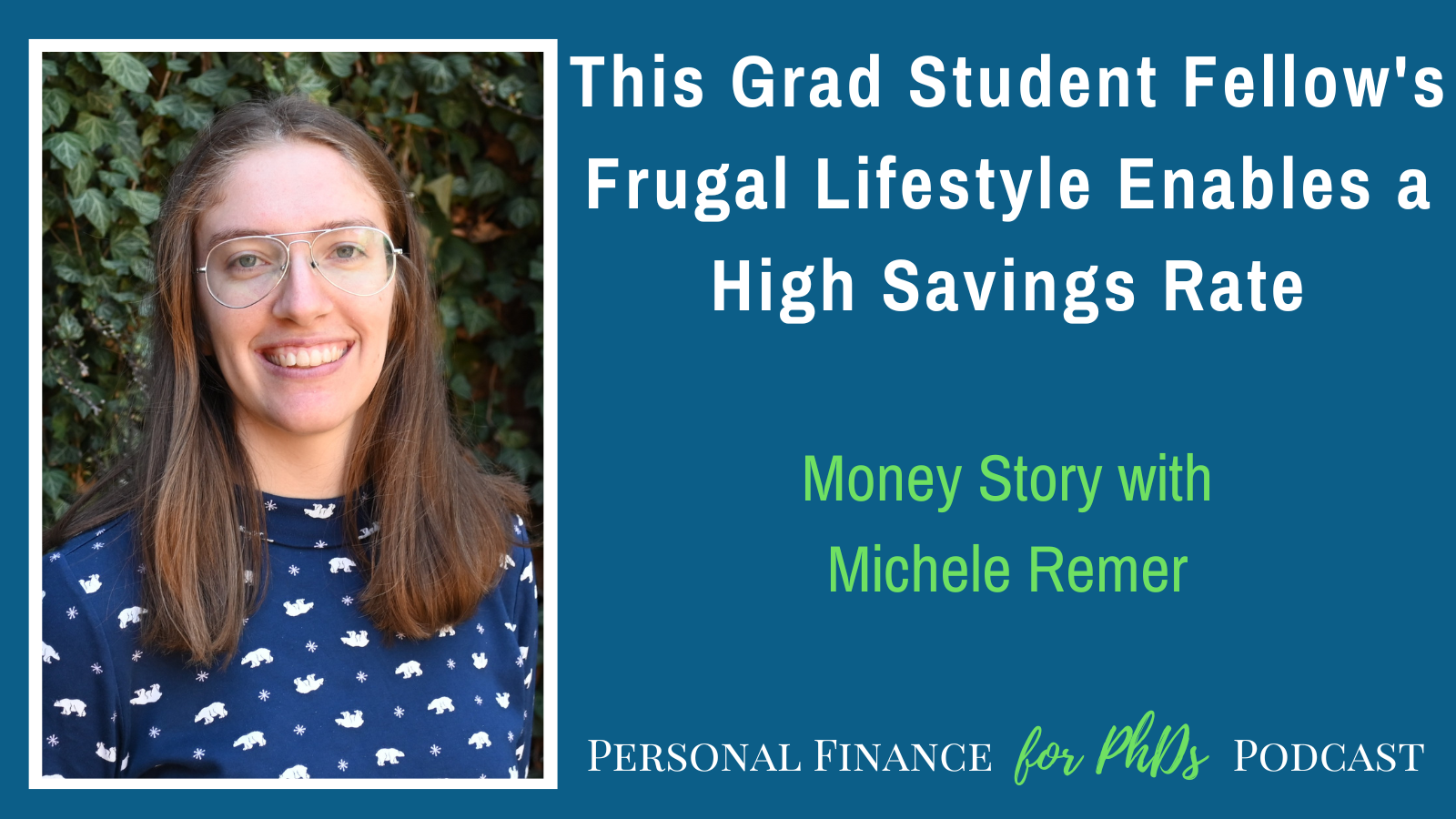
This Grad Student Fellow’s Frugal Lifestyle Enables a High Savings Rate

June 29, 2026 by Jill Hoffman Leave a Comment

In this episode, Emily interviews Michele Remer, a 4th-year PhD candidate at Michigan State University and repeat podcast guest. Michele breaks down her budget, detailing her top five largest expenses: rent, groceries, utilities, restaurants and social events, and transportation. During grad school, she has found ways to decrease her spending on some necessary expenses, which has allowed her to intentionally increase her spending in other areas of higher value. Due to her frugality and her National Science Foundation graduate research fellowship award, Michele has maintained a very high savings rate, which she puts toward her Roth IRA, taxable brokerage account, and student loans.

Links mentioned in the Episode

  • PF for PhDs Subscribe to Mailing List
  • PF for PhDs S13E8: This First-Year PhD Student Prioritizes Investing While on Fellowship
  • PF for PhDs S8E13: Can I Make Extra Money as a Funded Graduate Student on an F-1 Visa?
  • Host a PF for PhDs Seminar at Your Institution
  • Emily’s E-mail Address
  • PF for PhDs Podcast Hub
This Grad Student Fellow's Frugal Lifestyle Enables a High Savings Rate

Teaser

Michele (00:00): I’m just like, okay, I send my money here to, uh, pay off the debt, or I send to my savings account to save up, to pay off debt, or I’m sending it to my investment accounts. And so it’s not super exciting once you’ve got it set up, but I think that’s a good thing because then you just kind of get to live your life while it’s all happening in the background. So as long as you kind of have your expenses figured out, which is really nice.

Introduction

Emily (00:34): Welcome to the Personal Finance for PhDs Podcast: A Higher Education in Personal Finance. This podcast is for PhDs and PhDs-to-be who want to explore the hidden curriculum of finances to learn the best practices for money management, career advancement, and advocacy for yourself and others. I’m your host, Dr. Emily Roberts, a financial educator specializing in early-career PhDs and founder of Personal Finance for PhDs.

Emily (01:03): This is Season 24, Episode 2, and today my guest is Michele Remer, a 4th-year PhD candidate at Michigan State University and repeat podcast guest. Michele breaks down her budget, detailing her top five largest expenses: rent, groceries, utilities, restaurants and social events, and transportation. During grad school, she has found ways to decrease her spending on some necessary expenses, which has allowed her to intentionally increase her spending in other areas of higher value. Due to her frugality and her National Science Foundation Graduate Research Fellowship award, Michele has maintained a very high savings rate, which she puts toward her Roth IRA, taxable brokerage account, and student loans.

Emily (01:49): You’re probably listening to this podcast because you’re interested in improving your own practice of personal finance, and you want to learn the best PhD-specific strategies. Well, you don’t have to listen through the entire episode archive to do so. Instead, go to PFforPhDs.com/advice/ and enter your name and email there. You’ll receive a document that contains short summaries of all the answers ever given on the podcast to my final question regarding my guests’ best financial advice. The document is updated with each new episode release. Plus, you’ll be subscribed to my mailing list to receive all the latest updates there. Again, that URL was PFforPhDs.com/advice/. You can find the show notes for this episode at PFforPhDs.com/s24e2/. Without further ado, here’s my interview with Michele Remer.

Will You Please Introduce Yourself Further?

Emily (02:59): I am delighted to have back on the podcast today, Michele Remer. We, she first gave an interview for us in season 13, episode 8, published in 2022. At that time, Michele had just started graduate school at Michigan State University. She’s now finishing up her fourth year. During today’s interview, we’re gonna do a budget breakdown episode. So we’re gonna get to hear about Michele top five expenses, some other things she has going on in her finances, and we’re also gonna talk about how those certain expenses and so forth have changed over the last few years. And so it’ll be really interesting if you wanna go back and listen to that earlier episode to get that time point, to get the time point right now to get the um, how Michele summarizes that things have changed over that period of time. So Michele, thank you so much for volunteering to come back on the podcast. It’s great to have you. And will you please introduce yourself a little bit further for the audience?

Michele (03:47): Yeah, I can. Hi everyone. Um, like Emily said, I am doing my PhD and so I’m doing it at Michigan State University and I’m now a PhD candidate after passing my comps last semester. So officially went from student to candidate. Um, my undergrad degree was in environmental biology and now in my PhD I am in the Fisheries and Wildlife Department. And then, um, before starting my PhD, I worked a few seasonal jobs, one of which was volunteering with AmeriCorps, which I talked about in the previous episode. So that kind of gave me some good experience for learning how to save money and, um, knowing that going into this field I wouldn’t necessarily be making a ton of money.

Current Fellowship Income, Additional Income, and Household Size

Emily (04:31): Well, again, it’s wonderful to have you back. Um, okay, so let’s talk about today. Uh, you’re at Michigan State. Tell us a little bit about yourself, your household, if there are any other people or beings involved with that. Um, and you have an assistantship, do you have a fellowship? What’s going on with your income?

Michele (04:49): Yeah, so I, like I said, I go to school at Michigan State University, so that’s located in East Lansing. I actually live in the Lansing area as that is a bit more affordable, not living like super close to campus, relatively. Um, and then I’m also on fellowship currently and have been throughout my time at Michigan State. And I currently have one roommate in a shared house that I’ve lived in since the beginning of grad school. But this has changed from when I first started since originally we had three grad students in this house, but we’ve gone down to having only two people now.

Emily (05:26): Yes, I remember, I mean, your interview has really stood out for me over these years as you having this like ace in the hole with how much your, how much your rent was at that time <laugh>. So we’re gonna talk about the rent amount when we get there. Actually we’ll talk about the roommate situation too when we get to talking about rent. But good to know you’re living with one other person in a house in Lansing. Um, can you tell us what is your stipend income, your, your fellowship income, and then do you supplement your income in any way?

Michele (05:50): Yeah, so I was very lucky. I was fortunate to receive the GRFP and I was also lucky in the sense that I received it after the stipend increase went up from $34,000 up to $37,000, which in Lansing is very nice income to have. Um, and then, so I’m currently at the last year of the GRFP and that’ll be transitioning back into a university fellowship. So my income will actually go down, um, starting in September, but I will be supplementing that with another job over the summer helping out, uh, one of my committee members with some field work. And so it’s not quite making up the difference, but it’s getting me a little bit closer, which is nice.

Emily (06:32): So you’re anticipating coming off the GRFP, you’ve taken these measures to try to supplement your income currently, but in the past several years, have there been any points when you’ve made additional income?

Michele (06:43): Yeah, so throughout my time in grad school I’ve had what I call several small little side hustles that I’ve had. So that’s included opening, um, bank accounts to get the bonuses. Chase had one, I think last year that you got additi- an additional $900 if you open the checking and the savings account with them. And to, you just have to, to avoid having a fee, you just have to make sure you have direct deposit set up with them. And then I also did that for our local credit union at MSU. They had a similar thing when I first started grad school, so I think I got like an extra $100 from that. And then another thing that I’ve done is I open credit cards when I know that I have a big expense coming up. So in order to get like those travel bonuses, so like for my health insurance for instance, when I, I have to pay that with a credit card and so then that way I’m not spending my own money on trying to get these travel rewards.

Michele (07:36): And so that’s been also really nice. I haven’t done it too many times, probably just, uh, like twice maybe. But it has been nice to get a little bit more like travel points in that sense and then to cover various research projects or other professional development opportunities like conferences. I’ve applied and gotten some smaller fellowships through the university and I’ve also like volunteered at a conference to get lower registration before in the past. So just a few different ways to kind of, even though like with conferences it’s kind of sometimes a gray area between like who’s gonna cover it, it, it’s helpful for making sure that you have that and it looks nice in your CV, so.

Emily (08:14): Yeah, I love that you mentioned those specific avenues. Um, because they’re available to everybody. Like I don’t wanna speak out of return about visa regulations and so forth. So always international students need to be careful about what kinds of, um, avenues they pursue for earning additional income. But go back to my previous episode with um, Frank Alvillar and Sheena Connell about whether or not credit card rewards and those kinds of things, banking bonuses would be okay or not typically. Um, so go check that out. But none of these are gonna violate like the terms of your fellowship. They’re not going to, you know, rub your advisor the wrong way to be, you know, pursuing a credit card or like volunteering at a a conference. Those are absolutely very, very accessible ways for people to supplement your income and not ones that take hardly any time. I would classify those as passive, um, pursuits for increasing your income. So I love those suggestions. I hope that people um, take them to heart if they are looking for a little like marginal ways to either decrease some expenses or increase their income a little bit. When you were last on the podcast, I know we talked about your Roth IRA, so I wanna hear an update on what your current financial goals are, um, and how they’ve changed over the past few years.

Current Financial Goals, a 20% Savings Rate, and Debt Repayment

Michele (09:25): Yeah, so for the investing side of it, the Roth IRA, I’ve continued to focus on maxing it out. Um, even with the increases in the, I guess the floor for the Roth IRA, I think now you can do up to $625 a month, um, which is really nice that I’ve, with the GRFP been able to afford investing that. Um, and so that’s something that I try to prioritize when I can. If there’s like certain months where I’m not able to, then obviously I wouldn’t invest it. But that’s something that I’ve continued to prioritize.

Emily (09:59): Yeah, I think we’re up to $7,500 on an annual basis in 2026. I think that’s correct. And so with your income of $37,000 you’re looking at, that’s just about a 20% investing rate off of your gross income rate. So that’s pretty high for a graduate student. I know you’re about to say you’re working towards other goals as well. So just wanna put that touch point in there of like, okay, already like you have a relatively like very high savings rate for your current position. That’s awesome. Okay. You’ve got the Roth IRA, you’ve maxed it out even with the increases along the way. What else?

Michele (10:32): Yeah, so then with, if I do have like extra money at the end of the month, besides on top of the Roth IRA, I’ve been doing the a taxable brokerage, um, which that’s just obviously not as tax advantaged as a Roth IRA, but it still is helpful, especially for me. I’m not planning on buying a house anytime soon. The market is <laugh> not the best and I don’t know exactly where I’ll be. So I don’t really have a plan of purchasing a house in the next like five years or so and so, and I’m probably gonna continue renting. And so for me, I think it makes more sense for me to put additional money into, uh, investing rather than leaving it in a savings account. And then, um, the other thing that I did wanna mention that I just recently got a Fidelity credit card. This one don’t worry, no annual fee involved, but you, it gives you extra rewards if you, uh, invest in their Fidelity account, which can be your Roth IRA or a taxable brokerage. Um, and it’s also really nice if you charge any of your reimbursements for conferences or like I said was saying health insurance on there, you can get a pretty sizable percentage back or I think it’s like 2%, but when you’re paying that much, it’s a pretty big chunk of money, um, which is nice. So.

Emily (11:49): I love that idea as like, ’cause you mentioned opening credit cards for like, like signup bonuses. Um, I love the idea of having a baseline amazing cash back in a sense card like this Fidelity card is.

Michele (12:01): Yeah, I’ll say amazing is kind of a relative term, but <laugh>, it’s,

Emily (12:05): Yeah, but, but 2% for cashback card

Michele (12:07): Even $100 extra is so nice. So.

Emily (12:08): Yes. It is awesome. And then when you’re not working on a signup bonus, falling back and like always using that 2% cards great plan.

Michele (12:15): Yeah. Uh, which is really nice because I’ve found after doing a few of the annual fee cards, it’s, it gets to be kind of annoying to deal with and like having to remember to cancel it eventually if like you don’t, aren’t getting the enough rewards to kind of cover the cost.

Emily (12:31): Okay. So we talked about your Fidelity relationship and that’s great. Um, what else have you been working towards?

Michele (12:37): Yeah, so besides the investing, I’ve been working towards debt repayment. So I had a sizable chunk of student loan debt from my undergrad university since I went to, um, a private like liberal arts school. And so for that I, I borrowed from the federal government and then I also borrowed from a few family members who luckily had money saved up for me to go to school. And so as of right now, and I think in about three months I’ll have repaid my debt to my family members, which is awesome because I did not want to have to like owe them money anymore.

Emily (13:16): That’s incredible. And actually it’s particularly incredible that you’ve accomplished this during graduate school. So can I ask about, I don’t know, whatever you’d like to share, like either the starting balance or um, how much you’ve been paying on a monthly basis? Has it been regular or irregular? Like how has that relation-, that repayment relationship worked?

Michele (13:35): Yeah, so for this relationship, so it’s my parents, I, um, send them the money through, we have like a shared checking account kind of set up or I guess it’s like a shared bank account set up for this. So I send them like a set amount every month. And then also what I was doing at the beginning of grad school when I, I had extra money too because I just like didn’t want to owe them all this money. I think it probably started out at around like maybe 8 or $9,000. And so I was sending them like extra money as like I saved it up. And then I also, um, was just doing like a base of like a hundred dollars a month, um, just because I didn’t want to have to pay them back this money and I wanted them to have it back as soon as possible. And so that’s been really nice to basically by the end of grad school have, have that debt paid. And then for my other debt that’s through the federal government, I only took out the subsidized loans that I was offered. So that means like I didn’t pay any interest during grad school. And so for that I put it into like a kind of like a CD ladder when I had the, the rates were good, I would put it into a CD. And so then that way I’ve saved up like a large chunk of money to hopefully pay back, if not all of it, by the time the interest payments like come due, then I’m gonna be pretty close to paying off the debt. So I’m excited for that too. <laugh>.

Emily (15:05): Yeah. That’s incredible and I love that you’re introducing this idea of a CD ladder to the audience. It’s not something that, I don’t know that I’ve ever discussed on the podcast before. Um, but basically I love this approach because as you said, when we’re dealing with subsidized loans, not accruing any interest, you do not need to take any action and like your money is gonna be doing better for you literally in a savings account or a CD ladder or you know, money market account. I, I like that you’re not investing it. Right. I like that you’re not taking a lot of risk with it because you know, yes, this is gonna come due. Yes, I do wanna make these payments, um, pay it off quickly once you know it’s back in repayment. So I love that you’re not taking risk with it, but you’re doing as best as you can in terms of the interest rate, um, in the meantime. So wonderful approach. And another point of congratulations of wow, like look at all that you’ve accomplished financially during graduate school, like maxing out the IRA yearly, you know, getting ready or almost completely repay your student loan debt. Like that’s a lot to do as a graduate student.

Michele (16:07): Yeah, I’ve been really fortunate just the way everything lined up with the GRFP and um, also just, I mean we’ll get into my expenses, but I’ve also been able to keep my expenses relatively low as well, which is a good thing to be able to meet all these goals. And I will also say that I became a big fan of Mr. Money Mustache in <laugh>, uh, during grad school. And his approach really helped me be like, okay, how do I lower my expenses as much as possible, um, and kind of make sure my money is going to the right avenues. So.

Emily (16:43): Um, I’m not a big follow of follower of Mr. Money Mustache, obviously I have listened to him plenty of times and quite familiar with him, but, um, what I like about his approach is it’s really about finding satisfaction in a lower spending lifestyle. So it’s not about staying in your mind in a, um, a state of deprivation. It’s really about finding joy in simplicity and a low spending lifestyle. And I do think it’s quite compatible with the situation that graduate students are forced to be in, at least for a period of time. So I’m glad you found something that kind of like helped you with your overall, you know, disposition towards this financial stuff during graduate school. Um, is there anything you’d like to add about these, um, various goals that you’ve had or how they’ve shifted over the course of graduate school?

Michele (17:29): That’s the other thing is that it’s pretty boring when you’re doing like your finances in a, like a healthy way, I guess. Just like, okay, I send my money here to uh, pay off the debt or I send to my savings account to save up to pay off debt or I’m sending it to my investment accounts. And so it’s not super exciting once you’ve got it set up, but I think that’s a good thing because then you just kind of get to live your life while it’s all happening in the background. So as long as you kind of have your expenses figured out, which is really nice,

Emily (18:01): I think that’s very insightful. Healthy finances are boring. Like once you get it sorted out, you put everything on autopilot. Um, they’re boring, but that’s a good thing. Like you said, you can shift your attention away from those financial elements. You don’t have to pay a lot of attention to it once you have your decisions made and your system set up and then you’re free to <laugh> do anything else with your mind and your time. Um, so I think that’s very insightful. It’s not something that has to consume you continually, forever and ever and it shouldn’t, it shouldn’t be exciting, honestly, like you said, I mean I find it nice over time, you know, check the investment balance periodically, especially if things are going well, you know, in the market. Yeah, go ahead and check it. If things are not going well, don’t check it. <laugh> don’t look, you don’t need to know.

Michele (18:41): Yeah, it’s, it’s kind of crazy too just when, when you do get to like a stable place and you’re able to invest regularly, just looking back at my account over the past five years, it’s like, wow, like I didn’t think that this would add up to this much, you know, with the compound interest and this payments that I’m making. So yeah, it’s very satisfying. I will say once, I know not every grad student is able to contribute as much as I am, but even like if you can’t contribute until you graduate, like just starting out now is also, um, still gonna be help people out in the future.

Budget Breakdown: Housing

Emily (19:20): Okay. Let’s dive into those five, those top five expenses. Um, and feel free also to share how they’ve changed over the course of time in graduate school. Um, and I know number one is gonna be housing, it’s always housing for everybody. Um, so share about the rent payment that you’re making and share about how you only have one roommate now instead of two, like before. What’s going on with that?

Michele (19:42): Yeah, so basically when I started, um, the rent was probably, I mean I couldn’t really have gotten cheaper rent somewhere else, but it was $375 a month, which is insane <laugh>. Um, but it was $375 a month because we had three grad students living in a shared house with like one bathroom, one kitchen. And so that’s kind of why we decided. We had one roommate who graduated and moved out and she lived in like the top floor, which she was a trooper for living up there because it, it was like an A frame and so it’s not like a super great spot if you’re tall like me, I have to kind of lean when I go up there. Um, and so we were, my other roommate and I were still living here. We were deciding if we wanted to have someone else on the lease, but our other roommate had graduated and moved out. So we had the summer to our ourselves and during that time we were like, well, it’s really nice like sharing the bathroom with one less person, not having as much, um, to think about like the kitchen space as much. Like we still kind of had to plan around like our meal prepping around each other, but it wasn’t quite as bad as it was with three people since we didn’t do like a, we didn’t like cook together, we all cooked individually. So that was also a challenge. And so based on that and we both, my roommate, uh, who I lived with for the past three years was also on the GRFP, so we decided okay, we could probably swing to having just two of us. So that meant that our rent, it’s gone up slightly more since then, but currently it’s at $600 a month. So it’s still very affordable compared to other places around us as well and like living by ourselves would’ve been.

Emily (21:22): So your, the whole house is $1200 a month and you and your roommate are each playing paying half.

Michele (21:29): Yep. And so that roommate that I mentioned, she graduated in December, so she moved out and then, um, we, I think technically she’s my current roommate is like subletting her portion of the lease, but we’re gonna resign it in for the next year and then that’s gonna go up slightly to 630 a month each. So it’s going up by $60, which my landlord apologized, but I was like, it’s really not that much compared to like other places because he had like his property tax go up in his like rental fee. So.

Emily (22:00): Sure. And I’m also doing some quick mental math, um, that’s around 20%, right? Maybe a little over 20% of your gross income a little bit higher if we’re talking about net income, but really quite again, quite manageable. Like nobody is feeling rent burdened right on 20%.

Michele (22:17): No, no, it’s been, it’s a pretty affordable rent I would say. I know that, um, like some of my friends who live alone, they’re paying around like, um, eight to 900 a month for theirs. And so then there are other grad students though who are in like a shared housing situation. I think that’s pretty common for Michigan State at least.

Emily (22:42): Yeah, well I can see that even though you’ve elected to pay more in rent than you absolutely could have, um, still seems super affordable. Hopefully you’re getting use out of the space and you like only sharing with another person, like you said. Um, anything else you wanna talk about in terms of your rent expense?

Michele (22:57): It helps that, I’ve had great roommates who like, I think living with other grad students is really helpful ’cause you know, they’re all gonna be like respectful and um, kind of respecting your time. And also like that you’re also like both maybe working from home sometimes if you need to. So I think it, it’s really nice when you have like great roommates and I, I, I also prefer that because it helps you save money in other ways too if you’re, if we’re talking about like the financial side of it, but also like, I think the emotional side of it is great too to have someone like living with you. But um, it’s also nice like, you know, you can have your roommates like give you a ride to the airport if needed or pick you up from somewhere or like, just like take care, water your plants. My previous roommate had a cat and she never had to pay for a cat sitter ’cause I would always take care of her cat for her. So yeah, it’s just things like that, it’s just very useful to have a roommate I think. And I, I enjoy living with roommates. So.

Commercial

Emily (23:56): Emily here for a brief interlude. Would you like to learn directly from me on a personal finance topic, such as taxes, goal-setting, investing, budgeting, or designing your financial life, each tailored specifically for graduate students and postdocs? I offer live workshops, asynchronous online courses, and cohort-based programs on these topics, and I’m now booking for the 2026-2027 academic year. If you would like to bring my content to your institution, would you please recommend me as a speaker or facilitator to your university, graduate school, graduate student association, medical school, postdoc office, or postdoc association? My workshops are usually slated as professional development or personal wellness. Orientations, postdoc appreciation week, or close to the start of the academic year would be a perfect time for tax education or general personal finance content. Ask the potential host to go to PFforPhDs.com/financial-education/ or simply email me at [email protected] to start the process. I really appreciate these recommendations, which are the best way for me to start a conversation with a potential host. The paid work I do with universities and institutions enables me to keep producing this podcast and all my other free resources. Thank you in advance if you decide to issue a recommendation! Now back to our interview.

Budget Breakdown: Groceries

Emily (25:28): Let’s talk about your grocery expense. I know that’s number two on your list. Um, so tell us about your grocery spending.

Michele (25:35): Yeah, so I just looked at it for the last month, which it came up to $250. I would say that’s pretty average for me. I did go to a conference in like the beginning or at the end of April. And so like that was all covered by like a travel award. So I think it’s usually ranges between like $250 and $350 a month depending on like how much I’m spending or like if I have to do like a restock or something like that. And I will say I’m vegetarian so that also helps me save a lot of money too ’cause I’m not buying meat. So yeah.

Emily (26:08): Definitely. What do you find are other ways? ’cause I know yes meat is expensive, but so is dairy, so are nuts. So are, you know, other things, there are categories there that are expensive as well. Can you share anything about the way that you eat? Like do you have certain go-to meals or do you uh, batch prepare things? How does that work?

Michele (26:27): Yeah, so I guess I’m trying to think about like my day. So like for breakfast I usually just have the same thing. I have like two eggs with toast, so it’s pretty basic and I kind of know where to get like cheap, the cheap bread now, well I’d say cheap bread. Cheaper bread. I like don’t wanna get the like just tiny squares of white bread. I like to get good stuff. But um, yeah, like Trader Joe’s, we just got one of those in East Lansing, so I usually go there for that. Um, and then for lunch and dinner it’s usually like I will cook like on the weekends and then also like maybe on like Wednesdays or if I have time during the week and then I’ll just have my leftovers for both lunch and dinner. And then I also do what I call my bridge meals. So I’ll get like something like gnocchi at Trader Joe’s or some other frozen meal that if I’m like traveling or coming back and I don’t wanna make sure that I’m not ordering like takeout or something like that, I’ll have that ready to go. Um, and then that helps me too. And then as for the meals that I’m cooking, they’re usually, uh, pretty basic, some variety of having like beans or lentils with veggies and so those are all pretty cheap. Um, I do also do protein shakes, so that’s a little bit more just because I’m getting like protein powder and Greek yogurt and things like that. But, um, another way that I’ve saved some money on groceries too is I, I wish that I’d realized this sooner, but one of the grocery stores near me has a 10% off like discount for students. So you, with your student id, you can get um, 10% off groceries, which is really nice.

Emily (28:06): I hadn’t heard of that before actually. That’s amazing. Is it like a co-op or like locally owned or?

Michele (28:10): It’s actually one of the Meijers, but it’s like oh, the downtown location. And I think that maybe they were having issues like getting people to go there because it’s a little bit of the way for some people maybe, but yeah, I think, I’m not sure why they’re offering it, but I saw the sign and I was like, I have my student ID.

Emily (28:29): I was just gonna ask how you found out about it. So it wasn’t like another student who gave you that tip, you just saw a sign at the store?

Michele (28:34): Yeah, I literally just saw a sign at the store, so now I’ve been telling all my friends like, you guys should go here and get this 10% off with your student Id <laugh>.

Emily (28:41): Yeah, that’s amazing. What a good, I mean it’s a good idea for them, um, because yeah, most people don’t, I mean if you’re really frugal you would shop at multiple different places, but most people don’t shop that way. And so it makes sense to try to capture like people’s, you know, become the primary shopping destination for more people.

Michele (28:58): Yeah. And then the other way I save money on, on groceries, well is kind of getting into transportation, but I like to bike to go to the store <laugh>, so ah, um, that also saves you money because then you’re not buying anything that’s really bulky. So like, I’m not buying like pop or I guess, sorry, soda, um, Midwestern coming out, but um, things like that or, uh, any other like seltzer water, things like that I’m usually not purchasing. So.

Emily (29:27): Um, I would imagine also cuts down on impulse purchases if you’re looking at your, your backpack or your bags or whatever you’re using to carry the groceries. Um, I have a strategy that I now use, which is like, I very rarely physically go into grocery stores. I do all online ordering and then do pickup, um, which keeps like the impulse purchases at a minimum. 

Michele (29:46): Yeah, <laugh>. I will say that I, I’m not always going to the store with my bike so I, there is times where the impulse purchases still do come through, but it’s also just like a very enjoyable way to spend like a Saturday morning or afternoon even though the stores are kind of busy at that time, but it’s like a nice little bike ride to get there. So at least for me when I’m going to certain stores it’s like, um, like a nice trail. So

Budget Breakdown: Utilities

Emily (30:14): Yeah, I love to hear about that. Your next expense you told me is utilities. Lots of different utilities under that umbrella. Tell us about those expenses. Um, what they amount to typically and how they’ve changed.

Michele (30:25): Yeah, so those have gone up obviously since we have one less person. That was kind of when we were deciding if we wanted to have only two people live, the utilities, that was our sticking point because those can get quite pricey. So I looked at my past month and it came up to around $200, so that’s with electricity, water heating, cooling, internet, trash. And I also include my phone bill in that. So for like the first, obviously the phone bill I’m paying on my own, but everything else is split between my roommate and I and those are pretty variable just because, well I guess like the electricity and the water usually stays pretty, um, similar but like the heating and cooling, it’s more expensive in the winter here in Michigan to heat the house. And then we usually try not to use the AC unless it’s like super hot outside in the summer. And then the internet and the trash are also like pretty affordable. Um, I’ve actually managed to save money on utilities for the internet by switching from like a different provider. And then I also lowered the internet speed because most of the time, unless you’re like playing a lot of video games or something, you don’t need the speed that they give you as like the baseline. So yeah, that’s my utility bill.

Emily (31:49): Yeah, I love that you were, you know, conscious of that evaluating it because stuff like internet bills, they’re not the biggest things in your budget, but as fixed expenses, if you can just put in the like 30 minutes of effort or whatever it’s gonna take to like research it and, and call the company or chat with them or what have you, um, then you can sometimes get that bill lowered and very little effort, very long payoff like throughout the course of at least the next year. So that’s awesome. Have there been any other ways that you’ve decreased your spending on utilities over time?

Michele (32:23): Yes. So some of these people might not wanna do because they do take a little bit of extra time, but some ways that I’ve been able to lower my utility bills has been um, I line dry my clothes, which is obviously a lot easier when you’re in the house, but the dryer is kind of an energy hog.

Emily (32:41): I did that too during grad school.

Michele (32:42): Yeah, I actually, um, yeah, I have some like hanging up downstairs right now, but yeah, I just gotta, gotta time it if you like, need your like clothes at a certain time, like you gotta do like a day in advance, but it’s pretty easy. And then the other thing, um, my roommate who moved in probably doesn’t know what she’s getting herself into, but uh, I layer up in the winter, so kind of try to reduce heating bills by lowering the thermostat. Um, I think that’s a pretty obvious one. But then also in the summer, like running fans and keeping the blinds closed, um, like I said also the internet, but then my other thing I did was in Lansing at least the trash is you pay dependent on like the size of your trash and so I switch it to like the smallest size possible that only comes every other week. So that’s another way that I save money,

Emily (33:33): Another fixed expense that you managed to lower and as long as you’re confident you can like meet those, you know, those limits then that’s great.

Michele (33:41): Yeah. And then the last thing that just happened recently that I’m super excited about, I don’t actually know it’s gonna affect my energy bills at all, but, uh, I kept kind of pestering my landlord about our dishwasher and we just got a new one. And so even if it’s to save us money, it’s, it’s better because it’s a lot quieter so, and I don’t have to try to clean it as often. So yeah, that’s some ways to that I’ve done that. Well then I guess also the, um, for electricity, I don’t know if this is the case, like if it’s the same hours in other places, but our utility provider has like, uh, off peak and on peak hours, so we try to run like our bigger stuff like the dishwasher and the washing machine during those off peak hours.

Budget Breakdown: Restaurants & Social Activities

Emily (34:27): Definitely. Alright, then let’s move on. What is your fourth largest expense each month?

Michele (34:33): Yeah, so this one, the next two are kind of variable, but for this past month it was, um, $160 for restaurants and other social activities. So like this past semester I was the social chair and so I, I hosted some like department happy hours or I guess co-chair. And so that was, you know, we , would go out to like some bars and get like a drink or two and then also just going out to eat with friends as well.

Emily (35:03): And has that changed over the course of time?

Michele (35:05): Yeah, I would say that I, when I first started grad school I was a lot more frugal with those like kinds of social activities. I tried to limit them a little bit more, like tried to have people over at my house rather than going out as much. But now I’ve been that I feel like I’m in a better financial position. I have been going out to eat more often. Um, and then I guess another thing that I’ve started doing is I’ve been doing some sports leagues, so do like, um, adult volleyball or um, sand volleyball as well. So those have like higher costs to them as well, but they’re pretty affordable I would say, especially spread over the like the weeks that you’re participating in them.

Emily (35:50): I just love this that, you know, getting this picture of you at the beginning of graduate school and now four years in, like you’ve found ways to spend less in certain areas. You’ve also decided that it’s worthwhile to spend more in certain areas and still along the way you’ve done all this investing in debt repayment and it’s absolutely wonderful. So I’m very glad to hear that, you know, you’re putting your dollars where you value them.

Michele (36:10): Yeah, it’s, it is definitely like an adjustment because I feel like for so long, like you, like I said, I, I volunteered for AmeriCorps and then in undergrad I was like just saving money all the time and so it’s been nice to be like, okay, I have a little bit of breathing room now and kind of let loose a little bit more with some of my like, like I can go out to eat more often now. So it’s been nice.

Emily (36:36): I think we should do another follow up interview in another four years when you have a proper salary <laugh>, like, we’ll see, we’ll see where you are then. Are you, like, are you still very low spending or have you managed to, you know, moderate with the newer income or are you going crazy with investing? Like, yeah, we’ll let’s put a pin in that and, and return to it. Um, okay, your fifth, uh, highest expense in your budget? What’s that?

Budget Breakdown: Transportation

Michele (36:57): Yeah, so this one was also higher for this month because I went on a trip but, or kind of a trip I went home to visit family. Um, the transportation was $125 and so this usually is closer to $70 for car insurance and gas. But like I said, I like to bike a lot, so my gas is usually pretty low, which is also good for the current gas prices.

Emily (37:23): So it sounds like you have a paid off car, right? Can you tell us about your car?

Michele (37:28): Yeah. Okay. So for the car, it’s basically the same one that I’ve been driving since high school and like I said, my parents are very generous and so they made sure that me and my siblings each had a car. Um, and yeah, I basically don’t put any miles on it. I just use the car basically for like big trips and then if I do need to, like I’m going to those volleyball leagues that are kind of further away from campus then I’m driving to those things. But I, I try to keep my driving to minimum, which also is, is the money, but also because I’m really cognizant about my carbon footprint being in the Fish & Wildlife department. So I, I try not to drive as much as I can.

Emily (38:07): I see. And another way that you have found a kindred spirit in Mr. Money mustache because he definitely writes a lot about not owning a car or minimizing your car usage. So how do you commute to campus?

Michele (38:19): Yeah, I, I bike to campus so I have, the way I do it, I have like, um, a mountain bike that I put like a rack on the back and then I have two like bike bags that I attach. So it’s plenty of room for like my laptop and any other things I need to bring like books or um, like a change of clothes if I’m going to like work out or something like that. So yeah.

Emily (38:42): Have you thought about getting rid of the car entirely and if so, what, why are you keeping it?

Michele (38:48): I have thought about getting rid of my car, but I don’t want to because it’s very hard to live in the US without a car. Um, just like I said for those times where I am doing like a trip or something. And then also for those times where I’m traveling a bit further on to the outskirts of town, it’s basically if I just like worked and stayed at home, I wouldn’t need it. But since I do value those social activities then I do still need the car.

Emily (39:20): It is great. I feel like for something like this where it’s like, yeah, I get some marginal utility out of it. It’s not like a daily thing. It’s good that it’s falling to number five on your list and it sounds like some months it might be even lower, right? ‘Cause in particular you had a trip that you took this month, so in some months it might even be outside of the top five. Um, and that’s about the right size for something that is like, yes, this enhances my life in some, some way. It’s not totally essential. So it’s good that it, you know, that it is a paid off car and that the insurance doesn’t sound like it’s too expensive and, and you’re not using it that much. So the, the operating costs are not very high.

Michele (39:54): Yeah, I will say I did use it more this past semester than I have in the past just ’cause it was a particularly intense Michigan winter um, so I drove to campus a bit more than I usually do and um, just kind of had it on retainer a bit more than I usually do. But yeah, I’ve been usually like biking through the winter too. So.

Emily (40:17): How do you park on campus when you do drive?

Michele (40:20): My office is kind of on the outskirts so um, it’s kind of far away and so it’s not like, um, as big of a deal for me to park over there than it would be so I kind of just risk it on getting a ticket <laugh>. Um, and usually I, so far I’ve been fortunate but for my office parking, but if I am going on further onto campus, I pay, there’s like a pay by plate option so I’ll pay like five bucks or whatever it is for however long I’ll be on campus.

Emily (40:51): Gotcha. So once again, the car comes into use and these like occasional, okay the weather’s particularly bad occasional scenarios. Um, great. So that’s your backup plan for getting to campus is you have your car and you can <laugh>, um, skirt the parking regulations since there don’t seem to be any consequences <laugh>.

Michele (41:10): Yeah, well there is, um, there’s tickets but I somehow have avoided the parking attendants, um, just because it’s kind of for off the beaten path for them. But yeah, ’cause I think it wouldn’t really be too much, but um, the grad students are always doing that calculation like, how many tickets <laugh> would I need to get before getting a parking pass? So, so far it’s kind of the math that’s worked out for me.

Best Financial Advice for Another Early-Career PhD

Emily (41:35): Gotcha. Well we’ve run through your top five expenses. I mean, I’m just so pleased that like you’ve, you know, honed in what’s, what’s of value to you over time that you’ve obviously had these great financial accomplishments, you know, especially coming up in another year, whatever the timeframe is on your graduation, you can really say, wow, look at all these things I accomplished financially during graduate school. It’s incredible. We will wrap up with the question that I ask all of my guests and I know I asked it of you before, but what is your best financial advice for another early career PhD? And it could be something that we’ve touched on today already or it could be something completely new.

Michele (42:11): Yeah, so I have a few things. When I was thinking about what my best financial advice would be, the first thing is to track your spending as I think it’s really helpful to plug any holes where you don’t realize where you’re spending more money. Like for me, I’ve been spending more recently on going out to eat than I have in the past. And so the way that I’ve done that is I’ve mentioned Fidelity a lot because I use them for basically everything, but um, they have this really nice thing where you can connect all your credit cards to one location and so that way you can kind of automate the tracking. Um, and like if you, you could also probably add in like if you’re Venmo people or using cash for something, then you could track it that way as well. And then another thing that I probably, I think that was my last, last time I was on, I talked about the Roth IRA, but I recommend not only sending money to your Roth IRA but making sure that you’re depositing funds into a, some sort of fund because I, I have talked to people in the past who have only put it into the account and not invested in it. And so just gotta make sure that you realize that it’s not a normal bank account and you need to invest the money. So those are my two big pieces of advice.

Emily (43:24): Yeah, so mistake I literally made with Fidelity with the first IRA that I opened, I don’t know, hopefully their interface has changed <laugh> in the intervening time, but I for sure made that mistake. Also, I’ll say that at the time mutual funds were the thing to invest in and there were higher minimums. Now we have ETFs and it’s a little bit more flexible. So another thing to look out for to make sure that you know, you’re investing appropriately and that your money is not just sitting in a money market account.

Michele (43:50): Yeah, yeah. I’ve helped, um, multiple people like set up their Roth IRAs, so I’m always like, okay, make sure you have to pick one of these funds now. And I try to, I think people get overwhelmed by choosing, so I’m just okay if here pick one of these three <laugh>, they’re all basically the same though. So

Emily (44:07): Yeah, definitely. Um, I list this when I teach about getting started with investing, I list this as like a separate step. Like one send over the money, two, make sure it’s inve- like a few days later. Like make sure that it’s actually invested where you intended for it to go. And it’s not just randomly like you missed a step there. It’s a whole other thing you have to consider. Um, absolutely. Well Michele, it’s been so great to have you back in the podcast. I’m so delighted by this update and thank you again for volunteering. It’s been great to speak with you.

Michele (44:36): Yes. And thank you for having me on again. I appreciate it and thank you for all of the great work that you do with this podcast and helping everyone out with learning how to <laugh> navigate finances as a grad student.

Emily (44:46): Yeah. Thank you for saying that.

Outro

Emily (44:58): Listeners, thank you for joining me for this episode! I have a gift for you! You know that final question I ask of all my guests regarding their best financial advice? My team has collected short summaries of all the answers ever given on the podcast into a document that is updated with each new episode release. You can gain access to it by registering for my mailing list at PFforPhDs.com/advice/. Would you like to access transcripts or videos of each episode? I link the show notes for each episode from PFforPhDs.com/podcast/. See you in the next episode, and remember: You don’t have to have a PhD to succeed with personal finance… but it helps! Nothing you hear on this podcast should be taken as financial, tax, or legal advice for any individual. The music is “Stages of Awakening” by Podington Bear from the Free Music Archive and is shared under CC by NC. Podcast editing by me and show notes creation by Dr. Jill Hoffman.
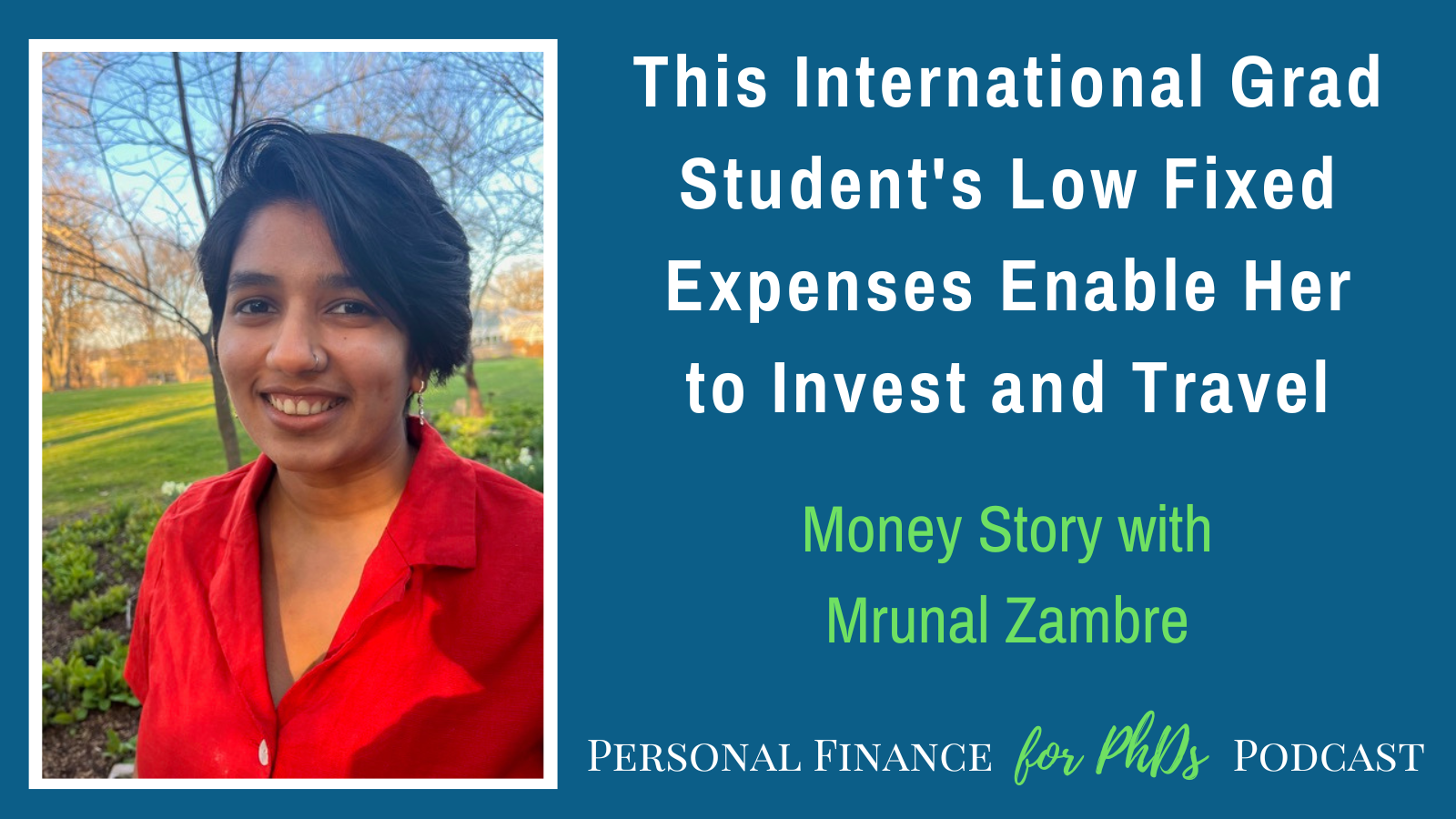
This International Grad Student’s Low Fixed Expenses Enable Her to Invest and Travel

March 9, 2026 by Jill Hoffman 1 Comment

In this episode, Emily interviews Mrunal Zambre, a 4th-year international PhD student at the University of Pittsburgh. Mrunal details her money management system, from her checking and savings accounts to credit cards, and how she and her grad student partner split expenses. She focuses on travel credit cards and the Bilt card to reduce the cost of international travel. Thanks to her stipend—recently increased to over $40k—and low fixed expenses, Mrunal maxes out her Roth IRA annually and invests in a taxable brokerage account, even though she’s not sure if she’ll live in the US long-term.

Links mentioned in the Episode

  • PF for PhDs Tax Workshops (Individual Purchase)
  • PF for PhDs Tax Center for PhDs-in-Training
  • The Simple Path to Wealth by JL Collins
  • Friends That Invest by Simran Kaur
  • PF for PhDs S4E17: Can and Should an International Student, Scholar, or Worker Invest in the US?
  • PF for PhDs S22E1: The Simple Way to Invest as an International Grad Student or Postdoc
  • PF for PhDs Subscribe to Mailing List
  • PF for PhDs Podcast Hub
This International Grad Student's Low Fixed Expenses Enable Her to Invest and Travel

Teaser

Mrunal (00:00): Time is of the essence at this age. And instead of kind of being on the fence about whether to not do it or you know, whether to just keep the money in a savings account, it kind of costs you. Um, so if you wait to figure that out till later when you have more money or more income, you might have already lost amount of money that you could have grown over time.

Introduction

Emily (00:34): Welcome to the Personal Finance for PhDs Podcast: A Higher Education in Personal Finance. This podcast is for PhDs and PhDs-to-be who want to explore the hidden curriculum of finances to learn the best practices for money management, career advancement, and advocacy for yourself and others. I’m your host, Dr. Emily Roberts, a financial educator specializing in early-career PhDs and founder of Personal Finance for PhDs.

Emily (01:03): This is Season 23, Episode 5, and today my guest is Mrunal Zambre, a 4th-year international PhD student at the University of Pittsburgh. Mrunal details her money management system, from her checking and savings accounts to credit cards, and how she and her grad student partner split expenses. She focuses on travel credit cards and the Bilt card to reduce the cost of international travel. Thanks to her stipend—recently increased to over $40k—and low fixed expenses, Mrunal maxes out her Roth IRA annually and invests in a taxable brokerage account, even though she’s not sure if she’ll live in the US long-term.

Emily (01:44): The tax year 2025 version of my tax return preparation workshop, How to Complete Your PhD Trainee Tax Return (and Understand It, Too!), is now available! This pre-recorded educational workshop explains how to identify, calculate, and report your higher education-related income and expenses on your federal tax return. Whether you are a graduate student, postdoc, or postbac, domestic or international, there is a version of this workshop designed just for you. I do license these workshops to universities, but in the case that yours declines your request for sponsorship, you can purchase the appropriate version as an individual. Go to PFforPhDs.com/taxreturnworkshop/ to read more details and purchase the workshop. You can find the show notes for this episode at PFforPhDs.com/s23e5/. Without further ado, here’s my interview with Mrunal Zambre.

Will You Please Introduce Yourself Further?

Emily (02:59): I am delighted to have joining me on the podcast today, Mrunal Zambre, a fourth year PhD student at the University of Pittsburgh. And we are gonna be talking through a lot of high level elements of her finances from how she manages cash flow to, you know, long-term investing strategies to how do we do some travel as a graduate student. So I’m really excited for this conversation. Mrunal, welcome to the podcast. Would you please introduce yourself a little bit further for the audience?

Mrunal (03:25): Yes. Yeah, thank you Emily. Yeah, happy to be here. Um, so I guess, yeah, I came to the US I’m an international student, so I came to the US in 2016. Um, I came here for my bachelor’s. Um, I did, I majored in neuroscience, did minor in computer science from, uh, university of Minnesota. I graduated in May, 2020 amidst the raging pandemic that was happening. Um, and after graduating I stayed, um, I stayed on, stayed in Minneapolis, working in a lab that I joined in my senior year. Um, so I stayed on as a research technician, worked in the lab till 2022 on OPT and then, um, throughout 2021 was applying to grad schools, um, for PhD in neuroscience and, um, am now at University of Pittsburgh since August, 2022.

Emily (04:19): Fantastic. Thank you so much for that, um, background. So let’s talk about the money. What’s your stipend? 

Mrunal (04:26): The exact number is 41,199k annually, which comes out to be around 3,180 per month after some taxes taken off, um, in 2022. It started at 33K when I first first admitted. And about a year later, um, the school of Medicine, which is where in which is, uh, which school my program is part of, um, they decided that um, all school of medicine grad programs get a stipend of 40K. So it was a big jump, uh, early on and I think it’s a privileged position to be in to get that big of a jump. Um, and after that year it’s been kind of increasing like two to 3% for inflation. Um, yeah,

Emily (05:09): Love to hear that story. Yeah. Do you know any like precipitating factors, like why they made that decision?

Mrunal (05:15): I’m a hundred percent not sure actually. Um, I don’t know. It was a new dean that had just started. I dunno, maybe there was, uh, some built up about cost of living related expenses and stuff. So maybe that played a role, but I’m not, I’m not sure actually. It was kind of surprise to me as well.

Emily (05:33): Yeah. But a, a wonderful surprise accepting at 33 and getting a jump up to 40. That’s awesome. Especially because, my understanding is Pittsburgh’s sort of a moderate cost of living city, right?

Mrunal (05:43): Yeah, exactly. It is. Uh, it’s not, it’s, you know, people think of it as East Coast, but it’s not really that close to East Coast. So pretty, pretty affordable I would say. And I think the stipend goes a long way, luckily.

Housing, Transportation, & Grocery Costs in Pittsburgh, PA

Emily (05:56): Amazing. Well, I wanna ask you about savings in a moment. Um, but first can we go over just like baseline expenses about how much you spend on housing, how much you spend on transportation, those kinds of things.

Mrunal (06:06): Mm-hmm. Mm-hmm. Yeah. Uh, so yeah, speaking of affordability, our rent is pretty, has been pretty good in Pittsburgh. Um, I am living with my boyfriend in a one bedroom apartment right now, and the rent right now is around 940. Um, my boyfriend is also in grad school at Carnegie Mellon, so he has, he does, he, we share the rent. Uh, and because he doesn’t have a stipend, my share of the rent is around 620 per month.

Emily (06:34): Oh, I’m sorry. I just assumed that that 900 something was your part of the rent. Oh, okay. Sorry, I have to, to like reconfigure. Okay. So you’re paying 620 and he’s paying, that would be something like a third, right? Um, okay. Wow. Alright. Some points for Pittsburgh here. Um, awesome.

Mrunal (06:52): We are lucky.

Emily (06:53): Glad to hear that. Yeah. So give do the, do the math for me. That’s around 20% ish of your take home pay.

Mrunal (07:01): Yeah. Let’s see. 600, around 600 out of, yeah. 3000 around there. Yeah. 

Emily (07:07): That’s really great. I mean, with other, you know, you’re definitely not rent burdened like we hear from so many other graduate students, so that’s amazing. What do you do for transportation?

Mrunal (07:15): The University of Pittsburgh gives us, um, our ID counts as a bus, uh, pass. So there is the bus system. Um, there’s also a train system, but I don’t really use that for my day-to-day. Um, so that is free for me. I use the bus to get into lab and come back from lab, um, like five days a week. And I also have, uh, a 2012 Honda Civic. Uh, I bought it in 2021 in cash, so no car payments there, but there is an insurance payment, which is about $90 per month. And because it’s the Honda Civic, we get pretty good mileage. Um, and we fill up gas and because we don’t drive to work every day, uh, we fill up gas around like once every three-ish or so, three-ish weeks or so. So that comes out to be like $38 per per filling <laugh>.

Emily (08:08): Yeah. Incredibly minimal transportation expenses. Awesome. I feel like, is there a story around the purchase of the car? ’cause that was a very difficult time period for purchasing a car. Um, so how did you find such a, well, great vehicle, reliable vehicle, nine years old at the time that you bought it? Like, tell me about your decision around purchasing that car.

Mrunal (08:28): Yeah, I mean, um, at that point I was I guess a year out of, uh, college and, you know, I was in Minneapolis, a very cold winter, snowy city. You know, I managed throughout college not having a car because we pretty much spent most of our time on campus. Um, but I think I had just moved out of campus and was like, yeah, I need some way to like move around. And yeah, I think the US is a very car centric place. And so I started looking and it was at that point a tougher market. Um, it took quite a bit of time to like come across this deal. I mainly used Craigslist, um, as my source of looking for cars. I did try going down the dealership route. Um, but I didn’t really like that culture because I think it was very sales focused and the salespeople were just telling me that anything they had was a very good deal and they might’ve been, but it felt very pressuring.

Mrunal (09:27): And I guess on Craigslist, um, you, you, you know, you have to sort through the listings over there. Um, and there were some that I, I met a few times, uh, some good cars, some were, some were no shows. So I think I kept looking and at one point I was like, um, maybe not worth it. ’cause I was also going through grad school applications at that point. Um, so I was like, I’ll just keep an eye once in a while on Craigslist, see what comes up and, but focus on grad school applications. But luckily this, this came up and I kind of jumped on it pretty quickly because I knew I wanted, like, I think because my family, my family has a history of driving Honda cars, I knew that they were pretty reliable and this was a pretty good deal in terms of like how, how much mileage it had.

Mrunal (10:20): Um, so I jumped on it, met with a person, seemed like in a good-ish condition, like some rust spots. And I kind of used that to bring down the cash a little bit, uh, bring down the, the price a little bit and kind of jumped on it like, like once it looked good, like checked all the boxes and just spent with it. And I’ve been happy with it so far. It’s pretty reliable. Um, no, huge like, problems with the car, like the money goes into maintenance, but yeah. So I guess that was kind of the decision process. Sorry, it was long-winded.

Emily (10:54): Well, the reason I asked about, it’s because I know a lot of graduate students who are looking at a car purchase are nervous to buy something as old as nine years old. Um, I purchased a car when I started graduate school was six years old, which is also, you know, a lot of depreciation had also happened. It was a good deal. Similar to you. I was very patient, I knew what I wanted, I waited. Um, so there’s, you know, a big advantage if you can take that into the purchasing process. Um, but I’m just glad to hear that there hasn’t been like majorly anything that’s gone wrong. We’ve done a little bit of maintenance that’s to be expected. Um, but I do think it just, it’s nice to share a story about someone buying an older car that turns out to be reliable and very inexpensive.

Emily (11:32): Right? Because you pay cash up front, the insurance cost is less when you have. A less expensive, an older car and so forth. Um, like you said, particularly with the Honda Civic, it’s great gas mileage, so on that front. Um, so yeah, just, I’m glad to hear about that like positive story and just wanna kind of assure other people, like if you do your homework as best you can about the make and model and then wait for, you know, one that seems reasonable to come up in terms of mileage and everything. Like don’t be afraid <laugh> of buying a car that has some years on it.

Mrunal (12:00): Yeah, exactly. Like I think the only, like, I did get pieces of advice from like my brother and my dad, um, and the only like, major thing that I can pass on is like, if it is around 100K in miles, that’s, that’s okay. And I think the car has still a lot of life left in it. So it’s okay to get a slightly the older car,

Emily (12:20): Especially because it doesn’t sound like you’re putting a lot of miles on it now. Like so if you’re not using it for your daily commute, what do you use the car for? 

Mrunal (12:29): Um, so right now it’s kind of been like for groceries on the weekend, uh, if we wanna go somewhere for a restaurant or see friends and stuff, so, and take any weekend trips, uh, we want to, we used the car when we were moving from Minneapolis to Pittsburgh, so that, that, that was a trip. Um, and at one point my partner, he was working and early on like in 2022, um, and he was using the car, so we kind of share it right now. Um, so I think so far we’ve accumulated about another like 45K miles on it and I think we still have good amount of time left on it. So right now it’s mainly for leisure and for our wants rather than our needs.

Emily (13:14): Yeah. And it’s also great when you have that setup of being able to share a car with someone like, oh, we only need light usage, and hey, the two of us together are using it lightly, like not very expensive. 

Mrunal (13:24): Yeah. Yeah. I, I think it’s been been great. I’m pretty happy with it so far.

Emily (13:29): So aside from housing and transportation, do you have any other like major structural expenses that are kind of worth mentioning with your budget?

Mrunal (13:36): Let’s see. So yeah, housing, transportation. I think groceries definitely, again, because my partner and I share, um, I think in total it comes around to be like 500 per month. I think we budget for a little bit and then we always kind of go a little bit extra because I think we both enjoy cooking at home and we enjoy, uh, we prioritize having, uh, fruits, vegetables, snacks. So it 500 is okay for us, even though it might seem a little much. Um, health insurance, thankfully is covered by the program for me. Um, I only pay for dental and vision, which comes out to be $25 per month. Yeah, those are the major ones. Yeah.

A 25% Savings Rate & Money Management

Emily (14:14): And pretty much everything else sounds like it could be just discretionary types of spending. So I’ll come back to the question that I asked you earlier, which is how much are you able to save? Do you have like a regular fixed savings, savings rate or how do you calculate that?

Mrunal (14:27): It’s taking a bit of budgeting, um, like looking at where my money’s going and what I have room for. And uh, currently I’m keeping aside around 880 per month, um, which comes out, I did the math comes out to be like around 10.5k per year and I think that’s around 25%. Um, it was a little higher. It, it varies. It’s not always consistent. Um, but that is how much I’m able to save <laugh> right now. Yeah. Yeah.

Emily (15:00): Awesome. Um, let’s talk a little bit more about the money management then. Like what accounts do you have? What purposes do you have for them? How do they interact with one another?

Mrunal (15:10): So in terms of like what accounts I have, um, there’s definitely a checking account where my paycheck comes into. I keep another savings account, which I keep for, um, irregular expenses. And it is also a high yield one through Capital One. Uh, and that I keep, um, around, I’m, I’m building on it, uh, but I’m ke I keep around like 2K in there. And I also have a high yield, another high yield savings account through Marcus, which in which I keep, um, a travel fund, a four month emergency fund and a car fund and for a car maintenance stuff. So in terms of management, yeah, paycheck goes into a check checking account. I move whatever money I wanna save right away into like the savings accounts or investment accounts will come to that. And, um, yeah, some additional into the higher yield irregular expenses account.

Emily (16:17): So why are you splitting some of that targeted savings between the two different banks?

Mrunal (16:23): Um, just for I think ease like mentally. Um, ’cause I, I keep my travel, emergency fund, and car fund together in that Marcus account, just so that it’s building the interest and compounding on a bigger amount. The irregular expenses I could keep in there, but I think I like to see it in my, the same app as my checking account kind of as a buffer. Like, okay, I don’t wanna touch my emergency bigger account as much, but let me, let me use this kind of as an in between of um, pull into it as I need, but also like put money back into it as I use it up. And like, you can make these like bigger savings goals for like emergency fund, but then things like medical expenses sometimes, like, I think those can be irregular and not consistent that you can’t like really look like budget for every month. So this allows me like, okay, this is just chunk of cash that’s sitting for things that come up. Um, and if I do have like a, something I really wanna buy like a, a nice sweater for myself, I can use that money, uh, because I’ve, I’ve been putting money away into it.

Emily (17:38): Let me see if I’m, I’m hearing this correctly. So it sounds to me like the the three types of money that you keep in the Marcus account, probably you withdraw from it less frequently, right? Emergencies, ideally it’s never, but maybe it’s sometimes and then travel, however frequently travel is probably not that often and then car maintenance again as little as possible, right? Um, and then the other account it’s has more flow, right? More going in, more coming out because you’re probably making withdrawals on a monthly basis for a variety of different purposes from that account. Is that right?

Mrunal (18:09): Yeah. Yeah. It can be monthly, semi-monthly, like every other month. Like it, it just, it’s, it’s not regular and that’s why irregular expenses

Emily (18:16): Yeah, that makes total sense to me. Um, and then within that Capital One, the smaller account, um, do you have it delineated? Like, it sounds like you have an idea of the types of things. It’s for like medical expenses or like purchasing of clothes, things like that. Do you have like this chunk of money is for this, this is for this? Or is it just like, oh, I kind of just keep it pulled together and I have a sense for how much I can spend in different categories?

Mrunal (18:40): Yeah, I don’t, I’ve not been delineating delineating it. I, I guess I’ve not figured out a way in the app to like make those little buckets within the account. I don’t know if there is one, if you can. If there is, I would, I would love to use it. Uh, but no, I don’t think I’ve budgeted, I’m not that strict on, uh, allocating that amount, um, into different little buckets. It’s more as it’s giving me some room to breathe in terms of, okay, I have some money I can spend it. Yeah.

Emily (19:11): This may be like a really nitpicky question, but I love talking about targeted savings, so um, if you had like a clothing expense that you wanted to purchase, would you for sure take the money out of that account? Or would you like kind of see if you can cash flow at that month and only withdraw if you like needed it?

Mrunal (19:30): There have been times where I’m like using my monthly cash flow to like make those purchases. Like I’ll, you know, try to cut back on certain things on a monthly basis if like on, on a given a month if I’m, if I know I wanna make this, uh, sweater purchase for example. Um, but sometimes I guess it depends, like it depends on if I feel confident that I’m able to cut down my expenses that month to make a slightly bigger purchase towards something else. Or if I’m still kind of building my irregular expense account, you know, maybe I’m prioritized building it so I cut down my monthly expenses. But you know, if it’s looking at, if it’s fitting at a good amount, I can maybe make advantage of, take advantage of having saved up that pool. And so not worry about my cash flow, but just pull, pull some money out of there.

Mrunal (20:22): I think it’s important, you know, like as you learn to like save, I think it’s also important to know and be okay with when to spend it and like be okay with spending it. So, um, I think that’s how I think about it. Like, all right, if I have saved it, you don’t wanna be too restrictive. Then that can feel like you’re not doing anything for yourself, uh, even though it might be, might feel nice to see your number grow. Um, but I guess, yeah, I do get a dopamine hit. I, I study, you know, I study neuroscience so I understand that it’s good to <laugh> find pleasure in some ways and use money, which you have worked hard to save.

Credit Card Usage

Emily (21:04): I definitely find pleasure both in saving and in spending <laugh>. So it’s like great when it goes into savings, great. When you get to pull it outta savings, like both ways feel good. Um, okay. Let’s talk about credit cards as well as kind of another layer on this. So do you use credit cards? How many, you know, you don’t have to tell us exactly, but like roughly, you know, how many, what kinds of cards are they and then um, how do they play into your cash flow management?

Mrunal (21:28): I do use credit cards. Uh, it has been a journey of slow learning experimentation. Um, I started in my senior year I think with just a discover like the student credit card with, with their 5% whatever, cash back on rotating categories. Um, so I started with just one. I learned very quickly that minimum payments that they say are not really minimum payments. Um, and you know, I was building interest and it kind of, and it was not very detrimental. Um, but I think just seeing that helped me like learn that okay, I do have to pay it off every month <laugh> if I don’t want to build interest. And so yeah, managing this card alone helped build credit. Uh, and then after that I got another travel card, uh, through a recommendation, um, around the time that we moved to Pittsburgh and that was that, that’s the Chase Sapphire preferred card.

Emily (22:22): I have it as well. I love it.

Mrunal (22:24): Yeah, I love it. And um, I used it so I put, because we were moving, there were some big expenses in terms of the U-Haul and stuff. Um, so we were able to put it on that card and then make, um, and then avail the 65K bonus points that they provide for new card members. And yeah, these points I was able to like eventually use towards like flying back to Indonesia, which is where I’m from that winter. Yeah. So I use that Chase Sapphire preferred card. Um, and because they kind of gives more points for like restaurants and travel related purchases. I use it at restaurants and like coffee shops. I love coffee. And so that is one card. Then another card is that I opened recently with my partner. It’s like, it’s a Capital One Venture Card is another similar to Chase Sapphire.

Mrunal (23:17): Um, so because it’s shared, both my partner and I put expenses on it and also used it to get their um, kind of bonus and it kind of, it helped us a lot. Um, the past year when my brother got married and he was having like a wedding in Ireland and back home in India and you know, lots of international travel, lots of clothes purchases and it actually helped a lot with the flights. We didn’t spend that much like maybe $200 on those flights. So it helped a lot then. So that is another card we now use it mainly for, uh, purchasing like groceries and like household stuff because it gives two times points on all kinds of transactions. The third card that I use, uh, is Bilt, which, uh, you can use for paying rent. Um, it, you know, it creates this account for you and then you, but you’re kind of putting it on a credit card.

Mrunal (24:17): Um, and I get like one times points for my $600 that I pay every month. It doesn’t accumulate that much because rent is thankfully not that bad. Um, but once in a while, once it accumulates to a certain point, I’ll maybe use it for like a hotel or something, uh, for like a getaway. Uh, so it’s not a big priority, it’s just there just to make use of the six, $600 that I do spend on rent. And so these are my major cards. I still keep the Discover one active since it’s my oldest account and keeps the credit score nice and big. So yeah, I think these four are the main credit cards that I have.

Emily (24:56): I like how, um, selective you were about the cards to open. I don’t remember if I’ve talked with another podcast guest who has the Bilt card. It’s something I’ve been very curious about for a while. Um, it seemed great. I understand they’ve been through kind of a transition recently. Is it still one that you would recommend even with the new terms or whatever is going on?

Mrunal (25:16): Yeah, the transition, I think the process has just started and I still have to go through the details of like what is happening. Like I think they’re still offering a Bilt card, um, despite changing the main like bank that they’re working with. And I think like obviously like I, I still have to do my research on it. Um, my plan is to like look at it and I think I’ll still keep or make use of whatever rent payment credit card that they’re offering. Um, just because I think it doesn’t hurt. You know, you’re paying the amount, paying the rent, the rent every month anyways. Um,

Emily (25:57): Yeah, just be clear, at least under the old terms there was no like fee or anything associated with doing this, like you pay the exact same amount in rent, they, they cut a check to your landlord or they go through whatever system you’re supposed to be using. Um, and then you just get points that, like you said, you can eventually transfer somewhere else and and use somehow. So it’s kind of like there really wasn’t a downside before. I’m again not clear on what the new terms are, but hopefully it will still be a similar like deal of just like, hey points on a purchase that you normally don’t get any kind of points on.

Mrunal (26:26): Exactly. Yeah. 

Emily (26:28): As long as they still pay your rent on time, <laugh> it’s gonna work.

Mrunal (26:30): Yes, exactly. You just have to make sure that, you know, it’s another auto thing that you set up like all right, pay this card off and that’s your rent card, you know, um, so as long as you do that, I don’t, I don’t think it’s more work or more fees or anything, so why not? Exactly.

Emily (26:45): Yeah. And the other two travel cards you mentioned also ones, like I said, I, I still hold the Chase Sapphire. We’ve used the venture card in the past and yeah, really great for travel and other types of purchases. Um,

Commercial

Emily (26:58): Emily here for a brief interlude! Tax season is in full swing, and the best place to go for information tailored to you as a grad student, postdoc, or postbac, is PFforPhDs.com/tax/. From that page I have linked to all of my free tax resources, many of which I have updated for this tax year. On that page you will find podcast episodes, videos, and articles on all kinds of tax topics relevant to PhDs and PhDs-to-be. There are also opportunities to join the Personal Finance for PhDs mailing list to receive PDF summaries and spreadsheets that you can work with. Again, you can find all of these free resources linked from PFforPhDs.com/tax/. Now back to the interview.

Sharing Expenses With Your Partner

Emily (27:50): And let me ask about the, the shared expenses with your partner. ’cause I know some listeners will be interested, um, in this. So it sounds like you have a credit card that is joint or you know, both of you’re on it, um, but you don’t have any common bank accounts. Am I reading that correctly?

Mrunal (28:04): Yeah. Um, just the credit card that is shared.

Emily (28:08): Okay. And then so you each pay like a portion of the card for example, and then it sounds like you have the rent split, like you have your portion, your partner has their portion.

Mrunal (28:16): Yeah, so yes, exactly. So what we, we’ve done, we have had to figure out a good system for ourselves. Uh, but what now that we’ve come to decide on is that that shared card will include like groceries, household and any other shared, um, expenses and we’ll pay that in half and whatever that is our personal. Um, so I see, I forgot to mention one addition to my credit card is, um, the venture one. So it has no fee. Um, and it has like I think 1.25 points for all purchases. But what I’ve done is that if I have an expense that is not, you know, restaurants, because you know, if, if it was restaurants I would put it on my chase ’cause that’s where it’s most beneficial, but I don’t wanna put it on my shared because I don’t want Peter to pay half of it. Peter’s his name, um, then I’ll put it on this third card and I’ll just pay that off. So it kind of accumulates points as well and can and accumulates along with the points that I get from the shared card. So in the end it helps, it just helps kind of manage <laugh> the money a little bit. We could go in and, you know, split transactions and you know, only select certain and do the math there of like how much we wanna split, but we wanna make it a system that works for us and is easy. So this is our in-between <laugh>.

Emily (29:44): Yeah, I, I really like that. I, I’ve been reflecting recently about managing expenses. It could be between two different people. It could be just as you do within yourself of like regular monthly spending. Non monthly spending and about how I so much prefer to use account differentiations for those different purposes instead of like, I’m just keeping a massive spreadsheet and I’m figuring out within the spreadsheet, this goes here, this goes here, this goes here. I would much rather do what you’re doing, which is like this is a credit card for this kind of purpose. This is a credit card for this kind of purpose, this an account for this purpose. Um, it makes it more complicated in terms of like the number of accounts that are open, but much more simple in terms of figuring out who pays for what or what account is drawing for what money. Like that part of it is much, much easier.

Mrunal (30:26): Exactly. Like there was a point where we were, you know, at the end of the month we would go through and, you know, make literally like a sheet of our expenses and categorize like is this the shared one? Is this a personal one? And then do the math to figure out who’s paying how much on that card. But it got a lot, it was tiring. Uh, we would not look forward to doing them and doesn’t help, right? Like we have to pay the credit card. So this is our system that I think, um, we’re both happy with. 

Investing as an International Grad Student

Emily (30:54): That sounds great. Thank you so much for telling us about that. Another question that I know people will be very interested in is how are you investing as an international graduate student?

Mrunal (31:03): I do invest, um, I started in around 2022. My partner was the one who kind of encouraged me and I think initially it was like, oh, should I invest or not? Like I don’t know about a Roth IRA, like I don’t know how long I’ll be in the country and I don’t want the money to be locked up. Um, but I think what I’ve learned through like learning about personal finance is that yeah, investing early and consistently is more important. Um, this like early, like the younger you are and even if you don’t know like where you’re gonna go or like what it’s gonna be like, it’s just good to have this money growing and instead of thinking about the decision point when you’re, you know, are finally at that stage of like figuring out what you’re doing with your life after you graduate or whatever.

Mrunal (31:54): So yeah, I do invest. I opened a Roth IRA account in 2022. I only started by like putting in a hundred dollars every month ’cause I, you know, it was new to me. Um, so I still started with just that and then after a few months I would start putting in like more like 500. Um, and since 2023 I’ve maxed out my Roth IRA, uh, every year, you know, after I figured that out because it’s a tax advantage account. Um, and I learned through, you know, some personal finance books about other ways to get tax advantages like 401k and stuff. But I think as a grad student, as an international grad student, we don’t have access to those kinds of benefits. And so there’s no 401k, no HS HSA. So the next best thing for me to do was just using a taxable brokerage account despite having to pay taxes on it.

Mrunal (32:50): Eventually. I think I just realized that, yeah, again, time is more important in the market. So I just started putting, putting money into it. And so besides the Roth IRA, I’ve been putting money into the taxable brokerage account since September, 2023 and been putting a little over like $200 into it whenever, whenever monthly I think. Um, so, and if some months I have some extra cash, um, I’ll add it to it whenever I can. So, so that, that’s what makes it so most of my savings right now, which is around like 800, a little over $800, most of it is investing and I’ll put some into the irregular expenses ’cause I’m pretty comfortable with where my savings and sinking funds are right now.

Emily (33:37): Awesome. Again, very simple. Exactly the decisions that I would’ve done at the same stage. I was not able to max out my Roth IRA when I was in graduate school, so that’s fantastic. But yeah, using the taxable brokerage account right after that makes a ton of sense. If you don’t have access to the other types of accounts as you mentioned, 401k, 403B, HSA, all these things are great. Not typically offered to graduate students. So we have to work with what is available to us. Let me ask briefly about your investing strategy. Like how did you choose what to invest in within the Roth IRA and within the taxable brokerage account,

Mrunal (34:10): I think it was a lot of reading. So I read these two books. Um, one was recommended to me by my brother, it’s called, I think written it down Simple Path to Wealth. I think by JL Collins. And the other one is, uh, it’s titled Friends That Invest by Sim Simran Kaur.

Emily (34:34): Haven’t heard of that one.

Mrunal (34:36): Yeah. So it started off as girls that Invest a podcast that I started listening to and their name has now changed for some, um, legal reasons. Some law, some, I don’t know, they changed their name <laugh> to friends that invest. So I, I came across like, I think I was first listening to personal finance podcasts. Um, and yeah, what I’ve learned has been through those two. Uh, what I’ve learned is that yeah, it’s, it’s better to do just broad index funds. The stock picking does not always work. I mean it could work but you know, it’s too much effort. Um, and not in the long term your money grows just as much with uh, broad index funds. So in my Roth IRA I’ve put in, I’ve put in my money mostly in the total US stock market. Um, which is I think VTSX if I’m correct.

Emily (35:30): I think that’s correct.

Mrunal (35:32): Um, and then I’ve dabbled a little bit into, I’ve put a little bit into the international market, so I put it, I think my split currently is like 85, 15%. So 85 domestic, 15% international. Um, just divers- my attempt at diversification, I’m not doing any more than this. And then in my taxable, um, it’s very similar. I half of my money in the s and p 500, um, and a little bit into like a Vanguard Growth Fund. It’s like VUG. Um, yeah, I’m not trying that hard. Uh, I’m just putting my money into these, uh, broad index funds and just watching it grow <laugh>

Emily (36:15): Sounds lovely. 

Mrunal (36:16): They do grow a lot. Yeah,

Emily (36:18): Yeah, exactly. What I would expect for someone at your like age and stage. Um, and it sounds like for the taxable brokerage account, you also have a very long-term time horizon, right? Like multi decades?

Mrunal (36:32): Uh, yeah, I mean I don’t, like, I don’t have uh, certain specific plans for any of these investments at the moment. Like I think the Roth IRA is definitely super long term unless I find the need to like withdraw my contributions early. Um, but I don’t plan on anything right now. Broker my brokerage account, no plans yet either. Perhaps maybe towards like real and real estate, like, you know, purchasing a house or something down the road. But yeah, I think what I’ve, what I’m just focusing on in terms of investments, just like letting it grow, letting it be like giving it time at the moment and yeah, I don’t know. I don’t have specific plans for it, so as long term as it needs to be.

Emily (37:16): Great. Um, and then you mentioned earlier, maybe I’ll stay in the us maybe I’ll end up moving elsewhere. Have you given any thought or planning to what happens with those investment accounts if you were to leave the country?

Mrunal (37:28): Let’s see, if I was to leave the country, I think like the taxable brokerage account is easy ’cause I can just like, you know, I think I don’t even know if I would take my money out because you know, people outside of the US also stay invested in the US market and you know, being in the US you are getting dollars, you know, you’re getting paid in dollars, it’s, it’s worth it to just remain invested even after you leave. Um, I mean it might change logistics in terms of what brokerage platforms you can use. Like currently I use Vanguard. I don’t know if I can still use it if I leave the country that would, I would have to figure that out. But I still think I was, I would stay invested or, you know, keep the money in the US market. Um, the Roth IRA, I’m not a hundred percent sure.

Mrunal (38:17): Like I think, you know, if I need to, I could take out my contributions and just leave whatever capital gain. If I’m using the term correctly, I would leave in it and take it out when I am eligible, which I think is some 59 years old or something like that. So I don’t know what the implications are. If you leave the country and you have this money sitting in the Roth ira, I think it’s doable. Like I think, I think it’s possible to just have it sit and you just take out your money once you can. In either case, I think I would still remain invested in the US market ’cause I think it’s the one that has more pot most potential for growth at the moment

Emily (39:01): For more discussion on that topic. Um, I’ll refer the listeners to, I have done two interviews with Hui-chin Chen [S4E17 and S22E1] who’s a an expert on investing in taxes for international professionals who, you know, cross borders in the course of their careers. Um, but I mean, what you were saying earlier very much echoes what she said, which is just like, get started.

Mrunal (39:19): Yeah.

Emily (39:19): Work out the details later, <laugh>, you know because first of all, the situation may not come to pass that you have to leave. Like maybe you will end up living in the US long term if it does come to pass. You can work out how to transfer, when to transfer, what the tax implications are, all that stuff at that time. And you can use professionals, which is of course as a professional what she would recommend. Um, but yeah, like you said, the, the important part is just getting started and I’m so glad to hear that like you didn’t allow these questions that we still have, um, to stop you from starting to grow your wealth because it, it sounds like it has been significant even only in the past, you know, few years.

Mrunal (39:55): Yeah. I think, uh, I think education around this is important. Like, I think everyone is gonna come in a little nervous, but I think like, which is why I think you, what you do with your platform is very important, right? Like spreading financial information, especially for grad students who don’t have a lot of access to them. So yeah, I think, yeah, I think educating around this is important and I think like the end lesson is like time is of the essence at this age because people, when, you know, people who are doing PhDs are kind of in their maybe like twenties or thirties, you know, so, which is I think a very important time for money to grow. And instead of kind of being on the fence about whether to not do it or you know, whether to just keep the money in a savings account, it kind of costs you. Um, so if you wait to figure that out till later when you have more money or more income, you might have already lost amount of money that you could have grown over time.

Emily (40:55): And I think especially for a grad student, like in your situation, so sometimes I’m so gung ho about investing and sometimes it’s really not appropriate for some graduate students. They really don’t make enough money. They have other debt they need to deal with. Um, so I don’t wanna come across as like investing is always the right choice and you have to get started and you’ll be doomed if you don’t start in your twenties and all of that stuff. Um, but for a grad student like you who has a very nice stipend in a moderate cost of living area, your, you know, fixed expenses are on the lower end. Like it really would be squandering the time if you weren’t investing right now. So you’re doing exactly, you know, the right thing for your finances for where you are. That’s not the same for everybody else everywhere else.

Emily (41:36): Um, but yeah, just imagine if, if you had led those questions, you know, hold you back from getting started and, and if you hadn’t taken that step and like what would you be doing with this money? Like yeah. Would be building up in savings or like maybe you’ll be spending a little bit more, but it sounds like you’re okay with how much you’re spending. So I’m so glad that you took that step and that you had like these other people in your life who were like encouraging you in that direction. You obviously did a lot of your own research as well, so I’m just so, just so pleased with this description and I’m so happy to share this conversation, um, with the audience and hopefully it’ll be encouraging, um, to some people and inspiring. So thank you so much for volunteering to come on the podcast.

Best Financial Advice for Another Early-Career PhD

Emily (42:11): Um, and I wanna end with the question that I asked of all my guests, which is, what is your best financial advice for another early career PhD? And it can be something that we’ve touched on already in the interview or it could be something completely new

Mrunal (42:22): I’ve been preparing for this. What I’ve written is that, um, the early, the first thing you should probably do with your stipend is understanding it’s the taxes around it <laugh>. Um, and yeah, so that you know when to pay your taxes so that, you know, down the road the government does not hold that against you, you know, especially if you’re international. The next thing I would just say is like, yeah, budget your money. Um, keep some money aside for savings if you can and build focus on building those emergency and sinking funds first. And when you are comfortable and in terms of your emergency and sinking funds, you should start investing. And even a little goes a long way in terms of time. So yeah. And the other advice I think I would give alongside this is automating your transactions or transfers so that you’re paying yourself first, you know, in the, in that <laugh> very cliche statement, but you know, so that you’re not thinking about at the end of a month, you know, after doing your needs and wants, like, okay, how much money I have left? Just put that money initially, like start small, you know, see if you are comfortable, try it out. You can change that amount, you know, on a month to month basis, but do that in an automated fashion just so you don’t have to think about it or alleviate these decision, um, points and don’t have to spend that much energy making those decisions.

Emily (43:45): Yeah. Couldn’t have said it better myself. Um, Mrunal thank you so much for volunteering again to come on the podcast and it’s been a pleasure to speak with you.

Mrunal (43:52): Yeah, this has been super fun. Thank you for having me.

Outro

Emily (44:04): Listeners, thank you for joining me for this episode! I have a gift for you! You know that final question I ask of all my guests regarding their best financial advice? My team has collected short summaries of all the answers ever given on the podcast into a document that is updated with each new episode release. You can gain access to it by registering for my mailing list at PFforPhDs.com/advice/. Would you like to access transcripts or videos of each episode? I link the show notes for each episode from PFforPhDs.com/podcast/. See you in the next episode, and remember: You don’t have to have a PhD to succeed with personal finance… but it helps! Nothing you hear on this podcast should be taken as financial, tax, or legal advice for any individual. The music is “Stages of Awakening” by Podington Bear from the Free Music Archive and is shared under CC by NC. Podcast editing by me and show notes creation by Dr. Jill Hoffman.
This Grad Student Puts Half Her Stipend Paycheck into High-Yield Savings

September 9, 2024 by Jill Hoffman

In this episode, Emily interviews Maggie Canady, a rising second-year grad student at the University of California at Irvine, on her budget breakdown. Maggie gives us a peek into her life via her top five expenses each month, which are rent, car insurance, groceries, utilities, and travel. Despite taking a pay cut when she started grad school, Maggie maintains close to a 50% savings rate on her stipend. Maggie and Emily end their conversation by discussing how Maggie can get started with passive investing.

Links mentioned in the Episode

  • PF for PhDs Quarterly Estimated Tax Workshop
  • Host a PF for PhDs Seminar at Your Institution
  • Emily’s E-mail Address
  • PF for PhDs Subscribe to Mailing List
  • PF for PhDs Podcast Hub
  • Maggie Canady’s Website
  • Maggie Canady’s Twitter
This Grad Student Puts Half Her Stipend Paycheck into High-Yield Savings

Teaser

Maggie (00:00): I live in a, uh, beautiful, like two story craftsman house here in LA and I have three other roommates. One of them is my boyfriend. Our house is, uh, $4,500 like total, and there’s four roommates total, and we split it four ways evenly. So we each pay, um, 1100. My boyfriend and I share, um, the like master bedroom, the larger bedroom. Yeah, I’ve lived in this house for two years now. It’s been great. I love my place and that’s also why I’m kind of doing the commute from LA to Irvine because I really love the community I’ve built out here.

Introduction

Emily (00:44): Welcome to the Personal Finance for PhDs Podcast: A Higher Education in Personal Finance. This podcast is for PhDs and PhDs-to-be who want to explore the hidden curriculum of finances to learn the best practices for money management, career advancement, and advocacy for yourself and others. I’m your host, Dr. Emily Roberts, a financial educator specializing in early-career PhDs and founder of Personal Finance for PhDs.

Emily (01:13): This is Season 19, Episode 2, and today my guest is Maggie Canady, a rising second-year grad student at the University of California, Irvine, and we break down her budget. Maggie gives us a peek into her life via her top five expenses each month, which are rent, car insurance, groceries, utilities, and travel. Despite taking a pay cut when she started grad school, Maggie maintains close to a 50% savings rate on her stipend. Maggie and I end our conversation by discussing how Maggie can get started with passive investing.

Emily (01:47): Let’s talk fellowship taxes for a minute here. These action items are for you if you recently switched or will soon switch onto non-W-2 fellowship income as a grad student, postdoc, or postbac; you are a US citizen, resident, or resident for tax purposes; and you are not having income tax withheld from your stipend or salary. Action item #1: Fill out the Estimated Tax Worksheet on page 8 of IRS Form 1040-ES. This worksheet will estimate how much income tax you will owe in 2024 and tell you whether you are required to make manual tax payments on a quarterly basis. The next quarterly estimated tax due date is September 16, 2024. Action item #2: Whether you are required to make estimated tax payments or pay a lump sum at time tax, open a separate, named savings account for your future tax payments. Calculate the fraction of each paycheck that will ultimately go toward tax and set up an automated recurring transfer from your checking account to your tax savings account to prepare for that bill. This is what I call a system of self-withholding, and I suggest putting it in place starting with your very first fellowship paycheck so that you don’t get into a financial bind when the payment deadline arrives.

Emily (03:07): If you need some help with the Estimated Tax Worksheet or want to ask me a question, please consider joining my workshop, Quarterly Estimated Tax for Fellowship Recipients. It explains every line of the worksheet and answers the common questions that PhD trainees have about estimated tax. The workshop includes 1.75 hours of video content, a spreadsheet, and invitations to at least one live Q&A call each quarter this tax year. The next Q&A call is this coming Friday, September 13, 2024. If you want to purchase this workshop as an individual, go to PF fsor PhDs dot com slash Q E tax. You can find the show notes for this episode at PFforPhDs.com/s19e2/. Without further ado, here’s my interview with Maggie Canady.

Will You Please Introduce Yourself Further?

Emily (04:14): I am delighted to have joining me on the podcast today, Maggie Canady. She is a current graduate student at UC Irvine, and today we’re doing a budget breakdown and we haven’t done one of those in a really long time, so I’m very excited about it. So Maggie, would you please introduce yourself to the audience a little bit further?

Maggie (04:30): Yes. Hi, everyone and Hi, Dr. Emily Roberts. That’s so, I’m so happy to be here. Um, my name is Maggie Canady. I am a rising second year clinical psych PhD student at UC Irvine. I’m originally from Dallas, Texas. I received my bachelor’s degree from Harvard in 2020 where I majored in psychology and minored in dance. Um, really broadly, my research interests, interests include understanding the risk and resilience factors around trauma exposure, as well as, um, learning about culturally responsive trauma interventions.

Emily (05:07): Okay, fascinating. And actually now that I know that you had a little bit of a gap between finishing undergrad and starting graduate school, let us know what you were doing during that period.

Maggie (05:17): Yeah, so my first year after I graduated and obviously graduated during the pandemic, I received a traveling fellowship from Harvard and I was supposed to be in Southeast Asia for a year. Um, that obviously couldn’t happen, so they said, okay, we’ll still give you the money, um, but you have to choose and create a project that stays in one state. So for my first year I was interviewing and photographing mixed race individuals and doing a, um, kind of like ethnographic project, um, about mixed race identity. And then after that I worked full time as a research assistant at the University of Southern California.

Emily (05:54): Okay. And I’m trying to sort of place some numbers on those kinds of jobs, like did you take a pay decrease when you started graduate school from that assistantship position?

Maggie (06:04): Yes, I did. So, um, at USC I was making about, I think I was making about $48,000 a year, $49,000 a year, and then went to a graduate student, uh, stipend <laugh> after that.

Current Stipend, Additional Income, and Household Size

Emily (06:17): Yeah, go ahead. Tell us what is your stipend right now?

Maggie (06:20): So this past year as a first year, I made a total of $29,125. Um, and that was for nine months of working as a part-time teaching assistant, which is defined as about 20 hours of work a week. Um, I also received a diversity recruitment fellowship of about $5,000 when I first started, and then I also received a merit award to help with summer costs, um, which I received at the beginning of the summer for $3,000. Um, this upcoming year I’ll make about $35,000, and this is due to the 2022 strike, um, that happened all across UC campuses. So starting, um, this, this year, the lowest paid workers will make $34,000. And then based on your level of experience, you make a little bit more incrementally. So this upcoming year I’ll make 35,000, which is great.

Emily (07:14): And that’s again for teaching assistantship, is that right?

Maggie (07:16): Yes, uhhuh.

Emily (07:17): Wow, I’m so glad to hear that. I’m so glad to hear that was the, the effect and also that you had some bridge funding for last year to kind of bring you closer up to that a number that you know, we will get to in this upcoming year. That’s really, really good to hear. Do you have any sources of income outside of your stipend?

Maggie (07:35): I occasionally tutor and babysit, but it’s very like one off and kind of just if my schedule allows, I’m also a dancer and I’ll get paid for gigs occasionally, um, like music video gigs or performance gigs. Um, but that’s more for like my own interest and like personhood as opposed to depending on that as, as like a source of income.

Emily (07:59): I see. Okay. And is there anyone other than you in your household, any living beings?

Maggie (08:05): Living beings? Yes. So I live in a, uh, beautiful, like two story craftsman house here in LA and I have three other roommates. One of them is my boyfriend, um, my boyfriend and I split a lot of the house grocery expenses, but when I pay my taxes at the end of the year, it’s just me.

Emily (08:24): Gotcha. Um, so no dependents, but you do have people, your boyfriend and other roommates that you’re sharing expenses with.

Maggie (08:30): Exactly.

Current Financial Goals and 50% Savings Rate

Emily (08:32): Alright. Are you currently working towards any financial goals?

Maggie (08:36): So I would eventually love to buy a house that feels a little bit, um, kind of like of a, a dream in the far distance right now, just with my stipend and how crazy California is with, um, like yeah. Houses. Um, but it’s definitely in the back of my mind, mind and when I put money into savings, that’s kind of what I’m thinking. I also love to travel, so I feel like I’m always kind of planning a trip or thinking about a trip and having money tucked away for a trip. I feel like when I think about my budget budgeting categories, that’s definitely one of them that I’m always, um, saving money for.

Emily (09:15): Okay. So you are, you do have some kind of savings rate for this like eventual house goal, um, and that could be several years away. Are you keeping that money in, in cash right now in like a savings account or are you investing it in some way?

Maggie (09:29): So I have, uh, Robin Hood and I am investing it, but I also have a high yield savings account. Um, and so I, this is like kind of one of my like tips or things that I learned this year, but, um, my 50% of my direct deposit goes directly to a high yield savings account and that, uh, a, that high-yield savings account is not connected to any of my credit cards or any of the ways that I spend money. So I feel like it’s just like this pot of money that, um, is really growing, which is really awesome. Um, and then I will also invest, um, invest like kind of every other month or so depending on like my schedule.

Emily (10:06): Wow, okay. A 50% savings rate. So once the money goes into the high yield savings account, does it come back out for spending in the present, like for travel, for example, like you just mentioned?

Maggie (10:16): I try not to, I try to really use like my 50% and, and go from there, but I definitely can pull from it and like have in the past, but I really try not to, I try to not touch it.

Emily (10:28): Okay. Wow. So you’re, you’re close to a 50% savings rate then. Yeah. This is something I’ve never heard of from <laugh>, a graduate students, so, okay. Now I’m very interested to hear how you’re managing your expenses to make that happen on the stipend numbers, um, that you mentioned. So that’s incredible. Let’s start talking about that. So we’re gonna go through your top five largest monthly expenses. And tell me first, are we hearing about these top five expenses based on like your average spending over the last year or like what you budget or like just last month or how did you come to this list?

Budget Breakdown: Housing and Car Insurance

Maggie (10:58): Yeah, so a couple of them are set in stone. Like my rent for instance is set in stone, that’s every month. My car insurance, I pay, um, every six months, so I just averaged it out for each month, but I pay it kind of in bulk. Um, and then my groceries, utilities, and, um, like flights that I pay for, um, that’s kind of an average. Um, so yeah, my rent is my biggest expense. Of course, it’s $1,100 a month. Um, so I’m, I immediately automatically budgeting for that.

Emily (11:30): Okay. So $1,100 per month for rent. Are you sharing? Okay. Just tell me more about the house. Like how many bedrooms are there? Yeah, how many people are there? Are you sharing a bedroom with your boyfriend and then you’re splitting it? Like, just tell me how you came to this number and what the house looks like.

Maggie (11:43): Yes, so fair. So, um, our house is, uh, $4,500, um, like total and there’s four roommates total and we split it four ways evenly. So we each pay, um, 1100. Well, we used to pay, we used to pay 1125 each. Um, but we have like a apartment. It’s kind of a long story, but now we each pay 1100, um, and we split it evenly. My boyfriend and I share, um, the like master bedroom, the larger bedroom. Um, and yeah, I’ve lived, uh, in this house for two years now. Um, we’ve lived together for coming up on four years. It’s about like three and a half right now. Um, and we’ve always split the rent evenly. Um, yeah, it’s been great. I love my place and that’s also why I’m kind of doing the commute from LA to Irvine because I really love the community I’ve built out here. Um, so yeah, 1100 and that’s what everyone in the house pays.

Emily (12:40): Gotcha, okay. Yes. ’cause I didn’t realize that you weren’t close to the university. So how long was your commute?

Maggie (12:46): My commute is anywhere <laugh> from 40 minutes to an hour and a half. Um, but I usually take the train and the train is like a clean an hour, 20 door to door, and I’m doing work on the train, et cetera. But if I drive, it varies depending on the traffic.

Emily (13:05): And do you commute every day? Every weekday?

Maggie (13:08): I, so during the school year, I commuted every day for the first two quarters, so about two thirds of the year. And then the last quarter I commuted for, I think it was, I think it was three days a week. Um, it really just depends on the quarter. It, and like these first two years are the most class intensive obviously. Um, so I will be commuting every day. And then the expectation is that as classes lessen more of my research becomes kind of independent. I won’t have to commute as much. And so it was like this real back and forth that I went of like, okay, do I move down to Irvine and like, do I kind of lose this community that I have but I’m closer to school or do I invest in kind of like my personal happiness and then have this balance? Um, and obviously I cho chose to stay in Los Angeles, um, and it’s, it’s been great. Um, occasionally I’ll house sit down in Irvine, which I guess is also, I don’t make money from it, but it is like kind of a relief from the commute. So it is an investment in some sorts but I’ll house, sit, dog sit, uh, closer, closer to campus.

Emily (14:12): I’m curious, um, how you and your roommates found this house,

Maggie (14:17): Craigslist, <laugh>? Yeah, so we were living in, um, echo Park, um, which is different neighborhood in la and we were looking for a new place that was slightly bigger. So we looked for about a year, really, I think eight years, eight months to a year. Um, and then my boyfriend found this place on Craigslist before it was on Zillow in the other, um, rental websites. So we were the first to apply. Um, we had three interviews with the landlords because they wanted to, um, rent to a family. Um, yeah, so they wanted to rent to a family. Um, but we convinced them that, you know, we all have incomes and steady incomes and that we’re reliable. So it’s been great. They’ve been great landlords.

Emily (15:05): Oh, that’s really interesting. I’m glad I asked about that. <laugh>. Um, yeah, ’cause I don’t talk with too many graduate students who live in houses with multiple roommates, but I think it can be a very cost effective, um, situation. So anyway, I’m, I’m just glad to hear all those details about yours.

Maggie (15:19): Oh my gosh. Yeah. I feel like it’s just like such a great perk of Los Angeles, that there’s so many beautiful, like artisanal houses and we have a front in the backyard and laundry and, you know, AC and uh, a fireplace. Like there’s so many, like, I don’t know, homey perks of it. And it is cost effective, which is sick.

Emily (15:37): All right. Number two, expense

Maggie (15:40): Car insurance. Um, so I pay $300 a month for a car insurance, which is definitely on the higher end. Um, I recently got an electric vehicle and it was a more expensive premium because of that. Um, yeah, my car insurance expires in September, so I’m definitely gonna be shopping around for a cheaper premium. So if you have any recommendations, I’ll definitely take them. Um, yeah, so it’s 300 a month.

Emily (16:10): I actually don’t have recommendations because I just found out that our car insurance company is pulling out of California.

Maggie (16:16): Wait, mine too.

Emily (16:16): I was using E-surance.

Maggie (16:18): Yes, same.

Emily (16:19): Okay. So we will both be shopping around.

Maggie (16:21): Okay.

Emily (16:21): For insurance on our electric vehicles. ’cause I also recently got an electric vehicle. Um, tell me, yeah, you too. How did you acquire this car? Because I’m not seeing a car payment on your list of expenses.

Maggie (16:33): Yeah, so I had a little electric car, um, before this one. It was like a little 2015 Nissan. Um, and I bought it on Facebook marketplace. Um, and it just didn’t go the distance. Like I had to charge it constantly, um, and all of that. So I was selling this car, I I put it on Facebook marketplace and then after about three to four months on Facebook marketplace, someone, um, purchased it. So I had, um, like that immediate check. Um, and I had, I’d say about like, so the car was 30, $37,000. I had this like about $10,000, $11,000 check from the car I sold. So then it was $26,000. I had about half of that money that I could, you know, I had allotted to like buy a new car. And then my parents helped me with the last like $12,000. So that’s how I bought the car full out. And then when I got my tax return in April, I got $7,500 back from that that I was able to give back to my parents. Um, so, so I’m, I know that math is kind of hard to like, speak out loud without seeing it. Uh, my parents probably gave about $5,000 to help me just like pay it out in full. And I had the rest in savings, the rest with selling my last car and then the, uh, tax stipend.

Emily (18:02): Yeah. Amazing. Um, I guess you probably had a pretty high savings rate during your last position as well, right? Making more money living in this same place. It sounds like same people.

Maggie (18:13): Mm-Hmm. <affirmative>.

Emily (18:13): So similar rent.

Maggie (18:15): Mm-Hmm. <affirmative>.

Emily (18:15): Um, yeah, so I, I see how that savings account was, was healthy enough to help you with that purchase, so that’s amazing not to have a car payment during graduate school, but, uh, yeah, hopefully we can get that insurance, uh, monthly cost down a little bit. I mean, you and I were probably both with insurance because it was a pretty good bargain <laugh> the last time we looked around, but hopefully there will be another bargain that we can both find. Um,

Maggie (18:36): I hope so. Yeah. <laugh>.

Emily (18:37): Yeah. Anything else you wanna say about that? Car insurance?

Maggie (18:40): Yeah, I guess this is more of like, um, kind of like a bigger thing, but, um, like my, my parents are like huge savers and I feel like I have like a very kind of like conservative background when it comes to money of like, okay, I’m going to like save my money and like, really just like, be aware of like, what’s coming in. And so I feel like I, I’m like always like, like nesting acorns or something, <laugh> with my money, which has been, has really paid off with like these bigger, um, payments. Um, so yeah, I, I think that that’s where it’s coming from of like, ’cause I know it’s like kind of insane to have like 50% of my income going to payments. Uh, sorry, 50% of my like, um, income’s going to savings. Um, but yeah, so I think that that’s where that’s coming from of this like very like, almost like must conserve my resources. Um, yeah.

Emily (19:35): Okay. Well let’s put a pin in that. We’ll come back to it at the end of the interview.

Commercial

Emily (19:41): Emily here for a brief interlude. Would you like to learn directly from me on a personal finance topic, such as taxes, budgeting, investing, and goal-setting, each tailored specifically for graduate students and postdocs? I offer workshops on these topics and more in a variety of formats, and I’m now booking for the 2024-2025 academic year. If you would like to bring my content to your institution, would you please recommend me as a speaker or facilitator to your university, graduate school, graduate student association, or postdoc office? My seminars are usually slated as professional development or personal wellness. Ask the potential host to go to PFforPhDs.com/financial-education/ or simply email me at [email protected] to start the process. I really appreciate these recommendations, which are the best way for me to start a conversation with a potential host. The paid work I do with universities and institutes enables me to keep producing this podcast and all my other free resources. Thank you in advance if you decide to issue a recommendation! Now back to our interview.

Budget Breakdown: Groceries, Utilities, and Travel

Emily (20:56): Let’s continue with our list. What’s your third largest monthly expense?

Maggie (21:02): Um, my third largest is groceries. And so I split this with my boyfriend. Um, but even after splitting, it’s anywhere between like one 50 to two 50 a month. Um, I love to cook and we’re always kind of cooking meals, so that’s part of it and that’s more cost effective. But groceries are expensive. Like I can see the difference even from being here since 2020. Like it’s just, it’s just crazy.

Emily (21:30): Yeah. But that number actually seems pretty low to me. I mean, I also <laugh> grocery shopping, cook for a family of four, but it’s two little kids, so it’s not that much more than, you know, just two adults and, uh, we spend quite a bit more than that. So you must be doing something right. Tell us about a few of your go-to meals.

Maggie (21:47): So we have, um, a Costco membership. And so like, we’ll get like a rotisserie chicken, like $5 rotisserie chicken from Costco.

Emily (21:54): The loss leader.

Maggie (21:56): Um, Yes, love, um, big fried rice, stir fry kind of people. I just made like a shrimp fried rice, so frozen shrimp and then whatever veggies I have. And, um, we buy like a 20 pound thing of rice, which is awesome. Um, soups, I, not really right now ’cause it’s summer, but I’m a big soup girl <laugh>, and that’ll last, like, that’ll be made in bulk on like a Sunday, and then I’ll use that as like meal prep for the week. Um, and then I eat like, pretty light breakfasts, like I’ll buy like a pack of like a big thing of yogurt and like granola. Um, yeah. Yeah.

Emily (22:36): So eating out does not appear in your top five expenses, but let us know where that falls in the list. Like, are you eating out, how often do you do? So,

Maggie (22:45): Uh, it really depends on my social battery <laugh>, which I feel is like this pendulum swing. And, um, like, so I was in Europe, um, this, um, at the first two weeks of this month, and like my shopping was like through the roof, like my eating out obviously because, you know, we were on vacation and so like when I came back I like shut my doors, like grabbed my groceries and like, have been cooking, like eating in just because like I can’t, like eat out for the whole month. Um, and then when I’m back in LA like it’ll kind of depend on like, oh, okay. I’ll feel like, oh, I have a little bit more free time in my schedule, so I’ll see more of my friends and then we’ll like go like, grab a drink or we’ll go out to eat. Um, and then I’ll like feel like, oh no, I’m way too stressed. I have to like, just can’t see anyone have to stay in and then I’ll just do that. Um, yeah, so it really kind of varies. Um, but when I, I do go out, I try to just like go for coffee or like, um, frozen yogurt or something, like, something that it’s like still I’m, I’m still paying for something, but I’m not paying like 30 bucks for a meal, you know?

Emily (23:56): Mm-Hmm. <affirmative> especially if your purpose is to see people, then it doesn’t really matter how much money you’re spending on the food or whatever, it’s more having this setting to to be together with other people.

Maggie (24:06): Yes, exactly.

Emily (24:07): And how about, um, takeout or, you know, DoorDash, GrubHub? Do you do any of that?

Maggie (24:13): So, no, my mom owns a restaurant. She’s had a restaurant for like 30 years and I worked for her growing up. Um, and then even throughout college whenever I was back. Um, and GrubHub and DoorDash just like are so awful to small business owners. Um, and so kind of seeing like behind the scenes, I was just like, I, I cannot endorse this. So it’s like more of a personal value. Um, but I, I don’t, I don’t, DoorDash, yes, <laugh>. Um, I’d say utilities, they average about $75 a month. Um, it’s $25 for, um, wifi and then like somewhere between like, like 10 to $20 for gas. And then depending on the month, the rest of it is, um, uh, electricity. So anywhere, honestly, probably like closer to 75 to a hundred dollars a month. Like it really just depend, like we’ve had the ac blasting this, you know, this past month, so it’s going, it’s gonna be a lot higher than usual, but then kind of in the fall and spring it’s, it’s very, very little, very minimal.

Emily (25:26): Yeah. And this is one of those areas where having the multiple roommates really, really helps because yes, your utilities go up a little bit more with the higher square footage, but things like internet, like that’s just gonna scale down. Right, exactly.

Maggie (25:38): Yeah. Yeah, yeah. That’s exactly right.

Emily (25:40): Sounds great. And your last expense? The fifth one,

Maggie (25:43): My last one, it’s, uh, most recently been flights. Um, I’ve been trying to buy like my holiday flights early and then, like I said, I was in Europe, so I bought those flights. Um, the most recent flight I bought was for my parents actually to come visit me. Uh, my dad had a coupon and then for my mom’s, uh, ticket was $400 round trip. And so like kind of going back to that, like travel as like a bucket for my budgeting, like it’s, it’s one of those things that I’m like, I will be traveling home for the holidays or like, I want my family to come see me or I wanna go on vacation. So it’s one of those things that I just, I’m like, okay, this is where money is gonna go, you know?

Emily (26:24): Yeah. And with a 50% savings rate, nobody can argue with spending a little bit on travel as well. Um, tell us about your, um, strategies around buying flights, if there are any. Like, are you loyal to any airlines? Do you use any certain credit cards? Like how do you work this?

Travel Credit Cards

Maggie (26:40): So I have a Southwest credit card, which honestly has not been as great as I expected. Um, but I’m from Dallas and uh, Southwest, um, has like love, uh, love Field Airport, which is 10 minutes from my house. So it’s, um, it’s nice to have the Southwest credit card because I am building points on that and I try to use those when I can, but the flights are usually quite expensive still. I also have a, um, I have to look at the exact one, but it’s a Chase, like traveling credit card and that’s been great.

Emily (27:14): The Sapphire Preferred, I’m assuming?

Maggie (27:16): Yes.

Emily (27:16): Okay.

Maggie (27:16): Yes, the Sapphire Preferred. I love that card. I try to do like all of my expenses on that card and that card actually paid for my flight to Europe this past time, like after, like, just spending for the entire year. And I love that. So those are my two. I also have a Amex Blue Preferred, which gives 6% back on groceries. Um, and so I’ll just give that back as like a, um, kind of like cash, like return. Um, so yeah, those are my, my top three.

Emily (27:51): Uh, what airline did you use for your trip to Europe?

Maggie (27:53): Oh, great question. I used, um, I think it was, I’m, I will probably get the name wrong. France Air or like Air France. Mm-Hmm. <affirmative>. Okay. Yeah. Um, because they’re a partner with Chase and so I was able to transfer my points from Chase to Air France.

Emily (28:10): Yeah, I’m, I’m quite familiar with the Chase system because I also was trying to be loyal to Southwest for a little while. Um, it’s a little bit easier actually with the family because we can do the Southwest Companion Pass, which is a really great like, value. Are you familiar with it?

Maggie (28:26): Yes. That’s amazing.

Emily (28:27): Yeah, so like you can always take one for the listeners once you earn the companion pass. You can always take one when, when the primary person books a flight, they can always take a companion with them on any flight, unlike some other airlines where it’s like once per year. Nope, it’s every flight as long as there’s a seat available, um, for free, which is amazing. Uh, but anyway, the Chase points Trav, uh, transfer to Southwest as you probably know. So I was working that system for a little while. And smart. Yeah. Seeing where else the Chase points could go. ’cause we also have the, um, the Sapphire preferred card, but I haven’t gotten into any of the other systems yet. Like I’m not an Amex, you know, so it’s something to explore and see what those partners are. ’cause yeah, I mean, using credit card rewards for travel seems to be the kind of the biggest bang for your buck.

Maggie (29:07): Yes, I totally agree. And I feel like I’m like so sold on Chase as like my credit card because of how many flights and like how many points I get that I can then transfer. I’ve heard that for American Express, like it’ll start paying off once you have like the platinum or whatever, like the highest kind of credit cards are, and I’m just not, I’m just not ready to spend like $600 a year on a credit card. So I haven’t yet, but <laugh> maybe one day.

Emily (29:34): Um, yeah. Well this is really exciting. So you’re spending quite a bit on travel, but you’re also trying to optimize as what, as much as you can with points and so forth. Mm-Hmm. <affirmative>. Um, and it seems like you’re sort of using that, uh, save the high yield savings account that you split your paycheck into as, um, what I would call a, a targeted savings account, at least to a degree. Mm-Hmm. <affirmative> because you can pull from that account when you have these like large flights or whatever coming up, right?

Maggie (29:57): Exactly. Yeah, you’ve got it exactly on the head.

Saving Vs. Investing

Emily (30:01): Okay. Um, so the question I kind of wanted to come back to is why are you saving and not investing given that you have quite a high savings rate and you could be doing some of both?

Maggie (30:12): Yeah, that’s a great question. I honestly feel like it’s from a, like lack of knowledge around investing. Like I know that investing kind of consistently and monthly and like diversifying your assets is the way to go, but I feel like there’s still a bit of fear for me there. And kind of going back to this idea of like where my parents came from of like saving, like my, my mom and I just got into investing in 2020, so it’s kind of this new endeavor for both of us and she’s really gotten into investing, um, in the past few years. Um, and for me, like, it’s just, I haven’t put that like energy into like really knowing what I’m doing. Um, but I feel like that’s potentially like a financial goal I can work on, um, alongside like saving for a house, um, just because there is like so many benefits, um, to it. So if you have any advice for me, I would definitely take it.

Emily (31:14): Yeah, I mean, I, I said a second ago that you weren’t investing, but that’s not quite true, right? Because you are using Robinhood Mm-Hmm. <affirmative> you said sort of inconsistently. Mm-Hmm. <affirmative>. What kind of investing are you doing with Robinhood? Like what are you investing in?

Maggie (31:26): Um, like I’ll invest, you know, I have to honestly go back and like, look, it’s kind of all over the map. Like, like I, it would be like Apple <laugh>,

Emily (31:37): But single stocks is what we’re talking about.

Maggie (31:39): Yes. Yeah, Exactly.

Emily (31:39): Not Like, um, ETFs or something

Maggie (31:41): Like that. No, not ETFs. Yeah. Okay. And see, like I, I feel like I can feel myself like not even really know, like exactly like feel, not feeling super confident in like having a conversation about it because I, it’s just, it’s like a place where there’s a big gap in my financial knowledge. Um, so yeah, I think that that’s definitely like kind of a next step for me. Um, yeah.

Emily (32:04): Yeah. Well I have, I have content recommendations for you, please. Are you more of a reader or more of a podcast listener? Um,

Maggie (32:13): Podcasts, I think for, especially with my drives,

Emily (32:16): So there’s a very, uh, well known person in the, uh, the fire space, the financial independence and early retirement space. His name is JL Collins. Mm-Hmm. <affirmative>. And he has a book, if you are a reader, I would recommend his book. Okay. But since you’re a listener, I would say find his interviews, which he goes on a lot of different podcasts, but he’s been on, for example, the Choose Fi podcast several times. So I, I would go find like the earliest one or two interviews where they’re probably going over the basics of, uh, his book is titled The Simple Path to Wealth. So it’s all about this strategy, which is passive investing, which is investing in, um, index funds and ETFs that are based on indices. And so it’s a very like set it and forget it kind of investing strategy, which I really like. And it’s the kind of strategy that I teach also because it’s the most effective Mm-Hmm. <affirmative>

Emily (33:02): In terms of the money that you’ll have at the end of the decades, like in your pocket because you’re paying very little in fees and you’re not letting your, um, psychology and your human emotions, you know, get in the, in the way, in the way of like your investing strategy. So I would go find some interviews with him, definitely on Choose fi. You can probably just search like your podcast player for Col j Collins and hopefully some interviews will come up. But choose FI for sure, has him. Um, I might also suggest Afford Anything that’s another podcast name. I bet he’s been on that podcast too, although I haven’t listened through all the archives extensively. So yeah, just find, find a few interviews with him and see if you sort of like his argument, his philosophy.

Maggie (33:42): This is so helpful. Thank you so much. And I will definitely check out The Simple Path to Wealth. Um, I have like two free audio book credits for some reason right now, so that’ll be one of ’em. <laugh>.

Emily (33:54): Yeah, I don’t know if it’s an audio book. I certainly heard Hope it is Okay, because it is very popular, so hopefully they have turned it into an audio book. But I’m curious, um, whether he the author is the one who’s reading it or whether they hired someone else. He has a very like deep like gravelly like old man voice, which actually think would be great for an audio book. So, um, yeah, I’m curious if if he’s the one who’s who, uh, read it or not. Um, but yeah, start, start there, I would say.

Maggie (34:19): Okay. I definitely will. And if, like, I’ll definitely take a book recommendation too, especially with the summer. I have like ex like exponentially more free time. Mm-Hmm. So

Emily (34:27): The one After The Simple Path to Wealth that’s also great on investing is Ramit Sethi’s book, I Will Teach You To Be Rich. Mm-Hmm. And that’s on more broad personal finance topics, but he’s, he does have a couple chapters devoted to investing, passive investing. So that would be another good one to read.

Maggie (34:42): Thank you. That’s so helpful.

Emily (34:44): Oh, sure. I mean, you are already, honestly most of the way to winning the game by just having like a very high savings rate on obviously a limited income and really dialing in your expenses. Obviously you’ve thought a lot about what you value, um, in the travel and so forth. So like you’re already doing a ton of stuff really well, and if you decide you want to, you know, devote some of that very high savings rate toward investing, you’ll really be able to grow your money, um, over the next few years. And even, um, this is not like advice, but depending on how far out that potential house purchase is, um, you know, a savings account might not be the most appropriate place for it. Some conservative invest investments might be an appropriate place, but it kinda depends on what your timeline is on, on that front. So it’s just something to think about. Like you could do a split, right? You can do a certain percentage into just straight savings, a certain percentage into investing. Maybe some of it’s for long term, some is for medium term. Mm-Hmm. <affirmative>, um, again with high savings rate you kind of can’t go wrong. Um, yeah. With choosing where you wanna put that money.

Maggie (35:42): Yeah, that’s a great point. Yeah. Okay. This is a great summer project. I am excited to Yeah. Kinda go down this route.

Emily (35:50): Yeah. Um, I hope the listeners enjoyed this because this is a really, you know, unique example of like living in a very high cost of living area. But as we were talking about kind of setting those highest, you know, the, the expenses that are, have the potential be the biggest in the budget, the rent, the transportation, getting those set at the, the best level that you can and sort of letting everything else fall where it may, and, and doing that, um, strategy of paying yourself first by splitting your paycheck. These are really great examples. So I wanna say to the listeners, if anybody else wants to come on and do a budget breakdown, I love doing these kinds of episodes. I wanna hear from people all over the country with all different kinds of stipends, and it’ll be every one single one is gonna be a very different story. Right.

Best Financial Advice for Another Early-Career PhD

Emily (36:29): Um, so Maggie, thank you so much for coming on the podcast. I’d love to ask you the final question that I end all my interviews with, which is, what is your best financial advice for another early career PhD? And it could be something that we’ve touched on already in the interview, or it could be something completely new.

Maggie (36:44): Ooh, okay. Yes. Well, a couple things We’ve already touched on. High-yield savings account. Definitely recommend that. Um, I use SoFi because I had a great offer. Um, so kind of look at whatever has, you know, a great, uh, high interest rate. Um, like I said, the, you know, trying to like immediately put my direct deposit into savings and into that high yield savings account, so I don’t even have to think about it, um, was like kind of a great, like passive like, or, you know, intentional act that now has become like routine. So that was really helpful. Um, I listened to, um, financial Feminists by Tori, uh, Dunlap this, uh, at the beginning of this year. And I feel like it was a really like great, um, like supportive start into thinking about finances, um, because she really breaks things down and you don’t feel like overwhelmed or Yeah, she, it just feels like it comes from like a context in a place in a positionality that I also, uh, subscribe to.

Emily (37:48): And that was the audiobook version, right? Yes. She has a podcast as well. I don’t think it’s called Financial Feminist though.

Maggie (37:53): No, it was the audiobook. Yes. Great distinction. Um, and that’s where I learned about, um, kind of like values and having like when you’re thinking about budgeting, kind of breaking up the budgeting into buckets and like three buckets that you care about. Um, and that was a really helpful framework. And then this is kind of like a small piece of advice. Sorry, I feel like I, I just have my list, so I was like, oh, lemme just say it. Go for it. Um, but institutions have money and like applying for stuff, my first year was really fruitful. Like I was a mentor and received a stipend, you know, like I was a volunteer for a conference and I received a stipend. Um, yeah, just like reading the emails weekly, weekly emails you might get from your institution and just like checking those for additional pockets of money.

Emily (38:42): Great. Great advice. Um, you won’t be needing it as much, right? With a massive pay increase that you’re gonna enjoy this year, but should still be available to you should you want to access those opportunities and amazing. Well, Maggie, thank you so much again for volunteering to come on the podcast and sharing your life with us for the last half hour.

Maggie (38:59): Of course. And thank you so much for having this podcast. It’s so helpful for people like me. So yeah, I really appreciate you.

Emily (39:06): You’re absolutely welcome.

Outtro

Emily (39:16): Listeners, thank you for joining me for this episode! I have a gift for you! You know that final question I ask of all my guests regarding their best financial advice? My team has collected short summaries of all the answers ever given on the podcast into a document that is updated with each new episode release. You can gain access to it by registering for my mailing list at PFforPhDs.com/advice/. Would you like to access transcripts or videos of each episode? I link the show notes for each episode from PFforPhDs.com/podcast/. See you in the next episode, and remember: You don’t have to have a PhD to succeed with personal finance… but it helps! Nothing you hear on this podcast should be taken as financial, tax, or legal advice for any individual. The music is “Stages of Awakening” by Podington Bear from the Free Music Archive and is shared under CC by NC. Podcast editing by Dr. Lourdes Bobbio and show notes creation by Dr. Jill Hoffman.

How This Outdoorsy Graduate Student Budgets Her Money and Time for Hobbies

October 24, 2022 by Meryem Ok 2 Comments

In this episode, Emily interviews Selena Cho, a second-year graduate student at the University of Utah who receives the NSF Graduate Research Fellowship. Selena shares her budget breakdown, through which her values and the joy she experiences in using her money in this way shine. Selena has right-sized her housing, transportation, and food spending so that they are fairly low but still meet both her needs and wants. By intentionally choosing a university in a medium cost-of-living city and maintaining moderate expenses, Selena has plenty of room in her budget for investing, eating out, and entertainment, which in her case means biking, skiing, camping, and other outdoor pursuits. Don’t miss Selena’s final advice about cultivating happiness during graduate school.

Links Mentioned in This Episode

  • Selena’s LinkedIn
  • PF for PhDs S13E5 Show Notes
  • Emily’s E-mail
  • PF for PhDs: Speaking (Seminars/Workshops)
  • PF for PhDs Subscribe to Mailing List (Access Advice Document)
  • PF for PhDs Podcast Hub (Show Notes)
S13E5 Image for How This Outdoorsy Graduate Student Budgets Her Money and Time for Hobbies

Teaser

00:00 Selena: We recently discussed the stipends at Utah in the department, and I would say the rough estimate for the stipend is around $22 to $24K for other students. And like having that in my head, I also made sure to like kind of live within those means as well because like, you know, the GRFP is only for three years. So, therefore, like if you know my PhD takes, you know, four or five years, I have to probably live on that stipend so I made sure to live within those means.

Introduction

00:40 Emily: Welcome to the Personal Finance for PhDs Podcast: A Higher Education in Personal Finance. I’m your host, Dr. Emily Roberts, a financial educator specializing in early-career PhDs and the founder of Personal Finance for PhDs. This podcast is for PhDs and PhDs-to-be who want to explore the hidden curriculum of finances to learn the best practices for money management, career advancement, and advocacy for yourself and others. This is Season 13, Episode 5, and today my guest is Selena Cho, a second-year graduate student at the University of Utah who receives the NSF Graduate Research Fellowship. Selena shares her budget breakdown, through which her values and the joy she experiences in using her money in this way shine. Selena has right-sized her housing, transportation, and food spending so that they are fairly low but still meet both her needs and wants. By intentionally choosing a university in a medium-cost-of-living city and maintaining moderate expenses, Selena has plenty of room in her budget for investing, eating out, and entertainment, which in her case means biking, skiing, camping, and other outdoor pursuits. Don’t miss Selena’s final advice about cultivating happiness during graduate school.

02:02 Emily: I’d like to give you an update on how things are going for Personal Finance for PhDs and myself as the owner and sole employee. This year, I’ve had some aha moments about how I want to spend my time in the business, and I’ve taken steps to restructure so that I’m spending more time doing things that really energize and inspire me and less time doing things that are not so fun or draining. First, I decided to continue shifting how I deliver my financial education. This shift started a few years ago as an experiment, but I’m now confident that it is the right direction for me. Pre-pandemic I was doing mostly live in-person seminars, which then switched in 2020 to live remote webinars. I realized that what I find most fun and rewarding in the business is interacting with you all, the PhDs and PhDs-to-be, through answering questions and facilitating discussions and the like. That’s why I do this interview-based podcast as opposed to another form of content. I also love creating educational materials, for example my slide decks and scripts, but in terms of actually presenting them, I only like it. Overall, I really enjoy giving live seminars and webinars, but it’s because of the interaction component, not the presenting component.

02:09 Emily: So, the shift is that I’m offering much of my content now in a pre-recorded format paired with live Q&A and discussion sessions. My experiment years ago was with a pre-recorded tax workshop, and I now offer my two tax workshops exclusively in this format, which I believe serves both me and the participants really well. In 2021, I also created a series of four deep-dive pre-recorded workshops for graduate students and postdocs on financial goal-setting, increasing cash flow, investing, and repaying debt. This year, I’m creating a year-long workshop series for prospective PhD students. Through this format, I get to spend my time largely on creating and updating the materials and interacting with the people who have already viewed or read through them, and I get to skip the middle part of presenting. I find this super enjoyable and am either nudging or requiring my university clients to move in this direction with me, depending on the content.

04:21 Emily: Second, I decided I want to return to working in person—selectively. I didn’t do any in-person work from the start of the pandemic through spring 2022, but in the past several months, I attended two conferences in person and facilitated two in-person discussion and Q&A sessions for the aforementioned deep-dive workshops. I had the best, best time at every single one of those events. They were so life-giving. It sounds cheesy but it’s true! I love my work, and I did not realize how much I had missed talking with people face-to-face for work. I now see that I’m definitely experiencing Zoom fatigue, specifically when it comes to giving webinars. On the other hand, I like not traveling and being at home with my family. So, I don’t want to return to the kind of travel I did pre-pandemic, and I don’t need to sustain or grow the business because I have all these pre-recorded offerings like I just discussed. So, my conclusion is that I would like to start back up with in-person seminars and workshops, but I’m going to be selective about the kinds of events I agree to and make sure that it’s going to be really fun for me to participate in. Conferences would definitely qualify. Ideally, like I had a chance to do with the discussion and Q&A sessions I just mentioned and will again next month with my workshop Hack Your Budget, the events would involve more interaction and less presenting.

05:47 Emily: I’ll wrap this up now with a heartfelt thank you to all of you who have recommended me as a speaker or recommended my tax workshops to your graduate schools, postdoc offices, grad student associations, etc. Finding the appropriate sponsors for this educational content and convincing them that it’s an in-demand topic is something that I could never do on my own. Thank you so much for planting those seeds. It’s the work that I do with universities, etc. that funds the whole business, including this podcast and the other free content I make available. If you would like to see it continue, and I hope you do, please consider making such a recommendation today. Thank you again, and that’s it for this update. You can find the show notes for this episode at PFforPhDs.com/s13e5/. Without further ado, here’s my interview with Selena Cho.

Will You Please Introduce Yourself Further?

06:50 Emily: I am delighted to have joining us on the Personal Finance for PhDs Podcast today Selena Cho. We are doing a budget breakdown today. So, we are going to hear how Selena manages her budget as a second-year graduate student at the University of Utah in Salt Lake City. So, Selena, welcome to the podcast. Will you please introduce yourself a little further for the listeners?

07:09 Selena: Thanks for having me, Emily. Well, hello everyone. I’m Selena Cho. I’m currently a second-year PhD student studying mechanical engineering at the University of Utah. I did my undergrad at UMass Amherst in mechanical engineering, and I’m actually in a transition phase where I’m switching labs.

Income and Household

07:27 Emily: We’re here to talk about your finances in Salt Lake City. So, please tell us more about your income and who’s in your household and those kinds of details.

07:38 Selena: So, I currently live in Salt Lake City. I’m originally from Boston. I grew up there all my life. And currently, I’m funded by the NSF GRFP. So, that’s $34K a year. And right now I live with my boyfriend and two other roommates in a four-bed, two-bath. The total rent is $2,500, and Sam and I are paying $600 each because we’re sharing a room.

08:06 Emily: Okay. Sorry, let me get this straight. You have four bedrooms and four people, but you are sharing a room.

08:12 Selena: Yes.

08:12 Emily: So, who has the extra bedroom? What’s going on there?

08:14 Selena: So the extra room is our gear room <laugh>.

08:18 Emily: Okay.

08:19 Selena: So, I guess I explain my hobbies yet. So, the household here we ski, we rock climb, we mountain bike, we cycle, we play tennis. Anything you can name, we do it. So, we also camp a lot too, meaning we have a lot of gear, which we have our fourth room dedicated to all of our gear. Yeah, <laugh>.

08:45 Emily: So, it sounds like you and your boyfriend and these other two roommates all share this like certain kind of lifestyle that apparently requires a lot of equipment that fills an extra bedroom and the garage in the house and so forth, all the storage. But in any case, your share of all this rent comes down to $600 per month. So, that’s what’s going into your budget, which seems like a pretty manageable amount of money, right? On that $34K GRFP stipend, right?

09:10 Selena: For sure. It’s actually the most expensive place I lived so far in Salt Lake City. But I would say the average rent in Salt Lake is around six to $800. I think that’s pretty fair, especially if you have roommates and stuff. Previous places I lived in were like $525 and like $435, and I think those were kind of like outliers in terms of rent because they were quite low. And originally, this place was listed for $2100, meaning it was going to be like $525 per tenant. But the landlord increased it actually to $2,800 and then we’re like wow, that’s a $700 increase. And we talked it down to $2,500, which was more manageable, especially on a graduate stipend.

Furniture Flipping Side Hustle

10:03 Emily: Wow. It’s good to know actually that negotiation is still possible even in an era of rapidly rising rents. Okay. So that is great. Is there anything else you want to add about, you know, your income or anything like that?

10:18 Selena: Sam and I like to pick up random furniture off the streets or wherever we find on KSL or Marketplace, and then we like to just sand it down and like make it pretty and then list it and resell it for, I don’t know, whatever price. So recently, we found a free teak table with eight chairs, an outdoor table setting, and we just like sanded it down, put some teak oil on it, and then we like resold it for $250, which was fun. <Laugh>.

10:52 Emily: Alright. So you have a little sort of monetized hobby, side hustle kind of situation. How much would you say that brings in on average on like a monthly basis?

11:02 Selena: Safe to say like around like $200, I think, a month at least. Because we also just like find random things and sell random things. And I guess that like really fluctuates. But the thing is we don’t really depend on it at all. It’s just more of like, oh now we have a little extra money to, I don’t know, go out to eat or something like that.

Financial Goals

11:22 Emily: Yeah, that sounds great. Well, let’s dive into your financial goals. So, we’ll talk about your expenses in a moment, but right now I want to know more like yeah, what are you doing overall to improve your personal financial situation? What kind of goals do you have going on?

11:37 Selena: So, I contribute to a Roth. So, I max it out. I think this year is $6,000, and I’ve been doing that for the past three years I think. So, I started in my undergrad, and my parents also started a life insurance for me. And so, I contribute that every month like a hundred dollars for a total of $1,200 a year. So, those are like my financial goals right now. I wish I had access to like a 401(k) where I can contribute but I don’t.

12:09 Emily: Well, I mean the $500 per month that’s going into the Roth IRA is already an awesome goal, awesome investing rate. So congratulations on your commitment to that. Do you do that regularly? $500 per month?

12:22 Selena: Pretty regularly. I think like if I can put in more that month, I will. Like I think early on in the year I just wasn’t spending that much money, therefore I was just like, guess I’ll just contribute to my Roth IRA this year. Because like I have, you know, a rainy day fund where I have enough in my savings where I can probably live off for a year. And then I also have like my checking account that has more than enough for me to live on with a year. And honestly I think I’m just like saving a little bit too much, and I should probably just contribute more to more of my investment accounts. Because I do have like your regular individual taxable accounts too.

13:04 Emily: Yeah, I was just going to say that would be a great next step if you wanted to invest beyond, you know, the amount in the Roth IRA, that a taxable brokerage account would be perfect. And you’re already there. So that’s great, it’s there if you ever want to to use it. Yeah, that’s one of the things that I teach in this framework that I use. I have like an eight-step financial framework that I teach, especially during my seminars. And one of the reasons I give ranges around like how much cash to have on hand is kind of for what you just mentioned, like sometimes it’s possible even as a graduate student to have too much cash on hand. Too much in the sense that it could then, you know, be used toward another purpose like repaying debt or used towards investments or something like that. And so, some people, because they don’t have a defined goal around that, they just keep accumulating and then it’s like well at some point it’s not really serving you to have that much cash. So, it sounds like you’re kind of at that like tipping point right there.

13:52 Selena: Yeah, I also recently paid off my car. So, after graduating, one of my quote graduation gifts that I got was a car where I supposedly share 50/50 with my parents, but it turned out to be 75 me, 25 my parents. So I recently was like, I have so much cash on hand right now. Literally why am I not paying it off? So I did, which is fun because I’m planning on selling that car to get another car that fits my lifestyle. So, like right now, the car that I bought was $18K, and right now even by a dealer’s party or whatever I can at least get $20-21K. So, Private Party on Kelley Blue Book right now is between 23 to 26. And my car is really low miles right now and I’m just planning on reselling it because I can make a lot of money off of it and planning on getting a vehicle that’s currently costing around $12-14K. So, that’s like my current, I guess financial goal is me selling off this car and buying a vehicle that suits my life better.

Income Tax

15:12 Emily: Yeah, I mean I love that on all fronts. Like, you know, tailoring the possessions that you have to the life that you actually want and of course selling a car in this like weird market where it happens to be that you can sell it for more than you bought it for. Wow. Who would’ve ever expected that? But that’s awesome all around. Okay, I know you have one other, what I would call kind of a financial goal, which is to handle your income tax because you’re on the GRF stipend. So, can you talk about how you do that?

15:40 Selena: Oh, so I think you had like a free Excel sheet that calculated your income tax. So I just used that and I just trusted it and hoped it worked. And the IRA isn’t coming after me right now, so I guess I did it right. So I think based on the sheet I believe it’s like around, I say set aside about $200 a month for the income tax. And that’s something I just automatically do. I didn’t set up like a new checking account just for that because I personally don’t need it because I know that $200 is there and I know I’m not going to touch it. And that’s just me, personally.

16:23 Emily: So, it sounds like it goes in with your other sort of general savings that you mentioned earlier. Yeah. But you’re just sure to put aside an additional $200 every time you get paid.

16:32 Selena: Yep.

16:32 Emily: Awesome. Well, we will link to that spreadsheet and the email series actually that it comes in in the show notes. So, if anyone else is interested in grabbing it, I’m glad it seems to have worked for you for last year. Hopefully, it was pretty accurate. Yeah. Okay, so we’ll link to that.

#1 Largest Expense: Rent & Utilities

16:48 Emily: Okay, let’s dive into your expenses, and we’ll just go one by one. So, starting with your largest monthly expense, what is that?

16:57 Selena: Largest is usually rent and utilities. So, currently, right now my rent is $600 and my utilities, which is just gas, electricity, and Wi-Fi is about $30 to $40 I think per month. So, let’s say right now my rent and utility is $650, so that’s my largest expense normally.

17:24 Emily: Now, you mentioned earlier that this is the most expensive place you’ve lived so far in Salt Lake City. Can you talk about that decision to spend more on rent than like you absolutely had to?

17:35 Selena: Yeah, so I think I wanted to live in a place that had, you know, more sunlight and just had more room for all my stuff and also living with friends. So, the people that live in my house right now, I ski with them and I bike with them and I climb with them. And basically, it was a place where we had more than enough space for everyone’s stuff and also have room for like a little workshop. So like for the little side hobby of like flipping furniture. So you know, we have like a whole garage where we have like a workbench and like all our tools and stuff. And for me like doing that makes me happy. Like doing all like the climbing, all the outdoor activities and hanging out with my friends makes me happy and flipping furniture makes me happy.

18:29 Selena: So, for me, I can justify paying slightly more because I think my quality of life increased. Compared to like when I was paying $435 for rent and I had like a window, but the thing is it was like under like a loft, therefore there’s no direct sunlight. So my room was dark all the time, therefore I didn’t really want to spend time in my room and I just like was over at my boyfriend’s house more, and basically I was just like paying money, paying rent for a space that I didn’t even live in, which was like in my eyes like a waste of money because I didn’t even use it.

19:08 Emily: Yeah. So, another kind of lifestyle decision, definitely this one takes a little bit more, but overall your rent is only just over 20% of your gross income. Of course that’s not taking into consideration your taxes, but that’s nowhere near, you know, the kinds of rent percentages that we see for graduate students in, you know, higher cost-of-living areas. So like yeah, even spending a little bit more, you’re still like well under the, you know, maximums that you sort of theoretically should be under to have a balanced budget. So, you’re totally free to spend more than that if you want to. It sounds great.

19:39 Selena: Yeah.

Commercial

19:42 Emily: Emily here for a brief interlude. Would you like to learn directly from me on a personal finance topic, such as goal-setting, investing, frugality, increasing income, or student loans, each tailored specifically for graduate students and postdocs? I offer seminars and workshops on these topics and more in a variety of formats, and I’m now booking for the 2022-2023 academic year. If you would like to bring my content to your institution, would you please recommend me as a speaker to your university, graduate school, graduate student association, or postdoc office? My seminars are usually slated as professional development or personal wellness. Ask the potential host to go to PFforPhDs.com/speaking/ or simply email me at [email protected] to start the process. I really appreciate these recommendations, which are the best way for me to start a conversation with a potential host. The paid work I do with universities and institutions enables me to keep producing this podcast and all my other free resources. Thank you in advance if you decide to issue a recommendation! Now back to our interview.

#2 Largest Expense: Groceries

21:05 Selena: I think like, I guess like moving on to my next expense, which is groceries. So, I cook all the time. I am a huge cook. I love cooking, and I love food because it was just like part of my family. We always ate well no matter what. And I was very, very like I only buy, you know, fresh produce. I never buy processed food. Because I just thought that I can make it myself. It’s so much more expensive to buy the box even though it’s more convenient. And I was like basically still saving a lot of money where I think my grocery bill per week was like, like $30 to $50 because I just knew how to buy groceries. Because like a lot of grocery stores, they would have like reduced bags of produce which was like a whole like, I don’t know, I would say like a five-pound bag of vegetables for like $1.25.

22:03 Selena: So, like I would buy that. And I have learned to spend a little bit more because that’s where I spend basically the most amount of money, next to my rent. And I’ve learned to, you know, like I go splurge at Costco a lot now because of it where I’m like, I deserve it because like I don’t spend money on anything else. So like why don’t I like eat better? Where I can, you know, like yeah I’ll buy salmon, I’ll buy a pack of salmon type of deal. And I used to like not even do that because I was like, oh you know, $20 is a bit too expensive for this. So like now I’ve just learned to spend a little bit more because I know I can afford it. Because previously I was just really like tight budgeting everything and I think, I wouldn’t say like I was like, you know, like sad about it but I think I wasn’t living my life as much.

23:06 Emily: I love another example of an area that you are, you know, you’ve sort of modulated how much you want to spend and found like a good balance for you right now. So, you mentioned I think that you were spending $30 to $50 a week on your like lower spending end. So like how much would you say you’re spending now?

23:21 Selena: I would say about $75. So, it’s not that big of an increase. So, $75 to like $100. The thing is I now split my groceries with my boyfriend. So, I would say normally groceries is between $300-400 per month.

23:43 Emily: Per person. Yeah.

23:44 Selena: No, no, no. Between the two of us.

23:46 Emily: Okay. Okay. So, your part is $150-200.

23:50 Selena: Yeah exactly. And I think because there’s like two of us, I feel like I’m like I can go buy more because there are two people, but the same time I’m really not expending, like it’s not a linear trend where like therefore you know, a second person means double the money. It really wasn’t. If anything, in some ways I save money because I’m able to like afford like expensive cuts of meats that I normally wouldn’t buy if it was myself.

Cooking and Meal Prepping

24:20 Emily: Interesting. I’m actually wondering how you fit in all this like cooking that you love to do with, you know, the work schedule obviously and then all the extracurriculars as well. How do you manage your time in that sense?

24:32 Selena: Well, I cook every night <laugh>. I don’t think I normally like schedule it, it’s just like a natural thing for me to do. It’s like it’s dinner time, therefore I’ll cook. So, when I go grocery shopping, I already have an idea of what I want to eat that week. And then usually all the ingredients that I get, I don’t like getting ingredients specifically for a recipe. I dislike doing that. I feel like you spend a lot more money when you do that. And I’ve learned to just work with what I have, because it’s not going to drastically change the taste of the dish at all. So, I’ve just like learned to get an idea on like what I want to eat. So let’s say like the week is like “Mexican week,” then like I know that I’m getting tomatoes, I’m getting avocados, I’m getting onions and stuff and all that stuff I can cut myself.

25:28 Selena: And that’s like stuff I can make a big bulk of, because I can make a whole big batch of beans, a whole big batch of pico. And then maybe at Costco, I buy the $4.99 rotisserie chicken, which is a steal. And I would get that and I would just basically break down the chicken myself and just like have it in the Tupperware all week. So then throughout the entire week, all I really need to do is just put my burrito bowl or my salad together, because I already have it pre-prepped. Or like, I like finding recipes I can make big bulk of, like Mediterranean. I can make a lot of chickpeas. I can roast chickpeas really fast. I can make all these like yogurt sauces like in you know, mason jars and stuff. And that’s stuff I can eat the entire week. So, I think it’s a lot of like buying stuff that you can easily maintain through the week. Like I would spend like an hour or two maybe on like a Sunday or whenever I buy groceries and break it down and then really all I need to do is just heat up stuff or maybe like make an additional salad where it just still feels fresh to eat.

26:46 Emily: I’m so glad I asked this question because when you were describing how you were eating earlier, I definitely was not picturing this. But it sounds like you are doing batch cooking, bulk prep and then your, you know, cooking or meal assembly each night is really just drawing on some of those ingredients you had prepped earlier in the week. So, it’s like a pretty fairly fast and easy like assembly at that point, which I think is great for coming home from work or whatever you’ve been doing that evening. So, that makes a ton of sense to me. Is there anything else you want to say about your grocery budget?

27:17 Selena: Don’t hardcore meal prep. I think my definition of meal prepping is making individual things that can be paired with other things. For instance, my chipotle yogurt sauce that I make. I can use it on a salad, I can use it as sauce on a burger, I can use it in a sandwich or anything. I like to make items that are very versatile and that I can change up what I’m eating so that it doesn’t feel like the same meal every dinner or lunch. I would say that’s my tip for people for meal prepping. It’s not have chicken, broccoli, and rice every single meal. It’s making stuff that can be used with other items is my advice.

28:11 Emily: Yeah, when I was sort of studying up on meal prepping a couple of years ago, that was a real insight that I got at that time, what you just articulated. I had first imagined meal prep as being what you just said, like actually assembling the same meal you’d eat like every day for a week. But instead, you can do the shift that you did, which is just assemble the components and then use the components in different ways. Like you said, salads or sandwiches or wraps or bowls or you know, whatever it might be. Yeah, that makes a ton of sense. Thank you.

#3 Largest Expense: Eating Out

28:40 Emily: So what is your third largest expense?

28:43 Selena: I would say eating out. So, I like to try different restaurants, and I keep that to like once a week type of deal. And I have a budget of probably I would say like $100-200 a month for eating out. Because I just grew up trying different restaurants, so that’s something I continue. And my partner and I, you know, enjoy doing it and exploring restaurants. And we didn’t want to be like hindered by the fact, you know, like, oh you shouldn’t eat out because it’s expensive. It’s like, I think the idea is that since we budget for it, we can spend money for this thing because we care. We, you know, enjoy it and that’s what we do. So, we budget about, you know, $100-200 a month to just eat out, try different restaurants, and not feel guilty about spending that money.

29:41 Emily: Yeah, I mean look at, you know, the elements we’ve mentioned so far. Like your income being what it is on the GRFP, your rent being reasonable, you have, you know, your car paid off, you cook almost all of your meals. So, spending, that’s only like $25 to $50 per person per meal if you’re only eating out once a week, which is like, yeah you’re trying like a pretty decent restaurant. Like that’s not convenience eating, that’s like a good like dining experience, right? So, I love this that, I don’t know, I’m just, every item I’m just like, oh wow, you’re really thoughtful about this and you really like tried to, you know, figure out what you want your lifestyle to be. This is great.

#4 Largest Expense: Gear

30:14 Emily: Okay, fourth expense then.

30:17 Selena: Gear. Gear like camping, ski passes, bike. So, I would say more these are kind of more one-time expenses. So, let’s say like, I think the most expensive thing I ever purchased was my bike, which was like $850. And you know, that’s a large amount of money to be spending on one item. But, you know, I’ve used that bike a lot to justify the purchase of that bike because it’s, you know, part of my lifestyle now that every weekend we go biking during the summer, or during the week we go for morning rides before work. And then in the winter it’s skiing season or snowboarding. I do both. So, a ski pass last year on the student discount from the U is $450 for the base icon pass and I’ve skied 25 days on it, so that’s like $18 a day for skiing, which is worth it in my head because I enjoy it very, very much.

31:23 Selena: And then coming out here I got, you know, a new pair of used skis for me. So I think, and I got a pair of good ski boots. I would say ski boots are probably the first purchase you should make that’s big for yourself, especially if you’re skiing because that’s the most important thing is ski boots, how comfortable they are. And it was like, should I buy like a cheap pair or should I buy a relatively good pair that fits me very well? And I decided on the latter, where I think I spent I think like $250 on it. But this pair of boots is going to last me for at least five to 10 years. So, that’s how I justified that cost. And then my skis, I got them for a hundred dollars used, and I can wax it myself and sharpen it myself.

32:17 Selena: So, I save another 50 to a hundred dollars there for tuning. This year, I think the ski pass I’m planning to get is like $750, which is very expensive for just, I know it’s only one mountain which is Alta. And it’s a lot of money, but we enjoyed skiing at Alta the most. So, why don’t we just only go to Alta compared to all the other places that we already visited and went for a few days? So, we decided to spend a little bit more so we can ski the place that we actually want to ski.

32:51 Emily: So, how much would you say that average like monthly/year category comes out to?

32:58 Selena: I would say about like $100-200 if it’s like spread out throughout the whole year. Because these purchases are kind of random at random times, because they’re not common occurrences.

Handling Irregular Expenses

33:11 Emily: Yeah. You mentioned when we were chatting before the interview started that you don’t use a system of targeted savings accounts, which is something I suggest for like a budgeting way to handle these like irregular expenses. So, why don’t you tell us how you do handle these irregular expenses?

33:28 Selena: I don’t think I personally plan for it. It’s more of like, because I already set aside money for my Roth and then like my savings, I’m good with my savings right now where I don’t feel like I need to contribute more. Because I already like set aside money for rent, groceries, Roth, and everything else. I know that I have this budget already that I can just spend money on. Because like I have the savings where I don’t touch it. That’s like my rain day fund. And then I have my checking account where it’s like more than enough for like really big purchases. And the checking account is the only account that I really touch throughout the whole month. And basically whatever is in that account, I can use because I already did everything beforehand.

34:23 Emily: I see. So, if I can express that in my own words, you know, you have your investing goals going on, you have your savings set, you have a need to draw down from savings that’s more like sort of emergency or like longer-term savings. And then you have your checking account, and just by glancing at your checking account, you can see how much money is sort of built up there. Because it sounds like you know, you’re living beneath your means in a sense of every single month you’re probably building up some buffer, more buffer in that checking account. And then occasionally you’ll have like these larger drawdowns if you have like a big purchase to make. But just by looking at the balance, you can see whether or not you have money available for a larger purchase. And you, it seems like, sort of naturally think about the course of a year.

35:03 Emily: You know, you mentioned earlier, oh you do these activities in summer, you do skiing and snowboarding in the winter, so you know you’re going to have some larger expenditures, maybe at the beginning of those seasons, but it’s something you can see coming. It sounds like a lot of this is coming intuitively to you or it’s something you’ve practiced very naturally for years. Whereas like I get very like analytical and like spreadsheety about this because I’m not like naturally that way. Like I would just spend money if it was available to me. So, I have to like hide it from myself to make sure I don’t spend it, right? Until the time comes when I do.

35:36 Selena: Mm-Hmm <Affirmative> that’s fair. And also, because I spend like the extra money for nicer items for my gear, these are one-time purchases for the next five to 10 years. So, like I would say last year was quite an expensive year for me because I bought a lot of new gear. I bought a bike, I bought skis, I bought boots and then like all the equipment, all the clothing that comes with it. But the thing is, I did not need to spend any of that this year because I already made that purchase. So like yeah, like sure I already saved on money, and the only thing I need to really buy now is just like ski passes, which are very expensive but it’s the only thing I need to buy. I don’t need to buy anything else.

36:21 Emily: Yeah. So really, that like, we called it a gear category earlier. I would actually just, leveling that up, it’s basically just entertainment. It’s just your flavor of entertainment, which is going to be buying ski passes and stuff like that. Because you really did the gear purchasing, you know, in the past as you just said. And going forward it’s just going to be like access to the, you know, places you want access to.

Note About Transportation

36:40 Emily: Well, this just sounds fantastic. Do you want to add a fifth expense this list, or do you want to stop there?

36:48 Selena: I don’t have any other expenses, maybe gas but <laugh>.

36:53 Emily: Well yeah, I was going to say we didn’t have any transportation expenses in this top, you know, four. So, would you put that at five, gas? Or like car insurance?

37:01 Selena: Not really, because I bike to work. So, and also, University of Utah, all the students and faculty have free access to the public transportation. So, whether it’s the bus or the TRAX system, which is like a train. And so, that’s free for all the students. And at all the places I lived in, I made sure that it was near public transportation. So, whether like I can walk to it or I can bike to a bus, which all the buses also have a bike rack on them, so I can just bike to the bus and then ride the bus to school and then I bike back home. So, because of that I don’t need to spend much money on gas besides like on weekend trips. And I would say like right now gas is like, what, $4.20 right here, I think? So, usually a tank is between like $40 to $60 for me. And I do that according to like my, you know, spreadsheets and stuff. I only do that once or twice a month. I have to say, I bike to school regardless of the rain or storm. Last year, I biked every single day to school or to work, whether it was snowing or not. Because I can always get to a bus at least.

38:25 Emily: So, it sounds like, I now see what you meant earlier when you said you were thinking of, you know, exchanging your car for one that better fits your lifestyle, because this is not a daily commute car, right? Or it is a daily commute car, but you don’t have a daily commute so you don’t need it for that purpose. You really want a car that’s going to fit your, as we were talking about earlier, the camping and the going up the mountains and so forth, all of that stuff. So actually, like the gas spending is almost really under that category that we talked about before under entertainment, because you’re using it for those weekend trips and everything and so, it’s access to the places you want access to for your entertainment purposes. Yeah.

38:58 Emily: Well, that sounds so great. Okay. Any other comments you want to make about your expenses?

39:05 Selena: So, we recently discussed the, like stipends at Utah in the department. And I would say like the rough estimate for the stipend is around $22-24K for other students. And like having that in my head, I also made sure to like kind of live within those means as well, because like, you know, the GRFP is only for three years, so therefore like if my PhD takes, you know, four or five years, I have to probably live on that stipend. So, I made sure to live within those means.

39:43 Emily: Yeah, that’s a great idea to make your fixed and larger expenses like your rent to fit within that lower stipend amount.

Best Financial Advice for Another Early-Career PhD

39:51 Emily: Let’s go to the question that I conclude all of my interviews with, which is, what is your best financial advice for another early-career PhD? And it could be something that we’ve touched on already in the interview or it could be something completely new.

40:07 Selena: I think when you’re applying to schools, know your lifestyle. So for me, I, you know, got into schools that are, you know, in big cities, you know, like Washington, the Bay Area, Boston, and Philly. And all of those cities were just very high-cost living, rent-burdened, you know, places. And they didn’t have the outdoor access that I wanted. Because I know that I’m going to be, you know, going somewhere on the weekends I know that I will be. And I wanted the access to be there, whether it’s, you know, climbing or biking. And I didn’t, you know, want to live in a rent-burdened city. I wanted a city that, you know, fit my outdoor lifestyle. And Salt Lake was that city for me. Where, it’s getting pretty expensive, but it’s not nearly as expensive as, you know, Boston where I grew up in. And for Boston, like I needed to drive two hours up to New Hampshire if I wanted to go climb outside.

41:13 Selena: And then like, you know, all the ski mountains are, you know, New Hampshire, Vermont, and Maine, which are all at least a two-hour drive. And then in Salt Lake it’s a 30 to 40-minute drive with traffic up the mountains, and I have four resorts near me right now that are less than one hour away. So, there was that for me. And I think while like the lab and the project is very important, the most you spend your time on is you know, your life outside of the lab. And I think it’s very important to be happy outside. Because I know that I need to be active for me to be happy. And I think people need to take that into consideration when picking grad schools. Because I’ve seen many of my friends that are, you know, very sad in the cities because they can’t really do anything, or things that they want to like back in undergrad going outside and stuff. So, that’s what I recommend.

42:11 Emily: Obviously, you know that I love this advice so much of really as you said, knowing yourself, knowing your values. I think your, like joy in your lifestyle has come across so clearly as we’ve been talking through how you break down your budget. Because your budget does reflect what your values are and what you want to be spending your time and your energy on. Of course, work is part of that and you chose a great university to go to. But as you said, work is actually a relatively small <laugh> fraction of how we spend our time. And so, what you’re doing outside of that is going to have a huge impact on your quality of life. And so, I’m just so pleased to hear this advice from you, and I I hope that a lot of, you know, whoever is listening to this who’s a prospective graduate student will really take that to heart and think critically to themselves about what they want their life to look like in graduate school, and hopefully apply to some places that are going to be able to, you know, offer them that lifestyle.

43:06 Emily: And in your case, you’ve paired it of course with also having a fantastic fellowship that pays you, I’m assuming above, you know, what the base stipend would be in your department, and so forth. And so, you really got kind of the best of both worlds of having like a decently high stipend in an okay cost-of-living area and getting to do all these other fantastic things with your time. So, I’ve just been so pleased to hear about your lifestyle. So, thank you so much for volunteering to come on the podcast, and it’s really been just a joy to talk to you!

43:36 Selena: Thank you for having me! I enjoyed my time here.

Outtro

43:43 Emily: Listeners, thank you for joining me for this episode! I have a gift for you! You know that final question I ask of all my guests regarding their best financial advice? My team has collected short summaries of all the answers ever given on the podcast into a document that is updated with each new episode release. You can gain access to it by registering for my mailing list at PFforPhDs.com/advice/. Would you like to access transcripts or videos of each episode? I link the show notes for each episode from PFforPhDs.com/podcast/. See you in the next episode, and remember: You don’t have to have a PhD to succeed with personal finance… but it helps! The music is “Stages of Awakening” by Podington Bear from the Free Music Archive and is shared under CC by NC. Podcast editing by Lourdes Bobbio and show notes creation by Meryem Ok.

How This Grad Student Saves Nearly 40% of Her Stipend in a High Cost of Living Area

September 26, 2022 by Meryem Ok Leave a Comment

In this episode, Emily interviews Janelle Coleen Dela Cueva, a rising second year graduate student in structural engineering at UCSD. Janelle breaks down her budget, including her largest four expenses and aggressive investing goals. Janelle’s gross stipend is approximately $2,500 per month, and she is able to save almost 40% of it due to subsidized university housing and strong habits that minimize her variable expenses. She still lives a comfortable life with weekly eating out, frequent international travel, and car ownership.

Links Mentioned in this Episode

  • Set Yourself Up for Financial Success in Graduate School (PF for PhDs Workshop)
  • PF for PhDs S13E3 Show Notes
  • PF for PhDs S11E1: This Grad Student’s Defensive Financial Planning Paid Off During the Pandemic (Money Story with Maya Gosztyla)
  • PF for PhDs Speaking Engagements
  • Emily’s E-mail
  • PF for PhDs S2E9: How to Make Money without Working: Credit Card Rewards and 529s (Money Story with Seonwoo Lee)
  • PF for PhDs S7E8: This Grad Student Travels for Free by Churning Credit Cards (Money Story with Julie Chang)
  • Skyscanner
  • Skiplagged
  • Momondo
  • PF for PhDs Subscribe to Mailing List (Access Advice Document)
  • PF for PhDs Podcast Hub (Show Notes)
Image for S13E3: How This Grad Student Saves Nearly 40% of Her Stipend in a High Cost of Living Area

Teaser

00:00 Janelle: I have a week off this summer. So, I want to spend that in Costa Rica around August. And then in December, I hope to visit family in the Philippines and Thailand. So, I will be traveling there for December.

Introduction

00:26 Emily: Welcome to the Personal Finance for PhDs Podcast: A Higher Education in Personal Finance. I’m your host, Dr. Emily Roberts, a financial educator specializing in early-career PhDs and founder of Personal Finance for PhDs. This podcast is for PhDs and PhDs-to-be who want to explore the hidden curriculum of finances to learn the best practices for money management, career advancement, and advocacy for yourself and others. This is Season 13, Episode 3, and today my guest is Janelle Coleen Dela Cueva, a rising second-year graduate student in structural engineering at UCSD. Janelle breaks down her budget, including her largest four expenses and aggressive investing goals. Janelle’s gross stipend is approximately $2,500 per month, and she is able to save almost 40% of it due to subsidized university housing and strong habits that minimize her variable expenses. She still lives a comfortable life with weekly eating out, frequent international travel, and car ownership.

01:35 Emily: I have a new workshop available exclusively for prospective graduate students! It’s called Set Yourself Up for Financial Success in Graduate School, and it comprises twelve modules that I will release throughout the 2023 application and admissions season. The modules that are available to join right now are:

  • Funding Models for Graduate School
  • Why and How to Apply for Fellowships
  • Your Financial Vision for Graduate School, and
  • Stipends vs. Cost of Living

Each module comes with a video on the subject matter, a private homework exercise to further explore the material, a reflection exercise that you share with me, and invitations to upcoming live discussion and Q&A calls with me. To read more about and purchase any of the currently available Set Yourself Up for Financial Success in Graduate School modules, go to PFforPhDs.com/setyourselfup/. I know that this material is invaluable for prospective graduate students, so if you are in contact with any, please share the link with them! You can find the show notes for this episode at PFforPhDs.com/s13e3/. Without further ado, here’s my interview with Janelle Coleen Dela Cueva.

Will You Please Introduce Yourself Further?

03:02 Emily: I am delighted to have joining me on the podcast today. Janelle Coleen Dela Cueva. She is a rising second-year graduate student in structural engineering at the University of California in San Diego. I also live in the San Diego area, North County. So, this is a local conversation for me. And today we are doing a Budget Breakdown, which we have not done in a while. So, Janelle will share with us her top five expenses as well as her financial goals and so forth. So, I’m really going to enjoy this conversation. Janelle, will you please introduce yourself a little bit further for the audience?

03:31 Janelle: Okay. So again, you know, my name is Janelle. I’m a rising second-year PhD student. I’m going to be doing that in the fall. Currently, my major is structural engineering with a focus on aerospace structures. I live in the San Diego La Jolla area in grad housing, and I have a roommate in my household. My income on a monthly basis is $2,510. And my position would be a GSR, so graduate student researcher.

Investment Goals

04:11 Emily: I was so impressed when you wrote in that you have major investment goals going on, as well as just managing your expenses, you know, in a high cost of living area on not the biggest stipend. Tell us about these investment goals that you have.

04:27 Janelle: Yes. Okay. So, for my investment goals, I have multiple goals, one of which is retirement. And that, you know, includes a Roth IRA and contributions to that monthly. And then a second goal would be to buy a house or maybe start a business. And so, I keep a separate investment fund for that specific goal.

04:51 Emily: Okay. So, you sort of have two locations for your assets. One is inside a Roth IRA, and one is in a taxable type investment account, just a normal investment account.

04:59 Janelle: Yes. A brokerage.

05:01 Emily: Yes. Let’s talk more about both of those. How much money are you putting towards that Roth IRA on a monthly or yearly basis?

05:08 Janelle: I am maxing out my Roth IRA at a $500 contribution every month.

05:14 Emily: Wow. So impressive. Something I never managed to do when I was in graduate school, even though the maximum was lower at that time, I was never able to max out. So, that is awesome. What inspired you to reach for that goal so early in life?

05:28 Janelle: I don’t know. I think I felt that everybody was working, and outside of a PhD, everybody was working in industry and I just felt this need to catch up as like a little bit of pressure to catch up with everybody. And so, I started saving a lot more money.

05:47 Emily: Okay. So, you’re kind of looking at your peers who didn’t take the grad school route and saying to yourself, okay, what can I do to sort of keep on track with what they’re doing?

05:56 Janelle: Yes.

05:56 Emily: Okay. That makes sense. And what about this other brokerage account? How much money are you contributing there? What are you investing in?

06:04 Janelle: For this other brokerage account, I invest around $423. It’s a very specific number, and the brokerage includes you know, dividend stocks and crypto.

06:19 Emily: Alright. What’s with the specific number? Is that just based on what you had in your budget, or is that tied to some other larger goal?

06:27 Janelle: This number is just what works in the budget. I just had some extra cash when I, you know, subtracted everything out.

Short-Term Financial Goals

06:35 Emily: Yeah. Well, that’s incredible. I mean, investing, going on, you know, close to a thousand dollars a month on a grad student stipend. Wow. We are going to find out in a moment how you’re doing that. Are there any other financial goals that you’re working on right now, or maybe financial goals that you’re not working on so that you can do these investment goals?

06:52 Janelle: I have two other financial goals that are short-term. So, I have an emergency fund, and I also have a vacation fund. And the vacation fund is about $200 a month. And the emergency fund, I stopped contributing because I reached my goal, but it was about three month’s worth of living expenses.

07:19 Emily: Yeah. Perfect. I know you’ve had some exposure in the past to my like eight-step like financial plan. It sounds like you’re working at least a few of those steps. I don’t know if you had that idea beforehand or you got it from me, but either way, I’m really happy that you are working that plan. So yeah, for now your emergency fund is full. If you have an emergency and have to deplete it a bit, that’ll become a goal again, it sounds like to, you know, contribute until it’s back up to that three-month level.

07:43 Janelle: Yes. And then once that occurs, it will eat away at the vacation fund. So, it’s either/or.

#1 Largest Expense: Rent

07:50 Emily: Gotcha. Okay. Well, I think we’re ready to talk about your top five largest expenses every month. So, let’s start with the largest one, the number one largest expense. What is that?

08:01 Janelle: My largest expense is rent.

08:03 Emily: Yeah, no surprise there.

08:05 Janelle: It’s really high <Laugh>.

08:06 Emily: How much are you spending on rent?

08:09 Janelle: The rent bill for my apartment is $1380, but I pay half of that at $690, because I found a roommate.

08:23 Emily: So, when you say roommate, like how big is your apartment? Is it a one-bedroom studio? Is it two bedrooms? How large are we talking?

08:30 Janelle: It’s a two-bedroom apartment with one restroom, but the restroom is in two rooms. So, one for showering and one for using the restroom.

08:40 Emily: Gotcha. Okay. So like a two-bedroom, one-bath situation. So, a pretty normal kind of thing to share with a single roommate. So, the way you phrased that, it sounded like this apartment is yours, but you have found someone to share it with, is that right?

08:55 Janelle: Yes. So, the entire lease is under my name and I got a two-bedroom because it had a lot of space, but I really looked for a roommate to cover the second or like half the rent.

09:10 Emily: Yeah, absolutely. And is your roommate another graduate student or someone else?

09:15 Janelle: My roommate is somebody else. She went to undergrad with me, so I knew her, but she doesn’t go to UCSD.

09:23 Emily: I always find it like, sort of interesting to investigate for me, like how graduate student housing works. Like who’s allowed to live there and so forth. It sounds like you, as the graduate student, then the lease is under your name, but you can, you know, sublease to whoever you like. Is that right?

09:38 Janelle: Yes.

60% Rent Hike at UCSD

09:38 Emily: Okay. Well, honestly though, a two-bedroom place for, I think you said $1380 a month is really not that bad. Like, I mean, how do you feel about that price?

09:50 Janelle: I feel that it’s not bad given the rising cost of rent in the area and just in California in general. I got really lucky with this rent because I signed up for it before UCSD got the 60% hike in rent.

10:12 Emily: Yes. We heard about this actually back in season 11, episode one with Maya Gosztyla, who is another UCSD graduate student. She also was saying that she had graduate student housing at a relatively low price, but she sort of told us as part of that interview, actually, I think, as a follow-up from the interview that this price hike was coming. So, can you give us an update on that? It sounds like you said you got in before the price hike, but what’s going on for other students?

10:38 Janelle: For other students, the price hiked a month after I signed my lease. So, I signed the lease for August, and the month after, September, the price hiked 50%. And it was because San Diego passed a rent control law, and that law went into effect this year in 2022. So, UCSD increased the rent by 60% just in time before this law went into effect.

11:08 Emily: I see. So, kind of on their side as the landlord, they’re seeing that in the future, their rent hikes are going to be limited. So they got all the rents up to market rate or closer to market rate in advance of that. So, sort of a perverse effect of that law, I would imagine.

11:23 Janelle: Yes. I wouldn’t say it was market rate for the apartments that they’re renting out, but on top of that, they are also increasing the rent to 3% every year, which is the maximum that they can increase rent every year from now on. And for my rent, it’s not into effect yet, but next month it will be going up to $1450, I think.

11:51 Emily: Gotcha. But you expect your rent, it sounds like is locked in with that 3% annual increase for as long as you stay in this current lease, right? As long as you stay with the apartment.

12:01 Janelle: Yes.

12:02 Emily: Okay. And do you have any plans? Like, do you, as of now plan to stay there for the rest of your PhD?

12:07 Janelle: Yes. I plan to stay here for the rest of my PhD, because the apartments outside of UCSD are much more expensive.

12:16 Emily: Yeah. So, I understand you have experience with this, right? Because you also went to undergrad at UCSD and you were not living in graduate housing as an undergraduate student. So, can you talk about what you were paying even, you know, a year or so ago?

12:28 Janelle: Yes. It’s less than, but the living situation is better. I paid $400 a month for my last apartment as an undergrad, but I shared the room with two other people, so it was a triple and then there was another room in that apartment with one person. So four of us lived in that apartment. One room was a triple, one was a single.

12:55 Emily: Wow. Okay. So, inexpensive, but definitely a trade-off there in terms of privacy and ability to concentrate and all of that stuff. So, yes. A better living situation for you now. Alright. So, it doesn’t sound like the strategy of getting in before price hike is replicable at this point. Unless you find, like your roommate has with you, a roommate who is locked in under this lower, like prior agreement. Other than that, all these new leases are going to be quite a bit more expensive.

13:23 Janelle: Yes. It was incredibly lucky.

#2 Largest Expense: Food

13:26 Emily: Yeah. Alright. What is your number two expense?

13:31 Janelle: My number two expense would be food. I aim to do $200 a month on food, groceries, and meal prepping, but I always go over that from eating out.

13:46 Emily: Okay. So $200 per month is like approximately your grocery cost. And then you have some additional costs for eating out on top of that.

13:54 Janelle: Yes.

13:54 Emily: Well, still, you know, that’s not terribly a lot of money for a single person. Can you tell us some of the strategies that you’re using around keeping that cost down?

14:05 Janelle: Yes. So, on a, you know, 2000 adult calorie diet, I try to shop, you know, as healthy as possible. So, produce is actually not that expensive. And then on Sundays, I meal prep enough meals for the entire week, and that level of like planning obviously helps me save a lot of money.

Meal Prepping Helps Save Money

14:34 Emily: Mm-Hmm <Affirmative>. How does it do that?

14:37 Janelle: So, when I meal prep ahead of time, it stops me from eating out all of a sudden, and eating out because I’m hungry and I don’t have food. So, it takes the convenience out of eating out. Or, you know, post-meeting or, you know, going to a restaurant near me. And this also helps with, you know, nutrition goals.

15:04 Emily: Yeah. Tell us a little bit more about like what you’re eating when you do these meal preps.

15:08 Janelle: I eat pasta and, you know, side of vegetables with some sort of protein, sometimes beef or chicken that I prepared in bulk.

15:23 Emily: Yeah. So, that’s like a lunch or a dinner. Do you take this food, I presume, you take this food to campus for lunches? What’s your like sort of rhythm of eating?

15:34 Janelle: Yeah. So, in the morning, I eat a bagel, so that’s breakfast, and I take a packed lunch to school and that’s lunch. And then in the evening, I do another packed meal prep at home. So, I can eat three meals a day. But this level of planning, it gets old when you eat the same thing over and over again. But what helps is that I try to plan out three different types of recipes on a Sunday and then just cook them all in bulk and then eat them throughout the week.

16:12 Emily: I see. So, like, even for instance, for your dinners, you have like, like three different dinners that you’re sort of rotating through? Or are you saying three different meals, like breakfast, lunch, and dinner?

16:22 Janelle: Yeah, for dinner, I have three different types of food that I cycle through. And then for lunch, I do the same thing just based on what I’m feeling. I have three different meals to choose from.

16:33 Emily: Gotcha. I’m always fascinated by this like meal prep process, which I’ve never like, sort of examined it, but I’ve never like fully devoted myself to it. So, I’m always really curious when other people are doing it successfully. So, thanks for those details.

Commercial

16:49 Emily: Emily here for a brief interlude. Would you like to learn directly from me on a personal finance topic, such as goal-setting, investing, frugality, increasing income, or student loans, each tailored specifically for graduate students and postdocs? I offer seminars and workshops on these topics and more in a variety of formats, and I’m now booking for the 2022-2023 academic year. If you would like to bring my content to your institution, would you please recommend me as a speaker to your university, graduate school, graduate student association, or postdoc office? My seminars are usually slated as professional development or personal wellness. Ask the potential host to go to PFforPhDs.com/speaking/ or simply email me at [email protected] to start the process. I really appreciate these recommendations, which are the best way for me to start a conversation with a potential host. The paid work I do with universities and institutions enables me to keep producing this podcast and all my other free resources. Thank you in advance if you decide to issue a recommendation! Now back to our interview.

#3 Largest Expense: Car

18:11 Emily: Okay. What is your number three expense?

18:15 Janelle: My third expense would probably be gas.

18:19 Emily: Yeah. So, let’s talk about your transportation situation. So, it sounds like you own a car.

18:23 Janelle: Yes.

18:24 Emily: Is it paid off?

18:25 Janelle: The car is paid off, so paying off the car is no longer an issue. So, this gas expense is $150 a month, or I guess not just gas, but car expenses is $150 a month. $70 goes towards the insurance, and the rest of it goes towards gas, but gas prices have been increasing a lot. So, I’ve been opting for you know, walking and taking the bus.

Why Own a Car?

19:00 Emily: Okay. But you do own a car. So like, let’s talk about that decision, like in the first place. Is it an option for you at all to not own a car, like maybe some of your peers do? Or like, why do you own a car?

19:13 Janelle: I own a car because my family lives in Los Angeles, and I think it’s really important for me to visit them, you know once every two weeks. Genuinely, I don’t need a car. And over time, I’ve really reflected on, maybe this is not a good expense to have because I can take the bus everywhere here in San Diego, and I can walk to school.

19:43 Emily: Hmm. Okay. So, it’s really just those trips to LA that are like the reason that you still own the car.

19:49 Janelle: Yes.

19:49 Emily: And the gas price, like the gas cost is like all for those trips.

19:53 Janelle: Yes. Yes. It’s all from those trips.

19:56 Emily: Yeah. I’m very familiar with this as well, because as I said, we live in North San Diego County and we have relatives in Orange County who we go to visit with some frequency. And we use our car for other things, but that’s one of the major reasons why we choose to have one. But like you, ours is paid off. The insurance cost is not very high. And so it’s like, oh, okay, well, yeah, you could, in your case, trade off the $150 per month car expense for maybe some increased costs of like public transit or however you’re going to be getting up to LA instead. Maybe that’s also public transit. But yeah, I don’t know. It seems like a small line item to me in the first place.

20:33 Janelle: Yes.

Alternatives to Car Ownership

20:33 Emily: Yeah. So, you feel good about the car ownership?

20:37 Janelle: Not necessarily. I think I could find a way to go to LA without the car. There’s a UCSD ride share Facebook group that I used to use in undergrad where it’s $20 a seat to LA and back to San Diego. And, you know, I feel that the car was a very frivolous expense.

21:00 Emily: Hmm. So, when did you acquire the car?

21:03 Janelle: I acquired it last year, around April.

21:10 Emily: So, April, 2021. So like, just before your graduation from college?

21:14 Janelle: Yes.

21:15 Emily: Okay. Interesting. Okay. Well, I’m glad it’s at least on your mind of like a debate, and good for other UCSD students or maybe other students in the San Diego area to know like, Hey, like you can set up your life. It’s okay to let go of a car if you really don’t need it. So, cool. Give us an update on whether you decide to keep it, or if you decide to sell it. I guess it’s a good time to be selling if you decide do that.

21:35 Janelle: It is. It is really good for a used car.

#4 Expense: Miscellaneous

21:37 Emily: Yeah. Okay. Well, what’s your number four expense?

21:42 Janelle: Yeah. My number four expense is just general necessities, clothing, and you know, recreation stuff. I put them all in the same line item, so clothing and going out to do activities are under the same item, which is $200.

22:04 Emily: So, that sort of general like spending money kind of line item, like as long as you keep, it’s all sort of discretionary in a sense that like you could spend it this month, you could spend it next month, but as long as you keep it within 200, like you’re good. You’re meeting your budget goals.

22:19 Janelle: Yes. That $200 encompasses like a lot of random things. As long as it’s like an item or it’s for recreation, for example, buying clothes or buying random medication at CVS. And it also includes, you know, let’s say I want to do a fun rec, going to the park to go rock climbing would probably also be in there.

22:46 Emily: Okay. Yeah. So, like pocket money sort of thing.

22:50 Janelle: Yes.

22:50 Emily: Yeah. That sounds great. And good on you for, you know, limiting yourself to this certain, I sort of think of it as like guilt-free money. Like as long as I stay within this boundary, I can spend it however I want. I don’t want to feel guilty about it at all. I like that, like budgeting sort of in that sense, when I first started doing that, giving myself permission to spend and not like overanalyze. Like, does this, you know, help me meet my goals or not, or whatever, whatever. I knew as long as I stayed within this boundary, I could like, feel good about any purchase that I wanted to make. So, I really like that kind of line item.

23:20 Janelle: Yes.

23:21 Emily: Alright. And your number five line item. What’s that?

23:24 Janelle: My number five line item, I think that’s it. I think it just goes savings, rent, vacation, groceries, transport, and recreation. There’s not a lot to fit in a $2,500 paycheck.

Vacation/Emergency Fund

23:38 Emily: True. Because we already got down to the miscellaneous spending. Well, let’s talk a little bit more about like that vacation fund. I think you said it was $200 a month, is that right?

23:47 Janelle: Yes. Yes. It’s $200 a month. And in a given year, it goes to like $2,500, honestly. Sometimes, it eats away at the emergency fund, which is a trade-off, but that vacation fund has let me travel to 10-plus countries by myself. It doesn’t seem like a lot, the $200 a month, but it can buy so much outside of California.

24:14 Emily: Yeah. So, going to 10 countries. Over how many years did you do that?

24:20 Janelle: Okay. So, I started at the end of my sophomore year. So, I guess from now maybe three, three and a half years.

24:29 Emily: Yeah. Okay. So, over three years, has the budget line item stayed at about $200 that whole time?

24:36 Janelle: Yes.

24:37 Emily: Okay, so we’re talking $7200, $7500 total, and you visited 10 countries.

24:44 Janelle: Yes.

24:45 Emily: How did you do that?

24:48 Janelle: Yeah, this is very difficult to say. I guess I plan it ahead of time with like a cost analysis, very comprehensive and all of the, you know, food every day, accommodation every night, and then plane tickets. But the cost of living outside of California, everywhere else in the world is a lot cheaper. So, if you think about it, if you’re spending $400 a month, you know, feeding yourself here in California. That goes a long way somewhere else. Where, for example, I stayed in Vietnam for I think two weeks, and per night, I stayed at a hostel. And even private rooms would be $10 a night, but a hostel where I shared the dorm with other people would be $3 a night. And then food every day was less than 10 bucks a day.

Travel Hacking

25:48 Emily: Yeah. Well, you still have the expense of getting there though. So like, are you doing travel hacking or are you paying cash for flights? How does that work?

25:56 Janelle: Oh, okay. I just started doing travel hacking. So, there’s this thing called credit training. If you keep up a good credit score, you can sign up for credit cards that give you cash rewards for traveling. And then once you obtain those rewards, you can cancel your credit card at the expense of your credit score. So, if you have any long-term goals like buying a house, obviously don’t credit churn your credit score. But given that credit churning that I started doing just this year to obtain a new credit card for traveling, after the period passed where the score deducted, I think around 20 to 30 points, I was still able to bring it up to 780 by keeping up monthly payments and being very responsible with that credit card and not, you know, spending credit that I don’t have in cash.

26:57 Emily: I love the strategy of travel hacking. We’ve had a couple of previous guests on the podcast, Seonwoo Lee and Julie Chang, and we’ll have those links in the show notes, who have talked about their systems in detail. Now, those were both pre-pandemic interviews, I think. Or I think Julie’s was like in the pandemic, but she was talking about like pre-pandemic strategies. I’m just like getting back into this myself, because we took a big pause from travel hacking. One, because the pandemic, and two, because we were buying a house and so we didn’t want to be messing around with our credit scores, but like since closing on the house, we’ve sort of been dipping our toe back into it. And it’s so fun. And I’m trying to think about like our, you know, 2023 and what trips we want to do then. Like, what’s coming up for you? Do you have any trips planned right now?

27:39 Janelle: Yes, I actually have, hopefully, I haven’t asked my boss yet <laugh> but my PI, I want to. I have a week off this summer, so I want to spend that in Costa Rica around August and then in December, I hope to visit family in the Philippines and Thailand. So, I will be traveling there for December. Another travel hack that I would like to add in. If you open Google incognito mode and then search up the flights through Skyscanner or the Skiplagged website or the Momondo website and compare all three, you can find generally the cheapest ticket. And so, the cheapest day to fly is Tuesday. It’s hundreds of dollars cheaper to fly on Tuesday than any other day. And then the cheapest day to buy the tickets are between 6:00 AM on Saturday to noon on Saturday.

28:42 Emily: Alright. I will be noting that and using that for my travel hacking endeavors going forward. It sounds like most of your travel is international, right? Because if your family is in like the LA area, it sounds like you’re probably not doing that much U.S. like travel, right?

28:57 Janelle: Oh yeah. It’s expensive to travel in the U.S. Whether it’s gas from driving to a road trip or whether it’s flying, the accommodation here is a hundred plus a night. It’s very difficult. I think it would be a lot cheaper to just go international.

Taxes and I Bonds

29:18 Emily: Hmm. Alright. Good to know. Yes. Okay. So, we’ve kind of come to the end of our like budget breakdown. It sounds like we covered your entire budget actually just with those top five plus the goals and so forth. But I wanted to ask you about one other thing, which was taxes. Because I think you mentioned when you said your income earlier, that’s like your gross income, like before taxes are taken out. So, how do you handle taxes on your stipend?

29:42 Janelle: For taxes on my stipend, I take out $127 every month and I put it aside and do my taxes when it’s due, I think this April and then, so I have a cash fund for the taxes ready. And so, you could put that cash fund in a high-interest account, so you can earn interest on it. And it’s not just sitting and getting eaten away by inflation. But another thing is that I put it on Gemini, GUSD stablecoin, which is a crypto that is one-to-one with the U.S. dollar, but it’s a 6.9% APR. So, I earn interest on all of my funds from taxes, vacation, stuff like that.

30:31 Emily: Hmm. Interesting. Yeah, I’ve been hearing more and more about the strategy, not something I have started doing myself, but obviously very enticing with that kind of interest rate. Not guaranteed though.

30:42 Janelle: Oh, another thing I could add is there are also I bonds for the U.S. government. Right now, between I think April to July, I’m not sure about those months. Don’t quote me on that, but there is a 9.6% APR for putting in like cash deposits on I bonds at a $10,000 maximum. But the issue with that is that you have to keep it there at least five years or get a three-month penalty removed. Yes.

31:14 Emily: Exactly. One of the reasons I’ve been hearing about I bonds for, I don’t know, half a year or so now at least, but yeah, but I haven’t done it because I’m a little nervous about the like, ah, well, all this, you know, saving is saving to spend for me. Like my cash is because I intend to spend it. So, how comfortable am I, you know, tying it up somewhere else. So, anyway, it’s a good question for each individual when you’re thinking about where to house your savings and how to get it to work for you a little bit.

Best Financial Advice for Another Early-Career PhD

31:41 Emily: Alright, Janelle, thank you so much for this budget breakdown! It’s been really fascinating for me, especially being sort of close by. I want to conclude our interview with the same question that I ask of all my guests, which is what is your best financial advice for another early-career PhD? And it could be something that we’ve already talked about in the interview, or it could be something completely new.

32:00 Janelle: Yes. My biggest advice would be to save whatever you can, and to put those savings somewhere where the money works for you. Where it’s not just getting eaten away by inflation, whether that be stocks or crypto or, you know, bonds, but definitely save what you can because that money is going to be useful, whether it’s for an emergency or if you want to, you know, change your life.

32:32 Emily: I love it. And the other sort of flip side of like having saved money, like having savings is great for what you just mentioned. You want to make a change or, you know, you have an emergency, whatever. It’s awesome to draw on that money. But the other side of it is the act of saving forces you to create margin in your life, like you’ve done, right? So like, you’re saving almost a thousand dollars a month for the sort of more long-term things. And you also have some short-term savings going on. So like, if you needed to pivot in the short-term and something happened, like you have some margin there to be able to eat into if necessary, if something came up. And so that, like, I just love, just like we need like time margin in our life. We also need financial margin in our life and energy margin and all the rest of it, which is so hard to maintain, but you’re doing a great job with your budget and it’s been really fascinating to chat with you about it and just congratulations on all the success. And I hope that, you know, you have it continued going forward as well.

33:27 Janelle: Okay. Thank you! It’s been really nice talking to you and getting to meet you in person and I, you know, listen to you in the car, driving back here, driving to LA.

33:39 Emily: That’s good to hear. I <laugh>, I love to talk with people who have listened to the podcast before. It’s kind of a kick for me to know that we already have a relationship that’s been established a little bit. So like, we can have conversations like this, which is really fun. So, thank you so much for volunteering!

33:54 Janelle: Thank you!

Outtro

33:59 Emily: Listeners, thank you for joining me for this episode! I have a gift for you! You know that final question I ask of all my guests regarding their best financial advice? My team has collected short summaries of all the answers ever given on the podcast into a document that is updated with each new episode release. You can gain access to it by registering for my mailing list at PFforPhDs.com/advice/. Would you like to access transcripts or videos of each episode? I link the show notes for each episode from PFforPhDs.com/podcast/. See you in the next episode, and remember: You don’t have to have a PhD to succeed with personal finance… but it helps! The music is “Stages of Awakening” by Podington Bear from the Free Music Archive and is shared under CC by NC. Podcast editing by Lourdes Bobbio and show notes creation by Meryem Ok.

How This Graduate Student Financially Manages Daycare Costs, Debt Repayment, Saving, and Side Hustling

December 16, 2019 by Meryem Ok

In this episode, Emily interviews Aubrey Jones, a PhD candidate in social work who lives in Tennessee. Aubrey is married and has a 3-year-old and a 1-year-old, which means childcare is their household’s largest expense. They discuss how Aubrey’s family found a great deal on their housing and how to minimize food waste with littles. Aubrey and her husband both have variable incomes, which play into their savings and debt repayment strategy; Aubrey’s main side hustle is a very popular and accessible one for graduate students. Aubrey and her husband have set their debt repayment and savings goals so that they can buy a home about a year after moving for Aubrey’s first post-PhD job.

Links Mentioned in the Episode

  • VIPKid Website
  • Qkids Website
  • Personal Finance for PhDs: Personal Finance Coaching Sign-Up
  • Personal Finance for PhDs: The Wealthy PhDs Group Program Sign-Up
  • Personal Finance for PhDs: Podcast Hub
  • Personal Finance for PhDs: Subscribe to Mailing List

grad student daycare cost

Teaser

00:00 Aubrey: You’ll find the money for things that you prioritize, and I think that’s so true. In the past, we didn’t necessarily prioritize our savings, and so it was hard to find money for that. And now suddenly, we’re prioritizing it and prioritizing extra payments, and it’s because we figured out where we can cut and what we don’t need to do.

Intro

00:26 Emily: Welcome to the Personal Finance for PhDs podcast, a higher education in personal finance. I’m your host, Dr. Emily Roberts. This is season four, episode 18, and today my guest for this budget breakdown episode is Aubrey Jones, a PhD candidate in social work who lives in Tennessee. Aubrey is married and has two small children, which means childcare is their household’s largest expense. We discuss how their family found a great deal on their housing and how to minimize food waste with littles. Aubrey and her husband both have variable incomes which play into their savings and debt repayment strategy, and Aubrey’s main side hustle is a very popular and accessible one for graduate students. Aubrey and her husband have set their debt repayment and savings goals so they can buy a home about a year after moving for Aubrey’s first post-PhD job. Don’t miss Aubrey’s spot-on financial advice at the end of the episode. Without further ado, here’s my interview with Aubrey Jones.

Will You Please Introduce Yourself Further?

01:25 Emily: I am delighted to welcome to the podcast today Aubrey Jones who is going to be doing a budget breakdown episode for us and she’s got some really interesting elements in here. So, I’m really looking forward to this conversation. Aubrey, will you please introduce yourself, your career, and your family?

01:43 Aubrey: Sure. So, My name’s Aubrey Jones, and I have a husband, Josh. And then we have two little kids. We’ve got a three-year-old and a one-year-old, Madison and Simon. And basically, I started the PhD program with a seven-month-old, and when I finished my PhD program, I will have a four-year-old and a two-year-old. And I am getting my PhD in hopes to become a research professor, hopefully in R1, in the near future.

02:17 Emily: And what is your field?

02:18 Aubrey: My field is social work.

02:22 Emily: It sounded like you’re about a year away from finishing, hopefully?

02:27 Aubrey: Yes, I am a year away from finishing. I was able to take an extra year because I was awarded an extra GRA position for the fourth year. So, I was able to do that, which was nice.

Aubrey’s Household Income

02:41 Emily: All right, well we are actually in a very similar spot. My two children are the same ages, roughly, as your two. So, I’m sure many of your expenses will sound very similar to me. So, please tell me about your household income, your income as a doctoral student, and other sources of income in your household.

02:58 Aubrey: Sure. So, as a doctoral student, I received a stipend throughout my entire program, and it’s fluctuated from year to year, but it’s on average about $15,000 a year. And then it’s covered my health insurance also. And then my husband works in a job in which sometimes he will get additional money. So he’s a recruiter and he works on a draw system, and once he’s caught up, then any additional money that he gets goes straight to him. So, our household income fluctuates as well. So, usually anywhere from about $55,000 on the low end to $75,000 on the high end is where we fluctuate. And then, I recently just started teaching with VIPKid. I had been hearing about it, I have friends who’ve done it, and I finally jumped in to do it just to supplement some costs in our household because the hours are so flexible. And then as a doctoral student, I’ve also just picked up other side work with professors who had funding and were able to pay me to do stuff like that during the summer or in addition to get the extra experience and also the extra income.

04:18 Emily: So, the $15K stipend that you mentioned, is that just during the academic year or is that 12 months?

04:26 Aubrey: It is 12 months. So, you’re required to do about 10 hours of graduate research assistantship work, and then they break it out throughout the year as your payments.

04:40 Emily: Okay. So the additional work you’ve taken on within your academic role or to the side of it–you said during the summer, but that’s not because you’re not being paid during the summer–it’s just because you have some different time allocations or something?

04:52 Aubrey: Yes, correct.

Side Hustle: What is VIPKid?

04:54 Emily: Gotcha. So, I want to hear a little bit more about VIPKid because, similarly to you, I have been hearing that name a lot and I don’t know how new it is, but it feels new to me. So, can you say–maybe for someone else who’s interested in this kind of side hustle–what you’re doing exactly and what kind of the advantages are that you see?

05:13 Aubrey: Sure. So, I really love it. I actually just started this month, and there’s a fluctuation in pay. It ranges from $14 an hour to, I believe, $22 an hour. And the way that they do it is you teach a 25-minute class to kids in China and you’re teaching them English. So, you don’t have to know any Chinese. You just have to take some TESOL certificates that the company actually offers you for free and go through some mock interviews so they can see that you’re using props in your classroom that you’re using, it’s shortened TPR [Total Physical Response], but basically they want to see lots of hand gestures and pointing at your mouth and telling the kids, you know, listen. So, the 25-minute class is what you teach, and they pay you by 25 minutes. So, most people start out at about $8 per 25-minute class.

06:25 Aubrey: And then, assuming you get another class, that’s where it turns into that hourly pay of $14 to $22. But essentially you teach a 25-minute class, you get half of that $14 to $22 an hour. And you open up the schedule and you choose when you’re available. So, they tell you what the peak times are and you’re running on Beijing time. So, for people who are in Eastern Standard Time, I almost think that they’ve got it the best because the peak times are between 7:00 AM and 9:00 AM and then in the evenings on Friday and Saturdays from about 8:00 PM to 11:00 PM. You can teach all through the night, and I know some people do. I do not. So, I teach in the mornings from about 6:00 to 7:00 AM. Mostly because my kids are still sleeping, and sometimes I get the full time booked. Sometimes I don’t.

07:26 Aubrey: So, like I said, this is my first month doing it and I’ve made–well it’s not even the whole month yet. So just in the month of July, I’ll make about at least a hundred dollars, assuming I get no others classes booked.

VIPKid: Teaching English to Kids in China

07:40 Emily: I was a little bit confused about this. So, you said that you’re teaching in English. Are you teaching English or what is the subject matter that you’re teaching?

07:50 Aubrey: Yeah. So, the goal of VIPKid, the reason that parents in China sign their kids up for it is to help their kids learn how to be more comfortable talking to native English speakers. So, you are teaching English, but the whole class is also in English. And so, by proxy, you’re having a conversation in English, you’re trying to teach them certain things in English, and so you might be teaching them different vocabulary words that day.

08:18 Aubrey: So, this week I was teaching a kid “stamp,” so I had an envelope and I had some stamps and we talked about the word stamp and you say “stamp” and you make them repeat it twice so that they’re learning the word and then they’re learning in context. I teach primarily older kids who are already fluent in English. So, it’s more of making them comfortable having that conversation as opposed to teaching them new things. Now, some people teach younger kids–like three, four years old. So, they really are teaching them English words and what that means. And so, they might say “happy, sad” and have them repeat it back. So, it just depends. But VIPKid already has the lessons prepared for you. So, you go through it with the student and the older kids read most of it. The goal is to have them talking about 75% of the time.

09:14 Emily: Gotcha. And I think I’m picking up that this is a one-on-one interaction?

VIPKid versus Qkids

09:18 Aubrey: It is a one-on-one interaction. Yes. And there’s another company called Qkids which is similar, and they do anywhere from one to four kids in the classroom. And they actually schedule for you. Whereas VIPKid, the parents choose you as a teacher. So, it’s a lot more competitive to make a savvy profile that parents want to choose you.

09:44 Emily: I see. Well yeah, I can definitely see why this is an attractive, exploding side hustle. At any rate, as of July, 2019. So, thanks for telling us about your experience with that. Do you like doing this so far? Do you imagine continuing? And how many hours are you devoting to it per week?

10:04 Aubrey: Okay. Yeah, so I do, I really like it. It’s a lot of fun. It’s different than anything I’ve done in the past, and I will definitely keep doing it for the foreseeable future. Right now, the summer months are kind of slow so I’ve been able to just open up more slots knowing that I wasn’t going to see as many kids. But in the future, primarily in the fall, I will be finishing my dissertation so I won’t be devoting nearly as much time to it. But after I’m done dissertating, probably five to 10 hours a week.

10:41 Emily: I’m really glad that you brought this up because I can see how, for someone who wants a side hustle, this is a really, really accessible one. It sounds like you’re able to get started pretty fast too.

10:52 Aubrey: Yeah, it took me about two weeks to go through the whole process.

10:57 Emily: Yeah. Excellent. Okay, so let’s dive into the budget breakdown, right? So, we’re going to talk through your top five expenses. And I don’t remember if you mentioned, but where do you live?

11:09 Aubrey: We live in Tennessee.

Budget Breakdown: Top Expense = Daycare

11:11 Emily: Okay, great. So, top expense.

11:15 Aubrey: Our top expense is daycare.

11:18 Emily: Ah, new and different because usually this is rent, but I am not surprised that daycare is at the top of your list with two children. So, how much are you spending?

11:27 Aubrey: Yes. So, daycare is about $1,000 a month for both kids to be in daycare full-time. And so, our youngest kid was not in daycare the whole time. He actually just started going to daycare more recently. And that’s because, as a graduate student, I was really lucky to have such a flexible schedule where he could essentially just home with me. I wasn’t taking classes, I was working on my dissertation, and when I had to work on my dissertation or do extra work for my GRA position, I was able to do so in the evenings or on the weekends when my husband was home. But now that I’m in the final stretch of my dissertation, I need the distractions out of the house so that I can work all the time. So again, that’s new. When it was just our daughter, it was closer to like $600 a month, I want to say, for her. So, obviously not greater than our rent at that point.

12:27 Emily: Yeah. I’ve had a similar approach. I am the primary caregiver for our children and so we mix in childcare maybe as needed and it kind of fluctuates. It really changes a lot with how old your children are and kind of what type of kids they are. Whether or not they give you time that you can be doing other things or whether they require a lot of hands-on attention, and that changes with age. So yeah, I definitely feel you on what you were trying to do in the past and also your decision to put them both in daycare full-time now. Is there anything else, any other comments you want to make on that daycare expense?

13:05 Aubrey: So another way that we reduced the cost of daycare too was our daughter was in daycare full-time when we first started, and I was a full-time student. And then once my classes started slowing down and they were online, I was able to transition her to a “Mother’s Day Out” program, which is just a part-time daycare, essentially. And so that drastically reduced our cost. It was like $80 a week to have her in that three days a week and they fed her and everything. So that was great. And then in the summers we’re able to take them both out and just pay about half the cost to keep their spots if we need to or if we want to so they can go part-time and full-time in the summer for a reduced rate, essentially.

Does Your University Aid with Childcare Expenses?

13:58 Emily: And does your university help at all with childcare expenses?

14:03 Aubrey: They do not. I will say that my professors and department have been incredibly supportive of me having kids and just understanding that. There was one time I had to bring my daughter to class with me because there was like a nasty flu outbreak happening at her school and I wasn’t about to let her get it, let alone really let myself get it. So, one of my professors let me bring her, and I was so thankful. And she just hung out and loved it. So they’re like emotionally supportive of that. But financially, no.

14:44 Emily: Yeah. They help you to a degree, but not as much as maybe we would like. Okay. Number one expense: childcare. What’s that second expense?

Budget Breakdown: 2nd Expense = Rent

14:55 Aubrey: Rent. So, we pay just a little over $907 a month, so I rounded it up to $908. And we actually pay below market value for where we live. We have a two-bedroom condo, we’ve got a garage, we’ve got a backyard, two bath. And I think our neighbors rent for about $1200 a month. When we first moved here, we actually only paid $875 a month and we were living across the street. And then our landlords decided to sell. And so we already knew the neighborhood. We really loved the neighborhood. This might sound silly, but we knew our mailman and to us, that was just so great. Like, we really know this place. And we had some friends who lived across the street and they happened to be moving out and going somewhere else. And we told them, “Hey, our landlords are selling, can we rent from you because we know you’re not ready to sell yet?” And they said, “Yeah, sure you can just cover our mortgage and our HOA fees.” And so that’s how it bumped up to $908, but still below market value for this area. So we’ve been really fortunate in that.

16:17 Emily: That is an amazing deal. I have to say, not the best financial decision for them, but really great for you.

16:27 Aubrey: Yeah.

16:28 Emily: Yeah. And of course, you know, I actually talked about this with another episode I did in season three. I interviewed a landlord who was renting to people he knew from his program. You know, they were his roommates at first. Then when he moved out it was people he had known from that graduate program, and he just talked about what like peace of mind it gave him to know his tenants and trust them. And so, yeah. Maybe they’re giving you a good deal on this rent, but they probably also have a lot less stress.

16:58 Aubrey: Yeah, absolutely. Yeah. And some of it too, like we do have to take care of some things on our own just because they weren’t really prepared to be landlords. So, like we have to pay to have someone come out and fix our dishwasher, which isn’t a big deal to us, but there are just a couple of trade-offs to it. But again, it’s better than having to go out and move all of our stuff and pay. I mean, that would be a large amount of money to increase that we just weren’t prepared for or ready for.

17:34 Emily: Yeah. Well, yeah, it sounds like a really good situation that you’re in. And I guess the tip that may be applicable to other people is get to know some homeowners who are ahead of you. Yeah. I actually also rented a private residence from a former graduate student who was then in a postdoc somewhere else when I was in graduate school, I did not know her personally so I don’t think we got any rental discount, but yeah, you know it happens. People buy, and then they move on.

Commercial

18:03 Emily: Emily here for a brief interlude. As a listener of this podcast, every week you hear strategies that another PhD has used to improve their financial picture. But listening and learning does not automatically translate into action in your own financial life. If you are ready to change how you think about and handle your money but need some help getting started, I can be of service. There are two main ways you can work with me to create and implement a financial plan tailored for you. First, I offer one-on-one financial coaching, either as a single session or a series as you make changes over the longterm. You can find out more at pfforphds.com/coaching. Second, I offer a group program called The Wealthy PhD that is part-coaching, part-course, and part-community. You can find out more and join the waitlist for the next time I open the program at pfforphds.com/wealthyPhD. I believe it’s possible to succeed with your finances at every stage of PhD training and throughout your career. Let’s figure out together how to make that happen for you. Now, back to the interview.

Budget Breakdown: 3rd Expense = Food

19:18 Emily: Okay. So, really good deal on rent. Excellent job on that. What’s that third expense?

19:23 Aubrey: This would be food. So, we are not super great at keeping our food costs down. That ranges anywhere from $800 to $1,000 dollars a month right now. And $1,000 is pretty rare. But, I was going through prepping for this and I felt like, “Well, let’s be honest, we’ve hit $1,000 before.” So, it doesn’t normally happen. We keep it closer to $800, and we’re pretty strict on that. So, we are feeding two kids. Our one-year-old, I swear, is just a garbage disposal. He just consumes everything and anything right now. And I was nursing him for about eight months, and then his appetite exploded. So, we switched him over to formula. So, we’re weaning off formula. So, that should start decreasing.

20:22 Aubrey: And then it also has a lot of our household stuff too, like diapers and pull-ups. We potty trained our oldest before our second was born because there was no way we were paying for two kids in diapers, and that was the best thing we ever did. She took to it really easily. I’m a little nervous the second time around that it may not go quite as well. And then we keep tons and tons of fresh produce in the house. But other ways that I do try to reduce the cost, things that we’ve been thinking about a lot more lately, especially once we started keeping track of our expenses, is food waste. And so that always seemed to really obvious to me. I would hear people talk about that and I would think, well, I don’t waste food. What are you talking about?

Strategies to Avoid Food Waste with Littles

21:09 Aubrey: And now I’m so much more cognizant of it. And my three-year-old will take two bites of something and say, “I’m done.” And in the past I used to think, “Okay, whatever.” And I would just toss it. And now, “What are you doing?” So, I just put it in the fridge and when she gets hungry later I put it back out on the table and say, “You can finish this if you’re that hungry.” And most of the time she doesn’t want to finish it because she’s not actually hungry. She’s just fishing around to see what I’ll give her. And then we’re really big on right now food exposure and trying to make sure that they’re constantly being exposed to vegetables. So, I’ve been buying a lot of frozen vegetables, which is really helping, so I’m not wasting the fresh vegetables. But I’m still able to make sure that they’re at least, even if they’re not eating it, they’re seeing it on their plate. So, that’s how we’ve decreased it. We don’t eat out. We cook almost all of our meals at home. My husband gets to eat out a little more for work. But yeah, I don’t see it going down much more, to be honest.

22:23 Emily: Yeah. I have to say, there’s again a lot of similarities in spending patterns between the two of us in this area because our one-year-old is also like eating everything in sight right now. She’s going through some kind of crazy growth spurt, which is actually great because that means that food that other people don’t want to finish, we can give to her, and she’ll finish it. So, that’s working out well. I also do the same thing. If my three-year-old doesn’t finish something, I may pack it back into the fridge because, like you, when it was just me and my husband, I was like, “Yeah, we don’t really waste that much food. Like we’re pretty on top of food consumption. But then you have a child who throws food on the floor, and like there’s a lot more waste that happens. So, we try to reduce it where we’re able to.

23:05 Aubrey: Yes, exactly.

23:05 Emily: And yeah, same thing about formula, which I hope is not a forever expense for us, but it’s pretty expensive in the meantime. So, yeah. Thank you for that insight. Oh, and the diaper situation. Yes. We also potty trained before our second was born so that we would not have two in diapers at the same time. Although we cloth diaper. So, for us it was more about not having to buy more cloth diapers to add to the stash. Right? Which is kind of the most expensive part of that whole process. So, yeah. All right. Thank you for your insight into that category. So what is your fourth largest expense?

Budget Breakdown: 4th Expense = Car Debt

23:39 Aubrey: So, that would be my husband’s car payment, which is $300 a month. And then we usually throw extra money at that. And that is one of the fewer pieces of debt that we have. And we plan to have that paid off by the end of the year, actually. Because he does do recruiting and he sometimes gets those bonus paychecks, we have just been able to throw that at debt. So, like last month we were able to throw an extra $1,000 at his car that wasn’t in the budget. So, that is always really nice. But we actually just had to get him a car because he had a 2000 Subaru and it finally just died while he was driving one day with our three-year-old. And so, it was time for him to get a car.

24:33 Emily: So, you’ve really taken that drive-it-into-the-ground advice to heart. You know, mostly when I talk to people about cars or I think about cars, it’s like we think about that long period, the almost two-decade period when you’re driving that single car. I don’t know when he bought it exactly, but the many years. And people are a little nervous about the endpoint. So, can you talk to me about when it broke down with your three-year-old in the car and how you handled that? It seems that it was okay, right?

24:59 Aubrey: It was a traumatizing week for her because my car, which is actually only three years old, broke down two days before, and she was in the car and we had to call my classmate to come pick us up. And then she was driving with dad and they were actually stopping to get her a treat because she had been such a good big sister. So, they stopped at Starbucks and they were in the drive-through and it just died in the drive-through line. And he had to push it. And so, twice in one week, this poor kid was in a car that broke down. So, that was a little traumatic. And she still talks about it. And this was three months ago, maybe. So, he had to get out and just push it by himself. And she did this cute little reenactment of him doing it. And I had to come pick them up, so I had to get the baby woken up from his nap and then go get them. And his car sat at Starbucks for three days until we could get a tow truck out there. And our insurance luckily covers the tow truck expenses. And so, he tried to put it on Facebook Marketplace to see if anyone was good at fixing cars or needed parts, and he didn’t get any bites. And so finally he just went to I think like an impound lot or something. But yeah, we had one car for like a month, so I was driving him to work and that’s across town. And so we had to really navigate our schedules. And then I tried to convince him to just have one car because we were making it work, but he wasn’t going for it. So, that’s how we ended up with a car payment.

26:51 Emily: Yeah, thanks for that story because we are also currently driving a car into the ground. And I do think about when that final end-point is going to be and what exactly is going to happen. But usually it’s okay. It’s a little difficult in the short-term, but it’s kind of worth it, right? To keep a car for a long time.

27:09 Aubrey: Absolutely.

27:10 Emily: So, what is the fifth expense on your list?

Budget Breakdown: 5th Expense = Husband’s Student Loan

27:12 Aubrey: That fifth one is my husband’s student loan. And that is $219 a month. And that should hopefully be paid off by the end of the year also.

27:22 Emily: Yeah. Let’s talk about that next and sort of under the category of financial goals. So, you’ve mentioned two types of debt so far. And so, what is your strategy with repaying debt?

27:35 Aubrey: Yes. So, the car and his student loan and my student loans are the only debt that we have. And so, right now, his student loan is bigger than his car payment. So, the car is our first thing that we’re trying to prioritize. So, any of the VIPKid money that I get is going to the car. Basically, we’re doing that snowball [method].

28:00 Emily: Yeah, I think it’s that snowball method. I was just going to say, you live in Tennessee, so this is Dave Country. [Do you follow Dave Ramsey?]

28:07 Aubrey: It is Dave Country. I don’t, but I do follow a lot of debt-free, financial independence people who have done Dave Ramsey. So, that’s where I’ve picked up some of our ideas and stuff. So, we’re really just attacking that car payment, putting anything extra that he gets to it. We’ve got a lot of financial goals, and this is why we’re not exactly Dave Ramsey because we’re also trying to save for a house at the same time. And so, our goal is to be debt-free from car payments and his student loans by the time we’re ready to purchase a house. And then my student loans are just kind of this whole other thing that right now we’re just unfortunately avoiding because I’m still in school. And we’ve limited using any student loans while I’ve been in my program except for one year when the baby was born and we just wanted to have that extra cushion just in case we knew that he would probably go to daycare. And we just weren’t sure, because my husband’s income fluctuates so much, if we’d be able to afford it every month or not.

29:18 Aubrey: So, the months that he gets a bonus check, we pay daycare out-of-pocket. And we pay most of daycare out-of-pocket and then supplement with those student loans. And then everything else goes to debt that’s not covering daycare. And then like I said, the VIPKid or any babysitting that I do or like I adjunct sometimes also, so that money goes straight to the car. So yeah, that’s our goal. Again, we think we’ll have that tackled by the end of this year just with where his business is at.

Importance of Prioritizing Your Financial Goals

29:52 Emily: I really love the strategy that you’re using. And I’ll make it explicit again. So, you’ve decided what your priorities are–car, husband student loan, your student loan–and you’re making whatever minimum payments are necessary on those and throwing all your money that you come up within a given month to that top-priority debt. That includes side hustle money. And this is very “Dave” like to have this clear prioritization and to throw everything you can at your top priority. And the reason that it works really well–and then I’m really glad you’re using this–is because it does keep you motivated to earn extra money in whatever ways you can fit into your schedule. As opposed to just like, “Oh, I think I should be side hustling in general. My budget could use some more padding.”

30:43 Emily: It’s much better to tie it to a specific goal. In your case, it’s debt repayment. And so, it really keeps your motivation high for pushing yourself because it is hard to be a parent and be in a PhD program and have the work associated with that. So, you’re doing a lot obviously, but it’s clear that you know exactly why, right? And you know, it’s a limited-term thing. As Dave says, “Live like no one else. So later you can live like no one else.” Which means, live like no one else right now. You’re hustling. You’re throwing everything you can at the debt. And then later, living like no one else is when you are wealthy and comfortable and the picture is rosy. So, it’s like a short-term period of sacrifice to really turbocharge and get ahead. I wanted to ask about your house downpayment goal. So, am I right in assuming that you guys will be moving wherever you get a job?

31:37 Aubrey: Yes, we will be moving wherever I get a job. So, our goal is to hopefully purchase a house about a year after. Just so we can get a feel for that area first before just showing up and buying a house and then realizing we chose the worst area to be. So, we do have money in our budget dedicated to savings. Which was something that we hadn’t always done. We used to kind of just, “Oh, okay, we have $10 left over this month, let’s put that in savings.” Where now we dedicate at least $200 goes to savings every month. So, that is obviously for emergencies or for this house if we can. And then, once his car and student loan get paid off, then the rest of his paychecks and stuff will start going to that down payment. And again, we hope that we’ll have probably $10,000 to $15,000 by the time we’re ready to move, is kind of our goal.

32:38 Emily: Yeah, that sounds really good. I think you’re really, again, on the right track by planning on renting for a year, wherever you move to. Because I totally agree. It’s really difficult to make such an important decision like where you’re going to live, especially in your case. You guys already have kids, so you know your kids are going to be in school, and like there’s just a lot of considerations there–to take that time to really get to know the area. And of course, continue to save up more money, for the down payment or whatever, before jumping into that purchase. So, final question here. What is your best financial advice for one of your peers? Maybe another parent in a graduate program?

Best Financial Advice for One of Your Peers?

33:17 Aubrey: Yeah, so I think my best advice would be to just remember why you’re doing it. Because we have tried many times to live like this and it’s always just become, “Ah, whatever we don’t want to.” And now we’re very motivated, I think, because of our children. Like we want to give them a house and like a nice life. So that’s my “why” of why we’re doing it. Why am I waking up at 5:00 AM to teach kids in Beijing English? It’s so that we can have this hopefully financial independence and teach our kids what to do with money. And then my husband has a good saying that he’s told his friends who are just starting out having kids and they’re freaking out about not being able to afford things. And he tells them, “You’ll find the money for things that you prioritize.” And I think that’s so true. In the past, we didn’t necessarily prioritize our savings and so it was hard to find money for that. And now suddenly we’re prioritizing it, and we’re prioritizing extra payments. And it’s because we figured out where we can cut and what we don’t need to do.

34:35 Emily: I think you are so exactly right with those comments, and they’re so insightful. I totally agree that you have to establish the “why” for why you care about personal finance at all, why you should care about your own finances. And then, once you know the “why,” that tells you your priorities, right? Top, second, et cetera. So like, it does make it so much easier when you know clearly what your motivation is, I think. Yeah. You and your husband–I think you guys are doing great. Really. Like, yeah, it sounds really good. I mean, I’m so glad you’re on a clear plan and there’s like a timeline on it, and yeah. It seems like it’ll all coalesce within the next one to two years with, you know. Hopefully, you’ll have the job you want and be in an okay place to live. Not much choice on that necessarily, but hopefully you’ll enjoy it, and the debt will be done, and you’ll be taking out a mortgage, and that’ll be a whole other ball game, and yeah. Sounds delightful, actually.

35:29 Aubrey: Yeah. And I will say, we’re very fortunate with his job that allows him to get bonuses and stuff that lets us pay things off, which is why it’s kind of variable and all over the place. But it wouldn’t be possible without his job, so we’re super thankful for that.

35:48 Emily: Yeah, of course. Well, best of luck to you and your family. And thank you so much for joining me today.

35:54 Aubrey: Yeah, thank you for having me.

Outtro

35:56 Emily: Listeners, thank you for joining me for this episode. Pfforphds.com/podcast is the hub for the Personal Finance for PhDs podcast. There, you can find links to all the episode show notes and a form to volunteer to be interviewed. I’d love for you to check it out and get more involved. If you’ve been enjoying the podcast, here are four ways you can help it grow. One, subscribe to the podcast and rate and review it on Apple podcast, Stitcher, or whatever platform you use. Two, share an episode you found particularly valuable on social media or with your PhD peers. Three, recommend me as a speaker to your university or association. My seminars cover the personal finance topics PhDs are most interested in like investing, debt repayment, and taxes. Four, subscribe to my mailing list at pfforphds.com/subscribe. Through that list, you’ll keep up with all the new content and special opportunities for Personal Finance for PhDs. See you in the next episode! And remember, you don’t have to have a PhD to succeed with personal finance, but it helps. The music is Stages of Awakening by Podington Bear from the free music archive and is shared under CC by NC. Podcast editing and show notes creation by Meryem Ok.

  • Go to page 1
  • Go to page 2
  • Go to Next Page »

Footer

Sign Up for More Awesome Content

I'll send you my 2,500-word "Five Ways to Improve Your Finances TODAY as a Graduate Student or Postdoc."

Success! Now check your email to confirm your subscription.

There was an error submitting your subscription. Please try again.

We won't send you spam. Unsubscribe at any time. Powered by Kit

Copyright © 2026 · Atmosphere Pro on Genesis Framework · WordPress · Log in

  • About Emily Roberts
  • Disclaimer
  • Privacy Policy
  • Contact