• Skip to main content
  • Skip to footer

Personal Finance for PhDs

Live a financially balanced life - no Real Job required

  • Blog
  • Podcast
  • Tax Center
  • PhD Home Loans
  • Work with Emily
  • About Emily Roberts

side hustle

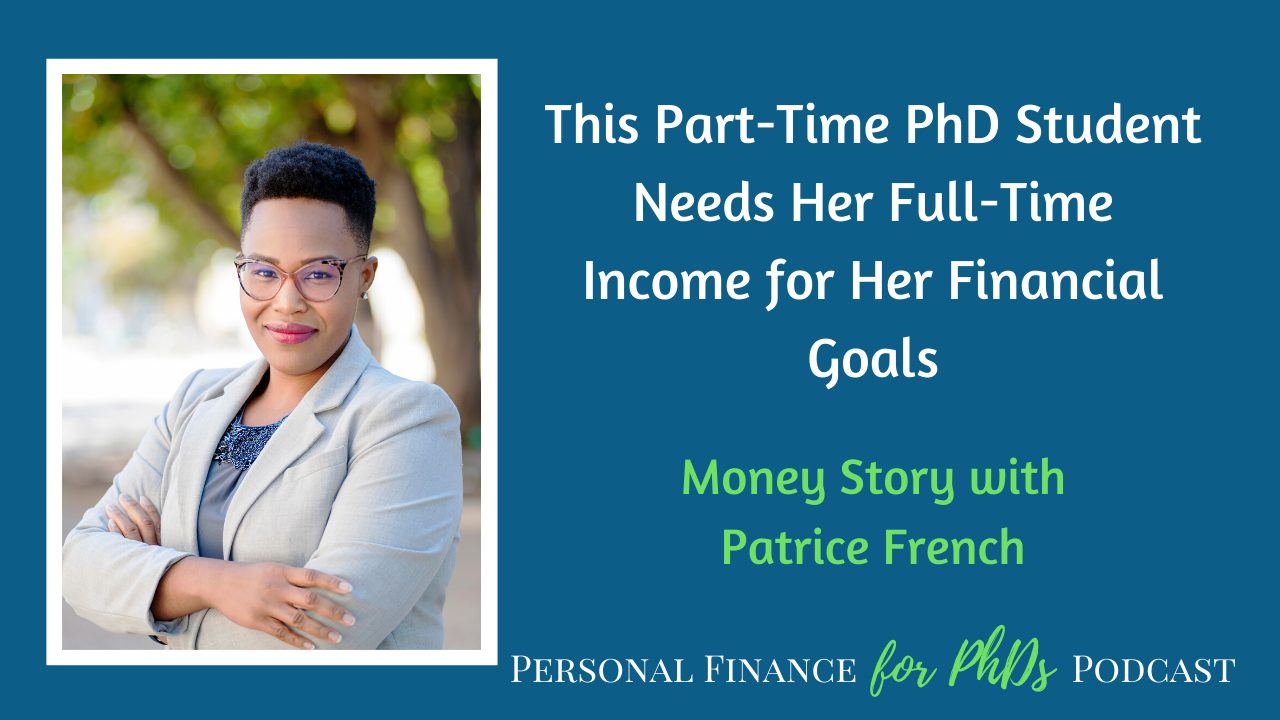
This Part-Time PhD Student Needs Her Full-Time Income for Her Financial Goals

November 25, 2019 by Lourdes Bobbio

In this episode, Emily interviews Patrice French, a PhD student in adult education at Texas A&M. Patrice has a full-time position at her university and is pursuing her PhD part-time. She is paying for her degree through her employee benefits and a small grant she won after searching and applying for over 50 external scholarships and grants. Emily and Patrice discuss her path to the PhD, her decision to maintain her full-time job while in her program, and what she expects the PhD to do for her career going forward. Along the way, they touch on Public Service Loan Forgiveness, repaying consumer debt, side income, investing for retirement, and the positive steps Patrice has taken with her finances over the past few months.

Links Mentioned in This Episode

  • Personal Finance for PhDs: Sign up for personal finance coaching
  • Personal Finance for PhDs: Wealthy PhD group program sign-up
  • Personal Finance for PhDs: Podcast Hub
  • Personal Finance for PhDs: Subscribe to the mailing list
  • Find Patrice French on Twitter
  • This Grad Student Defrayed His Housing Costs By Renting Rooms to His Peers
  • How the Promise of Public Service Loan Forgiveness Has Impacted This Prof’s Career and Family Decisions

part time PhD in TX

Teaser

00:00 Patrice: The reality at the PhD level is that there’s not a lot of funding for part time students and that’s just something that I had to contend with. I’ve scoured the internet, I’ve looked throughout all of our university. I looked at regional associations tied to my degree and it’s just not a lot out there for part time students, so being prepared to really fit the cost of your education is something that you have to think seriously about because there’s not going to be a lot of financial support for you as a part time student.

Introduction

00:35 Emily: Welcome to the Personal Finance for PhDs podcast, a higher education in personal finance. I’m your host, Dr. Emily Roberts. This is season four episode fifteen and today my guest is Patrice French, a PhD student in adult education at Texas A&M. Patrice has a full time position at her university and is pursuing her PhD part time. She’s paying for her degree through her employee benefits and a small grant she won after searching and applying for over 50 external scholarships and grants. Patrice and I discussed her path to the PhD, her decision to maintain her full time job while in her program, and what she expects the PhD to do for her career going forward. Along the way, we touch on public service loan forgiveness, repaying consumer debt, side income, investing for retirement, and the positive steps Patrice has taken with our finances over the past few months. I’m very excited to share her perspective here on the podcast. Without further ado, here’s my interview with Patrice French.

01:39 Emily: I have joining me on the podcast today, Patrice French and she will be telling us about her journey to the PhD as a part time student and a full time worker. So Patrice, thank you so much for joining me today.

01:52 Patrice: Thank you for having me Emily.

Will You Please Introduce Yourself Further?

01:54 Emily: Please tell us about yourself — where you’re in school, who your employer is, where you live, all those kinds of.

02:01 Patrice: Sure. Well, I am currently at Texas A&M University. I’ve been here a little over three years and this is also where I am pursuing my PhD. I am finished with my second year in my program, which is educational human resource development with an emphasis in adult education, but I like to call it adult education for short because the degree name is a little bit long and people often don’t know what that means. Texas A&M, the main campus is located in College Station, Texas, which is approximately a hundred miles northwest of Houston, Texas. So we’re not too far aside from some major cities in Texas.

02:44 Emily: Yeah, that sounds great. I actually have a little bit of a personal connection, I guess, to your field because my mother-in-law made her career in adult education and ultimately rose to the level of principal of an adult school. So yeah that’s what she’s been up to. Tell us your backstory, maybe from high school or college and what you were studying and what brought you to your current point.

From Social Work to Adult Education

03:12 Patrice: Sure. I have a background in social work actually. I have my bachelor’s and master’s in social work. I went to Texas Christian University in Fort Worth, Texas for my undergrad and I got my master’s degree at the University of Michigan, also in social work. So for a little bit of time I was licensed to practice social work in the state of Texas, but while I was pursuing my master’s degree, I learned that my focus on social work was pretty much in the minority because I was more focused on policy analysis, whereas most of my colleagues really wante to work inter-personally with families, children, things like that. I made a strategic decision to build my skill in a way that would support the efforts of social work, but at a macro level. While I was at my master’s program, I was a research intern at a social justice education program and my experience there basically just led me to an opportunity in higher ed doing social justice and multicultural education and basically led to my switch from social work to higher ed, which is where I’ve been for the past 10 years.

04:23 Patrice: My first job outside of my master’s degree, I would definitely say parallels different areas of social work, but I’ve transitioned in some ways to being more entrenched in higher ed where I wouldn’t consider my work to be social work. I did diversity and multicultural education work for four years and I was in St. Louis. I moved from University of Michigan to St. Louis in Missouri. I did that work for four years and then I transitioned to doing academic student success and retention work, where I oversaw unit that was tasked with supporting students who are transitioning to make sure they have their tools and things to be successful for retention, et cetera.

05:11 Patrice: I moved back to Texas about three years ago and some of that was precipitated by a major health event with my father. I was searching at the time, but by happenstance I happened to apply right around the time my father became ill. While I was in Houston, which is where I’m from, being with him, I basically got a really quick offer from Texas A&M. and I said, “well, I guess it’s meant to be that I’m back in Texas.” And a couple months later, I was back and that was in 2016 and I’ve been back since.

05:45 Patrice: As far as my trajectory to pursuing a PhD, I had been thinking about that really since I was in my master’s program and thought that I would work for three years and go back to school and become a social work researcher. But since I’ve kind of floated around outside of social work for so long, I didn’t think that was a good fit anymore, but I really was still interested and ended up exploring different programs either in psych or communication or an education for probably two or three years. I decided to take a break from looking at it because I thought it’d be more advantageous to work. I was not willing to sacrifice my income, and with my father’s health, I just put that on the back burner so I can be closer to him and my family to make sure that they had what they need. I was back at A&M and learned that they had an adult education program in my university and I actually work in the college that also hosts my program. I did some research and just decided to apply and got in. So a year into me working at A&M, I started my doctoral program and I started part time and have been pursuing the program part-time since 2017. It’s been a bit of a journey. I will say that I don’t know if I would recommend working full time and being in a doctoral program part-time or even, I know some colleagues that do it both full time. For me, I don’t really have any major life commitments to where I can’t balance it. I have a dog, but I am child-free, I don’t have a partner. Outside of going to visit my family, which is about an hour or 40 minutes drive away from me, which I usually go twice a month, I don’t have those huge commitments to where that it would make it harder to balance outside of just the commitment of supporting myself and making sure I’m doing what I’m meaning to do with my main employment position. And then just figuring out life and making sure I take care of myself, health wise and things like that. It’s been a lot.

Deciding on a Part-Time PhD

08:11 Emily: I can definitely see how you got to the PhD though. It’s clear from the point when you were in your master’s that the more academic kind of work and training was going to be a good fit at some point and you got there in a slightly different field than you were expecting. That’s great. I think you mentioned a little bit earlier that you didn’t want to sacrifice your income, but was that the main reason to do what you’re doing this way, with full time work and part-time PhD, rather than doing the PhD full time or are those programs not like well-funded or how did you come to that decision?

08:48 Patrice: I believe the year I started at A&M as an employee, they just started a new benefit where staff employees who could pursue a degree and get some tuition assistance. You had to work at the university for a minimum of one year to be eligible for that. The way that it was marketed at the time, I thought it was only $2,000 maximum for your pursuit of your degree or maybe between $2000 and $5,000 just for one year. So I was under the impression that I would be funding most of it myself and my program funds traditional full time students that are able to serve in TA, GA, or RA positions. Funding was not an option for me through my program nor was it at the larger university level because most of the graduate funding and fellowships were full time students. Or all of them actually. I haven’t seen any part time student funding fellowships at the university level. Financially, it would not have worked for me to go back to school full time because I think our average GA/TA salary is about $1,900 a month and most of them fund just traditional fall and spring hours, and the summer. My amount of bills and needing to be available if it was necessary to support my family. It just really wasn’t an option for me and I just didn’t want to sacrifice getting to a place where I was sort of comfortable. I didn’t want to struggle like I had been in graduate and undergrad and so I just decided not to do that.

10:31 Patrice: Up until the time when I got admitted, I was searching furiously for funding opportunities and I think I applied for over 50 external scholarships. I have a very detailed spreadsheet that tracks all of that and I didn’t get anything. I was applying to $500 scholarships from law offices or foundation repairs. It was just everything that didn’t have a stipulation for what a student should be, I applied for, and nothing. Right into the start of my program, I talked to our benefits people at the university and that’s when I learned that the benefit actually is as long as I’m employed at the university full time, I will get up to $5,000 a year in tuition assistance, which breaks down to $2000 for the fall, $2000 for the spring and $1000 for the summer. That, in combination with some fee waivers, which I think equate to about $300 a semester, really covers about 80% of my overall tuition fee costs. That ended up being way more affordable for me to have to come up with maybe $400 or $500 a semester in comparison to $2,600. In my college, our tuition and fees, excluding some of the fees that I don’t have to play as an employee , the tuition is about $2,547 per semester if I’m taking six credit hours. It sounds really inexpensive in comparison to some other institutions and I’m in state as well, so that makes a big difference, but still it wouldn’t be affordable on my salary to pay out of pocket without pursuing any external aid or scholarships or loans.

12:25 Patrice: I made a very intentional decision not to pursue any more student loans because I have them now and they are continuing to accrue interest and things of that nature, based on the payment plans I’m under because I am pursuing the public service loan forgiveness and have been under the income based repayment plan for four years. Now I’m on the pay as you earn, but my balance has increased and although I’m in school, I have chosen to waive my deferment so I can continue to make payment towards my loan so I can increase my qualifications sooner than later. I just didn’t want to occur any more debt and so I decided either I’m paying for this out of pocket as much as I can, so that might mean that it takes me 10 years to finish my degree, or I’m going to try to find some aid. Gratefully, I have been able to cover all of my costs for my program. I also found a small grant that I have to apply for annually, but I’ve gotten each year, that is for $1,500 for the fall and the spring.

13:36 Patrice: My net costs for my degree program has been negative for me out of pocket, meaning that in many cases between the grant and my tuition assistance, I actually get a little bit of a refund that I’m able to put towards books and supplies, software and other general living expenses. It’s actually worked out very well and I’m very grateful that I’m able to pursue my degree pretty aggressively. I think two courses per semester is a lot to be doing while working full time. And I do one in the summer. So far it’s been a very affordable degree. And even with that, I have a very detailed spreadsheet to the penny where I’m able to project how much my total degree is going to cost with fees, tuition, even diploma fee, the dissertation fee, even the regalia, I already haven’t an estimated a cost of total attendance. I’m being very diligent towards those costs, even though they have primarily been covered by my institution.

14:43 Emily: This is a very thorough explanation. Clearly you are on top of all of these different areas, in terms of the, and I’m, I’m glad that you mentioned pursuing all of those like scholarship applications that you did. I mean, only one grant has come of it, which is good, it’s what you needed, but not more than that because it was such a limited pool for part-time options. But it definitely sounds like you’ve been funded to the degree that you need to be and you just have to keep working your full time job and time to do the graduate work on the side. It’s different to work a full time job than to be like a TA, because a TA, tt’s only a 20 hour week per hour per week commitment and you have a presumably 40 hour per week commitment, but also as a professional, you’ve been doing this for a while, you’re very efficient. I can see how this would work out like pretty well, definitely financially, and also how you can manage your time. Before we move on from this, what does the future look like for you? What are your career goals with the PhD?

Post PhD Career Goals

15:56 Patrice: I always wanted to get a PhD for the credentials and that is still my primary goal. When I was admitted to my program, since Texas A&M is such a huge research institution, I wanted to open myself up to opportunities that would expose me to the academy, to what a tenure track faculty position could be for me. Is this something that I can see myself doing? So I’ve been building my experiences to both pursue the degree itself and also build my CV to give me opportunities, through publications, research experience. I’m still on the fence about whether or not I’m interested in an academic career and I’m leaning towards that not being for me and I do feel like I have a lot of skill and I’ve gotten some really positive feedback from my professors and peers in the field at conferences I’ve attended, but I don’t know if it’s for me in terms of the work with the writing and a lot has changed in the academy with how competitive it is. And quite honestly, based on my research, I would likely be taking a pay cut and would essentially be transitioning to a new career track that would take me maybe five to seven years to recoup the my salary that I had built thus far. And I don’t know if I’m willing to sacrifice that. I don’t really foresee myself getting a partner anytime soon, that may contribute to making a change in that decision. Aafter this, I do foresee myself staying in higher education. My current role right now is that I’m in an academic administrative position overseeing a program assessment that’s tied to some accreditation needs. It’s very much an administrative role, but there are lots of opportunities in higher ed that with the PhD specifically will open up opportunities. So I’m not too worried about where I’m going to land. I’m just gonna hold on for dear life for right now so I can finish my degree and then make some decisions about that. I’m crossing my fingers, I should be finished by the end of 2021 with everything. I have a year and a half left of coursework, so I should be done fall 2020, and my goal is to devote 2021 to writing. By 2022 I should be at a place to evaluate where I am and make some decisions, things like that. I don’t know, we’ll see.

18:30 Emily: You anticipated my next question because you had offhandedly said earlier, “Oh, might take me 10 years to finish,” but that definitely does not sound like the plan that you see yourself on, so that’s really, really good to hear.

Commercial

18:45 Emily: Emily here for a brief interlude. As a listener of this podcast, every week you hear strategies that another PhD has used to improve their financial picture. But listening and learning does not automatically translate into action in your own financial life. If you are ready to change how you think about and handle your money, but need some help getting started, I can be of service. There are two main ways you can work with me to create and implement a financial plan tailored for you. First, I offer one-on-one financial coaching, either as a single session or a series, as you make changes over the long term. You can find out more at PFforPhDs.com/coaching. Second, I offer a group program called The Wealthy PhD that is part coaching, part course, and part community. You can find out more and join the wait list for the next time I open the program at PFforPhDs.com/wealthyPhD. I believe it’s possible to succeed with your finances at every stage of PhD training and throughout your career. Let’s figure out together how to make that happen for you. Now, back to the interview.

Side Hustling for Extra Income

19:59 Emily: So in terms of funding your PhD, we’ve talked about you have your salary. Thankfully you haven’t, it sounds like, had to use your salary directly to fund the PhD. You have your tuition assistance from your employer. You have this grant that you won. But you told me that you also side hustle, so can you tell me about that?

20:16 Patrice: Yes, I am trying to find multiple ways to supplement my income even though I feel like I’m pretty stable. I did buy a home a couple of years ago and so there’s some costs that I’m looking to cover in terms of maintenance and repairs that are eating away at my salary more than I anticipated and I’m trying to recoup my savings. I have done a number of things. I have done freelancing editing work. I am renting out a room in my house with a colleague and friend of mine. I have done a lot of freelancing stuff as well, mostly editing. And something that’s more towards my student loans, I am partnered with an organization that basically connects nonprofit organizations with freelancers that have a level of skill that the organization needs and upon successful completion of a project, that organization will pay my student loans directly in the form of a stipend. And so I’ve done a couple projects. I haven’t done that many because I’m super busy, but that is another way that I’ve tried to indirectly try to pay down some of my debt with my loans even though I still plan on pursuing public service loan forgiveness, but I don’t know if I will continue to pursue that because it’s counted as income. So I did get a miscellaneous 1099 and it’s taxed, so I don’t know how advantageous it is for me to not see those costs directly, and how it affects my taxes. That’s pretty much what I’ve done. I don’t have a lot of time to do a lot of freelance stuff. Before I started, before I moved here, I did Ubering for a while, which was more lucrative for the drivers than it is now, hearing what I’ve heard, because I do still have some peers that drive for it. But I’m pretty busy so I don’t have a lot of times to do work that takes a lot of time, so any way that I can make free money, that’s where I’m kind of looking at now. The rental income is an easy way to do that and it works out both for myself and my friend because she gets to save money because she’s also in a doctoral program and is really looking to save on costs from renting her own apartment. And I’m able to get a little bit extra income that can go to other things.

22:45 Emily: Yeah, I was going to say the rental income sounds like the perfect solution in your situation because a full time job plus being a PhD student plus trying to side hustle where the side hustling involves trading your time for money, that is a lot on your plate and as you said, you’re visiting your family and so forth. The rental income is really just leveraging another asset you have, not your time, but your home, in a new way. That sounds like a really a really good fit. I’ve published an episode on the podcast before about a homeowner who rents out, who at the time was renting out rooms to his friends and how it was really just, while interpersonally challenging in a couple of ways, really overall very beneficial, mutually. So a good situation when you are able to rent to someone that you know and like and want to be around and trust to pay the rent on time and so forth.

Student Loan Repayment as a Part-Time PhD Student

23:38 Emily: You’ve mentioned your student loans a couple of times and your pursuit of PSLF. I meant to say earlier, it actually makes a lot of sense to me if you are into PSLF to not, I guess go to graduate school full time because I think that would have stopped the clock on that, I’m assuming.

23:56 Patrice: Yes. As long as I’m have my employment verified for full time employment, it would not. It still defers my loans automatically, but there is a one-time option to submit for a waiver of the deferment. You have to either stick with it or you don’t, they’re not going to give you the option to go back and forth, so I made that decision before I started, so I never had a lapse in my qualifying payments for that reason. I’m just sticking very diligently to and really connecting with the loan servicer in regards to where I am and I’m making my minimum payments and just chugging away.

24:37 Emily: And I think you may have mentioned earlier, are the student loans totally from your master’s degree or also from undergrad?

24:44 Patrice: They’re a combination. My undergrad degree was, my first two years were fully funded by scholarships and due to some transition and changes, a part of that was there was an increase in tuition of about up to 7% per year. And TCU is a private institution, so that 5-7% on $19,000, it makes a difference. My last two years of my undergrad, I think I took a total out of, I think, $14,000 and my master’s degree, I took out $24,000 and my master’s funding was only to cover my living expenses because I had a scholarship that covered all of my tuition and fees. While I tried to find employment while I was at Michigan, it was getting really tricky, so I just decided to take out the loans. I was only there for a 13 month program anyway, so I figured, let me just focus on my education and get out and just deal with the loans later. Total for both my degrees it’s about $36,000, but my balance is about $37,500 now eight and a half years later due to the accrual of interest and capitalization since I’ve been on the income based repayment plan instead of the standard option. So it’s just sitting there.

26:01 Emily: I’ve also done other other episodes where we discuss PSLF, very common in our community to be either pursuing it or considering it. What do you think about that decision now, eight and a half years in? Was PSLF the right route for you?

26:17 Patrice: I think it is. My salary when I was right out of my master’s degree was about $30,000 a year and it was in a state that took out state and local taxes, so my take home was about $1,800 per month. I think my standard payment at the time would’ve been about $400. That is a little bit under a quarter of my salary, and so I was really intentional about thinking about the options. I know I’m likely going to stay in nonprofit higher ed. That really wouldn’t be too much of a challenge to pursuing other employment options in lieu of a public service option. Really the salary and then my employment options were my main decisions behind that. I’m a little bit antsy about it given the challenges that I’ve been hearing about, but I think by the time that I’m qualified for forgiveness, there will have been…One, I think that any changes they make will affect new borrowers and not existing borrowers. Let’s say they take it away. I think that it won’t affect me. I think a lot of the hiccups that have happened with the borrowers that are qualifying now will have been remedied by the time that I qualify, which honestly should be in 2022, but I have some payments that are under review that I’ve not gotten a straight answer on in over a year. So my date is September 2023. So within 2022 or 23, I should have a qualification for forgiveness. I’m trying to stick to my decision. That’s why I’m on the fence whether or not I’m going to ambitiously start paying them down, or if I should just stick to the minimum payments because it really aggravates me to see my balance to staying. Because I’ve also been able to maintain a taxable adjusted salary that is, that keeps my payments pretty low. I have a very good accountant that’s able to, with my freelance income, to reduce my income a lot to where what’s reported helps to keep those payments low, which is a goal of mine since I am still covering a lot of other things. But I don’t know. We’ll see. If it happens that it no longer is advantageous for me, then I will make plans to pay them down because I am on a pretty ambitious consumer debt plan right now to where I should be done with all of my consumer debt, excluding my mortgage and my student loans, by next year. And so that should free up a lot of salary, especially if I continue to get some supplemental income through renting my room or stuff like that. So if it happens that I want to change my mind, I’ll just start ambitiously paying it down and will get rid of it.

29:19 Emily: You sound, overall, pretty optimistic about the program. I share your optimism.

29:25 Patrice: Cautiously, I’m cautiously —

29:27 Emily: Yeah, very good point. And really since you’ve been on the plan for eight years, it makes sense to hold out for that last 20% and just see it through and hope for the best.

Other Financial Goals

29:40 Emily: Tell about your other financial goals. You mentioned other debt repayment.

29:45 Patrice: Yes. So my goals right now are to really get a hold on my consumer debt. I have a little bit of credit card debt. I have a car that I have a year and a few months left back on that. I actually have been listening to a lot of your podcasts and reading the blog and have put together a debt plan where I think I’m using the avalanche method to really just target one area of debt at a time. I’m targeting the highest interest rate and then just tackling it and then going to the next. I have a pretty robust plan that if I stick to it, I should be done with everything by the end of June. I have a couple of credit cards and I have a car payment that I think has about $6,000 left on it. I had a really good interest rate on that. It has 2% interest on my car. Really, it wouldn’t save me that much. I have a loan for doing some home repairs and I would pay off a year early, a little bit under, maybe 10 months early on my current plan. I’m really just focused on getting the consumer debt down.

30:57 Patrice: I also want to build up my savings because partially me buying a house, there were some unanticipated expenses of repair really early on to me purchasing them. Since I had done so much on the down payment, I didn’t have the savings to do the repairs, so that was part of the reason why I have a loan for doing some of their repairs. By paying off all of this debt, it will free up a lot of my income so I can start saving, which is a big goal. I’d really like to have more of a cushion than I have right now. Besides that, some larger goals are to just do a lot better at my mid-term and long-term planning. I usually would just plan month to month and all my bills are really the same, so they’re on auto repayments. Any overspending I’m doing or not planning ahead is my fault, quite honestly, unless there’s an unexpected expense, like if my tire blew out or something. But a part of it is just me just being too social and liking to go out and drink and eat out when I can easily just eat at home. It’s just being more fortuitous on my budget so that I could meet some of these financial goals and I’m being less reliant on overspending and really trying to plan out.

32:19 Patrice: I actually have a spreadsheet that is between now and 2020 that kind of plans out how much I’m expected to spend on all my bills, which really shouldn’t change. And then as those debt balances go down, I anticipate that my salary is going to go up so I can start planning for more savings and planning around travel because that’s a big thing that I don’t do a good job at. If I’m traveling for a conference, which a lot of that is self funded, or I’m just going to visit friends and stuff, I kind of just figure it out, and usually me figuring out is putting on my credit card and paying it off later, which isn’t the best approach. I’ve actually applied for a credit card that has a really good mileage rate. There are no airports that are really close to me where I have a preferred airline and so I’m really focusing on putting my recurring bills on that card to build up points, so that I can use that for more of my travel instead of just relying on just any old card. I’m trying to be a little bit more savvy with things. I definitely think when I get through with my debt, I won’t really have to worry about trickling back to my credit cards since there will be so much more flexibility in my salary or my take home anyway. That’s about it.

33:40 Emily: Yeah. It sounds like you’re tackling now the personal finance side of things with the same kind of diligence and energy that you were in these other earlier areas that we discussed more related to your career. That sounds amazing. There are so many wonderful strategies that you just laid out and so I hope that everyone caught them the first time around. Great stuff that you’re doing right now. How are you doing on long-long-term, like retirement stuff? Does your employer already do a lot of that?

Retirement Savings

34:10 Patrice: Yeah. My previous employer, I worked at and institution in St. Louis, I forget what they matched up to, but after the year I was able to contribute at a matching rate up at least to 5%, but I think I might be wrong.I have a 403b that is sitting, that I haven’t touched, I’m just letting it accrue. And then I have a separate retirement plan since I worked for the state of Texas. They take a little bit longer to get vested in, so they’re contributing an equal amount, which is 7.6%, that I’m contributing each month. But after five years I’ll be fully vested as an employee. Um, so if I ever leave I can just let it stay there, I can come back and it’s a really robust retirement system. I will definitely be here long enough to get vested. Those are my main two things and because of that, I haven’t really pursued any other retirement options such as a Roth IRA or things like that, because I’m well-matched at my institutions and I think it’s the equivalent of a pension retirement with the state of Texas. I don’t think it’s your traditional investment fund. I think it’s fully funded and that my eligibility I think is at 55 years age or the equivalent of I think 20 years of service or something. If I wanted to, if I ended up staying in the state of Texas or at this institution, I would have the option to retire at 55 because I’ve been working here since before I was 30. I think it’s a good option. That’s something I’m paying attention to more readily, but I’ve been contributing to my retirement since I was 22, at a minimum of at least 2.5% of my salary, which was not a lot at the time because I was making $30,000 or $33,000 or whatever. But definitely at a point now I’m maxing out the full contributions and maybe if my salary is freed up once I start paying off my debt and have a more sizable savings and I might take out in a Roth IRA to maximize their savings as well. Or I think I’m also looking into some investments, but that’s kind of a long-term thing. I would feel more comfortable pursuing investments once all of my debt is free, so I’ll have a lot more pocket money to play with, assuming that I’m in the same role I’m in now, making the same salary that I am.

36:41 Emily: Yeah. I can definitely see this as one of the advantages of doing the PhD part-time while working full time is that not only do you have the higher salary, but you have these benefits that graduate students never receive. That’s awesome. And it seems like over the next two, three, four years, a lot of different pieces of your finances are going to get a lot easier, right? That’s going to be paid and PSLF will either come through or you’ll have to focus on paying off in another way. Other consumer debt will be gone. It really seems like…And of course when you finish your PhD and your salary hopefully will change, it’ll really be a pretty nice rosy picture at that time and you’ll be able to pursue the IRA or other types of savings, or whatever lifestyle stuff, whatever you want at that point.

37:29 Patrice: Yes. Yes. That’s my goal. Something I neglected to mention is hat my tuition benefit that the university is actually really smart in this because if you’re pursuing graduate level work, and you get tuition assistance from your employer in excess of $5,250 in a calendar year, anything over that amount would be taxed as income. And my previous institution gave a hundred percent tuition remission, but it was a private institution and tuition was about, I think $25,000 a year. So even if you were pursuing part time, most of my colleagues that were pursuing degrees, they would actually end up owing taxes annually because of that. Then our employer worked out a deal where you can just pay the taxes out of your salary, so it wouldn’t feel like such a big hit. But I don’t have to worry about the tuition assistance being a taxable benefit because it’s right under that mark in a calendar year, which is fantastic.

Financial Advice for Part-Time PhDs

38:32 Emily: Yeah, because I mostly deal with full time students, it’s something that I’m like, “Oh yeah, I remember those numbers, I remember being aware of that,” but it’s not something I’m intimately familiar with, so I’m glad you can tell us about that on the podcast. As we wrap up here, what is your best financial advice for another PhD student? Perhaps a part time student.

38:54 Patrice: I would definitely say, look and find as many resources as you can to fund your education. Depending on your program, there may be funding through grants. For example, I’m on a research project right now, that I’m not being funded on, but they got a little bit of money to fund graduate students for extra work. I know that it may be something to consider between the time you’re already spending working, but there is funding out there within your programs, through a lot of the research that’s being done. It’s really just being proactive to ask for it and also don’t feel like you have to rush to graduate and get it done. That’s something that I had to reconcile with, and I had to keep asking myself, why am I really pushing to get this done by this date? And there’s no real answer to that. So if you are reasonable with your time, that is something to make it really affordable, in terms of whether or not you’re going to pursue self funding or program funding or even things like loans and stuff like that. I have a colleague of mine that she and her husband actually bought an RV and we are a huge tailgating community at Texas A&M and she actually rents out her RV during our football season and that is partially how she’s able to fund her cost of her program. And so I’ve heard of some really creative things in addition to just the taking out loans or paying out of pocket that have helped support them.

Patrice: Unfortunately the reality at the PhD level is that there’s not a lot of funding for part time students and that’s just something that I had to contend with. In doing my exhaustive internet search, I was on some premium scholarship websites where you pay a fee to look in databases. I’ve scoured the internet, I’ve looked throughout all of our university. I looked at regional associations tied to my degree and it’s just not a lot out there for part time students. So being prepared to really fit the cost of your education is something that you have to think seriously about because there’s not going to be a lot of financial support for you as a part time student, even if your program gives a lot of flexibility in the pursuit of your degree, which my program does by offering a number of courses online and then in the evening. So it doesn’t really conflict with my nine to five, eight to five work schedule, but it just is hard. There’s just no way around it , there really isn’t. Maybe for some people that are in a partner relationship that it’s more feasible for them. Thankfully through my benefits I am able to not really worry about my cost, but if I wasn’t, I definitely would be taking a lot more time to pursue my degree because I am very much committed to not incurring any more student loan debt.

41:45 Emily: Yeah, I think the listeners can pretty well trust what you’re saying, when you say I have scoured the internet because you’re obviously very thorough in your work and so it’s disappointing to hear that, but better to be realistic about the situation than to go into it hoping that you’re going to win something that’s just not available to you. Thank you so much for joining me on the podcast. I am so glad to have your perspective here.

42:08 Patrice: Thank you so much Emily. I’m glad I’m able to share.

Outtro

42:12 Emily: Listeners, thank you for joining me for this episode. PFforPphDs.com/podcast is the hub for the Personal Finance for PhDs podcast. There, you can find links to all the episode show notes and a form to volunteer to be interviewed. I’d love for you to check it out and get more involved. If you’ve been enjoying the podcast, here are four ways you can help it grow. One, subscribe to the podcast and rate and review it on Apple podcast, Stitcher, or whatever platform you use. Two, share an episode you found particularly valuable on social media or with your PhD peers. Three, recommend me as a speaker to your university or association. My seminars covered the personal finance topics PhDs are most interested in, like investing, debt repayment, and taxes. Four, subscribe to my mailing list at PFforPhDs.com/subscribe. Through that list, you’ll keep up with all the new content and special opportunities for Personal Finance for PhDs. See you in the next episode, and remember, you don’t have to have a PhD to succeed with personal finance, but it helps. The music is Stages of Awakening by Poddington Bear from the Free Music Achive and is shared under CC by NC. Podcast editing and show notes creation by Lourdes Bobbio.

An Unfunded Summer Didn’t Deter this PhD Student Thanks to Her Creative Side Hustle

December 24, 2018 by Emily

In this episode, Emily interviews Bailey Poland, a rising second-year PhD student in rhetoric and writing at Bowling Green State University. Bailey earns a stipend of just $14,000 for the academic year, but manages to live a comfortable life thanks to her disciplined budgeting and two side hustles. Unlike many of her classmates, she devoted her first summer as a PhD student exclusively to research, relying on her side hustle income and savings from her stipend to tide her over until the next academic year started. Emily and Bailey discuss in detail Bailey’s housing choice, frugal habits, and unique Patreon side hustle that complements her graduate work.

Links mentioned in episode

  • Personal Finance for PhDs Membership Community
  • Volunteer as a Guest for the Podcast
  • Frugal Month
  • How to Financially Navigate an Unfunded Summer
  • Bailey Poland’s Patreon

unfunded summer PhD

0:00 Introduction

1:26 Q1: Please Introduce Yourself

Bailey Poland is a second year PhD student in the Rhetoric and Writing program at Bowling Green State University. Bowling Green is a city in Ohio, located to the south of Toledo, Ohio. Bailey’s stipend is $14,000 per academic year. Additionally, Bailey earns $460 per month from Patreon and $150 quarterly from copy-editing a music magazine focused on Texas. She is the only person in her household.

Bailey’s PhD stipend does not include summer funding. She budgets savings over the academic year in order to meet her expenses over the summer.

3:25 Q2: What are your five largest expenses each month?

Bailey’s largest expenses are rent at $600 per month, car payment at $200 per month, health insurance and fees at $400 per month, food at $150 to $200 per month, and car insurance at $112 per month.

4:14 #1 Expense: Rent

Bailey rents a two bedroom apartment for $600 per month. She says this rate is higher than other options available in Bowling Green. She looked at options for rent at rates of $350 to $450 per month, but these apartments were in poor quality or clearly undergraduate housing. Bailey used to own a house, so she approached her apartment search with those expectations.

Bailey’s apartment is in downtown Bowling Green. She walks to campus, so she doesn’t use her car or have a university parking pass. She drives to the grocery store, but she lives above a coffee shop. She thinks she is in the perfect location. She lives by herself in the two-bedroom apartment, so she sleeps in the smaller bedroom and uses the extra bedroom as her office and library.

6:18 #2 Expense: Car Payment

Bailey pays $200 per month for her car. She has a 2017 vehicle that she bought new. She traded in her older Toyota Corolla when she bought her new car. Due to unfortunate family circumstances, Bailey received money from inheritance and estate closure. She used this money for her car payments. She has stayed ahead of interest and has gotten ahead on payments.

8:06 #3 Expense: Health Insurance and Fees

Bailey pays health and insurance and fees in lump sums a couple times a year. The amount works out to about $400 per month. She uses her credit card to make the payment at the start of each semester, but she pays it off immediately. Her credit card pays back 1.5% so she received a small kickback. Generally, she doesn’t keep a balance on her credit card so she avoids interest payments.

She made her first health insurance and fees payment before she received any of her graduate school stipend. Because she formerly worked as a marketing analyst for global HR and payroll company, she had enough savings available to make this payment when she started graduate school. She chose to go to graduate school because she was much happier in a classroom than behind a desk in a corporate office.

10:25 #4 Expense: Food

Bailey pays $150 to $200 per month for food, which includes groceries and dining out. She plans and prepares meals ahead of time. She cooks two or three times a week and freezes leftovers. She takes food with her to campus.

She has a limited set of go-to recipes. One of her favorites is chile garlic tofu. She says the meal is filling and takes half an hour to prepare. She gets four meals from one block of tofu. She eats lots of eggs, pasta, and rice-based meals. Her vegetarian cooking has increased since she started PhD program.

Bailey learned meal preparation from trial and error in the first few months of graduate school. She figured out which meals took too long or she didn’t like enough to have leftover. She used the Budget Bites website to find recipes. She cooks on the free nights of her week, because she knows which nights she’ll want to eat dinner as soon as she gets home. Bailey is on campus from 8am to 6pm most of the week. The latest she gets home is 7pm or 8pm. She takes lunch and a small snack with her to campus, and she eats dinner at home.

14:51 #5 Expense: Car Insurance

When Bailey purchased her new car, her car insurance rate increased from $85 per month to $130 per month. She has a plug-in for diagnostics of her driving habit, which lowered her insurance rate to $112 per month. She only regularly drives to and from the grocery store, which is a 10 minute drive. She also drives to her mom’s house, which is 30 minutes away and all highway driving.

Bailey says graduate students can get by without a car in Bowling Green. In her PhD cohort, at least one person doesn’t have a car. Busses run regularly to and from campus. Grocery stores deliver for a fee. Local activities are accessible to pedestrians. Bowling Green does not have cabs, Uber, or Lyft. It is pretty rural. Bailey needs a car to leave town to see her family.

18:10 Can you tell us about your side hustles?

Bailey has two separate side hustles. For one, Bailey copy edits a magazine about the country music scene in Texas. She missed doing copy-editing work, so she posted on Twitter that she was looking for an opportunity. Someone from the magazine responded to her and said they’d pay her to copy edit. Bailey has had this side hustle for three years. She receives $150 every few months and she has learned a lot about a topic that is unfamiliar to her.

For another, Bailey uses Patreon, the crowdfunding platform for artists and creators. She receives $460 each month from Patreon. She got started after she defended her Master’s thesis and she quit her corporate job earlier than she had planned. She was working at a bookstore and she needed more income. Some of her friends had Patreon, so she was familiar with the platform. Bailey started by doing live readings of The Rhetorical Tradition, like live tweeting her readings with funny commentary. People got invested in her live readings and she transitioned the activity to Patreon. Reading The Rhetorical Tradition was a really long project. She planned in advance and read as much as possible during the summer so she wouldn’t need to read during her first graduate school semester. She planned to post about The Rhetorical Tradition on Monday and Friday, post photos of her mom’s three cats on Tuesday and Thursday, and post an essay style blog post on Wednesdays. She only writes one or two truly new posts per month. With her PhD work, she doesn’t have time to write four or five new posts a month. Recently she has started a new reading series that overlaps with her prelim list for her PhD. She is gaining familiarity with texts in her field, having interesting conversations with her patrons, and making some money.

Bailey has created a very niche platform. Starting a Patreon was a huge leap of faith. She used to be super active on Twitter with a group of 18,000 followers. She authored a book, which helped her gain an audience invested in her thoughts. She trusted that her audience would move with her from Twitter to Patreon. She front loaded the work during the summer, so during her first semester it was more like a passive income stream. Now it serves multiple purposes for her. She finds it fulfilling that her academic work is accessible to the public. Her work lately is archival, and through Patreon she can share what it’s like to work in an archive. Bailey finds joy in her patrons and appreciates that they pay for her to do this work.

26:35 How do your colleagues react to your side hustle? Do they take on side hustles?

Bailey says her colleagues know and are supportive. For example, Bailey did a public series on Patreon that was a reflection on teaching practices she learned at Bowling Green. Her program’s website’s homepage included a link to her series. Generally, PhD students are discouraged from outside work because they should focus on doctoral work, but her department gives no formal prohibition of outside work. Most other graduate students have some other work, though it may not be talked about.

During the summer, other PhD students in her department find jobs. Some find online teaching roles, and one is working in the garden center at Lowe’s Hardware Store. One is going to a writers retreat that comes with a stipend. PhD students with spouses don’t work or find part time work.

29:28 Q4: What are you currently doing to further your financial goals?

Bailey has a 401k from her corporate job that she will roll into a Roth IRA over the next few years. She has investments with Betterment that serve as her long-term emergency funds. She has a high earnings online savings account as her primary emergency fund. Her goal is to have three months of expenses saved, and she is $600 short of her goal. Generally, her goal is to have her retirement well planned. She wants to be in academia long term, but she can’t be certain about this path. She wants security and confidence during her job search. Having savings going into graduate school frees up opportunities.

During her first summer as a PhD student, Bailey is working on archival projects and taking a class. During the school year, Bailey has multiple things going on, like classes, teachers, committees, conference planning. Summer is really valuable to devote focused attention to a project. In subsequent summers, it is possible she will take teaching jobs.

34:30 Q4: What don’t you spend money on that might surprise people?

Bailey doesn’t have student loans. She paid all of her loans within two years after undergrad. She hasn’t taken out any loans for higher education. Because she went to a State school, had scholarship, and finished in three years, she had very manageable loans from her undergraduate education. She took a job after college right away.

She has stopped buying books, which is hard for her personally. Even if she buys used books, it adds up quickly. She tries to keep miscellaneous spending low every month. She used to buy $200 to $300 worth of books every month, now she just buys one book a month. She checks out a lot of books from the library, and she lives less than a block from local public library

She doesn’t spend a lot on hobbies. She likes to cross stitch. This is inexpensive and takes a long time. She can spend $20 on one project that entertains her for five months. She has hobbies that help her relax and are not difficult for her budget.

39:00 Q5: What are you happy with in your spending and what would you like to change?

Bailey’s rent is higher than she wants to pay and is more than what others pay. She negotiated for lower increase rate when she renewed her lease. She’s considering doing a spending fast over the summer because she has no stipend coming in. She wants to minimize the hit that her savings is taking. She can find entertainment in Bowling Green for free. For example, there is a huge arts community and a massive arts festival.

42:12 Q6: What is your best advice for someone new to your city who is budget-conscious?

Bailey recommends that someone new to Bowling Green shops around for a place to live. There a lot of good options. Graduate student housing is affordable and it is easy to find a roommate. She says to look for an apartment as early as possible. She started looking in July, which limited her options. She would have looked earlier if she knew.

She advises new PhD students in Bowling Green to plan on saving. She says make sure you have cushion before you get here. Graduate school is stressful enough without living paycheck to paycheck. You should get rid of debt completely if you can.

44:22 Q7: Would you like to make any other comments on what it takes to get by where you live on what you earn?

Bailey says it is definitely possible to live in Bowling Green frugally and have a good time. She says there is always stuff happening that’s free or inexpensive. Toledo is a twenty to thirty minute drive. It may not be possible to live on the stipend alone, but you don’t need much more. Bowling Green has a low cost of living and is a college town invested in the university community.

45:22 Conclusion

This PhD Side Hustler Maintains a Healthy Work-Life Balance

October 8, 2018 by Emily

Today’s podcast guest is Dr. Caitlin Faas, an assistant professor of psychology and perennial side hustler. We discuss her history with side hustling and her motivations for pursuing it. Caitlin’s current side hustle of academic coaching dovetails so well with her primary role as a faculty member that she’s even planning to include that work in her tenure packet. Her work involves coaching and teaching about time management, productivity, and overcoming psychological barriers to academic success, so listen through the episode and check out her website to learn the tips that work well for her and her clients.

Links Mentioned in Episode

  • Dr. Caitlin Faas’s Website
  • Personal Finance for PhDs Membership Community
  • Volunteer as a Guest for the Podcast
  • Side Hustle Nation podcast
  • Self-Employed PhD Network
  • How to Increase Your Income as a Graduate Student

healthy work life balance

Subscribe on Apple Podcasts, Google Play Music, Stitcher, or Spotify.

Give your feedback on Season 1 and influence the direction for Season 2 through this form.

0:00 Introduction

1:09 Please Introduce Yourself

Dr. Caitlin Faas is an assistant professor at small liberal arts college in Maryland. She’s had her job for five years, and soon she is submitting tenure packet. She went to graduate school at Virginia Tech, where she studied human development and family studies. She’s the developmental psychology professor in her department. Her research focus is emerging adulthood.

For her side hustle, Caitlin runs a business to coach busy professionals as they try to integrate school and academics into their daily life. She provides career direction and productivity tips to her clients, as well as offering advice on her blog and social media. Her clients are associate professors, graduate students, and professionals considering applying to graduate school.

3:17 Did you have a side hustle as a student?

Caitlin has always valued hard work and earning her own income. As an undergraduate, she worked while being a full time student. Then as a graduate student, Caitlin worked at the local yarn shop during the summer and had a couple corporate retail work experiences. Having extra spending money was her motivation for her side hustle. She’d usually spend her income from the yarn shop on yarn for her knitting hobby. She also used her money for non-funded academic opportunities, like going to conferences.

Caitlin and Emily both agree that having outside activities, whether paid or hobby, helps you personally while you’re a graduate student. A side hustles is a valuable way to learn other skills and discover what you enjoy doing.

Video Series: How to Increase Your Income as a Graduate Student

Subscribe to our mailing list to receive the 7-part video series on increasing your income as a graduate student, including side hustles and passive income.

Success! Now check your email to confirm your subscription.

There was an error submitting your subscription. Please try again.

We won't send you spam. Unsubscribe at any time. Powered by Kit

8:10 How did you transition into self-employment as your side hustle?

Caitlin went from graduate school directly into her assistant professor position. For the first two years, she focused on her productivity, time management, and personal values. She decided that she wanted to work 9-5 and use her non-work time as she chose. She trained for a half marathon and on her runs, she listened to Nick Loper’s Side Hustle Nation podcast. The stories she heard on the podcast inspired her to start her own business on the side. Starting a coaching business seemed like a way for her to take more control of her career trajectory in the face of an uncertain economy. In contrast to other professors who may do consulting on the side, Caitlin decided to create her own platform to reach the general public. She wanted to help people beyond her students and outside her own academic network.

15:13 What do you do in your business and how does it complement your primary job?

Caitlin is a personal coach, working with clients to improve their productivity, time management, writing and academic life. To get started, she took coaching classes and offered her expertise to a broad audience. Most clients needed help determining if they should leave their job to go to graduate school, so Caitlin’s work has evolved to focus on that audience.

She spends about 8-10 hours per week on her business during the academic year and 20 hours per week during the summer. This time is spent coaching clients, collaboratively editing writing and teaching writing skills, speaking at conferences outside of her field, engaging her audience on social media, and on networking calls. She recently began working with corporations to help bridge generational differences. For instance, she has advised business how to help baby boomers and millenials work better together. She’s been paid to give webinars in a corporate setting.

Caitlin and Emily comment that academics are trained to view much of their work as voluntary service. Academics do many tasks, like reviewing papers, as a service for no extra money. Yet through a side hustle, Caitlin is paid for these tasks, generating income for her valuable skills.

20:50 What benefits have you experienced from your side hustle?

Caitlin benefits from flexibility with her finances that come from her side income. She has student loan bills, so this income helps her make those payments. She dreams of financial freedom. Also, Caitlin likes that her side hustle gets her outside of the ivory tower. She enjoys getting to know other people and helping people. Her goal is help people feel empowered to make decisions about their career and be productive. Through her business, she feels in control of her career, where she can learn lessons and grow opportunities.

23:02 Can you tell us about your website?

Caitlin’s website provides free content for interested people. She includes a blog with posts about productivity, self-improvement, and deciding whether to go to graduate school. Every two weeks, she sends an email newsletter. She provides videos with a transcript and worksheets.

Her first website was very simple and didn’t have much content. Having a website was an important first step to establish her business and build an audience. As she earned more money, she could put some of that money back into her business. Now, she hires a graphic designer and video editor to improve the quality of her online products.

25:34 How do you manage your time between your primary job, side hustle, and other commitments?

As a productivity coach, Caitlin practices what she coaches. She is serious about working her primary job 9-5 and having free time on evenings and weekends. She is super strict about sleep, so she always make sure she has 8 hours of sleep each night. She encourages people to start with getting enough sleep. Caitlin critically considers how she likes to spend her time, so that she spends it on activities she enjoys. For instance, she has decreased the time she spends editing papers, because she finds more fulfillment from coaching clients in person. She read Gretchen Rubin’s books for inspiration, and suggests that others look for productivity role models to follow.

Increase Your Income

Join the mailing list to receive our 7-part video series, "How to Increase Your Income as a Graduate Student," including side hustles and passive income.

Success! Now check your email to confirm your subscription.

There was an error submitting your subscription. Please try again.

We won't send you spam. Unsubscribe at any time. Powered by Kit

30:48 How does your side hustle interact with your primary job?

At first, Caitlin kept her business idea quiet. Now that she has established her side hustle, she is open about it with people in her department. She says typically people don’t think too much about what she’s doing, but colleagues ask her about time management.

Coaching clients has made Caitlin a better professor, because skills she learned while she trained to be a coach showed her how to be a better teacher. She’s including information about her coaching business in her tenure package. She is making the case that her coaching business has improved her performance as a professor.

33:38 Would there be a situation where your side hustle became your primary job, or alternatively, you would stop it?

Caitlin has other goals that are fulfilled through her professor position. For example, one of her goals is travel, and her professor position gives her the opportunity to take her students abroad. She took her students to Greece, and her travel was paid for. She sees this as a perk of being a professor.

She is in a growth mode in her coaching business. She has 8-10 hours each week, so she’s examining how she can grow even though her time is limited. Additionally, Caitlin and her partner will be foster parents for teenagers soon. This family life transition may change her priorities and time management.

37:12 How could someone with a PhD find a side hustle that complements their primary work?

Caitlin recommends completing “What’s your purpose?” and “What are the things you like to do?” activities offered on several entrepreneur websites. Even though the entrepreneur path may not seem like an intuitive one for many with a PhD, Caitlin suggests plugging into the entrepreneur network to find support.

Through a side hustle, you can truly explore what you want to do and find something you love to work on. When you find something that you love, Caitlin says you have energy to overcome road blocks and make it grow. If you don’t love the work, you have the freedom to change direction.

39:40 Final Comments

Caitlin and Emily are both part of a self-employed PhD network led by Dr. Jennifer Polk. The network is very supportive and includes a diversity of people. Caitlin and Emily welcome people to reach out to them directly.

40:55 Conclusion

Code Maintenance Consultant

October 3, 2018 by Emily


Name: Carolyn Chlebek

University: Cornell University

Department/Program: Biomedical Engineering, PhD student


What is your side or temporary job?

I work as a consultant for a Gait Analysis Laboratory on campus. I maintain the code that provides the interface and analysis packages for the laboratory.

How much do you earn?

I earn $18/hr.

How do you balance your job with your graduate work?

I set aside 5 hours per week in my schedule. Typically, I look at my weekly schedule Sunday night and find some time that I physically block off – I ensure that I work 9 hr/day in total, therefore ensuring I give enough time for my research (minimum 40hrs/week).

Does your job complement your graduate work or advance your career?

Yes, this job can definitely influence my career. Much of my research requires me to create and maintain code, so this side hustle is good practice. Additionally, the graduate student who held this position before me went into consulting and found that this position was a great talking point in interviews and demonstrated his skills that made him a great fit for a consulting position.

How did you get started with your job?

Another graduate student in my lab held the position before me and recruited me to take over from him after he graduated.

Is there anything else you would like to share about your experience?

I enjoy the challenges of this position, and the more translational nature of this work – the lab uses this data to evaluate the healing progress of pet dogs after surgeries. They also use this data to guide future surgical decisions – as a dog lover, this is very motivating!

Group Fitness Instructor on Campus

September 26, 2018 by Emily

Name: Carolyn Chlebek

University: Cornell University

Department/Program: Biomedical Engineering, PhD student

What is your side or temporary job?

I work as a group fitness instructor through the Cornell Fitness Center.

How much do you earn?

I currently earn $18/hr, but anticipate raises the longer I teach and more certifications I receive. Additionally, this position allows me to get free gym membership.

How do you balance your job with your graduate work?

I teach 1-2 classes per week and select times that will not conflict with my experiments – right now I am teaching on Sunday nights, so it is a nice calming way to start my week.

Does your job complement your graduate work or advance your career?

My job does not directly impact my graduate work, however I study biomechanics so I can make very broad connections between my work and my side hustle. Additionally, the teaching experience that comes with group fitness will certainly add to my confidence should I go into academia & need to teach or give public presentations often.

How did you get started with your job?

Another graduate student in my lab taught group fitness classes and recruited me to join & learn how to teach.

Is there anything else you would like to share about your experience?

I love being able to connect with students – both in and out of my department – in a more social and healthy way! I also love being able to help people in their fitness journeys, and having an excuse to learn more about fitness and healthy lifestyles as I go through this job.

The Complete Guide to a Side Hustle for a PhD Student or Postdoc

September 17, 2018 by Emily

It’s no secret that PhD students and postdocs are paid a meager salary, sometimes not even as much as the local living wage. While a fraction of graduate students have probably always pursued side income to supplement their stipends/salaries, e.g., through part-time jobs, moonlighting, or odd jobs, only in recent years has it become easy to make money online or make money from home. Enter the ‘side hustle.’ The term exploded in popularity during the Great Recession along with the ‘gig economy.’ The flexibility of modern side hustles has made it possible for students and postdocs to fit their income-generating activities around their busy research schedules.

This article details why a graduate student or postdoc would want to side hustle, whether it’s allowed by their university/institution, examples of real side hustles held by PhDs, how to best manage the side income, and advice from PhDs with successful side hustles.

side hustle PhD postdoc

Motivations for Side Hustling

The motivations for having a side hustle during your PhD training are to make up for the deficiencies in what the university provides: money (primarily) and career-advancing experiences.

Increase Income

Pursuing your PhD during graduate school or gaining additional training as a postdoc is supposed to be your full-time (or more) pursuit. Research is life, right? Unfortunately, the positions don’t pay anywhere near as well as a regular full-time job.

The best case scenario for a PhD student or postdoc is that you will be paid enough to support yourself without making extreme lifestyle sacrifices, i.e., living in a van. However, there are plenty of programs and universities that do not even meet that low bar for a single person with no dependents. For a graduate student or postdoc with a dependent spouse (e.g., of an international trainee) or children, the low stipend or salary is almost certainly inadequate.

Graduate students almost always turn first to cutting their living expenses to be able to live within their means. They know that they are supposed to devote the lion’s share of their weekly energy to their coursework, research, and teaching. But when their backs are against the wall, some make money on the side to avoid going (further) into debt.

Career-Advancing Experiences

Some graduate students and postdocs are motivated to side hustle not by lack of income but rather lack of practical career preparation.

What careers does a PhD or postdoc prepare you for? These days, the vast majority of PhDs are not hired into tenure-track faculty positions. (Time to stop calling the jobs most PhDs get “alternative”, right?) Some universities have acknowledged this and put in place programming to help PhDs transition out of academia (my alma mater, Duke University, and in particular the Pratt School of Engineering, is innovating in this area), while others are still catching up.

Of course, PhDs have plenty of transferable skills that can be put to use in a wide variety of careers, but landing a job is still challenging.

Further reading: How My PhD Prepared Me for Entrepreneurship

A judiciously chosen side hustle (or even volunteer work) can help a PhD build out her resumé/CV and network to stand out from the other PhD applicants. A side hustle can teach you new skills, give you an opportunity to demonstrate the skills you already possess, and introduce you to professionals who can further your career journey.

Video Series: How to Increase Your Income as a Graduate Student

Subscribe to our mailing list to receive the 7-part video series on increasing your income as a graduate student, including side hustles and passive income.

Success! Now check your email to confirm your subscription.

There was an error submitting your subscription. Please try again.

We won't send you spam. Unsubscribe at any time. Powered by Kit

Are Side Hustles Allowed by Your PhD Program or Postdoc Position?

While some academics may take the view that side hustling distracts from classes, teaching, research, etc., for some people a side hustle is the main factor that enables them to stay in their graduate programs or postdoc positions. They side hustle because they want to keep doing PhD-level research; otherwise, they can just leave and earn more money elsewhere! If conceived and managed properly, a side hustle is not a distraction from the student or postdoc’s training but rather an enhancement of it.

If you think about graduate school or your postdoc as similar to any other type of job, usually the only stipulations regarding your side hustle are that: 1) it does not interfere with your primary job and 2) it does not present a conflict of interest. That logic is helpful for thinking through whether a side hustle is allowed, but the universities sometimes add layers of complexity.

Further reading: Can a Graduate Student Have a Side Hustle?

Side Hustle Permissibility by Position Type: International, Fellow, Employee, Etc.

There may be explicit bans on making money on the side or it may be frowned upon. The income and experience gained from a side hustle is not worth getting kicked out of your graduate program or postdoc position.

International trainees

The F-1 and J-1 visas generally only permit employment directly in your capacity as a graduate student or postdoc. Sometimes, you can seek permission for other employment ventures, such as Optional Practical Training (OPT) for F-1 visa holders. A side hustle that you work on simultaneously with your research will likely not comply with these rules, so it’s a no-go.

Fellowship Recipients (Graduate or Postdoc)

Check the terms of your fellowship funding supplied by your university, employer, or funding agency. There may be a stipulation that no outside income is allowed as the fellowship is designed to support you completely and require your complete dedication. If you choose to pursue a side income against the terms of your fellowship, proceed with extreme caution and recognize the downside is potentially losing your primary funding. In other cases, outside income is not mentioned by the fellowship terms or is even explicitly allowed.

Research and Teaching Assistants

This is the category of graduate students most likely to be able to get away with a side hustle or be explicitly allowed because your responsibilities are generally time-limited to 20 hours per week (officially). Of course, beyond that, you are responsible for your dissertation work, so side hustling might conflict with that important pursuit. If you are in a contract with your university, check its terms. If outside income is not allowed, proceed with caution as you might lose your assistantship. You might, however, find a provision that allows outside income, perhaps up to a certain number of hours per week.

Postdoc Employees

A postdoc employee has a regular job, albeit a demanding one. Your desire to side hustle at that point in your training is more likely motivated by career advancement rather than income. Again, check your contract, but a side hustle may very well be permissible as long as it doesn’t interfere with your work. If you are working in your field, though, it could be a good idea to seek your advisor’s permission in advance.

What Does Your Advisor Think?

The person with the most important opinion on your side hustle–after you–is your advisor. Allowed, disallowed, frowned upon… The status of side hustling in the eyes of your university, department, or funding agency is less important than its status to your advisor. If your advisor is an unforgiving taskmaster who expects his myopic view of the supremacy of research to be adopted by his trainees, a side hustle is a very risky endeavor. However, if your advisor is a reasonable and kind person who respects work-life balance, it may be better to ask for forgiveness rather than permission if your side hustle is discovered and viewed negatively.

The Bottom Line: The Spirit of the Law

The spirit of the law when it comes to side hustling during graduate school or your postdoc is that it should not distract from your training. (This sentiment does not apply to visa holders; the letter of the law is most important in that case.) Financial and career stress itself can easily distract from training, so it may be a matter of choosing the lesser of two ‘evils.’

Prohibitions against outside income make sense when the income comes from a part-time job with fixed hours (meaning that you wouldn’t be able to stay late in lab if necessary) or if it takes so much time overall that you can’t complete your work healthily. But I don’t find prohibitions against outside work that doesn’t interfere with the student or postdoc’s primary ‘job’ any more logical than prohibitions against having a family or a hobby (assuming no conflict of interest).

Ultimately, rules or no rules and advisor’s opinion aside, you are the only person who gets to decide whether to pursue a side hustle. You are the one who will manage it and make sure that it enhances your PhD training instead of detracting from it.

Types of PhD Side Hustles and Examples of PhD Side Hustles

I break side hustles for PhDs into four categories: ones that advance your career, ones that you enjoy, ones that pay well (enough), and passive income. A side hustle that pays well and advances your career is ideal. If you can’t achieve that, doing something you enjoy is obviously preferable to doing something that you dislike or feel neutral toward that simply pays some bills. Passive income is outside of this ranked order as it doesn’t involve trading time directly for money.

By the way, if you are looking for a way to increase your income that your advisor would be totally on board with, try applying for a fellowship. I’ve created a guide to applying for and winning fellowships that includes a list of broad, portable fellowships that pay full stipends/salaries.

Further reading: How to Find, Apply for, and Win a Fellowship During Your PhD or Postdoc

PhD Side Hustles that Advance Your Career

There’s no better type of side hustle than one that pays you and helps you along in your career. Through this type of side hustle, you put your current skills to use, learn new skills, expand your network, and/or explore a possible career path. Often, this sort of side hustle is related to your current field of research or uses skills you’ve honed during your PhD. You might even be able to start working for a potential future employer while you’re still in training.

Examples of PhD side hustles that advance your career are:

  • Consulting
    • Teaching (Derek)
    • Zoo and aquarium evaluation (Kathayoon)
    • Design (Mark)
    • Data science (Edward)
  • Writing
    • Freelance writing (Derek)
    • Freelance academic writing (Vicki)
    • Journalism
  • Editing
    • Freelance scientific paper editing (Julie and Amy)
    • Freelance scientific paper editing (Jenni)
    • Thesis/dissertation editing
  • Internships
    • Scientific research summer internship (Alice)
    • Engineering summer internship (David)
  • Professional fellowships
    • Science policy fellow (Emily)
  • Analysis
    • Research analyst for investor relations (Adam)
  • Teaching
    • Adjunct
    • Online professor (Kathayoon)

PhD Side Hustles that You Enjoy

Sometimes an enjoyable hobby can be monetized or you can find meaning and delight in a side hustle. This kind of side hustle is one you would likely spend some time doing even if you weren’t being paid and can be particularly revitalizing during the long slog of your PhD or postdoc.

Examples of PhD side hustles that you might enjoy are:

  • Monetized hobby
    • Art
    • Crafts
    • YouTube (Shannon)
    • Singing (Meggan)
  • Non-academic teaching
    • Piano (Kathayoon)
    • Fitness classes (Anonymous)
  • Resident advising
    • Resident advising for graduate students (David)
    • Resident advising for a fraternity (Adrian)

PhD Side Hustles that Pay the Bills

If the only purpose a side hustle fulfills is bringing in some money, it’s done its job. Sometimes these pursuits are necessary for survival, but you shouldn’t spend any more time on them than absolutely necessary.

Examples of PhD side hustles that (likely) simply bring in income are:

  • Tutoring
  • Retail
  • Food service
  • Uber/Lyft
  • Childcare

PhD Passive Income

Passive income has become a bit of a buzzword in recent years. Ostensibly, passive income occurs after you make some kind of investment that then pays a residual.

Making a monetary investment in a rental property or dividend-paying stock is a classic example of passive income. The former is definitely a possible income source for a PhD who owns her own home.

Further reading: Should I Buy a Home During Grad School?

If you don’t have money up front, you can “invest” your time and talent into a product that people will buy over time. The classic example of that type is an author who is paid a royalty with each book sale.

The current fad incarnation of passive investing is a promise that you can “make money while you sleep!” through online business, generally selling previously created digital products. (I do this in my business.) However, almost no online business runs for long without input of time and labor. The upside for a graduate student or postdoc, however, is that the large time investment needed up front to generate passive income and the maintenance over the long term can generally be performed on your own schedule and under the radar.

Examples of PhD side hustles that are passive income:

  • Writing (i.e., published author)
  • Patent holder (licensed)
  • Digital products
    • Flash cards and ebook (Alex)
    • Courses
  • Investing for current income
  • Landlording

Video Series: How to Increase Your Income as a Graduate Student

Subscribe to our mailing list to receive the 7-part video series on increasing your income as a graduate student, including side hustles and passive income.

Success! Now check your email to confirm your subscription.

There was an error submitting your subscription. Please try again.

We won't send you spam. Unsubscribe at any time. Powered by Kit

Balancing Your Side Hustle with Your PhD Work

Figuring out how to make money and settling into a groove of earning a side income can be exciting. It can even be more gratifying at times than your research as research is basically a series of failures punctuated by occasional successes. In those weeks and month when nothing is going right in your research, being able to turn to an activity with a known outcome ($$!) can be a welcome relief. However, you should not forget why you are pursuing the side hustle in the first place: to finish your PhD and pursue a certain career. (Of course, your side hustle may spur you to leave your program, but only do so after serious reflection! It shouldn’t be about the side hustle per se but a carefully considered evolution of your career plans.)

To that end, there are a few strategies you can use to make sure your side hustle complements and does not compete with your primary role:

1) Track Your Time

Set weekly limits for yourself on the amount of time you will spend on your role as a graduate student or postdoc vs. on your side hustle. If your time spent side hustling creeps too high or your time spent on research dips too low, you know you need to readjust. Expect your weekly time goals to change throughout the seasons of your PhD training.

2) Set Geographic and/or Temporal Boundaries

It’s best if you conduct your side hustle in a different location than your primary PhD workspace; for example, you could work from home on your side hustle and never in your office or on campus. An alternative to geographic boundaries is temporal boundaries, such as never working on your side hustle during daytime working hours. The exact boundaries you set will depend heavily on the nature of both your PhD work and your side hustle.

3) Choose a Flexible Side Hustle

An ideal side hustle for a PhD is one that can be accomplished from anywhere at any time and ramped up or down depending on how busy you are with your research. This is not realistic for all side hustles, but the more axes of flexibility yours has the better it will complement your primary job.

4) Keep Your Side Hustle Quiet (If Possible)

An internship or professional fellowship that requires time away from your graduate program or postdoc obviously can’t be kept secret, but many other side hustles can fly under the radar of your advisor and department if you want them to. The seriousness of the possible repercussions or how “frowned upon” side hustling is should dictate how open you are about your pursuit. Keep in mind that a side hustle in your current field of research may very well get back to your advisor as communities are quite small, so in that case it may be better to be completely above board.

Best Financial Practices for Your Side Hustle

Most side hustles are independent contractor or self-employment positions, which means that you become an entrepreneur (or solopreneur) of a kind. There are some common best practices in self-employment you should put in place from the start of your side hustle.

Further reading:

  • Best Financial Practices for Your PhD Side Hustle
  • How to Pay Tax on Your PhD Side Hustle

1) Use a Separate Business Checking Account

Separating your personal transactions from your business transactions at the account level will help you keep track of exactly how much money you are earning after expenses and what is deductible on your tax return. You can make periodic transfers from your business account to your personal account to pay yourself.

2) Set Aside Money for Tax Payments (Quarterly or Annually)

Your PhD side hustle generates (potentially) taxable income, subject not only to income tax but also in many cases self-employment tax. Add your marginal tax brackets at the federal, state, and local levels together with the FICA tax you must pay, and set aside that fraction of each of your side hustle paychecks to ultimately pay the extra tax. If you earn enough in your side hustle compared to your primary job, you eventually will need to start paying quarterly estimated tax. Fellowship recipients who don’t have automatic tax withholding are already familiar with this process. Even if you aren’t required to pay quarterly, expect a larger year-end tax bill.

Further reading: The Complete Guide to Quarterly Estimated Tax for Fellowship Recipients

3) Give your Earnings a Job

The best way to ensure you don’t blow your side income is to assign it a job to be completed as soon as it hits your personal account. You could pay a specific bill or two with your side income or only allow yourself certain indulgences from your side income. For example, Jenni saved her side hustle earnings for travel.

Closing Advice and Thoughts from PhD Side Hustlers

“Honestly, it kept me sane to have other things going on… [They] helped me to finish my dissertation more quickly because I was more focused on the time I had, instead of having lots of unstructured time to work.” – Kathayoon

“I’d encourage graduate students to pursue a lot of different opportunities while in school, even ones that are at a slant from what they usually do. It’s easy to get tunnel vision as a grad student, but if you open yourself up, you can develop really useful skills while reinvigorating your academic work.” – Derek

“I definitely recommend finding something in grad school that’s unrelated to the work you do, monetized or not, so that if all your experiments fail one week, you still have something meaningful to throw yourself into.” – Shannon

“This experience was critical for my transition out of graduate school. I ended up getting a full-time offer at the same company after maybe 2 months of hourly work and have been there for almost 2 years now. The best part was that I had an opportunity to try out my job before starting full-time. How else do you know if you want to launch a career in a certain field?” – Adam

  • « Go to Previous Page
  • Go to page 1
  • Interim pages omitted …
  • Go to page 3
  • Go to page 4
  • Go to page 5
  • Go to page 6
  • Go to Next Page »

Footer

Sign Up for More Awesome Content

I'll send you my 2,500-word "Five Ways to Improve Your Finances TODAY as a Graduate Student or Postdoc."

Success! Now check your email to confirm your subscription.

There was an error submitting your subscription. Please try again.

We won't send you spam. Unsubscribe at any time. Powered by Kit

Copyright © 2025 · Atmosphere Pro on Genesis Framework · WordPress · Log in

  • About Emily Roberts
  • Disclaimer
  • Privacy Policy
  • Contact