• Skip to main content
  • Skip to footer

Personal Finance for PhDs

Live a financially balanced life - no Real Job required

  • Blog
  • Podcast
  • Beyond the Broke Graduate Student
  • Tax Center
  • PhD Home Loans
  • Work with Emily
  • About Emily Roberts

PhD student

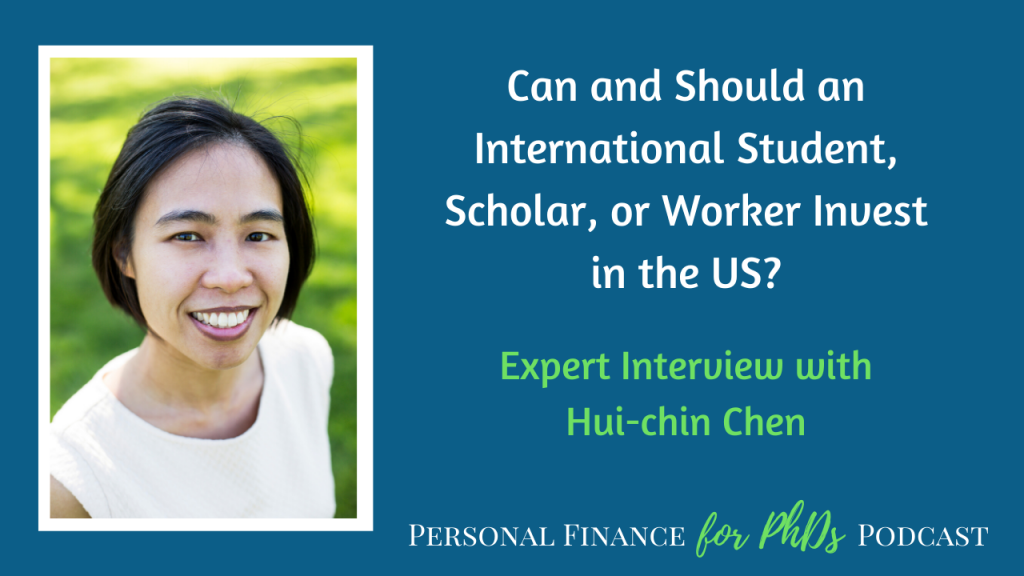
Can and Should an International Student, Scholar, or Worker Invest in the US?

December 9, 2019 by Lourdes Bobbio

In this episode, Emily interviews Hui-chin Chen, a Certified Financial Planner specializing in advising globally mobile professionals through her business, Pavlov Financial Planning. In the interview, Hui-chin answers the questions: Is it permissible for an international student, postdoc, or worker to invest while in the US, and if permissible, is it advisable? Hui-chin and Emily discuss several factors that could impact the answers to these questions: whether the person desires to stay in the US long-term, the type of visa they are on, what type of income they have (W-2 vs. fellowship/training grant), and whether they have access to a tax-advantaged retirement account, such as a 401(k), 403(b), or IRA. Listeners to this episode should come away with clear next steps to further evaluate whether and where to invest while living in the US.

Links Mentioned in This Episode

  • Attend an office hours with Hui-Chin on 7/22/2020
  • Money Matters for Globetrotters
    • Investing as a non-resident alien living in the US
  • Pavlov Financial Planning
  • Personal Finance for PhDs: Sign up for personal finance coaching
  • Personal Finance for PhDs: Wealthy PhD group program sign-up
  • Personal Finance for PhDs: Podcast Hub
  • Personal Finance for PhDs: Subscribe to the mailing list
  • Find Hui-chin Chen on Twitter
international investing in US

Teaser

00:00 Hui-chin: I would actually recommend the default is think about, well, if I had the extra money I can invest for the long term, I don’t really need the money — why not? So there has to be a really good reason why you don’t do it.

Introduction

00:21 Emily: Welcome to the Personal Finance for PhDs Podcast for higher education in personal finance. I’m your host, Dr. Emily Roberts. This is season 4 episode 17 and today my guest is Hui-chin Chen, a certified financial planner specializing in advising globally mobile professionals through her business, Pavlov Financial Planning. In this interview, Hui-chin answers the questions: Is it permissible for an international student, postdoc, or worker to invest while in the US and if permissible, is it advisable? We discussed several factors that could impact the answers to these questions. One, whether the person desires to stay in the US long-term. Two, the type of visa they’re on, F-1, J-1 or H-1B. Three, what type of income they have, that is W2 versus fellowship or training grant. And four, whether they have access to a tax advantage retirement account such as a 403B, 401k, or IRA. I’ve wanted to help the international graduate students in PhDs in my audience think through these questions and scenarios for a long time and I’m so grateful to Hui-chin for giving us her expertise in this area today. Please consider sharing this episode with your friends and peers. Without further ado, here’s my interview with Hui-chin Chen.

Will You Please Introduce Yourself Further?

01:42 Emily: I am so delighted to have joining me on the podcast today Hui-chin Chen. She is a CFP. Her business is Pavlov Financial Planning. She is an expert in this area of international students, postdocs, workers living in the US and what can we do investment wise? I know this is a question of high, high interest in my audience. I get this question every single seminar I deliver at universities. Can I invest in the us? Should I invest in the US. What kinds of accounts can I use? So Hui-chin is here to help us answer these questions as best we can. It’s a very complicated and detailed area, but you know, we’re going to work through it over the next 30 minutes or so. So Hui-chin, thank you so much for, for joining on the podcast and please tell us more about yourself and your business.

02:29 Hui-chin: Well, thank you for having me Emily and I think you covered like all the high levels. Like you said, I’m a CFP, a certified financial planner and I focus my work on clients and international planning needs, whether they’re immigrants to the US, people who are temporarily working in the US that migh leave or US citizens that become expats. So sort of like your listeners who are technically expats from other countries. So I deal with international complexities day in and day out for my clients, so I’m happy to answer any questions you might pose today.

03:05 Emily: Yeah, I mean I have been searching high and low for an expert, just like you. Will you please mention your blog name, your website name.

03:12 Hui-chin: Yes. You can read more about just in general financial planning topics for global and mobile people on moneymattersforglobetrotters.com and if you want to learn more about my business or working with me, it will be on pavlovfp.com.

03:29 Emily: Great. And you have a YouTube channel as well, right? What’s the name of that?

03:32 Hui-chin: Yes. Well there’s no name because I just record more like a series of different topics. The most recent one I recorded, I call it “Welcome to the USA: personal finance edition”. I think some of you might be interested or your spouses who accompan you to the US while you study or work and they may or may not be able to. So it goes through a lot of the different steps of understanding the US system that will be helpful if you eventually do want to stay in the US.

04:04 Emily: Yeah, perfect. Tell me just a little bit more about yourself — when did you arrive in the US, where are you from, why did you come here and those kinds of things.

04:12 Hui-chin: I first arrived full time in the US in 2004 for my graduate degree in public policy and management. I did consider going into a PhD, but I did not eventually and I basically stayed. Since then, I found a job in the US, I continued my work and then I met my husband in grad school, but after working separately for a few years, decided to get married and he got a job posting overseas in different countries. So I also have a very personal interest in working with people from all over the world because, for example, right now, I’m actually not physically in the US, we’re somewhere else. So.

Investing in the US as an International Student

04:58 Emily: Okay. Yeah. Fascinating. Oh my gosh. I really hope people follow up with you about this. So what we decided to do with this interview was to answer two broad questions, which are the ones that hear during seminars. The first is am I allowed to invest in the U S is this permissible? Secondly, is it advisable for me to invest in the U,S while I live here? Now the second question is a lot thornier than the first, I understand, so we’ll kind of go through a few different, aspects of this question that might affect the first question or the second.

Is it permissible? Yes!

05:33 Hui-chin: All right, so you’ll have to prompt me later for all these different questions. I’m going to answer the easiest one which is whether, as an international student who is not a US citizen or a green card holder, can I invest through a US based account? The answer is yes. And the United States is one of the few countries that’s very friendly to foreign investors investing directly in the stock markets and the US also has one of the largest stock markets. A lot of foreign companies come to list in the U S. dot. Markets. So really, even if you were not in the US, even if you were just like live in your home country and you want to open a US brokerage account, you can actually do it.

06:24 Hui-chin: It’s not only permissible, it’s actually a sometimes recommended way to invest, especially if your home country gives you very little access directly to investing equity on your own. A lot of countries don’t even have what we call retail access, like in the US. In a lot of places you have to invest through insurance contracts or very expensive mutual funds. So investing directly as a retail investor, that means that you’re as an individual, not going through an advisor, just like open your own account and start investing, it’s actually a great opportunity to do so. Now you’re in the US, it’s a lot easier. It’s easier for you to find information like that instead of doing it in your home country and tried to find those kinds of information. So that’s the long answer. But the short answer is it’s definitely permissible to do so. Right now you’re in the US and you can invest no matter what kind of income that you have. We’re talking about just a normal broker brokerage account, so it doesn’t give you any tax advantages. It’s just for somebody who wants to buy some ETFs or even just stocks. For example, if you really like Apple, you want to buy Apple stocks, you’re totally permissible to open a brokerage account online and pressures that Apple stocks with whatever money you have, either from your work in the US, from your grants, from your fellowships, or from your wealthy uncle back home who wired you some money. Those are all possible ways to invest.

Opening a Brokerage Account

08:06 Emily: So I think there may be, you can tell me if this is the case, I think there may be a distinction between something being permissible under the law and being, will I actually find a brokerage firm who will work with me? Because what I hear from international students and scholars is, and I never know if this is the rumor mill or if it’s actually their own experience is, “well it’s difficult to find a brokerage firm to approach who will work with me.” Is that the case? Is it, I can walk up to any brokerage firm and you know, as an international student or scholar or worker and open whatever. Or is it like, Oh well some of them might, by policy, be excluding certain types of people from you know, opening accounts.

08:51 Hui-chin: That’s a good question. Sort of at the practically, how does that work? So the first scenario is that if you have, for example, if you actually pay social security, now you have a social security number and you’re technically getting your income and you’re an employee of your university, then, for example, if you go onto Vanguard, that’s all the information they ask for. So at Vanguard, if you provide those two types of information, you will be able to open the account and plus you have a US address because you’re currently living in the US, so you actually do not need to already be a green card holder or something in order to have it processed through it. It doesn’t mean that if you eventually decide to leave the U S and if Vanguard finds out, they will want to close the account. So that’s one scenario.

09:43 Hui-chin: The other scenario is that I know some people because their totalization agreements, they don’t even have a social security number or they choose not to have one in the US and so in that case, even though you’re physically in the US and you have a US address through your apartment or on campus, it’s basically you’re considered a foreign, like how you file taxes as a nonresident alien, you can be a foreigner. So in that case, if you still have pretty close ties with your home country and you do decide to go back, you can actually open an account like your just a person living overseas, but in that case it is pretty much dependent on the brokerage company being willing to work with you because every brokerage company, like Schwab or Fidelity or TD Ameritrade, it’ll have their own internal list of which countries residents they were willing to do business with. So you’re basically declaring to them, I am a resident of some other country, would you would do business with me? And then they may or may not. So that’s another way to go about it.

10:59 Emily: Got it. So, okay, an international student or scholar who does not have an SSN, when they actually try to go and open a taxable brokerage account, what should they say to customer service? I’m a resident of X country, but I’m living in the US currently, will you work with me? Is that the question that they need to pose?

11:22 Hui-chin: Yeah, the question will really be, I’m a resident of another country, because if that’s the case, you’re providing an address of that country. You may be able to provide a us mailing address, but that’s not the address that’s associate with the account. So if they know that you are foreign customer, they will have different tax reporting, different tax withholding. Instead of filling out a W9, you fill out W8-BEN, all the different things, so it’s whether you want to be considered as a foreigner to the US institution or somebody who’s a US resident.

12:01 Emily: Got it. So in the case where someone does have an SSN, probably because they’ve been employed W2 employee for at least part of the time that they’re here, would you say that it’s totally fine to then present yourself as a US person? Even if you’re still technically a non resident alien for tax purposes, even though you have the SSN, but let’s say you’re a nonresident alien for tax purposes, is it okay to go ahead and use that SSN and be like, I’m a US person?

12:26 Hui-chin: Well, that’s the tricky part because you are still for tax purpose, like your dividend capital gains interest will be taxed differently. So you do need to report, you need to write a W8-BEN instead of W9. So I would just give an example on how easy it is to actually open an account. For example, on TD Ameritrade’s website they actually ask what kind of visa you have. So I’m just saying that usually in those kinds of applications, if you have a SSN, you have a US address, you have a US employer, it’s most likely those online retail brokerage account, they will allow you to open the account. But you also need to make sure that they know that for tax purposes you need to fill out a tax form as a non resident alien.

Investing during Short-term vs. Long-term Stays in the US

13:17 Emily: Got it. Okay. I think that’s very clear now. Than you so much for going through that in detail. Okay. So then let’s go back to the scenario of “I plan to stay in the US long term, or hope to, not sure if it’s gonna work out” versus “I don’t plan to stay in the US long term”. We now know what’s permissible, but then what is advisable? Should a person who hopes to stay in the US long-term, has the ability to invest right now — is there any reason for them to shy away from doing that because they’re not sure about the longterm status? Let’s start with that question.

13:50 Hui-chin: So like I mentioned, I guess, alluded to earlier, because the US is such an attractive market, not in terms of return or performance, but in terms of access, you can invest in a broad index in so many different countries, so many different companies with such little cost, and it’s really hard to beat if you tried to do it in some other country. Usually there’s more brokerage fees more commission, there are more hurdles to jump through as an individual investor. So I would actually recommend the default is think about well if I have the extra money I can invest for the long term, I don’t really need the money — why not? So there has to be a really good reason why you don’t do it upon the US perspective.

14:38 Emily: Got it. And so maybe that person in that situation is thinking, “well, is it a good reason that I might eventually leave?” How would the investments that are in the US for the moment, do they to exit the country with that person? If the person ends up leaving, how does that work and how’s that handled?

14:57 Hui-chin: Yeah. So as I mentioned earlier, even for somebody who’s never been to the US, some custodians will be willing to open account for a foreign customer. So if you’re thinking about, “Oh, I’m just leaving after I finished my grad degree in three years,” if the country you’re likely going to is on whatever list that custodian posts, like it’s European EU country or it’s a relatively developed country or it’s a safe country, it’s not like a terrorist country that may be on the treasury list of “do not do business with”, then you’re probably safe to assume that you can continue to hold the account. But of course do your own research on the specific countries. It’s impossible for me to go into every single country.

15:46 Emily: We’ll link to a reference if you can provide a reference of that treasury list. We’ll put that in the show notes and check to see if your country appears on this list, in that case, okay, we need to tread more carefully. But let’s say, okay the country is not on that list, go ahead.

16:04 Hui-chin: Yeah, so basically what will happen is that for example, if you went the first route when we’re talking about opening an account, you open account with the U S address and everything, and let’s say you actually end up staying over five years or you actually got a job at under H-1B then leave, right? So you actually went from nonresident alien for tax purpose to a US person tax role, and then you’re leaving, so you’re going back to a non resident alien textual. So you do need to report to the custodian that you’re leaving this is my W8-BEN, this my new address. So of course you want to make sure the custodian does business with people at that address. And there is some other complexity in terms of what you can invest in. Some people from the EU countries might know there are some new regulations saying that the custodian is not supposed to sell ETFs that’s not registered in the EU to their residents. So that’s one type of complexity that may come up that whatever you invested in, you may or may not be able to add more to it once you leave. But whatever you have already invested in, there shouldn’t be any issue with keeping it there, as long as the custodian is willing to keep you as a customer.

17:30 Emily: Got it. So let’s say then that the custodian is not willing to keep you as a customer, for whatever reason. What happens in that scenario?

17:39 Hui-chin: It does happen. Over the last 5 to 10 years, even some US citizens are experiencing that, living overseas, it used to be okay that custodians know that they live overseas and now they’re not okay and custodians say please close your account. For normal brokerage account, of course the first step was if you want to keep your investment in the US, you can always find a different custodian to move your investment to. You actually do not need to sell those investments. You can do a transfer. It’s just whoever’s holding those stocks will transfer the certificate electronically to another custodian. It’s not like you’re selling and getting the money back. But if because where you’re going next or because of personal reasons, after investing in the US for five years, you’re willing to take the money and leave, you can go ahead and sell your investments, close the account, taking the money and leave. There’s no problem with that. There’s also some tax considerations there. For people who are considered a nonresident alien, getting capital gains while they stay in the US for over 183 days versus they do not. Because if, for example, if there is a tax year when you have a US based account and you have a lot of capital gains on your Apple stock because it increases in value a lot, but if you already finish your study and you’ve moved back to your country for two years you’re just wondering, well, will I be taxed on the capital gains? The question is, you actually do not get taxed on the capital gains, in the US. There could be also tax treaties that differs between the US and your country, but in general, the rule is the US does not tax and your country may or may not tax that. So that’s actually a good–

19:34 Emily: It sounds like in that situation, where you’re planning on moving the money out of the US, it sounds like that’s the time to consult a tax advisor in the country that you’ve moved to, right? How to execute this, when to execute this and the tax implications. Is that right?

19:51 Hui-chin: Yeah. So you’re definitely thinking about tax strategy, because, as opposed to the situation I talked about, if you sell the day you leave the U S for example, like “I’m just closing everything down, I’m moving back home.” And if you sell the stocks as somebody who has lived in US, even though you’re a nonresident alien but you were in the US as a tax home, when you sell the stocks, the capital gain is actually taxed at 30%, unless their treaty dictates differently as well. Like you said. So definitely talk to your tax advisor in your home country, as well to understand how the tax coordination works.

Taxable vs. Tax-Advantaged Accounts

20:33 Emily: Got it. And now, you mentioned earlier that all of that was for a taxable brokerage account. So let’s also throw in the scenario that the person has been using a tax advantaged retirement account — IRA, 401k, 403B — and they’re not going to leave it in the US, they’re are going to be moving the money out, what are the tax implications of making a withdrawal from whichever account type.

20:56 Hui-chin: Yeah, in that scenario, basically first of all, you should know that there is a penalty that applies if you take money out of and IRA, 401K, 403B. You should have known it before you put money in, but that’s the same rule that applies broadly to everyone, whether you’re a US person or not. Right? Because the reason is that the government gave you a tax benefit and it’s the incentive for you to keep the money there for retirement. They don’t want you to take the money out. So, if you need the money obviously and you think closing the account, paying the penalty and income taxes is still better going back home and doing it in a few years because of the different tax situation, of course that’s something you can consider. But knowing, with a penalty if you are not not going to need the money and it is eventually going to pay for retirement, one thing you also can consider is to leave the account open for a very long time and let it grow. Of course, you cannot keep putting money into it, but whatever is in there can continue to grow and you can consider taking the money when your income is lower and take the penalty, so the income and the penalty together is less of a hit, or you can take it out when you are 59 and a half, which is the current law of when you can take it out and then there won’t be a penalty but there is going to be taxes in the US and withholding as well.

22:42 Emily: It sounds to me, and this may be painting with too broad of a brush, but it sounds to me like you know, if you end up having investments in the US, if you’re eligible to keep them in the US, and you do leave, sounds like it’s a good idea to keep the accounts open. You won’t be contributing anymore, at least to the tax advantage ones, but it doesn’t sound like there’s a big reason to be closing accounts and moving the money out, unless it is that you are not permitted to keep the accounts open based on the custodian and the rules of the country that you’re going to, and how they deal with the US, is that right? It sounds to me like that’s the pattern. Like go ahead and keep the money here and then when you’re of retirement age in the country that you’re residing and then you can work on doing the withdrawals and dealing with taxes at that time. Is that kind of broadly what you recommend?

23:32 Hui-chin: I think that’s generally correct. Like I said, the main reason for that is because the US is such a individual investor friendly country to allow you to invest that way, so like I said, I would ask the question of why not. Of course everybody’s situation is different. If there is a legit reason that you think that you shouldn’t be keeping the investment in US, of course, you just need to understand the tax implications. Otherwise, keeping investing long-term in the US, not just — let me clarify this, not investing in US companies only, but using a US based account and custodian, who charges you basically right now no commission to buy and sell anything and with very low mutual fund costs, very low ETF costs, it’s a really good bargain compared to the other alternatives.

24:34 Emily: Yeah. So it sounds like whether an individual in the US, not on a green card yet, not sure if they’re gonna be able to stay long-term or planning to not stay long-term, if they have the ability to invest at the time that they’re living in the US, as you said, why not? Why not go ahead and open the taxable brokerage account or the IRA or the 401k or whatever it is and use it, because it’s sort of, as we know — we don’t have to go into about the power of compound interest — starting to invest earlier is fantastic. So basically don’t a waste or fritter away the time that you may be in the US, it might be longer than you expect. Go ahead and start investing and then deal with either moving the money out or keeping here or whatever later, once you know where exactly are you going to be living. I like that approach of why not. So whether the intention is to stay in the US long-term or to not, go ahead and use the time while you’re here. Use your access. Go ahead and open the accounts, again if you’re able to be able to invest.

Free 10,000-Word Email Course on Investing for Early-Career PhDs

Subscribe to our mailing list to receive the 6-day email course designed for graduate students, postdocs, and PhDs in their first Real Jobs.

Success! Now check your email to confirm your subscription.

There was an error submitting your subscription. Please try again.

We won't send you spam. Unsubscribe at any time. Powered by Kit

Commercial

25:37 Emily: Emily here for a brief interlude. As a listener of this podcast, every week you hear strategies that another PhD has used to improve their financial picture. But listening and learning does not automatically translate into action in your own financial life. If you are ready to change how you think about and handle your money, but need some help getting started, I can be of service. There are two main ways you can work with me to create and implement a financial plan tailored for you. First, I offer one-on-one financial coaching, either as a single session or a series, as you make changes over the long term. You can find out more at PFforPhDs.com/coaching. Second, I offer a group program called The Wealthy PhD that is part coaching, part course, and part community. You can find out more and join the wait list for the next time I open the program at PFforPhDs.com/wealthyPhD. I believe it’s possible to succeed with your finances at every stage of PhD training and throughout your career. Let’s figure out together how to make that happen for you. Now, back to the interview.

Investing Under Different Visas

26:52 Emily: Okay. That was the first scenario to talk about. And then the second one was about visa types. So F-1, J-1 and H-1B. You’ve already said broadly it is permissible, but is it advisable? Are there any differences among people holding each one of those different visas that they should be thinking about? Or is it like, “no, the general consensus of it’s permissible, why not?” still applies no matter what visa type?

27:17 Hui-chin: I think that it’s not really only based on visa type, but the idea of combination of visa type, how long are you staying in the US — as, you know, F1 can turn from NRA to US person, J-1 as well, with different time frames. I would think about it as just, it’s very similar to what we were talking about before, like longterm or short term. Eventually, the main difference is tax treatment of if you’re staying, if you’re becoming a us person long-term, or even becoming a US citizen and we’re just going to pay US taxes forever versus at some point, in the future, it’s possible you will sever tax ties with the US, other than whatever investment you kept in the US. So overall investing in both scenarios are great. You just need to know the tax implication and the tax strategies, because if you’re switching from one to the other, there may be some opportunities for you to reduce taxes. And if you don’t think about it clearly or get the correct advice, you might find out, well I could have been taxed zero but now I’m getting taxed 30%.

28:28 Emily: Got it. So it’s not so much about the particular visa type, but rather at what point it flips to you being a resident alien for tax purposes, which is different on the different visa types. Okay, great! Quick one there.

Investing for Different Income Types

28:41 Emily: Third point that I wanted to talk about was the income type. So having W2 type income, or even self-employment type income, if that’s permissible, versus having this weird fellowship, training grant, non W2 type of income. This is very common for graduate students and also for postdocs. And so the general rule that certainly applies for US citizens and residents is if you have the W2 type of income that is taxable compensation for the purposes of contributing to an IRA. So let’s say in the scenario where the person does not have access to a workplace-based retirement account, they’re looking at can I open an IRA or not? Taxable compensation would be the W2 type of income. They can open an IRA and use that income towards it. If you go an entire calendar year and don’t have the W2 type of income, not taxable compensation, it’s all fellowship or training grant, and of course for international students, scholars, they’re not permitted to side hustle, they can’t have the second jobs and so forth, so there would be no possibility of having taxable compensation type of income. I guess the question is, whether they had access to an IRA or not, does it change the, we know it’s permissible, but does it change the advisable recommendation on whether to be investing at this time or not, knowing that in the one case with fellowship and training grant type income they wouldn’t be able to use an IRA but could be using a taxable brokerage account as we discussed earlier.

30:09 Hui-chin: I think that’s actually something we can just combine with the fourth one, so the tax-advantaged one. Like you said, eventually the main question is whether I have taxable compensation or I do not have taxable compensation.

30:23 Emily: Now, I want to jump in just to note that we’re recording this in November 2019 so the SECURE Act has not passed the Senate, yet. I am certainly hopeful that it will because what it does is it changes the definition of taxable compensation to include fellowship and training grant type of income, non-W2 income for graduate students and postdocs. So maybe when you’re listening to this, that law would have changed, and so certainly keep that in mind that we’re discussing this as what is the definition of taxable compensation. Basically, right now it does not include fellowship and training grant and come perhaps in the future it will, but right now it doesn’t. Okay, go ahead.

31:02 Hui-chin: I think at the very beginning you mentioned the whole connection to your personal service, right? So the idea of you can contribute to areas that you need to have taxable compensation and that’s related to the idea of it’s not just that it’s taxable, but it is a compensation for performing a service. If we’re just really thinking about why we’re using IRA, it is for the tax advantages. So even before you think about that, it’s like what would be the tax consequences or how much you save by using that kind of account and is that really helpful in your situation? I know, one question, you posed before is well, everybody wants a Roth IRA because they’re like, well, I’ll never get taxed in the future. I want to be able to contribute to that.” But a Roth IRA and traditional IRA have the same rule: the compensation needs to be taxable. So if it’s already not taxable, the government wouldn’t allow you to put money into something that’s never been taxed before. The Roth IRA is for the government to tax you up front, so it doesn’t tax you it in the future when you take it out.

32:26 Emily: Okay, let me, I just want to clarify this. This is a little bit new information to me. So when we have the two words, taxable and compensation, you have to have taxable compensation to contribute to an IRA. The compensation part of it is this, is it non-W2, fellowship and training grant type income? Okay, that’s not compensation. But now we’re also talking about the “taxable”, the first word there in taxable compensation. Your income has to be taxable in the US in the first place to be eligible to be contributed to an IRA. So maybe under certain tax treaties, your income for a time is not taxable in the US, that income would not be eligible to be contributed to an IRA. Correct?

33:05 Hui-chin: Yes.

33:06 Emily: Okay, great. Go ahead.

33:07 Hui-chin: Yeah, and the second one, we use compensation, but on the US-person side it’s called earned income. So if you look at IRS publications it’s always referred to earned income for US person related publications on contributing to IRA. Those two are equally important. It has to be earned income, so your compensation from service, and it’s taxable. The idea is that you will know whether you have that kind of income or not and if you have that income, meaning you’re getting tax in current year, so you’re thinking about, “Oh, if I contribute to an IRA or 401K, or 403B, I get taxed less. Or you contribute to it and now we get taxed, but in the future it won’t get taxed, which is the Roth side. In the first one, just the pretax contribution, it makes sense if you’re really high income. I think for the students, because if you’re on a 1040-NR, depending on the level of your compensation, because you may not have standard deduction, you may only have itemized deduction, some people can be at the zero percent, some people can be twelve percent or above, so you have to look at your tax situation of which bracket you’re going to be in to give you an idea of, well, maybe I want to do pretax instead. And the second one is, okay, so if I’m at a really low bracket, how about I just do Roths, but then the idea is you want the tax benefit in the future, right? But if you are going to move away from the US, how much more is that tax benefit versus simply using a taxable brokerage account, if you don’t get current year tax benefits. So those are the analysis that you need to go through, in terms of whether or not to use a tax advantage account, if you have the income type to do so.

35:20 Emily: Okay. Yeah. Let me see if I can summarize that. If you don’t have taxable compensation, can’t use a tax advantage account anyway, so go through the brokerage firm and go for the taxable brokerage account, if you’re able to use it, if you can set up that kind of cap. Okay. On the other side, we have eligibility for the 401K, the 403B, the IRA. If you want the tax deduction today for contributing to a traditional version of each of those accounts, great. Go ahead and take it and get a tax deduction today. Awesome. The money grows tax deferred, you’ll deal with the taxes in retirement or whenever you move the money out or whatever. For the Roth option, because of any of those kinds of accounts, because you don’t have the immediate tax advantage today, you really have to be asking yourself, does it make sense to put my money into a Roth IRA, no immediate tax advantage, but it will grow income tax free and then I can withdraw it income tax free in retirement versus can I just use a taxable brokerage firm, which is more flexible. And I think maybe the answer to that question, of course it will depend on the math in any individual’s scenario, but might come down to, again, what we talked about earlier, the expectation of staying in the US long-term or the hope, because really over the long, long term it is very advantageous to be using an IRA of any kind, Roth or traditional. But maybe if the time that you see yourself being in the US is on the shorter side, not to retirement or only five years or the length of your degree, then maybe it’s like, well why bother with the whole Roth IRA scenario? Let’s just go for the taxable brokerage account because if you are expecting to move the money out, for example, it’s kind of more of a pain to do so with a Roth IRA, because while you can withdraw your contributions, whatever gains have been in the account, if you try to withdraw those, then then the penalty comes into play. Is that correct?

37:12 Hui-chin: Yeah. And one big difference for people who eventually just move away from US and no ties in the US, I think I mentioned that before, you could qualify for 0% capital gains tax rate if you sell it, so it’s almost like the same, but the only difference is the dividend. So dividends are taxed at a flat 30% if your a NRA living outside of the US, but over the long term, if you’re investing in, for example tech companies, they don’t pay dividends anyway, and your main goal is for that capital gain growth for the next 30 years, then investing in Roth and investing in a taxable brokerage as an NRA living somewhere else is the same.

37:53 Emily: Gotcha.

37:53 Hui-chin: Why give yourself more ties to a Roth type account you can’t access and there’s more complexity.

38:01 Emily: I see. So really your investing strategy might change based on the tax treatment, if you’re no longer living in the US, of capital gains versus dividends. I actually do want to also add in for people who, I think this is still the case under post-tax custom jobs act, people who are the 12% marginal tax bracket or less, they have 0% federal tax on long-term capital gains and qualified dividends. So if you have a very tax efficient strategy, if you’re buying and holding, generally, as long as you stay in those lower tax brackets, you’re really going to see much or any income tax anyway. So why bother with the IRA, when you could be using a taxable account and not really having that much in the way of actual tax burden. Is that correct?

38:47 Hui-chin: Yeah. And just going back to definitely understand the tax treaty if you already know where you’re going to. Of course, most of the time you might think, well I’m just moving back to my home country, but then you get a job somewhere else and then you know, your life is not really as predictable, but at least understand the tax treaty between us and your home country, if you think it’s very likely you might end up there at retirement age when there would be IRA, 401k distribution consequences and compare that to, if I simply use a taxable brokerage, how does that change my dual country tax liability.

39:31 Emily: Got it. I think what I’m hearing mostly from this interview and the point that you just made about life being sort of unpredictable is, okay, here’s what you know. You know you’re in the U S right now. You have to be in the US for a few years, several years, maybe longer. Deal with what you know about right now, make the best decision you can for right now, and then if the situation changes later, you have to pivot. It’s possible to pivot. You’re not going to be losing your investments just because you’re leaving the country or whatever. It’s something that you can move with you, so you can adapt and change depending on, you know, the next step that you take. And hey, if you end up, if you do end up living in the US long-term, like until retirement age, it will be awesome if you started investing earlier and had started using an IRA or a 403B or a 401K earlier, as soon as you have access. Is that fair?

40:22 Hui-chin: Yeah. And I think those more specific questions and people questioning whether they should have account here. I think in my experience, I really mostly hear it from people from EU countries, Australia, Canada, because they feel like they have the same access when they move back. They don’t want the complexity of dealing with cross border things. And I totally understand that. And if you have good access to invest when you go back home, of course. But I think, what I know is being from a developing country myself is that most of the people who come to US see it as an opportunity and if you can have an investment in the US and don’t have to deal with turmoil that may be happening in your home country, most people jump on the opportunity. I don’t know that many people would say it’s a bad idea to open an account in the US.

Free 10,000-Word Email Course on Investing for Early-Career PhDs

Subscribe to our mailing list to receive the 6-day email course designed for graduate students, postdocs, and PhDs in their first Real Jobs.

Success! Now check your email to confirm your subscription.

There was an error submitting your subscription. Please try again.

We won't send you spam. Unsubscribe at any time. Powered by Kit

Where to Find More Information

41:26 Emily: Got it. I think we’ll leave it there. This has been fantastic. Thank you so much for joining me. Tell us again where people, can find you — your website, your business name and so forth.

41:35 Hui-chin: Yeah, sure. If you want to read more about what I just talked about, and this also how Emily found me, is on moneymattersforglobetrotters.com. It’s just a blog for reading. And if you’re interested in working with me, you can go directly to pavlovfp.com. That’s Pavlov Financial Planning.

41:54 Emily: Thank you so much for joining me today Hui-chin.

41:57 Hui-chin: You’re welcome.

41:58 Emily: Listeners, thank you for joining me for this episode. PFforPphDs.com/podcast is the hub for the Personal Finance for PhDs podcast. There, you can find links to all the episode show notes and a form to volunteer to be interviewed. I’d love for you to check it out and get more involved. If you’ve been enjoying the podcast, here are four ways you can help it grow. One, subscribe to the podcast and rate and review it on Apple podcast, Stitcher, or whatever platform you use. Two, share an episode you found particularly valuable on social media or with your PhD peers. Three, recommend me as a speaker to your university or association. My seminars covered the personal finance topics PhDs are most interested in, like investing, debt repayment, and taxes. Four, subscribe to my mailing list at PFforPhDs.com/subscribe. Through that list, you’ll keep up with all the new content and special opportunities for Personal Finance for PhDs. See you in the next episode, and remember, you don’t have to have a PhD to succeed with personal finance, but it helps. The music is Stages of Awakening by Poddington Bear from the Free Music Archive and is shared under CC by NC. Podcast editing and show notes creation by Lourdes Bobbio.


Negotiating PhD Funding Offers: This Grad Student Did It Successfully

January 28, 2019 by Jewel Lipps

In this episode, Emily interviews John Vsetecka, a second-year PhD student in History at Michigan State University. When John was a prospective PhD student, he attempted to negotiate the stipend and benefits of the three admissions offers he was seriously considering. John shares exactly how he initiated the negotiation process and the outcomes at each of the universities. His negotiation method is well-researched and well-considered and is applicable to many if not most other prospective graduate students. John and Emily also discuss how prospective PhD students should combat imposter syndrome during the admissions process.

Links mentioned in episode

  • Tax Center for PhDs-in-Training
  • Volunteer as a Guest for the Podcast
  • PhDStipends.com
  • GradCafe 
negotiating PhD offer

0:00 Introduction

1:05 Please Introduce Yourself

John Vsetecka is a second-year PhD student in the Department of History at Michigan State University. He studies modern Ukrainian history, with a focus on the 1932-1933 famine. Before beginning his PhD program, he worked as a GEAR UP advisor. This is a federal grant agency that works with low income students, called Gaining Early Awareness and Readiness for Undergraduate Programs. He worked in Colorado to help middle school and high school, low income students prepare for college. Before this job, he got a Master of Arts in History in 2014 at the University of Northern Colorado.

2:55 What PhD offers and interview requests did you receive from universities?

When John applied to PhD programs, he applied to eight schools and faced some rejections. He considered four offers, then narrowed his list to three. The first offer he eliminated would have required that he start with MA and work into PhD. Since he already had an MA, he felt he was ready to move on. He seriously considered three offers. He accepted the offer from Michigan State University, where he is now. He visited “University 2” in person for an interview. He had a virtual interview with “University 3.”

4:21 What did you think about the offers from these three universities?

John wasn’t sure what a fair offer was for a PhD position in History. Generally, PhD students are shy about sharing their financial experiences. So he did research and his mentor from the University of Northern Colorado guided him in this process. He talked to other PhD students, who would say they had enough to live on or that they were struggling. He used the websites GradCafe and PhD Stipends. He got a sense of what people were being paid, including their health insurance and fees. From all of this information, he decided two offers were fair and worth considering.

Emily shares an important piece of advice for prospective PhD students is to do your research. Anonymous databases, like PhD Stipends, provide more transparency around these offers. But you should talk to current graduate students, because it’s one thing to look at the numbers, and another thing to get a feel for how it is to live on that amount.

Further Reading: How to Read Your PhD Program Offer Letter

7:54 How did you initiate the negotiation process for your PhD stipend offers?

John negotiated his stipend offers during his interviews. He went to visit two universities in person for interviews, and had a virtual interview a University 3. His first interview was at University 2. During the visit, they have an itinerary and fully scheduled day. The experience is like a whirlwind. He prepared a set of questions for faculty members and set of questions for Graduate Director. With the Graduate Director, he talked about the PhD program as a whole to get their insight. Then he directly asked the Graduate Director if there is any other money available, such as other fellowships, and explained that he has other offers with higher financial value. The Graduate Director is the one that can control the money. The faculty can only put in good word on a student’s behalf. So as a prospective PhD student, you should know who you can talk to and know who you can negotiate with. You don’t need to be afraid to ask tough questions about financial aid.

The PhD program interview was a good time to negotiate PhD stipend offers. John waited until he received all offers to see where he stood across the field, and this gave him some leverage. Negotiating like this is is what people do with any other job. John told the Graduate Director that he had other offers, but he didn’t show them the letters themselves. Negotiating before receiving all other offers and before the interview can seem desperate. But if he negotiated after the visit, it might seem like that offer wasn’t his first choice and he was only negotiating after losing another offer. John also believes that talking in person is the best type of communication. Negotiating in person puts them on the spot.

During his interview visit for University 2, John asked the Graduate Director about the potential for a better financial package. The Graduate Director told John that they would get back to him a couple hours. Later that day, John received an email with a offer for a fellowship package. This showed John that they were willing to work on his behalf. He was surprised by this because he had expected them to negotiate and push back. During the interview visit, the department is most focused on recruitment, so they quickly considered his request and acted on it.

John went into the meeting with a set plan for negotiation. He had a notebook and visibly took notes during the conversation, which indicates that he took the negotiation seriously. Treating graduate school interviews like a professional scenario sets you up for success.

14:35 What new offer did you receive after negotiating?

Because he negotiated with the Graduate Director, John received an offer of a university fellowship instead of a teaching assistantship. The new offer was university-based funding, not department-based funding like his original offer. The university fellowship had different teaching requirements than the department teaching assistantship. It was more money in total, as well as better health care coverage. This showed what kind of control the department and university has over financial awards for PhD students. Even if the university can’t raise stipends, they can cover more fees or provide better benefits.

16:22 What outcomes did you get from negotiating with the other two universities?

John learned that not everyone would negotiate. At Michigan State, he had a generous offer that he was already happy with. Even so, he asked the Director of Graduate Studies at Michigan State about his financial award. The director kindly told him that his original financial award was what the department was willing to offer. John later learned that his department offers different financial packages based on a tiered system, and he was happy with the offer he received.

At University 3, John had a virtual meeting with the department. John brought up that he had offers with much more value than what they had offered him. John says that honestly, he was displeased with University 3’s financial offer. He learned that due to financial constraints at University 3, the department couldn’t offer more money. The department suggested term-to-term options. John didn’t want to be on his toes every semester wondering if he’d get paid. Though University 3 offered paid tuition, the money offered for teaching/research was not enough to even consider.

It’s important for prospective PhD students to recognize that some offers only tell you about the first year, while others present a five-year plan for funding.

19:35 Based on what you experienced, what would you do to negotiate differently?

John says he wouldn’t change much. While he knew negotiation was possible, he personally didn’t know anyone in his cohort group that negotiated their stipend offer. John heard from his advisors and mentors that it’s ok to ask, but you have to know to ask. John says this is one of those hidden things in academia. If prospective graduate students receive multiple offers, this is a chance to use offers against each other.
even if you get one offer, be happy, but if you get more offers you can use them

Emily brings up that often, applicants don’t feel a lot of confidence. They often think, “Who am I to be receiving these offers?” This imposter syndrome deters prospective PhD students from negotiating their stipends and ensuring that they receive the best offer.

22:27 How did you know negotiating your PhD offer would be possible and welcome?

John’s MA program advisor told him how to negotiate PhD stipend offers. First, you have to apply to multiple universities and know their programs well. Second, you need to know who you want to work with. Third, you need to talk with current graduate students. This is the most important advice. If you find their email on department websites, you can email them directly. Fourth, online communities like GradCafe help you connect with people who can help you.

John says that graduate school applicants should treat a PhD position like any other job. John says this profession should not be excluded from the process of negotiation. John’s experience at GEAR UP, where he helped low income students fight for undergraduate school money, showed him that there is a lot of money out there. He says it’s unfortunate so many undergraduates go into a lot of debt, when there are all types of money out there for different skills and talents. John wonders why graduate students can’t have that money too? There are different organizations, based in different fields, but money is out there. He suggests prospective students apply to everything they’re qualified for, but they also ask universities and departments what they can give.

Emily adds that prospective PhD students need to consider cost of living. If you have school A versus school B with higher stipend and in lower cost of living, you can ask the school A’s department what they can do to make the offer comparable.

26:44 Has your negotiation had any lasting impact on your graduate career?

John says the negotiation process doesn’t stop when you receive your final offer. Negotiation is a longer standing issue to think about in the future. At Michigan State, John and his peers negotiate for conference money, travel money, research money for the summer. Some graduate students can’t find money beyond teaching assistantships. Because he considered these benefits in his financial offer, he accepted a position that allows him the time and money to not worry. He has summer funding and he can teach online. For instance, he taught a seven week class online while being in Ukraine for research. He chose a school with an institutional investment. The department is doing well and it is investing in its students. He saw that the department was willing to invest continually in their students. He thinks the investment will continue after he graduates.

29:33 Final Comments

John says prospective graduate students should feel free to reach out to him. He likes to help in any way he can. When you get your offers, the first thing you should do is celebrate, and get a round of applause. After celebrating, look over your financial offer, and look beyond stipend to health insurance and benefits. If you get multiple offers, compare them. Be confident about your acceptance into a program and don’t be afraid to negotiate. Know that you have power in these situations. Even though graduate students often don’t have much power, this is the situation where you do. You have all the power and you should use it while you can.John treated PhD offers like job offers because it’s also a job, in literal and figurative sense.

31:27 Conclusion

This PhD Student Paid Off $62,000 in Undergrad Student Loans Prior to Graduation

September 10, 2018 by Emily

In this episode, Emily interviews Dr. Jenni Rinker, a mechanical engineering PhD currently working as a researcher at the Denmark Technical University. Jenni paid of $62,000 of student loans from her undergraduate degree while pursuing her PhD at Duke University. Her average payment was approximately $1,500 per month on a post-tax income of $2,700-$3,000 per month. Jenni shares her motivation for setting her lofty debt repayment goal and the practical strategies she used to accomplish it. After paying off her student loans, Jenni even saved enough money to take six months off from work post-defense.

Subscribe on iTunes!

Links mentioned in episode

  • Personal Finance for PhDs Membership Community
  • Jenni’s Budget Spreadsheet
  • Five Strategies to Improve Your Finances Today as a Graduate Student or Postdoc
  • Volunteer as a Guest in Season 2

0:00 Introduction

1:10 Please Introduce Yourself

Dr. Jenni Rinker is a postdoc researcher at the Denmark Technical University. She attended Harvey Mudd University for undergraduate studies in engineering then went to Duke University for graduate studies. Her PhD is in Mechanical Engineering.

2:28 We’re talking today about your debt repayment journey. Can you tell us about this?

After undergrad at Harvey Mudd in 2011, Jenni had $62,000 student loan debt. She set the goal to repay the full debt during her PhD. She accomplished this goal, paying off the debt in 3 years and 7 months.

3:48 Can you tell us more about what kinds of loans you had?

Jenni kept a spreadsheet, a valuable tool that she used to track her debt repayment. She only had the option of unsubsidized student loans because she comes from a middle class household. At the time she started graduate school in September 2011, Jenni had $62,00 total from nine different loans. Federal student loans from Sallie Mae and Nelnet made up $28,000, at 6.8% interest rates. Jenni’s private student loans came to $34,000 total. Her single largest loan was from Alaska Advantage, a loan of $8,500 at 7.3% interest. She had several low interest (3-4%) private loans from Wells Fargo.

5:54 What was your income during your PhD?

Overall, Jenni’s post-tax income varied from $2,700 to $3,000 per month throughout her PhD. Before she started graduate school, Jenni was awarded the National Science Foundation Graduate Research Fellowship. This fellowship provides an annual income of $34,000 for 3 years. When she started, Duke University offered her income in addition to her NSF fellowship. After the NSF fellowship period ended, Jenni won another external fellowship through the Office of Science that offered $3,000 per month.

However, Jenni started graduate school in debt and did not have any savings or assets she could use to reduce her debt.

10:50 Why were you so determined to pay off student loans during grad school?

Although student loan repayment could have been deferred while she was in graduate school, Jenni was uncomfortable with debt and letting interest accrue. She thought that keeping the debt would limit her choices after graduate school. The student loans felt like a weight over her head that was growing every day, and she wanted the freedom that would come after debt repayment.

Jenni decisively started paying off her student loans as soon as she started graduate school. She saw that her income was higher than her monthly expenses, so she made it her priority.

13:53 How did you pay off your student loans?

Jenni committed to her financial philosophy that the money earned from her job goes to rent, utilities, food, loans and other essential expenses first and foremost. Money for her other interests had to come from side income. Jenni earned extra income as a technical copyeditor. She had private clients and worked for the American Journal Experts. She funded several trips from her side income.

Spreadsheets were Jenni’s most important tool. She had a spreadsheet for each year, where each month had a tab. She calculated that $1,300 per month needed to be budgeted for student loans in order to pay off the debt in 4 years. Her living costs, the “monthly nut,” were $800 to $900 per month. She kept frugal habits, such as rarely going out to dinner.

Jenni implemented the strategy of paying herself first. Right after receiving her paycheck, she made her loan payment so the $1,300 was out of her account immediately and she wouldn’t be tempted to use it elsewhere. However, Jenni paid her student loans instead of building up her emergency fund, which was drained after she needed a car repair.

Jenni paid her loans manually, so she could pay the highest interest loans first. Her biggest loan also had the highest interest rate, so she prioritized this one first. Though she had nine different loans, she focused on paying off one loan completely before paying towards another loan.

Her story is an example of the debt avalanche method. Jenni prioritized bigger loans with higher interest to pay off first. She was motivated by paying as little interest as possible. This is in contrast to the debt snowball method, where a person pays off the smallest loans first, to feel motivated by these easy wins.

Jenni also identified where she overspends. She would take out cash to be more aware of her expenses.

28:23 Did you have any speed bumps during your debt repayment journey?

Though Jenni had one instance where she paid for car repairs, she feels like she got lucky with no major financial setbacks. Paying her student loans was her highest priority, and she ended up paying about $1,500 per month on average over three years and seven months. She paid her loans back faster than she expected.

29:53 How did you feel after paying off your student loans? Did anything change in your life?

Jenni realizes that this is an unusual accomplishment. She posted on Facebook and got many congratulations. At the time she made the final student loan payment, Jenni was still working on her dissertation.

She was so used to immediately using $1,300 for student loans, that she started saving that amount each month for travel. After she defended her PhD, she had stress-free travel for 6 months. She went to Patagonia, Europe, and traveled around the United States. Jenni already had a job lined up, so her travel was a true vacation to celebrate finishing her PhD and repaying her undergraduate debt. Jenni learned that traveling is very important to her, so this experience rejuvenated her and put her in the right mindset to start her postdoc.

34:30 Is there anything you wish you had done differently?

Jenni wishes she had rebuilt her emergency fund after she drained it for her car repair. Overall, she’s satisfied with her debt repayment journey. She balanced frugality with having a good quality of life.

During debt repayment, Jenni allowed herself flexibility for how much she paid every month. In the beginning, her repayment was more aggressive but she relaxed as time went on. She knew that in an emergency, her family could support her and she could pay her parents back for financial help in a tough situation.

38:14 Did this experience affect how you approach personal finance?

When Jenni moved to Denmark, she stopped tracking her daily expenses so carefully and has allowed herself to indulge in treats and go to cafes.

However, her budget spreadsheet is still her most valuable tool. She created her own spreadsheet template that makes sense to her. Jenni briefly considered using software budgeting tools like Mint, but never ended up trying one out. By using her own spreadsheet that she updates manually, she feels like she has more control of her budget. This manual system forces her to actively consider how she’s spending her money.

43:00 What advice would you give to someone starting graduate school with student loans?

First, Jenni recommends that graduate students with student loans set realistic goals. Your income must be more than your expenses, and you still need to have a good quality of life. Figure out your “monthly nut” and compare it to your income. Then, identify your problem areas in your expenses.

Second, she encourages graduate students to reevaluate their financial strategies. As graduate students, we have to educate ourselves about finance and learn from our mistakes. If your financial strategy is unsustainable, you can change it.

46:37 Final Comments

Jenni’s inspiring story is applicable to anyone in any kind of debt repayment scenario. The financial strategies Jenni used can help graduate students pay off their own student loan debt.

47:47 Conclusion

How to Find, Apply for, and Win a Fellowship During Your PhD or Postdoc

September 3, 2018 by Emily

Applying for fellowships is an essential component of your PhD training. My fellowship application advice is to apply for a few relevant fellowships as a prospective PhD student, whether you are coming from an undergraduate degree, master’s degree, job, or other fellowship. It’s also a great idea to keep applying for fellowships and grants throughout your PhD and postdoc for any years when you’re not already a fellow.

The advice in this article is on why, where, and how to apply for fellowships successfully. It has a particular focus on outside fellowships that are portable (you can use them at any institution), remunerative (they provide at least stipend/salary support), and broad (many research fields are eligible).

Fellowships at the graduate level are similar to scholarships at the undergraduate level in that they are awards that are given based on merit, and sometimes only a narrow slice of students is eligible. They are “free money” similar to scholarships and grants in the sense that they do not have to be repaid. What is different is that fellowships typically pay part or all of a PhD student or postdoc’s stipend/salary and may also include some money for tuition and fees. However, as a fellow you do have the responsibility of making progress in your research or else your fellowship is not likely to be renewed. PhD-level fellows are free to focus their attention solely on their research (in addition to classes in the early stage of training).

Further Reading:

  • How to Find and Apply for Fellowships (with ProFellow Founder Dr. Vicki Johnson)
  • How to Financially Manage Your NSF Graduate Research Fellowship
  • Weird Tax Situations for Fellowship Recipients
  • The Complete Guide to Quarterly Estimated Tax for Fellowship Recipients
  • Fellowship Recipients Can Save for Retirement Outside an IRA

Why Apply for Fellowships

Regularly applying for outside funding is an expectation in graduate school (and often before and after) that should be made more explicit. Even if you are fully funded by your program or group, you will benefit from applying for fellowships throughout your PhD and postdoc. The only reason to forgo submitting at least one fellowship application in a given year is if you are already funded by an outside fellowship in the upcoming year.

Further Reading: Why You Should Apply for Fellowships Even If You’re Fully Funded

There are numerous reasons apply for fellowships regularly, some of which apply even if you don’t ultimately win a fellowship.

1) A Higher Stipend/Salary

Often, outside fellowships are structured to pay a higher stipend than what is typically paid to a graduate student or postdoc. This is especially true for the prestigious, competitive, national fellowships. Winning an outside fellowship that awards a higher stipend/salary is one of the very few ways a graduate student or postdoc can secure a significant raise within the same career stage. Even if the fellowship pays a stipend/salary lower than the baseline amount for the department, typically the department will supplement the fellowship stipend/salary up to or even above the baseline pay as a gesture of appreciation to the student or postdoc for winning the fellowship.

2) Greater Independence

Depending on the PhD’s stage and department, an outside fellowship may confer an increased degree of research independence. For example, a fellow may be able to set up a new collaboration, pursue a side project, or complete additional lab rotations when a graduate student funded by another means would not be given permission. This is because the fellow’s funding is not tied to working on any specific project the way a grant would specify.

3) Negotiation Power

Virtually all PhD students and many postdocs assume there is no room for negotiation in their funding package. However, there are two points at which negotiation is possible: Upon admission to a program and upon winning an outside fellowship (best if combined). If you are funding yourself through a fellowship, that’s money that your advisor/department does not have to spend on you (assuming they would have), and that money has now been freed up for other purposes.

After finding out that you have won a fellowship, you can tactfully ask your advisor or department chair if it is possible for you to receive an extra benefit. You could ask for an increase in pay, a one-time or yearly bonus, or one of the extra degrees of independence listed above.

4) Excused from “Work”

One aspect of PhD funding that is not necessarily widely discussed is the difference between being funded by a fellowship and being funded by an assistantship.

A research assistant, teaching assistant, or graduate assistant is virtually always an employee of her university (as well as a student). You can be sure of this status if you receive a W-2 at tax time. The graduate student’s stipend or salary is being paid for work she does: teaching, research, or another type of service.

A fellowship, on the other hand, is an award, and there is not supposed to be any work requirement tied to it, although in practice the PhD student must of course make adequate degree progress.

There is not much of a functional day-to-day difference between graduate students funded by research assistantships in which the research is included in their dissertations and graduate students funded by fellowships. In both cases, 100% of the graduate student’s time (less time spent completing courses) can be devoted to his dissertation.

However, being funded by a fellowship makes an enormous difference in the day-to-day life of a graduate student who would otherwise be funded by an assistantship that requires non-dissertation-related work. That work requirement is typically 20 hours per week. Winning a fellowship excuses the graduate student from that work requirement, meaning that 20 hours per week can be devoted to research that furthers the student’s degree progress. This might very well shorten the time it takes for the student to complete his PhD.

5) CV-Booster

One of the unsung but most important benefits of winning a fellowship, particularly a prestigious national fellowship, is its effect on your CV. Once one fellowship committee has deemed you worthy of funding, that stands as a testament to your ability that is seen by every subsequent funding committee. Winning your first fellowship gives you momentum toward career success. Assuming you continue to be an excellent candidate, winning subsequent fellowships and grants becomes more likely.

6) Shows Initiative/Effort

In my opinion, applying for at least one outside fellowship concurrently with applying for graduate school is an unspoken requirement. Being able to say on your grad school application or in your interviews that you have applied for outside funding (even if you don’t ultimately win) shows the faculty members reviewing your application that you take initiative and are ambitious. Even once you are settled into a department and group in grad school, attempting to fund yourself will almost certainly be viewed favorably by your advisor, even if you are not awarded a fellowship.

7) Applying Forces You to Frame and Justify Your Research

Writing a fellowship application can be a wonder pause and possibly reset point in your research progress. You have to step back from your day-to-day work, think about the underlying motivations and aspirations for your project, and explain why they (and you) are worth being funded. This exercise alone is likely to benefit your research and experimental design.

8) Good Practice

The final benefit of applying for fellowships is that it’s good practice. If you stay in academia or research long-term, applying for grants is likely to become part of your regular work rhythm. You may as well start early, gain experience, and hone your message.

When to Apply for Fellowships

Most fellowship application deadlines are in the fall, though a few occur at other points in the academic year. Over each summer, you should create a list of the fellowships you plan to apply for in the upcoming academic year, including ones with deadlines later in the year. Create calendar reminders leading up to each fellowship deadline to ensure that your applications stay on track.

Where to Find Fellowship Opportunities

Your first stop for finding fellowship opportunities should be your research and/or program advisor (postdoc, graduate, or undergraduate). Ask him or her what fellowships you should consider applying to and what fellowships other students and postdocs at your same stage apply to. You can also ask your peers which fellowships they have applied to in the past or are applying to now.

Another great place to look are websites that maintain databases of fellowship opportunities. Your university or department may cultivate such a list. In the next section, I have provided my own list of broad fellowships to consider. Other great databases can be found at:

    • Princeton
    • Caltech
    • University of Illinois
    • Massachusetts Institute of Technology

Finally, try a simple Google search with keyword combinations of “fellowship” or “scholarship” along with anything particular to you, such as your field, research interests, career stage, demographics, standout qualities, etc. You may find a fellowship or scholarship that is tailored to you that your peers wouldn’t qualify for and therefore overlooked.

When looking for fellowship descriptions and listings, always consider both the large, well-known programs that fund a lot of fellows and lesser-known opportunities that may be a good match for you in particular, either because of your demographics or your research area. All of the advantages of fellowship funding apply to both types.

Fellowship Programs for Graduate Students and Postdocs

Below is a list of portable fellowship programs that are granted to a large number of fellows each year in a broad array of fields. These fellowships provide full or nearly full levels of stipend/salary support, often in addition to tuition and fees.

American Association of University Women Dissertation Fellowships

  • Website
  • Fields: All
  • Eligibility: US citizen or permanent residents; applicant must identify as a woman; current PhD students who will complete their dissertations between April 1 and June 30
  • Award: $25,000
  • Number of Awards: Not specified
  • Deadline: November 15, 2023

American Association of University Women Postdoctoral Fellowships

  • Website
  • Fields: All
  • Eligibility: US citizen or permanent residents; applicant must identify as a woman; must hold a Ph.D., Ed.D., D.B.A., M.F.A., J.D., M.D., D.M.D., D.V.M., D.S.W., or M.P.H. at the time of application
  • Award: $50,000
  • Number of Awards: Not specified
  • Deadline: November 15, 2023

Department of Defense Science, Mathematics & Research for Transformation (SMART)

  • Website
  • Fields: Aeronautical and Astronautical Engineering; Biosciences; Biomedical Engineering; Chemical Engineering; Chemistry; Civil Engineering; Cognitive, Neural, and Behavioral Sciences; Computer and Computational Sciences and Computer Engineering; Cybersecurity; Data Science and Analytics; Electrical Engineering; Environmental Sciences; Geosciences; Industrial and Systems Engineering; Information Sciences; Materials Science and Engineering; Mathematics; Mechanical Engineering; Naval Architecture and Ocean Engineering; Nuclear Engineering; Oceanography; Operations Research; Physics; Software Engineering
  • Eligibility: Citizen of the United States, Australia, Canada, New Zealand, or United Kingdom; 18 years of age or older; Requesting at least 1 year of degree funding; Able to accept post-graduation employment with the DoD for every year of funding requested; Minimum cumulative GPA of 3.0 on a 4.0 scale; Enrolled in a regionally accredited U.S. college or university or awaiting notification of admission for fall term.
  • Award: 1-5 years of support; $30,000-46,000/year stipend, full tuition and fees, $2,500 health insurance allowance, $1,000 miscellaneous supplies allowance
  • Number of Awards: Not specified
  • Deadline: December 1, 2023

Department of Energy Computational Science Graduate Fellowship (DOE CSGF)

  • Website
  • Fields: Science & Engineering Track: Aeronautics, Astrophysics, Biological Sciences, Chemical Engineering, Chemistry, Electrical Engineering, Environmental Science, Materials Sciences, Mechanical Engineering, and Physics. Mathematics/Computer Science Track: applied mathematics, statistics, computer science, computer  engineering or computational science.
  • Eligibility: Prospective and first-year graduate students; US citizens or permanent residents; full time uninterrupted study toward a Ph.D. at an accredited U.S. university
  • Award: up to 4 years of support; $45,000/year stipend, full tuition and fees, professional development allowance of $1,000 per year
  • Number of Awards: not stated; there are ~110 current fellows
  • Deadline: January 17, 2024

Ford Foundation Dissertation

  • Website
  • Fields: Research-based programs, e.g., American studies, anthropology, archaeology, art and theater history, astronomy, chemistry, communications, computer science, cultural studies, earth sciences, economics, education, engineering, ethnic studies, ethnomusicology, geography, history, international relations, language, life sciences, linguistics, literature, mathematics, performance study, philosophy, physics, political science, psychology, religious studies, sociology, urban planning, women’s studies, and interdisciplinary programs
  • Eligibility: Previous Ford Foundation Predoctoral Fellowship recipient; Current PhD students who will complete their dissertations no later than fall 2024; Enrolled in an eligible research-based program leading to a Ph.D. or Sc.D. degree at a not for profit U.S. institution of higher education; US citizens, nationals, permanent residents, and DACA recipients; Indigenous individuals exercising rights associated with the Jay Treaty of 1794; individuals granted Temporary Protected Status; asylees; and refugees; committed to a career in teaching and research at the college or university level in the U.S.
  • Award: 1 year of support; $28,000/year stipend
  • Number of Awards: ~36
  • Deadline: December 12, 2023

Ford Foundation Postdoctoral

  • Website
  • Fields: Research-based programs, e.g., American studies, anthropology, archaeology, art and theater history, astronomy, chemistry, communications, computer science, cultural studies, earth sciences, economics, education, engineering, ethnic studies, ethnomusicology, geography, history, international relations, language, life sciences, linguistics, literature, mathematics, performance study, philosophy, physics, political science, psychology, religious studies, sociology, urban planning, women’s studies, and interdisciplinary programs
  • Eligibility: Individuals who held a previous Ford Foundation Fellowship; Individuals who completed or will complete their PhDs or ScDs between 12/08/2015 and 12/08/2022; US citizens, nationals, permanent residents, and DACA recipients; Indigenous individuals exercising rights associated with the Jay Treaty of 1794; individuals granted Temporary Protected Status; asylees; and refugees; committed to a career in teaching and research at the college or university level in the U.S.
  • Award: 1 year of support; $50,000/year stipend
  • Number of Awards: ~24
  • Deadline: December 12, 2023

Graduate Fellowships for Science, Technology, Engineering, and Mathematics Diversity (GFSD)

  • Website
  • Fields: Astronomy, Biomedical Engineering, Chemistry, Computer Science, Geology, Materials Science, Mathematical Sciences, Physics, and their sub-disciplines, and related engineering fields (Chemical, Computer, Electrical, Environmental, Mechanical)
  • Eligibility: Prospective and current graduate students available for two summer internships; US citizens with the ability to pursue graduate work at a GFSD university partner
  • Award: Up to 6 years of support; $20,000/year stipend
  • Number of Awards: Varies
  • Deadline: December 29, 2023

Hertz Foundation

  • Website
  • Fields: Applied physical and biological sciences, mathematics, or engineering
  • Eligibility: Prospective and first-year PhD students; US citizens and permanent residents
  • Award: Up to 5 years of support; $38,000/9-month stipend and full tuition; $5,000/year stipend for fellows with dependent children
  • Number of Awards: 15 in 2023
  • Deadline: October 27, 2023

Life Sciences Research Foundation

  • Website
  • Fields: Life sciences
  • Eligibility: PhD or MD/DVM recipients (awarded less than 5 years ago); US citizens working in any geographic location and non-US citizens working in US laboratories; begun (or will begin) working in your postdoc lab between August 1, 2022 and July 31, 2024; Postdoctoral training must be completed in a lab different from that of your graduate (thesis) lab
  • Award: 3 years of support; $66,000/year for salary and $11,000/year for research
  • Number of Awards: 18-27
  • Deadline: October 1, 2023

National Defense Science and Engineering Graduate Fellowship (NDSEG)

  • Website
  • Fields: Aeronautical and Astronautical Engineering; Astrodynamics; Biomedical Engineering; Biosciences (includes toxicology); Chemical Engineering; Chemistry; Civil Engineering; Cognitive, Neural, and Behavioral Sciences; Computer and Computational Sciences; Electrical Engineering; Geosciences; Materials Science and Engineering; Mathematics; Mechanical Engineering; Naval Architecture and Ocean Engineering; Oceanography; Physics; Space Physics
  • Eligibility: Prospective and current (first or second year) PhD students; US citizens and nationals
  • Award: 3 years of support; $3,400/month in stipend, up to $1,400/year in health insurance, and full tuition and fees
  • Number of Awards: Up to 500
  • Deadline: November 3, 2023

National GEM Consortium MS Engineering and Science Fellowship Program

  • Website
  • Fields: Science and engineering
  • Eligibility: Senior or graduate of an accredited engineering or computer science program; Minimum cumulative grade point average of 2.8/4.0; Agree to intern for two summers with sponsoring GEM Employer; under-represented students (American Indian/Native, African American/Black, Hispanic American/Latino); US citizens or permanent residents
  • Award: Employer Fellows: full tuition and fees; $4,000 living stipend per full-time semester up to 4 semesters; minimum $16,000 total stipend over the entire Master’s program; up to two paid summer internships. University Fellows: full tuition and fees; Associate Fellows: full tuition and fees; at least $8,000 stipend per year
  • Number of Awards: ~180 in 2022
  • Deadline: 2nd Friday in November

National GEM Consortium PhD Engineering and Science Fellowship Program

  • Website
  • Fields: Science and engineering
  • Eligibility: Senior, masters student, or graduate of an accredited engineering or applied science program; Minimum cumulative grade point average of 3.0/4.0; Agree to intern with sponsoring GEM Employer; under-represented students (American Indian/Native, African American/Black, Hispanic American/Latino); US citizens or permanent residents
  • Award: Employer Fellows: full tuition and fees up to the 5th year of the PhD; $16,000 stipend for one academic year, supplemented by university; a minimum of one paid summer internship. Associate Fellows: full tuition and fees; at least $16,000 stipend per year
  • Number of Awards: ~240 in 2022
  • Deadline: 2nd Friday in November

National Science Foundation Graduate Research Fellowship Program (NSF GRFP)

  • Website
  • Fields: STEM and STEM education
  • Eligibility: Pursuing a research-based Master’s or Ph.D. at an accredited United States graduate institution, with a US campus; Completed no more than one academic year of full-time graduate study; Graduate students can apply only once either in their first or second year; US citizens, nationals, and permanent residents
  • Award: 3 years of support; $37,000/year in stipend, $12,000/year to institution
  • Number of Awards: 2,750
  • Deadline: October 16-20, 2023 (date varies based on discipline)

Paul and Daisy Soros

  • Website
  • Fields: Unrestricted
  • Eligibility: Prospective and current (first or second year) graduate students; immigrants and the children of immigrants age 30 or younger
  • Award: 1 or 2 years of support; $25,000/year stipend, 50% of tuition and fees up to $20,000 per year
  • Number of Awards: 30
  • Deadline: 10/26/2023

How to Create a Winning Fellowship Application

You can’t throw together an excellent fellowship application in a weekend. They take a great deal of time and effort to conceive, write, re-write, and improve with feedback. Below are the steps you must follow to submit a potentially winning fellowship application.

1) Find Fellowships that Are a Good Match for You

You will dramatically increase your odds of winning a fellowship if you are selective about which ones you apply to. Don’t waste time applying to fellowship programs that have been cultivated for candidates with characteristics or research interests that you don’t share or for which you are unambiguously unqualified.

2) Read the Fellowship Application Components and Prompts Carefully

It may seem like all fellowship applications are similar, but there are actually overt or subtle differences among them. Most if not all fellowship programs will want to hear about your research or research interests (research statement) and also about you personally (personal statement), but the particular aspects of each that they are looking for may differ. It’s vital to fully answer the specific prompts for each different application. Make it easy for the evaluators to confirm that you have addressed every component of their rubrics, e.g., intellectual merit and broader impacts (for the NSF GRFP), career aspirations, etc.

You may be able to use similar points and even prose across your fellowship applications, but each application statement must be carefully tailored.

Early on, it’s also important to identify the various non-statement components of the fellowship application so you can gather them without rushing. These components may include letters of recommendation, test scores, and transcripts.

You may be required to receive your current university’s permission (nomination) to apply for a fellowship, so you need to be aware of the requirements and deadline for applying for that pre-selection stage.

3) Select and Notify the Writers of Your Letters of Recommendation

Give the writers of your letters of recommendation plenty of notice regarding the fellowship applications you request that they submit to (at least a couple months). It is helpful to share with them a spreadsheet or similar in which you can list all the different applications, their due dates, and submission links for each application season.

Different fellowship applications may require different types of letter writers, so you may need to reach out to faculty members or other mentors who are not your primary research advisors for one application or another.

Give faculty members who have never written you a letter of recommendation in the past an extra-long period of time to prepare the letter and offer to meet with them to discuss your application.

4) Begin Drafting Your Fellowship Application Materials Well in Advance of the Deadline

Once you are finished preparing, it’s time to start writing. Again, writing well in advance of the application deadline is imperative. You need to give yourself time for high-quality research, reflection, and crafting. Finish a draft, walk away from it for a few days or a week, and then come back with fresh eyes. At any stage you may ask for feedback: outline, sketchy draft, full draft, or the I-think-it’s-complete draft.

5) Write for the Proper Audience

As with any piece of writing, it’s vital to write for a certain audience. In the case of fellowship applications, you must understand, possibly by reading between the lines, what the evaluators of the fellowship applications are looking for. This is not to say that you will simply tell them what they want to hear, but rather that you will highlight the specific components of your application that you know they have to or want to see included. You should also use language that the evaluator will understand, which likely does not include obscure jargon.

6) Seek Input from Advisors, Peers, and Past Winners

To create a competitive fellowship application, you need outside eyes and expertise. You can get feedback and tips from:

1. Your Research and/or Academic Advisor(s)

Your undergraduate or graduate advisor is the best person to read your statements and give you feedback from his or her perspective as a career researcher who has advised other fellowship applicants and winners. He or she may even be overseeing the project you have proposed in your application, in which case the feedback will be even more specific and useful. Your advisor is likely also writing you a letter of recommendation, so it’s a great idea to give him or her full awareness of what you’re proposing.

2. Other Research and/or Academic Mentors

You may reach out to other faculty or staff members at your current or past institutions to read and provide feedback on your fellowship application. Your university may even designate a specific faculty or staff member as a mentor for certain fellowship applications. Your current institution may hold workshops and seminars to guide you in your applications, which you should make every effort to attend.

3. Your Peers Applying for Fellowships

Forming a reading group for one or more specific fellowship applications is among the most powerful steps you can do to take your application from ordinary to extraordinary. Your group should be composed of your peers of a similar stage and field who are applying to one or more of the same fellowships. You should agree on deadlines for producing outlines and drafts of your statements and read one another’s work at one or more of the stages to help one another improve the ideas and writing therein.

4. Prior Fellowship Winners

You can learn from the past awardees of the fellowships you are applying to. The first network to tap is your personal one: your friends and (older) peers from your college or graduate school who have previously won the fellowship you are applying to. You can also search for advice from fellowship winners online. Ask these winners to share their tips with you, in particular anything that is unique to that one fellowship. Some past winners may even share their statements with you as a model, but if you do read them be quite careful to avoid even inadvertent plagiarism.

7) Finalize Your Fellowship Application

Once you have incorporated the feedback you receive from your mentors and peers, it’s time to finalize your statements and application. Follow all formatting specifications precisely, and even beyond that format your statements so that they are easy to for the evaluators to read.

Be sure to proofread the final version of your statements carefully. While you can complete this step yourself, it is probably even better to ask a friend or family member who has not yet read your statement to go through it with fresh eyes to catch any grammatical, spelling, or formatting mistakes. You might even be able to use your university’s writing center for this step.

Again, don’t wait to the last minute to load your application materials into the application portal. Do this a couple of days in advance of the deadline so you can be sure you have prepared all the materials properly. Finally, you’re ready to submit!

The main advice in this section is to give your application plenty of time and careful attention and to ask for feedback from anyone willing to give it to you!

How to Be an Excellent Fellowship Applicant

This last subject is arguably the most important one of this entire article. Submitting a large number of marvelously written fellowship applications will not propel a weak applicant to success. That is to say, prior to and concurrently with searching out and applying for fellowships, you should also take steps to increase your strength as an applicant.

Of course, fellowships vary in what they look for in a candidate. But there are commonalities:

  • Research experience with demonstrated results and/or deliverables (e.g., papers, posters, presentations, patents)
  • High grades and test scores
  • Strong and detailed letters of recommendation
  • Community service
  • Stand-out experiences
  • Career commitment to research, teaching, service, etc. (whatever is in line with the ideals of the fellowship program)

It’s a great idea to keep track of accomplishment or activity you participate in throughout your college years and beyond with a few annotations about your contributions to draw upon when preparing fellowship applications.

At the end of the day, what makes you an excellent fellowship applicant has a great deal of overlap with what makes you an excellent undergraduate or graduate student or postdoc, effective researcher, and personable individual. Effort you put toward making yourself a stronger fellowship applicant will benefit many other areas of your life as well.

This Grad Student in DC Prioritizes Living Alone and Investing in Mental Health

August 27, 2018 by Emily

In this episode, Emily interviews Christina Padilla, a PhD candidate at Georgetown University in human development and public policy earning $38,000 per year. Christina shares her top five expenses as a DC resident: rent, groceries, eating and drinking out, regular monthly expenses (i.e., phone, internet), and the copay for her therapist. They discuss Christina’s tips on leveling up her housing, meal planning, living car-free, and finding frugal fun in the city.

Subscribe on iTunes!

Links Mentioned in Episode

  • Membership Community
  • Volunteer to Be Interviewed in Season 2
  • Frugal Blitz

DC grad student

0:00 Introduction

1:18 Q1: Please Introduce Yourself

Christina Padilla is a PhD candidate at Georgetown University in Washington, D.C. She is in the psychology department, and specifically in the human development and public policy program. Her research focuses on early childhood, parenting, and early education.

Christina completed her undergraduate studies in Baltimore before taking a 2-year research position at the National Institute of Health (NIH) in the D.C. area, and then stayed for graduate school.

3:11 Q2: What are the top expenses that you have, either in a typical month or in the last month?

Christina’s top five expenses per month are rent, groceries, eating and drinking out, other regularly occurring monthly expenses like phone and internet access, and a copay for therapy, which she started in the fall.

4:15 Expense #1: Rent

Her first year at the NIH, Christina lived in Maryland because it was closer to her lab and her rent was only $600-$700 plus utilities, but she hated being so far outside the city. In her second year at the NIH, she moved to a group house and paid $800 a month. However, it was a very old house and required Christina to have four roommates. She lived there for three years, including her first two years of graduate school, and then decided it was worth it to live by herself. She had saved money to be able to live in a studio.

Now, Christina is budgeting with an income of $38,000 for the fall 2017 through the summer; after that, her funding situation is uncertain. She allocates $2,700 per month, and of that, rent is $1,350. For a place in D.C., that is not very expensive. Christina lives alone in a rent-controlled studio apartment in a very desirable area outside of Dupont Circle.

Transportation was once one of Christina’s top expenses, and she would spend $150 a month to get to and from campus. She does not own a car: all the costs were for public transportation. At present, she is able to walk to campus, and now spends about $40 every other month on Metro costs. Georgetown also has a free shuttle between the area she lives and the university campus.

9:13 Is the building that you’re living in popular with students?

Another graduate student living in the building recommended it to Christina when she moved out, but Christina took a different unit because the cost was significantly less due to rent control factors. A number of other Georgetown students do live in the building; there are quite a lot of young people and quite a lot of long-term residents, but very few people in between.

11:43 Expense #2: Groceries

Christina spends about $200 per month on groceries on average. Unless she is going to a social event, she tries to cook all of her meals at home instead of ordering out. Christina has a small kitchen, which it is in a separate room from the rest of the apartment. She does not have a dishwasher or garbage disposal, but all other major appliances are included.

13:11 Have you always tried to cook at home, or is that something you decided to do along the way?

Cooking dinner at home is a habit Christina has always had; eating out was only for special occasions, rather than a casual habit. Even when she was at the NIH, she would cook every day. Her savings enabled her to take a lengthy trip to Europe before starting graduate school—Christina and another woman compared their spending and found that a major factor in Christina’s savings for the trip was that she was not ordering out, and the other woman was ordering food almost every day.

16:17 Do you have any comments on how you keep food costs down in a high cost of living area?

Christina also allocates $200 per month for eating out, but her ability to stay within both budgets was enhanced when she started meal planning. Planning meals for a week and only buying what’s necessary for that week has helped her stay within her budget. Christina enjoys cooking, and so cooking food and freezing it is both relaxing and budget-friendly.

On Sundays, Christina will make breakfast and lunch for at least Monday through Wednesday, and cook again on Wednesdays. Previously, she would try to prepare meals one day ahead of time but would often find that she was too tired or busy to do so, and ended up having to cook in the morning or buy meals. By planning meals ahead and cooking in bulk, Christina saves herself money and time.

19:13 Expense #3: Eating and Drinking Out

Christina sometimes feels that $200 per month for eating and drinking out may be high, but acknowledges that D.C. is an expensive city to eat in—one brunch could cost $50 or $60. Brunch and happy hours are both popular in the city, and the costs of each can add up. The $200 also includes going out for celebrations and other social events. Christina avoids going out to eat unless it is with other people so that it stays a treat instead of becoming an expensive habit.

21:21 Expense #4: Other Regular Monthly Expenses

Other regular monthly expenses make up the fourth largest category for Christina, which amount to about $100 per month. She pays $35 each month for her phone, $43 for internet access, $13 for dental insurance, and $5 for Spotify, which is cheaper with a student membership. The cell phone price is for the cost of the actual phone; the one thing Christina’s parents still pay for is Verizon service.

22:12 Expense #5: Therapy Co-Pays

In the fall, Christina was having a difficult time with her dissertation. The $200 per month she now spends on co-pays were originally going into savings and have transitioned into payment for counseling. Christina mentions that all graduate students need support but sometimes struggle with talking about it or feeling justified in seeking out help, and enjoys talking about counseling to help de-stigmatize it. She considers it an investment in herself and getting through graduate school in one piece.

23:24 Will you be finishing grad school soon?

Christina has an external fellowship for $30,000 for two years, and her department gave her an extra $8,000 to match everyone else’s stipends. She will continue to receive the $30,000 stipend but does not know whether her department will award the $8,000 again. She hopes to finish in January of 2019. She may drop her counseling sessions to once or twice a month instead of each week.

25:33 Q3: What financial goals are you working on?

In addition to the five categories and other spending, Christina saves at least $200 per month. $100 goes into a mutual fund with Schwab and $100 goes into a Roth IRA that she set up last year.

Christina does not get a very good interest rate on her savings account and chose to invest in a mutual fund because of an episode of the John Oliver Show “Last Week Tonight,” from which she learned it would be a good option for her savings goals. She has not decided whether to use it for a mid-life expense or for long-term savings, such as a down payment on a house or for retirement.

28:03 Q4: What don’t you spend that much money on that might surprise people?

People are often surprised by how little Christina goes out to eat. Many people in graduate school tend to order in a lot for convenience. However, many people bring lunch to campus, so Christina regularly eats lunch with other people in her lab, and bringing food has not been an isolating experience.

29:24 Q5: What are you happy with in your current spending and what would you like to change?

Christina is overall happy that she is staying afloat and able to save money even though she lives in an expensive city. Many of her friends have “real” jobs where they make more money, and it is hard to compare herself to them, but she is pleased with being able to save at all. She tries to think positively about being paid to get a degree and be happy that a stipend is available, that tuition is covered, and that she has no student loan debt.

31:43 What advice would you have for someone who is starting in their first year at Georgetown?

Christina’s number one piece of advice is to be honest and reflective with yourself about your priorities in terms of housing. It’s not always possible to live in a luxury building in a great location without roommates and have low rent. There are housing options for all priorities, but you have to be honest about what you want and to be ready to make sacrifices in terms of money, location, or roommates. A lot of people live outside D.C. in Virginia or in Maryland, but many of those areas have become as expensive as D.C., so comparing prices is important.

Georgetown does not offer much graduate student housing, and what’s available is about equally expensive as other housing options if not more. Georgetown does provide shuttles, however, because the campus is not connected to the Metro line.

35:30 Any closing thoughts or other comments about living in D.C. on $38,000 per year?

D.C. has a lot of free activities, especially in the summer. There are many free outdoor concerts, and all of the D.C. museums and monuments are free to visit.

No matter where you live, setting a budget and sticking to it is immensely helpful. Christina uses the free version an app called Good Budget, which allows you to create spending categories and record your transactions. The app will show a green bar decreasing as you spend throughout the month. Christina found that Mint was not helpful for her in curbing her spending and now uses Good Budget instead.

Trying to keep up with people who have “real” jobs and salaries is impossible, but it is possible to politely take charge of social situations. For example, Christina recommends offering to choose the restaurant where friends will gather and selecting a lower-cost option. Other people may not recognize that their budget constraints might be looser than a graduate student’s.

Christina opts for casually steering events with friends towards more affordable activities, and will occasionally decline to go to things if they are too expensive. She has found that most people are fairly sensitive to graduate student budgets and have no problem with less expensive activities and options.

40:13 Conclusion

How Fellows Should Prepare for Tax Time at the Start of the Academic Year

August 20, 2018 by Emily

Most Americans don’t like to give any thought to their taxes between when their tax returns are due in mid-April and when their income forms arrive at the end of January. (Scratch that: they don’t want to think about tax anytime outside of the two weeks in early April when they scramble to assemble their returns!) The exception is when they start a new job and are asked to set up their income tax withholding by filing a W-4.

fellowship tax September

A version of this post first appeared on GradHacker.

Graduate students and postdocs – lucky us – have extra opportunities to consider tax withholding, namely every time we change funding from a compensatory source to a non-compensatory source or vice versa. Compensatory funding for your stipend comes from your job as a research, teaching, or graduate assistant. Non-compensatory funding for your stipend comes from fellowships and training grants that are technically awards, not payment for work. (If that distinction makes little sense to you, you’re not alone!) Similarly, postdoc salaries can come in compensatory and non-compensatory versions as well.

As the vocabulary that universities use for these types of funding varies somewhat, here’s how you can definitively determine which type you receive: Compensatory pay is reported at tax time on a W-2. The broadest statement that can be made about non-compensatory pay is that it isn’t reported on a W-2. Universities have different methods for reporting this pay, which include: a 1098-T in Box 5, a 1099-MISC in Box 3, a 1042-S (for international trainees), a courtesy letter, and not at all.

When it comes to tax withholding, compensatory pay is handled by universities the same way employee pay is handled by employers: The trainee files a W-4, which calculates the fraction of each paycheck that will be sent to the IRS throughout the year. Each spring, the taxpayer files a tax return that delineates her exact amount of tax due, and any excess money withheld is refunded or any additional tax due is paid. That system is relatively easy to grasp because it’s the same as what all employees in the US experience.

Fellows (by which I mean trainees whose stipends/salaries are non-compensatory) usually have a different experience with respect to tax withholding, which is the focus of this post.

A small number of universities allow fellows to set up tax withholding using a W-4, just like trainees who receive compensatory pay. If you are a fellow at one of these universities, file your W-4 and join the rest of the country in putting taxes out of your mind until next spring.

However, the large majority of universities do not handle any tax withholding on behalf of their fellows. This does not necessarily exempt those fellows from sending tax payments to the IRS throughout the year; by default, the IRS expects to receive regular payments from each taxpayer. Instead, fellows must engage with the 1040-ES and estimated tax payments, which are more typically used by the self-employed. (But: graduate students are not self-employed!) This omission of services on the part of the universities can be especially challenging for first-year graduate students on training grants or receiving fellowships, who not only may be unfamiliar with the quirks of non-compensatory pay but also the US tax system at large, especially if they have never been a full-time employee.

Further reading: The Complete Guide to Quarterly Estimated Tax for Fellowship Recipients

Fortunately, there are only a few simple steps that fellows need to take at the start of the academic year to prepare for their tax due next April:

1) Use Form 1040-ES to estimate the amount of additional tax you will pay for 2018.

Form 1040-ES is a one-page form (page 8) that assists you in making a high-level estimation of the amount of tax you will owe for this year. (If you want even more information, check out Publication 505.)

You will enter your expected adjusted gross income for 2018 in line 1. If your grad student stipend or postdoc salary is your only income, simply multiply the income on your paycheck by the number of paychecks you expect to receive in 2018. If you have a side income or were otherwise employed prior to starting your fellowship/training grant, add in that income as well.

The worksheet will then walk you through a truncated version of the calculations you will make on your tax return: subtracting your deduction (standard or itemized), calculating your tax due, and factoring in your credits and self-employment tax (from your side income, possibly).

In the end, you will have three relevant numbers: the estimated amount of tax you will owe for 2018 (line 11c), the amount you have to pay throughout 2018 to avoid being penalized (line 12c), and the amount of withholding expected in 2018 (line 13) (for instance, from your job or compensatory pay prior to your switch to non-compensatory pay).

2) Determine whether you are required to make quarterly estimated tax payments, and do so if you are.

If for 2018 you expect to have more tax withheld than the amount required to avoid a penalty, once again you can forget about taxes until next spring.

If for 2018 you will owe at least $1,000 in additional tax, you are required to make quarterly estimated tax payments. (Exception: If your withholding in 2018 is greater than the smaller of 90% of your 2018 tax due or 100% of your 2017 tax due if your 2017 tax return covered 12 months. See Figure 2-A of Publication 505.) You will send in to the IRS one-quarter of your additional tax due (line 15) by September 17, 2018 (for the period of June to August), January 15, 2019, April 15, 2019, and June 15, 2019. You can pay by mail using the vouchers in Form 1040-ES or online at www.IRS.gov/payments.

If in 2018 you will owe less than $1,000 in additional tax, you are not required to make quarterly estimated tax payment, but you will owe a lump sum at tax time.

3) Set up a system of self-withholding to prepare for your tax due quarterly or yearly.

Whether you are required to pay quarterly estimated tax or a lump sum at tax time, the best practice to handle those payments is to prepare for them with each paycheck. Basically, you should simulate your own personal tax withholding system to avoid being forced to come up with a large sum quarterly or yearly, which can be a shock to your budget or cash flow.

Divide your tax due, whether quarterly or yearly, by the number of paychecks you’ll receive in the period it covers. Transfer that amount of money each time you are paid to a dedicated savings account for tax payments. Then, when you pay your quarterly or yearly tax, draw your tax due from the “withholdings” you’ve created in that savings account. (You can also leave this money mixed in with other cash in your checking or savings accounts, but be sure to keep careful track of the amount you have earmarked for taxes so you don’t dip into it for other purposes.)

For the time that you receive non-compensatory pay, you’ll have to stay on top of making your quarterly estimated tax payments or verifying that you are not required to make them. First-year graduate students in particular should redo Form 1040-ES in January for their 2019 income, because while receiving non-compensatory pay for only the fall semester might not meet the requirement for paying quarterly estimated tax, receiving it for the entire calendar year probably will.

Loading…
  • « Go to Previous Page
  • Go to page 1
  • Go to page 2
  • Go to page 3
  • Go to Next Page »

Footer

Sign Up for More Awesome Content

I'll send you my 2,500-word "Five Ways to Improve Your Finances TODAY as a Graduate Student or Postdoc."

Success! Now check your email to confirm your subscription.

There was an error submitting your subscription. Please try again.

We won't send you spam. Unsubscribe at any time. Powered by Kit

Copyright © 2026 · Atmosphere Pro on Genesis Framework · WordPress · Log in

  • About Emily Roberts
  • Disclaimer
  • Privacy Policy
  • Contact