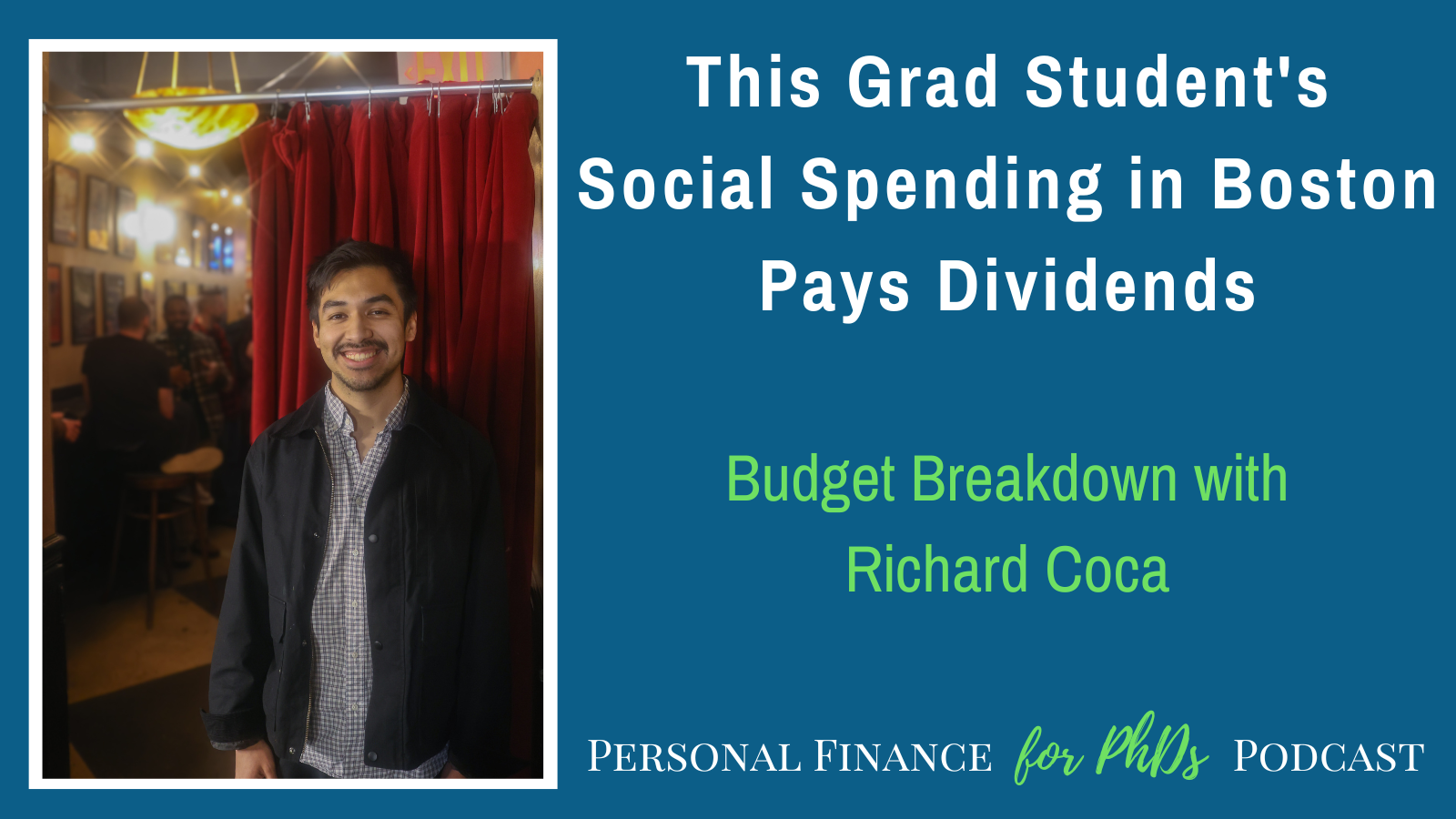
In this episode, Emily interviews Richard Coca, a 3rd-year PhD student at Boston University. Richard breaks down his budget, detailing his top five largest expenses: rent, groceries, eating out, hobbies, and social spending. He rents a bedroom and private bathroom in a shared home convenient to public transit in East Cambridge, and the higher rent is offset because he does not own a car. Richard has developed two intensive hobbies since starting grad school: running and stand-up comedy. To participate in those hobbies, he spends on race entry fees, shoes, and drinks and meals at venues. Richard used to overwork and be much more frugal; he now spends more on his hobbies, eating out, and friends, but he’s still reaching his goal of maxing out his Roth IRA every year. He feels mentally and physically healthy and is happy with his work-life balance.
Links mentioned in the Episode
- Die With Zero by Bill Perkins
- Host a PF for PhDs Seminar at Your Institution
- Emily’s E-mail Address
- PF for PhDs Subscribe to Mailing List
- PF for PhDs Podcast Hub
Teaser
Richard (00:00): When you are doing physically well, usually you are also doing mentally well and uh, financially well. And I feel like those three things kind of all are intertwined and if you’re working on one of them, they kind of help support the other two. Um, so I think, yeah, I might not be saving as much as I could be, but I think spending that money pays dividends and sort of my mental wellbeing as well as sort of just being uh, a lot more physically active, being a lot more in community with like the huge running community here in Boston, the standup scene here.
Introduction
Emily (00:43): Welcome to the Personal Finance for PhDs Podcast: A Higher Education in Personal Finance. This podcast is for PhDs and PhDs-to-be who want to explore the hidden curriculum of finances to learn the best practices for money management, career advancement, and advocacy for yourself and others. I’m your host, Dr. Emily Roberts, a financial educator specializing in early-career PhDs and founder of Personal Finance for PhDs.
Emily (01:13): This is Season 24, Episode 3, and today my guest is Richard Coca, a 3rd-year PhD student at Boston University. Richard breaks down his budget, detailing his top five largest expenses: rent, groceries, eating out, hobbies, and social spending. He rents a bedroom and private bathroom in a shared home convenient to public transit in East Cambridge, and the higher rent is offset because he does not own a car. Richard has developed two intensive hobbies since starting grad school: running and stand-up comedy. To participate in those hobbies, he spends on race entry fees, shoes, and drinks and meals at venues. Richard used to overwork and be much more frugal; he now spends more on his hobbies, eating out, and friends, but he’s still reaching his goal of maxing out his Roth IRA every year. He feels mentally and physically healthy and is happy with his work-life balance.
Emily (02:12): At the start of every academic year, fellowship recipients need to know that if they are not having income tax withheld from their paychecks, they should start self-withholding and possibly make a payment by September 15th. Otherwise, they are in for a nasty surprise when they file their tax returns next spring. If your university has not in the past provided adequate messaging and resources regarding estimated tax, would you please recommend me as a workshop facilitator for the start of the upcoming academic year? I offer both live and asynchronous versions of a workshop that guides US citizens and residents in filling out the Estimated Tax Worksheet in IRS Form 1040-ES and managing their money to seamlessly meet their tax obligations. These workshops are typically considered professional development or personal wellness. I would appreciate you cc’ing me when you recommend me so I can follow up with additional information for the potential host. Thank you very much! You can find the show notes for this episode at PFforPhDs.com/s24e3/. Without further ado, here’s my interview with Richard Coca.
Will You Please Introduce Yourself Further?
Emily (03:41): I am delighted to have joining me on the podcast today, Richard Coca. He is a third year PhD student in neuroscience at Boston University and today we are doing a budget breakdown. So we’re gonna get to know all of Richard’s top expenses and all of the nitty gritty details about his finances. So Richard, thank you so much for volunteering to come on the podcast. Will you please introduce yourself a little bit further for the audience?
Richard (04:03): Yeah, of course. Super excited to be here as a long time listener. Um, as you said, my name’s Richard Coca. I would describe sort of who I am. I’ve always kind of been in the science space and a scientist, but recently my PhD journey has been like, okay, science is obviously very difficult and very hard. There are other things to life. So I’ve been trying to sort of expand more and increase sort of my hobbies and in that sense that’s sort of had a stress on my budget and we’ll sort of break that down further. But I pivot back to you Emily.
Current Funding, a Cross Country Move, and Household Size
Emily (04:36): That’s great. Um, finding some identity outside of the lab. Very highly recommended <laugh> along this PhD journey. Um, wonderful. Okay, so we know you’re at BU. Um, can you tell us a little bit more about like how you’re funded? Do you have an assistantship or a fellowship or just give us some more details about that.
Richard (04:56): Yeah, so my program actually um, will fund you for five year guaranteed. Um, our stipend right now, um, now actually all the stipends at BU now that the union has negotiated a rate are all the same. So it’s around like $48,000 a year. Um, I actually was on our training grant for the first two years of my PhD. Um, so that was nice and they were nice enough to give what I thought at the time was a baller $3,000 relocation, stipend, um, and it was baller but then you kind of realized that living in Cambridge is expensive. I’m now on my PI’s uh, grant. So that’s my current funding source.
Emily (05:35): Well I know from my work around the country that um, Boston is an unusually difficult market to move to, right? Because you have um, the realtor fees if I remember correctly as well as, you know, first month’s rent, maybe last month’s. So that $3,000 probably really helped with that process I would imagine. Do you wanna give us any more details about how it was to actually move to Boston?
Richard (05:56): Yeah, I mean at the time I was actually living with uh, my former partner so it was less hard. So in that we had subsidized housing, which was so lovely. Um, but I think really a lot of the funding or a lot of the relocation went from like shipping all of our items to Cambridge, which I think in retrospect really didn’t need to bring that much from California. But um, I think it’s something you don’t know until you kind of live through it and make that move across the country.
Emily (06:27): And tell us about who is in your household now.
Richard (06:30): Uh, now I live with roommates, um, and that is um, it’s a bigger home in Cambridge, so I’ve always kind of lived in the Cambridge rental market. Um, yeah and uh, I’m very bougie in the sense that I always want my own little bathroom. So I do have kind of essentially a studio but like you know, you’re sharing a common space. Yeah,
Emily (06:55): Let’s find more out about your housing when we get to that in your list of expenses. Um, so you’ve covered your stipend, which sounds great actually. I mean I know Boston has a high cost of living area, but like that’s not bad at all. And like do you wanna give us any more details about were you there when the union was negotiating or like what was the timeline of that relative to you starting grad school?
Richard (07:16): Yeah, so I think the strike actually started probably like within the year of us moving here. Uh, so my first year was really clouded by a lot of strike negotiations and sort of classes not being offered. Um, my, I would say I’m glad that effort went through I think my PhD program even before sort of those efforts already was among one of the more higher paid programs at BU. Um, but there are also pro programs out here that were paid maybe like 20K a year. Um, so really glad sort of that effort went through for them.
Maxing out a Roth IRA and Using High Yield Savings Accounts as a Grad Student
Emily (07:50): Yeah, amazing. Are you currently working toward any financial goals?
Richard (07:55): Yeah, I think my goal every year, um, and I’ve learned, I just saw an article about this actually. It’s like Gen Z is doing a Roth IRA max every year. They’re the generation that’s done it the most and that’s always been something that I’ve done every year. Um, I think this year in particular I have tried to shift a lot more of my funds in high yield savings. I am kind of trying to think less about money and kind of just have it passively grow itself. Um, but really I think my goal is just every year maxing out Roth IRA and I think kind of at the point where I’m almost, I think I could spend a little more than I should, but you know, that’s something that I’m constantly negotiating with myself
Emily (08:36): In 2026 maxing out a Roth IRA is like seven and half thousand dollars I believe. And so I’m just doing some quick math in my mind. But that’s something like 13, 14% of your gross income, is that right?
Richard (08:48): Yeah, I think so.
Emily (08:49): So that’s a pretty ambitious like goal, so that’s amazing that you’ve been able to do that consistently.
Richard (08:55): Yeah, and I think part of it was like I was uh, set up nicely in college. Um, I was lucky enough where, um, due to sort of my parental income, I kind of never had to pay tuition. Um, and I was also an RA and I think that’s kind of the cheat code for undergrad or grad school. Um, you just get like seven K or that was my stipend, um, in undergrad and each year I would just throw that in the Roth IRA. Um, so I kind of have had at least five years of maxing it out or four years of maxing it out, um, which is nice to like look at as a good chunk of change. Yeah,
Emily (09:33): Yeah. Even when you are still, like you said, four or five years in, it really does start adding up like pretty early on. That’s amazing. And then when you mentioned like the high yield savings accounts and just putting money in there, um, do you have any, um, purpose linked to those accounts? Is it just to have some safety money or fallback money or like how do you think about that money?
Richard (09:52): Yeah, I, I just think like at least growing up I wasn’t really raised like my parents in particular up until like two years ago, like they are the type of people who, it like kills me, but like all their money is like in a checking account or like a savings account with very low interest. Um, so like learning about high yield savings account or like even different accounts, um, where you can, you know, the interest rates are a lot more generous I think of my high yield savings account as, oh, this is the interest that will be used for like casual spending money. Um, or at least that’s how I treat it. Um, I think in a way probably not the best financial perspective to look at it, but I, that is how I kind of currently use it. Um, yeah.
Emily (10:34): What types of things would you spend that on?
Richard (10:37): Yeah, I feel like, um, oftentimes, uh, and I, this goes sort of into some of my bigger expenses. Um, so thinking about sort of like social outings is particularly with my cohort or with friends out in the uh, Boston area, like those are very expensive. Especially here it’s like a, if you wanna have a good day in Boston, it’s a minimum of a hundred dollars. Um, so that’s the type of uh, time where the high yield saving kind of does generate. I don’t think it’s a hundred dollars if I’m being honest. Sometimes I do dip into it, but like, um, it covers part of it I would say.
Emily (11:10): And all of this is like you were saying earlier, in an effort to just feeling less stressed and less like tight about money. Is that right? Like you think you can, you should be loosening up a little bit more it sounds like.
Richard (11:21): Yeah, I will say like I kind of, in order to max out the Roth IRA earlier in college, I kind of feel like I um, was definitely a lot tighter and a lot more meticulous about how I was spending. Um, and in a way I kind of gave myself um, this feeling of missing out. ’cause a lot of my friends post-college kind of went into the whole traveling the world bit. Um, and I’ve done some of that, but I do feel like, I don’t know, uh, money is one of those things where like if you spend it, it somewhat comes back to you. I, I don’t know if that’s always necessarily true, but um, I definitely feel like I am not going to, uh, go and destroy my wallet if I accidentally dip a bit too much.
Emily (12:06): Hmm. I I’m getting like a, uh, a Die With Zero vibe from you. Have you read that book or have you heard about that book? Okay. It might, if you read it, it might reinforce some of this, um, mindset. It really helped me because from when I went through graduate school I like learned to be really frugal and really tight and really careful and all of those things. And definitely airing more towards maybe too much saving and not as much lifestyle spending as I should have been doing. And so that book, when I read it a few years ago, really helped me kind of rethink about just kind of what you were saying there is how money can buy you what the author calls memory dividends. Like it literally is an investment that you make in your enjoyment of your life going forward in the decades to always have those memories to look back on.
Emily (12:52): Um, so it just, it’s a book that does very well for people who aren’t have the tendency to over save. It’s definitely not a good book for somebody who’s already in like the overspending, not saving enough, investing enough for the future kind of, um, side of things. So anyway, I’m just, I think you might find, um, some commonalities if you did read that book, but I’m very curious now that we’ve had that point in the conversation to know about what your expenses are, um, to kind of see how you’re balancing things within this stipend. So we’re gonna run through your top five expenses in either last month’s budget or a typical monthly budget. So lead us off, what is your number one expense? It’s the same for everybody. <laugh>.
Budget Breakdown: Housing and Transportation
Richard (13:33): Yep. It’s always, it’s always rent. Um, and I live in east Cambridge, which is relatively nice area, maybe like a half hour to 40 minute commute to work. Um, and that is probably like the big budget, like where most of my income goes and that’s like $1600 a month. Um, just went up this year but it, it always does. Um, but that is sort of, you know, kitchen, uh, bedroom own bathroom, which I really love and it’s a big bathroom. Um, and I think for the area it’s like actually probably on the lower end I would say.
Emily (14:08): So 1600 a month. You said you have your own bedroom, your own bathroom. How many in like the overall unit or home size, how many people are living there?
Richard (14:17): So it’s two other roommates. Um, they share a bathroom. I think the rent is cheaper and kinda at the point where like I love having my own bathroom.
Emily (14:27): How did you find this place and how long have you lived there?
Richard (14:30): Uh, this was now year two. Um, and I kind of just found it via probably Craigslist actually. Um, and it was one of those moments where um, you know, the really lucky in terms of who my roommates are and I think in terms of almost their frugality, like they’re not the type who will run the heater 24/7 or necessarily like drive up utilities or anything else. Um, and it’s, yeah, shout out to them, um, because you know, those things do kind of add up. I think utilities wise, I probably spend less on utilities a month than I do groceries for sure. Um, or even like smaller things. Yeah,
Emily (15:13): That’s great. It’s really wonderful to find people who you have the same kind of attitude with about things like that. Um, tell me about the choice to live in Cambridge and have that length of a commute. Like tell us about your commute. Do you use public transit? Do you drive?
Richard (15:27): Yeah, so that’s a great question. Um, I used to live actually my first year when I was living with my, uh, former partner. We would live literally right above Harvard Square, like the red line station was underneath our house. Um, and back then I would just, it was weird because BU is like, it’s on the green line so you would have to go from the red line to the green line and it was easier to walk 45 minutes than it was to take the T. Uh, which is really like a failure of sort of that transportation system. So when I was moving I was like I need an easier commute public transportation wise. Um, and I want to be somewhat closer to the city ’cause that’s just where things really are. Um, so I knew I was gonna move towards East Cambridge and now my commute is maybe like 20 minute green line and then like a 20 minute walk to lab, which is awesome. Um, same time a lot more, I don’t know, fun, less stressful, I think, of a commute. Um, and I really have always loved living on the other side of Boston. There’s something about being separated by the Charles River where I kind of just like, once I cross it, I am detached from work and lab and, and kind of just relax.
Emily (16:38): That makes sense. And I’ve heard that so many times from people who have commutes of any sort, like it, it provides a reset point in your day and helps you, yeah, maintain that kind of psychological separation from your home life versus like your work life. And obviously that got destroyed <laugh> from you work from home like I do, uh, doesn’t exist. We don’t have that benefit. But anyway a lot of people hate commuting, but there is that one, you know, kind of upside for it. Um, that yeah, it gives you a reset point and a way to relax for part of the day. And I love using public transit, a combination of public transit and walking like that sounds ideal to me.
Richard (17:11): Yeah, and it is ideal. And I’ve also started, um, one of the hobbies I guess going on the next expense that I, um, has slowly crept up on me. It is like running. So I’ve started like run, commuting occasionally to work. Um, and then you also save on transportation, I guess expenses, which aren’t that high in Boston if I’m being quite honest.
Emily (17:31): Yeah. Actually let’s talk for a second about transportation expenses because you gave me a preview of your expenses and they don’t appear in the top five. So just tell me like, do you not own a car? Do you pay for a pass for public transit? Like how do your costs play out? And I know they’re not in the top five, but I’m curious about what they are.
Richard (17:49): Like my station in particular, um, it’s really just like $2.40 to take the T. Uh, and I would say like it, it’s frequent enough where um, if you’re, if you’re lucky and you need to catch a bus like, and you take the T immediately after it’s only 70 cents additional, um, so I would say like $2 a day or like 4 or 3, $4 a day actually. It really doesn’t add that much. And I’m also, because I do ride on the weekends, like I kind of save on that money. Um, so it’s not like a noticeable debt in the budget.
Emily (18:22): And your public transportation expenses are pretty much the sum of your transportation expenses. You don’t have any other regular transportation expenses?
Richard (18:29): Yeah, I don’t, yeah, I don’t use a car. I have a roommate who has a car, which again, this isn’t really coming clutch, uh, for those big Costco runs. Um, and I think yeah, other friends have cars and it’s so often where like if I am traveling to somewhere in state that’s farther out or say making a trip to New York, it really doesn’t like, it doesn’t make a big dent. Um, which like I’m coming from LA where you need a car everywhere to go and gas so expensive. I’m kind of like, that was one of the big selling points for moving across the country for me.
Emily (19:05): Yeah. And it definitely helps to offset the higher rent price if you have very, very low transportation costs and you don’t have to own your own car. Amazing. I love to hear that.
Commercial
Emily (19:16): Emily here for a brief interlude. Would you like to learn directly from me on a personal finance topic, such as taxes, goal-setting, investing, budgeting, or designing your financial life, each tailored specifically for graduate students and postdocs? I offer live workshops, asynchronous online courses, and cohort-based programs on these topics, and I’m now booking for the 2026-2027 academic year. If you would like to bring my content to your institution, would you please recommend me as a speaker or facilitator to your university, graduate school, graduate student association, medical school, postdoc office, or postdoc association? My workshops are usually slated as professional development or personal wellness. The fall semester is an excellent time for any type of personal finance content. Ask the potential host to go to PFforPhDs.com/financial-education/ or simply email me at [email protected] to start the process. I really appreciate these recommendations, which are the best way for me to start a conversation with a potential host. The paid work I do with universities and institutions enables me to keep producing this podcast and all my other free resources. Thank you in advance if you decide to issue a recommendation! Now back to our interview.
Budget Breakdown: Groceries and Dining Out
Emily (20:50): Okay. Your number two expense, what is that?
Richard (20:53): Uh, my number two expense is definitely probably gonna end up being my groceries. Um, as I said, I’ve started running a lot more and with that comes the dreaded food noise, so I’m like constantly, uh, getting more food. Uh, the other thing is like, because I um, was formally lived my partner, now I’m paying like the singles tax in terms of food prep and making more food. So I am not someone who like, actually I make probably make enough where I should have leftovers for lunch and should be saving there, but I’m not necessarily having leftovers after I eat dinner after a run. Um, which is like, I mean it is what it is, but I definitely spend more than I think one would typically expect for groceries. Uh, so it’s like maybe a hundred to 150, um, per week I would say. And I’m someone who loves fresh produce as well. Um, and I very frequently learn that if you buy big batches of like fruits and stuff, they will rot in my fridge. So I’m someone who has to get it like day of. Um, and there used to be a grocery like really close to my lab so I would just kind kind of swing by and eat a fresh plum or anything like that. Um, but yeah, it was like those small things like that were like a nectar, a $4 nectarine kind of like quickly added up, um, over the week.
Emily (22:17): So tell us about your like grocery shopping habits then. Like how many times per week are you grocery shopping? You mentioned Costco a moment ago. How often are you going there?
Richard (22:27): Yeah, I would say a Costco run is maybe like bimonthly like every other month. But, uh, the bigger expenses I would say would be um, like dinner and I think in, in terms of like, uh, shopping habits like that can range anything, anything between like once or twice a week to sort of the European model where I’m kind of going in there for, you know, just the ingredients for dinner for that night or for like fresh produce and stuff like that. Um, so one way I try to actually cut costs ’cause I started realizing it was getting like a bit excessive in particular for lunch. Um, is just like getting, relying more sort of on like food kit or like salad kits and stuff like that. Um, so I started doing more of the, you know, sometimes lunch has to be boring and I kind of had to convince myself of that. So more salads and sandwiches and stuff like that.
Emily (23:19): Yeah, I was just gonna ask about like what types of foods you’re eating and what types of foods you’re cooking for yourself. So you mentioned lunch, salads and sandwiches, like what kinds of things do you eat for dinner? Do you have patterns that you’re in?
Richard (23:30): Yeah, I feel like it’s mostly a lot of chicken. Um, I don’t typically eat pork, but I guess like the bigger expense would be like beef, um, and stuff like that.
Emily (23:41): And do you cook dinner like every night? You said that it’s hard to maintain leftovers, so are you cooking like pretty much every day?
Richard (23:50): Um, not as much as I should be and I think maybe it’s like the current recent spell that I’m in. Um, but I would say I like cook maybe every other day. Recently I’ve kind of, the other hobby that I’ve joined that’s been somewhat expensive is like I do standup now. Um, and sometimes making the open mic means that I’m not going to be able to make dinner or like trying to balance that between the PhD. Also getting my mileage in for my run for the week. Um, it means that I have to like stop by somewhere, uh, in between the commute and that’s sort of where my third expense is. Just like the, the food that I’m not cooking for myself. That adds up so quickly, that’s like $20 each time. Um, and I feel like that is definitely a bigger expense than say transportation per se.
Emily (24:39): So that third expense of like eating out of your own home Yeah. What does that add up to over the month?
Richard (24:48): Ooh, that’s like a good $300 I would say it’s a good chunk of change. It’s the one where I’m like, huh, maybe we should tie it up.
Emily (24:56): It just depends. That’s why we talk about goals first. Like if you’re meeting that Roth IRA goal, hey <laugh>, what else do you need to do? Right.
Richard (25:04): Yeah. Yeah.
Emily (25:06): Okay. So it sounds like you’re eating out, um, you know, when you’re transitioning from place to place. Um, you mentioned, you know, you used to grab things from the grocery, uh, near your work. Um, in what other situations do you find yourself eating out and I guess how do you feel about it? Like are you happy about spending that money or are you like, oh no, I need to find a different way to manage this?
Richard (25:26): Honestly, I’m someone who like, especially when I eat out with friends, like I would definitely not regret that. I feel like that is experi- experiential and going back to sort of the idea of memory dividends, having to pay for that, where I’m less excited to do so is when I’d say have gone for a run or I’ve had like a really long day in lab and I’m like, uh, screw it. Like I don’t wanna make dinner for myself. That’s sort of the time where I, I kind of look back in time. I’m like, no, just, just like quickly make some fajitas. It won’t be that long. Um, but yeah, I think I, the guilt I feel is probably going back to that idea of like, oh, you could be saving some money there. Um, but you’re not, but it is what it is.
Budget Breakdown: Hobbies
Emily (26:08): Okay. What is your fourth highest expense?
Richard (26:12): My fourth highest expense has to be like my hobbies. So like running or like stand up. Um, each definitely have a cost associated with them running in particular, I’ve been signing up for a lot more races and it’s kind of like the one that’s like biting me. Um, I recently did like the twin lobster half marathon with like a week’s notice and that was like a good a hundred dollars, uh, race fee. Um, that’s a huge chunk of change. And the other thing is like shoes, uh, the amount of mileage that I put into my shoes, I’ve needed to like replace ’em and that’s like maybe $150 to $200, uh, per pair. So that’s definitely been eating at me and I think I now have um, like seven or so pairs of shoes. Um, so it’s like a huge, huge part of sort of the disposable income I would say.
Emily (27:06): I am not a runner and I’ve never like paid to enter a race or anything. Can you tell me what like benefits you get from it? Is it being around other people? Do you do it with friends? Is it challenging yourself and your times? Like what’s the reasoning?
Richard (27:19): Yeah, I guess like they close the street so it’s like easier to set like a personal best. Um, but oftentimes races have amenities so they’ll have uh, actual like, um, let’s say water on the course or electrolytes on the course as well as like fueling bananas and sometimes they’ll have a metal or a t-shirt associated with them. And oftentimes it’s just like a sort of a chance to kind of prove to yourself like what you can do, um, which is a bit nice, but I really like the atmosphere of race day. Um, you can just sort of feel in the air like before the actual uh, sort of gun goes off that everyone’s kind of a little anxious and everyone wants to really do their best and there’s something about seeing people try really hard and sort of try to reach their goals. Um, it’s just like worth sort of pain to be around and just being in that community there.
Emily (28:11): How many races would you say you’re doing per year?
Richard (28:13): I would want to say maybe like two to three per season. Um, so that’s actually adding up to lots maybe like, um, eight to 10, I don’t know if I did my math right. Yeah. Some somewhere around that. Um, marathons are a lot more expensive because you have to kind of fly out there as well, uh, get accommodations, but I limit those to two per year. Um, I’m running Philly in the fall saving, saving on accommodations by staying with a friend actually. Um, and the other sort of local race that I do here are like the Cambridge seasonal 5Ks and that I try to, those are only like $40 a race I would say. Um, so it’s not too much. And then I try to do a couple of halfs as well.
Emily (29:01): Have you found, um, any other, um, PhD students or other like academics who have a similar commitment to running or their own like kind of athletic hobbies? Like is this something you bond with other people about?
Richard (29:13): Oh, oh, absolutely. Uh, same with standup comedy. You would be surprised how many academics are actually in those spaces. Um, and I think it’s like something that I really enjoy seeing. Like there’s been times where I’ve been say like at a comedy club and actually talking like pure science to the point where like, wow, the work that you do in your lab is extremely relevant to like what I’m doing in my dissertation. And that’s like something where I’m like, I wouldn’t say like only in Cambridge, but like it’s honestly like an awesome thing. I think about sort of the Boston ecosphere. Same with like running, there’s been times where I’ve met like the editors of journals of um, sort of like the science family or cell, um, and they’re just be giving like advice to like other grad students. I would say like in particular, something about the mid twenties brings out a lot of runners. Um, so there’s a lot of PhD students, um, that I’ve met who are like training for different things and people often say, you know, the PhD is like a marathon and sort of not a sprint. And I think that’s something that a lot of people actually take to heart. And I would say maybe running a marathon is easier than doing a PhD. Um, but that’s just my opinion.
Emily (30:24): That’s amazing that it also turns into a networking opportunity and and so forth. Um, yeah, I mean you mentioned maybe not only in Boston, but Boston would be a great place. There’s obviously, there’s just so many universities there, such a young population overall, like yeah, I would imagine if you’re just getting out there and doing things, you naturally run into a lot of other people who are in a similar position to you. Tell us more about the standup comedy. I mean, I totally understand, uh, you’re going from, you know, work over to where you’re, I don’t know what the word is, delivering a what do you do? A, an open mic. I, i don’t know what the words are, but you know, you have to grab dinner along the way. Um, what other costs are associated with that hobby?
Richard (31:05): Yeah, so doing an open mic or doing a showcase, a lot of the time these spaces are actually kind of very hard to come by. Um, Boston has a small comedy scene, I think relative to sort of the big three of LA, New York, and Chicago. Um, and recently a couple mics have been closing and one of the big things around that is like, you gotta support the venue. You really gotta support the menu. These guys need to sort of sell drinks, sell food in order for them to know this is profitable to put on these events. So there’s a cost of buying sort of drink or buying food to support the venue. Um, that goes into doing like open mic. The other expense is like if you do showcases or you get booked on for another show, there’s often the traveling that you have to do. Um, oftentimes that’s like another part of Massachusetts. So like, you know, paying for someone or like, you know, I would want to pay for someone’s gas if they’re driving me to like say Foxborough per se. Um, the other cost sort of associated with standup as well, if I’ve been lucky enough to sort of kind of co-produce, um, a show before. And it’s just like fronting the money for, uh, the things that you need for the after production, um, be it like flowers or, um, sort of the ticket writer for the other performers in the show.
Emily (32:23): Well this is so exciting and so unique that, that aspect of, of your hobby of doing standup. Okay. We’re down to your fifth largest expense on a monthly basis. What’s that?
Budget Breakdown: Gifts
Richard (32:34): Um, I would say more the social aspect. I’m someone who really loves spending money on gifts. Um, so when it comes to like friends’ birthdays or stuff like that, one of my friends actually who got me more into running, um, she’s great. Shout out to Viv, I think she’s over at Woods Hole right now. Um, she, uh, for her birthday I really wanted to sort of spoil her ’cause I, she really again got me into running, so I decided to get her like a fresh pair of running shoes as well as kind of like a runner starter pack, so like some gels and electrolytes and other stuff for like stretching. Uh, um, and I guess that was like a more, um, expensive gift. And I, I do like sort of thinking more of like well thought gifts for other people as well, um, whether that’s like surprising them or their graduation and stuff like that. So that’s kind of like on the scale of a hundred dollars, $250 kind of monthly splurges and stuff like that.
Emily (33:37): Amazing, amazing. You’ve identified that about yourself by this point, like that generous spirit like in that way. Um, and great that you have the room in your budget to, um, indulge it to the degree that you want. Kind of one of the themes that I, I think is coming out with this episode and you know, something you’ve, you’ve found along your journey in graduate school is this is finding these pursuits outside of the lab and outside of work, um, that are enhancing your life and satisfactory to you and so forth. Would you say that that is necessary to maintain like your mental health, your physical health and still work like very well and effectively in the lab? Or like how do you think about, I don’t wanna use the word balance, but like how do you think about the, the time and energy you’re spending at work versus these other pursuits and how do they complement one another or how do they, I don’t know, maybe compete with one another?
Richard (34:34): Yeah, I would kind of say that they’re almost intertwined. Like I think about I guess the earlier part of my PhD, um, and even post rotation, uh, like in the first lab that I joined, um, I was spending like a lot of time, a lot of effort on the weekend and I think, um, definitely at the expense of sort of a more balanced life approach and yeah, I’m sure I was saving money, but I definitely was not as happy I would say. Um, so I think like when you are doing physically well usually you are also doing mentally well and uh, financially well. And I feel like those three things kind of all are intertwined and if you’re working on one of them, they kind of help support the other two. Um, so I think, yeah, I might not be saving as much as I could be, but I think spending that money pays dividends and sort of my mental wellbeing as well as sort of just being, uh, a lot more physically active, being a lot more in community with like the huge running community here in Boston, the standup scene here. Um, if they’re doing, you know, I’m happy. Thankfully I’ve met like so many wonderful people and I think that really carries into sort of how I conduct myself at work. My coworkers often be like, you’re always smiling and I’m like, thank you for noticing that. Um, but I think it really helps, I think for, um, I don’t know, just like staying at the top of my game and trying to be who I am.
Emily (36:03): It’s really lovely to hear. Thank you for kind of summing up, you know, your, your approach, um, in this respect and I’m, I’m glad to hear that, you know, over the years in graduate school you’ve found a level of spending and a level of, you know, uh, time commitment that as you said, it’s kind of like a mutually positive reinforcing cycle between like your finances and your mental health and your physical health and your performance at work and so forth. So I’m just really glad to hear that. Um, Richard, thank you so much for, uh, volunteering to share your budget with us and give this interview.
Best Financial Advice for Another Early-Career PhD
Emily (36:31): Um, I’d like to end with the question I ask of all, I ask of all my guests, which is, what is your best financial advice for another early career PhD? And it can be something we’ve touched on already in the interview or it could be something completely new.
Richard (36:44): I would say probably like in all actuality, just try to max out that Roth RA if you can. Um, but also don’t be afraid to spend. ’cause like as I tried to touch upon earlier, like that money that you do spend does come back, whether it be in the form of memories or accidental networking with other people, I think it’s like a great opportunity. Um, like money is not something that just like sits there and collects dust. I think it’s something that can work, um, in your favor, uh, whether it be just like passive saving or sort of gaining an opportunity that you wouldn’t elsewise try.
Emily (37:19): Amazing. So glad to hear from you during this interview. Thank you so much for volunteering.
Richard (37:23): Alright. Well thank you so much for having me.
Outro
Emily (37:35): Listeners, thank you for joining me for this episode! I have a gift for you! You know that final question I ask of all my guests regarding their best financial advice? My team has collected short summaries of all the answers ever given on the podcast into a document that is updated with each new episode release. You can gain access to it by registering for my mailing list at PFforPhDs.com/advice/. Would you like to access transcripts or videos of each episode? I link the show notes for each episode from PFforPhDs.com/podcast/. See you in the next episode, and remember: You don’t have to have a PhD to succeed with personal finance… but it helps! Nothing you hear on this podcast should be taken as financial, tax, or legal advice for any individual. The music is “Stages of Awakening” by Podington Bear from the Free Music Archive and is shared under CC by NC. Podcast editing by me and show notes creation by Dr. Jill Hoffman.
Join Our Phinancially Distinct Community

Receive 1-2 emails per week to help you take the next step with your finances.

Managing finances in the energy industry requires careful planning and accurate reporting. This blog provides valuable insights into the importance of energy accounting services in USA for improving financial management and operational efficiency. Thanks for sharing such informative content!