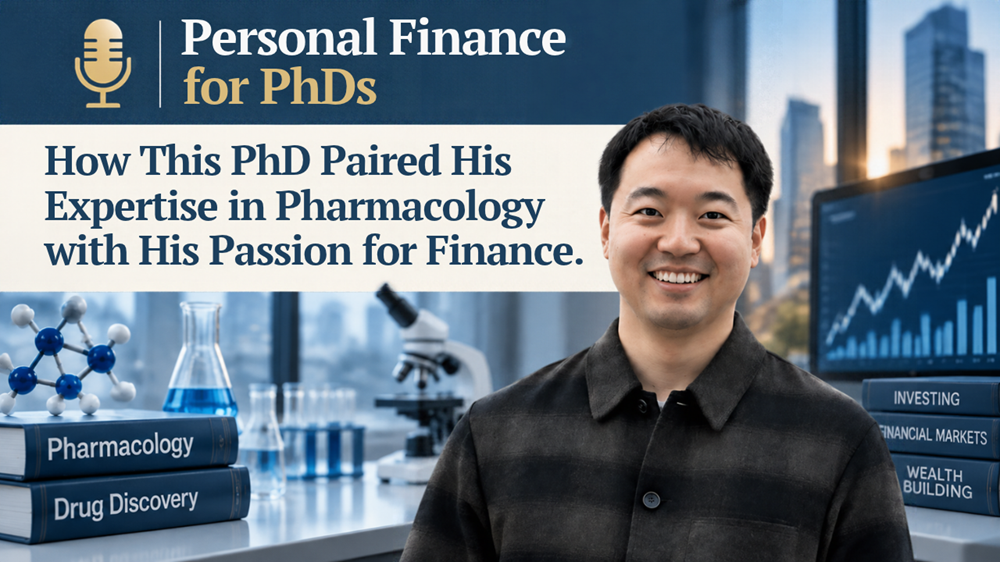
In this episode, Emily interviews Dr. Min Sub Lee, a Biotech Equity Research Associates at Guggenheim Partners. Min Sub developed a deep interest in both personal and business finances while pursuing his PhD in pharmacology at UCLA. In his last few years of graduate school, he explored career paths that would marry his expertise with his passion and ultimately started a job in sell-side equity research. Informational interviewing and networking were essential to Min Sub’s career transition. Don’t miss his encouraging words about the intangible value you develop during a PhD.
Links mentioned in the Episode
- Dr. Min Sub Lee’s Instagram
- Dr. Min Sub Lee’s Book: A Broke PhD’s Guide to Financial Independence
- PF for PhDs Subscribe to Mailing List
- PF for PhDs S11E4: This Grad Student’s Side Hustle Is Trading Options
- Host a PF for PhDs Tax Seminar at Your Institution
- PF for PhDs Podcast Hub
Teaser
Min Sub (00:00): A PhD is something that you should be proud of, right? Definitely own that to your heart and always have the self-confidence. And maybe one more thing, uh, going back to my example of balance sheet. So one feature of a balance sheet that I have not talked about actually is a category called an intangible asset.
Introduction
Emily (00:20): Welcome to the Personal Finance for PhDs Podcast: A Higher Education in Personal Finance. This podcast is for PhDs and PhDs-to-be who want to explore the hidden curriculum of finances to learn the best practices for money management, career advancement, and advocacy for yourself and others. I’m your host, Dr. Emily Roberts, a financial educator specializing in early-career PhDs and founder of Personal Finance for PhDs.
Emily (00:47): This is Season 25, Episode 7, and today my guest is Dr. Min Sub Lee, a Biotech Equity Research Associate at Guggenheim Partners. Min Sub developed a deep interest in both personal and business finances while pursuing his PhD in pharmacology at UCLA. In his last few years of graduate school, he explored career paths that would marry his expertise with his passion and ultimately started a job in sell-side equity research. Informational interviewing and networking were essential to Min Sub’s career transition. Don’t miss his encouraging words about the intangible value you develop during a PhD.
Emily (01:25): If you’re not yet on the Personal Finance for PhDs mailing list, what’s stopping you from joining through PFforPhDs.com/subscribe/? You’ll receive 1-2 emails per week on new podcast episodes, personal finance information tailored for PhDs, and opportunities to learn from me, both through your university and for free online. If you sign up through PFforPhDs.com/subscribe/, you’ll receive a short booklet that I wrote on five quick actions you can take today to improve your money situation. I hope to interact with you over email in the near future! You can find the show notes for this episode at PFforPhDs.com/s25e7/. Without further ado, here’s my interview with Dr. Min Sub Lee.
Will You Please Introduce Yourself Further?
Emily (02:15): I am delighted to welcome back on the podcast today, Dr. Min Sub Lee. He was last on the podcast in season 11, episode four. And we talked about options trading, a little bit of a departure from my normal topics here. And perhaps unsurprisingly, we will learn that Min Sub has had a career transition since finishing his PhD in March 2024, um, at UCLA. And he’s now working as a biotech equity research associate at Guggenheim Partners. And so we’re gonna learn about more of Min Sub’s financial journey during graduate school and what kind of led him to pursuing this alternative career path, um, that’s quite different from what he went to grad school for. So Min Sub, it’s wonderful to have you back on the podcast. Would you please introduce yourself a little bit further for anyone who didn’t listen to the prior episode?
Min Sub (03:06): Thank you for the intro, Emily. Uh, very nice to be back. Um, so my name is Min Sub. I did got my PhD in UCLA, um, back in spring of 2024. I currently work in the South Side Equity Research here at New York City. About four years ago, like, I’ve done a podcast discussing some of the basics, the fundamentals of trading options in a safe way. I mean, I realize that people still nowadays, I think, associate these options trading with these risky moves, which is true. I, if you do play your games incorrectly, then you can be stuck with massive holes in your play. But I mean, there are certainly ways to cer – have certain leverages and be able to sort of play your plays correctly. So feel free to like, like revert back to that episode, um, for the audience. I’m happy to discuss my career pivot, um, away from the traditional academic route, um, and more towards how I was actually able to discover my path, what actually led me to consider this path. Is this a path for you guys in, in, in the audience?
How Grad School Taxes Accelerated Dr. Lee’s Personal Finance Journey
Emily (04:03): Yeah, love to hear about that. We’ll get to the career transition a little bit later in the episode because I wanna start back when you were a graduate student, and can you just give us a little bit more details about how you started investigating more into your personal finances and what were you working on? And I know that you built some tools, like what were you working on in that area?
Min Sub (04:20): Yeah. So without going through all of the major details, um, personal finance has always been a big passion for me, um, even prior to wh- when I began grad school. But I think I officially started to take, um, my journey towards really optimizing my finances a lot more seriously when I really began to realize the complication of taxes, um, because, I mean, Emily has been very good at preaching this idea of making sure that you understand how stipends work, making sure that, that you don’t underpay or overpay your taxes, understand the, the liabilities and such. And honestly, that has happened to me, right? Like, second year of my grad school, when I was getting my training grants from my university, um, I was, it was a great way to hit my resume and stuff. But then I realized that there’s a lot more complication behind the scene as to, like, how do I actually make sure that finance put this down correctly, how do I make sure that I properly, uh, make my, my, uh, share payments on time?
Min Sub (05:13): And all of those things were very new topics at the time, and I was just looking for ways to think about, like, what is, uh, the best way to not get screwed up through the IRS and making sure that I, you know, pay my taxes properly the, the legal way. So my first journey is on access through those, uh, stipend, uh, regulations and such. But even then, I understand that in grad school, it, because the monthly stipend is a very limited income for many folks out there, especially people living in the high income area, it’s really, really important to learn how to budget properly and really, really making sure that you don’t go overboard on your spending. Obviously, we can talk about the basics of how do you actually manage your finance properly, right? The old saying, obviously, is save more and spend less, right?
Min Sub (05:58): But I think there’s a lot more we can actually learn about, um, and really learn to optimize our, our sort of journey besides that, right? And this is when I began to really build, um, my own financial model towards my personal life, right? Because if you own a business estate, right, as a business owner, right, you’re not simply just responsible for understanding what goes in and what goes out. There’s a lot of these elements in the balance sheet that, that Emily talks about, the whole concept of assets versus liability, right? How much equity do you actually have on this basis, right? Like what’s the long term versus short term then? All those things are really, I think, important features that we o- oftentimes overlook. And I took those elements of a balance sheet very seriously and really tried to investigate how can I actually utilize these features to my daily life.
Min Sub (06:49): Even to this day, I am still working on trying to optimize sort of my pathway, and I think it’s a really interesting exercise, especially if you do have a goal, es- especially if your goal down the road is, is, you know, retire early, um, or e- even making sure that, that you don’t just go overwork with savings and you’re spending. I think just documenting, like, all of these features is a really important part of everybody’s financial habit. I don’t think this is something for everybody could do, um, honestly, and that’s because, number one, it is very time-consuming to actually make sure that how do you actually allocate your, your monthly expenses to all these features? And you really, really have to have some passion behind optimizing your daily life. And to me, I was able to find a passion, and I think that’s how I was able to find my pathway in my current career journey.
How Dr. Lee’s Understanding of Personal Finance Evolved During Grad School
Emily (07:33): Yeah, I wanna ask more about just focusing on the personal finance aspect of this, what were some of the changes that you made over the course of graduate school in how you were allocating your resources?
Min Sub (07:44): Sure. Why don’t we start with the very basics, right? So a balance sheet is assets liability, right? Assets basically is you, you can include all the cash you have, all of your investments, and you, you could go even more details into account receivables, right, all those features. And then liability is basically everything that you owe. So when in grad school, like, obviously, I didn’t know any of those things, so I, I just started things as simple as possible, right? I simply just took whatever income I got, um, and then, you know, I basically was looking at my monthly expenses, whether that’s credit card fees or whether that’s, you know, uh, insurance fees, transportation fees, all those things. And I simply just try to make sure that my asset size is always higher than my liability, and eventually that will compound over the years. And that’s sort of like how I approached it the first four years of my grad school year.
Min Sub (08:31): But then, you know, on year four of my grad school year, I really wanted to, like, figure out, like, is this, like, is this the only way, um, to really just understand, like, how finances work in the grand scheme of things, right? Life is not just all about having expenses or income. There are other things that, that could happen here and there that could disturb monthly goals. And all of those things I have tried to take consider into, like, how much can I actually stay solvent for maybe next three months if, if things go bust. So, and that’s when I really wanted to build my own spreadsheet to understand, like, what is, um, a financial goal for me, right? Because ultimately, the whole concept of a financial journey is really personal to you. So starting year four of grad school, that’s when I really start to learn about the components of a traditional balance sheet, right?
Min Sub (09:20): You know, maybe, like, splitting this idea of assets into current assets versus non-current assets, right? Current assets refers to anything liquid that you currently have that you’re actually able to simply just remove from your bank account and pay whatever, uh, debt you have or use it for any particular expense, right? And of course, you also have your non-current assets, which s – oftentimes includes your CDs, right, these long-term investments that you cannot really liquidate, right? So obviously, in grad school, you know, like, you talk about this 403B, right, all these retirement, you, you, you know, accounts, Roth IRA. So, like, all of those are considered technically, to me, a non-current asset, because I don’t wanna touch them. So, by forcing myself to actually separate these accounts, um, between current versus non-current assets, that’s, that actually gave me a good confidence that if, even if things go absolutely bad, right, I still have these X, Y, Z backup plans that I can do, instead of basically relying on one of funds that is considered as one asset, right?
Min Sub (10:22): And same thing for liabilities, right? With liabilities, it’s a little trickier because, you know, I mean, since you do own a business, right, I’m sure, like, you know, you understand the whole concept of accounts payables, like, there’s different, like, elements as to, like, what actually constitutes a liability, but there’s also stuff like current liability, you know, non-current liability, right, and all those features do a- actually have certain impacts, obviously, on businesses because long-term liabilities do have somewhat of a different interest rate type of a cost of borrowing such than maybe a current current liability, right? So, that’s when I really start to, like, go a little more deeper, like, in, in, like, trying to optimize what actually is appropriate for me starting year four grad school. And eventually, as I accumulated more, uh, I try to make sure that my total spending is less than my total income, so, you know, a- as you have better cash flows, obviously, your current asset piles can actually increase, right?
Min Sub (11:14): And then from there, you could start to now think about how do you actually allocate your current assets to different pools of assets, right? Whether it’s maybe inventory, right? So, like, whatever materials or whatever, like, uh, computers, laptops, those resources that actually could help you achieve your goals and actually help you on your daily sort of routine. For some people, once they buy a computer, they simply say, “This is it,” right? But for me, I actually kept these expenses as an inventory, because to me, I knew that all the things that, that I purchased will give me some type of an economic value in the long term. You could even go, like, as hardcore as even trying to understand how to depreciate and amortize your assets, right? So if you have a $1,000 computer, maybe you expect a 10-year lifespan, so perhaps you could actually play your games like that and actually consider, um, you know, like, like, maybe year one, it’s, it’s worth $1,000, year two, maybe it, it might worth $9,000, and if you assume, like, a straight line depreciation, then maybe by year 10, it might worth zero, right?
Min Sub (12:15): So all, these are all small examples, but I think if you really, really enjoy finances and, and really under- understand how to take this game seriously, this is actually a very right? Uh, finance is just something that I just enjoy personally. So, like, I did genuinely enjoy sort of, like, playing with these, uh, deals and trying to understand what’s, what’s good for me, but, you know, like, if you want to, I think, optimize your, uh, goals, I think, um, this could be something that people could consider long-term.
Emily (12:42): I can definitely see the evolution of your thinking as applying more and more concepts that would be more relevant in, like, the business area, but to your personal finances, like you said, about inventory and depreciation, like, these are things that owners of larger businesses, like, have to consider. It’s helpful on the personal finance side because you can see, like, okay, the, the lifespan of this particular item is running out, I need to be prepared to replace it. Like, that’s helpful on the personal side as well. But I do think, like you were saying earlier, I think your passion for this area is really coming through and you’re taking it further <laugh> than the vast majority of people would take it, even, even ones who are into personal finances. Well, I’d like to talk now about how you made this realization that your interest in this area of finances, not just personal finance, was, was growing, um, and you started exploring careers in that area. Can you tell us about that shift that you made?
Exploring Financial Careers as a Pharmacology PhD
Min Sub (13:32): Of course. I won’t say that this was a binary choice, obviously, right? I mean, I, you know, starting grad school, I always wanted to try academia. Um, I always wanted to be on R&Ds, but it wasn’t really until, like I said, um, year four, year five, when I realized that my passion is probably not integrated within, uh, this R&D specialty. Because of these growing sort of interests in, in finance, I wanted to figure out a way to maybe integrate some, somewhat, somewhat of my career knowledge to something of a career, you know, in, in that choice. So I was doing a lot of re- researching and obviously I was doing a lot of reaching out to colleagues on LinkedIn, um, trying to, like, figure out what is an objective path for me that I could take used sort of, like, by taking my, um, sort of, um, goals.
Min Sub (14:11): This is something that I haven’t really told too many of my audience, but I also do actually have a published book on finance myself. That was a small project that I also started myself. A lot more of that happened during, during the COVID times, because we had some what more time to actually work on, on these stipend stuff. By publishing that book, I think that also gave me some degree of confidence that maybe this could be a right journey for me, because when I’m, like, a scientist, basically, you know, venturing to, like, this interesting zone here, it’s certainly not common, so I want to utilize what I have published to maybe, uh, anchor that a- as a good footprint for me to step into the world of finance. So consulting was a big thing that I considered for a while because it’s a pretty common, uh, pathway for PhDs who don’t really wanna stay in the wet lab research field, but want to still think about lab science and expand their critical thinking assessments to a career that requires those high level expertise.
Min Sub (15:06): I, unfortunately, uh, was not successful with that venture, so that’s why I really started looking into, like, other areas, like, investment banking, because, like, those fields are usually very finance heavy. What’s interesting about these other goals in the advanced degree field is that you don’t have to be a pure finance person. You could still be a PhD scientist, like I am, but there are actually opportunities out there for people to utilize their scientific skills into a financial career, right? And I was able to narrow down into either investment banking or in South Side equity research, which I’m currently right now. Um, what we do here in Southside Equity Research, for me, I cover the biotech space because, you know, my s- specialty comes from the biotech field, and we simply look for early stage biotech companies that could have a very big potential to succeed in post-marketing clinical trials.
Min Sub (16:04): So maybe you have this company X who are developing this drug Y. Nobody knows what, what that is. Basically, it’s our job to actually try to understand the footprint of these early stage companies and try to figure out, like, do these companies have any value? Should we actually pay attention and should investors come in and, and actually allocate capital to these companies because of their potential, um, success in the next five, 10 years? Now the question is, how does the finance come in? It comes in very handy, because ultimately, if you’re trying to evaluate in a company’s valuation, right, you want to understand, well, what is this company’s potential value? Is this, is it gonna be $5 million next year? Is it gonna be 20 million, 100 million, a billion, right? Somebody has to do the math. That, that actually is where we come in.
Min Sub (16:51): We actually are the ones who actually provide and actually calculate, um, and, and try to understand their balance sheet, understand the company’s backgrounds in finances, and try to figure out what is the path forward for this company, how much money do they actually have to raise, um, for success in the future, right? And ultimately, does their company’s pipeline have any monetary value for success? Basically, I think it was a nice integration of sort of my background and my passion in finance that really allowed me to figure out what could I do in the intersection of finance and science. This was a interesting way to pivot towards an area that I’ve honestly never though about before.
Emily (17:32): I’m so glad you shared that with us because I think it’s really instructive for people, even if their new developing passion during graduate school is not finance in particular, I love this illustration of finding that crossover point between your training and your expertise and then the area that you want to move towards that you have this more passion in, in your case, finances. So I’m really glad to hear that.
Commercial
Emily (17:53): Emily here for a brief interlude! I’m hard at work behind the scenes updating my suite of tax return preparation workshops for tax year 2026. These educational workshops guide you in identifying, calculating, and reporting your higher education-related income and expenses on your federal tax return. For the 2026 tax season starting in January 2027, I’m offering live and asynchronous workshops for US citizen/resident graduate students, postdocs, and postbacs and non-resident graduate students and postdocs. Would you please reach out to your graduate school, graduate student government, postdoc office, international house, fellowship coordinator, etc. to request that they host one or more of these workshops for you and your peers? I’d love to receive a warm introduction to a potential sponsor this fall so we can hit the ground running in January serving those early bird filers. You can find more information about hosting these workshops at P F f o r P h D s dot com slash tax dash workshops. Please pass that page on to the potential sponsor. Now back to our interview.
Networking as an Essential Job Search Strategy
Emily (19:14): And you spoke, um, early in that about reaching out to people on LinkedIn. I assume you’re doing informational interviewing, that kind of stuff. Can you speak a little bit more concretely about, like, the actual, how did you get this job? Did you apply online? Did you network? What were the actual steps that you took to make that transition?
Min Sub (19:28): Yes, absolutely. So here is the reality. When I was applying for jobs, probably starting early 2024, I think everybody, when they first start the job process, people first optimize their resumes, their CVs. We are somewhat programmed to apply massively online and hope for the best. Um, I think that has always been something that, honestly, everybody is used to, because that’s how we apply for colleges, that’s how we apply for PhD programs. So nobody really teaches you what actually is the right methodology for a career transition. I realized that this is probably not the right strategy, because nowadays, you know, like, I mean, I also understand that we do have a pretty, um, contracting job market, especially in the higher ed nowadays. It’s becoming more important than ever. Starting in grad school, probably as early as your third and fourth year, you really need to figure out what does your next two to three years look like for you?
Min Sub (20:22): And that means you have to really start doing these informational interviews with people. I understand that some people out there just don’t like, uh, networking, but you have to understand that there are people out there who really, really want a job, and people out there do genuinely enjoy networking. So you are competing against a pool of people out there who are willing to actually put their time on this work. So unfortunately, we are in, in this market probably for a while. You really need to actually be a lot more open-minded and realize that resume alone and hoping for the best approach is probably not the best way to apply for any jobs. I mean, even as PhDs, I think some people do have a very high pride with their PhDs. “Oh, I have a PhD. I must have leverage,” right? Well, that’s unfortunately not a piece anymore, because PhDs are also somewhat…
Min Sub (21:12): I won’t say it’s becoming common, right? But I think that the pool is getting bigger and obviously, you know, the actual entry pool requirement is also getting smaller. So the only way to stand out is really doing those informational networking. And I’m saying this because that is essentially how I was able to find a job. It took me a long time. I mean, probably from November of 2023 all the way through June of 2024, so about a seven to eight month window. I was networking almost every day. I was looking for people on LinkedIn. I was just searching out different, uh, contact information, right? I was trying to leverage everybody who I have around me to figure out a way to find that connection, because ultimately, you just need that one job. And once you have the job, you will have obviously a lot more leverage for your next, you know, career goals.
Min Sub (21:59): But it’s always that initial job that’s usually the most difficult, um, to get into. You know, and, and there’s plenty of ways to actually network the right way. Nowadays, I think people are simply just trying to use ChatGPT, um, to, uh, outsource their prompt, and I think that’s a very big mistake because networking folks know, like, who’s actually genuine and who’s not to do. Networking is something that every grad student honestly should really, really ingrain in their minds. I think it really is the anchor point to make yourself stand out.
Emily (22:26): I totally agree. And actually, I’ve shared this on the podcast before, but I did a very short-term fellowship after I finished my PhD, and one of the requirements of the fellowship was that we conduct a certain number of informational interviews, essentially one per week on average, during the course of the fellowship. And I just, that mindset of, like, this is a requirement that I must fulfill, was so helpful to me. And I, I totally agree with you that, like, it is a requirement, yet it’s not e- explicit, it’s not written down, no one’s gonna check you on it, but this is how you get your jobs. You should internalize it as a requirement for, as you said, those last few years of graduate school as you’re trying to sort out what you’re gonna be doing next and make those connections and lay the groundwork for actually applying. <laugh> I’m so glad you shared that with us. We’re gonna wrap up in just a moment, but is there anything else you wanna share about, you know, your journey or your career now, um, before I ask you our final question?
The Role of Self-Confidence in a Successful Job Search
Min Sub (23:16): I’m not gonna say that I got lucky, because certainly I have put a lot of work and a lot of uncertainty al- along the way. But in hindsight, when I look right now, I do feel like a lot of the favors were somewhat on my side. Ultimately, a job search is not easy for anybody, and especially for any o- of the audience who are currently looking for a job. Um, I feel you. I was there, and it really, really hurts to live through every day with multiple rejection letters. But I really just want to say that you can do it, right? It’s possible. Um, you really just have to have the right mindset, and the more you think about the downsides, it will simply just be worse for you. So always have your self-confidence, because I’m guessing most of my audience here has a PhD or are on the way for a PhD.
Min Sub (23:58): A PhD is something that you should be proud of, right? Definitely own that to your heart and always have the self-confidence. And maybe one more thing, uh, going back to that, my example of balance sheet. So one feature of a balance sheet that I have not talked about, actually, is a category called an intangible asset. It’s one of the more relative and most subjective topics in this id- idea balance sheet because essentially what, what it means is it’s something that you cannot quantify, right? So intangibles includes essentially human capital, how much value that you can provide to your society is how I view an intangible asset for a company, right? Their intangible could be something like, like a patent or something, um, that the company owns fully, but some people might value the patent differently than others, and that’s how you get a different price of premium for some valuations.
Min Sub (24:48): When I was trying to quantify this intangible asset terminology, right, um, I was thinking, like, do I go optimistic? Like, do I give myself a bigger value or not? I realized that the more value I give to myself with these intangibles, I gain more confidence. You could argue that, yes, by giving yourself this false artificial confidence, like, in a monetary point of view, you might be artificially inflating your goals, but if your total assets, including the intangible, right, is higher than when your intangible would not have been accounted for, right? It simply, I think, elevates your bar for success by giving myself that premium and by allowing myself to believe that I have the confidence to actually do well for my financial future, right? It continue to give and elevate that far every year. I still, I’m trying to figure out, like, how much do I actually give back to myself? ‘Cause I think that’s something that you have to really think about yourself. Again, this whole idea of personal finance is unique to you because it is your personal journey. Um, so I think sometimes you could actually be very creative with these things. So some things you can think about, right, that always have confidence.
Emily (25:58): I absolutely agree. And I’ve been thinking about this a lot recently as I’ve been, like, writing and reflecting on PhDs and finances overall. And, like, graduate school is such an important time of building into yourself and increasing the value of that intangible asset, which is, as you said, your own human capital, just to narrow it down to the workplace, but, like, your value in the workplace, as well as in other areas. That’s something that’s increasing throughout your PhD, for sure. And even if the rest of the balance sheet doesn’t look as rosy, that’s a really important component as a trainee, right? Your income is never gonna be the highest, your assets are not gonna be growing that fast, but that part of it can be increasing quite well, and then you can translate that into actual dollars, you know, once you get out of the PhD and you’re able to move on to that next transition point. So I love that you brought that up. Thank you so much for doing so. And just thank you so much for all these encouraging words about, you know, valuing yourself and, you know, being able to make that transition.
Best Financial Advice for Another Early-Career PhD
Emily (26:55): So I wanna end with the, um, final question that I ask of all my guests, which is what is your best financial advice for another early career PhD? And it could be something we’ve touched on in the interview already, or it could be something completely new.
Min Sub (27:06): I think I basically mentioned a good chunk of it. I start by thinking about what are some of the ways I can actually, um, increase my top line while, while reducing my expense. All those things are very old sayings, but the reason why successful people have done really well is because they have started with those fundamentals and really start to branch out and, and think about how to actually, um, better their finances long term. Just watch how you’re spending, you know, Emily’s great. I think she is, is probably one of the best resources out there for grad students who don’t really have much of a financial regimen, but I think she really gives very, very good advice, especially on tax season, right? I mean, I was her, um, you know, client myself back in, like, the early days when I was trying to figure out my taxes. And, you know, like, these podcasts, I do try to learn, uh, from other people, right, because I think she has very wonderful guests who can provide very, very good advice. So always use your network.
Emily (27:54): Well, thank you so much for saying that, and I wanna give you one last opportunity here. You mentioned you published a book on personal finance, so give us the title, give us where we can find it.
Min Sub (28:02): Uh, the title is called A Broke PhD’s Guide to Financial Independence, published on June 11th, 2023.
Emily (28:09): Amazing. I’m gonna look it up. I hope some of our listeners will as well. Um, Min Sub, thank you again for returning to the podcast and updating us and giving us all these encouraging words about our careers.
Min Sub (28:21): My pleasure. Thank you for having me.
Outro
Emily (28:26): Listeners, thank you for joining me for this episode! I have a gift for you! You know that final question I ask of all my guests regarding their best financial advice? We have collected short summaries of all the answers ever given on the podcast into a document that is updated with each new episode release. You can gain access to it by registering for my mailing list at PFforPhDs.com/advice/. Would you like to view transcripts or videos of each episode? We link the show notes for each episode from PFforPhDs.com/podcast/. See you in the next episode, and remember: You don’t have to have a PhD to succeed with personal finance… but it helps! Nothing you hear on this podcast should be taken as financial, tax, or legal advice for any individual. Podcast editing by me and show notes creation by Dr. Jill Hoffman.
Join Our Phinancially Distinct Community

Receive 1-2 emails per week to help you take the next step with your finances.

Leave a Reply