• Skip to main content
  • Skip to footer

Personal Finance for PhDs

Live a financially balanced life - no Real Job required

  • Blog
  • Podcast
  • Tax Center
  • PhD Home Loans
  • Work with Emily
  • About Emily Roberts

Career Transitions

Holding a Financial Standard While on the Faculty Job Market

April 20, 2026 by Jill Hoffman Leave a Comment

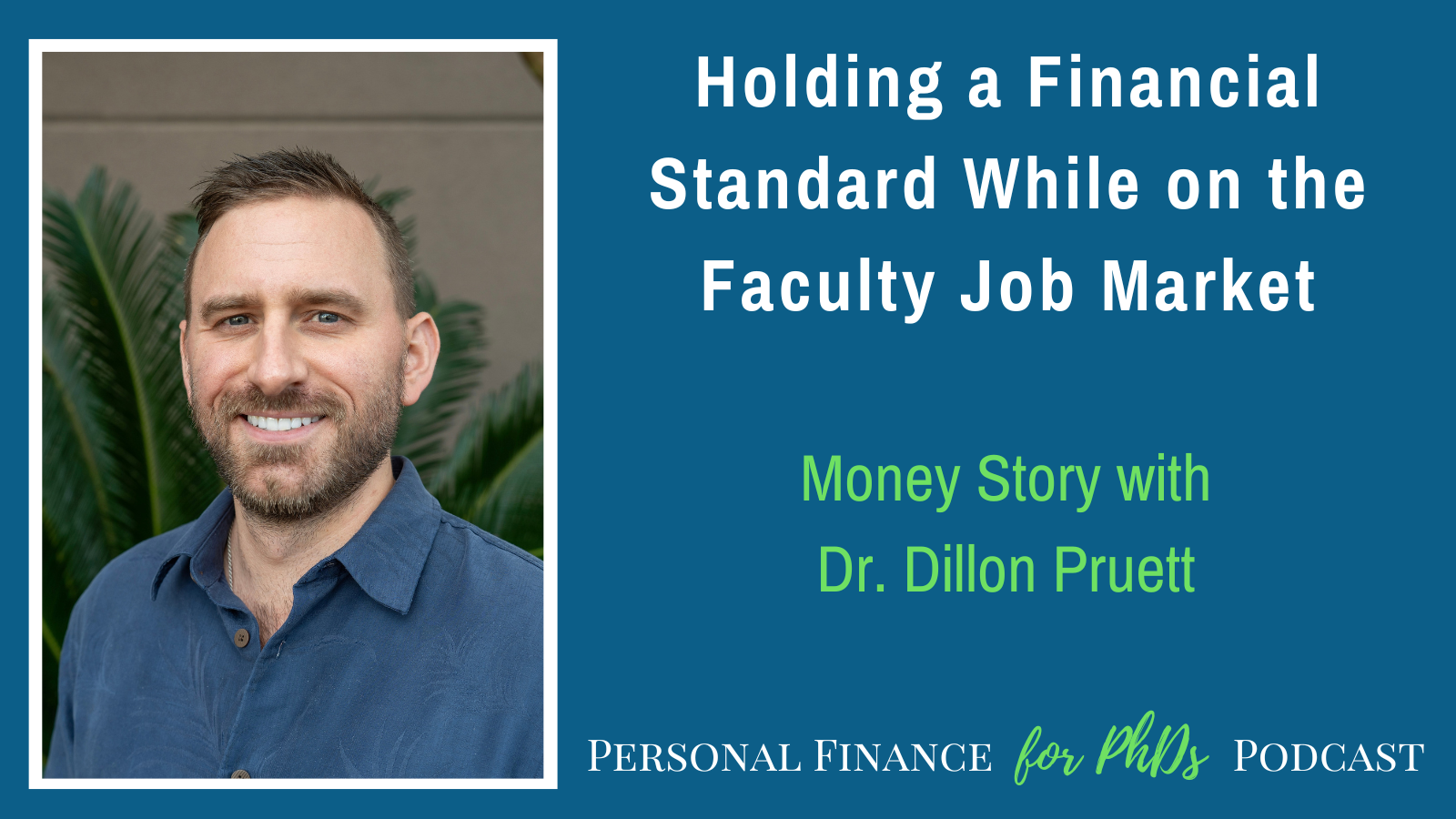
In this episode, Emily interviews Dr. Dillon Pruett, an assistant professor in the School of Communication Science and Disorders at Florida State University. This is the second part of a two-part interview in which we discuss Dillon’s turbulent faculty job search and transition to a faculty position. A higher income doesn’t completely ameliorate all financial challenges, but the future is looking bright. Dillon’s candor during this conversation is laudable, and his experiences are likely to be both relatable and a cautionary tale for prospective and new faculty members.

Links mentioned in the Episode

  • PF for PhDs S23E7: Financial Chaos Exacerbates a Low Graduate Student Stipend
  • PF for PhDs Podcast Guest Submission Form
  • Host a PF for PhDs Seminar at Your Institution
  • Emily’s E-mail Address
  • PF for PhDs Subscribe to Mailing List
  • PF for PhDs Podcast Hub
Holding a Financial Standard While on the Faculty Job Market

Teaser

Dillon (00:00): I was, my jaw dropped. I was like, are you kidding me? Like that is, that’s really, really crazy.

Introduction

Emily (00:20): Welcome to the Personal Finance for PhDs Podcast: A Higher Education in Personal Finance. This podcast is for PhDs and PhDs-to-be who want to explore the hidden curriculum of finances to learn the best practices for money management, career advancement, and advocacy for yourself and others. I’m your host, Dr. Emily Roberts, a financial educator specializing in early-career PhDs and founder of Personal Finance for PhDs.

Emily (00:48): This is Season 23, Episode 8, and today my guest is Dr. Dillon Pruett, an assistant professor in the School of Communication Science and Disorders at Florida State University. This is the second part of a two-part interview. In the first part, Dillon and I covered his financial journey through his PhD and postdoc at Vanderbilt University. In this second part, we discuss Dillon’s turbulent faculty job search and transition to a faculty position. A higher income doesn’t completely ameliorate all financial challenges, but the future is looking bright. Dillon’s candor during this conversation is laudable, and his experiences are likely to be both relatable and a cautionary tale for prospective and new faculty members.

Emily (01:33): For Season 24 of this podcast, I plan to publish a series of Budget Breakdown episodes. These interviews follow a template in which the interviewee shares their income, current financial goals, and five largest expenses. I’m looking for four grad students to provide these interviews, so this is your official invitation to volunteer. I love that on this podcast I get to feature PhDs and PhDs-to-be who are almost exclusively regular people and learn and share their real-life stories and strategies. If you would like to break down your budget, please go to PFforPhDs.com/podcastvolunteer/ and fill out the quick form, and I’ll be in touch over email. I look forward to interviewing you for this summer series! You can find the show notes for this episode at PFforPhDs.com/s23e8/. Without further ado, here’s my interview with Dr. Dillon Pruett.

Dr. Pruett’s Finances During the Postdoc Years

Emily (02:43): Okay. Let’s talk more about your postdoc then. I understand you did your postdoc at Vanderbilt as well, and it sounds like you didn’t move right. Were you staying in the same condo during that phase?

Dillon (02:52): Yes. Um, so that was a really great transition because I ended up doing a postdoc with a professor who I had collaborated with during my PhD. And so, um, she was also on my PhD committee. So when my dissertation defense was delayed a little bit, um, she knew exactly why. She knew exactly when it was scheduled for. There was no issue of having to contact another university and get my offer extended or have to change, you know, my moving date or any of, of that. So that, that was really, really great. Um, I noticed, so I, um, was on a TL1, which is a clinical and translational science fellowship. Um, and so, uh, that came with a stipend, I think it was about $56,000. Um, and that also came with, um, paid insurance. And so, um, that was, that was a huge boost in the amount that I was, it was more than double what I had previously.

Dillon (03:58): And so it pretty much ameliorated all of the issues I had with like counting the dollars to the end of the month. I was like, well, shoot, like this is this, this is great. I feel like a normal human being that can, you know, get a burrito and not have to be concerned that that’s gonna impact me down, down the road. Um, so that, that was, um, really huge just for, to feel like I could take a breath of fresh air. Um, even on my, my postdoc, there were some discrepancies within, um, the department and, um, I felt like I was comfortable with what I was getting, but again, knowing that other people were getting significantly more, um, was like, oh man, like it makes me feel like I am, I’m less than. So I had a very niche focus for, you know, my PhD and for my postdoc, um, postdocs that had a, a more heavily quantitative focus that could work on multiple projects. Um, were getting maybe like $90,000 a year. Um, and I think the justification was that that was more or less the going rate for the type of skills that were required for that role if those people were having the open market. And so that was, that was that. Um, so it would’ve been great to be getting, you know, almost twice as much as I was getting, but I was really grateful to be getting so much more than my PhD that it seemed like, you know what, again, just kind of focusing on myself, not letting myself worry about that. Um, and I think that my, my, uh, postdoc mentor advocated kind of on my behalf, but was essentially kinda shot down. I was like, no, we’re, that salary could not apply to me for what I was doing. Um, so no, um, no, ill feelings towards that. It’s more the issues, the larger system than my individual situation.

Emily (06:19): Yeah, I totally understand that. And people do make different amounts of money That’s true in different fields. They’re paid differently. Um, it just strikes me that like you were, they had you anchored at that grad student stipend level that unchanging grad student stipend level, so that yeah, when you double your compensation, like you feel great about it. Um, and I understand, you know, you, you were trying to, again, keep your eyes on your own paper, but like yeah, that does sting to have another person who had the same ti- kind of title as you, right. With such huge disparity. Okay. How many years were you in your postdoc and what was the financial transition, if any, that you were able to make during that period of time?

Tenure Track Faculty Salaries at R1 Institutions: $63,000 to $100,000+

Dillon (07:02): Yeah, I started my postdoc, um, in 2022, and then I, um, was applying for jobs fairly quickly, faster than I, um, anticipated with in 2023. Um, and that was because I’d had some, um, department search chairs that specifically reached out and said, Hey, you should apply for this. And I didn’t really quite feel ready for that, but I was like, okay, I mean, if you’re telling me, I guess I’ll at least put my name in the hat. Um, and once I had done like two or three applications, um, it was relatively trivial to just apply for, you know, seven or eight more. Um, and so I had a couple of on-campus interviews. Um, they were all places that I was at least interested in perhaps working at. Um, but one of the offers was for I think initially like $63,000 a year. And this is, uh, uh, an R1 school in the southeast.

Dillon (08:14): And I was, my jaw dropped. I was like, are you kidding me? Like that is, that’s really, really crazy. Um, I had a competing offer from another R1in the southeast, um, for I think 74. And I went back to the first school and said, Hey, you know, are you willing to match it? And they were sort of like, we can go up to 72, but we, we can’t match it. So I said, okay, that’s, that’s not gonna work for me. Um, for the other school that was at 74, um, I still felt like that was way low and I had a lot of debate because I’m like, well, look, this is a tenure track position at an R1 school. I felt like I could have success there. It would be limiting in what type of research I could pursue, but I felt like the bar was such that I could clear it and be a success.

Dillon (09:14): And so that, that gave me a, a big reason to pause. Um, at the same point in time, I did an on-campus interview for another R1 in the southeast that I knew would be over a hundred thousand per year. And so I was like, okay, that would also be a better place for me to do my research. Um, and I just feel like that would be the best fit. Um, it was a really weird situation where after I had my on-campus interview, I followed up and, you know, wanted to ask where they were in their search process and heard nothing and reached out again saying, Hey, I have other offers. Just wanted to know where you’re at again, nothing. So, um, I was pressured from the other school to say, Hey, like, are you gonna take this or not? And I basically just said, no.

Dillon (10:12): I said, you know, I am still waiting to hear back. And I just felt that 74,000 was, was very low. Um, still ended up being ghosted by the third place. Um, did not have a rejection email, not, and automated one, not anything else. It was just radio silence. So, um, that was really weird. Um, and I reached out to other professors at Vanderbilt. Uh, they were more senior to just be like, Hey, like, this seems odd, is this normal? And they were like, no, that’s not, but they, you know, kind of did their best to assure me that it was unlikely directly related to something inherent to me and more that they didn’t have their kind of department in order. And this is a reflection of that, and that if that is the way that things are going, then maybe that’s not a great spot to come in as an assistant professor.

Dillon (11:14): Um, so I ended up sort of doing a lot of interviews and getting very close, but kind of walked away from things and felt a little, um, unnerved by it all. I was like, okay, I, I had this position that would’ve been okay, really didn’t pay that well. I said, no, should I have accepted it? And then this other place that just didn’t even get back to me. Um, so then the following, uh, year, uh, I came back and did I think one or two apps kind of early and then did an on-campus interview, um, a little bit earlier in the season and was offered that and decided to take it, um, at Florida State. And I didn’t know it at the time, but the, um, o- offer was for $88,000 per year, um, on a nine month, um, contra- or salary or however that’s, that’s phrased.

Dillon (12:17): Um, and I was told that the starting salary was not negotiable for essentially like, uh, it’s set by the union. And I was a little bit surprised by that because I know that a lot of, a lot of state schools have faculty unions, but I didn’t quite understand how that played such, um, a large role in the salary negotiate sal- salary negotiation, because I really felt that that was like the most common negotiation point that you could have.

Deciding on a Tenure Track Faculty Position

Dillon (12:54): And so I was just sort of like, oh, that’s, that’s it. Um, okay, well, um, I guess this is my next big choice is do I take this or, or not. And I felt that Florida State was a place that I could, um, have success, have support. Um, I was in a good peer group. Um, it felt like things are gonna start getting very sticky very quickly with higher ed, and so it felt like I really should not wait on this, and this seems like a good spot. And so, um, that’s kind of how that all, all of that unfolded.

Emily (13:33): I’m trying to get to the timeline. We’re talking about fall 2024. Is that when you were extended the offer? Is that right?

Dillon (13:40): So I would’ve interviewed in December of 2024, and then I received an offer in, I think it was January of 2025.

Emily (13:48): Yeah. Sticky. Yeah, that’s a good way to put it. Sure. <laugh> uh, prescient. Good job. <laugh> securing something at that stage

Dillon (13:57): And kind of just layered on top of that. I was very sick for my interview week, week weekend. Um, I had a conference right beforehand and I had started to get sick and I was like, oh, all right. Maybe if I just take like one or two, like two days of rest where I am just trying to sleep and take meds, I’ll kind of get through it. Um, ended up getting worse and I had a fever, I was coughing consistently, I couldn’t sleep. I had lost my voice and I was like, I can’t call the day before I’m supposed to leave, or the day of I’m supposed to leave and just cancel this. Um, and so I was like, well, maybe by the time I get there I’ll be over the hump and I’ll be recovered. And so it was magical thinking. Um, and no, I was very sick.

Dillon (14:52): I went through like literally a bag of cough drops per day. Um, I had to have water with me the whole time near the end of my job talk, you know, I had this coughing spell that I had to take like a minute or two and a minute. A minute or two doesn’t sound like a long time, but when you’re coughing for a minute or two straight, um, it was, it was probably the toughest like academic thing that I’ve ever had to do, um, is you’re supposed to be on the whole time you’re supposed to be at, at your best and you’re conversational and answering these personal questions and research questions. And, um, I just got through it all and just said, okay, I guess this is, this is what I have to do. Um, I try to take this mindset that I’m like, imagine you’re like special forces in the military. There’s no option to not do it. You’re just gonna do it. And it ended up that it worked out.

Emily (15:53): What I’m actually taking from that story of, you know, these two rounds of applications and your interview process and all that is like, um, that you kind of had, I don’t know if I wanna say it’s an abundance mindset, but at least like not a scarcity mindset. Like you really talked yourself through, you know, declining the offers that you had because you were kind of like, they aren’t sufficient, it’s not gonna be a good fit. And I think a lot of people would say, I have a bird in hand, right? Like, I have it, I have to take the offer because these tenure track positions are so hard to come by. Um, yet you held out even, you know, it didn’t work out the first year, but working out the second year, despite the adversity and the interview and all of that, just like, yeah, you had a, a standard that you, um, held the job that you wanted to accept too. And so I just want people to get that message of like, it’s not all scarcity. Okay. I know there’s scarcity in academia, but not always, not for everyone. Um, there can be times when these things work out.

Dillon (16:58): Yeah. And you know, I’m very grateful that it didn’t work out because, you know, this is such a tough place to be, you know? And so, um, it’s tough to explain that to your family or your parents because they’re like, oh, okay, well you’re doing a PhD, so that means you’re gonna be a professor. And it’s like, well, first of all, it’s if you want to do it, and there’s a whole range of places and spaces that you can go with that, but also it is not any kind of guarantee. And like if, if you’re in your PhD, you, you, you kind of know that, but to explain to your parents that are like, I don’t know, um, as, as much as they love you and as much as they think you’re great, you can be really great and it can still be really, really tough. And so, um, that’s why I felt such anxiety from having said no to these places because I’m like, am I gonna be kicking myself, you know, a year or three down the road when I’m like, if I just had done that? Um, and so it, it did work out and I’m grateful for it.

Emily (18:05): I think you also, and maybe this is true, but you should have been taking some clues from okay, I was invited to apply like only a year into my postdoc. Like maybe I have a strong profile, like maybe I’m a competitive candidate here. Even though it didn’t work out in year one, it did, you know, subsequently. Um, the other thing about the parents, I think, or maybe outside people, like having that expectation of like, oh yeah, PhD means professors. Like when you actually like grab that ring and you’re like, I got it <laugh>, I’m accepting an offer. They’re like, of course, of course that’s what was going to happen. You’re like, no, you have no idea. Like what I went through to get to this point. <laugh>.

Dillon (18:41): Yeah, exactly. Exactly.

Emily (18:43): Okay. Well, is there anything that you’d like to share with us about your current position and the financial aspects of it? I mean, I kind of think you left a little open loop there with like, does the union actually determine faculty salaries? Like what have you discovered in your time since you accepted or since you started?

Dillon (18:59): Um, it’s still an open question. Um, so I know that that is not university wide. Um, it might have been that there was a specific pay line that was given to the school from the college that either there was a maximum or just a set amount. And that was just that. Um, there’s also some very interesting, uh, issues where I have a startup, but I cannot use my startup to pay students or to pay staff. And that’s kind of wild in the basic science space because like when you are just starting your lab, you, you get postdocs, you get, uh, research staff you like, that’s how you build up your lab and you do the work that you need to do. Um, and so it’s just a little bit odd that, um, that’s the restriction that, you know, I’m, I’m working through. Um, so

Emily (20:05): My understanding that until you get a grant, you can’t hire anyone. Is that right?

Dillon (20:10): Essentially. Yeah. Um, there are undergraduate and masters students who, um, can do sort of like, uh, i, I don’t know the exact term, but sort of like a, a research experience where they can work in your lab for a certain number of hours per week. Um, that’s not guaranteed. You have to, you know, there’s only so many students that that that can go around. Um, I’ve also learned that for as much as I have, you know, kind of complained about my PhD experience, um, it is a lot bleaker in other places. And so, um, you know, even with my department now, I’m like, oh, I don’t know that I would bring in a student unless I had a grant because there are so many issues. Um, they kind of, they extend in in multiple ways. Um, yeah, I want elaborate on, on, on that more, but, um, you know, I’m having to kind of transition from thinking about, okay, what were my experiences to now? What would I want, um, a student to experience as, as my student

Emily (21:29): That’s very positive. <laugh> in terms of an outcome of your experience to yeah, be thinking about it. ‘Cause you know, with some, again, I mentioned distance earlier, the distance of time, some people do forget or start to romanticize, um, their own financial experiences during graduate school, um, when it benefits them to do so in terms of who are they gonna hire and how much are they gonna pay them and are they gonna negotiate and all these things. So I appreciate that, you know, you’re still close to the experience, but that you’re taking that mindset and saying, okay, maybe better not to hire anyone under these circumstances until I can provide for them in a way that you think is fair and sufficient to, you know, further their development. Of course, the research that you want them to do for your lab.

Dillon (22:11): Yeah, I think that communication sciences and disorders is a very interesting field because it can be situated in a lot of different places within a university. It can be in the College of Arts and Sciences, it can be in a college of education, uh, at Vanderbilt it was kind of, uh, part of the medical program and biomedical sciences. Um, and so each of those different placements kind of impacts the expectations and the ability for your students to get funded in ways that I think would be appropriate.

Emily (22:48): Yeah. So it’s definitely something to consider when you’re doing interdisciplinary work. Right.

Commercial

Emily (22:56): Emily here for a brief interlude. Would you like to learn directly from me on a personal finance topic, such as taxes, goal-setting, investing, frugality, increasing income, or student loans, each tailored specifically for graduate students and postdocs? I offer seminars and workshops on these topics and more in a variety of formats. This is a perfect time to book me for a workshop at the end of the current fiscal year or at the beginning of the upcoming academic year. If you would like to bring my content to your institution, would you please recommend me as a speaker or facilitator to your university, graduate school, graduate student association, or postdoc office? My seminars are usually slated as professional development or personal wellness. Ask the potential host to go to PFforPhDs.com/financial-education/ or simply email me at [email protected] to start the process. I really appreciate these recommendations, which are the best way for me to start a conversation with a potential host. The paid work I do with universities and institutions enables me to keep producing this podcast and all my other free resources. Thank you in advance if you decide to issue a recommendation! Now back to our interview.

Financial Challenges as a Tenure Track Faculty Member

Emily (24:21): Okay. Give us a picture of your finances. Now we know your salary. Where is it taking you? What are you doing in your financial life now that you have this position?

Dillon (24:32): Yeah. Um, it still feels very unsettled, um, because I just moved in August, um, I moved from the condo that I lived in Nashville to a house that I’m renting with my wife. Um, there were a lot of expenses with the move. Um, Florida State provided a sign-on bonus, but not, but that was, uh, it, it was, it took several, uh, weeks for that to be dispersed. So I had to put a lot of moving expenses on a credit card. Um, it took a while for our condo to sell, and so there was a short period of time where we were doing a mortgage plus rent, um, which was really tough. And then my wife, um, had to move jobs and so there was, um, you know, about four weeks where she wasn’t working. She’s just now working towards her first, uh, full paycheck. And so the, the coffers have have kind of been, been drained.

Dillon (25:37): And so, um, I feel like, you know, give it another six months and we might be in a better place, but it still feels very kind of unsettled. Um, and so even though I’ve, you know, gotten a, a pay raise, it really doesn’t feel like it, it almost feels like, um, like a step backwards as far as, um, just the amount of money that’s, that’s been laid out. Um, additionally, I am, um, paid for nine month salary, um, which previously was 12, right? And so, um, there’s a, uh, institutional grant that you can apply for that helps supplement your summer salary for your first year, but it doesn’t fully replace it. Um, and so I’m gonna have to just be basically saving money through the months in order to pay my own salary in the summer. Um, so that feels a little, a little scary.

Dillon (26:43): Um, hopefully, you know, I can supplement that with grants down the road, but that’s gonna take, you know, at at least a year or more to, to do. So, um, I am hoping to, um, buy a house in like May or June, so that will be another kind of like big major purchase. Um, and a again, a lot of money associated with, with that. So, um, and I’m ba- what I’ve, what I did is I kind of put the money from the condo into a, uh, like money market account. Um, and so I, I can’t and won’t touch that up until that point. Um, and so, um, yeah, it, it, it’s, it’s good to be starting fresh, but also there’s some aspects of it that, um, just take a while to sort out.

Emily (27:39): I’m really glad to have this message on the podcast as well of like a higher salary is not a panacea. Like, it’s, it’s helpful, definitely better than not being paid as much, but like, as you progress in your life and your career and your finances, also kind of the stakes get raised. Like we’re talking about home ownership, right? So like selling a condo and like buying a house. So like we’re trying to do an upgrade here, you know? Um, and so the expenses get raised too, and things like moving, uh, interruptions in pay because of career transitions, like all these things are normal things that happen. So it’s like, yeah, you have the higher salary, but like you said, it doesn’t quite feel much easier yet. And hopefully once you know, things settle down from the transition, the moves and all that, like, hopefully you will start to feel better about it.

Emily (28:26): But like, yeah, it can take some time for sure. Um, so it’s not an immediate fix necessarily. The postdoc salary probably felt better, right? ’cause you didn’t move, you probably didn’t have an interruption, um, in your paychecks or anything. And so it was just like, oh, immediately there’s more money. That’s great, right? But when you factor in these other things that happen at these different career stages would involve moving different cost of living different places. Yeah, it can, yeah, challenging, but I’m very hopeful for you and your wife and your future and these changes that you’re going to make and yeah, that you’ll figure out <laugh> the summer salary and the grants and subsequent years, and maybe this year will be the hardest year, right? Financially getting all this stuff sorted out. Um, is there anything else that you’d like to share about this stage and your finances or money mindset during this stage?

Dillon (29:12): I don’t think so. I think that, um, I kind of came into both my PhD and my faculty job with reasonable expectations, and I’m really grateful for getting to pursue this, you know, line of research that is meaningful to me that I feel like I’m making an im- an impact. Um, there’s certainly days or times that I’m like, man, I have so many interests and I chose this really niche thing that not a lot of people can relate to. Um, and that feels, you know, tough. But then there are times when I feel like, man, if I’m not doing this, I don’t know who else would be, or, um, I can help someone down the road that, um, if I wasn’t doing it, um, I’m not sure we would have that, that knowledge. Um, so even, even throughout my PhD, I had a roommate who was like, oh, you should, you should, you know, just go and work for Google and like their speech sciences that does voice recognition stuff and you’ll get paid way more and you’ll have a better life and blah, blah, blah.

Dillon (30:30): And, uh, I was kind of offended by that. I was like, yes, I probably could do that, but that would completely abandon this, you know, sort of dream and this motivation that made me do this in the first place. You know, I wasn’t working towards just a degree because it sounded cool, or that was just the next logical step. Like this was something that I literally planned out from my freshman year in college. Um, and so it was sort of like, you know, pursue that or go out in flames trying. Um, and I think that because my motivation was so personal, it made it easier to push through some of the hard times where, um, people that maybe lacked that a little bit, you start to look around because you’re like, well, what’s, what’s the why? And I think that that is important. It’s no wrong or right answer, but I think it, you’re going to be in situations where you confront that to varying de- degrees and, um, I’m just glad that, you know, mine has, has worked out the way that, that it has.

Emily (31:37): People are allowed to make different decisions around this, right? Like, yeah, you have this personal motivation, as you said, you’ve had a long-term plan, you’ve been executing, and this is at least the first stage of the culmination of that. Um, and certainly try it out. And if you decide it’s not all that it’s cracked up to be, then you can make a pivot at some other point. That’s totally fine. Um, yeah, but I, I’m also struck by like mission-driven people also need to be paid well enough to sustain what they’re doing. So I hope that is the case for you now that you’re in this, um, this level of your career. Um, so Dillon, it’s been an absolute pleasure talking with you and hearing your story, and I think there’s so many great nuggets that listeners can have gotten from this interview depending on what stage they’re at.

Best Financial Advice for Another Early-Career PhD

Emily (32:23): Um, I wanna conclude with the question that I ask of all my guests, which is, what is your best financial advice for another early career PhD? And it can be something that we’ve touched on in the interview already, or it can be something completely new.

Dillon (32:35): I, I sometimes struggle with that because everybody’s different and what worked for me isn’t necessarily gonna work for everybody else. Um, but something that I got in the habit of that was a huge help was just tracking my spending and knowing, learning to know exactly what I could afford. Um, and that allowed me to make some choices that were trade offs, but at least I, I sort of knew the dollar amounts and how that would impact me. So, um, yeah, I, I think that because I was on this fixed amount for so long, I had kinda my core expenses that were paid for or that I could pay for, and then it was sort of, how do I play with the margins of that and what’s that going to go towards? Um, my, my wife went to law school and took out a lot of loans and she had a very different experience where she had such massive loans that she was like, oh, what’s a hundred dollars here or a hundred dollars there, it doesn’t really matter.

Dillon (33:45): And so she didn’t have that sort of fear of God into tracking her spending because she didn’t really have to. Um, but if you don’t do that in your PhD, you can kind of quickly accumulate things that will hurt you down the road. Um, so it’s not fun, but I could kind of, after a few years, I could kind of be like, oh, alright, I have approximately, you know, $400 to appropriate this month. Where’s that gonna go and how am I gonna do it? Um, and if I know there’s something, you know, five months down the road that I’m gonna do, I can try to segment as little as I could to put towards that. Um, controversial take here is that I feel like I leveraged credit cards very well. Um, I was not a crazy points guy, but I definitely took advantage of a lot of, um, signup offers.

Dillon (34:49): I was very good about paying off my credit cards, um, for the, for the most part unless there was like a 0% APR card that I basically took out specifically for that reason. Um, and so that gave me a little bit more money. It gave me a little more flexibility, having a zero interest essentially loan. Um, and then that also did help build my credit through time. So I have a credit history that’s lengthy and positive and, you know, they’re fairly good amount of it. In fact, I was always shocked that these credit cards were granted to me for, you know, $10,000 and I’m like, I can barely afford my groceries at the end of the month and you’re just giving me 10 grand. Like, that’s crazy. But if you do it right, you can, you can make that work. Um, again, that was a super intentional and thoughtful process that I did, and you can have that go sideways really, really quickly. Um, so it’s not exactly advice for everyone, but if you can kind of thread the needle, there are good things that can come.

Emily (36:05): Well, I think the second, I don’t wanna call it advice, but the second suggestion or, you know, modeling what you did follows very well from the first you have to master and understand your own spending and develop some intuition around that before you go into, um, playing with fire a little bit, <laugh>, which is, you know, the, the credit card games and so forth you can play because the temptation with credit cards, you know, using plastic in general and then doubly, so if there’s like a benefit, you know, points or sign up bonuses or whatever, there really is a little pull there to spend more than you would if you were using other forms of payment. And so, but if you have that knowledge and intuition and the budget or whatever it is that you’re doing to kind of keep your spending in line and on track, then you can do that successfully, which it sounds like you did.

Emily (36:51): Um, so I’m very glad to hear that that worked out for you. The Points game is not, uh, controversial on this podcast, so it’s something that we’ve talked about with other graduate students and I do think it’s one of the ways that people can find a little bit more wiggle room in their spending, uh, when they’re living on a low stipend like you were. Um, so Dillon, again, it’s been such a pleasure to have you. Thank you for sharing all this, uh, with us, especially these sort of behind the scenes things and emotional things that were going on with you through these unpleasant, you know, sometimes unpleasant things that happened. Um, I just think it’s a really honest window into the graduate student experience, the PhD experience, so thank you so much for sharing it with us.

Dillon (37:28): Yeah, glad that I can share.

Outro

Emily (37:44): Listeners, thank you for joining me for this episode! I have a gift for you! You know that final question I ask of all my guests regarding their best financial advice? My team has collected short summaries of all the answers ever given on the podcast into a document that is updated with each new episode release. You can gain access to it by registering for my mailing list at PFforPhDs.com/advice/. Would you like to access transcripts or videos of each episode? I link the show notes for each episode from PFforPhDs.com/podcast/. See you in the next episode, and remember: You don’t have to have a PhD to succeed with personal finance… but it helps! Nothing you hear on this podcast should be taken as financial, tax, or legal advice for any individual. The music is “Stages of Awakening” by Podington Bear from the Free Music Archive and is shared under CC by NC. Podcast editing by me and show notes creation by Dr. Jill Hoffman.

Resources for PhD Job Seekers from the Hosts of Propelling Careers

January 12, 2026 by Jill Hoffman Leave a Comment

In this episode, Emily interviews Dr. Jim Gould and Lauren Celano, the co-hosts of Propelling Careers, about strategies for PhD job seekers, starting with an update on the PhD job market. They discuss how PhDs can figure out the salaries of various careers and particular jobs, including where they might fall within a posted salary range, and what benefits are offered at a company. They review where job seekers can go for both free and paid assistance. Finally, both Jim and Lauren give excellent financial advice related to job transitions.

Links mentioned in the Episode

  • PF for PhDs Quarterly Estimated Tax Workshop
  • The Propelling Careers Podcast
  • The Propelling Careers Podcast Episode 82: Help me help you…
  • The Propelling Careers Podcast Episode 73: Steps in the job search process
  • PF for PhDs S22E5: Money Is a Good Enough Reason to Leave Academia
  • PF for PhDs Tax Center for PhDs-in-Training
  • Science Careers Individual Development Plan (myIDP)
  • PF for PhDs Subscribe to Mailing List
  • PF for PhDs Podcast Hub
Resources for PhD Job Seekers from the Hosts of Propelling Careers

Teaser

Jim (00:00): But it’s not productive to panic and say, oh my gosh, let me send out a whole bunch of of resumes or applications without actually going through the process. The process might end up being expedited time-wise, you know, instead of three to six months or nine months of exploration, job application, and interviewing, you might have a couple weeks, but you still have to go through the steps of doing that, and you have to fight off that panic.

Introduction

Emily (00:33): Welcome to the Personal Finance for PhDs Podcast: A Higher Education in Personal Finance. This podcast is for PhDs and PhDs-to-be who want to explore the hidden curriculum of finances to learn the best practices for money management, career advancement, and advocacy for yourself and others. I’m your host, Dr. Emily Roberts, a financial educator specializing in early-career PhDs and founder of Personal Finance for PhDs.

Emily (01:01): This is Season 23, Episode 1, and today my guests are Dr. Jim Gould and Lauren Celano, the co-hosts of Propelling Careers. Our topic is strategies for PhD job seekers, starting with an update on the PhD job market. We discuss how PhDs can figure out the salaries of various careers and particular jobs, including where they might fall within a posted salary range, and what benefits are offered at a company. We review where job seekers can go for both free and paid assistance. Finally, both Jim and Lauren give excellent financial advice related to job transitions.

Emily (01:42): These action items are for you if you switched onto non-W-2 fellowship income as a grad student, postdoc, or postbac last fall and are not having income tax withheld from your stipend or salary. Action item #1: Fill out the Estimated Tax Worksheet on page 8 of IRS Form 1040-ES. This worksheet will estimate how much income tax you will owe for 2025 and tell you whether you are required to make manual tax payments on a quarterly basis. The next quarterly estimated tax due date is this Thursday, January 15, 2026. Action item #2: Whether you are required to make estimated tax payments or pay a lump sum at tax time, open a separate, named savings account for your future tax payments. Calculate the fraction of each paycheck that will ultimately go toward tax and set up an automated recurring transfer from your checking account to your tax savings account to prepare for that bill. This is what I call a system of self-withholding, and I suggest putting it in place starting with your next fellowship paycheck so that you don’t get into a financial bind when the payment deadline arrives. If you need some help with the Estimated Tax Worksheet or want to ask me a question, please consider joining my workshop, Quarterly Estimated Tax for Fellowship Recipients. It explains every line of the worksheet and answers the common questions that PhD trainees have about estimated tax. The workshop includes 1.75 hours of video content, a spreadsheet, and invitations to at least one live Q&A call each quarter this tax year. This quarter’s Q&A call is on Wednesday, January 14, 2026 at noon Pacific Time. If you want to purchase this workshop as an individual, go to PF for PhDs dot com slash Q E tax. You can find the show notes for this episode at PFforPhDs.com/s23e1/. Without further ado, here’s my interview with Dr. Jim Gould and Lauren Celano, the co-hosts of Propelling Careers.

Will You Please Introduce Yourself Further?

Emily (04:05): I am delighted to have joining me on the podcast today, the host of the Propelling Careers podcast, Jim Gould and Lauren Celano, and they are gonna take the time to introduce themselves to you, but I just wanna say, if you’re a PhD, you need to go right now and subscribe to their podcast because it’s really, really valuable whether you’re in a job searching, you know, time or not. Although that is a subject of the podcast still something we need to keep up all the time. So go subscribe. Also, Jim, why don’t you go ahead and introduce yourself first.

Jim (04:32): Thanks, Emily for the invitation and thanks for the plug to our, uh, podcast as well. So, I’m director for postdoc affairs and program director for Responsible Conduct of research at Harvard Medical School, where I’ve been for almost 15 years now, providing programming and coaching and policy implementation for our postdocs here. I’ve received my bachelor’s in molecular biology from Clarion, University of Pennsylvania, my PhD in biochemistry at University of Louisville in Kentucky, and did my postdoc training in two different laboratories at the National Cancer Institute at the NCI in Frederick, Maryland.

Emily (05:05): Excellent. Lauren, how about you?

Lauren (05:08): Alright, well, currently, uh, the co-founder of a company called Propel Careers, and I do a lot to be able to help support PhDs and postdocs and early career people in their career journey. Um, but I’ve been in the life sciences sector now about 24 years, the first 10 of which was more drug discovery focused. And since about 2009 I’ve been working really closely with a whole range of postdocs and PhDs and early career people to help them navigate their careers.

Emily (05:34): My next question may have started to be answered by your, uh, background information there, but I’m, I’m curious how you developed this expertise, particularly in PhD careers. Um, Jim, why don’t we start with you because we know how you got your PhD, but then how did you get into this work?

Jim (05:48): Alright, so, you know, I I I was experiencing academia and research training firsthand as, uh, you know, in my bachelor’s. You know, I did a, uh, research stint, uh, summer undergraduate research fellowship actually at Ohio University and went into a PhD program trying to figure out what to do career wise with my molecular biology background. Uh, it seemed like it made sense going to graduate school, getting a PhD, struggled a little bit as a student, trying to figure out what it actually meant to, to do research and, and be successful there. And then, as I was a graduate student, realized that there’s an entire community and my peers and colleagues and fellow students who also needed help. And there wasn’t a ton of infrastructure for the development of professional skills, tons of research happening and, you know, we were able to, you know, show presentation skills, but it wasn’t a professional skill set.

Jim (06:42): And it was one of those things where we started ourselves building those skills and, and pulling groups together. And then the next step is like, okay, I don’t have enough experience to go on the job market directly from a PhD. So I did postdoc and not fully understanding what postdoc means ’cause there weren’t a ton of postdocs when I was a graduate student at U of L. There are more now. And just having been in that process in the training and struggling in each one of those stages and then figuring out things for myself, but also figuring out things to help my, my peers and colleagues. So that gave me a lot of just sort of on the ground practical experience and helping others. And then I realized I could probably do this for a career, but didn’t know what it looked like, didn’t know what it was, what it would be called.

Jim (07:28): I was looking at education and outreach, but it was running a, um, a postdoc association running seminar series, just being invited to sit on committees and panels and get questions asked of me like, well, what’s the postdoc experience? Where we’re faculty, we’re appointed, we, we don’t know exactly how postdocs are, are, are being treated or what they need or what the trainees need. And I was like, well, we need this, we need this. And it just sort of snowballed building a reputation, doing that, and then realizing I can make a career out of it. And at the same time, as I was in the middle of my, my postdoc, finishing my postdoc, there was a proliferation of postdoc offices growing, you know, and there are still institutions that are still starting postdoc offices. So I went from being a postdoc doing research, but also helping my, my fellow postdocs to running a postdoc.

Jim (08:20): And then I needed to learn the administrative aspect of policy development, of implementation, of learning how to coach. But doing this sort of day to day, week to week, growing and building my own portfolio of presentations, of skills, of coaching, I, I’ve been able to just build that expertise and now working with maybe even thousands of postdocs and PhDs and other trainees. So being able to then share that experience through my workshops, through my trainings and, and whatever else other people invite me to talk about. But also through that podcast that we have Propelling Careers.

Emily (08:56): And how many years has it been since you devoted yourself full-time to this

Jim (08:59): Full-time? It’s been 15 years. So I started this job in 2011, June, 2011. So June, 2026 will be 15 years on the dot.

Emily (09:08): Amazing. And I can see so many parallels actually between your story of, you know, needing this information for yourself and struggling through it, and then starting to teach other people with my own story. Of course, you decided to do this from within academia, <laugh>, and I’ve decided to do it from external academia, but still a lot of parallels in the motivation there. Um, Lauren, how did you come to, you know, decide to focus on this particular population?

Lauren (09:31): So, I, I have a scientific undergrad. I have biochemistry, molecular biology is what I focused on in college, and a lot of my friends decided to go to graduate school, so I started to get to know people that were doing their PhDs and some of them decided to also do postdocs. I also had moved to Boston in 2003 and, uh, started to be surrounded by people <laugh> with advanced academic training from the biotech activities I was involved in, but also just from my friend network and that sort of thing. And I started to notice that a lot of people had these amazing skills, but didn’t always know what to do. And in my working world, before Propel, I was, uh, getting to know a lot of different people in biotech companies and across a whole range of different roles and that sort of thing. And when I ended up, uh, going back for my MBA, I started to see that there was this need to be able to help people think about their future, to think about what are they doing and how are they leveraging their skills.

Lauren (10:25): I was giving advice to a lot of friends of mine, and then I realized that maybe this is something that could be applicable to other types of people. So I kind of fell into it, to be honest. But it’s been really fun to be able to help all these motivated people that really just wanna do great work and they wanna change the world through their research and activities and, uh, and so forth. So it’s been really nice. So for me, it’s been about 16 and a half years, so it’s funny, Jim, to think about like, when I started interacting with you, that was shortly after you came to HMS. So it’s really a small world, but I’m so happy that we got to kind of grow up together, <laugh> in this space.

Jim (11:00): Yeah, being able to, to do this straight out of postdoc, there was a huge learning curve. And one of the things that I wanted to point out with, with what Lauren and I were, were talking about with our relative path is that it wasn’t, we had to explore it, we had to find it, it wasn’t just laid out in front of us, okay, you have an MBA, now you go do this, you have a PhD, now you go do this. And I, I know that for our audiences, relative audience is yours and ours, it’s, it’s very similar. Like, okay, I’m going to undergraduate, I could do these things. I could go pre-med, I could go to graduate school, but we don’t know what’s happening two or three, even five years down the road. So being able to figure that out while still being productive as a student, as a trainee, as a postdoc, you know, it, it’s almost like you have two jobs. You need to figure out what your next job is, but also you have to be productive in, in your fellowship as well.

Emily (11:51): Absolutely. I totally agree. Um, I I think about it the same way of having the academic training aspect of your job and then the professional development and perhaps even job search and pursuit of careers aspect of your job. Um, you just mentioned, Lauren, that it’s a small world and I had the pleasure of meeting both of you in person. Um, within the past year, Jim and I saw one another at NPA, the National Postdoctoral Association Annual Conference. Then Lauren and I saw one another at the graduate career consortium annual meeting, and after that I wanted to set up this podcast interview. But I’m so glad for that timing because right now is a really interesting and critical moment for PhDs in terms of their, anyone who’s looking for a job. Right? <laugh>

Current State of the PhD Job Market

Emily (12:30): We have heard overall in the media that the job market is so difficult right now. And so I want to get an update from you two on how the PhD job market in particular is doing. Because I know from looking at BLS data that, you know, PhDs overall have a really, really low rate of unemployment. And as of the last update, which I looked at, and now we had a government closure in between, but the last jobs update I saw that PhD unemployment has ticked up a little bit, but still very low overall. But Jim, you said to me earlier this year when we met that PhDs are more likely to be underemployed than unemployed, which is also not a great, uh, image. So take this how you will, but I want to hear from each of you like your assessment of the job market right now for PhDs.

Lauren (13:13): Yeah, I I can start on this one and then Jim can, uh, can add, so the job market’s really hard. We actually have a podcast that we put out a few months ago about reasons why the job market is so challenging. There’s financing challenges, all sorts of things that we go into. Uh, it’s a really hard time, especially in life sciences and in high tech in particular. It’s very challenging for people. There’s been a lot of layoffs and reorgs for different reasons. So for people that are currently looking for roles right now that are finishing up graduate school or finishing up their postdoc, there’s so many people on the market, which is making the job market really hard. It’s taking people longer to find roles. People have to be even more persistent in terms of the job search process to find opportunities. And sometimes, you know, at a practicality, people just need a job. And so there’s some cases where people just take a job just to be able to pay rent and things like that as opposed to their ideal job because they just need something. So it’s a, it’s a complicated, we could probably spend like three hours just on that topic, but, but Jim, what, what else do you have to add there

Jim (14:16): For the reasons that you just explained Lauren, but also there are, um, there’s, there’s relative safety and, and that might not be so true nowadays, but traditionally, historically there’s relative safety in academia for many PhDs and postdocs. And they tend to remain in those positions longer or maybe go on the, the job market multiple times, at least historically. Now it is changing because of, of just funding constraints and, and changes in the NIH and and, and changes in indirect costs. And, you know, it costs more now to keep a postdoc and graduate students. But the, the idea is that they stay in positions longer. They might extend their PhD, they might extend their postdoc a year or two, so they don’t go, they don’t finish a fellowship and then go unemployment. So they extend a fellowship. And that’s what I meant by underemployment, where they stay in a position where they’re not advancing. There’s no sort of promotion structure within academia right now, at least for postdocs to continue to advance, uh, within that structure. They’re also may be even under appointed as I as sort of just explains like they, there’s no path of advancement. And then the other thing that, that Lauren kind of hinted at is sometimes they end up taking jobs out of need rather than sort of matching skill sets and advancement that are, tend to be below their skill set or experience level, because again, the fellowship funding is over and they need to find a job rather than launching their career. So there, there tends to be a little bit of underemployment and that it ended up catching up eventually. But there is, you know, there, there is this aspect of academia is this kind of warm, cozy, at least it used to be this warm, cozy place where you could take your time doing research and being productive and getting publications out, and then there’s a kind of a soft launch and or, or whatever on your, your next step of your career. It just sort of extended a little bit. So it’s not, you don’t lead to unemployment ’cause you don’t just lose postdoc jobs. It’s, you end up staying longer and you end up being under, under appointed and underemployed,

Emily (16:19): Except that some postdocs are losing their jobs now. Um, I mean because of funding changes, I actually worked with a university this fall who in the midst of me working with them, they conducted layoffs of their postdocs. So it’s unusual <laugh>. It’s, it’s different than at other times. And I wonder if, I know we could spend so much time on this, but if you had any advice for how PhDs can meet the moment, and I’ll say that in the financial realm, when people are experiencing job loss or financial emergency or anything like that, the advice is kind of like, well, it’s just more important to do all those classic things that you were told to do anyway, right? Like, have the emergency fund and diversify your sources of income and, and be able to cut your expenses if you need to. So I’m wondering, in your sphere, is there any different advice or is it just like, yeah, go listen to all of our podcast archives and just do all the stuff we’ve already been talking about <laugh>

Advice for the Current PhD Job Market

Lauren (17:12): One thing Jim and I say all the time is don’t do this alone. So find resources at your institution, reach out to your network, may- have your materials together, right? You need to have a resume or a CV depending upon what you’re applying to. It needs to be up to date. So if you do have to look for a job quickly, you’ve got something you can share. Otherwise you lose time trying to put it together, cultivating your network, you know, again, like reaching out to people. But when you do that, uh, we did an episode recently in the podcast called Help Me Help You, which was all about if you’re gonna be engaging your network, help them help you, what do you say to them? How do you share information? How do you make it easy for people to help you, especially if you might be in a time crunch due to layoffs, reorgs changes that are unexpected and things like that.

Jim (18:02): Yeah. And, and in, in addition to what Lauren was just talking about, we have to fight the urge or we advise fighting the urge of panicking because, you know, panic is not productive for the most part. Being able to understand the landscape. There’s, there’s e- there’s a, a grieving process that happens, especially if you lose a job. We’re not downplaying that, but it’s not productive to panic and say, oh my gosh, you know, let me send out a whole bunch of, of resumes or applications without actually going through the process. The process might end up being expedited time-wise, you know, instead of three to six months or nine months of exploration, job application and interviewing. You might have a couple weeks, but you still have to go through the steps of doing that. And you have to fight off that panic and realize in the grand scheme of things, a a three month gap or a one month gap or even a six month gap in your employment record is relatively meaningless, especially in academia and moving into industry because those now, you know, industry is, is relatively, there’s, there’s high turnover, you know, and you’re, you’re going to have multiple jobs, maybe even multiple careers. And now in academia, we are now feeling that, as you pointed out, Emily, you know, postdocs are losing their jobs. We are, you know, downsizing in academia, especially in the, the research realm. So we need to remain nimble, but you need to fight off that, that urge to panic and just remember your resources and your network and community.

Emily (19:27): I like that encouragement of just like, there is a process here. Like work the process, like work the steps. Um, you don’t have to reinvent the wheel. Okay, <laugh> like resources like yours and others that maybe available to people are, are excellent to be accessing at this time.

Lauren (19:40): Well we did a podcast episode recently about the 26 steps in the job search process. <laugh>, I mean, not not to overwhelm people, but it’s a lot of work. It’s a lot of work to be able to effectively engage in this. So I would say check that out because it could help people start to get a feel for things they could do to help them be productive in the side.

Jim (20:00): Yeah. And, and that list it, it could have been a hundred things and we, we were able to sort of pull that list and, and you know, glean it and, and, and call it. But the idea is that there, the, that there might be, um, maybe healing in that process. Just doing the thing also helps you able to control the controllables. So again, fight the urge of panic but also re remember that there are many things outside of your control in this, in this world and in this process. You, you, you can’t control somebody interviewing you or hiring you, but you can control doing the process. You can control, you know, engaging your, your network. You can control putting out quality applications.

Emily (20:38): I love that. And all the episodes that you mentioned, Lauren and Jim, by the way, will be in the show notes. So anybody looking for that, go to pfforphds.com/podcast. Find this episode and you’ll get all the links to the Propelling Careers podcast.

Pay Transparency Laws and PhD Salary Ranges

Emily (20:51): Okay. I wanna talk a little bit more about finances, specifically within the job search and job application process. Uh, I learned from your podcast that there have been all these new like pay transparency laws in various states that have come into effect. So I want you to explain a little bit about what that means and how PhDs can figure out what is an appropriate, um, salary or salary range for a career that they’re looking for. And also in a specific location. ’cause obviously cost of living is gonna massively change this as well.

Lauren (21:19): So I’ve had the fortunate, uh, nature. So part of what I do in my career is I do recruiting with a few companies and, uh, I’ve had opportunities hands on to actually be a part of some of these pay transparency activities. And so for example, in Massachusetts, October 29th, 2025, the pay transparency law went into effect, which means companies of more than 25 people are supposed to have salary ranges for each role that they post. In California, this went into effect January 1st, 2023. I was recruiting with a company at the time in California. So I was involved in actually posting the salary ranges and I was so nervous to actually put it out there. But it’s been great actually for candidates to have a little more transparency around where they may fall. Now it’s a range, right? So you have, you have, you know, let, let’s say the range might be a hundred to $120,000 for a certain role. Typically people pay kind of in the middle of that range. ’cause you wanna allow people opportunities to be able to grow once they come into an organization. So as a candidate, I would anticipate probably like middle of the range is probably where you should fall for that. As you’re looking at opportunities though, it can be helpful to see the ranges. ’cause then you can start to get a sense of which roles could align to your financial considerations. ’cause there could be some situations where a certain type of role just isn’t gonna align and that’s fine. You can then focus your efforts on ones that are out there. Washington and New York also have pay transparency laws. And you know, one thing that’s helpful to keep in mind is that maybe you live in a state that doesn’t have pay transparency laws. Well, you can still look at states like California, Massachusetts, New York, Washington and start to get an idea potentially of what ranges could be. It may differ a little bit in, you know, the Midwest or the South or something, but at least you may start to see kind of ballparks in certain ranges. The other thing I would say is, you know, when you’re doing informational interviews you can ask people like, do you have an idea of what the salary might be for this particular role? But not just that though, what are the other benefits, right? And we’ll talk more about that, but it’s like the whole package. Don’t be afraid to utilize your network. There’s a few other ideas I have, but I know Jim has some thoughts on this too, in terms of advice he’s given.

Jim (23:37): Yeah, there, there, you know, if in academia, uh, you know, Laura was talking a lot about industry and, and just outside of academia, but there are public institutions, public colleges and universities that have to pay, have to post their salary. So you can get an insight on relative salaries. They’re usually a year or two, sometimes even three years behind. So you can get a a sense, you know, and I know, you know, inflation is, is increasing. So tho those salaries may not be as accurate, but you get a sense of what the range might be depending on, you know, full professor, assistant professor, associate professor, or even, you know, scientific staff or you know, administrators within university. The other thing is, you know, um, the American Association for Medical Colleges, it produces for a fee, a a booklet of salaries across medical schools and medical colleges. So you can get an insight into that. You know, depending on if you are more, more biomedical research and you’re going into a a private medical, um, research institution, you can, you know, basically purchase those, um, you know, those ranges and salaries. But one of the things that, that Lauren already mentioned that’s really effective is when you’re out there gathering information, meeting people and networking, you do these informational interviews and you collect that kind of information, you don’t want to necessarily ask them specifically how much do you make in your role. That is, that tends to be rude, but you can say, how much can I expect in a, you know, in an introductory role or a, a scientist one role at, at your company or in your sector. And they should be able to give you a, a relatively accurate range as well. So, but you, you have that more direct information that, um, you, you could probably trust a bit more than finding stuff on the internet, uh, in indeed.com or Glassdoor or, or salary.com as well.

Lauren (25:28): To build on Jim’s point, some of the other professional organizations have salary guides. So American Chemical Society every couple years does a salary guide. So if you wanna be a chemist in a certain place, you can probably find a range. Uh, the Association of University Tech Transfer Managers also has salary ranges. So maybe some of you listening to this are involved in professional associations. Well ask that association, do you do a salary survey? Because maybe they do and that might help you. And also universities oftentimes collect this information. So if you wanted to move to California, you could do a search of some universities out in California and maybe they’ve compiled a, a information about recent PhD graduates and recent master’s graduates in their location in different sectors. It’s not gonna be perfect, but it may give you an idea of ranges just to be able to help in terms of that information. There’s a lot of information out there, but the source of the information, that’s the important part to make sure that you are seeking sources that are credible. That’s why sometimes Glassdoor and LinkedIn and so forth, sometimes it’s self-reported or made up in other capacities. So you just wanna be careful in terms of where you’re getting that information from.

Jim (26:42): You. You also wanna be careful with, again, the information you gather and you are moving in, in a different geographic area because cost of living varies across the United States and, and obviously the world. So if you gather information about salaries in the Boston area, but you’re moving to Pittsburgh, those numbers are gonna be inflated. Uh, Pittsburgh is generally gonna pay lower, but the cost of living is is cheaper, so your dollar might go a little bit further. So thinking about those aspects as well.

Emily (27:11): This, this is great information, thank you so much. And I, I love that you mentioned like different sort of categories of places that people can go to find this information. And I love the idea of someone starting this very early on like years or more, you know, a year more before they’re actually engaged in a job search process to try to figure out like maybe their own financial expectations and what sectors and what titles kind of align with that. Like for example, I did an interview recently with Dr. Gabrielle Fil- Filip-Crawford, who actually also met at GCC and she was talking about how pay transparency talking with our colleagues about pay helped her understand that she was never going to make enough money inside academia on her faculty track that she was on to satisfy her lifestyle needs and wants. And so it helped her leave that sector entirely and find more remunerative work that was, you know, still in line with what she wanted for her career. And so I just think that’s really, really important that we have realistic and grounded expectations about what different types of careers pay, what different titles pay. Because frankly, as a PhD you have a lot of transferrable skills that are kind of flexible. And so if you could fulfill the, you know, the requirements of roles with a few different titles, like you should look into what those different titles pay and the tracks that they’re on, um, to see, you know, what best aligns with your financial desires as well.

Lauren (28:29): 100%. Exactly. And of course it’s not always just about the money, but the culture and the kind of career trajectory. There’s a lot of things to factor in in terms of taking a role, uh, or not, but finances come into play and you wanna make sure that people are realistic so you can, whatever quality of life you need that you’re able to meet that.

Jim (28:50): Yeah, I agree. Quality of life is, is, is front and center, especially nowadays. We want to be able to, to work, to be able to live, not necessarily live to work for a lot of, a lot of different people.

Commercial

Emily (29:03): Emily here for a brief interlude! Tax season is in full swing, and the best place to go for information tailored to you as a grad student, postdoc, or postbac, is PFforPhDs.com/tax/. From that page I have linked to all of my free tax resources, many of which I have updated for this tax year. On that page you will find podcast episodes, videos, and articles on all kinds of tax topics relevant to PhDs and PhDs-to-be. There are also opportunities to join the Personal Finance for PhDs mailing list to receive PDF summaries and spreadsheets that you can work with. Again, you can find all of these free resources linked from PFforPhDs.com/tax/. Now back to the interview.

Learning About Benefits Information During the PhD Job Search

Emily (29:55): Okay, so we’ve talked about how to work out what kinds of salaries are on different careers and where to locate yourself on a range that you might see. Um, I wanna ask about benefits as well because, you know, certain benefits can be really, really important to people, especially related to like health insurance stuff. Like does this company offer parental leave? Does this company offer, um, you know, a specific medication that I need for a health condition that I have? Um, you know, different things like that. And how can someone who is looking or applying for jobs understand like, is this company even gonna meet, like benefits wise, my expectations? I understand you could probably ask about that very late in the process, like after you’ve gotten an offer, but is there any way to get that information earlier so that you don’t like waste your time maybe pursuing something that is not ultimately gonna work out?

Jim (30:44): So is because of the, the job market being so, um, so difficult at the moment, they want really good candidates and, uh, universities, colleges, um, companies, so on and so forth. If they, they usually put the benefits first and foremost at maybe at the bottom of the job description. They’re very proud to say, we offer, you know, uh, unlimited paid time off. We offer childcare subsidies, we offer commuting subsidies. So there are a lot of things that you can just find in the job description. And if it’s not in the job description, they probably have a why work here website or webpage where you land on. It’s more HR oriented, but you can find a lot of the different types of, of information and benefits, you know, from the job description, the job ad. Usually towards the end you’re like, we are very happy to be family oriented and all of these other things because, you know, the, the audience that, that Lauren and I tend to to work with are early career researchers and mid sort of midlife, mid thirties early or late twenties, early thirties, building their families as well. So the, I think companies are now understanding more than ever that they’re hiring not just the perfect candidate, but also a a a whole person that likely has a family with them.

Lauren (31:57): Yeah. And to, to add to that, I would say, I mean there’s some companies that literally have their entire benefit guide on the website. You can download it, it’s, you know, 45 pages with all the healthcare options, the 401k match, the vacation, the holidays, the cell phone reimbursement, et cetera, et cetera. But you know, also to plug the informational interview, when you talk to people at certain companies, it’s fair to ask, can you share some insights about benefits? Because this is something when I counsel people, and I’m sure Jim, you do too, and Emily for sure, you know, people look at the sal- the base salary and they’re either happy or sad depending upon what their expectations were. But then I always advise people, make a list of everything, right? The base salary is a hundred grand, okay, is there a bonus? Is there cell phone reimbursement? Is there commuter reimbursement? Is there like lunch provided a couple times a week, uh, et cetera, et cetera, et cetera. So I’ve had situations where the base salary is a hundred thousand dollars, but the total package is actually like $135,000 because of the extra things associated with the offer. So that’s where it’s really helpful as a candidate to make sure you’re looking at the entire package. Plus, of course, what’s the culture like, what’s the work-life balance like, what’s the enjoyment of the role? Those are a little bit intangible, but also super important as you consider what’s gonna be the next best fit for you?

Emily (33:27): Is it appropriate to ask generally? Can you tell me about the benefits? ’cause obviously people probably in the interview process don’t necessarily wanna reveal oh yeah, I’m thinking about having a baby soon. Like yeah, I have a chronic medical condition, or, you know, whatever the case is. 

Lauren (33:40): I think it’s fair to ask and, and I, I know, so in the recruiting work I do, typically after the first discussion, I’ll send people a summary of the details, but if, if you don’t get sent that I would ask it because these things are important. You don’t wanna get to the end of the interview and realize that the company doesn’t have things you need because then you just spent a lot of time and a lot of their time interviewing for a role that then is not gonna be a fit. So I love just being open and honest <laugh> and just asking for what you need and hopefully the organizations you are interviewing with will be able to provide information.

Jim (34:11): Yeah, it may not be your leading question. Be like, you know, when you first get in, what are the, what are the benefits? And it may not be the central question, but when given the opportunity, or maybe as you’re rounding out the interview or the discussion, be like, would you mind sharing, you know, the, the benefits package or, or a more information about benefits as well? Because during the interview it’s more about fit and work and, and connection and, and sharing your experience and credentials, but benefits will play a huge part in the actual decision if an offer is tendered.

Free Career Search and Career Development Resources for PhDs

Emily (34:43): You all mentioned earlier, um, graduate students and postdocs accessing resources related to career search and career development at their own institutions. Um, I’m wondering for people who have already, maybe they’re aware of that resource or maybe they’re no longer affiliated with institutions, so they don’t have access to those kinds of offices anymore. Um, what kinds of free resources are available? I mean, we know about your podcast, but anything else? And then is there ever a point when a person should consider paying for professional services or a course or anything like that?

Jim (35:16): So I, I know Lauren and I, we tend to align with, with some of this, uh, this interaction and, you know, the feedback and advice. But I do want to reiterate, even though, you know, people might not be still affiliated with in-, with institutions or schools or colleges, they are still alums of those schools and colleges and can go back as an alumni to maybe access career services, career offices. So you, you can still have some access, it might be limited, but there are also other offices that, you know, like mine, you know, especially, you know, if a postdoc is transitioning out and their end date is, um, I don’t know, a week from now, I’m not gonna turn them away in seven or eight days after their, their appointment ends. They can continue to come back as they’re transitioning out. So there, there’s also workforce development. Again, thinking about if you’re transitioning out, you can really leverage and access all of those resources. If you’re being terminated or you’re actually on your way out, you can tool up. But don’t forget that you are an alum of schools and universities where you paid probably thousands upon thousands of dollars. They still, you know, give you access to their, their, you know, uh, alumni office as well as their, the career services office. Other resources that I really like are kind of like, you know, um, communication, leadership, you know, emotional, uh, intelligence assessments. Those tend to be free. You, you can go to a, a coach and a professional and pay for those services and get, you know, um, some help unpacking some of those things. But there are a lot of those are free and the explanations are pretty clear and straightforward and it allows you to understand how you communicate and how others communicate and how things land for you. Where you can then stretch yourself into different personality types or with different personality types. Uh, I, so those are kind of the, some of the free stuff that you can get into, but you can pay to do some of those things like strengths finders or Clifton strengths. You, you, you have to, you know, buy the book for strengths finders and then you have access to like your top five strengths, but you could pay someone to sort of coach you on those things as well. And I know Lauren has a lot more information and insight as well.

Lauren (37:26): Totally. I mean, one, uh, one free thing that I often suggest to people is the myIDP by Science Careers. It, it was a tool, uh, meant mostly for biomedical and biosciences, uh, graduate students, but it could be used by other people as well. These, some of these things are transferable to other disciplines, physics and, and, and others. Uh, but you know, you put in your interest skills values and then it rank orders one of 20 career paths that could be a fit. Doesn’t mean you have to do patent law if that comes up first, but it can be a nice way to start to understand, oh wow, if I have these interests in skills, those writing careers or outreach careers or entrepreneurship careers or whatever seem to be a fit. Sometimes people just need a little bit of insight and then it can launch this whole new area that’s out there. Um, on the, you know, on the paid, uh, coaching side. I mean certainly some people need a ton of help in terms of tailoring the resumes, interview prep and things like that. So there are coaches out there that can help. The key is make sure you find a coach that’s appropriate in terms of background, expertise, even level of people that they’ve engaged with. I, I’ve had a few people recently that have come to me ’cause I do some coaching work with people and they may have gone to someone that just coaches like executive level people and here’s someone that’s just coming outta their PhD, that coach may not have the right type of advice ’cause they’re not used to working with people at more of the entry level. They’re used to working with people that are more seasoned or I’ve had people that have gotten career coaches, but they coach people in different industries. And so like the cosmetics industry is definitely way different than life sciences, which is way different than data science. So it can be really helpful to do your due diligence to make sure if you are paying for coaching services and career advice services, that you are paying for the right, the right information and the right, uh, the items to be able to make sure it’s actually useful for you.

Jim (39:20): And, and it might be helpful in the short term, very near term, you might, you might pay someone for a couple of sessions and then you, you’re on the path to, to success or you might buy a subscription for a month or a couple weeks to, uh, job, job listings or even like LinkedIn, you know, uh, uh, you know, high level. So, but it should not be a long term or, or a forever type of situation. But you know, there are times where you might need that extra help and you can’t find it for free and you need to reach out and have someone or some, some, uh, resource that actually is a paid resource, but it should not be necessarily a long-term commitment.

Lauren (39:59): I know in Massachusetts there’s even these like mentorship networks. I’ve been a mentor for at least 10 of the last 15 years for the Massachusetts chapter of Association of Women in Science. So they have a year long mentorship program. You pay a small amount of money to be a part of it, but then you get someone like me giving you advice every month about, you know, your career, how do you navigate things, how do you build resumes, how do you job search? So just I would say be resourceful. ’cause there could be a lot out there. It’s just sometimes you don’t always know where to begin. So that’s where ask your network, you know, engage with people so that way you’re not doing this alone.

Emily (40:33): Yeah, I just wanna underline that, that like, clearly there are so many either free or near free or hey, you already paid for this in the past, so let’s just keep using it, uh, resources available, go to those first by all means. But I can imagine there are some people who, like this job searching has gone on for like a long time and anything that they need to do to truncate the end of this and just get into a position might, you know, might be worth the investment. Is there anything else that you’d like to tell us about the financial side of job seeking and job interviewing?

Additional Insights About the Financial Side of the PhD Job Market

Jim (41:03): There is a cost, time and financial and resource when going on the market. You might have to invest in new interview materials, like maybe a printer or a new laptop or professional clothing or outfits, maybe microphones or, or you know, you know, headsets for phone interviews or, or zoom interviews. But also you might want to understand how if you’re traveling for the job or traveling for the interview, how that reimbursement or payment or upfront, you know, scheduling will, will impact your finances because sometimes you are, you don’t have a ton of money and they want you to pay for the flight and they’ll reimburse you afterwards. Or the pay for the hotel and flight, they’ll reimburse you afterwards that, that could be two, $3,000 very quickly where they reimburse you 30, 60 or 90 days later. So, uh, again, just understanding that there’s an actual cost, not just your time because going on the job market is a timely cost. It’s a almost a second job, but there are these, you know, these little purchases that tend to add up that, that you could be in a thousands of dollars just going on the market, buying new clothes, buying new materials and, and actually traveling.

Emily (42:17): Great point that in the event of job loss, your emergency fund is not just there to pay for your ongoing living expenses, but you may have increased expenses to engage in this as well. Thank you.

Lauren (42:27): And I know we touched briefly on this, but I, I just wanna reinforce this point. When you look at the actual salary, just don’t look at the actual salary <laugh>, look at the benefits, the entire package because that will help you get a better understanding of if you end up having a few job offers, which one’s going to be the best fit. I just, I urge people make a spreadsheet, I’m sure Emily, you probably love spreadsheets to keep track of things so you can really compare apples to apples if you’re lucky enough to get a few offers and know you have to know what your like turn, turn away point is, right? If, if you need a certain amount of money to be able to live, then you need to know that. So then if a job doesn’t cover that, then you may have to say no, even though the role could be amazing, you don’t wanna take something knowing that you’re going to be in a negative financial situation starting from day one. So these are sometimes really hard discussions to have with people, but it’s really important to be honest so that way you can find a role and be able to focus on the role and not be stressed out about not being able to have proper finances.

Emily (43:33): And this may be a concept that is unfamiliar to people coming out of graduate school or the postdoc that you should feel financially supported in the role that you’re in. Absolutely. Thank you so much for those, um, concluding words. Where can people find Propelling Careers?

Lauren (43:48): We have our podcast on Spotify and Apple podcasts, and again, our podcast is free <laugh>, we have at the end of 2025, we’ll have 88 episodes. We have a ton of content and hopefully all of you find it valuable as you peruse.

Best Financial Advice for Another Early-Career PhD

Emily (44:04): Excellent. And I wanna end here by asking each of you the question I ask of all my interviewees, which is, what is your best financial advice for an early career PhD? And that could be something that we’ve touched on in the interview already, or it could be something completely new,

Jim (44:17): Right? It for me, it’s a combination of what we, we, we’ve already talked about is it it, and it’s a two-parter. Don’t do this alone. Use all of your resources to understand the, the cost, uh, of, of transitioning finding jobs and being successful in your career, but also understand and know the true cost of living in an area that you might be moving to. And that was, you know, Lauren, you know, talked about, you know, moving to a job and, and not realizing how much it cost. And and that’s something that actually happened. It, we got sticker shock when we moved up to here from Frederick Maryland to Boston. Uh, uh, it was a, a jump in salary, but it was not actually enough. And I didn’t realize that until after the fact. And it set us back several years in our finances to then catch up. And I think I still feel that we are actually behind where we would’ve been if we did actually just stayed in Frederick, uh, at points.

Lauren (45:08): And from my standpoint, so I see some people, they finish their PhD or postdoc and they get a job offer from a large pharma company and they go out and buy a new car, they get a nicer apartment maybe in the seaport of Boston and it’s like, don’t blow all your cash <laugh> right away. Like it could be really helpful to still live below your means so you can save some money so you can have a rainy day fund. You never know what might happen in the future. So it’s just as much as you may want to buy when you see your first check, like buy all this nice stuff, try to hesitate on that <laugh>. So, so that way it just allows you a little more freedom in the future.

Emily (45:48): There’s a big difference between splurging on a one-time purchase and splurging on something that’s gonna cost you some more money every single month going forward. So you’re absolutely preaching to the choir here. I love it. Thank you so much for this wonderful interview. I hope everybody goes and checks out your podcast. Thank you so much for joining me.

Jim (46:05): Thank you Emily.

Lauren (46:06): Thank you Emily.

Outro

Emily (46:17): Listeners, thank you for joining me for this episode! I have a gift for you! You know that final question I ask of all my guests regarding their best financial advice? My team has collected short summaries of all the answers ever given on the podcast into a document that is updated with each new episode release. You can gain access to it by registering for my mailing list at PFforPhDs.com/advice/. Would you like to access transcripts or videos of each episode? I link the show notes for each episode from PFforPhDs.com/podcast/. See you in the next episode, and remember: You don’t have to have a PhD to succeed with personal finance… but it helps! Nothing you hear on this podcast should be taken as financial, tax, or legal advice for any individual. The music is “Stages of Awakening” by Podington Bear from the Free Music Archive and is shared under CC by NC. Podcast editing by me and show notes creation by Dr. Jill Hoffman.
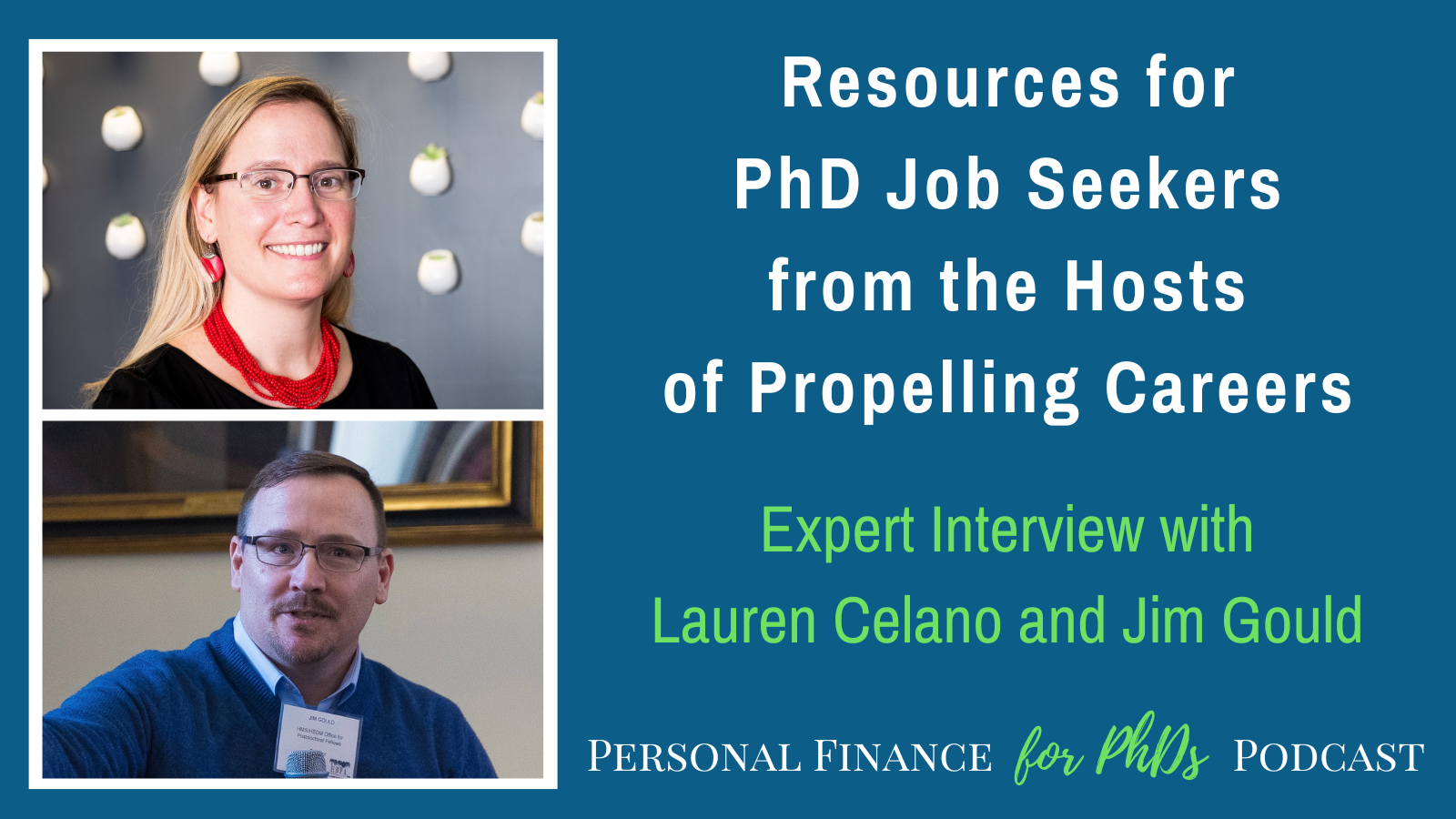
This PhD Minimized Student Loan Debt While on an Unstable Career Path

November 3, 2025 by Jill Hoffman 1 Comment

In this episode, Emily interviews Dr. Hannah Percival, an instructor at Houston City College who holds a PhD in music theory. Hannah shares how she financially made it through graduate school on a small stipend, including how she minimized student loan debt, side hustled, and kept her expenses low. She also tells the stories of landing her first and—more importantly—second post-PhD jobs and gives great advice for job seekers.

Links mentioned in the Episode

  • Emily’s Email Address
  • PF for PhDs Tax Workshops (Sponsored)
  • PF for PhDs Subscribe to Mailing List
  • PF for PhDs Podcast Hub
This PhD Minimized Student Loan Debt While on an Unstable Career Path

Teaser

Hannah (00:00): In general, I have found that if a department will be supportive of you, um, emotionally, they will also support you financially. And if they are going to just treat you as a cog in the machine, that will also show up in the money. So it’s okay to advocate for yourself to receive that.

Introduction

Emily (00:28): Welcome to the Personal Finance for PhDs Podcast: A Higher Education in Personal Finance. This podcast is for PhDs and PhDs-to-be who want to explore the hidden curriculum of finances to learn the best practices for money management, career advancement, and advocacy for yourself and others. I’m your host, Dr. Emily Roberts, a financial educator specializing in early-career PhDs and founder of Personal Finance for PhDs.

Emily (00:57): This is Season 22, Episode 6, and today my guest is Dr. Hannah Percival, an instructor at Houston City College who holds a PhD in music theory. Hannah shares how she financially made it through graduate school on a small stipend, including how she minimized student loan debt, side hustled, and kept her expenses low. She also tells the stories of landing her first and—more importantly—second post-PhD jobs and gives great advice for job seekers.

Emily (01:28): If you want to bring one of my live tax workshops to your university next tax season, get in touch with me ASAP! Between now and the end of the year, I’m populating my calendar, especially early February, with in person and remote speaking engagements. My workshops are typically hosted by graduate schools, postdoc offices, and graduate student associations, and sometimes individual departments. Whether you are in a position to make those arrangements or simply want to recommend me, you can get the ball rolling by emailing me at [email protected]. My tax workshops, both live and pre-recorded, are my most popular offering each year because taxes are such a widespread pain point for graduate students, postdocs, and postbacs. You can find the show notes for this episode at PFforPhDs.com/s22e6/. Without further ado, here’s my interview with Dr. Hannah Percival.

Will You Please Introduce Yourself Further?

Emily (02:40): I am delighted to have joining me on the podcast today, Dr. Hannah Percival, who is a full-time music professor and the program director for music at Houston City College. And we are gonna be talking all about making grad school work on a tiny budget <laugh>. So Hannah, I know we’re gonna get a lot of insight outta this interview. Thank you so much for volunteering to come on, and will you please introduce yourself a little bit further for our audience?

Hannah (03:02): Yes. Hi everyone. I am Hannah Percival and I have received my doctorate in fine arts in music theory and I also have a graduate, uh, certificate in piano pedagogy from Texas Tech University.

Emily (03:15): And what have you done since then? Give us a preview.

Hannah (03:19): So now I am the, uh, program coordinator at Houston City College and I’m a full-time instructor at Houston Community College. And currently this is my dream job. I love the students that I get to work with and I feel like a lot of the choices I made in grad school have prepared me super well for this position.

Minimizing Student Debt During Undergrad and Grad School

Emily (03:38): Hmm. Okay. Let’s see if we can circle back to that a little bit later. When, um, you approached me about giving this interview, you said that it was really important to you that you minimize the amount of student debt you need to take out during your PhD. So can you tell us more about what’s like normal in your program and why that approach was important to you?

Hannah (03:55): Yeah, definitely. Um, so I had a lot of emotional support and, um, encouragement from my family, but I didn’t have any financial support. Um, and so through my undergraduate degrees, minimizing debt was also important. Um, I commuted an hour and a half each way. Well, I went to community college first, um, which is one reason I have such a big passion for working at community colleges. Um, but then I commuted an hour and a half each way. Um, in order to keep working at my piano studio, I had at my parents’ house, um, for my bachelor’s degree. So I came out of the bachelor’s degree, I think that was debt free. There may have been a small, I think I took a small temporary loan for, I went on a study abroad to France for a summer and then paid that off. And so then I had a similar mindset with my master’s degree where my master’s degree is in a different field, it’s in counseling. Um, and I did the research track because I felt like it would really inform my teaching. And so that was also scholarship based because, um, as my salary as a worship leader was paid as a scholarship for this school. So minimizing debt was already really important to me. And then when I was reading up about what grad school is like, um, I saw how I was very aware of how few jobs there were <laugh>. And so even though I knew I really wanted to go to get a PhD and have that experience, I wanted to make sure that I did it in a way that wasn’t going to overly burden me in the future if I didn’t get an academic job. Um, and I think, although I probably couldn’t have articulated that at this, that this at that time, I think stability is really important to me. Even though I chose a career that’s in fine arts and in education in higher ed, um, stability is really important to me. And I think a large reason that became even more true for me during my PhD was because I had a lot of mental health and physical health issues and I realized that those can be expensive in America. And so I wanted to make sure that I wasn’t, that I was setting myself up for success even with those extenuating circumstances.

Emily (06:19): Hmm, that makes a lot of sense to me and I’m so glad that you, I mean you’re obviously very intentional throughout your entire, you know, academic journey there. I’m wondering if, um, in your field, is it typical for people to take out student loan debt and even in the program that you attended, was it typical for your classmates to be taking out debt?

Hannah (06:38): I would say it ranges a little bit. I know that when I was looking at my career options and loans in general, my parents suggested that I sort of think about what my, i-, what would be a range of salary for what I, the career I would do and to take out no less, uh, take to not take out more than a year’s salary just as a benchmark. And I think a lot of music musicians know that the fields are not very well paying. They used to always tell us don’t go into music for the money. But I also think that musicians tend to feel very, um, dedicated and driven towards having a successful career. And so sometimes we tend to get tied up in the like prestige of needing to go to a very big university or study with a specific professor or have a specific level of instrument. And so that can also influence what you’re paying for as a musician. And I think music is an interesting cross section, especially in America where it can be a tool for people like me that felt like music was the best way to improve their life career goals. And also it’s often a very privileged, um, subset of people that are able to have those private lessons. Um, so I always hear the horror stories of people that, you know, went like a hundred thousand dollars in debt for a bassoon career and then didn’t get it into the symphony. Um, and of course those are the horror stories, but those are still real people that made difficult choices and didn’t receive the, uh, payment out that they had invested into it. So I would say there’s definitely a sub. There’s both definitely people who were more conservative about it. Um, and those were the people I gravitated towards in grad school. But there’s also definitely the pressure to don’t worry about money. You need to worry about making the best art that you can.

Emily (08:38): It’s so interesting that we’re having this conversation right now ’cause like, okay, we’re recording this in September, 2025 and you know, the, the advice that your parents give you, you know, don’t let your student loan debt exceed more than one year of your expected salary. Pretty standard. It makes a lot of sense. It’s been given for a long time. Now we’re looking at, um, you know, with the passage of the one big beautiful bill act, these overall lifetime federal student loan limits of a hundred thousand dollars for most people, and then $200,000 for certain high paid, you know, career track graduate degrees. And so I I’m imagining your track is more on that a hundred k side of things. Um, and even your example just now was that would be a, that would be a lot to take out for like this a type of career where you didn’t make it to the upper echelon of, you know, what the possibilities were. So I think this is a, a subject that’s on a lot of people’s minds at the moment and how this new, um, you know, the new rules from the federal government are going to impact borrowing for graduate degrees. Is it going to bring down the cost of programs or is it going to push more people to the private loan market or a combination of, of the two? Um, so anyway, no answers there just yet, but it makes total sense to me like why your approach to this was the way it was. And so, uh, I guess I’ll ask, did you end your PhD with no student loan debt or, you know, one year’s expected salary or like how, how did you actually finish up with respect to the student loans?

Hannah (09:59): I was looking it up right before this podcast and I couldn’t find the exact number, but I know it was no more than 13,000. Um, and I paid that off as I went. Um, I didn’t accrue that until the very end of my degree. Um, so that was right when the pandemic hit <laugh> and I had health issues at the same time, so I took out the loans for that. Um, and also something that um, I think is important is that when you receive a TA ship, you really need to look at all of the details of it and you need to know it super well and not rely on the institution or the professors to remind you of those things. And so I was aware of some of the things like I wouldn’t get paid until October so that like moving costs would be expensive, um, or not paid out until later. And I was aware of a lot of those things, but there was also in the fine print of if, you know, if your degree goes more than four years, the TA ship does not last more than four years. But nobody mentioned anything to me about that. So I was already proactive about that and had been asking around and my um, advisor realized, oh yeah, that’s a problem. And was able to find funds to keep me on as a, um, lab assistant for our research lab. But that was tricky and could have been a lot worse if I hadn’t been more proactive about that.

Emily (11:30): Wonderful advice makes, oh my gosh, I, I know there are people in the audience who really need to hear that just now. And even what you said about, um, oh, I ended up accruing, you know, most of that debt it sounds like in one year because there was a confluence effect. Okay. Pandemic, nobody expected that. And then also personal stuff coming up at the same time. And that’s actually just like on the point that I was just making about these federal loan limits, like it makes a lot of sense to have your, your plan, your like plan a for how you’re gonna fund graduate school, not to be, to be maxing out all of the loans and for everything to be going perfectly with your TAship or whatever it is to last the entire time. Because like in the course of a PhD is a long period of time and some curve balls are gonna be thrown your way. And so you need to have a little bit of room to pivot. So like you had given yourself that room by like not taking out student lending or taking it out and repaying it, you know, gradually earlier in your degree so that by the time you finished, even though you had this final curve ball <laugh>, um, you know, the overall total was really quite minimal.

Hannah (12:28): Yes. And I received a generous, um, fellowship where I, I mean it was a TA ship as well as a scholarship, so it paid all of my tuition and then fees and then I had some for living expenses. Um, so I was able to use that for the first four years and, but already I think by year three or four I had started taking on some extra side gigs and then, um, that was really helpful to utilize those when my funding, um, became less steady. And I think that one reason, I mean I, I think it took me seven years to six or seven years to finish, but um, part of that was because I was working and aut- also I chose to get an extra graduate certificate because I felt like that would really help my job chances both in academia and um, just in the professional music world. And it really did. So even though I ended up taking out some at the end, I had that flexibility because I hadn’t been using them that whole time. And it was one of the direct unsubsidized loans. And so that was very helpful because during the pandemic all of the interest was paused. So I was able to pay that off within six months, I think a year or six months. So that was very nice.

Strategically Choosing a PhD Program

Emily (13:47): Well you just brought up increasing your income and so I wanna hear more about how you did that because you described like the funding package that you received, um, but then also you were doing other kinds of side work. So let’s talk about that. But as we’re doing it, I would love for you to share also, um, because you just said it took six or seven years to finish post masters and I’m wondering if any of that, you know, extended timeline on the PhD was because you were working and what really the interplay is there between like, okay, I need more money to live, but I also need to get to graduation. So like, let’s talk about both of those things.

Hannah (14:20): Yes, definitely. Um, I think, so first of all, I think one of the best things I did was I was very strategic in choosing my graduate degree program. I saw that the funding packages for PhDs were much larger than those for master’s degrees, which makes sense. And my bachelor’s degree was in music theory and it had prepared me exceptionally well to be, to go straight into a PhD in music theory. But on paper I had a master’s degree in a very different field. So a lot of schools were not open to that, but some were very open to that. And so I had four schools that I was extremely interested in that were fine with, um, PhD students who’d had a bachelor’s degree in music but not a master’s. And they were specifically also focusing on music cognition, which was a way for me to use them, use the psychology counseling alongside with my music, um, theory. And actually I think it was my eventual advisor who helped me phrase it this way in an email of like, I think I was phrasing as a liability. And he was like, no, this is great because you have a different perspective and that can make you really unique and valuable. So, um, I had two offers. I really appreciate the fact that I invested in myself and in my future enough to pay out of pocket to go and visit both campuses. It led to some really candid conversations with students, um, and faculty at both of the institutions. And one of them, the, the institution I didn’t go to did not end up offering me that much money, but also they told me that they would try to get me in front of a classroom once before I graduated, whereas Texas Tech said that I would be an instructor on record for one or two classes every semester and I felt like that would make such a huge difference in my resume and it did actually on the job market quite a bit. And so that was really important to me. So the first thing I would do is if you have a unique situation like I do or did where you’re wanting to go into a PhD in a field that’s not directly after a master’s in your field, I would encourage you to still look at doing a PhD because any courses that you need to make up are usually going to be part of that PhD program anyway. Depends on each institution of course. But at mine it was very similar, just that the dissertation took longer at the PhD level, I would say that my degree progress was, uh, faster than a lot of my contemporaries. Um, now that I’m thinking about it, it was, let’s see, I started in 2015 and then graduated in 2021. So yeah, six years. But a, a lot of that last year and a half was because of the pandemic. My research is researching how people bond together socially over music and that hit right as COVID hit <laugh>. So my research got really changed.

Emily (17:22): I love taking it back to that selection process, um, for graduate school and that yes, you included the financial components in in the decision, but also your career progression based on your career goals. It wasn’t, you mentioned earlier about like program prestige for example, that’s important, that’s a factor, but there are other very important things as well. And so I’m really glad that you brought up those other points about like, well, is this, is this program actually gonna get me what I want in terms of the job that I wanna have after this? Like, um, it’s easy to forget that when you have all these other things that are maybe more like in your face about who do I wanna work with or like these kinds of things. So I’m really glad you brought us back there.

Increasing Your Income During Grad School With Side Jobs

Emily (17:58): So you were funded for, you know, to some degree throughout it sounds like, but then when did you bring in like outside work and how much of an impact I guess did that make on your, um, your ability to live comfortably as a graduate student?

Hannah (18:11): Yeah, so um, I think it was about year two. Yeah, I think it was about year two I started doing some extra gigs. Um, and I’ve always had multiple jobs my whole life. I think that’s just part of being a musician. So that was always sort of my plan. Um, the, the two that really were the biggest income generators and also the best for my resume were that I worked at the graduate writing center. So I got to help students, um, at any graduate program at our college, work on job documents and work on their uh, projects. And it was very interesting because get to talk to all these people from different fields and uh, I also got the opportunity to practice teaching writing, which I feel like is a really important skill within music research that’s not often taught. And then I was a, um, teaching artist for the Lubbock Symphony Orchestra. So I would go into classrooms in public schools and teach, um, music for second graders about their science curriculum or about their um, political science curriculum. So that was very fun. Both of those were very fluid as far as I could schedule them when I needed to around my classes and my TAship. That was very helpful and would have been very difficult to do a different, um, a different type of work that wasn’t more flexible. Um, I also did two like tutoring accompanying piano lessons. Those were sort of like the black market or like kind of just did it without on my own gig work. Um, and then during the off times, um, sort of an inverse where Lubbock is very isolated and so at Christmas time if I stayed in Lubbock I could make a lot of money as a pet sitter and doing gigs by playing music at Christmas. But for the first two years in the summer it the, all of the college students tend to leave. And so my little bubble really, really would collapse economically. And so I actually went back home to live with my parents for two summers so I could work at a local bookstore and then actually pay for my rent during those months. After a few years then I was able to do some more of the writing at uh, working at the writing center during the summer and working with um, Lubbock Symphony during the summer. But my first two years I actually went back home first.

Emily (20:36): I love all these ideas, all these creative ideas and some of them of course are unique to you and the skills that you were developing, you know, during graduate school and some of them are things that probably other people could do as well. Well, um, I like that you had that like observation about the town emptying out at certain times of year and how that affected you. And certainly if you live in a college town then uh, you have to take into account those cycles. Um, so interesting. Okay. Is there anything else you wanna add about increasing income or side? Actually I do have one more follow up question. Um, you mentioned the writing center job and that it was, um, you could schedule it around your, you know, the volume of work that you had going on elsewhere. That’s really cool. ’cause I would’ve thought that a writing center job would be sort of like an assistantship, like a regular certain number of hours per week. So can you explain to me how that job was different than like your TA type position?

Hannah (21:28): It was a certain number of hours per week, but because we were working with um, graduate students, a lot of graduate students preferred evening hours and so I was able to schedule most of my writing sessions or you know, client sessions in the evenings. And I think for a while we may have even done Saturdays online, I can’t remember, but I remember that they weren’t just during the nine to five, so that was very helpful.

Emily (21:55): I see. And I love jobs like, well I’m using the word job a little bit loosely, but work that graduate students can pursue that they can schedule around what works for them because your primary focus is getting through that dissertation and doing the research that you need to do. And so yeah, there are certain times when your source of income is gonna have to take, you know, a back seat and you still want it to be there for you and you’re ready to, you know, have a different schedule, put more hours into it. So that’s very, very helpful when you can find that kind of work.

Hannah (22:25): And I found it actually very, um, motivating for finishing my degree because everyone was working with graduate students who were trying to work through their own dissertations and a lot of the, about 50% of the staff were grad current graduate students. And so it was also encouraging to be in a group of people who were currently writing and going through that process. Um, while there were a lot of people doing things like music musicology, um, or music performance, there weren’t that many people who were doing a music PhD when I was. And so I sort of had to build my own little cohort and doing the writing center really helped. And it was also nice to do it in a group that’s not your own field. Sometimes it’s, it’s nice to connect with graduate students that are not just with your same professor and same classes but still have similar experiences that they’re going through.

Emily (23:19): Absolutely. This is an important part of like side work that often goes overlooked, which is the networking. Like it can, in your case it helped you find people who can motivate you to get to your finish line in terms of your PhD or you know, there’s other purposes in other settings of course. Anything else you wanted to add about the income side of the equation?

Applying for Small Scholarships and Career Planning

Hannah (23:36): I encourage people to apply for small scholarships that seem really relevant to what they need for the same reasons you just mentioned. Um, you know, it’s free money <laugh>, which is awesome. Um, and you also build those networks that are super helpful for in that moment, getting to know people that are interested in your field and also it adds to your resume. It’s another thing you can put on it, uh, that helps you gain more scholarships. So I know some people, um, in the past used, like I had an advisor in undergrad encourage me not to apply for small scholarships because it wasn’t worth the time. But I have found them very helpful.

Emily (24:15): I’m so glad that you added that. Yeah, I mean applying for scholarships too is one of, I’m, I’m really surprised that your undergrad advisor said that because I feel like the attitude generally is like you’re gonna be preparing a lot of materials for a lot of different purposes anyway. And so like yes of course you have to tailor and you have to be selective, but I don’t know that the time burden is that much and winning it really can help you, not only monetarily but also in all these other factors that we were just talking about. So like, yeah, I’m glad you kind of <laugh> moved on past that advice and said, okay, I’m gonna go in a different direction. 

Hannah (24:48): I think that it’s also really important when you’re in the bubble of grad school to be thinking about multiple different careers you could use, um, postgraduate school and part of that is looking to see what are the most, where will my skills be most used? So also what you love and also what you’re good at. But I think sometimes in music we often prioritize what we love or what we want to do, but I think there’s a lot of benefit in also seeing what will be the most required of me in a field. So I realized that all music, all bachelor’s degrees in the US um, tend to require four semesters of music theory, four semesters of sight singing and ear training, and four semesters of class piano. And so I felt like focusing on those were really great, um, job security and so I pursued some extra the, the extra certificate and I have found that to be extremely helpful. ’cause those are sort of the like bread and butter of the degree plans and then if you have extras that you can add on, that’s great, but being able to fill in where it’s most, um, there’s a significant need for those courses can be really helpful.

Emily (26:09): Yeah, I mean kind of what we were talking about earlier about like, oh plan a, like plan A might not work out and it’s helpful to have some skills that are going to apply. So you have a plan B and a plan C and so forth. Um, very, very smart.

Commercial

Emily (26:22): Emily here for a brief interlude! I’m hard at work behind the scenes updating my suite of tax return preparation workshops for tax year 2025. These educational workshops explain how to identify, calculate, and report your higher education-related income and expenses on your federal tax return. For the 2025 tax season starting in January 2026, I’m offering live and pre-recorded workshops for US citizen/resident graduate students, postdocs, and postbacs and non-resident graduate students and postdocs. Would you please reach out to your graduate school, graduate student government, postdoc office, international house, fellowship coordinator, etc. to request that they host one or more of these workshops for you and your peers? I’d love to receive a warm introduction to a potential sponsor this fall so we can hit the ground running in January serving those early bird filers. You can find more information about hosting these workshops at P F f o r P h D s dot com slash tax dash workshops. Please pass that page on to the potential sponsor. Now back to our interview.

Housing and Transportation Choices That Kept Expenses Low

Emily (27:40): Let’s talk about the expenses side of the equation. The other half of like making it work financially as a graduate student. So were there any like, um, either really valuable or like really creative, um, things that you did to um, keep a lid on your expenses during graduate school?

Hannah (27:56): Yes, I was also lucky in that Lubbock is a very low cost of living area. Um, and I know that that’s not always true. That’s definitely something I also took into account before moving. Um, but one thing I did, I took a lot of searching but I found a really cute, um, duplex or more like a quadruplex but little apartment that was within walking distance. It was a long walking distance but walking distance. So I didn’t, ’cause I didn’t have a car for the first three years, which is another reason why I didn’t really have any jobs until side jobs until year two or three. So I couldn’t really leave anywhere that wasn’t campus. Um, so that really kind of limited things and I thought it would limit my social life, but I’m also kind of introverted anyway and I found people that were willing to like pick me up to go to a board game night and things. So I, I didn’t find it to be a huge sacrifice unless it was a, a windstorm then that was rough.

Emily (28:57): Okay. So is the sort of frugal tactic there the place where you lived or is it the living in such a place that you didn’t need to own a car?

Hannah (29:05): I think a combination. So if I had lived in a town that had really good public transportation, then that would also save me a lot of money. Um, Lubbock is not known for being a walking town, so I was lucky in that I was able to find a place close to campus that was reasonably priced. So I think it was a combination of realizing that Lubbock did not have good public transportation and I wasn’t going to have a car. So making sure that some of like the money that I would’ve paid for a car went more towards the um, rent. So I think that my rent was 750 a month, which was really nice.

Emily (29:50): Hmm. And you said something like it was a difficult search process. Like can you give us any tips what you think might be applicable for other graduate students? Because I, I’ve heard this kind of over and over on the podcast is like I really had to put in legwork, but I found a deal.

Hannah (30:06): Yes. My mom and I drove down to Lubbock and we talked with a, uh, realtor, well actually we talked with two or three realtors and we went and looked at several different properties, um, that were all within walking distance of the college and two of the like realtors we talked with, it just wasn’t a good fit. And the, the location one place we looked at the ceiling like I would not have been able to stand up in the apartment for my entire, you know, college degree <laugh>. Um, and so we were supposed to go back to uh, back home but we still hadn’t found a place to live so we ended up staying an extra day and continuing to look at other um, properties and we finally found one that was nice and um, but it took a lot of searching. So I think knowing what your like, um, most important things are, which mine was walking distance to school, I was good and I ended up spending a little more than I wanted but it was, oh and I wanted it to be safe. So, but then that also meant I had to compromise on other things. Like the laundromat was in the, um, the laundry was in the garage and um, I don’t think there was no central heating and things like that. So.

Emily (31:27): I see. Well can I ask then about, it sounds like at some point you acquired a car and what the sort of trade off was there because you also mentioned well that enabled me to do different kinds of work.

Hannah (31:39): Yeah, so again, lucky, I was lucky in that um, through an inheritance my parents were able to buy me a used car and so the car um, helped me go and do more gigs. And so that was really nice because it was able, you know, I didn’t have to pay for the car payment. So that was a big blessing and it helped me to be able to go do more gigs throughout Lubbock.

Emily (32:03): But you have to pay for insurance, you have to pay for gas. You have to pay for registration. So like there are, aside from just definitely the cost of the car itself, there’s other like expenses. But it sounds like it was worthwhile, right?

Hannah (32:14): Yes, yes. Yeah, it was for me.

Emily (32:16): Alright. What other frugal tactics did you use?

Using Free or Low-Cost Campus Resources

Hannah (32:19): I tried to use as many of the campus resources as possible. Um, so we had a food bank and um, I was able to use counseling services there and um, at one point I used medical services on campus and then I realized that our student health insurance, I mean the insurance that I got through being a TA was good enough that I could go outside of campus and receive a little bit cheaper and better care. Um, but always looked for all of the free food options and go to all of the different like talks that had free food.

Emily (32:53): Can I ask about the food bank usage? Because I know some students have certain feelings about accessing basic needs like that, but like how did you think about that?

Hannah (33:03): I ended up not using it as much as I could have because I, I don’t know why, honestly, I think I had this idea of like, well I’m good enough, somebody else can use it. 

Emily (33:14): So you had certain feelings about it too.

Hannah (33:15): Yeah. But if everybody feels that way, um, but I know it was just really helpful for my mental health to know that it was there if I needed it.

Emily (33:23): This is actually something that came up, um, in an interview that I’ve not published yet, but that will be coming out before, before this current interview is coming out. And that’s about actually looking, we were talking earlier about the selection of graduate school, um, taking into account the student services that are provided at the different options that you have in particular basic needs. And we were talking earlier about plan A for, you know, your funding during graduate school. Hey, it’s really great to know if there are basic needs services available on campus, even if you don’t plan on using them. Like you said, just knowing it’s there as a backup option can be really, really helpful and comforting. And so, you know, if you hit some, some skids that like, okay, like that’s there for me, I’m not going to be food insecure.

Hannah (34:04): Yes, yes, definitely. I um, I think my biggest expense with the medical bills, um, so that was a frustrating thing, but it was really nice that we did have good health insurance, um, through being a ta. Um, yeah, I really wanted a kitty, but I waited because I was like, what if the kitty has health problems and I can’t take them to the vet? And then that ended up being um, a good thing. I adopted a kitty, um, during the pandemic. I couldn’t wait any longer. Um, but then um, he ended up having some pretty severe diabetes complications, but by then I had already had a stable job and things. But I’m proud of younger Hannah for not getting a cat then even though I wanted it because I think it was, it did end up being much more expensive than I expected.

Emily (34:58): Yeah, you were prescient in that way actually. And yeah, I mean if you’re struggling just to provide for yourself, then yeah, you definitely have to think twice about adding anyone to your household in that sense. Was there anything for other people who really want to be pet owners <laugh> while they’re in graduate school, uh, but maybe think the same as you, it’s, it’s not the right time financially. Like were there ways that you could get some of the same benefits of having a pet that um, that you know, before you actually could adopt one

Hannah (35:26): Highly recommend being a pet sitter <laugh> because yes, you get all of those cuddles and you get paid for it. 

Emily (35:33): Yes. Um, I just put this in the sample chapter for my book that I’m writing, which is like, uh, about increasing income and saying how like baby pet and house sitting, hey, like if you get some personal joy out of those like scenarios and you get paid for it, like double benefit.

Hannah (35:49): Yes.

Transitioning From Grad School to Full-Time Employment

Emily (35:51): Let’s talk then about when you transition out of graduate school and we’re applying for full-time positions. Um, do you have any other advice for people who are in like a similar stage or leading up to that stage?

Hannah (36:03): Yes. One is more generic that I think people hear a lot, but I think is still important. At the graduate writing center I learned a lot about helping to really tailor your documents to the job ad and to um, also for funding if you’re applying for a specific type of grant or funding. And I found that extremely useful not only for um, you know, getting an interview but also for understanding is this a job that I want? Is this the type of opportunity that would be good for me? Am I good match for this? Um, but I will also say that even when you tailor everything and you work really hard on your applications, it’s still very confusing. And having now been on some job searches, it’s also very confusing. Like the whole process is confusing for the applicants I think because you don’t get a lot of feedback on what you did wrong or right. Um, and there’s a lot of luck involved of like, are you the specific candidate that that person needs at that specific time and they may have needs that they haven’t been able to like, um, advertise exactly. So I think being kind to yourself during the job hunt is very important because there’s a lot of luck involved unfortunately. Um, and I applied to hundreds, um, over many years. I got about 10 initial interviews, um, and I only got, well, I guess I only got one on campus interview, so there weren’t very many on campus interviews. Um, but I really felt like it was still important for me to do that process and to continue trying for that. During that time I was continuing to work at the graduate writing center and I taught piano lessons, um, but I started rewarding myself with, um, every rejection letter I would get, whether it’s for a, a funding opportunity or a job, I would buy myself office supplies. So I had so many fancy pens for a while.

Emily (38:14): Yeah, I mean at least when you were receiving that bad news, you can say, oh but I get to buy something really pretty from my desk. That’s nice. Um, so it sounds to me like that you finished graduate school, you were doing this sort of part-time work, um, while you were continuing to apply for full-time positions. Is that right? Okay. And I think your advice is very good, very spot on. But like, is there anything more that you can say about that perseverance, because that’s a lot of applications that you had to submit.

Hannah (38:44): Yes, it was, I, I wanna acknowledge that I did get married during that time and it was to someone that had savings and had a steady job and that was really wonderful. It was also really important to me that I have the career that I had worked so long for. So I, um, could have certainly built up my piano studio and done taken on more writing clients, but I really wanted to try to be the co- a college professor since I had worked for that for so long. So I got an opportunity to teach at a school and it was teaching all the things I wanted to during the interview, it seemed like it was going to be a great fit where I could really help students and it was in a small environment. So we moved and thankfully my husband’s job is remote so he was able to move with me. Um, but I got there and I had already had some health issues and I let them know before I came that I was going to need a sub for the first two weeks. So before I accepted the job, I let them know and they were okay with that. Um, but then when I got there, they hadn’t gotten any subs for me and then they were upset that I hadn’t been more dedicated to my students even though I was on bed rest for my surgery. And so it quickly became very toxic and it got to the point where after about eight weeks in that job, I found myself very jealous of people in the grocery store, like workers in the grocery store because I was like, they’re able to do their job and go home and be done and they don’t have to worry about am I harming this student’s future? Am I helping the student take on so much college debt knowing that they’re not going to be successful in this program? So I reached out to my PhD advisor and he was very encouraging saying that, you know, I was more important than the job title and that if I ended up leaving and doing my plan B or C or D that was more important than letting the job and the toxicity of that job wreck my mental health to irreparable spot. So while I was teaching full-time at that institution, it was $24,000 a year for full-time, which is not enough to survive on. So I was also adjuncting for Houston Community College at the time, um, online. And everyone I knew who was at that level working had to do two jobs at once. Um, whether it was teaching at more than one institution or some other kind of job. And that actually gave me, um, the job that I have now. So it was a really good learning experience to realize that I can be good at this job and I can love it and I can still be at the wrong spot. So to realize that sometimes you can have your dream job and it’s not the right environment and to be willing to walk away from that is hard, but sometimes it can lead you into more healthy positions. Um, and the position I’m in now, I feel very supported. My colleagues are wonderful. I still get to help support students and I feel like I am being supported for the long haul. So I just want to encourage people that if your your dream job turns out not to be your dream job, that’s okay.

Emily (42:24): I’m taking two things from that story and I’m so glad that it took the turn <laugh> that it did. Um, the, the first is that the long protracted search for the first job did not have to be repeated, right? It was much more ready that you got the second job, um, even though the first one took so long to land.

Hannah (42:42): Although, although I did do, um, I was applying to even more jobs with the full-time in order to get out of that position.

Emily (42:49): Yeah, that makes sense. But it didn’t take the length of time that.

Hannah (42:51): Correct.

Emily (42:52): You know, the first one took, um, and the second one was that opportunities came from working. So.

Hannah (42:57): Yes, absolutely

Emily (42:58): Just, just doing anything that’s, you know, related. I mean as related as it can be of course to the career that you ultimately want, but like just doing any kind of work in that field is going to be helpful to you in some manner. And it, I hear this story over and over again of like the part-time work I did or, you know, it led to that full-time job. It happens over and over, it makes sense. People wanna hire known quantities of course. So I just wanna point that out as well as like keep working <laugh>, uh, even side work, uh, in addition to the full-time job. If, if you’re not, if the full-time job is not everything that you know it cracked up to be, then keep creating opportunities for yourself through working and of course continuing to apply as you did. So I find that very encouraging. Um, anything else you wanna share with our audience? You know, advice for getting that first job or the second job post PhD?

Hannah (43:51): It’s okay to want stable income and I think that that’s not always talked about in music. I, it’s we’re told to follow our passion and I’m lucky in that I did find the job that I wanted all along and um, you know, it’s got a really nice bow on the story, but I also know a lot of people that have happier lives outside of academia that are, have the space now to do things that they’ve wanted to do in their artistic field. Um, but in general I have found that if a department will be supportive of you, um, emotionally, they will also support you financially. And if they are going to just treat you as a cog in the machine, that will also show up in the money. So it’s okay to advocate for yourself, um, to receive that. And so when I went over to this full-time position, um, I ended up making three times the amount of money for like half the work. And so I also encourage people, um, to consider highly consider, um, working at a community college. Um, especially if you have a passion for teaching. It doesn’t have the prestige as some other places. Um, and some places have a little bit of a stigma because you often are not paid to research, you’re not, your research is not the important part, but there’s a lot of funding available. And so a lot of the professors that have the most lucrative jobs I know tend to work full-time at community colleges.

Emily (45:26): I actually have, um, a neighbor where I live who has a PhD and teaches at a local community college. And I, I believe it has the same kind of tenure system. Obviously it’s not based on the same things that it would be at an R one institution, but there’s still a great deal of job security that can be attained through this route. Which as you said earlier, is one of your high like values. Hannah, thank you so much for this interview. It’s been, it’s been very encouraging and yes, I’m so glad that you volunteered to give it.

Best Financial Advice for Another Early-Career PhD

Emily (45:55): Would you please share with us your best financial advice for another early career PhD? And it could be something that we’ve touched on in the interview already or it could be something completely new.

Hannah (46:03): Yes. I was brainstorming how to phrase this with my husband ’cause it was this big complicated thing and he said, um, don’t get academia tunnel vision. And I loved that phrasing because in academia we tend to have these ideas. If you do this and then you do this, and if that doesn’t work, you just keep trying. And that if, if you have to move your family to a place they don’t want to be, you do it or you take the place that has the best prestige. And I have found that it is good and healthy to prioritize your own mental personal stability. And sorry, I messed that up, <laugh>, that it’s good to prioritize your own mental health and physical health and stability. You get to choose how you work for academia and you get to choose if academia is placing you into a position that is untenable, it’s okay to do plan B or plan C.

Emily (47:06): I love the phrasing that your husband came up with. I love your phrasing that you had just there. You choose how you work for academia. Like this is a two-way street ultimately. And we’ve seen so much with, um, I, I mean this is going on for decades now but the quit lit like people make, you know, they think that academia is the be all end all and then realize that it’s not and they end up leaving for, you know, greener pastures and so forth. And just great advice. I want people to go back, listen to that little segment over again because it’s so, so true and we all need to hear it more. So thank you very much. Um, and thank you again for volunteering to give this interview.

Hannah (47:40): Thank you so much and I appreciate all of your work Emily, your, um, work on, um, the tax preparation was so helpful, especially because understanding how taxes work for things that are both stipend but then also a paycheck are very like very confusing. So I really, really appreciate you and so does my tax returns.

Emily (48:00): Okay. Thank you so much for saying that.

Outro

Emily (48:12): Listeners, thank you for joining me for this episode! I have a gift for you! You know that final question I ask of all my guests regarding their best financial advice? My team has collected short summaries of all the answers ever given on the podcast into a document that is updated with each new episode release. You can gain access to it by registering for my mailing list at PFforPhDs.com/advice/. Would you like to access transcripts or videos of each episode? I link the show notes for each episode from PFforPhDs.com/podcast/. See you in the next episode, and remember: You don’t have to have a PhD to succeed with personal finance… but it helps! Nothing you hear on this podcast should be taken as financial, tax, or legal advice for any individual. The music is “Stages of Awakening” by Podington Bear from the Free Music Archive and is shared under CC by NC. Podcast editing by me and show notes creation by Dr. Jill Hoffman.
Money Is a Good Enough Reason to Leave Academia

October 20, 2025 by Jill Hoffman 1 Comment

In this episode, Emily interviews Dr. Gabrielle Filip-Crawford, the founder of the peer support network Recovering Academics. Gabrielle left her tenure-track position after discovering she was vastly underpaid with almost no room for salary growth even after promotion. Gabrielle shares the common financial questions and mindsets that she sees within the Recovering Academics community, such as not understanding what different careers pay and feeling guilty for needing to earn more money. Gabrielle and Emily discuss how graduate students and postdocs can improve their money mindsets prior to pursuing academic or non-academic positions post-training.

Links mentioned in the Episode

  • Dr. Gabrielle Filip-Crawford’s LinkedIn
  • Recovering Academics Email Address
  • Dr. Gabrielle Filip-Crawford’s Website: Next Draft LLC
  • PF for PhDs Tax Workshops (Sponsored)
  • PF for PhDs S22E2: How to Negotiate Your Salary Post-PhD
  • PF for PhDs Subscribe to Mailing List
  • PF for PhDs Podcast Hub
Money Is a Good Enough Reason to Leave Academia

Teaser

Gabrielle (00:00): That was kind of my mindset going from grad school to postdoc to faculty position. Each one paid more than the last. And so that faculty role that didn’t pay enough for me to really live on was the most I’d made up to that point. And it didn’t occur to me for a ridiculously long time. That didn’t mean it was a good salary just because it was more than my postdoc.

Introduction

Emily (00:34): Welcome to the Personal Finance for PhDs Podcast: A Higher Education in Personal Finance. This podcast is for PhDs and PhDs-to-be who want to explore the hidden curriculum of finances to learn the best practices for money management, career advancement, and advocacy for yourself and others. I’m your host, Dr. Emily Roberts, a financial educator specializing in early-career PhDs and founder of Personal Finance for PhDs.

Emily (01:03): This is Season 22, Episode 5, and today my guest is Dr. Gabrielle Filip-Crawford, the founder of the peer support network Recovering Academics. Gabrielle left her tenure-track position after discovering she was vastly underpaid with almost no room for salary growth even after promotion. Gabrielle shares the common financial questions and mindsets that she sees within the Recovering Academics community, such as not understanding what different careers pay and feeling guilty for needing to earn more money. Gabrielle and I discuss how graduate students and postdocs can improve their money mindsets prior to pursuing academic or non-academic positions post-training.

Emily (01:44): I’m delighted to share that I will join the Recovering Academics weekly call on Tuesday, November 18, 2025 for a 60-minute Q&A call. If that group is a good fit for you and you’d like to join in time for that Q&A, get in touch with Gabrielle via LinkedIn or [email protected]. If you’ve been enjoying this podcast and want to see it continue, would you please help spread the word? Take a minute to leave a review on Apple Podcasts or Spotify, text a recent episode that you enjoyed to a friend, or give it a shout-out on social media. Any of those actions helps me to grow Personal Finance for PhDs and continue finding amazing guests for the interviews. You can find the show notes for this episode at PFforPhDs.com/s22e5/. Without further ado, here’s my interview with Dr. Gabrielle Filip-Crawford.

Will You Please Introduce Yourself Further?

Emily (02:49): I’m delighted to have joining me on the podcast today, Dr. Gabrielle Filip-Crawford, who is the co-founder of Next Draft LLC, and the founder of the Peer Support Group, Recovering Academics. And Gabrielle is a former academic, and we’re gonna be talking a lot about that journey as well as the journeys that she’s observed among others. And Gabrielle and I met actually at the graduate career consortium annual meeting that happened last June. We’re recording this interview in September 2025, and we were both sponsors of the conference. And so of course, I love to meet the other sponsors and get to know how they support the academic community as well. And so we decided this was worth a whole podcast interview. So Gabrielle, welcome to the podcast, and will you please introduce yourself further for the audience?

Gabrielle (03:32): Yeah, thank you so much for having me on. It is a pleasure to be here and chat with you. Um, so I am, uh, as you said, co-founder of Next Draft LLC. My background is in social psychology, graduated with my PhD in 2015, and I went straight into academia, so I was a postdoc for a year and then, uh, on the tenure track at a liberal arts college for six years after that. And I ended up transitioning out of, uh, my academic position and moving into the world of program evaluation and applied policy research. And that’s what I’ve been doing for the last few years now.

Emily (04:12): Tell us more about the decision to leave your tenure track job, because I understand that finances played a heavy role in that.

Gabrielle (04:20): They definitely did. So I think one of the things that kind of caught me up around finances is nobody ever really talked to me about what normal people earn <laugh>. Um, I have a lot of friends who work in the tech industry, work for Google, Microsoft, Facebook, who make just massive amounts of money, and I didn’t wanna work in big tech. And so I thought, well, I’m just never gonna earn a salary like that, and what I’m earning is normal. And I earned 56,000 as a tenure track professor with PhD, and nobody really pointed out the discrepancy between that and what PhDs were earning outside of academia and outside of tech. And there were kind of two financial nails in the coffin to my decision to leave. One was, uh, the APA, the American Psychological Association published salary data, and they published the mean salary for people with a bachelor’s in psychology, a master’s in psychology, and a PhD in psychology. And I was right there at the average salary for a bachelor’s. And then I found out that a colleague who had been my department chair was tenured, had been there for more than a decade, was making 60,000. Um, and I just saw this future of, man, I’m gonna be here for my whole career and I’m gonna be lucky if by the time I retire I hit 70,000 a year. And it just wasn’t feasible. I have a family, I have a child, and, um, childcare costs, school costs, uh, everything’s pretty expensive and just not doable on a salary like that.

Feeling Financially Dissatisfied in Academia

Emily (06:12): Now, it would be one thing if you saw that you were under earning compared to what you could potentially earn elsewhere, but you were okay with it, right? The finances still worked in your own personal life. We’re not saying everybody needs to make as much money as they possibly can in their field, but as you were getting to at the end of your answer, like it was not personally satisfying to you to stay at that level and you could see the future. Like it wasn’t gonna, you know, sometimes professors can expect decent leaps up in salary as they go through the, the, you know, professor process with their promotions, but that apparently was not the case for you. So can you tell me a little bit more about like the financial maybe dissatisfaction that you had? Not just the comparison, but for yourself?

Gabrielle (06:54): Yeah, definitely. I think that we hear a lot in academia about, you know, we’re not being, we’re not in it for the money, right? It’s not about the money. And so I think there was sort of a internal unwillingness to look at that for a long time and feeling like almost guilty for considering money. Like it shouldn’t be a career consideration. I am here, I am able to do this amazing job that so many people want, and I’m unhappy with it for a material reason, which felt, um, felt like it wasn’t okay to admit. And, um, but that just bumped up against financial reality, right? Of, of trying to pay childcare costs. And I don’t live, I am, I’m in Minnesota, I’m in the Twin Cities. It’s not a super high cost of living, but it’s also not a super low cost of living. Um, and I need to be able to make ends meet. I need to be able to meet the needs of my family. And when I started really thinking about it, it was clear to me that, you know, it was like, money can’t buy happiness, right? But there’s like, but it can <laugh> be a really big factor. It can pay for, it can be the difference between, you know, your car breaks down and it’s a huge crisis for the family for months and causes a massive amount of stress. Or you go to the mechanic and you get car fixed and you move on with your life and it’s okay and you can afford what you need to afford to make your life work. So I think that that was kind of eye-opening when I kinda gave myself permission to start really thinking about it and, and opening up that question of, well, what do I actually need? And how can I get that?

Recovering Academics Peer Support Group

Emily (08:50): Yeah. Thank you so much for sharing that more detail in your perspective on this, because I’m sure it’s really valuable for you to say, I was in this mindset, this is what we are told in academia, and I had to really reexamine that. Um, and that gets me to like, let’s talk more about this peer support group of recovering academics ’cause it sure, like this conversation that we’re having right now is one of many types of conversations you have in that group. So can you tell us more about recovering academics?

Gabrielle (09:18): Sure. So when I was looking to leave my position, there were several of us from my university who were job hunting at the same time, and we kinda ended up finding each other. And, uh, we started meeting every week. And it just started out as, you know, our little internal group within our university supporting each other through the job application process, talking about the challenges. And through that it became clear that there were a lot of people in the same position we were of, we, we landed the coveted tenure track jobs. Some of us had tenure and, um, for a variety of reasons that just wasn’t, it didn’t fit with what we needed in our lives anymore. And so I put a call out on LinkedIn just trying to reach out and see if there were other folks in that same position. A bunch of people responded. We held a Zoom meeting with maybe a dozen people that first time. Um, another member of the group dubbed us recovering academics and the name stuck. And, um, what we did is built a Slack community and, uh, we meet weekly on Zoom, and we have done so now for more than three years. And the group grows almost weekly. Uh, word of mouth, generally, we don’t have, uh, a website for the group. We are a very private group because leaving academia can be a really sensitive process for a lot of people. And we don’t want, we don’t want anyone to feel unsafe seeking out help and support. Um, originally the goal was to kind of bring together people leaving tenure track or tenured roles, and almost immediately we expanded beyond that. So we have people leaving from every career stage you can think of from every type of institution. Uh, we have academic staff including, um, like student affairs staff, uh, academic librarians. Um, it’s a really wide variety of people. It’s cross disciplinary. Uh, there are people from nursing, engineering, chemistry, English, um, media studies, ethnomusicology, psychology. We’re kind of across the board. And a big value of the group is breaking through a lot of the isolation that happens when people think about leaving academia and providing a safe place for people to ask questions and to bring up things like salary and, um, and financial struggles and all of this, um, all of the issues around money that get wrapped up in this process,

Emily (12:03): I can so see the value of that kind of group. Um, I don’t, I don’t wanna call academia a cult, but like <laugh>, you’re, you’re like, not, okay, I’m reading a book right now. <laugh>, it’s science fiction. It’s a dystopian, you know, but like, if you speak out like you, if you even question their like society, you’re immediately killed like death penalty now. Okay. Academia is not that extreme, but there are consequences for you to be very open about potentially leaving in a way that other kinds of industries are not that way. Um, and so I, I’m definitely hearing like that value of privacy and being able to ask those questions in that setting that you. Could not ask in your workplace, or you might not even be able to ask among your peers at other institutions because what if you decide to stay and they knew you had doubts. You know, like, um, so I, I see that now given that this is so, such a, um, a closely held group and you don’t have a website. How do people find out how to join? Because I’m sure somebody listening is like, I need this in my life right now, <laugh>.

Gabrielle (13:04): Yeah, absolutely. So, um, so despite being a very, very private group, we have over 480 members now. So people find us, um, generally people find us either through me on LinkedIn, people are more than welcome to message me or connect with me on LinkedIn. Um, and then I will share information about the group. And I do also wanna be clear that this is a free group that no one pays to attend this. Money’s not a part of that picture. Um, because I couldn’t afford <laugh> coaching resources when I was leaving. And I know a lot of us are in the same boat if we’re leaving for financial reasons or if that’s a contributing factor, then we probably can’t spend thousands on a coaching program, even if that would be amazing and valuable. Um, so this isn’t a substitute for coaching, but it’s definitely, it’s sort of crowdsourced, um, coaching in a way. Um, so people can reach out to me directly. Um, there are other group members, uh, we get a lot of referrals from other group members as well. Um, but for folks who might not be connected or know that they are connected with members, I’m probably the easiest, um, place to look. And we are hopefully soon gonna set up a, a webpage attached to my business webpage, just so I have a place to direct people more easily.

Common Limiting Beliefs Among Recovering Academics

Emily (14:29): Yeah, that sounds good. So I would like to hear more about, you know, in you sharing your personal story about the decisions leave academia, you brought up, you know, um, the salary comparisons between what you could make with your degree inside versus outside of academia. Um, you brought up like, oh, we’re not supposed to be in this for the money. Um, but I’m wondering if there are any other like, common questions or limiting beliefs or mindsets that you’ve noticed, uh, within the recovering academics community beyond those ones that you’ve already brought up.

Gabrielle (15:02): Mm-hmm <affirmative>. Yeah, I think, um, I mean, I think the first thing that strikes me in just hearing how people talk about money in the group is just, um, for such a highly educated group of individuals, we are kind of astoundingly ignorant <laugh> when it comes to financial issues. Um, people don’t have a good sense of what salaries look like and you know, what other people make with the skills that they have. So they have no idea what they should be looking for. They don’t know how to ask for the appropriate salary. They don’t know anything about salary negotiation or anything like that. Um, and one place that also carries over is there’s a lot of people who move into some form of, um, entrepreneurship, uh, or do some level of consulting. And so then there’s also this whole how do you value your skills and how much do you charge and what is appropriate.

Gabrielle (16:11): And then a third bucket is, um, for those of us who move out and do make more money in our new position, what the heck do we do with the additional income that we have and how do we manage that? And that is definitely something that has come up. People don’t know how, what kind of accounts their money should be in. They don’t really know how to manage that. They don’t know how to, um, they’ve never really been able to think about, what if I was able to put this much money into retirement, should I, how do I do that? Do I pay down my debt first? Do I do that? Like, we don’t really know, um, how to, how to manage, um, because it’s a good problem to have. Right? But, um, but definitely still an issue. And I think a lot of us probably are not making the best financial decisions because we just are a little, uh, a little bit at sea with having those decisions to make.

Emily (17:09): Yeah, I can see not only, ’cause I’ve thought before about like the catch up that PhDs at some point when their income does increase, I mean, hopefully it does at some point increase a lot <laugh>, um, what they can do in terms of their financial goals to like, ’cause a lot of ’em feel like they’re behind, whether they leave academia when they’re 30 or 40 or 50 or whatever, a lot of people feel that they’re behind. Now whether that’s true or not depends on who you’re comparing yourself to, but, um, they feel behind. And so I have thought about like, what are those, if, if there’s any special considerations that group should have, um, once, you know, exiting academia. But what you brought up that I think is really interesting is not only is there kind of a, an actual dollars and cents monetary catch up, but there can also be a little bit of a catch up needed just in education around like norms. And like what your goals should be. Um, I I’m even thinking about like benefits, like benefits inside academia can be really different. They actually should be pretty generous in some ways, and they could be quite different when you’re looking at positions in industry or in other sectors. And so just knowing that like, oh, my employer is no longer gonna pay for this, or like, I don’t have a pension, or, you know, these other kinds of questions might come up too. And making that kind of industry shift as well. So, uh, you’re making me wish that I didn’t just specialize in graduate students, postdocs, <laugh>, because I can see that the questions can continue in, in certain environments for a long time afterwards.

Gabrielle (18:35): They definitely can. And I also think that the more advanced someone is in their career, um, the more awkward they feel about asking the questions, they feel like they should know, I’m 45 years old, I’m leaving this career that I’ve been in for decades, and I should know how retirement works. I should know how I should be investing my money. I should know what kind of savings account I need. And so people are embarrassed to, to ask these questions.

Emily (19:07): One of the reasons that I do specialize in the way that I do, um, is because I think that the vast majority of graduate students and postdocs, as you were saying earlier, like coaching is expensive. At the career coaching option. Yes. You might spend thousands of dollars on, if you’re working with an individual or you could buy a course that’ll be, you know, less expensive. Um, what I perceive is that, like, I specialize where I do because, um, these people have no ability to do anything, a course a coach, anything. But the good thing is that once you get that higher salary, like once you can actually make the transition, whether that’s within academia or, or leaving academia. Um, you do have the money once a transition is made to hire professionals. But it can still be intimidating psychologically, like what you just said. Like, okay, I could afford to hire professional, but like, are they gonna help me with my, like, really basic questions that I feel embarrassed to even ask? So I can see why that would be a barrier as well.

Gabrielle (20:06): Yeah. And not even necessarily knowing what kind of professional you need. There are a lot of different, um, a lot of different players in the financial industry. And so it’s, do I need a financial advisor? Do I, how much money do I need to have to make it make sense? To hire someone who’s like to manage things versus just consult with somebody on a one-off basis, um, versus just hire somebody to do taxes. There, there’s a lot of, um, options and, and it’s not always clear what makes sense to invest in.

Emily (20:41): Hmm. And since we’re in this environment right now, I’ll just go ahead. And let people know all the options that you just said are available. So like, you don’t need a million dollars, you don’t need half a million dollars to hand off to an investment advisor to manage for you. Yes, you could do that if you had that kind of money. But as you said, there are so many more people in the last like 10 years offering more of a fee for service model. Um, that’s more about paying someone for their time rather than paying someone to manage investments for you. So you can pay someone for a package. Like it might even be as low as a thousand dollars, maybe a few thousand dollars, um, for okay, you create a plan for me and like it’s on me, the client to execute it. Like that’s not the advisor’s responsibility ’cause they’re just working with you for a limited period of time. But they can answer those questions. And I, I actually, my perception of the industry is that people who have that model of like, you’re just paying for their time, you know, you might work together once, twice or maybe over the course of a year, there’s different models, they’re much more willing to answer those kinds of, like, I feel like I should know this already, but can you just tell me like, what is a 401k like, you know, um. How much should I be, you know, prioritizing my retirement versus my kids’ college? You know, tho- those kinds of questions are, they’re much more open to that than someone who’s strictly focused on managing investments. They might not answer a question for you, like, should I pay off my mortgage faster? You know, they, that might be outside their sort of area of operation, but people who you’re just paying for their time should use that time, however you the client want to use it, if that makes sense. So I think whatever sense, yeah, whatever your level of wealth, whatever your income, you should be able to find someone at that level to help you. Um. But again, it’s getting over the, can I even reach out for help <laugh> part of it?

Commercial

Emily (22:28): Emily here for a brief interlude! I’m hard at work behind the scenes updating my suite of tax return preparation workshops for tax year 2025. These educational workshops explain how to identify, calculate, and report your higher education-related income and expenses on your federal tax return. For the 2025 tax season starting in January 2026, I’m offering live and pre-recorded workshops for US citizen/resident graduate students, postdocs, and postbacs and non-resident graduate students and postdocs. Would you please reach out to your graduate school, graduate student government, postdoc office, international house, fellowship coordinator, etc. to request that they host one or more of these workshops for you and your peers? I’d love to receive a warm introduction to a potential sponsor this fall so we can hit the ground running in January serving those early bird filers. You can find more information about hosting these workshops at P F f o r P h D s dot com slash tax dash workshops. Please pass that page on to the potential sponsor. Now back to our interview.

The Problem With Academia’s “Not in It for the Money” Mindset

Emily (23:46): Do you have anything else you wanna add to, you know, the common like questions or, or like mindsets that you’ve seen within the group, you know, relating to finances?

Gabrielle (23:55): Yeah, I mean, I do wanna mention again that the, that mindset of we don’t, um, we’re not in it for the money because that is transitioning out of academia involves like a lot of psychological transitions, a lot of identity shifts. And that is a really central one. And it’s just so difficult for people. And the number of people who, when they introduce themselves, we have an intro channel on our slack, and their written introduction of themselves includes essentially some sort of apology for pay being part of their decision making process to, to us, to other people who are in the same boat. Like there’s nobody from the outside looking at this and there’s still this, this, um, guilt that they had to consider something as ordinary as money <laugh> in their, in their, you know, making decisions about their life. So that shows up on a very regular basis of just this feeling of like, there, there needs to be some higher calling reason why I’m changing careers. I can’t just say, you know what, this isn’t enough money for my family to live on and I need to earn more <laugh>. So we try to reassure people that’s enough. If you need that, you need that.

Emily (25:19): Absolutely. What an indictment of academia, right? That they’ve, we’ve been brainwashed by the culture of these institutions that I mean, it’s a racket, honestly, <laugh> like make people grateful for the job that they have so that the pay doesn’t matter, even if the pay is so low that they can’t reasonably afford to live in the city where the institution is located, you know? Oh my goodness. Oh my goodness. I’m so glad that you all are, are doing that work, um, in that moment for those people. Like yeah, it can be enough. And not to say that you can’t find mission driven work elsewhere that is still reasonably compensated. Like just Absolutely. It’s because of that, that tie to like the tenure track because they say it’s a one way street and you know, all that kind of stuff. And it’s not true. Like yeah, it’s true sometimes, but like, it doesn’t have to be true for everybody. Anyway. Okay. Thank you so much for bringing that up again. ’cause it is so important. So like same message going out to my audience. Like, I mean, okay. They’re probably already listening to this podcast. They probably understand that money is a factor <laugh> in like living a good life. Um, and if it gets, if the pay is low enough, it might be the only factor telling you. Like, it’s, it’s time to move on from this position or this type of work. Yeah. Oh my goodness. Yeah.

Developing a Healthy Relationship With Your Salary

Emily (26:36): So let’s pull back a little bit from like the people that you usually work with of these, you know, academics or people who work in academia, um, considering a transition out, pull it back to my more typical audience of prospective graduate students, current graduate students, postdocs, people who are still, um, in the academic system, and maybe they’ll stay long term or maybe they won’t. But they’re earlier in their careers. So how can this audience of people start to work on their money mindset so they can have a healthy relationship with their careers and with their earnings wherever they end up? What are your thoughts about that?

Gabrielle (27:13): Yeah, I mean, I think that’s a great question. And what I encourage grad students to do is start doing informational interviews as early on as they can. So talk to people in careers they think they might be interested in, talk to alumni of their program who’ve either are in academia or aren’t. Um, either way, I, I have no skin in the game of whether people stay in academia or leave. I want people to pursue careers that are a good fit for them. And that could be either. Um, so talk to people and ask about money. People are, are generally have the idea that it’s taboo to talk about much more than the reality is that it’s a taboo. People generally are okay answering money, answering money questions, and you don’t have to say like, how much do you make? Um, what I asked people when I was doing informational interviews was, um, how, how, what’s a typical salary for this kind of role? Or, you know, here’s the experience that I have, what’s a reasonable starting salary for me to aim for? Um, so it’s not like you have to come out and just be like, what’d you earn last year? Um, which might feel awkward to ask a stranger. So I would say talking to people and getting kind of just a baseline idea of what, uh, of what people make. And then we tend to approach if, if people are aiming for an academic career, they tend to approach it with this mindset of not what do I need in order to thrive in my life and have all of my needs met, but, um, like, what can I stand to put up with in order to win this prize of having a tenure track position? So I encourage people to start from thinking about their needs and their values. So for example, if somebody values their family and it’s important to them to be near family, where does family live? How much money do you need to earn to live near family? Then that is a filter in your job search process, A baseline filter. You’re not gonna look at jobs that earn less than that because you can’t meet your need of living near your family if you don’t earn at least that amount. Um, so yeah, so I encourage people to, to start not from this sort of almost this end point of what job do I wanna end up in, but what do I want my life to look like? And finances is a big part of that because you need to earn enough to live where you wanna live and to have everything in your life that you want to have in your life travel’s important. You need to think about, well, how much do I need to budget for that? How much am I gonna need to earn to be able to budget that?

Emily (30:06): Yeah, it’s been a minute since I brought up Cal Newport on the podcast. I know I’ve done that a lot in the past, but he has this term that he uses, I believe it’s lifestyle centric career design. And so that’s kind of the, what you just mentioned is like the start of lifestyle centered career design. And I think that even someone who has just finished their PhD, Cal Newport uses a term called career capital. The more career capital you’ve built up, the more you can design your career to fit the lifestyle that you desire. But even someone who’s just finished their PhD has a degree of career capital. It’s not as much as they’ll have five or 10 years later, but they have some <laugh>, um and so that’s a perfect starting point for doing exactly the exercise you just mentioned of like, let’s just baseline, what do I need geographically? Maybe not necessarily a specific geography, but like type of place that I want to live. Um, you can think about your lifestyle too in there. Actually I did an interview, it was published, um, I put it out at the beginning of season, um, 22 of the podcast with, um, Dr. Kate Sleeth from EduKatedSTEM. And we talked about figuring out a minimum salary number in a certain location, kind of what you were just talking about. But one of the elements we added there that I wanna bring to this conversation is don’t just take like your current postdoc salary or you know, wherever, whatever stage you’re at, and then like translate that to a different city. Really think about what you need to add on to that salary to make your life, um, enjoyable. And so of course you’ll have some extra responsibilities of taxes and maybe your student loan payments. Those will be added on as like a baseline. But beyond that, do you wanna take some vacations? Do you wanna buy a home? Do you want to just spend more on entertainment than you have been the last, you know, x many years, um so really think about like intentionally what you want to add into your life when you’re thinking about those minimum requirements of the next job. And I also wanna go back to your first point about informational interviewing, which I think is so powerful. And actually, even if you were staying in academia, I feel like you should still do informational interviews because your one observation at your one institution or your one pi or whatever is not, you know, everything that happens in academia. And I had this, um, I did a very short term fellowship after I finished my PhD in science policy. And it was very intentional. Like it gave us work experience, but there was also a set aside time for like professional development, like a certain number of hours per week we were supposed to spend on that. And part of that professional development was we had to a, conduct a minimum number of inter- informational interviews like it, you know, with other people in science policy. And it was so valuable. And I wasn’t even asking that much about salary and these kinds of things that you’re talking about. Which are very important. But it gave me a much better idea that, oh, actually I didn’t want to stay in science policy and I wanted to pursue this business that I was, you know, starting at that point personal finance for a PhDs. And so it’s such a valuable process and it, and going through that policy fellowship gave me permission to do it. It was like, oh, it’s a requirement. I can just tell people like, I’m doing this fellowship and it’s a requirement that I interview you, you know, or at least that ask, I ask you for an interview. Um, and so it gives you like that permission. So I just wanna tell everyone listening like, you’re required, you’re required to conduct five, 10 informational interviews in these career fields that you want to go into. I think it’s absolutely necessary before you start applying for jobs.

Gabrielle (33:19): Yeah, I completely agree. And my experience has been particularly in reaching out to PhDs that they, at worst, they’re too busy to talk, they’re never offended that you’ve reached out. They’re usually very happy to give their time and, and meet with you. So I think people are very nervous about reaching out to strangers, but folks who’ve left academia are really looking for ways to give back and are generally on board <laugh> with meeting with grad students, postdocs, other faculty looking to transition. There’s a lot of, um, generosity in the community. And I also wanted to come back to one thing that you said, which is one of, I think people overlook the importance of learning what you don’t want to do. Um, and that is incredibly valuable with, with, um, internship experiences, with informational interviews, trying things and finding out it’s not a good fit is fantastic. You’ve, you’ve ruled out a whole area, you don’t have to think about that. Um, you’re narrowing in on what, what you do want. I tend to conduct any job search kind of, I never know what fields exist out there and I don’t wanna accidentally rule things out that might be a good fit. So I tend to rule out the things I know I don’t wanna do and look at whatever is left <laugh>.

Emily (34:40): You know, you just brought up I think another strategy for, um, you know, improving your money mindset even while you’re inside academia, which is going beyond that informational interviewing and going to internship, which you just mentioned. Or any type, any type of work experience. It could be paid work, it could be volunteer work, but anything that exposes you to other workplaces and other missions and other environments and other people like so valuable while you’re a graduate student or postdoc in helping you clarify, as you were saying, what you do, what you don’t want to do going forward. And again, if you’re asking those financially pointed questions like you mentioned, what, what would you suggest as a starting salary? You know, I should ask for a starting salary for, you know, this type of work, um, that can break you out. Because one of the big, big issues with PhDs is that we’ve, we’ve the process of getting that education and the training takes so long that we become anchored at this like stipend or like this postdoc salary, like level of income. And so you’re going into that next position like, oh, well if I just make like a little more, that would be great. Instead of like, I need to realistically understand what this market pays and what I, I can ask for keeping in mind what we talked about earlier about like discovering your own minimum requirements as well and what, what fields are gonna fit with that and what fields maybe aren’t, you know?

Gabrielle (35:57): Yeah, absolutely. That was kind of my mindset going from grad school to postdoc to faculty position. Each one paid more than the last. And so that faculty role that didn’t pay enough for me to really live on was the most I’d made up to that point. And it didn’t occur to me for a ridiculously long time. That <laugh> that didn’t mean it was a good salary just because it was more than my postdoc.

Emily (36:25): I know it’s because we forget, like when you enter graduate school again, it might, it might be your first job, you know, your first full-time position. And like, you again, become anchored at those levels. And unless you’re talking to your peers, you know, maybe who you went to college with who didn’t take that track, unless you’re talking with them, you may forget that you’re vastly underpaid as a graduate student. Yeah. Pretty well underpaid as a postdoc as well. And then depending on what you go into afterwards, still could be underpaid even as a full-time big girl job, you know, academic <laugh>, um, for sure.

Emily (36:56): Okay. Any other strategies that you can think of to, you know, for those trainees just to be working on their money mindsets? 

Gabrielle (37:03): I mean, I think any, any kind of opportunity to educate yourself on what we were talking about earlier of like what people don’t know, right? Of the basics of just what, how do retirement accounts work, <laugh>, where should I prioritize my savings? How do you approach paying down debt? Just any kind of education that they can gain around that. It’s easy to write that off because you’re stuck in this low salary stipend situation. And, um, it’s like, well, that doesn’t apply to me. I, I barely have money for groceries, much less investing, but it is still, you won’t always be there. And so the more kind of prep you can do ahead of time, so you’re not very confused when you do eventually make more money, um, I think is really valuable.

Emily (37:53): I totally agree. And like also you just advertised for my podcast, so like, hello listener, if this is your first time listening to this podcast, like please subscribe, keep here because we talk about all this stuff and like you just said, like maybe it’s not actionable right now, but it could be in just next year, three years from now. And you wanna be prepared for that. But I would say don’t, just don’t just listen to my podcast. Maybe if you’re interested in this topic, find a few other, uh, long distance mentors so to speak, you know, gurus or educators that you can listen to. Maybe it’s some other podcasts or maybe it’s, you know, YouTube creators or books that you wanna read. Like there’s so much excellent financial education material out there. Um, yeah. None of it’s tailored for, you know, graduate students, students in postdocs except for mine. But that doesn’t mean you can’t learn from it and learn from lots of different people. So like, create like a panel in your mind, maybe there’s like five different people who you wanna listen to, to learn from about this topic because as you said, it will become relevant and actionable like before you know it.

Gabrielle (38:51): Yes.

The Recovering Academics Community and Next Draft LLC

Emily (38:52): Wrapping up here, um, you mentioned how um, people can get access to the recovering academics community. Which is through you on LinkedIn. So great place to look for you. Any other places that people can go to follow up with you about anything we’ve talked about today?

Gabrielle (39:06): The group has a, an email address so folks can reach out to me that way too. It’s [email protected]. So anyone can send an email that way. And, um, and I will get back to you with more information on the group. Um, and once we do have websites set up, I can share that with you if you wanna, um, add the link with the description of this, of this episode or anything.

Emily (39:32): Do you wanna tell us more about Next Draft LLC?

Gabrielle (39:35): Sure. Yeah. So one of the things that came out of Recovering Academics was, uh, you know, years of working with a lot of people leaving mid-career who were, uh, essentially having career existential crises and had no idea what else they could do and we’re, you know, mid forties associate professors who were panicking. So part of the idea for next draft, um, came from the idea of, of stepping in earlier in the pipeline. Again, we don’t, we aren’t pushing people to leave academia or to stay. The idea is to provide grad students with the tools that they need to make informed values-based decisions about the career paths that they want to explore so that they can, uh, it kind of building on what we were talking about before, right? Make sure that they are making decisions that keep their actual needs in mind and their deal breakers in mind, and that they’re not just, um, pursuing an academic role at all costs because it’s the only thing that they know that they can do. And this is especially relevant for folks in the humanities and social sciences where the connections between academia, uh, their academic research and industry are, um, not always as clear. So, uh, we do workshops and so our, uh, website is nextdraftllc.com. Um, we do, uh, workshops that individuals can sign up for to work on, um, various aspects of the job search process. We also work with universities to offer those workshops. And we are planning in January to launch a small group mentoring program where people can, uh, get support and thinking through their job search process from somebody who, uh, from their same discipline who has kind of been through the transition themselves. And the mentors that we’re working with have all worked in faculty roles and in non-academic roles. I can kind of speak to both and support grad students who are thinking about whether or not to make that transition.

Emily (41:44): Incredible. Okay. Nextdraftllc.com. Is that right?

Gabrielle (41:47): That’s right.

Best Financial Advice for Another Early-Career PhD

Emily (41:48): Beautiful. Okay. Last question that I end on with all of my guests. Um, what is your best financial advice for another early career PhD? And that could be something that we’ve touched on already in the interview, or it could be something completely new.

Gabrielle (42:01): I think we’ve touched on, I think really open communication around money is, is key of just learning about what, what are people earning, what is a reasonable salary? So you have some sense of, of reality to counter that feeling of being stuck in the stipend that you’re making or that mindset of, um, we’re not in it for the money. Um, so I want people to really open up the sources of information that they’re learning from and give themselves permission to think about money and that it is okay to think about we, for better or worse, live in a capitalist society where we all have to earn money to pay our bills, um, and get all of the other things that we actually want in our lives. So it’s okay to think about that and it’s okay for it to be a key piece of decision making. And there’s nothing, you haven’t done anything wrong as an academic to be keeping money in mind.

Emily (43:08): So well said. Thank you Gabrielle, so much for this wonderful interview.

Gabrielle (43:12): Yeah, it was a pleasure. Thanks for having me.

Outro

Emily (43:24): Listeners, thank you for joining me for this episode! I have a gift for you! You know that final question I ask of all my guests regarding their best financial advice? My team has collected short summaries of all the answers ever given on the podcast into a document that is updated with each new episode release. You can gain access to it by registering for my mailing list at PFforPhDs.com/advice/. Would you like to access transcripts or videos of each episode? I link the show notes for each episode from PFforPhDs.com/podcast/. See you in the next episode, and remember: You don’t have to have a PhD to succeed with personal finance… but it helps! Nothing you hear on this podcast should be taken as financial, tax, or legal advice for any individual. The music is “Stages of Awakening” by Podington Bear from the Free Music Archive and is shared under CC by NC. Podcast editing by me and show notes creation by Dr. Jill Hoffman.
How to Negotiate Your Salary Post-PhD

September 8, 2025 by Jill Hoffman 1 Comment

In this episode, Emily interviews Dr. Kate Sleeth, the founder of EduKatedSTEM, on salary negotiation for PhDs. They discuss why everyone should negotiate salary and why Kate regrets not negotiating in her first position in academia. Kate teaches how someone should calculate their minimum salary number before going into a negotiation, including the free tools to use. They wrap up with Kate’s best single tip regarding the negotiation process and her best financial advice, both of which are straightforward to implement.

Links mentioned in the Episode

  • Dr. Kate Sleeth’s Website
  • Dr. Kate Sleeth’s LinkedIn
  • Dr. Kate Sleeth’s Bluesky
  • Dr. Kate Sleeth’s Instagram
  • Dr. Kate Sleeth’s YouTube Channel
  • Dr. Kate Sleeth’s Twitter
  • PF for PhDs Quarterly Estimated Tax Workshop
  • Host a PF for PhDs Seminar at Your Institution
  • Emily’s E-mail Address
  • Free Salary Research Tools: Salary.com, Salary Expert, Payscale, MyPlan.com, PaycheckCity
  • PF for PhDs Subscribe to Mailing List
  • PF for PhDs Podcast Hub
How to Negotiate Your Salary Post-PhD

Teaser

Kate (00:00): The negotiation begins when you apply. I don’t think a lot of people realize that, but there is always going to be a question, how much are you currently making? And how much do you hope to receive should you receive, you know, get this job. And so you need to know a number or something to put in that as you apply for the role. So you actually need to do your homework before you hit submit on the application.

Introduction

Emily (00:33): Welcome to the Personal Finance for PhDs Podcast: A Higher Education in Personal Finance. This podcast is for PhDs and PhDs-to-be who want to explore the hidden curriculum of finances to learn the best practices for money management, career advancement, and advocacy for yourself and others. I’m your host, Dr. Emily Roberts, a financial educator specializing in early-career PhDs and founder of Personal Finance for PhDs.

Emily (01:03): This is Season 22, Episode 2, and today my guest is Dr. Kate Sleeth, the founder of EduKatedSTEM. Our conversation revolves around salary negotiation for PhDs. We discuss why everyone should negotiate salary and why Kate regrets not negotiating in her first position in academia. Kate teaches how someone should calculate their minimum salary number before going into a negotiation, including the free tools to use. We wrap up with Kate’s best single tip regarding the negotiation process and her best financial advice, both of which are straightforward to implement.

Emily (01:42): Let’s talk fellowship taxes for a minute here. These action items are for you if you recently switched or will soon switch onto non-W-2 fellowship income as a grad student, postdoc, or postbac; you are a US citizen, resident, or resident for tax purposes; and you are not having income tax withheld from your stipend or salary. Action item #1: Fill out the Estimated Tax Worksheet on page 8 of IRS Form 1040-ES. This worksheet will estimate how much income tax you will owe in 2025 and tell you whether you are required to make manual tax payments on a quarterly basis. The next quarterly estimated tax due date is September 15, 2025. Action item #2: Whether you are required to make estimated tax payments or pay a lump sum at time tax, open a separate, named savings account for your future tax payments. Calculate the fraction of each paycheck that will ultimately go toward tax and set up an automated recurring transfer from your checking account to your tax savings account to prepare for that bill. This is what I call a system of self-withholding, and I suggest putting it in place starting with your very first fellowship paycheck so that you don’t get into a financial bind when the payment deadline arrives.

Emily (03:07): If you need some help with the Estimated Tax Worksheet or want to ask me a question, please consider joining my workshop, Quarterly Estimated Tax for Fellowship Recipients. It explains every line of the worksheet and answers the common questions that PhD trainees have about estimated tax. The workshop includes 1.75 hours of video content, a spreadsheet, and invitations to at least one live Q&A call each quarter this tax year. The next Q&A call is on Friday, September 12, 2025. If you want to purchase this workshop as an individual, go to PF for PhDs dot com slash Q E tax. You can find the show notes for this episode at PFforPhDs.com/s22e2/. Without further ado, here’s my interview with Dr. Kate Sleeth of EduKatedSTEM.

Will You Please Introduce Yourself Further?

Emily (04:12): I am delighted to have on the podcast today Dr. Kate Sleeth, the founder of EduKatedSTEM. And Kate and I actually met last spring, we’re recording this interview in August, 2025, but we met at the National Postdoctoral Association annual meeting in March, 2025. And I went to Kate’s talk on negotiation, and I knew immediately that she had to come on the podcast and share a number of her insights with you. Now, I wanna give you a warning that Kate and I could talk for hours about our subject today, which is negotiation of salaries. Um, but we’re not going to, because this is a brief podcast episode. So if you want more from Kate, she gives workshops. She can work with you as an individual. She has follow-up resources, so I’m gonna have her point to all that stuff later. So we’re just giving you a teaser into this topic today. So Kate, again, welcome to the podcast. Would you please give us some more background about your career and what EduKatedSTEM is?

Kate (05:07): Thanks, Emily. Thank you for having me. Uh, so I, uh, was a scientist. I was a biochemist. I have a PhD. Uh, my thesis was on, uh, DNA repair mechanisms, and I did three postdocs. So I’m a very experienced postdoc person, and, um, I have experience in both the UK and America. I moved to LA to do my third and final postdoc, and then I moved into a graduate school administration. So I went from a lower administrator all the way through to being the Associate Dean of Administration and student Development. And it was over that time that I got interested in giving, um, webinars, seminars, things like that on a variety of topics. Negotiation being the one that everybody is always excited about. Um, and EduKatedSTEM is an offshoot of that, that I thought I could help more people. So I have a YouTube channel where I put up advice on various things. Again, I have a series on negotiation up there, um, and I go in, as you said, I give, I give, um, talks at conferences and, uh, also, uh, universities, things like that. So I will be, uh, talking at SACNAS if everyone’s coming to SACNAS later in the year. Oddly enough, I’m not talking about negotiation at that one. Um, but I, uh, will be talking if people are at that meeting.

How Negotiation Became a Passion for Dr. Kate Sleeth

Emily (06:27): Beautiful. Thank you so much. And, um, let’s get more of like your sort of personal story into how this became a passion point for you when you first started teaching more and more about negotiation.

Kate (06:40): So negotiation is something that everybody needs to learn how to do, right? We all wanna make more money or have, um, better things to do with our job, whether that’s more days off or, um, the ability to work remotely at times, uh, and other things, you have to ask that during the negotiation if you hope to receive them. And so, whilst I was a postdoc and whilst I was a lower administrator, I saw a lot of people talk about negotiation. And it was always lots of acronyms and it was very theory based and they didn’t really tell you, this is how you do it. These are the tools that you use and this is how you structure it. And I thought, well, there has to be an easier way, a more straightforward way of explaining how to do the negotiation. So I read a few books around the topic.

Kate (07:30): I saw some, um, presentations that I thought did a little bit more than the average. You know, this is the BATNA, these are the acronyms. And I was like, no, I’m gonna make my own. And it’s completely tailored. What you saw, um, in the spring at the NPA was tailored to a postdoc audience, um, in the city that we were in. And so whenever I come to an institution, whether that’s over a webinar or in person, I talk about that location. So all of the examples I use are for either, depending on the audience, a postdoc, graduate student, whatever, at that location. And then I talk about jobs that they might want to go to, cities that they might want to move to. And it’s all relevant, all of the searches that I’ve done within the past week. So the information I’m showing is absolutely relevant at the time that I’m showing it.

Kate (08:23): Um, and realistically, I did not do well at my first negotiation. Obviously as a postdoc, you don’t negotiate, really, there isn’t a lot you can do. When I moved into the role as an administrator, I was on a visa and they said that they were going to support my green card application and ’cause of the expense of that they were gonna to reduce my salary because they would be paying for my green card. And that affected every single salary negotiation after that because obviously the lower you come in, um, the, the higher the increases you need to be to kind of bring you back to where you should be. Um, and in the end, they didn’t pay for my green card <laugh>. So learn from that, um, and negotiate appropriately because I could have said, no, I, I understand you’re gonna be paying for my green card, but I ought to be being paid a higher amount even with that because that definitely impacted every single salary negotiation and, um, promotion that I ever received.

Why Is Negotiation Important?

Emily (09:28): And your leading directly into where I wanted to go with this next part of the conversation, which is why should people negotiate? You’ve just given us one reason is that, that at least as long as you stay with the same organization, that level that you come in, go in on, is going to inform every single salary you receive at that organization for the rest of your time there. So that’s one reason. Let’s start off as high as <laugh> we reasonably can here, but what are some other reasons or motivations for negotiation?

Kate (09:57): Um, so obviously, yes, you obviously want more money. More money is always lovely, um, but it’s going to help people who come into your role after you leave because they always look at the previous person’s history. And if you negotiate a higher salary, the person after you will hopefully also get the highest salary. So if it’s hard for you to think, I need to negotiate from me personally, be altruistic and think about the people who are following you afterwards, you’re gonna have help them kind of give them a leg up.

Emily (10:30): I really loved when I heard you point that out. It wasn’t a a, a phrasing or an angle on that that I had quite heard of or thought about before. But I realized that, so I, when I speak about negotiation, which is not that often ’cause it’s not really my area of expertise, I do it more in the grad student realm because as you said, postdocs, it’s not that usual to negotiate graduate students. It’s even more unusual, yet some people do it. And this is one of the reasons why I think that people should at least try is because you’re communicating, you’re signaling to that person on the other side of the table from you. It is important that I, and people in my position are compensated appropriately. So please consider increasing my stipend. But really that bleeds over into your peers and the people who follow you. It just, you signaling that this is an important area that you value, that you, you know, you wanna be paid reasonably well. So I really love that point. Think about the person following you in the position after you, yeah, the budget for that position is gonna be expanded if you’re successful in your negotiation.

Kate (11:25): Mm-hmm <affirmative>. Yeah, it’s a key thing. And also it makes you feel more appreciated because if you don’t negotiate and you come in thinking that you’ve got a great salary and there’s other people who have maybe even the same title and role and position as you, and you find out they’re, I dunno, anywhere between five and 20,000 more than you, you’re not going to feel appreciated. And you know, the company didn’t do anything wrong. They obviously want to bring you in as cheaply as possible because they want to save money. It’s not necessarily a good thing, but it’s, it’s the reality of the situation. And so they are trying to negotiate you down. You want to try and negotiate your worth and show them the skills that you, you’re bringing to the table and therefore you earn hopefully more money. Um, but if you don’t do that at the beginning and you find out that other people are earning potentially significantly more than you, you’re not gonna feel appreciated. You may start looking for a different role somewhere else.

Emily (12:28): And that’s one of the reasons why actually like you, the job candidate, um, and also the employer, that’s actually an area where you two are aligned. You both want you to be happy in that role. And compensation is part of that because turnover is so expensive for companies. And so it’s really in their best interest to keep you happy with your compensation so that you have longevity there. Are there any other, uh, reasons for negotiation that you’d like to add?

Kate (12:54): So the other reason to negotiate is it’s just good practice. And it’s something that I talk about in my presentation. You negotiate all the time. It’s just not necessarily for a salary or for benefits. So even if you’re talking with someone about your plans for this evening, what restaurant you want to go to, what movie you want to see, you are negotiating hopefully to get what you want. And so it will definitely help. And you need to practice before you go in to get comfortable with the idea of asking for more money. And you’re not going to say that you are entitled to to more money or you deserve more money. You’re gonna be very polite about it and deferential, but you will make sure that the person that you’re talking to understands that you would appreciate to receive more money or benefits or whatever.

Kate (13:44): It’s, and you have to remember a lot of the time, the person that you’re negotiating with doesn’t necessarily have the power to make those decisions. So if you upset them, they are not going to go back to the person who does have the power and advocate on your behalf to get you more of whatever it is that you want. So it’s good practice, it will help you in everyday life if you can kind of keep cool and measured and just ask for what you want. Um, and I, I think even if you are talking about a part-time job, you know, you can always say, I was hoping for a little bit more money or however you want to phrase it, and you may, you may get it, you never know.

Emily (14:24): I think this is such an important point about you want, probably the person that needs to say that you’re negotiating with still has a chain of command. They have to run this up. And so you want them on your side, you wanna understand what their motivations are and you know, realize what you have in common and how it’s important that you can work together to get what you want, a higher salary or their benefits or whatever it’s going to be. But yeah, you want them to be your champion. So of course you have to do this in a very, um, socially aware kind of way. Um, so wonderful tip.

Emily (14:56): Um, the next thing that I wanna talk about, I, I’m skipping over something. Okay, so what was great about the talk of yours that I saw at NPA is that you were discussing how to understand, um, you know, typical compensation for various different types of jobs in different areas of the country. So like the salary research aspect of this. And this is a very important component of the negotiation process because um, you have to know what the positions typically pay, why you might be making more or less than what is average and and so forth. So it’s very important to understand the market and when you go into a negotiation, your basis for negotiation is what you’re bringing to the role.

Commercial

Emily (15:38): Emily here for a brief interlude. Would you like to learn directly from me on a personal finance topic, such as taxes, budgeting, investing, and goal-setting, each tailored specifically for graduate students and postdocs? I offer workshops on these topics and more in a variety of formats, and I’m now booking for the 2025-2026 academic year. If you would like to bring my content to your institution, would you please recommend me as a speaker or facilitator to your university, graduate school, graduate student association, or postdoc office? My seminars are usually slated as professional development or personal wellness. Ask the potential host to go to PFforPhDs.com/financial-education/ or simply email me at [email protected] to start the process. I really appreciate these recommendations, which are the best way for me to start a conversation with a potential host. The paid work I do with universities and institutes enables me to keep producing this podcast and all my other free resources. Thank you in advance if you decide to issue a recommendation! Now back to our interview.

Identifying Your Personal Minimum Salary Number

Emily (16:57): However, there is a back part of this calculation. That’s what we’re going to talk about in the interview next, which is how much do I as a job candidate actually want and need to make irrespective of what the job type pays you as a person have a number that you would like to make and you know, hopefully that job will typically pay you more than that personal number that you need, but you at least need to know the number because when you go into that negotiation process, you need to know what number we are not gonna go below. For sure. So in your talk you discuss the salary research that is so important. We’re skipping over it right now. We’re not doing it in this interview. Where we’re gonna focus on instead is that personal part of it, understanding what your number is. So can you tell us more about how you teach people that part of the process? How do they come up with their own personal minimum salary number?

Kate (17:48): So a lot of the time it’s on your budget. So I always encourage the first thing you do before you apply for a job, before you have a major life change. So a marriage, a divorce, getting a pet, getting um, uh, you know, having children. Make sure you know how much money you need to survive. So I have a budget, you can go in and download it and um, I want you to be brutal, brutally honest about what you spend, because I’ve done this with undergrads and they are potentially spending their parents’ cash. So they are less realistic about how much money they would like to earn. Like I’ve done this and they’ve come out and said I need to make a starting salary of at least $150,000 because I can’t give up <laugh> um, you know, my food delivery costs, I go out multiple times a week and all of these other things. And I’m just looking at them thinking, wow, as an, as a recent undergraduate with your, with your degree, you are hoping to make 150,000. Like you need a decent reality check. So go through, you know, your rent and all of those things know exactly how much you need to survive and that is the number that you cannot possibly go beneath because if you don’t make that, you can’t pay all of your bills, you can’t pay back any debt that you might have, that is absolutely the lowest that you can go. But you might not decide that that is the lowest that you are willing to take. So during your, um, your research and whenever you apply for a job, you are gonna do some research. There are many different websites that you can use. My personal favorite, um, tends to be salary.com, but there are others out there.

Kate (19:41): I’ll just mention some. Um, you have Indeed, obviously you have salary.com, which is what I use all the time. Salary Expert, Payscale, MyPlan.com. And then if you are thinking about moving location, you then need to do a cost of living comparison. And again, lots of those websites also have it. Salary.com has it. That’s what I use. And what you do is you put in where you are currently living, the salary that the job might have where you’re currently living and then you know, I’m thinking about moving to insert city and it will literally come back and, and it will tell you, you know, the city that you’re considering moving to is either more or less expensive than where you’re, so if it’s more expensive, it will tell you you need to make this much money in order to maintain the standard of life that you’ve currently got.

Kate (20:35): And obviously if you’re going to somewhere that is cheaper, then you’ll have a better standard of living. But that is definitely something to consider because I live in Los Angeles and if you, you move to LA you can definitely get sticker shock because everything here is so much more expensive. I think there’s only San Francisco and New York that are definitely more expensive to live in. Uh, but there’s some cities that are also somewhat close. But I always use moving to LA as my example because everyone is always like, Ooh, yes, you know, you can have the job, but usually the the increase in salary may or may not be equivalent to what you need to maintain your standard of living if you move here. And that’s just something that you need to consider because if you are taking a promotion, if you’re moving somewhere you hope you have more money, you have a better quality of life, that you can have more savings.

Emily (21:34): Absolutely. You always have to put those numbers in the context of the local cost of living. I totally agree. Um, and I actually wanted to expand a little bit more on what you just said about well maybe you actually want to increase your lifestyle <laugh> as you move along in your career. And I especially think about this in the transitions from, you know, graduate student to postdoc, from postdoc to having a proper permanent post PhD job maybe as you receive promotions later on. Um, because I think where you started was absolutely correct. Let’s take what we’re currently spending, you know, multiply that by that by some factor, you know, depending on where you’re moving, that’s a minimum. Well, okay, but who wants to live that grad student lifestyle forever and ever? Probably no one. And I do think it’s appropriate as you make more money to increase your lifestyle, not mindlessly inflate your lifestyle, but add in some specific things that are really important to you. Like you mentioned, you know, family formation, maybe you wanna buy a home. These things are expensive and you may want them later in your life. So I would say when you’re building that budget, you know, start where you are, but then also add in those line items or those increases for what you want in your next stage of life. Um, and one other small point there is your tax burden will change as you move along in your career. Specifically as a graduate student, you’re not paying social security and medicare tax. You will be paying those later on if you have a proper W2 job. Um, your student loans may go from being in deferment to being in repayment and you have to factor that into, so there are some expenses that just naturally come in when you change stages. So I just wanted to point that out too, like take that minimum number, but why don’t we add on to that minimum number too <laugh>.

Kate (23:11): So there’s another free tool that you can use, which is called PaycheckCity.com. And I would encourage you to go and look at it and you can put in how much the salary that you are going to hopefully be making is. And it will tell you these are the taxes that will be coming out. You can literally change the state that you are in and you can say whether you’ve got family or not. And it will tell you what your final take home pay is going to be, which is something that I don’t think a lot of people realize. I know that the first time I got taxed I was like, ooh, ooh, I don’t like that. I don’t like that at all. Um, but it’s something that, that has to be paid. So I always say go to salary.com and do your, um, the salary that you want, the cost of living comparison, and then head over to PaycheckCity and figure out exactly what your take home pay is gonna be.

Emily (24:06): Yes, <laugh>. Exactly. I moved, um, post-graduate school, moved to Washington State, which is a zero income tax state, and then to California, which I have not found to be overly burdensome, but is a higher income tax state. So very, very worth, you know, those considerations as you’re moving to different locales. Um, excellent, excellent. Thank you so much for pointing to those tools. I think those are gonna be super helpful for our audience who you know is in these various stages. Um, okay, we’re gonna get back to negotiation now. I want you to give us just one tip about the negotiation process. ’cause I know you could give a whole presentation on this, but let’s just leave our listeners with one concrete takeaway.

Negotiation Begins Before You Submit Your Application

Kate (24:46): So I think you need to realize that the negotiation begins when you apply. I don’t think a lot of people realize that, but there is always going to be a question, how much are you currently making and how much do you hope to receive should you receive, you know, get this job. And so you need to know a number or something to put in that as you apply for the role. So you actually need to do your homework before you hit submit on the application. And I don’t think a lot of people know that. I always advise that if you can write something in that, then you write something like salary commensurate to my skills. Uh, but most HR people don’t like that because you’re not giving them a number and some application systems actually force you to insert a number. And so I always say you could always insert a range if you can do that, but you need to know what that range is. So I can do these searches very, very quickly and I always think if it takes 10, 15 minutes of your time to then make a knowledgeable application at the beginning and it will then help you potentially earn, I don’t know, five, 10, $20,000 more, how much is that 10 minutes worth to you? Because it’s necessary if you’re going to be successful at the negotiation.

Emily (26:05): Very good point. And that research has to happen at some point in the process anyway. You’re just getting a jump on it when you do the application part. And I totally think for those different, um, suggestions, like if you can enter text <laugh>, enter text, if you can enter a range, enter a range, well if they force you into a number, you know, it has to be in the range that they’re thinking to, right? So it’s gotta be in there. So that’s an excellent tip. And I know from, I guess my study of negotiation overall is like, um, nobody wants to throw out their first number <laugh>, so they’re kind of forcing you to do it. So any way you can get out of it, get out of it, but if you have to do it, you need to know what’s reasonable. So thank you so much. Um, where can people follow up with you, learn more from you book you, where can they find you and follow up resources?

Connect with Dr. Kate Sleeth

Kate (26:48): So I have a website which is EduKatedSTEM.com, and it’s with a K EduKatedSTEM. Um, I’m on YouTube under the same handle. I’m on Instagram, um, blue sky, Twitter, all of those good things. If you want to specifically get the things that I do for negotiation, um, I’m happy to come in and obviously present at your location, but if you are kind of stuck and like, oh my gosh, I’m about to negotiate, I just need some help right now, obviously I will advise you in person, but you can go and download my budget template, my negotiation, um, little kind of worksheets, which I think is is very short. I’ve taken, you know, many books and I’ve smashed it down. And so I think it’s 15 pages of just the highlights that you absolutely need. And there’s also a video of me giving the presentation that I give, um, and that’s available for a whole $5 on Patreon. So pretty darn cheap. Um, if you, if you want that,

Best Financial Advice for Another Early-Career PhD

Emily (27:53): Hmm. If you actually applied, uh, 1% of what you learned, you would, um, make that over in orders of magnitude, I’m sure. Um, excellent. Kate, thank you so much. And I’m gonna ask you the question that I ask of all of my guests, which is, what is your best financial advice for an early career PhD? And that can be something that we’ve touched on in the interview already, or it could be something completely new.

Kate (28:16): So I’m going to give you, um, the advice that my husband will appreciate <laugh>, because when I met him, I was a postdoc and a financial advisor. So his first question was, how much money are you saving? And I chuckled and said, I’m a postdoc living in LA clearly not a lot if at all. And he was horrified. And so he started getting me to put just a little way a a little sum every paycheck. And then if I got a pay increase, once I started moving into, uh, the administrative roles, every time I got a pay increase, a portion of that went into savings. So I did get a little bit more spending money, but not the whole lot. And that made it much easier. And within a very short period of time, my savings had bloomed. Uh, so not only was I putting into my, um, 401, is it called a 401k, right? That’s what you call it in America. Um, so I hadn’t been doing that and he was utterly horrified. And so I started putting money in my 401, and then in addition I also started putting money into savings. And it just, it just helps. It’s, it, what’s the, I can’t think what the word is, compounds it. The, the amount compounds so you get more money. So the earlier you start, the more money you have at the end. And I can’t believe that that is the advice, advice that I’m giving because he would be so happy <laugh>. But it’s, it’s a really important thing. And as a postdoc, I just didn’t think I earned enough money to do that. And he just sat me down and was like, at some point, you’re gonna be old and you are going to need money. Thank you honey. Very blunt. Um, and so yes, it kind of hurts the first few months and then you get used to it and then it’s really hard not to touch that money because you’re like, Ooh, I really want that thing and I’ve got the cash right here. Um, but you are thinking about your future self and your future self. Well, thank you. When you’re older and you have a cushion.

Emily (30:20): Absolutely. I mean, it’s excellent advice and I, I like hearing it from you as like, I mean, obviously you’re teaching negotiation, but not as a natural personal finance person, right? Like, you learn this from the person who became your husband and you implemented it in a time when you didn’t think you could. And I think that’s so common before we start saving in an intentional way. We always think it’s impossible. I thought the same thing. So, but it’s like, well, like he said, at some point you just have to do it because your future self needs this money. So just get started and like you said, in a small way and as you progress through your career, as we’ve been talking about, you negotiate for more, you put part of that raise, you know, increase your savings rate, part of is spend on lifestyle. Perfect. Perfect. Everybody’s happy. So I love that advice. Kate, thank you so much for coming on the podcast. It was a pleasure to meet you at NPA and I’m so glad we got to record this, uh, conversation from my audience.

Kate (31:09): Thank you for having me, Emily.

Outro

Emily (31:21): Listeners, thank you for joining me for this episode! I have a gift for you! You know that final question I ask of all my guests regarding their best financial advice? My team has collected short summaries of all the answers ever given on the podcast into a document that is updated with each new episode release. You can gain access to it by registering for my mailing list at PFforPhDs.com/advice/. Would you like to access transcripts or videos of each episode? I link the show notes for each episode from PFforPhDs.com/podcast/. See you in the next episode, and remember: You don’t have to have a PhD to succeed with personal finance… but it helps! Nothing you hear on this podcast should be taken as financial, tax, or legal advice for any individual. The music is “Stages of Awakening” by Podington Bear from the Free Music Archive and is shared under CC by NC. Podcast editing by me and show notes creation by Dr. Jill Hoffman.

This Former Prof Found True Flexibility and Profitability in Her Academic Editing Business

December 2, 2024 by Jill Hoffman Leave a Comment

In this episode, Emily interviews Dr. Paulina Cossette, a former professor and the owner of Acadia Editing. Paulina followed the prescribed academic path, but found herself profoundly unhappy in her faculty position. After leaving academia, Paulina stumbled into academic editing and eventually started working under her own brand. As a business owner, Paulina earns more, works less, and has true flexibility, which has enabled her to design her lifestyle in a way that was not possible within academia.

Links mentioned in the Episode

  • Host a PF for PhDs Tax Workshop at Your Institution
  • Dr. Paulina Cossette’s Instagram
  • Dr. Paulina Cossette’s Facebook
  • Dr. Paulina Cossette’s LinkedIn
  • Dr. Paulina Cossette’s Academic Editing Website
  • Dr. Paulina Cossette’s Free Video Series on Becoming an Academic Editor
  • PF for PhDs Subscribe to Mailing List
  • PF for PhDs Podcast Hub
This Former Prof Found True Flexibility and Profitability in Her Academic Editing Business

Teaser

Paulina (00:00): The system makes it unsustainable, particularly if you have kids, though, not exclusively. Um, and so I think I just reached a breaking point, you know, and, and it really wasn’t planned.

Introduction

Emily (00:24): Welcome to the Personal Finance for PhDs Podcast: A Higher Education in Personal Finance. This podcast is for PhDs and PhDs-to-be who want to explore the hidden curriculum of finances to learn the best practices for money management, career advancement, and advocacy for yourself and others. I’m your host, Dr. Emily Roberts, a financial educator specializing in early-career PhDs and founder of Personal Finance for PhDs.

Emily (00:53): This is Season 19, Episode 8, and today my guest is Dr. Paulina Cossette, a former professor and the owner of Acadia Editing. Paulina followed the prescribed academic path, but found herself profoundly unhappy in her faculty position. After leaving academia, Paulina stumbled into academic editing and eventually started working under her own brand. As a business owner, Paulina earns more, works less, and has true flexibility, which has enabled her to design her lifestyle in a way that was not possible within academia. If you’ve been enjoying this podcast and want to see it continue, would you please help spread the word? Take a minute to leave a review on Apple Podcasts or Spotify, text a recent episode that you enjoyed to a friend, or give it a shout-out on social media. Any of those actions helps me to grow Personal Finance for PhDs and continue finding amazing guests for the interviews. You can find the show notes for this episode at PFforPhDs.com/s19e8/. Without further ado, here’s my interview with Dr. Paulina Cossette.

Will You Please Introduce Yourself Further?

Emily (02:15): I am delighted to have joining me on the podcast today, Dr. Paulina Cossette, who is a former professor and currently has a business called Acadia Editing Services. I’m really excited to learn about her business journey, her exit from academia, all that kind of related stuff. And so, Paulina, welcome to the podcast, and will you please introduce yourself to the audience a little bit further?

Paulina (02:36): Yeah, thanks so much for having me, Emily. Um, so I used to be a political science professor. Um, I was in academia for about 12 years, uh, and in 2019, um, I had a 1-year-old child and I was just sort of, uh, very overwhelmed, um, and getting fed up with the lifestyle of academia, having to work seven days a week, you know, just facing that burnout, especially having just had a baby. Um, and so I decided to quit and we moved aco- across the country to live in Maine near our family. And I sort of fell into copy editing. And, you know, long story short, uh, four or five years later, here I am, I have a successful editing business and I work from home for myself. Um, and life is good.

Emily (03:28): I love this concept. Okay. Are you familiar with Cal Newport?

Paulina (03:32): Yes.

Emily (03:33): Okay, so I’m gonna get his like, name of this wrong, but it’s like lifestyle centered career design, something like that. Have you heard him talk about this lifestyle centric career design? Something like that? Um, so that really sounds like, I mean, you said you fell into it, but it, I mean, it really sounds like that’s kinda what you were doing, right? You had built up career capital in academia and then said, Nope, my lifestyle is more important than this particular job, and so I’m gonna pivot and use this career capital in another area that supports how I want my full life to look like. Okay. So very, very great brief introduction, but let’s kind of dive, you know, more into this and sort of starting back from the beginning of the academic journey, like what led you into the career in academia in the first place?

Dr. Paulina Cossette’s Academic Journey

Paulina (04:17): So I, you know, I was always a good student. Um, I was a first generation college student, so I didn’t really have guidance on any of that other than my grandparents who were always saying, you have to go to college because that’s how you succeed. And I just, I liked school and I liked learning, so I just, I went to college, um, I kept, I just kept going and, you know, I started doing research, uh, as an undergrad and then went on to get a, the PhD program and I didn’t really have a plan, you know, I just sort of enjoyed being in school. And then once you get to graduate school, I think this is true for many people. Um, your advisors direct you towards academia and, you know, I was in political science, so there weren’t, there wasn’t any discussion of alternatives of industry or, you know, working in government or anything else. Uh, and I didn’t really know, uh, I didn’t know any other options. And, you know, they said, you apply to these schools and you get the tenure track job, and it doesn’t matter if you don’t like where you’re living, that’s just part of it, you know, you don’t have to stay there forever. And so I, I think like many people, I sort of fell into this funnel, you know, of like, this is, this is what you do, and I just did what I was told. And, um, it worked for a little while, but that was a recipe ultimately for disaster. So, um, so yeah, I, I loved school and I loved learning, but it was just sort of like, I, I just kept doing what I was supposed to do, uh, and ended up, you know, ended up there and not very happy.

Emily (05:56): Hmm. I wonder if I was on a track similar to this myself, um, up until the point in graduate school, um, when I discovered personal finance, actually. And that’s when I figured out like, oh, people have like all kinds of different jobs and businesses sometimes, and like some people work part-time and some people retire. And like all the, it’s just sort of opened my mind. And not that I was on necessarily an academic track, but certainly to stay in research, that was my intention. Um, so that is so interesting, and I totally, I totally understand how that would happen, but also good on you for being successful, even in something where you were like, I’m just following the prescribed path here. Um, but clearly it, it went well for you for a time at any rate. Right? And then you sort of, you know, briefly said earlier that the timing of you leaving your job was, you know, around when your child was very young. Is there anything else you wanna share about that decision to leave and like maybe what you thought you were jumping into next?

Paulina (06:52): Yeah, I think, um, it was a long time coming and I’m actually, I’m reading Annie Duke’s book Quit right now, where she talks about how we put off this decision to quit far longer than we should. Um, and it, it brings back a lot of memories. ‘Cause that was the exact situation that I was in, that I was so unhappy. And I thought, well, maybe it’s just the school I’m at. So I went on the job market and I changed schools, and I was, it was better, but I was still unhappy. It’s still, you know, and like I said, I I, I had my son. I was working seven days a week, and it was just, the system makes it unsustainable, um, particularly if you have kids, though not exclusively. Um, and so I think I just reached a breaking point, you know, and, and it really wasn’t planned. Um, my husband and I had talked for a long time about moving, um, his mom had been diagnosed with lung cancer. Uh, and so all of these factors were sort of playing on our minds until we finally reached this breaking point and said, you know, I said, I just can’t do this anymore. And it was the summer of 2019 and I resigned and we sold our house and we moved to Maine. And I had no idea what I was gonna do. I, you know, I thought I would go on the non-academic job market, trying to find something around here in Maine, which is not, you know, there aren’t a lot of options, um, trying to find remote positions. And I kept striking out, you know, people kept telling me I was overqualified or I wasn’t the right fit, or they decided not to hire anyone. Or like, it was, it was a really demoralizing experience, you know, feeling like, I have all this training and education, I’m smart, I’m hardworking, but nobody sees that, you know? And I think a lot of people go through that where they just don’t know how to translate the academic lingo into industry lingo, um, on a resume. And so I had just written a book and we had worked with a freelance copy editor in as part of the process of publishing it. And I thought, oh, well I could do that. I’m a really good writer. Everybody always tells me I’m, I’m a good writer, you know, I can edit. And so initially I thought it would be temporary, but I ended up loving it. And, you know, like you were saying about the lifestyle change, uh, this was shortly before Covid and then Covid happened and I thought, oh my God, I’m so glad I’m working from home. I’m so glad I didn’t take a job in an office. Um, ’cause especially with little kids, you know, I didn’t wanna be having to go off to work and then come home and potentially, you know, getting sick or something. So, um, yeah, so I really just fell into it, um, and ended up loving it, and everything has just grown from there.

Building an Academic Editing Business

Emily (09:45): Amazing story. And I, I mean, I think so many people in academia, whether that’s just as grad students or postdocs or whether that’s a career in the professorship type position after that can relate to this. I mean, there’s so many like academic exit stories like floating around in the last 10 years. Um, even on this podcast. It hasn’t been published at the time that we were recording this interview, but an upcoming episode is someone with a very similar story of having gotten that tenure track position and then just, it was not the right fit and ended up quitting, moving across the country, you know, familial reasons in the mix, kids in the mix, all that stuff, not surprisingly another woman. Um, so there’ll be echoes of that same like, motivation, um, between these two interviews as well. Um, and so I’m so glad that you found something that you loved, but it, it, it does sound like you are casting around and applying for different things and trying different things and, um, not sitting stagnant, but really like pursuing some different things until you found something that was an awesome fit. And I, I just love that. So let us know more about your business now, like, um, it’s been a few years since you like started it. So what does it look like now?

Paulina (10:47): Um, so when I first started out, I was very much a freelancer. The idea of being an entrepreneur was like, that’s too much for me. That sounds like a lot of risk. I could never do that. Um, and so I started out freelancing for some different companies that we usually refer to as editing agencies, um, where you have scholars from all over the world upload their documents and then the company hires you as a freelancer to edit them.

Emily (11:16): I worked in such a service as a side hustle for several years, yes.

Paulina (11:19): Oh, fantastic. So, you know that it is not ideal and the pay is not very good, but when you’re just starting out, it’s a great way to learn the business. You know, you are, um, it’s essentially, I tell my students it’s on the job training. You know, it’s if, if you’re faculty, you know how to do academic editing, um, but you’ve just never done it at the level that is required, you know, in professional editing, fixing every mistake using advanced tools and word track changes, all that stuff. And so I think working for these agencies is a great way to get that initial experience. And my mistake was that I just stayed there too long. You know, I didn’t have enough confidence in myself. Um, I saw other editors in these Facebook groups talking about how the way you make real money is to get private clients. And I thought, oh, I’m not good enough for that. You know, like the, the academic imposter syndrome carried over into this new life, unfortunately. Um, but eventually I got more and more experience and I decided probably a year or two ago, you know what, I’m just gonna go for it. And I started, uh, connecting with some private clients. And at first it was just a handful of people, but I, my confidence grew and I, and, and people were happy with my work. And so I realized that I really am good at this. And I think, you know, I wish it hadn’t taken me so long. Um, I did have a second child in that period, so I, I, you know, had other things going on. But, um, but yeah, I think I’ve, I’ve learned so much from building a business, you know, and, uh, a lot of it is just having confidence in myself. But a lot of it also is also that, you know, a lot of PhDs, um, think that they don’t have any skills that they can apply outside academia. I think they’re, they’re terrified to leave graduate school or their academic position because they think that they’re not gonna be able to do anything else. But there’s so much about a PhD or other doctoral program that trains you to be successful. You know, you’re hardworking, you’re persistent, you’re creative, you’ve got thick skin, you know, like all of this stuff. You’re a, a pretty good writer, probably. Um, you know how to do research, you like to learn new things. Um, all of this, no matter whether you wanna go into editing or business or, you know, industry or whatever, you have so many skills that you can apply elsewhere. And I think that the process of building a business has taught me that

Emily (13:55): I agree so much. I actually, right when I was, I guess around the time I started my business, which is also the time that I finished graduate school, I was kind of, yeah, I was trying some different things, sort of like you did for a little while. And, um, I, I remember writing a blog post about like, the similarities between like entrepreneurship and, um, the academic life. And in addition, all those, all those characters, which that you mentioned are totally, I totally agree with them. And I don’t remember if you had this in there, but I really focused a lot on like, sort of being, um, like a self-starter slash really in charge of your own work in an independent way by the time you finish a PhD. Or certainly if you go beyond that, um, very similar to being like a solopreneur or like the top person in like a business. Um, and also for me anyway, working alone. ’cause like I am a solopreneur, so I work with contractors, but I don’t have employees of my own. Um, and so that was also very similar to like, okay in, when I was in graduate school, like I had some collaborators, but I, I worked my own projects. And so like, not being part of a closely working together team was very similar to me between those two like environments. So yeah, I mean, and I actually, I really relate also to your experience of like, I’m gonna try this, um, mode of work first as like a freelancer. So working for somebody else’s business, whether as an employee or as a contractor, either way you would sort of learn what the business is and then eventually gaining the confidence, as you said, to strike out on your own and sort of do it under your own branding. But coming with that, uh, there’s much more responsibility for actually getting clients. So like, that’s the part when I was doing the freelance, like editing work, I loved that I didn’t have to get clients, I just had to do the work. Whereas when you become the business owner, like the sales aspect is something you have responsibility for. So that’s a tough, like, that’s a big role to like add when you’re making that shift. Do you have anything else that you’d like to add to that?

Paulina (15:45): Um, yeah, you know, what you just said about, uh, marketing and things being just a bit more challenging. And that’s exactly what I tell my students is like, it’s not ideal to start out working for these editing agencies that pay less, but it lets you focus on that training, uh, and, and really perfect your editing skills before you then go out and try to attract private clients. ’cause marketing does take a lot of work. It is, you know, I don’t wanna paint the picture that entrepreneurship is easy because it’s not, but um, it certainly does pay off when you get there, you know, and you figure out how to connect with people. And I think, um, I also agree with what you were saying about the similarities between being faculty or being in academia and being a solopreneur is one of the biggest things that I hear from people that they’re terrified to leave academia because they don’t wanna lose their flexibility. And I always push back on that because, um, I don’t think academia is all that flexible. You know, there’s a meme that’s gone around that says, academia lets you work, or you have to work seven days a week, but you can choose any seven days a week that you want. Uh, and it’s so true, you know, but being, being an in entrepreneurship, you, you do, you get to keep that flexibility and you’re not working nine to five.

Emily (17:03): Hmm. I agree. Like it might be a big shift for like an employee to then strike out on their own in a business, an employee in the sense of like, not in an academic setting where like maybe you work your 40 or your 45 or your 50 hours, but you can kind of turn it off and you don’t have a ton of responsibilities like outside of that. But in the way that academia can be all consuming business also can be all consuming. And so whatever skills you’ve learned about, like the boundaries that you can put up can, it can also be translated between those two settings. And like you said, academia is flexible in the sense of like, yeah, exactly. You are just gonna have a ton to do. So like, pick what you’re gonna do, all that ton of work. And, you know, business ownership is a little bit different because you can sort of define the scope a little bit better. Someone else isn’t defining it for you of how much work there is to do.

Commercial

Emily (17:47): Emily here for a brief interlude! I’m hard at work behind the scenes updating my suite of tax return preparation workshops for tax year 2024. These educational workshops explain how to identify, calculate, and report your higher education-related income and expenses on your federal tax return. For the 2024 tax season starting in January 2025, I’m offering live and pre-recorded workshops for US citizen/resident graduate students and postdocs and non-resident graduate students and postdocs. Would you please reach out to your graduate school, graduate student government, postdoc office, international house, fellowship coordinator, etc. to request that they host one or more of these workshops for you and your peers? I’d love to receive a warm introduction to a potential sponsor this fall so we can hit the ground running in January serving those early bird filers. You can find more information about hosting these workshops at P F f o r P h D s dot com slash tax dash workshops. Please pass that page on to the potential sponsor. Now back to our interview.

Personal Finances as a Professor and as a Business Owner

Emily (19:03): Let’s talk about the money part of this. So compare, you know, your job as a professor, what that paid and what it required of you to what you’re doing now. Like how have your, I’ll say, how have your personal finances changed with this transition? And there’s a lot of transitions in there. You mentioned, you know, multiple children moving across the country. Care, you know, caring for elderly parents. Like there’s a lot in there. So like how has your financial situation changed from when you had that previous position to, to now?

Paulina (19:30): So, um, with editing specifically, uh, so much of how much you can earn is based on how quickly you can edit because there are some editors who charge hourly, but I think that’s sort of on the way out. I think both editors and clients like to charge per word. So, you know, for each project you can give a quote, uh, based on your per word rate, you know about how much you’re gonna make based on your editing speed. The client knows what they’re gonna pay. And so, um, obviously the faster you can work while, you know, being accurate still, uh, the more money you can make. And so I think I am fortunate because I can edit pretty quickly, um, certainly as I’ve gotten more experienced. Um, and so I would say that, you know, my, I was making about $60,000 when I was a, an assistant professor on the tenure track in political science when I left, plus the benefits. And, you know, you, when you have a salary job, they’re contributing to your health insurance and retirement and all that, which you obviously lose when you go freelance. Um, my first year out of my first year of freelance editing, I made about 45,000, and that was working maybe 20 to 25 hours a week. Um, and you know, just kind of trying to figure out the landscape. Uh, my second year I made the same amount, but I took three months off because I had my daughter, uh, and wanted to take time for that. Um, and then within the last few years, it’s just climbed steadily, especially when I started working with private clients. And, you know, you’re not having to, you can charge much more. You’re not giving up those costs to some other company that’s employing you. Um, and this year I’m set to hit six figures. So, uh, and that’s only working about 30 hours a week. So, you know, there are a lot of editors out there who struggle with finding clients, but I’ve, I’ve somehow managed to find this formula that lets me, that has let me build up a client base with referrals and repeat clients and just new people finding me through Google or whatever. Um, and I’ve had a lot of success. And so, you know, I’m, I’m happy to share that with other people, uh, you know, to, to try to help them find their way out of academia.

Emily (21:52): Hmm. So it’s while not, and immediately upon that transition, it’s the business that you’ve built over time, I would say does compensate you well, more than, um, the academic position did, even after accounting for the benefits and so forth. And you’re limiting your work to 30 hours a week as you said, whereas it was whatever, 60, 70, whatever it was when you were in academia. Um, awesome. I’m glad to hear that both the up the upside of more money and less time both together. That’s amazing. Um, so when you volunteered for this interview, you said that you had a message for academics who are unsatisfied with their jobs like you were. So what’s that message?

A Message for Academics Who Are Unsatisfied With Their Jobs

Paulina (22:33): Um, I, if, if I could just talk to every unhappy academic, you know, I would say you don’t have to stay you if you are miserable. And you know what, if you are in academia and you’re happy, that’s fantastic. Uh, that that’s wonderful. But there are so many people out there who are unhappy and they’re terrified to leave for all the reasons we’ve been talking about, and they just feel trapped. And, you know, in the so many people that I’ve talked to in the last several months, um, you can see the anguish in their faces, you know, you hear it in their voices and, and I know exactly what that feels like. The anxiety, the stomach churn, the do I leave? Do I stay, do I leave? Do I stay? Uh, it’s horrible and I don’t want that for anyone, you know? And so if I could, if I could tell anyone who is unhappy, that’s, that’s my message is, you know, if you wanna go into editing, great. I’d love to help you get there. But, uh, no matter what you wanna do, um, you just don’t stay right. Life is too short to, um, life is too short to be unhappy and to not do what you wanna do.

Emily (23:40): Incredible. I absolutely agree. Life is too short. I’m, I’m 39 now, and so I am, I’m not having a midlife crisis, but I’m having a midlife like rethink, like, yeah, this, this is my life. Like, am I happy with the choices that I’ve been making? Most of them, yes, I am very happy. Um, what can I do differently? You know, going forward, what can make this an even better experience for me? Because you only get one life. And so to spend your twenties and your thirties and into your forties, maybe like as you just described, like dreading every day at work. Absolutely. Life is too short. Um, so totally agree. Will you please tell us more about like, well, one, where can, where can people find you if they want to, you know, employ your editing services? And I understand there’s another arm to your business actually, which is like helping other people make this kind of transition. So tell us about all that.

Get in Touch With Dr. Paulina Cossette

Paulina (24:31): Yeah, so for editing, um, my homepage is acadiaediting.com. Um, and you can also find me on Instagram, Facebook, uh, LinkedIn. Um, and that’s, that’s pretty straightforward. If you have an editing project, I usually just ask to see a draft and give a quote and happy to help whether it’s, uh, you know, a dissertation or journal article or even I’ve edited tenure packets and job market letters. Um, and then yeah, this summer I launched a digital course and group coaching program called Becoming an Academic Editor. Uh, we’ve just wrapped our first cohort. Uh, it’s a 12 week program and we’ve started our second cohort, um, so far over 20 people have gone through it. Um, and it basically, I teach you what I did, right? How to start freelance editing, how to build a website, how to find clients, um, and it’s really awesome because of that we do these weekly Zoom calls and you’re just surrounded by people who are just like you, who understand how horrible academia can be and who are ready to get started with, you know, like you were saying with that, that midlife change of, uh, really starting to pursue what makes us happy instead of what we feel like we were supposed to be doing.

Emily (25:52): That sounds incredible. And actually not to like whatever, get content out of your course, but when you described your transition, you left the job first and then you started and you found editing after having, after struggling to find another position. And so I would imagine what you’re teaching people now is, okay, you already have an idea that you might wanna edit. Let’s start that on the side before we quit the big job. Is that right?

Paulina (26:16): There’s honestly, there’s a mix of people. Um, some found me and I had one student who said she was in a therapy appointment and decided she had to leave academia and she went home and googled it and she found my website and enrolled in the course right away. Uh, other people have started editing on their own and are not having success. They’re struggling to find work, and so they find me and, and are able to get some help. Um, other people, yeah, they just wanna make some extra money, you know, they don’t wanna leave their academic job and they like that with freelancing. They can work five or 10 hours a week editing and bring in some extra cash or do it in the summer or whatever. Um, so it’s really, it works no matter what your situation is, as long as you’re a strong writer and you understand academic publishing, then you know, it’s, it’s totally doable for whatever your timing and all that.

Emily (27:10): I love it. Um, I’ll share that. Like I, when I was doing this kind of work, which I did for, I don’t know, maybe three years or so, four years, um, strictly as a, you know, contractor for another company, um, I did it as a side hustle and I started it after I defended as I was starting personal finance for PhDs and it wasn’t bringing in as much money as I wanted to bring in yet. So it was like another, it was truly like for the money, that’s why I was doing it. I didn’t anticipate having a career in this area or anything. Um, but when I started I was like, wow, I could have been doing this earlier, like I could have been doing this during graduate school as a side hustle. Like, um, and I liked that it was within, it was all within kinda my area of expertise and like that was really like nice that I still got to use those skills. Um, so I think at any stage, if you wanna pick it up and whether it’s gonna be a thing on the side or whether it’s gonna be like you are really doing this like for a lot of time and it’s gonna be one of your main sources of income, uh, maybe transitioning on to being your full-time income, like, that’s awesome. So I’m glad that people can find you if they’re curious about this career path.

Best Financial Advice for Another Early-Career PhD

Emily (28:09): Um, let’s wrap up with the question that I ask all of my guests, which is, what is your best financial advice for another early career PhD? And that could be something that we’ve touched on already in the interview or something completely new.

Paulina (28:22): So, um, so my biggest piece of advice I think is, you know, we all know we’re supposed to save and have a budget and all that stuff, but at some point, if you’re not earning enough money, enough money, you can’t save, right? I, I grew up with a single mom with not very much money at all. And so I know you, you just can’t save if there’s not enough coming in. And so for anybody who is getting their PhD and thinking about going on the job market, absolutely you need to negotiate. Uh, and I think this is especially important for women in particular who, you know, we don’t apply to jobs because we think we don’t, we’re not qualified. Um, whereas men will apply to any job that you know that they feel like they’re extra qualified for, even if they’re not. Um, so apply to jobs when you get an offer. Negotiate, right? Don’t be a don’t be afraid to ask for what you’re worth and, uh, let them tell you no, right? Like don’t, don’t assume that you’re not gonna get it and then be afraid to ask. Just go for it ’cause you deserve it.

Emily (29:25): Awesome. I love it. Okay, we’ll leave it there. Thank you so much for volunteering to come on the podcast. It was delightful talking with you.

Paulina (29:32): Thanks so much, Emily. It’s been fun.

Outtro

Emily (29:44): Listeners, thank you for joining me for this episode! I have a gift for you! You know that final question I ask of all my guests regarding their best financial advice? My team has collected short summaries of all the answers ever given on the podcast into a document that is updated with each new episode release. You can gain access to it by registering for my mailing list at PFforPhDs.com/advice/. Would you like to access transcripts or videos of each episode? I link the show notes for each episode from PFforPhDs.com/podcast/. See you in the next episode, and remember: You don’t have to have a PhD to succeed with personal finance… but it helps! Nothing you hear on this podcast should be taken as financial, tax, or legal advice for any individual. The music is “Stages of Awakening” by Podington Bear from the Free Music Archive and is shared under CC by NC. Podcast editing by Dr. Lourdes Bobbio and show notes creation by Dr. Jill Hoffman.

  • Go to page 1
  • Go to page 2
  • Go to page 3
  • Interim pages omitted …
  • Go to page 5
  • Go to Next Page »

Footer

Sign Up for More Awesome Content

I'll send you my 2,500-word "Five Ways to Improve Your Finances TODAY as a Graduate Student or Postdoc."

Success! Now check your email to confirm your subscription.

There was an error submitting your subscription. Please try again.

We won't send you spam. Unsubscribe at any time. Powered by Kit

Copyright © 2026 · Atmosphere Pro on Genesis Framework · WordPress · Log in

  • About Emily Roberts
  • Disclaimer
  • Privacy Policy
  • Contact