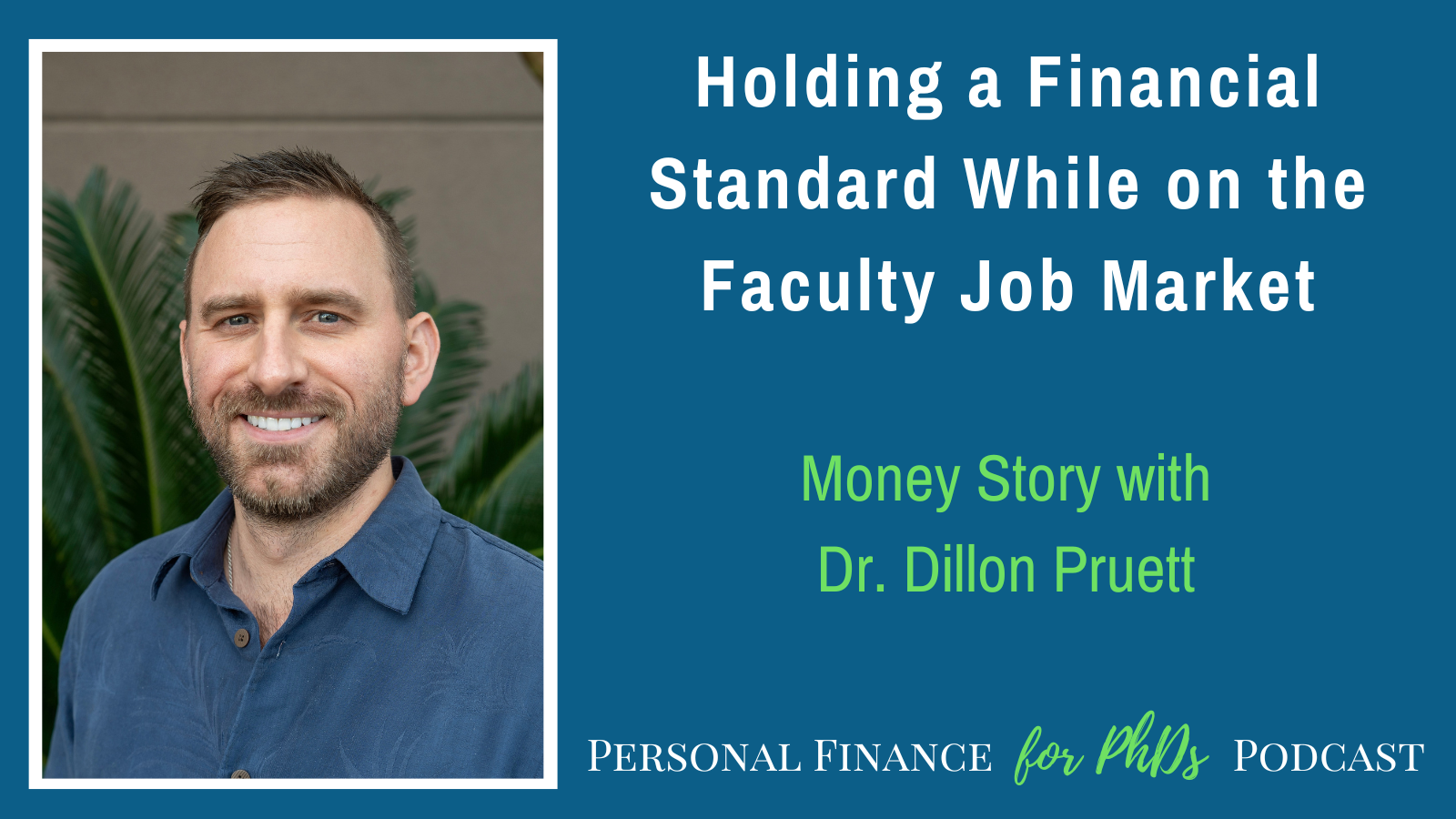
In this episode, Emily interviews Dr. Dillon Pruett, an assistant professor in the School of Communication Science and Disorders at Florida State University. This is the second part of a two-part interview in which we discuss Dillon’s turbulent faculty job search and transition to a faculty position. A higher income doesn’t completely ameliorate all financial challenges, but the future is looking bright. Dillon’s candor during this conversation is laudable, and his experiences are likely to be both relatable and a cautionary tale for prospective and new faculty members.
Links mentioned in the Episode
- PF for PhDs S23E7: Financial Chaos Exacerbates a Low Graduate Student Stipend
- PF for PhDs Podcast Guest Submission Form
- Host a PF for PhDs Seminar at Your Institution
- Emily’s E-mail Address
- PF for PhDs Subscribe to Mailing List
- PF for PhDs Podcast Hub
Teaser
Dillon (00:00): I was, my jaw dropped. I was like, are you kidding me? Like that is, that’s really, really crazy.
Introduction
Emily (00:20): Welcome to the Personal Finance for PhDs Podcast: A Higher Education in Personal Finance. This podcast is for PhDs and PhDs-to-be who want to explore the hidden curriculum of finances to learn the best practices for money management, career advancement, and advocacy for yourself and others. I’m your host, Dr. Emily Roberts, a financial educator specializing in early-career PhDs and founder of Personal Finance for PhDs.
Emily (00:48): This is Season 23, Episode 8, and today my guest is Dr. Dillon Pruett, an assistant professor in the School of Communication Science and Disorders at Florida State University. This is the second part of a two-part interview. In the first part, Dillon and I covered his financial journey through his PhD and postdoc at Vanderbilt University. In this second part, we discuss Dillon’s turbulent faculty job search and transition to a faculty position. A higher income doesn’t completely ameliorate all financial challenges, but the future is looking bright. Dillon’s candor during this conversation is laudable, and his experiences are likely to be both relatable and a cautionary tale for prospective and new faculty members.
Emily (01:33): For Season 24 of this podcast, I plan to publish a series of Budget Breakdown episodes. These interviews follow a template in which the interviewee shares their income, current financial goals, and five largest expenses. I’m looking for four grad students to provide these interviews, so this is your official invitation to volunteer. I love that on this podcast I get to feature PhDs and PhDs-to-be who are almost exclusively regular people and learn and share their real-life stories and strategies. If you would like to break down your budget, please go to PFforPhDs.com/podcastvolunteer/ and fill out the quick form, and I’ll be in touch over email. I look forward to interviewing you for this summer series! You can find the show notes for this episode at PFforPhDs.com/s23e8/. Without further ado, here’s my interview with Dr. Dillon Pruett.
Dr. Pruett’s Finances During the Postdoc Years
Emily (02:43): Okay. Let’s talk more about your postdoc then. I understand you did your postdoc at Vanderbilt as well, and it sounds like you didn’t move right. Were you staying in the same condo during that phase?
Dillon (02:52): Yes. Um, so that was a really great transition because I ended up doing a postdoc with a professor who I had collaborated with during my PhD. And so, um, she was also on my PhD committee. So when my dissertation defense was delayed a little bit, um, she knew exactly why. She knew exactly when it was scheduled for. There was no issue of having to contact another university and get my offer extended or have to change, you know, my moving date or any of, of that. So that, that was really, really great. Um, I noticed, so I, um, was on a TL1, which is a clinical and translational science fellowship. Um, and so, uh, that came with a stipend, I think it was about $56,000. Um, and that also came with, um, paid insurance. And so, um, that was, that was a huge boost in the amount that I was, it was more than double what I had previously.
Dillon (03:58): And so it pretty much ameliorated all of the issues I had with like counting the dollars to the end of the month. I was like, well, shoot, like this is this, this is great. I feel like a normal human being that can, you know, get a burrito and not have to be concerned that that’s gonna impact me down, down the road. Um, so that, that was, um, really huge just for, to feel like I could take a breath of fresh air. Um, even on my, my postdoc, there were some discrepancies within, um, the department and, um, I felt like I was comfortable with what I was getting, but again, knowing that other people were getting significantly more, um, was like, oh man, like it makes me feel like I am, I’m less than. So I had a very niche focus for, you know, my PhD and for my postdoc, um, postdocs that had a, a more heavily quantitative focus that could work on multiple projects. Um, were getting maybe like $90,000 a year. Um, and I think the justification was that that was more or less the going rate for the type of skills that were required for that role if those people were having the open market. And so that was, that was that. Um, so it would’ve been great to be getting, you know, almost twice as much as I was getting, but I was really grateful to be getting so much more than my PhD that it seemed like, you know what, again, just kind of focusing on myself, not letting myself worry about that. Um, and I think that my, my, uh, postdoc mentor advocated kind of on my behalf, but was essentially kinda shot down. I was like, no, we’re, that salary could not apply to me for what I was doing. Um, so no, um, no, ill feelings towards that. It’s more the issues, the larger system than my individual situation.
Emily (06:19): Yeah, I totally understand that. And people do make different amounts of money That’s true in different fields. They’re paid differently. Um, it just strikes me that like you were, they had you anchored at that grad student stipend level that unchanging grad student stipend level, so that yeah, when you double your compensation, like you feel great about it. Um, and I understand, you know, you, you were trying to, again, keep your eyes on your own paper, but like yeah, that does sting to have another person who had the same ti- kind of title as you, right. With such huge disparity. Okay. How many years were you in your postdoc and what was the financial transition, if any, that you were able to make during that period of time?
Tenure Track Faculty Salaries at R1 Institutions: $63,000 to $100,000+
Dillon (07:02): Yeah, I started my postdoc, um, in 2022, and then I, um, was applying for jobs fairly quickly, faster than I, um, anticipated with in 2023. Um, and that was because I’d had some, um, department search chairs that specifically reached out and said, Hey, you should apply for this. And I didn’t really quite feel ready for that, but I was like, okay, I mean, if you’re telling me, I guess I’ll at least put my name in the hat. Um, and once I had done like two or three applications, um, it was relatively trivial to just apply for, you know, seven or eight more. Um, and so I had a couple of on-campus interviews. Um, they were all places that I was at least interested in perhaps working at. Um, but one of the offers was for I think initially like $63,000 a year. And this is, uh, uh, an R1 school in the southeast.
Dillon (08:14): And I was, my jaw dropped. I was like, are you kidding me? Like that is, that’s really, really crazy. Um, I had a competing offer from another R1in the southeast, um, for I think 74. And I went back to the first school and said, Hey, you know, are you willing to match it? And they were sort of like, we can go up to 72, but we, we can’t match it. So I said, okay, that’s, that’s not gonna work for me. Um, for the other school that was at 74, um, I still felt like that was way low and I had a lot of debate because I’m like, well, look, this is a tenure track position at an R1 school. I felt like I could have success there. It would be limiting in what type of research I could pursue, but I felt like the bar was such that I could clear it and be a success.
Dillon (09:14): And so that, that gave me a, a big reason to pause. Um, at the same point in time, I did an on-campus interview for another R1 in the southeast that I knew would be over a hundred thousand per year. And so I was like, okay, that would also be a better place for me to do my research. Um, and I just feel like that would be the best fit. Um, it was a really weird situation where after I had my on-campus interview, I followed up and, you know, wanted to ask where they were in their search process and heard nothing and reached out again saying, Hey, I have other offers. Just wanted to know where you’re at again, nothing. So, um, I was pressured from the other school to say, Hey, like, are you gonna take this or not? And I basically just said, no.
Dillon (10:12): I said, you know, I am still waiting to hear back. And I just felt that 74,000 was, was very low. Um, still ended up being ghosted by the third place. Um, did not have a rejection email, not, and automated one, not anything else. It was just radio silence. So, um, that was really weird. Um, and I reached out to other professors at Vanderbilt. Uh, they were more senior to just be like, Hey, like, this seems odd, is this normal? And they were like, no, that’s not, but they, you know, kind of did their best to assure me that it was unlikely directly related to something inherent to me and more that they didn’t have their kind of department in order. And this is a reflection of that, and that if that is the way that things are going, then maybe that’s not a great spot to come in as an assistant professor.
Dillon (11:14): Um, so I ended up sort of doing a lot of interviews and getting very close, but kind of walked away from things and felt a little, um, unnerved by it all. I was like, okay, I, I had this position that would’ve been okay, really didn’t pay that well. I said, no, should I have accepted it? And then this other place that just didn’t even get back to me. Um, so then the following, uh, year, uh, I came back and did I think one or two apps kind of early and then did an on-campus interview, um, a little bit earlier in the season and was offered that and decided to take it, um, at Florida State. And I didn’t know it at the time, but the, um, o- offer was for $88,000 per year, um, on a nine month, um, contra- or salary or however that’s, that’s phrased.
Dillon (12:17): Um, and I was told that the starting salary was not negotiable for essentially like, uh, it’s set by the union. And I was a little bit surprised by that because I know that a lot of, a lot of state schools have faculty unions, but I didn’t quite understand how that played such, um, a large role in the salary negotiate sal- salary negotiation, because I really felt that that was like the most common negotiation point that you could have.
Deciding on a Tenure Track Faculty Position
Dillon (12:54): And so I was just sort of like, oh, that’s, that’s it. Um, okay, well, um, I guess this is my next big choice is do I take this or, or not. And I felt that Florida State was a place that I could, um, have success, have support. Um, I was in a good peer group. Um, it felt like things are gonna start getting very sticky very quickly with higher ed, and so it felt like I really should not wait on this, and this seems like a good spot. And so, um, that’s kind of how that all, all of that unfolded.
Emily (13:33): I’m trying to get to the timeline. We’re talking about fall 2024. Is that when you were extended the offer? Is that right?
Dillon (13:40): So I would’ve interviewed in December of 2024, and then I received an offer in, I think it was January of 2025.
Emily (13:48): Yeah. Sticky. Yeah, that’s a good way to put it. Sure. <laugh> uh, prescient. Good job. <laugh> securing something at that stage
Dillon (13:57): And kind of just layered on top of that. I was very sick for my interview week, week weekend. Um, I had a conference right beforehand and I had started to get sick and I was like, oh, all right. Maybe if I just take like one or two, like two days of rest where I am just trying to sleep and take meds, I’ll kind of get through it. Um, ended up getting worse and I had a fever, I was coughing consistently, I couldn’t sleep. I had lost my voice and I was like, I can’t call the day before I’m supposed to leave, or the day of I’m supposed to leave and just cancel this. Um, and so I was like, well, maybe by the time I get there I’ll be over the hump and I’ll be recovered. And so it was magical thinking. Um, and no, I was very sick.
Dillon (14:52): I went through like literally a bag of cough drops per day. Um, I had to have water with me the whole time near the end of my job talk, you know, I had this coughing spell that I had to take like a minute or two and a minute. A minute or two doesn’t sound like a long time, but when you’re coughing for a minute or two straight, um, it was, it was probably the toughest like academic thing that I’ve ever had to do, um, is you’re supposed to be on the whole time you’re supposed to be at, at your best and you’re conversational and answering these personal questions and research questions. And, um, I just got through it all and just said, okay, I guess this is, this is what I have to do. Um, I try to take this mindset that I’m like, imagine you’re like special forces in the military. There’s no option to not do it. You’re just gonna do it. And it ended up that it worked out.
Emily (15:53): What I’m actually taking from that story of, you know, these two rounds of applications and your interview process and all that is like, um, that you kind of had, I don’t know if I wanna say it’s an abundance mindset, but at least like not a scarcity mindset. Like you really talked yourself through, you know, declining the offers that you had because you were kind of like, they aren’t sufficient, it’s not gonna be a good fit. And I think a lot of people would say, I have a bird in hand, right? Like, I have it, I have to take the offer because these tenure track positions are so hard to come by. Um, yet you held out even, you know, it didn’t work out the first year, but working out the second year, despite the adversity and the interview and all of that, just like, yeah, you had a, a standard that you, um, held the job that you wanted to accept too. And so I just want people to get that message of like, it’s not all scarcity. Okay. I know there’s scarcity in academia, but not always, not for everyone. Um, there can be times when these things work out.
Dillon (16:58): Yeah. And you know, I’m very grateful that it didn’t work out because, you know, this is such a tough place to be, you know? And so, um, it’s tough to explain that to your family or your parents because they’re like, oh, okay, well you’re doing a PhD, so that means you’re gonna be a professor. And it’s like, well, first of all, it’s if you want to do it, and there’s a whole range of places and spaces that you can go with that, but also it is not any kind of guarantee. And like if, if you’re in your PhD, you, you, you kind of know that, but to explain to your parents that are like, I don’t know, um, as, as much as they love you and as much as they think you’re great, you can be really great and it can still be really, really tough. And so, um, that’s why I felt such anxiety from having said no to these places because I’m like, am I gonna be kicking myself, you know, a year or three down the road when I’m like, if I just had done that? Um, and so it, it did work out and I’m grateful for it.
Emily (18:05): I think you also, and maybe this is true, but you should have been taking some clues from okay, I was invited to apply like only a year into my postdoc. Like maybe I have a strong profile, like maybe I’m a competitive candidate here. Even though it didn’t work out in year one, it did, you know, subsequently. Um, the other thing about the parents, I think, or maybe outside people, like having that expectation of like, oh yeah, PhD means professors. Like when you actually like grab that ring and you’re like, I got it <laugh>, I’m accepting an offer. They’re like, of course, of course that’s what was going to happen. You’re like, no, you have no idea. Like what I went through to get to this point. <laugh>.
Dillon (18:41): Yeah, exactly. Exactly.
Emily (18:43): Okay. Well, is there anything that you’d like to share with us about your current position and the financial aspects of it? I mean, I kind of think you left a little open loop there with like, does the union actually determine faculty salaries? Like what have you discovered in your time since you accepted or since you started?
Dillon (18:59): Um, it’s still an open question. Um, so I know that that is not university wide. Um, it might have been that there was a specific pay line that was given to the school from the college that either there was a maximum or just a set amount. And that was just that. Um, there’s also some very interesting, uh, issues where I have a startup, but I cannot use my startup to pay students or to pay staff. And that’s kind of wild in the basic science space because like when you are just starting your lab, you, you get postdocs, you get, uh, research staff you like, that’s how you build up your lab and you do the work that you need to do. Um, and so it’s just a little bit odd that, um, that’s the restriction that, you know, I’m, I’m working through. Um, so
Emily (20:05): My understanding that until you get a grant, you can’t hire anyone. Is that right?
Dillon (20:10): Essentially. Yeah. Um, there are undergraduate and masters students who, um, can do sort of like, uh, i, I don’t know the exact term, but sort of like a, a research experience where they can work in your lab for a certain number of hours per week. Um, that’s not guaranteed. You have to, you know, there’s only so many students that that that can go around. Um, I’ve also learned that for as much as I have, you know, kind of complained about my PhD experience, um, it is a lot bleaker in other places. And so, um, you know, even with my department now, I’m like, oh, I don’t know that I would bring in a student unless I had a grant because there are so many issues. Um, they kind of, they extend in in multiple ways. Um, yeah, I want elaborate on, on, on that more, but, um, you know, I’m having to kind of transition from thinking about, okay, what were my experiences to now? What would I want, um, a student to experience as, as my student
Emily (21:29): That’s very positive. <laugh> in terms of an outcome of your experience to yeah, be thinking about it. ‘Cause you know, with some, again, I mentioned distance earlier, the distance of time, some people do forget or start to romanticize, um, their own financial experiences during graduate school, um, when it benefits them to do so in terms of who are they gonna hire and how much are they gonna pay them and are they gonna negotiate and all these things. So I appreciate that, you know, you’re still close to the experience, but that you’re taking that mindset and saying, okay, maybe better not to hire anyone under these circumstances until I can provide for them in a way that you think is fair and sufficient to, you know, further their development. Of course, the research that you want them to do for your lab.
Dillon (22:11): Yeah, I think that communication sciences and disorders is a very interesting field because it can be situated in a lot of different places within a university. It can be in the College of Arts and Sciences, it can be in a college of education, uh, at Vanderbilt it was kind of, uh, part of the medical program and biomedical sciences. Um, and so each of those different placements kind of impacts the expectations and the ability for your students to get funded in ways that I think would be appropriate.
Emily (22:48): Yeah. So it’s definitely something to consider when you’re doing interdisciplinary work. Right.
Commercial
Emily (22:56): Emily here for a brief interlude. Would you like to learn directly from me on a personal finance topic, such as taxes, goal-setting, investing, frugality, increasing income, or student loans, each tailored specifically for graduate students and postdocs? I offer seminars and workshops on these topics and more in a variety of formats. This is a perfect time to book me for a workshop at the end of the current fiscal year or at the beginning of the upcoming academic year. If you would like to bring my content to your institution, would you please recommend me as a speaker or facilitator to your university, graduate school, graduate student association, or postdoc office? My seminars are usually slated as professional development or personal wellness. Ask the potential host to go to PFforPhDs.com/financial-education/ or simply email me at [email protected] to start the process. I really appreciate these recommendations, which are the best way for me to start a conversation with a potential host. The paid work I do with universities and institutions enables me to keep producing this podcast and all my other free resources. Thank you in advance if you decide to issue a recommendation! Now back to our interview.
Financial Challenges as a Tenure Track Faculty Member
Emily (24:21): Okay. Give us a picture of your finances. Now we know your salary. Where is it taking you? What are you doing in your financial life now that you have this position?
Dillon (24:32): Yeah. Um, it still feels very unsettled, um, because I just moved in August, um, I moved from the condo that I lived in Nashville to a house that I’m renting with my wife. Um, there were a lot of expenses with the move. Um, Florida State provided a sign-on bonus, but not, but that was, uh, it, it was, it took several, uh, weeks for that to be dispersed. So I had to put a lot of moving expenses on a credit card. Um, it took a while for our condo to sell, and so there was a short period of time where we were doing a mortgage plus rent, um, which was really tough. And then my wife, um, had to move jobs and so there was, um, you know, about four weeks where she wasn’t working. She’s just now working towards her first, uh, full paycheck. And so the, the coffers have have kind of been, been drained.
Dillon (25:37): And so, um, I feel like, you know, give it another six months and we might be in a better place, but it still feels very kind of unsettled. Um, and so even though I’ve, you know, gotten a, a pay raise, it really doesn’t feel like it, it almost feels like, um, like a step backwards as far as, um, just the amount of money that’s, that’s been laid out. Um, additionally, I am, um, paid for nine month salary, um, which previously was 12, right? And so, um, there’s a, uh, institutional grant that you can apply for that helps supplement your summer salary for your first year, but it doesn’t fully replace it. Um, and so I’m gonna have to just be basically saving money through the months in order to pay my own salary in the summer. Um, so that feels a little, a little scary.
Dillon (26:43): Um, hopefully, you know, I can supplement that with grants down the road, but that’s gonna take, you know, at at least a year or more to, to do. So, um, I am hoping to, um, buy a house in like May or June, so that will be another kind of like big major purchase. Um, and a again, a lot of money associated with, with that. So, um, and I’m ba- what I’ve, what I did is I kind of put the money from the condo into a, uh, like money market account. Um, and so I, I can’t and won’t touch that up until that point. Um, and so, um, yeah, it, it, it’s, it’s good to be starting fresh, but also there’s some aspects of it that, um, just take a while to sort out.
Emily (27:39): I’m really glad to have this message on the podcast as well of like a higher salary is not a panacea. Like, it’s, it’s helpful, definitely better than not being paid as much, but like, as you progress in your life and your career and your finances, also kind of the stakes get raised. Like we’re talking about home ownership, right? So like selling a condo and like buying a house. So like we’re trying to do an upgrade here, you know? Um, and so the expenses get raised too, and things like moving, uh, interruptions in pay because of career transitions, like all these things are normal things that happen. So it’s like, yeah, you have the higher salary, but like you said, it doesn’t quite feel much easier yet. And hopefully once you know, things settle down from the transition, the moves and all that, like, hopefully you will start to feel better about it.
Emily (28:26): But like, yeah, it can take some time for sure. Um, so it’s not an immediate fix necessarily. The postdoc salary probably felt better, right? ’cause you didn’t move, you probably didn’t have an interruption, um, in your paychecks or anything. And so it was just like, oh, immediately there’s more money. That’s great, right? But when you factor in these other things that happen at these different career stages would involve moving different cost of living different places. Yeah, it can, yeah, challenging, but I’m very hopeful for you and your wife and your future and these changes that you’re going to make and yeah, that you’ll figure out <laugh> the summer salary and the grants and subsequent years, and maybe this year will be the hardest year, right? Financially getting all this stuff sorted out. Um, is there anything else that you’d like to share about this stage and your finances or money mindset during this stage?
Dillon (29:12): I don’t think so. I think that, um, I kind of came into both my PhD and my faculty job with reasonable expectations, and I’m really grateful for getting to pursue this, you know, line of research that is meaningful to me that I feel like I’m making an im- an impact. Um, there’s certainly days or times that I’m like, man, I have so many interests and I chose this really niche thing that not a lot of people can relate to. Um, and that feels, you know, tough. But then there are times when I feel like, man, if I’m not doing this, I don’t know who else would be, or, um, I can help someone down the road that, um, if I wasn’t doing it, um, I’m not sure we would have that, that knowledge. Um, so even, even throughout my PhD, I had a roommate who was like, oh, you should, you should, you know, just go and work for Google and like their speech sciences that does voice recognition stuff and you’ll get paid way more and you’ll have a better life and blah, blah, blah.
Dillon (30:30): And, uh, I was kind of offended by that. I was like, yes, I probably could do that, but that would completely abandon this, you know, sort of dream and this motivation that made me do this in the first place. You know, I wasn’t working towards just a degree because it sounded cool, or that was just the next logical step. Like this was something that I literally planned out from my freshman year in college. Um, and so it was sort of like, you know, pursue that or go out in flames trying. Um, and I think that because my motivation was so personal, it made it easier to push through some of the hard times where, um, people that maybe lacked that a little bit, you start to look around because you’re like, well, what’s, what’s the why? And I think that that is important. It’s no wrong or right answer, but I think it, you’re going to be in situations where you confront that to varying de- degrees and, um, I’m just glad that, you know, mine has, has worked out the way that, that it has.
Emily (31:37): People are allowed to make different decisions around this, right? Like, yeah, you have this personal motivation, as you said, you’ve had a long-term plan, you’ve been executing, and this is at least the first stage of the culmination of that. Um, and certainly try it out. And if you decide it’s not all that it’s cracked up to be, then you can make a pivot at some other point. That’s totally fine. Um, yeah, but I, I’m also struck by like mission-driven people also need to be paid well enough to sustain what they’re doing. So I hope that is the case for you now that you’re in this, um, this level of your career. Um, so Dillon, it’s been an absolute pleasure talking with you and hearing your story, and I think there’s so many great nuggets that listeners can have gotten from this interview depending on what stage they’re at.
Best Financial Advice for Another Early-Career PhD
Emily (32:23): Um, I wanna conclude with the question that I ask of all my guests, which is, what is your best financial advice for another early career PhD? And it can be something that we’ve touched on in the interview already, or it can be something completely new.
Dillon (32:35): I, I sometimes struggle with that because everybody’s different and what worked for me isn’t necessarily gonna work for everybody else. Um, but something that I got in the habit of that was a huge help was just tracking my spending and knowing, learning to know exactly what I could afford. Um, and that allowed me to make some choices that were trade offs, but at least I, I sort of knew the dollar amounts and how that would impact me. So, um, yeah, I, I think that because I was on this fixed amount for so long, I had kinda my core expenses that were paid for or that I could pay for, and then it was sort of, how do I play with the margins of that and what’s that going to go towards? Um, my, my wife went to law school and took out a lot of loans and she had a very different experience where she had such massive loans that she was like, oh, what’s a hundred dollars here or a hundred dollars there, it doesn’t really matter.
Dillon (33:45): And so she didn’t have that sort of fear of God into tracking her spending because she didn’t really have to. Um, but if you don’t do that in your PhD, you can kind of quickly accumulate things that will hurt you down the road. Um, so it’s not fun, but I could kind of, after a few years, I could kind of be like, oh, alright, I have approximately, you know, $400 to appropriate this month. Where’s that gonna go and how am I gonna do it? Um, and if I know there’s something, you know, five months down the road that I’m gonna do, I can try to segment as little as I could to put towards that. Um, controversial take here is that I feel like I leveraged credit cards very well. Um, I was not a crazy points guy, but I definitely took advantage of a lot of, um, signup offers.
Dillon (34:49): I was very good about paying off my credit cards, um, for the, for the most part unless there was like a 0% APR card that I basically took out specifically for that reason. Um, and so that gave me a little bit more money. It gave me a little more flexibility, having a zero interest essentially loan. Um, and then that also did help build my credit through time. So I have a credit history that’s lengthy and positive and, you know, they’re fairly good amount of it. In fact, I was always shocked that these credit cards were granted to me for, you know, $10,000 and I’m like, I can barely afford my groceries at the end of the month and you’re just giving me 10 grand. Like, that’s crazy. But if you do it right, you can, you can make that work. Um, again, that was a super intentional and thoughtful process that I did, and you can have that go sideways really, really quickly. Um, so it’s not exactly advice for everyone, but if you can kind of thread the needle, there are good things that can come.
Emily (36:05): Well, I think the second, I don’t wanna call it advice, but the second suggestion or, you know, modeling what you did follows very well from the first you have to master and understand your own spending and develop some intuition around that before you go into, um, playing with fire a little bit, <laugh>, which is, you know, the, the credit card games and so forth you can play because the temptation with credit cards, you know, using plastic in general and then doubly, so if there’s like a benefit, you know, points or sign up bonuses or whatever, there really is a little pull there to spend more than you would if you were using other forms of payment. And so, but if you have that knowledge and intuition and the budget or whatever it is that you’re doing to kind of keep your spending in line and on track, then you can do that successfully, which it sounds like you did.
Emily (36:51): Um, so I’m very glad to hear that that worked out for you. The Points game is not, uh, controversial on this podcast, so it’s something that we’ve talked about with other graduate students and I do think it’s one of the ways that people can find a little bit more wiggle room in their spending, uh, when they’re living on a low stipend like you were. Um, so Dillon, again, it’s been such a pleasure to have you. Thank you for sharing all this, uh, with us, especially these sort of behind the scenes things and emotional things that were going on with you through these unpleasant, you know, sometimes unpleasant things that happened. Um, I just think it’s a really honest window into the graduate student experience, the PhD experience, so thank you so much for sharing it with us.
Dillon (37:28): Yeah, glad that I can share.
Outro
Emily (37:44): Listeners, thank you for joining me for this episode! I have a gift for you! You know that final question I ask of all my guests regarding their best financial advice? My team has collected short summaries of all the answers ever given on the podcast into a document that is updated with each new episode release. You can gain access to it by registering for my mailing list at PFforPhDs.com/advice/. Would you like to access transcripts or videos of each episode? I link the show notes for each episode from PFforPhDs.com/podcast/. See you in the next episode, and remember: You don’t have to have a PhD to succeed with personal finance… but it helps! Nothing you hear on this podcast should be taken as financial, tax, or legal advice for any individual. The music is “Stages of Awakening” by Podington Bear from the Free Music Archive and is shared under CC by NC. Podcast editing by me and show notes creation by Dr. Jill Hoffman.
Join Our Phinancially Distinct Community

Receive 1-2 emails per week to help you take the next step with your finances.

Fully funded scholarship program for PHD finance