• Skip to main content
  • Skip to footer

Personal Finance for PhDs

Live a financially balanced life - no Real Job required

  • Blog
  • Podcast
  • Tax Center
  • PhD Home Loans
  • Work with Emily
  • About Emily Roberts

grad student

This Grad Student Bought a Home at the Start of His Doctoral Program

February 9, 2026 by Jill Hoffman Leave a Comment

In this episode, Emily interviews Ethan Muller, a first-year doctoral student in theology at Villanova University. Ethan and his wife purchased their first home outside of Philadelphia at the start of his six-year program. Ethan shares the details of his and his wife’s financial profile, their emotional readiness to become homeowners, and their plans for the home once he finishes his program. After local mortgage lenders were unable to work with him due to his student status and 9-month stipend, Ethan connected with Sam Hogan, who knew exactly how to make the lending process much faster and easier. Ethan and Emily close the conversation by discussing which other PhD students should consider home ownership.

Links mentioned in the Episode

  • PF for PhDs AMA on the PhD Home-Buying Process
  • Host a PF for PhDs Tax Seminar at Your Institution
  • PF for PhDs Tax Center for PhDs-in-Training
  • First-Time Home Buyer by Scott Trench and Mindy Jensen
  • PF for PhDs Subscribe to Mailing List
  • PF for PhDs Podcast Hub
This Grad Student Bought a Home at the Start of His Doctoral Program

Teaser

Ethan (00:00): Especially in the shifting landscape of being an academic, you know, you could apply for something and get in, what does that look like with your house, and what equity did you have time to build? Which is also why before the program, it felt like a big deal to us to just simply attempt to buy a home.

Introduction

Emily (00:24): Welcome to the Personal Finance for PhDs Podcast: A Higher Education in Personal Finance. This podcast is for PhDs and PhDs-to-be who want to explore the hidden curriculum of finances to learn the best practices for money management, career advancement, and advocacy for yourself and others. I’m your host, Dr. Emily Roberts, a financial educator specializing in early-career PhDs and founder of Personal Finance for PhDs.

Emily (00:53): This is Season 23, Episode 3, and today my guest is Ethan Muller, a first-year doctoral student in theology at Villanova University. Ethan and his wife purchased their first home outside of Philadelphia at the start of his six-year program. Ethan shares the details of his and his wife’s financial profile, their emotional readiness to become homeowners, and their plans for the home once he finishes his program. After local mortgage lenders were unable to work with him due to his student status and 9-month stipend, Ethan connected with Sam Hogan, who knew exactly how to make the lending process much faster and easier. Ethan and I close the conversation by discussing which other PhD students should consider home ownership.

Emily (01:40): By the way, I’m hosting an AMA with Sam Hogan on Thursday, February 19, 2026, so that he can answer all your mortgage and first-time homebuyer questions! Sam is a mortgage originator specializing in early-career researchers. Anyone who is considering buying a home is welcome to attend, whether that’s in the near or far future. Register for the event at P F f o r P h D s dot com slash mortgage.

Emily (02:09): The tax year 2025 version of my tax return preparation workshop, How to Complete Your PhD Trainee Tax Return (and Understand It, Too!), is now available! This pre-recorded educational workshop explains how to identify, calculate, and report your higher education-related income and expenses on your federal tax return. Whether you are a graduate student, postdoc, or postbac, domestic or international, there is a version of this workshop designed just for you. While I do sell these workshops to individuals, I prefer to license them to universities so that the graduate students, postdocs, and postbacs can access them for free. Would you please reach out to your graduate school, graduate student government, postdoc office, international house, fellowship coordinator, etc. to request that they sponsor this workshop for you and your peers? You can find more information about licensing these workshops at P F f o r P h D s dot com slash tax dash workshops. Please pass that page on to the potential sponsor. Thank you so, so much for doing so! You can find the show notes for this episode at PFforPhDs.com/s23e3/. Without further ado, here’s my interview with Ethan Muller.

Will You Please Introduce Yourself Further?

Emily (03:45): I am delighted to have joining me on the podcast today, Ethan Muller, who is a first year PhD student at Villanova University. And Ethan is here with a home ownership story, and you all know how much I love a home ownership story for graduate students. So that’s our topic for today. We’re gonna get into all the dirty details. So Ethan, welcome to the podcast. Will you please introduce yourself a little bit further for the audience?

Ethan (04:08): Yeah, thanks for the kind introduction. My name is Ethan. I’m a first year doctoral student at Villanova, Pennsylvania, which is wonderful. It’s right outside of Philadelphia. I spent most of my time before this doing grad work in the Boston area with my wife and went through the incredibly hard process of applying to PhD programs and was lucky enough to, uh, wind up, I guess at Villanova. Yeah.

Emily (04:35): Can you tell us just a tiny bit more in that background question about maybe the timeline on this? Like when did you finish undergrad? What were you doing between then and when you applied for doctoral programs and also when you got married?

Ethan (04:48): Yeah, that’s a great question. My then girlfriend and I decided that we did not wanna go to grad school, um, as, uh, anything other than a married couple. So in the, I guess it was early spring of 2023, we both applied, um, to graduate programs. She got into Northeastern University and I got into a seminary on the north shore of Boston. So we got married in the spring of 2023 and went to grad school from 2023 to 2025. I applied to PhD programs the fall of 24 and heard back in the spring of 25.

Emily (05:27): Great. And what is your wife doing now? Is she also doing more school or has a job?

Ethan (05:32): My wife works in marketing. She has training in clinical psychology. She’s worked previously as an ABA therapist, wanted to switch it up, wanted to do something different. So now she’s in the field of marketing, which is great, expanding her CV a little bit. Um, we both during our grad school days, worked at Whole Foods Market, which is our claim to fame. It was our <laugh>, our our era to save a little bit of money while we lived on campus and, um, that kind of let her see some different experiences in different fields and corporations. So.

Why Buy a Home as a First Year PhD Student?

Emily (06:01): I love that story actually. It’s, it’s so often that I find that work experience itself is what opens our minds to other possibilities for how, you know, areas in which we might work or apply our education and so forth. So that is awesome. Thank you so much for that, um, backstory. And so when you’re, you know, you’re into this PhD program and you’re moving to Philadelphia, what made you interested in buying a home at that stage?

Ethan (06:24): Yeah, uh, it’s quite rare, especially as an academic to, there’s only a certain few places you can really go for school, depending on the field. I mean, sometimes people are limited to, Hey, I’m moving to the west coast. Other times it’s Chicago. It, it’s really rare. So I’m in a very niche field of theology where I knew that Philadelphia was a place where I could go one, because I was born and raised in Pennsylvania. So it became a very intentional part of my pitch to being accepted, um, that Pennsylvania was a place not only that I loved dearly, but wanted to return to. Um, so my wife and I really pushed hard to get into Villanova. I was very honest with the faculty there. Reached out, uh, quite a few times in order to make strong connections to put my best foot forward. Pennsylvania was the place for us. One, because this is not just a me decision, it was my wife as well. But two, the cost of living was much different than Boston. We loved the Boston area, it was brilliant. There’s so many wonderful opportunities and connections, but Pennsylvania really offers a good access to many different areas of the country, while also having a lesser cost of living, which for people who wanted to own a home, uh, that, that was pretty key for us.

Emily (07:39): So, but why, even though, you know, you’re, you’re sure you wanna put roots down in Pennsylvania and you, you know, you’re presumably there for the length of your doctoral program at a minimum. Um, why buy? Because renting is obviously the default and easier decision.

Ethan (07:52): Yeah, that’s for sure. We rented all up until that point, uh, most of the rhetoric that was given to me was, you can’t buy unless you have a certain amount of time, which I’m not sure how accurate that is or how many times other people have heard that. Like, oh, you need to have five years or 10 years when you buy. Um, and we had some people come alongside us and say, Hey, maybe that’s not so true. If you have time to save money while living on campus as a grad student, even if you’re in a next place for three to four years, no matter where we were gonna go, we felt like we had a enough of our debt covered to really put a foot forward into buy to make an investment. It just felt like something we were ready for.

Emily (08:34): I heard the same thing, um, the same rule of thumb around five years, or it could be even longer in some cases. Um, and I agree that that is off-putting for a lot of people starting a PhD program because they don’t, it could be only five years or it might be a little bit less or maybe a little bit more and we just don’t know. But I agree with you that it’s, it’s actually much more nuanced in that first, I mean, as a rule of thumb, it’s fine, but you always have to take a rule of thumb and then go into your specific market and your specific situation and really drill down into that. And the other thing is that that rule of thumb really comes from the transaction costs of buying and selling within a short period of time. And how likely it is that the appreciation of the value in your home is going to overcome those very high transaction costs. Very legitimate question, but the kind of corollary to that is like, well, maybe you don’t need to sell the home just because you finished your doctoral program. Like one, maybe you’ll stay in the area, you’ll still use the home. Two, maybe you’ll decide to rent it out. Like just because you finished your program doesn’t mean you actually have to sell and incur those transaction costs anyway. Probably some things that you were also thinking about when you were making this like evaluation.

Ethan (09:37): Yeah, one of the things for us was it’s whether you’re there for three years or four years, it doesn’t have to three to be a three or four year investment. The, the, the investment of the house can last much longer than that. And I think in the shifting world of academics is we saw, especially with Zoom, there was capacities to have an academic role while being in a singular area. So even though, uh, you know, who knows what’s happening with education as a whole nowadays, we knew that my wife and I could, she could find a job that was remote. I could find an academic job that was remote. So putting down those roots and investing in the house seemed more probable than let’s say 10 years ago.

Emily (10:11): Hmm. I totally agree. Yeah. Thank you for bringing up the changing work norms that we’re dealing with <laugh> and yeah, you’re not the first person as an academic who I’ve spoken to who is either working remotely or open to working remotely. Um, you know, within their roles. You mentioned that you had been in a master’s program, you were also working at Whole Foods, um, you of course have your wife’s job and your like stipend offer from your doctoral program. So putting that all together, like what was your financial profile that you kind of like presented as like a prospective homeowner?

Financial Profile as a Prospective Homeowner and Grad Student

Ethan (10:41): Yeah, I’m, the biggest aspect to my wife and I’s homeownership profile was that we didn’t have any school debt. That was one of the biggest things for us. We went to grad programs where there was open funding for us where we, we really went to the places where we got the most scholarships and we could pay off the debt as quickly as possible. Um, along with that, we had some strong savings in a couple investments, but really the thing I think that spoke the loudest was we had good credit. We had years of credit history and we had no debt and no student loans. Um, which really I think every lender we talked to was really happy with that. Um, because you don’t realize that the common norm, at least for a lot of academics and a lot of my friends has been there, is so much, there’s so much debt and there’s so many things that can get in the way, uh, of putting down a down payment or even just paying for an appraisal and things of that nature. So my wife and I went into the graduate season knowing that if we wanted to buy a house, we had to focus on debt. So we’ve started paying off our debt while we were in grad school working at Whole Foods. That was, we worked alongside that probably 30 hours a week just to supplement and slowly pay that off. So when two years was up, um, we wouldn’t have any student loans.

Emily (11:58): So if, if I, if you don’t mind, um, when did you acquire the student loans? Was it only from undergrad and you managed to, you know, okay, so just from undergrad, so that’s great. So you were in your master’s programs, you had your offers from there, whatever the funding packages were, plus you were working 30 hours per week on top of that, and that’s how you managed to repay the prior debt.

Ethan (12:20): Yes. Uh, it’s a hard road <laugh>, it’s a hard road that I’m sure many other people in grad school and in doctoral programs feel as well. Um, but I also think it’s really important that when you’re in these big metropolitan cities for academics, there are part-time jobs that are really accessible. Whole Foods has a great starting rate. They started me off at $18 an hour with zero experience and gave a discount. So there’s ways that you can make things work.

Emily (12:44): Then tell me a little bit more about your income, if you don’t mind. ‘Cause you have a two income household and we’re talking about Philadelphia, so yeah. How much are you guys making together or individually?

Ethan (12:55): Yeah, so my stipend is a nine month stipend. I know each school does it differently. I, these things fluctuate, but I’m at $30,000 for nine months and then the summers, there’s still coursework and things of that nature. But you do have a capacity to go and get a job or just internships, different funding at the school. My wife works in marketing. She’s around 45, I would say 40 to 45 depending, because you know, there’s incentives in different, um, qualifications for that. So all around we’re probably $70K a year, uh, on a good year. So it’s, we are a little bit outside the Phil- City of Philadelphia. That’s one of the beautiful things. Um, I go on the turnpike for a little bit and I can get to school, which is very, very nice. Uh, one of the benefits to doctoral work, so we are in a more rural area that has, uh, less living costs than, uh, downtown Philly would.

Emily (13:51): Hmm. Let’s talk about that. Home selection and the location is certainly part of it a little bit. So you have, you know, around $70,000 a year able to demonstrate on your paperwork that you’re gonna be earning um, in a year. And so like what, like price, because I, I haven’t even kept up with, I know interest rates are kind of like shifting now. So what price range does that enable you to buy in? And then what did you like ultimately select and, you know, share whatever you would like to about the home that you actually purchased?

Ethan (14:17): Most of the homes in our area, which is central Pennsylvania’s a very interesting real estate area because it’s low inventory, but high demand. So things go very quickly and they’re normally listed at a premium, which is similar to a lot of places nowadays. Um, we were looking in the, our, our top number was 330,000. That was the max that we could do. And now things depend, are you working to, is the price more loose? Are they, is it gonna sell quickly? There’s all these things that go into it. We ended up buying at that price, which was good for us, but it was also a place where if we were going to spend the extra money, it had to be move-in ready and it wasn’t necessarily a flip sort of investment. We were able to secure a house within a day. It was only up for a day. Very competitive market. We had to see it the day of for 330,000. So.

Emily (15:09): Yeah. So of the down payment, you don’t have to gimme the exact figure, but was it in like the 3 to 5% range of like the minimum for a conventional loan? Or was it like higher than that?

Ethan (15:19): It was very interesting. So the sellers of the house wanted a really high earnest money deposit, so it felt larger on the earnest money deposit end. I think the earnest money deposit was somewhere around 3%. Um, and the total down payment ended up being I think 7%.

Working With Mortgage Lenders as a Grad Student

Emily (15:40): Interesting. I understand that you ended up working with my brother Sam Hogan, um, for your loan and that’s how we got connected. But I’m wondering, you know, you told us you make, um, $30,000 over nine months. Is that W2 income or is it fellowship or like what’s the reporting like nature of the stipend?

Ethan (16:00): Yeah, that’s a great question and something I had to figure out early on when I reached out to lenders. It is, I am an employee of Villanova University, which is very helpful, I would say to anyone who’s applying to programs or once you get in, you can immediately reach out and ask ar what your HR, what your status will be. Um, Villanova’s really student focused and friendly, where they made sure based on doctoral students complaints and questions so forth, that they were employee status and not just independent contractors, um, which was very helpful. So it, it is W2.

Emily (16:35): Okay. I know that makes it so much simpler for lenders, so much simpler. But I’m wondering why you ended up working with Sam who kind of has like a specialty in this area. Did you have trouble working with local lenders? Like what went on on that front?

Ethan (16:47): Yeah, local lenders were incredibly friendly, but not always well versed in my situation. Uh, I didn’t run into any bad people, but I was forced to go online and somehow, you know, find this podcast and then find Sam and Sam was incredibly helpful and knew exactly what he needed from me. A lot of other lenders, I spent a lot of time trying to say, this is the situation, these are the documents I have, this is what I’m trying to qualify myself as. And they were wanting to reach out to the school. Would reach out to different people in my program and reach out to me a lot of the day. Sam already had a checklist of what he needed and how he was gonna get it done, and it went very smoothly. So the local, local agents and lenders were great, but it was, it was quite complicated with them.

Emily (17:33): Hmm. So you were kind of having to educate them about what the situation is, whereas Sam already deals with this day in and day out and he, he knows what’s going on. Um, was it the nine month stipend that was like giving people some pause?

Ethan (17:46): Yeah, a lot of people because it wasn’t 12 months and because it wasn’t medical. That’s one of the things I ran into as well. I’m in a humanities field, which I think some lenders rightfully so see as a bit more, uh, volatile. Um, it was brought up at one point that it was an issue that it wasn’t for a MD or a medical doctor that they wouldn’t be able to sponsor or help with. So there was a, a slew of things that I ran into in which people were hesitant to lend

Emily (18:19): Yeah. They didn’t have like a box that you fit in like neatly, but Sam Sam’s very familiar with all this, so yeah. I’m really glad to hear that he had like the checklist. He was able to like move quickly and everything. Is there anything else you wanna say about the process of like securing the loan or like any of the, the, you know, the contract period or just anything about else about the home purchasing process

Ethan (18:41): With the home purchasing process, I think sometimes, especially as an academic where most people are tight on money, I would say make sure you know what you have. Uh, it was often for me where your agent is asking you, are you okay with this? Are you okay with that? And if the home buying process is quick, know what your yes lines and no lines are, know what’s uncomfortable, know what is uncomfortable. Um, even with Sam, Sam was great helping us wait for a good rate, just waiting for a good rate nowadays is incredibly hard and, and can be very stressful. So knowing for you, this is the last day I wanna lock my rate, this is the last day I wanna worry about this. It just sort of having a strategy and not, um, it can be just really stressful to look at the lack of money that you have instead of what you’re comfortable with. So I would just offer the encouragement to be okay with what you have and, and plan for, um, using that in the most appropriate way.

Emily (19:35): Yeah, I totally concur as, especially in like a fast moving market, like what you’re describing, you really have to have given thought in advance to like what is a boundary, what is a yes, what is a no, what is a need, what is a want? Like all of that stuff when you’re, um, yeah, selecting the home that you’re gonna be living in for at least a few years.

Commercial

Emily (19:54): Emily here for a brief interlude! Tax season is in full swing, and the best place to go for information tailored to you as a grad student, postdoc, or postbac, is PFforPhDs.com/tax/. From that page I have linked to all of my free tax resources, many of which I have updated for this tax year. On that page you will find podcast episodes, videos, and articles on all kinds of tax topics relevant to PhDs and PhDs-to-be. There are also opportunities to join the Personal Finance for PhDs mailing list to receive PDF summaries and spreadsheets that you can work with. Again, you can find all of these free resources linked from PFforPhDs.com/tax/. Now back to the interview.

Initial Experiences With Homeownership

Emily (20:46): So you’ve been a homeowner for like, we’re recording this in November, 2025, so a handful of months now. Um, how have you found the experience? Has there been any like surprises, like positives, negatives?

Ethan (20:59): As far as negatives, I can’t say there’s a whole lot. We’re still very new. We moved in in September, so there’s not a whole lot that we can say that has gone wrong, thankfully, because that’s not always the case. Positives is there’s always things to learn. So if you’re an academic, you’re in a good spot because you must like learning and owning a home is a learning process. One of the things that we found really beneficial about having a home and making this step has been the sort of accomplishment of it, of it can feel so difficult to finding a home in this market that there is a real relief that once you get into a home you maybe haven’t even thought about what you’re going to do with the home. You’re just so happy that you have one. And I think one of the positives is once you get into the home, it really is, uh, an anchor and something to be proud of and something to hang your hat on that you went through the process because it’s so multifaceted and a lot of it was out of my vernacular interest rates and, and I, I didn’t know what an earnest money deposit was if you asked me 12 months ago. There’s a lot of that that you can accrue and I think it makes you well versed to help other people, but also look whether it’s time for your next house, I feel so much more capable, uh, in reaching out to lenders and agents and even with my own finances, it makes you dive deeper into sort of your whole inventory of knowledge.

Emily (22:24): Yeah, that’s very true. And we touched on this a little bit earlier, but do you anticipate this home to be something that you live in just while you’re in graduate school? Um, or so do you definitely see yourself moving at the end of it? Do you definitely not see yourself moving it? Are you open to multiple possibilities? It certainly sounds like you wanna stay in the area, but what about like this specific home?

Ethan (22:45): For the specific home we, it is a four bed, three bath, now, it’s technically two and a half bath. Um, I think they bump that number up on Zillow for the, for the looks of it, but it has space. So one of the things that we’d always consider is this could be more of a investment property in the sense of it was not perfect, but it could use some cosmetic updating. So when we sell it, we certainly could do some things in that realm. We’d love to stay in the house. I’m in a six year program, so at least for that long, um, outside of that, Pennsylvania’s a good area for postdoc research as well. I’m not gonna try and predict where I’m going, but it’s in a good area. It’s in a growing area. We felt like if we bought this house in six years, this area, we’ll still have a lot of people looking for a home, especially a single family residence. So we feel comfortable that no, no matter which way it goes, we’re just gonna put as much cosmetic work into the home as possible and move on from there.

Emily (23:43): So it sounds like you have a happy, happy scenario. Like if you end up staying longer than six years, that’s great. You’ve made a choice that probably will work for that situation or if you end up leaving after six years, that’s all you also thought through that scenario. This is something I was exposed to when I read, um, the First-Time Home Buyers Handbook, I believe is the title, and it’s by Mindy Jensen and Scott Trench over at BiggerPockets. Just even, it’s like in the introduction of chapter one, first thing I learned in the book was like, think through the possible outcomes. You live in the home forever, you sell the home, you move, but rent out the home. Are you going to be, are you making a selection that you are happy with, no matter which of those scenarios it ends up being. So if you know for sure that one of them’s out, that’s okay, but are the other couple of possibilities like you’re set up to do that. Because obviously, like you said, there are some properties that would not make a good rental property that you would pretty much have to either stay in forever or sell, and that does of course limit your options. So it sounds like you were thinking through all those possibilities.

Ethan (24:42): Yeah, the versatility to us was a really big deal. We wanted something that if it is an investment, it’s gonna have the widest exposure to helping us in the future as possible. Especially in the shifting landscape of being an academic, you know, you could apply for something and get it in in New York. What does that look like with your house and what equity did you have time to build? Which is also why before the program it felt like a big deal to us to just simply attempt to buy a home.

Homeownership Considerations and Advice for Grad Students

Emily (25:07): Yeah, absolutely. I mean if your finances are ready like yours were, you know, you had repaid the debt, you had some savings you had on paper, your offer letters and so forth like that is ready. Of course, not everybody, even if they wanna buy a home during graduate school, would be ready to do so right at the beginning. But I agree, like as soon as you are able to, the more time you give yourself, the better. As you’ve been entering into your graduate program and meeting other people, have you met any other homeowners in your graduate program or in other programs at Villanova?

Ethan (25:35): There are a couple, you know, graduate programs, there’s, there is a nice mess of people from different stages in life. Um, there are a few, yeah, there’s a few my, I would say in my generation to keep that as <laugh> as uh, classy as possible. But there are not a lot. And I think a lot of the times when I’ve talked to people about buying a house, they’ve, the question isn’t necessarily how did you do it? It’s how did you start? Because I think people feel really intimidated by the idea of doing so, and it’s not that they have a lack of capacity to do so, it’s just, oh, you know, it is a really overbearing process and having someone else who has done it can just feel like a good encouragement to them. So not a lot of people, but definitely people that are interested in doing so.

Emily (26:27): Hmm. Well I’m glad you’re, you know, available as a resource of course to your peers to give them your tips and what you learned through the process. And I’m glad that you’re, you know, you came on this podcast to, um, cast a wider net of like, hey, maybe it’s possible for you, like it, it is a project, but it’s not, not like too onerous. It just depends on whether you’re financially and emotionally kind of ready for that, which definitely sounds like you were. So maybe to add on to the discussion we’ve already had, but are there any, like, what are the circumstances under which other PhD students or doctoral students should consider home ownership?

Ethan (27:00): This is really basic, but one of the first instances is look at the institution that you’re at. I know that Villanova has a couple economic fail safes for its students that if something really negative were to happen, let’s say your car breaks down, your expensive MacBook breaks, right? And you were planning to buy a house that can take a real hit into your dreams of owning a house. Villanova at my institution has resources where they will cover that for it’s graduate and PhD students. So if you’re an at an institution that has these things to back you up one that’s really helpful. Two, I would say it’s exactly what you said, make sure you’re emotionally ready for it because looking for a house alone can be an emotional rollercoaster. It’s a wonderful coaster that you get off at the end and it’s awesome, but during it it’s a little frightening. And then third, I would say, if you feel that you can keep up with your debt, that’s the biggest thing. If you can continue to make payments, if it’s dwindling, if you feel comfortable with the payment, what, what kind of payment you’d be comfortable with. Those would be the big three things. Your institution, your emotions. Are you ready to buy a house? Is that something you want? Is that what the people around you want? And then third, what is your capacity to have a down payment? And also what’s your monthly gonna look like?

Emily (28:15): And I would say to that third question, um, if you really are considering home ownership, you can reach out to a lender. Like you can reach out to Sam for example, and just be like, this is the financial picture at the moment. Uh, yes, am I ready to buy in what price range, what I qualify for? And a lender of course will give you that information, but they might also say to you, Hey, your, your application’s gonna look a lot stronger if you clear, you know, your credit card debt. There may be some things they can suggest you of like maybe work on this first. Um, student loans, I know you paid yours back. Student loans are less of a heavy weighted consideration. Especially if they’re currently in deferment. So I would say if your only debt is student loans, like go for it, get what the picture is. But like that may not hold you back as much as an equivalent amount of another type of debt. I guess I’ll put it that way. Um, like if you had a car loan or you know, some other things going on like that. So like yeah, it’s never too early to just say, what would I qualify for right now? Okay, if I cleared my credit card debt, if I did this, then what would I qualify for? And maybe come back in a year, whatever, when you’ve had a chance to work on those items within your financial profile.

Ethan (29:27): Yeah, that’s a great point and thanks for the clarification. I think with that, I would say reach out to multiple lenders. One of the first lenders I reached out to said, Hey, you’re not gonna be able to buy a house in the central PA area for at least two years. And I, it was very defeating and very strange and I just felt the need to maybe get a second opinion. So I would say reach out to maybe if you don’t find an answer completely satisfactory and you wanna double check where you stand with a certain lender, reach out to a different one, see what they say and if you get similar feedback, go from there.

Emily (30:00): Yeah. I would say especially if those early answers are, um, limiting or like telling you you can’t reach your goal, like keep asking. Because frankly some PhD students will receive the answer of we don’t lend to people with your type of income or with, or we don’t lend to students or, you know, kind of what you were hearing. Oh, well if you were a medical student it would be different. But in this scenario we don’t do. So you may hear some of those answers. So like you said, always get, I would say minimum three, talk to at least three different lenders, get three different quotes. Um, let Sam be one of them because he does have a specialty in this area if you are a grad student or a postdoc, that kind of thing. But uh, still, you know, there is always a possibility that in your local area, maybe you will find a lender that deals with students or deals with postdocs all the time and like they have that checklist like Sam did, like they may be more familiar. It just very much, you know, could be dependent on your individual housing market.

Ethan (30:48): Yeah, yeah, absolutely. And Sam, again, just to speak to Sam, Sam was wonderful and not only that, but Sam immediately took the pressure off me to try to validate my situation and he could speak the language and immediately asked, Hey, I know you’re gonna have a statement from your acceptance letter of how much you’re gonna make each year. Can you send that to me? And in my head I was thinking, well how does he know that? Like he, he just read, read my mind. That’s wonderful. So having someone with that expertise is really helpful.

Emily (31:16): At least, yeah. One area of the buying process that doesn’t have to be like, quite so onerous. Like, like working with an experienced real estate agent who loves working the first time home buyers, like that’s another real huge like asset in your corner if you can find someone like that.

Ethan (31:30): Yeah. Finding a good real estate agent, they are worth their weight in gold. And I think you hit the nail on the head. There is a lot I didn’t realize, some real estate agents do not enjoy working with first time home buyers and that is more of a burden to them because first time home buyers are going to look at more houses and investigate different things and not know what they want. So that, I think that’s a great point.

Emily (31:49): Well, Ethan, is there anything else that you’d like to add about this whole journey, um, before we ask our final question?

Ethan (31:57): Yeah, I would just a I just wanna echo something you said earlier, which I think was really sound advice, which is just keep asking if, even if you don’t feel like you’re prepared to buy a house, but you have that desire to reach out to a lender, ask them what your situation is, that that’s very similar to what we did. Yes, we didn’t have a lot of debt, but we also did not have a lot of income during the summer and I wasn’t working, I hadn’t worked for a while. Um, my wife and I had never worked two jobs at the same time until this fall when we bought the house. So at that time we were on one income and it was not, uh, an exuberant amount of money, but it was still possible. So I would just offer an encouragement ask and you don’t know what doors could open or close

Emily (32:38): And just, we sort of touched on this, but like you can go to a lender with your offer letter, like you don’t have to wait for your first paycheck to arrive. Um, I’m trying to remember, I know Sam and I have talked to this before. It’s either two months or three months in advance of your start date. You are, you could get a loan based off of your offer letter, so it’s not too early if it’s, you know, the summer before you’re gonna start, you know, a PhD program in the fall. Like if you have that offer letter in hand, you can start those conversations for sure.

Ethan (33:03): Yeah, that’s a great point.

Best Financial Advice for Another Early-Career PhD

Emily (33:05): Okay, Ethan, I, we will wrap up with the final question that I ask of all my guests, which is, what is your best financial advice for another early career PhD? And it could be something that we’ve touched on in the interview already, or it could be something completely new.

Ethan (33:18): I would say reach out to your schools for as many financial opportunities as possible. One of the reasons that I had this opportunity was I bugged my school to see whatever funding I could receive at any moment. And I think as much as we wanna focus on buying the house, there are opportunities at the university you’re at where there are dollars that are waiting to be used no matter what field, what department there are opportunities. And I think having that just a season where maybe you get a scholarship you don’t, you didn’t know was coming, can really, really help your chances to get a house and make you feel more confident in going through that process. So I would say reach out to your institutions about funding, funding that may be available to help you in any way, shape or form, whether it’s health insurance subsidy, whether it’s, uh, a reimbursement for classes or textbooks. Use those tools to your advantage and while you’re looking to buy a house,

Emily (34:08): Love that advice. And I know I, I’ve, I talk with a lot of administrators and it really is the case that there is funding available that sometimes goes unallocated just because they didn’t know where to direct it to. So like ask your advisor, ask your director of graduate studies, anybody on your committee, just like all the appropriate people within your orbit, is there something I could be applying for? Is there money available? Like what do you think I’m a good candidate for? Um, especially if you are anything below fully, fully funded as a graduate student. I mean even if you are, you can still ask, but if you’re below fully funded, then for sure have those conversations. Then they, they should be expecting them frankly because if you’re not fully funded, then they should be expecting that you’re looking around for more opportunities. <laugh>.

Ethan (34:51): Yeah, absolutely. They, especially if you’re not fully funded, there’s a honor system there where they should be bringing you funding opportunities, I would think.

Emily (34:59): Yes. Okay. Well Ethan, thank you so much for joining me on the podcast today and congratulations on your home purchase.

Ethan (35:06): Thank you so much. I appreciate all you do for people who are in precarious academic situations looking for houses. We really appreciate your encouragement and the wealth of knowledge you bring. So thank you.

Emily (35:14): Awesome. Thanks

Outro

Emily (35:26): Listeners, thank you for joining me for this episode! I have a gift for you! You know that final question I ask of all my guests regarding their best financial advice? My team has collected short summaries of all the answers ever given on the podcast into a document that is updated with each new episode release. You can gain access to it by registering for my mailing list at PFforPhDs.com/advice/. Would you like to access transcripts or videos of each episode? I link the show notes for each episode from PFforPhDs.com/podcast/. See you in the next episode, and remember: You don’t have to have a PhD to succeed with personal finance… but it helps! Nothing you hear on this podcast should be taken as financial, tax, or legal advice for any individual. The music is “Stages of Awakening” by Podington Bear from the Free Music Archive and is shared under CC by NC. Podcast editing by me and show notes creation by Dr. Jill Hoffman.
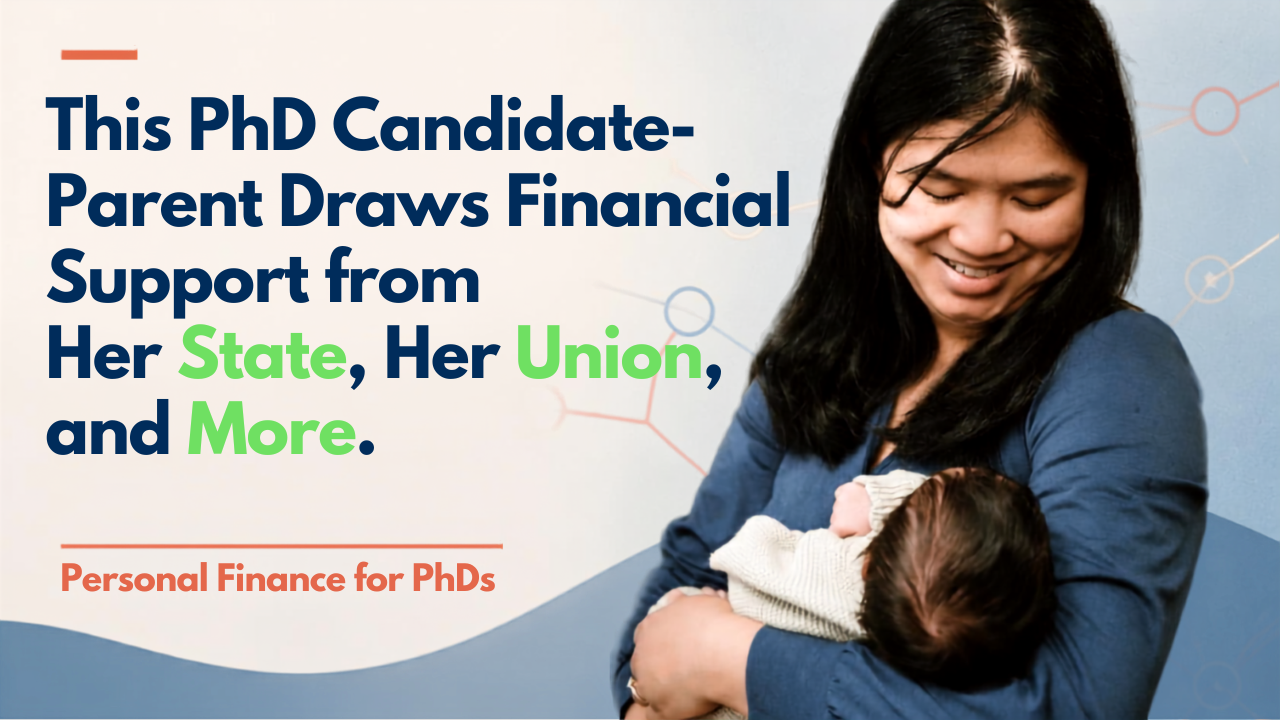
This Grad Student Experiences Financial Ease Thanks to Her Side Hustles

January 26, 2026 by Jill Hoffman Leave a Comment

In this episode, Emily interviews Nashae Prout, a 5th-year PhD candidate in toxicology at the University of Rochester. Nashae’s first year of graduate school on a $28,000 stipend was financially challenging, so she now maintains two side hustles. She serves as a graduate community assistant for graduate housing, an up to 10 hour per week position that gives her a 55% reduction in rent. She also adjuncts for a nearby university with the support of her PI. Between these two side hustles and her disposition toward frugality, Nashae can comfortably max out her Roth IRA and spend in areas that matter to her, experiencing financial ease. She concludes the interview with excellent advice on time management and prioritization.

Links mentioned in the Episode

  • Nashae Prout’s Instagram
  • Host a PF for PhDs Tax Seminar at Your Institution
  • PF for PhDs Tax Center for PhDs-in-Training
  • PF for PhDs Subscribe to Mailing List
  • PF for PhDs Podcast Hub
This Grad Student Experiences Financial Ease Thanks to Her Side Hustles

Teaser

Nashae (00:00): I know how hard it is. My first year, I definitely had to have a very strict budget in what I spent my money on and how much of it I did spend. And so it like just takes some of that stress off your shoulders and I have to think about, okay, I can’t do this ’cause I have to pay rent and I can’t do that ’cause I have to pay off this card bill.

Introduction

Emily (00:32): Welcome to the Personal Finance for PhDs Podcast: A Higher Education in Personal Finance. This podcast is for PhDs and PhDs-to-be who want to explore the hidden curriculum of finances to learn the best practices for money management, career advancement, and advocacy for yourself and others. I’m your host, Dr. Emily Roberts, a financial educator specializing in early-career PhDs and founder of Personal Finance for PhDs.

Emily (01:02): This is Season 23, Episode 2, and today my guest is Nashae Prout, a 5th-year PhD candidate in toxicology at the University of Rochester. Nashae’s first year of graduate school on a $28,000 stipend was financially challenging, so she now maintains two side hustles. She serves as a graduate community assistant for graduate housing, an up to 10 hour per week position that gives her a 55% reduction in rent. She also adjuncts for a nearby university with the support of her PI. Between these two side hustles and her disposition toward frugality, Nashae can comfortably max out her Roth IRA and spend in areas that matter to her, experiencing financial ease. She concludes the interview with excellent advice on time management and prioritization.

Emily (01:56): The tax year 2025 version of my tax return preparation workshop, How to Complete Your PhD Trainee Tax Return (and Understand It, Too!), is now available! This pre-recorded educational workshop explains how to identify, calculate, and report your higher education-related income and expenses on your federal tax return. Whether you are a graduate student, postdoc, or postbac, domestic or international, there is a version of this workshop designed just for you. While I do sell these workshops to individuals, I prefer to license them to universities so that the graduate students, postdocs, and postbacs can access them for free. Would you please reach out to your graduate school, graduate student government, postdoc office, international house, fellowship coordinator, etc. to request that they sponsor this workshop for you and your peers? You can find more information about licensing these workshops at P F f o r P h D s dot com slash tax dash workshops. Please pass that page on to the potential sponsor. Thank you so, so much for doing so! You can find the show notes for this episode at PFforPhDs.com/s23e2/. Without further ado, here’s my interview with Nashae Prout.

Will You Please Introduce Yourself Further?

Emily (03:32): I am delighted to have joining me on the podcast today, Nashae Prout, who is a fifth year PhD candidate at the University of Rochester. And we’re gonna be talking about increasing income and making your budget work on a grad student stipend. So Nashae, thank you so much for volunteering to come on the podcast and will you please introduce yourself a little bit further?

Nashae (03:51): Yeah, um, happy to be here. My name’s Nashae Prout. I am from Washington DC and I am a fifth year PhD candidate at University of Rochester’s Toxicology Training program.

Emily (04:01): Excellent. Now, uh, let’s take it back a little bit ’cause I wanna set up what your fin- your finances and your financial life were like coming into graduate school. So I understand you graduated from college debt free. Can you tell us like how that happened?

Nashae (04:16): Yes. So I have a three-pronged approach in how I, uh, got through undergrad debt free. So one, um, I started off at community college. Uh, a lot of people don’t always do that, but it’s a really viable option, especially if you don’t have that much money to, you know, go right into a four year institution. So that was number one. Number two, I did have a lot of financial aid. Um, I qualified for the Pell Grant. Um, we also have a tuition assistance grant in DC because there’s no public colleges in DC um, where, sort of this in between we’re out of state everywhere else, but where we’re in state, it’s only private institutions that cost a lot more money. And so because of that, the DC government provides students with a $10,000 grant for each year of college. I think up until five years they cover you for the, for five years, um, for any four year institution that you join.

Nashae (05:11): And so I got that every year. I made sure to put in my application each year to renew it because I needed that money once I started at Morgan State University, which is where I did my undergrad. And then on top of that I also was an NIH BUILD scholar. Um, NIH BUILD is, it’s an acronym Building Infrastructure Leading to Diversity. We were one of 10 sites in the United States. Um, and so it was a two year, um, traineeship where I got partial tuition coverage as well as money each month, um, after working a certain amount of hours. Um, and I will say, um, at that point I was breaking even if not give or take about a hundred dollars. So by the end of it I did pay for my college myself, so maybe a couple hundred. But in those first two years when I was at community college, my parents did, um, help me out tremendously and thankful to them every single day for paying for my uh, community college.

Emily (06:05): Yeah, well even with parental support to, you know, for a certain period of time, that’s still a huge accomplishment to get through college without debt. Did you go directly to graduate school or did you take any time in between?

Nashae (06:18): No, I went directly into graduate school. I, that summer I didn’t do any work. I was working since I was 14 years old every summer and it was the first summer I did nothing and I quickly realized there’s a reason why I always had a summer job because I got really bored of watching daytime TV really fast. 

PhD Offer Letters and Funding Sources

Emily (06:35): Um, okay. So tell us more about like maybe your offer letter and like how, how you were funded throughout, you know, up to this, you know, fifth year of your PhD program.

Nashae (06:47): Yeah, so, um, I actually had two offers for a PhD program, one at Rochester and the other one at a school in Texas. And I, and while Texas does not have um, income taxes, that that was a good selling point, however, I decided to go for the Rochester offer just ’cause it was a bit closer to home and I loved the culture of the program as well. And so that offer letter, I think, um, I wanna say it was maybe like 28 K, but they also gave me a relocation assistance, um, fund, I think it was like a thousand to $2,000, which I, um, was really grateful for in terms of, you know, having to move, uh, six, seven hours away from my family. Um, so that did sweeten the pot. Um, the first year we’re all funded underneath the, uh, dean scholarship. So all first years, um, at my school are funded by that scholarship. Um, after that I was on a T32 grant with my program. And then currently, um, yes, so that was second and third year I was on the T32 and then fourth year and onwards I am covered by a grant with my PI.

Emily (07:52): Okay, so you’ve switched kind of from fellowship to training grant to assistantship, um, but has that 28K pretty much stayed stable or like gone up a little bit?

Nashae (08:01): Yeah, it goes up, um, what is it, I think 3% every year. So it’s gone up a little bit every year to like match inflation.

Side Income: Graduate Community Assistant

Emily (08:08): Okay. And I know where we’re going with this is that we’re gonna talk about your side income. So that 28k plus, you know, 3% growth each year. Has that not really been sufficient to pay for at least what you want your living expenses to be?

Nashae (08:21): I am never, I’d just say this, I’m never just satisfied with what I’m getting. I’m always gonna wanna challenge myself and get more, um, my parents are immigrants to the United States. They’re both from Jamaica and so they’ve always instilled in me to work hard. Um, my dad, he’s a construction worker, but he’d also always do side jobs. So I always saw him, he’d be, you know, done doing this, but he’d go into this person’s house to do the side project to get extra money. And so when I saw the opportunity, um, to start a side job, I took it. And that first one was with, um, graduate housing. Um, they had a GCA position, which is a graduate community assistant position open. I actually applied for it twice the first time I didn’t get it and the second time I ended up getting the position. Um, and it’s, it didn’t seem like it was out of the realm of what I’d be comfortable doing. It’s a lot of, you know, putting on events, um, greeting residents. I’m a yapper so I like talking with people anyways, so it’s not, um, it wasn’t too much of a deviation from like what I’d be comfortable doing on the side for a couple hours every week.

Emily (09:25): Okay. So let me ask, do you, did you have to live in the housing to have this job or were you able to live elsewhere?

Nashae (09:33): No, so you have to live within graduate housing for at least four months before being eligible to become a graduate community assistant. You also have to live in that graduate area that you’re going to be working in. So I live in my complex and because of that I am over, um, I’m responsible for um, I think the 700s and 800s like apartment blocks in this complex. If I was a GCA at one of the other complexes, I’d have to be a resident there for four months. I think I could transfer, but there’s a transfer fee and I didn’t wanna pay that ’cause there was another position open, but I would’ve had to move there to be eligible for it and I did not wanna move. I like my apartment.

Emily (10:14): I see. So you had already chosen your housing anyways, just like what you personally wanted for your time in graduate school and then, then you saw these open positions and were like, oh, I can add that into my life right now. That seems manageable, is that right?

Nashae (10:27): Yeah, because you’re only eligible to live here if you’re a trainee or a medical student or anything like that. And so everyone else that’s also GCA is also either an MBA student, a PhD student, or they’re a med student.

Emily (10:40): Okay. And you told us a little bit about the nature of the job and about the time commitment. Um, but what are you getting? Are you getting paid? Are you getting like a, a reduction in your housing costs or like how does the compensation work?

Nashae (10:51): Yeah, so because a lot of the programs don’t allow for us to be, um, paid or at least to a certain extent, we can’t get paid depending on what grant you’re on. What, um, graduate housing does is that they don’t pay us. What they do is they give us a rent reduction every month on our rent. So I get 55% off of my rent costs.

Emily (11:09): Nice. Yeah, that, I mean you said it was maybe like two hours per week. That seems like a great trade off. What, what dollar amount does that equate to?

Nashae (11:17): I’d say it depends on the week. So some weeks are a lot more intensive, especially in the summertime. We do have a lot more residents coming in, so we have to make sure that we greet them all. We have to make three attempts to greet them. Um, so that’s just knocking on their door, seeing if they’re home, if they’re not, okay, if, if they are then we have to chat with them for a little bit. Um, so it, I think it’s technically 10 hours per week, but it ebbs and flows throughout the semester. So middle of fall semester, I am doing less hours technically, but in the summertime I am doing more, but this is mostly stuff on the weekends and I, I, um, am responsible for hosting one event per month. Um, which I think the hardest part is just advertising the event. So you know, sending out those flyers, printing it off and posting it in like the laundry room and stuff like that. So it depends on for like the hours, like some are just, some seasons are more busy than other seasons are, like winter time. We don’t technically have much to do from the end of the semester to the start of, um, the spring semester in Ja- in like the end of January. So that’s like a pretty lax time where we’re not doing anything. So it ebbs and flows I’d say. So more than two hours, but some weeks it is more so like two hours. Like especially in the wintertime there’s zero hours technically.

Emily (12:33): Awesome. And you said it’s a 55% rent reduction, so I’m imagining this is a benefit worth at least several hundred dollars, is that right?

Nashae (12:40): By this year it’s at least a reduction by like five to 600.

Emily (12:44): Very nice. Very nice. Helps a lot.

Nashae (12:46): Yes, it makes like very affordable

Emily (12:49): Yeah. And so it sounds like you, you’ve, you still continue to hold this position, is that right? You started in maybe like your second year-ish and then you still have it?

Nashae (12:57): Yeah, I started in my second year. I was eligible in my first year, but again, I interviewed for it and I didn’t get it that first round. Um, still in my second year and it’s been smooth sailing ever since. I’m, uh, one of the OG GCAS in the position, so everyone else in my complex is currently newer than I am, so I sort of help them sometimes with like, oh, who do I contact for this or who do I chat with for that?

Emily (13:20): Nice. Um, well it sounds, I, I don’t know the, it sounds like a great position. I I am always a little bit like regretful when I look back at grad school and like I never even thought about like, or you know, considered doing this type of position yet. It seems like yeah, pretty good amount of financial benefit for like the work you need to put in, especially if you find the work like pretty pleasant, you know, overall. 

Nashae (13:42): I have a shopping problem so I love shopping with the school’s money to host the events anyways. Like it’s, it’s a win-win situation in my opinion.

Emily (13:50): Yeah, I would say for, certainly for current graduate students, if you would like <laugh> a rent reduction, you know, look, look into this.

Nashae (13:58): Free rent is, yeah, yeah. Free rent is worth it if you wanna do that side, but 50% off is also very reasonable.

Emily (14:04): Yeah, it’s, it’s more compensation but it’s more work, right, for, for that type of position. But I would also say for like maybe even prospective graduate students who are concerned about the cost of housing in like the city that they’re considering moving to look for this kind of opportunity sooner rather than later. It could even be part of your like decision of where you go, like whether, if it is a position that you’re willing to take on whether those positions are available because it can be a massive help, 50%, a hundred percent kind of rent reduction in a high cost of living area would matter a lot for a graduate student. Um, so I really appreciate you telling us about the position. Seems like a good fit for you.

Nashae (14:40): Yeah, I personally love it. I am hoping that other people that you know need it can also get a position similar to this, especially if you’re in a high cost of living. I wouldn’t consider Rochester very high cost of living. Like the original rent is about maybe a bit over a thousand dollars for a rent one bedroom. So it’s not, it’s very reasonable. So it’s just helps me even more in terms of like this like moderate cost of living area.

Side Income: Adjunct Faculty Member

Emily (15:04): Yeah. And I understand you have another side job, um, maybe not surprising given your description of like who you are and like just you wanna be busy and wanna be working a lot. So like what’s your other side position?

Nashae (15:16): Yeah, so my other side position is being an adjunct faculty member at Nazareth University. Um, it’s a local liberal arts college here in Rochester.

Emily (15:24): So how did you first come, well I guess tell us what you teach and like is it all the time year round or in certain semesters?

Nashae (15:33): Yeah, so I teach um, biology lab, so it’s um, a one credit course and then I also last spring semester taught science communications or sorry, intro to science communications and that was a three credit course. Um, it’s, they’re both, um, in person on campus, um, classes that I teach, I do the lab courses in the fall and then I do in the spring I did science communications. Um, it’s pretty reasonable in terms of time commitment. I do one evening class and one afternoon class for my lab sections and I only do, I only did one science communications class since that one did take a lot more time grading wise. Grading wise, since it is a, uh, writing class. So you know, you’re doing papers and continual uh, edits on people’s like work

Emily (16:23): And were you like the instructor of record for either one of those?

Nashae (16:28): Yeah, so I am the listed instructor for all the courses that I teach at Nazareth.

Emily (16:32): Nice. And did you have to prepare a curriculum as well?

Nashae (16:36): No, so, um, I do have leeway with the science communications class, however, for the science laboratory class, because it is standard across all lab sections, that one is predetermined. So I have leeway in terms of how I get the material across, but the experiments that are laid out are laid out in a scheduled fashion and it’s the same for all faculty teaching the course.

Emily (16:58): And did you pursue this position purely for more money or was it for teaching experience or like what were your motivations?

Nashae (17:06): Yeah, so, um, I got the position actually because a lab member of mine was already an adjunct there and through word of mouth I was able to apply for some of their extra adjunct positions. Um, I I would say it was 50% wanting more money and 50% wanting to pad my CV with an experience. Um, I’ve done volunteer work with teaching, um, but I want to have the experience of actually being the actual instructor for a class, you know, having to take high level science stuff and break it down into something digestible for a freshman under undergraduate.

Emily (17:41): How do you feel it’s been working for you in, in terms of, let’s take the, the career development, the CV padding as the first point, like you think it’s been worthwhile, has it been rewarding for you? Has it, you know, opened up any other opportunities?

Nashae (17:53): I definitely feel like it’s been rewarding. I really do like teaching. The worst part about teaching is just the grades. Honestly. I hate, um, having to grade <laugh> but other than that I like going in, I like interacting with the students. Um, honestly they’re all really great. I would also say that it’s good for my CV because I’m getting experience and it helped me determine whether or not I did wanna pursue education at the moment. You know, with funding crazy as it is. Um, I’m not putting all my eggs in the academia basket, but I do have the experience and it is something that if the right opportunity, you know, occurs, then I would pursue it further. Especially if it was for either liberal arts college or a health professions college, like a pharmacy school because um, I like when students are really engaged. My favorite ones are the, the, the super nerdy ones because they ask the most questions and they’re the most engaged with the course material.

Emily (18:48): Did you not have an opportunity through your regular graduate program? I mean I guess you described your funding path didn’t involve TAing at all and so it sounds like you, you sort of had to go outside your university to find these kinds of opportunities, is that right?

Nashae (19:02): Um, so yeah, my program does not require any type of TAship. We’re only, um, required to do research. So I did become a TA for one semester for one of our courses, but they don’t pay you for the, for being a ta, it’s purely a volunteer type of of um, thing. I did put it on my CV of course and there is good experience there but for me, if I was going to take my time three days out of the week to go sit down in a class and be there for the entire duration, I wanna be paid for my time. And so to me it’s worth it to, you know, go off campus twice a week or once a week to teach and get paid for it versus staying on campus which eats your commute just to walk down the hallway to the um, classroom. But I’d much rather be paid for my time than not be paid for my time. And it looks better on the CV to have like you are actually the instructor your name is on the syllabus versus just being the TA for a course at your own institution.

Emily (19:58): Yeah, for sure. Um, and do you mind sharing your pay rate for those two classes?

Nashae (20:04): Yeah, so it’s around $3,000 per class per semester. So the more classes you teach the more you can get. However, as an adjunct I am limited to a maximum of three classes per semester.

Emily (20:17): Oh three per semester. Well that, yeah, that’s quite a bit more than you’re doing at the moment.

Commercial

Emily (20:23): Emily here for a brief interlude! Tax season is in full swing, and the best place to go for information tailored to you as a grad student, postdoc, or postbac, is PFforPhDs.com/tax/. From that page I have linked to all of my free tax resources, many of which I have updated for this tax year. On that page you will find podcast episodes, videos, and articles on all kinds of tax topics relevant to PhDs and PhDs-to-be. There are also opportunities to join the Personal Finance for PhDs mailing list to receive PDF summaries and spreadsheets that you can work with. Again, you can find all of these free resources linked from PFforPhDs.com/tax/. Now back to the interview.

Impact of Side Income on Finances During Grad School

Emily (21:15): From these two different side jobs, which you’re holding them both now, right? So this is probably like the most money slash the least rent, you know you’ve had to pay uh, during your course of time in graduate school. What would you say has been the overall effect on your finances? Like more high level?

Nashae (21:29): I would say for me it’s one being able to comfortably max out my Roth IRA every year. Um, I didn’t open it until I was like a second or third year in my PhD, but I was able to max it out for the past couple years, which I think is great because I don’t think I would’ve been able to afford to do that otherwise without maybe surviving on ramen noodles and air for <laugh>, the, all my meals and my PhD. So that is I think the biggest one. Secondarily, I’m able to comfortably like travel to see my family every year. Um, I don’t ask them for any money. I’ve been financially independent from them since I’ve moved out. I don’t wanna put that burden on them. My dad just retired, um, so I’m able to go fly to them or drive whenever I feel the need to.

Nashae (22:15): I also, um, treat myself, I do one musical festival each year. Um, I did uh, I’m doing Camp Flog Gnaw this year, so, uh, very excited for that. Um, I am splitting the hotel costs with my um, friends because I am, I like treating myself but I’m not crazy. I will not stay in LA for my own self for a hotel room. Um, we are splitting it. All four of us are spliting the hotel room. So I also do that and I also uh, like taking care of myself uh, and not having to think too much about what I’m buying. Like I definitely do, I’m very much a budget oriented person, however I’m able to like go thrifting and it was within like my allotted 30 to $50 budget for a outing. I’m able to comfortably do it. Sometimes I have gone overboard, but for the most part I’m able to save quite a bit of money every year. Just just less strain.

Emily (23:08): Yes, exactly. So like not only are you like building for your financial future through the Roth IRA, but just in your day-to-day decisions around money, you just have more ease and less stress and like you said, you’re not going like overboard as a graduate student. It’s kind of hard to go overboard in in any area, but just the additional income that you’re bringing in and the rent reduction allows you that. Um, yeah, just not to be stressed about these like more like low level purchases which absolutely characterizes, you know, the the grad student experience.

Nashae (23:37): And I don’t do like a lot of those like small purchases but like for example, I make my coffee at home. I don’t go out to get my coffee. I, I pack my lunches most days. I rarely go out to eat. Um, I will go out to drink on the weekends or something with friends or like go have a dinner here and there. But like for the most part I live like pretty frugally like my entire outfit right now it is all thrifted clothing. The outfit is under $10. Um, I love saving money where I can but because I get extra income I’m allowed to like splurge where I want to.

Emily (24:07): Yeah, and it sounds like you have a very high level of awareness of your budget too. Like you know that your spending is under control in these certain areas so that you have the more ease in the other areas that seems like they provide more like value to you.

Nashae (24:21): Absolutely. I love being able to like I think about all my purchases of course, but I’m able to comfortably pay off my credit card bill every month. I always use my credit card ’cause it’s a cashback credit card and so I never spend more than what I have anyways. Um, but even if I spend over a thousand dollars on a month on my credit card, I’m always able to comfortably cover that without going into the red.

Emily (24:44): Do you see any differences between you and your peers at Rochester in this regard or are most of your peers also working side jobs so that they can have you know, similar financial freedom?

Nashae (24:54): I would say most of my peers aren’t working side jobs. I’d say maybe 30 to 40% perhaps. Um, I have some friends that were also GCAs. I’ve had some friends that work in the graduate um, affairs office. I’ve had some friends, um, teach on the side. I know at least one other person from my school that teaches at Nazareth. Um, I definitely would say I wish more people would take more opportunities because I know how hard it is. For my first year, I definitely had to have a very strict budget in what I spent my money on and how much of it I did spend. And so it like just takes some of that stress off your shoulders to not have to think about, okay, I can’t do this ’cause I have to pay rent and I can’t do that because I have to pay off this card bill or that um, car insurance note. Or whatever it is. Um, I definitely feel like I wish more people like took more opportunities like this ’cause there are opportunities to get teaching and not have it, um, be for free. I will say the other side of our campus, like the, like the arts engineering school, they do get paid for, um, being a TA. However, for my campus we don’t. And so that is something that I know a lot of graduate students do. It’s part of their, um, funding package. But at least for my school and my program, we do not get paid for a TA ships, which is why I stopped doing it after that first semester.

Academia Approved Side Hustles

Emily (26:16): Yeah, and I, I neglected to ask this earlier, but um, does your advisor know about your adjuncting position or like is it all like sort of out in the open or is it something that you do kind of quietly?

Nashae (26:27): No, he definitely knows. Um, I actually talked with him about like how many courses I should or should not teach. I’ve never gone above two courses because we both agree that that was the maximum ’cause it’s like one evening I, it’s a 6:00 PM course so it doesn’t interfere with my studies and my work. Um, ’cause I’m able to do nine to five and then the earliest course I’ve ever taught was, uh, 1:00 PM which I, we always have our meeting directly after the course anyways, so it doesn’t impact my work negatively, I’m still meeting my milestones as I should.

Emily (26:56): I I’ve started using the term academia approved, like academia approved side hustles and like adjuncting is usually an academia approved side hustle because obviously it’s in the wheelhouse. Everybody knows even if it’s at a different institution, like everybody gets, you know, uh, why you would wanna do it and what the requirements are and the time commitment and all that sort of thing. So like as long as it’s sort of like legally permitted by everybody’s visa and like the terms of your funding and all that, um, it’s pretty likely like with your advisor that they would be encouraging of this kind of thing as long as of course you have scheduled it so that it’s not gonna interfere with your primary work.

Nashae (27:31): Absolutely, yeah, I know when I was on the T 32 I wasn’t allowed to, I think it was either 10 or 15 hours of external work per week. But even with both of my jobs, um, I teach like a one, I teach one to three credits every semester at Nazareth, so that’s not impacting it there. And then for my GCA position I, it oscillates between maybe like five to 10 hours per week. So I’m still well within or below that 15, um, that 15 hour minimum maximum, um, that’s allotted with um, T 32 grants.

Emily (28:06): Yeah, and it’s really just good to know as a student, like that sort of rule on the backend. Like especially if you got pushback from your advisor, like, oh no, I’d actually don’t think you should take that other position. You say, well, you know, my funding technically allows for this amount and this is how I’m going to balance it. You have to still convince them, but like you have a little bit of support by just it being the policy. Okay. Don’t go above 15 hours per week.

Nashae (28:28): Yeah. And I’m very happy that, love my PI, he is great and he supports me doing this because he wants me to have that breadth of experience because my, again, my uh, program does not require any type of, um, TAship or adjuncting or what have you. So this is extra opportunity for me to gain experience in something that isn’t traditionally offered in my program of study.

Emily (28:50): Excellent. I can definitely see why your advisor would be encouraging of that. Is there anything else you wanna add on that point before we move to our final question?

Nashae (28:58): I would say, uh, just my one thing about, uh, teaching philosophy. I think a lot of people, this is like the soap, this is the soapbox me. I think we should strive to be, um, servant leaders, hearing what the people that we’re serving need from us and then working to provide them with what they need instead, instead of, you know, internally thinking, oh, okay, this is what I’m going to give instead of asking what do you need? That’s my one, um, thing that I I would just like want people to, to um, have and just spread as information. Like if you’re in a leadership position, make sure that you’re serving the people that you’re leading.

Emily (29:34): I can see how that applies both to your teaching position and your position with graduate housing. Definitely.

Nashae (29:39): Exactly. Yeah, I always wanna listen to feedback and listen to requests, um, and then work to achieve that.

Best Financial Advice for Another Early-Career PhD

Emily (29:45): Awesome. Well let’s wrap up with the final question that I ask of all my guests, which is, what is your best financial advice for another early career PhD? And it can be something that we’ve touched on in the interview already or it could be something completely new.

Nashae (29:57): Yeah, I would say my advice for any early career PhD is to time manage very well. And if you can time manage very well, then you can do a side hustle. I would never want someone to prioritize their side hustle over their PhD. Um, I’m here to get my PhD, that’s what I moved here for, so I’m always gonna put that on top. But if you have the time management skills to do a side hustle or do two like I’m doing, um, then do it. I think it’s one of the best financial decisions I’ve made as an adult, um, is having these side jobs that, um, one are not very hard. Really the only thing I dislike is the act of grading because it’s very tedious to grade each student, but my class is never more than 16 students, so it’s not that much in the grand scheme of things. I’m not doing a 100 plus person lecture where I’m grading it’s maximum 30 students that I’m grading for an assignment at a time. So if you can time management, if you have the time management skills, then do it. If you can’t, then focus more so on your, on your studies and look for opportunities within your university so that it’s a bit easier for you to potentially add something else onto your plate.

Emily (31:06): I totally agree. You have to like get your, you have to have your time management house in order, as you were saying before you can pursue these other financial opportunities because like you said, you have to keep the main goal in mind. The main goal is to finish that PhD and get a great job afterwards. And if you get distracted by side hustles, especially side hustles that like, you know, your job as an adjunct, like that’s still career building, um, most likely. And so especially if you get distracted by a side job that has nothing to do with your career, it can really add a lot of time, which is ultimately detrimental financially to you. So these two are like very, very intertwined. So I’m really glad you brought that up. Thank you.

Nashae (31:44): Absolutely. Yeah.

Emily (31:45): And thank you so much for volunteering to come on the podcast. It was great talking with you.

Nashae (31:49): Absolutely. I am happy to be here and I’m happy if at least one person takes my advice or falls in my footsteps and is able to save more money than they would have and be a little bit set up, you know, better for the future considering like the crazy economy we have going on right now.

Emily (32:05): Absolutely.

Outro

Emily (32:15): Listeners, thank you for joining me for this episode! I have a gift for you! You know that final question I ask of all my guests regarding their best financial advice? My team has collected short summaries of all the answers ever given on the podcast into a document that is updated with each new episode release. You can gain access to it by registering for my mailing list at PFforPhDs.com/advice/. Would you like to access transcripts or videos of each episode? I link the show notes for each episode from PFforPhDs.com/podcast/. See you in the next episode, and remember: You don’t have to have a PhD to succeed with personal finance… but it helps! Nothing you hear on this podcast should be taken as financial, tax, or legal advice for any individual. The music is “Stages of Awakening” by Podington Bear from the Free Music Archive and is shared under CC by NC. Podcast editing by me and show notes creation by Dr. Jill Hoffman.
Resources for PhD Job Seekers from the Hosts of Propelling Careers

January 12, 2026 by Jill Hoffman Leave a Comment

In this episode, Emily interviews Dr. Jim Gould and Lauren Celano, the co-hosts of Propelling Careers, about strategies for PhD job seekers, starting with an update on the PhD job market. They discuss how PhDs can figure out the salaries of various careers and particular jobs, including where they might fall within a posted salary range, and what benefits are offered at a company. They review where job seekers can go for both free and paid assistance. Finally, both Jim and Lauren give excellent financial advice related to job transitions.

Links mentioned in the Episode

  • PF for PhDs Quarterly Estimated Tax Workshop
  • The Propelling Careers Podcast
  • The Propelling Careers Podcast Episode 82: Help me help you…
  • The Propelling Careers Podcast Episode 73: Steps in the job search process
  • PF for PhDs S22E5: Money Is a Good Enough Reason to Leave Academia
  • PF for PhDs Tax Center for PhDs-in-Training
  • Science Careers Individual Development Plan (myIDP)
  • PF for PhDs Subscribe to Mailing List
  • PF for PhDs Podcast Hub
Resources for PhD Job Seekers from the Hosts of Propelling Careers

Teaser

Jim (00:00): But it’s not productive to panic and say, oh my gosh, let me send out a whole bunch of of resumes or applications without actually going through the process. The process might end up being expedited time-wise, you know, instead of three to six months or nine months of exploration, job application, and interviewing, you might have a couple weeks, but you still have to go through the steps of doing that, and you have to fight off that panic.

Introduction

Emily (00:33): Welcome to the Personal Finance for PhDs Podcast: A Higher Education in Personal Finance. This podcast is for PhDs and PhDs-to-be who want to explore the hidden curriculum of finances to learn the best practices for money management, career advancement, and advocacy for yourself and others. I’m your host, Dr. Emily Roberts, a financial educator specializing in early-career PhDs and founder of Personal Finance for PhDs.

Emily (01:01): This is Season 23, Episode 1, and today my guests are Dr. Jim Gould and Lauren Celano, the co-hosts of Propelling Careers. Our topic is strategies for PhD job seekers, starting with an update on the PhD job market. We discuss how PhDs can figure out the salaries of various careers and particular jobs, including where they might fall within a posted salary range, and what benefits are offered at a company. We review where job seekers can go for both free and paid assistance. Finally, both Jim and Lauren give excellent financial advice related to job transitions.

Emily (01:42): These action items are for you if you switched onto non-W-2 fellowship income as a grad student, postdoc, or postbac last fall and are not having income tax withheld from your stipend or salary. Action item #1: Fill out the Estimated Tax Worksheet on page 8 of IRS Form 1040-ES. This worksheet will estimate how much income tax you will owe for 2025 and tell you whether you are required to make manual tax payments on a quarterly basis. The next quarterly estimated tax due date is this Thursday, January 15, 2026. Action item #2: Whether you are required to make estimated tax payments or pay a lump sum at tax time, open a separate, named savings account for your future tax payments. Calculate the fraction of each paycheck that will ultimately go toward tax and set up an automated recurring transfer from your checking account to your tax savings account to prepare for that bill. This is what I call a system of self-withholding, and I suggest putting it in place starting with your next fellowship paycheck so that you don’t get into a financial bind when the payment deadline arrives. If you need some help with the Estimated Tax Worksheet or want to ask me a question, please consider joining my workshop, Quarterly Estimated Tax for Fellowship Recipients. It explains every line of the worksheet and answers the common questions that PhD trainees have about estimated tax. The workshop includes 1.75 hours of video content, a spreadsheet, and invitations to at least one live Q&A call each quarter this tax year. This quarter’s Q&A call is on Wednesday, January 14, 2026 at noon Pacific Time. If you want to purchase this workshop as an individual, go to PF for PhDs dot com slash Q E tax. You can find the show notes for this episode at PFforPhDs.com/s23e1/. Without further ado, here’s my interview with Dr. Jim Gould and Lauren Celano, the co-hosts of Propelling Careers.

Will You Please Introduce Yourself Further?

Emily (04:05): I am delighted to have joining me on the podcast today, the host of the Propelling Careers podcast, Jim Gould and Lauren Celano, and they are gonna take the time to introduce themselves to you, but I just wanna say, if you’re a PhD, you need to go right now and subscribe to their podcast because it’s really, really valuable whether you’re in a job searching, you know, time or not. Although that is a subject of the podcast still something we need to keep up all the time. So go subscribe. Also, Jim, why don’t you go ahead and introduce yourself first.

Jim (04:32): Thanks, Emily for the invitation and thanks for the plug to our, uh, podcast as well. So, I’m director for postdoc affairs and program director for Responsible Conduct of research at Harvard Medical School, where I’ve been for almost 15 years now, providing programming and coaching and policy implementation for our postdocs here. I’ve received my bachelor’s in molecular biology from Clarion, University of Pennsylvania, my PhD in biochemistry at University of Louisville in Kentucky, and did my postdoc training in two different laboratories at the National Cancer Institute at the NCI in Frederick, Maryland.

Emily (05:05): Excellent. Lauren, how about you?

Lauren (05:08): Alright, well, currently, uh, the co-founder of a company called Propel Careers, and I do a lot to be able to help support PhDs and postdocs and early career people in their career journey. Um, but I’ve been in the life sciences sector now about 24 years, the first 10 of which was more drug discovery focused. And since about 2009 I’ve been working really closely with a whole range of postdocs and PhDs and early career people to help them navigate their careers.

Emily (05:34): My next question may have started to be answered by your, uh, background information there, but I’m, I’m curious how you developed this expertise, particularly in PhD careers. Um, Jim, why don’t we start with you because we know how you got your PhD, but then how did you get into this work?

Jim (05:48): Alright, so, you know, I I I was experiencing academia and research training firsthand as, uh, you know, in my bachelor’s. You know, I did a, uh, research stint, uh, summer undergraduate research fellowship actually at Ohio University and went into a PhD program trying to figure out what to do career wise with my molecular biology background. Uh, it seemed like it made sense going to graduate school, getting a PhD, struggled a little bit as a student, trying to figure out what it actually meant to, to do research and, and be successful there. And then, as I was a graduate student, realized that there’s an entire community and my peers and colleagues and fellow students who also needed help. And there wasn’t a ton of infrastructure for the development of professional skills, tons of research happening and, you know, we were able to, you know, show presentation skills, but it wasn’t a professional skill set.

Jim (06:42): And it was one of those things where we started ourselves building those skills and, and pulling groups together. And then the next step is like, okay, I don’t have enough experience to go on the job market directly from a PhD. So I did postdoc and not fully understanding what postdoc means ’cause there weren’t a ton of postdocs when I was a graduate student at U of L. There are more now. And just having been in that process in the training and struggling in each one of those stages and then figuring out things for myself, but also figuring out things to help my, my peers and colleagues. So that gave me a lot of just sort of on the ground practical experience and helping others. And then I realized I could probably do this for a career, but didn’t know what it looked like, didn’t know what it was, what it would be called.

Jim (07:28): I was looking at education and outreach, but it was running a, um, a postdoc association running seminar series, just being invited to sit on committees and panels and get questions asked of me like, well, what’s the postdoc experience? Where we’re faculty, we’re appointed, we, we don’t know exactly how postdocs are, are, are being treated or what they need or what the trainees need. And I was like, well, we need this, we need this. And it just sort of snowballed building a reputation, doing that, and then realizing I can make a career out of it. And at the same time, as I was in the middle of my, my postdoc, finishing my postdoc, there was a proliferation of postdoc offices growing, you know, and there are still institutions that are still starting postdoc offices. So I went from being a postdoc doing research, but also helping my, my fellow postdocs to running a postdoc.

Jim (08:20): And then I needed to learn the administrative aspect of policy development, of implementation, of learning how to coach. But doing this sort of day to day, week to week, growing and building my own portfolio of presentations, of skills, of coaching, I, I’ve been able to just build that expertise and now working with maybe even thousands of postdocs and PhDs and other trainees. So being able to then share that experience through my workshops, through my trainings and, and whatever else other people invite me to talk about. But also through that podcast that we have Propelling Careers.

Emily (08:56): And how many years has it been since you devoted yourself full-time to this

Jim (08:59): Full-time? It’s been 15 years. So I started this job in 2011, June, 2011. So June, 2026 will be 15 years on the dot.

Emily (09:08): Amazing. And I can see so many parallels actually between your story of, you know, needing this information for yourself and struggling through it, and then starting to teach other people with my own story. Of course, you decided to do this from within academia, <laugh>, and I’ve decided to do it from external academia, but still a lot of parallels in the motivation there. Um, Lauren, how did you come to, you know, decide to focus on this particular population?

Lauren (09:31): So, I, I have a scientific undergrad. I have biochemistry, molecular biology is what I focused on in college, and a lot of my friends decided to go to graduate school, so I started to get to know people that were doing their PhDs and some of them decided to also do postdocs. I also had moved to Boston in 2003 and, uh, started to be surrounded by people <laugh> with advanced academic training from the biotech activities I was involved in, but also just from my friend network and that sort of thing. And I started to notice that a lot of people had these amazing skills, but didn’t always know what to do. And in my working world, before Propel, I was, uh, getting to know a lot of different people in biotech companies and across a whole range of different roles and that sort of thing. And when I ended up, uh, going back for my MBA, I started to see that there was this need to be able to help people think about their future, to think about what are they doing and how are they leveraging their skills.

Lauren (10:25): I was giving advice to a lot of friends of mine, and then I realized that maybe this is something that could be applicable to other types of people. So I kind of fell into it, to be honest. But it’s been really fun to be able to help all these motivated people that really just wanna do great work and they wanna change the world through their research and activities and, uh, and so forth. So it’s been really nice. So for me, it’s been about 16 and a half years, so it’s funny, Jim, to think about like, when I started interacting with you, that was shortly after you came to HMS. So it’s really a small world, but I’m so happy that we got to kind of grow up together, <laugh> in this space.

Jim (11:00): Yeah, being able to, to do this straight out of postdoc, there was a huge learning curve. And one of the things that I wanted to point out with, with what Lauren and I were, were talking about with our relative path is that it wasn’t, we had to explore it, we had to find it, it wasn’t just laid out in front of us, okay, you have an MBA, now you go do this, you have a PhD, now you go do this. And I, I know that for our audiences, relative audience is yours and ours, it’s, it’s very similar. Like, okay, I’m going to undergraduate, I could do these things. I could go pre-med, I could go to graduate school, but we don’t know what’s happening two or three, even five years down the road. So being able to figure that out while still being productive as a student, as a trainee, as a postdoc, you know, it, it’s almost like you have two jobs. You need to figure out what your next job is, but also you have to be productive in, in your fellowship as well.

Emily (11:51): Absolutely. I totally agree. Um, I I think about it the same way of having the academic training aspect of your job and then the professional development and perhaps even job search and pursuit of careers aspect of your job. Um, you just mentioned, Lauren, that it’s a small world and I had the pleasure of meeting both of you in person. Um, within the past year, Jim and I saw one another at NPA, the National Postdoctoral Association Annual Conference. Then Lauren and I saw one another at the graduate career consortium annual meeting, and after that I wanted to set up this podcast interview. But I’m so glad for that timing because right now is a really interesting and critical moment for PhDs in terms of their, anyone who’s looking for a job. Right? <laugh>

Current State of the PhD Job Market

Emily (12:30): We have heard overall in the media that the job market is so difficult right now. And so I want to get an update from you two on how the PhD job market in particular is doing. Because I know from looking at BLS data that, you know, PhDs overall have a really, really low rate of unemployment. And as of the last update, which I looked at, and now we had a government closure in between, but the last jobs update I saw that PhD unemployment has ticked up a little bit, but still very low overall. But Jim, you said to me earlier this year when we met that PhDs are more likely to be underemployed than unemployed, which is also not a great, uh, image. So take this how you will, but I want to hear from each of you like your assessment of the job market right now for PhDs.

Lauren (13:13): Yeah, I I can start on this one and then Jim can, uh, can add, so the job market’s really hard. We actually have a podcast that we put out a few months ago about reasons why the job market is so challenging. There’s financing challenges, all sorts of things that we go into. Uh, it’s a really hard time, especially in life sciences and in high tech in particular. It’s very challenging for people. There’s been a lot of layoffs and reorgs for different reasons. So for people that are currently looking for roles right now that are finishing up graduate school or finishing up their postdoc, there’s so many people on the market, which is making the job market really hard. It’s taking people longer to find roles. People have to be even more persistent in terms of the job search process to find opportunities. And sometimes, you know, at a practicality, people just need a job. And so there’s some cases where people just take a job just to be able to pay rent and things like that as opposed to their ideal job because they just need something. So it’s a, it’s a complicated, we could probably spend like three hours just on that topic, but, but Jim, what, what else do you have to add there

Jim (14:16): For the reasons that you just explained Lauren, but also there are, um, there’s, there’s relative safety and, and that might not be so true nowadays, but traditionally, historically there’s relative safety in academia for many PhDs and postdocs. And they tend to remain in those positions longer or maybe go on the, the job market multiple times, at least historically. Now it is changing because of, of just funding constraints and, and changes in the NIH and and, and changes in indirect costs. And, you know, it costs more now to keep a postdoc and graduate students. But the, the idea is that they stay in positions longer. They might extend their PhD, they might extend their postdoc a year or two, so they don’t go, they don’t finish a fellowship and then go unemployment. So they extend a fellowship. And that’s what I meant by underemployment, where they stay in a position where they’re not advancing. There’s no sort of promotion structure within academia right now, at least for postdocs to continue to advance, uh, within that structure. They’re also may be even under appointed as I as sort of just explains like they, there’s no path of advancement. And then the other thing that, that Lauren kind of hinted at is sometimes they end up taking jobs out of need rather than sort of matching skill sets and advancement that are, tend to be below their skill set or experience level, because again, the fellowship funding is over and they need to find a job rather than launching their career. So there, there tends to be a little bit of underemployment and that it ended up catching up eventually. But there is, you know, there, there is this aspect of academia is this kind of warm, cozy, at least it used to be this warm, cozy place where you could take your time doing research and being productive and getting publications out, and then there’s a kind of a soft launch and or, or whatever on your, your next step of your career. It just sort of extended a little bit. So it’s not, you don’t lead to unemployment ’cause you don’t just lose postdoc jobs. It’s, you end up staying longer and you end up being under, under appointed and underemployed,

Emily (16:19): Except that some postdocs are losing their jobs now. Um, I mean because of funding changes, I actually worked with a university this fall who in the midst of me working with them, they conducted layoffs of their postdocs. So it’s unusual <laugh>. It’s, it’s different than at other times. And I wonder if, I know we could spend so much time on this, but if you had any advice for how PhDs can meet the moment, and I’ll say that in the financial realm, when people are experiencing job loss or financial emergency or anything like that, the advice is kind of like, well, it’s just more important to do all those classic things that you were told to do anyway, right? Like, have the emergency fund and diversify your sources of income and, and be able to cut your expenses if you need to. So I’m wondering, in your sphere, is there any different advice or is it just like, yeah, go listen to all of our podcast archives and just do all the stuff we’ve already been talking about <laugh>

Advice for the Current PhD Job Market

Lauren (17:12): One thing Jim and I say all the time is don’t do this alone. So find resources at your institution, reach out to your network, may- have your materials together, right? You need to have a resume or a CV depending upon what you’re applying to. It needs to be up to date. So if you do have to look for a job quickly, you’ve got something you can share. Otherwise you lose time trying to put it together, cultivating your network, you know, again, like reaching out to people. But when you do that, uh, we did an episode recently in the podcast called Help Me Help You, which was all about if you’re gonna be engaging your network, help them help you, what do you say to them? How do you share information? How do you make it easy for people to help you, especially if you might be in a time crunch due to layoffs, reorgs changes that are unexpected and things like that.

Jim (18:02): Yeah. And, and in, in addition to what Lauren was just talking about, we have to fight the urge or we advise fighting the urge of panicking because, you know, panic is not productive for the most part. Being able to understand the landscape. There’s, there’s e- there’s a, a grieving process that happens, especially if you lose a job. We’re not downplaying that, but it’s not productive to panic and say, oh my gosh, you know, let me send out a whole bunch of, of resumes or applications without actually going through the process. The process might end up being expedited time-wise, you know, instead of three to six months or nine months of exploration, job application and interviewing. You might have a couple weeks, but you still have to go through the steps of doing that. And you have to fight off that panic and realize in the grand scheme of things, a a three month gap or a one month gap or even a six month gap in your employment record is relatively meaningless, especially in academia and moving into industry because those now, you know, industry is, is relatively, there’s, there’s high turnover, you know, and you’re, you’re going to have multiple jobs, maybe even multiple careers. And now in academia, we are now feeling that, as you pointed out, Emily, you know, postdocs are losing their jobs. We are, you know, downsizing in academia, especially in the, the research realm. So we need to remain nimble, but you need to fight off that, that urge to panic and just remember your resources and your network and community.

Emily (19:27): I like that encouragement of just like, there is a process here. Like work the process, like work the steps. Um, you don’t have to reinvent the wheel. Okay, <laugh> like resources like yours and others that maybe available to people are, are excellent to be accessing at this time.

Lauren (19:40): Well we did a podcast episode recently about the 26 steps in the job search process. <laugh>, I mean, not not to overwhelm people, but it’s a lot of work. It’s a lot of work to be able to effectively engage in this. So I would say check that out because it could help people start to get a feel for things they could do to help them be productive in the side.

Jim (20:00): Yeah. And, and that list it, it could have been a hundred things and we, we were able to sort of pull that list and, and you know, glean it and, and, and call it. But the idea is that there, the, that there might be, um, maybe healing in that process. Just doing the thing also helps you able to control the controllables. So again, fight the urge of panic but also re remember that there are many things outside of your control in this, in this world and in this process. You, you, you can’t control somebody interviewing you or hiring you, but you can control doing the process. You can control, you know, engaging your, your network. You can control putting out quality applications.

Emily (20:38): I love that. And all the episodes that you mentioned, Lauren and Jim, by the way, will be in the show notes. So anybody looking for that, go to pfforphds.com/podcast. Find this episode and you’ll get all the links to the Propelling Careers podcast.

Pay Transparency Laws and PhD Salary Ranges

Emily (20:51): Okay. I wanna talk a little bit more about finances, specifically within the job search and job application process. Uh, I learned from your podcast that there have been all these new like pay transparency laws in various states that have come into effect. So I want you to explain a little bit about what that means and how PhDs can figure out what is an appropriate, um, salary or salary range for a career that they’re looking for. And also in a specific location. ’cause obviously cost of living is gonna massively change this as well.

Lauren (21:19): So I’ve had the fortunate, uh, nature. So part of what I do in my career is I do recruiting with a few companies and, uh, I’ve had opportunities hands on to actually be a part of some of these pay transparency activities. And so for example, in Massachusetts, October 29th, 2025, the pay transparency law went into effect, which means companies of more than 25 people are supposed to have salary ranges for each role that they post. In California, this went into effect January 1st, 2023. I was recruiting with a company at the time in California. So I was involved in actually posting the salary ranges and I was so nervous to actually put it out there. But it’s been great actually for candidates to have a little more transparency around where they may fall. Now it’s a range, right? So you have, you have, you know, let, let’s say the range might be a hundred to $120,000 for a certain role. Typically people pay kind of in the middle of that range. ’cause you wanna allow people opportunities to be able to grow once they come into an organization. So as a candidate, I would anticipate probably like middle of the range is probably where you should fall for that. As you’re looking at opportunities though, it can be helpful to see the ranges. ’cause then you can start to get a sense of which roles could align to your financial considerations. ’cause there could be some situations where a certain type of role just isn’t gonna align and that’s fine. You can then focus your efforts on ones that are out there. Washington and New York also have pay transparency laws. And you know, one thing that’s helpful to keep in mind is that maybe you live in a state that doesn’t have pay transparency laws. Well, you can still look at states like California, Massachusetts, New York, Washington and start to get an idea potentially of what ranges could be. It may differ a little bit in, you know, the Midwest or the South or something, but at least you may start to see kind of ballparks in certain ranges. The other thing I would say is, you know, when you’re doing informational interviews you can ask people like, do you have an idea of what the salary might be for this particular role? But not just that though, what are the other benefits, right? And we’ll talk more about that, but it’s like the whole package. Don’t be afraid to utilize your network. There’s a few other ideas I have, but I know Jim has some thoughts on this too, in terms of advice he’s given.

Jim (23:37): Yeah, there, there, you know, if in academia, uh, you know, Laura was talking a lot about industry and, and just outside of academia, but there are public institutions, public colleges and universities that have to pay, have to post their salary. So you can get an insight on relative salaries. They’re usually a year or two, sometimes even three years behind. So you can get a a sense, you know, and I know, you know, inflation is, is increasing. So tho those salaries may not be as accurate, but you get a sense of what the range might be depending on, you know, full professor, assistant professor, associate professor, or even, you know, scientific staff or you know, administrators within university. The other thing is, you know, um, the American Association for Medical Colleges, it produces for a fee, a a booklet of salaries across medical schools and medical colleges. So you can get an insight into that. You know, depending on if you are more, more biomedical research and you’re going into a a private medical, um, research institution, you can, you know, basically purchase those, um, you know, those ranges and salaries. But one of the things that, that Lauren already mentioned that’s really effective is when you’re out there gathering information, meeting people and networking, you do these informational interviews and you collect that kind of information, you don’t want to necessarily ask them specifically how much do you make in your role. That is, that tends to be rude, but you can say, how much can I expect in a, you know, in an introductory role or a, a scientist one role at, at your company or in your sector. And they should be able to give you a, a relatively accurate range as well. So, but you, you have that more direct information that, um, you, you could probably trust a bit more than finding stuff on the internet, uh, in indeed.com or Glassdoor or, or salary.com as well.

Lauren (25:28): To build on Jim’s point, some of the other professional organizations have salary guides. So American Chemical Society every couple years does a salary guide. So if you wanna be a chemist in a certain place, you can probably find a range. Uh, the Association of University Tech Transfer Managers also has salary ranges. So maybe some of you listening to this are involved in professional associations. Well ask that association, do you do a salary survey? Because maybe they do and that might help you. And also universities oftentimes collect this information. So if you wanted to move to California, you could do a search of some universities out in California and maybe they’ve compiled a, a information about recent PhD graduates and recent master’s graduates in their location in different sectors. It’s not gonna be perfect, but it may give you an idea of ranges just to be able to help in terms of that information. There’s a lot of information out there, but the source of the information, that’s the important part to make sure that you are seeking sources that are credible. That’s why sometimes Glassdoor and LinkedIn and so forth, sometimes it’s self-reported or made up in other capacities. So you just wanna be careful in terms of where you’re getting that information from.

Jim (26:42): You. You also wanna be careful with, again, the information you gather and you are moving in, in a different geographic area because cost of living varies across the United States and, and obviously the world. So if you gather information about salaries in the Boston area, but you’re moving to Pittsburgh, those numbers are gonna be inflated. Uh, Pittsburgh is generally gonna pay lower, but the cost of living is is cheaper, so your dollar might go a little bit further. So thinking about those aspects as well.

Emily (27:11): This, this is great information, thank you so much. And I, I love that you mentioned like different sort of categories of places that people can go to find this information. And I love the idea of someone starting this very early on like years or more, you know, a year more before they’re actually engaged in a job search process to try to figure out like maybe their own financial expectations and what sectors and what titles kind of align with that. Like for example, I did an interview recently with Dr. Gabrielle Fil- Filip-Crawford, who actually also met at GCC and she was talking about how pay transparency talking with our colleagues about pay helped her understand that she was never going to make enough money inside academia on her faculty track that she was on to satisfy her lifestyle needs and wants. And so it helped her leave that sector entirely and find more remunerative work that was, you know, still in line with what she wanted for her career. And so I just think that’s really, really important that we have realistic and grounded expectations about what different types of careers pay, what different titles pay. Because frankly, as a PhD you have a lot of transferrable skills that are kind of flexible. And so if you could fulfill the, you know, the requirements of roles with a few different titles, like you should look into what those different titles pay and the tracks that they’re on, um, to see, you know, what best aligns with your financial desires as well.

Lauren (28:29): 100%. Exactly. And of course it’s not always just about the money, but the culture and the kind of career trajectory. There’s a lot of things to factor in in terms of taking a role, uh, or not, but finances come into play and you wanna make sure that people are realistic so you can, whatever quality of life you need that you’re able to meet that.

Jim (28:50): Yeah, I agree. Quality of life is, is, is front and center, especially nowadays. We want to be able to, to work, to be able to live, not necessarily live to work for a lot of, a lot of different people.

Commercial

Emily (29:03): Emily here for a brief interlude! Tax season is in full swing, and the best place to go for information tailored to you as a grad student, postdoc, or postbac, is PFforPhDs.com/tax/. From that page I have linked to all of my free tax resources, many of which I have updated for this tax year. On that page you will find podcast episodes, videos, and articles on all kinds of tax topics relevant to PhDs and PhDs-to-be. There are also opportunities to join the Personal Finance for PhDs mailing list to receive PDF summaries and spreadsheets that you can work with. Again, you can find all of these free resources linked from PFforPhDs.com/tax/. Now back to the interview.

Learning About Benefits Information During the PhD Job Search

Emily (29:55): Okay, so we’ve talked about how to work out what kinds of salaries are on different careers and where to locate yourself on a range that you might see. Um, I wanna ask about benefits as well because, you know, certain benefits can be really, really important to people, especially related to like health insurance stuff. Like does this company offer parental leave? Does this company offer, um, you know, a specific medication that I need for a health condition that I have? Um, you know, different things like that. And how can someone who is looking or applying for jobs understand like, is this company even gonna meet, like benefits wise, my expectations? I understand you could probably ask about that very late in the process, like after you’ve gotten an offer, but is there any way to get that information earlier so that you don’t like waste your time maybe pursuing something that is not ultimately gonna work out?

Jim (30:44): So is because of the, the job market being so, um, so difficult at the moment, they want really good candidates and, uh, universities, colleges, um, companies, so on and so forth. If they, they usually put the benefits first and foremost at maybe at the bottom of the job description. They’re very proud to say, we offer, you know, uh, unlimited paid time off. We offer childcare subsidies, we offer commuting subsidies. So there are a lot of things that you can just find in the job description. And if it’s not in the job description, they probably have a why work here website or webpage where you land on. It’s more HR oriented, but you can find a lot of the different types of, of information and benefits, you know, from the job description, the job ad. Usually towards the end you’re like, we are very happy to be family oriented and all of these other things because, you know, the, the audience that, that Lauren and I tend to to work with are early career researchers and mid sort of midlife, mid thirties early or late twenties, early thirties, building their families as well. So the, I think companies are now understanding more than ever that they’re hiring not just the perfect candidate, but also a a a whole person that likely has a family with them.

Lauren (31:57): Yeah. And to, to add to that, I would say, I mean there’s some companies that literally have their entire benefit guide on the website. You can download it, it’s, you know, 45 pages with all the healthcare options, the 401k match, the vacation, the holidays, the cell phone reimbursement, et cetera, et cetera. But you know, also to plug the informational interview, when you talk to people at certain companies, it’s fair to ask, can you share some insights about benefits? Because this is something when I counsel people, and I’m sure Jim, you do too, and Emily for sure, you know, people look at the sal- the base salary and they’re either happy or sad depending upon what their expectations were. But then I always advise people, make a list of everything, right? The base salary is a hundred grand, okay, is there a bonus? Is there cell phone reimbursement? Is there commuter reimbursement? Is there like lunch provided a couple times a week, uh, et cetera, et cetera, et cetera. So I’ve had situations where the base salary is a hundred thousand dollars, but the total package is actually like $135,000 because of the extra things associated with the offer. So that’s where it’s really helpful as a candidate to make sure you’re looking at the entire package. Plus, of course, what’s the culture like, what’s the work-life balance like, what’s the enjoyment of the role? Those are a little bit intangible, but also super important as you consider what’s gonna be the next best fit for you?

Emily (33:27): Is it appropriate to ask generally? Can you tell me about the benefits? ’cause obviously people probably in the interview process don’t necessarily wanna reveal oh yeah, I’m thinking about having a baby soon. Like yeah, I have a chronic medical condition, or, you know, whatever the case is. 

Lauren (33:40): I think it’s fair to ask and, and I, I know, so in the recruiting work I do, typically after the first discussion, I’ll send people a summary of the details, but if, if you don’t get sent that I would ask it because these things are important. You don’t wanna get to the end of the interview and realize that the company doesn’t have things you need because then you just spent a lot of time and a lot of their time interviewing for a role that then is not gonna be a fit. So I love just being open and honest <laugh> and just asking for what you need and hopefully the organizations you are interviewing with will be able to provide information.

Jim (34:11): Yeah, it may not be your leading question. Be like, you know, when you first get in, what are the, what are the benefits? And it may not be the central question, but when given the opportunity, or maybe as you’re rounding out the interview or the discussion, be like, would you mind sharing, you know, the, the benefits package or, or a more information about benefits as well? Because during the interview it’s more about fit and work and, and connection and, and sharing your experience and credentials, but benefits will play a huge part in the actual decision if an offer is tendered.

Free Career Search and Career Development Resources for PhDs

Emily (34:43): You all mentioned earlier, um, graduate students and postdocs accessing resources related to career search and career development at their own institutions. Um, I’m wondering for people who have already, maybe they’re aware of that resource or maybe they’re no longer affiliated with institutions, so they don’t have access to those kinds of offices anymore. Um, what kinds of free resources are available? I mean, we know about your podcast, but anything else? And then is there ever a point when a person should consider paying for professional services or a course or anything like that?

Jim (35:16): So I, I know Lauren and I, we tend to align with, with some of this, uh, this interaction and, you know, the feedback and advice. But I do want to reiterate, even though, you know, people might not be still affiliated with in-, with institutions or schools or colleges, they are still alums of those schools and colleges and can go back as an alumni to maybe access career services, career offices. So you, you can still have some access, it might be limited, but there are also other offices that, you know, like mine, you know, especially, you know, if a postdoc is transitioning out and their end date is, um, I don’t know, a week from now, I’m not gonna turn them away in seven or eight days after their, their appointment ends. They can continue to come back as they’re transitioning out. So there, there’s also workforce development. Again, thinking about if you’re transitioning out, you can really leverage and access all of those resources. If you’re being terminated or you’re actually on your way out, you can tool up. But don’t forget that you are an alum of schools and universities where you paid probably thousands upon thousands of dollars. They still, you know, give you access to their, their, you know, uh, alumni office as well as their, the career services office. Other resources that I really like are kind of like, you know, um, communication, leadership, you know, emotional, uh, intelligence assessments. Those tend to be free. You, you can go to a, a coach and a professional and pay for those services and get, you know, um, some help unpacking some of those things. But there are a lot of those are free and the explanations are pretty clear and straightforward and it allows you to understand how you communicate and how others communicate and how things land for you. Where you can then stretch yourself into different personality types or with different personality types. Uh, I, so those are kind of the, some of the free stuff that you can get into, but you can pay to do some of those things like strengths finders or Clifton strengths. You, you, you have to, you know, buy the book for strengths finders and then you have access to like your top five strengths, but you could pay someone to sort of coach you on those things as well. And I know Lauren has a lot more information and insight as well.

Lauren (37:26): Totally. I mean, one, uh, one free thing that I often suggest to people is the myIDP by Science Careers. It, it was a tool, uh, meant mostly for biomedical and biosciences, uh, graduate students, but it could be used by other people as well. These, some of these things are transferable to other disciplines, physics and, and, and others. Uh, but you know, you put in your interest skills values and then it rank orders one of 20 career paths that could be a fit. Doesn’t mean you have to do patent law if that comes up first, but it can be a nice way to start to understand, oh wow, if I have these interests in skills, those writing careers or outreach careers or entrepreneurship careers or whatever seem to be a fit. Sometimes people just need a little bit of insight and then it can launch this whole new area that’s out there. Um, on the, you know, on the paid, uh, coaching side. I mean certainly some people need a ton of help in terms of tailoring the resumes, interview prep and things like that. So there are coaches out there that can help. The key is make sure you find a coach that’s appropriate in terms of background, expertise, even level of people that they’ve engaged with. I, I’ve had a few people recently that have come to me ’cause I do some coaching work with people and they may have gone to someone that just coaches like executive level people and here’s someone that’s just coming outta their PhD, that coach may not have the right type of advice ’cause they’re not used to working with people at more of the entry level. They’re used to working with people that are more seasoned or I’ve had people that have gotten career coaches, but they coach people in different industries. And so like the cosmetics industry is definitely way different than life sciences, which is way different than data science. So it can be really helpful to do your due diligence to make sure if you are paying for coaching services and career advice services, that you are paying for the right, the right information and the right, uh, the items to be able to make sure it’s actually useful for you.

Jim (39:20): And, and it might be helpful in the short term, very near term, you might, you might pay someone for a couple of sessions and then you, you’re on the path to, to success or you might buy a subscription for a month or a couple weeks to, uh, job, job listings or even like LinkedIn, you know, uh, uh, you know, high level. So, but it should not be a long term or, or a forever type of situation. But you know, there are times where you might need that extra help and you can’t find it for free and you need to reach out and have someone or some, some, uh, resource that actually is a paid resource, but it should not be necessarily a long-term commitment.

Lauren (39:59): I know in Massachusetts there’s even these like mentorship networks. I’ve been a mentor for at least 10 of the last 15 years for the Massachusetts chapter of Association of Women in Science. So they have a year long mentorship program. You pay a small amount of money to be a part of it, but then you get someone like me giving you advice every month about, you know, your career, how do you navigate things, how do you build resumes, how do you job search? So just I would say be resourceful. ’cause there could be a lot out there. It’s just sometimes you don’t always know where to begin. So that’s where ask your network, you know, engage with people so that way you’re not doing this alone.

Emily (40:33): Yeah, I just wanna underline that, that like, clearly there are so many either free or near free or hey, you already paid for this in the past, so let’s just keep using it, uh, resources available, go to those first by all means. But I can imagine there are some people who, like this job searching has gone on for like a long time and anything that they need to do to truncate the end of this and just get into a position might, you know, might be worth the investment. Is there anything else that you’d like to tell us about the financial side of job seeking and job interviewing?

Additional Insights About the Financial Side of the PhD Job Market

Jim (41:03): There is a cost, time and financial and resource when going on the market. You might have to invest in new interview materials, like maybe a printer or a new laptop or professional clothing or outfits, maybe microphones or, or you know, you know, headsets for phone interviews or, or zoom interviews. But also you might want to understand how if you’re traveling for the job or traveling for the interview, how that reimbursement or payment or upfront, you know, scheduling will, will impact your finances because sometimes you are, you don’t have a ton of money and they want you to pay for the flight and they’ll reimburse you afterwards. Or the pay for the hotel and flight, they’ll reimburse you afterwards that, that could be two, $3,000 very quickly where they reimburse you 30, 60 or 90 days later. So, uh, again, just understanding that there’s an actual cost, not just your time because going on the job market is a timely cost. It’s a almost a second job, but there are these, you know, these little purchases that tend to add up that, that you could be in a thousands of dollars just going on the market, buying new clothes, buying new materials and, and actually traveling.

Emily (42:17): Great point that in the event of job loss, your emergency fund is not just there to pay for your ongoing living expenses, but you may have increased expenses to engage in this as well. Thank you.

Lauren (42:27): And I know we touched briefly on this, but I, I just wanna reinforce this point. When you look at the actual salary, just don’t look at the actual salary <laugh>, look at the benefits, the entire package because that will help you get a better understanding of if you end up having a few job offers, which one’s going to be the best fit. I just, I urge people make a spreadsheet, I’m sure Emily, you probably love spreadsheets to keep track of things so you can really compare apples to apples if you’re lucky enough to get a few offers and know you have to know what your like turn, turn away point is, right? If, if you need a certain amount of money to be able to live, then you need to know that. So then if a job doesn’t cover that, then you may have to say no, even though the role could be amazing, you don’t wanna take something knowing that you’re going to be in a negative financial situation starting from day one. So these are sometimes really hard discussions to have with people, but it’s really important to be honest so that way you can find a role and be able to focus on the role and not be stressed out about not being able to have proper finances.

Emily (43:33): And this may be a concept that is unfamiliar to people coming out of graduate school or the postdoc that you should feel financially supported in the role that you’re in. Absolutely. Thank you so much for those, um, concluding words. Where can people find Propelling Careers?

Lauren (43:48): We have our podcast on Spotify and Apple podcasts, and again, our podcast is free <laugh>, we have at the end of 2025, we’ll have 88 episodes. We have a ton of content and hopefully all of you find it valuable as you peruse.

Best Financial Advice for Another Early-Career PhD

Emily (44:04): Excellent. And I wanna end here by asking each of you the question I ask of all my interviewees, which is, what is your best financial advice for an early career PhD? And that could be something that we’ve touched on in the interview already, or it could be something completely new,

Jim (44:17): Right? It for me, it’s a combination of what we, we, we’ve already talked about is it it, and it’s a two-parter. Don’t do this alone. Use all of your resources to understand the, the cost, uh, of, of transitioning finding jobs and being successful in your career, but also understand and know the true cost of living in an area that you might be moving to. And that was, you know, Lauren, you know, talked about, you know, moving to a job and, and not realizing how much it cost. And and that’s something that actually happened. It, we got sticker shock when we moved up to here from Frederick Maryland to Boston. Uh, uh, it was a, a jump in salary, but it was not actually enough. And I didn’t realize that until after the fact. And it set us back several years in our finances to then catch up. And I think I still feel that we are actually behind where we would’ve been if we did actually just stayed in Frederick, uh, at points.

Lauren (45:08): And from my standpoint, so I see some people, they finish their PhD or postdoc and they get a job offer from a large pharma company and they go out and buy a new car, they get a nicer apartment maybe in the seaport of Boston and it’s like, don’t blow all your cash <laugh> right away. Like it could be really helpful to still live below your means so you can save some money so you can have a rainy day fund. You never know what might happen in the future. So it’s just as much as you may want to buy when you see your first check, like buy all this nice stuff, try to hesitate on that <laugh>. So, so that way it just allows you a little more freedom in the future.

Emily (45:48): There’s a big difference between splurging on a one-time purchase and splurging on something that’s gonna cost you some more money every single month going forward. So you’re absolutely preaching to the choir here. I love it. Thank you so much for this wonderful interview. I hope everybody goes and checks out your podcast. Thank you so much for joining me.

Jim (46:05): Thank you Emily.

Lauren (46:06): Thank you Emily.

Outro

Emily (46:17): Listeners, thank you for joining me for this episode! I have a gift for you! You know that final question I ask of all my guests regarding their best financial advice? My team has collected short summaries of all the answers ever given on the podcast into a document that is updated with each new episode release. You can gain access to it by registering for my mailing list at PFforPhDs.com/advice/. Would you like to access transcripts or videos of each episode? I link the show notes for each episode from PFforPhDs.com/podcast/. See you in the next episode, and remember: You don’t have to have a PhD to succeed with personal finance… but it helps! Nothing you hear on this podcast should be taken as financial, tax, or legal advice for any individual. The music is “Stages of Awakening” by Podington Bear from the Free Music Archive and is shared under CC by NC. Podcast editing by me and show notes creation by Dr. Jill Hoffman.

Catching Up with Prior Guests: 2025 Edition

December 15, 2025 by Jill Hoffman Leave a Comment

Emily published the first episode of this podcast in July 2018. This is the 246rd episode, and over the last six and a half years, the podcast has featured over 300 unique voices in addition to her own. For our last episode in 2025, we are catching up with the guests from Seasons 15 through 17, and a few from earlier seasons as well. The guests were invited to submit short audio clips to update us on how their lives and careers have evolved since the time of their interview, as well as to provide their best financial advice if that has changed since that initial interview.

Links mentioned in the Episode

  • PF for PhDs Podcast Hub
  • PF for PhDs Subscribe to Mailing List
  • Emily’s E-mail Address
  • PF for PhDs S17E5: Can You Earn Money from Publishing a Scholarly Book?
  • Dr. Laura Portwood-Stacer’s Books
  • Dr. Ana Romero Morales’ Website: Brewing Dinero
  • PF for PhDs S14E3: Navigating Grad Student Finances While Undocumented
  • PF for PhDs S16E1: How This Grad Student Budgeted for Having Her First Child
  • Madeline Hebert’s Twitter/X
  • Host a PF for PhDs Tax Seminar at Your Institution
  • PF for PhDs S13E2: This PhD Student-Nurse Is Confident in Her Self-Worth
  • Dr. Brenda Olmos’ LinkedIn
  • Dr. Brenda Olmos’ Instagram
  • PF for PhDs S8E3: Knowing Your Worth in an Environment that Devalues Your Work
  • PF for PhDs S4E19: How Effective Presentations Advance Your Career and Improve Your Finances
  • Dr. Echo Rivera’s Youtube Channel: More Than PowerPoint
  • Dr. Echo Rivera’s Website
Catching Up with Prior Guests: 2025 Edition

Introduction

Emily (00:00): Welcome to the Personal Finance for PhDs Podcast: A Higher Education in Personal Finance. This podcast is for PhDs and PhDs-to-be who want to explore the hidden curriculum of finances to learn the best practices for money management, career advancement, and advocacy for yourself and others. I’m your host, Dr. Emily Roberts, a financial educator specializing in early-career PhDs and founder of Personal Finance for PhDs.

Emily (00:28): This is Season 22, Episode 9, and today I am featuring several past guests! I published the first episode of this podcast in July 2018. This is the 246th episode, and over the last seven and a half years, the podcast has featured over 300 unique voices in addition to my own. For our last episode in 2025, we are catching up with the guests from Seasons 15 through 17, and a few from earlier seasons as well. I invited them to submit short audio clips to update us on how their lives and careers have evolved since the time of our interview, as well as to provide their best financial advice if that has changed since our initial interview. The audio clips in this episode are ordered by when the original episode was published, most recent to least recent. If you’d like to circle back and listen to any of the previous interviews, you can do so in your podcatcher app or at my website, PFforPhDs.com/podcast. To keep up with future episodes, please hit subscribe on that podcatcher and/or join my mailing list at PFforPhDs.com/advice. You’ll hear an update from me first, followed by the rest of the guests. You can find the show notes for this episode at PFforPhDs.com/s22e9/. Happy listening, happy holidays, and happy new year! See you in 2026!

Dr. Emily Roberts

Emily (02:05): Hi! This is Emily Roberts from Personal Finance for PhDs. I am of course the host of this podcast and you hear from me in every episode! As in previous years, I’ll give you a personal update and then a business update. Personally, I’ve had a great year but perhaps a quieter year and more home-focused than 2024. For example, my family took two vacations this year, one to the Grand Canyon over spring break and one staycation in San Diego over the summer, and the staycation was honestly awesome. I definitely want to do more of that going forward. My husband and I also oversaw some home renovations due to water damage that seemed to go on forever but have thankfully finished now, and we’re really enjoying the remodeled aspects of our home. My daughters are in fourth and second grade, and these are such fun ages. They have lots of activities of course, but I’m really enjoying the ones we can participate in together as a family, like Girl Scouts, tennis, and baking. For myself individually, I’m a three times per week regular at Orange Theory Fitness and loving how I’m feeling. But my reading stats are down! I’ve only finished 37 books so far this year. Another 2025 highlight was attending my brother’s wedding—you know Sam from our prior podcast interviews—I was a bridesmaid, my husband was a groomsman, and my daughters were junior bridesmaids. To sum up, I can honestly say that I’m very happy and satisfied with my personal life right now.

Emily (03:34): As for Personal Finance for PhDs the business, as someone who works adjacent to academia obviously I have been following the political landscape and experiencing some secondhand ups and downs. Starting in March, I was really concerned with the viability of my business. Thankfully, I was somewhat reassured by my interactions with past and prospective university clients at the conferences I attended over the summer and even more reassured once speaking engagements started lining up for the fall semester. Some of my previous clients were unable to hire me this year but others did and I worked with a few new clients as well. Overall, my business made approximately the same amount of money in 2025 as in 2024, so I will take that as a win. This year, I also gave myself a non-revenue-generating project to occupy my time. Over the summer, I took a course to write a book proposal, which I submitted to a few university presses in the fall. As of the moment I’m recording this, my proposal is under peer review at two presses, and the reviews that have come back so far have been very supportive of publication. I’m hoping to receive at least one advance contract offer in the next month or two. I’ve started writing the book, which is great, but I don’t think I’ll really feel underway with that until I know who will publish it, so that’s coming soon. The subject of the book, as you might imagine, is personal finance for stipend-receiving PhD students. I’ve been sharing updates on the book and the publication process on my YouTube channel, Personal Finance for PhDs, so check that out if you want to follow along.
Thanks for listening to my update! If you want to get in touch, you can visit my website at PFforPhDs.com or email me at [email protected].

Dr. Laura Portwood-Stacer

Laura (05:23): I’m Laura Portwood-Stacer and I appeared on season 17, episode five titled, Can You Earn Money From Publishing a Scholarly Book? I’m a developmental editor and publishing advisor for scholars who want to publish books. My editorial business is called Manuscript Works and my 2021 book, The Book Proposal Book has helped thousands of scholarly authors navigate the book publishing process. My big news for 2025 is that I had a new book come out also in Princeton University Press’s Skills for Scholars series, just like The Book Proposal Book was. My new book is called Make Your Manuscript Work, and it walks readers through the process of preparing a manuscript for a book or any kind of scholarly text to ensure that it’s publishable. One of the big lessons in my new book is that in order to evaluate whether your manuscript is working, you need to get clear on what your mission is, meaning what are your goals in trying to get published in the first place?

Laura (06:18): On my previous podcast episode with Emily, we talked about earning money as one possible goal someone might have when publishing a scholarly book. On that episode, I pointed out that the financial rewards associated with publishing a scholarly book often do not come from the publishing contract itself, but if your book lands successfully with your dream publisher and reaches your intended audiences effectively, then you can often leverage your book publication into other income generating opportunities. In my new book, Make Your Manuscript Work, I encourage writers to think about those opportunities upfront before getting too far into the revision process. What do you want your book to do and who do you need to reach in order to accomplish that? Having clear answers to those questions can make the revision process so much more straightforward and ensure that all the time and labor you pour into writing your book will actually have tangible outcomes on the other side of publication.

Laura (07:14): I’ll use my own new book as an example. Although my publisher paid me a decent advance payment for my new book writing, it actually represented a loss of money for me because of the opportunity costs. Every hour I spent writing the book was an hour I couldn’t spend working with a client or creating a course or workshop that would earn me revenue. My editing and advising business took a 20% income hit in 2024 because so much of my time went into finishing my book. Yet in 2025, I was able to leverage the work I’d done on the new book into a new online course, the manuscript development workshop where I offer hands-on guidance to writers who are working toward publishing a scholarly book or article. By leveraging the new book into a new course, I was able to get my 2025 income back to the level I wanted it to be, and I hope the book publication will continue to introduce me to new writers who may want to work with me in the future because I knew that’s what I wanted my new book to do. I wrote it very intentionally as a practical and accessible guide that teaches my way of working on manuscripts. My book will help thousands of scholarly writers who will never work with me personally and at the same time, the book works as a calling card for my courses and services. If you’d like to write a book, I encourage you to think of it in similarly practical terms. Writing a book will likely cost you something in the short term, but the long-term payoffs can be even greater than the costs if you write and publish your manuscript effectively. To learn more about both of my books for scholarly writers and to see how they can help you achieve your own publishing goals, you can check out my website at manuscriptworks.com/book.

Dr. Ana Romero Morales

Ana (08:58): Hello everyone, I am Ana Romero Morales and I’m the founder of Brewing Dinero. I apologize as I am getting over being sick. I was on the personal finance for PhD’s podcast season 14, episode three on the podcast, I spoke about my financial and graduate experiences as a DACA recipient, resources for undocumented graduate students and ethical boundaries to consider between personal finance and mental health. Since being on the podcast, I had my first baby, moved from the Midwest to the west coast, and I’m actually uh, soon to have another baby girl. The transition to the west coast has been easy and hard in different ways. Of course, having to adjust to a higher cost of living, but also enjoying being close to family and watching my daughter be loved by her aunts, grandparents and extended family. As parents now we’ve had to adjust our financial goals and take on additional expenses that comes with raising little human beings along with the move.

Ana (10:07): I started a new job as a child psychologist while continuing to facilitate workshops for first gen college students and working with my clients that are in my six month coaching program. 2025 has been quite a year in terms of politics and its impact on undocumented communities. It is a scary time to be undocumented or a DACA recipient trying to pursue graduate schools when laws are being implemented to limit one’s access, especially in some states over others. I wish I could say something to make it all better, but the fear is real. If you know, you know. What I can say is continue to reach out to commu, to your community for support. If you are in graduate school, talk to your department about ways to support your ability to finish your degree, and if you’re thinking about graduate school or looking for other resources, remember that there are still organizations out there providing access to grants and scholarships that don’t require US citizenship.

Madeline Hebert

Madeline (11:17): Hi, my name is Madeline Hebert. I interviewed for this podcast back around June of 2023, which aired as season 16 episode one. During it we spoke about how I budgeted for the arrival of my first child as a second year PhD student. Since then, we’re actually expecting our second and the way we’re budgeting for this one is based a lot on what I learned from my experiences from having the first. I think that the one thing I wish someone had told me that I know now and is my advice for early career PhDs is that you really can and need to do what’s best for you in your situation with your personal goals and values, and this advice holds true beyond financial choices, as I’ve found it also applies to decisions related to your dissertation and career exploration. For me, it’s appeared in realizing that even though we could buy a home, it wasn’t best for us.

Madeline (12:09): On the flip side, we found that it actually benefits us more to have our second and I remain in graduate school as opposed to going for a full-time job and leaving even if just for a year. I think that some people have always known or abided by this advice, but I for one have always wanted to know what’s the right or best or most efficient choice, and I’ve just come to accept that it really does look different for each person, and so as much as it may be daunting, it really does benefit you to know your options and it doesn’t have to be overwhelming or a complex Excel sheet or multiple savings accounts as you might hear if you look back on my episode, it just needs to work for you and if it’s not working for you or even if it used to but no longer does, then it’s okay to pause and revisit your options. I think accepting this sooner would’ve saved me a lot of financial anxiety, stress, and time spent looking at my banking accounts, so that’s my best advice for early career PhDs. Now you can find me on the University of Connecticut’s graduate student page or on Twitter/X @SRIQResearch.

Commercial

Emily (13:18): Emily here for a brief interlude! I’m hard at work behind the scenes updating my suite of tax return preparation workshops for tax year 2025. These educational workshops explain how to identify, calculate, and report your higher education-related income and expenses on your federal tax return. For the 2025 tax season starting in January 2026, I’m offering live and pre-recorded workshops for US citizen/resident graduate students, postdocs, and postbacs and non-resident graduate students and postdocs. Would you please reach out to your graduate school, graduate student government, postdoc office, international house, fellowship coordinator, etc. to request that they host one or more of these workshops for you and your peers? I’d love to receive a warm introduction to a potential sponsor this fall so we can hit the ground running in January serving those early bird filers. You can find more information about hosting these workshops at P F f o r P h D s dot com slash tax dash workshops. Please pass that page on to the potential sponsor. Now back to our interview.

Dr. Brenda Olmos

Brenda (14:36): Hi Emily. It’s good to connect with you again. This is Brenda Olmos or Dr. Olmos, if you will, and I was on season 13, episode two in September of 2022. At that time, I had started my third and final year of my PhD program and I defended my dissertation in July of 2023 Since the episode I got married, moved in with my husband, started a job in industry in March of 2024 and started maxing out my retirement accounts again. I knew at the end of my PhD that I did not want to pursue a tenure track academic career right away, partially because a postdoc or an academic salary were much less than my salary prior to my PhD and partially because I knew my research would be difficult to fund. It was based on healthcare discrimination and minoritized groups. I am now the administrator of education and development for advanced practice providers in a large health system in central Texas, and I really enjoy my work.

Brenda (15:33): I am the first person in this role, so I have been able to mold the position to my strengths and I build orientation curriculum for new clinicians, plan and lead skills workshops, and soon we’ll be starting two specialty clinical fellowships for nurse practitioners and physician associates. I feel this job utilizes my strengths and it pays more than I made when I was a nurse practitioner prior to my PhD, so I’m happy with where I landed post PhD. I still consider an academic career maybe in my future, but maybe more in administration than in research. My best financial advice for an early career PhD is to get out of debt as soon as possible. In my episode, I had talked about how I didn’t take on any debt for my PhD since it was funded, and I would also say start investing again asap. I am back on track now to retire at age 50 if I choose, but I do see myself working until 60 or beyond since I do enjoy my work and I finally feel like it’s sustainable. If I were starting my PhD again today, I would probably spend a lot less than I did so I could invest a bit more in that time, but the spending got me through the hard time, so I don’t really have any regrets. I don’t have a brand or a website, but I can be found on LinkedIn with my name Brenda Olmos and on Instagram as AlmostBrenda, A-L-M-O-S-T. Brenda, thanks for including me in this and have a great holiday season.

Dr. Samantha McDonald

Samantha (17:00): Hi there. This is Samantha McDonald. I was on season eight episode three and the title of my episode was Knowing Your Worth in an Environment that Devalues Your Work. Um, I think a lot has changed in the most recent update since I graduated from UCI. I ended up working at Meta the tech giant for a few years, um, continuing the same sort of savings pathway and knowing my worth and how much I was in the tech world, but I actually decided to leave Silicon Valley and spend almost three years unemployed <laugh> intentionally so on a what my partner and I call a sea sabbatical, SEA, living on our sailboat and sailing around the Pacific Ocean for a few years, which was amazing. And then after spending some time away from work and employment, I just recently came back into employment as a lecturer and professional track faculty at the University of Maryland in the School of Information.

Samantha (18:11): So my life kept taking a 180 from a tech giant to unemployment, uh, and sabbatical to being back in academia. Um, I don’t have any change, I think in advice for financial advice. I think a lot of what I said stays the same of knowing your worth in a place that oftentimes feels like you’re competing for the pennies and the scraps with how much people are undervalued as graduate students. I don’t think that has changed. I do think that the new generation coming in, uh, especially when I talk to undergrads, are much better at knowing their worth than I think previous generations. So I think that’s the biggest change where I think a lot of my advice is becoming more and more obvious for the next generation, but I still feel like it’s a struggle for people to understand how to value themselves in graduate school in a place where there is a lot of struggle financially, um, happening.

Samantha (19:11): So I don’t know if that has particularly changed, but um, yeah, everything is going great. Um, being back in academia has definitely been a crazy shift, but one that I’m happy to be in and I am definitely still on the path of financial independence and one of the beauties of how much I was able to save in graduate school and my time just for a few years in tech, it was I was able to financially afford taking a few years off while I’m still young and have adventures and do all these things before you either become too old or too dependent on other living beings, whether it be children or grandparents or parents to do those things. So everyone told us when we bought a boat, go small, go now. And that’s exactly what we did when we were young and we’re, we have no regrets of doing that.

Dr. Echo Rivera

Echo (20:06): Hello, this is Dr. Echo Rivera from season four, episode 19. I help PhD students end death by PowerPoint and create more visually engaging talks and lectures. Well, so much has changed in the last six years, and I first want to acknowledge that the future might feel really bleak for PhD students and academia in general. It’s been a really bad year, but keep going. You can still do this. You can get through this and you will find a way, and my best financial advice for every PhD student right now is to make sure you don’t put all your eggs in one basket. What I mean by that is to make sure you aren’t hyper-focusing on just one specialized skill branch out and be multi-skilled because those are the people getting hired, keeping their jobs and getting promoted. Even now, for example, PhDs who can run advanced stats or use R or whatever are kind of a dime a dozen now because every student is told to prioritize those types of technical skills.

Echo (21:23): Just about every PhD student is told to focus on pubs above everything else, et cetera. So that’s what I mean, like consider the advice you are being given about what to prioritize and assume that every other PhD student in the world was told to do the same thing. Now, I don’t say that to make you depressed, like don’t get depressed about it. Use that to your advantage. Think about the thing you’ve been told to deprioritize too, because chances are every other PhD student has been told the same thing, which means if you can shine at that thing, that thing that no one else is good at, then you are going to shine as the competitive must hire. And guess what meets that criteria? Engaging, effective, powerful presentation skills. Every grad student is told to deprioritize that, put it on the back burner. Don’t worry about it.

Echo (22:27): Few other grad students are developing these skills. So do you see what that means? If you are the one who can do both, run advanced stats and visually explain it in a way that everybody loves, that’s the competitive must hire. Do not wait until your job talk to take that seriously. Do not wait for your postdoc to take that seriously. It will be too late. Trust me, I’m the one that gets the panicked, heartbreaking emails and I’m the one who sees what those draft job talk presentations look like. I cannot stress this enough. Please, you need to start now, but I promise we can make it fun and empowering. Come over and check me out on YouTube. Search my name, Echo Rivera. The channel is called More Than PowerPoint, and visit my website echorivera.com for free training. I’ve got lots of resources to help you. I will make you a communication star. I got your back. Let’s do this. Okay, have a good day. Bye everyone.

Outro

Emily (23:45): Listeners, thank you for joining me for this episode! I have a gift for you! You know that final question I ask of all my guests regarding their best financial advice? My team has collected short summaries of all the answers ever given on the podcast into a document that is updated with each new episode release. You can gain access to it by registering for my mailing list at PFforPhDs.com/advice/. Would you like to access transcripts or videos of each episode? I link the show notes for each episode from PFforPhDs.com/podcast/. See you in the next episode, and remember: You don’t have to have a PhD to succeed with personal finance… but it helps! Nothing you hear on this podcast should be taken as financial, tax, or legal advice for any individual. The music is “Stages of Awakening” by Podington Bear from the Free Music Archive and is shared under CC by NC. Podcast editing by me and show notes creation by Dr. Jill Hoffman.
How Financial Policies Impact Graduate Student Attrition

December 1, 2025 by Jill Hoffman Leave a Comment

In this episode, Emily interviews Dr. Connor Ferguson, a postdoc at the University at Buffalo studying how professional development and student success initiatives influence the graduate training environment. While pursuing her PhD in higher education at West Virginia University, Connor worked full-time as a student affairs professional supporting health sciences graduate students, which has given her multiple perspectives on how to support graduate students. Connor and Emily discuss the best practices that universities and programs can implement to reduce graduate student attrition and strengthen the workforce development pipeline, including how to raise stipends and provide for basic needs.

Links mentioned in the Episode

  • Dr. Connor Ferguson’s LinkedIn
  • Dr. Connor Ferguson’s Google Scholar
  • Emily’s E-mail Address
  • PhD Stipends
  • Host a PF for PhDs Tax Seminar at Your Institution
  • PF for PhDs S22E5 Money Is a Good Enough Reason to Leave Academia
  • PF for PhDs Subscribe to Mailing List
  • PF for PhDs Podcast Hub
How Financial Policies Impact Graduate Student Attrition

Teaser

Connor (00:00): You don’t want the students to be overwhelmed. You don’t want them to burn out. But at the same time, if they’re not able to make a wage to sustain a healthy living environment, they’re gonna be overwhelmed and they’re gonna burn out.

Introduction

Emily (00:21): Welcome to the Personal Finance for PhDs Podcast: A Higher Education in Personal Finance. This podcast is for PhDs and PhDs-to-be who want to explore the hidden curriculum of finances to learn the best practices for money management, career advancement, and advocacy for yourself and others. I’m your host, Dr. Emily Roberts, a financial educator specializing in early-career PhDs and founder of Personal Finance for PhDs.

Emily (00:50): This is Season 22, Episode 8, and today my guest is Dr. Connor Ferguson, a postdoc at the University at Buffalo studying how professional development and student success initiatives influence the graduate training environment. While pursuing her PhD in higher education at West Virginia University, Connor worked full-time as a student affairs professional supporting health sciences graduate students, which has given her multiple perspectives on how to improve the graduate student experience. Connor and I discuss the best practices that universities and programs can implement to reduce graduate student attrition and strengthen the workforce development pipeline, including how to raise stipends and provide for basic needs.

Emily (01:34): If you want to bring one of my live tax workshops to your university next tax season, get in touch with me ASAP! Between now and the end of the year, I’m populating my calendar, especially early February, with in person and remote speaking engagements. My workshops are typically hosted by graduate schools, postdoc offices, and graduate student associations, and sometimes individual departments. Whether you are in a position to make those arrangements or simply want to recommend me, you can get the ball rolling by emailing me at [email protected]. My tax workshops, both live and pre-recorded, are my most popular offering each year because taxes are such a widespread pain point for graduate students, postdocs, and postbacs. You can find the show notes for this episode at PFforPhDs.com/s22e8/. Without further ado, here’s my interview with Dr. Connor Ferguson.

Will You Please Introduce Yourself Further?

Emily (02:45): I am delighted to have joining me on the podcast today, Dr. Connor Ferguson. She is a postdoc at the University of Buffalo, and we met last summer 2025 at the Graduate Career Consortium annual meeting, and during the poster session, we got deep into a discussion on grad student stipends and advocacy and Connor’s particular interest in attrition in graduate among graduate students. And Connor told me about this upcoming study that she’s working on. It was just so fascinating. I knew I had to have her on the podcast, so I’m very excited. Connor, welcome to the podcast. Um, and will you please introduce yourself a little bit further for the audience?

Connor (03:22): Sure. Uh, thanks Emily. Thank you for having me. So I received both my master’s and doctorate in higher education from West Virginia University. I also have a graduate certificate in university teaching. My doctoral work specifically examined the influence of faculty mentorship on graduate student self-efficacy development, but also while I was pursuing both of those graduate degrees, I worked full-time as a student affairs professional, specifically supporting health sciences graduate students at my institution. Uh, my professional role was to support the graduate education environment through mentoring, strategic recruitment, and the implementation of professional development programming. And during this experience, I formed individual connections with students and I really got to learn about what they loved about graduate education and the research, but also I really learned about what made it a struggle, um, and how I could try to help them. So during that practical experience, I identified areas in which practitioners could shape programming or initiatives to support the needs of the graduate student population. And that objective has been pretty consistent. It’s a consistent theme across all of my work efforts. And I’m currently a postdoctoral researcher at the University of Buffalo, where our lab focuses on culting-, cultivating and retaining the future STEM workforce through the implementation of some evidence-based practices that emphasize equality of access. And I’m specifically looking at how professional development and student success initiatives influence the graduate student training environment.
Emily (04:57): Those of you watching the video could see that I was just nodding, nodding, nodding, nodding along with everything that Connor just said. I love this like dual or at least like multiple perspectives, um, that you have, you know, personally and professionally on the graduate student population.

How Do Stipends and Benefits Impact Grad Student Attrition?

Emily (05:10): This is amazing. And so as you know, and as all the listeners know, this is a finance podcast. So let’s take what the framing that you just gave all your background, you know, what your lab is currently doing, and let’s talk more specifically about money. So how have you observed or how are you hypothesizing that stipends and benefits and other monetary, you know, things that affect the graduate student population, um, and their own personal finances, how are they contributing to this, um, overall problem of attrition? You know, and you also phrased this as workforce development, right? So broad broadly, workforce development maybe more specifically attrition at the graduate student level.

Connor (05:49): Sure. So, um, at a more general level, research has shown that students choose to withdraw from graduate programs for many reasons, including program fit, uh, personal reasons, departmental issues, but also financial challenges. Um, before I dive fully into the financial component, my professional experience and research is placed in the biomedical and health sciences graduate student realm, of which these programs tend to be on the upper end of those stipend and benefit ranges, um, compared to students in the humanity and social sciences. So just that overarching perspective, I am in the biomedical realm, but overall across disciplines, financial instability is a serious concern for graduate students. So when stipend and benefits don’t support a living wage, students can face a chronic financial stress that impacts both their academic performance and their overall wellbeing. And we see more and more students reporting that they are being paid at, at or near the poverty level. And with some of these graduate programs, they’re also expected to essentially work full-time in the labs that they’re in. So there are limited opportunities for students to pursue additional employment elsewhere. Some programs are also discouraging students from pursuing additional employment. They state that this is because graduate studies and research makes up a full-time commitment. And I can see that coming from a place of care, right? You don’t want the students to be overwhelmed, you don’t want them to burn out, but at the same time, if they’re not able to make a wage to sustain a healthy living environment, they’re gonna be overwhelmed and they’re gonna burn out.

Emily (07:25): Not to mention the international population, right, who are legally barred from having virtually any source of income outside of their stipend.

Connor (07:33): Yes, that’s an incredibly important point. Thank you for bringing that up. So for example, I had spoken with a student who worked full-time as a PhD student, right? But they also worked overnights as an EMT, and they were incredibly exhausted and incredibly tired, and that weaves its way into all aspects of their life. But they felt that they needed to do that in order to support themselves and their family. So when students are discouraged from pursuing supplemental employment but are in need of a supplemental income, they could feel trapped between the institutional expectations and financial survival. And that tension can contribute to burnout and attrition.

Emily (08:17): And I also just wanna say, I mean all, all your points are perfectly well taken, but like I also firmly believe that it’s not just about basic needs and survival, it’s also about having a satisfactory and fulfilling life. Especially if we’re talking about PhDs, like that’s a long time to be living at the poverty level, for example. So like for me, I just wanna encourage everyone listening like, it’s okay also to want more for your financial life than just baseline survival, although that is the discussion that we’re having in certain kinds of programs at certain places,

Connor (08:49): Right. Yeah. Uh, baseline living wage is the bare minimum <laugh>. Um, but unfortunately we do have to start at the bare minimum in some of these discussions, um, in order to get this going. And stipend ranges are really variable across programs, disciplines, institutions. Um, in my previous employment I collected stipend data for comparable institutions because our students were consistently, and if this was good that they were consistently bringing up that the stipend wasn’t enough. Um, oh my gosh, now make, now I’m thinking about why it’s usually student led efforts, but maybe we can loop back to that. Um, I know that there was a broader graduate student effort called PhDstipends.

Emily (09:31): That’s actually my website.

Connor (09:33): Okay, perfect. Well, it’s still ongoing. Um, and that was collected student reported data, so prospective students can check that out to see if the stipend and the, I think they’ll probably connect probably to the MIT living wage calculator.

Emily (09:49): We actually used to link the MIT living wage database, but more recently I could not secure permission from the owners of that database to do so. So it’s no longer there. Although I highly recommend it. I highly recommend visiting the living wage database. I find it to be a very useful resource.

Connor (10:04): Yeah, absolutely. I mean, also when you’re thinking about getting a new job and trying to understand what your salary here versus in a new location, what that all translate to the really helpful resources. I guess another point that I feel, um, I should discuss is that there’s more to the graduate student financial package than just the stipend. Um, a lot of times we forget about the value of the tuition waivers. So for doctoral research assistantships, for many PhD programs, they’ll receive a stipend tuition waiver and health insurance. And that tuition waiver is a substantial amount of money that the student’s not responsible for while they pursue their training. Ultimately though, the stipend, so the take home salary is often not supportive of a living wage. Um, but I myself was not in a stipend supported position, so I feel like I would be really grateful for a tuition waiver. So that’s why that little caveat perspectives in there.

Emily (10:58): Yeah, I definitely find that graduate students feel different ways about this. Um, some put a high value on that tuition waiver or scholarship, whatever the form is, um, because they really are considering, wow, I would be paying that, you know, to pursue that degree. Um, if this wasn’t offered and others are like, this is funny money and it is meaningless to me because whatever the number is, you would pay it for me. So I really just care about the stipend. So I definitely see, you know, those different, um, perspectives there. I wanna actually sort of double click on something that you said a few minutes ago, which is about, um, that the students at West Virginia were coming with their concerns around the stipend to the administration. And that was very helpful to you and your position to hear, you know, all of those concerns and then start doing that research of, okay, what are our, you know, peer programs offering? Are we competitive with them? So I just wanted to reemphasize that to the listeners of like, this is an effective strategy. Like if you have concerns about the stipend that’s being offered, bring it up and get your peers to bring it up at every, you know, reasonable opportunity. Um, especially actually at the prospective student stage. Um, it may not, I mean, hopefully it’ll, you know, enhance your offer that you try to negotiate. Maybe it won’t, but the people who you’re voicing this to are taking notes and they will eventually respond if they’re hearing over and over again that their stipend is just not competitive with other programs.

Connor (12:30): Yeah. And we did in fact, get some feedback once from an applicant who chose to go a different way. And it is really helpful to see that one of the reasons was that the financial package was not comparable to another opportunity because ultimately, uh, graduate programs are seeking to recruit those students. So they want to be competitive. And being vocal on all avenues is how we can create change. Um, if we’re quiet, then the administration either doesn’t know or they’re gonna choose not to know about these challenges.

Why Should Universities Care About Grad Student Attrition?

Emily (13:01): Absolutely. We’ve just spoken quite a bit about the effect of, you know, insufficient stipends or low stipends on graduate students’, um, wellbeing, their ability to progress in their programs and perform well and all of that. Let’s flip the perspective to the university side. Why <laugh>? You know, we, we talked about attrition, we talked about graduate students withdrawing from their programs. Why do universities, uh, care about that? It’s kind of a silly question, but what’s your framing on that?

Connor (13:31): So, universities should be concerned with graduate student attrition at multiple levels. Um, so it can be considered a failure to support the student. It could also be viewed as a disruption to the research enterprise. Um, and it could also demonstrate financial inefficiency within the institution itself. So kind of like three different perspectives. Um, and so my student affairs background leads me to center the individual. So I’ll start here with the, the student perspective. So looking at the student as individuals and supporting them through the attainment of their educational goals and the pursuit of their desired career pathways. And here I’ll emphasize that not all attrition is negative. Sometimes leaving a program is the right choice for the student’s goals, but my research focuses on attrition that occurs because of structural barriers, not personal fit. So when students leave under those conditions, it can reflect a failure of institutional support and could also signal some broader inequities in how we prepare and sustain our students. So from that student affairs perspective, attrition can represent, represent like an unfulfilled promise between the institution and the student.

Emily (14:49): I’m so glad you started with that framing ’cause that’s exactly where I would, um, sit as well. But because I spend so much time there, I’m curious about your other approaches as well to this issue.

Connor (15:00): Sure. So in order to get some stakeholder buy-in, um, it’s really helpful to kind of frame these issues from the broader research enterprise or from the business perspective. So in general, um, graduate students are significant contributors and leaders within the academic research enterprise, uh, both in terms of advancing science within their academic research team, but also as they progress into their future careers. And these students are active members of their research teams. And when research teams as a whole encounter a challenge or a setback, those setbacks can pose a considerable cost to the research institution and their team. So we look at graduate student nutrition as a specific type of challenge to that research progress. And you could also consider more of the ripple effects of graduate student attrition. Um, graduate students become active members and leaders of the broader scientific community or the scientific research community. And so attrition within graduate programs for reasons outside of the student’s personal motivations could impact the quality and viability of the overall research enterprise.

Emily (16:10): That approach to it is something that I’ve become more and more concerned about as the more work that I do in this area. And starting to see that bigger picture of you as you phrased it earlier, workforce developments. Go on. What’s that third way that, uh, that you frame the issue for, for universities?

Connor (16:26): That third way is framing it within the business realm of higher education, um, because much of the United States higher education system functions within a business structure now. So we frame attrition around this concept of waste. And we’re not using waste to devalue the student experience or to devalue the student, but to make that problem legible to those in- institutional decision makers who are viewing this as a business. Um, so in general, supportive doctoral programs requires a significant, uh, commitment of institutional, state and federal resources. So we have a lot of stakeholders, um, at play here, and the costs increase when cases of attrition occur. And so more specifically, training doctoral students requires a substantial investment of many layers. This includes the stipends support, but also through student and faculty recruitment in training students. And also if you consider time as a financial resource, which it should be considered a financial resource. So when a student leaves those resources are partially lost. And university stakeholders can view such attrition as a sign of institutional waste and inefficiency. And we are in a time of tightening budgets and a real pressure on accountability metrics. So attrition then becomes a point of concern specifically related to institutional inefficiency. So I suppose when I talk about attrition as waste, it’s really a call for universities to invest wisely into efforts that promote greater retention. So investing in financial stability, but also mentorship, programming and supportive climates. Those are effective strategies to yield positive training outcomes and reduce financial inefficiency.

Emily (18:17): And the way that, you know, you approach that really is sort of turning around saying to the institutions, there is a degree of waste happening here. As you said, it’s not because of the, the fit issues that aside, maybe people leave programs because their career goes no goals, no longer aligned. That’s that’s totally fine, that’s a separate issue. Um, but if you see that you’re not, uh, that money is being wasted, uh, because you’re not supporting the graduate student population sufficiently in x, y, z areas, well address those x, y, z areas, reduce the waste, like win win, win win for everybody. Right. Um, so I’m so glad that you took the time to explain like the, sort of those different perspectives, um, on the issue and, and put that term waste, you know, in, in some context for the listener. So I appreciate that. So when we met last summer, uh, you were telling me that you were putting in a grant and that you have, um, some ongoing and also some upcoming studies around this issue. So can you tell us more about, um, what you’re planning?

Other Attrition Related Research: Lab Switching and Master’s Degrees as Career Exploration

Connor (19:17): Sure. So the study that we spoke about, uh, last summer was specifically about the phenomenon of switching labs. Um, sometimes referred to as changing mentors depending on the discipline and whether it’s bench work or not. So in my study, I’m proposing that the biomedical sciences education community specifically just to frame the balance of my case view, switching labs as a type of attrition to be studied and prevented when appropriate, uh, to promote positive student outcomes and support the significant financial investments made when matriculating doctoral students into pro- um, programs. It’s a little different than fully withdrawing from the program, but we have less knowledge about switching labs. We know that it, it can increase the time to degree. So at a, you know, far back lens, we can see that an increased time to degree means more financial commitment. Um, but we don’t formally know about the phenomenon. And so we don’t know about the factors that influence the decision to choose to switch labs. And we also don’t know about the corresponding impact on the training experience for both the student and the faculty member, but also training outcomes and the overall institutional financial commitment. So I’m implementing a mixed methods approach to capture institutional metrics, but also the student and faculty narratives of lab switching.

Emily (20:46): Anecdotally on my end, I remember from graduate school that some lab switching preceded withdrawal, right? It sometimes the issues can be resolved by changing mentors and sometimes it’s just indicative of graduate school not being a good fit for that, um, individual. So just from my own like observations and experience, I can see that this is definitely merits, you know, further investigation. Would you like to share anything else about other sort of questions you have, um, or that you’re trying to ask that are cir- circling around, you know, the topic we’ve discussed?

Connor (21:20): Yeah, I have, I have one that I can share about. One study that we’ve wrapped up and we’re working on submitting a manuscript at this time is examining master’s programs specifically, um, with students that seek out master’s programs as precursors to professional or doctoral level degree programs and students viewing those as strengths to build their application resume. But they’re also perceiving those as significant financial investments into the opportunity to pursue an additional graduate degree. So we’re looking to understand maybe what can we do to, uh, supplement some training that these students are seeking at the master’s level within their undergraduate programming, such that they might not need to make such a significant financial investment. Um, a lot of the times a master’s degree is necessary, um, or important towards their career goals, but for those students that were in our particular study, it may not have been the most financially necessary decision. And ultimately we want our students to be financially stable. It’s better all around for their productivity, their wellbeing in this uncertain job market and uncertain economic climate. So we’re just looking to see what interventions can be done at the undergraduate level to maybe help students go straight to where they want to go instead of using master’s programs as career exploration tools.

Emily (22:52): Absolutely. This is a population that I’m also highly interested in, and whenever I get the opportunity to teach rising or prospective graduate students, I absolutely relish it because so much trouble financially that graduate students get into, you know, years into a PhD program. A lot of that could be headed off, um, earlier if they understood the culture of different programs better or if they did, you know, um, weigh finances maybe more heavily among the factors when they were choosing their graduate program or if they had attempted to negotiate or, or there’s a lot of different ways that that could play out. Um, but I think oftentimes prospective graduate students kind of related what you were saying as like using the masters as, um, a tool for, you know, further career, you know, further educational attainment, um, down the line. Sometimes undergraduate students, um, aren’t yet making the best decisions around. They don’t understand the context and the meaning of all these numbers that are being thrown around in front of them, um, yet in a way that they will start to appreciate multiple years down the line. So the more we can get information in front of them and context in front of them, the earlier the better in my opinion.

Commercial

Emily (24:09): Emily here for a brief interlude! I’m hard at work behind the scenes updating my suite of tax return preparation workshops for tax year 2025. These educational workshops explain how to identify, calculate, and report your higher education-related income and expenses on your federal tax return. For the 2025 tax season starting in January 2026, I’m offering live and pre-recorded workshops for US citizen/resident graduate students, postdocs, and postbacs and non-resident graduate students and postdocs. Would you please reach out to your graduate school, graduate student government, postdoc office, international house, fellowship coordinator, etc. to request that they host one or more of these workshops for you and your peers? I’d love to receive a warm introduction to a potential sponsor this fall so we can hit the ground running in January serving those early bird filers. You can find more information about hosting these workshops at P F f o r P h D s dot com slash tax dash workshops. Please pass that page on to the potential sponsor. Now back to our interview.

What Steps Can Universities Take to Reduce Attrition?

Emily (25:27): Okay. So going back kind of to the beginning of our conversation, um, and also, you know, the, the studies that you’ve been talking about, what ways do you, what steps do you think universities and programs could take to reduce attrition among their graduate student populations to reduce this waste, you know, aspect of their expenditures? Um, this doesn’t have to be super well supported by evidence yet, but, you know, drawing on your professional expertise and your observations, what are your thoughts? What are some best practices?

Connor (25:57): My thoughts might be like big dream ideas that would require a lot, a lot of work, but I do think that reducing graduate student attrition would require a multifaceted approach. So one that would support students before they enter graduate school. So prospective graduate students, uh, one that provides strong onboarding once they arrive into their graduate programs, and then one that focuses on interventions when challenges arise. So we had just kind of started talking about this, so I’ll start, I’ll really dive into preparing before graduate school. So some graduate student attrition happens because students realize mid grad program that the degree doesn’t align with their goals. And that could be seen as a gap in earlier career preparation, which is not necessarily the fault of the student, but it is definitely an area in which institutions can target interventions. So how can, right, we kind of spoke about this, how can institutions educate undergrads about the variety of careers available with a baccalaureate degree or about the pathways that would necessitate a graduate degree? So I personally pursued a master’s degree right out of undergrad because I wasn’t sure what I wanted to do next. And I was like, I’ll just take out loans. And I, it’s not, I would say it wasn’t the most financially responsible decision I’ve ever made. Uh, specifically because I used the master’s program as a career exploration tool. Um, I stand by the program, I’m happy where I am now. It led me to my PhD program, it led me to my research, it worked out. But I am drowning in student loan debt. And I do feel that this is a problem that other students face as well. And that personal experience shapes how I view career exploration at the undergraduate level. So what can we be doing at the undergrad level to appropriately educate students on the values and purpose of graduate degrees as they relate to their broader goals?

Emily (27:58): I’m sure you’re absolutely aware, but you know, this issue is not an individual issue only, it’s not a university level issue only. It’s now like in the spotlight for the federal government with the changes that have just been implemented to the federal student loan program. 

Connor (28:12): And students are anxious about that. Students are uncertain if they’ll be able to pursue their graduate programs or continue their graduate programs. It’s just we don’t need more question mark, question marks in an otherwise stressful time for students..

Emily (28:28): And the financial implications are gonna become stronger, right? For, you know, people who have to access the private loan market instead of being able to use federal loans, et cetera, et cetera, interest rates, repayment options, like there’s just gonna be even more weight on this decision. So it’s very timely <laugh> that you’re looking at this. Yeah.

Connor (28:48): So that was focusing at the undergraduate level, right? Because if we can reduce the number of students who realize mid grad program that this wasn’t the pathway for them, we could also be saving both the students and institution the time and the resources. But most of my like passion projects, my efforts and research tend to examine the onboarding programming of graduate students like orientation, um, because I’m particularly interested in strengthening mentor mentee relationships and the graduate student training experience. So structured onboarding efforts can help normalize graduate student expectations and also prepare students for the transition to this new environment. And these programs are more and should be more than just presenting logistics, uh, and instead provide opportunities to help students be successful in graduate studies and beyond. And so these are perfect places to begin exposing students to resources that will help them, like topics around financial literacy or, you know, advertising podcasts like these during orientation. It would require consistent reminders throughout their training that these resources and support systems exist. Because I know students experience an information overload when they start their program, but being aware of these resources early can be so beneficial because then you’ll know where to look when a challenge arises. Um, it’d be nice if you were prepared in advance, but I think many of us seek out resources when we need, when we’re in a time of need.

Emily (30:21): Um, and I’ll just put a plug in there that, I mean, ideally during orientation, yes, graduate students would be introduced to their, uh, financial wellness offices, which I don’t know, they aren’t always called that they might be housed in financial aid or other areas around the university, oftentimes in, um, student affairs or student services. But somewhere on your campus, there are people who can help you with your financial matters that arise. Not just taking out student loans like you might think that’s all financial aid is therefore, but these offices do many, many other things. Um, and so in case you didn’t hear it anywhere else, access your financial wellness office at your university, they will probably be delighted to see a graduate student because they normally see a lot of undergrads. Um, but the more, like we were talking about earlier, you know, the more you bring up financial issues to administrators, well the more you and your peers visit the financial wellness office, the more they will start to pay attention to your population and your specific questions.

Connor (31:13): Absolutely. It raises awareness to other institutional leaders as well of the significance of those programs and departments. Um, looking at it like a customer service base, right? You see a rise in customers, let’s pour more resources into that support service. Um, and those professionals, like you said, would love to see a student. They’re there for a reason. So let’s use those resources

Emily (31:35): Using that same framing of like, okay, we, you know, we, we talked about, um, graduate student attrition as a waste issue for universities. You just talked about seeing students through certain offices, you know, maybe, um, could in one light, view students as customers to their office, to their small business within the university. Um, hey, go use those resources more because that will bring more resources to that office that serves you, um, and your peers. I actually make the same argument about basic needs. I wonder if you agree with this that like, go use that food pantry on campus if assuming you are eligible for it. Don’t think someone else needs this more than me. No, you are the one who needs it. <laugh>. Go there and use it and then they’ll get more resources and there’ll, there’ll be a bigger pie available for everybody who needs it.

Connor (32:21): No, absolutely. I, food pantries are so significant and I understand why students might not wanna go to a food pantry. I do think there’s a, an unfortunate negative stigma surrounding food pantries or like students can feel embarrassed is what I’ve heard. It’s there to help, it’s there for you. It’s there as a resource. I’ve seen some institutions do some more creative approaches to try to alleviate some of those feelings of embarrassment, right? Like, so you don’t necessarily need to sign your name or log in to use the food pantry. So it’s just removing some barriers to make those things easier, uh, to access.

Connor (32:58): And I actually think that ties into my interventions when a challenge occurs idea. So starting big picture here, attrition can follow an unresolved conflict. So there could be conflict, um, with a mentor within a research team. Um, attrition can also follow conflicts that lead to personal or financial challenges. So an institution can make a real difference by focusing on these interventions. So in- interventions that would support students in a financial crisis, right? Beyond increasing stipends could include robust leave of absence policies that are easily shared with students so they know that they’re there before a crisis occurs. Um, or expansive food security services. So food pantries that are accessible to students that are on various points of campus, uh, food pantries that are inclusive of a variety of dietary needs, um, and food pantries that are responsive to changes in the landscape that impacts food security benefits. So when we see a rise based on benefit changes, um, food pantries that rise to that occasion to be accessible to the students that are no longer receiving other support services that they were previously receiving.

Emily (34:14): Yeah, I don’t think we need to talk around it. So we’re <laugh> recording this episode on November 13th, 2025. So, uh, the, the federal shutdown has, has just ended and SNAP benefits, um, allegedly have been or will be restored, but it’s obviously the timelines are different on like a state by state basis. So the SNAP benefits should be coming back, uh, or, or have been back depending on where you are. Um, but absolutely in total agreement. So like I’ve of course have been thinking a lot about SNAP, um, supplemental nutrition assistance program of food stamps, um, of course during this shutdown, especially as it loomed, you know, towards the beginning of November. Um, and I was also thinking about how some universities, like I believe at least in some University of California campuses, I don’t know if it’s like all of them, they have people on campus who help students enroll in SNAP benefits. Like they know that enough of their population qualifies, that they have dedicated people at least periodically, um, who help students enroll. So that is another one of those, like it’s, it’s not necessarily responding in a crisis, but it’s, it’s preventing a crisis from occurring by there being more visibility around, hey, there’s, you know, federal, state, local benefits that graduate students may qualify for. Let’s help you, let’s help you get past that barrier of paperwork. And maybe that barrier of, um, shame or like self-selecting out by just kind of normalizing it. I mean, okay, I don’t love that graduate students in some places are paid so little that they do qualify for SNAP on a regular basis. Like let’s, that is a problem. Um, given that that is the situation, it is helpful to get them past the paperwork hurdle, um, of, of that, you know, particular being able to enroll in that benefit. So anyway, is there anything more that you’d like to say about like accessing federal, state, local benefits as a graduate student or how universities can tie in with these other resources that are available?

Connor (36:06): Yeah, I mean I think a huge factor is just educating, like you mentioned the students one, that they’re eligible for these services and two, that it’s not bad to use these services. Like they’re there for you, they’re there to support you, and we have limited social services that are available to us compared to other countries. And so we should really be using the ones that we do have because as we’ve seen, we can lose those very quickly. But as institutions, let’s educate our students because they might not be aware of these resources and services available so they can pursue those if needed.

Emily (36:39): One other resource I wanted to bring up that you didn’t explicitly mention, but was in kind of the theme that you just brought up of like, you know, sort of helping in a time of crisis. I mean, I totally agree about the leave of absence policies. It also doesn’t have to be crisis. We can talk about parental leave medical. Like, you know, all, all under that category. Um, but a lot of universities have started offering emergency loans or emergency grants. I mean, the grants is the most helpful <laugh> thing there, but sometimes it’s in the form of a loan. Um, this is outside of, you know, the federal student loan system or whatever. This is something that the universities themselves provide. Um, it’s a growing trend that I’ve seen across, you know, the financial wellness, um, operations at universities. And so that’s another resource that again, is a best practice universities should be providing and making it obvious to students when they qualify or what kinds of things qualify for, you know, being able to take out those grants or loans. Um, so that, yeah. And, and students also being more aware of this, like on your side. Yeah. If you’re experiencing something and it’s going to affect your ability to perform in your graduate program, just reach out and see what your university can do for you. It might be something like a grant or a loan.

Connor (37:44): Yeah, I think the key factor there is that students sometimes need to reach out to learn about these resources. So I suppose in a preemptive intervention is to just kind of really make sure those resources we tell them to students right out the gate. So we don’t lose any students who encounter a challenge and then just get sucked into this, this bubble of trying to navigate the challenge that they don’t ask their student affairs professionals. But I agree it was something that my previous employer was starting up, um, like a, a grant fund for students in emergency need, uh, before I left the position. And I think it’s, it’s a wonderful resource when our students are aware of it.

Emily (38:23): Anything else you’d like to add on this topic of, you know, um, once a student is, is a continuing student in the university, um, best practices for helping them navigate through financial challenges?

Connor (38:35): I think there is tremendous strength in being open in the dialogue surrounding financial challenges. Uh, we see this with successful, you know, student efforts that lead to stipend increases. Just building that sense of community amongst your peers, um, offers the chance to learn from others about what they’re doing, but also provides opportunities for collective action. So I think really focusing on open dialogue is just, it’s, it’s a gift and we should be leveraging it.

Emily (39:05): Hmm. Yes, I’ve absolutely heard that from other interviewees who have been involved with unions or involved with unionization movements or not even an official union situation. Just as you said, collective action, Hey, talking with your peers and bringing up financial concerns to your department chair and like maybe there is something that that person can do or that they can forward onto, you know, the person of the chain from them. Um, it doesn’t have to have a formal name like a union to be helpful. Um, like you said, it starts with building community. So yeah, thank you for adding that. Well, Connor, it’s been so wonderful to talk with you. I’ve learned a lot from this conversation, so thank you so much for being willing to come on the podcast after just meeting me one time briefly at a conference. I really appreciate it.

Best Financial Advice for Another Early-Career PhD

Emily (39:46): Um, I’d like to ask you the question that I end all my interviews with, which is, what is your best financial advice for another early career PhD? And that could be something that we’ve touched on in the interview already, or it could be something completely new.

Connor (39:58): My best financial advice for early career PhDs I think will stem from what we just spoke about, about open dialogue, uh, but specifically being proactive and transparent around conversations about salaries and benefits, which I’m sure people hear a lot, but it’s for a reason. So I think a lot of confusion and anxiety around career decisions. I’m, I’ve experienced this myself, I’m experiencing it now as I looked to transition to other jobs about, it comes from this secretive nature about money that we’ve been taught in the past. And we often don’t know what a fair salary looks like for our field and what benefits we should expect, but also what benefits we could ask for in addition to a package. So it’s just incredibly important in an uncertain job market where so many are also managing student loan debt and that lack of information really creates a sense of vulnerability.

Connor (40:54): We also tell students to follow their passion, and I, I love that, but passion alone won’t pay rent and it won’t pay off the student loans. So hopefully emphasizing financial transparency will allow students to make career choices that will be fulfilling, but also sustainable. And we are seeing some employers being more transparent upfront with pay ranges, but we’re also seeing that many still aren’t. So graduate and early career professionals, um, are kind of left to scavenge for this information when employers could easily bridge this gap by providing that information upfront. So my advice is to don’t, don’t be afraid to ask, um, ask about salary ranges early in the interview process. Uh, talk with peers about what they’re earning, be open about what you are earning. That way we can normalize these conversations and we can collectively push back against this culture of salary secrecy that is really creating a disadvantage for folks that are starting out.

Emily (41:58): Absolutely. Who does this culture of secrecy benefit? Who is perpetuating it? Um, exactly examine that. I actually, I’ll point listeners to a recent interview I did with Dr. Gabrielle, uh, Filip-Crawford of recovering academics where we talked around the same theme of, um, openness around financial, you know, salaries, benefits, all those kinds of things as well as, you know, you just used the word sustainability and in the light of like our broader conversation around workforce development, like we as a world country state, et cetera, we need people who are highly trained in these specialized areas to perform work functions that are beneficial to society. And so it just makes sense for all of us to be concerned about people persisting in those career paths and ultimately getting to the place where they can have a great job where they’re, you know, contributing, using their training and so forth and, you know, benefiting our society as a whole.

Emily (42:55): And so these earlier investments like we’ve been talking about throughout this, um, interview, um, only ultimately help towards, you know, sustaining that pipeline and getting people to that end result that we all benefit from. So I love this framing around how do we invest just a little bit more to get these people to the finish line of their PhD and into, you know, the career that they desired and they went to training for. So I love it. Thank you so much Connor for agreeing to come on the podcast and it was great to talk with you.

Connor (43:23): Yeah, thank you for having me.

Outro

Emily (43:35): Listeners, thank you for joining me for this episode! I have a gift for you! You know that final question I ask of all my guests regarding their best financial advice? My team has collected short summaries of all the answers ever given on the podcast into a document that is updated with each new episode release. You can gain access to it by registering for my mailing list at PFforPhDs.com/advice/. Would you like to access transcripts or videos of each episode? I link the show notes for each episode from PFforPhDs.com/podcast/. See you in the next episode, and remember: You don’t have to have a PhD to succeed with personal finance… but it helps! Nothing you hear on this podcast should be taken as financial, tax, or legal advice for any individual. The music is “Stages of Awakening” by Podington Bear from the Free Music Archive and is shared under CC by NC. Podcast editing by me and show notes creation by Dr. Jill Hoffman.
Financially Thriving as an International Scientist in the US

November 17, 2025 by Jill Hoffman Leave a Comment

In this episode, Emily interviews Dr. Sonali Majumdar, the assistant dean for professional development in the graduate school at Princeton University. Sonali is the author of the recently published book Thriving as an International Scientist: Professional Development for Global STEM Citizens. Sonali and Emily discuss the various financial challenges that international graduate students, postdocs, and researchers face when coming to the US, including the start-up expenses and relative financial dependence on their advisor’s grants. They also touch on the learning curve that international scientists experience in the areas of immigration, taxes, and investing.

Links mentioned in the Episode

  • Dr. Sonali Majumdar’s Book: Thriving as an International Scientist
  • Emily’s E-mail Address
  • Host a PF for PhDs Tax Seminar at Your Institution
  • PF for PhDs S22E1: The Simple Way to Invest as an International Grad Student or Postdoc
  • PF for PhDs S4E17: Can and Should an International Student, Scholar, or Worker Invest in the US?
  • PF for PhDs Subscribe to Mailing List
  • PF for PhDs Podcast Hub
Financially Thriving as an International Scientist in the US

Teaser

Sonali (00:00): And what happens as a result of that is we sort of start, um, falling prey, um, to what could be called deficit thinking or scarcity mindset, which is focusing more on the problem and planning our life around the problem and not around possibilities. And so that, that’s a problem, not just for the individual, but also for science in general.

Introduction

Emily (00:35): Welcome to the Personal Finance for PhDs Podcast: A Higher Education in Personal Finance. This podcast is for PhDs and PhDs-to-be who want to explore the hidden curriculum of finances to learn the best practices for money management, career advancement, and advocacy for yourself and others. I’m your host, Dr. Emily Roberts, a financial educator specializing in early-career PhDs and founder of Personal Finance for PhDs.

Emily (01:05): This is Season 22, Episode 7, and today my guest is Dr. Sonali Majumdar, the assistant dean for professional development in the graduate school at Princeton University. Sonali is the author of the recently published book Thriving as an International Scientist: Professional Development for Global STEM Citizens. Sonali and I discuss the various financial challenges that international graduate students, postdocs, and researchers face when coming to the US, including the start-up expenses and relative financial dependence on their advisor’s grants. We also touch on the learning curve that international scientists experience in the areas of immigration, taxes, and investing.

Emily (01:44): If you want to bring one of my live tax workshops to your university next tax season, get in touch with me ASAP! Between now and the end of the year, I’m populating my calendar, especially early February, with in person and remote speaking engagements. My workshops are typically hosted by graduate schools, postdoc offices, and graduate student associations, and sometimes individual departments. Whether you are in a position to make those arrangements or simply want to recommend me, you can get the ball rolling by emailing me at [email protected]. My tax workshops, both live and pre-recorded, are my most popular offering each year because taxes are such a widespread pain point for graduate students, postdocs, and postbacs. You can find the show notes for this episode at PFforPhDs.com/s22e7/. Without further ado, here’s my interview with Dr. Sonali Majumdar.

Will You Please Introduce Yourself Further?

Emily (02:58): I have a really special podcast interview for you today. Dr. Sonali Majumdar is with me. She is the assistant Dean for Professional Development at Princeton University and the author of the newly released book, thriving as an International Scientist Professional Development for Global STEM Citizens. We are recording this interview just a couple days after the book launch date in late October, and so we’ll get this interview right out so that all of you can enjoy the book if you think that it applies to you. Um, so Sonali and I have, uh, been in, you know, collaboration and correspondence for several years now. Um, she hired me a few years ago as a speaker back at UVA and we see one another at conferences on and off. And so it’s just a great opportunity for me to speak with her in this format on the podcast and get to introduce you all to her. So, uh, Sonali, would you please introduce yourself a little bit further to the audience?

Sonali (03:47): First of all, it’s really nice to talk to you again, Emily. We just saw each other last weekend, uh, but it’s always a pleasure to get to collaborate with you. I really appreciate the topic that you’ve been working on for PhDs on financial literacy. Um, okay, so a little bit about me. Um, my name is Sonali Majumdar, like you said. I am born in India. Um, I identify as an international scientist, um, and in some ways this is my third career path. So I started after my undergrad and master’s in microbiology and biotechnology in India. My first job and career path was in healthcare entrepreneurship. I, with a team of physicians and clinical embryologists, started an IVF clinic in a hospital in Calcutta, India, and did that for about three odd years. Um, and that’s when I got excited about doing PhD. Someone told me in the middle that you actually get paid, um, and, you know, to do research. And I thought, wow, that’s great. And as has been the theme of my career so far, um, I get bored every few years. I when I, there are moments in my life when I feel like I’m using my hands more than my head, and that’s sort of been the indicator of a change in my career path. And that’s how I kinda moved into the US in 2007 for PhD in, uh, earned in biology at University of Georgia, um, and spent the next decade as a PhD and a postdoc, uh, scientist.

Sonali (05:11): I did my postdoc in Sloan Kettering studying RNA protein complexes, um, first in CRISPR biology or like, you know, bacterial immunity systems. And the second in understanding the role of RNAs in brain development and different forms of cancer. Um, but it was, again, when I was a postdoc that I got, um, interested and in a different problem, which was how were we really training our scientists? We were all kind of stumbling into different career paths. That was also around the time that NIH had really started looking at data for PhDs and postdocs in the sciences. Um, and we realized that vast majority of postdocs don’t go into academic fields, but we weren’t getting intentionally trained, uh, for the dynamic careers that we could be, you know, beneficial and adding value to society. And, and so that’s where I started doing a lot of volunteering work, um, in New York City, um, to, uh, for equitable access for professional development for postdocs primarily, and got involved in National Postdoc Association, uh, did a leadership program in Genetic Society of America, and did a lot of work with, um, the, um, Sloan Kettering’s Postdoc Association, as well as, um, started, I was on the founding board for this organization called New York City Postdoc Coalition. So doing all of that with working on professional development and science communication kind of work, I thought, again, I was being more creative outside the bench then on it. And so that was my, uh, you know, thought of moving my career. But I was on visas, and this was around 2018. It was a very different time in terms of, uh, you know, similar to now the, uh, immigration climate was tense, um, and changing fields was hard and there wasn’t a lot of precedence for immigrants to do that, but I made it work, and we can kind of talk about that in a bit. But over the last seven or so years, I’ve, uh, been building professional development program for PhDs and postdocs. Um, like, uh, you said I was at University of Virginia there before for about four years, building a new program called PhD Plus. That’s where we got the opportunity to collaborate. And since 2022, I’ve joined the graduate school of Princeton University building out, um, this program called Grad Futures here, um, focusing more on science engineering graduate programs.

Sonali (07:28): So, yeah, I, I’ll stop right there. Um, it’s generally been my own experiences, my friends’ experiences, many of whom are immigrants, and then like advising our graduate students and postdocs in two different universities and as well as nationally. Um, if I were to put a number, it’s possibly more than 500 or so trainees that I’ve advised in the last seven odd years, um, that I’ve seen similar themes, especially among immigrants, um, that I thread into this book called Thriving as an International Scientist. Um, and then also it’s kind of came through someone in our professional community who said that there was a need for this book, someone I’ve looked up to who started talking a lot about, um, support for international scientists, um, when I was a postdoc myself. And so this was a good time to kind of like write about some of the things I’ve learned, um, and also ground the challenges of international scientists, um, and thread best practices of professional development in a more customized manner, um, and also make the stories of international scientists visible. Um, we are way more than our immigration challenges or, um, minority, um, you know, um, myths that we have in terms of getting the job done.

Dr. Majumdar’s Book: Thriving as an International Scientist

Emily (08:46): Beautiful. Thank you so much for that introduction and the backstory about how you got to this point. Um, and thank you for, you know, telling us a little bit even about the book already. I actually had a new appreciation for the position that international scientists are in here in the United States, actually at the conference that we were both at this past weekend, um, which was, what can you be with a PhD hosted at NYU Langone. Um, and I went to a session on, I think it was titled like, Can You Stay or Should You Go? And I was a little bit of a fish out of water, right? Because as a, you know, native born US citizen, I did not experience any of these things, but obviously I’ve had many peers and collaborators over the years who have been, um, part of this system. And I <laugh> got, uh, just from that session, a new appreciation for all the complexity and all the strategy and all the decision making that has to go into, um, as you put it in, you know, the title of your book, like Thriving as a Scientist across borders and in different, you know, contexts.

Emily (09:43): Um, is there anything you’d like more to tell us about, like the themes of the book? And actually I’m curious, maybe we’ll start here. Um, is the book written for, um, let’s say international grad students, postdoc scholars in the us or is it a even more global context of a any country of, you know, presence?

Sonali (10:02): Um, there’s definitely, um, more specific, um, chapters for international graduate students, postdocs and in fact scientist- early career scientists or scientists at any stage. Um, the chapters on Visa, et cetera are definitely more contextual for those who are in the United States, but there are def- uh, broader chapters, um, which might be resonant for international scientists globally in any country who might face similar challenges setting up life in a new country on trying to understand the culture or communication norms, et cetera, that are pretty broadly applicable here.

Emily (10:36): Okay. Thanks for clearing that up. Um, and yeah, any other themes you’d like to share from the book before we start really talking about the financial aspects?

Sonali (10:44): So I’d like to say that, you know, when, when you ask me about the central theme, and I’ve been giving talks about this, this is becoming more and more visible to me that somehow our lives as international, whether it’s grad students, postdocs or scientists, we face a paradox. Um, on one end we sort of drive cutting edge research innovation, um, in our professional lives, um, while operating in sort of like a restrictive environment in our personal lives, mostly driven by the immigration landscape, um, and policy, so to speak. And what happens as a result of that is we sort of start, um, falling prey, um, to what could be called deficit thinking or scarcity mindset, which is focusing more on the problem and planning your life around the problem and not around possibilities. Um, and so one example of that is choosing sort of your career paths and planning your future based on visa, visa feasibility rather than your ambition and your interests. Um, and so, and that could also have a bearing on, you know, the lack of creativity one might filter into their professional life, um, after operating in this restrictive, you know, sort of environment. And there could be repercussions to one’s future in the research as well. And so that, that’s a problem not just for the individual, but also for science in general because we are not, we are trying to train like more holistic thinkers. Um, um, and that’s a barrier. And so what, uh, this book is trying to also do outside of foregrounding the unique needs of immigrant scientists, um, is really helping them push beyond, first of all, acknowledge when they might fall prey into a scarcity or deficit thinking. Um, and then push beyond that by really, um, harnessing some of the skills they’re learning in this research. Uh, whether it’s creative thinking, whether it’s curiosity, growth mindset, and giving them more actionable strategies, um, to look beyond the restrictions, to navigate their lives, to think expansively within and beyond the sort of rules made in their immediate environment.

Emily (13:00): Yeah, and, and actually just again, thinking about this session from this conference this past weekend, that was kind of what I learned from that session. I think some people in the audience did as well, like the presenter was going through different visa options and of course, maybe, you know, the H-1B is kind of prominent in people’s minds, but he was saying there’s so many different ways to like, to have a visa that allows you to work in the United States, depending on your exact situation, exactly what you were thinking you were saying, just use curiosity, look into all the options, everybody’s situation’s different. So it has to be pretty personalized. Um, but it just opened my mind quite a bit to the possibilities, um, in this space as well. And so, yeah, you’re not locked into like one single path. Um, there’s a lot of different ways that this can branch, and I admit that I did not, I was not aware of how, um, restrictive things could get in terms of your career, uh, options through the immigration process. Like how, as you were saying earlier, like pivoting a little bit or changing fields, like in some cases you’re not permitted to go too far from, you know, the original reason why you were, um, admitted.

Sonali (14:05): I think the thinking is, and one of the reasons for this is a lot of these immigration rules and policies haven’t changed in 30 odd years, right? Like there have been some improvements made in the past decade or two decades, but the thinking is if the United States is investing in your training in X area, you should work in that X area, that that’s what you are good for. But the reality of the job market and careers and such is a lot more dynamic. Um, and so it is with scientists as well, by and large, more and more, a lot of scientists are not just working in the research field that they did their PhD or postdoc, and they’re also working outside academia. They’re working outside research all altogether, like whether it’s in business of science, whether it’s in science policy and communications. Um, and that’s where, you know, it can be done. Um, there’s a, a lot of storytelling aspect to show how you are training and aspects of the, the broader skill sets you’ve learned as scientific think, uh, thinking can be applied to many different career paths. I mean, I’m an example of that, that where I could show that my PhD training is just as applicable in administration and understanding graduate education. Um, but it’s, again, folks don’t know about it as much, whether they are the international students or their employers. There needs to be a lot of education and clarity on both ends so that we can start building those narratives, um, and trying to explore the options. So that’s definitely something that we have to kind of collectively work toward. 

Startup Expenses as an International Scholar

Emily (15:36): And absolutely your book furthers that cause your, um, you know, your current position furthers that cause professional development broadly in this area can pay attention to this and help, um, scientists in, in this area as well. So I’m so glad about that. Let’s talk more about money though. So, um, you know, we were kind of chatting together and we figured out a few different areas where, um, certainly we can give a little bit of guidance from the book on how, um, international scientists can thrive financially while they’re in the us. So let’s start with like when they first arrive, what do you see as like the common way that, you know, grad students or postdocs, um, or early career researchers pay for the moving costs, the startup expenses associated with moving to a new place, getting the rental set up, um, how are they typically doing that? And then how <laugh> might we suggest that they could do it in a better way?

Sonali (16:27): Um, I mean even before that, right? Like, and when I look back around my own life, I was, I was working at the time, um, and so I could actually use part of my salary, whether it was paying for GRE preparation or the taking the test, the fees required for that. The multiple universities you make applications to like that is a limitation, right? You know, I mean, especially for a lot of internationals coming from countries where the conversion rate to US dollar is pretty steep. So in, I was from India and from Indian rupees to US dollar back in the day, it was actually half of what it is right now. Um, and so 2007, I think it was around 45, um, rupees was a dollar. Now it’s over 70, right? Um, and so that limits the number of applications you can even send because, uh, you know, a lot of people take out loans even from that stage, um, um, or depend on family.

Sonali (17:21): Um, and then you have the set of costs, like you said about the flight tickets, um, coming and paying for like, you know, even reserving, um, an apartment, uh, if you’re living there you have to pay a security deposit, the first month’s rent, setting up all the utilities, um, you know, phones and other expenses before you’ve seen the first paycheck even, right? Um, and so all of these you have to kind of like have, um, figured out and hopefully you are thinking, but like a lot of people are kind of figuring it out as they go along. Um, the other thing is during visa interviews, when you are being looked at to come to the United States, they ask you for financial documents on your savings in your home country to make sure that you can actually sustain yourself, um, before your financial support assistantship, whatever is your form of finan- income comes in.

Sonali (18:17): Um, and so from the beginning there’s that, right? Like from my own life, you know, this is where, um, university international offices, even student associations were really helpful. And so the Indian Student Association at University of Georgia, actually one of the most fundamentally important things they did was recognize this housing issue. So they had like, you know, started negotiating with properties on, um, helping, you know, immigrant international students find accommodation, doing roommate matching, negotiating for rent and security deposit issues, informing, um, the students when they got in. So they would work with the international office on just collaborating on that. And since I’ve then I’ve learned a lot of international offices actually do that in terms of like sending more information to graduate students. So congratulations for coming to Princeton. You know, these are things you have to look into as you would also pay-, file your paperwork, just start looking into this is what expenses would look like.

Sonali (19:19): And then social media has clarified a lot of things like, you know, I came pre-social media time where a lot of things were not, um, clear for us, visible for us. Now there’s so many tutorial videos, other international scientists kind of talking about these things. Um, and by and large now departments and graduate schools are also recognizing this. Um, and I might be kind of talking about a lot of these elite urban institutions, but some of them do also have financial support in helping out for a setup costs, um, or just like financial funding and support to support the tuition or, you know, so, um, before they actually come in here. Um, and so there’s that. I also talked to, um, in terms of what can be done to help.

Sonali (20:07): Like, the other thing is there are a couple more things. One is you don’t have a car when you’re coming. You have to take a test to show that you can drive, maybe even take a driver trainer, training. So many internationals don’t necessarily get a car in the first year. They have to figure out the public transport option. And so I was talking to, um, a faculty, um, his name is Harmit Malik, he’s in Fred Hutch. He, I interviewed him as part of the book and we were discussing on this specific aspect of setup costs. And he suggested this idea that he’s been discussing in his institution of maybe, uh, frontloading some of the, the stipend, maybe taking part of the stipend from say, December or some other month and front loading and paying them before they come. Um, you know, that could be one idea where when they need the money, they have some, um, and the second is also seeing if there can be vouchers or, uh, discounts for Ubers, right? Like if, if someone got like a per month X amount of dollars to use toward Uber or carpooling, that could also be very helpful, uh, for those who don’t have, they’re not, who are not living close to campus and cannot use, uh, campus transit or public transit. Um, and so those, those are like some creative ways that we can go around. But unfortunately with the, uh, current budget climate and higher ed, this is not a problem that is at the forefront of everyone’s mind. Um, but we definitely, these are unresolved issues that we have to think about. Um, and I mean, speaking of like the national organization, I think National Postdoc Association has done a great job. They have an onboarding guide for all postdocs with a specific section for international postdocs, and they also have like a separate resource for guide for international scientists and international postdocs. Um, and so some of these organizations are doing a lot of work in kind of clearing and, uh, expectations and making some of these things visible from the beginning.

Emily (22:12): I think it’s so important to share best practices like what you were just doing in this interview and also I’m sure in the book as well, so that we can create more systemic helps for, you know, based probably at each institution for the scholars coming into that institution. I love the ideas that you shared already. And actually I was recently, I visited, um, university of Texas Southwestern Medical Center to give a workshop there, and I was introduced to, um, someone in the international office whose job is like, I think her title is like relocation specialist, which you would think is very, I thought, oh, that’s common at the faculty level, but no, like, it’s actually accessible to postdocs and grad students as well. So like kind of an even more specialized version of what you were just talking about with, you know, uh, what the international offices are doing and what the, you know, student groups are doing to help this, you know, transfer of information and transfer of best practices to the incoming, um, people.

Navigating the Hidden Financial Curriculum of Life in the US

Sonali (23:06): I mean, some of these things have been improvements over time, right? Since I started PhD in 2007, but even during my time there were like small things that the international, which looks like small, but it was foundationally important, uh, was doing an orientation, which many uni- uh, international offices do for a weekend. But during the orientation they actually had, um, you know, the social security administration office come on campus and set up our social security accounts. Um, so we didn’t have to go somewhere to their offices not knowing where they’re at. During that week we were told, if you want to open up your social security account, you can do it here. If you want to open up your bank account, you can do it in the orientation. And so bringing them all to you, and I remember I took advantage of all of those <laugh> just so I didn’t have to figure out how to go to, which bank to go to, where to go to. Um, and yeah, we, those kind of smaller things, but um, um, they did was really helpful over the long term.

Sonali (24:09): But like even then, I mean, there’s a lot of these hidden curriculum which are like unwritten rules, which I feel like maybe this generation knows a little bit more about than we did was the idea of credit history, which took me a while to figure out, right? Like one of the first hurdles I faced was getting a phone, like getting a like cell phone. Um, and many of the providers have these requirements for having a, uh, established credit history, but how do you have that as it’s a chicken and egg problem? Same thing with cars and stuff like, but those are different, like more, um, established investments you’re making down the line. Um, and so while you couldn’t open up a credit card until you’ve been in this country for about like six or so months and you’ve established some amount of, uh, financial statements, um, and so there, there were one or two companies back in 2007 phone companies that would let you, um, and they recognized this market, the immigrant market <laugh>, um, and a lot of folks actually ended up getting those phones in the first year until they could build up their credit history and move to a different provider that where they could show that.

Sonali (25:13): And so things like this, um, those are hard things that you kind of learn through practice. Um, but this is where the community, um, senior international students, um, who had been through this experience in the recent past were really helpful in helping us figure out. And so we each had a peer mentor when we started, um, through the international office, through the Indian Student Association, who would talk about these issues and they would take us around. Um, and we also had like some, uh, local families, um, from, you know, India who would help us on, you know, grocery shopping or just taking us to a grocery store every weekend, um, before we had a car and such and such. So yeah, I mean there’s also a lot of help around from just the community. Um, but these are just even systems like, you know, to learn in a new country, those kind of take some time. 

Emily (26:07): Absolutely. And just to bring it back around to the money, like I feel I started graduate school in 2008, so similar timing to you. Um, and I am getting the impression that in the, you know, decade and a half since then, um, that graduate student graduate schools have more and more recognized what I at that time was calling the problem of the long first month, which you mentioned is like, okay, or for me, for example, orientation started in mid-August, but I didn’t get my first paycheck till the end of September, right? The long six weeks of the long first month before you get paid, I feel like there’s been more and more action on getting paychecks sooner to graduate students. Um, but even better

Sonali (26:45): Biweekly, the biweekly thing is amazing.

Emily (26:47): Yes. Or more frequent pay. Yes, exactly. Um, but even better is getting a bonus upfront to help pay for these startup expenses or like you said, less ideal but also helpful an advance on, you know, a, a later paycheck just to have access to that bulk amount of money that you need right up front. But this is also something that people can ask. Like you said, it’s a difficult climate for funding right now, but it doesn’t hurt to ask, you know, as you’re looking at your offer letter, whether it’s for a grad student postdoc position, something later, if it doesn’t include information about a startup bonus or a moving stipend or anything similar, just ask. It absolutely does not hurt to ask. And you may actually get some money out of it,

Sonali (27:25): And especially as a postdoc, you probably will <laugh>. Um, ’cause postdocs are weird, right? Like in terms of some of them are actually employees and staff. And so those are part of staff benefits. So if you don’t ask, you won’t get. I I definitely got, um, these benefits as a postdoc moving into New York City. Um, and so yeah, that’s, as a postdoc you should be asking about all of these things

Emily (27:48): For sure.

Commercial

Emily (27:50): Emily here for a brief interlude! I’m hard at work behind the scenes updating my suite of tax return preparation workshops for tax year 2025. These educational workshops explain how to identify, calculate, and report your higher education-related income and expenses on your federal tax return. For the 2025 tax season starting in January 2026, I’m offering live and pre-recorded workshops for US citizen/resident graduate students, postdocs, and postbacs and non-resident graduate students and postdocs. Would you please reach out to your graduate school, graduate student government, postdoc office, international house, fellowship coordinator, etc. to request that they host one or more of these workshops for you and your peers? I’d love to receive a warm introduction to a potential sponsor this fall so we can hit the ground running in January serving those early bird filers. You can find more information about hosting these workshops at P F f o r P h D s dot com slash tax dash workshops. Please pass that page on to the potential sponsor. Now back to our interview.

Learning US Systems: A Time-Consuming Endeavor

Emily (29:08): And you just mentioned also that it takes some time to figure out the new system that you’ve just moved into, the financial and legal and otherwise system. So let’s talk a little bit more about that. Like how are international scientists affected by this, you know, learning curve that they have to be on when they move to a, a new country in terms of the financial system?

Sonali (29:29): Yeah, and like I said, it’s uh, helpful when you have mentors and folks you can talk to. Um, but even like with that, some of these systems are so convoluted, um, you know, I am thinking primarily about the healthcare insurance and, you know, the healthcare system in the United States. I still don’t have a complete grasp over it and I’ve been here for 17 years. Um, and so, you know, I mean, uh, the other part of it is the number of options, right? Like I don’t even, sometimes it’s easier to say, oh, as a student you only have that option. I’m like, okay, <laugh>, I guess I’m just gonna enroll in that. But when you have multiple different options, you’re constantly trying to figure out which one’s good or not. But now with like, there’s a lot of online calculators, whether it’s with your benefits package or with your, and even with within the, you know, the package that you’re getting through your university, they have this virtual assistance that can help you kind of figure out, given your circumstances, given your family circumstances, which package might be a better situation. Back in our time there were human beings that you had to like, take appointments from and go get some of these ideas.

Sonali (30:32): So the benefits healthcare, um, all of that like takes time and it’s, the rules are becomes a little different by visa type, right? Like, so, and this is where things get complicated on a student visa, you have x amount of options as a J-1 scholar, you might have a completely different portfolio of options for your health insurance, for your be-, you know, benefits, if any. Um, and so those are things like, and the other thing is the time, right? Like not time to learn, but like the time to invest in learning, um, because you are also, you know, busy doing research or setting up credibility, um, in your lab.

Sonali (31:10): Um, and that’s the other thing that I talk about in the book. It’s like there are chapters for faculty advisors, for administrators where I discuss at, ’cause I know through my own experiences, through friends and talking to a lot of people that many have faculty who just think, you know, taking care of immigration status, et cetera. People can do all their own time in the evenings, weekends. But no, that like takes a lot of time. Like you need to give them grace to actually take care of the amount of paperwork there is to maintain your immigration status. Um, they could be spending some of that in their weekday, but like many of them don’t feel like they can. And so they basically spend their weekends. And so that’s the other part of the work-life balance on when you have all of these systemic things that you have to maintain in your life. Um, there’s the financial burden of it, but there’s also the time burden of it because you may or may not feel like that you have the flexibility to spend your weekday or any portions of your weekday taking care of that.

The Financial Costs of Maintaining Your Immigration Status

Sonali (32:12): Um, and speaking of the financial burden, I wanna make another point on immigration. Um, so although your university or employer would petition on your behalf, whether it’s for a student visa or a postdoc scholar, scholar visa or work visa, every time you that gives you the permit, you get the approval on the petition to with the permission to work a study. And that has is a document type, but to actually get the stamp on the visa on your passport, you have to either go to an embassy or a consulate in your country and there’s a separate set of fees for that. And, and they may give it to you for the entire time that your permit is on for like, whether it’s four years or five years, or they may only give it to you for two odd years and then you had to renew it. And so even as a student visa, I had to renew my student visa a few times. You have to incur whatever, a hundred dollars, $200, $500, that is the visa fees to get that stamping in the consulate. And so even maintaining your immigration status, there is a recurring cost beyond the employer’s, you know, petition cost that they’ve paid for your application. And so there’s that too that you have to know, um, and have money set up for, um, as something that for discretionary that you might have to spend every once in a while and then flight if you wanna go home, those are expensive. Um, um, the farther you live, um, it’s not just time, it’s how much money you can spend to go out. And so some internationals don’t even go home every year to save that money. And so there’s different aspects of our life. It’s not just sort of like the new systems that a lot of it has these other financial sort of costs to it. 

Emily (33:59): Yeah, I definitely remember my lab mates in graduate school having once or once every two years, some of them at least needing to go home for these immigration, you know, purposes. And as you said, the flights are very expensive, time cost, monetary cost. I also recall, and I’ve gotten this question from grad students and postdocs over the years, that there’s, I would say a four to five figure cost to the process of getting your green card right, to moving to that stage of the immigration process. And so that’s something that people start saving up for, um, well in advance of when the, you know, the date and the timing actually comes because it’s a very significant cost on that kind of salary.

Sonali (34:36): Yeah. So there are few tracks on the permanent residency, primarily called EB1A or the national interest waiver, which is under EB-2, where you can self-petition. Um, and in that scenario you have to pay both for the application or petition cost, which is a few thousand dollars, and the lawyer fees, which can be substantial. Um, and uh, and if you wanted the decision within 15 days, you can expedite it for an additional cost on top of that. And on a very sort of, if I were to put a number on it, and I had looked into this too, <laugh>, I mean I, I was stubborn where I at some point decided if this country needed me, I would not spend my own money on it <laugh>. So I’ve only gone through employer, that’s how stingy I am. I, I only, I have only gone through employer sponsorship and they’ve mostly paid my way through, uh, keeping my careers here.

Sonali (35:28): Um, but I looked into actually applying on my own and how um, how much any of these like lawyers et cetera costs. Like, so I would have at some point saved close to 10,000 odd dollars for just like the lawyer petition and the expedited fee. It comes down to something like that, uh, for one petition. And then some lawyers have schemes on if it’s, they will guarantee it if they like your case enough and if they’ll give you 50% of the money back if you don’t, your petition isn’t moved for like approved. Um, and so some of those law firms have these, but in today’s climate, I don’t even know what they’re doing because the rules are changing every day. And now with this like new proposal of adding a hundred thousand dollars for the new H1B visa petitions, which may not like most likely don’t apply to our student visa or the J-1 scholar visa category because that’s a transferring from one visa to another. But for anyone who is abroad and starting off as a faculty or any other role which would require a new H1B petition, employers have to incur that additional cost on top, which would make them even less, uh, inclined to recruit someone who is outside the us. And so yeah, there’s, um, it’s becoming harder in the immigration landscape in terms of financially how much money there is, um, involved in this. 

Emily (36:51): Yeah, I’m glad you brought that up because I also got clarity during the session that that new H1B fee, which was all, you know, all the news was more for people coming from outside the US if you’re already here, just to reassure audience members, if you’re already here for grad school or your postdoc and you’d be doing a change of visa type, the new fee does not apply in that scenario. Um, but I’m thinking of some other systems that can cost time and money to, you know, figure out which are the tax system and the investing system in the us. Do you wanna make any comments about either one of those?

Understanding U.S. Taxes as an International Student

Sonali (37:22): Yeah, I’ve mostly used the automated, um, taxed, uh, sort of calculator to figure out. And that’s also where there are differences between how much you’re taxed when you are on what’s called a non-immigrant alien or non-resident alien category, which is typically most visas. Um, once you’ve lived about five years in the country on any visas you are identified or as an resident for tax purposes, although you are not a permanent resident. And so at some point, I think by the end of my PhD, I was a resident my tax purposes, and that’s when in the next year’s filing I saw a difference <laugh> in how much like my returns were. I was like, oh. So I was actually paying more as, um, as a so-called non-resident alien in the category that I was at. Then there’s other differentiation about, there’s some countries that have agreements, trade agreements and other tax treaties, um, where you might get some deductions, uh, based on if you’re coming from that country, which some other countries don’t have. And so it’s very disparate in terms of how much your tax is withheld in your monthly stipend. And then the other issue is with the, um, whether you’re on assistantship versus fellowship on how you actually pay the taxes. Um, I wish I could give more like details about that, but I’m probably not the best person I’m to talk about it, but it’s quarterly versus annually is at least what I know 

Emily (38:57): For residents for tax purposes, don’t worry. I talk about that plenty in other episodes. We don’t need to cover it here.

Sonali (39:03): And so yeah, there’s definitely that, uh, bit of you can see, um, how your tax filing and, um, the returns change, um, based on, you know, your visa status or your type of visa, uh, whether you are, and then there’s like compounding factors, like I’ve been single the entire time in the United States, so you know, I, I feel like I get tax taxed a lot more, um, than folks who might be with families. Um, and then you also have the local city, and that’s the other thing that I learned around the time that the federal taxes and state taxes are not the only taxes that in places like New York City <laugh> in Manhattan district, your local tax is pretty exorbitant as well. Um, and so when I started looking at how much of my monthly stipend was being withheld, I was like, wow, like this is not just your, um, health insurance or other benefits. These are sort of like state and city taxes that are also getting withheld. So my advice would be to like pay attention to those line items, um, and at least if you are gonna, if you have the ability to make any sort of enrollment changes in your benefits in the next year, doing it accordingly based on how much is being withheld from your monthly salary or stipend.

Emily (40:15): And in addition, as kind of you mentioned earlier when you were getting up to like a, a status change, like when you go from non-resident to resident for tax purposes, as you said, depending on what was going on before your taxes could go down, they could go up, they could stay similar. All different kinds of things are possible, uh, depending on what country of residence you had and what your type of income was as you mentioned fellowship versus, um, you know, W2 type employment. So really good to pay attention to that stuff. Um, something that I get questions about a lot, I’m sure you do as well. Uh, basically the question is, okay, I am an international scientist. I’m living in the US right now. I don’t know what the long-term future is. Should I start investing while I’m here in the US? And of course I have a way that I answer that, but I’m curious how you would address that or what you would get people to think about for that question.

Investing While in the US as an International Student or Postdoc

Sonali (41:02): I mean, and this, this is hard, right? Like, ’cause you may not get benefits on a, um, on a student visa or a J-1 scholar visa. Um, but I still think that you should be at least whether it’s your Roth IRA, um, that’s post tax, right? Um, that you should be putting in some money into a Roth, um, and you know, it’s building wealth. It’s just not just savings. And so as it is, there is um, um, what do we call it? The, the salary tax on how long you are training as a PhD and postdoc, the amount of years it takes for you to catch up with the market, uh, wages for someone with a lower educational level or at the same educational level. So you, they have a premium, a salary premium, um, you’re taking a hit in the number of years you are training.

Sonali (41:52): And so the only way to even equalize or think about this is how I think about is like only way for you to kind of catch up is if you are building wealth savings and, uh, rather than having your savings sitting around in the, um, in the bank, which you can, through a higher yield savings account, at least it’s adding some more to it. I would say at least putting some percent of that in the, into a Roth IRA every year. Um, my dad taught me this pretty early on, um, emergency funding on how much you should have in your bank account and that, I know there’s like metrics on what percent of your salary should have as sort of like just disposable sort of, uh, discretionary funding for yourself. But my father was like, just look at, make sure you always have in your bank account a return flight round, round way flight from India to the US as your emergency.

Sonali (42:49): Um, because you might have to come at any point, whether it’s for family emergency, whether it’s for other situation. So just think existential first what is. So the the way that I started thinking about is like, what is the worst case scenario where I might have to leave or do something? How much money will I need, whether it’s to wrap up my life and move somewhere else and do something, do I have that amount sitting around in a bank account that I can just, you know, uh, leverage right away? And then the additional amount of money that I’ve saved over time can go into building wealth through investments. Um, it gets better. You get more financial advice once you are like an employee and you have benefits packages and stuff, but it’s harder to do as a student because, and cost of living is so high, you know, um, you know, renting is so high.

Sonali (43:37): Um, and so I think in some ways in the beginning to like coming into the United States, I had, I think most way through my PhD I shared my apartment with people I never lived alone. And that was sort of like an, um, cost effective way in terms of like back then the rents weren’t as high. Um, but that’s something you could think about. Like, you know, folks could think about on how do you save money, whether it is more on, you know, the rent or other lifestyle choices you’re making and putting that money, parts of that money into investment. Um, and some of it is post tax, so you should be able to take it out when, when you want to. 

Emily (44:17): Yeah. I I answer the question very similarly. Just go ahead, get started. As, as you said, it’s, it’s one of the only ways to kind of compensate for those low salary years to not come out so far behind. Um, you, you know, your similar peers

Sonali (44:30): And I’ve, I’ve learned from mistakes myself, right? Like, ’cause I wish I had asked the question, what was the alternative? The alternative’s not doing it and you’re not making building wealth at in those years. And so I’m already kind of like, you know, behind on that, those, some of those, uh, student years. Yeah. 

Emily (44:46): Yeah. Well, I guess another alternative that sometimes people think about is investing in their home country instead of investing through the US financial system. And I’ve done a pair of interviews actually with a previous guest named Hui-chin Chen that I would recommend to anyone listening who’s in this situation where we talk about, um, you know, investing as a non-resident, let’s say, um, in the, in the US and why she encourages people to do it through the US systems. Um, ’cause they’re relatively more open, um, transparent, lower cost than many other countries. Not all, but compared to many other countries.

Funding Challenges for International Scholars

Emily (45:18): The other thing that you brought up that I thought was a really, really good thing to talk about during this interview was the fact that there’s, um, funding available in the US that is restricted only for US citizens, or let’s say permanent residents. And so relatively, if you’re an international scientist in the US you have access to perhaps fewer funding options. And so what are the implications of that? Um, well I don’t wanna call it scarcity mindset ’cause you mentioned that earlier, but like that reality of like the fund

Sonali (45:46): Yeah. So there’s actually data around that. So, um, NSF has this survey called the Survey of Foreign Doctorates where they, um, assess the landscape of those who’ve just got their PhDs, um, science engineering as well as humanities, all programs, uh, across US universities. And one of the questions they have in that survey is, what was the source of your doctoral stipend or income, um, in, in the, during your PhD and the numbers, I actually have it in front of me. It’s uh, uh, approximately 50. In 2022s results, 52% of visa holders who were PhD students, uh, were on, uh, faculty directed research assistantships or institutional teaching assistantships compared to 34% of their domestic PhD, um, counterparts. There’s multiple sort of implications of this. The most obvious one is the, if you apply for an independent PhD fellowship, the earlier and the more frequently you do, you can show that you have fundability of your ideas, you can pursue your own ideas and you are more competitive on the faculty job market, right? So that’s sort of the most, uh, obvious one.

Sonali (46:58): Um, the sort of like the indirect implications are when you’re tied to a faculty directed research, you’re also tied to how their career is moving. You are more likely to take the stress that they are bearing on like kind of their grant cycle or grant cycle. Um, you are also reliant on them, um, on their freedom, uh, or their flexibility on you pursuing a independent idea. Many students I talk to ha- are scared that their faculty perceived or real will not be supportive, supportive of them investing time in professional development outside their labs in doing an internship or a CPT, um, all of those decisions that you have to make are tied to faculties uh, whims or, you know, mindset about any of those. And so one way to kind of course correct that is having those conversations early on, knowing that you are kind of going to have more of an employee status with them in seeing how they feel about most of these and having clear expectations before you start working for someone in their lab.

Sonali (48:04): Um, and that the sort of least obvious one, which I’ve talked to a few people in the book who talk about it, especially as a postdoc, is the, um, sort of like the attrition and layoff situation. So if fa- faculty loses a grant, um, they might have to lay off people and if your complete income is dependent on them getting a grant, you are more likely to have your contract terminated mid cycle, um, because they lost money. Like they don’t have money to support you. And given the kind of climate that we are in with, um, shrinking research funding, um, and also the domestic candidates who are applying for these federal fellowships, those are shrinking. They’re gonna also compete for the non-federal, smaller, you know, fellowships that were open to internationals. So there’s higher competition in the smaller amount of fellowships that are, uh, available.

Sonali (48:57): And then there’s like the market changes and sort of like the flux and the mass layoffs that are happening both on the private sector as well as in the academic sector, um, that makes it like, you know, the internationals are very vulnerable to it. Um, the other sort of constraints with that is if you’re on a visa, you have a time cycle time clock typically called like grace period, which is typically 60 day on a work visa. Um, when you have to find another employment within those two months if you wanna maintain your immigration status. If not, you have to wrap up your life and leave. Um, and so those are like kind of a lot of different constraints that make internationals pretty vulnerable to the labor market changing as rapidly and you know, as it is now and with the impacts of AI and all of the other reasons that people have been talking about, I think our international colleagues and students are in a very highly vulnerable place.

Emily (49:54): And that’s why, I mean, I know that you finished writing this book over a year ago and you did not have a crystal ball as to what the situation would be looking like upon publication, but it’s a good time for this kind of resource to be out, um, for this kind of community.

Sonali (50:07): Yeah, and some of these challenges have been persisting for many, many years. It has nothing to do with, it’s come to a head now, it’s been amplified now with the current changes, but we had to collectively like have conversations and make progress and improvements in some of these systems and some of the choices our advisors and employers are making, and at least minimally make things visible. If you’re not gonna sponsor a position, keep, make that very visible in the job description, right? Have more grace and flexibility and empathy where your students can like, be more explicit in saying, I don’t mind you spending some time in a professional development. Uh, don’t keep it sort of hanging so they assume the worst. And so the, in this climate, like I hope that each of us as mentors, as employers, as managers have a role to play where we might not be able to make systemic changes, but we can improve the lives of our international colleagues and trainees every day by making small choices. 

Emily (51:05): I think that’s a wonderful place to end our discussion. Um, if people are curious and want to read the book, where can they find it?

Sonali (51:12): This is how it looks. It’s a very pretty color <laugh>. Um, but yeah, you’ll find it in every you know, place where you can find books, Barnes and Nobles, uh, Amazon, as well as I’d recommend going into the University of California press site and you’ll get a 30% discount if you actually buy through the press site.

Best Financial Advice for Another Early-Career PhD

Emily (51:30): Beautiful. Um, okay. Final question that I ask of all my guests. Uh, what is your best financial advice for an early career PhD? And that could be something that we’ve touched on already in the interview or it could be something completely new,

Sonali (51:44): Um, like I said, like, you know, definitely saving and creating some wealth, whether it’s through investments. Um, and the other thing that I’ve learned is diversifying to the extent possible, um, your investment portfolio, um, so that you are not very sort of, um, vulnerable to any sort of like market changes. And so whether that’s equity or other sources of investment, think about that. So yeah, my best financial advice would be actually getting an advisor and seeing how you can even in small ways build your wealth. Um, there’s a lot of financial literacy resources, financial advisors who are free of cost at universities. That’s the best thing about universities. A lot of these things that cost you outside in your life actually come as free resources at universities. So take advantage of that. Um, even if it’s once a year, schedule that time in your calendar maybe every summer to just check in with your financial advisor and talk to them about how do you improve your portfolio.

Emily (52:43): Mm, very good point. Yeah, it’s very popular now for universities to have financial wellness offices or something titled similar to that. So that would be a great, um, first stop in addition to the international house actually, or international office, um, in yeah, getting some of these financial issues sorted that we’ve touched on in the interview. So Sonali, thank you so much for giving this interview. Congratulations on the book. Um, I hope it’s a wild success and thank you so much for sharing your insight with us.

Sonali (53:10): Thank you so much, Emily. This is always a pleasure talking to you.

Outro

Emily (53:23): Listeners, thank you for joining me for this episode! I have a gift for you! You know that final question I ask of all my guests regarding their best financial advice? My team has collected short summaries of all the answers ever given on the podcast into a document that is updated with each new episode release. You can gain access to it by registering for my mailing list at PFforPhDs.com/advice/. Would you like to access transcripts or videos of each episode? I link the show notes for each episode from PFforPhDs.com/podcast/. See you in the next episode, and remember: You don’t have to have a PhD to succeed with personal finance… but it helps! Nothing you hear on this podcast should be taken as financial, tax, or legal advice for any individual. The music is “Stages of Awakening” by Podington Bear from the Free Music Archive and is shared under CC by NC. Podcast editing by me and show notes creation by Dr. Jill Hoffman.

  • Go to page 1
  • Go to page 2
  • Go to page 3
  • Interim pages omitted …
  • Go to page 32
  • Go to Next Page »

Footer

Sign Up for More Awesome Content

I'll send you my 2,500-word "Five Ways to Improve Your Finances TODAY as a Graduate Student or Postdoc."

Success! Now check your email to confirm your subscription.

There was an error submitting your subscription. Please try again.

We won't send you spam. Unsubscribe at any time. Powered by Kit

Copyright © 2026 · Atmosphere Pro on Genesis Framework · WordPress · Log in

  • About Emily Roberts
  • Disclaimer
  • Privacy Policy
  • Contact