• Skip to main content
  • Skip to footer

Personal Finance for PhDs

Live a financially balanced life - no Real Job required

  • Blog
  • Podcast
  • Tax Center
  • PhD Home Loans
  • Work with Emily
  • About Emily Roberts

Blog

Form 1098-T: Still Causing Trouble for Funded Graduate Students

February 28, 2019 by Emily

Form 1098-T is issued to many (though not all) graduate students and reflects some of their higher education income and expenses. Until this year, the 1098-T was rife with problems for funded graduate students, and in many cases caused more confusion than it clarified. The 1098-T underwent a makeover in 2018, which corrected the worst of these problems. However, the shift could cause funded PhD students to owe a larger-than-expected amount of tax in 2018.

1098-T problems

Further reading: How to Prepare Your Grad Student Tax Return

What Is Form 1098-T?

Form 1098-T is a tax form generated by educational institutions to communicate the education-related expenses and income associated with an individual student. It reflects the transactions in the student’s account (e.g., Bursar’s account) from a given tax year. The form’s primary use is to document the amount of money a student (or the student’s parents) may be able to use toward an education tax benefit.

The 1098-T underwent a makeover for tax year 2018, and it has improved significantly. However, some of the issues with the prior version of the form are still causing problems in 2018. This article outlines those problems and their solutions.

What Does the 1098-T Communicate?

A few of the fields on the 1098-T are most relevant to funded PhD students.

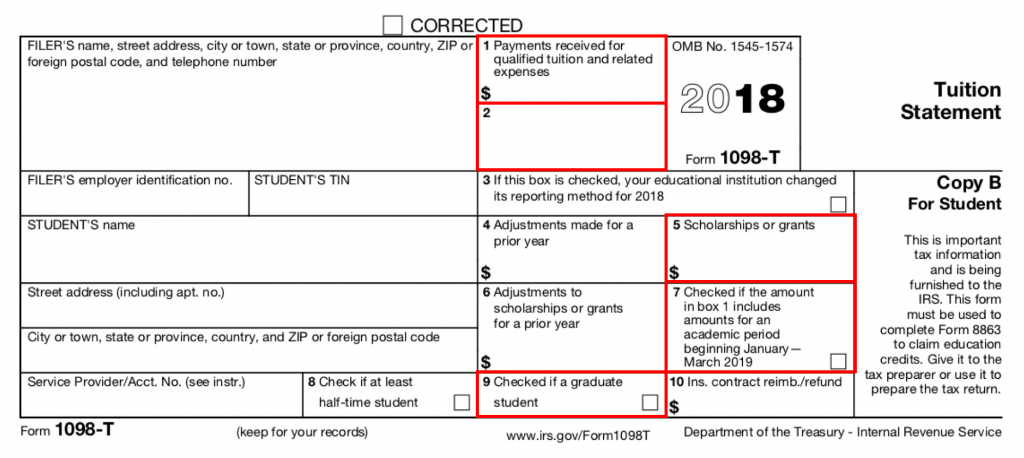
Box 1 Payments Received

This box reflects the amount of money paid on your behalf or by you for tuition and related fees. For example, if your department pays for your tuition, the amount of the tuition will show up in Box 1.

Box 2 Amounts Billed

This box is no longer in use in 2018, but many (most?) universities used it until 2017. Box 2 also reflects tuition and related fees, but it is a sum of the charges billed in the tax year rather than the amounts paid. A bill could be issued in one tax year and not be paid until the subsequent tax year.

Box 5 Scholarships and Grants

This box reflects the scholarships, fellowships, and/or grants received by the student in the tax year. The money that paid your tuition and fees will show up in this box. The fellowship (or other non-compensatory income) that paid your stipend or salary may or may not be included in this box.

Box 7

This box is checked if any bills or payments for a term beginning in January through March of the following tax year were included on the current year’s 1098-T. For example, if your university received payment in December for a term starting in January, this box will be checked.

Box 9

This box is checked if you are a graduate student.

The remainder of this article reviews the problems with the 1098-T and how they can be ameliorated.

Receive Your Tax "Cheat Sheet"

Subscribe to the Personal Finance for PhDs mailing list for essential information to help funded US graduate students (citizens/residents) with their federal tax returns

Success! Now check your email to confirm your subscription.

There was an error submitting your subscription. Please try again.

We won't send you spam. Unsubscribe at any time. Powered by Kit

Problem #1: Academic Year and Calendar Year Misalignment

Box 7 concerns the misalignment between the academic year and the calendar year.

Bills and Payments to Your Student Account

Ideally, the bills and payments for a given term will all show up on the 1098-T for the same calendar year in which the term falls.

Each fall term is like that: you may be billed or make a payment a month or two prior to the start of the term, e,g., in August for a term starting in September, but all the charges and scholarships and payments are done in the same calendar year.

However, for spring terms, you may be billed and perhaps make payments at the end of one calendar year for a term beginning in January to March of the next calendar year. In this case, the 1098-T for the earlier tax year is the one that reflects those expenses, and if a tax benefit is in order, it can be taken in the earlier year.

Historical Billing Practices for the 1098-T

In 2017 and prior, this caused a significant though largely unnoticed problem for funded graduate students (or anyone receiving scholarships): A university could post a bill for a spring term in December of the prior year, for example, and not post the scholarship that paid that bill until the start of the term in the later calendar year. That means that the earlier year would have an excess of expenses in Box 2, while the later year would have an excess of income. If not corrected, this could result in a tax deduction or credit in the earlier year and excess taxable income in the later year.

Imagine a typical fully funded graduate student at a university that had its accounting system set up this way and that used Box 2 on the 1098-T. (This was a common scenario.) In the student’s first calendar year, there would be two semesters of expenses billed but only one semester of scholarships posted. If the student used the numbers from the 1098-T without correction, he would be eligible for a tax break in that first year (or his parents would take it if he were a dependent). Each subsequent calendar year would have an equal number of terms of expenses and scholarships posted, which would probably result in small, not very noticeable discrepancies between the expenses and income. However, in the student’s final year, the system would catch up, and there would be scholarships posted with no corresponding expenses, resulting in excess income and excess tax due. In some cases, the extra tax due could exceed the value of the tax break taken in the earlier year. (Not to mention that if the student were a dependent in that first year his parents would have received the tax break, whereas he has to pay the extra tax himself in the last year.)

The correction that should have been performed throughout these years when a scholarship and the expense the scholarship paid showed up on different years’ 1098-Ts is to match up in the same calendar year the expense billed with the scholarship that paid the expense. Typically, that would mean not using an available tax benefit in an earlier year and preferring to use it in the later year that the income came in. When the expense and the scholarship that pays the expense are used in the same calendar year, the scholarship can be made tax-free using the expense if it is qualified. Specifically, you would report the relevant qualified education expenses in the later year rather than the earlier, meaning that the 1098-T in both years would be inaccurate / need adjustment.

What Changed in 2018?

Starting in 2018, Box 2 has been eliminated. This means that all universities now have to report payments received for tuition and related fees in Box 1. If the university switched its reporting system between 2017 and 2018, Box 3 is checked.

This is a much better system going forward for funded graduate students. It means that when a scholarship is posted to the student account to pay for tuition and related fees, that amount will show up in Box 5 and Box 1 in the same year, since they are the same action. It doesn’t matter if that happens in the same calendar year as the term or an earlier calendar year, because they will always be reported together.

However, this change causes two potential problems in 2018 for students at universities that made this switch.

1) If a charge was billed at the end of 2017 for a term stating in the first three months of 2018 and the bill was paid in 2018, the same expense will show up on both the 2017 and 2018 1098-Ts, first in Box 2 and then in Box 1.

Therefore, anyone receiving a 1098-T with Box 3 checked must determine whether one or more of the expenses summed in Box 1 was already used to take an education tax benefit in 2017. If that is the case, the expense cannot be used again in 2018.

2) This change in accounting systems also may force the unbalancing issue I described earlier for students finishing grad school. 2018 could be the year that there is excess income with no expenses available to offset it (after correction). If this happens, the student can either choose to pay the extra tax in 2018 or file amended returns going into the start of grad school when this problem originated (up to 3 years) to match up all the prior scholarships and expenses properly. This would still result in extra tax paid now, though it may be less than if the problem remained unamended.

The good news is that after catching up in 2018 if necessary, starting in 2019 the 1098-T will be much more straightforward.

Problem #2: Qualified Education Expenses Are Incomplete

The tuition and related fees reported on the 1098-T are not quite synonymous with the “qualified education expenses” you use to take an education tax benefit. In fact, there are different definitions of qualified education expenses depending on which benefit you use. Most likely, the amount listed in Box 1 is the amount of qualified education expenses the student has under the most restrictive definition for the Lifetime Learning Credit or the American Opportunity Tax Credit.

The definition of qualified education expenses for the purpose of making scholarship and fellowship income tax-free is more expansive. It includes certain required fees and expenses that were excluded from the definition of QEEs for the other education tax benefits, such as student health fees and required textbooks purchased from a retailer other than the university.

To find these additional qualified education expenses, check your student account, bank account, and saved receipts. Then, net them against your excess scholarship and fellowship income to make the income tax-free.

Problem #3: Not All Students Receive One

When Box 5 of the 1098-T exceeds Box 1 for a given student, the university does not have to generate a 1098-T. Some universities, as a courtesy, generate 1098-Ts for all students regardless of the Box 5 vs. Box 1 balance. This inconsistency generates confusion among graduate students and leads to the information in the student account being ignored.

Conclusion

It is clear that the 1098-T was not designed with funded graduate students in mind. Ideally, the 1098-T would be completely redesigned or a new form would be created to assist graduate students in preparing their tax returns. Until that happens, the 1098-T is not an independently useful document as it must be considered alongside the transactions inside and outside of the student account. The makeover to eliminate Box 2 was an improvement; at least starting in 2018, the 1098-T is no longer grossly misleading.

Filed Under: Tax Tagged With: 1098-T, graduate school, graduate students, tax

This Postbac Fellow Saves 30% of Her Income through Simple Living and a SciComm Side Hustle

February 25, 2019 by Jewel Lipps

In this episode, Emily interviews Maya Gosztyla, a postbac fellow at the National Institutes of Health in Rockville, MD who saves approximately 30% of her income from her stipend and freelance science writing income. Her goals for funding her PhD program applications and upcoming move to grad school and wedding motivate her to keep her expenses low and sustain her side hustle. Maya gives great financial advice for PhDs in transition into and out of grad school.

Links mentioned in episode

  • Tax Center for PhDs-in-Training 
  • Volunteer as a Guest for the Podcast
  • Gradblogger Connect 
  • How Much Tax will I owe on My Fellowship Stipend or Salary?
  • Quarterly Estimated Tax Workshop

postbac savings rate

0:00 Introduction

1:15 Please Introduce Yourself

Maya Gosztyla graduated in May 2018 from Ohio State. She majored in Neuroscience and Molecular Genetics. She started as a postbac at National Institutes of Health (NIH) right after graduation. She is mainly focused on drug discovery research. Her interests are in neurodegenerative diseases in particular. She is applying to PhD programs, with intent to begin her PhD program in Fall 2019. Maya is relieved that she does not have to balance undergraduate coursework with time spent on graduate applications. She also has more time for the interview weekends, which Emily says can be a fun experience.

2:33 What is your income? Where do you work and live?

Maya’s postbac annual salary is $30,000. She works at NIH location in Rockville, Maryland. The cost of living in this location is fairly high, because she is in the Washington DC metro area.

3:26 What was your financial situation coming into your postbac position?

Maya didn’t have any student loans. She says she treated filling out scholarship applications like a full time job, so she was able to fund her entire junior and senior years of undergraduate education. She didn’t spend all of her scholarship stipend during senior year. She has emergency savings fund of about $7,000 since she graduated from college.

4:25 Do you apply the same mindset from your undergraduate scholarships to your graduate school fellowship applications?

Maya says she has been applying to many graduate school fellowships. She applied to the National Science Foundation Graduate Research Fellowship Program (NSF GRFP), the National Defense Science and Engineering Graduate Fellowship (NDSEG), and one example of a school specific fellowship is the Knight-Hennessy Scholars at Stanford University. In addition to her graduate school applications, she has been sending in many applications to go after award money in full force. Emily assures that this strategy is a great idea, because you are certain that you will get paid for your graduate work.

5:58 Where did you move from? How did you manage your finances during your move?

Maya’s rent during college was $350 per month. In Rockville Maryland, her rent is $850 per month. Maya says what helped her most during her move was making a really detailed budget. She used several cost of living calculator websites. Additionally, she doesn’t have tax withdrawn from her postbac stipend, so she had to estimate quarterly tax.

She was in shock when she moved from the inexpensive Ohio city to the much more expensive DC area. She thought she needed to spend as little as humanly possible. For instance, she first moved into a bedroom in a three bedroom apartment. Her portion of the rent was $700 per month, which is the cheapest she could find in the area. She had an hour long commute, and she had to leave the apartment because of a cockroach infestation. Maya advises that people not to choose the cheapest apartment, but to take into account other factors. She says it can be worth more rent money to be closer to work for a shorter commute, and to live in a quality apartment.

Maya used cost of living calculators to get a sense of the maximum expenses she would have in the DC area. She says she spends less than suggested by the calculators. She talked to people who are in the NIH postbac program, because these are people in her age group and income level. At this early career stage, people are willing to share information about income and rent.

10:04 What is your savings rate? How are you saving this amount each month?

Maya is averaging around 30% of her gross income, pre-tax, going into savings. She emphasizes the importance of setting targets and timelines for what she is saving for. One of her specific goals was to pay for PhD program applications, which was well over $1000. She wanted to start an Individual Retirement Account (IRA), since she’s not sure she can have an IRA while she’s in graduate school. Another financial goal is to get married next summer! With her partner, she wants to take a couple of weeks vacation in Europe. She wants to do all of this without tapping into her emergency fund, because she wants to use this fund for her move to graduate school.

Maya has several frugal strategies. She doesn’t have a car, which is unnecessary in DC and major cities. She takes a bus to work, which she says is reliable. NIH will pay for public transit, so she gets reimbursed for her bus expenses. Maya says eating out is really expensive. She cooks almost all of her meals, and she meal preps. She goes out to eat with friends, as a social experience, it’s important to eat food to bond with people. This happens two to three times a month, and they don’t go out for drinks that much either. She views her eating out expenses as paying for access to space and people, and eating food isn’t the purpose. She set a rule for herself that she won’t eat out alone.

She goes to work, gets groceries, finds free stuff to do, and she doesn’t spend on entertainment. Also, she has a side source of income. Maya does science writing as a freelancer. It’s not easy work, but it’s not incredibly technical. She can pick and choose when and what kind of assignments she wants to accept.

15:27 How did you get connected to opportunities for freelance science writing?

Maya started a blog about Alzheimer’s Disease while she was in college. She wasn’t making money from the blog, but she started getting cold emails from people who liked her writing who would commission her for articles. She uses Upward, the freelancing website to find clients. Upward has a fee of 30% from every writing, so she charges more to make sure she doesn’t undercharge for her work.

Emily recommends the academic blogging network on Facebook (now called Gradblogger Connect) as a great resource for people interested in blogging and podcasts.

She doesn’t see science writing as her career. The variable income makes her feel anxious. She’d like to keep writing on the side, because she believes it is important for scientists to write about research for the public. Emily says that a side hustle during the PhD training is useful to figure out if this is what you want to do for your career.

20:37 Do you consider yourself having a financially quiet life?

Maya says that she applies a KonMari method to her purchases. She asks herself questions like, “will getting take out actually make me happier?” She does spend money on flights, because her fiancé lives in Ohio and she travels to see him. Maya observes that people spend money because they feel like they have to. She says it’s not a sacrifice for her to not go out every weekend, because she doesn’t really like alcohol. Emily says that it’s very interesting to apply Marie Kondo’s method to finances, and ask “does this spark joy?” Maya has gone through the introspection to consider what is bringing her high value. When you have low income, you can’t just default to the kind of consumerism you see around you.

23:30 Have you started thinking about how you’ll financially manage the transition to graduate school?

Maya is applying to high cost of living areas, so she feels more prepared for that move. Since she’s lived in the DC area, she will have a better idea of expense in places like Boston and San Francisco. She’s trying not to touch her emergency fund, because she needs it for her moving expenses. She is also trying to make sure that fiancé and her are comfortable in their current low income lifestyle, she wants to avoid the lifestyle creep. Graduate school will be a transition, but Maya will also experience the life transition of combining her lives with her partner.

25:02 Do you have any advice for someone looking at a transition out of college or into graduate school?

Maya says the first thing you have to do is look at what you have and where do you want to be in a month, or year. There is no way to set a savings rate if you don’t have something you’re aiming for. She gives the example that she wanted to save $4,000 for their honeymoon, then she could create a budget with that goal in mind.

She also says don’t forget about taxes. She had lab mates who didn’t know this. They weren’t setting aside money for tax season, and ended up owing. She says you can set up a separate savings account to set aside taxes. Emily says that this blindsides a lot of people. She has created resources on her website to help people estimate their quarterly tax.

Maya says you need to buy things that actually make you happy. She offers the caveat that if something is actually important, like you don’t need to get the cheapest apartment, get one you want. You can keep stock of what you actually care about. Maya wonders if people really know the taste of expensive wine, for example, or if it’s more about expectations. Emily says we may need to shuck the expectations. You have to figure out if something is right for you, if it “sparks joy” for you, and it’s not an expectation that others put on you. Maya says that others don’t pay attention.

Finally, Maya says to keep a really detailed spreadsheet. She used to use Mint, but now she uses a manual spreadsheet, and inputs once a week. She customizes it for her needs.

30:47 Conclusion

Filed Under: Podcast Tagged With: budgeting, frugal, interview, podcast, savings

Weird Tax Situations for Fellowship and Training Grant Recipients

February 20, 2019 by Emily

One of the most puzzling tax scenarios that is common in academia—but almost unheard of outside of it—is fellowship or training grant funding because it is neither a wage nor self-employment income. Fellowships and training grants, which I call “awarded income,” frequently pay the stipends and salaries of graduate students, postdocs, and postbacs. This post explains the weird tax situations for fellowship and training grant recipients and how to address them. I’ll clarify right up front that you do need to incorporate your awarded income into the gross income you report on your tax return, and you almost certainly will end up paying tax on it (unless your total income is very low or you have lots of other deductions/credits).

weird tax fellowship

This article was last updated on 1/17/2025. It is intended for US citizens, permanent residents, and residents for tax purposes. It is not tax, legal, or financial advice.

Further reading/viewing:

  • How to Prepare Your Grad Student Tax Return
  • Fellowship and Training Grant Tax Forms
  • Grad Student Tax Lie #1: You Don’t Have to Pay Income Tax
  • Scholarship Taxes and Fellowship Taxes  | Taxes for college students, grad students, and postdocs

I have to define my terms up front here because “fellowship” is used variously inside and outside of academic research, and these weird tax situations don’t always apply. What I’m talking about is when your income from your academic/research role is not reported on a Form W-2 (and you’re not self-employed).

Often, though not always, winning an external or internal fellowship generates this kind of income. The National Science Foundation Graduate Research Fellowship (GRFP) and the Department of Defense National Defense Science and Engineering Graduate Fellowship (NDSEG) are among the most well-known examples of this type of income at the graduate level for STEM fields. Basically, you’re being paid because you won an award, not because you are directly trading work or time for money. This kind of income can also come from training grants, such as the National Institutes of Health Ruth L. Kirschstein Institutional National Research Service Award (T32), and in those cases you might or might not be labeled a fellow by your institution.

If your income is reported on a Form W-2, whether it’s called a fellowship or not, this post doesn’t apply to you!

Personally, over my time in/near academia, I received awarded income on five occasions:

  • I was postbaccalaureate fellow at the NIH for a year between undergrad and grad school, and my income was reported on a 1099-G.
  • I was on a training grant in my first year of grad school, and my income was reported on a 1099-MISC in Box 3.
  • I won an internal fellowship for my second year of grad school, and my income was reported on a 1099-MISC in Box 3.
  • I was paid from my advisor’s discretionary funds in my sixth year of grad school, and my income was reported on a 1099-MISC in Box 3.
  • I was a Christine Mirzayan Science and Technology Policy Fellow at the National Academy of Engineering, and my income was reported on a 1099-MISC in Box 3.

Receiving Unusual Tax Forms

The way to definitively tell that you’re receiving awarded income is that you don’t receive a Form W-2 at tax time for your income, which was likely paid similarly to a regular salary or perhaps in a lump sum per term. Instead, you might see your income reported on some other strange tax form:

  • Form 1098-T
  • Form 1099-MISC
  • Form 1099-NEC
  • Form 1099-G

There are other possible mechanism for this reporting; these are the four most commonly used by universities and funding agencies.

None of these forms was designed for reporting awarded income and none do it very well, but they do get the job done if you know what you’re looking for.

Form 1098-T

Form 1098-T, which is issued to some students depending on your university’s policies, is sort of a clearinghouse form for the sum of your fellowships/scholarships/grants received (in Box 5) and also the sum of the qualified tuition and related expenses that were paid (Box 1) to your student account. Your fellowship income might be lumped in with your scholarships in Box 5, which makes them a little hard to parse, or Box 5 might only include your scholarships (see next section if so).

The good thing about Form 1098-T if it includes your fellowship income is that it does put front and center two of the important numbers you’ll need to work with when you prepare your tax return, the sum of your awarded (fellowship, scholarship, and grant) income (Box 5) and a subset of your Qualified Education Expenses (Box 1). You don’t really need to know what your fellowship income was independent of your additional scholarship/grant income See Weird Tax Situations for Fully Funded Grad Students for more details about working with Form 1098-T.

Form 1099-MISC

Form 1099-MISC is a slightly confusing form to receive for fellowship income.

Any non-academic who hears/sees that you have income reported on a 1099-MISC is going to think you’re self-employed. Self-employment and contractor income used to be reported in Box 7, which no longer exists following the creation of Form 1099-NEC (see next). Fellowship income usually shows up in Box 3, “Other income.” If you are a grad student or postdoc, you are not self-employed; do not pay self-employment tax!

The instructions for the 1099-MISC tell you to (“generally”) report your Box 3 “Other income” in the “Other income” line on your Form 1040 Schedule 1. There is a precise line on which you should do so: Form 1040 Schedule 1 Line 8r, which is labeled “Scholarship and fellowship grants not reported on Form W-2.”

Form 1099-NEC

The IRS resurrected Form 1099-NEC, which stands for “non-employee compensation,” starting in tax year 2020. All self-employment and contractor income is now supposed to be reported in Box 1.

Unfortunately, a minority of funding agencies are also reporting awarded income on Form 1099-NEC Box 1. Similar to Form 1099-MISC, if you are certain that this income is fellowship or training grant income and not self-employment income, you should report it as fellowship income on your tax return. If you erroneously report it as self-employment income, you will pay self-employment tax (15.3%) and exclude yourself from taking a higher education tax break.

Form 1099-G

Form 1099-G is typically used when the funding body is part of the federal government. The awarded income shows up in Box 6, “Taxable grants.”

Further reading:

  • How to Prepare Your Grad Student Tax Return
  • Where to Report Your PhD Trainee Income on Your Tax Return

Receiving No Tax Forms

Going along with the theme of not receiving a Form W-2 at tax time, you might very well not receive any tax form at all! It’s very common for there to be zero communication between the organization that pays the fellowship and the fellowship recipient. Other times, the fellow might receive what I call a “courtesy letter,” which is just a short, informal letter stating the amount of fellowship money paid.

Further reading: What Is a Courtesy Letter?

Fellows who don’t receive tax forms or whose institutions and funding agencies don’t communicate with them at all about their personal taxes may feel completely adrift. They have no idea where to even start with preparing their tax returns. Many pay no taxes at all (if you know someone like that, send them this article!) since it takes a certain level of awareness of your tax responsibility to even wonder if you need to pay income tax. Even those who suspect they need to report and pay tax on their fellowship income might be daunted by the task of figuring out from scratch exactly how to do that.

Further listening: Do I Owe Income Tax on My Fellowship?

But it’s really a simple process to carry out if you know what to do! You should be able to find the amount of fellowship or training grant income you were paid for the whole year from your bank records. If you’re not a student, you just straight report that number in Form 1040 Schedule 1 Line 8r. If you are a student, you have to work with your other scholarships and qualified education expenses a bit before reporting a number for your awarded income; see Weird Tax Situations for Fully Funded Grad Students for more details.

Further reading: Where to Report Your PhD Trainee Income on Your Tax Return

Quarterly Estimated Tax

In my observation, the great majority of awarded income recipients have the responsibility of paying quarterly estimated tax—and many, many, many neglect to do so. If you need one level of awareness to even understand you’re supposed to pay tax on your fellowship income, you need an even higher level of awareness before you follow through on paying quarterly estimated tax. In fact, if the organization providing you the fellowship didn’t mention this, it’s not a water cooler topic around your department, and/or you’ve never been self-employed or close to someone who is self-employed, you almost certainly wouldn’t know to do it.

The basic principle here is that the IRS expects to receive tax payments throughout the year, not just in April when your tax return is due. If you owe enough additional tax at the end of the year (and don’t qualify for an exception), the IRS is going to demand not only your tax payment but late fees and interest as well.

The main system for sending tax in to the IRS is tax withholding on a normal paycheck. If you don’t do that or your withholding isn’t sufficient, you’re supposed to pay estimated tax. Basically, you send in a payment (no forms need to be filed) to the IRS four times per year to make sure you don’t have too much extra tax due when you file your yearly tax return. You should work through the estimated tax worksheet on p. 8 of Form 1040-ES to figure out if you are required to pay quarterly estimated tax and in what amount; you can also find the instructions for filing it in that form.

Further reading: The Complete Guide to Quarterly Estimated Tax for Fellowship Recipients

Taxable Compensation and Earned Income Tax Breaks

Some of the tax breaks the IRS offers are contingent on the type of income you have, and fellowship income (not reported on From W-2) does not necessarily qualify.

Individual Retirement Arrangement

To contribute to an Individual Retirement Arrangement (IRA), you (or your spouse) must have “taxable compensation.”

Through 2019, the definition of “taxable compensation” did not include fellowship and training grant income not reported on Form W-2. However, starting in 2020, the definition of “taxable compensation” changed for graduate students and postdocs to include fellowship and training grant income even if not reported on From W-2.

Therefore, all types of graduate student and postdoc taxable income, whether reported on a Form W-2 or not, is eligible to be contributed to an IRA starting in 2020.

Further reading:

  • Fellowship Income Is Now Eligible to Be Contributed to an IRA!
  • The Graduate Student Savings Act Fixes a Major Flaw in Tax-Advantaged Retirement Accounts

Earned Income Tax Credit

The Earned Income Tax Credit (EITC) or Earned Income Credit (EIC) is a credit extended to low-income individuals and families. If your household income is quite low and/or you have one or more children, you might be able to receive the credit. As the name implies, you need “earned income” to qualify for the EITC. Unfortunately, fellowship/scholarship income is not considered “earned income” (Publication 596 p. 18). Puzzlingly, having zero earned income disqualifies you from the credit, but having too much non-earned income also disqualifies you from the credit. The definition of earned income also plays into the calculations for the Child Tax Credit and Additional Child Tax Credit.

Dependent Status

When you are trying to determine if you should file a tax return as an independent adult vs. a dependent of your parents, it is more difficult to qualify as independent with fellowship income rather than an equal amount of W-2 income. (This only applies to students under age 24.) While education expenses count as part of the amount of money that goes toward your “support,” scholarships and fellowships that you won do not count as you providing your own support.

Kiddie Tax

Fellowship income counts as unearned income for the purposes of being subject to the Kiddie Tax. If you are under the age of 24 on December 31 and a student, your “unearned” income exceeding $2,700 may be subject to a higher tax rate than the ordinary rate.

Further reading: Fellowship Income Can Trigger the Kiddie Tax

Filed Under: Taxes Tagged With: fellowship, grad students, postbacs, postdocs

Weird Tax Situations for Fully Funded Grad Students

February 20, 2019 by Emily

“Actually, I get paid to go to school.” How many times have you said that to distant relatives and new acquaintances? If you look at it that way, being a funded grad student is a pretty sweet gig. But there are definitely downsides, like the low pay, sub-par benefits, and the weird tax situations that come with getting paid to be a grad student in the US. Receiving a 1098-T that has seemingly no basis in reality and having to incorporate it into your tax return—or worse, not receiving one—can become a real time- and energy-suck. The whole tax return support system seems to have been set up to help people who are in the red with their universities, not people who are in the black. Fortunately, there are solutions to these weird tax situations for fully funded grad students, and I’ve brought them to light for you in this point.

weird tax fully funded grad student

The points covered in this post are strictly to do with being a funded graduate student (“candidate for a degree”) at a US university. It is primarily written for graduate students who are US citizens, permanent residents, and residents for tax purposes.

This article was most recently updated on 12/18/2025. It is not tax, financial, or legal advice.

Further reading:

  • How to Prepare Your Grad Student Tax Return
  • Why It Matters How You Are Paid

You Might or Might Not Receive a 1098-T

Form 1098-T looks like a super official tax form, rather like Form W-2. However, it’s not as weighty of a form as other tax forms you might receive for the purpose of reporting income. Form 1098-T’s primary purpose is to let the IRS know that a student (or a student’s parents) might try to take a higher education tax credit so that it can check the amount of the tax break claimed; it’s not designed and is not well-suited for reporting income, which is primarily what funded graduate students need to do. In fact, it’s optional for universities to even generate a Form 1098-T for a student for whom the Form 1098-T’s Box 5 (“Scholarships or grants”) would be greater than Box 1 (“Payments received for qualified tuition and related expenses”), which is often the case for funded graduate students. So as a fully funded graduate student, you might receive a 1098-T or you might not; the choice belongs to your university.

Further reading: What Is a 1098-T?

Your 1098-T Might Mislead You

The only thing worse than not receiving a 1098-T is receiving one that is misleading.

Further reading: Form 1098-T: Still Causing Trouble for Funded Graduate Students

When a 1098-T is issued, it is supposed to contain all of the scholarships and grants that were processed through the graduate student’s account (Box 5) as well as the payments received (Box 1) for qualified tuition and related expenses. In addition, your fellowship stipend might appear in Box 5 (or it might not). You would think this would be straightforward bookkeeping, yet I’ve spoken with numerous graduate students who, even after careful study of the transactions in their student accounts, could not understand how the sums were calculated.

Even if your Form 1098-T is a straightforward representation of the transactions in your student account, the net fellowship/scholarship income you should report on your tax return is not necessarily Box 5 minus Box 1. More on that next!

You Have to Calculate Your Taxable Awarded Income

It’s really straightforward to report your Form W-2 income, which I call “employee income,” on your tax return. The number is right there in Box 1, and it goes into Form 1040 Line 1a.

However, you have to calculate the taxable portion of your fellowship/scholarship/grant income, which I call “awarded income,” before reporting it on your tax return.

This is because, as a student (“candidate for a degree”), you’re eligible for a higher education tax break called tax-free scholarships and fellowships, which is detailed in Publication 970 Chapter 1. This means that the awarded income that you receive is taxable only to the extent that it exceeds your “qualified education expenses.”

To calculate your taxable awarded income, you need to add up all of your awarded income and then subtract all of your qualified education expenses. (This is not the same calculation as subtracting your Form 1098-T Box 1 from your Form 1098-T Box 5—more on that next!) Sometimes, this will net out to zero, like if the scholarship for your tuition exactly pays the amount of your tuition. Sometimes, there will be excess income or excess qualified education expenses.

In fact, funded graduate students often overpay their true tax liability because they miss accounting for some of their qualified education expenses! This could happen because they forgot about an education expense they paid for out of pocket or because they misunderstood that a charge in their student account actually was a qualified education expenses under this benefit.

Further reading: Where to Report Your PhD Trainee Income on Your Tax Return

You Have to Figure Out Your Own Qualified Education Expenses

To expand on that point, there is a lot of well-deserved confusion over what a “qualified education expense” actually is. This is because the definition of a Qualified Education Expense is slightly different depending on the tax break you’re trying to take. Yeah, that’s another weird tax situation for fully funded grad students.

IRS Publication 970 Introduction:

“Even though the same term, such as qualified education expenses, is used to label a basic component of many of the education benefits, the same expenses aren’t necessarily allowed for each benefit.”

Tuition is considered a qualified education expense for tax-free scholarships and fellowships and the two higher education tax credits, but some additional expenses, such as required fees and course-related expenses, e.g., books and supplies, are included in the definition for tax-free scholarships and fellowships. Even a personal computer could be considered a qualified education expense for tax-free scholarships and fellowships under very well-defined circumstances. These types of expenses are unlikely to appear on your 1098-T in Box 1 because they’re usually paid out of pocket. You should refer to Publication 970 for the full definitions of qualified education expenses under the three different education benefits.

Furthermore, the number that appears in Box 1 of your Form 1098-T is not the sum of your qualified education expenses that are processed by your student account. Box 1 of Form 1098-T reflects “qualified tuition and related expenses,” which has its own definition that excludes certain expenses that are qualified education expenses under tax-free scholarships and fellowships.

Further reading: What Are Qualified Education Expenses?

One controversial point is whether your student health insurance premium is a required fee/qualified education expense for the purpose of making the scholarship that pays it tax-free. Insurance and student health fees, along with some other expenses, are explicitly disallowed as qualified education expenses for the Lifetime Learning Credit, but not for making scholarships tax-free.

My tax return preparation workshop contains a complete discussion of qualified education expenses, including common gray-area examples that graduate students encounter, and how to calculate the taxable portion of your awarded income.

You Might or Might Not Be a Dependent of Your Parents

Because graduate students are students, they might be considered dependents of their parents (or another relative) for tax purposes if they were under age 24 on 12/31. Many parents (and their tax preparers) try to claim their of-age children as dependents without referencing the relevant definitions. If your parents assume you are a dependent but you believe you are not, together you can go through the definition carefully to make the final determination.

The conditions for being considered a dependent of your parent are:

  • You are age 23 or younger at the end of the calendar year.
  • You were enrolled as a student in at least 5 calendar months (doesn’t have to be consecutive).
  • You lived with your parents for at least half the year (being away for educational reasons can count as living with them).
  • You are not filing a joint return (with a caveat).
  • You must meet the “Support Test”: You did not provide more than half of your own support in the calendar year (see Publication 17 Worksheet 3-1).

For any years that the first three points above apply to you, you should fill out the Support Test to determine if you provided enough of your own support to qualify as independent. Keep in mind that education expenses count as “support” that you needed, but scholarships and fellowships that paid that support don’t count as being provided by you, the student.

You’re (Mostly) Not Paying FICA Tax

FICA (Social Security and Medicare) taxes seem like an unavoidable burden for employees and self-employed people. But even if you’re an employee of your university (i.e., you receive a W-2 at tax time), you’re most likely not paying FICA tax because you have a student exemption. This exemption depends on both the primary function of the organization that employs you (i.e., educational) and your primary relationship with the organization (i.e., as a student rather than an employee).

The student exemption is almost universal for graduate students, but I have come across two exceptions that depend heavily on the exact wording of the exemption:

1) Graduate students at research institutions that are not primarily universities might not receive the exemption.

2) Graduate students, even at universities, whose primary relationship with their employer is as an employee rather than a student may pay FICA tax. For example, this might occur during the summer vs. during the academic year, and could happen without the student even perceiving a difference in roles. (This is not common, but I have seen it a few times.)

Graduate students receiving fellowships also do not pay FICA tax, but that is because they are not receiving wages rather than due to their student status.

You Cannot Take the Saver’s Credit

The Saver’s Credit is a very valuable credit that low-income earners can take if they contribute to a retirement account, such as an IRA. However, full-time students are not eligible for the credit.

Yes, there are a lot of weird tax situations for fully funded grad students. You have to do a bit of legwork instead of just blindly entering numbers from your 1098-T into tax software or ignoring your excess scholarship income. But if you break the issues down one by one, it’s actually straightforward to determine how to resolve them.

Filed Under: Taxes Tagged With: grad students, tax return

Do I Owe Income Tax on My Fellowship?

February 19, 2019 by Emily

Postbac, graduate student, and postdoc fellows frequently ask whether their fellowships are considered taxable income. PhD-type fellowships that are not reported on a W-2 are non-compensatory income. They might be reported on a 1098-T in Box 5, on a 1099-MISC in Box 3, or on a courtesy letter or not reported at all, which accounts for the widespread confusion. Publication 970 answers the question of when a fellowship can be considered tax-free. Fellowships are considered part of the recipient’s taxable income unless they go toward paying qualified education expenses (students only).

Links Mentioned in the Episode

  • Publication 970

income tax fellowship

Transcript

Welcome to the Personal Finance for PhDs Podcast – a higher education in personal finance. I’m your host, Emily Roberts.

I’m doing something a little bit different in this special bonus episode for Season 2.

I’m using it to answer a frequently asked question that I receive about taxes. The question is: Do I owe income tax on my fellowship?

In this episode, I’m speaking to citizens and residents in the United States. And I’m also talking about PhD-type fellowships whether at the postbac level, the graduate student level, or the postdoc level.

What’s going on with these fellowships that makes the recipient question whether or not they are taxable is that they are not reported on a W-2. They might not be reported at all, or they may be reported on a 1098-T in Box 5, on a 1099-MISC in Box 3, or on a courtesy letter, which is not an official tax form but rather just a letter that states what the amount of the fellowship was in that calendar year.

Fellowship income is considered part of your taxable income. Now, you may not actually end up paying tax on your fellowship income depending on the rest of your return, like the deductions and credits you’re going to be able to take, but it is considered part of that taxable income.

Now, I know you’re not inclined to just believe me right off the bat. I mean, there’s a strong incentive for you to believe that your fellowship income is not taxable, so I’m going to give you a bit of evidence here.

IRS Publication 970 is the definitive publication on the taxability of fellowship and scholarship income. I’ll read you a few excerpts from Chapter 1 of Publication 970.

First, some definitions:

A scholarship is generally an amount paid or allowed to, or for the benefit of, a student (whether an undergraduate or a graduate) at an educational institution to aid in the pursuit of his or her studies.

A fellowship grant is generally an amount paid for the benefit of an individual to aid in the pursuit of study or research.

So you can see that fellowship grants are much more broad; they can be issued to non-students, whereas scholarships only go to students.

Chapter 1 of Publication 970 approaches fellowships and scholarships from the perspective of trying to make them tax-free.

So let’s see how that can happen:

A scholarship or fellowship grant is tax free (excludable from gross income) only if you are a candidate for a degree at an eligible educational institution.

So right off the bat we know that anybody who is receiving a fellowship who is not a student cannot make their fellowship tax-free, i.e., it is part of their taxable income.

Additionally:

A scholarship or fellowship grant is tax free only to the extent: It doesn’t exceed your qualified education expenses…

So now we’re just dealing with the graduate student population that has the potential to make a scholarship or fellowship grant tax-free.

The way that we use the terms ‘scholarship’ and ‘fellowship’ in academia, a ‘fellowship’ generally refers to the money that you take home for your living expenses, whereas ‘scholarship’ is the money that goes towards paying your tuition and fees, the qualified education expenses.

Very roughly speaking, your qualified education expenses can make your scholarships tax-free if you’re a fully funded graduate student, but there’s no more qualified education expenses to start making your fellowship income tax-free. Therefore, again, roughly, your fellowship income is included in your taxable income.

So to summarize, fellowship and scholarship income that goes towards paying our qualified education expenses like tuition and fees can be made tax-free, but fellowship and scholarship income that goes towards paying other kinds of expenses like your living expenses can’t be made tax-free.

Now, I’m glossing over some very important details on how you actually calculate your taxable income, so if you want more information about that, please see the tax center on my website, pfforphds.com/tax.

But, there you go, roughly speaking, fellowship income does need to be included in your taxable income, whether you are a postbac, a graduate student, or a postdoc.

Thanks for joining me in this short bonus episode!

Please share this episode on social media and with your peers because this is a message that they need to hear. It’s not a message that they want to hear, but it’s a message that they need to hear to stay on the right side of the IRS.

Show notes for this episode can be found at pfforphds.com/s2be1.

Thanks for joining me today, and I’ll see you in the next episode!

Further reading/viewing:

  • Weird Tax Situations for Fellowship Recipients
  • How Much Tax Will I Owe on My Fellowship Stipend or Salary
  • The Complete Guide to Quarterly Estimated Tax for Fellowship Recipients
  • How to Prepare Your Grad Student Tax Return (Tax Year 2019)
  • Scholarship Taxes and Fellowship Taxes

Filed Under: Podcast Tagged With: awarded income, fellowship, non-compensatory pay, stipend, tax, taxable compensation, taxable income

Using Data to Improve the Postdoc Experience (Including Salary and Benefits)

February 11, 2019 by Jewel Lipps

In this episode, Emily interview Dr. Gary McDowell, the executive director of Future of Research. Future of Research is an advocacy organization that uses data to empower early-career researchers. Gary outlines the ongoing work at Future of Research before diving into the details of their recently published study on postdoc salaries. Emily and Gary discuss the complexities around categorizing and counting postdocs as well as the interesting results from the data Future of Research acquired by Freedom of Information Act requests. Current postdocs can contribute to this ongoing project by submitting their salary and benefits data to the Postdoc Salaries database.

Links mentioned in episode

  • Tax Center for PhDs-in-Training
  • Volunteer as a Guest for the Podcast
  • Future of Research
  • Paper: Assessing the landscape of US postdoctoral salaries
  • Nature News “Pay for US postdocs varies wildly by institution” 
  • PostdocSalaries.com
  • PhDStipends.com

postdoc salaries

Teaser

Gary (00:00): We actually found that the median salary for all postdocs across the US, regardless of field, was actually pegged to the minimum National Institutes of Health National Research Service award stipend.

Introduction

Emily (00:18): Welcome to the Personal Finance for PhDs podcast, a higher Education in personal finance. I’m your host, Emily Roberts. This is season two, episode three, and today my guest is Dr. Gary McDowell, the Executive Director of Future of Research, an advocacy organization that uses data to empower early career researchers. Gary shares results from future research’s, recently published study on postdoc salary data gathered through FOIA requests. We also discuss how prospective postdocs can properly evaluate and negotiate their postdoc job offers. Current postdocs can contribute to this ongoing project by entering their salary and benefits data to the database at postdocsalaries.com. Without further ado, here’s my interview with Gary McDowell. Today on the podcast I have Gary McDowell from Future of Research, and we are going to be discussing postdoc salaries. Uh, they have just wrapped up or well wrapped up a milestone in an ongoing project, and we’ll be discussing that. So, Gary, please, you know, tell us a bit more about yourself and about future of research.

Will You Please Introduce Yourself Further?

Gary (01:25): Sure. Um, so I, uh, I’m from Northern Ireland Originally, I grew up in Northern Ireland, in Scotland. I did all of my, um, undergraduate and postgraduate study in the UK, um, and then moved over to the US to become a postdoc, um, first at Boston Children’s and then at Tufts University, uh, both in the Boston area. Um, and it was while I was there that I started getting more in interest in the, um, the scientific system itself, um, and how we are training people, how we are, um, you know, setting scientists up for success and producing scientists and not just science. So, um, obviously at that time I was also experiencing a lot of the frustrations that people find with the, the hyper competition that there is in this system. Um, and so, um, moved on afterwards. Uh, I’m now the executive director of this nonprofit future of research, uh, and we’re trying to, uh, champion, engage and empower early career researchers with evidence to help them change the, uh, research system and the enterprise that they’re experiencing, uh, and make improvements.

Emily (02:36): Yeah, I love this. It obviously dovetails really well with what I do. Uh, you guys have a broader focus. Mm. Um, I’m more narrow about just really getting people dialed in and helping them with their finances. Um, kind of throughout, you know, uh, pre-graduate school, during graduate school, post-graduate school. Um, so I love that we have sort of complimentary pursuits here. And we’ll of course be talking about that specifically with, with respect to salary in a moment. But can you, um, give me kind of a little bit more of an overview about, you know, what’s your team at future of research? What have you guys been up to, generally all the different areas that you work in?

Future of Research Nonprofit

Gary (03:09): Sure. So, yeah, we’re, uh, an organization, um, at the moment there’s just me as staff, and we have a board of about 20 early career researchers. Um, so we ended up forming this nonprofit. Originally we’d had a, a conference to bring early career researchers together and discuss some of the issues with, uh, the system and with hyper competition, um, that there is particularly in biomedicine. Uh, and from that conference and then a bunch of conferences around the country, we quickly realized there was this, this need for this, um, this group to be, you know, trying to have these conversations. Um, and in particular, you know, trying to give data and evidence to early career researchers to help ’em make better choices, but also to educate in some sense the rest of the scientific community about the realities that our generation is currently experiencing. So, you know, we have this board, um, um, and volunteers who are actively working on a bunch of projects and issues that, that come up and that we’re experiencing. Um, we have two major projects, which I think are, are, have both come out of local meetings that we held in the last couple of years which are really very, um, you know, we, we wanna try and have specific projects that we’re setting up and establishing, um, having looked at a, a need, uh, around in the community. So those projects, one of them we’re calling who’s on board, and that’s trying to get, uh, more early career folks into leadership positions. So we’re gonna start trying with scientific societies and trying to get more people onto the voting council positions at the top of the, the organization. Um, you know, and trying to bring in that perspective. Um, also recognizing that a lot of people need leadership training and development and, and so on. And hopefully generating a network of future leaders, um, that, that, uh, organizations across research can tap into. Then the other major project that we’re really pushing at the moment is, uh, focusing around mentoring. Um, I think mentoring is one of the biggest concerns of, um, grads, postdocs, uh, et cetera, you name it, throughout the system right now, junior faculty in particular, one of the first things that, that I am asked by junior faculty is, you know, how do I find out more about mentoring people and managing people because I don’t know how to do it and suddenly I’m expected to. Um, and, you know, this can lead to all sorts of issues with people reaching their full potential. Um, you know, egregious behavior can, can occur and is not really held accountable. So we’re, we’re pushing a big summit next June in Chicago to bring people working in this space, this, um, and doing research on mentoring together and trying to figure out what we can do to take grassroots action to really make sure institutions are putting mentoring right at the center of what they’re interested in. Um,

Emily (05:57): Yeah, sounds amazing. Um, especially, particularly the latter project, I think. Um, yeah, please keep going. Or any other major efforts there.

Gary (06:07): Yeah, so we, then we have, so those are things that we’ve sort of set up, um, deliberately, and then there’s things that we’ve sort of responded to and we try to be responsive to, you know, needs that arise. So one of those projects is sort of related to the who’s on board thing. Um, and it’s to do with peer review. Uh, and in particular, we’re trying to address this phenomenon of grad students and postdocs, essentially ghost writing a peer review report that is then submitted under somebody else’s name to a journal. Um, and you know, this, this is not only a problem, it’s sort of scholarly recognition. Um, but it, you know, at the same time we’re hearing that there’s not enough reviewers, um, and journals are sort of crying out for more reviewers and this lack of transparency about who’s actually doing the review and getting the names of particularly, you know, grads and postdocs who journals may want to review again in the future. Um, those sort of barriers of not putting those names across, um, and of not recognizing that scholarly work, uh, and, and who, who did it, um, is a thing that we’re pushing, uh, both with journals, but also, uh, we did a survey asking people about their experiences with this. And one of the big things coming up is that, of course, principal investigators have not been trained in peer review either generally. And so a lot of these practices are to do with just a lot of, uh, assumptions and, um, um, you know, a lack of clarity that there should be a different practice that you should be giving these names. So it’s really, that’s been really interesting to work on and sort of was in response to a survey done by, um, junior folks at eLife in the last year. So, so we’ve been following that. And then the other one, which, which we can talk more about now, is the, the salary project. Um, that really started just as we had formed the nonprofit. It was when there was a change to federal labor law being proposed, um, and the long, and the short of it was that this was going to affect postdocs and it was going to raise their salaries, um, or institutions were going to have to essentially have postdocs clocking in and out and, uh, tracking their time, which is not really very realistic. So, so there was this push to raise salaries, and we, we were following what institutions were doing, uh, to accommodate that change. And that then led us to asking, well, what are the actual salaries that people have and led into the, the, the work that we’ve, we’ve done here.

Emily (08:29): Yeah, I would love to talk about that a little bit more in depth now. Um, when I was, you guys just came out with a, a paper recently, right? What’s the title of that and where can people find it?

Gary (08:39): Sure. So the title is Assessing the Landscape of US Postdoctoral Salaries. Um, it’s open access, it’s in the studies in graduate and postdoctoral education, um, and, uh, which is part of the Emerald Insight Publishing Group. Uh, yeah,

What is a Postdoc?

Emily (08:56): Yeah. So my <laugh>, my question is, I was very interested in this, uh, section of the paper where you talked about the different titles that postdocs might have and how that affects what salaries they have. And it just led me to the question of what is a postdoc?

Gary (09:09): Yeah.

Emily (09:10): Actually, like, can we start there? What’s a postdoc?

Gary (09:12): Yeah. So yes, a postdoc is, so I can give you, I can start with what I think a postdoc should be, and we can maybe work from there. My, you know, when you’re, you’re going through the academic track, um, there’s, you know, you go through your undergraduate phase, then you go to graduate school, you get your PhD, uh, that’s the point at which in my opinion, you should be learning how to do science, how to carry out research, how to, you know, do experiments, uh, how to analyze them, how to learn the nuts and bolts of being a scientist. Um, then what has become the default over time is that in order to become a professor after getting your PhD, there’s an intermediate step known as the postdoc or carrying out post-doctoral research, um, post obviously being, after getting your doctorate. And, um, in my opinion, this is a period in which you should be thinking about your own research goals and how to take those forward and learning under the mentorship, uh, slash apprenticeship of an investigator who already, you know, is doing this, learning how to manage a group, learning how to mentor people, learning how to manage budgets, how to write grants, how to, you know, ensure that your research project can succeed and that you can lead a team. Um, but the postdoc more likely is in reality is, um, a period of further research. Um, usually someone will move on to do a, another project. It’s quite common to change field and get experience by doing a postdoc there. Um, but in reality, what people are doing is trying to get, uh, a number of papers trying to demonstrate that they can succeed in perhaps a different lab to where they did their PhD, um, and, um, sort of accrue credentials in order to get a faculty position to then start as a, as a professor.

Emily (11:09): And I, what I was curious about, because your understanding and my understanding are very, um, similar to one another, I was also coming outta sort of the biomedical world, so that kind of makes sense. But, um, I think in your paper you had something like 11 different common titles under which postdocs can be hired. And so I was just wondering if there’s part of the issue, uh, a discrepancy between how the, the employers or universities or workplaces or mentors see postdocs and how postdocs see themselves.

Gary (11:37): Yeah.

How Was the Idea for a Project to Assess Postdoc Salaries Formed?

Emily (11:38): Um, and we can get into this a little bit more, but one of, I think the main motivations behind your project was, um, just kind of trying to figure out what level of awareness universities, et cetera, have about their own, their own postdocs, whether they’re employees or not. So let, let’s take it back there a little bit bit. So like, you’re, you’re coming up with this idea. Okay. How, how was this idea formed for the project? What exactly were you asking?

Gary (12:00): Yeah, so you’re, you’re totally right, because we were coming from this perspective, I think this is particularly why we took the route that we did. Um, when we were looking at the policies that were being updated in response to this labor law, we started to ask ourselves the question, well, these are policies at an institution that doesn’t tell us necessarily what people are actually getting paid. And it requires adherence to a policy, uh, and that someone essentially is checking up that the policy is being followed. Now, we already, we have a, a preprint, um, paper, um, that we’ve done with, uh, rescuing biomedical research, another nonprofit in this space, um, looking at the National Science Foundation’s data on the number of postdocs. And, um, this was in reaction to a paper that claimed that the number of postdocs was in decline, because that apparently seemed to be reflected in the NSF data. Um, and we dug into that data a little, and we first questioned whether there was actually a decline or whether there was actually a bubble of people postdocing for longer after the recession in 2008. But one of the things we found was that institutions were doing a pretty terrible job of reporting year to year how many postdocs they had. And so, while we were very receptive to, you know, institutions telling us, oh, well, we’re raising our salaries, like this is going to be our new policy. Um, if you don’t know who your postdocs are to begin with, we were curious as to whether people would be falling through the cracks and whether you would actually know who your postdocs are, and, um, whether they’re getting the salaries that they’re supposed to be getting, uh, whether, whether the policies were actually reflected in reality, or whether an institution could say, you know, we recommend all our postdocs get this salary, and then there’s no follow up or, or action on that. So that was a big part of that. Right. And, and knowing as you say that there is this great breadth of, um, assumptions about what the postdoc is, um, you know, there is this constant argument of whether they are employees or whether they are trainees. Um, you know, sadly it seems that they’re employees whenever it suits in keeping them out of training or outta things that you need to do for students. But they’re also trainees when it suits in terms of giving them lower salaries and not giving them benefits.

What Position Counts as an Employee or Not an Employee?

Emily (14:16): I was just going to ask about that. Actually. This is one of, this is just a question that I’m constantly asking about whether people are employees w receiving W twos. Or not employees. And I would think that categorizing people as not employees would be an easy way to get around the, uh, you know, the pol- the, it’s a fair labor of Standards act, right? The FLSA, right?

Gary (14:38): Yeah. So yeah, the, the interesting thing about that, and a lot of institutions did in the beginning try to claim that they’re, because also it’s complicated by where the money comes from for the postdoc. So most postdocs are paid directly off a research project grant, um, as quote unquote staff on the grant. But a lot of postdocs are also on fellowships of various kinds from a whole multitude of different organizations and people on fellowships, uh, especially if they are per paid directly and not paid through the institution, they’re most usually referred to as trainees. Um, they often get the, the worst situation of losing their benefits often when they get on a fellowship, um, after moving off a, uh, another mechanism, um, because the institution says you’re no longer an employee, therefore you no longer have to provide benefits. And this came up a lot with the, the, the Labor Act, um, updates. And what was really interesting was the Department of Labor, um, the specification of like, who is a, who is an employee or not, doesn’t come down to who pays you. It’s the nature of the work that you’re doing. And one of the most interesting things that came up was this, this pushback that occurred of you can’t just claim that your fellows are not, that they are exempt from this law. They actually are not. And indeed, the Department of Labor told that to the National Institutes of Health, that’s why they raised their fellowship stipends, um, because they were told these people are not exempt. They are explicitly, they ended up explicitly being, uh, part of the target of those trying to make the change. Um, so yeah. So the, even within those definitions, part of them are just institutional. The institution will just argue that they have that definition, but it actually sometimes doesn’t even stand up under, under law. So it’s, it’s been an interesting part of this.

Emily (16:24): Yeah, that is very interesting. And it is so important, um, I think for people who are looking to take a new position, whether it’s as a graduate student or as a postdoc or, or what have you, um, to know going into it, how you are viewed by the institution. Employee, not employee trainee, not a, not trainee, um, just because yeah, your, your benefits or whatever might, um, change depending on the, the status that you have. Um, they could be taken away from you if something changes at the university level. Um, so just kind of go into whatever situation you have with eyes wide open.

What Did You Do for the Postdoc Salaries Project?

Emily (16:57): Yeah. So let’s get back to the, to the salary project. Um, so you were curious about, you know, whether policies were actually being applied at, at the institution. So, so what did the actually project end up being? What did you do for it?

Gary (17:10): Sure. So, so we wanted to get these salaries, and this is data that is not, you know, easy to find, uh, that is out there. And so we ended up with this rather blunt, somewhat aggressive, but also, um, easy and also standard methodology, which was to carry out freedom of information requests at public institutions. So what we would do is contact the freedom of information, uh, office or the public records office at the, at a public institution. They’re legally required to give out data like this. And we would ask for, um, in this case, we asked for the simply the title and the salary of everyone who was a postdoc. Um, we wanted to keep it as, as easy as possible. And that was on, we were asking for salaries on the date of December 1st, 2016, which was when this labor law was due to come into effect, uh, when, when changes were, were likely to happen, the institutions had been preparing for at the time. Um, and so, yeah. And so we asked, basically asked for, for this data. Now the, the reason it’s a bit aggressive is that it ends up, um, basically forcing the institution to give data in a, you know, we weren’t asking institutions, we weren’t going to the sort of postdoc offices or to various administrators and asking them to give us the data. Um, but that actually worked out as a really interesting part of this project as an internal metric of whether a university’s administration knows what postdocs are. So I would find some institutions were able to provide the data with no problem, and other institutions, I would be contacted back and asked, you know, what is a postdoc? Can you explain what this is? You know, I would have to look up titles sometimes at the institution to find out what the relevant titles were that we wanted. Um, and, um, you know, we were sort of cross-checking the number of salaries we’re getting with the number that NSF thought, um, that they had. Which, again, those numbers should be reported by people who know better what postdocs are to the NSF. And so we’re, you know, providing all these like controls and looking at seeing how good is the data that we’re getting, um, you know, on top of just getting the numbers, what standard is it at? What are we getting back? And that was actually a really interesting aspect of, of what we were receiving as well.

Commercial

Emily (19:32): Do you know what’s even scarier than an upcoming committee meeting the prospect of preparing your tax return? But it doesn’t have to be that way. I’ve created a variety of free and paid resources to help you get through tax season with as little pain as possible. These resources are specifically for grad students and fellowship recipients, post back through postdoc, check them out at pfforphds.com/tax.

Analysis and Findings from the From the Postdoc Salaries Project

Emily (20:03): So once you were able to get, you know, some data, uh, coming back from these public institutions, uh, what what did you do with that? What was, what was your analysis like?

Gary (20:14): Sure. So we had, uh, a data scientist on our team, um, who went through and tried to analyze, basically, you know, we’re, we’re sort of looking at the, the, the distributions of salaries. Um, and, you know, we wanted to break things out by geographic region, um, by, uh, gender, um, and, um, possibly other demographics. We have a little try at that. And also by the, the title, whether what variables there were that were affecting the salaries, um, and what we, you know, what were we seeing overall as the, again, you know, to a big part of this was just assessing the landscape, just figuring out what postdoc salaries looked like and giving us a sense, uh, giving us a bar to work from, uh, in terms of, of efforts going forward.

Emily (21:03): And so, was there anything, uh, well, what were sort of the broad, I guess, conclusions, was it just like, okay, here’s ranges of salaries and, uh, here’s the breakdown of these different groups. Like what were some of those conclusions? And then also was there anything that came out of that that was actually surprising to you?

Gary (21:18): Yeah, so, um, so yeah, we sort of got broad distributions of where salaries were. And we actually, um, before the, the paper was done when we’d actually done the, uh, initial data gathering, we had it write up, um, uh, in nature about this, um, I think it was titled Postdoc salaries very wildly from institution to institution. Um, and they did a very nice demographic of where all the salaries lay, and most people were in the forties, thousands of dollars, um, you know, between 40 and and 49,999, um, which made sense. Um, we actually find that 22% of all of our data was in a $25 range around the new, uh, NIH minimum stipend, uh, which was very close to what the proposed salary threshold had been under the, the federal labor law change. So we found that that really had a, a very striking effect. Um, and in fact, one of the things that was most interesting and I think, um, is useful for us in, in doing policy work going forward, we’re interested in finding out what is, what are the levers that we need to pull in order to raise postdoc salaries? And we actually found that the median salary for all postdocs across the us, regardless of field, was actually pegged to the minimum, uh, national Institutes of Health, um, national Research Service award stipend. So these are the, the numbers that NIH uses for things like F awards and T awards that postdocs are paid off. Um, these are the only people who have to actually be paid according to this stipend. Um, but a lot of institutions just peg their salary scale to the NIH, and in particular, they may not use the scale year to year. They may not have increases per year, but they certainly will peg the minimum salary, must be the NIH’S level. And so we actually find that the most effective policy lever for raising postdoc salaries in the US would be to get the NIH to raise their, um, the, the NRSA award stipends. And that’s obviously something we’ve been pushing. 

Emily (23:28): I’m, I’m so glad you brought that up. Um, I remember, so several years ago, I, I did a fellowship at the, um, the National Academies, and I remember reading their, uh, postdoctoral report. The postdoctoral experience revisited, I think was the recent report on it. And seeing that and seeing that discussion about how important the NIH minimum salary, uh, recommendation was, how so many universities were going off of it, which is really just so surprising because again, it’s one, it’s a recommendation. And except for their own internal stuff like it, you know, that’s required. But for everyone else, it’s just a recommendation. And two, it’s a minimum. And it’s not at all taking into account like different cost of living, you know, areas. Like is it, like, is that minimum supposed to be for Bethesda, or is it supposed to be national? I’m not even sure about that. But, um, yeah, anyway, just the fact that they were going off of this as if it were absolute truth and no, it was only ever a minimum and only ever a recommendation. And I’m so glad that you brought that up. And I believe I read that within the last, we’re recording this in December, 2018. I think within the last week or so, NIH actually has raised, um, their, their recommended minimum salary, right?

Gary (24:35): They have, yeah. They have done, they, they did a big raise. We actually plotted this out in a, in the first figure in the paper of raises over time. And, um, you know, the, most of the raises, um, to the current towards the current level happened during the NIH doubling around the turn of the century. Uh, and then the, the Fair Labor Standards Act was actually another major push. Um, you know, the NIH had been pushed along, uh, a couple of times by various reports. Um, I think the, the, the last one previous to the FLSA was the 2012 Biomedical Working Group report. And so there’s been these little pushes and since the FLSA, they’ve pushed up a lot at that point, and then they have consistently continued to push quite high. Um, I think this year was a 2% increase, so that now the minimum is at $50,000, uh, which has been recommended for, for quite some time now.

Emily (25:30): Yeah. So they finally reached another milestone there of getting into the the fifties range <laugh>.

Gary (25:34): Yeah, exactly. So, um, yeah. And then, you know, this has actually been useful as a real policy example. You know, I and, uh, the president of Future of Research, Jessica Polka, were both on the National Academy study, uh, for the next generation researchers initiatives, which NIH is releasing its recommendations on, uh, in a, in a few weeks. And, um, one of the things we were able to push having this data was, well, we know the NIH number is a very important number. And so the recommendation, I think in the upcoming outta that report was NIH needed to raise its number, but also institutions should take that number and then adjust for cost of living and for years experience. So sort of both, both groups needed to be both sets of stakeholders needed to be, to be, uh, yeah. Working on that.

Emily (26:20): Yeah, absolutely. Um, so any other interesting findings from the paper?

Gary (26:25): Yeah. Um, I think one of the things I was surprised with, uh, most was how many salaries there were in the fifties thousand, uh, of dollars. Um, and it was interesting, you know, we did a little bit of, uh, breaking down by, um, by field as far as we could. Um, we had only requested the title and, um, salary of the postdocs to, you know, to have this basic, uh, uh, request, um, and as reasonable requests that hopefully institutions wouldn’t refuse as possible. But half of those institutions ended up giving us also names and department, uh, information so we could work out field for a large subset. Um, and we find that there was no real field dependence on the salaries. Um, you know, I think a lot of people assume that, oh, the humanities will be all the salaries in the low range and the, you know, the higher ones will be computer science, and certainly towards the higher end, you do see some of that. But, you know, there’s no, the humanities are not lower on average than anyone else, to be honest. You’d be surprised how often biomedical en- engineering is, uh, in the low salary range. Um, and, um, yeah, so I think that was one of our surprises, and a lot of this anecdotally seems to be, um, you know, when I go and talk around the country about salaries, um, and make a, a big push for people to be talking about salaries, uh, I hear a lot of who negotiates. Um, a lot of postdocs are negotiating salaries a lot more than I think people know. And so there’s this whole, I think there’s this disparity in who’s asking and who’s not asking. And you know, frankly, that we’re not even supposed to be talking about money to talk about money in academia, as I’m sure you’re, you’re often facing as well in your work to talk about this is already to, to cast out on whether you deserve to be there, because if you’re looking for money, you shouldn’t be in academia sort of thing. Right. So, so that’s been an interesting thing to push as well.

Emily (28:22): Yeah. And I think that leads well into, um, the project that we first met over. Um, you first approached me about, so to give a little backstory for the listener, um, in 2014, I think my husband and I created a website called, uh, PhDstipends.com and it’s just a really simple database where people can enter what their stipends or salaries or fellowships or whatever, uh, your, your university is calling it, uh, basically how much you’re being paid, um, and then kind of whatever other details you would like to add. Um, and it’s just a very simple database, but it’s got, I think there’s over 4,000 entries in it now, and it’s, it’s getting pretty robust. Um, and so anyway, it’s a great place to go to just kind of compare maybe for prospective graduate students offers that they’re getting, um, to see if they’re reasonable, see what other people at that university are being paid, see what, you know, other people in their field are earning at different universities. So that’s kind of that purpose. And then forever, we had the idea that we should do the same thing for postdocs, but we never did it until you and I entered into conversation. And, um, if I remember correctly, the motivation for wanting something like what we eventually created, which is postdocsalaries.com, um, was to figure out if, again, these, well, sort of what you’re saying, if the policies are actually being played out at the individual level for postdoc. So, um, if even the data that was being reported to you was the same as what was perceived to be, you know, the salary by the postdoc, um, him or herself, and then also, you know, the FOIA requests were only given to public institutions. And so you’re completely missing everybody who’s at a private institution. So that was a big question mark there. Um, so yeah, so anything else from your perspective to add about sort of why we started that aspect of the project?

Gary (30:01): Yeah, I mean, as you say, you know, for example, I have no data from Boston <laugh>, um, in the, the postdoc salary paper here because there’s no public institutions essentially there that we FOIA’d or that you can FOIA. So that’s obviously, you know, that’s an example of missing out a, a huge chunk of the population. Um, and, you know, then you’re asking the question, well, this is all for public institutions. Do we think the private institutions might be paying more or less or, or what have you? So again, getting people to self-report, um, you know, the quality of the data that we got for this paper, um, we had a lot of pre-processing, first of all, because, um, frankly, the data that we got, what we asked for was annualized salaries. What we often got was what had been through payroll, and again, with the example of people on fellowships, uh, if they were being paid directly, um, sometimes we would get these salaries back that were zero or a few thousand dollars. Um, and you know, the, the absolute legal minimum under federal labor law is 23,660. Um, and so we, we give institutions the benefit of the doubt and said, well, let’s cut off all the salaries, be below this certain level. That’s not to say all the ones above it or exactly what is being paid, but there was this element of nuance to the numbers we were getting and whether that would affect overall our data. So with the self-reporting, um, it’s nice to not only get private places, but also to get a sense of whether what people are reporting, um, matches up with what the institution is reporting. We, we knew for one institution, university of Washington, um, they had actually sent us excellent salary data. Um, and, uh, I was contacted over social media by someone on a fellowship there who said, oh, you know, you’ve been talking a little bit about how fellows are gonna be lower. Um, you know, I, I’m betting that my salary in Washington will look lower than it is. And I was like, well, all the Washington salaries look, you know, very, they’re all above NIH and they all seem like pretty good. So I just sent that person what their salary was in my data, and they said, oh, that’s exactly what I’m seeing. So it was even, it was really great to see that positive story of an institution that was, you know, giving us like, the data exactly that we wanted <laugh>. Um, so, and seeing that match up. Um, but yeah, I think it’s, it’s fun to, to have the, the, the effort online for people to self-report because it gives you, you know, we are obviously putting out salaries and we’ve repeated our data collection effort again for 2017 and 2018. And so we’re starting to gather that data now and we can keep putting that data out there. But I think it’s very useful also for, for this sort of self-reporting tool for people to go in and look and see what people are doing. And it also gives the opportunity for people to comment on issues that have come up. ’cause we also have benefits in there. Benefits is just a whole minefield with postdocs, even within the same institution. There can be all sorts of different benefits categories for all sorts of different titles of postdocs. So people self-reporting what they’re getting, and also just having a free form space in which to comment on things they experienced has been really interesting to look at. Um, and that sort of sharing of information, which is really what we’re very passionate about, that people are making informed choices and able to act on those.

Emily (33:17): I think that’s where we have such good overlap between, between you and I in terms of our missions and, and I am like all about more transparency around money in general, but salary, I mean, that’s a really difficult area, but we need more transparency around that too. So I agree. It’s so interesting to look into the database. Um, again, postdocsalaries.com, go there, enter your salaries, enter your benefit information. What I love seeing again is, uh, fellowship versus employee kind of stuff. That’s so interesting. And again, what the titles are. And, uh, we do have a section there for demographics as well, so that you guys, that that data is not, uh, publicly visible, but you guys are able to do that analysis on it to continue the questions of who’s being paid what and why. Um, and then my other favorite kind of section about this is regarding negotiating, which you brought up earlier. Um, the last time I looked, which wasn’t, it was maybe a couple months ago, about 25% of the people who had entered, you know, their information into postdocsalaries.com had negotiated something or is had attempted to. Uh, which was kind of a higher proportion that I was thinking, but it’s very encouraging. And so any, I would say any person who’s looking at taking a postdoc position should at least attempt to negotiate. It might not be successful, but, uh, you know, that’s what you would do for any normal job. And absolutely, this is, you are at a high level of training already. Uh, many of us consider it to be a job, whether it’s that officially or not. And so I think it’s a good encouragement just to see other people’s examples, just to know that other people are negotiating and you know, you can do it too. 

Gary (34:46): I think that has been one of the biggest surprises. And then, you know, it’s one of those things that when I knew that a lot of people must have been negotiating because the salaries were there, were salaries higher than what I was expecting. And then starting to talk about that with people. Yeah. 25% now, I actually think sounds about right. Like it’s, it sounds high, but it also is, I think reflects the, the, the data broadly. Um, and my favorite thing in talking about this too, because whenever I give a talk in an institution, I just love to bring up money and talk about money and usually under the, the auspices of, we’re not supposed to talk about this, so I’m not gonna talk about salary and like, what you should do about it. Um, and as you know, speaking to graduate students in particular, um, this should be one of the questions that you ask your prospective pi, and I am, you know, the not only to to get more money, which I think people deserve, but also frankly, how that question is answered will tell you a lot. I think about whether you want to work with that person, because someone who says no can give very different reasons and can be a person that you may, may or may not want to work for. For example, if someone says, I would really love to pay you more, you know, I only have so much of a certain grant, you know, we can look into applying for fellowships and I can give you some more money on top as a reward, which is a thing that also happens quite often. Um, you know, because essentially you’re saving me a salary so I can give you some money out of a, you know, another budget or something for, for that. Uh, as a, as a thank you, uh, versus someone who says, oh, why would I pay you more? Right? Like, why, why should I give you a higher salary? This isn’t about the money. Like, I think if a person tells you that you should really reflect on whether you wanna work for that person, because that could reflect other attitudes that they have about you and your role and your importance and so on. And, and whether you are a warm body in the lab versus someone that they really wanna see succeed and, and encourage. So I think that’s, it’s all part of gathering information and being, you know, making an informed choice, um, and realizing also that you are a bargain, uh, to these people and that, you know, you really should be pushing. If they want someone good, it’s good to try and push a little and see, see whether they’re, they’re willing to budge on some of these things.

Action Steps That Postdocs Can Take Today to Improve Their Salaries, Benefits, or Working Conditions

Emily (37:02): I love it. I love it so much. <laugh>. Um, let’s, let’s zoom back out a tiny bit. So, what can a person who is a postdoc today or expects to be a postdoc in the near future, um, what can they do, what can they get involved in that will help them improve either their salary or their benefits or working conditions or anything like that? What’s some action steps that postdocs can take today?

Gary (37:24): Sure. So, um, always having data to hand is such a useful thing. So both for the individual, but also for groups who are trying to advocate. You know, we hope that the data like this gives a, um, gives a somewhat of a mandate to say, Hey, you know, here are salaries that people are getting, um, that, that are, you know, are in my field or at this institution or what have you, and, you know, or this is what your policy says and this is what you should be doing. Really trying to go in with, with that, particularly on the personal level is good. Um, we found that, um, what was a nice example was that when we were comparing various institutions publicly, we found that there were administrators at institutions who were trying to push for raises who had faced opposition. Um, suddenly we’re able to say, well, we’re being compared with everyone else on this list and we don’t look very good compared to our, our aspirational peers or our, you know, whoever they’re comparing themselves to. And if we wanna be competitive for postdocs, um, that, you know, that then they were having success with that. So for groups who are looking to push for change at an institution, um, you know, there’s a number of lines of evidence. Um, we have, uh, various resources at our, our website on postdoc salaries that we hope are useful for people trying to push for those change at institutions. Again, comparing with the peers is always a useful one. Um, also pointing out the recommendations that there are, I think our most recent recommendation is that the salary should be at least 50,000 then has cost of living adjusted locally, then also has years of experience. Um, and, uh, yeah, that, that these are the recommendations that are out there, that this is what institutions should be doing. Um, you know, we see varying success with this, uh, at various institutions. It depends who’s there to be honest, and, and whether they feel they are concerned about this or not. Um, I would definitely recommend to institutions who are in the Midwest, um, or who are at places where there’s a, um, you know, there’s some institutions you go and they’re like, oh, we really struggle to get quote unquote good postdocs. Um, not quite sure exactly what that means. I think it’s a little bit of, you know, we are not in Boston, so we struggle to get all the people who just apply to Boston. But that’s a good point of, you know, if you’re in institution that shows that you can pay more and live somewhere in the Midwest, which has a lower cost of living, you actually may attract more people at this time when, you know, people are struggling to be able to afford to stay in academia, to be perfectly honest. So, so I think these are all good buttons to, to try to push. Um, and now that we have this data here as a baseline to start working with, working with, um, hopefully that’s, that’s a useful thing to, to use as evidence.

Emily (40:13): Yeah, absolutely. And the, the listeners can participate in this by again, going to postdocsalaries.com and entering their information and telling your colleagues and your friends about it too, and just continue to spread it. I think as of this recording, we have about 1200, um, entries, which is decent, but like, let’s keep it growing. Absolutely. Um, and you guys will keep going on the public institution side of that effort. So I would say particularly if you’re at a private institution, it’s even more important to get out this self-reporting, uh, mechanism because there’s not another good way to get at the data, at least that we know of right now. So, yeah. Gary, thank you so, so much for, for joining me today and I look forward to, you know, continuing to work together on this.

Gary (40:54): Yeah, for sure.

Conclusion

Emily (40:56): Gary, I’m so glad you joined me on the podcast today for this important conversation. Show notes for this episode are at pfforphds.com/S2E3. If you wanna get in touch with me, you can email me at [email protected] or find me on Twitter @pfforPhDs or Facebook Personal Finance for PhDs. If you’d like to receive updates on new podcast episodes and other content, go to pfforphds.com/subscribe. See you in the next episode. The music is Stages of Awakening by Poddington Bear from the free Music Archive and is shared under CC by NC Podcast. Editing and show notes creation by Jewel Lipps.

Filed Under: Podcast Tagged With: fellowship, interview, podcast, postdocs, salary

  • « Go to Previous Page
  • Go to page 1
  • Interim pages omitted …
  • Go to page 43
  • Go to page 44
  • Go to page 45
  • Go to page 46
  • Go to page 47
  • Interim pages omitted …
  • Go to page 79
  • Go to Next Page »

Footer

Sign Up for More Awesome Content

I'll send you my 2,500-word "Five Ways to Improve Your Finances TODAY as a Graduate Student or Postdoc."

Success! Now check your email to confirm your subscription.

There was an error submitting your subscription. Please try again.

We won't send you spam. Unsubscribe at any time. Powered by Kit

Copyright © 2025 · Atmosphere Pro on Genesis Framework · WordPress · Log in

  • About Emily Roberts
  • Disclaimer
  • Privacy Policy
  • Contact