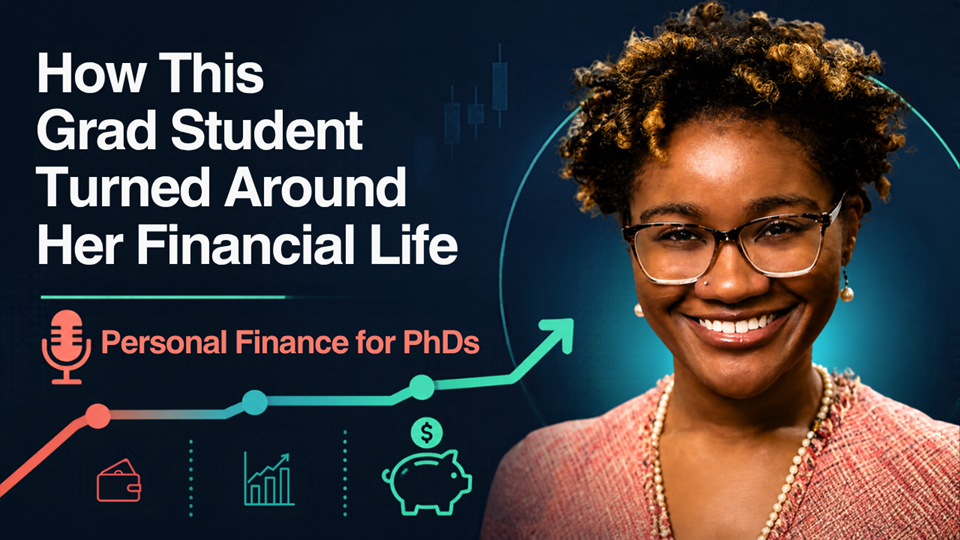
In this episode, Emily interviews Alexis Smith, a 5th-year PhD candidate at Emory University, to break down her budget. Alexis worked between finishing her master’s and starting her PhD, and she had trouble adjusting her spending down to the level of her $32k graduate student assistantship stipend. Thankfully, over time, she both decreased her spending across several categories and increased her income through the new grad student union contract at Emory and a large outside fellowship. Alexis details her current top five expenses as a single grad student living near Atlanta. Alexis’s income and spending levels now allow her to max out her Roth IRA, pay down her credit card debt, and save for near- and mid-term expenses.
Links mentioned in the Episode
- The Bridge Podcast
- Host a PF for PhDs Tax Seminar at Your Institution
- PF for PhDs Subscribe to Mailing List
- PF for PhDs Podcast Hub
Teaser
Alexis (00:00): Then coming into the PhD program, just adjusting down was challenging for me. And so I kind of racked up credit card debt that way. And then I reached a point where I was like, “This has got to stop. This is no longer sustainable. This is not how my mother taught me to manage my money.”
Introduction
Emily (00:18): Welcome to the Personal Finance for PhDs Podcast: A Higher Education in Personal Finance. This podcast is for PhDs and PhDs-to-be who want to explore the hidden curriculum of finances to learn the best practices for money management, career advancement, and advocacy for yourself and others. I’m your host, Dr. Emily Roberts, a financial educator specializing in early-career PhDs and founder of Personal Finance for PhDs.
Emily (00:46): This is Season 25, Episode 6, and today my guest is Alexis Smith, a 5th-year PhD candidate at Emory University. Alexis worked between finishing her master’s and starting her PhD, and she had trouble adjusting her spending down to the level of her $32k graduate student assistantship stipend. Thankfully, over time, she both decreased her spending across several categories and increased her income through the new grad student union contract at Emory and a large outside fellowship. Alexis details her current top five expenses as a single grad student living near Atlanta. Alexis’s income and spending levels now allow her to max out her Roth IRA, pay down her credit card debt, and save for near- and mid-term expenses.
Emily (01:32): If you’ve been enjoying this podcast and want to see it continue, would you please help spread the word? Take a minute to leave a review on Apple Podcasts or Spotify, text a recent episode that you enjoyed to a friend, or give it a shout-out on social media. Any of those actions helps me to grow Personal Finance for PhDs and continue finding amazing guests for the interviews. You can find the show notes for this episode at PFforPhDs.com/s25e6/. Without further ado, here’s my interview with Alexis Smith.
Will You Please Introduce Yourself Further?
Emily (02:08): I am delighted to have joining me on the podcast today, Alexis Smith, who is a fifth year PhD candidate at Emory University. And today, we are doing a budget breakdown. So we’re gonna find out what Alexis spends in Atlanta or, and/or what her financial goals are. And it’s gonna be a great conversation. So Alexis, thank you so much for volunteering to come on the podcast. And would you please introduce yourself a little bit further for the audience?
Alexis (02:33): Yes. Well, thank you so much for having me. I’ve listened to this podcast for so long, so it’s so exciting to be on here. Um, but my name is Alexis Smith. As you said, I’m a fifth year doctoral candidate in the Behavioral Social Health Education Sciences program at Emory and the Laney Graduate School. And my research looks at the impact of structural racism and social capital on breast cancer outcomes for Black women.
Emily (02:59): Fascinating. And I understand you even do some public outreach related to this, is that right?
Alexis (03:04): Yeah. Yeah. We work with women in the metro area, um, who are breast cancer survivors and thrivers. And we actually have a podcast, <laugh> um, where we offer them an opportunity to share their stories and about their journeys. We do a lot of public outreach and things like that.
Emily (03:20): What’s the name of the podcast?
Alexis (03:22): Bridge Community is the name of it and the podcast is The Bridge.
Emily (03:26): Oh my gosh. I love, obviously when people are doing meaningful work for their graduate degrees and their research overall. And of course, my focus is on the financial side, but I always am hoping and endeavoring and striving for, um, graduate students and PhDs, et cetera, to be well supported financially while they’re in those training stages so that they can flourish themselves and also positively impact the world with their work. So I’m just really pleased to hear about this. <laugh> Let’s get down into those numbers. So first of all, just again, introduce yourself a little bit further. Where do you live and what is your position with the university? Like why are you getting paid?
Alexis (04:02): Okay, beautiful. I’m technically in Decatur, Georgia. I’m a 10-minute drive from campus. If anyone knows Atlanta, they know Atlanta traffic. And so I wanted to be very close to campus. I am a graduate research assistant, so I do work in breast cancer and kidney disease. And so I’m being paid for the work that I do on a chronic kidney disease project as well as teaching. I also teach.
Emily (04:27): Am I correct in interpreting that you are a part-time employee of the university? You have a W-2 for your stipend.
Alexis (04:34): Yes, I do. Exactly.
Emily (04:36): Okay. Gotcha. Has that always been the case throughout graduate school? Okay.
Alexis (04:39): It has.
Emily (04:40): Very good. And is it just you in your household or is there anyone else involved in this financial picture?
Alexis (04:44): It’s just me and my cat. <laugh>
$80,000 in Annual Income as a Grad Student
Emily (04:47): Nice. Um, okay. How much are you paid on an annual basis?
Alexis (04:53): On an annual basis, I’m paid about 43,000.
Emily (04:56): Nice. And again, is that something that stayed consistent throughout graduate school?
Alexis (04:59): So when I came in, it was around 32, 33,000. And then through some advocacy efforts of students in the graduate school, and we’re also unionized now, we now have a stipend of about 43,000. And every year, they would kind of increase it a little bit, I guess, for like lifestyle inflation and things like that. So now we’re at 43.
Emily (05:21): I love to hear it. Uh, I’m recalling now, yes, Emory has been on a unionization journey in recent years. I’m so glad to hear about that jump. It’s well deserved, obviously, <laugh> but to agree to come to a school at 32, and then five years later to be at 43 is like, okay this is looking a little brighter than you though it was you know, when you committed. Do you have any other sources of income, like side hustles or fellowships or anything like that?
Alexis (05:46): Yeah, I do. So I am a Gates Millennium Scholar, and so I have the Gates Millennium Scholarship, which basically provided funding through undergrad, my master’s, and now the PhD. So I get additional income from that. And it’s a scholarship that comes directly to me, well, through the school to me. And then I also work with another project on the side for like a few hours a week, which ends up being like two to $400 a month.
Emily (06:12): Okay. Amazing. And so from the Gates Millennium Foundation, is that like an annual amount? Is it monthly? How is that distributed?
Alexis (06:20): It’s, it’s by semester. So I get a stipend in the semester. So for this past semester, it was 16,000 for fall semester, and then I’ll get another stipend in the spring.
Emily (06:32): And so this is on top of the 43 that you mentioned earlier. Okay. So adding this up, we’re looking at now, let’s see, 32 plus 43. We’re up to 75 plus your other side hustle of, let’s call it, you’re closer to 80. Is that right?
Alexis (06:50): Well, the other side hustle kind of varies. I almost don’t even count it. <laugh> Because it’s so, uh, minimal.
Emily (06:56): Okay. And all of that is take home for you. None of that’s going towards like tuition or other kinds of education expenses.
Alexis (07:02): No. All take home for me. Yeah.
Current Financial Goals: An Emergency Fund, Debt Repayment, Home Down Payment, and Elder Care
Emily (07:03): Amazing. I love to hear it. Okay. Congratulations on having that fellowship. And that it’s able to stack on top of the you know, existing funding. So that’s amazing. Okay. Let’s talk about your financial goals then. What financial goals are you currently working toward?
Alexis (07:20): The two that I’m actively working towards now are I’m building up my emergency fund. So by the end of this year, I will have saved up six months of expenses. So that’s like my big goal. And then my second goal is debt repayment. I don’t pay the minimum of my credit card. I pay $400 a month on the credit card, so I wanna get that done. Um, and then I also have like sinking funds that I also put money into, so I wanna build those up as well. And then ultimately, I am building towards a home down payment. Um, I don’t know if I wanna buy a house. I’m still not sure, but I feel like I just wanna start saving towards it just in case. And then the last thing is elder care. So I’m an only child and it’s just me and my mom and she’s disabled. And so one of the things I wanna make sure is that I’m able to provide for her in her elderhood. So yeah. So those are the big things I’m saving for.
Emily (08:17): In terms of the elder care, is that something you are currently like funding your mom or is it more like I’m saving so that I can do this in the future if called upon?
Alexis (08:25): I’m saving so I can do it in the future.
Emily (08:27): And is that all cash savings or are you doing any investing?
Alexis (08:30): Yes. I am doing some investing. Some of this goes into savings and then this year I’m on track to max out my Roth IRA.
Emily (08:38): Incredible. Awesome. And you don’t have any benefits through the university in terms of retirement like access, right?
Alexis (08:45): No.
Emily (08:45): The 403B? Okay. Gotcha. Typically the case, but I like to check. Okay. If I may ask, how did the credit card debt come about? Was there like an emergency in the past?
Alexis (08:55): Yeah. Very good question. So a combination of things. So I worked after my master’s degree before I started the PhD, and honestly, it was just really difficult for me to adjust back down to <laugh> a PhD stipend. Um, so I did have credit card debt coming into the doctoral program. Like I had a big trip and then I had to fund a couple of emergencies. And so then coming into the PhD program, just adjusting down was challenging for me. And so I kind of racked up credit card debt that way. And then I reached a point where I was like, “This has got to stop. This is no longer sustainable. This is not how my mother taught me to manage my money.” Um, so then I was like, kind of put the card away. I stopped using it, and now I’ve been like working away to pay it off.
Adjusting to a Lower Income During Grad School
Emily (09:46): See, this is something that I love about these budget breakdown episodes that I think we’re gonna talk about your expenses. And then I realize, oh, there’s so much more interesting backstory here. Can you tell me a little bit about that financial adjustment to graduate school? How much money were you making before? Were you also living in the same area or did coming graduate school come with a move or like just because I know a lot of prospective graduate students are concerned about the same thing. Like, “Hey, I’ve been working for a few years, post-undergrad, post-masters. I like my lifestyle. <laugh> What’s gonna happen when I, when I go back to living on a stipend?” So can you just tell us more about what that transition was like?
Alexis (10:17): I was making about 55K before I started. I was working for a nonprofit organization in Montgomery, Alabama, and then started making 32K. And so when I first started the program, I was not getting the additional fellowships — was not happening. Um, so it was only the 32K, no side hustles, nothing like that. And rent was significantly higher here in Atlanta than it was in Montgomery. Like in both places I was living alone. Um, but I think I ended up, I don’t know, maybe was 500 or so more in rent when I moved to Atlanta. And I guess, you know, you could say, well, I could have had roommates, but <laugh> I’d been living alone for a number of years and just was unwilling to have roommates again. And so that, that came with an added expense where I wasn’t sharing housing expenses. Um, so that w –
Emily (11:11): So we’re talking about a, a decrease in the top line number and an increase just in cost of living differences between those two cities. Yeah.
Alexis (11:18): Mm-hmm. Exactly.
Emily (11:19): And so how did that Millennium Foundation Scholarship restart? Like, why didn’t that start right at the beginning?
Alexis (11:26): Part of it was just lack of knowledge on my end. Because technically my program is fully funded, I didn’t know that I could receive this top off until my third or fourth year. So this is a recent occurrence. It hasn’t been all five years.
Emily (11:41): Yeah. That makes sense. But really good PSA. I mean, I know the Millennium, the Millennium Foundation grant is, it’s rare, but I have interviewed actually someone on the podcast before who received it and it just seems like an incredible boon. But, but any kind of outside fellowship that you’ve won in the past, it’s always just worth inquiring. Like how does the stack, how can it stack? Can it continue? I’m glad you sorted it out after a few years. Okay. Well, this gives us a really good picture of how you got to this point where you’re doing this cash savings, you’re gonna be maxing out your IRA this year, you’re repaying that past credit card debt. Is there a reason why you’re not throwing all the cash savings money towards the credit card debt? Like why is it important to you to be working on both simultaneously?
Alexis (12:22): Um, I don’t know. Like there’s a part of me that really just wants to have the money saved up, especially because, you know, I’ll be graduating hopefully in the spring and I’ll be, I’m applying to postdocs, I’ll be applying to jobs. But in this current market, I have no idea how long that’s gonna take. And so I wanna be able to fund myself for up to six months if possible. And so it’s kind of important to me to have that like chunk of savings stashed away in case I need it. But I have thought about that and I, but I think part of it is like my own personal comfort of wanting to have it just in case I need it.
Budget Breakdown: Housing
Emily (12:57): Okay. Gotcha. Let’s finally dive into those expenses. This is the classic like budget breakdown that we do on the podcast, which is you’re gonna list your top five line items in your budget every month, and we’ll kinda talk about those amounts and how they come to be that way. And it should be illuminating, I think, for graduate students generally, but also specifically in that Atlanta, Decatur kinda area of like, oh, like more, less, similar, not? Like what are these choices and, and how do they, you know, play out? So your top five expenses, starting with number one, everyone’s number one is the same. What is it for you?
Alexis (13:32): It is rent. <laugh> Um, so my base rent is 1,600. And then once you add in fees and water and things of that nature, it ends up being 1,800 a month.
Emily (13:44): Okay. So part of your utilities are bundled in. And you already mentioned that you live alone. Um – Give us a little bit of a, a picture. Is it a studio, one bedroom? How many square feet do you have?
Alexis (13:53): It’s a one bedroom, no idea how many square feet, but it’s like a standard one bedroom apartment. Yeah.
Emily (14:01): Who owns it? Is it like a big apartment complex? Is it an individual landlord?
Alexis (14:07): Yeah. It’s a complex, an apartment complex. So there’s like, I don’t know, 30 buildings or something like that in the complex.
Emily (14:15): Huge. Yeah. <laugh>
Alexis (14:16): Yeah.
Emily (14:16): Yeah. Is this popular with students?
Alexis (14:17): It is actually, because it’s so close to campus. I recently went to, like, one of those meet and greet things they have and ran into a number of, like, first-year graduate students. So I think it is. And I, I actually am here because a previous student lived here and recommended it to me.
Emily (14:34): All right. So I just did some back of the envelope math, and I think your base rental price compared to your overall income is something around 25% – ish, give or take with taxes and those kinds of things. Does that sound about right? So that is, like, very manageable. Um I mean, to me, it sounds like a large number, but in terms of the amount of money you’re taking in overall, like, this is a very reasonable, especially for today’s climate, fraction of your income to be spending on rent. So that’s awesome. Anything else you’d like to say about the rent question?
Alexis (15:07): I will say in terms of just, like, trajectory, I’ve not always lived in this apartment. I used to live in another apartment in the same complex, um, but it was a two-bedroom. And there’s a whole story into why I was in a two-bedroom. But the rent just went to the point to where it was just, I could not maintain it. And this was before I was receiving the additional scholarship. And so I downsized into a one-bedroom apartment since I moved here.
Emily (15:33): So that’s a very strategic, like, your income has gone up and this major expense has come down, actually, because you made some different choices there. So, like, yeah, I can see how that would’ve put you in a bind on that earlier stipend amount, but, like, now it’s comfortable. That’s great. Good for you for making that decision, because, like, moving is not easy. When I teach graduate students and postdocs, like, and people are very interested in reducing expenses, I go to that housing number. It’s like, this is… It’s the hardest thing to change because moving is such a pain. It takes time, it takes money, it takes research, blah, blah. You gotta provide pizza and beer to your friends, like, all the things. <laugh> Um, and yet, if you manage to do it the way that you did, every single month, it’s paying off in that lower you know, significantly lower, um, cost. And so, good for you for making it happen. It’s not an easy decision.
Alexis (16:20): Yeah. No, it was… Well, it just was no longer sustainable, so I had to. <laugh>
Budget Breakdown: Utilities
Emily (16:26): Definitely. Glad to hear it. All right. Your number two line item in your budget.
Alexis (16:30): Utilities. I lump all of my utilities. I mean, they’re different bills, but I just kinda lump them all together in my budget. And so that is my phone bill, so my cell phone, which is both for me and my mom. And that ends up being $163 a month. And then power and gas ends up being about $100 a month. And then my internet is about $46 a month.
Emily (16:54): It sounds like probably two of those are fixed expenses, right? The internet and the phone bills, and then the power is a fluctuating one, right? But you have the range kinda dialed in.
Alexis (17:03): Yeah.
Emily (17:04): That makes sense. Have you ever taken any intentional steps around decreasing or increasing, um, any of these utilities?
Alexis (17:10): So I just recently decreased the internet from, it was, like, $75 to 46.
Emily (17:17): How’d you do it?
Alexis (17:17): So I just did that in the last month. I changed companies. <laugh>
Emily (17:20): Okay. Is it, like, a promotional thing at the new company or –
Alexis (17:23): Yeah, it was a promotional thing, but I just found out from a friend that they offer… It’s Xfinity, and they offer a student discount.
Emily (17:32): Nice. Um, I love it when you get tips like that from fellow graduate students. It’s like these people really know what the opportunities are in your area, right? I mean, especially with utilities, there are these monopolies in place, and sometimes it is, like, you can’t really compare people across different cities or even different neighborhoods because, yeah, they may be serviced by different providers. But that’s awesome that you heard that and implemented it.
Alexis (17:54): Yeah.
Commercial
Emily (17:57): Emily here for a brief interlude! I’m hard at work behind the scenes updating my suite of tax return preparation workshops for tax year 2026. These educational workshops guide you in identifying, calculating, and reporting your higher education-related income and expenses on your federal tax return. For the 2026 tax season starting in January 2027, I’m offering live and asynchronous workshops for US citizen/resident graduate students, postdocs, and postbacs and non-resident graduate students and postdocs. Would you please reach out to your graduate school, graduate student government, postdoc office, international house, fellowship coordinator, etc. to request that they host one or more of these workshops for you and your peers? I’d love to receive a warm introduction to a potential sponsor this fall so we can hit the ground running in January serving those early bird filers. You can find more information about hosting these workshops at P F f o r P h D s dot com slash tax dash workshops. Please pass that page on to the potential sponsor. Now back to our interview.
Budget Breakdown: Groceries
Emily (19:18): How about your number three expense?
Alexis (19:19): My number three expense would be groceries, and that’s about 200 to 250 a month.
Emily (19:26): Wow. You’re a frugal grocery shopper. How are you making that work?
Alexis (19:29): I am. Well, one, it’s just me. And two, I kind of have pretty set things. So one of the things I do is I get the family meal plans, which feed, like, four to six people. And so that’s anywhere from, like, 25 to $35 a week. And so that will feed me for one of my meals for a week. I meal prep. And I just like quick, easy meals, so like pastas or stir fries, an omelet. So I’m pretty streamlined when it comes to my grocery bill.
Emily (20:02): So go back a minute because I’m not sure… You mentioned a family meal plan, but are you referring to… I’m not sure what you’re referring to as a meal kit or –
Alexis (20:10): Oh, sorry. So, like, yes, like, you can go to, like, Sprouts or Whole Foods and get, like, a family meal. So you get a protein, a veggie, and another side, and I can eat off of that for a week.
Emily (20:24): Okay. So it’s like prepared food from the grocery store. I gotcha. Okay. So yeah. So that is, you’re outsourcing the meal prep <laugh> to the grocery store – But you’re taking care of one meal per week out of that, uh, pipeline. You mentioned a couple of types of foods that you eat. Do you wanna expand on any more? Like, give us your favorite quick and easy meal, dinner or lunch or whatever would be relevant.
Alexis (20:45): Yeah. So my favorite is probably a chicken Caesar salad. So I just buy the, um, salad mix, and then I get, like, the frozen chicken bites, and then I cook them up, and I have, like, a warm chicken Caesar salad, or I’ll make a pesto pasta. Um, those are probably my two go-tos. And they’re super quick, super easy, and very affordable.
Emily (21:08): Now, you gave me a preview on what your top five expenses are, so I know that eating out is not gonna fall in these top five. So tell me about your interplay between that grocery spending and eating out. Like, you know, are you brown bagging your, your lunch every day to work? Or, like, when do you eat out or under what circumstances?
Alexis (21:27): So, yeah, so I do eat out. I have a line item in my budget for eating out. I also have one for coffee shops because I love coffee. I let myself have, like, a nice dinner out, maybe once a month. Every now and then, I may get a small meal, but typically, I try to keep it under $15. So, like, it’ll be, you know, something small or sometimes I may get something larger, but can actually make it two meals because I’m… I just don’t have a very big appetite, so I can easily make, like, a meal, two meals, and then that’ll last me for a couple of days.
Emily (21:59): Okay. But it sounds like you’re not in, like, a regular cadence of eating out. It’s not like, oh, every Friday I’m doing this and every Wednesday lunch I’m doing this.
Alexis (22:08): So, that was an issue I had when I first moved here. So, these are things I’ve learned over time.
Emily (22:14): Well, we wanna benefit from your from your experience here. So, please tell us how that went.
Alexis (22:20): Yes. I used to DoorDash and Uber Eats all the time when I first started. And I think it was just adjusting to school and, like, being so tired and just not having the energy to cook. This went on for a few months, and then I looked up, and I’m like, “Oh, my goodness. I’m spending so much money eating out. This is why, you know, <laugh> this is why my account looks the way it does.” That’s when I really got kind of buckled down and said, “Okay, I need to start meal prepping. I need to start cooking. I need to see what are other ways I can meal prep, even if I’m not the one doing it.” Um, so yeah, no, this is only a new thing. <laugh>
Emily (23:02): Great. Well, you timed coming on this podcast very well because we can learn all these lessons, uh – from your experience. Um, another question that, because you just mentioned, you know, energy, right? Like, you know, getting home at the end of the workday and I’m just too tired to cook, and I know… I mean, this happened to me in graduate school too. I mean, well, it’s probably happens to everybody, right? Nobody wants to cook when they get home from work. So, you know, you mentioned getting the prepared foods from the grocery store, you mentioned meal prep. Um, is that what you do, like, for dinners? Like you’re like, “Oh, no, I, I know exactly what I’m eating and it takes me, you know, five minutes to heat it up.” Or, like, how does your actual after work, like, eating routine go?
Alexis (23:36): So, on the weeks when I have the meal prep, I just heat it up. I don’t have one this week because I won’t be in town for the weekend. Um, so this week is just trying to figure something out. I’ll probably have a chicken Caesar salad tonight because I’ve got some mix in the refrigerator and some chicken in the freezer. Some days, it’s, I just have to figure it out on the fly, but on the weeks that I’m doing well, I just come home and heat it up so I don’t have to think about it, which is helpful for me. I like not having to think about what I’m going to cook.
Emily (24:04): Yeah, for sure. You’re spending $250 a month on groceries, that’s a pretty low amount, even for one person. It means very clearly that you have this dialed in, but I just wanna point out for the listener that, like, when you’ve noticed yourself in a habit of eating out DoorDashing or whatever it is for convenience, you’ve traded that. So you said, “I, this cost is too high. I’m instead gonna get this, you know, prepared food from the grocery store, this meal prep food.” And yeah, that probably is more expensive than getting all those base ingredients. But you were not in a situation where you were willing to use those base ingredients, um, so you went for kind of like that next downgraded thing. And still, overall, you’re only spending 200 to $250 a month. Like, it has not exploded the grocery budget to trade off with that eating out budget, right? So, like, this was a really positive trade-off for, like, your money, your energy, like, all those things.
Alexis (24:54): Exactly. And I think it works for me because I am, like, a snacker, so I, I also graze throughout the day, and so it helps, I think, inadvertently, it keeps cost down <laugh> because I am a grazer. So I know that might not be applicable for everybody, but it works for me.
Budget Breakdown: Cat Care
Emily (25:11): Yeah. Well, great just to put your strategies out there and people can pick up what they want to. Um, okay, let’s go to your fourth line item.
Alexis (25:18): The fourth one is my cat. So I spend about $170 a month on him. He’s recently had some health issues, so I already always had insurance on him. And then the vet offered another insurance that I could get through them to cover his visits and a teeth cleaning. This is kind of cat lore, but they have to put cats… They have to give them anesthesia to clean their teeth, and so it ends up being very expensive. And so they’ve been telling me since I had him, “He needs to get his cleaned. He needs to get his teeth cleaned.” I’m like, “I can’t. It’s… That’s $1,200. There’s no way.” So with this extra insurance, it kind of pays for itself because it comes with the cat, um, teeth cleaning. And so, yeah, between his insurance, insurances, plural, <laugh> and his food, and treats, and things like that, it, it comes out to about $170 a month.
Emily (26:12): So I love this financial, like, question. Like, would I rather pay for one-off expenses as they arise, knowing the dollar amount’s going to be high? Or would I rather, as you mentioned earlier, set up sinking funds for this purpose? Or would I rather pay an insurance policy that’s… Or any kind of sort of a maintenance plan where an external provider is saying, “Yes, for this fixed monthly cost, like, this is what you’re getting and you won’t be surprised by things.” Um, I think those three choices, depending on how you wanna run your finances, any of them could make sense, but you’ve made this insurance choice, so that’s great. And I, I love hearing from pet owners because I don’t think we talk about it <laugh> enough on the podcast And it’s obviously a very significant part of many, many people’s lives. So now, you know, it’s one of your top five line items.
Alexis (26:57): Yep, it is one of my top five.
Emily (26:59): But, I mean, I’ll just point out for the listener, like, the difference between your number one and your number four is a full order of magnitude, right? Like, your rent is up there, you know, 16, $1800 a month, depending on how you wanna calculate it. Um, your other top costs are really not adding up to that much, and that’s why we’ve gotten down a full order of magnitude, like, just within this list. But thank you so much for sharing how you decided to handle your pet costs. How about your fifth line item?
Budget Breakdown: Fun and Maintenance
Alexis (27:25): My fifth line item is my fun and maintenance, is what I call it, which ends up being around 150, sometimes 160. And so, that’s for my nails, because I like to get my nails done because it makes me happy. And for entertainment, so I like to go to the museum, maybe a concert every couple of months, or get books, like I’m a big reader. All of those are things that go into my fun/maintenance budget line item.
Emily (27:52): Awesome. And is this also anything that has shifted over time?
Alexis (27:57): I’ve always had the fun and maintenance line item in my budget, but it was much lower. And then one, I realized I was spending more, so I was like, “Well, I need to adjust it.” And two, now that I have, like, the extra income, I’m able to do things like get my nails done. So that one has actually increased over time.
Emily (28:13): I really like to hear that, actually. Like, you’ve decreased the rent, you’ve decreased some utilities, you’ve dialed in your grocery spending. Hey, that means you get to allocate more money to, um, some of these expenses that are, yes, discretionary, yes, variable, but still important for your life satisfaction. So that’s so great that you can, you know, you’ve dialed down these other items so you can dial up something else that’s really, you know, valuable to you.
Alexis (28:38): I appreciate you saying that because sometimes it feels kind of frivolous, like, “Oh, I go get my nails done.” But it makes me happy, and I have the bandwidth for, like, the wiggle room in my budget to do so. And because, again, I kind of skimp in other areas so I can splurge in others. So thank you for saying that.
Emily (28:57): Exactly. Yeah. I like Ramit Sethi’s quote on this topic, which is, um, “Cut mercilessly on costs you don’t care about so you can spend extravagantly on things that you do.”
Alexis (29:07): Yes. No, and that… He actually reading that book kind of, um, inspired me to be like, “Oh, like, I don’t have to, like, cut everything. I can have fun things in my budget.” So, yeah.
Beyond the Top Five Expenses: Transportation
Emily (29:20): I do have another question, which is about something that doesn’t appear in your top five, which is transportation costs. So, can you tell what your transportation situation is?
Alexis (29:28): Yes. So, I do drive. I have a car, and I do pay insurance on that car, but it isn’t the… I don’t have a car payment, so there’s no car payment, and the insurance is less than my lowest line item. Like, I think it’s, I don’t know, like, $60 a month or something like that. Like, I’m on my mom’s insurance, so that helps.
Emily (29:46): Okay. So, it’s like a little bit of a bundling situation. Um, but let me ask about the car, because that insurance amount tells me that this is a pretty modest car, I think. So, like, when did you acquire it? How old is it now?
Alexis (29:58): So, I got the car… In 2021. Um, it was a 2019 when I got it. And I do have a sinking fund for car repairs and, like, car maintenance and things like that. So that kind of ends up being more when I go every few months.
Emily (30:15): And what kind of a car is it?
Alexis (30:16): It is a Nissan Sentra.
Emily (30:18): Okay. That makes sense. And do you see this car lasting you for a while longer? Are you planning on upgrading it at any point?
Alexis (30:24): I’m planning on driving it until I can’t drive it anymore. <laugh> I don’t plan on upgrading it anytime soon. I like not having a car payment.
Emily (30:31): That’s the ding ding correct personal finance answer. <laugh> Yes. The car is a necessity, but once you buy it, like, hold onto it as long as possible.
Alexis (30:42): Exactly. Exactly.
Emily (30:42): We’ve gotten so much out of this interview, that picture of where you were financially when you started graduate school, how many changes you’ve made, the income going up, the expenses coming down, being able to put more into your financial goals and paying off debt and savings and the Roth IRA and all that wonderful stuff. Would you be able to give us any more insight into your planned next step? So you mentioned we’re here in October 2026. You are hoping to graduate in the spring, you’re applying for postdocs, maybe other positions. You mentioned that you wanna build up that six-month emergency fund because we do not know yet what the job situation’s going to be. Any other comments you wanna tell us about this upcoming transition out of graduate school?
Financially Preparing for Post-PhD Life
Alexis (31:17): Yes. I’m applying to post-docs now. Hopefully one of those will work out. Um, and I’m hoping to stay ideally within like the Southeast region to be close to home and family. Um, but we’ll see. I am a planner, um, and I love a good spreadsheet. So I plan to like create a new spreadsheet budget for the postdoc, hopefully to stay pretty close to the PhD, you know, because the income will probably be very similar with my extra scholarships and things like that. But also thinking about kind of what is the next steps in terms of my savings goals and like once I hit the six month, which will be at the end of this year, um, I think I’m gonna have to like let go of my need to save, save, save and like start putting that towards my credit card and investing and things like that.
Emily (32:06): Yeah. I think that’s a really important question to ask yourself or anybody ask themselves within their financial plan, especially if you have a habit of saving or a tendency towards saving is knowing what the stopping point is and knowing what enough is so that, because the savings serves a purpose, but the purpose is not to grow your wealth, right? It’s to step in in times of emergency, to help you with unexpected expenses. It’s not counteracting that credit card interest rate. It’s not fighting inflation over the long term the way your investments would, they’ll grow ahead of that. So knowing the stopping point is very, very important. And I was really pleased to hear that, you know, you’re planning on maxing out the Roth IRA this year. Presumably you’ll do that next year, um, as well, if not maybe other kinds of investing, depending on how the you know, the work situation goes. That’s all great to hear. And do you have any control or influence on when you graduate? Are you able to wait for job offers before officially graduating or is it like, no, I’m gonna be out at a certain point whether or not I have a job?
Alexis (33:03): That is a really good question. So my committee is kind of flexible. I’m the one that’s really pushing for spring finish, but I do have the wiggle room to continue into the summer or into the fall.
Emily (33:16): So it’s hopeful that if a job doesn’t come through in time, that you may be able to extend. Um, but, you know, ideally, yeah, you would get out on your own timeline. Uh, so the, the emergency fund may just be able to continue as an emergency fund, not necessarily something you need to draw down on because you may be able to make a very small lapse in time, right, between the end of your grad student position and the start of the next position.
Alexis (33:40): Exactly. Exactly.
Emily (33:41): Yeah. That sounds awesome. Well, Alexis, it’s been such a pleasure to speak with you and we’ learned so much through this conversation. Thank you. Thank you so much for sharing your wisdom with us.
Best Financial Advice for Another Early-Career PhD
Emily (33:49): I’m gonna ask you the question that I ask of all my guests, which is what is your best financial advice for another early career PhD? And it can be something that we’ve touched on in the interview already, or it can be something completely new.
Alexis (33:59): Have a money plan and stick to it, whether that looks like having a budget and sticking to a budget. I know not everyone want, like, appreciates or wants a budget or likes budgeting. So, but like I would say have a money plan. So whether that be having money goals or having guardrails for yourself, like, have one and stick to it. Um, don’t be like me. <laugh> In my early years.
Emily (34:21): You got it together. You got it together over time.
Alexis (34:23): Don’t be like me in my early years. Um, but yes, have a money plan and stick to it.
Emily (34:29): Yeah, that sounds really good. Like, I think the way that I would kind of, um, apply that maybe in your situation is I, it’s not very sexy, but I like the phrase live within your means. Like yeah. As a grad student, like, you need to be living like a grad student, you know? So like that was a hard adjustment for you at the beginning. And you figured it out. You did. And you increased your income. So it’s all good, like the outcomes on it, but it is a really tough thing to face of like, oh yeah, I need to be living <laugh> like a graduate student because I am graduate student. Again, you’ve already done the master’s. And, and back and forth, back and forth. But like, so wonderful how it’s worked out and I wish you all the best with graduating in the coming months and, and your next job and all of that. So thank you so much again for volunteering to come on the podcast.
Alexis (35:12): Thank you so much for having me. This has been such a pleasure.
Outro
Emily (35:20): Listeners, thank you for joining me for this episode! I have a gift for you! You know that final question I ask of all my guests regarding their best financial advice? We have collected short summaries of all the answers ever given on the podcast into a document that is updated with each new episode release. You can gain access to it by registering for my mailing list at PFforPhDs.com/advice/. Would you like to view transcripts or videos of each episode? We link the show notes for each episode from PFforPhDs.com/podcast/. See you in the next episode, and remember: You don’t have to have a PhD to succeed with personal finance… but it helps! Nothing you hear on this podcast should be taken as financial, tax, or legal advice for any individual. Podcast editing by me and show notes creation by Dr. Jill Hoffman.
Join Our Phinancially Distinct Community

Receive 1-2 emails per week to help you take the next step with your finances.

Leave a Reply