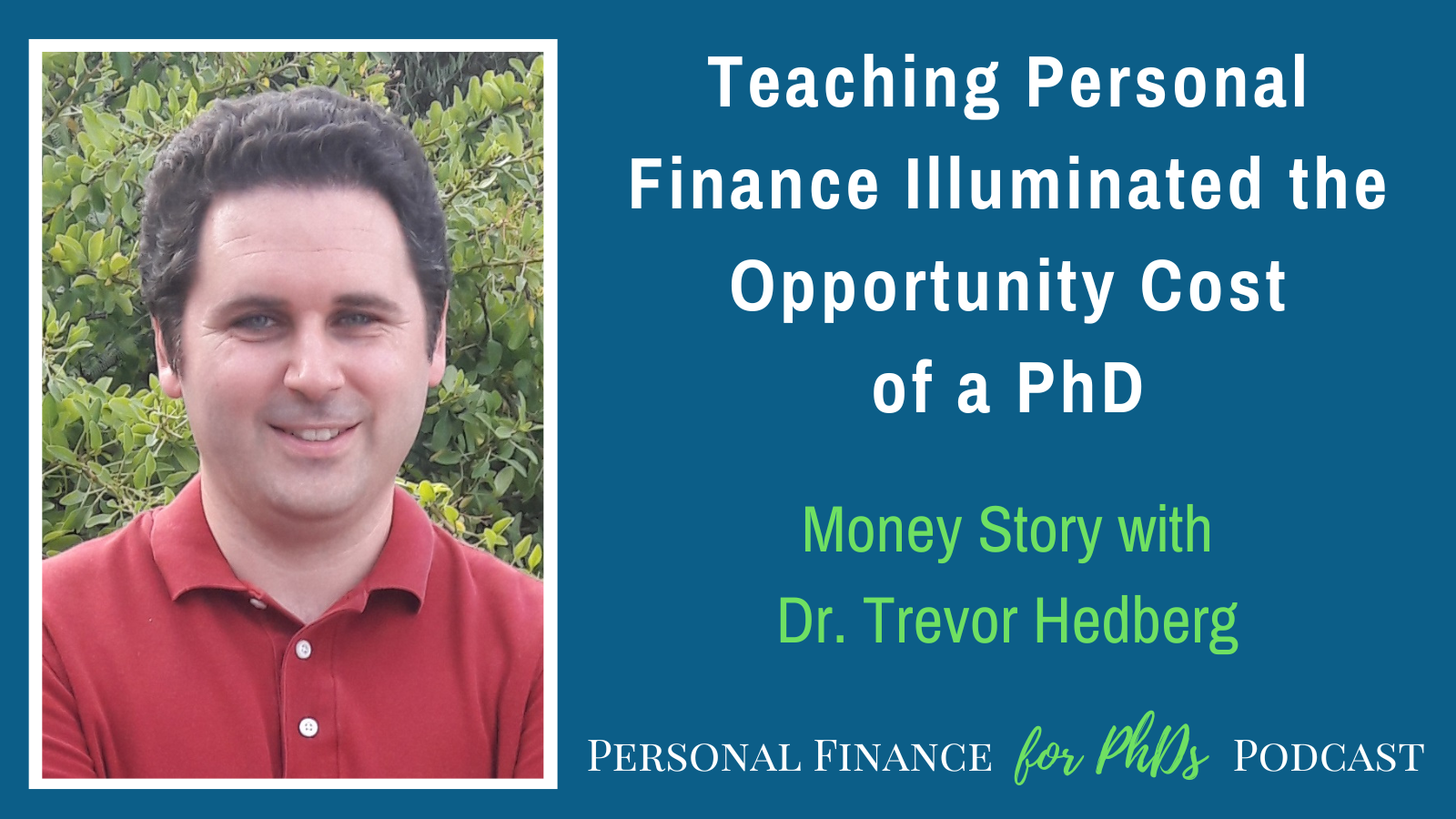
In this episode, Emily interviews Dr. Trevor Hedberg, an assistant professor of practice at the University of Arizona who teaches a seminar on personal finance to undergrad students based on Morgan Housel’s The Psychology of Money. Trevor is a repeat podcast guest, and he shares how teaching the course has made him think differently about finances during his PhD and postdoc, including the financial opportunity cost of grad school and lifetime wealth killers.
Links mentioned in the Episode
- Dr. Trevor Hedberg’s Website
- Learn more about Dr. Trevor Hedberg’s research
- PF for PhDs Tax Workshops (Individual Purchase)
- PF for PhDs Tax Workshops (Sponsored)
- PF for PhDs S8E14: A Low-Cost Lifestyle Can Be Both Necessary and Enjoyable During Grad School
- The Psychology of Money by Morgan Housel
- The Art of Spending Money by Morgan Housel
- PF for PhDs Tax Center for PhDs-in-Training
- PF for PhDs S22E4: The Importance of Financial Student Services to Graduate Students on Stipends
- Millionaire Mission by Brian Preston
- PF for PhDs Subscribe to Mailing List
- PF for PhDs Podcast Hub
Teaser
Trevor (00:00): Because I think that the actual mechanisms for building wealth over time are really pretty simple to understand, but remarkably difficult to put into practice. And I think also as academics, like we’re primed to think that problems in the world sort of correlate in difficulty with their complexity. But it’s not always the case that problems are difficult because they’re complicated. Sometimes it’s just that there are psychological and behavioral things that kind of sabotage us in, in what we’re trying to do.
Introduction
Emily (00:38): Welcome to the Personal Finance for PhDs Podcast: A Higher Education in Personal Finance. This podcast is for PhDs and PhDs-to-be who want to explore the hidden curriculum of finances to learn the best practices for money management, career advancement, and advocacy for yourself and others. I’m your host, Dr. Emily Roberts, a financial educator specializing in early-career PhDs and founder of Personal Finance for PhDs.
Emily (01:07): This is Season 23, Episode 6, and today my guest is Dr. Trevor Hedberg, an assistant professor of practice at the University of Arizona who teaches a seminar on personal finance to undergrad students based on Morgan Housel’s The Psychology of Money. Trevor is a repeat podcast guest, and he shares how teaching the course has made him think differently about finances during his PhD and postdoc, including the financial opportunity cost of grad school and lifetime wealth killers.
Emily (01:37): The tax year 2025 version of my tax return preparation workshop, How to Complete Your PhD Trainee Tax Return (and Understand It, Too!), is now available! This pre-recorded educational workshop explains how to identify, calculate, and report your higher education-related income and expenses on your federal tax return. Whether you are a graduate student, postdoc, or postbac, domestic or international, there is a version of this workshop designed just for you. I do license these workshops to universities, but in the case that yours declines your request for sponsorship, you can purchase the appropriate version as an individual. Go to PFforPhDs.com/taxreturnworkshop/ to read more details and purchase the workshop. You can find the show notes for this episode at PFforPhDs.com/s23e6/. Without further ado, here’s my interview with Dr. Trevor Hedberg.
Will You Please Introduce Yourself Further?
Emily (02:50): I am delighted to have a repeat guest on the podcast today, Dr. Trevor Hedberg, who is currently an assistant professor of practice at the University of Arizona. Trevor was first on the podcast in season eight, episode 14, way back in 2021 when he was a postdoc, and we’ve had five years of time pass. Um, and there’s been a lot of changes and Trevor has a lot of new insights for us today. So I’m very excited to dig into that, um, both on the professional and personal front. So Trevor, will you please introduce yourself and tell us what’s been going on professionally in the last five years?
Trevor (03:26): Sure. Thanks Emily, and thanks for having me back on the, uh, podcast after all this time. So, um, I’m, I’m now as, as you said, an assistant professor of practice. Uh, my primary affiliation is with W.A. Franke Honors College. Uh, I also have a partial affiliation with the philosophy department. Um, the last time I was on, I was a postdoc at Ohio State. Um, and in the, a year or so after that, uh, I landed this job here at the University of Arizona and have been, um, continuing to teach undergrads, do my research, and, um, and most recently I’ve started teaching a personal finance, um, seminar here in the Honors college.
Teaching Personal Finance Seminars Using the Psychology of Money
Emily (04:03): And that is what prompted us to revisit and have another interview. And I’m so excited about this. Um, but yeah, tell us how you went from, you know, doing philosophy for your PhD to teaching personal finance at this point.
Trevor (04:16): Yeah, well, if, if anybody remembers five years back, I did, I did talk a bit about, uh, when I was in graduate school, the, the challenges associated with managing to live on such a small stipend. And so I had some personal interest in issues in personal finance because I had been grappling with some of them, uh, in my own, in my own life, just to kind of, you know, make it as a graduate student, uh, without having to take out additional loans. Um, when I got here to the University of Arizona, it was not part of my original, you know, teaching load. Uh, I was mainly hired to teach applied ethics courses, which is what my main research area is. Um, but there was a personal finance seminar that was being offered in the Honors college, but it was being offered by an out of house faculty, a faculty member in a different department that we were paying, um, to teach that seminar once a year.
Trevor (05:03): And these little honors seminars are one credit classes that, um, all honors students have to take one of them in order to graduate with the honors distinction on their transcript. So, and that happened to be one of the most popular classes, but it was only offered once a year. And the course caps on these seminars are pretty small, like, you know, low twenties in terms of the number of students. And so they were interested in, you know, this, that course was always maxing out. It’s, it had tons of people on the wait list and just, there was a lot of student demand, so it just came up in an administrative meeting. Um, you know, is there, is there someone else who might wanna teach like a course in this area? And I said I could take a crack at it. And, um, about a year later, um, we, you know, we piloted the first, and of course that course filled to capacity.
Trevor (05:53): Um, I used a, uh, I used the primary text Morgan Housel’s, the psychology of money, um, because my way of teaching the course is not just the nuts and bolts of personal finance, you know, what’s a credit score? What’s an IRA, how do you save for retirement? How do you design a budget? It’s also about the psychological and behavioral elements of, of money management and trying to familiarize the students with the, the obstacles that get in the way ’cause I think that the actual mechanisms for building wealth over time are really pretty simple to understand, but remarkably difficult to put into practice. And I think also as academics, like we’re primed to think that problems in the world sort of correlate in difficulty with their complexity. Um, because almost all the things, especially in philosophy, like all the stuff I write about, these are super complicated moral issues with all kinds of, you know, things changing empirically.
Trevor (06:44): All kinds of assumptions being made in the background about effects of, you know, emerging technologies and things like that. But it’s not always the case that problems are difficult because they’re complicated. Sometimes it’s just that there are psychological and behavioral things that kind of sabotage us in, in what we’re trying to do. And history is littered with examples of people who came upon or accumulated vast amounts of wealth at some point in time and managed to lose all of it in a very short span of time. Um, and, and my hope is that the students that come outta my class won’t follow that life trajectory.
Emily (07:20): Well, I love that you mentioned Morgan Housel’s book, and actually at this moment I’m on the waiting list for his next book or whatever his most recent book is. I’m, I’m at the library. I’m gonna be getting it soon. I’m really excited about that. Um, I’m wondering, is that the same, uh, core text that the previous, um, professor who was teaching this course was using? Or was that a shift that you made?
Trevor (07:41): So, interestingly, it was the same primary text that he was using, but I did not know that when, um, when I was like, I was essentially just looking at different books that, trade books that were written for, you know, a general audience in this area. And that was the one that kept coming up, uh, as a, a very popular source. I mean, the, the way the book is structured, each chapter essentially has one key lesson or idea, and the chapters are only, you know, eight to 10 pages long and there’s 20 of ’em. And so for a one credit course, um, where, you know, you don’t want to really overburden the students in that kind of class with a ton of a ton of reading, um, or assessments. It was just a good fit. Uh, I didn’t, now I have this semester, um, this is my third time teaching the course. I have cut out a couple of chapters of the book that I had previously assigned and replaced them with other material covering the same stuff. Uh, ’cause you know, some chapters seem to resonate more with students than others. And so I’m, I’m trying to, you know, kind of keep, keep tweaking the, the course content to a, to adapt to what works best, um, for the students, uh, Housel’s like new book is called The Art of Spending Money, and I actually do have a chapter from that book that I’m, that I’m gonna use, um, this semester. There’s a lot of overlap in his ideas in the art of spending money and in the psychology of money. But I did find, uh, I haven’t read the entirety of the art of spending money, but like probably two thirds of it, I have found the prior book, the Psychology of Money, I, I thought it was superior. Um, the, and I think like there’s overlap between the ideas. It’s clear to see that the artist spending money is an extension of some of the things he says. But, um, certainly as a teaching tool, I think the psychology of, of, of money has is, is a very good text and, and works well for, for these purposes.
Final Project: Creating a Long-Term Financial Plan
Emily (09:33): Yeah. And certainly a credit to it that you and your predecessor both independently chose it for this particular course. Um, it is a very easy and entertaining read and almost like filled with anecdotes and yeah, it’s a very, um, it moves along very quickly and it teaches you a lot in a very effective way, I think. Um, is there anything else that you wanna tell us about the course itself?
Trevor (09:55): Probably the, um, the final project that I’ve had the students do in the class the previous two times is I, I have made them actually design and outline a personal financial plan from their current age, which for most of ’em is about 20 all the way up to retirement age at 65, uh, operating at about five year intervals. Now doing that, uh, that is challenging for anybody to do regardless of, of, of your, of your age or your, um, financial situation. But I think that a lot of these students have never, they’ve never imagined like their, their wealth building journey on this long time horizon. And so I got a lot of feedback the first semester I taught the course where like everybody was like, this is a really valuable thing to do. And also, this was really, really hard and I would like some more direct guidance and more resources.
Trevor (10:40): Um, so I spent more of an effort last semester, um, showing them in class how to use retirement calculators and, um, and where to look to get information about like what their expected income is in their anticipated career at different life stages. And, uh, and also pointed some things out about like, you know, what commonly goes wrong over the course of a lifetime in trying to, because I, I required them in their timelines to incorporate some negative life events that, not saying that those things will happen, but basically like, don’t design your plan operating where, oh, I’m never gonna have any health emergencies. I’m never gonna have a, be in a car accident. I’m never gonna, you know, have any period of unemployment or decide to make a career change or go through a divorce. Like these are not realistic. Something bad will happen to you over 45 years of your life. You just don’t know exactly what it is. So plan for some of those things. Imagine that those things alter what your plans are and, and adjust your goals, um, accordingly, or like build in that preparation into how you structure your emergency savings or, or, um, or what you end, you know, what, what career decisions you make earlier in your life.
Emily (11:50): I think that exercise is so valuable. And actually I don’t think I’ve ever done that, like, to that level of detail, like projecting that far out. But I did want for our audience to take it down to a, a smaller timescale. Um, and just emphasize this principle of don’t assume everything is going to go perfectly financially, um, especially as you’re entering into a new position as you’re entering graduate school, as you’re entering a postdoc later on in your career. Um, if you’re pro projecting your budget and trying to figure out, okay, can I make it on this stipend? Can I make it on this postdoc salary in this city? You have to build in some of those shocks and prepare your finances for them because the length of term you’ll be in, you know, your PhD program, the length of time you’ll be in a postdoc way too long to assume that nothing is gonna go wrong. And so if your plan relies on everything going perfectly and you’re living on a razor’s edge, it’s not a good enough plan at that point.
Trevor (12:43): Yeah. The, the one, um, the one change that I am making this semester to that final kind of project is I am giving them an alternative option because a number of students kind of seemingly wanted to do this in previous courses, which is I’m gonna allow them alternatively to spend 12 weeks during the semester tracking their spending. Um, and then essentially the, the personal financial plan has two components, like the timeline that I’ve kind of described, and then a narrative that syncs up the timeline with like the course content and material. Like, why did you pick the strategies you did? How is it influenced by the, um, the stuff that we’ve read? Uh, it’s the same thing, but it’s like the information you’d be using is like, what did you learn about your spending over these 12 weeks of tracking your interactions with money? What do you spend money on? How is that consistent or not consistent with the things that we have, uh, covered in the, in the class? You know, what changes might you make in light of what you’ve learned to how you are, uh, to how you’re spending money or what you’re spending things on. Um, now whether or not students will actually like do this project, ’cause this requires you to get started like week three or week four, I’m gonna outline for them next week like how to use a template that I’m giving them for tracking, you know, your spending over time. So it’s an experiment. We’ll, we’ll see how many people actually do it. Um, but, but the idea behind both of these is just, you gotta have a certain level of intentionality and forethought with respect to how you manage your money. It does not magically happen in, in some way. And, and, and for I think virtually every student who takes this class, they’ll not have done either of these things, either this long-term kind of mapping things out to retirement, at least hypothetically, or just let me see what I’m spending money on for three months and see if I am okay with my behaviors. Uh, and if not, what am I gonna do to make a change?
Emily (14:38): I’m just loving this. I hope the audience is as well. And you know, I’m sure they’re all wishing they had the opportunity to take this course, uh, when they were in undergraduate or in graduate school. Um, it sounds incredible, uh, but I understand that you, you know, this is now your third time through teaching the course. It’s caused some reflections and, um, you know, rethinking in you about, you know, decisions you’ve made in the past and so forth. So I’d love for us to kind of, yeah, with this new information and deeper knowledge that you have in this area. Like, let’s speak to, you know, your time as a graduate student and as a postdoc, and how your thoughts about that have changed.
The Opportunity Cost of Grad School
Trevor (15:12): Yeah, so one of the things when, one of the, the basic pieces of advice you always get if you go to grad school in the humanities is like, don’t take out any loans to pursue because of the career prospects are uncertain and you don’t wanna take on additional debt, so on. That’s a totally fair point. It’s actually very understated, um, how important that is. But there’s also, like, there’s a really high opportunity cost to going to graduate school in, in, in any humanities field in your early twenties because the, you’re, you’re de you’re depriving yourself of, of a financial resource that we don’t talk about that much. Um, so a lot of people will point out like, well, if you, if you got an even just an entry level job where you were making, I don’t know, $50,000 a year to start out, you’d not only be working towards having a higher income, you would also be potentially, you know, paying off your debt sooner or, you know, uh, accumulating, you know, $50,000 a year instead of 15 or $20,000, whatever your graduate student stipend was.
Trevor (16:09): Um, that’s all fair. But the real resource that you’re depriving yourself of is time, uh, and specifically time for your money to grow via some kind of investment mechanism. So the, the alternative where you’re making 50 or $60,000 a year in your early twenties as opposed to try just trying to get by, not take out any more loans and, but not in a position to really save anything, um, when you’re in graduate school, that time is disproportionately more valuable than time in your thirties and forties and so on. Because if you put that money even in just like a basic index fund, um, it’ll, we have to make some assumptions about like, you know, based on past performance of how like the market does, but it’s reasonable to think that whatever money you put in will double somewhere between seven and 10 years after you put it in.
Trevor (17:00): So if you were to spend your twenties, even if it was just, I don’t know, $10,000, $15,000, put that in. By the time you are in your, you know, mid sixties and looking to retire, that money is going to have, have doubled four to six times. And so you’ll be in a position where if it was say, $10,000 and even if it only doubled four times, 10,000 goes to 20,000, 40,000, 80,000, that’s $160,000 by the time you get all the way down there. This is the, just the basic concept of compound interest, which I spend about two weeks trying to drill into my students in, in this class because all of them are typically 18 to 20 year olds. And so for them, the greatest resource they have is, is their time. So I think, I think this is an element of going to graduate school, uh, and being in graduate school for a long time with a relatively modest salary, uh, that isn’t properly appreciated because you’re, you’re not just depriving yourselves of like income in the short term. You’re also taking away like essentially one doubling cycle on money that you could save. And that, that, that cycle that takes place during the twenties, so and so if you, if you lumped all this money in instead, like when you’re 30 instead of when you’re in your early twenties, you’ll only wind, you’ll only have about half as much at the end of this process as you would’ve had, um, using that same money if you just put it in eight to 10 years earlier.
Emily (18:27): I, I wanna make sure the audience is really picking up on this because, um, as you’re saying, it’s not just the lost wages, it’s the lost time for the investments. You, we can presume in our scenario, you would’ve been doing had you not been in graduate school, and it’s not just a few thousand dollars or 10 or $20,000 that you could have invested, let’s say in your twenties, if we’re talking about a traditional PhD student, what we’re really talking about is the last doubling that occurs on your money. Your career itself is let’s say seven years longer if you start it after your bachelor’s degree instead of starting after your PhD. So to make up for that last lost doubling, which could be worth, it could be worth a million dollars. It could be worth hundreds of thousands of dollars easily. You have to earn more on the backside of the graduate degree and save more on the backside of the graduate degree, invest more, um, to make up for the lost time.
Emily (19:24): And so, as you know, from your perspective as someone in the humanities, um, that’s something that you have to be very, very cognizant of, careful about, like if you, how much is the premium going to be on your salary if you have the PhD versus not? What’s the expected outcome there if you get the tenure track job versus you have to take some other kind of job because it didn’t work out in that respect. So you have to make so much more money to make up for this. Now we can all make lifestyle decisions, like it’s okay if you just want to have a PhD, but to be aware of the financial, you know, implications from that decision. Um, really it should be taught before you make these decisions about where you’re, you know, if you go to graduate school, where you go to graduate school and so forth. So I’m really glad you brought this up. I just wanted to put another like kind of underline under there that’s not just a few thousand dollars, it’s the last doubling that you’re missing out on.
Trevor (20:18): Yeah. Now, as a disclaimer, I should note that like, I don’t think this is in itself like a decisive reason to never go into any graduate program or pursue any professional training. Um, most people who go into graduate school in philosophy or any humanities field like I did, uh, you’re probably making that decision primarily for non-financial reasons. I would hope, I would hope that that is the primary motivation for, for doing that. So it’s not like I look back and I say, oh, it was just a total mistake to go to graduate school in philosophy because I, because, you know, my 65-year-old self could have, I don’t know, $500,000 more than I would’ve had, uh, in, in the, in the timeline that I’m currently in. It’s more like knowing what I know. Um, if I could go back in time, one of the things I would’ve done, I was able to still save a, a significant chunk of money while I was in grad school.
Trevor (21:06): And I used some of that to pay off, um, a couple of stu of, of the student loans that I had from undergrad. Um, but I had enough money at, at a couple of points in time where I could have opened a Roth IRA and it wouldn’t have been a huge sum of money initially if I did it as a lump sum, it would’ve only probably been like a couple thousand dollars. But I think what I would’ve liked to do is open a Roth IRA around the age of maybe 23 or something like that, and put in, you know, a hundred dollars a month or something like that. Uh, just get into the hab- even if it was only $50 a month, right? Just build a habit of just putting money in investing in this vehicle. And I just, it did not occur to me, uh, at that time, uh, to do that. So that’s probably the biggest, the biggest change I can look back on and say I would’ve made, um, in grad school. The-
Emily (21:52): Absolutely. So to take that scenario that I just said, okay, you’re starting a career, let’s say seven years later because you decided to do a PhD and you couldn’t save in that meantime, um, that’s true under that set of assumptions that we were just talking about. But what you just pointed out is if you can start to invest a little bit, then you have started that clock, then you’re not missing out entirely on the last doubling, you’re missing a fraction of it because you’re able to invest much less than you would if you had a different kind of job during that period. But you’re, you’re lessening the damage, right, of that lost time just by getting started a little bit. And as you said, a hundred dollars a month, $50 a month, this is still a significant amount of money once you project it forward, you know, as you said, four to six doublings later.
Emily (22:34): Like, this is a significant and effective amount of money. And so it’s not, um, something that you should disregard just because, oh, I can only save $50, I can only save a hundred dollars. No, go ahead and do it if, if you’re financially ready for it. And as you just mentioned, it not only is the effect of the money itself, but the, it’s the effect of the habit. It’s the effect of you having your identity as I am someone who invests even in difficult life circumstances. I still invest, you know, and so that’s very, very valuable as well.
Commercial
Emily (23:03): Emily here for a brief interlude! Tax season is in full swing, and the best place to go for information tailored to you as a grad student, postdoc, or postbac, is PFforPhDs.com/tax/. From that page I have linked to all of my free tax resources, many of which I have updated for this tax year. On that page you will find podcast episodes, videos, and articles on all kinds of tax topics relevant to PhDs and PhDs-to-be. There are also opportunities to join the Personal Finance for PhDs mailing list to receive PDF summaries and spreadsheets that you can work with. Again, you can find all of these free resources linked from PFforPhDs.com/tax/. Now back to the interview.
Financial Changes After Grad School
Trevor (23:54): Yeah, so once I got out of grad school and, and got into kind of, you know, making like a reasonable, like closer to that $50,000, you know, hypothetical income we were talking about, um, the things I did after that was like, I immediately paid down, you know, my high interest student loan debt. Uh, I had never had any, I’ve never had any credit card debt. I’m one of those, uh, what they call in the industry deadbeats who uses credit cards, but just pays off the balance in full every single month. Uh, so that wasn’t an issue. And then I, um, now I, I didn’t really look into, it took me about two years to pay off that debt and to pay off my car. And then I started my postdoc at Ohio State, and it was really that moment, like early, like I believe I was 31, um, when I was actually like, okay, I have some retirement money from, you know, that was just being pulled from my paycheck at South Florida.
Trevor (24:45): Let me convert that into a Roth IRA and, and let’s, let’s actually now start, start like taking this, you know, seriously, not because it’s like, I didn’t care about it previously, but it’s like I actually have money now. I actually am saving a significant chunk of, of my income because one thing I did manage to avoid and have continued to manage to avoid is I have not really had the lifestyle creep problem that, that some people experience, where as your income goes up, your, your lifestyle and the cost of it proportionally increases so that you, you know, you’re making $10,000 more a year or $20,000 more a year, but you’re not actually saving any more money than you were when you were making less. Um, that has not been a, I I haven’t been tempted, um, to, uh, just start to live lavishly, um, once, once I had like a real income
Emily (25:39): Listeners. I have, I need to be very disciplined still <laugh>.
Trevor (25:43): Yeah, so I, I think, I think once I got into like doing the stuff in the postdoc, like I don’t really think there are a lot of choices I would’ve made differently given that, but I, I do, as I said, wish I had kind of set myself up, um, a little bit better. One thing I have learned in teaching this class and just investigating kind of the trends in among, you know, my, the, these people in their late teens, early twenties, folks who are just starting to manage their money. Um, there are certain kinds of well-known like wealth killers, and it’s amazing how often if you just, if you just, if you read some books on the subject or if you, uh, just browse like YouTube videos or other social media for like, from financial advisors or other people, the same kinds of problems just surface over and over again in this in different ways.
Four Common Financial Wealth Killers
Trevor (26:27): Credit card interest, I think is the most well known like wealth killer because the interest rates are so high, you do not wanna ever be carrying a balance month to month on a credit card. Um, student loan, um, interest if, if the, particularly if you’re taking out like private student loans with real high interest rates and not being very aggressive and paying those off. Um, historically there have been cases of people who spend 10, 20 years paying down a balance, and because they were paying so little on the balance, the amount they owe is actually more than the amount they started with because they’re not, they’re not paying off any of the principal money they borrowed, they’re just paying off the interest. Um, that’s a disastrous situation that I, you know, emphasized to my students, you gotta avoid.
Trevor (27:11): And then the two things that, so I knew about those, but there were a couple other things I did not know about, um, teaching this course, one of which is just dubiously financed auto loans. Um, this is sort of a combination of a couple of things. Buying, buying a car you can’t afford, uh, but also buying it on terms that I didn’t even know existed. Uh, I, you know, I, I’ve heard now that there are apparently 84 month and 96 month car loans, which I didn’t know that was a thing. Um, and the interest rates, um, the car I have right now is a 2.9% interest rate, which is pretty good. I think I’ve seen interest rates of like between 11 and 16%, uh, in, in some, in some instances that get talked about in some of these videos. And that’s, um, that’s sort of nightmarish. Uh, and granted, I know like, you know, having a good credit score is what qualifies you for interest rates. Not every people are in different circumstances, but you gotta be cognizant of what kind of car you can afford given your financial situation.
Trevor (28:07): And you’ve, you’ve, you’ve gotta, you’ve gotta find a better, better situation with that. You cannot take, if you’re, if you’re paying 11% interest on $80,000 car, uh, by the time and it’s 84 months, by the time you pay that off, you’re probably paying double what the car’s value is. And it’s a depreciating asset. So if you, you know, get, if you get caught in a situation where you have to get rid of the vehicle or it’s totaled out or something like that, uh, you may have to roll negative equity into your next, which is another thing that I didn’t even know was like an option for, for vehicle purchases. So I don’t know if, like, I was just naive about how people buy cars or, or what, but seeing like all of the ways you can sabotage yourself in that area has been somewhat enlightening for me teaching, um, teaching the class.
Emily (28:51): I totally agree with you, and this is really great stuff to know when you’re going into like your first car purchase or maybe your first financed car purchase or new car purchase or something along those lines. Um, but zooming back out to that like sort of lifetime timeline that we were talking about earlier, one of those other wealth killers related to cars is just always having a car loan. Like never keeping a car <laugh> much, much long, you know, much, much longer past the time period when you’re done paying off the loan. A lot of people do get in a cycle of, they’re just accustomed to it. They’re just accustomed to always having a car loan when their car is paid off, they get another new or they finance another car. And that, that habit alone makes a massive difference for your wealth over your lifetime.
Emily (29:36): I mean, easily a million dollars if we’re talking about like more expensive like kinds of cars, it’s incredible what that habit is. Now, there are structural reasons why this happens, okay? Like we live most of us in very car dependent cities. Absolutely. And so cars are a necessity for a lot of people. And the other thing, sorry, this is a little bit of soapbox for me, but like the types of cars that are being produced now are much, much, much more expensive than types of cars that have been produced in the past. So people feel like they’re kind of forced into a very expensive car just because they’re very limited options on the lower end of the price range. So that is a structural issue that’s kind of pushing people in this direction that’s also very worth, you know, pointing out. But the more, as you’re doing with your students, you know, the more awareness you have about these, um, influences around you, the more that you can try to work against them when you’re making your own individual decisions.
Trevor (30:28): Yeah, and I, I definitely empathize with the point about, um, not wanting to be in a state where you don’t have a car payment every month. So when I came to Arizona, I was driving, um, a Hyundai Elantra that had been fully paid off for several years, but a few months into being here in Arizona, uh, it was one of those older models of vehicles that, uh, unbeknownst to me did not have what is known as a key immobilizer, which means that if you knew what to do, uh, and unfortunately, yeah, so there was a, a TikTok trend about this that was going around under the hashtag Kia Boys, where it was basically a series of tutorials about how to steal Kias and Hyundais that had been manufactured without key immobilizers. And essentially if you strip off the steering column and know what to look for and have like a large blunt object, uh, like in, in this case, I believe it was a, just a screwdriver, um, a flathead Phillips flathead screwdriver that was used. You can, um, you can get the car to start without having any of the keys, right? And so overnight, uh, my car was stolen outta my apartment parking lot and crashed and totaled out in, uh, in like 25, 30 minutes outside of town. Um, and this is apparently just what these people were doing. Um, so somewhere on TikTok, there may be a video in, in the archives of someone driving my Elantra and just crashing it out in the Catalina Foothills of Arizona. Um, but I had two off-, just two. I was woken up by two police officers knocking on my door at 7:00 AM and be like, sir, do you have the keys to your vehicle? Do you know where it’s located? You know, et cetera, et cetera. So we eventually figured out what had happened. Someone had broken out the back window, uh, of the car climbed in, stripped off the steering column. There was a screwdriver in the vehicle that was not mine. That was a very long, you know, uh, there had been a bunch of stuff that had been, you know, it, the vehicle had been totally trashed. It was totaled. Um, so I had to buy a new car here in Arizona. Like that wasn’t my financial plan. This is one of those things that can go wrong, right? We were talking earlier about you can’t, you can’t, like that was a completely unanticipated event. Um, my insurance gave me a very good like, payout for the vehicle, but I had to get a new vehicle right when it wasn’t, it wasn’t part of the plan. Um, so I’m looking forward to, in about a year where I will have this current car paid off and not, um, and not, not have, hopefully not have that car payment for a lot, for a lot longer. I know my new car does have a key immobilizer, so at least won’t be destroyed in the same way.
Trevor (32:53): So the, the one other thing I learned that that was not, this was definitely not a thing when I was growing up, is, um, there’s, so one of the great advantages we have now compared to the past when it comes to like building wealth, is you can manage your investments and other stuff like online. You don’t have to go through like a broker at a brick and mortar bank. Um, and, and you can, you can get a snapshot of like how things are going, what you’re doing, et cetera, way more easily. But the downside of that is it’s now also possible to engage in dubious investment practices or what we would just describe as outright gambling, um, with your money. Some of that is in investment formats. People who are doing, like, they’re, they’re pretending sort of to be day traders, uh, and, and doing, doing things with their money. That’s, I think just basically indistinguishable from gambling, especially if they’re doing things like investing in these, these crypto meme coins where occasionally something hits it big, but the vast majority of the time these things just crash zero over over time. Um, and, and the other big one is sports betting, which is just everywhere now.
Trevor (33:56): And, uh, used to be a very niche thing, uh, that that very few people did. And if they did, it was really just kind of a novelty, like, oh, I happen to be in Vegas, so whatever I, I, I bet on a horse race or something like that, I, but now it’s everywhere and you can access it on your phone. Lots of, lots of, and, and it disproportionately affects young men. Um, the vast majority of, of sports bets are men, uh, and they’re, they skew really young. Um, that, you know, age range of 18 to 25 seems to be like the, the largest, um, growing demographic of that. So I’ve been trying to caution my students many times about not doing these things, these behaviors where you’re ex the expected value is not that you gain money over time, right? And that’s why FanDuel and DraftKings and these, um, why they give you these promotional benefits, you know, that $5 get $200 in bonus bets or, or these, these profit boost tokens they give out where, oh, if your bet hits you get 1.5 times the payout on this. You know, it’s all designed to just keep you there placing bets because they know the longer you’re in the game, the more likely it is that eventually you’ll lose and they’ll make money off of you.
Emily (35:10): Absolutely. I was just explaining to my daughters a few days ago, the concept of gambling. Like they don’t even know what it is. They’re very young, and I, the first thing I said to them is, the house always wins. Remember that <laugh>, like, do not let go of that lesson. The house always, always wins. As we’re recording this interview, um, in January, 2026, it happens to be that I listened to a podcast episode yesterday of deep questions with Cal Newport where he covered sports betting and gambling and the new technology around that and how prevalent it is, as you were mentioning. And this also came up for me in previous conversations with Dr. Zach Taylor, who’s been a repeat guest on the podcast as well, who works with undergraduate students too. And so the stat that I heard in that episode with Cal Newport was that, um, 70% of young men who live on a college campus have a sports betting account, right?
Emily (35:55): We don’t know how much they’re using it, but they have an account, they have access to it. Um, and so to me, I don’t address gambling much. I think this is maybe the first time it’s come up on the podcast, but to me, I struggle with, um, helping to teach how <laugh> entertainment and spending money on entertainment might be okay, and it can be part of your budget, but how gambling, you know, obviously taken too far, it becomes very addictive and very financially damaging and damaging to relationships. And like, how do you find yourself on that spectrum and sort of for your own personal self, your own personal values, decide what you’re comfortable with and what you’re not. How, how do you address this with your students?
Dr. Hedberg’s Experience with Sports Betting on FanDuel
Trevor (36:37): What I tell the students about gambling, whatever form it takes, is that you need to approach what you’re doing. That money that is not savings money, that’s not money that you’re, you know, putting aside for emergency savings. It’s not money that you’re investing for retirement. This is money that needs to be in the same category as like, I’m going out to a nice restaurant, or I’m, I’m going to the movies with some friends, or I’m, I’m, I’m buying some, you know, decorative item from my home or whatever. Um, it needs to be money that you are okay if there is zero return on investment, if it is all, if it is all lost. Um, and that’s how I approached, um, I did a couple of years ago, um, use FanDuel, uh, which is one of the major sports betting apps, uh, for one year. And I basically took a fixed sum of money, which in my case it was like a thousand dollars.
Trevor (37:23): And I said, this is what I got for the whole year. If I lose all of it, that’s it. If I, whatever I, you know, and, and, and we’ll just see what happens. I mostly bet on NBA games as a sport I’m the most familiar with in that, in that kind of context. I actually wound up making $50 over the course of this whole experiment, but it was incredibly tedious, um, and did not make me enjoy watching basketball more. Um, for me it was very much the opposite. I could have made more money just putting that a thousand dollars into, uh, a brokerage account or even like a high yield savings account probably. Um, and so that, that was not, uh, ’cause the other factor is like the gambling earnings or taxed in kind of a weird way. So like, I’m, I’m not sure I actually made $50.
Trevor (38:09): I don’t know what the positive value was, but it was negligible is the, is the point. I neither made nor lost a meaningful sum of money doing that. Um, but if I had lost all of that money, nothing about my financial future would’ve hinged on that. There was no expected amount, rate of return. It was just an experiment. Wanna see how this app works? Want to see what, what this experience is like because so many people are doing it. Um, I don’t really regret doing the experiment, but I also like have deleted my account. Will never go back. So, um, I encourage, you know, my students to, if they are going to do any kind of gambling, to approach it that way, like set aside a fixed sum of money that is just your, and, and have it budgeted in that way. Don’t put more money into your account and do not anticipate or make projections about your financial future based on anticipated earn earnings or gains. Um, that, that’s a recipe for disaster.
Emily (39:06): And I think that, um, paired with this extra, this optional exercise that they have of tracking their spending over the course of the semester is really valuable because some people may be adding money all the time to these kinds of accounts, and it’s one of those like small transaction things that can kind of get overlooked unless you’re really, really in your numbers and adding them up over the course of the month or what have you. And so that could be really valuable. Oh, I’m actually spending this many hundreds of dollars per month on gambling, and maybe that’s not, that’s more than entertainment budget than I need to be spending at this point. Right?
Trevor (39:38): Yeah, I, we’ll see, I I, since I have done that activity before, um, I don’t know what to expect for what, what, how many students will do it or what I’ll, or what I’ll learn about it. But, um, but I do think that if they, if they really did it for the full 12 weeks, that’s three months, that’s enough of a time slice that they would get some idea of what some of their habits were, and they might get some insight into, um, where they might want to make changes, uh, in, in, in the future. Or maybe they would discover like, oh, I’m, I’m doing better in this than I thought, you know, it’s possible.
Dr. Hedberg’s Future Financial Plans
Emily (40:11): Absolutely. Uh, you mentioned the future, so I wanted to ask you if your own plans for your life, your finances have ch- and you know, forward looking have changed at all from your experience teaching this course?
Trevor (40:25): I think for the most part, I mean, I think some of the habits that I have had, had, had developed, um, I, I, I feel are a little bit more vindicated given, you know, like the avoidance of high interest debt and a and a few of the other things. Uh, as I mentioned earlier, I do kind of wish in the past and maybe I had developed an investing habit a little bit earlier. Um, but the, the one thing that is different now is that when I was a postdoc, I was always operating on basically 18 month time horizons with everything in my life because, you know, what’s the next job? What, what am I doing to make myself competitive for that next cycle? And that included the fi- the financial stuff too, right? I mean, there, there was, you know, there was an expectation that at some point that would stretch out longer term, but it’s really hard to like, feel like you’re prioritizing re- retirement outcomes when you don’t even know whether you’re gonna be employed the next academic year.
Trevor (41:18): And once, once I got here at Arizona and once, like, after a year or so, I kind of got the sense that this could be a fairly stable and permanent, you know, appointment, you know, and I liked living here and liked the people I work with. Um, then it became easier psychologically to say like, okay, we’re gonna, I’m gonna overhaul some of the things I’m doing and we’re gonna really, we’re gonna be maxing out that Roth IRA, the university has a, has an HSA as as well that you can use as a kind of retirement investment vehicle. So I’m maxing that out also. Um, and then, um, I also opted in actually to the university’s pension, uh, options. So they give you two options at the University of Arizona, and you have to decide pretty early in your, when you start your job, what you’re taking.
Trevor (42:00): One of ’em is a 403B, which is structured like a 401k, and the other one is a defined benefit pension plan where if you, there’s a formula where like you get a certain percentage of your highest five income earning years in the state of Arizona based on how many years you worked. And, um, so if you work, like, I don’t have the table in front of me right now, but if you work around 25 to 30 years in, in, in the state of Arizona, uh, while you’re eligible for the pension and are putting in the amount of, you know, it’s mandatory, they just deduct it, you know, pre-tax from your, um, from your paycheck, uh, you will get like something like 70% ish of your, of that salary every month, you know, for the rest of your life until, until you die. Uh, so the hope is that between like my Roth IRA, which is like a, like something that I’m maintaining on my own and which started with funds from Ohio State and University of South Florida, like the retirement stuff I had done in those places before getting here between that and the HSA and then having a pension hopefully between those three things, you know, in tandem. Um, I’ll, I’ll be all right when I, when I get into my sixties. Um, right now the short term goal is I’m, I’m, uh, I’m, I’ve got some m- money that I’m growing to potentially make a down payment on a house or, or maybe buy a condominium or something like that.
Emily (43:27): It’s amazing. I’m so glad to hear that, um, that you chose the pension. I mean, obviously the numbers are different for different people, but just to have that perspective, um, for the podcast audience of like, yeah, pensions actually do still exist, um, in higher education at certain types of institutions. And so this may be a choice that you are faced with and you, it’s really a combination of a career and a financial decision. And it’s also, I also would be very tempted by the pension just for the aspect of the guaranteed income. And as you said, you can still do some retirement investing on your own. Maybe you consider it optional, maybe you consider it necessary, I don’t know. Um, but you still have those other vehicles that you know, you can use for that purpose as well. So anyway, it’s just very interesting and as I’ve gotten, um, well closer to retirement, I guess you could say time keeps passing. Um, I find that idea of guaranteed income to be very attractive and possibly worth, you know, paying a premium for in some ways. So, super interesting.
Best Financial Advice for Another Early-Career PhD
Emily (44:23): Um, I wanna end with the question that I ask all of my guests, which is, what is your best financial advice for another early career PhD? You answered this the first time you’re on the podcast, so let’s get a, a refresh on that. And it can be something that we’ve touched on already in the interview, or it could be something completely new.
Trevor (44:40): The thing that I’ve learned, like I’ve mentioned here earlier, that the one thing I would go back and change is that I would’ve started, I would’ve opened a Roth IRA and I would’ve started investing, even if it was a tiny sum of money every month, just to build that, just to get that habit. Like this is just the thing I do. Um, I think that is something that is not on a lot of 22, 23-year-old PhD students radar. And that’s something that I would definitely, uh, tell people. Now, if I was, if I was advising, uh, an undergrad student who’s gonna go to grad school, this is, this is something that I would make them, um, privy to because, uh, you know, there are all these, um, calculators you can use on in online space to figure out how much money it’s worth. The most common figure that I’m familiar with, which, uh, originates from a guy named Brian Preston, who, who runs like a, I think it’s like called the the Money Guy Show, or the Money Guy podcast or whatever.
Trevor (45:33): He has a book called Millionaire Mission. He’s got this chart, uh, based on, it’s basically how much is a dollar worth at the age of 65 invested at different ages. And, and it assumes a declining rate of like investment returns as you get closer to retirement because you make your, you make your portfolio a little more conservative to make sure that that money doesn’t fluctuate dramatically right before you retire. And essentially $1 invested at age 20, at least according to his calculations, is worth about $88 at the age of 65. Now, again, there are some assumptions built into how that’s calculated, but on any plausible estimate, in my view, the minimum is it’s gonna be like $64 and it could be higher, it could be over a hundred, depending on, again, what background assumptions you’re making, how aggressive your portfolio is, and what actually happens in the market.
Trevor (46:23): So getting even just a small amount each month when you’re 21, 22, 23 years old into these kinds of accounts is just such an incredibly powerful thing. But you don’t get that money for 40 plus years. So there’s a trade off, you know, and, and I know as a graduate student, I was always weighing like, how much emergency savings do I need in the event that I’m unemployed for six months after I get my PhD? And it’s easy to look back now and to say like, oh, I really wish I’d invested, you know, 10,000, $20,000, uh, of, of that, of that money I had on hand now because I didn’t have that period of unemployment. But that’s very much a hindsight bias because certainly if things had gone a little bit differently, there could have been a gap of some sort where I would’ve been very glad to not have a bunch of money tied up in a retirement account. So this has to be, these things have to be weighed, but a small amount, $20 a month, $50 a month, whatever you can scrounge away, like just building that habit and knowing like this is, when you were in even I think once you get to your thirties and you see how much it’s grown in just that short time, you, you will not regret building that habit early and and making those choices.
Emily (47:31): Very well said. Trevor, thank you so much for giving this interview. Thank you for coming back on the podcast and giving us all an update. It was wonderful to hear from you.
Trevor (47:39): Yeah, thanks for having me back, Emily, it was great to see you again, chat about this stuff. And, uh, I, you know, I’ve, I’ve, I have enjoyed teaching about it and I, I expect I’ll keep doing that here in the Franke Honors College for quite some time.
Outro
Emily (48:02): Listeners, thank you for joining me for this episode! I have a gift for you! You know that final question I ask of all my guests regarding their best financial advice? My team has collected short summaries of all the answers ever given on the podcast into a document that is updated with each new episode release. You can gain access to it by registering for my mailing list at PFforPhDs.com/advice/. Would you like to access transcripts or videos of each episode? I link the show notes for each episode from PFforPhDs.com/podcast/. See you in the next episode, and remember: You don’t have to have a PhD to succeed with personal finance… but it helps! Nothing you hear on this podcast should be taken as financial, tax, or legal advice for any individual. The music is “Stages of Awakening” by Podington Bear from the Free Music Archive and is shared under CC by NC. Podcast editing by me and show notes creation by Dr. Jill Hoffman.
Join Our Phinancially Distinct Community

Receive 1-2 emails per week to help you take the next step with your finances.

Leave a Reply