• Skip to main content
  • Skip to footer

Personal Finance for PhDs

Live a financially balanced life - no Real Job required

  • Blog
  • Podcast
  • Tax Center
  • PhD Home Loans
  • Work with Emily
  • About Emily Roberts

update episode

Catching Up with Prior Guests: 2025 Edition

December 15, 2025 by Jill Hoffman Leave a Comment

Emily published the first episode of this podcast in July 2018. This is the 246rd episode, and over the last six and a half years, the podcast has featured over 300 unique voices in addition to her own. For our last episode in 2025, we are catching up with the guests from Seasons 15 through 17, and a few from earlier seasons as well. The guests were invited to submit short audio clips to update us on how their lives and careers have evolved since the time of their interview, as well as to provide their best financial advice if that has changed since that initial interview.

Links mentioned in the Episode

  • PF for PhDs Podcast Hub
  • PF for PhDs Subscribe to Mailing List
  • Emily’s E-mail Address
  • PF for PhDs S17E5: Can You Earn Money from Publishing a Scholarly Book?
  • Dr. Laura Portwood-Stacer’s Books
  • Dr. Ana Romero Morales’ Website: Brewing Dinero
  • PF for PhDs S14E3: Navigating Grad Student Finances While Undocumented
  • PF for PhDs S16E1: How This Grad Student Budgeted for Having Her First Child
  • Madeline Hebert’s Twitter/X
  • Host a PF for PhDs Tax Seminar at Your Institution
  • PF for PhDs S13E2: This PhD Student-Nurse Is Confident in Her Self-Worth
  • Dr. Brenda Olmos’ LinkedIn
  • Dr. Brenda Olmos’ Instagram
  • PF for PhDs S8E3: Knowing Your Worth in an Environment that Devalues Your Work
  • PF for PhDs S4E19: How Effective Presentations Advance Your Career and Improve Your Finances
  • Dr. Echo Rivera’s Youtube Channel: More Than PowerPoint
  • Dr. Echo Rivera’s Website
Catching Up with Prior Guests: 2025 Edition

Introduction

Emily (00:00): Welcome to the Personal Finance for PhDs Podcast: A Higher Education in Personal Finance. This podcast is for PhDs and PhDs-to-be who want to explore the hidden curriculum of finances to learn the best practices for money management, career advancement, and advocacy for yourself and others. I’m your host, Dr. Emily Roberts, a financial educator specializing in early-career PhDs and founder of Personal Finance for PhDs.

Emily (00:28): This is Season 22, Episode 9, and today I am featuring several past guests! I published the first episode of this podcast in July 2018. This is the 246th episode, and over the last seven and a half years, the podcast has featured over 300 unique voices in addition to my own. For our last episode in 2025, we are catching up with the guests from Seasons 15 through 17, and a few from earlier seasons as well. I invited them to submit short audio clips to update us on how their lives and careers have evolved since the time of our interview, as well as to provide their best financial advice if that has changed since our initial interview. The audio clips in this episode are ordered by when the original episode was published, most recent to least recent. If you’d like to circle back and listen to any of the previous interviews, you can do so in your podcatcher app or at my website, PFforPhDs.com/podcast. To keep up with future episodes, please hit subscribe on that podcatcher and/or join my mailing list at PFforPhDs.com/advice. You’ll hear an update from me first, followed by the rest of the guests. You can find the show notes for this episode at PFforPhDs.com/s22e9/. Happy listening, happy holidays, and happy new year! See you in 2026!

Dr. Emily Roberts

Emily (02:05): Hi! This is Emily Roberts from Personal Finance for PhDs. I am of course the host of this podcast and you hear from me in every episode! As in previous years, I’ll give you a personal update and then a business update. Personally, I’ve had a great year but perhaps a quieter year and more home-focused than 2024. For example, my family took two vacations this year, one to the Grand Canyon over spring break and one staycation in San Diego over the summer, and the staycation was honestly awesome. I definitely want to do more of that going forward. My husband and I also oversaw some home renovations due to water damage that seemed to go on forever but have thankfully finished now, and we’re really enjoying the remodeled aspects of our home. My daughters are in fourth and second grade, and these are such fun ages. They have lots of activities of course, but I’m really enjoying the ones we can participate in together as a family, like Girl Scouts, tennis, and baking. For myself individually, I’m a three times per week regular at Orange Theory Fitness and loving how I’m feeling. But my reading stats are down! I’ve only finished 37 books so far this year. Another 2025 highlight was attending my brother’s wedding—you know Sam from our prior podcast interviews—I was a bridesmaid, my husband was a groomsman, and my daughters were junior bridesmaids. To sum up, I can honestly say that I’m very happy and satisfied with my personal life right now.

Emily (03:34): As for Personal Finance for PhDs the business, as someone who works adjacent to academia obviously I have been following the political landscape and experiencing some secondhand ups and downs. Starting in March, I was really concerned with the viability of my business. Thankfully, I was somewhat reassured by my interactions with past and prospective university clients at the conferences I attended over the summer and even more reassured once speaking engagements started lining up for the fall semester. Some of my previous clients were unable to hire me this year but others did and I worked with a few new clients as well. Overall, my business made approximately the same amount of money in 2025 as in 2024, so I will take that as a win. This year, I also gave myself a non-revenue-generating project to occupy my time. Over the summer, I took a course to write a book proposal, which I submitted to a few university presses in the fall. As of the moment I’m recording this, my proposal is under peer review at two presses, and the reviews that have come back so far have been very supportive of publication. I’m hoping to receive at least one advance contract offer in the next month or two. I’ve started writing the book, which is great, but I don’t think I’ll really feel underway with that until I know who will publish it, so that’s coming soon. The subject of the book, as you might imagine, is personal finance for stipend-receiving PhD students. I’ve been sharing updates on the book and the publication process on my YouTube channel, Personal Finance for PhDs, so check that out if you want to follow along.
Thanks for listening to my update! If you want to get in touch, you can visit my website at PFforPhDs.com or email me at [email protected].

Dr. Laura Portwood-Stacer

Laura (05:23): I’m Laura Portwood-Stacer and I appeared on season 17, episode five titled, Can You Earn Money From Publishing a Scholarly Book? I’m a developmental editor and publishing advisor for scholars who want to publish books. My editorial business is called Manuscript Works and my 2021 book, The Book Proposal Book has helped thousands of scholarly authors navigate the book publishing process. My big news for 2025 is that I had a new book come out also in Princeton University Press’s Skills for Scholars series, just like The Book Proposal Book was. My new book is called Make Your Manuscript Work, and it walks readers through the process of preparing a manuscript for a book or any kind of scholarly text to ensure that it’s publishable. One of the big lessons in my new book is that in order to evaluate whether your manuscript is working, you need to get clear on what your mission is, meaning what are your goals in trying to get published in the first place?

Laura (06:18): On my previous podcast episode with Emily, we talked about earning money as one possible goal someone might have when publishing a scholarly book. On that episode, I pointed out that the financial rewards associated with publishing a scholarly book often do not come from the publishing contract itself, but if your book lands successfully with your dream publisher and reaches your intended audiences effectively, then you can often leverage your book publication into other income generating opportunities. In my new book, Make Your Manuscript Work, I encourage writers to think about those opportunities upfront before getting too far into the revision process. What do you want your book to do and who do you need to reach in order to accomplish that? Having clear answers to those questions can make the revision process so much more straightforward and ensure that all the time and labor you pour into writing your book will actually have tangible outcomes on the other side of publication.

Laura (07:14): I’ll use my own new book as an example. Although my publisher paid me a decent advance payment for my new book writing, it actually represented a loss of money for me because of the opportunity costs. Every hour I spent writing the book was an hour I couldn’t spend working with a client or creating a course or workshop that would earn me revenue. My editing and advising business took a 20% income hit in 2024 because so much of my time went into finishing my book. Yet in 2025, I was able to leverage the work I’d done on the new book into a new online course, the manuscript development workshop where I offer hands-on guidance to writers who are working toward publishing a scholarly book or article. By leveraging the new book into a new course, I was able to get my 2025 income back to the level I wanted it to be, and I hope the book publication will continue to introduce me to new writers who may want to work with me in the future because I knew that’s what I wanted my new book to do. I wrote it very intentionally as a practical and accessible guide that teaches my way of working on manuscripts. My book will help thousands of scholarly writers who will never work with me personally and at the same time, the book works as a calling card for my courses and services. If you’d like to write a book, I encourage you to think of it in similarly practical terms. Writing a book will likely cost you something in the short term, but the long-term payoffs can be even greater than the costs if you write and publish your manuscript effectively. To learn more about both of my books for scholarly writers and to see how they can help you achieve your own publishing goals, you can check out my website at manuscriptworks.com/book.

Dr. Ana Romero Morales

Ana (08:58): Hello everyone, I am Ana Romero Morales and I’m the founder of Brewing Dinero. I apologize as I am getting over being sick. I was on the personal finance for PhD’s podcast season 14, episode three on the podcast, I spoke about my financial and graduate experiences as a DACA recipient, resources for undocumented graduate students and ethical boundaries to consider between personal finance and mental health. Since being on the podcast, I had my first baby, moved from the Midwest to the west coast, and I’m actually uh, soon to have another baby girl. The transition to the west coast has been easy and hard in different ways. Of course, having to adjust to a higher cost of living, but also enjoying being close to family and watching my daughter be loved by her aunts, grandparents and extended family. As parents now we’ve had to adjust our financial goals and take on additional expenses that comes with raising little human beings along with the move.

Ana (10:07): I started a new job as a child psychologist while continuing to facilitate workshops for first gen college students and working with my clients that are in my six month coaching program. 2025 has been quite a year in terms of politics and its impact on undocumented communities. It is a scary time to be undocumented or a DACA recipient trying to pursue graduate schools when laws are being implemented to limit one’s access, especially in some states over others. I wish I could say something to make it all better, but the fear is real. If you know, you know. What I can say is continue to reach out to commu, to your community for support. If you are in graduate school, talk to your department about ways to support your ability to finish your degree, and if you’re thinking about graduate school or looking for other resources, remember that there are still organizations out there providing access to grants and scholarships that don’t require US citizenship.

Madeline Hebert

Madeline (11:17): Hi, my name is Madeline Hebert. I interviewed for this podcast back around June of 2023, which aired as season 16 episode one. During it we spoke about how I budgeted for the arrival of my first child as a second year PhD student. Since then, we’re actually expecting our second and the way we’re budgeting for this one is based a lot on what I learned from my experiences from having the first. I think that the one thing I wish someone had told me that I know now and is my advice for early career PhDs is that you really can and need to do what’s best for you in your situation with your personal goals and values, and this advice holds true beyond financial choices, as I’ve found it also applies to decisions related to your dissertation and career exploration. For me, it’s appeared in realizing that even though we could buy a home, it wasn’t best for us.

Madeline (12:09): On the flip side, we found that it actually benefits us more to have our second and I remain in graduate school as opposed to going for a full-time job and leaving even if just for a year. I think that some people have always known or abided by this advice, but I for one have always wanted to know what’s the right or best or most efficient choice, and I’ve just come to accept that it really does look different for each person, and so as much as it may be daunting, it really does benefit you to know your options and it doesn’t have to be overwhelming or a complex Excel sheet or multiple savings accounts as you might hear if you look back on my episode, it just needs to work for you and if it’s not working for you or even if it used to but no longer does, then it’s okay to pause and revisit your options. I think accepting this sooner would’ve saved me a lot of financial anxiety, stress, and time spent looking at my banking accounts, so that’s my best advice for early career PhDs. Now you can find me on the University of Connecticut’s graduate student page or on Twitter/X @SRIQResearch.

Commercial

Emily (13:18): Emily here for a brief interlude! I’m hard at work behind the scenes updating my suite of tax return preparation workshops for tax year 2025. These educational workshops explain how to identify, calculate, and report your higher education-related income and expenses on your federal tax return. For the 2025 tax season starting in January 2026, I’m offering live and pre-recorded workshops for US citizen/resident graduate students, postdocs, and postbacs and non-resident graduate students and postdocs. Would you please reach out to your graduate school, graduate student government, postdoc office, international house, fellowship coordinator, etc. to request that they host one or more of these workshops for you and your peers? I’d love to receive a warm introduction to a potential sponsor this fall so we can hit the ground running in January serving those early bird filers. You can find more information about hosting these workshops at P F f o r P h D s dot com slash tax dash workshops. Please pass that page on to the potential sponsor. Now back to our interview.

Dr. Brenda Olmos

Brenda (14:36): Hi Emily. It’s good to connect with you again. This is Brenda Olmos or Dr. Olmos, if you will, and I was on season 13, episode two in September of 2022. At that time, I had started my third and final year of my PhD program and I defended my dissertation in July of 2023 Since the episode I got married, moved in with my husband, started a job in industry in March of 2024 and started maxing out my retirement accounts again. I knew at the end of my PhD that I did not want to pursue a tenure track academic career right away, partially because a postdoc or an academic salary were much less than my salary prior to my PhD and partially because I knew my research would be difficult to fund. It was based on healthcare discrimination and minoritized groups. I am now the administrator of education and development for advanced practice providers in a large health system in central Texas, and I really enjoy my work.

Brenda (15:33): I am the first person in this role, so I have been able to mold the position to my strengths and I build orientation curriculum for new clinicians, plan and lead skills workshops, and soon we’ll be starting two specialty clinical fellowships for nurse practitioners and physician associates. I feel this job utilizes my strengths and it pays more than I made when I was a nurse practitioner prior to my PhD, so I’m happy with where I landed post PhD. I still consider an academic career maybe in my future, but maybe more in administration than in research. My best financial advice for an early career PhD is to get out of debt as soon as possible. In my episode, I had talked about how I didn’t take on any debt for my PhD since it was funded, and I would also say start investing again asap. I am back on track now to retire at age 50 if I choose, but I do see myself working until 60 or beyond since I do enjoy my work and I finally feel like it’s sustainable. If I were starting my PhD again today, I would probably spend a lot less than I did so I could invest a bit more in that time, but the spending got me through the hard time, so I don’t really have any regrets. I don’t have a brand or a website, but I can be found on LinkedIn with my name Brenda Olmos and on Instagram as AlmostBrenda, A-L-M-O-S-T. Brenda, thanks for including me in this and have a great holiday season.

Dr. Samantha McDonald

Samantha (17:00): Hi there. This is Samantha McDonald. I was on season eight episode three and the title of my episode was Knowing Your Worth in an Environment that Devalues Your Work. Um, I think a lot has changed in the most recent update since I graduated from UCI. I ended up working at Meta the tech giant for a few years, um, continuing the same sort of savings pathway and knowing my worth and how much I was in the tech world, but I actually decided to leave Silicon Valley and spend almost three years unemployed <laugh> intentionally so on a what my partner and I call a sea sabbatical, SEA, living on our sailboat and sailing around the Pacific Ocean for a few years, which was amazing. And then after spending some time away from work and employment, I just recently came back into employment as a lecturer and professional track faculty at the University of Maryland in the School of Information.

Samantha (18:11): So my life kept taking a 180 from a tech giant to unemployment, uh, and sabbatical to being back in academia. Um, I don’t have any change, I think in advice for financial advice. I think a lot of what I said stays the same of knowing your worth in a place that oftentimes feels like you’re competing for the pennies and the scraps with how much people are undervalued as graduate students. I don’t think that has changed. I do think that the new generation coming in, uh, especially when I talk to undergrads, are much better at knowing their worth than I think previous generations. So I think that’s the biggest change where I think a lot of my advice is becoming more and more obvious for the next generation, but I still feel like it’s a struggle for people to understand how to value themselves in graduate school in a place where there is a lot of struggle financially, um, happening.

Samantha (19:11): So I don’t know if that has particularly changed, but um, yeah, everything is going great. Um, being back in academia has definitely been a crazy shift, but one that I’m happy to be in and I am definitely still on the path of financial independence and one of the beauties of how much I was able to save in graduate school and my time just for a few years in tech, it was I was able to financially afford taking a few years off while I’m still young and have adventures and do all these things before you either become too old or too dependent on other living beings, whether it be children or grandparents or parents to do those things. So everyone told us when we bought a boat, go small, go now. And that’s exactly what we did when we were young and we’re, we have no regrets of doing that.

Dr. Echo Rivera

Echo (20:06): Hello, this is Dr. Echo Rivera from season four, episode 19. I help PhD students end death by PowerPoint and create more visually engaging talks and lectures. Well, so much has changed in the last six years, and I first want to acknowledge that the future might feel really bleak for PhD students and academia in general. It’s been a really bad year, but keep going. You can still do this. You can get through this and you will find a way, and my best financial advice for every PhD student right now is to make sure you don’t put all your eggs in one basket. What I mean by that is to make sure you aren’t hyper-focusing on just one specialized skill branch out and be multi-skilled because those are the people getting hired, keeping their jobs and getting promoted. Even now, for example, PhDs who can run advanced stats or use R or whatever are kind of a dime a dozen now because every student is told to prioritize those types of technical skills.

Echo (21:23): Just about every PhD student is told to focus on pubs above everything else, et cetera. So that’s what I mean, like consider the advice you are being given about what to prioritize and assume that every other PhD student in the world was told to do the same thing. Now, I don’t say that to make you depressed, like don’t get depressed about it. Use that to your advantage. Think about the thing you’ve been told to deprioritize too, because chances are every other PhD student has been told the same thing, which means if you can shine at that thing, that thing that no one else is good at, then you are going to shine as the competitive must hire. And guess what meets that criteria? Engaging, effective, powerful presentation skills. Every grad student is told to deprioritize that, put it on the back burner. Don’t worry about it.

Echo (22:27): Few other grad students are developing these skills. So do you see what that means? If you are the one who can do both, run advanced stats and visually explain it in a way that everybody loves, that’s the competitive must hire. Do not wait until your job talk to take that seriously. Do not wait for your postdoc to take that seriously. It will be too late. Trust me, I’m the one that gets the panicked, heartbreaking emails and I’m the one who sees what those draft job talk presentations look like. I cannot stress this enough. Please, you need to start now, but I promise we can make it fun and empowering. Come over and check me out on YouTube. Search my name, Echo Rivera. The channel is called More Than PowerPoint, and visit my website echorivera.com for free training. I’ve got lots of resources to help you. I will make you a communication star. I got your back. Let’s do this. Okay, have a good day. Bye everyone.

Outro

Emily (23:45): Listeners, thank you for joining me for this episode! I have a gift for you! You know that final question I ask of all my guests regarding their best financial advice? My team has collected short summaries of all the answers ever given on the podcast into a document that is updated with each new episode release. You can gain access to it by registering for my mailing list at PFforPhDs.com/advice/. Would you like to access transcripts or videos of each episode? I link the show notes for each episode from PFforPhDs.com/podcast/. See you in the next episode, and remember: You don’t have to have a PhD to succeed with personal finance… but it helps! Nothing you hear on this podcast should be taken as financial, tax, or legal advice for any individual. The music is “Stages of Awakening” by Podington Bear from the Free Music Archive and is shared under CC by NC. Podcast editing by me and show notes creation by Dr. Jill Hoffman.
Catching Up with Prior Guests: 2021 Edition

December 20, 2021 by Lourdes Bobbio

Emily published the first episode of this podcast in July 2018. This is the one hundred and fiftieth episode, and over the last three and a half years, the podcast has featured 134 unique voices in addition to Emily’s. The last episode in 2021 catches up with the guests from Seasons 4 through 6. The guests were invited to submit short audio updates on how their lives and careers have evolved since the time of their interview. They also included their best financial advice for an early-career PhD if their answer has changed since the initial interview.

Link Mentioned in this Episode

  • Episode Guests and where to find them online:
    • Dr. Emily Roberts (Season 1, Episode 1; Episode 2; and Season 3, Episode 1; Season 5, Bonus Episode 1; and Season 8, Episode 18) — website, Twitter
    • John Vsetecka (Season 2, Episode 2) – Twitter, email
    • Dr. Lourdes Bobbio Smith (Season 3, Episode 11; Season 5, Bonus Episode 1; and Season 6, Episode 18) — Twitter, Instagram
    • Jane CoomberSewell (Season 4, Episode 8) — email
    • Abigail Dove (Season 4, Episode 9)
    • Patrice French (Season 4, Episode 15) — Twitter
    • Dr. Zach Taylor (Season 5, Episode 10 and Episode 11) — email
    • Dr. Rachel Blackburn (Season 5, Episode 12)
    • Courtney Danyel (Season 6, Episode 17) — email, website
    • Meryem Ok (Season 6, Episode 18) — Twitter
  • Personal Finance for PhDs: Book Club
  • Personal Finance for PhDs: Podcast Hub
  • Personal Finance for PhDs: Subscribe to the mailing list
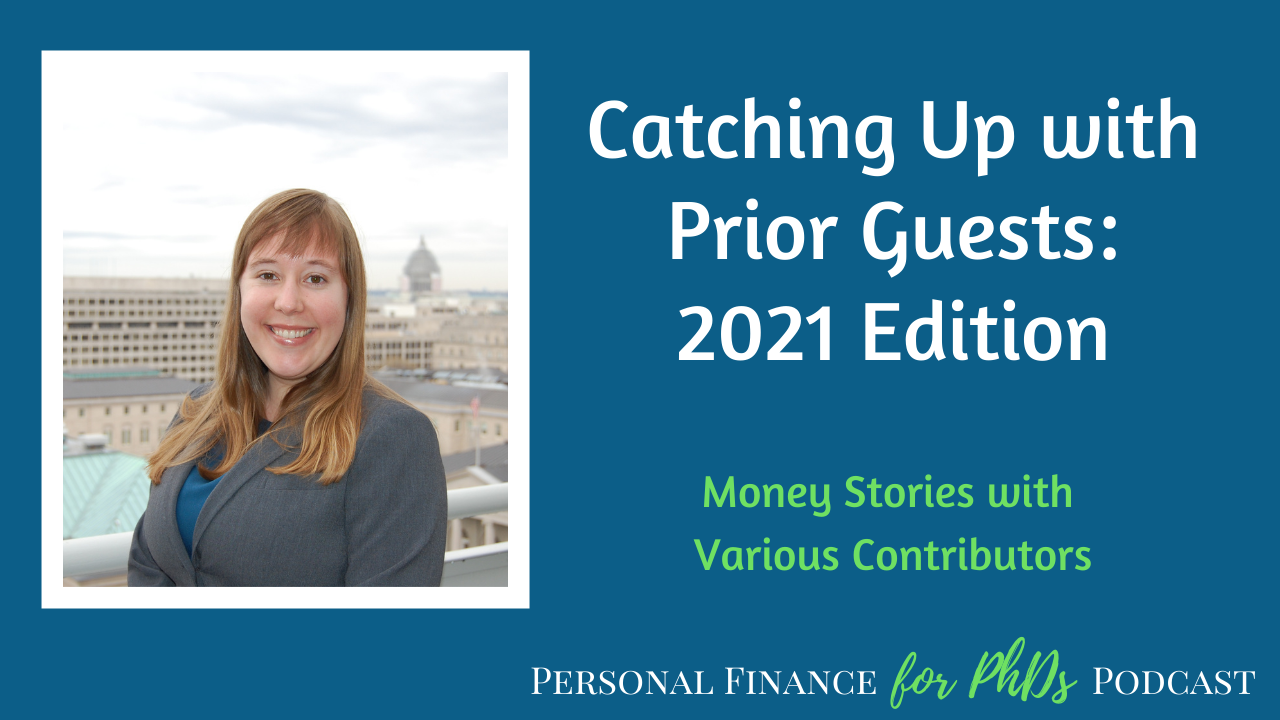
Episode image of Dr. Emily Roberts with the title "Catching Up with Prior Guests: 2021 Edition" and the subtitle "Money Stories with Various Contributors"

Teaser

00:00 John: You know, life doesn’t wait and you can still be financially sound while in graduate school.

Introduction

00:10 Emily: Welcome to the Personal Finance for PhDs Podcast: A Higher Education in Personal Finance. I’m your host, Dr. Emily Roberts.

00:19 Emily: This is Season 10, Episode 20, and today I am featuring many guest voices! I published the first episode of this podcast in July 2018. This is the one hundred and fiftieth episode, and over the last three and a half years, the podcast has featured 134 unique voices in addition to my own.

00:41 Emily: For our last episode in 2021, I thought it would be fun to catch up with the guests from Seasons 4 through 6, and a couple from earlier seasons as well. I invited them to submit short audio clips to update us on how their lives and careers have evolved since the time of our interview, as well as to provide their best financial advice if that has changed since our initial interview.

01:03 Emily: The audio clips in this episode are ordered by when the original episode was published. If you’d like to circle back and listen to any of the previous interviews, you can do so in your podcatcher app or at my website, PFforPhDs.com/podcast. To keep up with future episodes, please hit subscribe on that podcatcher and/or join my mailing list at PFforPhDs.com/subscribe.

01:28 Emily: You’ll hear an update from me first, followed by the rest of the guests. Happy listening, and I am wishing all good things for you in 2022!

Dr. Emily Roberts

01:43 Emily: Hi! This is Emily Roberts from Personal Finance for PhDs. I am of course the host of this podcast and you hear from me every week!

01:52 Emily: It seems strange to say, but 2021 was a banner year for me and my family.

01:59 Emily: On the personal side, my husband and I bought our first home, which I discussed in great detail in Season 8 Episode 18. We now live in the San Diego area, which has been our dream for over a decade. Our children are in kindergarten and preschool, and after being out of school for over a year due to the pandemic, it’s really wonderful for our family to be in a routine and for them to be around their peers. We are loving playing tourist in San Diego and enjoying the incredible weather and wealth of outdoor activities.

02:32 Emily: As for my business, Personal Finance for PhDs, I am so grateful that it has grown quite a lot in the last year. I’ve simplified my paid offerings so that I can focus on what seems to be in highest demand: 1) my personal finance seminars, both live and pre-recorded, which are hosted by universities; 2) my tax workshops, which can be purchased by individuals or in bulk by universities; and 3) the Personal Finance for PhDs Community, which individuals can join. To each of you who have joined the Community or one of my workshops in 2021 or recommended me within your university, you have my sincere thanks. The reason I can continue to create this podcast and all of my free resources is the revenue that I generate in these other areas.

03:20 Emily: I’m really looking forward to starting 2022 off strong with tax season and admissions season. If you know any PhDs-to-be who need help in either of those areas, please send them my way!

03:32 Emily: Thanks for listening to my update! If you want to get in touch, you can visit my website at PFforPhDs.com or find me on Twitter @PFforPhDs.

John Vsetecka

03:49 John: Hi everyone. It’s John Vsetecka from Season 2, Episode 2 on the personal finance for PhDs podcast. Several years ago, I got to talk with Dr. Emily Roberts about negotiating PhD offers and I wanted to just offer a quick update on how I think that has benefited me up until this day. So since that time, many things have happened. I got married during this time. I’ve moved and now I’m actually living outside of the US. I am currently in Kiev, Ukraine working on the last stages of my research for my dissertation, so I am now at the tail end of my graduate career.

04:29 John: When I last spoke to Dr. Roberts, we discussed how to go about negotiating PhD offers and I want to offer an update now about why I still think you should this. When I was applying to programs prior to 2017, I was able to successfully negotiate offers at several universities. This has really, I think benefited me to this day because I was able to choose the school, not only with a great funding package, but also great benefits that I’ll talk about in just to second. I know things have changed since the pandemic and many programs last year halted admissions, and this has made many programs and departments more competitive, and so you might be a little hesitant to negotiate an offer if you receive one, but I still think you should. If you receive a funded offer and you should absolutely make sure that any offer you receive is funded, this is really important, I think you should still ask if there’s anything else that that department or program can do for you.

05:29 John: Now, this can mean more money. This can mean insurance benefits. This can mean grant money, travel money, or any other resources that they have. See if there’s anything else that they can tack onto your package to help you be more successful in your program. And if you’re fortunate enough to have multiple offers, you should still negotiate these and see which one is the best one for you. And this might not be the one with the most money, but I think the ones that tend to offer the most money and the most incentives tend to be the best bet for your graduate career because life doesn’t wait and you can still be financially sound while in graduate school, if you can start by looking at what your department can offer you so you can plan ahead and make the best of your earning while you’re in graduate school.

06:18 John: So my advice remains the same. Again, if you receive multiple offers, don’t be afraid to ask. In some ways this is just like a job offer. It’s okay to negotiate. It’s okay to ask what else they can do for you. You’re going to do a lot for them. Don’t be afraid to reach out to the director of graduate studies or whoever’s in charge in your department and see what else they can do for you, if your package sort of insinuates that maybe there’s more that is available. I’ll leave you with that and of course, if you have any other questions about graduate school or negotiating offers, you can always get in touch with me on Twitter. My handle is @JohnVsetecka, or you can feel free to email me, it’s [email protected]. Best of luck to those of you who are applying and I hope you have successful negotiations.

Dr. Lourdes Bobbio Smith

07:22 Lourdes: Hi listeners. My name is Dr. Lourdes Bobbio Smith and I’ve been on a few episodes of the podcast. I was first on Season 3, Episode 11, where I gave a budget breakdown as an NDSEG fellowship recipient at Penn State University. I was also on Season 5, Bonus Episode 1, where I discussed my life as we entered social distancing in early 2020, and on Season 6, Episode 18, where I discussed some best practices as a side-hustling graduate school. Since those episodes, I have defended my PhD, started a business and gotten married.

07:55 Lourdes: In my first episode I spoke about how I use targeted savings accounts to save for various mid- and long-term financial savings goals, which hasn’t changed. My husband and I were able to fund our wedding with a combination of the wedding targeted savings fund I discussed in the episode, as well as savings my now husband had, and some generous gifts from our parents.

08:15 Lourdes: Since getting married and joining finances with my husband, we still use the target savings accounts, but we’ve modified what those different savings buckets are. Buying a house, which was previously a long term goal, has now become a more short to mid-term goal as we are looking to settle down in a house of our own. We also recently adopted a cat and my husband’s car is on the older side, so we are making sure to keep a pet fund and a car fund well funded as part of our monthly targeted savings. Investing is also a big priority in our household, and we’ve been able to max out our Roth IRA for 2021 and invest outside of the Roth in taxable brokerage accounts.

08:52 Lourdes: Post-PhD I’m working on a few different things. I have a job as a research associate at Penn State, I continue to work with Emily on this podcast, and I’ve also started a wedding stationery business this year. It’s been a fun adventure to learn both the management and financial sides of owning a business. I initially invested some of my own money, but it’s been self-sustaining for the last few months and I will even be turning a profit in my first year in business. 

09:17 Lourdes: I was asked to give my best financial advice for early-career PhDs and I would say, invest as early as you can, even if it doesn’t seem like you can contribute a lot. When I was first on the podcast, I was early in my own investing journey, only able to contribute a little each month, and it seemed like the progress was slow growing. But even in the two years since then, I’ve been able to see how powerful compound interest can be when it comes to growing your money.

09:44 Lourdes: If you’d like to connect online, you can find me on Twitter @lourdesb1012, that’s l o u r d e s b 1 0 1 2. You can also find my business on Instagram @cardsmithdesignstudio. Thanks for listening and have a good new year!

Jane CoomberSewell

10:08 Jane: Hi Emily! It’s Jane CoomberSewell of CoomberSewell Enterprises here, and we last chatted back in Season 2 (editors note: this should be Season 4), Episode 8, and we talked a lot about working on a budget, and self-sufficiency when you have a family and you’re doing a PhD and you’re also running a business. We talked a lot about menus, budgeting, gardening, both for practical reasons and for your mental health. And in terms of early career financial advice, none of that’s really changed except remember to have some fun. So occasionally after you’ve obviously dealt with all the bills, go and have a drink with friends, or have a meal out, or go and do what we did at the weekend, which was go and have a game of bowling, but only with adults, no children in tow. It was lovely.

11:03 Jane: Thanks so much for the timing of this as well. I finally got to my graduation yesterday. Within the business, Joyce, my other half has very much rebranded herself as an autism advocate and that’s going really well. And for me, I’m concentrating on research, but not in the academic sense. So at the moment I have two family biographies that I’m writing that people are paying me, have commissioned me to write, as well as attempting to turn my thesis into something slightly less theoretical for the commercial market. That’s my update. Everybody take good care and if you want to get in touch, it’s [email protected].

Abigail Dove

11:53 Abigail: My name Is Abigail Dove, and I was on Season 4, Episode 9, where Emily and I discussed the graduate Student Savings Act of 2019. I spearheaded the endorsement of this bill by the Federation of American Societies for the Advancement of Science, also known as FASAS, as part of a science policy fellowship. The graduate student savings act is a bi-partisan bill that allows graduate students and postdocs to be able to contribute income from a fellowship stipend to an individual retirement account or IRA. Previous IRS wording prevented contributions from fellowships as they were considered unearned income.

12:27 Abigail: Since we recorded that episode, I have a few big updates on the personal side. I have a daughter who is 18 months old, and I will be defending my PhD in a couple weeks and looking forward to the post-graduate student life.

12:40 Abigail: The big update in relation to the episode where I appeared on is that trainees can now contribute to IRAs while receiving fellowship stipends. The language from the Graduate Student Savings Act was added to an omnibus spending bill HR 1865, and was passed into law at the end of 2019. Emily did touch on this update after our interview to share the good news with everyone in a bonus episode in season four, for more information, be sure to check out that episode. But this is really fantastic news for anyone on fellowship stipends and wants a say for retirement.

13:11 Abigail: My updated financial advice has thus changed a result of the new laws. Since everyone is now allowed to contribute to an IRA, I highly recommend that if you have the financial ability to do so, do it. There’s a maximum contribution cap for IRA accounts and right now that cap is set at $6,000 for anyone under the age of 50. Additionally, there are income caps, but graduate student stipends are unfortunately well below those income caps so not something that we often have to worry about. That $6,000 cap may sound intimidating, so contribute what you can or put aside a fraction of your paycheck towards an IRA contribution. It’s never too early to start contributing to a retirement account, and it’s a good spending habit to start. And no amount is too little.

Commercial

13:57 Emily: Emily here for a brief interlude! Are you a graduate student, postdoc, or early-career PhD considering buying your first home in the foreseeable future? If so, I invite you to join the Personal Finance for PhDs Community for a Book Club discussion of First-Time Home Buyer: The Complete Playbook to Avoiding Rookie Mistakes by Scott Trench and Mindy Jensen of BiggerPockets. I and all the Book Club participants will read the book and come together for a one-time live discussion in January 2022. This is perfect timing for anyone with an eye on the spring or summer 2022 peak buying season. Since it might be hard to find this book in a public library, I will give you a copy of the book after you join the Community. If you want to join the Book Club for First-Time Home Buyer, please fill out the survey, including your availability for the discussion, at PFforPhDs.com/BookClub/. That’s P F f o r P h D s dot com slash B o o k C l u b. Now back to our interview.

Patrice French

15:03 Patrice: Hi my name is Patrice French, I was interviewed on Personal Finance for PhDs on November 25th, 2019 Season 4, Episode 15. I am still a full-time employee and am near the end of my doctoral program. I will defend and graduate in spring 2022. Since then I have made some major financial changes. I’ve sold my house, given the strong seller’s market. I have paid off all of my debt except for my student loans and will be eligible for a student loan forgiveness in March of 2022. I plan to transition to a career outside of higher education, in industry, and will likely relocate. As far as the best financial advice I can give for early career PhD is really create some clear goals in mind and create a plan from which to meet those goals. But don’t put a lot of pressure on yourself if things come up. Save, save, save! I have multiple savings accounts for things so that it doesn’t really dip into my income. So if I have car repairs, I have a car repair savings account and things of that nature. And definitely don’t pay for an educational program if you don’t have to. I can be reach on Twitter at @FrenchieMSW. And that’s it.

Dr. Zach Taylor

16:44 Zach: Hey everyone. This is Zach Taylor. I was on Season 5, Episodes 10 and 11. I’d like to give a little bit of an update. I’ve taken a new position. I’m now the assistant director of admissions for communication at Texas State University. It’s the first institutional position that I’ve had after having my PhD because I graduated into the pandemic and that was a very tough job field. But I wanted to give a few updates about how I think a little bit of my advice has changed since COVID 19 has happened and has really changed the landscape, especially of graduate education in the social sciences.

17:27 Zach: I know a lot of the harder sciences like your chemistry or engineering requires graduate students to be in a lab, working with physical materials, but a lot of social sciences PhDs, things like higher education where I came from, sociology, psychology at times, does not require you to be physically in a classroom. And I think people aspiring to earn a PhD, people in graduate school right now need to think how important is the on campus, in the classroom environment? How important is that physicality? And can you save money by taking online classes or taking hybrid classes. Think to yourselves about how much time and money is spent on commuting, especially in urban areas, coming from an Austin perspective. If I was still going to school living where I live now, I would have at least an hour long commute, including a car ride, a bus ride, and a walk. And that hour could be used to make money, could be used to do academic work.

18:29 Zach: So I think that might really change my perspective on the advice that I would give for an early career PhD is really considering online options, in addition to everything else I spoke about — the cost of living in your area, what you’re willing to go without and how you can side hustle to make a little bit extra cash. If anyone has anything that they want to reach out to me, please do so. My email is [email protected], just my initial ZT at U Texas dot edu. Thanks everyone.

Dr. Rachel Blackburn

19:08 Rachel: Hi, this is Rachel Blackburn and here is my update. So since I last recorded the episode of personal finance for PhDs (Season 5, Episode 12), I actually got thinking about finance quite a bit. I was in a tenure track position, teaching as a professor, but I decided that the thought of not getting tenure, and that forthcoming potential instability was a little bit much for me. And I also considered what if I do get tenure and then I’m committing to this place for the long term and is that what I really want? And the thought hit me, when’s the last time I got to choose where I lived? I also took a look at the finances because I was teaching at a public university, I was able to take a look at salaries and I could see that even by the time I might get full professor, if that was what was in the cards for me, that my salary would not go up by a whole lot. It occurred to me that I really wouldn’t reach my financial goals. So I decided to leave academia.

20:18 Rachel: I’m still researching and publishing and writing, but I have left teaching and I’m now a learning consultant for a public company. In leaving my position as a professor and moving on to this company, I gave myself a 70% raise. I’m now making more than I would be if I were a full professor at my previous university. Now I’m learning all kinds of things about employee stock purchase plans and things like that. So that’s actually where I’m at now. I’m saving more money than I ever thought I would. And I feel like I’m meeting my goals a lot faster, so it’s great. And I’m still teaching, I just do it now on behalf of developing training material for a company. That’s where I’m at and thank you again. Good luck everyone! Bye!

Courtney Danyel

21:19 Courtney: Hi! This is Courtney Danyel. I was on (Season 6) Episode 17 of Personal Finance for PhDs, and my topic was how freelancing can take your career from academia to affluence. And that’s my brand AcademiaToAffluence.com, where I teach other people with an academic background how they can learn to freelance and grow their online income like I did. We talked about how I actually only work maybe 15 or 20 hours a week, but I earn full-time income as a freelance writer. And the reason I’m able to do that is because I find writing gigs that are highly specialized in my niche and so I’m able to earn higher income for work that takes me less time to do.

22:04 Courtney: We also talked about how freelancing gave me the freedom to travel around the world and live wherever I want and so I’ve been spending the past seven years actually living in Africa, in Ethiopia. Since that episode, which was back in August, 2020, I’ve actually immigrated back to the United States, where I continue to freelance and I continue to work maybe 15 or 20 hours a week on that, but now actually have another part-time job here in the United States also. Another great thing about freelancing is that it gives you the flexibility if you wanna have multiple careers you can have them, and you can earn full-time wage as a part-time influencer and pursue a career in academia or elsewhere, which is really nice. That’s something that’s changed in life since I was first on the podcast.

22:53 Courtney: My best financial advice for any early career PhD is to diversify your income. Give yourself options. Be a freelancer, be an academic, have your own business, do something on the side, but never put all your eggs in one basket and always have options for yourself so that when life changes or you want to make a change, like I have recently, you can do that. If anyone has questions about applying your skills from academia to a freelance career like I have done, please do shoot me an email. You can contact me at [email protected]. Thank you!

Meryem Ok

23:36 Meryem: Hi everyone, this is Meryem Ok recording on Friday, November 26, 2021. While I typically work behind the scenes as an editor for the podcast, I was featured in Season 6, Episode 18, along with fellow Virtual Assistant Lourdes Bobbio, for an episode about Best Practices in Side Hustling During Graduate School. As I mentioned in that episode, one of the reasons that I’m grateful for my side hustle is that the extra income provides me with a cushion for those occasional purchases that might happen outside of my usual spending habits. This really comes in handy especially around this time of year when there are a lot of birthdays in my family, in addition to the holiday season, so my spending on gifts and eating out tends to spike up a bit.

24:24 Meryem: This past semester, one of the financial adjustments that I made was when my university moved from paying fellowship recipients on a monthly basis to a once-per-term model. At first, I was pretty uneasy about the change, but after talking to Emily and sitting in on some town halls, I felt more prepared and ready to strategize. When that first lump sum arrived in August, I immediately contributed part of it to my Roth IRA and moved most of the remainder into a high-yield savings account. If you want to learn more strategies, check out Emily’s blog post, “How to Financially Manage a Once-Per-Term Fellowship Paycheck.”

25:06 Meryem: As a personal and professional update, I recently changed my Twitter username, so it’s now @Meryem_T_Ok, if anyone is curious to learn more about my MD-PhD journey and intestinal stem cell research. Shoutout to all my fellow grad students on the research grind – I’m rooting for you and hope you have some time to recharge in the coming weeks. 

Outtro

25:37 Emily: Listeners, thank you for joining me for this episode! pfforphds.com/podcast/ is the hub for the Personal Finance for PhDs podcast. On that page are links to all the episodes’ show notes, which include full transcripts and videos of the interviews. There is also a form to volunteer to be interviewed on the podcast. I’d love for you to check it out and get more involved!

Emily: If you’ve been enjoying the podcast, here are 4 ways you can help it grow: (1) Subscribe to the podcast and rate and review it on Apple Podcasts, Stitcher, or whatever platform you use. (2) Share an episode you found particularly valuable on social media, with an email list-serv, or as a link from your website. (3) Recommend me as a speaker to your university or association. My seminars cover the personal finance topics PhDs are most interested in, like investing, debt repayment, and effective budgeting. I also license pre-recorded workshops on taxes. (4) Subscribe to my mailing list at PFforPhDs.com/subscribe/. Through that list, you’ll keep up with all the new content and special opportunities for Personal Finance for PhDs. See you in the next episode, and remember: You don’t have to have a PhD to succeed with personal finance… but it helps!

Emily: The music is “Stages of Awakening” by Podington Bear from the Free Music Archive and is shared under CC by NC. Podcast editing by Lourdes Bobbio and show notes creation by Meryem Ok.

Footer

Sign Up for More Awesome Content

I'll send you my 2,500-word "Five Ways to Improve Your Finances TODAY as a Graduate Student or Postdoc."

Success! Now check your email to confirm your subscription.

There was an error submitting your subscription. Please try again.

We won't send you spam. Unsubscribe at any time. Powered by Kit

Copyright © 2025 · Atmosphere Pro on Genesis Framework · WordPress · Log in

  • About Emily Roberts
  • Disclaimer
  • Privacy Policy
  • Contact