• Skip to main content
  • Skip to footer

Personal Finance for PhDs

Live a financially balanced life - no Real Job required

  • Blog
  • Podcast
  • Tax Center
  • PhD Home Loans
  • Work with Emily
  • About Emily Roberts

tax

How to Financially Manage Your NSF Graduate Research Fellowship

April 5, 2019 by Emily

Congratulations on being awarded the National Science Foundation (NSF) Graduate Research Fellowship (GRF) (or a similar remunerative, competitive, national fellowship)! Whether you’re a prospective grad student or a current first- or second-year PhD student, this fellowship is a great boon to your research, your CV, and almost certainly your finances. However, you may not yet realize that your finances will become a bit tricky once you start receiving your fellowship. With the help of this article, you can avoid the pitfalls associated with fellowship income and fully capitalize on the benefits.

NSF GRFP stipend

Further listening: The Financial and Career Opportunities Available to National Science Foundation Graduate Research Fellows

The NSF GRFP’s Negotiation Power

I’m sure you didn’t miss this headline info about the NSF GRFP: The fellowship pays you a stipend of $34,000 plus $12,000 of educational expenses to your institution for three years. Awesome! At the majority of universities in the US, that stipend amount is well above what you would be paid if you didn’t receive the fellowship, so you’ve effectively achieved a raise for the next three years.

But the good news doesn’t stop there: Your university/department might confer even more benefits upon you for winning independent funding. If the administration isn’t forthcoming about these additional benefits, it is appropriate to inquire about them.

Independence

Your new outside funding may give you a degree of independence in your research that you wouldn’t otherwise enjoy. This is highly dependent on your field, department, and advisor, but the fellowship may enable you to take your doctoral research in a direction that you advisor couldn’t or wouldn’t have supported without it. Perhaps you could take a risk on a side project, establish a new collaboration, or take extra time to rotate through a lab to gain new skills.

Additional Funding

At many universities, there is a standard offer of additional funding for winning a multi-year, lucrative fellowship like the NSF. This offer could come in one or more forms, such as:

  • A guarantee of funding for additional years
  • A one-time bonus
  • A stipend supplement above $34,000 while you have the fellowship
  • A stipend supplement after the fellowship concludes (e.g., up to $34,000/year for your remaining time in graduate school)

Not all departments offer additional funding to NSF GRFP recipients, but it’s worth inquiring about with your advisor, the administration, and current NSF fellows at your university. Stipend supplements during the time that you receive the NSF GRF are more common in high cost-of-living cities where the departmental base stipend is near $34,000/year to begin with. For example, searching “NSF” in the PhD Stipends database reveals stipend supplements awarded during the NSF GRFP years to students at the University of California at Berkeley, Northwestern University, and Columbia University, while a student at the University of California at San Diego writes that he/she received no funding incentive for winning the NSF GRF.

For Prospective Graduate Students

You’ll never have more negotiation power than you do as a prospective graduate student with an outside fellowship in hand. Unfortunately, you don’t have a lot of time to negotiate as the NSF GRFP awards list comes out approximately two weeks before grad school decision day, April 15.

Further reading: Vote with Your Feet, Prospective Graduate Students

As quickly as possible, you need to clarify if the offers from the universities you are still considering are going to be sweetened at all now that you have your fellowship. If the financial package from your preferred university isn’t up to par with your other offers (after considering cost of living differences), you can tactfully ask if a bonus, stipend supplement, or guarantee of future funding is possible.

Join Our Phinancially Distinct Community

Receive 1-2 emails per week to help you take the next step with your finances.

Success! Now check your email to confirm your subscription.

There was an error submitting your subscription. Please try again.

We won't send you spam. Unsubscribe at any time. Powered by Kit

Budgeting with Your Fellowship Income

There are two vital questions you need to ask of your department before you can begin creating a budget for your NSF GRF stipend.

  1. After the fellowship ends, what will my stipend be?
  2. How frequently is my fellowship disbursed?

Accelerate Progress on Financial Goals

In my ideal personal finance-oriented world, an NSF fellow would live on (less than) the base stipend from his department and put all the excess income received toward growing his wealth. There are a few advantages to that approach:

  • Your lifestyle roughly matches that of your peers in your department.
  • You can relatively quickly achieve financial goals such as saving or debt repayment.
  • If your income is set to drop once the fellowship ends, you avoid acclimation to the higher, temporary income and don’t have to make major lifestyle sacrifices once the three years are up.

Some financial goals you could work on during the time you receive the additional fellowship funds are:

  • Eliminating any troublesome debt (e.g., credit card balances, medical debt, car loan)
  • Saving up cash for short-term needs and expenses (e.g., emergency fund, targeted savings accounts)
  • Investing for long- and mid-term goals (e.g., retirement, house down payment)
  • Pay down student loans

Further reading:

  • Options for Paying Down Debt during Grad School
  • Why Every Grad Student Should Have a $1,000 Emergency Fund
  • Targeted Savings Accounts for Irregular Expenses
  • Whether You Save during Grad School Can Have a $1,000,000 Effect on Your Retirement
  • Why the Roth IRA Is the Ideal Long-Term Savings Vehicle for a Grad Student
  • Why Pay Down Your Student Loans in Grad School

This strategy is easiest to implement for graduate students who start the NSF GRF after one or more years in grad school. Just put all of your ‘raise’ toward financial goals and don’t change anything about your lifestyle! Prospective grad students will have to be more conscious about setting up their grad student lifestyle on a lower income than they will start out with.

Preparing for the Post-Fellowship Income Drop

If you choose to upgrade your lifestyle with your fellowship stipend, be careful to maintain any long-term financial contracts at a level that will be sustainable for you after your income drops (if it will). The two key areas to watch out for are housing and transportation expenses. While it is possible to reduce your spending in either of these areas during grad school, it is a painful process, so it is preferable to lock in your spending in those areas at a level that you can maintain long-term.

Budgeting with an Irregular Income

Sometimes, fellowships are disbursed to the recipient at a frequency other than monthly, e.g., once per term. This schedule can cause issues for budgeting, which is usually framed as turning over each month.

One of the advantages of an infrequent disbursement schedule is that you are paid at the beginning of the period rather than the end, so the money you need throughout the period is already available to you. However, you may not be able/inclined to use typical budgeting software functions and prefer to set up your own budgeting system.

One of the most useful budgeting concepts for people with irregular incomes is that of fixed vs. variable expenses. At the beginning of your budgeting period, project the fixed expenses that will be paid during the period, such as your rent/mortgage, debt payments, certain utilities, subscriptions, etc. Then allocate your remaining income to your variable expenses at a frequency that is convenient for you. For example, you can estimate the variable utility bills that you may pay monthly during the period, plan to spend no more than a certain amount of money each week on groceries, and give yourself a lump sum of money for entertainment for the entire period to be spent as opportunities arise. In this way, allocate your fellowship disbursement so that you are sure that your expenses won’t exceed your income (leaving some buffer for unexpected expenses).

Income Tax Implications of the NSF GRFP

Your NSF GRFP stipend is subject to federal income tax. (It is usually subject to state and local income tax as well, but there are some exceptions.)

Further reading:

  • Grad Student Tax Lie #1: You Don’t Have to Pay Income Tax
  • Grad Student Tax Lie #4: You Don’t Owe Any Taxes Because You Didn’t Receive Any Official Tax Forms
  • Grad Student Tax Lie #5: If Nothing Was Withheld, You Don’t Owe Any Tax

However, the taxation of fellowship stipends is handled completely differently by universities than assistantship pay.

Tax Reporting

While assistantship pay is reported on a W-2, fellowship stipends are not required to be reported in any particular way.

Receive Your Tax "Cheat Sheet"

Subscribe to the Personal Finance for PhDs mailing list for essential information to help funded US graduate students (citizens/residents) with their federal tax returns

Success! Now check your email to confirm your subscription.

There was an error submitting your subscription. Please try again.

We won't send you spam. Unsubscribe at any time. Powered by Kit

A large fraction of universities, possibly the majority, do not report outside fellowship stipends on any official tax form. At most, the fellow might receive a courtesy letter, which is an informal letter stating the amount of the fellowship stipend received during the calendar year.

Some universities report fellowship stipends on Form 1098-T in Box 5 (along with other scholarship and grant income).

A small minority of universities report fellowship stipends on Form 1099-MISC in Box 3.

Whatever reporting mechanism used or not used, the important information to bring to your tax return preparation process is the amount of fellowship stipend paid to you during the calendar year. From that point, the fellowship stipend income is treated the same as any other fellowship/scholarship/grant income, and (possibly after some adjustments) it will ultimately be taxed as ordinary income.

Further reading:

  • Weird Tax Situations for Fellowship Recipients
  • How to Prepare Your Grad Student Tax Return

Quarterly Estimated Tax

While you are required to pay federal and usually state income tax on your fellowship stipend, the vast majority of universities do not offer automatic income tax withholding on your fellowship stipend as they normally do for employee pay. (You should inquire whether automatic withholding is an option and use it if so, but the remainder of this section assumes it is not offered.)

This means that you will receive 100% of your gross fellowship stipend instead of your stipend net of income tax as you would assistantship pay. However, the IRS still expects to receive income tax payments throughout the year, so you will have to look into filing quarterly estimated tax.

Further reading: The Complete Guide to Quarterly Estimated Tax for Fellowship Recipients

As a default position, you should assume you are responsible for paying quarterly estimated tax. It’s possible that you won’t be required to in the year you switch on or off of the fellowship or if you’re married to someone with a high income and high withholding, but even in those cases it’s prudent to check.

The way you calculate your quarterly estimated tax due (and figure out if it’s required of you) is by filling out Form 1040-ES. That form will give you the amount of the payment you are supposed to make four times per year and an estimate of your total tax due for the year. You can make the payment online at IRS.gov/payments or through a host of other mechanisms.

Whether or not you are required to file quarterly estimated tax, it’s a great idea to set up a personal system that simulates automatic tax withholding. Open a separate savings account labeled “Income Tax” and transfer in the fraction of each paycheck you receive that you ultimately expect to pay in tax each time you are paid. Then, draw from that savings account when you make your quarterly or yearly tax payments.

Investing Implications of the NSF GRFP

The upside of receiving the NSF GRF is that your income is most likely higher than it would have been, which means you have an increased ability to achieve financial goals during graduate school such as debt repayment, saving, and/or investing.

Free Email Course: Investing for Early-Career PhDs

Sign up for the mailing list to receive the free 10,000-word email course designed for graduate students, postdocs, and PhDs in their first Real Jobs.

Success! Now check your email to confirm your subscription.

There was an error submitting your subscription. Please try again.

We won't send you spam. Unsubscribe at any time. Powered by Kit

Through 2019, fellowship income, like that of the GRFP, was not eligible to be contributed to an Individual Retirement Arrangement (IRA). However, starting with tax year 2020, fellowship income is eligible to be contributed to an IRA, eliminating the only major downside of receiving fellowship income.

Further listening: Fellowship Income Is Now Eligible to Be Contributed to an IRA!

An IRA is a tax-advantaged retirement savings vehicle. It’s a great idea to use an IRA (or other tax-advantaged retirement vehicle such as a 401(k) or 403(b)) for your retirement savings as it helps you maximize your long-term rate of return by protecting your investments from taxes. As a graduate student, you almost certainly don’t have access to the university 403(b), so the IRA is basically the only game in town for tax-advantaged retirement savings.

Further reading:

  • Everything You Need to Know About Roth IRAs in Graduate School
  • Why the Roth IRA Is the Ideal Long-Term Savings Vehicle for a Grad Student
  • Should a Graduate Student Save for Retirement in a Roth IRA?

Making Ends Meet on a Graduate Student Stipend in Los Angeles

March 25, 2019 by Jewel Lipps

In this episode, Emily interviews Adriana Sperlea, a PhD student in computational biology at the University of California at Los Angeles (UCLA). Living in Los Angeles is financially challenging to say the least, and Adriana has found ways to improve her cash flow over time, such as by doing a summer internship, moving into subsidized graduate housing, living car-free, and budgeting intensively. She has even recently started contributing to a Roth IRA! Adriana and Emily additionally discuss how Adriana discovered that she owed a large tax bill on her fellowship income and how she paid those back taxes and started paying quarterly estimated tax.

Links mentioned in episode

  • Tax Center for PhDs-in-Training
  • Volunteer as a Guest for the Podcast
  • Why You Should Invest During Grad School
  • Quarterly Estimated Tax Workshop for Fellowship Recipients

grad student los angeles

Teaser

Adriana (00:00): I tell everyone, I, I’ve told people in my lab being like, no, you have to do this. It’s simple and it’s easy, and it can help you a lot.

Introduction

Emily (00:15): Welcome to the Personal Finance for PhD’s podcast, A Higher Education in Personal Finance. I’m your host, Emily Roberts. This is season two, episode six, and today my guest is Adriana Sperlea, a PhD student at UCLA. Adriana shares her detailed budgeting process, how she keeps her expenses in Los Angeles in check, and what a difference doing an internship made in her financial life. We also discussed the mistake she made with her taxes while receiving a fellowship and how she got that aspect of her financial life back on track. Without further ado, here’s my interview with Adriana Sperlea. I’m welcoming to the podcast episode today, Adriana, who is joining us from, uh, Los Angeles. She’s a graduate student at UCLA, and in today’s episode, we’re covering budgeting, you know, the big challenge of living in a high cost of living area on a grad student stipend. Um, she’s doing really well with this, and she’ll tell us all about her process and what financial goals she’s able to accomplish, and then also about something that happened in her second year of graduate school, which is a big, uh, financial mishap, financial challenge that she had to overcome. And we’re talking about how to, one, not let that happen to you, and two, if something big like that does happen, how to work through it and how to recover from it. So that’s a subject for, um, today’s episode. So Adriana, thank you so much for joining me today.

Please Introduce Yourself

Adriana (01:40): Yeah, hi. It’s great to be here.

Emily (01:43): Uh, so first question right off the bat is, you know, just take a moment to introduce yourself to us, where you are, what you’re studying, and so forth.

Adriana (01:50): Yeah, so my name’s Adriana. I, um, go to UCLA for graduate school. I’m in the bioinformatics program there, uh, which is actually an interdepartmental program, so we don’t have our own department, uh, which sometimes causes all, like, funding gets complicated also. Um, yeah, and I live in Los Angeles. Um, I’m, and I’m actually an international student, so I’m originally from Romania, uh, which also adds a wrinkle to the funding situation.

Emily (02:15): Yeah. Okay, great. Um, and so what, what are you making there? What is your stipend?

Adriana (02:20): Yeah, so, um, we’re, I’m pretty fortunate. We’re in a fully funded program. The stipend is 30, around $32,500 a year, I think it is now. It goes up a little bit every year with inflation and stuff. Um, and so that’s before tax, like after tax, it comes out to about 28,000 a year, I think. Um, which what I know is that every year I get, every month I get $2,400 into my bank account.

Emily (02:45): Okay. And how long have you been there?

Adriana (02:47): So this is my fifth year, that I’ve been here for.

How do you live within your means in Los Angeles?

Emily (02:51): Okay, great. You have long experience then, um in Los Angeles. So, um, right off the bat, you know, when, when we were prepping for this episode, I know about you that you live, uh, within your stipend, you live within your means, you’re not having, you know, loans and so forth coming out for you. And so, um, why did you do that during graduate school? Because I think some people might look at living in LA and living on, you know, 30 some thousand dollars a year and say like, oh gosh, this is gonna be really, really tough. I’m gonna need some extra support from here or there. Um, so why, why did you per not not pursue any of those routes?

Adriana (03:31): So, um, it basically wasn’t really an option for me to pursue those routes. Um, a I don’t have any extra support from my family, um, just because they can’t really afford it, and they’re also far away from me. They’re still back in Romania. Um, and because I’m an international student, I can’t actually take out loans. Um, I, there’s some small private loans that I could probably qualify for now after a few years, but at least in the beginning of my graduate school for sure no. Um, so that was kind of, yeah. Um, the only way I could supplement my income and I did, um, it was actually through, um, internships. So I did do an internship, um, in between my, uh, after my third year of graduate school. But yeah, that was the only extra income, otherwise it would be extremely illegal for me to work, um, federally illegal, so I would get potentially deported. So yeah.

Emily (04:18): Yeah, I noticed that, um, you know, I, I talk a lot about side incomes and stuff and, and to some extent I know that debt is an option, uh, for domestic graduate students. But the thing is that like, if you’re in a tight situation, like some places, some programs, they just plain are not paying enough, and it’s really the international students that are in the hardest squeeze because they have no, as you said, legal, other options out of this. Like, there’s no other way to work, there’s no way to get access to these loans, like that is it, that’s the end of the story. And so I really think that in, in some cases, domestic students can learn a lot from international students on how to make things work because their back is really up against the wall, um, more so than domestic students. So I wanna hear a little, a tiny bit more about this internship, um, so in that year that you, the summer that you did the internship, were you, like, did your grad student stipend stop and you were instead paid through the internship, or did you get like both or how did it work?

Adriana (05:17): Yeah, so I actually got both, but that’s a corner case, like that’s not how it usually works. Um, other people in my program have done internships, and I think depending on when your, where your funding is coming from, most of the time your other funding stops and you just get your internship. Um, in my case, I was on this training grant that, um, encourages, I think it’s actually a requirement of the training grant to do an internship, um, because it’s called Biomedical Big Data Training Grant. So they want to do an internship where you actually explore using big data in the biomedical field, yada, yada. So it’s actually part of the training grant, so they keep paying you. Um, so I got my training grant. I didn’t get, the training grant was actually supplemented by a little bit of a graduate student researcher funding. Um, I didn’t get that part, but I was still getting that and my income from the internship. And I was living in San Diego, which was slightly cheaper than Los Angeles, so that helped too. <laugh>.

Emily (06:08): Yeah. Cool. Okay. So did you actually like sublet your place in Los Angeles for the summer?

Adriana (06:13): Um, so I was living with my boyfriend at the time. Um, so he kept paying. I, I kept paying. Did I pay? It was a little bit ago. I think we had, yeah, I stopped paying half of my rent, I think my half of the rent here. Um, and then, yeah, I subleted a place in San Diego.

Emily (06:29): Yeah. So it’s good that you had the double income because you had the double rent <laugh> for a little while. Yes. Yeah, that can be really tough when you do have to move for just a short, a short period of time. Yeah. Um, okay.

What is your approach to budgeting in Los Angeles?

Emily (06:41): But you had, through that period, I would imagine already this effective like, budgeting system in place. So for, for making it work, for making it on your stipend with no other kind of outside income sources, um, yeah. How, how do you budget? Tell us about your system.

Adriana (06:58): Yeah, so I mean, I think even before budgeting, there’s like kind of the more basic thing where like you kind of have to figure out housing that’s like the first order of priority in LA and it’s hard, but there are ways, I mean, currently for example, I’m in a situation where I’m in graduate student housing that’s subsidized. So it’s actually really affordable. Um, but not, there’s not enough for everyone. So it’s not a, not all graduate students get it. So making it work with roommates, like finding the roommates, like hustling on Craigslist, finding the right deals, like you have to shop around a lot. Um, but there are still ways to find something that can kind of fit in that, like desirable percentage of your income. Maybe. Like, I, I don’t think 30% is feasible in Los Angeles <laugh>. Um, it’ll still probably go up to like 40%, but still, um, yeah, making it work.

Emily (07:47): Well, I would like to hear a little bit more about that one, about the subsidized housing, and then two, just about your, when you’re hustling, when you’re hustling on Craigslist, what are you looking for? How do you find those deals? Because I mean, Los Angeles is a huge city. We’ve got a lot of universities there. I’m sure there are some local people who wanna hear about this because it’s such a problem. And then it will also translate well, I think, to other high cost of living cities. So tell me a little bit more about the, the subsidized housing through UCLA. Like how do you get into it?

Adriana (08:14): So that’s a, that the subsidized housing is a lottery based system. Um, so you just apply and then when someone moves out, they let someone off the wait list in, and I think there’s some random component to it. I don’t really, know, there’s not a, I don’t know exactly how that process works, but you get an email if you got it. So, and you celebrate. 

Emily (08:31): Are you allowed to stay as long as you would like? Or is there a cap on it?

Adriana (08:35): So in the one that I’m currently in, yes. Um, well, no, not, I think it’s nine, seven years, seven or eight years, basically, as long as hopefully you don’t need more than that, so, yeah. Um, but it is month to month, so people sometimes will move out, like not, not at the beginning of a year. Um, and then anyone can take their spot. So, yeah. Um, the, it, it’s actually a great system, but it’s just not enough of it. And I’ve, I’ve talked a lot at UCLA trying to push, um, more housing, more affordable housing for students. It’s needed like Los Angeles, it’s impossible. So

Emily (09:06): How much of a discount are you getting? Like how much is the subsidy?

Adriana (09:10): Uh, well it’s, it’s not like percentage based, but it’s, it’s subsidizing that it is cheaper. So, uh, a one bedroom, we have like a junior one bedroom. It’s me and my fiance now living in it. Um, and we pay, uh, 30, around 1300 for the whole place. So split, I pay like $650 for, for rent, which is amazing for LA.

Emily (09:31): Yeah, 650 sounds like pretty good for a lot of cities around the country. Yeah. So a junior, one bedroom. Okay. Yeah. So it helps certainly if you have someone that you’re willing to share a bedroom with.

Adriana (09:43): Yes, a hundred percent. So that may be, if you have a significant other, then that’s a lot easier. I’ll be honest, I’ve talked to people in grad school that talk about like the advantages of having a partner in terms of rent <laugh>, um, but then also you can share a bedroom. I mean, it’s not ideal as a graduate student. You don’t want to be sharing a bedroom, but if you need to make it work because there’s no other money share a bedroom like that, that can be the case. Yeah.

Emily (10:08): Yeah. I just actually ran into someone, um, not ran into, someone attended a seminar of mine a couple days ago and she said, yep, I live in a, I share a bedroom with my roommate. That is still a thing that is happening, like to make her her budget work. So it’s not, it’s not totally unheard of, not totally out of the question. Okay. I totally agree with you. You have to get that housing component kind of set, and that’s something around which a, a lot of the rest of your budget will, will be determined. Um, yeah. So is there anything else like that? Is housing the one expense that you need to fix first? Or like, what about transportation? Did you figure that out before really working on your budget? 

Adriana (10:43): So I mean, housing and transportation are probably the two big ones. Um, I don’t own a car. Um, so for me it’s like you can pay a little more for rent because I don’t own the cars. I don’t have car costs like insurance and all that, or parking. And so I can live a little closer and not have the car. You can have the car that’s more cost, but you might be able to get cheaper rent. So that’s kind of a balance, I feel like. Um, I mean, if also if you’re somewhere that has public transit, then you, your problems are way easier. But in LA it’s kind of the trade off between car and, um, housing. Yeah.

Emily (11:13): Yeah. Okay. So you live car free. That’s awesome. I love that.

Adriana (11:16): Well, so my fiance does have a car now, so

Emily (11:18): Oh, okay. So you’re sort of, you sort of share a car.

Adriana (11:20): Yes, now I do. Yeah. But I didn’t have one for a very long time,

Emily (11:24): So I, I forgot that I wanted to go back to this, um, this idea of how can you find like, affordable housing? Do you have any tips about that?

Adriana (11:33): Um, yeah, I mean, honestly, a lot of it’s just like spending time and looking around and eventually you’ll find kind of these offers that are not as common. Um, there are in LA there the, there’s this one type of building in LA in particular, I forget what they’re called, but basically they’re like older houses that are honestly like, not earthquake proof, <laugh>, um, they’re the <inaudible> build. They have like a carport underneath. Um, and those, because they’re not retrofitted and they tend to have like slightly older furniture and like the AC is like not super up to date and stuff like that, they tend to go for a little less. And occasionally in some areas there is rent control. So if you can get into a place that has the rent control, then your rent at least won’t go up. Um, so there’s various hacks like that, and it’s all about just like having patience and kind of starting early on the housing search. Um, but I do know that it’s getting harder every year. So yeah, there’s, there’s only so much you can do with that, to be perfectly honest. Like, I don’t wanna like claim that it’s, I have some amazing magic for finding housing because it’s just tough.

Emily (12:37): Yeah. So you’re just saying be patient, um, sort of target, you know, types of buildings that you know, are gonna be less expensive. Yeah, I’m a little concerned about this not being earthquake proof thing, <laugh>. Um,

Adriana (12:50): It’s the truth. That’s how it, I mean, yeah, I don’t know if that like, it’s a good thing to say that you should live somewhere that’s not retrofitted, but I do know those apartments are not well retrofitted. It’s a common thing. And that’s why I think they’re going, a lot of them are being like, replaced by newer developments. Um, but yeah, there’s, I mean, maybe don’t live somewhere that you don’t feel safe, of course. But, um, there, you know, you can definitely sacrifice on things like granite countertops, <laugh>, or the open space. You know, like you’re not gonna get, um, something beautiful, but you can get something livable and clean for, um, more affordable.

What is the system that you use for budgeting?

Emily (13:27): Yeah. Okay. So, okay, so let’s return to the, the budgeting, um. System that you used. I, I’d love to hear more about just how you make it work overall. Once, once you’ve gotten this rent and then like your decision about transportation in place.

Adriana (13:40): Yeah. So I’ve had, for a very long time I had this like spreadsheet system where I would put in my income that comes in every month and I would separate it. I would put in my fixed costs, like the rent that has to be paid and my bills, like my phone bill, um, whatever other bills you have that are just monthly, like if you have a gym membership, if you have other bills, et cetera. Um, if you have to pay for insurance, I guess you have a car, you would have that there too. Um, and then I split whatever is, I did sub subtract that from my monthly income and then I divided into four. Um, ’cause there’s like four weeks in a month. And then whenever I buy something, I entered it, I entered in my spreadsheet and I have a cell that subtracts that from my weekly budget.

Adriana (14:22): Um, and so I always have a sense kind of like, of what I’m spending. Um, and I try, so for me, I, I notice, I think, I think it’s common from a lot of grad students that eating out tends to drive your budget up a lot. Like if you don’t cook your own meals, like that’s gonna be a big expense. Um, so for me it’s all about just, you know, buying my, making sure I buy my groceries on the weekend and kind of prep some type of food and make sure I’m cooking my meals. And if my meals are cooked and I’m on top of that, then I pretty much don’t spend anything Monday through Friday, to be honest. ’cause I just go into lab. I eat lunch that I brought from home and then I come back home. So there’s not a lot of expenses. And so then by the end of the, on the weekend, you still have like a hundred something dollars to work with that. Um, you can, you know, you can go see a movie, you can go out, you can do something.

Emily (15:09): I’ll just recap that for a second. ’cause I wanna make sure I, I really like what I’m hearing. I wanna make sure I understand. So, so you take your, your total monthly income, and then you subtract out all of your, basically your monthly bills. They’re often fixed expenses. Maybe there’s some variable in there, like some utilities or something. I dunno if any of your utilities are variable, but, so you’re subtracting out all those monthly bills and then you take the remainder and you divide it up by the week. And so you have your, your sort of, uh, discretionary or variable spending money for each week, and you start that week by buying your food, your groceries for the week. And you basically just are living sort of a, uh, a lifestyle where you don’t spend much during the week. Like, you know, you’re not, you’re not buying gas, you just said you don’t have a car. You’re not eating out during the week, you’re presumably not doing any entertainment stuff so that when you get to the following weekend, you know, you have, you know, the amount of money you have to work with, uh, in terms of being able to do some discretionary stuff, some fun stuff, um, eating out or entertainment or bar or what have you. Does that sound, is that, yeah.

Adriana (16:08): That’s pretty much it. Yeah. And then, I mean, there’s, you know, you wanna have a little bit of room. I have, I actually have a little bit of money set aside for like, things that come up, you know, like things can come up, so you can’t always anticipate that, like the miscellaneous stuff. Um, but yeah, that’s pretty much how it works. And I mean, um, the other thing is like if I have, I see something that I wanna buy, right? That’s just like something I want that’s fun. I want this new pair of jeans, or I want this, I don’t know, whatever it is. Um, like for example, a new part for my gaming computer, something like that, right? Um, I will, I won’t buy it the moment I want it. I’ll make a list and then at the end of either the month or the week or whenever, after a while, I look at that list and then I go through it and kind of rank the things that I’ve I, that I’ve seen that are like, oh, I would really like to own this. And then the impulse part is out of it, right? So now I can make kind of a cool-headed decision about it and I can see where I’m at, how much can I actually afford? And then I can actually buy a few of those things.

Emily (17:08): Yeah, I love that. I love that idea. So you’re, you’re sort of formalizing the practice of delayed gratification. You have a centralized list that you’re using and you’re adding something catches your eye, you add it to it, and then after some days or maybe a full month or something, you’re reevaluating, do I really want that? Is it worth it? What’s the amount of money I have right now available to spend on it? Yeah, that sounds awesome.

What do you do about large expenses?

Emily (17:30): Um, what do you do about like, large expenses, like if you were to fly home?

Adriana (17:35): Yeah, so I mean, in this past year, because it’s been, um, my rent has gone down since I’ve moved into the subsidized housing, um, I’ve been able to have a little more leeway with that. So I usually have a little more extra money at the end of the month. Um, I have, since my internship, I’ve actually maintained this emergency fund, um, that’s about two or $3,000 in just a savings account that’s not, that I can still access whenever I want to. Um, so usually for big expenses like that, I’ll go into, it’s not really just an emergency fund, I guess it’s more of a big expenses that I, that are necessary though. Um, and I’ll, I’ll use from there and then I’ll gradually fill that back up, um, with money as I have extra during the month. Before that, um, before the internship where I did, I had this like extra money saved up. Um, it was pretty tough. Um, I didn’t go home that often, like all the way to Romania. Um, occasionally my mom would help with that, like she would help with the plane ticket. Um, but yeah, so it, it’s tough when big expenses come up.

Emily (18:47): Yeah, definitely. I mean, I like that you, I mean, it sounds like you had this, this one, one summer, only one summer where you did this internship, but because you were getting that dual pay, because the pay rate was a bit higher, it, it sort of gave your finances overall a boost plus the boost that you’re getting from the subsidized housing. And so kind of between those two, you’ve gotten a little bit ahead, right? You’re able to have this money set aside for kind of whatever comes up. It’s already there, you can draw on it and then refill it. Um, instead of being like, I don’t know, putting something on a credit card and then having to repay that over time, you’re sort of repaying yourself into your own savings.

Adriana (19:25): Yep.

Emily (19:25): Kind of like doing the debt, you know, process. So

Adriana (19:28): I’m super afraid of credit cards, actually <laugh>. So I have credit cards for maximizing like rewards and stuff like that, but I absolutely do not spend money on a credit card unless I have that money in checking like that liquid money. So, yeah.

Emily (19:41): Yeah, that’s perfect. I, I use, in grad school, I, I also was pretty afraid of credit cards for like, the first few years that I was like an adult. And I very strictly stuck to that system of, okay, the money is already in my bank account. I’m spending it just like I would if I were swiping my debit card, but I’m only doing this because I’m getting like extra rewards at the end of the day. I think there’s a healthy amount of fear right there. There’s a healthy level of fear that you can apply to credit cards. Maybe you can take it too far. And certainly some people are not afraid enough, but there’s like a sweet, you know, middle, middle there. Um, okay. Yeah. Is there anything else you wanna say about like, your budgeting or just how you’re making it work in la?

Any other comments about your budget or how you make it work in Los Angeles?

Adriana (20:21): One thing is that recently I have kinda like loosened the reins on how I budget, where I don’t maybe like log everything. Like I would log literally, oh, I bought coffee a dollar 50 into my Excel spreadsheet. I don’t do that anymore in the past year or so. Um, just ’cause you kind of get a sense of it after you’ve done it for a long time of what you can or cannot afford. So you don’t make silly purchases because you know what’s affordable and what’s not. Um, and I think that’s part of the learning system. Like you just, you learn that as you go. So

Emily (20:49): Yeah, you’ve sort of, you’ve internalized your budget. It’s now like in your mind instead of explicitly like in your spreadsheets.

Adriana (20:56): Yep, exactly.

Emily (20:57): Yeah. That’s nice. I, I think I, well, I never completely stopped tracking. I think I also internalized, um, my budget during grad school, but then everything got thrown when I moved. Right? If you go to a new city, you have a different life, different setup. Like you’re kind of, you’re not starting over at, you know, square one, but you’re taking a couple steps back in terms of that, that intuition or that like internalization, I think. So that’s a good time to start doing all the, you know, intensive tracking. Again, if there’s a big shift, you know, in your life.

Commercial

Emily (21:30): Do you know what’s even scarier than an upcoming committee meeting the prospect of preparing your tax return? But it doesn’t have to be that way. I’ve created a variety of free and paid resources to help you get through tax season with as little pain as possible. These resources are specifically for grad students and fellowship recipients postbac through postdoc, check them out at pfforphds.com/tax.

Can you talk about saving for retirement?

Emily (21:59): Okay. And you also told me earlier that you are saving for retirement, you’re contributing to an IRA. Can you tell me a little bit about why you’re doing that and how you’re doing that?

Adriana (22:09): Yeah. I’m not saving much. I’m not even maxing it out <laugh>. Um, but I am saving, so, um, about a year or so ago, I just, so my fiance’s uh, dad actually, he like talks a lot about, uh, investing and stuff like that. And I was like, on Thanksgiving, I was like, I, I need to figure that out. Like, can you tell me what you’re doing? Because you talk like there’s stocks that sounds super complicated. And he was like, all right, this is what you do. You go and you buy this book, it’s called A Random Walk Down Wall Street*, and you read it and then you got this. And that’s what I did. I bought the book and I read and I was like, oh, this is not at all complicated. Like, investing is not rocket science at all. Um, there’s just a weird culture around it that makes it sound complicated.

[* This is an affiliate link. Thank you for supporting PF for PhDs!]

Adriana (22:51): And I think people like to talk about it as if it’s something that’s just rocket science, but it’s totally not. It’s super easy and you can do it at like kind of a low risk. I’d say, um, if you want to, and also this is the best time in your life to do it because it doesn’t matter what, like, oh, the market is crashing, I don’t care. That’s a perfect time to buy more because I only have to have access to this money in like 60 years. So maybe not 60, but you know, like 40 years from now. So it’s actually really not stressful at all. I thought it would be super stressful of like, oh my God, now I have to worry about the market. But you really don’t. The best investment strategy when you’re, uh, our age is to just forget your password or something like that, you know, for your investment account and just don’t look at it.

Adriana (23:34): Um, yeah, so I just used, um, I use a Roth IRA because it’s, um, money that’s after. So I’ve already paid taxes on it, um, as opposed to using a traditional IRA or something else that, um, you pay tax when you take money out of it. So when you retire. And my rationale for that was that I’m in probably in the lowest tax bracket I’ll ever be in, um, because it’s the lowest tax bracket that exists. Um, so this is a good time to do that because my tax, uh, is only gonna go up. Um, and yeah, that’s what I do. I put like $200 every, uh, month in it. Um, and that’s just been a recent thing ’cause I was like, oh, I probably can swing that now because of the rent and whatever. So I just did it and it goes up pretty nicely. It’s just like fun to look at it every once in a while and so that you’ve accumulated money and, um, yeah, it’s, you can actually, because of compound interest, right, you can end up having a lot more money when you retire. And I know you write about this on your blog too, and I, I read a little bit about the that there as well.

Emily (24:35): I just, for, for any listener who is nervous or intimidated about investing, I just want you to go back and go back, you know, three or four minutes in this podcast, listen to exactly what Adriana said like a few times and listen to her like, you know, the transformation that she went through in being intimidated to just asking a very simple question of someone getting a book recommendation, which she just gave to you and just saying, read this book. It’s so simple. We do have a culture of making investing seem a lot more complicated than it is. And like, I guess that’s because people make money off of making it sound complicated. But for goodness sake, that does not need to be, it should not be, it is so simple and, you know, you just put it absolutely perfectly about your strategy and, and why you’re doing it that way. And yeah, everyone just listen to that a few times over again. Um, great. Go pick up a random walk down Wall Street. Perfect. Perfect recommendation. Thank you so much for sharing that. I’m, I’m really glad to yeah, hear that the same thing that I say, but just coming from someone else who, who approached it from a different way and got to the same conclusion and I think it’s exactly right. So thank you so much for that.

Adriana (25:42): Yeah, no, yeah, I’m super into inve. Like I tell everyone, I, I’ve told people in my lab being like, no, you have to do this. It’s simple and it’s easy and it can help you a lot. Yeah.

Can you tell us the story of your big financial mistake from your second year?

Emily (25:51): Exactly. Um, so let’s switch gears and talk about this, uh, big financial, uh, mistake or challenge that came up in your second year. Can you tell us that story?

Adriana (26:02): Yeah, so it’s a little bit of a longer story, but I’ll, I’ll try to make it short. Um, so, um, I guess, so when I started graduate school, I was still taxed as an international student. Um, so what that means is, and so I went to, I was an international student in undergrad as well. I went to college in the US um, and I had never had to worry about taxes because they were always withheld from my, um, any salary I had. So I had some small on-campus jobs in undergrad and taxes always been withheld, right? So I never had to worry about it. Um, and then in my, after one quarter in graduate school, I had officially been here for five years and that’s when your, um, your residency status for tax purposes changes from a non-resident alien to resident for tax purposes. So that’s, it literally just means we can now tax as if you’re a resident, but you don’t get anything else that residents get <laugh>.

Adriana (26:56): Um, so when that changed, they actually, so sorry. No, that’s <inaudible>, it was a long time ago, but when it, that actually changed in June, in June of my first year of graduate school. And so what they did is they retrospectively went and said, okay, so this applies to this whole year. It doesn’t apply just starting after June, so we’re actually gonna give you back $3,000 that we withheld from your stipend because you were an international student and we withhold from international students, so we’re giving you back $3,000. Um, and I was like, what is this money that I’m getting back? Why am I getting it back? I don’t even know what it is. Um, and they’re like, yeah, well, taxes, blah, blah, blah, something, something. So I had never heard of anyone having this issue before. I asked a few of the people in the program like how much money they spend on, they, like, did they pay taxes on the fellowship?

Adriana (27:44): How does it work? Because all my money did come from, so it’s, it’s different and, and you write a lot on your blog, there’s tons of resources on this. Um, I’m like, how it’s different if you’re in a fellowship, taxes don’t get withheld, you still have to pay them. Um, and people were like, oh, I paid about a thousand dollars. Oh, I paid like $2,000. There were just like sums all over the board. And I think part of those are from like people, some people were still getting claimed as dependents on their parents. Some people potentially were just committing tax evasion, I’m not quite sure. Um, it’s just all sorts of like information from so many places. And I was like, okay, well this seems fine. Like, I don’t know, I’m just gonna, I’ll, I’ll put this money kind of away. But I did end up spending a little bit from it that I got back.

Adriana (28:26): And then I didn’t know that after that I have to start, like my paycheck went up and I just had no idea what was going on. And I was kind of like, you know, I was like, if, if something bad happens, I would’ve heard about it, right? Because someone else would’ve had this issue and I would’ve, there would’ve been a big uproar about it, but no, then April hit and I had to do my taxes and I did my taxes and it said, you owe $3,000 in taxes. Uh, which was like, what? Um, and it was pretty scary. Um, like I kind of freaked out about it a little bit, um, the way I, you want me to talk about how I dealt with it too, right? Like what happened next?

Emily (29:04): Yeah, yeah. So like the first part of this story is, it’s complicated a little bit because of your previous status as a, a non-resident alien, but it, it is a similar story to what many graduate students go through often, you know, they enter their programs in the biomedical sciences, it’s very common to be on a fellowship or training grant, uh, non W2 income for a year or two, three years at the beginning of your PhD, maybe you won an outside fellowship and so that, that first year, yeah, maybe you came out of college, your income wasn’t too high, maybe you’re still dependent on your parents. It’s, it’s complicated, but also you have usually very little tax due for that year, if any. But then that’s that first full calendar year that you’re in graduate school when you’re supposed to be paying quarterly estimated tax, but you don’t know to do that.

Emily (29:51): Super, super common. I mean, I meet, I meet people in this situation all the time. You don’t know that you’re supposed to be paying and then maybe at the end of the year you figure out that you, you know, had this large amount of tax that you either should have been paying or at least at that point it’s due all at once. Um, or you know, I’ve talked to people who go several years without making this discovery and so then it just builds up and builds up and builds up. In your case, you did figure it out just one year in, um, yeah. That you, you were, were, you know, going to owe tax a good amount of tax on your stipend and maybe you were supposed to be paying that or maybe not during the year. Um, so yeah, that’s kind of where we are. You see this big bill.

How did you pay the tax balance?

Emily (30:28): How did you, I mean, it sounds like you still had some of that money set aside. Did you use that and then where else did you turn for the balance?

Adriana (30:35): Yeah, so I had a little bit set aside, um, but it wasn’t, I think I had about a thousand dollars set aside. Um, so I still had to pay like $2,000. Um, I did get lucky again in that I was actually from a previous year disputing with the IRS, um, over a thousand dollars that they hadn’t given me back on a return. Um, and it was because of this. Um, so they withheld from me, uh, in that first quarter of graduate school, right? That’s from the previous tax year. And I actually was owed that money back because there’s a treaty between Romania and the US and so when you have a treaty status, you can get your tax money back from the first five years. But UCLA still withheld it and they weren’t giving it back, and it was this whole thing. So the, that thousand dollars finally got resolved at the same time as with this giant tax bill. So I got some money from there. Um, and then I actually applied for a payment plan with the IRS, which you can do. And um, they kinda laughed at me because it was only for a thousand dollars <laugh>. Um, but I did, this is usually people that apply for, those have like giant sums, right? That they have to pay, um, or I’m not sure, but they seem to make, they made it seem, when I talk to ’em on the phone as if, why do you need a payment plan for this?

Emily (31:50): Um, yeah. ’cause you’re a grad student and you can’t make a thousand dollars materialize out of nowhere.

Adriana (31:55): Exactly. <laugh>. Um, so I did a payment plan and they were like, yeah, sure, it’s fine. Because usually the, the conditions are just, you have to not have applied for a payment plan in the past five years, I think, and the sum has to be below something absurd, like $200,000. I don’t even know what it was. It was something that wasn’t close. Um, so yeah, so I did that and then I slowly just kind of paid it off. Um, and that actually happened, a similar thing happened to my fiance where he also did a payment plan because he had a smaller tax bill, but it was still a pretty significant sum that he couldn’t just make a appear overnight. So yeah, we, we both took advantage of that. So that’s a good pro tip I guess to.

Emily (32:32): Yeah, that is um, I don’t think I’ve spoken with anybody. I mean, I’m aware these payment plans exist, but I, I don’t think I’ve spoken with anybody before who’s been on one. So it sounds like it was a pretty easy, positive experience. I mean, a lot of people are very intimidated to even like talk to the IRS, like if they know they have this outstanding balance, it’s like, oh, I don’t even wanna engage with this because, you know, they’re gonna like gobble me alive or whatever. But it sounds like it worked out okay. Right.

Adriana (32:58): Yeah, there’s a lot of time spent on hold because they’re, uh, like when you call them that you, there’s not, the call center is super overwhelmed with calls. Um, but they, they, they were, yeah, they were okay with it, so, yeah.

Emily (33:09): Okay. Yeah, so that’s how you worked through it. You had, uh, the savings still, you had a different <laugh> unrelated dispute being resolved at the same time, plus the payment plan and that kind of got you through that. That’s really, really good to know for anyone who is facing a similar, you know, I’m, we’re gonna be releasing this episode shortly before, um, April 15th, 2019. And so if you are a graduate student and you’re coming up on that, you know, you’re filing your annual tax return or maybe it’s your first, um, estimated tax payment for 2019 and you realize that you cannot pay this, the IRS is a place to turn to for help really. Um, it’s, I guess it’s a little bit like finance. I mean it’s IRS debt, like it’s, you’re sort of financing it through the IRS, but it’s, uh, manageable it sounds like, as long as you can afford to be waiting on hold to talk with them. So I’m really glad that you shared that aspect. Thanks.

Adriana (33:57): Yeah, and I don’t think there’s any interest. They never, there’s, it’s an interest free thing, I think for the most part.

Emily (34:02): Yeah, I think if you totally ignore what’s going on and they’re like, then that’s when penalties and interests rack up. But if you engage with them and start working with them, then they can like waive those fees and, and penalties and stuff. So it’s definitely better to just admit that like, Hey, I know, I know this debt exists, you know, this debt exists. Uh, let’s work on, you know, figuring out how to pay it rather than just, uh, yeah, just sort of trying to run and hide ’cause it’s not gonna work out in the long run.

Adriana (34:26): Yeah, absolutely. <laugh>.

Final Comments

Emily (34:28): Yeah. Well, um, yeah, thank you so much Adriana for, for sharing that with us. Do you have any sort of closing comments about, you know, any, any tips you didn’t get in any other part of this interview?

Adriana (34:39): Budgeting can definitely be tough and kind of it’s time consuming and a little bit stressful. Um, but it’s totally worth it because it’s more stressful to not afford to pay your rent <laugh>. So that’s, yeah. 

Emily (34:52): Kind of what we were just talking about, like it’s, it’s better to just face up, fess up, face up to the reality of the situation always and engage, you know, with what, whatever you need to engage with rather than just trying to run hide because it just, it just compounds the problems really. Yeah. Thank you for, thank you for sharing with that, that with us. And uh, thank you so much for being on the podcast today.

Adriana (35:14): Yeah, thank you for having me. This was great,

Outro

Emily (35:18): Adriana. Thank you so much for being my guest on the podcast today. Show notes for this episode are at pfforphds.com/S2E6. As a postscript, this episode is being released shortly before April 15th, 2019, which is the deadline both for your annual tax return and your quarterly estimated tax payment for the first quarter of 2019. If you’re unsure how to go about calculating and making that payment, please consider purchasing my quarterly estimated tax workshop for fellowship recipients. The prerecorded videos walk you line by line through how to fill out Form 1040es. I also hold a live q and a session once per quarter to answer any questions that arise for you during the process. You can find more information about the workshop at the tax center on my website pfforphds.com/tax. If you wanna get in touch with me, you can email me at [email protected] or find me on Twitter at pfforPhDs or Facebook personal finance for PhDs. If you’d like to receive updates on new podcast episodes and other content, go to PFforphds.com/subscribe. See you in the next episode. The music is Stages of Awakening by Poddington Bear from the free Music Archive and is shared under CC by NC Podcast. Editing and show notes creation by Jewel Lipps.

Form 1098-T: Still Causing Trouble for Funded Graduate Students

February 28, 2019 by Emily

Form 1098-T is issued to many (though not all) graduate students and reflects some of their higher education income and expenses. Until this year, the 1098-T was rife with problems for funded graduate students, and in many cases caused more confusion than it clarified. The 1098-T underwent a makeover in 2018, which corrected the worst of these problems. However, the shift could cause funded PhD students to owe a larger-than-expected amount of tax in 2018.

1098-T problems

Further reading: How to Prepare Your Grad Student Tax Return

What Is Form 1098-T?

Form 1098-T is a tax form generated by educational institutions to communicate the education-related expenses and income associated with an individual student. It reflects the transactions in the student’s account (e.g., Bursar’s account) from a given tax year. The form’s primary use is to document the amount of money a student (or the student’s parents) may be able to use toward an education tax benefit.

The 1098-T underwent a makeover for tax year 2018, and it has improved significantly. However, some of the issues with the prior version of the form are still causing problems in 2018. This article outlines those problems and their solutions.

What Does the 1098-T Communicate?

A few of the fields on the 1098-T are most relevant to funded PhD students.

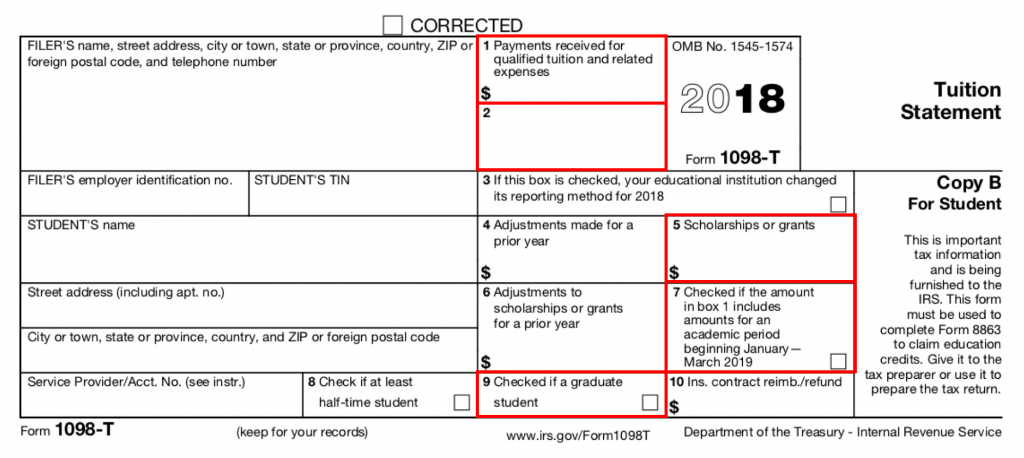
Box 1 Payments Received

This box reflects the amount of money paid on your behalf or by you for tuition and related fees. For example, if your department pays for your tuition, the amount of the tuition will show up in Box 1.

Box 2 Amounts Billed

This box is no longer in use in 2018, but many (most?) universities used it until 2017. Box 2 also reflects tuition and related fees, but it is a sum of the charges billed in the tax year rather than the amounts paid. A bill could be issued in one tax year and not be paid until the subsequent tax year.

Box 5 Scholarships and Grants

This box reflects the scholarships, fellowships, and/or grants received by the student in the tax year. The money that paid your tuition and fees will show up in this box. The fellowship (or other non-compensatory income) that paid your stipend or salary may or may not be included in this box.

Box 7

This box is checked if any bills or payments for a term beginning in January through March of the following tax year were included on the current year’s 1098-T. For example, if your university received payment in December for a term starting in January, this box will be checked.

Box 9

This box is checked if you are a graduate student.

The remainder of this article reviews the problems with the 1098-T and how they can be ameliorated.

Receive Your Tax "Cheat Sheet"

Subscribe to the Personal Finance for PhDs mailing list for essential information to help funded US graduate students (citizens/residents) with their federal tax returns

Success! Now check your email to confirm your subscription.

There was an error submitting your subscription. Please try again.

We won't send you spam. Unsubscribe at any time. Powered by Kit

Problem #1: Academic Year and Calendar Year Misalignment

Box 7 concerns the misalignment between the academic year and the calendar year.

Bills and Payments to Your Student Account

Ideally, the bills and payments for a given term will all show up on the 1098-T for the same calendar year in which the term falls.

Each fall term is like that: you may be billed or make a payment a month or two prior to the start of the term, e,g., in August for a term starting in September, but all the charges and scholarships and payments are done in the same calendar year.

However, for spring terms, you may be billed and perhaps make payments at the end of one calendar year for a term beginning in January to March of the next calendar year. In this case, the 1098-T for the earlier tax year is the one that reflects those expenses, and if a tax benefit is in order, it can be taken in the earlier year.

Historical Billing Practices for the 1098-T

In 2017 and prior, this caused a significant though largely unnoticed problem for funded graduate students (or anyone receiving scholarships): A university could post a bill for a spring term in December of the prior year, for example, and not post the scholarship that paid that bill until the start of the term in the later calendar year. That means that the earlier year would have an excess of expenses in Box 2, while the later year would have an excess of income. If not corrected, this could result in a tax deduction or credit in the earlier year and excess taxable income in the later year.

Imagine a typical fully funded graduate student at a university that had its accounting system set up this way and that used Box 2 on the 1098-T. (This was a common scenario.) In the student’s first calendar year, there would be two semesters of expenses billed but only one semester of scholarships posted. If the student used the numbers from the 1098-T without correction, he would be eligible for a tax break in that first year (or his parents would take it if he were a dependent). Each subsequent calendar year would have an equal number of terms of expenses and scholarships posted, which would probably result in small, not very noticeable discrepancies between the expenses and income. However, in the student’s final year, the system would catch up, and there would be scholarships posted with no corresponding expenses, resulting in excess income and excess tax due. In some cases, the extra tax due could exceed the value of the tax break taken in the earlier year. (Not to mention that if the student were a dependent in that first year his parents would have received the tax break, whereas he has to pay the extra tax himself in the last year.)

The correction that should have been performed throughout these years when a scholarship and the expense the scholarship paid showed up on different years’ 1098-Ts is to match up in the same calendar year the expense billed with the scholarship that paid the expense. Typically, that would mean not using an available tax benefit in an earlier year and preferring to use it in the later year that the income came in. When the expense and the scholarship that pays the expense are used in the same calendar year, the scholarship can be made tax-free using the expense if it is qualified. Specifically, you would report the relevant qualified education expenses in the later year rather than the earlier, meaning that the 1098-T in both years would be inaccurate / need adjustment.

What Changed in 2018?

Starting in 2018, Box 2 has been eliminated. This means that all universities now have to report payments received for tuition and related fees in Box 1. If the university switched its reporting system between 2017 and 2018, Box 3 is checked.

This is a much better system going forward for funded graduate students. It means that when a scholarship is posted to the student account to pay for tuition and related fees, that amount will show up in Box 5 and Box 1 in the same year, since they are the same action. It doesn’t matter if that happens in the same calendar year as the term or an earlier calendar year, because they will always be reported together.

However, this change causes two potential problems in 2018 for students at universities that made this switch.

1) If a charge was billed at the end of 2017 for a term stating in the first three months of 2018 and the bill was paid in 2018, the same expense will show up on both the 2017 and 2018 1098-Ts, first in Box 2 and then in Box 1.

Therefore, anyone receiving a 1098-T with Box 3 checked must determine whether one or more of the expenses summed in Box 1 was already used to take an education tax benefit in 2017. If that is the case, the expense cannot be used again in 2018.

2) This change in accounting systems also may force the unbalancing issue I described earlier for students finishing grad school. 2018 could be the year that there is excess income with no expenses available to offset it (after correction). If this happens, the student can either choose to pay the extra tax in 2018 or file amended returns going into the start of grad school when this problem originated (up to 3 years) to match up all the prior scholarships and expenses properly. This would still result in extra tax paid now, though it may be less than if the problem remained unamended.

The good news is that after catching up in 2018 if necessary, starting in 2019 the 1098-T will be much more straightforward.

Problem #2: Qualified Education Expenses Are Incomplete

The tuition and related fees reported on the 1098-T are not quite synonymous with the “qualified education expenses” you use to take an education tax benefit. In fact, there are different definitions of qualified education expenses depending on which benefit you use. Most likely, the amount listed in Box 1 is the amount of qualified education expenses the student has under the most restrictive definition for the Lifetime Learning Credit or the American Opportunity Tax Credit.

The definition of qualified education expenses for the purpose of making scholarship and fellowship income tax-free is more expansive. It includes certain required fees and expenses that were excluded from the definition of QEEs for the other education tax benefits, such as student health fees and required textbooks purchased from a retailer other than the university.

To find these additional qualified education expenses, check your student account, bank account, and saved receipts. Then, net them against your excess scholarship and fellowship income to make the income tax-free.

Problem #3: Not All Students Receive One

When Box 5 of the 1098-T exceeds Box 1 for a given student, the university does not have to generate a 1098-T. Some universities, as a courtesy, generate 1098-Ts for all students regardless of the Box 5 vs. Box 1 balance. This inconsistency generates confusion among graduate students and leads to the information in the student account being ignored.

Conclusion

It is clear that the 1098-T was not designed with funded graduate students in mind. Ideally, the 1098-T would be completely redesigned or a new form would be created to assist graduate students in preparing their tax returns. Until that happens, the 1098-T is not an independently useful document as it must be considered alongside the transactions inside and outside of the student account. The makeover to eliminate Box 2 was an improvement; at least starting in 2018, the 1098-T is no longer grossly misleading.

Do I Owe Income Tax on My Fellowship?

February 19, 2019 by Emily

Postbac, graduate student, and postdoc fellows frequently ask whether their fellowships are considered taxable income. PhD-type fellowships that are not reported on a W-2 are non-compensatory income. They might be reported on a 1098-T in Box 5, on a 1099-MISC in Box 3, or on a courtesy letter or not reported at all, which accounts for the widespread confusion. Publication 970 answers the question of when a fellowship can be considered tax-free. Fellowships are considered part of the recipient’s taxable income unless they go toward paying qualified education expenses (students only).

Links Mentioned in the Episode

  • Publication 970

income tax fellowship

Transcript

Welcome to the Personal Finance for PhDs Podcast – a higher education in personal finance. I’m your host, Emily Roberts.

I’m doing something a little bit different in this special bonus episode for Season 2.

I’m using it to answer a frequently asked question that I receive about taxes. The question is: Do I owe income tax on my fellowship?

In this episode, I’m speaking to citizens and residents in the United States. And I’m also talking about PhD-type fellowships whether at the postbac level, the graduate student level, or the postdoc level.

What’s going on with these fellowships that makes the recipient question whether or not they are taxable is that they are not reported on a W-2. They might not be reported at all, or they may be reported on a 1098-T in Box 5, on a 1099-MISC in Box 3, or on a courtesy letter, which is not an official tax form but rather just a letter that states what the amount of the fellowship was in that calendar year.

Fellowship income is considered part of your taxable income. Now, you may not actually end up paying tax on your fellowship income depending on the rest of your return, like the deductions and credits you’re going to be able to take, but it is considered part of that taxable income.

Now, I know you’re not inclined to just believe me right off the bat. I mean, there’s a strong incentive for you to believe that your fellowship income is not taxable, so I’m going to give you a bit of evidence here.

IRS Publication 970 is the definitive publication on the taxability of fellowship and scholarship income. I’ll read you a few excerpts from Chapter 1 of Publication 970.

First, some definitions:

A scholarship is generally an amount paid or allowed to, or for the benefit of, a student (whether an undergraduate or a graduate) at an educational institution to aid in the pursuit of his or her studies.

A fellowship grant is generally an amount paid for the benefit of an individual to aid in the pursuit of study or research.

So you can see that fellowship grants are much more broad; they can be issued to non-students, whereas scholarships only go to students.

Chapter 1 of Publication 970 approaches fellowships and scholarships from the perspective of trying to make them tax-free.

So let’s see how that can happen:

A scholarship or fellowship grant is tax free (excludable from gross income) only if you are a candidate for a degree at an eligible educational institution.

So right off the bat we know that anybody who is receiving a fellowship who is not a student cannot make their fellowship tax-free, i.e., it is part of their taxable income.

Additionally:

A scholarship or fellowship grant is tax free only to the extent: It doesn’t exceed your qualified education expenses…

So now we’re just dealing with the graduate student population that has the potential to make a scholarship or fellowship grant tax-free.

The way that we use the terms ‘scholarship’ and ‘fellowship’ in academia, a ‘fellowship’ generally refers to the money that you take home for your living expenses, whereas ‘scholarship’ is the money that goes towards paying your tuition and fees, the qualified education expenses.

Very roughly speaking, your qualified education expenses can make your scholarships tax-free if you’re a fully funded graduate student, but there’s no more qualified education expenses to start making your fellowship income tax-free. Therefore, again, roughly, your fellowship income is included in your taxable income.

So to summarize, fellowship and scholarship income that goes towards paying our qualified education expenses like tuition and fees can be made tax-free, but fellowship and scholarship income that goes towards paying other kinds of expenses like your living expenses can’t be made tax-free.

Now, I’m glossing over some very important details on how you actually calculate your taxable income, so if you want more information about that, please see the tax center on my website, pfforphds.com/tax.

But, there you go, roughly speaking, fellowship income does need to be included in your taxable income, whether you are a postbac, a graduate student, or a postdoc.

Thanks for joining me in this short bonus episode!

Please share this episode on social media and with your peers because this is a message that they need to hear. It’s not a message that they want to hear, but it’s a message that they need to hear to stay on the right side of the IRS.

Show notes for this episode can be found at pfforphds.com/s2be1.

Thanks for joining me today, and I’ll see you in the next episode!

Further reading/viewing:

  • Weird Tax Situations for Fellowship Recipients
  • How Much Tax Will I Owe on My Fellowship Stipend or Salary
  • The Complete Guide to Quarterly Estimated Tax for Fellowship Recipients
  • How to Prepare Your Grad Student Tax Return (Tax Year 2019)
  • Scholarship Taxes and Fellowship Taxes

The First Step to Complete Your Grad Student Tax Return (2018)

January 9, 2019 by Emily

There is one vital step grad students need to take when starting to prepare their tax returns. It’s a super simple step, but most often overlooked, and skipping it can lead to an inaccurate return or even overpaying tax. This is the step that you take before you start feeding any numbers to your 1040, your tax software, or your tax preparer, and it is to find and categorize all of your income sources (funded grad students have at least two!).

If you found this video insightful and you want to take the next step to completing your tax return – including one trick to reduce your tax due that your tax software or tax preparer can easily miss – register for my workshop, “How to Complete Your 2019 PhD Trainee Tax Return (and Understand It, Too!).”

grad student tax return step

A Graduate Student’s Balanced Money Formula

June 18, 2018 by Emily

Grad students frequently wonder how much they should spend on various expenses or even how much they should be saving. The Balanced Money Formula (BMF) answers this question for the average American, but how applicable is it to a grad student’s budget?

Further reading: The Power of Percentage-Based Budgeting for a Career-Building PhD

grad student balanced money formula

A version of this post originally appeared on GradHacker.

What Is the Balanced Money Formula?

The BMF, as defined in All Your Worth: The Ultimate Lifetime Money Plan* by Elizabeth Warren and Amelia Warren Tyagi, is a high-level allocation of your net (after tax) pay to three areas: needs, wants, and savings. The idea is that if you conform to this ratio throughout your life, you will have a great chance of feeling satisfied with your current spending while saving enough for your future. The trap that many people fall into is letting the needs component of their spending take up too much of their income, which crowds out saving and inhibits spending your money in areas that bring you a lot of comfort and satisfaction (your wants).

[* This is an affiliate link. Thank you for supporting PF for PhDs!]

The magic ratio of the BMF is 50% to needs, 30% to wants, and 20% to savings. The definitions of these three categories are a little different than what you might intuitively think. Needs are defined as all expenses that must be paid on a regular basis, such as rent/mortgage, minimum debt payments, insurance, contracts, groceries, transportation, and utilities. Wants are defined as discretionary purchases such as restaurant eating, entertainment, shopping (beyond basics), and travel. Savings is broken up into a few stages and categories. When you have debt other than for your mortgage, savings means accelerated debt repayment (the minimum payments are in the needs category). Once you are out of all debt except your mortgage, the 20% to savings becomes 10% for retirement, 5% for extra mortgage payments, and 5% for your “dream” goal.

Keep in mind that the BMF was not designed for a Millennial audience. I’m particularly concerned about the advice to save only 10% of net income for retirement (and only after you’re out of non-mortgage debt). Millennials will likely only have one-and-a-half legs of the older generations’ three-legged stool available to them – personal retirements savings and a reduced Social Security benefit (no pensions). That personal retirement savings leg is going to be doing most of the heavy lifting, and 10% of net after you’re debt-free probably isn’t going to cut it.

What I think is valuable about the BMF is the emphasis that there is a place for each of needs, wants, and savings throughout your life, the stern warning against letting the needs category inflate, and the suggested 5:3 ratio between spending on needs and wants.

Can and Should Every Graduate Student’s Financial Management Conform to the BMF?

Absolutely not.

1. The BMF may be right for a lot of people, but ultimately it is just an opinion. You can create your own BMF with a different ideal ratio among needs, wants, and savings that works best for your life. The point is to find a ratio that keeps you on track to accomplish your financial goals without feeling too restricted.

2. Even if you do agree with the BMF, All Your Worth acknowledges that an individual might not stick to the BMF during special life circumstances. Living on a low stipend for a limited period of time while you’re receiving training can qualify as special life circumstances if you need it to. You can find another ratio to keep during grad school and set up your post-grad life to fit the BMF.

Given these caveats, the BMF is still a good starting point for planning how to allocate your stipend pay.

How Can a Graduate Student Create a Balanced Money Formula for Herself?

First, categorize your spending according to the BMF’s needs/wants/savings definition and see how it compares to the suggested 50:30:20 ratio. When I did this during grad school, I was pleasantly surprised that my financial allocation aligned within 1% of the BMF (though my full 20% to savings was going into retirement savings). This told me that my gut feeling that my spending and saving was in balance and sustainable was probably correct.

The danger for graduate students is the same as for the population at large: the needs category ballooning and edging out what makes your life stable (savings) and fun (wants). Even for graduate students, the percentage of your post-tax income that is spent on needs rising above 50% should give you pause and compel you to consider ways to reduce your spending. You may not get it under 50%, but the better you do with minimizing that category the more ‘in balance’ you will probably feel.

In some high cost-of-living areas, close to 50% of a graduate student’s stipend might be spent on rent alone and of course in those cases the BMF cannot be achieved. But if you are over 50%, you should be doing as much as you reasonably can to minimize that category of expenses overall. For example, perhaps your rent is high, but you live with a roommate to get it as low as possible, and the location allows you to live car-free, which minimizes your overall needs spending. Consider capping the percentage of your pay that you are willing to spend on needs at your absolutely maximum (e.g., 70%) to trigger yourself to reduce one of your large fixed expenses, even if it requires moving, should your needs ever rise to that level.

Join the Mailing List to Download Frugal Tips for PhDs-in-Training

The download includes 30+ frugal tips for PhDs-in-Training with links to video and additional written content.

You'll receive 1-2 emails per week to help you make the most of your money during your PhD training.

Success! Now check your email to confirm your subscription.

There was an error submitting your subscription. Please try again.

We won't send you spam. Unsubscribe at any time. Powered by Kit

Some graduate students with more generous stipends and/or a manageable cost of living may spend significantly less than 50% of their stipends on needs. In the case, the best course of action is not to intentionally spend more on needs (though you have the leeway if you would like to), but rather to increase the amount you save and/or spend on wants.

If you have asked yourself if you are spending a reasonable amount of money on your wants and needs and saving enough, the BMF is a great formula to use as a starting point for your budget. However, over time you will likely want to adapt how you allocate your money to best match your values and goals.

Savings in Graduate School

If you want and are able to follow the BMF, the 20% of your money that is saved during graduate school could go toward building an emergency fund, investing for the future, and/or paying down debt. You should start with at least a baby emergency fund of $1,000, if not a few months of expenses. According to All Your Worth, your next step should be to pay off all non-mortgage debt, but if (some of) your debt is at a low interest rate and doesn’t bother you, investing for retirement is a great choice as well. Let both the math of the situation (interest rates on debt vs. expected rates of return on investments) as well as your personal disposition toward the options lead you to the correct choice in your life.

While I am a proponent of adding money each month to targeted savings accounts to help you pay for irregular expenses, I think this type of saving should come from your needs or wants categories. Saving with respect to the BMF should be only for mid- or long-term goals, whereas saving for irregular expenses is a short-term goal.

It is enormously worthwhile to start building the habit of saving during graduate school, even if you can’t reach the 20% target from the BMF. Applying compound interest in the form of investing or debt repayment to even a small percentage of your pay is amazingly powerful.

Free Email Course: Investing for Early-Career PhDs

Sign up for the mailing list to receive the free 10,000-word email course designed for graduate students, postdocs, and PhDs in their first Real Jobs.

Success! Now check your email to confirm your subscription.

There was an error submitting your subscription. Please try again.

We won't send you spam. Unsubscribe at any time. Powered by Kit

For Stipends that Are Just Too Low

Not having room for needs, wants, and savings to some degree in your grad student budget is an indicator that your pay is too low or your spending is askew. If you are earning too little from your role as a graduate student, your options are to develop a side income or take out student loans. You must carefully weigh the consequences of your choices. Student loans will hold you back from building wealth post-grad school. A side income might benefit you if it furthers your career goals, or it might distract from your degree progress, which should be your top priority.

Increase Your Income

Join the mailing list to receive our 7-part video series, "How to Increase Your Income as a Graduate Student," including side hustles and passive income.

Success! Now check your email to confirm your subscription.

There was an error submitting your subscription. Please try again.

We won't send you spam. Unsubscribe at any time. Powered by Kit

What percentages of your net pay do you spend on needs, wants, and savings? Have you ever successfully reduced the amount of money you were spending on needs?

  • « Go to Previous Page
  • Go to page 1
  • Go to page 2
  • Go to page 3
  • Go to page 4
  • Go to Next Page »

Footer

Sign Up for More Awesome Content

I'll send you my 2,500-word "Five Ways to Improve Your Finances TODAY as a Graduate Student or Postdoc."

Success! Now check your email to confirm your subscription.

There was an error submitting your subscription. Please try again.

We won't send you spam. Unsubscribe at any time. Powered by Kit

Copyright © 2025 · Atmosphere Pro on Genesis Framework · WordPress · Log in

  • About Emily Roberts
  • Disclaimer
  • Privacy Policy
  • Contact