• Skip to main content
  • Skip to footer

Personal Finance for PhDs

Live a financially balanced life - no Real Job required

  • Blog
  • Podcast
  • Tax Center
  • PhD Home Loans
  • Work with Emily
  • About Emily Roberts

side income

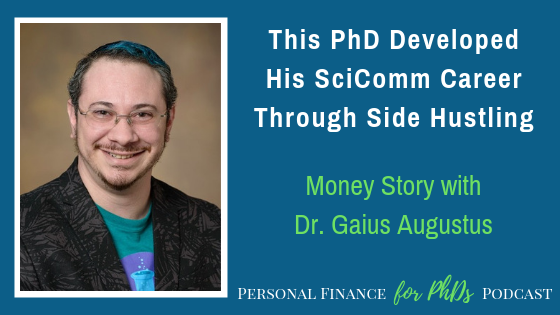
This PhD Developed His SciComm Career Through Side Hustling

July 29, 2019 by Emily

In this episode, Emily interviews Dr. Gaius Augustus, a PhD in cancer biology and habitual side hustler. Gaius combines his artistic talent and knowledge of science to communicate science visually and teaches others to do the same. Within Emily’s framework of side hustles, Gaius details the half-dozen side hustles he pursued during graduate school and how they have contributed to his personal and professional development. He has now turned one of his grad school side hustles into a full-fledged side business in his post-PhD life. In this discussion, Gaius shares his hard-win insights into time management, self-advocacy, and imposter syndrome. This episode is a must-listen for anyone looking to advance her career through side hustling, networking, or volunteering.

Links Mentioned in the Episode

  • Financially Navigating Your Upcoming PhD Career Transition
  • Gaius’s Website (gaiusjaugustus.com)
  • The Indigo Path
  • The Complete Guide to a Side Hustle for a PhD Student or Postdoc
  • Smart Passive Income

science communication side hustle

Teaser

00:00 Gaius: When I started doing this I just went to the office and said, look, I need extra money and this is the way that I’ve found to make extra money and I’m still going to get my work done and I expect you to hold me to that, but this is something I have to do.

Introduction

00:23 Emily: Welcome to the Personal Finance for PhDs podcast, a higher education in personal finance. I’m your host, Emily Roberts. This is season three, episode 10 and today my guest is Dr. Gaius Augustus, a PhD in cancer biology, artist and side hustler. During grad school, Gaius pursued half a dozen different side hustles, which contributed to his personal and professional development as well as financial bottom line. In what is now his side business, he combines his love of science and his artistic talent and training to communicate science visually through figures, graphical abstracts, infographics and more and teaches others to do the same. In this discussion, Gaius shares his hard-won insights into time management, self advocacy, and imposter syndrome. Without further ado, here’s my interview with Dr. Gaius Augustus.

Will You Please Introduce Yourself Further?

01:15 Emily: My guest on the podcast today is Dr. Gaius Augustus, and he’s going to be talking to us about his history with side hustling and how that’s actually turned into a side business, which is very exciting. Gaius, will you please introduce yourself a little bit further? Let us know more about who you are.

01:34 Gaius: Sure. Thank you so much for having me, Emily. I actually have a kind of interesting past. I have my PhD in cancer biology, but I actually started out as an artist and in high school. I went to a fine arts high school, I loved the arts, and I actually got really into comic making and video production. When I left high school, I actually went for film and television at a fine arts university. I ended up leaving that because the culture wasn’t quite right. I went into retail and worked retail for about five years. While I was working retail, I got some experience in the pharmacy. I was like, oh, this is pretty cool, I could make a living as a pharmacist. And I was really kind of missing the science part of my life.

02:25 Gaius: And so I decided to go back to school for pharmacy and joined a lab and just fell in love with the scientific process. I got my bachelor’s in 2014 in integrative studies, which is a kind of design your own degree program where you can mix from different disciplines. I mixed biology, chemistry and a little bit of psychology. Then I went straight into a PhD program at the Arizona Biological and Biomedical Sciences Program at University of Arizona, which is an umbrella program, again so that I could choose a program within that. Then I joined the cancer biology program in 2015. I literally, two weeks ago, April 2019, defended my PhD, and now I am trying to figure out what to do with the rest of my life.

03:26 Emily: Yeah! Fantastic. I love to hear that non-traditional route to the PhD. It’s definitely going to inform the rest of our conversation today.

Why Did You Side Hustle During Your PhD?

Emily: Throughout your progress through the PhD and maybe even before that you have been a side hustler, habitual side hustler. Why did you start side hustling during your PhD?

03:51 Gaius: I want to say that when I was an artist, I took science classes for fun in high school and everyone thought I was crazy. Again, I was at a fine arts high school. When I went back to school for science, I thought, okay, this is it, right? I’ve always missed the science. Here it is. But then as I got into science more, I realized I really missed the art. And I never really thought there was a way to balance that. I thought, okay, well these are just two separate things that I have to do. During my PhD I started thinking, okay, is there a way to mix this? So I started with just like making comics where I anthropomorphize science topics and wrote those comics and never really to share, just to have them.

04:39 Gaius: As I started going on and people started being interested in those types of things, I started thinking this is pretty cool that people are interested, but I never really thought about making money with it. So along the same time, my partner, who is not in grad school or a scientist and is an artist who has been making money in our new city as an artist, was thinking about how we can make a little bit of extra money besides just what I make for my grad school stipend and something that was a little different than them having to go get a traditional job.

05:18 Gaius: We actually started our first big side hustle, which was starting a kind of art, crafty sort of side our business, which I’ll talk about a little bit more later. Along with that, when I started talking to people about that, people were really interested in that, and they were very interested in the fact that I had been an artist. As I got interested in science communication about two years ago, the people that I was talking to about that were also like, hey, you can also do this cool artsy stuff. How can we fit that in? I started by just doing infographics, and I wanted to learn animation for fun. So I just was like, if I can figure out animation in time for whatever your deadline is, then let’s do that.

06:06 Gaius: I was actually hired by the University of Arizona Cancer Center to create infographics and animations when I could. Animations weren’t difficult because I had some experience in the past with it. It wasn’t as difficult as I thought it would be to get back into that. From there, people just start hearing about it. The more people heard about it, the more people were interested in it. So I was like, I guess I can make money doing this. That would be really awesome because I could do both art and science and learn about lots of cool science. That’s really what motivated me to start. Just knowing that there’s a possibility to make money was like the original thought, but then learning that I could do something I really loved and make money doing, it was a really big reason for me to push a little bit harder.

06:59 Emily: I really love that story. I’m so happy we’re going to go even more in depth with it in a moment. Because it seems so organic. You weren’t simply out to make extra money, although that’s a very welcome side benefit and maybe an important benefit. But it was just, what do you want to spend your time doing? Where are your interests leading you? Also you’re kind of responding to the market, right? Like you were, I’m putting some things out there, oh, and people are responding and it leads me over in this direction and then it leads me over here. I’m excited to hear even more about that.

07:38 Gaius: Something I find really interesting is I remember in my undergrad talking to one of my advisors. He always talked about how intentional his path was. I was always really jealous of how intentional everything he had done and all the types of things he had tried in order to reach where he was at that point. I still think about it all the time, that he was always saying making intentional choices to get to where you are. My life has been the complete opposite. It’s just been chaos. It’s more been like, what opportunities are available? Let’s take it, let’s move on to the next one. But still, if you allow yourself to not think of those things that you’ve done as mistakes and instead think of them as intentional choices that you made that have led you to this path, I think it’s really a good way to get yourself into new opportunities and use everything that you’ve done in your path to inform what you do with your life right now.

08:41 Emily: Yeah, you’re using the word intentional, which is like, everyone can get behind that. Like of course you want to make choices that are well considered, but I think what your professor was saying was more like a linear path, right? Like, like straightforward and efficient.

09:01 Gaius: And forward-thinking. I think he was thinking, okay, 20 years in the future, this is where I want to be, I think that was more what he thought he was saying. Whereas I think like you were about to say, you just want to make choices that you are intentional about in that moment. You mean to make the choice that you make with whatever hardships you have right now or whenever you’re dealing with right now, you make what choices you can and go forward with those.

09:29 Emily: Yeah, absolutely. Not that your professor’s path was a bad one if he’s happy with the outcome of course. But there are plenty of people who set out on a path and keep at it for decades and aren’t happy with the outcome even though they were very intentional and they were very efficient. That definitely depends more on your personality. It’s about knowing yourself really. I’m so happy to hear about your journey as a counterpoint to that.

Side Hustling Framework for PhDs

Emily: You already mentioned a couple different side hustles that you’ve had going on and also were starting to say how that’s led your current business. I have this framework that I like to use when I talk about side hustling, which is that side hustles, let’s say for a grad student, can fall into one of four categories or maybe even multiple of four categories.

10:19 Emily: The first is what I call “career-advancing.” So a side hustle, and again, these all make money in some capacity or another, but it’s letting you explore a new career area or maybe it’s expanding your network or maybe it’s demonstrating skills or learning new skills. Something that we think is going to advance your career. That doesn’t have to be your scientific career. It could just be whatever else you want to do. So there’s that. The second one is an enjoyable hobby that you happen to be able to monetize. It’s something you enjoy doing, not even necessarily a hobby, but just an activity that you enjoy that you happen to be able to monetize. The third category is that you don’t enjoy this activity at all, but it does pay you.

11:04 Emily: So I’m thinking this is like, well, you mentioned working retail earlier. I don’t know if that’s your passion. It doesn’t sound like it ended up being the route you went, but that’s also something a lot of grad students do just for extra income and I doubt it’s very career-advancing or enjoyable. The last one is passive income, which may be a little bit unfamiliar to people who are not in the entrepreneurial space. Basically in those first three paradigms, I’m assuming that you’re trading your time for money more or less directly. With passive income, it’s more about investing a lot of time, money, energy, or creativity to create a product that then sells over time. The very classic example is of an author. You write a book, and then the book sells. Over time you get those royalties. This is complicated a little bit with advances and we won’t go into that, but that’s kind of the idea. You put a lot of time and energy into something and then you sell it over time. So thinking about that framework, which we’ll link from the show notes: Put the side hustles that you’ve had into those different buckets, if you would.

12:11 Gaius: Yeah, sounds good. I thought about this from, should I talk about each one individually or should I talk about the framework? I think that the framework is so well designed or so well thought out that I’m just going to talk about it from the framework side.

Career-Advancing

Gaius: When I think about career-advancing, I’m thinking about networking. Like you said, it doesn’t have to be scientific, but it can be about growing your network and people who can help you find jobs in the future. So, like I said, I worked for the University of Arizona Cancer Center. I made infographics and animations and did some writing for them as well. That was definitely career advancing. I met so many people through that. I actually did six months of work for them volunteer, so I wasn’t getting paid at all. And then I did six months where I was getting paid, but that was a great career-advancer as far as meeting everyone at the university and people who potentially I could work for in the future.

13:20 Emily: I actually have a follow up question on that one because that sounded fantastic from the first time you brought it up. I was so excited about it. How did you get into that position? It sounds like it started with volunteering, but how did you initiate that volunteer relationship?

13:36 Gaius: One of the hardest things I think all of us have to do as graduate students is promote ourselves. Right? You have to promote yourself when you learn to write grants, you have to promote yourself when you tell your PI about your cool new experiment that you want to try that costs a lot more money than your PI maybe thinks it’s worth. I actually was helping with website design. I used to do freelance web design on the side of working retail. Like you said, I’m a longtime side hustler. So I was helping my department with redesigning their website and in order to get a better idea of what they needed, they pulled in the PR person from the Cancer Center. We just were having conversations because I show up to meetings on time and he shows up to meetings on time and academics don’t.
14:28 Gaius: We were just having conversations before all of our meetings, and I mentioned that I was looking into science communication. Finally one day he was just like, you should come work with us. I’m not sure I have a budget, but I really like what you’re saying. So it was totally me just talking about things I liked and being willing to talk about myself and what I do and what I think I do well and someone being willing to say, okay, well I want to take a chance on you and give you more experience and get a volunteer to help me out to get that opportunity.

15:09 Emily: It’s very clear from that story that this was about networking. You volunteered your skills at the small circle of your initial network, which was your department, and that led you to a slightly wider network and more opportunities there. That sounds amazing. This is a bit more of a financial or technical question, but I’m just curious about how being hired by the cancer center, the PR wing, played with your stipend. Was that in addition to it? Was that all kosher at the university level? Were you hired as an independent contractor? What were all the details there?

15:46 Gaius: At the time I was on an NIH training grant. There were a lot of discussions between the department and the Cancer Center about how that was going to work. Apparently they looked into the fellowship and made sure that there was no language saying I couldn’t get paid. Then what they did was they just said, okay, well we can only pay you up to a certain number of hours because you’re a student worker. What this person did was just found the best offer he could as far as an hourly pay where I could kind of maximize my income under the guidelines that were currently there. He was a really big advocate for me and I really appreciate that. But there was definitely some arguments and conversations that had to happen between the university and the cancer center and my department.

16:44 Emily: Clearly. In addition to just the pay issue, which it sounds like that’s a very specific solution for the training grant you were on and so forth. How did your advisor feel about you…? Because a lot of people keep their side hustles quiet, right? They don’t let their advisor or other people know about it. But clearly your advisor must have known about this from the beginning or early on. How did that go over?

17:08 Gaius: This is going to go back to kind of self advocacy again. I worked in retail for five years, and in retail there is no self-advocacy. You do what you’re told, and if you don’t, anyone could have your job or at least that’s what they tell you even when it’s not true. I’d had some really, really horrible bosses and really horrible experiences in retail. When I started back in school, one of my goals was never to be treated like that again. When I got into grad school and started thinking about doing on the side… Sadly it was never a question of is my PI going to be okay with this. When I chose a PI, I was very straightforward and saying I’m kind of going to do what I want to do and I need your support and how do you feel about that?

18:05 Gaius: And he was like, you know, I want to do what’s best for you and your career, and I will work with you. Wo when I started doing this, I just went to the office and said, look, I need extra money and this is the way that I’ve found to make extra money and I’m still going to get my work done. I expect you to hold me to that, but this is something I have to do. He was very worried about me and very worried about whether I was going to be able to keep doing it, but he supported me and never questioned it. He just made a couple of like side glances, but then it was just like, do what you got to do.

18:46 Emily: Yeah. You finished in five years it sounds like. So this didn’t end up tacking on any extra time at minimum. This is a great tip for anyone who has not yet chosen an advisor: to find someone who is going to be supportive of your career broadly defined – however you want to define your career. That person should be supportive, or if they’re not, know that early on and don’t work with them unless you’re 100% on the tenure track. I’m really glad that you described like your relationship with that person and how that worked out. That was so much detail, but that was such an exciting side hustle.

Emily: What’s the next one on your list?

19:24 Gaius: One thing that I’ve been doing a lot over just the past like six months is a lot of freelance sci art. I’ve been doing infographics, graphical abstracts, animations for scientists, for departments. That’s been extremely fun, but it’s also been a great networking experience. A lot of the time, I work with someone and then someone who they know is like, oh, this person told me that you are great to work with, I would like to work with you too. As far as career-advancing steps, the sci art, freelance, and I’ve done a little bit of writing as well has really helped with getting that networking done and also giving me the confidence that I needed to say people do enjoy my work. Also, they’re not just hiring me because they like me because strangers are hiring me. Those have been my big career-advancing hustles.

20:21 Emily: Yeah, that sounds like so much fun as you just said. If people want to see your work, where’s the best place to go?

20:28 Gaius: All of my work is available on my website, which is gaiusjaugustus.com, which I hope you’ll put in the notes since it’s not always the easiest to spell. If you also search Gaius Divi Filius on Twitter, you can see me and get to my website. I’m on Instagram as Process of InQUEERy with inquiry spelled with “queer” in the middle. I am on Facebook with Process of Inqueery as well.

20:55 Emily: I wanted to put that in the middle of the episode instead of just at the end so that people can go and look at your stuff as they’re continuing to listen to this conversation. I would imagine that just by the nature of what you did with that particular side hustle of it being art, it sounds like it’s incredibly shareable. You chose something where networking is easy. If you do a great job, people are going to ask who’s behind that work.

21:17 Gaius: It’s interesting you say that because I’ve never thought about that before. I’m a very visual person. I struggled to learn science because it was reading the books and reading articles and I do so much better when I started reframing it as look at the results and then try and frame your scientific ideas around the results and then read the articles and see if they agree with you. Same with learning science, go and look at the pictures in the chapter, try and figure out what they mean and then read the text and make sure I’m getting on the right track. I’ve just always been that kind of visual person. I’m drawing, in class, ideas out since I was little. So it’s interesting. I hadn’t really thought about the fact that people just see it and it automatically gives a good networking side of things.

22:09 Emily: Yeah. You’re much more in touch with the sci comm community than I am. But when I think of science communication, I initially think about the written word. I don’t go to to video or to art or anything, but maybe it’s a bigger component of it that I realize. Anyway, I just think it’s a really wonderful way of communicating that may be undertapped at this point.

22:35 Gaius: I agree completely. I think you hit the nail on the head about how most people feel about sci comm.

Commercial

22:43 Emily: This summer. I’m putting forth extra support for PhDs undergoing career transitions into grad school, a post doc or a real job. If you’re moving onto the next stage in your career or thinking about it, please visit pfforphds.com/next to check out my articles, webinars and coaching program. Allow me to come alongside you during this transition to ensure that you set yourself up for financial success.

Enjoyable Activity or Hobby

23:13 Emily: What’s the next side hustle? Any monetized hobbies?

23:18 Gaius: On the enjoyable category, one of the big ones is the side hustle that I started initially with my partner. We’re pagan and we love making stuff. As we were making things for us, we just decided to bring that to a broader audience. We actually make resin jewelry. We make pagan goods, things that maybe you would find in your house or things you might want to wear out to just kind of show off pagan pride as well as just things that everyone uses but instead of looking at it from just a regular angle, we say how would we look at this from a pagan angle? Recently my partner made plushes and instead of an animal or something, they made crystal balls.

24:12 Gaius: So stuff like that. We make a lot of the resin jewelry, but we’re also kind of pushing that a little bit further now into other things like plushes and shirts and things like that. That’s all through theindigopath.com, which if you go to is not anything yet. We took down our shop to do a bunch of conventions and things like that and we’re rebuilding it to put up our new branding and things like that. But that’s been something that’s just been pure enjoyment. It’s paying for itself, but that’s about it at this point.

24:47 Emily: Yeah. I love that you found something that you could do with your partner. Just something fun that’s a bonding experience or a fun project to work on together. I’m sure that it has relational benefits as well as the potential monetary benefits and just something enjoyable to do with your time. Although it does not sound like you are hard pressed for things to do with your time! Plenty going on already. What’s next in your list?

It Pays But It’s Not Enjoyable

25:10 Gaius: The next is the “it pays, but I don’t necessarily enjoy it.” The big one for me is web design. I do love web design, but I don’t necessarily like doing web design for other people. I love playing around with it for myself. I’ve been doing it for years and like I said I used to do it freelance. It pays the bills. When people want or need help with their website, I can get people up and running quickly. I can do trainings so that people can understand it. I was also a cheap sell for my department to be able to redo their website for very, very low pay. That’s probably my best example of something that pays, but it’s not necessarily the thing that I want to be doing with the rest of my life.

25:59 Emily: Yeah. Well it sounds like you should increase your rates on that. Do less of it, but get more out of what you do.

26:06 Gaius: Yes. You’re probably right.

Passive Income

26:07 Emily: Anything else in that category or should we move on to the passive one?

26:14 Gaius: Oh, let’s move on to the passive, which I’m really excited about, but also very skeptical about because I know that there is a lot of talk in my blogs about whether you should do passive income or whether you should wait until you have a following to do passive income. I’ll just tell you what I do. One thing that I do is I write blog articles for my website. I actually started doing that because I was part of the Grad Blogger Connect Group on Facebook led by Chris Coney, and I just decided to start this blog. It was the first thing I ever did to do any science communication, before I worked for the cancer center or anything. I just put ads in there, and I think I have like a $1.20 in my ads account. So it’s never really made me anything but it’s there. But because I’ve written the blog articles, those will continue to be there and when my site blows up in the near future and people are reading those articles a lot, those ads hopefully will make some income at some point.

27:21 Emily: Is this the same website that you mentioned earlier?

27:23 Gaius: Yes, it is the same website.

27:25 Emily: Okay, great. Glad to hear it’s all integrated together.

27:29 Gaius: Yeah, that was something I really wanted, but it’s very difficult to do the more side hustles you try. You have to figure out how to get all that branding to work together. The other thing actually, which is also on the same website, is I have a shop of just designs on T-shirts and pillows and things like that. I knew I wanted to do that because I love making up T-shirt designs. As part of The Indigo Path, we constantly are buying iron-on stuff to make designs. The shop doesn’t use my iron-ons, they are actually professionally printed. But I do like the idea of having a totally customized wardrobe. The shop has a lot of cool science-y themed designs. This is passive. I make the designs, I put them up in the shop. If somebody likes it, they buy it. It doesn’t matter if it’s a week from now or a year from now, I’ll still get hopefully about the same cut on that. I put in that up-front work. Whatever money I make down the road comes from the initial work that I put into making those designs.

28:44 Emily: Yeah. I don’t know if I told you this, but that shop was the reason that I invited you on the podcast. I saw that as a potentially passive income stream and I was like, alright, I need to talk to this guy.

29:01 Gaius: The shop feels to me like the dark secret of my website, because even though it’s up front, I don’t really advertise it that much. Bbut I just love making designs and putting them on stuff. Especially all over prints, which I don’t actually have that many of on the site, but I am obsessed with all over prints. So I make them, I put them up there and I don’t promote it but I think that it’s really cool and it’s probably one of the favorite things that I do.

29:34 Emily: Yeah. Like you said earlier, there’s talk about when to introduce potentially passive streams of income and so forth to your business, but it just sounds like the perfect medley of some of the other things we’ve talked about. It uses your unique skills and your unique subject area interests. It’s just something that you enjoy doing and you threw up the end result online. If people want to come and find it, cool. I think what’s interesting about passive income though, especially when we’re talking about web-based businesses, is that it’s not really ever truly passive. If no one came to your site, if you weren’t driving traffic to your site from other means, then no one would ever find it and no one would ever buy it. It’s really not truly passive because you have to still be active online and somehow trying to get traffic to your site, such as by doing podcast interviews! But anyway, your time is decoupled from what money you make from it. So that’s what makes it passive.

30:33 Gaius: Definitely. And I will say that if you put your work up on other websites, it can be more passive. Etsy is that if you get your hashtags right, so there’s some up front work as usual, but if you get your hashtags right, you really figure out the game on Etsy, you can do pretty passive income. As soon as you move into a realm where like you said, you have to drive traffic, then it becomes less passive. But it’s still way more passive than a lot of the work that I do. If you’re already creating things, in some ways there’s no drawback. If I’m already creating these designs to put on T-shirts for myself, at some point there’s no drawback to just putting it up for other people to have as well.

31:24 Gaius: That’s in my mind the great time to do passive income if you don’t have a lot of following, is to do things like you said, that you already enjoy and you’re already doing. I caution people when they’re like, I’m going to build this entire course and do all these things into it. It’s been a year developing it and I don’t even know whether people are going to sign up for it. No one knows who I am. That’s when it’s like, well if you really love designing courses and you’re really passionate about this, then that’s great. But as far as passive income is concerned, that year of work may take a lot longer to come back to you.

32:04 Emily: Yeah. If anyone in the audience is interested in passive income and you haven’t yet heard of Pat Flynn, please go check him out right now. His brand is Smart Passive Income. This story just reminded me of his origin story. He was an architect and studying for some kind of licensing exam. As he was studying, he created a study guide, and when he was done and he passed the exam, he put the study guide up online for sale. It sold like gangbusters, apparently surprising everyone, including him. That was the start of his passive income empire. As you were just saying, if you can put in 5 or 10% more work and make something that you’ve already created for yourself something that other people could use, why not go ahead and just see what happens. You haven’t invested any time that you wouldn’t have otherwise. There’s really no downside there.

Benefits and Detriments of Side Hustling During Grad School

Emily: I want to speed through the next set of questions, which is, what are the general benefits that you’ve experienced by side hustling during graduate school and the downsides or the detriments? Anything that we haven’t already covered?

33:10 Gaius: I think the biggest upside is just having that creative outlet. I also think for other people the greatest benefit is being able to try things out before you decide to switch careers, if that’s what you’re thinking. I’m thinking of leaving academia, and as soon as I started thinking about leaving academia, I was like, oh my God, if I don’t do academia, what do I do? Do I have to go back to retail? That was a big enough push to try out other things and see what happens and to see if building this kind of business model is possible. The downsides really are the commitment that you have less free time. I feel like I’m always working and have to schedule off time to say, okay, I’m really going to go do other things. It can slowly take over. It can become really fun and a good excuse to not do schoolwork. I know people already have problems with procrastination. So you do have to be very intentional about how you do it, and it does have the possibility of growing out of control. You really have to think hard about what you’re doing, when you’re doing it, and how much.

34:25 Emily: Yeah, that’s a great point. It’s actually something that I experienced during graduate school. I wouldn’t call the blog that I had at that time necessarily a side hustle, but it was certainly a time intensive hobby that brought in money a little bit. I was not very thoughtful at the time about why I was spending so much time on my blog instead of doing my work. It turns out finance is much more of a passion for me than my specific research area, no surprise now, but it was at the time. As you just said, be really thoughtful and be balanced, because financially having a side hustle can help you a lot with your cash flow during grad school. What’s not going to help you is delaying your graduation and delaying getting a full time job or launching a full time business or whatever the next thing is for you.

35:19 Gaius: I actually purposefully delayed writing my dissertation until the latest I could. I could’ve graduated probably nine months earlier, but I just kept pushing it because I knew that I would have that income and I was like, well at least I know I have income and so I’ll just keep pushing it until I can’t push it anymore. That was not smart.

35:43 Emily: I see what you’re saying because you were, as you just mentioned, thinking, do I have to go back to retail if I don’t have another job lined up? So certainly that’s a reasonable thing to be afraid of. I don’t want to graduate before I have something lined up. That’s a total thing that people might delay for that reason. But as you were exploring those other options, you are actively working on it, you weren’t just work like, oh no, I’m afraid to graduate and I’m not making any progress in actually getting to a point where I want to graduate, therefore I’m going to delay. It’s an understandable path.

Emily: Now, as I understand, you’ve just defended and you’re looking for a full time job, but you’re also now developing a side business, which is weaving together some of the different things that we’ve talked about so far. Can you talk about a little bit of the mindset shift from going from I’m a PhD student first and a side hustler second to now I’m starting a business.

36:44 Gaius: For me it was less of a change as far as I’m a PhD student to I’m a business owner and more of a shift in thinking about how other people saw me. So seeing people be like, oh Gaius draws cool stuff. This is really neat. Can you draw something for me? Going from that to wow, your work is really amazing. I would love to pay you to do it. That was a really huge jump for me. Like I said, I started out in art school, I took my first art classes like in eighth grade to start on my art career. I was always going through this thinking I’m never going to be good enough, and this is the first time that I ever thought, I am good enough to make art my living. I think having that kind of self confidence was really the big shift for me. The business side, because I’d been doing these other side hustles like The Indigo Path, it wasn’t really that hard for me, but just understanding that people appreciated me and that I was worth it and I was talented enough. That was a huge hurdle for me.

38:05 Emily: Yeah. Sounds like imposter syndrome, something we are so familiar with.

38:09 Gaius: I don’t know what you’re talking about!

38:11 Emily: It can definitely crop up in other areas besides your PhD work. That goes back to the self-advocacy theme from earlier. It’s just a different application of it. I’m really glad to hear that you’re progressing on that front and defeating your gremlins.

Last Advice for a Grad Student Side Hustler

Emily: In the last minute or so we have here, do you have any advice for another graduate student pursuing side hustling, interested in pursuing side hustling, that we haven’t already covered? We have covered so much. But did you have anything else you want to throw in there?

38:44 Gaius: No. The main thing I want to stress over and over again is that you have to balance your time. I highly suggest anyone who’s in grad school to have some kind of side passion. It doesn’t have to make you money, though it’s great if it does. Really think about how much time you’re spending, why are you doing it, why are you continuing in your PhD or grad program or whatever, and make sure that all of those things are happening in the right amount of time and the right doses as well as for the right reasons. Because the ultimate goal is for you to find a balance that makes you happy, not for any other reason. As long as you’re happy and reducing your stress overall and not just delaying your stress, I think you’re in the right place, but that balance is really important.

39:39 Emily: Oh yeah. Thank you so much for emphasizing that. Thank you so much for being my guest today.

39:44 Gaius: Thank you for having me.

Outtro

39:46 Emily: Listeners, I’m so glad you joined us for today’s episode pfforphds.com/podcast is the hub for the Personal Finance for PhDs podcast. There you can find links to all the episode show notes, a form to volunteer to be interviewed, a survey, and a way to join the mailing list. I’d love for you to check it out and get more involved. See you in the next episode! The music is stages of awakening by Paddington bear from the free music archive and is shared under CC by NC. Podcast editing and show notes creation by Jewel Lipps.

How to Successfully Plan for Retirement Before and After Obtaining Your PhD

April 8, 2019 by Jewel Lipps

In this episode, Emily interviews Dr. Brandon Renfro, a finance professor and financial advisor. Brandon shares the tortuous path that led him to his current faculty position at East Texas Baptist University and side business in retirement advising. They discuss the long-term financial effects of doing a PhD – both positive and negative – and how to have a successful retirement even if you can’t save (much) during your PhD training.

Links mentioned in episode

  • Tax Center for PhDs-in-Training
  • Volunteer as a Guest for the Podcast 
  • Brandon Renfro, PhD, Retirement Planning and Wealth Management

PhD plan for retirement

0:00 Introduction

1:05 Please Introduce Yourself

Dr. Brandon Renfro has a PhD in Finance. He is both an academic and a practitioner. He advises retirement advising for individuals. He does financial planning while being a tenure track professor.

2:02 What was your career trajectory?

Brandon says that he “walked backwards” or stumbled into his PhD. As an undergraduate, he planned to go to law school. He was advised to major in business in preparation for law school. He took an American enterprise course and saw a presentation about the time value of money in the retirement planning context. This presentation inspired him, so he majored in finance and loved it. He went to law school but says he crashed and burned. He was in the military and had GI bill benefits. He decided to use his GI bill benefits for an Master of Business Administration (MBA). He asked his MBA advisor about adjunct teaching. He had to have 18 graduate hours in the discipline to teach a course. He discovered he loved teaching. He decided he wanted to teach full time. He feels fortunate that he got a tenure track position at a liberal arts college in Louisiana, where he worked for three semesters. Now he is in his third semester at East Texas Baptist.

Emily points out that Brandon tried stuff and saw what stuck. Brandon agrees that this is important to explain to students today. He says many students set a goal and stick to it no matter what, even if the path isn’t right for them. He says there is a time when you should recognize if you don’t love what you’re doing and you should try something different. Brandon says he would tell his 18 year old self to major in finance, but at the time it didn’t occur to him.

Emily asks how Brandon handled the sunk costs of going to law school. Brandon clarifies that he didn’t meet the GPA requirements to continue law school but he wasn’t sad about it. He says he was miserable in law school. He had taken out loans to pay for the year in law school. He says it was $20,000 that he spent to learn that he didn’t want to be an attorney. He says if he looks at it like it’s money he spent to learn that he loves being a finance professor, it was worth it.

7:47 Given that a person has decided to do a PhD and maybe a postdoc, what are the effects of their financial outlook?

Emily starts by explaining that graduate students, postdocs, and early career PhDs have a lot of anxiety around saving for retirement. Most of these people are in their 20s or 30s and they know they are supposed to be investing for retirement. But planning for retirement feels overwhelming in the context of their competing financial demands, like student loan payments or saving for a house down payment, coupled with their suppressed income for an extended period of time.

Brandon says that if you put off starting a career to do a PhD, this will make saving and preparing for retirement a little more challenging. These are foregone years of savings. However, academics have the ability to work past typical retirement age. As a professor, you can work longer and save money for retirement for more years, even if you start work and start saving a little later in life. Emily clarifies that PhDs can add years on the back end, instead of on the front end, to the total years that they can work to save for retirement. PhDs can do this because their work is fairly intellectual, and hopefully they get better with time. It’s less daunting to add years at the end in these career paths than others. Brandon says it’s (physically) easier to talk about what you know than it is to work on a factory floor, and you can prolong the years you do this kind of work. Even as PhDs reach retirement age, they have options to be an instructor, lecturer, adjunct, or consultant. You can work less than a full time load, and still capitalize on your years of experience.

Brandon says even while you’re working in your 30s or 40s, you have the ability to leverage expertise outside the classroom. Even if you are working a full time tenure track position, you have a lot of knowledge that you can leverage in industry, even while you’re teaching. Emily shares that when she was an engineering PhD student at Duke University, she saw plenty of professors had consulting businesses or wrote books. In academia, there are many ways to step outside your primary role and leverage your expertise. Emily says that there are plenty of opportunities to have side hustles all through your career. She is part of a community of self employed PhDs, and many people’s self employed job is on the side of their full time job. Brandon believes there is a lot of potential for academics to be self employed. He says even if you were the lowest ranked student in the lowest ranked PhD program, you still have knowledge and you are already part of a select group. Emily says any PhD can find a market where their skills are valuable. They give examples of formatting and copy-editing and tutoring.

17:13 How can someone handle the income jump after the suppressed income period of being a trainee in a PhD or postdoc?

Brandon says in one phrase, avoid “lifestyle creep.” When you suddenly go from an undergraduate or PhD student lifestyle based on lower income to receiving a full time income, you need to be mindful to not immediately start living at the new income. He says you don’t need to be extremely frugal, but use a moderate amount of your new income to build your emergency savings, pay down consumer debt, and pay down student loans in order to be much better off in the long run.

Emily shares the standard personal finance advice to commit a large percentage of your raise to your financial goals. Either all of the raise or as much of the raise as you can, put it towards goals instead of your consumption spending. She says it applies even more when you have a large income jump. Most of it should be used to accelerate financial goals. When Emily and her husband finished their PhD programs, they applied this concept to their new “real jobs” income. They had several financial goals that they focused on and avoided lifestyle creep.

Brandon shares his story about buying a house. He was unsure where he would get his tenure track position, but he wanted to build equity without committing his family to a large mortgage payment. He bought a small rent house before they bought a house to live in. Emily brings up that some people rent their properties as they move, in contrast to how Brandon purchased the property purely as a rental property.

23:40 Grad students and some postdocs don’t pay into the social security system. What are the long term effects of missing out on these years of contributions?

Brandon explains that social security benefits are based on 35 years of covered earnings. Essentially, it’s an average of your highest 35 years of earnings. If you’re starting to contribute later, do the math. If you’re in your early 30s, you may be in your late 60s before you have 35 years of covered earnings. The issue is that your benefit will be calculated with some zeros in the 35 year average, which skews down your average. When you’re on the back end of your career, this may influence your decision to work for a few more years to replace some of the years where you contributed zero dollars to social security.

26:59 What steps can someone who’s in or recently been in PhD training do to mitigate negative effects of lower income and not contributing to retirement?

Brandon brings up the psychological benefit of being used to living on a small income. He says to continue to live like that for a couple of years so that you can build yourself a financial cushion and start saving for retirement. He says eventually the feeling goes away and you get used to the new level of income. Psychologically, it’s harder to start saving for financial goals later.

Emily says that this is classic personal finance advice. Sometimes the lifestyles of PhD students are lower than those of college students. She says it’s difficult to deflate lifestyle. You might see the higher paycheck from your first real job, then you lock yourself into higher housing costs or buy a new car. It’s difficult to take a step back, but it’s much easier to keep a similar lifestyle and put the new income to your financial goals and slowly work up your lifestyle.

30:16 If a person starts saving during graduate school, what kind of effect can that have on retirement?

Brandon explains the first presentation that he saw on the effect of compound interest. If you started when you were 18 years old and you saved just $2,000 per year in a retirement account, you would have a million dollars for retirement if you simply earned the average market return. He says the same is still true if you start at 30 or 32, but there are a few less years for compounding to take effect.

Emily says that even during graduate school, saving a couple hundred dollars a month is accessible. It’s not a thousand dollars every month that you need to save. The earlier you take these steps, the more and more impact it can make. It really does make a difference to take these steps earlier.

Brandon adds that at least, don’t make negative steps. Buying a cheaper car or cheaper clothes can go a long way. Emily says that the professional students, like law students, were living a higher lifestyle even though they were living on loans. She says the smallest amount of debt that you have to take on during training will make it easier for you in a few years.

35:50 What do you do for clients?

Brandon can help with anything within realm of retirement planning. He can help someone starting out. He can help graduate students and postdocs sort through their different options for retirement plans. He can help with decisions about how to invest within retirement plans. Brandon encourages you to take retirement very seriously and to think very hard about putting off retirement. He says it’s really hard to make a strong case against contributing to a plan with an employer match. He says employer match is essentially free money. Emily says an employer match is a 50% or 100% return on investment.

Emily clarifies that someone looking at different options can ask Brandon for help considering which option to prioritize. Brandon can help overcome “analysis paralysis.” Brandon says something is almost always better than nothing, and you need to just do something. He encourages you to envision your retirement and what your financial goal looks like.

40:03 Final Comments

Brandon’s contact information is at brandonrenfro.com. If anyone has a question about something that he hasn’t published an article about on his website, send him an email and he will write about it!

41:15 Conclusion

How To Launch A Side Hustle in Grad School

April 1, 2019 by Emily

Side hustles are all the rage these days. Everyone seems to have one, and some even translate into big money! However, in my experience, few grad students are aware of (or understand how) to get one going. Even fewer faculty seem to be aware of how they could have one themselves OR how they can support their students in this endeavor. In this post, I’m going to talk to you about why you want to launch a side hustle, and why it’s worth your time to do it in grad school. If your a faculty member these tips can also apply to you!

Today’s article on how to launch a side hustle is by Dr. Leigh A. Hall. To read an article today by Emily, please visit Leigh’s website, Teaching Academia.

launch side hustle

What Is A Side Hustle?

A side hustle is a way to earn extra cash. Ideally, it’s going to be something you are super passionate about because you will be spending extra time creating it. Side hustles happen outside your current full time job (or graduate studies/assistantship). You decide how much time you want to devote to it and when you want to put in the hours. You can work with someone else, but most side hustles tend to start out as solo ventures. As they become more successful, you may find you need to pay others to help you. Some people have such successful side hustles that they eventually leave their full time job and devote themselves solely to their project.

Why Should You Launch A Side Hustle?

You might be thinking you have enough to do right now. You don’t need to have extra demands on your time. And there’s no guarantee that a side hustle will pay off anyways, right? But think about it this way – if your side hustle is inline with things you already enjoy doing then you’re not wasting any time by devoting yourself to it. If you were going to do it anyways, then you lose nothing by seeing if you can generate some extra income by sharing your work with others.

However, the side hustle is not just about you. While it can be a great way to generate extra income, ultimately you are providing a service that benefits others. If people are willing to pay you for your work – whatever it may be – that means they find value in it which means you are enhancing the lives of others in some way.

Finally, a side hustle can allow you to establish yourself beyond your academic career. It will allow you to connect with more people, and different people, than you likely would through academia alone. This can bring you a whole host of opportunities and open doors that otherwise would have stayed close. Your work as an academic will likely reach a narrow subset of people. Add a side hustle to that and you can expand your reach.

How To Identify The Right Side Hustle For You

Ok – you’re interested but unsure about where to start. The first thing is to figure out what you want your side hustle to be about. It can be connected to your day job, but it doesn’t have to. If you have a hobby that you are exceptionally good at then you could turn that hobby into your side hustle. It doesn’t have to extend from your job.

For example, several years ago I ran a successful yoga blog. I’m not a yoga teacher. I just wrote about going to yoga classes and what I learned in the process about myself. Eventually the blog ran its course, but I was able to get some great sponsorships and support along the way.

Because my blog added value to the yoga community, companies would send me yoga mats, clothes, shoes, all kinds of goodies for review. I even got to review a meal kit service so I had groceries mostly paid for now and then. My yoga practice was a serious hobby, and it was able to generate some income for me – even if just through free products – that I enjoyed and benefited from.

Currently, my side hustle extends from my job. I have a number of courses I sell. Do I generate massive amounts of income? No, but I do enjoy a nice supplement that I can do with as I please (I often just save it).

The key here is to pick a niche that you enjoy and that you want to share with others. And it’s perfectly fine to have both a hobby and a professional side hustle! You get to set the hours and how much you will be involved so do what’s best for you.

Launching Your Side Hustle

There are a number of ways to launch your side hustle, and any combination of them can work. After you identify your niche, you’ll need to consider how you want to connect with others. Some common ways to do this are:

  1. A website. You can get one for free (wordpress.com) and later move to a paid version. A free version lets you test the waters and play around without the stress of having to pay for it.
  2. A YouTube channel: I highly recommend this. Everything is going in the direction of video. A channel will allow you to build an audience. And while you are giving people content for free, once they see that you have something of value they will start to buy your more in-depth products.
  3. Patreon: Admittedly, I need to get this one going. Patreon allows you to sell memberships at varying tiers. For example, you might have people who give you 5.00 every month in exchange for specific things you create or offer. A second tier of people might give you 10.00 a month and receive something different/more. You get to decide how to price the tiers and what people get in return.
  4. Selling Courses: You may want to create one or more courses that people can access asynchronously. A number of platforms allow for this with varying advantages and disadvantages. Udemy allows you to post your courses free of charge, but they will take a hefty fee in return (they also help with marketing your courses). Platforms like Teachable and Thinkific require you to pay an ongoing fee or yearly subscription for your courses to be hosted, and they do no marketing. However, you stand to keep more of your money each time you sell a course here than on Udemy.

Launching your side hustle thus requires:

  • A clear vision of what you are going to be offering
  • Who would be interested in your product/creations?
  • Understanding where to house yourself and your work

A side hustle is going to require a mix of free and paid content. You are going to want to have a website or YouTube Channel (likely both) and a plan in place for content development. What do you want to sell? When will you find time to create this content and build out your offerings (both free and paid).

If you’re wondering if there is a right/wrong/best time to launch your side hustle my answer to you is this:

There is no best time to launch. You need to know what it is you want to do and what platforms you want to start out on. Then you go. You don’t need to do everything at once, and you can build out along the way as you get comfortable. The trick is to not get caught up on something not being good enough or that you only need to do X and then everything will be perfect. We’re not looking for perfect here. We’re looking for a few key things to be in place and then it’s time to go.

Having a side hustle can bring in extra income while allowing you to grow and develop professionally or with a hobby. The sooner you get started the sooner you will start to reap the rewards.

Dr. Leigh A. Hall is a professor at the University of Wyoming where she holds the Wyoming Excellence Chair in Literacy Education. She’s had a side hustle for four years now selling courses that can benefit graduate students and early career academics. See her work at TeachingAcademia.com.

The Complete Guide to a Side Hustle for a PhD Student or Postdoc

September 17, 2018 by Emily

It’s no secret that PhD students and postdocs are paid a meager salary, sometimes not even as much as the local living wage. While a fraction of graduate students have probably always pursued side income to supplement their stipends/salaries, e.g., through part-time jobs, moonlighting, or odd jobs, only in recent years has it become easy to make money online or make money from home. Enter the ‘side hustle.’ The term exploded in popularity during the Great Recession along with the ‘gig economy.’ The flexibility of modern side hustles has made it possible for students and postdocs to fit their income-generating activities around their busy research schedules.

This article details why a graduate student or postdoc would want to side hustle, whether it’s allowed by their university/institution, examples of real side hustles held by PhDs, how to best manage the side income, and advice from PhDs with successful side hustles.

side hustle PhD postdoc

Motivations for Side Hustling

The motivations for having a side hustle during your PhD training are to make up for the deficiencies in what the university provides: money (primarily) and career-advancing experiences.

Increase Income

Pursuing your PhD during graduate school or gaining additional training as a postdoc is supposed to be your full-time (or more) pursuit. Research is life, right? Unfortunately, the positions don’t pay anywhere near as well as a regular full-time job.

The best case scenario for a PhD student or postdoc is that you will be paid enough to support yourself without making extreme lifestyle sacrifices, i.e., living in a van. However, there are plenty of programs and universities that do not even meet that low bar for a single person with no dependents. For a graduate student or postdoc with a dependent spouse (e.g., of an international trainee) or children, the low stipend or salary is almost certainly inadequate.

Graduate students almost always turn first to cutting their living expenses to be able to live within their means. They know that they are supposed to devote the lion’s share of their weekly energy to their coursework, research, and teaching. But when their backs are against the wall, some make money on the side to avoid going (further) into debt.

Career-Advancing Experiences

Some graduate students and postdocs are motivated to side hustle not by lack of income but rather lack of practical career preparation.

What careers does a PhD or postdoc prepare you for? These days, the vast majority of PhDs are not hired into tenure-track faculty positions. (Time to stop calling the jobs most PhDs get “alternative”, right?) Some universities have acknowledged this and put in place programming to help PhDs transition out of academia (my alma mater, Duke University, and in particular the Pratt School of Engineering, is innovating in this area), while others are still catching up.

Of course, PhDs have plenty of transferable skills that can be put to use in a wide variety of careers, but landing a job is still challenging.

Further reading: How My PhD Prepared Me for Entrepreneurship

A judiciously chosen side hustle (or even volunteer work) can help a PhD build out her resumé/CV and network to stand out from the other PhD applicants. A side hustle can teach you new skills, give you an opportunity to demonstrate the skills you already possess, and introduce you to professionals who can further your career journey.

Video Series: How to Increase Your Income as a Graduate Student

Subscribe to our mailing list to receive the 7-part video series on increasing your income as a graduate student, including side hustles and passive income.

Success! Now check your email to confirm your subscription.

There was an error submitting your subscription. Please try again.

We won't send you spam. Unsubscribe at any time. Powered by Kit

Are Side Hustles Allowed by Your PhD Program or Postdoc Position?

While some academics may take the view that side hustling distracts from classes, teaching, research, etc., for some people a side hustle is the main factor that enables them to stay in their graduate programs or postdoc positions. They side hustle because they want to keep doing PhD-level research; otherwise, they can just leave and earn more money elsewhere! If conceived and managed properly, a side hustle is not a distraction from the student or postdoc’s training but rather an enhancement of it.

If you think about graduate school or your postdoc as similar to any other type of job, usually the only stipulations regarding your side hustle are that: 1) it does not interfere with your primary job and 2) it does not present a conflict of interest. That logic is helpful for thinking through whether a side hustle is allowed, but the universities sometimes add layers of complexity.

Further reading: Can a Graduate Student Have a Side Hustle?

Side Hustle Permissibility by Position Type: International, Fellow, Employee, Etc.

There may be explicit bans on making money on the side or it may be frowned upon. The income and experience gained from a side hustle is not worth getting kicked out of your graduate program or postdoc position.

International trainees

The F-1 and J-1 visas generally only permit employment directly in your capacity as a graduate student or postdoc. Sometimes, you can seek permission for other employment ventures, such as Optional Practical Training (OPT) for F-1 visa holders. A side hustle that you work on simultaneously with your research will likely not comply with these rules, so it’s a no-go.

Fellowship Recipients (Graduate or Postdoc)

Check the terms of your fellowship funding supplied by your university, employer, or funding agency. There may be a stipulation that no outside income is allowed as the fellowship is designed to support you completely and require your complete dedication. If you choose to pursue a side income against the terms of your fellowship, proceed with extreme caution and recognize the downside is potentially losing your primary funding. In other cases, outside income is not mentioned by the fellowship terms or is even explicitly allowed.

Research and Teaching Assistants

This is the category of graduate students most likely to be able to get away with a side hustle or be explicitly allowed because your responsibilities are generally time-limited to 20 hours per week (officially). Of course, beyond that, you are responsible for your dissertation work, so side hustling might conflict with that important pursuit. If you are in a contract with your university, check its terms. If outside income is not allowed, proceed with caution as you might lose your assistantship. You might, however, find a provision that allows outside income, perhaps up to a certain number of hours per week.

Postdoc Employees

A postdoc employee has a regular job, albeit a demanding one. Your desire to side hustle at that point in your training is more likely motivated by career advancement rather than income. Again, check your contract, but a side hustle may very well be permissible as long as it doesn’t interfere with your work. If you are working in your field, though, it could be a good idea to seek your advisor’s permission in advance.

What Does Your Advisor Think?

The person with the most important opinion on your side hustle–after you–is your advisor. Allowed, disallowed, frowned upon… The status of side hustling in the eyes of your university, department, or funding agency is less important than its status to your advisor. If your advisor is an unforgiving taskmaster who expects his myopic view of the supremacy of research to be adopted by his trainees, a side hustle is a very risky endeavor. However, if your advisor is a reasonable and kind person who respects work-life balance, it may be better to ask for forgiveness rather than permission if your side hustle is discovered and viewed negatively.

The Bottom Line: The Spirit of the Law

The spirit of the law when it comes to side hustling during graduate school or your postdoc is that it should not distract from your training. (This sentiment does not apply to visa holders; the letter of the law is most important in that case.) Financial and career stress itself can easily distract from training, so it may be a matter of choosing the lesser of two ‘evils.’

Prohibitions against outside income make sense when the income comes from a part-time job with fixed hours (meaning that you wouldn’t be able to stay late in lab if necessary) or if it takes so much time overall that you can’t complete your work healthily. But I don’t find prohibitions against outside work that doesn’t interfere with the student or postdoc’s primary ‘job’ any more logical than prohibitions against having a family or a hobby (assuming no conflict of interest).

Ultimately, rules or no rules and advisor’s opinion aside, you are the only person who gets to decide whether to pursue a side hustle. You are the one who will manage it and make sure that it enhances your PhD training instead of detracting from it.

Types of PhD Side Hustles and Examples of PhD Side Hustles

I break side hustles for PhDs into four categories: ones that advance your career, ones that you enjoy, ones that pay well (enough), and passive income. A side hustle that pays well and advances your career is ideal. If you can’t achieve that, doing something you enjoy is obviously preferable to doing something that you dislike or feel neutral toward that simply pays some bills. Passive income is outside of this ranked order as it doesn’t involve trading time directly for money.

By the way, if you are looking for a way to increase your income that your advisor would be totally on board with, try applying for a fellowship. I’ve created a guide to applying for and winning fellowships that includes a list of broad, portable fellowships that pay full stipends/salaries.

Further reading: How to Find, Apply for, and Win a Fellowship During Your PhD or Postdoc

PhD Side Hustles that Advance Your Career

There’s no better type of side hustle than one that pays you and helps you along in your career. Through this type of side hustle, you put your current skills to use, learn new skills, expand your network, and/or explore a possible career path. Often, this sort of side hustle is related to your current field of research or uses skills you’ve honed during your PhD. You might even be able to start working for a potential future employer while you’re still in training.

Examples of PhD side hustles that advance your career are:

  • Consulting
    • Teaching (Derek)
    • Zoo and aquarium evaluation (Kathayoon)
    • Design (Mark)
    • Data science (Edward)
  • Writing
    • Freelance writing (Derek)
    • Freelance academic writing (Vicki)
    • Journalism
  • Editing
    • Freelance scientific paper editing (Julie and Amy)
    • Freelance scientific paper editing (Jenni)
    • Thesis/dissertation editing
  • Internships
    • Scientific research summer internship (Alice)
    • Engineering summer internship (David)
  • Professional fellowships
    • Science policy fellow (Emily)
  • Analysis
    • Research analyst for investor relations (Adam)
  • Teaching
    • Adjunct
    • Online professor (Kathayoon)

PhD Side Hustles that You Enjoy

Sometimes an enjoyable hobby can be monetized or you can find meaning and delight in a side hustle. This kind of side hustle is one you would likely spend some time doing even if you weren’t being paid and can be particularly revitalizing during the long slog of your PhD or postdoc.

Examples of PhD side hustles that you might enjoy are:

  • Monetized hobby
    • Art
    • Crafts
    • YouTube (Shannon)
    • Singing (Meggan)
  • Non-academic teaching
    • Piano (Kathayoon)
    • Fitness classes (Anonymous)
  • Resident advising
    • Resident advising for graduate students (David)
    • Resident advising for a fraternity (Adrian)

PhD Side Hustles that Pay the Bills

If the only purpose a side hustle fulfills is bringing in some money, it’s done its job. Sometimes these pursuits are necessary for survival, but you shouldn’t spend any more time on them than absolutely necessary.

Examples of PhD side hustles that (likely) simply bring in income are:

  • Tutoring
  • Retail
  • Food service
  • Uber/Lyft
  • Childcare

PhD Passive Income

Passive income has become a bit of a buzzword in recent years. Ostensibly, passive income occurs after you make some kind of investment that then pays a residual.

Making a monetary investment in a rental property or dividend-paying stock is a classic example of passive income. The former is definitely a possible income source for a PhD who owns her own home.

Further reading: Should I Buy a Home During Grad School?

If you don’t have money up front, you can “invest” your time and talent into a product that people will buy over time. The classic example of that type is an author who is paid a royalty with each book sale.

The current fad incarnation of passive investing is a promise that you can “make money while you sleep!” through online business, generally selling previously created digital products. (I do this in my business.) However, almost no online business runs for long without input of time and labor. The upside for a graduate student or postdoc, however, is that the large time investment needed up front to generate passive income and the maintenance over the long term can generally be performed on your own schedule and under the radar.

Examples of PhD side hustles that are passive income:

  • Writing (i.e., published author)
  • Patent holder (licensed)
  • Digital products
    • Flash cards and ebook (Alex)
    • Courses
  • Investing for current income
  • Landlording

Video Series: How to Increase Your Income as a Graduate Student

Subscribe to our mailing list to receive the 7-part video series on increasing your income as a graduate student, including side hustles and passive income.

Success! Now check your email to confirm your subscription.

There was an error submitting your subscription. Please try again.

We won't send you spam. Unsubscribe at any time. Powered by Kit

Balancing Your Side Hustle with Your PhD Work

Figuring out how to make money and settling into a groove of earning a side income can be exciting. It can even be more gratifying at times than your research as research is basically a series of failures punctuated by occasional successes. In those weeks and month when nothing is going right in your research, being able to turn to an activity with a known outcome ($$!) can be a welcome relief. However, you should not forget why you are pursuing the side hustle in the first place: to finish your PhD and pursue a certain career. (Of course, your side hustle may spur you to leave your program, but only do so after serious reflection! It shouldn’t be about the side hustle per se but a carefully considered evolution of your career plans.)

To that end, there are a few strategies you can use to make sure your side hustle complements and does not compete with your primary role:

1) Track Your Time

Set weekly limits for yourself on the amount of time you will spend on your role as a graduate student or postdoc vs. on your side hustle. If your time spent side hustling creeps too high or your time spent on research dips too low, you know you need to readjust. Expect your weekly time goals to change throughout the seasons of your PhD training.

2) Set Geographic and/or Temporal Boundaries

It’s best if you conduct your side hustle in a different location than your primary PhD workspace; for example, you could work from home on your side hustle and never in your office or on campus. An alternative to geographic boundaries is temporal boundaries, such as never working on your side hustle during daytime working hours. The exact boundaries you set will depend heavily on the nature of both your PhD work and your side hustle.

3) Choose a Flexible Side Hustle

An ideal side hustle for a PhD is one that can be accomplished from anywhere at any time and ramped up or down depending on how busy you are with your research. This is not realistic for all side hustles, but the more axes of flexibility yours has the better it will complement your primary job.

4) Keep Your Side Hustle Quiet (If Possible)

An internship or professional fellowship that requires time away from your graduate program or postdoc obviously can’t be kept secret, but many other side hustles can fly under the radar of your advisor and department if you want them to. The seriousness of the possible repercussions or how “frowned upon” side hustling is should dictate how open you are about your pursuit. Keep in mind that a side hustle in your current field of research may very well get back to your advisor as communities are quite small, so in that case it may be better to be completely above board.

Best Financial Practices for Your Side Hustle

Most side hustles are independent contractor or self-employment positions, which means that you become an entrepreneur (or solopreneur) of a kind. There are some common best practices in self-employment you should put in place from the start of your side hustle.

Further reading:

  • Best Financial Practices for Your PhD Side Hustle
  • How to Pay Tax on Your PhD Side Hustle

1) Use a Separate Business Checking Account

Separating your personal transactions from your business transactions at the account level will help you keep track of exactly how much money you are earning after expenses and what is deductible on your tax return. You can make periodic transfers from your business account to your personal account to pay yourself.

2) Set Aside Money for Tax Payments (Quarterly or Annually)

Your PhD side hustle generates (potentially) taxable income, subject not only to income tax but also in many cases self-employment tax. Add your marginal tax brackets at the federal, state, and local levels together with the FICA tax you must pay, and set aside that fraction of each of your side hustle paychecks to ultimately pay the extra tax. If you earn enough in your side hustle compared to your primary job, you eventually will need to start paying quarterly estimated tax. Fellowship recipients who don’t have automatic tax withholding are already familiar with this process. Even if you aren’t required to pay quarterly, expect a larger year-end tax bill.

Further reading: The Complete Guide to Quarterly Estimated Tax for Fellowship Recipients

3) Give your Earnings a Job

The best way to ensure you don’t blow your side income is to assign it a job to be completed as soon as it hits your personal account. You could pay a specific bill or two with your side income or only allow yourself certain indulgences from your side income. For example, Jenni saved her side hustle earnings for travel.

Closing Advice and Thoughts from PhD Side Hustlers

“Honestly, it kept me sane to have other things going on… [They] helped me to finish my dissertation more quickly because I was more focused on the time I had, instead of having lots of unstructured time to work.” – Kathayoon

“I’d encourage graduate students to pursue a lot of different opportunities while in school, even ones that are at a slant from what they usually do. It’s easy to get tunnel vision as a grad student, but if you open yourself up, you can develop really useful skills while reinvigorating your academic work.” – Derek

“I definitely recommend finding something in grad school that’s unrelated to the work you do, monetized or not, so that if all your experiments fail one week, you still have something meaningful to throw yourself into.” – Shannon

“This experience was critical for my transition out of graduate school. I ended up getting a full-time offer at the same company after maybe 2 months of hourly work and have been there for almost 2 years now. The best part was that I had an opportunity to try out my job before starting full-time. How else do you know if you want to launch a career in a certain field?” – Adam

How to Financially Navigate an Unfunded Summer

May 21, 2018 by Emily

One of the most frustrating aspects of graduate school is that your income may fluctuate with each term. In some fields and at some universities, you might change roles not just each academic year but perhaps as frequently as each semester or trimester. When each role (fellow, teaching assistant, research assistant, graduate assistant) comes with a different pay rate, the result is a variable or irregular income. It’s even common to go without an income for a term, most typically the summer. This does not mean that you are at loose ends over the summer or free to work any type of other job. Research must go on in order for you to graduate in a timely manner!

An unfunded summer – or even just an income decrease – is not at all financially trivial for a grad student, and the solutions to an irregular income that other people use are not necessarily available or optimal for a grad student because of his low overall income. Of course, the ideal situation is to secure funding over the summer from an RA position or outside grant. If that option is not available, you must consider other avenues. If you see the funding lapse coming or it occurs regularly, you can prepare for it throughout the entire year.

Video Series: How to Increase Your Income as a Graduate Student

Subscribe to our mailing list to receive the 7-part video series on increasing your income as a graduate student, including side hustles and passive income.

Success! Now check your email to confirm your subscription.

There was an error submitting your subscription. Please try again.

We won't send you spam. Unsubscribe at any time. Powered by Kit

1) Get Another Job

You can take a job to replace the income you received during the academic year.

It may not be possible (or ethical) to find a regular full-time job since you plan to return to your fellowship or assistantship in the fall. A temporary or seasonable job is a good alternative, whether full-time or part-time.

First, look for a job that would advance your career in some way; it might help you demonstrate an existing skill, learn a new skill, expand your network, or simply look good on a CV. A paid internship is an example of a temporary job that is likely to advance your career.

Second, look for a job that you would enjoy doing, even if it’s not career-advancing. Your university is a great place to start when searching out opportunities, such as a work-study position. Inside or outside your university, there may be opportunities to work with younger students who are also on summer break, such as through camps or tutoring services.

Third, look for a job that pays you the highest available rate while still allowing you some time for your research and/or professional development on the side. If it isn’t advancing your career and you don’t enjoy it, just earn as much as you can per hour so you can minimize your work time.

2) Become Self-Employed

A way to earn an income that is an alternative to a temporary job is to work for yourself. It takes a certain personality and a lot of work to be successfully self-employed, but the advantages are:

  • You choose the type of work and clients,
  • It has the potential to pay a better hourly rate than a job, and
  • Your schedule and workload are under your control.

Try to think of a unique or marketable skill that you have and how you can leverage it to serve clients.

A few generic avenues for self-employment available to many grad students are:

  • Consulting (in your field),
  • Tutoring,
  • Freelance research, writing, and/or editing, and
  • Childcare.

If self-employment appeals to you, you should start pursuing it ASAP, because it often takes time to start generating an income/get paid. You might have to sustain your business year-round, though you could ramp it up or down depending on your academic workload.

Increase Your Income

Join the mailing list to receive our 7-part video series, "How to Increase Your Income as a Graduate Student," including side hustles and passive income.

Success! Now check your email to confirm your subscription.

There was an error submitting your subscription. Please try again.

We won't send you spam. Unsubscribe at any time. Powered by Kit

3) Save in Advance

The typical financial advice for dealing with an irregular income or lapse in income is to save up in advance so that you can cover your expenses from your savings instead of your income. This is good advice for someone with an income that far exceeds her expenses. For example, if you will go three months without an income, you should save approximately one-quarter of your income from each month that you are paid to sustain yourself during your unfunded summer. Setting this savings goal ensures that you keep your expenses in check year-round while building up the account you plan to draw from.

But how many graduate students are able to save one-quarter of their net income? And more so, how many of those well-paid graduate students might actually face an unfunded summer?

To the degree possible, you should save from your academic year income (your grad student income as well as side hustle if you have one) to pay expenses during your unfunded period if you don’t know you will earn as much from a different job/side hustle. In the face of short-term uncertainty, especially with respect to income, cash is king. But be honest with yourself from the first regular paycheck you receive about whether this plan is feasible.

4) Reduce/Shift Expenses

In the spirit of living within your means, if you are going to earn less or live off savings during your unfunded summer, you should try to reduce your expenses as well.

As your largest expense is likely housing, that’s where you should look first. If there is nothing physically keeping you at your university over the summer, you can move for the term. Sub-let your academic-year home and rent a less expensive place somewhere else, move in with your parents/relatives, or house-sit.

If any other of your typical expenses become unnecessary over the summer, try to jettison those as well. For example, many cities offer a slate of free activities over the summer, so you may be able to dramatically reduce the amount of money you typically spend on entertainment, eating/drinking out, etc.

Another possibility for making ends meet on a temporarily lower income is to shift any expenses possible to when you have a higher income. This doesn’t necessarily reduce the amount you would spend, but rather makes budgeting easier. Expenses that might be shifted include:

  • Shopping, i.e., for clothes, electronics, household furnishings,
  • Routine medical/dental/vision care,
  • Non-monthly insurance premiums or subscriptions, and
  • Vacation.

5) Take Out Student Loans

Finally, if you are enrolled as a student and taking a sufficient number of credits over the summer, you may be eligible to take out a student loan. (Credits don’t necessarily equal classes, depending on how your university registers graduate students.)

This is in my opinion a method of last resort and should only be used to speed progress toward graduation if a large salary bump is expected. A summer free from teaching or other service obligations can be an incredibly fruitful time for research progress – for some projects, it might be the only time when meaningful work is accomplished – so student debt can be reasonably justified for that purpose.

Do some math on the ROI of taking on the debt (principal and interest) vs. your other income options for an unfunded summer to make sure it’s worth it. You don’t want to end graduate school with an amount of debt that will be onerous to pay back with your post-PhD salary, but you also don’t want to tread water in graduate school and put off earning that post-PhD salary for too long.

Using student loans over the summer isn’t incompatible with any of the other options; use the other approaches to minimize the amount of student loans you need to take out/repay them immediately to the degree that they do not interfere with your research progress. Also, it is preferable to take out student loans than to accrue higher-interest rate debt (e.g., credit card debt) due to poor planning.

If you know your upcoming summer will be un/under-funded or you aren’t sure whether you’ll be able to secure an academic position or grant, start preparing now by:

  1. Reducing your expenses and saving as much as you can.
  2. Searching for temporary/part-time jobs.
  3. Pursuing a self-employment side hustle that ideally both pays well and complements your graduate work.

Even if you find funding for your summer and don’t need the side hustle or saved money, you will have put yourself in a better financial position and set your mind more at ease about the potential for subsequent unfunded summers.

How to Improve Your Finances this School Year

October 4, 2017 by Emily

A new school year brings the sense of a fresh start, even for those of us who are largely unmoored from the academic calendar. Even with a PhD trainee’s limited income, we can harness our renewed optimism for our finances each September. If you are willing, there are steps you can take this week, this month, and this year to improve your relationship with money, your money management skills, and your net worth.

A version of this post was first published on GradHacker.

improve your finances

Improve Your Finances This Week

Identify your life values

There is no single right way that everyone should use their money; your own individual best practices will be based on your life values. Your values are the concepts that you hold most dear; examples include freedom, fun, family, health, excellence, and so on. Identifying what is most important to you will bring great clarity to your financial decisions. You can choose to spend more resources fulfilling your values and dispense with things and activities that do not.

Further reading: Determining Your Values and Financial Goals in Graduate School [A Personal Finance for PhDs Guide]

For example, when my husband and I identified ‘community’ as one of our top values, we knew we wanted to allocate more money for traveling to visit our families and attend weddings. To enable that, we cancelled our cable TV and stopped eating out for convenience, as those areas of spending did not correspond to any of our values.

Create a balance sheet

A balance sheet is a snapshot of your entire financial life – every asset and every debt listed by type, financial institution, balance, etc. If you have any confusion or disorganization in your finances – or the tendency to bury your head in the sand – a balance sheet will help you see your whole situation at a glance. If you have debts, you can also include the minimum payments and interest rates so that you can easily decide which payoff to tackle first. Your balance sheet may reveal vestigial accounts or other duplications that you can clear up this week.

Start tracking your spending

My top financial ‘tip’ for grad students newly interested in their finances is to implement a tracking system for all their financial transactions. The simple act of tracking is often enough to start optimizing behavior. You can do this manually with anything from a notebook and pen to an app such as Wally or automatically with software that links to your accounts such as Mint or Mvelopes.

Create a prioritized goal list

Taking your values and balance sheet into consideration, list the current financial goals you would like to reach. You may be able to work on some of those goals simultaneously. For the goals that should be tackled sequentially, choose the order in which you will focus on them so that you can make quick progress. For example, if you have multiple debts you want to pay off, use the debt snowball or debt avalanche method to create your prioritized list.

Improve Your Finances This Month

Implement a frugal strategy

Trying out a new frugal strategy is a great way to unblock what can feel like an impossibly tight financial situation. You don’t have to commit to it forever – just give it a test run so that you can evaluate how much money you save and how it affects your life. (Bonus points if the frugal strategy you choose reduces a fixed expense!) You can find tons of suggestions online (example: 66 Ways to Save Money in New York City) or among your peers.

Further viewing/reading: A Month of Frugal Tip for PhDs-in-Training by PhDs(-in-Training)

Join the Mailing List to Download Frugal Tips for PhDs-in-Training

The download includes 30+ frugal tips for PhDs-in-Training with links to video and additional written content.

You'll receive 1-2 emails per week to help you make the most of your money during your PhD training.

Success! Now check your email to confirm your subscription.

There was an error submitting your subscription. Please try again.

We won't send you spam. Unsubscribe at any time. Powered by Kit

Optimize your food spending

Food spending is a prime target when you are trying to free up more money, as it’s among the largest variable expenses in a grad student’s budget. Check out these articles on how to get the most for your money:

  • Give Yourself a Raise: Prepare Your Own Food Even with a Busy Schedule
  • Fueling Grad School
  • Make Your Stipend Go Further: Bring Your Lunch to School
  • Eating Well on a Grad Student Stipend
  • Frugal Strategies: Food

Add to your emergency fund

Even a small amount of available cash can save your bacon in the case of an emergency. If you have nothing put aside for emergencies right now (46% of Americans surveyed couldn’t even cover a $400 emergency), set a goal of saving $1,000 for that purpose. If you already have $1,000, consider setting a larger goal based on your current monthly expenses or your insurance policy deductibles. You can add to your emergency fund with a monthly savings goal or in dribs and drabs as you free up cash.

Improve Your Finances This Year

Right-size your housing and transportation

As housing and transportation eat up a huge fraction of a grad student’s income, it’s important to pay only what you can afford or – in some high cost-of-living areas – as little as is feasible. If you realize that you are overspending on rent or your car, it will take some time and doing but you can correct the situation by moving, getting a roommate, selling your car, switching to cycling for your commute, etc.

Develop a side income

There are two ways to free up more money each month: spend less or earn more. Grad students tend to focus on the “spend less” side of that equation, forgetting that “earn more” is sometimes also an option, depending on the source of your funding and your department’s culture. A judiciously chosen side job can advance your career as well as generate income, providing you with opportunities far beyond what your program can.

Increase Your Income

Join the mailing list to receive our 7-part video series, "How to Increase Your Income as a Graduate Student," including side hustles and passive income.

Success! Now check your email to confirm your subscription.

There was an error submitting your subscription. Please try again.

We won't send you spam. Unsubscribe at any time. Powered by Kit

Regularly invest and/or pay off debt

In some situations, the best a grad student can do is keep his head above water financially in grad school, but in others it is possible for a grad student to increase her wealth. The best way to increase your net worth is to make saving, investing, and/or paying down debt regular and automatic (pay yourself first). Don’t only use frugality or a side income to free up cash flow that is then lost to the ether. Commit that cash flow to working for you through automatic monthly transfers to your savings account, investments, or loans.

Free Email Course: Investing for Early-Career PhDs

Sign up for the mailing list to receive the free 10,000-word email course designed for graduate students, postdocs, and PhDs in their first Real Jobs.

Success! Now check your email to confirm your subscription.

There was an error submitting your subscription. Please try again.

We won't send you spam. Unsubscribe at any time. Powered by Kit

What are you doing this week, month, or year to improve your finances?

  • « Go to Previous Page
  • Go to page 1
  • Go to page 2
  • Go to page 3
  • Go to page 4
  • Go to Next Page »

Footer

Sign Up for More Awesome Content

I'll send you my 2,500-word "Five Ways to Improve Your Finances TODAY as a Graduate Student or Postdoc."

Success! Now check your email to confirm your subscription.

There was an error submitting your subscription. Please try again.

We won't send you spam. Unsubscribe at any time. Powered by Kit

Copyright © 2025 · Atmosphere Pro on Genesis Framework · WordPress · Log in

  • About Emily Roberts
  • Disclaimer
  • Privacy Policy
  • Contact