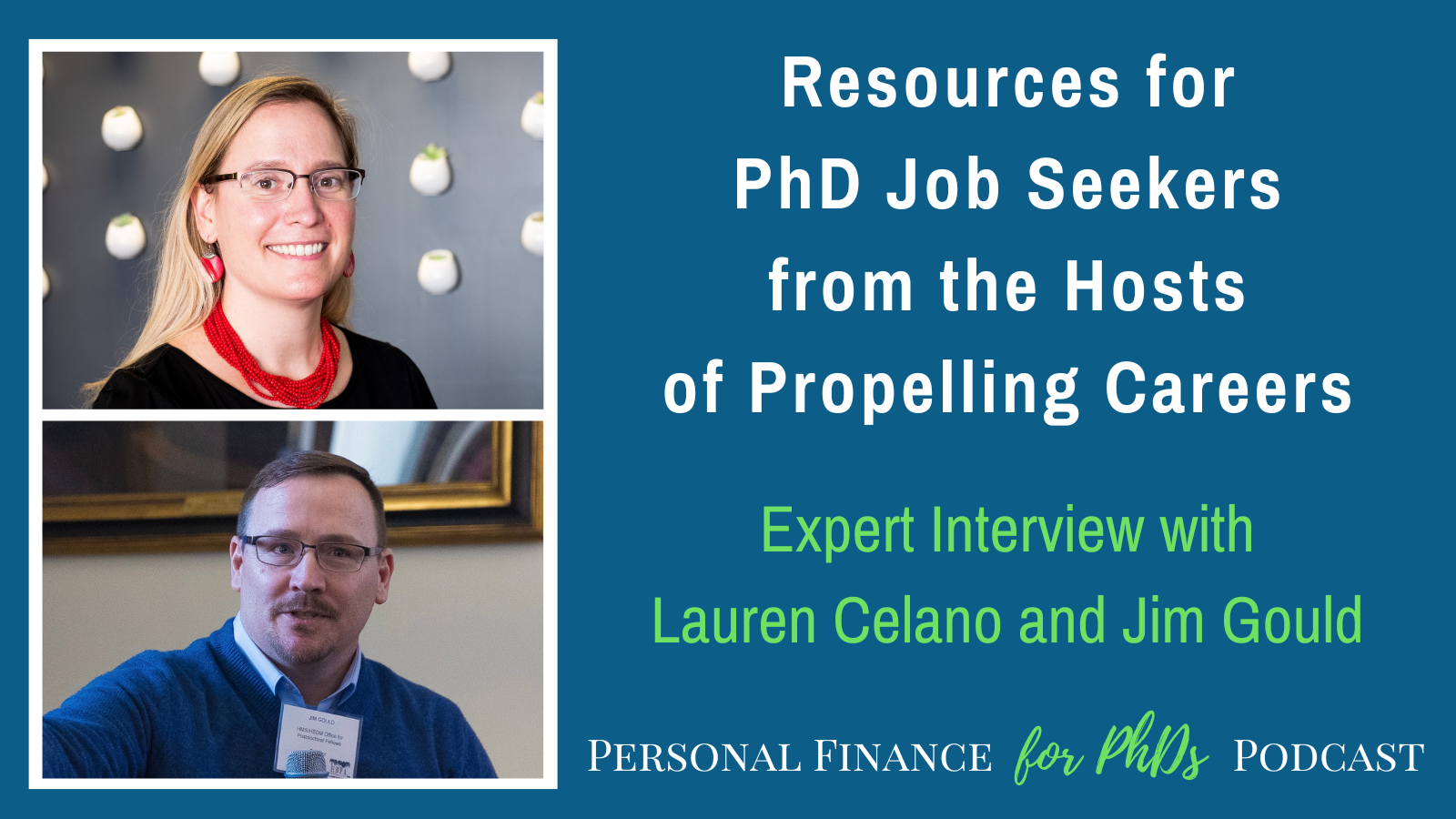
In this episode, Emily interviews Dr. Jim Gould and Lauren Celano, the co-hosts of Propelling Careers, about strategies for PhD job seekers, starting with an update on the PhD job market. They discuss how PhDs can figure out the salaries of various careers and particular jobs, including where they might fall within a posted salary range, and what benefits are offered at a company. They review where job seekers can go for both free and paid assistance. Finally, both Jim and Lauren give excellent financial advice related to job transitions.
Links mentioned in the Episode
- PF for PhDs Quarterly Estimated Tax Workshop
- The Propelling Careers Podcast
- The Propelling Careers Podcast Episode 82: Help me help you…
- The Propelling Careers Podcast Episode 73: Steps in the job search process
- PF for PhDs S22E5: Money Is a Good Enough Reason to Leave Academia
- PF for PhDs Tax Center for PhDs-in-Training
- Science Careers Individual Development Plan (myIDP)
- PF for PhDs Subscribe to Mailing List
- PF for PhDs Podcast Hub
Teaser
Jim (00:00): But it’s not productive to panic and say, oh my gosh, let me send out a whole bunch of of resumes or applications without actually going through the process. The process might end up being expedited time-wise, you know, instead of three to six months or nine months of exploration, job application, and interviewing, you might have a couple weeks, but you still have to go through the steps of doing that, and you have to fight off that panic.
Introduction
Emily (00:33): Welcome to the Personal Finance for PhDs Podcast: A Higher Education in Personal Finance. This podcast is for PhDs and PhDs-to-be who want to explore the hidden curriculum of finances to learn the best practices for money management, career advancement, and advocacy for yourself and others. I’m your host, Dr. Emily Roberts, a financial educator specializing in early-career PhDs and founder of Personal Finance for PhDs.
Emily (01:01): This is Season 23, Episode 1, and today my guests are Dr. Jim Gould and Lauren Celano, the co-hosts of Propelling Careers. Our topic is strategies for PhD job seekers, starting with an update on the PhD job market. We discuss how PhDs can figure out the salaries of various careers and particular jobs, including where they might fall within a posted salary range, and what benefits are offered at a company. We review where job seekers can go for both free and paid assistance. Finally, both Jim and Lauren give excellent financial advice related to job transitions.
Emily (01:42): These action items are for you if you switched onto non-W-2 fellowship income as a grad student, postdoc, or postbac last fall and are not having income tax withheld from your stipend or salary. Action item #1: Fill out the Estimated Tax Worksheet on page 8 of IRS Form 1040-ES. This worksheet will estimate how much income tax you will owe for 2025 and tell you whether you are required to make manual tax payments on a quarterly basis. The next quarterly estimated tax due date is this Thursday, January 15, 2026. Action item #2: Whether you are required to make estimated tax payments or pay a lump sum at tax time, open a separate, named savings account for your future tax payments. Calculate the fraction of each paycheck that will ultimately go toward tax and set up an automated recurring transfer from your checking account to your tax savings account to prepare for that bill. This is what I call a system of self-withholding, and I suggest putting it in place starting with your next fellowship paycheck so that you don’t get into a financial bind when the payment deadline arrives. If you need some help with the Estimated Tax Worksheet or want to ask me a question, please consider joining my workshop, Quarterly Estimated Tax for Fellowship Recipients. It explains every line of the worksheet and answers the common questions that PhD trainees have about estimated tax. The workshop includes 1.75 hours of video content, a spreadsheet, and invitations to at least one live Q&A call each quarter this tax year. This quarter’s Q&A call is on Wednesday, January 14, 2026 at noon Pacific Time. If you want to purchase this workshop as an individual, go to PF for PhDs dot com slash Q E tax. You can find the show notes for this episode at PFforPhDs.com/s23e1/. Without further ado, here’s my interview with Dr. Jim Gould and Lauren Celano, the co-hosts of Propelling Careers.
Will You Please Introduce Yourself Further?
Emily (04:05): I am delighted to have joining me on the podcast today, the host of the Propelling Careers podcast, Jim Gould and Lauren Celano, and they are gonna take the time to introduce themselves to you, but I just wanna say, if you’re a PhD, you need to go right now and subscribe to their podcast because it’s really, really valuable whether you’re in a job searching, you know, time or not. Although that is a subject of the podcast still something we need to keep up all the time. So go subscribe. Also, Jim, why don’t you go ahead and introduce yourself first.
Jim (04:32): Thanks, Emily for the invitation and thanks for the plug to our, uh, podcast as well. So, I’m director for postdoc affairs and program director for Responsible Conduct of research at Harvard Medical School, where I’ve been for almost 15 years now, providing programming and coaching and policy implementation for our postdocs here. I’ve received my bachelor’s in molecular biology from Clarion, University of Pennsylvania, my PhD in biochemistry at University of Louisville in Kentucky, and did my postdoc training in two different laboratories at the National Cancer Institute at the NCI in Frederick, Maryland.
Emily (05:05): Excellent. Lauren, how about you?
Lauren (05:08): Alright, well, currently, uh, the co-founder of a company called Propel Careers, and I do a lot to be able to help support PhDs and postdocs and early career people in their career journey. Um, but I’ve been in the life sciences sector now about 24 years, the first 10 of which was more drug discovery focused. And since about 2009 I’ve been working really closely with a whole range of postdocs and PhDs and early career people to help them navigate their careers.
Emily (05:34): My next question may have started to be answered by your, uh, background information there, but I’m, I’m curious how you developed this expertise, particularly in PhD careers. Um, Jim, why don’t we start with you because we know how you got your PhD, but then how did you get into this work?
Jim (05:48): Alright, so, you know, I I I was experiencing academia and research training firsthand as, uh, you know, in my bachelor’s. You know, I did a, uh, research stint, uh, summer undergraduate research fellowship actually at Ohio University and went into a PhD program trying to figure out what to do career wise with my molecular biology background. Uh, it seemed like it made sense going to graduate school, getting a PhD, struggled a little bit as a student, trying to figure out what it actually meant to, to do research and, and be successful there. And then, as I was a graduate student, realized that there’s an entire community and my peers and colleagues and fellow students who also needed help. And there wasn’t a ton of infrastructure for the development of professional skills, tons of research happening and, you know, we were able to, you know, show presentation skills, but it wasn’t a professional skill set.
Jim (06:42): And it was one of those things where we started ourselves building those skills and, and pulling groups together. And then the next step is like, okay, I don’t have enough experience to go on the job market directly from a PhD. So I did postdoc and not fully understanding what postdoc means ’cause there weren’t a ton of postdocs when I was a graduate student at U of L. There are more now. And just having been in that process in the training and struggling in each one of those stages and then figuring out things for myself, but also figuring out things to help my, my peers and colleagues. So that gave me a lot of just sort of on the ground practical experience and helping others. And then I realized I could probably do this for a career, but didn’t know what it looked like, didn’t know what it was, what it would be called.
Jim (07:28): I was looking at education and outreach, but it was running a, um, a postdoc association running seminar series, just being invited to sit on committees and panels and get questions asked of me like, well, what’s the postdoc experience? Where we’re faculty, we’re appointed, we, we don’t know exactly how postdocs are, are, are being treated or what they need or what the trainees need. And I was like, well, we need this, we need this. And it just sort of snowballed building a reputation, doing that, and then realizing I can make a career out of it. And at the same time, as I was in the middle of my, my postdoc, finishing my postdoc, there was a proliferation of postdoc offices growing, you know, and there are still institutions that are still starting postdoc offices. So I went from being a postdoc doing research, but also helping my, my fellow postdocs to running a postdoc.
Jim (08:20): And then I needed to learn the administrative aspect of policy development, of implementation, of learning how to coach. But doing this sort of day to day, week to week, growing and building my own portfolio of presentations, of skills, of coaching, I, I’ve been able to just build that expertise and now working with maybe even thousands of postdocs and PhDs and other trainees. So being able to then share that experience through my workshops, through my trainings and, and whatever else other people invite me to talk about. But also through that podcast that we have Propelling Careers.
Emily (08:56): And how many years has it been since you devoted yourself full-time to this
Jim (08:59): Full-time? It’s been 15 years. So I started this job in 2011, June, 2011. So June, 2026 will be 15 years on the dot.
Emily (09:08): Amazing. And I can see so many parallels actually between your story of, you know, needing this information for yourself and struggling through it, and then starting to teach other people with my own story. Of course, you decided to do this from within academia, <laugh>, and I’ve decided to do it from external academia, but still a lot of parallels in the motivation there. Um, Lauren, how did you come to, you know, decide to focus on this particular population?
Lauren (09:31): So, I, I have a scientific undergrad. I have biochemistry, molecular biology is what I focused on in college, and a lot of my friends decided to go to graduate school, so I started to get to know people that were doing their PhDs and some of them decided to also do postdocs. I also had moved to Boston in 2003 and, uh, started to be surrounded by people <laugh> with advanced academic training from the biotech activities I was involved in, but also just from my friend network and that sort of thing. And I started to notice that a lot of people had these amazing skills, but didn’t always know what to do. And in my working world, before Propel, I was, uh, getting to know a lot of different people in biotech companies and across a whole range of different roles and that sort of thing. And when I ended up, uh, going back for my MBA, I started to see that there was this need to be able to help people think about their future, to think about what are they doing and how are they leveraging their skills.
Lauren (10:25): I was giving advice to a lot of friends of mine, and then I realized that maybe this is something that could be applicable to other types of people. So I kind of fell into it, to be honest. But it’s been really fun to be able to help all these motivated people that really just wanna do great work and they wanna change the world through their research and activities and, uh, and so forth. So it’s been really nice. So for me, it’s been about 16 and a half years, so it’s funny, Jim, to think about like, when I started interacting with you, that was shortly after you came to HMS. So it’s really a small world, but I’m so happy that we got to kind of grow up together, <laugh> in this space.
Jim (11:00): Yeah, being able to, to do this straight out of postdoc, there was a huge learning curve. And one of the things that I wanted to point out with, with what Lauren and I were, were talking about with our relative path is that it wasn’t, we had to explore it, we had to find it, it wasn’t just laid out in front of us, okay, you have an MBA, now you go do this, you have a PhD, now you go do this. And I, I know that for our audiences, relative audience is yours and ours, it’s, it’s very similar. Like, okay, I’m going to undergraduate, I could do these things. I could go pre-med, I could go to graduate school, but we don’t know what’s happening two or three, even five years down the road. So being able to figure that out while still being productive as a student, as a trainee, as a postdoc, you know, it, it’s almost like you have two jobs. You need to figure out what your next job is, but also you have to be productive in, in your fellowship as well.
Emily (11:51): Absolutely. I totally agree. Um, I I think about it the same way of having the academic training aspect of your job and then the professional development and perhaps even job search and pursuit of careers aspect of your job. Um, you just mentioned, Lauren, that it’s a small world and I had the pleasure of meeting both of you in person. Um, within the past year, Jim and I saw one another at NPA, the National Postdoctoral Association Annual Conference. Then Lauren and I saw one another at the graduate career consortium annual meeting, and after that I wanted to set up this podcast interview. But I’m so glad for that timing because right now is a really interesting and critical moment for PhDs in terms of their, anyone who’s looking for a job. Right? <laugh>
Current State of the PhD Job Market
Emily (12:30): We have heard overall in the media that the job market is so difficult right now. And so I want to get an update from you two on how the PhD job market in particular is doing. Because I know from looking at BLS data that, you know, PhDs overall have a really, really low rate of unemployment. And as of the last update, which I looked at, and now we had a government closure in between, but the last jobs update I saw that PhD unemployment has ticked up a little bit, but still very low overall. But Jim, you said to me earlier this year when we met that PhDs are more likely to be underemployed than unemployed, which is also not a great, uh, image. So take this how you will, but I want to hear from each of you like your assessment of the job market right now for PhDs.
Lauren (13:13): Yeah, I I can start on this one and then Jim can, uh, can add, so the job market’s really hard. We actually have a podcast that we put out a few months ago about reasons why the job market is so challenging. There’s financing challenges, all sorts of things that we go into. Uh, it’s a really hard time, especially in life sciences and in high tech in particular. It’s very challenging for people. There’s been a lot of layoffs and reorgs for different reasons. So for people that are currently looking for roles right now that are finishing up graduate school or finishing up their postdoc, there’s so many people on the market, which is making the job market really hard. It’s taking people longer to find roles. People have to be even more persistent in terms of the job search process to find opportunities. And sometimes, you know, at a practicality, people just need a job. And so there’s some cases where people just take a job just to be able to pay rent and things like that as opposed to their ideal job because they just need something. So it’s a, it’s a complicated, we could probably spend like three hours just on that topic, but, but Jim, what, what else do you have to add there
Jim (14:16): For the reasons that you just explained Lauren, but also there are, um, there’s, there’s relative safety and, and that might not be so true nowadays, but traditionally, historically there’s relative safety in academia for many PhDs and postdocs. And they tend to remain in those positions longer or maybe go on the, the job market multiple times, at least historically. Now it is changing because of, of just funding constraints and, and changes in the NIH and and, and changes in indirect costs. And, you know, it costs more now to keep a postdoc and graduate students. But the, the idea is that they stay in positions longer. They might extend their PhD, they might extend their postdoc a year or two, so they don’t go, they don’t finish a fellowship and then go unemployment. So they extend a fellowship. And that’s what I meant by underemployment, where they stay in a position where they’re not advancing. There’s no sort of promotion structure within academia right now, at least for postdocs to continue to advance, uh, within that structure. They’re also may be even under appointed as I as sort of just explains like they, there’s no path of advancement. And then the other thing that, that Lauren kind of hinted at is sometimes they end up taking jobs out of need rather than sort of matching skill sets and advancement that are, tend to be below their skill set or experience level, because again, the fellowship funding is over and they need to find a job rather than launching their career. So there, there tends to be a little bit of underemployment and that it ended up catching up eventually. But there is, you know, there, there is this aspect of academia is this kind of warm, cozy, at least it used to be this warm, cozy place where you could take your time doing research and being productive and getting publications out, and then there’s a kind of a soft launch and or, or whatever on your, your next step of your career. It just sort of extended a little bit. So it’s not, you don’t lead to unemployment ’cause you don’t just lose postdoc jobs. It’s, you end up staying longer and you end up being under, under appointed and underemployed,
Emily (16:19): Except that some postdocs are losing their jobs now. Um, I mean because of funding changes, I actually worked with a university this fall who in the midst of me working with them, they conducted layoffs of their postdocs. So it’s unusual <laugh>. It’s, it’s different than at other times. And I wonder if, I know we could spend so much time on this, but if you had any advice for how PhDs can meet the moment, and I’ll say that in the financial realm, when people are experiencing job loss or financial emergency or anything like that, the advice is kind of like, well, it’s just more important to do all those classic things that you were told to do anyway, right? Like, have the emergency fund and diversify your sources of income and, and be able to cut your expenses if you need to. So I’m wondering, in your sphere, is there any different advice or is it just like, yeah, go listen to all of our podcast archives and just do all the stuff we’ve already been talking about <laugh>
Advice for the Current PhD Job Market
Lauren (17:12): One thing Jim and I say all the time is don’t do this alone. So find resources at your institution, reach out to your network, may- have your materials together, right? You need to have a resume or a CV depending upon what you’re applying to. It needs to be up to date. So if you do have to look for a job quickly, you’ve got something you can share. Otherwise you lose time trying to put it together, cultivating your network, you know, again, like reaching out to people. But when you do that, uh, we did an episode recently in the podcast called Help Me Help You, which was all about if you’re gonna be engaging your network, help them help you, what do you say to them? How do you share information? How do you make it easy for people to help you, especially if you might be in a time crunch due to layoffs, reorgs changes that are unexpected and things like that.
Jim (18:02): Yeah. And, and in, in addition to what Lauren was just talking about, we have to fight the urge or we advise fighting the urge of panicking because, you know, panic is not productive for the most part. Being able to understand the landscape. There’s, there’s e- there’s a, a grieving process that happens, especially if you lose a job. We’re not downplaying that, but it’s not productive to panic and say, oh my gosh, you know, let me send out a whole bunch of, of resumes or applications without actually going through the process. The process might end up being expedited time-wise, you know, instead of three to six months or nine months of exploration, job application and interviewing. You might have a couple weeks, but you still have to go through the steps of doing that. And you have to fight off that panic and realize in the grand scheme of things, a a three month gap or a one month gap or even a six month gap in your employment record is relatively meaningless, especially in academia and moving into industry because those now, you know, industry is, is relatively, there’s, there’s high turnover, you know, and you’re, you’re going to have multiple jobs, maybe even multiple careers. And now in academia, we are now feeling that, as you pointed out, Emily, you know, postdocs are losing their jobs. We are, you know, downsizing in academia, especially in the, the research realm. So we need to remain nimble, but you need to fight off that, that urge to panic and just remember your resources and your network and community.
Emily (19:27): I like that encouragement of just like, there is a process here. Like work the process, like work the steps. Um, you don’t have to reinvent the wheel. Okay, <laugh> like resources like yours and others that maybe available to people are, are excellent to be accessing at this time.
Lauren (19:40): Well we did a podcast episode recently about the 26 steps in the job search process. <laugh>, I mean, not not to overwhelm people, but it’s a lot of work. It’s a lot of work to be able to effectively engage in this. So I would say check that out because it could help people start to get a feel for things they could do to help them be productive in the side.
Jim (20:00): Yeah. And, and that list it, it could have been a hundred things and we, we were able to sort of pull that list and, and you know, glean it and, and, and call it. But the idea is that there, the, that there might be, um, maybe healing in that process. Just doing the thing also helps you able to control the controllables. So again, fight the urge of panic but also re remember that there are many things outside of your control in this, in this world and in this process. You, you, you can’t control somebody interviewing you or hiring you, but you can control doing the process. You can control, you know, engaging your, your network. You can control putting out quality applications.
Emily (20:38): I love that. And all the episodes that you mentioned, Lauren and Jim, by the way, will be in the show notes. So anybody looking for that, go to pfforphds.com/podcast. Find this episode and you’ll get all the links to the Propelling Careers podcast.
Pay Transparency Laws and PhD Salary Ranges
Emily (20:51): Okay. I wanna talk a little bit more about finances, specifically within the job search and job application process. Uh, I learned from your podcast that there have been all these new like pay transparency laws in various states that have come into effect. So I want you to explain a little bit about what that means and how PhDs can figure out what is an appropriate, um, salary or salary range for a career that they’re looking for. And also in a specific location. ’cause obviously cost of living is gonna massively change this as well.
Lauren (21:19): So I’ve had the fortunate, uh, nature. So part of what I do in my career is I do recruiting with a few companies and, uh, I’ve had opportunities hands on to actually be a part of some of these pay transparency activities. And so for example, in Massachusetts, October 29th, 2025, the pay transparency law went into effect, which means companies of more than 25 people are supposed to have salary ranges for each role that they post. In California, this went into effect January 1st, 2023. I was recruiting with a company at the time in California. So I was involved in actually posting the salary ranges and I was so nervous to actually put it out there. But it’s been great actually for candidates to have a little more transparency around where they may fall. Now it’s a range, right? So you have, you have, you know, let, let’s say the range might be a hundred to $120,000 for a certain role. Typically people pay kind of in the middle of that range. ’cause you wanna allow people opportunities to be able to grow once they come into an organization. So as a candidate, I would anticipate probably like middle of the range is probably where you should fall for that. As you’re looking at opportunities though, it can be helpful to see the ranges. ’cause then you can start to get a sense of which roles could align to your financial considerations. ’cause there could be some situations where a certain type of role just isn’t gonna align and that’s fine. You can then focus your efforts on ones that are out there. Washington and New York also have pay transparency laws. And you know, one thing that’s helpful to keep in mind is that maybe you live in a state that doesn’t have pay transparency laws. Well, you can still look at states like California, Massachusetts, New York, Washington and start to get an idea potentially of what ranges could be. It may differ a little bit in, you know, the Midwest or the South or something, but at least you may start to see kind of ballparks in certain ranges. The other thing I would say is, you know, when you’re doing informational interviews you can ask people like, do you have an idea of what the salary might be for this particular role? But not just that though, what are the other benefits, right? And we’ll talk more about that, but it’s like the whole package. Don’t be afraid to utilize your network. There’s a few other ideas I have, but I know Jim has some thoughts on this too, in terms of advice he’s given.
Jim (23:37): Yeah, there, there, you know, if in academia, uh, you know, Laura was talking a lot about industry and, and just outside of academia, but there are public institutions, public colleges and universities that have to pay, have to post their salary. So you can get an insight on relative salaries. They’re usually a year or two, sometimes even three years behind. So you can get a a sense, you know, and I know, you know, inflation is, is increasing. So tho those salaries may not be as accurate, but you get a sense of what the range might be depending on, you know, full professor, assistant professor, associate professor, or even, you know, scientific staff or you know, administrators within university. The other thing is, you know, um, the American Association for Medical Colleges, it produces for a fee, a a booklet of salaries across medical schools and medical colleges. So you can get an insight into that. You know, depending on if you are more, more biomedical research and you’re going into a a private medical, um, research institution, you can, you know, basically purchase those, um, you know, those ranges and salaries. But one of the things that, that Lauren already mentioned that’s really effective is when you’re out there gathering information, meeting people and networking, you do these informational interviews and you collect that kind of information, you don’t want to necessarily ask them specifically how much do you make in your role. That is, that tends to be rude, but you can say, how much can I expect in a, you know, in an introductory role or a, a scientist one role at, at your company or in your sector. And they should be able to give you a, a relatively accurate range as well. So, but you, you have that more direct information that, um, you, you could probably trust a bit more than finding stuff on the internet, uh, in indeed.com or Glassdoor or, or salary.com as well.
Lauren (25:28): To build on Jim’s point, some of the other professional organizations have salary guides. So American Chemical Society every couple years does a salary guide. So if you wanna be a chemist in a certain place, you can probably find a range. Uh, the Association of University Tech Transfer Managers also has salary ranges. So maybe some of you listening to this are involved in professional associations. Well ask that association, do you do a salary survey? Because maybe they do and that might help you. And also universities oftentimes collect this information. So if you wanted to move to California, you could do a search of some universities out in California and maybe they’ve compiled a, a information about recent PhD graduates and recent master’s graduates in their location in different sectors. It’s not gonna be perfect, but it may give you an idea of ranges just to be able to help in terms of that information. There’s a lot of information out there, but the source of the information, that’s the important part to make sure that you are seeking sources that are credible. That’s why sometimes Glassdoor and LinkedIn and so forth, sometimes it’s self-reported or made up in other capacities. So you just wanna be careful in terms of where you’re getting that information from.
Jim (26:42): You. You also wanna be careful with, again, the information you gather and you are moving in, in a different geographic area because cost of living varies across the United States and, and obviously the world. So if you gather information about salaries in the Boston area, but you’re moving to Pittsburgh, those numbers are gonna be inflated. Uh, Pittsburgh is generally gonna pay lower, but the cost of living is is cheaper, so your dollar might go a little bit further. So thinking about those aspects as well.
Emily (27:11): This, this is great information, thank you so much. And I, I love that you mentioned like different sort of categories of places that people can go to find this information. And I love the idea of someone starting this very early on like years or more, you know, a year more before they’re actually engaged in a job search process to try to figure out like maybe their own financial expectations and what sectors and what titles kind of align with that. Like for example, I did an interview recently with Dr. Gabrielle Fil- Filip-Crawford, who actually also met at GCC and she was talking about how pay transparency talking with our colleagues about pay helped her understand that she was never going to make enough money inside academia on her faculty track that she was on to satisfy her lifestyle needs and wants. And so it helped her leave that sector entirely and find more remunerative work that was, you know, still in line with what she wanted for her career. And so I just think that’s really, really important that we have realistic and grounded expectations about what different types of careers pay, what different titles pay. Because frankly, as a PhD you have a lot of transferrable skills that are kind of flexible. And so if you could fulfill the, you know, the requirements of roles with a few different titles, like you should look into what those different titles pay and the tracks that they’re on, um, to see, you know, what best aligns with your financial desires as well.
Lauren (28:29): 100%. Exactly. And of course it’s not always just about the money, but the culture and the kind of career trajectory. There’s a lot of things to factor in in terms of taking a role, uh, or not, but finances come into play and you wanna make sure that people are realistic so you can, whatever quality of life you need that you’re able to meet that.
Jim (28:50): Yeah, I agree. Quality of life is, is, is front and center, especially nowadays. We want to be able to, to work, to be able to live, not necessarily live to work for a lot of, a lot of different people.
Commercial
Emily (29:03): Emily here for a brief interlude! Tax season is in full swing, and the best place to go for information tailored to you as a grad student, postdoc, or postbac, is PFforPhDs.com/tax/. From that page I have linked to all of my free tax resources, many of which I have updated for this tax year. On that page you will find podcast episodes, videos, and articles on all kinds of tax topics relevant to PhDs and PhDs-to-be. There are also opportunities to join the Personal Finance for PhDs mailing list to receive PDF summaries and spreadsheets that you can work with. Again, you can find all of these free resources linked from PFforPhDs.com/tax/. Now back to the interview.
Learning About Benefits Information During the PhD Job Search
Emily (29:55): Okay, so we’ve talked about how to work out what kinds of salaries are on different careers and where to locate yourself on a range that you might see. Um, I wanna ask about benefits as well because, you know, certain benefits can be really, really important to people, especially related to like health insurance stuff. Like does this company offer parental leave? Does this company offer, um, you know, a specific medication that I need for a health condition that I have? Um, you know, different things like that. And how can someone who is looking or applying for jobs understand like, is this company even gonna meet, like benefits wise, my expectations? I understand you could probably ask about that very late in the process, like after you’ve gotten an offer, but is there any way to get that information earlier so that you don’t like waste your time maybe pursuing something that is not ultimately gonna work out?
Jim (30:44): So is because of the, the job market being so, um, so difficult at the moment, they want really good candidates and, uh, universities, colleges, um, companies, so on and so forth. If they, they usually put the benefits first and foremost at maybe at the bottom of the job description. They’re very proud to say, we offer, you know, uh, unlimited paid time off. We offer childcare subsidies, we offer commuting subsidies. So there are a lot of things that you can just find in the job description. And if it’s not in the job description, they probably have a why work here website or webpage where you land on. It’s more HR oriented, but you can find a lot of the different types of, of information and benefits, you know, from the job description, the job ad. Usually towards the end you’re like, we are very happy to be family oriented and all of these other things because, you know, the, the audience that, that Lauren and I tend to to work with are early career researchers and mid sort of midlife, mid thirties early or late twenties, early thirties, building their families as well. So the, I think companies are now understanding more than ever that they’re hiring not just the perfect candidate, but also a a a whole person that likely has a family with them.
Lauren (31:57): Yeah. And to, to add to that, I would say, I mean there’s some companies that literally have their entire benefit guide on the website. You can download it, it’s, you know, 45 pages with all the healthcare options, the 401k match, the vacation, the holidays, the cell phone reimbursement, et cetera, et cetera. But you know, also to plug the informational interview, when you talk to people at certain companies, it’s fair to ask, can you share some insights about benefits? Because this is something when I counsel people, and I’m sure Jim, you do too, and Emily for sure, you know, people look at the sal- the base salary and they’re either happy or sad depending upon what their expectations were. But then I always advise people, make a list of everything, right? The base salary is a hundred grand, okay, is there a bonus? Is there cell phone reimbursement? Is there commuter reimbursement? Is there like lunch provided a couple times a week, uh, et cetera, et cetera, et cetera. So I’ve had situations where the base salary is a hundred thousand dollars, but the total package is actually like $135,000 because of the extra things associated with the offer. So that’s where it’s really helpful as a candidate to make sure you’re looking at the entire package. Plus, of course, what’s the culture like, what’s the work-life balance like, what’s the enjoyment of the role? Those are a little bit intangible, but also super important as you consider what’s gonna be the next best fit for you?
Emily (33:27): Is it appropriate to ask generally? Can you tell me about the benefits? ’cause obviously people probably in the interview process don’t necessarily wanna reveal oh yeah, I’m thinking about having a baby soon. Like yeah, I have a chronic medical condition, or, you know, whatever the case is.
Lauren (33:40): I think it’s fair to ask and, and I, I know, so in the recruiting work I do, typically after the first discussion, I’ll send people a summary of the details, but if, if you don’t get sent that I would ask it because these things are important. You don’t wanna get to the end of the interview and realize that the company doesn’t have things you need because then you just spent a lot of time and a lot of their time interviewing for a role that then is not gonna be a fit. So I love just being open and honest <laugh> and just asking for what you need and hopefully the organizations you are interviewing with will be able to provide information.
Jim (34:11): Yeah, it may not be your leading question. Be like, you know, when you first get in, what are the, what are the benefits? And it may not be the central question, but when given the opportunity, or maybe as you’re rounding out the interview or the discussion, be like, would you mind sharing, you know, the, the benefits package or, or a more information about benefits as well? Because during the interview it’s more about fit and work and, and connection and, and sharing your experience and credentials, but benefits will play a huge part in the actual decision if an offer is tendered.
Free Career Search and Career Development Resources for PhDs
Emily (34:43): You all mentioned earlier, um, graduate students and postdocs accessing resources related to career search and career development at their own institutions. Um, I’m wondering for people who have already, maybe they’re aware of that resource or maybe they’re no longer affiliated with institutions, so they don’t have access to those kinds of offices anymore. Um, what kinds of free resources are available? I mean, we know about your podcast, but anything else? And then is there ever a point when a person should consider paying for professional services or a course or anything like that?
Jim (35:16): So I, I know Lauren and I, we tend to align with, with some of this, uh, this interaction and, you know, the feedback and advice. But I do want to reiterate, even though, you know, people might not be still affiliated with in-, with institutions or schools or colleges, they are still alums of those schools and colleges and can go back as an alumni to maybe access career services, career offices. So you, you can still have some access, it might be limited, but there are also other offices that, you know, like mine, you know, especially, you know, if a postdoc is transitioning out and their end date is, um, I don’t know, a week from now, I’m not gonna turn them away in seven or eight days after their, their appointment ends. They can continue to come back as they’re transitioning out. So there, there’s also workforce development. Again, thinking about if you’re transitioning out, you can really leverage and access all of those resources. If you’re being terminated or you’re actually on your way out, you can tool up. But don’t forget that you are an alum of schools and universities where you paid probably thousands upon thousands of dollars. They still, you know, give you access to their, their, you know, uh, alumni office as well as their, the career services office. Other resources that I really like are kind of like, you know, um, communication, leadership, you know, emotional, uh, intelligence assessments. Those tend to be free. You, you can go to a, a coach and a professional and pay for those services and get, you know, um, some help unpacking some of those things. But there are a lot of those are free and the explanations are pretty clear and straightforward and it allows you to understand how you communicate and how others communicate and how things land for you. Where you can then stretch yourself into different personality types or with different personality types. Uh, I, so those are kind of the, some of the free stuff that you can get into, but you can pay to do some of those things like strengths finders or Clifton strengths. You, you, you have to, you know, buy the book for strengths finders and then you have access to like your top five strengths, but you could pay someone to sort of coach you on those things as well. And I know Lauren has a lot more information and insight as well.
Lauren (37:26): Totally. I mean, one, uh, one free thing that I often suggest to people is the myIDP by Science Careers. It, it was a tool, uh, meant mostly for biomedical and biosciences, uh, graduate students, but it could be used by other people as well. These, some of these things are transferable to other disciplines, physics and, and, and others. Uh, but you know, you put in your interest skills values and then it rank orders one of 20 career paths that could be a fit. Doesn’t mean you have to do patent law if that comes up first, but it can be a nice way to start to understand, oh wow, if I have these interests in skills, those writing careers or outreach careers or entrepreneurship careers or whatever seem to be a fit. Sometimes people just need a little bit of insight and then it can launch this whole new area that’s out there. Um, on the, you know, on the paid, uh, coaching side. I mean certainly some people need a ton of help in terms of tailoring the resumes, interview prep and things like that. So there are coaches out there that can help. The key is make sure you find a coach that’s appropriate in terms of background, expertise, even level of people that they’ve engaged with. I, I’ve had a few people recently that have come to me ’cause I do some coaching work with people and they may have gone to someone that just coaches like executive level people and here’s someone that’s just coming outta their PhD, that coach may not have the right type of advice ’cause they’re not used to working with people at more of the entry level. They’re used to working with people that are more seasoned or I’ve had people that have gotten career coaches, but they coach people in different industries. And so like the cosmetics industry is definitely way different than life sciences, which is way different than data science. So it can be really helpful to do your due diligence to make sure if you are paying for coaching services and career advice services, that you are paying for the right, the right information and the right, uh, the items to be able to make sure it’s actually useful for you.
Jim (39:20): And, and it might be helpful in the short term, very near term, you might, you might pay someone for a couple of sessions and then you, you’re on the path to, to success or you might buy a subscription for a month or a couple weeks to, uh, job, job listings or even like LinkedIn, you know, uh, uh, you know, high level. So, but it should not be a long term or, or a forever type of situation. But you know, there are times where you might need that extra help and you can’t find it for free and you need to reach out and have someone or some, some, uh, resource that actually is a paid resource, but it should not be necessarily a long-term commitment.
Lauren (39:59): I know in Massachusetts there’s even these like mentorship networks. I’ve been a mentor for at least 10 of the last 15 years for the Massachusetts chapter of Association of Women in Science. So they have a year long mentorship program. You pay a small amount of money to be a part of it, but then you get someone like me giving you advice every month about, you know, your career, how do you navigate things, how do you build resumes, how do you job search? So just I would say be resourceful. ’cause there could be a lot out there. It’s just sometimes you don’t always know where to begin. So that’s where ask your network, you know, engage with people so that way you’re not doing this alone.
Emily (40:33): Yeah, I just wanna underline that, that like, clearly there are so many either free or near free or hey, you already paid for this in the past, so let’s just keep using it, uh, resources available, go to those first by all means. But I can imagine there are some people who, like this job searching has gone on for like a long time and anything that they need to do to truncate the end of this and just get into a position might, you know, might be worth the investment. Is there anything else that you’d like to tell us about the financial side of job seeking and job interviewing?
Additional Insights About the Financial Side of the PhD Job Market
Jim (41:03): There is a cost, time and financial and resource when going on the market. You might have to invest in new interview materials, like maybe a printer or a new laptop or professional clothing or outfits, maybe microphones or, or you know, you know, headsets for phone interviews or, or zoom interviews. But also you might want to understand how if you’re traveling for the job or traveling for the interview, how that reimbursement or payment or upfront, you know, scheduling will, will impact your finances because sometimes you are, you don’t have a ton of money and they want you to pay for the flight and they’ll reimburse you afterwards. Or the pay for the hotel and flight, they’ll reimburse you afterwards that, that could be two, $3,000 very quickly where they reimburse you 30, 60 or 90 days later. So, uh, again, just understanding that there’s an actual cost, not just your time because going on the job market is a timely cost. It’s a almost a second job, but there are these, you know, these little purchases that tend to add up that, that you could be in a thousands of dollars just going on the market, buying new clothes, buying new materials and, and actually traveling.
Emily (42:17): Great point that in the event of job loss, your emergency fund is not just there to pay for your ongoing living expenses, but you may have increased expenses to engage in this as well. Thank you.
Lauren (42:27): And I know we touched briefly on this, but I, I just wanna reinforce this point. When you look at the actual salary, just don’t look at the actual salary <laugh>, look at the benefits, the entire package because that will help you get a better understanding of if you end up having a few job offers, which one’s going to be the best fit. I just, I urge people make a spreadsheet, I’m sure Emily, you probably love spreadsheets to keep track of things so you can really compare apples to apples if you’re lucky enough to get a few offers and know you have to know what your like turn, turn away point is, right? If, if you need a certain amount of money to be able to live, then you need to know that. So then if a job doesn’t cover that, then you may have to say no, even though the role could be amazing, you don’t wanna take something knowing that you’re going to be in a negative financial situation starting from day one. So these are sometimes really hard discussions to have with people, but it’s really important to be honest so that way you can find a role and be able to focus on the role and not be stressed out about not being able to have proper finances.
Emily (43:33): And this may be a concept that is unfamiliar to people coming out of graduate school or the postdoc that you should feel financially supported in the role that you’re in. Absolutely. Thank you so much for those, um, concluding words. Where can people find Propelling Careers?
Lauren (43:48): We have our podcast on Spotify and Apple podcasts, and again, our podcast is free <laugh>, we have at the end of 2025, we’ll have 88 episodes. We have a ton of content and hopefully all of you find it valuable as you peruse.
Best Financial Advice for Another Early-Career PhD
Emily (44:04): Excellent. And I wanna end here by asking each of you the question I ask of all my interviewees, which is, what is your best financial advice for an early career PhD? And that could be something that we’ve touched on in the interview already, or it could be something completely new,
Jim (44:17): Right? It for me, it’s a combination of what we, we, we’ve already talked about is it it, and it’s a two-parter. Don’t do this alone. Use all of your resources to understand the, the cost, uh, of, of transitioning finding jobs and being successful in your career, but also understand and know the true cost of living in an area that you might be moving to. And that was, you know, Lauren, you know, talked about, you know, moving to a job and, and not realizing how much it cost. And and that’s something that actually happened. It, we got sticker shock when we moved up to here from Frederick Maryland to Boston. Uh, uh, it was a, a jump in salary, but it was not actually enough. And I didn’t realize that until after the fact. And it set us back several years in our finances to then catch up. And I think I still feel that we are actually behind where we would’ve been if we did actually just stayed in Frederick, uh, at points.
Lauren (45:08): And from my standpoint, so I see some people, they finish their PhD or postdoc and they get a job offer from a large pharma company and they go out and buy a new car, they get a nicer apartment maybe in the seaport of Boston and it’s like, don’t blow all your cash <laugh> right away. Like it could be really helpful to still live below your means so you can save some money so you can have a rainy day fund. You never know what might happen in the future. So it’s just as much as you may want to buy when you see your first check, like buy all this nice stuff, try to hesitate on that <laugh>. So, so that way it just allows you a little more freedom in the future.
Emily (45:48): There’s a big difference between splurging on a one-time purchase and splurging on something that’s gonna cost you some more money every single month going forward. So you’re absolutely preaching to the choir here. I love it. Thank you so much for this wonderful interview. I hope everybody goes and checks out your podcast. Thank you so much for joining me.
Jim (46:05): Thank you Emily.
Lauren (46:06): Thank you Emily.
Outro
Emily (46:17): Listeners, thank you for joining me for this episode! I have a gift for you! You know that final question I ask of all my guests regarding their best financial advice? My team has collected short summaries of all the answers ever given on the podcast into a document that is updated with each new episode release. You can gain access to it by registering for my mailing list at PFforPhDs.com/advice/. Would you like to access transcripts or videos of each episode? I link the show notes for each episode from PFforPhDs.com/podcast/. See you in the next episode, and remember: You don’t have to have a PhD to succeed with personal finance… but it helps! Nothing you hear on this podcast should be taken as financial, tax, or legal advice for any individual. The music is “Stages of Awakening” by Podington Bear from the Free Music Archive and is shared under CC by NC. Podcast editing by me and show notes creation by Dr. Jill Hoffman.
Join Our Phinancially Distinct Community

Receive 1-2 emails per week to help you take the next step with your finances.

Leave a Reply