• Skip to main content
  • Skip to footer

Personal Finance for PhDs

Live a financially balanced life - no Real Job required

  • Blog
  • Podcast
  • Tax Center
  • PhD Home Loans
  • Work with Emily
  • About Emily Roberts

Blog

How This Graduate Student Rejects the Academic Culture of Being Broke

January 27, 2020 by Meryem Ok

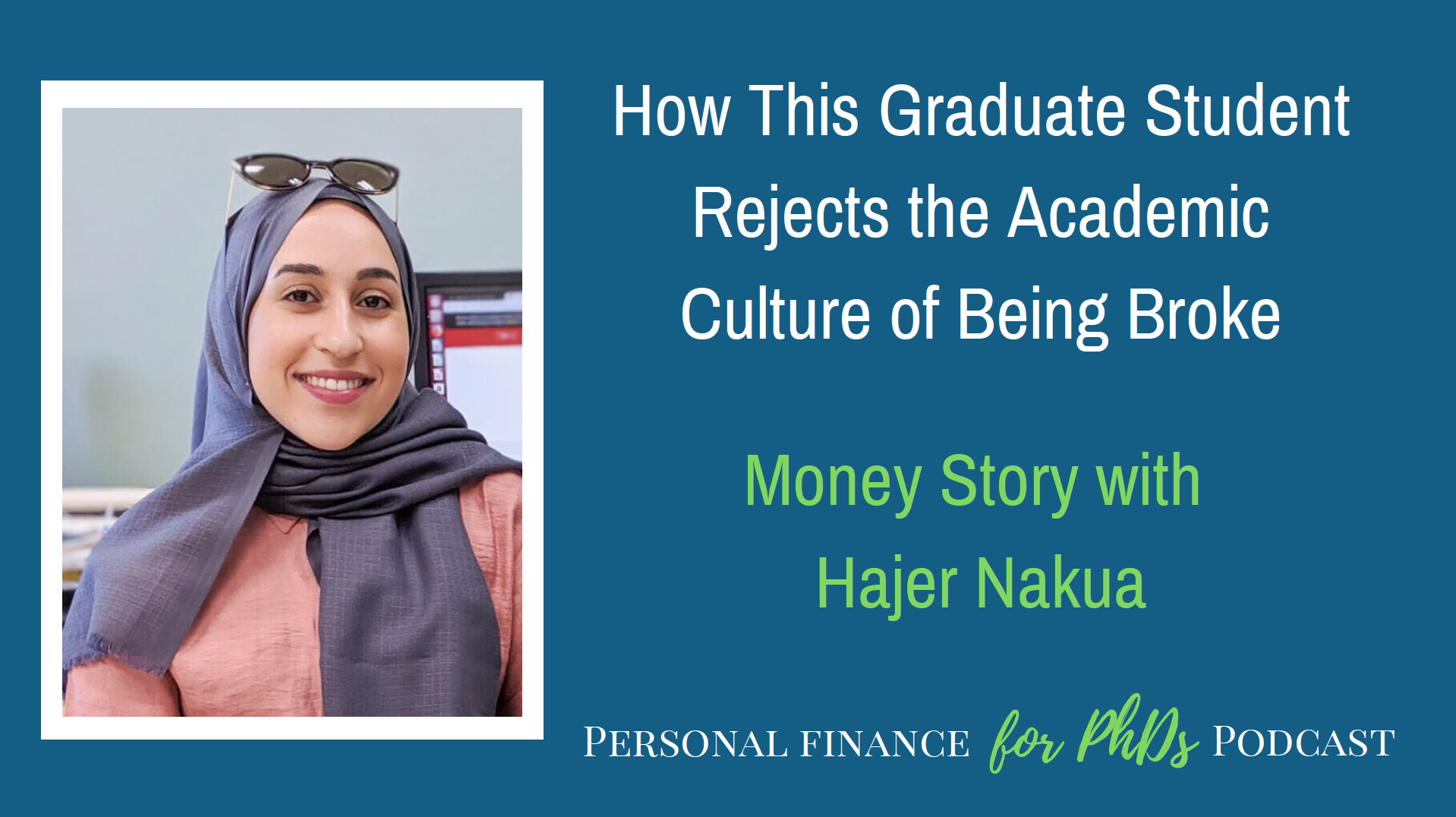
In this episode, Emily interviews Hajer Nakua, a rising second-year PhD student in neuroscience at the University of Toronto. Hajer describes how the culture of being “broke” in academia becomes a self-fulfilling prophecy for individual graduate students. Hajer and Emily discuss in detail Hajer’s top three strategies for breaking this cycle of brokeness in graduate school and how you can change your money mindset. Hajer identifies the culture of consumerism as the top culprit.

Links Mentioned in the Episode

  • Personal Finance for PhDs: Tax Center
  • Raw Talk Podcast Website
  • Hajer’s Instagram: @itshajernakua
  • Personal Finance for PhDs: Podcast Hub
  • Personal Finance for PhDs: Subscribe to Mailing List
academia culture of broke

Teaser

00:00 Hajer: You know, if people don’t talk about how they’re spending money and all they talk about is the fact that they’re broke, it’s really easy to be like, “Okay, yeah, sure.” But to be more open with money and not have it very taboo I think will really help spearhead discussions of what does it mean to be in graduate school and have money. Like, how are the best ways to spend my stipend?

Intro

00:25 Emily: Welcome to the Personal Finance for PhDs podcast, a higher education in personal finance. I’m your host, Dr. Emily Roberts. This is season five, episode four, and today my guest is Hajer Nakua, a rising second-year PhD student in neuroscience at the University of Toronto. Hajer describes how the culture of being broke in academia becomes a self-fulfilling prophecy for individual graduate students. We discuss in detail her top three strategies for breaking this cycle of brokeness in graduate school, and how you can change your money mindset. Without further ado, here’s my interview with Hajer Nakua.

Will You Please Introduce Yourself Further?

01:04 Emily: I have joining me on the podcast today, Hajer Nakua, and she is a recently started graduate student. We are recording this in August of 2019 so she’s going into her second year. And we’re going to be discussing today the “culture of broke” inside academia and how to combat that with your own personal finances. So, Hajer, thank you so much for joining me today. And will you please tell the audience a little bit more about yourself?

01:28 Hajer: Thank you very much, Emily, for having me. And sure. I just finished my undergrad in Psychology, Neuroscience & Behavior at McMaster University in Ontario. I finished in April 2018, and in September 2018, I started my graduate training at the University of Toronto. It’s technically in the Institute of Medical Science, but my field is specifically neuroscience. And even more specific, I use computational technology. So, things like neuroimaging, brain imaging, MRI, to better understand brain behavior relationships in a population of psychiatric children.

The Culture of “Broke” in Academia

02:07 Emily: Very, very interesting. So, you have been in academia–well, your PhD program, at any rate–for only about a year, but that’s been long enough to start to absorb the culture of being broke. So, would you please start to describe that for me?

02:22 Hajer: Sure. I’ve actually noticed this culture very, very persistently in undergrad, and it’s more of a student thing than when you’re a PhD–you’re still considered a student. And it’s just the idea that students, because they don’t have a very stable income, they’re supposed to be broke. And that is a very, very persistent limiting belief that many students have. And I find that particularly in PhD, Masters, or any graduate school program because of the high expense of the program, people just sort of settle into the idea of, “Oh, I’m broke, I’m supposed to be broke.” And it often limits them from taking the necessary measures to try to build wealth even during their PhD or graduate school training.

03:00 Emily: Well, you know you have found a very friendly audience in me with this message. I totally agree with you. To me, like if you’re looking at the numbers, right? Like if you’re actually looking people’s income and outflow and everything, to me, there’s usually a pretty big difference between someone who is paying out of pocket to be in school. They’re probably taking on student loan debt or maybe they’re supported by their families or even maybe they’re drawing on their own savings from the past, and someone who does have their education expenses paid for, plus there’s a stipend on top of that. That to me is like black and white, a very different situation. But you’re right that, because there’s often a continuum between those two things, people who are on the, “Well, you actually do have an income side of that,” can have some of the mindset still from when they were on the other side of the equation. Again, because as you said, the label of “student” is still there. And you said for me a couple of magic words, which were “limiting beliefs,” which I am very interested in. Can you expand on that a little bit?

Can You Expand on Limiting Beliefs?

04:03 Hajer: Sure. So, in general, a limiting belief is this very persistent idea someone has that often allows them to settle into something that prevents them from moving forward with whatever it is that they want in their life. And that’s a very vague and general explanation. But in this case, I find that when people say things such as, “Oh, I’m broke,” they sort of get over the idea that, “Maybe I should have a savings account, maybe I should start, you know, being more financially savvy.” They’re like, “Should I buy this $10 meal? Yeah. Whatever. I’m broke. What another $10?” So, it’s this constant idea that any sort of wealth, any money management is not applicable to their life.”

04:46 Emily: Yeah.

04:46 Hajer: I think that’s very persistent in particularly graduate school. And quickly commenting on one thing that you said. Although there is a stipend, and it’s fair that many people move for a PhD program, so that often goes towards living expenses. So, of course, the amount of money that someone gets, it’s not high, but it’s still, as you said, a little bit surprising to me sometimes that there’s such a strong sense of, “I have no money,” even though technically there is some sort of cash flow coming in.

05:16 Emily: Yeah. And this is another difficult point, right? Because for some people, the stipend is insufficient to live on in that city. It’s tragic that some graduate schools choose to pay their students that way–their workers or their fellowship recipients–that’s something that needs to change kind of about the higher education system as a whole. So, in some cases, it really is true. There’s not enough to live on. You have to be going into debt, whether it’s student loan debt or consumer debt or you’re being supported by someone else. And I think around 50%, or if I’m trying to remember the stats correctly, around 50% or less of doctoral students ultimately do take out some sort of student loans during their graduate degrees, right? Not just from undergrad. Yet, in other cases, as you were just saying, the stipend may be sufficient to live on maybe even sufficient to do a little bit more with.

06:09 Emily: But because of those limiting beliefs, that isn’t even considered, it’s just an assumption. You’re a student, you’re going to be broke, there’s nothing else you can do about it. And like you said, sort of acquiescing to that idea and not acting in a way that could change that situation just because you think that it can’t be changed. Yeah, this is a big part of my message, so I’m really glad that we can have this discussion today. So, what would you say that if someone does accept being broke as a limiting belief, even if it’s not factually numbers-wise necessarily the case–what’s the harm in that? What’s the effect in that?

The Harm of Brokeness as a Limiting Belief

06:48 Hajer: It prevents them from trying to seek opportunities to sort of build any sort of wealth or income. When I say wealth, I don’t mean, you know, those like $1 million wealth. I mean, just sort of being able to work towards your financial freedom, which is a huge goal, particularly in the West as a lot of prices have been getting a lot more expensive. So, it prevents starting that. People often say, “Oh, in my PhD I’m broke so I’m going to stay that way. And then maybe after I’ll sort of think about how I want to think about money or how I want to build my income.” I find that very problematic because PhD is a really pivotal time in your life. So, the vast majority of people start between 22 to 32, in that decade, a lot of students are. And that’s a really key time to sort of build for retirement, or whatever it is, any goals that you may have.

07:40 Hajer: So, starting from an early age, they think, “Oh, that’s it. That’s a problem for later.” Or, “No, I don’t have the money to try to really focus on building financial freedom slowly, slowly, slowly.” It can really be detrimental in their ability to A) save, and also learn how to be good with money when you don’t have a lot of money. Because we’re not saying that PhD students have a great salary, as we’ve spoken about before, but it’s still important to sort of think about ways to be financially savvy at a time where you may not have a lot of wealth. And then as you build on later in life, you’ll get better and better at it. So, I feel like there’s a lot of wasted opportunity during the PhD years once someone succumbs to that limiting belief.

Investing in Yourself: A Cautionary Tale to Grad Students

08:25 Emily: Yeah, I totally agree. There are two points in there that I’d like to follow up with. The first is, so at least I have heard, you know, from some aspects of the culture, that your twenties are your time to invest in yourself. Don’t really worry so much about saving for retirement or whatever it might be. There’s time to do that later. Your twenties are your time to invest in yourself. And, if you’ve heard that message, you might think, “Well, yeah, I’m pursuing a PhD. Like that’s a great thing to be doing with my twenties in terms of investing in yourself.” And that’s true. But I do think that maybe the people who are propagating that, “Twenties are the time to invest in yourself” message are assuming that people have a much higher income. That during the course of your 20s, you’re going to be ramping up that income and you know, pursuing all these different opportunities.

09:12 Emily: Maybe you’re starting your own company or whatever it is. That’s a little bit of a different level of potential wealth, you might say, then what we’re talking about in more like the PhD land. Because it is a really difficult thing to start off, let’s say in your twenties, with a certain stipend. And then five, six, seven plus years later still have pretty much that same stipend that’s coming in. It’s very difficult to increase your income at all while you’re in graduate school unless you turn to outside sources of work. So, that’s something that doesn’t really jive for me about that message of like, “Invest in yourself in your 20s.” It’s like, yeah, you can do that, but please note that your income, if you do that through graduate school, is not actually going to be increasing during that time. Or at least not, you know, appreciably.

Investing in Retirement: Slow and Steady Pays Off

09:57 Emily: So, that was one thing that I wanted to point out. And the other one was just, as you were saying, I just wanted to underline the power of starting to invest. Whether that’s, you know, paying off debt or actually investing in stocks or something in your 20s is incredibly valuable because you have so much more time on your side before you reach the goal of, “Okay, I want to support myself in retirement,” or whatever your goal might be. It’s so, so valuable to put away even a very small amount of money early on. The earlier on you can do it, the better because of the magic and the power of compound interest. So, it’s something where like, as you were just saying, if you acquiesce to the idea that you’re going to be broke and you can’t, you know, invest for retirement or pay off your debt or whatever–if you succumb to that idea in your 20s, you might dismiss, “Oh, well, okay, I did have like $20 this month that I could have saved, or like $50. That’s not that much money, whatever. It’s fine.” Actually that is a lot of money once you compound it over multiple decades. So, it’s something where, as you were saying, succumbing to that limiting belief really does damage you in the long-term. If there was something you could have done about it, you know, in the present, which again, for some people it isn’t, but for others perhaps you could.

Investing in Yourself vs. Your Future ≠ Mutually Exclusive

11:16 Hajer: Yeah. And also I wanted to comment on the idea that, “Oh, in your 20s you’re supposed to enjoy yourself and invest in yourself.” And while I agree with that philosophical idea, I think that people often make it very mutually exclusive where there is being financially savvy and then there’s enjoying spending on yourself and investing in yourself and quote unquote self-care and all that kind of stuff. So, I think the message which is driven by consumerism teaches people that, “Oh, you don’t need to think about the future now. You don’t need to be financially savvy now. It’s just spend whatever you want to spend.” And if you have that limiting belief that you’re broke, it’s a very easy message to take in. And it also sort of fills that cognitive dissonance that anyone may have. However, again, I don’t think it’s mutually exclusive.

12:02 Hajer: I think that you can equally–if you’re able to support yourself and your stipend is sufficient–I do genuinely think that you can enjoy yourself and invest in yourself, whether it is with consumerism goods or other self-care habits, and also plan for the future and try to be more financially savvy. And it doesn’t need to be as complicated as investing, but like you said, it could just be having an emergency account that you know that every month a hundred dollars is going to be put in the savings account. I definitely think that in many cases, you can do both. And I think life is very enjoyable when you do both because you know that you’re enjoying the present, but you also know that you are planning for the future, and I think that there’s a lot of sort of warmth that comes with that on the inside.

12:45 Emily: Yeah, I totally agree with what you’re saying. This is what I found to be the case as well, that I never wanted to completely sacrifice my enjoyment of the present. A part of me enjoying the present was feeling more secure in my finances. And so it wasn’t like it has to be all one way or the other. And again, this is another limiting belief, right? Like, “You can only work on your financial future and then the present is going to be completely sacrificed.” Or, “You can only enjoy the present and then you cannot do anything for the future.” In fact, there usually is a balance between those two things. And why also when we choose to be extreme in one way, do we always choose the extreme of enjoying the present and not the extreme of sacrifice in the present, at least for the vast majority of people? So, yeah, I really enjoyed that part of our discussion. So, okay, let’s say we have a listener who says, “Okay, I’m hearing you. I’m hearing you. What can I do now on my grad student stipend or my postdoc salary?” Or whatever amount of money is coming in. You know, “How can I not be broke anymore? I’ve been telling myself that I have to be broke. Okay. Maybe I don’t have to, but what do I actually do to not be broke anymore?”

How to Exit the Cycle of Broke

13:51 Hajer: Okay. I love this question. I wanted to say more of a philosophical idea and then go towards practical tips. The first thing is to recognize that you’re always accountable for all the money that you use and you spend, because I think that people often–I hear this all the time, “I don’t know where the money goes. It just sort of leaves my bank account, and I just keep tapping. I have no idea what I’m buying.” So, I think when you’re at that level, you really need to step back and think, “Where is my money going?” If you’re a Tapper, if you’re just like, “I can tap my way through life,” you really need to sit back and think, “Well, what am I actually tapping on? How do I stop these habits?”

14:29 Hajer: So, I think that’s the first important step to acknowledge self-accountability in your spending and financial habits and your financial future. That’s number one. Number two, I think saving money can be a lot easier than people expect. And oftentimes when you go to YouTube or you read these blogs, they have these very complex budgets and you know, all these things are very meticulous and they understand that as a graduate student, a lot of our time is spent on project management, making sure that we’re sort of completing every stage of the project. So, you don’t want to add so much more to your plate that you’re being super meticulous. So some habits that I started off with is A) have an automatic transfer from a checking account to a savings account. So, I will check how much money would I need to save per month for whatever it is that I want. Maybe I’m saving up for a vacation, saving up for a car, whatever it is that you want to do. Calculate your monthly budget and then just transfer that so it’s on autopilot. You never have to think about it. And whatever’s left in your checking account, you can just spend. And that way it’s a much simpler methodology to get the end goal. Which is that, there’s a certain amount allotted for things that you want to do. You’re thinking about the future, but you have enough to enjoy.

You Don’t Have to Budget in Order to Save

15:43 Emily: I want to add to that for a moment because I think this is a really, really good and important point. Because there are some people who as you said, maybe it’s because of busy-ness, but maybe it’s not–some people don’t want to keep a budget. They don’t like to be feeling–even though they’re telling themselves what to do–they don’t like being told what to do with their money at any given time. So, the thing is though is that you don’t have to budget to save, but you can just go ahead as you were just saying and take the step of saving. And as long as you don’t end up overdrawing the amount of money you have left, then Hey, you’ve accomplished the step of saving and you’re trusting yourself to stay within the ultimate confines of the remainder of your money.

16:25 Emily: And you don’t have to silo all that money off into different categories if you don’t want to. If that’s helpful for you, great. But if you’re too busy, you don’t like it, just start saving and you know, adjust–you can live off the rest of it. So that tip, I mean, if that’s the only one anyone gets out of the podcast, that’s a hugely powerful one. I totally agree with you. Automate savings, do it first thing after you get paid. Don’t allow yourself to consider that money part of your general monthly spending, but rather put it first thing towards whatever goal it is that you’re working on, as you said. So, please continue. But I love that first point.

Tip 1: Automated Savings. Tip 2: Check Your Food Expenses

16:57 Hajer: I’m happy that you like it. What really helps me, especially during grad school–because I’m someone who is more on the meticulous end. I like know exactly where everything’s going in all aspects of my life. But I really found that this tip is the best one to start off with because I’m a big believer in gradual changes. So, nobody’s going to go from a reckless spender to a meticulous budgeter in a month because they have this very intense goal. And I think that it’s not practical to think that or to take those steps. So, I think sort of automated savings is the best way to go especially for graduate students. And then further on, as your money increases, you may want to be a little bit more meticulous. My second tip, and I’ve seen this in undergrad and graduate school, people spend an absurd amount of money on food, I’ve learned.

17:43 Hajer: And not grocery shopping. We’re not talking about whole foods, organic apples, we’re just talking about buying food every single day, buying a coffee and a drink with that. So, a lot of people that I know in graduate school spend $20 a day just on their daily food intake, in addition to any grocery shopping that they may do. And I really wanted to bring this up because when you really calculate how much money food takes out of your wallet, it almost would make you cry because it’s just one of those things that you don’t feel it because it’s $15 here, it doesn’t seem like a lot. The next day, $7 here, it doesn’t feel like a lot. So, that’s one thing. If you find that a lot of your money is being spent on to-go food, so food outside of your own home and outside of groceries, I really think the first step in addition to the savings account is tightening that up and trying to just do the grocery shopping and meal-prepping or whatever it is that’s how you want to eat. It’s up to you. So, we’re not talking about from a health perspective, although it helps. But from a money perspective, I really think that’s the first place people need to look at–their food spending habits.

Pay Attention to Repeated Spending Patterns

18:48 Emily: Yeah, of course. I have more to say on this as well because I love this tip as well. So, I actually found myself falling into this when I was in graduate school. So, something that would happen to me–and you can tell me if you relate to this–this is especially in the first couple of years when I was in grad school and I was still in classes and had like homework to do and stuff. So, you know, go to campus, you know, do your classes. I’ve packed my lunch. Okay. I packed my lunch every day, but there were plenty of days when I would sort of, without knowing in advance, I would actually stay late. So, I would stay over the dinner hour and be working on campus in the evenings because, you know, I had like a good study group going for like a couple of my classes.

19:23 Emily: We would meet and kind of talk about the homework and stuff, you know, in the evenings, a couple days a week. Maybe there’s something in the lab that I didn’t get to during the day. I need to get to it a little bit later. But I didn’t want to be hungry, of course. So anyway, I would go and buy convenience food on campus. This would happen, you know, once, twice a week, something like that. Not seemingly a hugely damaging habit. But when I kind of stepped back and evaluated that, I was like, “Okay, this is a pattern. It’s not totally unexpected that I stay into the evenings at least a couple days, you know, on campus.” So it’s not like, “Oh my gosh, this is only happening this one time. It’s a one-time exception.” No, it was an exception that was happening on a regular basis.

20:05 Emily: And so once I realized that that pattern had formed, I was like, “Okay, I need to do more than just pack my lunch. I have to also keep some food that I could eat for dinner at least as a heavy snack or something that’ll tide me over until I actually get home in the little bit later part of the evening.” So, it’s one thing, of course–people have heard the tip, right? To pack your lunch–but I would say just if you see patterns developing where you need to eat on campus and you see yourself turning to convenience foods, just try to acknowledge that that’s happening and take some steps so that it doesn’t catch you by surprise.

Keep a Snack Drawer, and Bring Your Own Tea (or Coffee)

20:38 Hajer: I actually had the exact same experience. I started to develop like a snack drawer. So, there’s a couple of healthy snacks I like, some that I make, some, you know, whatever it may be–maybe it’s like an apple or something for the week–and I keep that there. And that way, whenever I have to stay later–which I try not to do, I am someone who, you know, at 4:00 PM that’s my home time–but of course, like you said, there are times you just can’t control it. So, I know that there is something there and it’s something that I brought. Even if it’s a $3-4 bagel, that still adds up. My biggest thing was I used to really enjoy buying tea outside. I just loved in the morning coming with my tea and it was only $2 and 67 cents from Starbucks at the time.

21:24 Hajer: I memorized it and I always had it ready because I knew exactly how much it was. But over time you realize how much it would cost. And what I started to do is A) bring my own tea and buy a really cute mug. So, I felt good walking in with my tea mug. But sometimes if I didn’t have my mug, I would actually just ask for a cup and hot water and I would bring my tea bag, and I have them on my desk. And that saved a lot of money. But you just don’t feel that because $2.67 doesn’t seem like that much money. So, even something as small as tea, I felt that like, “Oh wow. By the end of the month, I have considerably more money than I did last month.” And it was just one very small change.

21:59 Emily: Yeah, because it’s a daily or an almost daily habit. Making a small change can make a huge difference.

Commercial

22:09 Emily: Emily here for a brief interlude. Tax season is upon us, and while no one loves this time of year, it’s particularly difficult for post-bac fellows, funded grad students, and postdoc fellows. Even professional tax preparers are often thrown for a loop by our unique tax situation, and don’t get me started on tax software. I provide tons of support at this time of year for PhD trainees preparing their tax returns, from free articles and videos to paid at-your-own-pace workshops, to live seminars and webinars for universities and research institutes. The best place to go to check out all of this material is pfforphds.com/tax. That’s P F F O R P H D S.com/T A X. Don’t struggle through tax season on your own. Visit my website for the exact information you need in the most efficient form available. Now, back to the interview.

Changing Your Money Mindset

23:12 Hajer: One thing that has really helped me is–so, there’s multiple aspects of consumerism that we all fall into, and I think it’s very pertinent in grad school just because, “Oh yeah, the whole broke culture.” But it’s a very funny dissonance where we love to talk about how broke we are, but we love to spend money at the same time. So, I find that’s very common. So, in general, in addition to food, other habits that you may have, I think it’s very important to check. So, many of us like to spend a lot of money on fast fashion. And we know that it’s not going to last very long. We just love the idea of going into a fast-fashion store, buying a $40 shirt. Seems like a good idea, but you know, in four months you’re not going to wear that shirt anymore.

23:54 Hajer: So, it’s things like that where you really want to try to look at alternatives where you may have to put in a greater sum in the beginning, but in the long run you’re really going to help your finances. And I think thinking in that way has really helped. So, instead of the idea of instant gratification, “I want a latte right now. I want this shirt right now. I want this meal right now.” Get outside that mindset. And instead think, “Okay, long-term, what do I want? Because when it comes to the food or the clothes or whatever, the idea is, “I want to have a meal that I enjoy.” That’s really the core of what you want. But that can come in many different ways. And many of it you can save a lot of money with.

24:34 Hajer: “I want to buy clothes that I enjoy.” Okay, well, what are better spending habits that you may do so that in the long-term, you know that you’re saving money? So, and just in general, letting go of the need of instant gratification, which to be honest, is very, very hard in our very, very multi-consumerism culture. Many businesses make billions of dollars because of the fact that it’s very hard to let go of instant gratification. But the way that I like to think about it is, the PhD is the biggest test of lack of instant gratification in your entire life. You are never going to get this level of delayed gratification where you work two years and you got one paper. You know, you work four or five years, you finally got your PhD. So, really changing your mindset and saying, you know, “I’m doing this for the long run. Like I know that the PhD is not going to be enjoyable all the time, but at the end I’m going to enjoy it.” Think that same way about money and your finances. And I think that one thing is just so powerful, and it can fuel a lot of change. So, although it’s not as much a practical tip, but I think that’s an important way to redirect or reconceptualize how you view your spending habits.

The Multiple Benefits of Being Future-Focused

25:47 Emily: Yes. Unsurprisingly, I love this point as well. This is actually something that I’ve spoken and written about on a few occasions, but I’ve never heard anybody else bring it up. So, I’m really glad that you did, which is the specific characteristics of a person who is in a PhD program or has completed a PhD program. Some of those characteristics can lend themselves very, very well to financial success. As you were just saying, thinking long-term about your career. “Okay, I’m going to dedicate multiple years to achieving this PhD.” As you were just saying, sometimes the experiments, the research itself, can take a really, really long time, especially at the beginning. You become really persistent. You are dedicated when you are in a PhD program or have accomplished a PhD, and you’re really future-focused.

26:33 Emily: And all those things serve really, really well if you’re able to translate them into the area of your personal finances as well. PhDs are also resourceful. They are creative. They’re all these really positive things. Even just getting admitted into a graduate program means that you have a lot of these characteristics and you will further develop them during the course of the PhD. And so yeah, if you can find a way to apply those in the financial realm as well, I mean you’re going to be a superstar, basically. Just by the characteristics that brought you to the stage of training that you’re already at. So, I really, really totally agree with this point. I think something that you said that people don’t necessarily acknowledge is if they take a step back from the treadmill of consumerism, they might think, “I have to live this way forever. I have to be frugal forever. I have to say no to buying X, Y, Z forever.”

You Don’t Have to Be Rich in Order to Be Frugal

27:27 Emily: But the thing is that if you can take that step back from consumerism for a period of maybe a few years and really get your finances solid underneath you, and really do things like investing in yourself and increasing your income and so forth, you can add–I mean consumerism is kind of a negative word–but you can add mindful spending back in after a period of, you know, stepping back from it, if you just again, have some wherewithal to your finances. So, for example, something that is a common criticism of frugality tips that are disseminated is that you have to already have money to be frugal, right? So, stuff like buying in bulk or like what you were just saying, actually, buying an investment piece of clothing that’s a little bit more money instead of multiple cheaper pieces of clothing that aren’t going to fall apart faster.

28:19 Emily: Well, you do need money upfront to do those things. So, a common criticism of frugality is you have to be rich to be frugal, right? It kind of doesn’t make sense. But the thing is that it doesn’t take that long of building up some savings or something to have enough money to start taking those frugal steps that do require an upfront investment, which of course not all of them do. And so, it might be that, “Okay, yeah, I’m just going to go on a spending fast for three months. At the end of the free three months, I will be able to take all these other frugal steps, which will then be able to fund me starting to spend again.” So, it doesn’t have to be a forever sacrifice. It can be a short-term thing that can then sort of catapult you to greater and greater ability to build your wealth. Does that make sense?

Inching Toward Investments: Take Your Time

29:04 Hajer: Totally. And I had a couple of comments on the frugality. Because I used to actually think like that, too. I used to think, “You know, frugality comes from a relative place of privilege.” To be able to think–and even the comment on fast fashion that I brought up, I was listening to a podcast and one of the key women who tried to really vouch for sustainable fashion. She works with a lot of celebrities. She talks about the fact that if you really calculate how much money you are spending on fast fashion, you could easily buy a couple of those things and investment pieces. So, again, it’s the idea–and like you mentioned as a PhD student–you know, really understanding where’s the investment worth being put in. And another really important point that I wanted to say is, I don’t think it’s wise to do all these changes all at once.

29:54 Hajer: To be like, “Okay, that’s it. I’m kind of all out. I’m changing everything I wanted to change.” There are of course going be habits that trickle in and that’s totally fine. But it’s again thinking that you’re responsible for your wealth, your financial management. So, what are the steps that you think you can do? And then start from there and slowly build in. So, you know, if you want to be a little bit more frugal or you want to go on a spending fast, but you want to make sure that you have some money initially just in case, then make that your priority and you’ll sort of focus on that. So, these are all gradual tips that require time to sort of get back on your feet of comfort with your money and comfort with your finances, but it’s important just to start somewhere and then, you know, build from there.

30:41 Emily: Yeah, I think that the idea that you have to revolutionize everything in your life at once to be successful with money is another one of those limiting beliefs that isn’t true that we tell ourselves as an excuse to getting out of doing anything. So, when I think about my own journey–when I started my business, Personal Finance for PhDs, it was when I finished graduate school and I had already attained a great deal of financial success at that point. And so if you looked at me at the end of graduate school and saw, “Okay, she’s got her stuff together, she’s budgeting, she’s saving, she’s investing, paying off debt, all that stuff.” It’s easy to overlook the seven years between college and when I finished my PhD that it took to get to that point of success. And I did not start off doing everything right out of the gate, right? This is something that I learned very gradually over time, and yet still, by my own definition, obtained a great deal of financial success several years later. So, it’s not that you have to exactly be like me or exactly be like you or exactly be like someone else you hold up as a model, like a financial mentor or something. You don’t have to instantly transform to be that person. It’s okay for it to take years. It will still be effective if you make slow changes. In fact, probably more so because it’s more sustainable.

Personal Finance Really Is “Personal”

31:55 Hajer: Exactly. And also take into consideration your personal situation. So, many PhD students live at home, so of course they don’t have the very high rent to pay. And of course that makes many things easier. Many PhD students are supported by other individuals that help them out. And some PhD students, again, are living in a more difficult financial situation in the sense that they have to pay rent and they’re solely responsible for themselves. So, take in your situation, and really think about what are the actionable steps that I can do, what are the beliefs that are holding me back? How do I change those? And again, it will take years to be really comfortable with the way that you want to spend money, and that’s completely okay. And there’s never the best way to money. There are certain things that some people may think, “Oh, you don’t need to spend on that.” But I personally like to and I’m okay with that. So reaching that place where you’re confident and comfortable in your money spending, it takes many years. But like you said, it’s always worth it. But it’s always important to take in your personal situation and your personal wealth and not try to compare your situation to someone else’s.

33:02 Emily: This is actually one of my favorite things about personal finance, is that it is intensely personal and intensely individual and there is not a cookie-cutter solution that’s going to work for everyone. It’s a challenging thing for me as a personal finance educator, but it’s just something that makes it such a rich field to be in. I want to get back to this question of mindset. Are there any more comments that you want to make about how to break this mindset, this accepting of the culture of being broke?

Encouraging Open Dialogues About Money in Grad School

33:29 Hajer: I think the first thing I want to say, like we mentioned, this culture is very, very persistent. This mindset is very, very hard to stay out of. Like sometimes I find, even though I’m totally against it, I find that I say things about the whole broke culture of being a student. In terms of breaking the mindset, it’s just always important to understand what being broke means and what us casually saying the word means. Many people, as we mentioned, do have some level of finances that they can spend. If you find that you are able to spend money, you’re technically not broke. So, you just think about that, and then take the steps that you want to take to get more financial freedom. And also just, I think it’s really helpful to bring up the conversations around your colleagues, whether that’s in school, your classmates, those in your lab.

34:22 Hajer: I do that often in my lab. It’s quite a big lab. So, we often talk about money and what does it mean to have money in graduate school. And sometimes if someone says, “Oh, you know, graduate students are always broke,” it’s important to sort of chime in and think, “Okay, well why are we broke? How do you break those down? Is it something that we just think in our head?” So, that’s why I think this podcast, I really gravitate towards it. Because it is just trying to have that conversation started. And I think that’s the most effective way to break that down because it’s hard as an individual, even if you got over that, just sort of change the culture around you and it will always creep into your mindset. But just starting the conversation, it doesn’t have to be on a podcast, of course.

35:02 Hajer: Individually, it’s really important to talk to the people around you about money and not make money a very taboo topic. Because I think if people don’t talk about how they’re spending money and all they talked about is the fact that they’re broke, it’s really easy to be like, “Okay, yeah, sure.” But to be more open with money and not have it very taboo I think will really help spearhead discussions of what does it mean to be in graduate school and have money. Like, how are the best ways to spend my stipend?

Call to Action: The Importance of Budget Breakdowns

35:32 Emily: This is one of the reasons why I really love doing the budget breakdown episodes that I have done in the past. In my first season of the podcast, I did 50% of the interviews were budget breakdowns where I think it was all graduate students except I did my own as well. I think it was all graduate students and talking about, “Okay, this is where I live, this is how much I make and this is how I spend it and these are my financial goals.” And it’s something that I’ve continued with the podcast, although not at the 50% frequency, but I just want to point out that I love these local examples, right? These very relatable examples. If someone else from that same institution living in the same city hears that particular podcast, that’s an easy way to start a discussion–not necessarily even with the person who was interviewed, but just someone else like, “Oh my gosh, I heard this thing and that person is spending how much on rent? And that means that they can turn around and do this with their finances. I wonder how I can find a place where I can only spend that much on rent?” Or like, “Wow, they meal prep their food and that means they only–you know.”

36:25 Emily: But it’s really valuable to see those local examples that are very, very relatable to you. Because it’s very easy to dismiss, as we were talking about before, frugal tips or something as something that doesn’t apply to me because I live in X , Y, Z and this is my particular situation. Well, if you end up talking to people who make the same amount of money that you do and live in the same place that you do, it’s a lot more relatable and their strategies are a lot more translatable. And frankly, you’re more likely to hear them if you listen to them. If you hear them from someone who you can identify with in those other factors. So, this is basically just a call for any listeners, please volunteer and submit your budget breakdown. Volunteer for a budget breakdown episode because I love doing those and I’m not really getting that many volunteers for them now, which is why we do a lot of other types of episodes. But anyway, I still love them. They hold a special place in my heart and I think they’re really valuable.

37:11 Hajer: I love them as well. On YouTube, I think Glamour magazine on YouTube has a lot of budget breakdowns, particularly in individuals in very expensive city like New York, San Francisco. And again, it’s really nice sort of think about how someone else spends their money and then you can translate that into thinking about how you spend your money. Another tip is, the first step if you’re going to take one actionable step, especially to break down the whole broke culture, is to really calculate how much money is going in every month, how much money are you spending? And that way you can numerically counteract the idea that, “Oh, you’re broke.” Because if it’s the, “Oh wow. After all the money that I get and after I spend it, I still have $400, like I’m not really a broke.” So, I think it’s really getting in tune with how much you’re spending. But because of the way the culture is right now, not many people are in tune with their spending habits. So, again, falling into that very broke culture. It’s very easy.

Tell Us More About Your Podcast Team

38:07 Emily: So, I understand you are part of a podcast team as well. So, what is that podcast and how can people find it? What is it about?

38:15 Hajer: So, it’s called Raw Talk Podcast, and essentially it’s a science communication podcast headed by students in the Institute of Medical Science at the University of Toronto. And essentially what the team tries to do is take these really key topics that people are interested in and go to scientists and ask them about their research and the latest discoveries of those topics. So, we’ve covered a wide array of topics such as autism spectrum disorder, the circadian rhythm, mental health in graduate school. And the idea is just to help you know, the general public and everyone understand what is the latest research and how do we best understand some of these topics that are not always well-represented in the media or that people may be curious in. You can find it on Facebook, Instagram, any podcast app, and Twitter and it’s just Raw Talk Podcast. And on Instagram, there’s a lot of new content featuring our guests and some really cool science tips or science fun facts. So, we really just try to break down some of the complex parts of science and be able to translate it using very local researchers that many people can Google and email.

39:31 Emily: This is such a fun way for people to get involved in science communication, I think. I mean I love podcasting obviously, And I just think it’s an amazing medium. And so, this is something that I know has been started. This kind of thing has been started at many other universities as well. And so, I mean if this is something that attracts you about potentially communicating science from your own university and you don’t want to take it all on yourself, it’s a really good idea to get a few other students together who are also interested in the same thing and start it up together and kind of spread the work around. So, that’s exciting. How long has this podcast been going on for?

40:06 Hajer: When the summer finished, which was about April, May, we just finished our third season, so we’re starting our fourth season in September.

How Else Can You Be Reached?

40:18 Emily: Great, great. Okay. And how else can people find you individually?

40:23 Hajer: Sure. So, I recently just started a science communication account myself as a science student and also moreso to share the graduate student experience and experience with research and academia. What does it look like, particularly being from more of an underrepresented group? I really wanted to share what that looks like, navigating academia and research. So, my main platform right now is Instagram, but I do hope to branch out and start blogging. But my Instagram is, @itshajernakua. So, I T S H A J E R N A K U A. And yeah, it’ll be really nice. And I try to share tips of grad school, tips about finding passion with research, and I’m also starting to get more into financial and money tips as a graduate student.

41:08 Emily: That sounds amazing. Okay, well, thank you so much for coming on the podcast and sharing this wonderful content.

41:14 Hajer: Thank you so much for having me. This is my first podcast being interviewed, not interviewing. So, this is really exciting.

Outtro

41:20 Emily: Listeners, thank you for joining me for this episode. Pfforphds.com/podcast is the hub for the Personal Finance for PhDs podcast. There, you can find links to all the episode show notes and a form to volunteer to be interviewed. I’d love for you to check it out and get more involved. If you’ve been enjoying the podcast, here are four ways you can help it grow. One, subscribe to the podcast and rate and review it on Apple podcast, Stitcher, or whatever platform you use. Two, share an episode you found particularly valuable on social media or with your PhD peers. Three, recommend me as a speaker to your university or association. My seminars cover the personal finance topics PhD’s are most interested in like investing, debt repayment, and taxes. Four, subscribe to my mailing list at pfforphds.com/subscribe. Through that list, you’ll keep up with all the new content and special opportunities for Personal Finance for PhDs. See you in the next episode. And remember, you don’t have to have a PhD to succeed with personal finance, but it helps. The music is Stages of Awakening by Podington Bear from the free music archive and is shared under CC by NC. Podcast editing and show notes creation by Meryem Ok.

Filed Under: Frugality, Uncategorized Tagged With: audio, grad school, interview, money story, savings, transcript, video

How to Combat the Negative Financial Attitudes We Learned in Academia and in Childhood

January 20, 2020 by Lourdes Bobbio

In this episode, Emily interviews Cortnie Baity, a doctoral candidate in Human Development and Family Sciences at Florida State University and licensed marriage and family therapist intern. Cortnie’s dissertation is on how your upbringing influences your financial attitudes and behaviors later in life and how to effect better financial outcomes, specifically for African American families. Cortnie shares a framework from the literature of four money belief systems, three of which significantly correlate with income and net worth and two of which can become pathological. We discuss the financial messages PhDs absorb from academia and how those might influence financial attitudes and behavior. We conclude with Cortnie’s advice for PhDs who want to combat financial attitudes that don’t serve them well.

Links Mentioned in This Episode

  • Find Cortnie Baity on Psychology Today or contact her via email
  • Personal Finance for PhDs: Tax Hub
  • Personal Finance for PhDs: Podcast Hub
  • Personal Finance for PhDs: Subscribe to the mailing list
  • Article: Money Beliefs and Financial Behaviors: Development of the Klontz Money Script Inventory
  • The Money Script Inventory

financial attitudes academia

Teaser

00:00 Cortnie: I would suggest early career PhDs to take a financial attitude questionnaire and to gain additional insight to see what financial attitudes you resonate with the most and how they could be possibly subconsciously guiding on your financial behaviors and influencing your overall financial well-being.

Introduction

00:25 Emily: Welcome to the Personal Finance for PhDs podcast, a higher education in personal finance. I’m your host, Dr. Emily Roberts. This is season five, episode three and today my expert guest is Cortnie Baity, a doctoral candidate in human development and family sciences at Florida State University and licensed marriage and family therapist intern. Cortnie’s dissertation is on how your upbringing influences your financial attitudes and behaviors later in life, and how to bring about better financial outcomes, specifically for African American families. We discuss how financial attitudes form and how they translate into behavior. Cortnie shares a framework from the literature of four money belief systems, two of which can become pathological. We discussed the financial messages PhDs absorbed from academia and how those might influence financial attitudes and behavior and what PhDs can do to combat financial attitudes that don’t serve them well. Without further ado, here’s my interview with Cortnie Baity.

Will Please Introduce Yourself Further?

01:25 Emily: I am delighted to have joining me on the podcast today Cortnie Baity, who is a doctoral student, and she specifically has an interest in financial attitudes and how they develop. This is such a relevant subject for us. I’m so delighted that Cortnie reached out to me and that we’ve been corresponding and she agreed to come on the podcast. So Courtnie, will you please introduce yourself?

01:47 Cortnie: Hello, Dr. Roberts and hello listening audience. Again, my name is Cortnie Baity. I am a current doctoral candidate in the human development and family sciences PhD program. I am located at Florida State University. I earned my masters of science degree from the couple and family therapy program at the University of Kentucky, where I initially became interested in personal finances. Just a little bit of background about my areas of research, it includes family finances, personal finances, socialization processes, African American families, and minority mental and physical health disparities. The overall goal of my research program is to minimize any inqualities in mental and physical health, experienced by black families. In the way that I have chosen to go about intervening on health for black families is looking at how personal finances influences or undergirds some of those health disparities that we might be noticing in the literature.

02:52 Emily: That is so interesting. So exciting. Really, really glad that you’re working in that area. Can describe for us for just a couple of minutes, the dissertation that you’re working on, your specific research?

03:04 Cortnie: Yes. So my dissertation studies financial socialization in black American families, and its implications on financial wellbeing for young black adults. My primary hypotheses is that black young black adults experience asset and resource inqualities, in part because they receive minimal or possibly counterproductive training about finances. My goal with my dissertation is to do three things: document diverse types of family, financial socialization experienced by black young adults, explore the consequences of types of family, financial socialization for financial literacy and financial wellbeing, and then lastly, consider gender variation experienced in family and financial socialization and how it may have undesired effects on financial literacy and financial wellbeing. My overall hope for this study is to, in this study and in following research, will be to produce clinical strategies for marriage and family therapists like myself to help black clients improve financial management, which can help reduce asset and resource inequalities among black families. Personal finance has been demonstrated in the literature to be connected to mental and health outcomes, especially unfavorable mental and physical health outcomes. So I’ve chosen to focus my research on personal finance interventions to improve black health overall.

What is Financial Socialization?

04:40 Emily: Yeah, I’m sure the listeners know that this is a subject that I’m intensely interested in — how to improve financial outcomes among our population, the PhD population. And this is so applicable. It’s a great subject for me to learn about as well. You’re using the term family financial socialization. Can you explain that? Can you define that a little bit more? What plays into that?

05:03 Cortnie: Yes. If we think about socialization broadly, there’s a communication component, so it’s the sending and receiving of a social message, but it also includes the implementation and application of that message into the individual’s life. If we put that into context of personal finance, we’re looking at how families socialize their members surrounding personal finances. That includes how the messages and beliefs surrounding personal finances, including budgeting, world perspectives about money, and the economy and that influences an individual’s financial attitudes. There’s also a tie between financial attitudes or your perspective of finances and how that influences your financial behaviors. And then of course your financial behaviors feed into your overall financial well-being.

06:03 Emily: Yeah. So there’s a whole chain there and this is something that is being passed from parents and other family members to children, and it’s being propagated within families, as well as within society more largely. Can you give some concrete examples of maybe those communications or demonstrated behaviors?

06:23 Cortnie: Sure. One concrete example of a family financial socialization that you may witness in families is, for instance, when families, parents will distribute out an allowance to a child, and they say, “Hey, you know, you have this amount of money once it’s gone, if you want to buy things for your hobbies or if you want to buy a video game, that money is gone.” And so it’s socializing the child surrounding finances in the family social context. Some type of message is being transmitted over to that child. The thought behind family financial socialization is that the child not only hears that message from the receiver, but they start to internalize that message and start to make decisions about their environment around them, based on the message from the receiver. And in that case, whether the child internalize the message to save the money and let it stretch a little bit. So don’t kinda spend all your money on the most expensive video game because you know that if you want to go to the movies the next weekend with your friends as well, you won’t have anymore financial means until the next time that you receive an allowance. So that will be one concrete example.

07:47 Emily: Yeah. Thank you for that. That’s definitely an example of an intentional or an overt way that parents would communicate around finances to their children. I don’t know about you, but the family that I grew up in, the signals around finances were implicit. We did not talk very openly about this subject, but I learned a lot from my parents by example. So can you give another example of how that kind of communication would work?

08:11 Cortnie: Oh yes, absolutely. Gudmunson and Danes has a family financial socialization theory and they support the idea that the majority of family financial socialization happens through modeling or observation. So one implicit way that we learn about money is when our parents will take us to the bank with them. There is some type of message that is being sent to us that there are outside institutions that help us to manage our money. That would be one concrete example of family financial socialization. You’re with your parent, it’s in the family social context is not really being spoken we’re at the bank because I need them to help me manage my money, but it’s that kind of unspoken undertone. It’s an institution It’s associated with money. I see mom and dad go here. So those kind of implied messages are occurring in that kind of way.

09:16 Emily: It’s a really, really interesting example. It just reminds me of, well first of all there’s a large unbanked population within the United States, right? So there’s all kinds of children who are not getting that particular kind of message that maybe some other children are. Maybe the actual interaction the parent is having with the teller or the manager could be positive, could be negative. All kinds of differences there. And it’s actually making me think now. So I have two very young children. The older one is maybe on the cusp of being able to learn some money lessons if we were to overtly teach something. But I’m just thinking about how much financial stuff that I do that it just takes place digitally online. It wouldn’t necessarily be seen very easily by my children if I just choose to not do that stuff in front of them. So yeah, I don’t know. Going into the new generation, we might have to have different strategies around how to do the socialization, given the differences.

10:09 Cortnie: Very true, very true.

The Four Financial Attitudes

10:11 Emily: Okay. So that’s about how parents and families are communicating some lessons around finances, implicitly or explicitly. How the children are receiving those attitudes. Can you speak a little bit more about the connection between what you’re learning in your family and the attitudes and so forth that you develop and then how that translates to behavior? What the connection is between those two.

10:33 Cortnie: Personal finance psychology and marriage and family therapist scholars, Klontz and Britt have produced some studies that look at how financial attitudes developed and they suggest that trans-generational personal finance messages, typically learned in childhood, subconsciously influences the development of financial values and beliefs. And collectively these financial values and beliefs are referred to as financial attitudes. So Klontz and Britts specifically have come up with four distinct financial attitudes. One is money avoidance, money worship, money status and also money vigilance. To have these categories are important because some of them suggest a pathologic view of money that can have a negative impact on your financial behaviors in your overall financial well-being.

11:35 Emily: I love to hear a framework. This is great. Can you say a couple of words about what each of those four categories are so people can kind of say, “Oh, I definitely see myself here or there.”

Money Avoidance

11:45 Cortnie: Reiterating when I say a financial attitudes are important because certain attitudes for example, like money avoidance and money worship, have been demonstrated to suggest pathological views of money. Those who resonate with money avoidance attitudes may tend to believe that money is bad or that you don’t deserve money, and for people with this personality, money can typically evoke feelings of fear, anxiety, or disgust even. This is a financial attitude that is common among low income, younger, and single individuals because they typically have something going on with them where money is evoking these anxiety or stressor indicators for them. It has been demonstrated that typically those who are money avoidant produce, financial outcomes like financial well-being that are not as high as individuals who possibly resonate more with other types of financial attitudes.

12:58 Emily: Yeah, I definitely can see that. I mean, we can sort of imagine very easily that prototype person who is money avoidant. There’s probably, I don’t know if they’d be listening to the podcast, but there’s certainly potentially some of those within academia, within graduate students. Maybe not because of how they were raised, but then the environment that they’ve been put in, you know, since getting into training. We’ll talk more about that a bit later, but go through these other three categories please.

Money Worship

13:23 Cortnie: Money worship, more so those types of individuals, you would see indicators of that individual where they’re very central to their career. They’re very central to building wealth and things like that. It can be suggestively pathological. In the Klontz Money Scripts inventory, there is a cutoff score for what is kind of considered as like a clinical concern, a clinical cutoff score. If you go beyond that threshold, you will be considered possibly you need to look into it being an actual issue. Even if you resonate with, and I do want to say it is possible for you to resonate with several categories of financial attitudes. For a lot of people it kind of depends on the context. Like we talked about, being a PhD student. But going back to what I was saying with the, clinical cutoff score, there essentially are four different types of financial attitudes and worship would be another example of that. There’s literature that goes through the exact representations of the four financial attitudes and Klontz and Britt will be the scholars to kind of refer to that information in further detail.

15:05 Emily: Yeah, I would love it if you could send me a link to put in the show notes for that. Yeah. So I think money worship is another one where we can again, sort of maybe imagine a prototype for that. And I think that I, obviously I don’t know about this clinically for myself, but I have been very careful, mentally to not, because I think I have maybe some tendencies where I could fall into that category. Maybe not even tendencies, but just based on what I do, right? I talk a lot about money. I’m very careful to not allow myself to fall into that category.

Money Status and Money Vigilance

15:33 Emily: Can you remind me what the final two were and maybe give some examples? These were maybe more the non pathological categories.

15:41 Cortnie: Money status, it more so resonates with viewing money as a social status for yourself. And then also money vigilance is being careful with money. Those are two that are not as suggestive to pathological views of money.

16:02 Emily: Yeah. Okay. Thanks for that clarification. I’m seeing myself maybe in the vigilance category, for sure, and I hope the audience is starting to get an idea of where they might fall and what possible interventions might be helpful depending on where they are.

Commercial

16:21 Emily: Emily here for a brief interlude. Tax season is upon us and while no one loves this time of year, it’s particularly difficult for post-bac fellows, funded grad students, and postdoc fellows. Even professional tax preparers are often thrown for a loop by our unique tax situation. And don’t get me started on tax software. I provide tons of support at this time of year for PhD trainees preparing their tax returns. From free articles and videos, to paid at-your-own-pace workshops, to live seminars and webinars for universities and research institutes. The best place to go to check out all of this material is pfforphds.com/tax that’s P F F O R P H D dot com slash T A X. Don’t struggle through tax season on your own. Visit my website for the exact information you need in the most efficient form available. Now back to the interview.

How Financial Attitudes Can Affect Your Finances

17:25 Emily: Can you give maybe like a concrete example of how let’s say, a money avoidant person, a behavior that might result from that attitude?

17:33 Cortnie: I think that it kind of blends into our follow-up question of how does academia, how does being a graduate student, how does that influence certain financial attitudes. As we all know, being a graduate student is very expensive, yet graduate students often have very little income, unless you’re in a situation where you do have enough fellowships and scholarship funding to carry you throughout your entire program. Also, because graduate students are in the process of becoming experts in their field, they may feel like they do not deserve to get paid very much. Those kinds of experiences typically evoke fear and anxiety surrounding money, which could be suggestive that graduate students tend to have a money avoidant financial attitude. Of course, there are clinical cutoffs for that, as we discussed before, but some of those common experiences and feelings of being a graduate student, surrounding money, may lead to being category categorized as money avoidant.

18:52 Emily: Yeah, I definitely want to talk about for this for another moment, because I think this is going to be such a common experience for many people in our audience. Either that they’re currently in this space, they are currently a graduate student and experiencing some of these forces and attitudes or maybe that is in their past and it’s still something they’re working on because they still have some residual effect, mentally, from that time. I do think there are pervasive messages within academia that your passion should sustain you. You should not care how much money you’re making right now or in the future because you just love your work so much, none of the rest of that matters. It really plays into a larger attitude within academia. And I’m not blaming any person or institution. This is just like a mother culture kind of thing around “Well, you should just go ahead and put your life on hold while you’re in training. Nothing else matters aside from your training. Put your money on hold, put your relationships on hold. Other things in your personal life, your health, mental health, all that stuff is secondary to the all consuming goal of your research getting to a certain level, finishing your dissertation, whatever it is. Super, super unhealthy. Super, super unsustainable. I mean, maybe you can do that for a few months or a year, but for the five, ten, more years you might be in training it’s too tall of an order. And yet this is still the message that we’re all kind of marinating in within academia. Right? And so what I think I’m hearing from you is that these messages, maybe it’s not the family that we grew up in, right? That has a certain influence on us. But then our academic family is also having an influence. Does that make sense? Can you talk a little bit more about that?

20:37 Cortnie: That definitely makes sense because essentially what family financial socialization theory suggests is that our founding beliefs and values surrounding money typically come from the family system because that’s typically our first opportunity to learn in a social context. As you become 18 and you move away from home and you have more interactions with other socialization agents, like being in an academic setting, being around peers, being in a romantic relationship, that influences your personal finances as well, or how you’re being socialized around personal finances as well. It’s certainly a undertone, kind of an unspoken thing in academia that the main goal is to focus on getting your program or research to a certain level, getting through the program and graduating and the personal finance piece is often not really addressed very much, or the stressors that are associated with finances are typically not addressed unless you actually go directly to a personal finance specialist on campus that can help you to continue to fund your program. And not just your program, but your life outside of that. A lot of graduate students have full blown families. They’re married, they have mortgages and all kinds of things like that. So yes, academia can definitely put some stressors on your personal finances and your financial beliefs and kind of make you question “Should I be money avoidant because it gives me so much anxiety or possibly having the opposite effect of making you so money vigilant to the fact that you kind of become OCD about just budgeting down to the dime every single semester so that you can have all your expenses covered.

22:43 Emily: Yeah I think there’s the component of what we sort of implicitly absorb in academia about work being the primary thing. But then there’s what you were just saying, the actual real life in your face stressors – the stressors associated with being academia, not being paid enough for where you’re living, having to pay tuition fees, the budgeting issues. These are all not just in your mind, these are real problems that are happening to students. And I think what I’d also love you to comment about is the influence that these experiences and hearing these messages can have on a young adult, right? We’re just talking about okay, the family is the first place where we start to form these attitudes. But I would imagine that a graduate student in their 20,s maybe straight through college and to graduate school is going to have a different set of experiences than someone who starts later on after working. Maybe they are married, maybe they’ve had just more time to build up what their beliefs are and their attitudes around their own finances. Can you comment about that a little bit?

23:46 Cortnie: So I’m not speaking from my empirical research theoretical standpoint. This is just my own personal perspective. But my belief is that when young adults go straight through graduate school and they don’t really get that real world application personal finance management, they kind of start at a deficit when it comes to personal finances as an early career PhD, or if you’re graduating fresh out of a master’s program or early career master’s degree recipient. You don’t have those opportunities to really grapple and absorb what it means to budget with an income and a salary, especially not at the level that you will be earning outside of a graduate program. Then also maybe not being privy to the realities of the consequences of not having enough personal finance related literacy. Not knowing about how credit works, how student loans may impact credit, how that may later impact your purchasing power when it comes to purchasing a new home or a car. And then of course, it has implications on your romantic relationship. Having to have not so easy conversations with your partner that “Hey, you know, when it comes to my personal finances, I’m kind of behind the curve”, especially if you have a partner who did not take the graduate school route, who did have opportunities to kind of build up their financial literacy through work experiences and budgeting that adults do who do not decide to go straight through graduate school. So yes, absolutely, going to graduate school for us to sit significant amount of years, not participating in the workforce as like a traditional adult would so to speak, definitely can leave a graduate school student at a little bit of a deficit when it comes to managing their personal finances. Unless you’re a business major, typically you do not get that background working knowledge about personal finance management.

How to Work with the Money Attitudes You Have

26:11 Emily: Yeah. This is exactly the space that I’m trying to step into. On that subject, once a person recognizes, “okay, academia is feeding me some toxic messages, it’s giving me all these stressors,” what do you do with that? How is it that you can change financial attitudes. Or maybe it’s from the upbringing as well. Maybe you recognize, “okay, my family was not super healthy around this, can I change my own way I approach these things?” How do you actually do that?

26:39 Cortnie: Me, personally, as I’ve gone throughout my graduate school education, I have become more immersed in the subject area of personal finances, becoming more aware of my own financial attitudes and financial behaviors that do not serve me well, and I go by the saying of try to practice what I preach in my clinical practice. And as a therapist, I suggest to all my clients, the first step of changing an unwanted behavior is to acknowledge that it’s problematic and explore its origins. If you recognize that you’re just taking out way too many loans, it’s just not feeling right to you, kind of explore the fact you’re going against what one of your financial values or beliefs are, which is to keep your loans to a minimum, and explore where the origin of the motivation to do that behavior is coming from. Once you have acknowledged that the behavior is problematic, explored its origins, from there I will suggest seeking out resources to support the desired behavior change. Personally what I did for myself is one, I made personal finances, I was very intentional incorporating that in my area of research. And also, my niche is actually surrounding personal finances, mental health, physical health and family relationships. And so it kind of forced me to get immersed in the personal financial literature, become more financially literate in ways that were supportive of my career, but also in my personal life. So I actually did the accredited financial counseling education requirement through Texas Tech University. I did that program back in this past spring and I learned a wealth about personal finances that not only legitimized myself as a marriage and family therapist, that her niche would be personal finances, but also my research. I will say another huge impact that it had was application into my own personal finances. Recognizing that there’s an issue with the financial attitude or the behaviors that you have become accustomed to in graduate school, exploring what the origins are, like why did you even start doing these behaviors, and then seeking out resources, and there’s a wide variety of ways of doing that, but just becoming more knowledgeable about healthy money management.

29:44 Emily: I can definitely see a parallel in myself to what you’re saying. I didn’t necessarily know that what I was trying to do was changing my attitude so that my behaviors would follow. But I can see, from my upbringing, I grew up with a one one parent who was like a spender and one who was like a saver, and sort of absorbed the spender mindset from one of my parents. And that was something when I finally had my own paycheck coming in, I realized my small stipend cannot support the spender inclinations that I had based on my upbringing. And so that was something that I had to, as you were just saying, recognize, “okay, this is going to put me at some dissonance here.” This desired behavior and the financial realities, I realize, “Okay, well that I learned that from my parent. That doesn’t have to be what I do. That’s just what my parent behaves that way, I can be different.” And as you just said, seeking out more and more resources and support around the positive behavior that I wanted to affect, which was not spending a lot of money whenever I wantet to. And so the resources that I went to at that time were personal finance books, the personal finance blogosphere, which now has morphed into podcasts and blogs and Reddit and all these other wonderful places where you can go for resources. So I really sort of started to see into the lives of people who I could recognize as models of positive financial behaviors and start to, um, enact what they were doing in my own life. And if I would be so bold, I will say that the Personal Finance or PhDs community is one of these places where you can learn some of these positve behaviors, from me and from the guests who I interview and from the articles I have on the site and there’s lots of ways you can get involved. In fact, please, if you’re not yet on my mailing list, get on my mailing list because I’ll be sending this great content your way every week.

31:35 Emily: Cortnie, thanks so much for pointing that out. I think we’re coming to the end of the interview here. If someone wants to follow up with you, maybe they have a question about something you’ve said today or maybe they’re like, “Oh my gosh, I need Cortnie in my life. I need more Cortnie”, how can they get in touch with you?

31:51 Cortnie: For those listeners out there who are interested, I’m always happy to share whatever information I have and chat with you. So, um, I can be best contacted at my email. It’s [email protected]. I am also listed on the Psychology Today website as a psychology today verified marriage and family therapist intern. You can look their website up and then as we’ve discussed previous to actually starting the interview, you’ll leave the actual website in the notes. Then also the agency that I’m currently contracted it as a marriage and family therapist intern, Better Living Solutions in Tallahassee, Florida, and we’ll also leave information for their direct website. Those are two additional mediums to gain contact with me.

32:57 Emily: Yeah, it’s so excellent. All that information will be in the show notes as Cortnie just said.

Final Words of Advice

33:00 Emily: So last question here, Cortnie, what is your best financial advice for another early career PhD?

33:07 Cortnie: In the same spirit of the conversation we’ve been having, I would suggest early career PhDs to take a financial attitude questionnaire — one example is the Klontz money script inventory — and to gain additional insight. If you have some inklings but you’re not exactly sure if you’re at that clinical cutoff for certain financial attitudes, to see what financial attitudes you resonate with the most and how they could be possibly subconsciously guiding on your financial behaviors and influencing your overall financial well-being.

33:47 Emily: Perfect. And can we add that link to the show notes as well?

33:49 Cortnie: Absolutely.

33:50 Emily: All right. Perfect. Oh, Cortnie, this is such a wonderful interview. Thank you so much for providing your expertise on this subject.

33:56 Cortnie: Thank you so much for having me Dr. Roberts, I enjoyed talking with you.

Outtro

34:01 Emily: Listeners, thank you for joining me for this episode. PFforPphDs.com/podcast is the hub for the Personal Finance for PhDs podcast. There, you can find links to all the episode show notes and a form to volunteer to be interviewed. I’d love for you to check it out and get more involved. If you’ve been enjoying the podcast, here are four ways you can help it grow. One, subscribe to the podcast and rate and review it on Apple podcast, Stitcher, or whatever platform you use. Two, share an episode you found particularly valuable on social media or with your PhD peers. Three, recommend me as a speaker to your university or association. My seminars covered the personal finance topics PhDs are most interested in, like investing, debt repayment, and taxes. Four, subscribe to my mailing list at PFforPhDs.com/subscribe. Through that list, you’ll keep up with all the new content and special opportunities for Personal Finance for PhDs. See you in the next episode, and remember, you don’t have to have a PhD to succeed with personal finance, but it helps. The music is Stages of Awakening by Podington Bear from the Free Music Archive and is shared under CC by NC. Podcast editing and show notes creation by Lourdes Bobbio.

Filed Under: Financial Goals Tagged With: expert interview, financial attitudes, interview, PhD student

Healthy, Wealthy, and Wise: Choose a PhD Program That Will Support Your Personal and Professional Development

January 13, 2020 by Lourdes Bobbio

This episode comprises seven audio clips from PhDs and PhD students who are advocates for PhD students’ professional and personal development. They each answer the prompt: “What aspects of a PhD program – beyond academics and research – should a prospective graduate student consider when deciding among offers of admission and why? How should they investigate and evaluate the strength of a program in this area?” The contributors are Dr. Emily Roberts of Personal Finance for PhDs on finances, Mr. Kevin Bird on unionization and advocacy, Dr. Emily Myers on unionization and advocacy, Dr. Jen Polk of Beyond the Professoriate on career development, Dr. Katy Peplin of Thrive PhD on mental health, Ms. Susanna Harris of PhD Balance on mental health, and Dr. Katie Wedemeyer-Strombel on work-life balance. Please share this episode with all the prospective PhD students in your life!

Links Mentioned in This Episode

  • Find the contributors on Twitter:
    • Dr. Emily Roberts
    • Mr. Kevin Bird
    • Dr. Emily Myers
    • Dr. Jennifer Polk
    • Dr. Katy Peplin
    • Ms. Susanna Harris
    • Dr. Katie Wedemeyer-Strombel
  • Personal Finance for PhDs: Podcast Hub
  • Personal Finance for PhDs: Subscribe to the mailing list
  • Finance: Calculate the Living Wage
  • Finance: How to Read Your PhD Program Offer Letter
  • Finance: Additional Financial Factors to Consider Before Accepting an Offer of Admission
  • Unionization and Advocacy: Find out more about unions in Washington and California
  • Career Development: Beyond the Professoriate
  • Mental Health: Thrive PhD
  • Mental Health: PhD Balance
  • Work-Life Balance: More from Dr. Katie Wedemeyer-Strombel

PhD personal professional development

Introduction

00:05 Emily R.: Welcome to the Personal Finance for PhDs podcast, higher education in personal finance. I’m your host, Dr. Emily Roberts. This is season five, episode two and today I have a very special episode for you. I have invited six other PhD advocates to contribute their voices to this episode and you’ll hear from myself and each one of them in turn. The questions I’ve asked each of these contributors to answer are: what aspect of a PhD program, beyond academics and research should a prospective graduate student consider when deciding among offers of admission, and why? How should they investigate and evaluate the strength of a program in this area?

00:45 Emily R.: If you’ve already matriculated into or completed a PhD program, you probably appreciate what an important topic this is. Will you take a minute to please share this episode with prospective PhD students in your sphere of influence? Please tweet your thoughts on the episode using the hashtag #PhDfactors. In this episode, we’re going to hear from me, Dr. Emily Roberts of Personal Finance for PhDs on finances, Mr. Kevin Byrd on unionization and advocacy, Dr. Emily Myers on unionization and advocacy, Dr. Jen Polk of beyond the professoriate on career development, Dr. Katie Pepin of thrive PhD on mental health, Ms. Susanna Harris of PhD balance on mental health and Dr. Katie Wedemeyer-Strombel on work life balance. Without further ado, let’s hear from our contributors.

Finances with Dr. Emily Roberts

01:43 Emily R.: Naturally, my contribution to this episode revolves around your finances, specifically how to evaluate whether you will be sufficiently supported by the stipend or salary provided by the program. You may or may not end up using this factor when you choose your PhD program, but either way you should go into graduate school well aware of the financial realities. When I was applying to PhD programs, I didn’t pay much attention to the stipends in the offer letters. I naively trusted that every program I was accepted to would support me financially to a reasonable degree. The PhD program I picked based on only the research opportunities and location actually did pay a decent stipend, but that was blind luck on my part. I know now that graduate students often do experience a great degree of financial stress and ill effects. Approximately 50% of PhD students take out student loans, prior to graduation and many also accumulate credit card and other types of consumer debt. Some PhD students qualify for snap benefits and a few experience food insecurity. Think about the difference it would make to your mental health alone to attend a graduate program with a stipend that allows for a comfortable standard of living versus a program where you have to pinch every penny, side hustle like mad, and still be in the red every month. Do you think you will be able to perform well academically if you’re experiencing chronic financial stress?

03:08 Emily R.: There are long-term financial effects to think about as well. If you currently have student loans, will your stipend allow you to start to repay them? If they are un-subsidized, they will accrue interest all through your graduate school deferment period and you’ll have an even larger balance to tackle post-PhD. What if you were able to start investing with your stipend? If you’ve never played around with a compound interest calculator, pause this episode and spend a few minutes doing so now. With reasonable assumptions, investing $250 per month throughout only five years of graduate school can turn into nearly $1 million in your retirement years. That’s $1 million of wealth in retirement that would not exist if you accepted a stipend that didn’t afford you that ability to save.

03:56 Emily R.: Are you sufficiently motivated to pay attention to the stipends in your offer letters? Good. I’m going to tell you how to evaluate the single most important factor in your funding package. The number that I want you to find in each of your offer letters is your stipend or salary net of fees. Some of your offer letters might state this number clearly and some might obfuscate it. To compare apples to apples across all your offers, you need to know how much money is actually going to end up in your bank account after your tuition, insurance premiums, and all fees have been paid. If your offer letter doesn’t make it clear to you what financial obligations you will have to pay to the university from your stipend, it’s worth a follow-up email to clarify.

04:39 Emily R.: Next, we need to put this net stipend number in the context of the local cost of living for the university. I like to use the MIT living wage database for this. The living wage is basically the amount of money it takes to pay for basic living expenses like housing and food in that local area. It doesn’t include discretionary expenses like travel or putting money toward financial goals. Go to livingwage.mit.edu and click on the state and county of the university you’re considering scroll until you see the amount of money that constitutes a living wage, including income taxes for a single person. If you have a child, or someone else who depends on your income, you may need to scan over to the amounts for larger family sizes. Take the living wage number you found and compare it to the stipend after all education related expenses have been paid. Ideally, your stipend will be higher than the local living wage. Personally, I felt I was able to live comfortably during grad school and save a good amount of money and my stipend was about one third higher than the local living wage. The number that represents your stipend, net of fees divided by the local living wage is the number that you can compare across all of your offer letters.

05:54 Emily R.: Now, what should you do with this information? My advice, which you can take or leave, is to eliminate from consideration all of the PhD programs that will pay you less than the local living wage. If you choose to go to a program that pays you poorly, steel yourself for the likelihood that you will take out student loans or consumer debt during your PhD or have to devote a lot of time to side hustling. You may decide that this is worthwhile, but at least now you’ll go in with your eyes open. If you have two or more offers that are above the local living wage, if you like, you can continue to factor in financial considerations as you make your decision. In fact, I’ve made a list of a dozen additional factors you should evaluate before committing to a PhD program. The stipend divided by the local living wage actually just scratches the surface. You can download the PDF of the full list by going to pfforphds.com/offerletter and signing up for my mailing list.

Further reading: 10 Ways to Combat Financial Fragility Beyond Grad School

Unionization and Advocacy with Mr. Kevin Bird

07:00 Kevin: Hi, my name is Kevin Byrd. I’m a PhD candidate in the department of horticulture at Michigan State University and I’m also the current president of the graduate employees union in Michigan State and I’ll be covering how and why to take graduate unions into account for your graduate school decision. Graduate unions are important to consider because I think they’re central to a safe, secure, and equitable experience in graduate school. If you have a graduate union, it means there’s a system in place to combat harassment, discrimination, overwork, and other workplace mistreatments, independent from these university institutions. It also means there’s more power to pushing universities to provide living wages, comprehensive health insurance to all graduate assistants and to keep university fees low. When we were looking at other universities at Michigan State for our last contract campaign, we found a pretty stark pattern that the highest stipends in terms of cost of living were held by unionize universities and the lowest by non-unionized. In fact the only universities that had stipends less than half the cost of living were non-unionized universities.

08:03 Kevin: Additionally, through collective bargaining, there is something that holds institutions to their word and maintains benefits and services graduate assistants are entitled to receive. When I was an undergraduate at the University of Missouri, there was a moment when graduate assistants lost their health insurance with two days notice. Without a binding collective bargaining agreement, these students were largely left powerless to get back the benefits they were promised upon signing. Meanwhile, at Michigan State after several contract campaigns, we have some of the most comprehensive health care on campus with low deductibles and low co-pays, even after the university tried to reduce those benefits in the last contract cycle. It’s this sort of stability and progress that unions help maintain and build upon year after year. Hopefully the benefits of unions are at least partially clear right now and we can move on to how to evaluate unions at universities that you’re looking at.

08:52 Kevin: One of the first things to look at is whether the university is public, private, public universities are governed by state labor law, while private universities are governed by federal labor law. Given the latest ruling by the national labor review board, most private university unions are fighting for a struggle to be recognized by universities, whereas many state labor laws allow for graduate students to be unionized. Knowing whether university is public or private is one of the easiest ways to figure out if there is an established union or if there is a union currently fighting for recognition. Right now at Harvard University, the University of Chicago, and Loyola, all private universities, there are unions but they are not officially recognized by the university and they have not been able to participate in collective bargaining.

09:33 Kevin: The next move would be some internet sleuthing to look at the website of the union at the university you’re looking at first see if they have their last collective bargaining agreement posted. This would tell you the benefits that graduate assistants currently have with the university, especially important things like the minimum stipend the university can pay you, the pay increases every year, and the current health insurance plan the graduate students currently enjoy.

09:54 Kevin: Next, would be the current campaigns the union’s currently working on. What sort of things need to be addressed in the university? What’s the union doing to address them? And what does progress look like over the last few years? All of these things will help you get a landscape of what issues are facing a campus and how a union is working to address them and how successful they’ve been in the past. Additionally, you can look at media presence to see how the news covered the last bargaining cycle that a union undertook. Did they have to shut down streets with a march? Did the hold rallies? What sort of actions were they able to take that eventually led to the progress that they got in their latest contract? These things in particular can tell you how well organized a union is and how they can use their power to make changes on progress for graduate assistance.

10:34 Kevin: You can also look for other benefits that unions provide to their members. At Michigan State, we have something called the solidarity grant where members can apply to the union in times of financial need and receive a couple of hundred dollars or a thousand dollars to address major crises that have occurred in their life, from a flat tire to burst pipes. One final thing to consider is whether the university website talks about the union on it. This could be an indication of labor relations between the union and the university. It’s probably best to be at a university that acknowledges and at least recognizes the union and works to distribute information about contract benefits to prospective and current students.

11:07 Kevin: All these things considered, I would personally recommend prioritizing universities with strong unions in your decision. A graduate degree can take many years and the political and economic landscape can change rapidly. An established union is capable of increasing and maintaining current benefits, while also fighting off rash decisions by university administrations. If you’re committing to live somewhere for five years and you’re embarking on an ambitious academic project, it’s good to have someone on your side fighting for your benefits and maintaining a quality of life that you deserve while you’re working on this degree. While these conditions may exist anywhere, I think they’re much more likely to occur in universities with strong graduate unions.

Unionization and Advocacy with Dr. Emily Myers

11:50 Emily M.: Hi, my name is Dr. Emily Myers. I, very recently, as of last week, have a PhD in pharmacology from the University of Washington, here in Seattle. I am also an executive board member with UAW 4121, which is the union that represents about 6,000 postdocs and academic student employees, like teaching and research assistants, here at the University of Washington. I am going to give some insights into what I wish I had known when I was looking for a PhD program, and how important unions can be for your graduate student experience beyond stipends and student fees, which unions have also won major victories for graduate students.

12:31 Emily M.: So I chose my program for my science interests and because I loved Seattle, but I really didn’t have the depth of knowledge about how institutions work that I do now that I’m on the other side of my PhD. I was fortunate that I chose a university where the graduate students had been unionized and had been building power since 2001 and we had stronger workplace protections than most other schools, because academia is a strict hierarchy, with power dynamics that do not favor trainees, like grad students. In tandem with these power structures are institutional structures, where harassment and discrimination are widespread. In fact, the National Academies of Science, Engineering, and Medicine put out a report last year showing that women in science face rates of harassment second only to the military, and that this was for white women, and so fails to capture any sort of intersecting identities. And it’s important to understand that harassment and discrimination are about power, and who has power, and who maintains access to that power. Unions are a fundamental way to change power structures, through bottom up grassroots organizing, and gives graduate students and other trainees more of a voice in their workplace. As union members, we have access to third party neutral arbitration, which is the only scenario where the university does not have final control over the outcome of a harassment claim. This is a huge step in rebalancing power and that’s one of the top things that grad students at Harvard are on strike over and are fighting for right now.

14:07 Emily M.: In addition, unions can be a phenomenal source of community in graduate school, because graduate school can be extremely isolating. And so finding folks outside of your discipline is huge and the unions can also offer resources that are not dependent on university approval, which can be critical for international students on visas. And I think that enthusiasm and recognition for the need to change these power structures is reflected in how we are seeing a huge spike in graduate students and postdocs forming unions across the country at all kinds of schools.

14:43 Emily M.: So to give an example of this, towards the end of my time as a PhD student, I made a complaint about a professor in my department who notorious for making sexual jokes for harassing young women and saying racist things. And the university investigated and said while they believed us, but it wasn’t bad enough, meaning it didn’t cross the legal definition of harassment, and so the university was not liable and would not take further action. And it was through working with my union, we were able to get this professor removed from supervision of grad students, even after the university failed to take action. So I am not sure that without my union community and allies, I would have felt safe enough to say anything in the first place, let alone get results from speaking out about harassment.

15:32 Emily M.: As always, I hope anyone listening here won’t face harassment and discrimination in their time as a graduate student or in general. But I also strongly encourage anyone who comes from a marginalized background or is concerned about their future work environments to consider the status of a graduate student union in their decisions about choosing a program. So you can find out if a university has a union by either asking current graduate students. Or universities typically will have a labor relations office and you can check their webpage to see what workers are unionized on campus and you’ll want to look for a name and local number. Like for example, UAW 4121 is United Auto Workers four one two one. Because student senates and associations are not the same thing. And you can always reach out to current graduate unions like mine at UAW4121.org for more resources or resources or information. Or for example, if you’re in California, it would be UAW2865.org. And with that I just want to say congratulations on your PhD programs and good luck.

Career Development with Dr. Jennifer Polk

16:50 Jennifer: My name is Jennifer Polk and I’m co-founder of Beyond The Professoriate. I earned my PhD in history from the University of Toronto and now work full-time helping graduate students and doctoral degree holders build awesome careers. It’s crucial to actively attend to your career while pursuing a PhD. This might seem counterintuitive. After all, isn’t the PhD itself the thing that will help your career? While that may occasionally be true, it’s only true if you build into your experience activities and accomplishments that matter to employers, both within and beyond academia. That building is usually something you need to do for yourself. You can’t rely on your advisor or graduate program to do it for you.

17:44 Jennifer: Most PhD students live on minimal stipends and it’s common for folks to take additional paid work, if they’re able, to pay their way. An awful lot of folks have significant student loans too, of course, and if you’re a regular listener of this podcast, you know all this very well. All of that is to say that you might need a decent paying job pretty quickly once you graduate. Since it could take months to find work, even for the most successful among us, you’ll need to put in the groundwork over the years of your PhD to build experiences, gain skills, and cultivate a professional network that spans a variety of fields. That’s so you’ll be in a good position to get hired when it’s time to start applying for jobs. Ideally, your advisor will be supportive of your career no matter where it takes you. A good match with your primary advisor is incredibly important. That’s true beyond career concerns, of course. Advisors have a lot of influence over your experience, much more than you might expect, and there are academic studies that show this. I’m not just making it up.

19:01 Jennifer: Beyond your advisor, ideally, your department and the graduate program specifically will actively create opportunities for you and your fellow students to gain professional experience and grow your networks. Maybe you can do an internship with the full support of your department or attend regular lunch and learn or other networking events that they organize. Pay attention to academic and nonacademic resources. The default in many academic disciplines is to privilege scholarly careers above all others. Avoid, please, avoid departments that give you that vibe. They are not living in reality and you very much will be.

19:46 Jennifer: The bottom line here is to make sure your advisor will treat you with respect always and support you doing what you need to do to build career-relevant experiences and skills for both academic and nonacademic careers. You can absolutely ask your prospective advisors pointed questions about what kinds of career support you can expect. This is your career, your life, and you want to make sure you’ll get the support and resources you need for success during and after your studies. Graduate school is hard enough without all this added stress.

20:21 Jennifer: As you’re exploring your options, learn about programming and other opportunities available to you via the institution’s career center or graduate school. Look, for example, for a robust series of workshops, for career consultants, you can make one on one appointments with. Maybe they focus specifically on graduate students, even just PhD students. That’s awesome. You can also investigate what’s being done at the association level, so to check on what your academic discipline is up to. For example, some of the larger scientific societies host regular webinars and program multiple career-related sessions during their annual meetings. That’s great. Do take a proactive approach before you accept an offer and enroll. This is not the time to be shy. If you don’t find a good fit, you might be better off not doing a PhD at all or not this year. Your bachelor’s or master’s degrees are absolutely good enough to help you create an awesome career and life for yourself. One filled with all the creativity, intellectual rigor and challenging problem solving that drew you to want to do a PhD in the first place.

21:36 Jennifer: Learn more about Beyond the Professoriate on our website beyondprof.com and you can find us on social media too. You can also follow me, Jen, on Twitter at @FromPhDtoLife. I’d love to see you there. Thank you.

Mental Health with Dr. Katy Peplin

21:58 Katy: Hello, my name is Dr. Katy Pepin and I am the founder and head coach of Thrive PhD. Thrive PhD is a community for graduate students. It’s also individual coaching, courses, a Twitter presence, and Instagram all at that handle. Why I care about this aspect, mental health, of PhD programs is because it was one of the things that was so hard for me when I was a grad student. I have been dealing with a brain that tends toward anxiety, that can have some depression issues. My diagnoses aren’t as important as the fact that I knew early on in my PhD program that if I didn’t take care of my brain, as well as my career and my publications, I wasn’t gonna make it through.

22:48 Katy: So some of the things that I think it’s important to consider when you’re looking at a PhD program are first of all, the resources that are available for your mental health, through the university and hopefully at no cost or little cost to you. Some questions to ask: are grad students allowed to be seen in the on-campus mental health facilities? Sometimes those are undergraduate student only, so that’s important to know. Whether or not the health insurance that you’ll be offered covers mental health services or medications? If so, is there a limit to how many sessions you can have per year or per semester? Do you have the ability to be seen by providers outside of that insurance network or are you limited to a handful of people inside of the area? All really good questions to ask for your insurance.

23:41 Katy: Secondly, it’s important to kind of ask some questions around the mental health culture in the department. Some of the sure sign tells for me are: one, do graduate students stay enrolled? Do they have a high dropout rate? Sometimes that can indicate a mental health climate problem. Do people openly and excitedly talk about their non-PhD, non-grad school lives in the program? Do they talk about how they go rock climbing? Is it encouraged to work out? Do people have the ability to flex their schedules based on how they’re feeling on any given day? Is the opportunity available for you to work remotely? And if people are struggling, do people feel comfortable asking for help around those areas?

24:29 Katy: It can be really difficult to find that out on a prospective visit or even from an email as you’re evaluating, as you’re not a student. But it can be very important to find ways to ask that question. So some of the questions that I have asked to get around the mental health climate without directly saying, does your faculty support or not support the idea of graduate students having robust mental health resources and support, are to ask things like, do people feel comfortable talking about their personal lives? Do any graduate students have different family structures? Do graduate students have kids? Is anybody a parent? Is anyone a caretaker? What kind of relationships do people have? And are those things supported? Another great question to ask are how are the boundaries around breaks? One of the sure fire tells of a department that has a kind of problematic culture around mental health is that students either don’t feel comfortable taking breaks or they only take them in between the semester when their grading is finished or when the university is otherwise shut down. So ask graduate students, you know, what are the PI’s policies around weekends and evening work? What are the policies if you need to go home unexpectedly or if you’re not from here? Is it flexible enough for you to work remotely if you need to? Are there opportunities for graduate students to tweak the conditions of their work in order to best support themselves?

26:02 Katy: It can be really hard to ask those questions and it definitely can be worrying to say, I want to know what these resources are in advance because some graduate students might feel like that makes them seem like they’re already a problem and they’re not even there. So I would embolden you and encourage you to ask as many questions as you feel comfortable, but know that there are always ways to build support around yourself, whether that is through what the university provides or supplementing it from an outside perspective or place. I’m wishing you a happy new year. And again, my name is Katy Paplin. I am the founder of thrive PhD. You can find me on Twitter or Instagram @ThrivePhD or thrive-phd.com

Mental Health with Ms. Susanna Harris

26:58 Susanna: Hi everyone. My name is Susanna Harris and I am a PhD candidate at the University of North Carolina in Chapel Hill. I am also the founder and CEO of the PhD Balance. PhD Balance is an online community dedicated to talking about those difficult challenges and problems we face while we’re in our graduate programs. I founded this group because we really wanted to make a space to talk about certain things like dealing with difficult advisers or understanding what to do after graduation, but most importantly we wanted to talk about the struggles that students have with their mental health and with dealing with mental illness throughout their programs. I really care about this because I myself have depression and anxiety and I realized that a lot of other people around me did as well, but we just didn’t talk about it.

27:48 Susanna: For this reason, I think it’s really important to look at graduate programs and understand how they will support students’ mental health. You can get a good idea of this based on what kind of resources they have, as in, can you go to campus health? How long does it take to get an appointment? What kind of treatments are covered and can you see a therapist outside of those treatment options? This might include how does the department respond to when there is a mental health crisis or when a student divulges to someone that they are struggling with some sort of mental illness. You can even understand what is the culture surrounding the discussion of mental illness. Does the department actively provide resources? Will the lab group that you’re joining be open and accepting of someone having a difficult time? Does the university provide mental health days or access to other kinds of literature? This is really important because although a lot of us, myself included, go into graduate school thinking we are prepared and we will somehow get through it faster and easier than the average, we have to remember that the average is made up of people just like us and I’ve quickly realized that the challenges I faced in the PhD were just as hard as people before me had said.

29:06 Susanna: So what are the best ways to go about seeing if your new program or your new lab will take care of your mental health, no matter what kind of challenges arise? The best way to do this is to just ask people directly. Say, “this is something that is commonly talked about. I know that others have expressed difficulties with dealing with their mental health. How does it work in where you are?” It’s better to ask things about how or what or when rather than just asking, “is the mental health culture good or is mental health supported?” You can ask things like what has happened in the past when someone has talked about these things or you can say, are you aware of what resources there are and can you show me where to find them? Even understanding if a faculty member or a lab member or department has or knows about these resources tells you a lot about how important this topic is to them.

29:57 Susanna: If you want to understand more about my perspective, you can find me on Instagram and Twitter at @SusannaLHarris and I would love for you to check out PhD Balance. We have a website that’s www.phdbalance.com or you can follow us on Twitter and Instagram to hear other people’s stories of dealing with these really hard challenges in graduate schools and sharing resources about how to get through a program. That’s at @PhD_balance. So thank you so much. Bye.

Work-Life Balance with Dr. Katie Wedemeyer-Strombel

30:39 Katie: Hi, I’m Dr. Katie Wedemeyer-Strombel and if you follow me on Twitter it will be no surprise that I’m here to talk about the importance of considering work-life balance when choosing a PhD program. This is a subject I’m passionate about because I chose a PhD program without considering things like departmental culture and the recreational opportunities in the area. Both of these ended up being a pretty bad fit for me and in hindsight I wish I would have more strongly considered the nonacademic factors as seriously as I considered the academic ones. As a PhD student, it’s very easy to lose yourself to your program, to your work, and it’s critical that you’re able to rest and recreate regularly in ways that fuel you. As I say frequently, rest is not just a reward for hard work, but a critical component to working hard. Making sure that the university you attend and the surrounding area can provide enough resources for your well-rounded life and interests is important.

31:33 Katie: When you become a PhD student, generally you will work for the university as a teaching or research assistant in addition to conducting your own research and while will take up a lot of your time and energy, it should not and does not have to be all that you are. You are allowed to be a whole person, not just a research robot and finding a departmental culture and location that fit your interests is important.

31:57 Katie: Let’s first talk about departmental culture. What do I mean by this? Let’s say for example, if you don’t drink alcohol but learn that a department you’re considering regularly encourages binge drinking as a reward for working hard, then perhaps that’s not a great fit for you. If it’s important for you to see your family for certain holidays, make sure that the department you’ll be joining encourages or at the very least does not reprimand students for taking time to spend with loved ones.

32:25 Katie: Now about location of the program. This is something, again, I mistakenly did not consider when choosing my program and it made falling into the bad habits of overwork and over-drinking too easy, as my usual hobbies and recreational activities were hard to come by in the area. For example, do you like to hike and camp? Then a university in a flat state with few nature exploration opportunities may not be a good fit. Do you enjoy seeing or performing in live theater? Google the area and make sure there’s an outlet for this nearby. Does seeing the ocean or other body of water help calm you down when you’re stressed out? If so, maybe only consider schools that have natural features that fit these needs.

33:04 Katie: So how can you look into the work life balance factors as a perspective student? Well, the best thing you can do is ask current students in the department, preferably over the phone or in person, questions about the local culture within the department and the recreational opportunities nearby. Preferably, you’ll be able to talk to this current students over the phone or in person, and I specifically recommend asking over the phone or in person so that the current students will feel more open to answering honestly, as they don’t have a written record of their answers. If you are unable to ask in person, say on a recruiting trip, you can email and ask for a quick phone call. In my experience as both the perspective student and the current student in this scenario, most folks are happy to chat and share their own experiences. Some questions that I recommend asking are: are current students able to comfortably take time to spend with loved ones? Can they travel for holidays? Are they encouraged or reprimanded for working reasonable hours and taking time away when needed? What do they do for fun that’s not related to their work? What do they like most about the location of their program? And what do they like most about the departmental culture that they’re in? If you’re a minority, I’d also recommend asking others who share similar backgrounds with you if they feel that their way of life feels welcomed and safe within their department and local culture. And one of the most important questions I think you can ask is if the current student would choose the same program again, knowing what they know now about it.

32:42 Katie: So now that you’ve talked with the current students about the departmental culture and the location of the university, what do you do with this information? Seriously consider their answers and allow those answers to help you decide between programs. If you get an off feeling from a program’s culture or worry that you won’t be able to do your favorite hobby, trust your gut and find a program that best suits your needs, both the academic and your personal work life balance needs. As my amazing advisor, Dr. Tarla Rai Peterson once told me, “We are all better off when we give ourselves permission to know one another as whole people.” Your PhD research is going to be important, but who you are as a person is even more important and I encourage you to consider your own personal needs in addition to your academic ones in choosing a program. For more on work life balance as a graduate student, you can read some articles I have in the Chronicle of Higher Education or follow me on Twitter at @krwedermeyer. Thanks for listening and best of luck as you choose your program.

Outtro

35:58 Emily R.: It’s Emily again as we close out this episode. I’d like to emphasize two themes I heard from the contributors. First, grad school is your real life. It’s not reasonable to try to ignore or suppress your personal life or what makes you happy and healthy for the five or so years you’ll spend in your PhD program. Choose a PhD program that enables you to live a full life and succeed academically. Second, you can find a good amount of information online, but nothing can replace personal real time conversations with current graduate students. The best time and place for those conversations, and your other observations, is during campus visits. I encourage you to attend as many of those as you possibly can and participate in them fully, asking all the questions the contributors suggested in this episode. You can follow up over the phone, as needed, as decision day approaches. I wish you all the best in choosing the PhD program that will foster both your professional and personal development. Please share this episode with all of the prospective PhD students in your life.

37:12 Emily R.: Listeners, thank you for joining me for this episode. PFforPphDs.com/podcast is the hub for the Personal Finance for PhDs podcast. There, you can find links to all the episode show notes and a form to volunteer to be interviewed. I’d love for you to check it out and get more involved. If you’ve been enjoying the podcast, here are four ways you can help it grow. One, subscribe to the podcast and rate and review it on Apple podcast, Stitcher, or whatever platform you use. Two, share an episode you found particularly valuable on social media or with your PhD peers. Three, recommend me as a speaker to your university or association. My seminars covered the personal finance topics PhDs are most interested in, like investing, debt repayment, and taxes. Four, subscribe to my mailing list at PFforPhDs.com/subscribe. Through that list, you’ll keep up with all the new content and special opportunities for Personal Finance for PhDs. See you in the next episode, and remember, you don’t have to have a PhD to succeed with personal finance, but it helps. The music is Stages of Awakening by Poddington Bear from the Free Music Archive and is shared under CC by NC. Podcast editing and show notes creation by Lourdes Bobbio

Filed Under: Have a Life Tagged With: career, expert interview, grad student, grad students, mental health, prospective grad student, unionization, work-life balance

How Winning Fellowships Forced This Grad Student to Take Out Student Loans

January 6, 2020 by Lourdes Bobbio

In this episode, Emily interviews Dessie Clark, a doctoral candidate in Community Sustainability at Michigan State University. In 2018, Dessie received a few small fellowships for conference travel and a couple months of stipend income. In 2019, the financial aid office told her she had been “over-awarded” and had to pay the travel fellowship money back. Dessie took out student loans to pay that bill and then set up a payment plan with the IRS when she couldn’t pay the additional tax due on the fellowships. Dessie shares the steps she takes now when receiving fellowships so that she does not become over-awarded and how to prepare for tax time as a fellowship recipient.

Links Mentioned in This Episode

  • Find Dessie Clark on Twitter and on her website
  • Personal Finance for PhDs: Tax Hub
  • Personal Finance for PhDs: Podcast Hub
  • Personal Finance for PhDs: Subscribe to the mailing list
  • The Complete Guide to Quarterly Estimated Tax for Fellowship Recipients
  • Workshop: Quarterly Estimated Tax for Fellowship Recipients

over-awarded fellowship grad student

Teaser

00:00 Dessie: Outside of academia, people wouldn’t hesitate to ask questions about their paycheck, right? And so we need to kind of be thinking about it the same way. If something was different on your paycheck, you would ask why or what’s going on and how you need to deal with it. So just not being afraid to try and talk to people about what’s going on with you so you don’t get in a bind.

Introduction

00:22 Emily: Welcome to the Personal Finance for PhDs podcast, higher education in personal finance. I’m your host, Dr. Emily Roberts. This is season five episode one and today my guest is Dessie Clark, a doctoral candidate and community sustainability at Michigan State University. In 2018, Dessie received several thousand dollars in fellowship income for travel awards and a couple months of stipend income. In 2019, she received a bill from the university for the amount of the travel awards. Apparently, she had become overawarded, a term that was totally new to me., Dessie he took out student loans to pay back the university, and to add insult to injury, faced a higher tax bill that season as well. Dessie relays what she had learned on how to avoid becoming over awarded and her advice for all graduate students receiving stipends. Without further ado, here’s my interview with Dessie Clark.

Will You Please Introduce Yourself Further?

01:19 Emily: I have joining me on the podcast today Dessie Clark, who is a graduate student and is going to be telling us about being awarded fellowships as a graduate student and some of the unexpected downsides that can come with being awarded fellowships, which is of course a wonderful thing, but in Dessie’s case they caused a few other complications. Dessie, thank you so much for joining us on the podcast today and will you please tell us a little bit about yourself?

01:45 Dessie: My name is Dessie Clark and I am a doctoral candidate in community sustainability at Michigan State University. I actually got my master’s degree at Vanderbilt University in community development and action. And then I moved to Michigan to finish out my PhD.

02:01 Emily: Great. And how long have you been at Michigan State?

02:04 Dessie: I have been at Michigan State for four years.

02:09 Emily: Okay. So I won’t ask you when you’re finishing, but I’ll just say soon, you’re finishing soon.

02:13 Dessie: Yeah, hopefully this year, maybe next year, maybe, you know, whenever.

Funding During the PhD:

02:16 Emily: Yeah. So can you tell us a bit how your funding has worked since you’ve been doing your PhD?

02:22 Dessie: I’ve mostly been funded as a research assistant, so that provides coverage for tuition and then a stipend to live on. There have been a couple of summers where I’ve taught as an instructor, but for the most part it’s been RAs. And then there have been some brief moments in time where fellowships have also come into play, which is what I wanted to talk about today.

02:43 Emily: Yeah. Please elaborate about that. When did you win fellowships and maybe what amounts were they, those kinds of details?

02:52 Dessie: I think one of the things that’s important is that I didn’t necessarily know that I was getting fellowships. How this came into play for me was I had friends that had gotten fellowships and they had talked about how they were unaware of the tax implications. So I knew when I was going to apply for fellowships or asked for them that there would be tax implications there. But for me, I was actually receiving fellowships in the form of travel awards. So there were multiple times where I applied to go to conferences, and when I was awarded that travel money, I wasn’t aware that they were fellowships. So I’ve won I guess, fellowships of several thousand dollars for travel. Then there was a brief time where, I needed to change labs and so fellowships were used to fund me in my transition.

03:40 Emily: Okay. So definitely for the travel awards, we’re only talking about thousand, few thousand dollars here and there. Seemingly a relatively small amount of money, right? And then when you were switching labs, was it a semester’s worth of funding or how long was that?

03:54 Dessie: It was still relatively small. It was a couple of thousand dollars, but all of these fellowships awards actually happened in the same semester, so by the end it ended up being like $7,000 or $8,000.

04:07 Emily: Oh, okay. When they hit all at once, it really does add up in that case. Okay. So yeah, you didn’t really know that that was what you were receiving. So what happened? You get this money and it’s all good, right?

04:19 Dessie: Right. So I get this money and I’m really excited, I can afford to go to these conferences, I’m able to switch labs. But one of the things that I didn’t know is that they were fellowships, so I was kind of surprised two-fold. The first thing that happened that let me know that something wasn’t going quite right was that — this was in the fall of 2018 — so when I was going to start school in spring 2019, I got a bill from the university that said, “you owe us money, you’ve been over awarded.” I had no idea what that meant, but what I understand now is that every student has a cap on what they’re allowed to receive for education-related expenses. They had decided that this amount of money that I had received for travel had thrown me over that, so I needed to pay back university. That was kind of the first thing I noticed.

Fellowship Cap and Being Over-awarded

05:05 Emily: Let me pause there, because this term over awarded is new to me as well. What are you paying back to the university?

05:16 Dessie: What they were charging me ended up being the sum total of those travel award costs. There’s something that you can do to kind of help with this. Like I said, every student has a cap for how much money they’re allowed to receive, but one of the things that your department can do is they can write a letter saying, “This travel money is necessary for this person’s education. This is advancing their education or contributing in some way and this money is going towards that. It’s nothing extra. It’s not something we can go shopping on. This is money for the students’ education.” I didn’t know that that was something that could be done or needed to be done, so it wasn’t done in my case. I got this bill and it happened to be for the exact amount that I had received for travel awards. I found out through talking to financial aid that basically those things have been passed through as fellowships and because of how they were categorized, I got more money from the university than I was allowed to and so I needed to pay it back.

06:12 Emily: So it sounds like your stipend had been paid by your RA position and this supplemental fellowship, but those were kind of evening out to be what you’re allowed to be paid. And then these travel awards were over and above that and they were like, you’re not allowed to receive this money. This is literally the first time I’ve heard of this. I don’t know if maybe this is unique to your university or your department or maybe in all these cases, other people write these letters, their advisors write these letters that you’re talking about. I’m not sure how that works out, but this is really the first time I’m hearing about this, so it’s definitely raising like some major red flags for me.

06:46 Dessie: Yes. So from my understanding, and this is just what I’ve been told, this kind of cap exists for every student that is at a university, but I don’t know if it’s just how my university chose to handle it, or if this is happening a lot more than people know about, but basically what happened was I was over whatever that cap is. So it became a huge issue because now I’m sitting here before I can start school being told that I was thousands of dollars.

07:15 Emily: Right, exactly. So what did you do?

07:19 Dessie: What I did was what I didn’t want to do, I took out student loans and they subtract it from that.

07:24 Emily: So you took out student loans to pay the university for money that you had won that you used go to conferences. This Is bananas. This situation makes no sense. I’m really glad that you volunteered to come on the podcast to talk about this because the situation I’ve heard in the past for other students is that maybe they have a fellowship coming from the university or maybe they have an RA position or TA, something like that. Then they win a fellowship that’ll pay like their stipend. And a lot of students think, “I am in the money now.” They think getting that fellowship on top of the existing funding for their RA position or whatever it was. That is almost universally not the case. It is possible that you may end up being paid more than you were going to in the first place, but it’s not going to be double what your stipend was to begin with. And so there’s plenty of people who are caught by surprise by “what I just won funding, what do you mean you just take away my other funding?” No, that’s definitely how that works everywhere. There may be some room for negotiation and so forth, but that’s how the standard situation works. But I’m really glad to hear about your situation as well. So you know, now that you have been through the whole thing, what could have been done on your behalf and wasn’t. I don’t know. This is something that I’ve never heard of, of a student having a proactively ask for, so of course you wouldn’t have known, but I guess in the future, anyone listening who receives extra fellowships in some manner, make sure that you’re not going to run into any kind of cap, or whatever exceptions need to be made are going to be made on your behalf. Is that your advice?

Proactive Steps to Avoid Getting Over-awarded

08:54 Dessie: Yes, that is definitely my advice. I think something else too that really ties into this, that I experienced, is I got another fellowship for travel in spring and of course this time I was like, “hi, can you please write this letter and send it to financial aid? “And they were able to do that. But I came upon a situation this summer where there was something the university was going to pay for and they weren’t able to pay for it the way that they want it to. I had gone to my college and I said, I need help figuring out how this thing is going to get paid for, but it can’t be a fellowship because I’m scared I’m going to get over awarded again and I’m going to owe it. My college was really great at hearing that concern and trying to work with me on it, but what ended up happening in the meantime is that the graduate school at my university granted it as a fellowship anyway. One of the things that I think is a kind of a broader issue is that when we’re getting loans or we’re getting grants, we have to accept them and there’s usually some paperwork that we have to go through promising whatever and making sure we fully understand the impacts, but I was awarded a fellowship without my permission basically. I think that the school has figured it out, so that way I won’t be over awarded and this won’t impact me, but I also think that’s why I said at the beginning, it’s really important to know how things are being classified and categorized on your behalf because maybe something is a fix, but then all of a sudden six months down the road you’re being asked to pay it back. I think keeping an eye on that is really important.

10:15 Emily: Yeah. I mean, it sounds like you were taking the proactive steps the second time around that you knew to take, and yet, as you just said, they can just push these things through into your student account and there’s no process around it. It’s totally on their end and they have control over it. But I guess, did it just end up being that they just took it back like, “Oh, we gave it to you, now we’re going to take it back and award you the money in some other way?”

10:40 Dessie: They ended up just doing what I was talking about before and doing the right amount of paperwork to explain why this is an educational expense and all of that. I think it was handled because they knew that there were some extra steps that needed to be taken. But I think another thing too is you asked me how I found out about all this. Like so many other students at tax time, it really became a “you owe this money.” I think too, it’s easy for us to just think like, well this was only, you know, $1,000 here or $1,000 there. But it really adds up. And for most graduate students, we’re not in a super comfortable financial place. So even a surprise tax of a couple of hundred dollars can really set you back.

11:20 Emily: Yeah, and sometimes I think it’s easy to forget the academic year and the calendar year don’t line up, right? So you could be receiving fellowships maybe in two different academic years, but if they fall in the same calendar year, then it’s all going to add up at that year-end tax return.

Commercial

11:40 Emily: Emily here for a brief interlude. Tax season is upon us and while no one loves this time of year, it’s particularly difficult for post-bac fellows, funded grad students, and postdoc fellows. Even professional tax preparers are often thrown for a loop by our unique tax situation. And don’t get me started on tax software. I provide tons of support at this time of year for PhD trainees preparing their tax returns. From free articles and videos, to paid at-your-own-pace workshops, to live seminars and webinars for universities and research institutes. The best place to go to check out all of this material is pfforphds.com/tax that’s P F F O R P H D dot com slash T A X. Don’t struggle through tax season on your own. Visit my website for the exact information you need in the most efficient form available. Now back to the interview.

Tax Consequences of Being Over-awarded

12:44 Emily: Okay, not only did you, you know — Hey, you received award funding. Awesome. Got that. Oh no, you have to pay it back to the school. Ridiculous. You have to take out student loans, do that. So essentially, with some middlemen, you were just taking out student loans to go to conferences, which is probably not a decision, it sounds like, you would have made, had you known that was going to be outcome. On top of that, travel and research is not a qualified education expense for making fellowships tax free. So you end up with this tax bill on top of all the other stuff that’s happening. How did that play out?

13:19 Dessie: I think one of the things that I knew when I was changing labs is that I knew that a portion of that fellowship money, I knew it was untaxed* and I was gonna need it. So I was able to put that aside. What surprised me is when I sat down with my accountant and she put two and two together, that all these other things had been categorized as fellowships, the amount I had set aside to pay taxes on was not nearly the amount of money that I needed. That was obviously a huge strain. I’m lucky enough that I have a partner who works, but we did end up having to go on a payment plan to the IRS because I just couldn’t afford to come out of pocket the amount that I owed.

[* By ‘untaxed,’ Dessie is referring to the fact that income tax was not withheld for her on this portion of her income, not necessarily that it is tax-free.]

13:57 Emily: At the point when you were working with your tax preparer, at what point in tax season was that? Were you getting ready to file and you found out that, “Oh wait, I’m going to owe more than I had set aside?”

14:08 Dessie: It was right at the end. There was no fixing it. I getting ready to file taxes and she’s like, this is not looking good, and it was what it was at that point.

14:18 Emily: Not all the listeners may know, but some people might hear, maybe from their parents or something, about filing extensions. So they get another, I don’t know, six months or something to file your tax return. You do not get an extension on actually the tax that you owe. You only get the extension on the return. So if you’re finding out in March or April that you owe a tax bill and you’re not prepared to pay it, as you said, graduate students typically live without much margin in their lives. If you find that you owe a tax but you’re not prepared to pay it, really probably the best thing to do is what you did, which is to go on a payment plan with the IRS. A lot of people would say, “Oh my gosh, the IRS, I’m so afraid I don’t want to talk to them. I don’t want to deal with them,” but actually that’s the worst step you can take, is not to talk to them. Did the payment plan work out okay? Did it end up being all right that you could pay a little bit over time?

15:06 Dessie: I’m still on it to this day. I owed a chunk and there’s only so much I could put towards it per month. So yeah, it has worked out. I’m making my payments so I haven’t gotten in trouble with the IRS, but it isn’t a new bill now every month that I have to pay. I think too, just thinking about this calendar year and the implications for next tax season, I think now I’m just very closely watching anything financially that comes through the school just to make sure I don’t get into this situation again. I know now there are ways that your department or your college can help you, and making sure that these expenses are processed the way they should be as true education expenses and not as extra in your life. And just keeping an eye on that. I think especially as I get into the fall, I will definitely be following up with my administrators and saying, “Hey, just want to make sure I see this here. Was there something that went with this to make sure that I’m not getting a bill for being over-awarded again, or I’m not having any more tax implications than I already know I will have.”

Saving Money for Taxes When Your Fellowships Do Not Have Tax Withheld

16:08 Emily: Right. At this point, now that you’re so aware and you’re so proactive about everything, are you filing quarterly estimated tax or does your additional tax due not rise to that level of necessity?

16:22 Dessie: It doesn’t rise to that level, but I am always putting stuff aside. Even when there are things that should be categorized in a way that I won’t have to worry about that, I’m still always just taking a certain percentage and putting it aside, because I think in my situation, the worst case scenario is to have what happened this year and be totally surprised and unprepared, because that’s exactly what happened.

16:42 Emily: Can you tell the listeners a little bit about your system for setting money aside? Because maybe they want to know, mechanically, how you do that.

16:48 Dessie: Yeah. I am not an accountant so I don’t have this down to any kind of science. It’s just kind of what I’ve found has worked for me. So anytime that I get any kind of award through the school, whether it be for travel or whatever else, it could be research money, I always take about 30% of that and I put it in a savings account. And that seems to be kind of a pretty safe estimate of you definitely won’t need to pay more than that, and so I think that’s been my system now. Even when I make requests for money, I always keep that in mind, because I think something that I’ve watched other students go through is they ask for exactly what they need, forgetting about that tax buffer. And so you might end up short or paying back necessary money later.

17:33 Emily: Yeah, good idea. I do think 30% is a very good margin, probably more than you’ll need, but better to be on the safe side than on the sorry side, as you definitely found out. Do you have like a separate savings account that you use for that or something?

17:46 Dessie: Yes, I have a savings account that I just don’t touch. I kind of joke with my partner, that it’s like the savings account that you don’t use as a savings account. There is no level of emergency that could make me touch that money. I pretend it’s not there because for all intents and purposes, it’s not mine. It’s the government’s, and I don’t want to end up in a situation. I mean it’s August, right? And I’m still on a payment plan for this past year’s taxes. I don’t want to have to do that again.

18:12 Emily: Yeah, I do the exact same thing. When I was in graduate school, some years…Well, I guess it wasn’t in graduate school, but it was when I did my postbac, taxes weren’t being withheld. I had to pay quarterly estimated tax at that time. I started doing the exact same thing. I set up a separate savings account, I have it nicknamed tax, put money in there as I get money to come in, withdraw from it as I was paying quarterly estimated tax. But I wanted to say that I do the exact same thing as you, which is that I don’t think about that tax savings account as being my money. Right now, when I’m self employed, I also have the responsibility of paying quarterly estimated tax. And so I actually calculate my, or our family’s net worth every month, on the first of the month, and so I calculate two numbers, which is one my technical net worth, which includes the tax money in it, and then what I label as my true net worth, which subtracts that tax savings account balance out. And I say, “Nope, I don’t even think of it as being mine right now because, as you said, I know I just have to hand it over to the IRS in a few months.” I don’t want to think of it as accessible at all, in the meantime. So yeah, thanks for sharing about that.

Final Words of Advice

19:16 Emily: Is there any other final advice around the situation that you would want to tell someone else so they don’t get into the same kind of problems that you did?

19:24 Dessie: Yeah, just kind of recapping what I said. So I think, of course, the conversation that fellowships are untaxed* is just a broader conversation we need to be having in general because I don’t think a lot of people know that. But again, just monitoring how things are being processed for you and if they’re technically being categorized as a fellowship. Then, I think that for the most part students are pretty safe. I don’t want to create mass panic as far as this cap goes. If you’re just talking about you just have an RA or you know, just the little student loans or you just have a TA. I think where you start to get near this cap is when you’re doing a lot of research awards and travel awards and teaching where it’s on top of what you’re already getting. I think for students that might have multiple things going on, like I clearly had, making sure you’re having a conversation and knowing where that line is so that way you don’t cross it because the way that they balance their books is you’re not going to know until you’re far down the road and the money is already spent. It’s going to be the next semester. So just keeping an eye on that and honestly just reaching out and asking your financial aid office and saying “I know that there’s a certain amount of aid that we’re allowed to get. What is my number?” So you can kind of monitor it yourself because I really think that for most people, you’re better off saying, “No, I’m not going to take that award this semester. No, I’m not going to get this or do this now” and waiting, so you don’t cross that line and end up having the money need to be paid back.

[* By ‘untaxed,’ Dessie is referring to the fact that income tax was not withheld for her on this portion of her income, not necessarily that it is tax-free.]

20:44 Emily: Yeah. Or just be aware, as you were saying earlier, that these letters or whatever can be written so that the money goes on top. So it sounds like, at least your university, your department, it wouldn’t be like, oh, your advisor just wants to pay you more or someone wants to just like give you a fellowship. You’re going to run into problems with that. It has to be something that’s justifiable under their system for raising their cap on an exception basis to allow that award to go through.

21:10 Dessie: Right, and I think too, just noting that the people that work in financial aid may not be as familiar with why research money or why conference money is an educational expense. So things that you might see and go through and you think, “Oh yeah, that’s totally an expense for my education. Anyone would see that?” No, you might have to justify it and they might need, you know, justification from your department on why this is important for your education.

21:32 Emily: Yeah. And I will just add that financial aid professionals and so forth, they’re not going to touch this tax issue with you. They’re going tell you to go away if you try to ask them tax questions. But in the area of how much you’re supposed to be awarded and what the education expenses are, they are the experts in that area. So you can definitely go to them with those kinds of questions. Just don’t ask them, “what’s my tax bill going to be?” They’re not going to answer that. But, yeah, among that subject matter, they are the best people to go to, I think. It sounds like you’ve developed a little bit of a working relationship with those people.

22:04 Emily: Dessie, thank you so much for giving this interview and sharing the story. I think it’s really unfortunate how it worked out and also just that you were saying that you didn’t catch all of this until the following calendar year or the following semester, naturally. That’s how these things work. Of course you wouldn’t, but because it happened so late, it sounds like the proper paperwork couldn’t have been pushed through in the past. I just want to ask the concluding question that I ask of all my guests, which is what is your best financial advice for another graduate student or early career PhD?

22:34 Dessie: I think asking questions. I think that early and often you should ask questions about the money that you’re getting, where it’s coming from, how it’s classified, and just always not being afraid to shoot financial aid and message and say “Hey, this has come through. Is there anything I need to do with this?” Because I think everyone, us included, but also the financial aid folks would rather be proactive about dealing with a problem rather than getting the early spring email, which was “what is happening, I can’t pay you a couple of thousand dollars.” I think just always asking questions and not being scared to ask about how these things impact you. Outside of academia, people wouldn’t hesitate to ask questions about their paycheck, right? And so we need to kind of be thinking about the same way. If something was different on your paycheck, you would ask why or what’s going on and how you need to deal with it. So just not being afraid to try and talk to people about what’s going on with you so you don’t get in a bind.

23:28 Emily: Yeah, absolutely. And like you said earlier, you don’t have to accept a fellowship. It can just be pushed through. And likewise for some other people, they might not even really be aware of how they’re being paid. They’re just kind of receiving a paycheck and they don’t really know is it from an assistantship. I mean they would know if they were teaching your class, right? They know if it says teaching assistantship, but is it a fellowship, is it an RA, I don’t know. The roles, like what you actually do for each of those things, are pretty much the same. So you might not even be aware until you get a W2 at tax time or don’t get a W2 at tax time, what happened in the previous year. Then, if any adjustments need to have made, then it’s too late, right? Then the tax year has already ended. So totally want to underline that advice — know why you’re being paid, know what kind of tax forms you’re going to receive.

24:10 Emily: I just want to add in a final note for the listeners, if there’s anyone listening who is receiving a fellowship, even a small award, like what Dessie’s been talking about during this interview, you should look into whether or not you need to file quarterly estimated tax. I’m going to link in the show notes my massive article on quarterly estimated tax. And I also have a workshop on that that’s linked from that article. So I’ll link to both those things in the show notes. Please note that the deadlines for quarterly estimate tax are in mid April, mid June, mid September and mid January of every year, usually the 15th of the month or the business day following. So keep those deadlines in mind. If you are receiving a fellowship, you might not have to pay quarterly, but at least you need to investigate and figure out whether or not it’s your responsibility, or whether like what Dessie’s doing, you can just set the money aside and leave it until the end of the year and pay it all at once with your annual tax return.

Loading…

25:01 Emily: Thank you again Dessie for coming on and giving this interview and giving this word of warning to all the other graduate students listening.

25:08 Dessie: Thank you for having me.

Outtro

25:10 Emily: Listeners, thank you for joining me for this episode. PFforPphDs.com/podcast is the hub for the Personal Finance for PhDs podcast. There, you can find links to all the episode show notes and a form to volunteer to be interviewed. I’d love for you to check it out and get more involved. If you’ve been enjoying the podcast, here are four ways you can help it grow. One, subscribe to the podcast and rate and review it on Apple podcast, Stitcher, or whatever platform you use. Two, share an episode you found particularly valuable on social media or with your PhD peers. Three, recommend me as a speaker to your university or association. My seminars covered the personal finance topics PhDs are most interested in, like investing, debt repayment, and taxes. Four, subscribe to my mailing list at PFforPhDs.com/subscribe. Through that list, you’ll keep up with all the new content and special opportunities for Personal Finance for PhDs. See you in the next episode, and remember, you don’t have to have a PhD to succeed with personal finance, but it helps. The music is Stages of Awakening by Podington Bear from the Free Music Archive and is shared under CC by NC. Podcast editing and show notes creation by Lourdes Bobbio.

Filed Under: Fellowship Tagged With: fellowship, grad school, interview, money story, stipend, tax

Fellowship Income Is Now Eligible to Be Contributed to an IRA!

December 30, 2019 by Emily

In this episode, Emily explains the new legislation that allows non-W-2 fellowship income to be contributed to an Individual Retirement Arrangement (IRA). Up until 2019, fellowship or training grant income (reported on a Form 1098-T or Form 1099-MISC or not reported at all) was not eligible to be contributed to an IRA. Certain legislation, the Graduate Student Savings Act (GSSA), which fixes this problem, has been proposed a few times since 2016, but never passed. However, at the end of the 2019 Congressional session, the text of the GSSA was passed and signed into law as part of an omnibus spending bill (H.R. 1865). PhD trainees who are newly eligible to contribute to an IRA should consider their overall financial status and goals to determine whether to contribute and in what amount.

Links Mentioned in this Episode

  • IRS Publication 590A (p. 6, old definition of taxable compensation)
  • The Graduate Student Savings Act Fixes a Major Flaw in Tax-Advantaged Retirement Accounts
  • House Resolution 1865
  • IRS Publication 970 (p. 5, definition of fellowship)
  • Everything You Need to Know about Roth IRAs in Graduate School
  • One-on-One Financial Coaching
  • The Wealthy PhD
taxable compensation fellowship IRA

Intro

Welcome to the Personal Finance for PhDs podcast: a higher education in personal finance. I’m your host, Dr. Emily Roberts.

This is Season 4 Bonus Episode 1, and in this episode I will update you on recent legislation that has a major positive impact on the PhD trainee population.

Specifically, starting on January 1st, 2020, the definition of “taxable compensation” for the purpose of contributing to an individual retirement arrangement or IRA was  updated to include taxable fellowship income not reported on a W-2.

That’s the takeaway point for those of you already in the know about this issue: Your taxable non-W-2 fellowship income is now eligible to be contributed to an IRA. You can open a Roth or traditional IRA on January 1 or following and put in the $6,000 maximum contribution if you like, assuming your taxable fellowship income is at least $6,000 in 2020. If that’s all you need to know, feel free to stop this episode now, but please share it with your peers as you go.

In the rest of this episode, I will review the prior definition of taxable compensation and how it negatively impacted the PhD trainee community and then explain the recent legislation that changed the definition for 2020 and forward. At the end of the episode, I’ll point you to a few resources to help you in your investing journey.

1 The Prior Definition of Taxable Compensation

The federal government offers a few different tax incentives to encourage individuals to invest for their retirement.

When you invest money inside a tax-advantaged retirement account, you don’t have to pay tax on the growth in your investments as you would for a regular taxable investment account and you also can take a tax break on either the amount of money you contribute to the account or the amount of money you withdraw from the account in your retirement.

Most of the tax incentives are offered through workplace-based retirement accounts, such as a 401(k) in the private sector or a 403(b) in the nonprofit sector. However, there is one type of account that can be opened outside of your workplace, and that is the Individual Retirement Arrangement or IRA.

You as an individual can go to just about any brokerage firm and open an IRA, and it’s not at all connected to where you work. The contribution limit for an IRA is $6,000 per year if you’re under age 50.

The restriction the federal government places on IRAs is that you have to have what’s called “taxable compensation” in a given calendar year to contribute to an IRA. Your overall income also has to fall under certain limits to contribute.

The old definition of taxable compensation was as follows. Think of a two-column list. The left-hand column is types of income that are considered taxable compensation, and the right-hand column is types of income that are not considered taxable compensation. I’m not giving you the exhaustive lists, but just an idea.

In the left-hand list, taxable compensation, you had:

  • W-2 income, such as you would receive from being an employee,
  • Self-employment income,
  • Alimony,
  • Etc.

In the right-hand list, not taxable compensation, you had:

  • Rental income,
  • Interest and dividend income,
  • Pension or annuity income,
  • Taxable scholarship and fellowship income not reported on a W-2,
  • Etc.

This was specified in the tax code. So if your fellowship or training grant income was reported on any kind of tax form other than a W-2, such as a 1098-T or 1099-MISC, or not reported at all, it was not considered taxable compensation for the purposes of contributing to an IRA.

That means that if you went an entire calendar year with only non-W-2 fellowship income, you would not have been able to contribute to an IRA in that calendar year.

This was really tough news for a lot of people in our PhD community. The irony was that students and postdocs who won outside fellowships often received a higher income than their employee peers, so they perhaps had more money available to invest, but they were barred from using an IRA to do so.

Now, there were a couple workarounds. Keep in mind that the contribution limit to an IRA is $6,000 or the amount of your taxable compensation, whichever is lower.

First, the calendar year and the academic year do not line up. So if your funding source switched between W-2 and non-W-2 between academic years, you would still have at least a degree of IRA eligibility in that calendar year.

Second, if you were married and your spouse had taxable compensation, you could contribute to a spousal IRA, up to their amount of taxable compensation or the overall $12,000 per year limit for two IRAs, whichever was lower.

Third, if you had a side hustle, that self-employment or W-2 income would give you some eligibility.

As a last resort, if you truly didn’t have access to an IRA in a calendar year, you still had the option to invest for retirement in a regular taxable investment account. If you chose a tax-efficient investing strategy, such as passive index investing, you probably would not have much of an additional tax burden due to the favorable tax rates for long-term capital gains and qualified dividends. However, this tax advantage was not widely recognized.

The effect of this law was that many PhD students and postdocs who had the financial means to invest for retirement were prevented from contributing to IRAs, and they likely didn’t try to invest instead in a taxable account. The law sent the message that PhD trainees were not supposed to be investing for retirement and were not worthy of being extended the same tax break that employees were. This had an overall dampening effect on the financial ambition of PhD trainees, which in my opinion was a very serious problem.

2 The Legislation That Changed the Definition

All that has changed now. In essence, the new legislation moved taxable scholarship and fellowship income not reported on a W-2 from the right-hand column to the left, from being explicitly excluded from the definition of taxable compensation to being explicitly included in the definition for graduate students and postdocs.

The origin of this legislation was the bipartisan Graduate Student Savings Act or GSSA, first introduced in 2016 in the Senate by Senators Elizabeth Warren and Mike Lee and in the House by Congressmen Joe Kennedy and Luke Messer; however, it was not passed at that time. The GSSA was re-introduced in 2017 and 2019 and eventually included in the bipartisan SECURE Act in 2019, none of which passed.

You can learn more about the GSSA in Season 4 Episode 9 of this podcast, in which I interview Abby Dove, a graduate student who as a science policy fellow worked on getting a scientific advocacy group to endorse the GSSA.

Ultimately, in the closing days of the 2019 session, the text of the GSSA was included in an omnibus spending bill along with the rest of the SECURE Act, passed by both chambers of Congress, and signed into law by the president.

I’ll read to you exactly the change that was made in House Resolution 1865, and I’ll link it from the show notes.

“SEC. 106. CERTAIN TAXABLE NON-TUITION FELLOWSHIP AND STIPEND PAYMENTS TREATED AS COMPENSATION FOR IRA PURPOSES.

(a) In General.—Paragraph (1) of section 219(f) of the Internal Revenue Code of 1986 is amended by adding at the end the following: “The term ‘compensation’ shall include any amount which is included in the individual’s gross income and paid to the individual to aid the individual in the pursuit of graduate or postdoctoral study.”

(b) Effective Date.—The amendment made by this section shall apply to taxable years beginning after December 31, 2019.”

There you have it! The definition of “taxable compensation” for the purposes of contributing to an IRA now includes taxable fellowship income for graduate students and postdocs. However, by my reading, it seems that taxable post-baccalaureate fellowships have not been included in the definition.

That language of “aid the individual in the pursuit of graduate or postdoctoral study” reflects the definition of a fellowship from IRS Publication 970, which reads quote “A fellowship grant is generally an amount paid for the benefit of an individual to aid in the pursuit of study or research” end quote.

3 What to Do Now

This change is really good news for the PhD trainee community overall, but it may or may not materially change anything for you. If you now have access to an IRA in 2020 when you otherwise would not have, what should you do? I imagine that PhD trainees fall into one of three groups.

First, some PhD trainees should not be investing for retirement right now, so having access to an IRA doesn’t really matter. This is the case if you don’t have the available cash flow to invest or have other, higher-priority financial goals, such as paying off high-interest debt or saving up cash.

Second, some PhD trainees are ready and able to invest but don’t have pre-existing savings or investments. Maybe they have recently finished paying off certain types of debt or saving up sufficient cash, and they now have cash flow available for investing. This is the group that can open up an IRA and set up a regular savings rate into it; this is called dollar cost averaging. With a $6,000 per year limit, your regular monthly contribution to the IRA can be up to $500, which would be a great savings rate for a graduate student or postdoc.

Third, some PhD trainees have already been saving or investing outside of an IRA and are eager to contribute a lump sum of money to an IRA. You are permitted to contribute the full $6,000 in one go if that’s your preference. Then, throughout the year, you can direct your ongoing savings rate to a taxable investment account or other financial goals.

One question I’ve already received a few times is whether fellowship recipients will be able to contribute to a 2019 IRA. In general, you are allowed to contribute to your prior year’s IRA up until tax day of the subsequent year, and this is a strategy I recommend to anyone who has not yet maxed out their IRA for the prior year. However, since the text of the bill says the change will go into effect after December 31, 2019, my reading is that the old definition of taxable compensation will apply to 2019 IRAs and the new definition will apply to 2020 IRAs.

If you’re not sure what your unique next steps should be or if what I spoke about today even applies to you, I am available to coach you. I can’t recommend specific funds, but we can work together to determine your next financial goal, increase your savings rate, and figure out which high-level investing strategy is most appropriate for you.

You can set up one-on-one coaching with me by going to PFforPhDs.com/coaching. Another excellent option is to participate in my upcoming program, The Wealthy PhD, through which you will receive course content, individual and group coaching, and community with your peers. You can find more information about The Wealthy PhD at PFforPhDs.com/wealthyPhD.

I would be absolutely delighted to shepherd fellowship recipients who have never before invested through the process.

As for additional resources, I have many, many articles on investing on my website, and I have linked several updated ones from the show notes. You can find the show notes for this episode at PFforPhDs.com/s4be1 for season 4, bonus episode 1.

For international students and postdocs, I would also recommend listening to Season 4 Episode 17 of this podcast, which answers the question of whether it is permissible and advisable for international students, postdocs, and workers to invest while living in the US. Keep in mind that I recorded this episode prior to the definition of taxable compensation changing.

Finally, if you need to take a big step back because you were surprised to hear that your fellowship and potentially scholarship income is taxable, I recommend listening to Season 2 Bonus Episode 1 of this podcast, titled Do I Owe Income Tax on My Fellowship?

Thank you for joining me for this special bonus episode. Please spread the good news about IRA eligibility to your peers also receiving fellowship or training grant income by sharing this episode with them!

Outtro

Listeners, thank you for joining me for this episode.

PFforPhDs.com/podcast is the hub for the Personal Finance for PhDs podcast. There, you can find links to all the episode show notes and a form to volunteer to be interviewed. I’d love for you to check it out and get more involved.

If you’ve been enjoying the podcast, here are four ways you can help it grow:

One, subscribe to the podcast and rate and review it on Apple podcast, Stitcher, or whatever platform you use.

Two, share an episode you found particularly valuable on social media or with your PhD peers.

Three, recommend me as a speaker to your university or association. My seminars covered the personal finance topics PhDs are most interested in, like investing, debt repayment, and taxes.

Four, subscribe to my mailing list at PFforPhDs.com/subscribe. Through that list, you’ll keep up with all the new content and special opportunities for Personal Finance for PhDs.

See you in the next episode, and remember, you don’t have to have a PhD to succeed with personal finance—but it helps.

The music is Stages of Awakening by Podington Bear from the Free Music Archive and is shared under CC by NC.

Filed Under: Investing Tagged With: audio, expert discourse, fellowship, grad student, Graduate Student Savings Act, IRA, postbac, postdoc, taxable compensation, training grant, transcript, video

How Effective Presentations Advance Your Career and Improve Your Finances

December 23, 2019 by Lourdes Bobbio

In this episode, Emily interviews Dr. Echo Rivera, a PhD in community psychology and founder of Creative Research Communications. Echo is an expert in effective presentation, and she teaches these skills to other academics and researchers. Emily and Echo discuss the various ways effective presenting can improve an early-career PhD’s finances, such as through career advancement and networking in person and online. Effective presentation design can even help you feel more confident and move past a fear of public speaking, as it did for Echo.

Links Mentioned in This Episode

  • Creative Research Communications
  • Find Dr. Echo Rivera on Twitter, Instagram, LinkedIn, and YouTube
  • Personal Finance for PhDs: Sign up for personal finance coaching
  • Personal Finance for PhDs: Wealthy PhD group program sign-up
  • Personal Finance for PhDs: Podcast Hub
  • Personal Finance for PhDs: Subscribe to the mailing list

effective presenting PhDs

Teaser

00:00 Echo: Try to invest in yourself as soon as you can. Especially for something like effective communication skills, effective presentation skills, the earlier you can get in on some type of professional development, it’s going to pay off more in the long run.

Introduction

00:21 Emily: Welcome to the Personal Finance for PhDs podcast, a higher education in personal finance. I’m your host, Dr. Emily Roberts. This is season 4, episode 19 and today my guest is Dr. Echo Rivera, a PhD in community psychology and expert in effective presentation design. During graduate school, Echo began teaching herself effective presentation design to help her move past her own anxiety around public speaking. Through her business, Creative Research Communications, she teaches academics and researchers how to present effectively. We discuss the various ways effective presenting can improve your career prospects and financial bottom line. Without further ado, here’s my interview with Dr. Echo Rivera.

Will You Please Introduce Yourself Further?

01:05 Emily: Joining me on the podcast today is Dr. Echo Rivera, and I’m so pleased to have Echo on. We’ve been in each other’s circles for a number of years now, but this is actually the first time that we’re talking together live. I’m really excited to have a conversation with her about what she does and how it can improve early career PhDEs finances. So Echo, thank you so much for coming on the podcast.

01:26 Echo: Thank you so much for having me. I’m really excited to be here.

01:29 Emily: Awesome. So please tell us a little bit more about yourself.

01:33 Echo: Yeah, so just real briefly, I have a PhD in community psychology from Michigan State University and immediately after finishing my PhD, I got a job as a research associate at a nonprofit research and evaluation center and that’s in Denver, Colorado. I worked there for three years and then quit so that I could pursue my own business full time. That’s called Creative Research Communications and I’ve been doing that for about one and a half years. That’s the nutshell.

02:09 Emily: So one and a half years full time, but you started this sometime before you left your job?

02:14 Echo: Yeah, it was the side hustle. Something I worked on on the weekends or when I got home after work.

02:20 Emily: Yeah, we talk plenty about side hustling on this podcast. Echo and I met through the self employed PhD community originally, which now is part of Beyond the Professoriate run by Jen Polk and Maren Wood. If any of you are self employed in your side hustle or your full time thing, or interested in that, that’s a great community to join to have more conversations with me and people like Echo and others who are pursuing the same kind of thing, so definitely want to plug that.

More About Creative Research Communications

02:48 Emily: All right. So awesome. You’re now self-employed. Tell us a little bit more about what your business is, like what do you actually do?

02:56 Echo: Yeah, so I help academics and researchers and scientists and basically people in this higher education world, I help them communicate their work more effectively and creatively. So that’s mostly through slide presentations, like PowerPoint, Keynote, Google Slides, stuff like that, because it’s just a great place to start for a lot of people, but it also includes things like comics and infographics and visual abstracts and just things that are beyond a standard conference presentation or publication. Today I’ll be focusing on presentations, but a lot of it’s about creativity.

03:36 Emily: Gotcha. What inspired you to go into this line of work?

03:40 Echo: In undergrad I was really torn between going into graphic design for my major or psychology for my major. I had already transferred universities and it was already going to take me five years to get my bachelor’s degree and it would have taken even longer if I switched my major to graphic design. So I basically just went with psychology and I enjoyed research. My degree is in research, not clinical psychology, so I just kind of went with it. But I never really left that graphic design world. I took classes, I learned on my own, and in grad school, I just kind of started merging those together, using graphic design for things like participant recruitment flyers and toolkits, presentations, obviously. I did comics for a blog. It just kind of always was merged for me, and I really loved it, so I made it my business.

04:37 Emily: Yeah. Well, it is kind of a leap from applying your talents and doing something for your own work, to teaching others how to do it or doing it for other people. Now which one do you do or is it both?

04:49 Echo: It’s both. I do design presentation slides or comics or things like that for others. I also train people to do it and I have sort of different options, like an online course or one-on-one sort of more mentoring style. I try to help everybody where they’re at, and what their available time and resources look like. So I offer that that wide range.

05:13 Emily: Gotcha. Very, very exciting. I had another interview recently in season three with Dr. Gaius Augustus who told a similar story, I’m sure you know Gaius, of how he also was an artist and a scientist and over time has found a way to combine both of those two passions. So yeah, really cool that we’re having another episode around that same idea.

Effective Presenting and Finances

05:35 Emily: But Echo, why are you here on a personal finance podcast talking about effective presenting? How can the skills that you teach people, if people are able to present more effectively, how can that actually affect their bottom line?

05:52 Echo: I’m so excited to talk about this, especially because I haven’t really talked about this on my blog, yet, so this is kind of the first time I’m really out there telling people this, but I need to, because effective presenting it can help you in some pretty obvious ways, but also some more indirect ways that you might not have thought about. The things I want to talk about today are how effective presenting can help you with the obvious thing, which is a job talk. Pretty important. And some of the less obvious things, like networking and promotions, once you have a job.

Situation #1: Job Talks

06:29 Emily: Excellent. Yeah, let’s get started with the obvious one. If you are finishing up your PhD, finishing up a postdoc, finishing up a job, you’re looking for something new. Pretty common. If you’re going to another research position, certainly within academia, but also outside of academia that you’re going to have to give a job talk or research talk in some capacity. So you’re presenting your past work, maybe you’re even presenting a proposal for future work at that particular institution. That’s kind of the context of what we mean by a job talk. So what can people do when they’re preparing for a job talk to make it killer? And why would it matter if they did a great presenting job with that? How would that actually affect whether or not they get the position?

07:10 Echo: Yeah, yeah. Let’s talk about all of that. So why does this matter? I’ll start there. The reason why this matters is because once you get to that point, once you’re invited for an interview, the job talk is probably one of the most important things. I have even a couple of quotes for you. Karen Kelsey, from The Professor Is In, who is amazing and if you don’t know about her website definitely check it out. In one of her webinars about job talks, she had a quote, this is sort of like a loose quote, but she said “you cannot bomb the job talk and still get the job.” She just came right out and she just said it. You’re not going to get an offer if you bomb the job talk. That’s how important it is. And even Rick Reis, I might be saying his name wrong, from Stanford, he’s called Tomorrow’s Professor, he said the job talk is, quote: “Perhaps the single most important thing you’ll do during an academic interview.” So you know that’s a lot of pressure. I mean a lot rides on this job talk and —

08:22 Emily: I just want to jump in there, because it’s a little bit almost counterintuitive to think that it would matter that much, right? If you can’t do this one thing, you are disqualified from this new position. Because maybe giving presentations is not going to be a huge part of that actual job. Maybe doing the research is what it is or maybe it’s teaching, which is a little bit different from a presentation kind of scenario. The one-on-one interviewing that you do over the course of the interview visit, all that stuff matters as well. And maybe why is the job talk important in particular? I mean, we’re not asking why, we’re just saying it is really, really important. It’s a little bit counterintuitive because maybe you’re not thinking that that’s a huge part of what you do. I mean, what percentage of your time do you actually spend presenting, as like a researcher or an academic? It’s pretty small ,yet a lot rides on those singular moments, right?

09:17 Echo: Yeah, absolutely. And I think part of it is…I don’t know how it was 10, 15 years ago, but we all know how much more competitive the job market is now. It’s an ultra competitive situation and it is one way where you can set yourself apart from other people who are also there or doing a job talk. So that is one reason I think it’s so important. But I’m sure it’s a complex combination of reasons too.

09:50 Emily: That was the obvious thing, right? You’ve got to nail the job talk, of course, and the skills that you teach are going to help the candidate do that. Outside of the job talk scenario, what are some other ways and other scenarios where effective presenting can really help your finances?

Situation #2: Networking

10:08 Echo: Networking is one of the ones that might surprise people, because it is a little more indirect. This is something that will help just about everyone. I know we were just talking about a job talk and an academic interview, which mostly applies to academic jobs, but in terms of nonacademic jobs, as well as academic jobs, your network is crucial. It’s crucial for getting opportunities, whether it’s for publications or projects or grants or jobs even — your network is really crucial at pretty much any stage of your career. So how do you network? There’s a lot of tips out there, there’s a lot of suggestions, and one way is through presentations. So how? If you think about it, conferences are actually an excellent opportunity for increasing your network, which I think a lot of people already know. I don’t think that’s new and surprising. What people might not think about is that if you have a visually engaging, effective presentation, one that is organized, one that is easy to follow, that people understand that doesn’t feel overwhelming, isn’t just all text, isn’t just bullet points, it doesn’t have word clouds, doesn’t have all the data, it’s an organized narrative — people will be more likely to come up to you and talk to you after your presentation and you’re going to stand out more. If you think about it, one hard part about networking is just making that introduction. When you want to meet someone new but you’re nervous, you don’t know how to break the ice, you don’t know what to say — if you have a presentation, you’ve given that to people. People can now come up to you and they know what they want to say — “your presentation was great, your slides were great, I loved your presentation” — and it breaks the ice and people have already connected with you because you presentation was great. It speeds all that up along and encourages ways to build your network.

12:17 Emily: I totally, totally agree with you. Obviously as someone who presents as part of my living, I agree with you that it’s, it’s a wonderful way to start networking. Another thing, a little bit to take a step back from maybe an individual presentation that you give, if you as a researcher, as a PhD, increase your confidence around presenting because you’ve learned how to create effective visuals, you’ve done some practicing of your actual delivery of presentation, wouldn’t you be more likely to put your name in to do this sort of thing more and more and more, if you build up your skills and you feel competent. It’s kind of a stereotype, but public speaking is people’s number one fear, right? It’s like the worst, most intimidating thing that you would possibly do. Many, many people think that. So instead of shrinking back from those opportunities, if you have confidence around that, especially if you’ve been trained in some capacity, then you can again, put yourself out there, put yourself forward, and be increasing your network, because you’re just having more and more of those opportunities, where maybe you wouldn’t, if you weren’t feeling so confident about it.

13:23 Echo: Absolutely. I’m really glad that you actually brought that up because I’ve really started all of this — my own personal training for effective presenting, because I was terrified of public speaking. I was scared. I was nervous. I would throw up before a presentation. I was really high on that anxiety scale. I started doing visual presentations and storytelling and academic presentations almost as a way to distract from myself and help myself just get up on the stage hoping people would look at my slides and not mean. Then, just over time people would compliment me and I would be surprised and not believe them at first, but then, over time, it really did build up my confidence and now I love it. Now I love public speaking and giving presentations because I know people are going to engage with it. It’s going to resonate with them, they’re going to be able to understand it and it goes really well.

14:23 Emily: Yeah, and this ties into the job talk part of it as well. If you’re feeling confident about giving that job talk, you’re going to come off that much better in the interview. Something I’ve also seen, and this is sort of regarding networking as well, in the past few years since I’ve been giving presentations at universities, I see people pull out their phones or their iPads and take photos of my screen. I’m assuming it’s usually for their own like future reference or something like that. But if you, and I’m not saying I do, but if one has really beautiful visuals up on that screen, that’s a sharing opportunity, in terms of social media. We’ve all seen, if you follow a conference on Twitter, people are posting images of slides from presentations and so forth, so if you have a particularly beautiful, engaging, clear, as you were saying earlier, slide, that’s something that could even expand that network beyond the people in the room.

15:18 Echo: That’s such a great idea. Yeah, that is so true. I definitely see people sharing slides from conferences they’re at all the time on Twitter and the ones that get a lot of engagement and excitement are definitely the ones I would say are more well-designed compared to the ones that are all text, small text, bullet points, that kind of thing.

15:38 Emily: Yeah. The text ones might be getting some photos in the room because they’re like, “Oh, I can’t read all of this and the amount of time it’s going to be up, I need this for future reference”, but the shareable ones are definitely going to be the more beautiful and clear ones.

Commercial

15:53 Emily: Emily here for a brief interlude. As a listener of this podcast, every week you hear strategies that another PhD has used to improve their financial picture. But listening and learning does not automatically translate into action in your own financial life. If you are ready to change how you think about and handle your money, but need some help getting started, I can be of service. There are two main ways you can work with me to create and implement a financial plan tailored for you. First, I offer one-on-one financial coaching, either as a single session or a series, as you make changes over the long term. You can find out more at PFforPhDs.com/coaching. Second, I offer a group program called The Wealthy PhD that is part coaching, part course, and part community. You can find out more and join the wait list for the next time I open the program at PFforPhDs.com/wealthyPhD. I believe it’s possible to succeed with your finances at every stage of PhD training and throughout your career. Let’s figure out together how to make that happen for you. Now, back to the interview.

Situation #3: Promotions

17:07 Emily: Okay, so what was the third way that effective presenting can affect one’s bottom line?

17:13 Echo: The other way was promotions. This works for academic context, but also nonacademic context. A lot of people think that, okay, so presentations are great for a job talk, itt helps me get the job, but once I have it, now it’s time to worry about tenure. And that is all about publications and that’s not a good time to learn how to present effectively. And yes, publications are important. I’m not trying to diminish that at all, but I think people don’t realize how presentations can help with the other part of the tenure package. So for example, I just had a student in one of my online courses, she’s an assistant professor. She just did her third year review letter, which she called, a mini tenure package and she wrote in there in her section about teaching effectiveness, she talked about the professional development that she took, how it helped her teach her undergrads and how she was evidenced based principles that she learned in my course for learning and memory and that kind of thing. And she had quotes from her student evaluations and her students even said things like “the PowerPoints were the best part of the class” — is a loose quote. But it was something like that where they said PowerPoint slides were the best part of this course. And so it can help you in that area. It can help you with maybe the broader impact, if you have to talk about that. It can help you with those other areas if you just frame it that way.

18:49 Emily: Yeah, absolutely. I mean, this all again goes back to effective communication of which presenting and visuals and all of that are components of that. But just effective communication in general, of course that’s going to help you maintain the job you have, get promotions at the job that you’re in, not just in a new job scenario. Yeah. Great point. And again, I actually want to go back to the confidence aspect that we were talking about earlier because I’m thinking, okay, we’ve been talking a lot about landing a job, keeping a job, and that’s career-related, which is obviously within the scope of personal finance. But I’m also thinking about like negotiations. I don’t know if you’d necessarily be using visuals in a in a negotiation session with your potential supervisor or boss, or your existing one, b,ut again around the confidence, if you’re just building up your confidence in talking in front of people, in presenting a case to other people, that is an enormous asset to have with you when you go into a negotiation situation.

19:53 Echo: Yeah, and I would actually agree with that. Part of effective presenting, a lot of people are thinking probably about design, about typography and text and text size and colors and that kind of thing, which is definitely part of it. The other part is also the story-boarding, which is just the word I use to describe organizing your content, what order are you going to say things, what are you going to say, what level of detail. And learning that for presentations is a great place to start, but then it starts helping you just to make good arguments in other areas. I’ve heard this from my students that it even helped with things like grant applications because you learn how to set up your argument and maybe it’s not an argument, but you still learn how to hook the audience from the first thing that you say. So yeah, if you want to negotiate for a promotion or a raise, you’ll have more skills to do that in a more narrative, storytelling kind of way. A lot of academics were trained to do fact, fact, fact, like just a list of facts, just a data dump. And that’s not an effective way to communicate. That wouldn’t be an effective way to communicate for a promotion, probably. You would want to start with more of an engaging opening, so to speak.

21:23 Emily: Yeah. I’m really seeing how, I mean, we started talking about effective presenting, but how these skills that you’re talking about are permeating so many different areas of professional life.

21:35 Emily: Okay, I think we’ve made a good case. People care about the skill set, they want to get better at it. Really quickly, what are some tips that you have for people to do a better job in this area that they could implement right away?

Presentation Tips You Can Implement Today

21:52 Echo: Yeah. I think there’s some things that you’ve heard before so I won’t spend too much time on them. I’ll just reinforce them a little bit. Less text. Yes, even academics want less text on your slides and you want to use bigger font sizes. A lot of people they have too small font sizes. The other thing that I wanted to mention, because a lot of people feel like the problem is PowerPoint, and that they have to spend a lot of money on a fancy program like Prezi, or they have to take a lot of time to learn a new program. I have good news and the good news is that you don’t need to do that. PowerPoint is actually fantastic. You can absolutely make visually engaging presentations with PowerPoint or with Keynote. So if you’re an Apple user, Keynote is great as well. Google Slides is okay. It has fewer features, and most people have PowerPoint anyway. So PowerPoint is great. You can totally use PowerPoint.

22:53 Emily: Yeah. So it turns out the tool was not the problem, it’s our usage of the tool.

22:59 Echo: Exactly. And the other thing I wanted to mention was habits. You probably also know that you should be practicing your presentation and that you should be starting your presentation earlier than say, on the plane ride to the conference. I know —

23:16 Emily: You don’t say?

23:17 Echo: I know it happens, I’ve done it, so I totally get it, I’ve totally been there. But if you start earlier, it doesn’t have to be a lot of time, but if you start earlier and give yourself time in between revisions, you’ll be surprised at how much better your presentations turn out, because I think a lot of presentations are ineffective because people are cramming in it at the last second.

23:40 Emily: Yeah, it’s just something that hasn’t been thought through well yet.

23:44 Echo: Yeah, exactly.

Final Words of Advice

23:46 Emily: The final question that I like to ask everyone who comes on the podcast is what is your best financial advice for another early career PhD? And that could be related to what we’ve been talking about today or it could be something totally different.

24:00 Echo: Yeah, I think, partly related to what we’re talking about is try to invest in yourself as soon as you can. Especially for something like effective communication skills, effective presentation skills, the earlier you can get in on some type of professional development, it’s going to pay off more in the long run. For example, if you learn it now, then you’re going to have those skills when it comes time to make your job talk presentation, you’re teaching demo. You’ll already know how to make good slides for that and a good presentation from start to finis,h rather than trying to do all of that at the last second. And the earlier you learn it, the sooner your presentations will be better and more effective, and then you can sort of continue to improve on that over time. That’s sort of a tip I wanted to share.

24:53 Emily: Yeah, totally, totally agree. And the thing is, the listener might be thinking, especially if they’re still in training, “I am investing in myself right now, I’m taking this huge pay cut to like be in grad school or be doing a postdoc, that is investing in myself.” But the unfortunate reality, as we mentioned earlier, is that a lot of essential skills for the workplace, and even for the job you have right now, are not being taught by universities or by advisers or by departments. Maybe they are in some pockets, I don’t want to say that’s a universal thing. Maybe you at your university have a course on public speaking. Maybe there’s something available to you, that’s awesome if you can take advantage of that. But probably most places it’s not available, or it’s not really a good time investment, maybe you have to put way too much time into it than what would be effective for you. So I totally agree that it’s oftentimes very necessary to go outside the university environment to pick up these skills. And the earlier you do it, of course, as you said, the more and more you can deploy those skills over the years and hone them and continue to develop them.

Find Dr. Echo Rivera Online

25:58 Emily: Speaking of which, Echo, how do people get them to get you to teach them some of these skills that we’ve been talking about?

26:06 Echo: Yeah, so I hope that I’ve excited people about learning presentation design and how to be an effective presenter because I have tons of stuff on my website. I have free courses, I have tons of blog posts, I have some download-ables in my blog posts, I have a YouTube channel. All of that you can find at echorivera.com so it’s just my name, Echo Rivera dot com. I’m also really active on social media. I’m on Twitter and Instagram and my handles are @echoechoR. Find me on social media, check out my website. I’d love to connect and I’m just kind of curious what people thought of this podcast and if they learned something new or just want to chat, so don’t hesitate to reach out.

26:59 Emily: Yeah, absolutely. When this episode comes out, I’ll be tweeting a bunch of times that week and tagging Echo and certainly reply to any of those and tell us like what you thought about this. Maybe this is a surprising thing for us to talk be talking about on a personal finance podcast, but as you can see, it plays into your finances in so many different ways and these skill sets are so essential. Echo, thank you so much for, for being my guest today.

27:24 Echo: Thanks so much for having me.

Outtro

27:26 Emily: Listeners, thank you for joining me for this episode. PFforPphDs.com/podcast is the hub for the Personal Finance for PhDs podcast. There, you can find links to all the episode show notes and a form to volunteer to be interviewed. I’d love for you to check it out and get more involved. If you’ve been enjoying the podcast, here are four ways you can help it grow. One, subscribe to the podcast and rate and review it on Apple podcast, Stitcher, or whatever platform you use. Two, share an episode you found particularly valuable on social media or with your PhD peers. Three, recommend me as a speaker to your university or association. My seminars covered the personal finance topics PhDs are most interested in, like investing, debt repayment, and taxes. Four, subscribe to my mailing list at PFforPhDs.com/subscribe. Through that list, you’ll keep up with all the new content and special opportunities for Personal Finance for PhDs. See you in the next episode, and remember, you don’t have to have a PhD to succeed with personal finance, but it helps. The music is Stages of Awakening by Podington Bear from the Free Music Archive and is shared under CC by NC. Podcast editing and show notes creation by Lourdes Bobbio.

Filed Under: Income Tagged With: audio, career, expert interview, interview, presentation skills, transcript, video

  • « Go to Previous Page
  • Go to page 1
  • Interim pages omitted …
  • Go to page 34
  • Go to page 35
  • Go to page 36
  • Go to page 37
  • Go to page 38
  • Interim pages omitted …
  • Go to page 79
  • Go to Next Page »

Footer

Sign Up for More Awesome Content

I'll send you my 2,500-word "Five Ways to Improve Your Finances TODAY as a Graduate Student or Postdoc."

Success! Now check your email to confirm your subscription.

There was an error submitting your subscription. Please try again.

We won't send you spam. Unsubscribe at any time. Powered by Kit

Copyright © 2026 · Atmosphere Pro on Genesis Framework · WordPress · Log in

  • About Emily Roberts
  • Disclaimer
  • Privacy Policy
  • Contact