• Skip to main content
  • Skip to footer

Personal Finance for PhDs

Live a financially balanced life - no Real Job required

  • Blog
  • Podcast
  • Beyond the Broke Graduate Student
  • Tax Center
  • PhD Home Loans
  • Work with Emily
  • About Emily Roberts

financial strategies

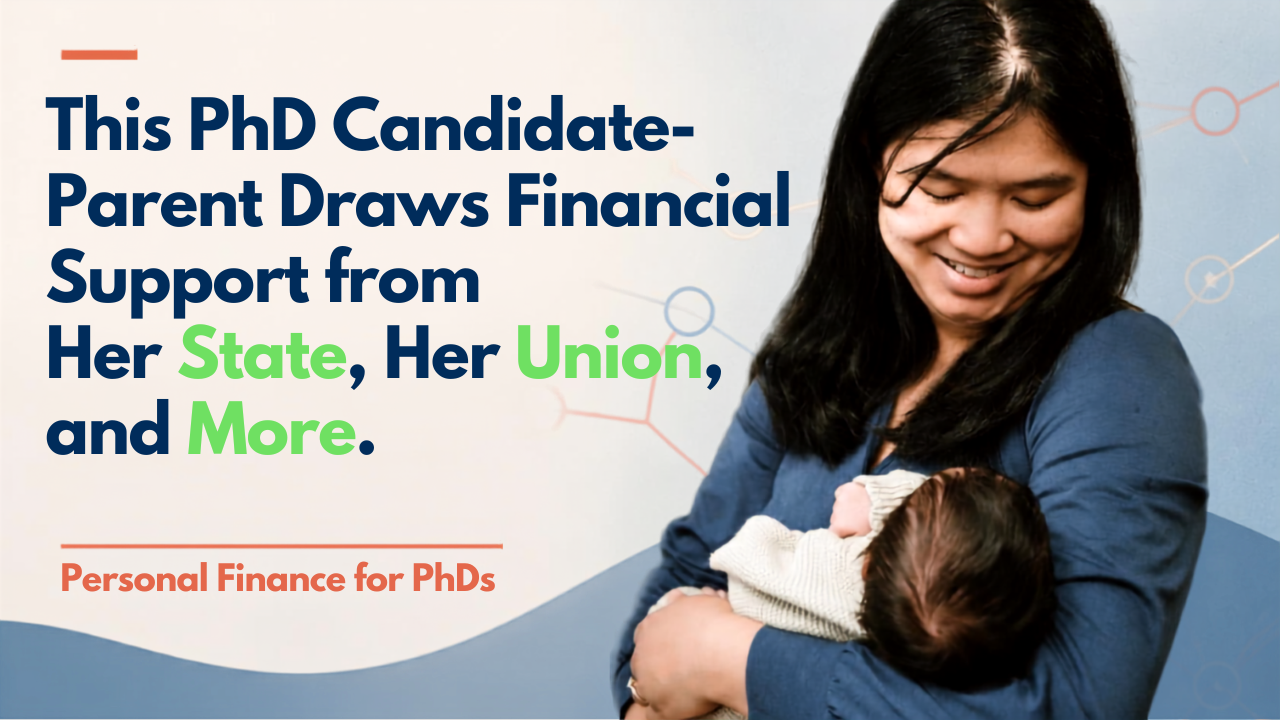
This PhD Candidate-Parent Draws Financial Support from Her State, Her Union, and More

September 14, 2026 by Jill Hoffman Leave a Comment

In this episode, Emily interviews Madeline Hebert, a 5th-year PhD candidate at the University of Connecticut and married mother of a toddler and newborn. Madeline shares how her money mindset has changed over the last several years, from poring over every last expense in her budget to investing in frugal strategies and increasing her income through fellowships and paid projects. She also details the systems from which she has drawn financial support, chiefly through state childcare benefits and her grad student union. The total value of these benefits is so high that Madeline chose not to pursue a $100k one-year fellowship because it would have negatively impacted her family’s bottom line.

Links mentioned in the Episode

  • PFforPhDs Quarterly Estimated Tax for Fellowship Recipients (Individual Purchase)
  • PFforPhDs Quarterly Estimated Tax for Fellowship Recipients (University Sponsored)
  • PF for PhDs S16E1: How This Grad Student Budgeted for Having Her First Child
  • Host a PF for PhDs Seminar at Your Institution
  • Emily’s E-mail Address
  • PF for PhDs Subscribe to Mailing List
  • PF for PhDs Podcast Hub
This PhD Candidate-Parent Draws Financial Support from Her State, Her Union, and More

Teaser

Madeline (00:00): I found myself applying for like every single award, grant, um, scholarship. And before I would let imposter syndrome affect it a lot more being like, oh, like I’m not qualified or I don’t fit that or whatnot. But instead now I’m like, I need money. I’m taking every single opportunity I can get.

Introduction

Emily (00:21): Welcome to the Personal Finance for PhDs Podcast: A Higher Education in Personal Finance. This podcast is for PhDs and PhDs-to-be who want to explore the hidden curriculum of finances to learn the best practices for money management, career advancement, and advocacy for yourself and others. I’m your host, Dr. Emily Roberts, a financial educator specializing in early-career PhDs and founder of Personal Finance for PhDs.

Emily (00:51): This is Season 25, Episode 2, and today my guest is Madeline Hebert, a 5th-year PhD candidate at the University of Connecticut and married mother of a toddler and newborn. Madeline shares how her money mindset has changed over the last several years, from poring over every last expense in her budget to investing in frugal strategies and increasing her income through fellowships and paid projects. She also details the systems from which she has drawn financial support, chiefly through state childcare benefits and her grad student union. The total value of these benefits is so high that Madeline chose not to pursue a $100k one-year fellowship because it would have negatively impacted her family’s bottom line.

Emily (01:41): Let’s talk fellowship taxes for a minute here. These action items are for you if you recently switched or will soon switch onto non-W-2 fellowship income as a grad student, postdoc, or postbac; you are a US citizen, resident, or resident for tax purposes; and you are not having income tax withheld from your stipend or salary. Action item #1: Fill out the Estimated Tax Worksheet on p. 12 of IRS Form 1040-ES. This worksheet will estimate how much income tax you will owe in 2026 and tell you whether you are required to make manual tax payments on a quarterly basis. The next quarterly estimated tax due date is September 15, 2026. Action item #2: Whether you are required to make estimated tax payments or pay a lump sum at time tax, open a separate, named savings account for your future tax payments. Calculate the fraction of each paycheck that will ultimately go toward tax and set up an automated recurring transfer from your checking account to your tax savings account to prepare for that bill. This is what I call a system of self-withholding, and I suggest putting it in place starting with your very first fellowship paycheck so that you don’t get into a financial bind when the payment deadline arrives. If you need some help with the Estimated Tax Worksheet or want to ask me a question, please consider joining my workshop, Quarterly Estimated Tax for Fellowship Recipients. It explains every line of the worksheet and answers the common questions that PhD trainees have about estimated tax. The workshop includes video content, a spreadsheet, and invitations to at least one live Q&A call each quarter this tax year. The last live Q&A call for this quarter is today, Monday, September 14, 2026. If you want to purchase this workshop as an individual, go to PFforPhDs.com/QEtax/. You can find the show notes for this episode at PFforPhDs.com/s25e2/. Without further ado, here’s my interview with Madeline Hebert.

Will You Please Introduce Yourself Further?

Emily (04:08): I am delighted to have joining me on the podcast today a repeat podcast guest, Madeline Hebert. She is a rising fifth year PhD candidate at the University of Connecticut and was last on the podcast in season 16, episode one, talking about having her first child very early on in graduate school and how she budgeted for all of that and figured out childcare. And we’re gonna be revisiting some of those same topics, but in, you know, a few years further along in this episode because Madeline has now had her second child during graduate school, um, and has, you know, that’s really changed her thinking about, um, things related to money. So Madeline, thank you so much for coming back on the podcast. Will you please introduce yourself a little bit further for the audience?

Madeline (04:50): Thanks. Yes. Um, my name is Madeline Hebert. I am a fifth year graduate student at the University of Connecticut, and I have two children now. One who is two and a half, will be three in August and the other one was born on, in February. So I’m really excited to be back here. I study LGBTQ youth, um, and interested in public policy, intervention prevention for them. And then my husband, he’s a telemetry worker. He’s also now a student himself and he has been working an hourly rate and now is about to go down to, um, about like per diem, what they call, is what they call it.

Emily (05:28): And what’s he studying?

Madeline (05:29): He is, um, he just got entered, uh, accepted into a dental hygienist program. It’s at the local community college and we’re really excited about that because yeah, he’s really excited to get to change career um, transitions basically.

Parenthood and Its Impact on Your Money Mindset

Emily (05:43): Awesome. Well, let’s get into it. Our last interview fell at a really like interesting stage because you, at the time of the art interview, you were pregnant, um, with the first baby. And obviously, you know, that, that stage is what it is and you’re a parent already, but now you’re a parent in a much different way <laugh> having two babies out in the world in childcare, you know, you have to balance everything with your, your work and all that. So just, you know, give us your thoughts now about how your view of money has changed, you know, in the past few years, um, with these life stages.

Madeline (06:15): I think that like at the beginning, I used to be super really anxious about money and I was doing like a l – I was following like a lot of the budgeting and itemization and looking back behind and, um, and that was really useful for the time. But now with like two children, it’s much more difficult and stressful, I think, to do like all the item line by line and to take the time and have the time to be budgeting like that. So I find that instead thinking about money in a very global sense, being like, okay, I know how much I’m generally going to be making this month and we try to stick to that expenditure within the month and we kind of more so like maybe once a week I’ll look at my app and be like, okay, like we are either above or below what I think that we should be for having spent for that month. But that has also reduced a lot of financial anxiety and has also helped a lot with being able to manage like, okay, are we able to spend what we need?

Madeline (07:10): Also thinking about money as like, okay, I have to buy things in a very cost effective way. So we signed up for a Costco membership, which at the upfront is a bit more expensive and we’re very fortunate to be able to cover that cost because in the end we’re ending up saving a lot on buying in bulk and buying shelf stable foods and buying, um, things like freezer, large amounts of meat that we can freeze and use throughout the month kind of thing. So we kind of now shop monthly. So that’s also kind of affected my, the way that I think about money. And then like literally just finding every single way to make money, um, from a kind, not from a side hustle perspective, because again, like when you have kids, your time becomes very precious and very limited I have found, but at the same time it’s much more intentional. And so instead it’s more kind of like, not even passive income, but making use of a high yield savings account and taking advantage of entry, um, entry modes for the fact that I travel at least twice a year for conferences, I invested in a travel, um, the, a travel credit card that is a little bit, again, pricey at the upfront, but then I essentially am being paid to have it because of how much I’m using it and the benefits that it’s giving me and the, um, travel credits that it’s given me. And so things like that, um, I’ve been taking advantage of. Um, I’m also been trying to find, I found myself applying for like every single award, grant, um, scholarship. And before I would let imposter syndrome affect it a lot more being like, oh, like I’m not qualified or I don’t fit that or whatnot. But instead now I’m like, I need money. <laugh> I’m taking every single opportunity I can get. I’m trying to, I find myself having to try to hop onto every single like project that I have the capacity for and I have to be much more intentional about which projects I sign up for because again, that time’s limited and I’ve had to turn down some opportunities in fact because they were not paid. I have to be like very upfront and being like, I’m sorry, but I’m looking for a paid summer, um, project to work on and to help with. But that’s also led to me reaching out to other faculty who I might not have reached out to before because I knew that they had funding and I tried to find ways that, in which my own research could fit into their project. So this way I could also be of hireable help in the, in other words.

Madeline (09:34): So that’s been kind of interesting because that relationship with money I’ve found has also affected my relationship with my research in trying to be like, okay, I need a project and a research interest that helps me also create a path forward in careers that are more popular in the higher paying industry. So moving towards a public policy research prevention intervention space has allowed me to be looking into more government type jobs and looking into public policy related jobs, public health jobs. So that’s something that was also kind of a, I am interested in it, but also because the way of my relationship with money now I’m moving towards that as well.

Emily (10:17): I think all of those shifts that you just mentioned are really positive and ones that probably other grad students, whether they’re parents or not, probably need to be moving in those directions. I mean, understanding that like your work and research has to have some market value, like yeah, of course it does, like especially moving out of graduate school or out of academia. I wanna take some of the things that you just mentioned piece by piece, um, because again, I do think these are all like really positive evolutions, um, maybe for you motivated by becoming a parent, but also again, something that other people can learn from whether they’re in that situation or not. And the first one you mentioned was about like sort of getting out of the weeds of, um, super detailed tracking or like daily basis kind of tracking and getting up into the, um, how can I have a longer term view of my money and of frugality so that you are, as you were kind of saying, like it’s okay if something costs more upfront if it’s able to help you spend less over time. And that is something that I think maybe can take some time for people to make that leap because they do need to get out of the like s- serious paycheck to paycheck cycle to be able to do something like purchase a Costco membership or, you know, pay the upfront annual fee for a travel credit card. But it is possible for a lot of people who to start taking that longer view. So I’m really, um, glad that you mentioned that. Do you think, because I have also made the shift dur – I also made the shift during graduate school. Do you think it was necessary to be in the weeds for a period of time before making that jump? Or do you think, mm, I could have just taken this like higher level view from the beginning and that would’ve been better?

Madeline (11:58): I think that was really beneficial. I’m not entirely sure if it was necessary per se, but I do think that for me it was really beneficial because it helped me get a good grip of like, okay, this is how much I can spend. I tend to think of very black and white thinking. So saying, okay, I have $20 to spend this week on snacks really makes me aware of like, okay, how much have I gone to Starbucks this week? But then it also gives me this freedom to say, oh, if I want Starbucks, I have like X amount of money still to set aside to spend on myself. Whereas now I’m like, okay, like I know that I want to go and spend money on myself, but now I’m a little bit more like, okay, like, well, where are we a little bit and want to check in with my husband about it? And then, but because I have a husband to also kind of like talk about finances with, it has made it to where we do have to talk about like, okay, like, do we want to set aside a little bit of money or make sure that we have spent roughly an allocation of particular amount of that monthly bu – higher budget? But because he works an hourly job, so some months he’s only worked like a full three weeks instead of four weeks or we travel for two weeks, like that is a constantly shifting number. So it helps us to not be like, oh, well, this week we don’t have this much or it reduces a lot of the anxiety around there by not having that, um, minutia or minute, um, examination of the numbers.

Emily (13:24): I think probably you’ve also most likely dialed in your larger necessary expenses, um, and you’ve become very familiar with them over the time that you’ve been in graduate school so that, um, you don’t have to pay as much attention to those really, really tiny expenses if the, if the large ones are dialed in appropriately. I know we’re gonna talk about childcare a little bit later on, but can you share with us how, like, your housing has changed over that period of time?

Changes In Fixed Expenses: Housing, Food, Internet, & Streaming Services

Madeline (13:51): It’s funny that you mentioned it because the housing changed after the childcare changed. So originally we were living in a one bedroom, um, apartment and it was about 1,400 starting off in every year it would increase about $50. So that was a pretty, like, manageable increase. And, um, that has now actually increased to an apartment that is about 1,800 now, now 1,900, just recently, 1,945 for our two bedroom apartment, two bathroom apartment, which, which has honestly been, like, much higher quality of life for us though. Um, but that changed. Our food has been still roughly around 300, some months 400 to 500, but we don’t go out very- I find that we swapped going out to, like, a nice restaurant for more Taco Bell and McDonald’s kind of restaurants, and maybe once a month we’ll actually go out to a real restaurant. Um, and so those kind of expenditures have changed. They, but it still feels like we’re going out to eat. It still feels like, oh, we’re not, like, cooking every single night. Um, but my husband makes a very good point that very often we do cook, probably more so than a lot of our peers that he finds. Um, and so, like, just about every night he cooks or we have a, like, leftovers. Um, and so that, um, has gone down. Trying to bundle, like, expenses for, like, streaming services usually. He’s got, like, for example, Disney through his phone bill. I realized that our internet service was doing, like, another deal. It had increased after, like, that two-year promotional contract, but then I found out that I’ve, every now and then I check. And so by doing that, I found out, “Oh, wait, they’re doing a new promotion that’s actually cheaper than what I’m currently paying. Let me get in on that, and now I pay less again for my internet.” So s- some small things like that. Those are our biggest expenses, that electricity, water. We don’t really spend much on, on other things. Those are kind of the big bucket spending things I find.

Emily (15:52): Yeah, it’s really good that you’re paying attention to those fixed expenses, like, you know, phone bill, internet bill, these kinds of things. Like you said, you just have to touch base, like, maybe once a quarter, you know, one, once every, you know, twice a year, something like that. And then you can find those opportunities. And it doesn’t have to be the daily checking in, right, like you sometimes would do with your variable expenses. Now, there was another, um, sort of big category you mentioned earlier in your answer, which is about, um, increasing your income has become much more of a priority for you, um, having the children. And again, I think this makes a lot of sense that the general grad student evolution, and of course, thinking forward to your next stage in your career. I really like that you mentioned that you used to feel some, um, imposter phenomenon and now you’re just like, “I have to get through it because I just need the money. I just have to apply anyway.” Um, can you expand on that a little bit more, like, maybe how you look for opportunities?

Finding Opportunities to Earn Extra Income During Grad School

Madeline (16:44): My department, they tend to do, like, a little weekly announcement being like, “So-and-so, congrats. They got some sort of award.” Um, it’s been making me, like, they, we also get these, like, daily digests that are super annoying, honestly, but they also offer, like, a rewards and fellowship, scholarship opportunities. And I, every single day now, I s – just scan it being like, “Hmm, is there anything that looks like it might be worth my while to go look into?” Um, if I hear that so-and-so got, like, an assistantship with a professor, I’m like, “Hey, um, can, I was wondering if you think that they might have a little bit, if they might be still looking for people or, um, is there, like, anything that might need assistance on?” Um, just, also just remembering, okay, like, every single time I’m reminded that there’s yearly of scholarship awards, I apply for every single one that I can. And I try not to get in my head by being like, “Oh, well, like, do I deserve to apply for, like, the financial need-based scholarship? Do I, um, is it bad that I’m asking for government assistance?” So, like, I know that my state offers, um, financial assistance for winter heating, even if your heating is included in your rent. It offers assistance for diapers, it offers assistance. My university has, like, a parent resource event once a semester, and I go attend that and I make sure I grab some diapers and some, and some wipes and stuff. So, like, not trying to get the shame and the guilt and all that encumbered, and instead being like, “Okay, like, these are things that I need to take advantage of so that this way, like, I don’t have to spend these expenditures later on.”

Emily (18:16): I’m so glad you brought that up, because it’s actually a theme I’ve been exploring in some other podcast interviews recently, and also in the writing that I’m doing about kind of getting past the mental blocks that might tell you this assistance being offered is not for me, or I do not deserve to avail myself of these resources. Um, and just, like, from an outside perspective, like, you haven’t even mentioned how much money you make or anything, but, like, you’re a PhD student, your husband’s now, like, working part-time and going to school. Like, you all are investing in yourselves, in your education, in your professional development right now, and that’s something that our society should support. And for goodness sakes, you got two children too. So, like, let’s support this family as you’re all growing and developing, and that will make you so much more successful and able to, you know, contribute so much to society, both of you, all four of you, um, in the future. And so, it just makes sense to me that, like, that people make these resources available and that you should take advantage of them, um, and as much as possible, get out of your feelings about it. Like you’ve said, that you’ve really been trying to, like, push past. So, like.

Commercial

Emily (19:25): Emily here for a brief interlude. Would you like to learn directly from me on a personal finance topic, such as taxes, goal-setting, investing, budgeting, or designing your financial life, each tailored specifically for graduate students and postdocs? I offer live workshops, asynchronous online courses, and cohort-based programs on these topics, and I’m now booking for the 2026-2027 academic year. If you would like to bring my content to your institution, would you please recommend me as a speaker or facilitator to your university, graduate school, graduate student association, medical school, postdoc office, or postdoc association? My workshops are usually slated as professional development or personal wellness. Ask the potential host to go to PFforPhDs.com/financial-education/ or simply email me at [email protected] to start the process. I really appreciate these recommendations, which are the best way for me to start a conversation with a potential host. The paid work I do with universities and institutions enables me to keep producing this podcast and all my other free resources. Thank you in advance if you decide to issue a recommendation! Now back to our interview.

Connecticut’s Government Assistant Program: Care 4 Kids

Emily (20:54): Let’s move on to then talking about, like, what are the sort of helps and, and systems and resources that you have noticed around you, especially since becoming a parent, um, and just go through them, like, one by one, because other people may, you know, see similar things in their own surroundings.

Madeline (21:10): Perhaps the biggest number one support, um, system besides my family itself is probably, um, this, honestly, the state government assistance and that exists within Connecticut. So the Connecticut, um, offers a, what they call Care 4 Kids program, which is a state subsidy program for childcare that the, the kind of effect that it’s had, it has reduced a childcare that normally is, like, around at least 1400 up to $2,000 per kid down to, like, $200 for our family. Um, and so, like, you can hear, like, just how enormous of a difference and shift of financial, um, freedom that that allows, and financial flexibility that that kind of assistance allows. Um, so that has been just monumentally incredible for allowing us to be able to move into our two bedroom apartment, to be able to continue buying healthy foods for ourselves, to make sure that we’re able to sustain ourselves, not only in just not, to where we’re not just surviving, but we’re actually being able to still thrive to some degree. And so –

Emily (22:14): May I ask, um, because on the last interview that you gave, I, I believe you were talking about how you had chosen, like, a campus affiliated daycare. That I think maybe was sliding scale, if I’m remembering correctly. Um, did you not know about the state system at that point? Or, like, when did that s- When did you kinda, like, plug into that?

Madeline (22:31): That’s a good question, because I don’t remember if I didn’t know about the state assistance back then or not. I don’t think I did. I think that I learned about it a couple of months in, and that’s actually been a really tricky thing, because the state system requires you. They, they prioritize parents who are working, they prioritize parents who are working, and students. So, PhD student, um, parent, really great candidate. Um, but it also has income caps where you have to make, um, to get in, you have to make around, like, 65% of the state median income, and then once you’re in, you can make up to 85% of the state median income to remain in the program. And so, but they base it off of either what you make yearly or what you make monthly. And so what I make monthly, because I’m a student with a stipend amount monthly, it looks much higher, even though yearly I’m not being paid for three months. So in reality, I have to essentially save away a portion of my income for, to cover this summer month. So what I ended up doing is I applied it as an annual income, and I indicate that I’m being paid essentially annually because that would reduce how much I’m being shown to be m- making for the monthly expense, which allowed us to be able to enter into the program. But that’s really tricky because if you don’t realize that you can and need to do that as a graduate student, especially on this kind of contract system, then you look like you’re making too much and you don’t qualify. Literally, when it first happened, it looked like I was like, “You’re, like, $20 over. You don’t qualify.” And so for actually, like, up until probably in January, maybe even March of the first year, we were paying, like, $900 every single month. And that’s only because I divided what is a 10-month tuition rate, um, across a 12-month, um, span.

Emily (24:22): So at the time that you first applied, you had to be at 65% of the median income for the state or lower. Um, and it sounds like, you know, y- you figured out a way to present your income accurately, um, but so that it showed that. And then after that point, you would be permitted to increase your income. So when you’ve talked about, like, applying for more fellowships or, like, applying to, you know, have additional assistantships or, or what have you, that has not bumped you above that 85%, it sounds like.

Madeline (24:47): Correct. Correct.

Emily (24:48): So it’s a little bit of a game of, like, we wanna increase the income, but we know there’s a ceiling at some point.

Madeline (24:53): Yes. And that part of that was when we were like, “You know what? Now’s a great time for my husband to drop down from being full-time to part-time and so, and become a student, so this way our income cannot go above that threshold.” So that- He had already been planning on becoming a student, but the original idea was that he would go after my PhD, but then we were like, “Actually, it’s really beneficial for us to be able to, um, have you go now, so this way we don’t go above that threshold.” So it’s being cognizant of, like, okay, how much are we making now to fit into all these, like, little pieces? It’s like a puzzle game.

A $200 per Month Childcare Bill That Gets Reimbursed

Emily (25:28): I don’t know if your second child has already entered into, um, daycare, but when you have the two in, what’s the total cost gonna be for the household?

Madeline (25:36): So they do what’s called a family fee. And at first, I wasn’t sure about how that would work because the family fee is supposed to be like a percentage of your total income. And it turns out that no matter how many ch – well, at least for our case, having two children in it, it’s still basing upon the family fee itself. So one child now we pay for, and the other child is essentially free, actually. I don’t know what that’s going to look like because every single summer they change daycares because the current, the school affiliated daycare is only open until June, and I still got work in the summer, so they switch daycares and then back, they return back in the fall. And those daycares have different rates, so that’s a little bit complicated. But, um, essentially, we only pay $200, and we were paying $200, and now we still pay $200. So that’s been really incredible.

Emily (26:26): That is incredible. I, I think about, like, you know, when people talk about how, like, you know, the US is one of the only developed countries that doesn’t have, like, early childhood education and all of that. It’s like, wow, Connecticut is doing it at least for these, like, low income, like, residents like you all are. So, again, that’s really, really encouraging that that’s available to you. And, um, something that, you know, people who aspire to become parents during graduate school, if you know that beforehand, you can really look carefully at, you know, the individual universities and the states that they’re in to see what kind of support is gonna be available to you from those different, like, levels. Okay, so you said the main big time support is this childcare program through the state, that’s amazing, but what else has helped you financially?

Madeline (27:08): My union’s been really great as well because they offer also a childcare reimbursement program, or not program, but they have a childcare reimbursement fund. And so, they actually calculate a per kid rate, and because our, um, childcare costs are so low now, we essentially get reimbursed fully for the childcare costs from that funding as well. So, that’s another little bump up that we get, um, from the union every semester.

Emily (27:35): Okay. My mind is, like, blown right now. Like, <laugh> like, okay, childcare, number one, like, I think we talked last time, like, there are several big costs going into, you know, having a child. Childcare, top of the list, leaves also up there, insurance also up there, medical bills, of course, feeding and, and diapering and so forth. But, like, the childcare is, like, the main. Once you get through the whole birth and, and, you know, newborn phase, like, the childcare is the main, main, main big expense. And so, ugh, I’m just so pleased that those resources were available for you, um, because, yeah, you, you wouldn’t have to, you know, take such a huge financial hit for this decision to become a parent during graduate school, so that’s amazing.

Madeline (28:15): The fact of the way that the childcare subsidy program works, the way that my union works is actually a reason that I declined, like, the. Well, I almost had the opportunity. I was, um, in the process of getting interviewed for a job that would pay, like, 100K, honestly, but it had no health insurance, no contracts for any sort of assistance like that. And because it paid so much on paper, I would essentially make myself in, um, ineligible for remaining in the subsidy program. And when I did the math, I came out making less per month, essentially, because of all the additional costs compared to just staying as essentially the idea of the poor graduate student, right? And so that was kind of ironic to me to see, like, the- just the. We don’t talk about it as much, I think, the financial relief that, like, just having certain systems in place, because it doesn’t come on paper that I’m making a lot, but I essentially am receiving the benefit of a much more higher cost than, than what I would be making if I were making much more money.

Madeline (29:21): Especially, especially being pregnant and then expecting to deliver that baby and such. Um, I though about that too. I was like, “What’s the cost of paying marketplace health insurance compared to what my union subsidizes through our employment and everything and what that covers too, because we don’t, we didn’t pay, we don’t pay anything for hospitalizations or anything that comes from hospitalization. Um, and I know that people can pay, like, a couple thousand dollars for having a baby, just like most basic way of having a baby. Um, and we’re really fortunate because our baby ended up in the PICU center right after birth, and it was such a relief to know that we wouldn’t have to really worry about being hit with a extremely high medical bill after that.

Emily (30:05): Oh my goodness. Yes.

Madeline (30:07): Yeah, I, I think that people don’t realize like, oh, like looking at the benefits that a place offers you is, is almost just as important as looking, well, probably just as important as looking at the actual numbers that the place is offering you. That’s what I’ve learned. <laugh>

Emily (30:21): And when you were looking at that job offer, the 100K job offer, would that be like you would’ve left your PhD program and that would’ve been your full-time thing?

Madeline (30:29): Yes. I would’ve taken. I was planning on, um, considering an academic leave of absence because it’s a one-year fellowship to work as like a state governor’s, um, fellow. So I didn’t have the job offer officially, but it was, um, I was in the second round of interviews and then I found out I was pregnant and then I was like, “Oh dear, I need to figure out this before I make serious adjustments.” Um, and part of that was because with all the budget cuts and everything, my department and a lot of departments across, um, the university have been limiting the graduate assistantship hours from a full-time to a 75%. So that was something that I was trying to navigate. And that goes back to that value of money, prioritizing, making sure that my family is cared for and making sure that we’re making enough money versus being like, okay, like not necessarily being like, oh, is this necessarily the best trying to get out of my degree as fast as I can or trying to go on every single project I can. I have to think a little bit differently than I think than I would’ve if I weren’t in this position as a grad student.

Emily (31:26): Mm-hmm. And is that because of basically your limited work hours, like because of the amount of childcare/how much time of course you want to spend with your children? Um, is that the limiting factor is at the time?

Madeline (31:37): I don’t find it’s the time actually. It’s, it really is just making like at 20% we’re able to afford life. It really, and then at 75% we would be going into debt more. And so it’s, it was a waiting game of figuring out like, would I be able to secure a 20-hour assistantship? Would my husband, what is my husband going to be paid at? How many hours is he going to get? How many hours do I need? Just all of the, those small, that’s where my new money calculation into the weeds has gotten into, is to looking at like those kind of things being like, what do we need to be able to afford life at not even like high quality, I would say, but just like being able to be like, okay, we don’t have to fear like going into debt really, um, for just like daily living. And so that was what I was really considering. I was like, oh, like 100K looks really good to be able to know like, oh, I, I’m pretty sure we can, we can survive off of that kind of thing. Um, and how is that gonna look with my husband going to school and having to drop hours potentially because of schooling and stuff? Um, ironically, I find myself to be even more focused and more, working more because of daycare. I’m like, oh, I only have nine to five. I gotta get some work done in this hour. Whereas before I was like, it’s three o’clock. I wanna go nap. I can work later in the evening. And then, and not actually work probably.

Emily (33:02): Yeah. I definitely saw that in graduate school with like the postdocs in my lab who were parents, like who kept very rigid hours but were very efficient when they were there. Any other sort of, um, sources of support that you’ve relied on?

Creating a Village During Grad School

Madeline (33:15): Yes. Um, a lot in the parenting community I find you talk about like creating a village. And so I have found the village through having, finding friends through my daycare, finding friends through literally just seeing people at like the farmer’s market with a kid and being like, “Hey, you have a baby. I have a baby. Let’s be friends.” Um, just finding different ways of support. And so that’s been emotionally, that’s been sometimes even financially, not necessarily that they’re paying us, but for example, when our baby was in the hospital, our friends picked up our oldest. Our friends helped us by, we do family dinner nights now. And so we share in the cost of like eating together, sometimes getting groceries. We go to Costco together. So like sharing in purchases like that sometimes financially has been really beneficial.

Emily (34:01): I think the intangible support though, like, not intangible, the, the tangible support that doesn’t have a dollar sign associated with it, um, is really, really important. And I know you’re long distance from your family and your husband’s family, right? Um, and similarly, when I had my children, we were long distance from all of our family members. And I also created a village with other parents in a similar situation. Uh, there were a lot around. Um, and so actually this has come up in recent interviews as well of like, in that case, my interviewees were talking about how it’s so beneficial to have roommates because you have a built-in support system that’s different than having just friends who you don’t live with. Like yeah, that person’s gonna give you a ride to the airport or like you can share food or what have you. And so you’ve created a similar thing among like the community of parents around you. Makes total sense. And it does, it does boil down to your bottom line eventually because maybe you get those favors, you know, that you would’ve had to pay a babysitter to do, um, otherwise. Or like you’re saying, the time that you would spend like cooking, maybe you only have to do that, you know, half as much as you used to because you’re able to share with your community. Um, it has both a positive like emotional effect as well as ultimately a financial effect.

Madeline (35:11): Yes, it definitely. The babysitting part’s big time because we’ve babysit for each other now and I’m like, that saves like easily 100, $200 because babysitting is not cheap.

Emily (35:21): My, uh, parent, community of parents near me now, uh, our kids are a little bit older, but we’re always like, “It’s easier when there’s other kids over because they just entertain each other and we can, you know, go cook or whatever needs to happen.”

Madeline (35:33): That’s exactly our thinking behind those family nights.

Emily (35:36): Yeah. So we’ve gone through, um, the, the state system and the childcare, the union, um, your, the village you’ve created. Any other sources of support that you’ve leaned on?

Additional Supports: Home Visitors and a Buy Nothing Group

Madeline (35:47): The other systems I can think of would be like the, um, home visitors, uh, which is part of the state systems that exist. And then also our Buy Nothing group, ironically, even though, like, it’s not the same as any other system that I have, to be honest. It’s been very interesting in that I can just say like, “Hey, like, we are looking for some help with, for maternity photos. We would love to have some, but we can’t afford them. Would someone be willing to come take our photos?” Just something like that, having neighbors who we can say, “Hey, um, can you help us move into our new apartment?” Um, they’ve been really, really helpful just to be like, “Hey, I need somebody who can drive my husband because my kids are all asleep. Can you take him to the doctors for us?” So those are other kind of little systems just like that we’ve created that’s kind of part of that village, but it’s not quite the same relationship as like a friendship, I would argue.

Emily (36:38): Mm-hmm. That’s interesting that your buy nothing community extends to like favors. I, I haven’t noticed that in mine. It’s more just like things, like take these things, have these things, you know, um, which I certainly use now. And honestly, for children who are growing very quickly, it’s very, very useful to have a pipeline of, you know, hand-me-downs coming your way and a place to get, you know, cheaper free equipment or car seats or just anything in that, um, line. So yeah, I can totally see how buy nothing would, um, help in that way.

Madeline (37:07): It was a, it was actually the suggestion of our home visitor. She’s like, “Why don’t you just ask that group that you always go to because it can’t hurt to ask and stuff.” And so we, that’s another way that I supplement like that itch for shopping. Like there’s like that you wanna doom spend or you feel stressed and you want some retail therapy and you’re like, “I don’t really have money to do that kind of stuff.” So instead I just go on my buy nothing group and I’m like, “Hmm, what, what’s popping up there?” And you get that thrill of dopamine being like, “Oh, I got selected,” or, “Oh, I got to it first and stuff.” So that’s kind of another psychological way of like kind of handling the stress of like not having a whole lot of disposable income I find. Um, it’s just kind of shopping on Facebook like that.

Emily (37:46): I love that idea. And again, it applies to non-parents as well. If like the thrill of the shopping is what you’re looking for, then put that extra layer of challenge of it’s gotta be free. <laugh>

Madeline (37:57): Yeah, 100%.

Emily (37:59): Well, I’m so thankful for all the insights that you’ve shared in this interview. I mean, especially about, you know, looking at that fellowship offer, or not offer, but like the interview process you were going through for that fellowship and realizing, oh wow, that number is high, but the benefit, the lack of benefits is completely offset and like what the situation you’re currently in is actually pretty good, especially that you wouldn’t be delayed another year for finishing your PhD and, and getting out into the, you know, permanent workforce and all that. So there’s so many insights that you’ve shared. Thank you so much, Madeline.

Best Financial Advice for Another Early-Career PhD

Emily (38:28): Um, I will end our interview by asking you the question that I ask all of my guests, which is what is your best financial advice for another early career PhD? And it could be something that we touched on already in the interview or it could be something completely new.

Madeline (38:41): Best thing that I have to say for an early career PhD student, um, would be just to really consider like what do you need and not be afraid to try to go for it. So if that means that you need financial assistance, try to get out of your head about that. If you need, um, if you need help with childcare, looking to see like what are creative ways to work through that. Be willing to ask friends, be willing to ask and find a neighbor that you feel you can trust, be willing to look into what government state assistances there are. And also just recognize like the power of systematic effects, like making sure like, oh, do, is there good health insurance available? Is there, um, are there other good benefits available? Not just looking at that bottom number, um, that bottom line.

Emily (39:28): Of course. Thank you so much for illustrating that for us during the interview today.

Madeline (39:32): Thank you. I’m so happy to have gotten to talk with you for this. So thank you for having me back.

Emily (39:37): Absolutely.

Outro

Emily (39:40): Listeners, thank you for joining me for this episode! I have a gift for you! You know that final question I ask of all my guests regarding their best financial advice? We have collected short summaries of all the answers ever given on the podcast into a document that is updated with each new episode release. You can gain access to it by registering for my mailing list at PFforPhDs.com/advice/. Would you like to view transcripts or videos of each episode? We link the show notes for each episode from PFforPhDs.com/podcast/. See you in the next episode, and remember: You don’t have to have a PhD to succeed with personal finance… but it helps! Nothing you hear on this podcast should be taken as financial, tax, or legal advice for any individual. Podcast editing by me and show notes creation by Dr. Jill Hoffman.
How to Live on Time to Maintain Margin in Your Financial Life

June 16, 2025 by Jill Hoffman 5 Comments

In this episode, Emily explains how to live on time with your finances. Living on time means maintaining financial margin in your life to be able to absorb unexpected occurrences in your income or spending. When you’re behind in your finances, your income is going out the door right after you receive it, you have balances on your credit cards that you can’t pay off until your next paycheck comes, and/or you are unprepared for the next manual tax payment that is required of you. This may be true even if you’re not experiencing financial consequences such as interest payments on debt. The good news is that it’s very simple, though not necessarily easy, to transition to living on time once you know what it means.

Links Mentioned in the Episode

  • PF for PhDs One-on-One Financial Coaching
  • Host a PF for PhDs Seminar at Your Institution
  • Emily’s E-mail Address
  • PF for PhDs Subscribe to Mailing List
  • PF for PhDs Podcast Hub
How to Live on Time to Maintain Margin in Your Financial Life

Introduction

Welcome to the Personal Finance for PhDs Podcast: A Higher Education in Personal Finance.

This podcast is for PhDs and PhDs-to-be who want to explore the hidden curriculum of finances to learn the best practices for money management, career advancement, and advocacy for yourself and others.

I’m your host, Dr. Emily Roberts, a financial educator specializing in early-career PhDs and founder of Personal Finance for PhDs.

This is Season 21, Episode 2, and today is a solo episode from me on how to live on time with your finances. Living on time means maintaining financial margin in your life to be able to absorb unexpected occurrences in your income or spending. When you’re behind in your finances, your income is going out the door right after you receive it, you have balances on your credit cards that you can’t pay off until your next paycheck comes, and/or you are unprepared for the next manual tax payment that is required of you. This may be true even if you’re not experiencing financial consequences such as interest payments on debt. The good news is that it’s very simple, though not necessarily easy, to transition to living on time once you know what it means.

I am delighted to announce that I am now offering one-on-one financial coaching! If you are a PhD or PhD-to-be in the US, I would be happy to serve as your financial coach. I can help you prioritize your financial goals, brainstorm and refine ideas for reducing spending, manage your side hustle income, start investing, prepare for tax season, set up a functional budget, evaluate a stipend or salary offer against your expected living expenses, and much more. What I can’t do is give you individualized investment or tax advice, but beyond that, it’s really open. As of now this coaching is structured as one-time appointments, so there’s no big commitment and you can book just one session or multiple at whatever interval makes sense to you. You can view my rates and book a free 15-minute initial call at PFforPhDs.com/coaching/. During that call, you’ll introduce yourself and your financial questions to me, I’ll let you know if we’re a good fit for a coaching relationship, and we’ll decide how you can best prepare for our first session together.

You can find the show notes for this episode at PFforPhDs.com/s21e2/.

Without further ado, here’s my solo episode on living on time.

Living on time is a concept I touch on in some of my financial education workshops, but I don’t always have time to expound and explain it completely, and it can be confusing. I decided to create this episode to go into detail about what I mean by it and how to enact it in your financial life. Also, this isn’t a concept that I really see other financial educators cover in depth so I can’t refer you to a book or similar resource. It’s not that mysterious or anything, as you’ll see, it’s probably more that the educators don’t have lower-income people front of mind for their teaching.

What Does It Mean to Live on Time Financially?

The basic concept here is that you shouldn’t unintentionally obligate your future income to pay for your current or past expenses. Basically, I’m encouraging you to not slide unknowingly into debt, although the debt I’m cautioning you about doesn’t always look like you might expect. I’ll share in a moment the three main ways this can easily happen.

The reason that I bring this up is that funded graduate students and others who live paycheck-to-paycheck, either habitually or occasionally, are particularly susceptible to not living on time and experiencing related consequences, such as overdraft fees, credit card interest, and financial stress.

What I’m going to suggest to you is a new way to be aware of your cash flow, i.e., your income coming in and your expenses going out, and that you exercise discipline to align with this concept of living on time. If you aren’t currently living on time, you are living with little or no margin in your financial life. When your financial life is going okay, do your best to live on time and create margin, so that the margin is there for you to access when your financial life is not going okay. In a way, this is an extension of the common financial advice to build an emergency fund.

Two more notes before we dive into what it means to live on time:

First, debt is a financial tool that is available to you. It’s not immoral or wrong to take out debt or be in debt. Debt is to various degrees financially damaging, so you should certainly carefully consider the type and amount of debt you take out. So when I said earlier that you shouldn’t unintentionally obligate your future income to pay for your current or past expenses, I’m not speaking about debt that you have intentionally taken out, such as student loans, a car loan, a mortgage, etc. In fact, I would rather you have a little more well-considered debt than to habitually live behind.

Second, I’m not at all shaming you for not living on time, if in the course of this episode you discover that you aren’t. I would venture that the vast majority of Americans do not practice what I’m about to outline. There are frequent instances in my own life when I’m not living on time and am eating into margin that I created in the past. That’s okay, that’s what it’s there for, but when you emerge from that tougher period, you should try to get back to living on time. Going back to the analogy of an emergency fund, your emergency fund is available for you to use, and after you spend some of it down, you should work gradually to build it back up so that it’s there for you the next time you need it.

Okay, enough beating around the bush, let’s get down to what I define as living on time financially.

1) All your income from one month goes to funding the next month’s spending.

In my view, monthly budgeting cycles make the most sense because so many of your bills are due once per month, including, virtually always, your largest bill, your rent or mortgage payment. A month is also long enough to average out most of your more frequent consumption-based expenses like groceries, car gas, eating out, etc. So if we are going to use a monthly cycle for our expenses, I also suggest that you create a monthly cycle for your income. Specifically, all the income that you bring in the course of a month funds the next month’s expenses. All of the income you receive in June should go toward funding your July expenses. That means that on July 1st, you should have sitting in your checking account all of your income from June, plus any buffer amount of money that you might like to keep in your checking account. That June income will be spent down over the course of July. All of the income you receive in July should be preserved for your August expenses.

If you are paid a monthly or bimonthly salary, this is a really simple and natural cycle to adopt. Things get a little more interesting when you are paid biweekly, weekly, or at some other cadence or have an income that varies with number of hours worked or amount of work accomplished. In those cases, the amount of money you take in over the course of a month will change, perhaps every month. I’ve seen people adopt really complex and confusing systems for handling their bills when their paycheck dates and amounts move around from month to month. They do this because they are using their income as soon as it comes in to pay expenses. In my view, it’s much simpler to wait. Collect all the income in the course of a month, know how much it is, and then use it in the subsequent month. You can even plan a unique monthly budget for every month if this happens a lot, but it’s all going to be based on money already received, not money you expect to receive.

If you are paid less frequently than monthly, which happens with some fellowships, your version of living on time does not include all income in one month funding the next month’s expenses because you don’t have income in every month. Tune back in later in this podcast season for a whole episode devoted to managing your unique income frequency.

In fact, the more of a time buffer you can create between when you receive your income and when you start spending it, the better, up to a point. When I was in graduate school, depending on my funding source, I was paid either on the 25th of the month or the last day of the month. I didn’t have much of a buffer because I was turning around and starting to pay expenses from that income within a day or a few days. After I finished grad school, I set up my business to pay my salary on the 15th of each month so that I could let that money rest, so to speak, for about two weeks before I started spending it in the subsequent month. My husband is currently paid bimonthly on the 15th and last day of the month. We’ve backed up our time buffer even a little further so that we let those paychecks rest for between half a month and a full month before we start to spend them, meaning that the money we will spend in July was received on May 31st and June 15th.

2) Use credit as debit and don’t slide into buy now pay later.

We’ve discussed living on time with respect to your income, and now I want to turn to living on time with respect to your expenses. The biggest danger in this area is the use of debt to delay actually paying for your expenses. This, too, can make budgeting much messier than it has to be.

The principle here is to use credit cards, if you choose to use them at all, as if they were debit cards. That means that every time you make a charge on a credit card, you already have the money to pay for that purchase in your checking account. You could pay the expense in cash, with debit, or with credit.

It’s all too easy with credit cards to push forward actually paying for the purchases you make for a few weeks or over a month. The same goes for buy now pay later schemes like Affirm and Afterpay.

To go back to our example from the last section, the money that you receive in June funds July’s expenses. Those July expenses can be put on a credit card, but you should be able to pay off the credit card in July with that June money. In fact, if you haven’t paid much attention to this before, I suggest that you pay your credit cards off completely at the end of each month to make sure you aren’t carrying any charges forward.

Getting behind with credit cards looks like making charges in July that you actually pay for in August or even September. If you combine it with using your income as soon as you receive it, you might be using August or even September income to pay for charges you made in July. That’s what I mean about unintentionally obligating your future income. You’re behind. And you didn’t even mean to be.

3) Keep up with your tax obligations.

This point only applies to people who are not having income tax automatically withheld from their paychecks, such as grad students, postdocs, and postbacs paid by fellowships or training grants who are US citizens, permanent residents, and residents for tax purposes.

Automatic income tax withholding by employers is very convenient for the individual. A more or less appropriate fraction of each paycheck is set aside and sent to the IRS and your state tax agency on your behalf to pay your annual income tax obligation. You never receive the money in your paychecks.

However, if you are not having income tax automatically withheld from your paychecks, that doesn’t mean you don’t owe the income tax. You will have to pay it at some point, whether it’s when you file your annual tax return or throughout the year via estimated tax payments.

For these individuals, I recommend setting up what I call a system of self-withholding, which means that from each paycheck, you automatically transfer the amount of money you expect to pay in income tax to a savings account dedicated to sequestering this money from the money available to you to spend. When it comes time to pay the IRS and your state tax agency, you pull the payment from this particular savings account, which has been pre-funded with the amount due.

Therefore, this is one more component of ‘living on time.’ If you don’t set aside the money for these tax payments, and perhaps spend it or allow it to leave your bank account for some other purpose, you will be caught out when the payment comes due and need to set up a payment plan with the IRS if you can’t pay—once again, sliding unintentionally into debt.

Living on time means preparing for your income tax bill with every paycheck that you receive, just like when you had an employer doing it for you.

I actually didn’t plan it this way, but it turns out that the day this episode drops, Monday, June 16, 2025, is the estimated tax payment deadline for quarter 2. And that is strange because June is the sixth month of the year, not the seventh. You would think that each quarter, for estimated tax purposes, would be three months long, with the payment due date coming midway through the following month, but you would not be correct. For whatever reason, the payments are due in mid-April, mid-June, mid-September, and mid-January, implying quarter lengths of three, two, three, and four months. Oh, but you still owe one-fourth of your calculated annual obligation on each due date. So to live on time, not only should you save a fraction of each paycheck for your future tax obligations, but you need to make sure that you save extra in quarter 2 or prior quarters to meet that early deadline.

Commercial

Emily here for a brief interlude.

Would you like to learn directly from me on a personal finance topic, such as taxes, goal-setting, investing, frugality, increasing income, or student loans, each tailored specifically for graduate students and postdocs? I offer seminars and workshops on these topics and more in a variety of formats, and I’m now booking for the 2025-2026 academic year.

If you would like to bring my content to your institution, would you please recommend me as a speaker or facilitator to your university, graduate school, graduate student association, medical school, postdoc office, or postdoc association? My workshops are usually slated as professional development or personal wellness. Orientations, postdoc appreciation week, or close to the start of the academic year would be a perfect time for tax education or general personal finance content. Ask the potential host to go to PFforPhDs.com/financial-education/ or simply email me at [email protected] to start the process.

I really appreciate these recommendations, which are the best way for me to start a conversation with a potential host. The paid work I do with universities and institutions enables me to keep producing this podcast and all my other free resources. Thank you in advance if you decide to issue a recommendation!

Now back to our interview.

Why Attempt to Live on Time

So why should you endeavor to live on time the way I have defined it, even if you don’t always live up to the ideal?

Think about what could happen if you don’t live on time—if you spend your paycheck the day after it comes in and put charges on a credit card that you aren’t able to pay off for a month or two?

First, the income side. If anything goes awry with your income and you don’t receive a paycheck when you expected it in the amount that you expected, immediately you’re overdue on bills or unable to buy gas or food without accessing debt. If you get sick and miss work and either don’t have paid sick leave or you run out, your next paycheck will be smaller than usual or nonexistent. If you depend on side hustle income, but it dries up suddenly, you may find yourself in a bind. If you are on fellowship, your university might play fast and loose with your paycheck date as they don’t have the same legal obligation to stick to a schedule that they would if you were employed. I’ve seen this happen over multiple years to fellows in the University of California system, for example, who expected a stipend disbursement on September 1, but it didn’t come until over a week later. And earlier this spring, the paychecks of NSF postdoc fellows arrived late because of interference by the Trump administration. Of course, none of that is the fault of the individual, but they are the ones to suffer the consequences of a late paycheck, so it’s best to be proactive to build in some margin. When you live on time, a paycheck coming late or in a smaller amount than anticipated is still a problem, but you’ve bought yourself some time to figure out how to pivot.

Second, the expenses side. If you’re spending money you don’t already have in your bank account on a regular basis, what happens when an unexpected expense arises or an expense is larger than you anticipated? You have no margin to absorb these expenses on a temporary basis so that you can figure out your next move. Maybe you’ll put the expense on a credit card, but that tips you into carrying credit card debt instead of managing to pay it off by the due date to avoid interest accruing. If you maintain margin on your credit cards through the habit of living on time, breaking that habit once in a while by making a charge you can’t pay for immediately gives you a handful of weeks to adjust your spending in other areas so that you can ideally pay it off by the due date.

You can see from these examples that it’s not a terrible thing to eat into this margin when you need to to buy yourself time. But if you never maintain the margin in the first place, sliding unintentionally into a type of debt, it can’t serve its purpose when you hit a speedbump in life.

Of course, if you do have an emergency fund, you could access it to handle a small or missed paycheck or an unexpectedly high expense. I just consider the emergency fund to be the backup layer to the margin that’s created by living on time.

In fact, I think you should get on time with your finances even before starting to build your official, separate emergency fund.

How to Start Living on Time

If you are not currently living on time in the most ideal sense, how do you start moving in that direction? The answer is perhaps disappointingly simple. You have to spend less than you earn—even more so than what you’ve been doing to this point.

The ultimate outcome I want for you is to start each month with zero balance on your credit cards and a checking account balance equal to all of your income from the prior month. You can also add a buffer of $500 or $1,000 if you feel more comfortable with that, and I would recommend that if you are operating off of a once-per-month paycheck that arrives late in the month.

As a variation on this, you don’t actually need to clear the balance off of your credit cards at the end of each month as long as you have enough in checking to cover the balances on top of your prior month’s income and you have all the cards on autopay. However, that means your target checking account balance will vary every month.

How do you get from where you are to your target checking account balance and zero balance credit cards? You have to save money. I suggest first trying to do so inside of your checking account because that is where the money ultimately needs to go. You basically need to see your checking account balance gradually increase month over month until you reach your target. But that process can be difficult to track with money cycling in and out all the time, so alternatively you can save money in a separate savings account until you reach your goal and then transfer it into checking and pay off your credit cards in one fell swoop. I would only recommend this method if you’re not accruing interest on credit card debt. After you reach your target checking account balance, all you have to do is maintain the correct balance. Or, if you use the margin for one reason or another, restore it as soon as you’re able to by, you guessed it, saving money.

How do you save money? It’s not really the topic of this episode, but your choices are essentially to earn more, spend less, or redirect your existing savings rate. Your mileage will definitely vary on which of those options is most accessible.

If you are currently saving money for a different goal, I would suggest pausing progress on that goal until you’re living on time. The exception would be if your goal is to repay high interest rate debt, in which case that can take precedence. Whatever goal you’re working toward would get disrupted anyway if you had a loss of income or an unexpected expense.

If this is a goal that can be accomplished in the short term, the most immediate way to increase your savings rate is likely to spend less, so try some temporary fasts from discretionary spending such as eating out, alcohol, and entertainment and re-evaluate your small, fixed expenses like subscriptions.

If this is a longer-term goal, you can try to increase your income through side hustling, if that’s permissible, by winning a fellowship or grant, or negotiating. I also recommend re-evaluating your large, fixed expenses such as housing and transportation and creating new habits to reduce your grocery spending.

In closing, I want to emphasize that living on time is an ideal, and I don’t expect you and you shouldn’t expect yourself to live up to it 100% of the time. However, if you make it a general practice to reserve all of your income from one month to fund the next month’s spending, use your credit cards as if they were debit cards, and keep up with your tax obligations, you will have financial margin in your life to absorb the smaller shocks that you might experience like a late paycheck or unexpected expense. To get to living on time, you just have to save money so that your checking account balance grows to your target level at the start of each month.

Outro

Listeners, thank you for joining me for this episode!

I have a gift for you! You know that final question I ask of all my guests regarding their best financial advice? My team has collected short summaries of all the answers ever given on the podcast into a document that is updated with each new episode release. You can gain access to it by registering for my mailing list at PFforPhDs.com/advice/.

Would you like to access transcripts or videos of each episode? I link the show notes for each episode from PFforPhDs.com/podcast/.

See you in the next episode, and remember: You don’t have to have a PhD to succeed with personal finance… but it helps!

Nothing you hear on this podcast should be taken as financial, tax, or legal advice for any individual.

The music is “Stages of Awakening” by Podington Bear from the Free Music Archive and is shared under CC by NC.

Podcast editing by me and show notes creation by Dr. Jill Hoffman.

How to Reduce Financial Anxiety as a Limited-Income PhD

June 2, 2025 by Jill Hoffman Leave a Comment

In this episode, Emily presents five suggestions for reducing financial anxiety that you could use alongside your general anxiety management strategies. These five suggestions are designed to be used by graduate students, postdocs, and PhDs who are in objectively stressful financial situations. They include choosing just one financial goal, taking a small step, creating a recurring appointment, thinking through the worst case scenario, and talking with others.

Links mentioned in the Episode

  • Host a PF for PhDs Seminar at Your Institution
  • New PF for PhDs Workshop: Create Your Financial Emergency Response Plan
  • Anxiety definition from the American Psychological Association
  • Healthline: Money Anxiety Is Common, But You Don’t Have to Handle It Alone
  • Emily’s E-mail Address
  • PF for PhDs Subscribe to Mailing List
  • PF for PhDs Podcast Hub
How to Reduce Financial Anxiety as a Limited-Income PhD

Introduction

Welcome to the Personal Finance for PhDs Podcast: A Higher Education in Personal Finance. This podcast is for PhDs and PhDs-to-be who want to explore the hidden curriculum of finances to learn the best practices for money management, career advancement, and advocacy for yourself and others. I’m your host, Dr. Emily Roberts, a financial educator specializing in early-career PhDs and founder of Personal Finance for PhDs.

This is Season 21, Episode 1, and today is a solo episode from me with five suggestions for reducing financial anxiety that you could use alongside your general anxiety management strategies. These five suggestions are designed to be used by graduate students, postdocs, and PhDs who are in objectively stressful financial situations. They include choosing just one financial goal, taking a small step, creating a recurring appointment, thinking through the worst case scenario, and talking with others.

I recently created a new workshop, the topic of which dovetails pretty nicely with this episode. The title is Create Your Financial Emergency Response Plan. As the name implies, during the workshop, I guide you through creating a plan for handling the type of financial emergency you’re most likely to encounter at the moment, which is the loss of your primary income. The idea is to really think through the resources that you would rely on if your grant gets cancelled, your funding runs out, you’re laid off, or you can’t land a job as quickly as you expected. Then, you’ll decide what steps you can take in the immediate future to bolster your plan’s likelihood of success. I piloted this workshop with subscribers to my mailing list, and it was very well received. I’m offering this workshop in two formats. The first is as a live workshop for university clients, so if you’d like to learn more about that you can go to PFforPhDs.com/financial-education/. I would really appreciate you recommending the workshop to an appropriate host at your institution. The second is as a pre-recorded workshop for individuals. You can read more details about this option and purchase it via PFforPhDs.com/financialemergency/.

If you perceive that there’s a reasonable chance that you might lose of your primary income in the next year or so, I hope that you will find a way to take this workshop, either via your institution or individually, so that you can create your plan and experience a bit of relief from the financial anxiety and stress that our academic and research community is currently experiencing. You can find the show notes for this episode at PFforPhDs.com/s21e1/. Without further ado, here’s my solo episode on reducing financial anxiety.

Disclaimer

I have to get this out of the way up front: I’m not a psychologist or anything similar—my PhD is in engineering—so the strategies I’m sharing with you today don’t necessarily have a medical or clinical basis or backing. Also I personally am not a generally anxious person and I’ve never sought treatment for anxiety or anything like that. I have experienced financial anxiety and financial stress at times, particularly when I was in graduate school, because money is obviously important to me and objectively that was a financially challenging time, and I did become too preoccupied with it for a while. However, I’m more so coming to this topic from my position as a financial educator, someone who is thoughtful about finances, reads and listens widely, and talks with people. And I have noticed that many people in our PhD community experience some degree of financial anxiety as well as financial stress.

What Is Financial Anxiety?

One conversation in particular inspired this episode. This past spring, I gave away a bunch of one-on-one money coaching sessions as part of my Giveaway Spring initiative. One of those coachees, a graduate student, came to me with the chief question, “How do I reduce my financial anxiety?” The person shared that they also experience climate anxiety and had found a body of suggestions for reducing it that were helpful, and so were looking for something similar in the financial realm.

I thought this was a fantastic question, but I wasn’t very well-prepared to answer it during that coaching session. I did make a couple of suggestions and gave a podcast recommendation, but promised to look into the topic further. This podcast episode is my follow-up for that coachee and all of you.

Let’s start off with a definition of financial anxiety, because it is distinct from stress, and I want to at least try to not conflate the two.

I pulled this definition of anxiety from the American Psychological Association’s website: “Anxiety is an emotion characterized by feelings of tension, worried thoughts, and physical changes like increased blood pressure. Anxiety is not the same as fear, but they are often used interchangeably. Anxiety is considered a future-oriented, long-acting response broadly focused on a diffuse threat, whereas fear is an appropriate, present-oriented, and short-lived response to a clearly identifiable and specific threat” (https://www.apa.org/topics/anxiety).

Furthermore, I pulled this summary of financial anxiety from an article from Healthline: “Money anxiety, in basic terms, happens when you worry about your income or fear something bad could happen with your finances. To put it another way, it’s an emotional response to your financial situation… A few signs your anxiety around money is becoming a more serious concern are aches and pains, avoidance, analysis paralysis, no work-life balance, rigidity, rumination, and trouble sleeping” (https://www.healthline.com/health/anxiety/money-anxiety#signs).

If you are experiencing financial anxiety, you should put into practice general anxiety-reducing advice to the extent of your ability, things like getting enough sleep, eating well, exercise, meditation and mindfulness, etc. You should also consider therapy, if that is accessible to you, such as through your university. In this episode, I’m going to focus on ideas for reducing anxiety long-term that are more specific to your finances. These strategies are ones that I pointed to during that coaching session and that I teach in my workshops. I’m going to avoid strategies that will primarily reduce your financial stress, like earning more or spending less, to focus more on the anxiety reduction. Of course, not all these strategies may work for you since anxiety is caused by and manifests differently in everyone.

Suggestion #1: Choose Just One Financial Goal to Work on at a Time

Here’s something I like to say in my financial goals workshop: There are a lot of good things you could be doing with your money. When you’re living on a limited grad student stipend or postdoc salary, you can’t work on all of them at once. You have to pick and choose the most optimal single goal. When you focus all of your available savings rate on just one goal at a time, you make relatively quick progress, which helps you to stay motivated and even get creative about how you might reach your goal even faster. When you split your available savings rate across multiple goals, you make slow or even imperceptible progress toward all of them, which can be very demotivating, and you’re more likely to abandon your plan.

How I think this principle can help with anxiety is that you give yourself permission to set aside all of your potential priorities save for the single one you’ve decided to work toward in the present. Instead of spinning your wheels in your mind telling yourself that you should be addressing every single aspect of your financial life or potential financial life, you can feel calm and settled that you are working toward the one most important thing you should be doing at the moment. The rest can wait until later.

In my workshops, I teach a financial framework that guides you in selecting that singular goal that’s most appropriate for you at any given time. I get a lot of questions like should I repay my student loans while they’re in deferment or start to invest? Should I save up cash or pay down my credit card debt? The framework answers those questions. If you can accept that it’s best to work on just one goal at a time and have confidence that you’ve chosen the most optimal goal to work toward, hopefully your mind can rest easier that you’re doing everything you need to right now and that those other goals will be addressed when the time is right.

While I can’t present my whole financial framework in this podcast episode, I will get you started on it: Step 1 is to create a starter emergency fund in a separate, named, high-yield savings account. Previously, in normal times, I suggested a starter emergency fund size of $1,000 to two months of expenses. Since academia and research are currently under attack in the US, I’ve revised the target size for the starter emergency fund to three months of expenses.

The good thing about having a target for this goal is that there is a defined end point. I have actually seen a tendency to over-save among some PhD trainees, and that is potentially financial anxiety manifesting itself. Having an emergency fund is vital, but there are other great financial goals to work toward as well, namely steps 2 through 8 of my framework, so it’s important to move on once you’ve fulfilled the first step. Excess savings are not actually serving any practical function for most people most of the time.

Suggestion #2: Take Just One Small Step

Related to that first suggestion of picking just a single goal, even a goal can be too overwhelming sometimes. For example, Step 2 of my framework is to pay off all high-priority debt, which includes credit card debt, IRS debt, and high interest rate debt. That’s a lot! So you really have to break it down further to make it manageable; it’s still far too intimidating as a group of debts.

Pick just one of these various debts that you want to work on first. Let’s say it’s a credit card balance. Break it down even further. What’s the one very first smallest step you can take to start to clear this debt? Maybe you could set up autopay on that card for more than the minimum, unsave the card from your online shopping portals and wallets, or eliminate one recurring expense so you can shift the money over to repaying the debt. Maybe you need to simply log in to the account and look at the balance if you’ve been avoiding that! Choose something readily accomplishable in just a few minutes.

Taking that very first small step might help to alleviate some anxiety because you are starting to take appropriate action. Again, you don’t have to do everything all at once, and in fact trying to tackle everything simultaneously can be counterproductive. Don’t beat yourself up about not going from A to Z immediately. It’s better to take one small step and then another than to stay stuck at the starting line.

Commercial

Emily here for a brief interlude. Would you like to learn directly from me on a personal finance topic, such as taxes, goal-setting, investing, frugality, increasing income, or student loans, each tailored specifically for graduate students and postdocs? I offer seminars and workshops on these topics and more in a variety of formats, and I’m now booking for the 2025-2026 academic year. If you would like to bring my content to your institution, would you please recommend me as a speaker or facilitator to your university, graduate school, graduate student association, medical school, postdoc office, or postdoc association? My workshops are usually slated as professional development or personal wellness. Orientations, postdoc appreciation week, or close to the start of the academic year would be a perfect time for tax education or general personal finance content. Ask the potential host to go to PFforPhDs.com/financial-education/ or simply email me at [email protected] to start the process. I really appreciate these recommendations, which are the best way for me to start a conversation with a potential host. The paid work I do with universities and institutions enables me to keep producing this podcast and all my other free resources. Thank you in advance if you decide to issue a recommendation! Now back to our interview.

Suggestion #3: Create a Recurring Appointment with Your Finances

My next suggestion is one that I came up with spontaneously during the coaching session that I mentioned, and it’s a variation on a commonly recommended tactic. The idea is to create a recurring appointment to address your finances, perhaps 30 to 60 minutes 2 to 4 times per month. In a couple, this is often referred to as a money date, but I think it would work very well for a person managing financial anxiety, whether single or coupled, and that’s how I’ll speak about it now.

During your money appointment, you should run through a few potential action items.

1) What do I need to decide regarding my finances? This is your time to think through and possibly research decisions you need to make. Maybe you want to open a new type of account and you’ll use this time to review your options. Maybe you have an upcoming spending opportunity and you need to figure out whether it’s possible and how you’ll pay for it. Updating your budget is a type of decision as well.

2) What do I need to do regarding my finances? This might involve carrying out a decision you just made or made previously. It probably involves minor recurrings tasks, like recording your net worth, updating your tracked expenses and comparing them to your budget, or manually paying a bill.

3) What do I need to learn regarding my finances? I think that you should make financial education a regular part of your life, and you might devote a portion of each appointment to it. Perhaps you can read a book in installments, listen to a podcast episode, or catch up on a financial creator’s social media content. This learning could be targeted to a certain topic you want to bone up on or be general.

4) What do I need to celebrate regarding my finances? Take some time to acknowledge when you’ve accomplished a goal or reached a milestone. Your celebration might just be an internal “good job!” during your appointment, or you could commit to a more visible celebration, like treating yourself or sharing your good news with a family member or friend.

What this strategy, when practiced regularly, could do for your anxiety is two-fold:

First, you will do things within your finances. Because of the regular attention you’re giving your financial decisions and tasks, your to-do list will get whittled down and you will make positive strides. It can help you get out of the procrastination-perfectionism cycle that is so common among PhDs. After a while, you start to trust yourself that you are appropriately handling your money—because you are! This can reduce anxiety in some cases.

Second, with this meeting, you have created a time container for your financial energy, whether that’s positive energy or negative. When you start to experience more acute financial anxiety, part of how you can alleviate it is to tell yourself that you will think about and/or deal with the matter during your next appointment. You can even keep a running agenda so items don’t slip through the cracks. You might also want to limit your consumption of financial content, like this podcast, to this appointment window only. This can help you calm your mind outside of those meeting times so you aren’t ruminating 24/7 about financial matters. You have already marked on your calendar when you’re going to address it so you can have confidence that it will be addressed at the appropriate time.

One final tip: Occasionally, you may need to call or chat with a financial institution during business hours. So, while your regular appointment time does not need to be during business hours, it might be helpful to identify a secondary time that falls within that window that you can use for that purpose when necessary.

Suggestion #4: Think Through the Worst Case Scenario

During another recent coaching session, not specifically related to financial anxiety, the coachee shared with me that they had an impulse to hold on to grant money they received and not spend it on research. Their reasoning was that they could keep the money in reserve for future research expenses in case they never won another grant. However, they had already told me during the session that in the past spending grant money on research expenses produced results that, as you would expect, made their subsequent grant applications stronger.

So I asked that coachee, “Well, let’s say that your worst-case scenario came to pass and you never won another grant. What would happen? Would you still be able to finish your PhD?” We talked through that for a few minutes, and the coachee realized that they had ways to pivot if they didn’t get any more grants and that the proper course of action would be to spend the already received grant money instead of holding onto it.

The coachee had been held up by this decision about what to do with the grant money for some time before we met. Yet all that really needed to happen was to face the dragon, so to speak. Once they looked the dragon of not winning another grant full in the face, they realized that it wasn’t so scary and was in fact manageable.

Other scary potential scenarios that might cause anxiety could be funding being cut off or running out, a soft job market in your chosen field, rising cost of living, or a personal or familial emergency.

Now, realizing that the scenario is manageable is not always going to be the outcome when you decide to address the source of your financial anxiety or stress. However, I think often it is the case that you’ll feel better having fully faced the possible worst case scenario rather than trying not to think about it.

I saw this with the pilot version of Create Your Financial Emergency Response Plan. I asked participants to self-report their financial anxiety on a scale of 1 to 5 at the beginning and end of the workshop, and they reported a 1-point reduction over that span of time. What we did, in part, was face up to the possibility that the participants could lose their primary incomes and created a plan for what resources to draw upon if that happened. The participants left the workshop with a few next steps to carry out or research to increase the chance of their plan successfully helping them navigate a loss of income.

Suggestion #5: Talk with Other People about Money

The last option I’ll put forward for reducing your financial anxiety is to talk with other people about money generally or your financial anxiety in particular. It can really help to know that you’re not alone in your struggles, stress, and anxiety. In fact, these coachees that I’ve been mentioning were taking this exact step when they signed up for a session with me, and several of them spontaneously expressed at the end of our time how much it had helped them emotionally just to talk and hear from me.

Of course, financial coaching isn’t the only way you can accomplish this. You can broach the topic with a friend or family member. Polling shows that financial stress and anxiety are very common among Americans generally, and I have to imagine it’s only increased in our current financially uncertain times. It may help to speak with someone who knows more intimately what’s going on right now in academia and research, like a friend who’s also a peer. I certainly found it easier to talk about money with my fellow grad students back when I was in that stage of life because I knew all of our incomes were within a tight range so we could all relate to one another.

If even speaking with a friend is too much, going back to the small step suggestion, perhaps consume some public financial content. Not if it worsens your anxiety of course, but if you find it helpful. You already know about this podcast. Another podcast that might help is called Money Feels, and I would suggest in particular the early episodes, where they speak often about money trauma. Again, you might find that particular podcast helpful or super not helpful, but there are lots of financial content creators out there on every platform for you to choose among.

That’s it from me for this episode! I hope that if you are experiencing financial anxiety that you will try out one of these suggestions alongside your other general management strategies. If you do, please let me know how it goes!

Outro

Listeners, thank you for joining me for this episode! I have a gift for you! You know that final question I ask of all my guests regarding their best financial advice? My team has collected short summaries of all the answers ever given on the podcast into a document that is updated with each new episode release. You can gain access to it by registering for my mailing list at PFforPhDs.com/advice/. Would you like to access transcripts or videos of each episode? I link the show notes for each episode from PFforPhDs.com/podcast/. See you in the next episode, and remember: You don’t have to have a PhD to succeed with personal finance… but it helps! Nothing you hear on this podcast should be taken as financial, tax, or legal advice for any individual. The music is “Stages of Awakening” by Podington Bear from the Free Music Archive and is shared under CC by NC. Podcast editing by me and show notes creation by Dr. Jill Hoffman.

How This Grad Student-Parent Managed Her Money and Time in the Bay Area

October 23, 2023 by Jill Hoffman Leave a Comment

In this episode, Emily interviews Dr. Ilana Horwitz, an assistant professor of Jewish Studies and Sociology at Tulane University. Ilana started her PhD at Stanford when her first child was nine months old, and she had a second child after her third year. Emily and Ilana discuss the frugal tactics and time management strategies that she employed while her children were young. They also discuss the income disparity and gender dynamics that came into play between Ilana and her husband during that period and when Ilana was on the academic job market. Finally, Ilana makes the case for having children as a grad student instead of as a faculty member. If you are a parent in academia, whether as a grad student or full-time employee, don’t miss this episode!

Links mentioned in the Episode

  • PF for PhDs Podcast Guest Submission Season 17+
  • Host a PF for PhDs Seminar at Your Institution
  • Emily’s E-mail Address
  • Fair Play by Eve Rodsky
  • PF for PhDs Subscribe to Mailing List 
  • PF for PhDs Podcast Hub
  • Dr. Ilana Horwitz’s Website
How This Grad Student-Parent Managed Her Money and Time in the Bay Area

Teaser

Ilana H (00:00): I think really creatively and outside the box about how you can garner resources in your community, in your social network to help you sort of accomplish things. And it’s not necessarily like a specific amount of money, but that, you know, if you have a talent, like maybe you can tutor somebody in statistics and in exchange they can watch your kids for a couple of hours.

Introduction

Emily (00:32): Welcome to the Personal Finance for PhDs Podcast: A Higher Education in Personal Finance. I’m your host, Dr. Emily Roberts, a financial educator specializing in early-career PhDs and founder of Personal Finance for PhDs. This podcast is for PhDs and PhDs-to-be who want to explore the hidden curriculum of finances to learn the best practices for money management, career advancement, and advocacy for yourself and others.

Emily (01:03): This is Season 16, Episode 4, and today my guest is Dr. Ilana Horwitz, an assistant professor of Jewish Studies and Sociology at Tulane University. Ilana started her PhD at Stanford when her first child was nine months old, and she had a second child after her third year. Ilana and I discuss the frugal tactics and time management strategies that she employed while her children were young. We also discuss the income disparity and gender dynamics that came into play between Ilana and her husband during that period and when Ilana was on the academic job market. Finally, Ilana makes the case for having children as a grad student instead of as a faculty member. If you are a parent in academia, whether as a grad student or full-time employee, don’t miss this episode!

Emily (01:50): This is your official invitation to please volunteer as a guest for one of the upcoming episodes! I love that on this podcast I get to feature PhDs and PhDs-to-be who are almost exclusively regular people and learn and share their real-life stories and strategies. Please go to PFforPhDs.com/podcastvolunteer/ and fill out the quick form, and I’ll be in touch over email. I look forward to interviewing you in the coming months! You can find the show notes for this episode at PFforPhDs.com/s16e4/. Without further ado, here’s my interview with Dr. Ilana Horwitz.

Will You Please Introduce Yourself Further?

Ilana H (02:57): Sure. Thank you so much for having me on on this podcast, Emily. I am an assistant professor of Jewish Studies and Sociology at Tulane University. I went to graduate school at Stanford in the Graduate School of Education and I got my PhD in Sociology of Education and Jewish Studies. But I had a long career before I started graduate school. I worked in management consulting and in several sort of researchy and evaluation kind of roles and a couple of startups. And so I didn’t start my PhD until I was 30. And then after I did my PhD, I stayed at Stanford for a two year postdoc and then joined the Tulane faculty. And I’m now in my third year at Tulane.

Ilana’s Book: The Entrepreneurial Scholar

Emily (03:44): Excellent. And please tell us the subject of this book, ’cause I can already see there’s overlap with your professional history there and the subject and everything.

Ilana H (03:51): Yeah, absolutely. The title of the book is called The Entrepreneurial Scholar and it’s really a book about how early career scholars and PhD students can think about generating influential ideas while working with very limited resources and navigating an environment of high uncertainty. This is something that people who are entrepreneurial are really good at, but people who are really good at school tend to not be as good at. So it’s really a book that tries to get people to think differently about the dispositions and sort of habits that they bring to graduate school.

Emily (04:26): I love it. Absolutely. There’s no way I’m gonna miss this when it comes out. So we are recording this interview in September, 2023. The book is expected to be out in summer 2024, and I will have Ilana back on the pro on the podcast during that post book period promotional period. ’cause I’m so curious about this whole process, not just the subject of the book, but the making of the book. So is really exciting, but this is not our subject for today. Our subject for today is the fact that you had a child before you even started graduate school, and then you had another one during graduate school. And so we’re gonna talk about kind of the financial stuff that you did to, you know, make that work while you were a graduate student. And so let’s start off by talking about kind of what was your family structure and and what were the finances like at that time and all those details.

Family Structure and Finances During Graduate School

Ilana H (05:09): Yeah, so I had my first kid in January of 2013. And at the time I was working and I had applied to graduate school. And ironically today actually my kids are off from school. So if you’re watching the video here, they are in the background. here, they are much older. But I had Aria I was working and then when I had her, I, a few weeks after she was born, actually my advisor called me and said he had accepted me into the program and so I decided not to go back to work. And I was able to stay home with my first one for eight months. And then I started graduate school when she was nine months old. We had our second baby between my third and fourth year we actually tried to plan it to h her between my second and third year because of sort of but it takes so long to get pregnant sometimes that I realized that planning. It was a very silly attempt. At the time, in terms of our finances, we were pretty financially stable. My husband and I had both worked at that point for about a decade. And so we had a lot of money saved up and he had a pretty stable job in the Bay Area. I had about $40,000 of loans from undergrad and from my first master’s at Teachers Columbia. But they were in deferment and we, I had a pretty generous stipend from Stanford. It was only, it was $25,000, but I had an additional sort of $20,000 for four for a couple of years from an outside source. So I was making about 45,000. But we had very high expenses. So living, we lived on Stanford’s campus in the family housing, which I’ll talk a lot about. But we, our rent started at about $2,000 at the start of graduate school. And then it was up to 2,700 by the time I finished graduate school a month. And then we had really high childcare expenses. We did put our children in daycare full-time. And basically by the time sort of my last few years of grad school, we were paying $50,000 a year in childcare expenses. ’cause Each kid cost over $2,000 per year. So that pretty much all wiped out my entire salary. But we did have my husband’s income to get us through it.

Emily (07:39): Wow, okay. Thank you so much for all those details. So it sounds like your stipend from Stanford at least initially was around 45 k. Did you get any supplement for like a childcare grant or anything? I’ve, I’ve noticed that some other students have had access to those kinds of resources.

Ilana H (07:55): I did not. While I was at Stanford, there was a big push to help parents because parents were really struggling. One of my classmates, actually, Tina Cheuk, somebody you could talk to someday started a whole campaign around mothers and parents in academia. And as a result of this like amazing advocacy work that she did, I think parents were able to apply for grants of up to $10,000, partly to cover not just childcare, but also healthcare. My understanding is that the healthcare expenses through Stanford were in extraordinarily expensive and people weren’t able to pay for it. I was on my husband’s insurance, and so we were able to do it that way. But the sort of advocacy work that she did made a big difference to some parents. And I think by the time I left, there were more resources available to parents.

Emily (08:44): Thank you so much for telling us about that effort because it just goes to show that these advocacy efforts are effective in, in various places. I love to hear that. Tell me a little bit about, more about like, okay, you said we’re basically trying to basically getting by on your husband’s salary because yours is effectively going to childcare. I just wanna know because you said it’s high cost of living, but presumably your husband also has a good Bay Area type salary. I’m trying to understand how much of a strain this was being in graduate school. So like, were you guys still able to invest? Were you guys still able to save or was it like, Hmm, nope. Like there’s no, the building towards the future is the career thing here. It’s not the financial thing at this time.

Ilana H (09:22): We were able to, I think, continue saving, but part of I think my own challenge was that I I had grown up sort of like a, as a working class immigrant, my family moved from the former Soviet Union when I was seven. And then my my, my parents had sort of like pretty working class jobs and then my father unexpectedly passed away when I was 14. And so I think having grown up sort of in some economic precarity and also seeing my mom really having to figure out her finances on her own has always made me very like nervous about being reliant on somebody else’s income, which is, you know, nothing that my, is my husband’s fault, but it’s my own sort of struggle. And so even though we were fine financially, I was constantly trying to think about ways to sort of be frugal, ways to be creative about resources which I know we’re gonna talk about. But I, I felt like I had to sort of because I wasn’t working and I’d been so used to working, I felt like I had to find all sorts of ways to save money and be really, really efficient with our resources.

Creative Financial Strategies During Graduate School

Emily (10:25): So what kinds of things were you doing? Like what could be helpful maybe for other people in a similar situation to hear in terms of how you could keep a lid on expenses related to your children?

Ilana H (10:36): I tried to think really creatively about using and harnessing the communal resources of the Stanford community. So I mentioned that we lived in graduate student housing and our apartments were tiny. But what was amazing is that we had these communal playgrounds and I started spending time hanging out with other parents, you know, on the swing set and whatever. And I realized that like everyone had a lot of really interesting skills and I was like, how can we all sort of bring together all of our unique skills to help each other? And so one thing I knew I was good at was taking family photographs. I had like a background in photography, I really loved it. And so I posted, there was like a parent listerv, and so I posted an email saying like, I would like to barter my photography services in exchange for somebody coming to help me build my furniture. I don’t have time to build my baby crib and the dresser and all these things. And so if you come and build my furniture, I will take family photos. And so that was one thing I started doing. I also sent out an email saying, who wants to do like a meal swap? Because during my winter breaks, spring breaks and summer breaks, I would go on a intensive sort of cooking frenzy where I would cook a ton of stews and soups and chilies and then freeze them in mason jars. And I was like, but I would get sick of the same soup. So I was like, if other people did this, we could have a big soup swap. So I thought about doing that. I also realized, you know, your kids wear some of their clothes like five times and they’re brand new. And so I started organizing baby clothing swaps and also not just for clothing, but like strollers and cribs and all these other things. And I, I think the key thing was like not being shy to ask and sort of put the ideas out there because I think some people feel like, oh you know, I have to, we live in this very individualistic society and I had to get out of this mindset and think about what is the, what can the community do together that’s bigger than what all of us can do individually. I also started all of our houses were attached and I realized that our baby monitors would reach across homes. And so like we had good friends who lived like one door down, like there was somebody separating us. But our monitor reached over there and I said like, we wanna go out to dinner. We don’t wanna pay for our babysitter once we put our baby to bed. Can we give you the monitor and like you just check on our baby? And we did that and we, and then we would exchange those sort of services for each other. So those were some of the ways that I creatively thought about using and leveraging all the parents in the community to help each other.

Emily (13:15): Well, I love those ideas, not just for the specifics of baby clothes or bartering services, but because you were leading by example and you’re still leading by example by sharing this with us on the podcast. So did you find that people were very receptive to these ideas? I would be if I heard them, then again, I’m a pretty frugal person. So how, how were they received?

Ilana H (13:34): Yeah, I think they were received great. I think people were really in the same boat. And I think everybody was trying to make ends meet. There was a lot of stay-at-home parents and graduate housing. It was very typical for men to be getting their graduate degrees and for moms to be full-time with childcare responsibilities. Because basically if you have more than like two kids, it doesn’t sort of make sense to pay for care. It’s often, you know, cheaper for the mom to stay home. And so people who had three or four children did that arrangement and they were still really struggling. So people, yeah, definitely embraced the idea of communal sharing. They loved it. And we also lived in the Bay area where there was like a mentality of recycle, reuse, repurpose. So I think that helped us also,

Emily (14:30): Yeah, my mind is boggling a little bit, thinking about a family being supported by a grad student or postdoc kind of salary or stipend in the Bay area. But I know this often comes up for, for instance, international students and postdocs, right, whose spouse doesn’t have a working type visa, so they literally have no choice. But to be, you know, the stay at home parent or a stay at home home spouse wow, okay. That’s such an awesome idea and I think it really helped in your case that you all did live. I mean, it sounds like you put things out to the parent listserv, but also many of you were actually neighbors. And so that like proximity and the familiarity that that breeds, I would imagine helped a lot with that initiative.

Ilana H (15:08): Yeah, because I think what that did was develop a sense of trust. Like it wasn’t random people who who you didn’t know who you were trying to collaborate with, right? We had this like, I’m a sociologist, so I’ll just say like we had developed this sort of these networks of trust of social capital. And so I knew that like giving my monitor to you and other parent, I knew who they were, I knew who their children were, their children had probably played at my house. There was a sort of sense of trust and reciprocity that developed by the virtue of the fact that we were all in the same boat and living in close proximity to each other. I also took advantage of a bunch of some Stanford resources that I think some parents don’t, didn’t even know exist. And I wanna put this out there, like for students to see if this exists on your campus. So Stanford dining halls had amazing food and children ate for free, completely for free. And so not only did I not have to cook and clean for my kids, you know, but also it was free. And so we went to the dining hall on a very, very regular basis. It was also like nice to see other families there. It got my children to try new foods, but that was an incredible resource. I also did some things like I co-oped at my kids’ school. If you co-op meaning like you volunteer in the classroom for two hours a week, you can get a discounted tuition rate. So I did that. I also served on the board, which got me 10% off of the tuition. And then I also thought creatively about outsourcing and when I wanted to outsource things. So I come from a business background. Sometimes I like to think like an economist. And so there was a period of time in my sort of fifth year I was taking really some really hard classes trying to finish my work on my dissertation. And it was just too much and I just like wasn’t able to do all the cooking. And so I had talked to one of the parents I’m sorry, not the parents, one of the teachers in my kid’s school and she mentioned like she lived on her own. She was kind of lonely and she loved to cook. And I was like, would you like to come and like spend a couple hours at my house cooking on a Saturday or Sunday and I will pay you? And so I paid her $25 an hour and she came and she did a couple hours of cooking that basically would hold us over for the rest of the week. And the way I thought about that expense was like I was also doing some side hustling and had some consulting jobs on the side and I was like, for me to do an hour of work, you know, I would generally get paid, you know, between like 50 to a hundred dollars depending on the job. Sometimes it was a lot less. But generally I was like, for an hour of my work I could basically get, you know, several hours of time from for somebody to cook. And so I thought about outsourcing in a pretty strategic way because I had this other income coming in from side hustling.

Emily (17:58): Yeah, I love that point and thank you so much for bringing it up. A lot of people within the personal finance community talk about your hourly rate, like your hourly compensation rate and say, ah, anything you know, below that you should outsource it if you can get it done for less. I don’t quite agree with that, but in your situation there’s an exact corollary, which you just said this was not your base salary that you were comparing to. This was the extra hours you could put towards the side hustle that you were comparing to. So it directly freed up your time for that particular income source. So that’s why the comparison works really well. And I love this idea of you like, you know, in your first four years of graduate school doing all this batch cooking during your breaks and like getting prepared and getting your family used to the system of we eat freezer meals and we do this bulk cooking stuff. And then after that realizing, oh wow, I don’t, I now don’t even have time for the cooking part of it, but we’re already used to kind of the system and so you can just outsource that last leg of it and make it work for you. So yeah, thank you so much for like talking about your thought process through that. Was there anything else that you considered outsourcing other than cooking or, or did outsource? I mean,

Ilana H (19:03): Occasionally I would outsource some childcare help. So my kids were in school full time, which was like eight to six. And occasionally I would have people some of their teachers would come on the weekend and I would pay them hourly to watch my kids if I ne needed to do something over the weekend and couldn’t real, you know, ask my husband to sort of watch the kids yet again. I don’t think there was anything else that I can think of.

Time Management During Graduate School

Emily (19:29): Okay. Well now that we’re into kind of the time management portion of the conversation, can you share with us any other like time management related strategies used to make this period of your life work?

Ilana H (19:40): Yeah, so I in the beginning of graduate school, probably my first and second year I would put my, my daughter, I just had one at the time and she would go to bed pretty early, right? That’s the great thing about babies. They go to bed by like seven 30 and I would do a lot of work at night, but then I realized I couldn’t sleep particularly when I was working on my qualifying paper, which is what we have instead of comps. Because I was just thinking about the data in my head all the time and like trying to resolve puzzles as I was trying to sleep and it just wasn’t working. And so I decided to totally shift my schedule to go to bed by about 9 30, 10 at the latest and then wake up five to five 30. And my kids, especially in sort of the later years, were not waking up until like seven. And so I would get a solid hour and a half of work time in the morning and I felt so productive and so fabulous. It took, you know, other people I’ve given this advice to have started it. And then they give up really quickly. The, the trick is you have to stick with it for a couple weeks. Like the first couple days are so hard ’cause your body is not used to doing that. So stick with it and for, you know, it, it can work.

Emily (20:48): So this strategy is called the split shift. It’s something that I learned about in Laura Vander cam’s, I know how she does it, which is about working moms with high impact jobs. And yeah, it’s super, super common as you said, because your kids are only awake for those limited windows. If you’re working for a lot of that window, then you don’t get to see them that much. So you sort of shift the work around, like you said, you tried it in the evening, that’s what most people do, but it didn’t work for you for the reasons you said. And so I love that you just didn’t give up on the strategy entirely. You just shifted the window. Now it is very challenging to get up before young children, at least most young children, but it sounds like it was working for you all. And I know actually from the podcast that Laura Vander cam co-hosts, which is called Best of both worlds, that her co-host is also a very, very early riser. So she loves that morning split shift as well. So yeah, and I totally agree with you. I changed my own sleep habits sort of early on the pandemic. I had never been one to consistently be waking up at the same time every day. And I was a bit of a night owl, but I started getting up at 6:00 AM every day. And you’re exactly right, it’s the, you have to stick with the schedule, you have to power through the initial like difficult early part, and then it becomes more easy as your body then regulates itself towards that schedule that you’ve set instead of like me just being haphazard all over the place when you go to sleep and when you wake up.

Ilana H (22:03): Yeah, that’s absolutely right. Being consistent with a sleep schedule is really important. So I wake up really early on the weekends also. Another thing that I did or things people often said to me in graduate school, like, I don’t understand how you do it. Like, how can you be a mom and a grad student? And actually I think I was more productive than most people because I knew that I had this very finite period of time, right? Like, I have eight to six and that’s it. And so I didn’t, I wasn’t on social media. I like dilly, didn’t dilly dally. Like I didn’t waste any time, every moment that I had, I was incredibly productive because I knew my time was limited as opposed to, I think people who are like, I have all day, like, so what if I watch a couple hours of TV now as a result? I was like, had no idea what was going on in the world. I had no, I have no pop culture knowledge at all whatsoever. I pretty much lived under a rock, but I was really efficient. And so there’s something to be said about knowing that you have a finite period of time and being really efficient during those hours.

Emily (23:01): I think I have to imagine not only the the parenthood aspect of this, but your past work experience played into this as well because I think it’s really difficult for people sort of like me, I almost did this who go pretty much directly from undergrad to grad school and carry that like student mindset, the student schedule, the student finances, the student identity and so forth into their graduate careers if they haven’t had the kind of interruption like you did by a working career. So probably a lot of the habits and strategies you learned in your twenties were you, you were then able to apply once you got to graduate school.

Ilana H (23:30): Yeah, I, by the time I got to graduate school, I knew myself really, really well and I knew what worked for me and what didn’t. I think early in my career I was always like waiting till the last minute to do things and was a total procrastinator and submitted things late. And really I, and one of the things I, the biggest lesson I learned in my mid twenties when I tried working for a couple of organizations is that I didn’t do well having a boss. I really needed to have autonomy and agency in my work. And being a PhD student and now a faculty member is exactly what is, that’s exactly what I have and that’s what I love so much about my job because I learned that I really needed to set my own schedule. I wanna be able to work what I want on what I want and how I want. And I didn’t do well telling me to, having people tell me sort of how to do my job and when to do it. But so my biggest, you know, general advice for people when they come to me about career advice is to take time off between being an undergrad and a grad student because you learn so much about yourself as well as about the real world. As opposed to when you go straight through. There’s so many ideal things that we think about theoretical things we learn about in the classroom that just don’t translate or are much more difficult in reality. And when you actually go to work in the real world, you see some of those some of those things play out.

Emily (24:52): I love it. I give the same advice whenever anyone seems receptive to it.

Commercial

Emily (24:59): Emily here for a brief interlude. Would you like to learn directly from me on a personal finance topic, such as taxes, goal-setting, investing, frugality, increasing income, or student loans, each tailored specifically for graduate students and postdocs? I offer seminars and workshops on these topics and more in a variety of formats, and I’m now booking for the 2023-2024 academic year. If you would like to bring my content to your institution, would you please recommend me as a speaker or facilitator to your university, graduate school, graduate student association, or postdoc office? My seminars are usually slated as professional development or personal wellness. Ask the potential host to go to PFforPhDs.com/speaking/ or simply email me at [email protected] to start the process. I really appreciate these recommendations, which are the best way for me to start a conversation with a potential host. The paid work I do with universities and institutions enables me to keep producing this podcast and all my other free resources. Thank you in advance if you decide to issue a recommendation! Now back to our interview.

Family Roles and Responsibilities During Graduate School

Emily (26:17): Now, we already got a hint of this earlier in the email when you were talking about not wanting to rely on someone else financially. So I wanna ask about in your household during this period, how were the roles working between you and your husband? Did you have defined areas of responsibility? Was that something you were constantly negotiating? I’m sure it changed with time, but can you tell us about that process?

Ilana H (26:39): Yeah, absolutely. When I started graduate school at the time my husband had a very long commute to his job. This is in the day when people actually commuted to work. And so I was in charge both of childcare pick up and drop off. But also because I was, you know, in grad school and I had the more flexible schedule it was assumed and we never had like an outright conversation about it, but it was assumed that I was gonna be the one to take the time off. And so when my kid first started daycare, she was sick all the time. She had ear infections, she had flus, she had colds, all the stuff. And I also, at the time, Stanford operates on a quarter schedule, which I had never been on a quarter schedule. And it’s very different than a semester schedule because things move very fast. And so you can never say to yourself on a quarter schedule like, oh, I’ll get to that later. Or like, I missed that concept, I’ll get to it later because there is no later, it’s only 10 weeks. And so I just remember my first quarter it was really hard. I took this very difficult economics class or it was difficult for me ’cause I was trying to learn things that the other undergrad students in the class it was very intuitive to them, like integrals and derivatives. And my kid was constantly sick. And so even missing like two or three or four classes, which is what ended up happening set me back a lot. And so I really struggled with how to like navigate both, like the idea that the grad student is the more flexible one means that we are always having to, to take that on. And also as the mother, there’s so much of the like kind of invisible childcare responsibility. So for example I was the one that managed all the clothes. Like I knew when they would outgrow the clothes and where the next size was. And sort of keeping all of that organized. I did all the co-oping at the, at the school. I was the one that had to do all the paperwork for the school and do take with them to all the doctor’s appointments and hired, you know, anyone that we, you know, brought in outside of childcare hours. So sort of navigating all that kind of what was I think called the invisible responsibility of childcare fell on me. And that was really hard. Another thing that was especially hard is when I was on the job market when I went on the, I went on the job market three times and I was very unsuccessful up until I finally got this job at Tulane. But at one point I had been offered a job at or at least a postdoc at Brandeis. And at the time my husband, this was pre Covid and my husband said like, you want us to move to Boston for two years for you to make $50,000? Like that doesn’t make any sense. You know, it’s not a permanent job and it would mean that I would have to give up my job, which, you know, in terms of our household hold finances would make no sense. But for me it was hard to sort of navi like feel like, oh, when am I ever gonna get my turn? If it’s always about money I’m never gonna get to have a turn. And so when I finally got a job offer at Tulane, I said to my husband and he didn’t wanna move to New Orleans, I said, you know, if, if you, if we don’t move for this job, like I’m gonna be very resentful. Um and then Covid hit and he was able to take his job remotely with him, but he had even agreed to move to New Orleans before that happened. So and now actually he works from home. And when my kids are sick, he’s the one that now stays home with them and I go and teach and we have a much more even sort of distribution of childcare and it’s, it’s great. But because the grad school time is when you, you know, you’re more flexible, I think that compounded by the gender dynamics of childcare responsibility made it hard for me.

Emily (30:24): Absolutely. You were, it was a double whammy on you. Right? And you mentioned earlier about some of your peers and housing having like a stay-at-home spouse. Now I imagine, were there any women who were graduate students among that who had the stay-at-home husband? Or did you only see the opposite model?

Ilana H (30:40): I think I only saw the opposite model.

Emily (30:45): And isn’t that telling right?

Ilana H (30:47): It is telling.

Gender and Income Dynamics with a Working Partner

Emily (30:48): Yes. absolutely. So you had this, these two seemingly really good reasons right, why you should be the one to be handling the childcare and as you said later on, the roles changed and, and things shifted. But is there any like advice that you would give to your past self or someone else who’s in a similar gendered plus income differential, like kind of situation that would’ve helped you I don’t know, get to graduation faster, feel more balanced, whatever would’ve been a greater degree of success for you at that time?

Ilana H (31:18): This one is kind of maybe sort of silly, but you know, when I was on the job market maybe the second time and I was applying pretty widely, my husband and I would have these like extensive conversations before I applied anywhere. Like could we imagine living there and we would, you know, get into this whole thing. Like I’d apply to a job at Notre Dame and he’d be like, do you really wanna live in South Bend, Indiana? No offense to anybody listening from South Bend, Indiana, but he’s like . That wasn’t his first choice of places to move. But we would have these extensive conversations and in retrospect like that was a waste of time and, and a waste of emotional energy because none of those jobs panned out. So I don’t know why we bothered like sort of investing so much of our conversation time and emotional energy even having those conversations. Um and when I did apply to the job at Tulane, he was like, I, I had sort of given up by then about asking him where I should apply or not apply. That was my third time on the market and I was like, I’m just gonna apply wherever ’cause none of it’s gonna work out anyways. And when I applied he, he just kind of remarked like, oh by the way, like I have no interest in living in New Orleans. And I was like, oh well I won’t get the job anyways. And I did and it worked out. But I just, I wish I hadn’t spent so much emotional energy sort of thinking about whether we could actually move somewhere.

Emily (32:34): I would imagine compounded with this situation is the fact that you were living in the Bay Area and I’m imagining the type of job that your husband has, it’s very difficult to leave that area of the country and the job opportunities that it affords unless you’re really looking to get out, you know, and then you can, you know, leverage your experience and your high salary and all that when you go somewhere else. But if you’re not already desiring that, I can see that that area has a pull. I’m never gonna make as much money elsewhere, by the way. You don’t need as much, but I’m never gonna make as much money elsewhere as I do here. So I I imagine that plays into it as well.

Ilana H (33:04): It does. And also my husband has a job that he is really passionate about. He works in clean energy and I you know, he’s super, he was super supportive of me going to graduate school. I’m very supportive of his career. But it made it hard to look outside of the Bay area ’cause there’s not a lot of clean tech jobs elsewhere. And there was a point at which I was you know, interviewing for a job at a highly teaching focused university. I did not really want to be in a, in a teaching intensive university, but it was in the Bay Area. I didn’t end up getting the job, but that would’ve been probably a sacrifice I would’ve had to make for us to stay in the Bay Area so that we could at least kind of have you know have both of us be happy. But then, you know, because of the pandemic, his job did become remote and it enabled us to move to New Orleans and for him to be able to stay working for his Bay Area company,

Emily (33:54): That is one of the, so to speak, positive things that’s come out of our pandemic experiences. Like you mentioned the remote work possibility. I mean, child sick days are not easy, but it’s certainly much less of a strain if you didn’t have to leave the house in the first place for your job. And you don’t have to scramble for the backup childcare or sacrifice your whole day of going to classes like you had to do to stay home with the sick kids. So in, in that respect and the working remotely, you can work for a company here and live over here, which is something that my husband does. That’s all been very interesting and, and in some ways positive, but we’re still kind of working it out, right, as a society . Yeah. Is there anything else that you would like to say about that dynamic between you and your husband or anything that you would, you know, offer to other people by the way of advice or things to think about?

Ilana H (34:38): Yeah, I would say that no one really talks about the gender dynamics and sort of being the doctoral student and being a mother and all of that. Like, I just think I wasn’t psychologically prepared. It wasn’t a conversation that people were having, you know, people were talking about like where we don’t have lactation rooms and you know, sort of more the logistical challenges. But I was, I think navigating the sort of role dynamic challenge and didn’t have a lot of people I think who were part of that conversation. And I just wanna normalize that experience more for people.

Emily (35:19): Have you read Fair Play by Eve Rodsky?

Ilana H (35:23): I have not.

Emily (35:24): This is a suggestion for you slash anyone who has I would say a lot of work to be done in your household and maybe, maybe there’s children involved, maybe there’s not, but is feeling like my partner, I’m doing so much more, they’re not pulling their weight. And something that the book helped me realize was just the degree of work that is going on in my house and actually, wow, my husband is doing a lot and we both feel like we’re doing more than the other person just ’cause there’s so much to do and we don’t always see the labor that the other person is putting in. And so what that book does, and there’s like a sort of a game associated with like a card, like a, the cards have like responsibilities and you say, okay, this is your card, this is gonna be your responsibility, but I’m gonna take this card, it’s gonna be my responsibility. And so it’s a way of really putting that work of the household out in the open and making it much more explicit and splitting it in a way that makes sense for people’s time availability and interest and talents and all that sort of thing. So it’s, it’s a way of negotiating and maybe maybe taking the the edge out of that conversation by using this this game or this like set of tactics. So something to put out there as well. Now you mentioned earlier, for instance, your husband had a long commute and that is a day killer. Absolutely. So like really the availability, his availability was a legitimate barrier in that situation, you know, so we have to acknowledge that as well.

Ilana H (36:42): Yeah, absolutely. And he wanted to be, you know, really helpful. So part of it was like my own issue that I didn’t sort of maybe advocate for myself, but part of it was that, you know, yeah, he wasn’t, he wasn’t there and he was so, so, so incredibly encouraging and supportive of me going to grad school. I didn’t even wanna go at first. I didn’t think I’d be able to sort of do do it well. So I definitely don’t wanna paint a picture of him not being a supportive husband. He, he absolutely was. And now everything in our house is like, feels fantastic. But you know, it also took a little bit of couples counseling to figure out that dynamic, which is something I encourage people to consider.

Emily (37:21): And your kids are a little older than mine, but I’ve noticed it has gotten a bit easier as they’ve gotten out of the baby and toddler stage the workload.

Ilana H (37:28): Absolutely.

Emily (37:29): You know, once they can do some things for themselves, wow, okay, that’s your responsibility now getting dressed or whatever it is. So the workload comes down a little bit in that respect, although as I understand the emotional workload increases as the children get older. And I just wanna say like, I’m so glad that you were willing to have this, this aspect of the conversation with me. It is a very difficult thing to talk about. And it is a financial issue really because these kinds of thoughts and the gender dynamics and everything that we’re talking about plays into women’s careers and how much financial success they’re able to have, how much they’re able to bring to their household. You know, if you’re constantly the one who’s on for childcare, then are you really going to be viewed well by your boss and be up for that next promotion and so forth. So like these are real sacrifices that can have effect on the household finances as well as the individual finances. So it’s important to talk about it.

Ilana H (38:15): Yeah, absolutely.

The Benefits of Having Children During Graduate School

Emily (38:17): Okay, awesome. So one thing that you told me in our prep for this interview is that you were really glad that you had your children prior to and during graduate school instead of waiting until you had your faculty position. So I want you to make the case for why people who are emotionally and otherwise ready for children should just go ahead and do it while they’re in graduate school.

Ilana H (38:34): I think think there’s never gonna be a time where you have as much autonomy and agency as you do during graduate school. Like people in graduate school think they’re so busy. faculty life is, is much harder. Because now I not only have to teach at set hours, I also have to hold, you know, office hours. I have to go to faculty meetings. I have like real responsibilities that would make it so much harder if I had to worry about you know, my kid being sick or just like generally being tired. Because when you’re a grad student, like if you’re tired and you need to take a day off or a couple hours off, no one cares. But now people are gonna notice, or at least I would feel really self-conscious about it. And also you know, the, the sort of feeling of the tenure o clock is real now and it wasn’t real. Like if I needed to stay in grad school an extra year I could. And the, the sort of pressures that I feel now are much more significant. And so I think doing it during the freedom of graduate school if you can manage it financially is the way to go. Well,

Emily (39:47): I wanna probe on that point just one second further, if you can manage it financially. Now you had your husband’s income, so that’s great. And you have your, a generous stipend from Stanford. Do you think it would’ve been easier to do this as a faculty member with your faculty salary versus the grad student salary? What kind of difference would that have made?

Ilana H (40:05): No I mean I, my faculty salary is, faculty salary is, you know, it’s a little higher, but I live in New Orleans and salaries here aren’t that high. And so I don’t actually think it would’ve made a big difference. I, I mean also realistically, I couldn’t have waited. I was already 30 when I started graduate school. And I didn’t start my faculty job until I was in my very late thirties, so I needed to have kids then. But I think the, I think I would’ve preferred to just take out loans and still do it during graduate school as opposed to doing it as a faculty member.

Emily (40:46): Yeah, it’s interesting because you have to think about, especially like you said, when you’re starting graduate school at an older age, if your vision for your life is I wanna be a faculty member and I wanna have children and all this has to come together somehow, then really what you’re doing when you take out student loans is you’re betting on yourself and you’re, you’re borrowing from your future self to pay for your current life. And if you’re confident in the track that you’re on and that you’re gonna make enough income to be able to justify those loans and pay them back, then I do think that makes sense. And plenty of people do take out childcare to take out student loans, pay for childcare, for example. It’s a very reasonable thing to do when what you’re doing is investing in your career and your future earning potential.

Ilana H (41:21): Yeah, and I wanna just be clear that it doesn’t mean that you think you’re gonna make it into a faculty position. It means you’re betting on yourself having a job. And I knew that with a PhD I would get a job and that it would be a decent paying job. I did not expect to necessarily become a faculty member. As we’ll talk about a year from now the odds of getting a faculty position are incredibly low, like in the single digits. And so you have to be confident that you will get a job which you know, requires a, a whole sort of different kind of mindset but not necessarily a faculty job. And maybe you could get a job that pays much more than a faculty job because this job doesn’t pay all that much.

Emily (42:04): Yeah, absolutely. And I do think as you get higher up in the, you know, people with this degree level, you know, high school, college, graduate school, the people who have the highest degrees like doctorates have the lowest unemployment rates. So it’s pretty likely you’re gonna have some kind of job, probably a pretty decent paying job, even if it’s not the faculty member one, like you said, the consolation might be you make more outside of academia.

Best Financial Advice for Another Early-Career PhD

Emily (42:23): So Ilana, this has been such a wonderful conversation. I’ve really enjoyed talking with you and I’m looking forward to having you back once your book comes out. I wanna leave us with the last question I ask of all my guests, which is, what is your best financial advice for another early career PhD? And that could be something that we’ve touched on already in the interview or it could be something completely new.

Ilana H (42:40): So because this is a podcast specifically talking about childcare and directed at parents, my advice is gonna be particularly about that topic and that is to think really creatively and outside the box about how you can garner resources in your community, in your social network to help you sort of accomplish things. And it’s not necessarily like a specific amount of money, but that, you know, if you have a talent, like maybe you can tutor somebody in statistics and in exchange they can watch your kids for a couple of hours, but think creatively about the sort of non-financial resources in your community and how those can be exchanged to create, to create help for everybody.

Emily (43:24): And something I’ve noticed when I’ve started doing this actually in recent years with my neighbors, my immediate neighbors also have young families like I do, is that the exchange of resources also creates and reinforces the community. So like, it feels good to help someone else and it feels good to be helped by someone else so you can actually get, you know, stronger relationships out of this exchange as well.

Ilana H (43:43): Yeah, I think that’s absolutely right and I think it contributed to our feeling like we have a really strong community during graduate school and that people are really counting on each other. We again like live in this very individualistic society where we don’t want to ask other people for help. We wanna think that we can do it on our own and we just need to get out of that mindset.

Emily (44:03): Absolutely. Ilana, thank you again so much for volunteering to be on the podcast and I can’t wait to talk with you again in less than a year.

Ilana H (44:09): Thanks Emily.

Outtro

Emily (44:16): Listeners, thank you for joining me for this episode! I have a gift for you! You know that final question I ask of all my guests regarding their best financial advice? My team has collected short summaries of all the answers ever given on the podcast into a document that is updated with each new episode release. You can gain access to it by registering for my mailing list at PFforPhDs.com/advice/. Would you like to access transcripts or videos of each episode? I link the show notes for each episode from PFforPhDs.com/podcast/. See you in the next episode, and remember: You don’t have to have a PhD to succeed with personal finance… but it helps! Nothing you hear on this podcast should be taken as financial, tax, or legal advice for any individual. The music is “Stages of Awakening” by Podington Bear from the Free Music Archive and is shared under CC by NC. Podcast editing by Dr. Lourdes Bobbio and show notes creation by Dr. Jill Hoffman.
The Gardener and Rose Approach for Childfree PhD Couples

May 23, 2022 by Meryem Ok Leave a Comment

In this episode, Emily interviews Dr. Jay Zigmont, who holds both a PhD in Adult Education and Certified Financial Planner designation. Jay has focused his financial planning practice, Live Learn Plan, on the childfree community, and his book, Portraits of Childfree Wealth, will be published on June 1, 2022. Emily and Jay discuss the stories and interview excerpts from the book and Jay’s observations about the relationship between being childfree and finances. Jay holds up the model of the Gardener and Rose as a potentially useful one for dual-PhD couples, which is what he and his wife practice.

Links Mentioned in this Episode

  • Portraits of Childfree Wealth (Book by Dr. Jay Zigmont)
  • PF for PhDs Community
  • Childfree Wealth (Dr. Jay Zigmont’s Website)
  • PF for PhDs Register for Mailing List (Access Advice Document)
  • PF for PhDs Podcast Hub (Transcripts/Show Notes)

Teaser

00:00 Jay: And I was amazed that people would share this. I mean, to be frank, people would rather talk about their sex life than their finances. But people were sharing it all, and it’s just amazing to see.

Introduction

00:15 Emily: Welcome to the Personal Finance for PhDs Podcast: A Higher Education in Personal Finance. I’m your host, Dr. Emily Roberts. This is season 12, episode one, and today my guest is Dr. Jay Zigmont, who holds both a PhD in Adult Education and the Certified Financial Planner designation. Jay has focused his financial planning practice, Live Learn Plan, on the childfree community, and his book, Portraits of Childfree Wealth will be published on June 1st, 2022. We discuss the stories and interview excerpts from Jay’s book and his observations about the relationship between being childfree and finances. Jay holds up the model of the gardener and rose as a potentially useful one for dual PhD couples, which is what he and his wife practice.

01:10 Emily: If you’ve been getting value from this podcast, would you please do me a favor? This is a perfect time of year to recommend me and my work to an appropriate host or sponsor at your university or Alma mater. In case you didn’t know, I offer numerous personal finance seminars and workshops on topics like taxes, investing, budgeting, and debt repayment, all tailored for graduate students, postdocs, and/or prospective graduate students. If you think that you and your peers would benefit from my teaching, please recommend me to your graduate school graduate student association or post office. These recommendations help me get my foot in the door with new clients or remind past clients of the need for this material. If you choose to recommend me over email, please Cc me, [email protected] so that I can pick up the conversation. It’s only possible for me to create free-to-you content like this podcast if I have paying clients for my speaking engagements and prerecorded workshops. Thank you in advance for recommending me. Without further ado, here’s my interview with Dr. Jay Zigmont, CFP.

Would You Please Introduce Yourself Further?

02:29 Emily: I am delighted to have joining me on the podcast today, Dr. Jay Zigmont. He is a CFP whose practice is called Live Learn Plan. And he’s also a PhD. His PhD is in Adult Learning from Yukon, and we’re going to be talking today about his kind of specialty within his financial planning practice, which is in childfree people. So, that’s kind of the topic, and specifically how like his career has progressed and how he and his wife together have progressed in their careers and trade offs in their childfree life. So, Jay, it’s such a pleasure to have you on the podcast. Thank you so much for volunteering! And would you please introduce yourself a little bit further for the listeners?

03:06 Jay: Absolutely. Emily. So what I do for my day job is I help people understand their dreams and figure out their life and financial planning. I specifically work with childfree folks, which is a interesting area, because in finances it’s completely ignored. There’s no mention in the entire certified financial planning training of being childfree. So I try to bring a little bit of my own life and my research into the practice.

03:30 Emily: Yeah, that’s really, I just think it’s really exciting to learn people’s niches and like why they chose them. Obviously, I have a very specific niche in my like financial education stuff. So, that’s awesome that you’re kind of overlapping your own life choices with what you focus on in your profession. So, it’s a little bit of an unusual path, right? To get a PhD and then get a CFP later on. That’s a certified financial planner by the way, for those who aren’t familiar with the acronym. So, can you tell us how your career took that path?

04:00 Jay: Yeah, so I spent a lot of time in healthcare and academia and you know, everybody listening, there are probably some people who have done both those careers. And it’s always good, bad, and ugly. And across that time, the thing that was common was I was doing coaching. So, whether it’s executive coaching, career coaching, life coaching, academic coaching, whatever it is. And the reality is people are more willing to pay for financial coaching than they are for some of the other. And as soon as you do that, you need to start working on a CFP, become an investment advisor, all the other ones to cross the T’s dot the I’s. And what I’ve found is that I can combine life coaching or life planning with financial coaching and financial planning, because I don’t know if you can separate your life and your finances, but at least that’s the way I look at it, they’re all together.

04:45 Emily: I have the exact same viewpoint. It’s one of the things that has always like excited me about personal finance is that it is so intertwined with just your life holistically. It’s impossible to separate. And I think you really can like get to know people really well, what their values are, what excites them through how they are using their money or how they would like to use their money in the future. So, I totally agree. That’s really, really fun.

05:08 Jay: So, I’m also advice-only. So, I’m an advice-only CFP. I don’t do investment management for people. So, my work is around teaching people to do it themselves. So, that matches where I come from. But it’s also, frankly, different in the financial world, because I’m not charging an AUM fee or anything like that. I meet with people on a regular basis. I actually meet with them monthly and we work through their life finances and it just helps people grow.

05:31 Emily: I totally agree. This is a really new, like exciting model within financial planning. I don’t know if the listeners will be familiar with the AUM or assets-under-management model, but that’s where you hear like a, you know, an advisor’s charging you 1% or some other fee similar to that, to do all your investment management for you, but your model is completely different. And a lot of, I think younger planners are moving towards this fee-only model where, like you said, you’re paying kind of for someone’s time and expertise, but it’s a teaching relationship. It’s a coaching and guiding relationship. I’m working with a financial advisor as well who’s a CFP who works under that same model of a subscription model instead of this like AUM model. So yeah, I really, I love that.

Portraits of Childfree Wealth

06:10 Emily: So, in preparing for this interview, you sent me a book. Can you tell us about the book and the study that you did that leads into it?

06:20 Jay: Yeah. So, I actually started off with a different plan than my book. And, you know, when you dive into research, you have this idea of what you’re gonna look at and then it goes somewhere else. And I’m a qualitative researcher by nature. So, I really wanted to look at the question of what is it like to be childfree, and how does that impact your life and your finances and your wealth? And I’d done a bunch, you know, got a bunch of surveys, got a bunch of data, started going through it. But I was doing these interviews with these people, and these amazing stories came out of what their life was like. And I said, okay, I have to kind of pause some of the analytical work I’m doing and just share these life stories because they don’t exist. You know, and the childfree, they’re about 11% of the U.S over 55 are childfree. And a recent study in Michigan found that 27% of adults are childfree, but there’s no stories about kind of like, well, what does that mean? How does that work? What is that life like? And I was like, how is it possible that such a large group, I mean, we’re talking millions and millions of people, don’t have something, and in the financial literature it’s completely ignored? So, I’m sharing the stories, and hopefully people can go, “Oh, that’s me,” or, “Wow, I didn’t realize that was a way of life.”

07:28 Emily: Can you say the name of your book and when it’s coming out?

07:31 Jay: So Portraits of Childfree Wealth comes out June 1st.

07:35 Emily: Okay. So, I read this in preparation for the interview, and what I found fascinating is that it feels very honest. It feels very unfiltered, especially about a topic like finances, which is so sensitive. And a lot of people are not willing to speak openly about it. So, it is really exciting that you could, you know, compile these interviews and really share, like you just said, like exactly what life is like for these, you know, selected people that you included in the book. So, it was really a fascinating read. Disheartening at times, honestly, but also very encouraging at times. Because obviously different people have different kinds of stories.

08:10 Jay: So, you’re right on it. And I think one of the most shocking things to people is, being childfree doesn’t mean you’re rich. There are people in there literally talking about living on an air mattress. You know, I’m like, the way I look at it is, you know, if they had a kid they’d drown, you know, they just barely keep, and I was amazed that people would share this. I mean, to be frank, people would rather talk about their sex life than their finances, but people were sharing it all. And it’s just amazing to see.

08:37 Emily: Yeah, and I don’t know if this is one of maybe the threads that you pulled out of this set of interviews, but definitely in a number of them, finances were not necessarily like a motivation for making a choice to be childfree, but it helped a lot on that front. Like you said, some of people interviewed would not, I think, be able to financially support a child without some additional like outside assistance, the way they were earning and living like at the moment. And so, it seems like a practical choice as well.

09:10 Jay: Yeah. And I think, so because we’re talking to researchers, this is always a fun one. There’s a relationship, I’m being technical on that, between growing up in poverty or poor and choosing childfree. I don’t have enough data to look at correlation/causation, but there is something there, you know? I didn’t come up with it. I don’t have the money. And then I’ve made that choice. And I think that’s one of those that we’re going to have to dive deeper in to understand, but there are also people that have chosen, well, I’m not having kids because of climate or medical issues or all different reasons. So, I mean, they’re just as varied as the people themselves.

FIRE versus FILE

09:47 Emily: Yeah. And I’m sure this is probably typically a multivariate decision, right? It’s not just one overriding reason for making the choice to be childfree, but it’s, it’s a few things that all kind of come together. Besides the relationship between growing up in poverty and choosing to be childfree, what were some other like key observations or other relationships that you saw?

10:06 Jay: So, I think some of the interesting ones, I was surprised the amount of childfree folks that say they don’t really want to retire. So, there’s a lot of work right now on the FIRE movement, Financial Independence, Retire Early. And there are a couple people that are FIREd and some people like inadvertently FIREd and all that. But most people are going, I’d rather do what I call FILE, Financial Independence, Live Early. It’s kind of dimmed the work. You know, Ryan shares his story in the book of, he works 25 hours a week, never on Fridays, never before 10:00 AM. And like he could take his laptop and go to Palm Springs and do work from anywhere. And that’s really interesting because I think that might be a unique thing to the childfree community that you can get up and go and have that mobile life. But it’s also, if your goal is not retirement, it completely changes your financial plan.

10:54 Emily: I really like that you had that acronym that you explained a few times throughout the book, the FILE. And it reminded me of some of these other like flavors of FIRE, like barista FIRE and Coast FI and all of those. Yeah, super interesting.

11:09 Jay: Some of the people in the FIRE community will argue with me and say, well, Choose FI or Slow FI, the same as FILE. And I go, well, here’s the question? The question is, are you retiring at the end? And what you hear is a lot of FIRE people go, “No, I don’t really want to retire.” Well then you’re not FIRE-ing. You are doing something else. And I think the point I was trying to work through is if I’m not retiring, then my financial plan shouldn’t reflect retiring. And people go, well, what does that change? Well, it changes a lot of your assumptions, and it changes what are your goals, and how does that fit?

11:41 Emily: Yeah. That’s a really exciting concept. Were there any other observations or relationships that you’d like to pull out from the study?

The Gardener and the Rose

11:48 Jay: Yeah, I think the other one I mentioned in there comes out of me and my wife to an extent is this concept of the gardener and the rose. So, my wife and I were both PhDs, and anyone that has a family with two PhDs, you know how hard it is to get a career with two PhDs. Does that make sense, Emily?

12:04 Emily: I know it very well. My husband has a PhD, too.

12:07 Jay: Yeah. So, we get this trailing spouse thing, and it just, it’s a nightmare. My personal belief is it’s almost impossible to get two careers at exactly the same level at exactly the same time for two PhDs. It is possible, but I mean, it’s like you won the lotto. And what I heard from the childfree folks was people were looking at, Hmm, what are the options? And what my wife and I did is we look at it as the gardener or the rose. Somebody’s the rose growing, and somebody’s the gardener providing the support. And I have to clear, you know, that is not gendered roles or anything like that. It’s just expectations, because somebody has to provide support, and somebody has to grow. And my wife and I, we actually have made a conscious effort that we’re going take turns, you know, and that allows the rose to kind of grow and do its own thing.

12:54 Jay: And what you heard is people in this book saying, “Well, you know, we have two incomes. We don’t need both. One of us is not happy.” And I’m like, “So, quit.” And they’re like, “Wait, what?” I’m like, “Well, take turns growing and you can work this gardener and the rose approach. And I’ve got people in there that one’s creating his own video games and he’s doing indie game design and they’re living in an RV. He’s the rose right now, and his wife works in healthcare. It’s this thing that can happen where you can take these turns. Does that make any sense?

13:24 Emily: It absolutely makes sense to me. And as I was reflecting on this concept, I was trying to sort of apply it to like my relationship with my husband and how our careers have progressed. It doesn’t fit, I think, quite as cleanly for us as it does for you and your wife. But I see elements of it at different times and in different ways.

Commercial

13:43 Emily: Emily here for a brief interlude. If you are a fan of this podcast, I invite you to check out the Personal Finance for PhDs Community at PFforPhDs.community. The community is for PhDs and people pursuing PhDs who want to take charge of their personal finances by opening and funding an IRA, starting to budget, aggressively paying off debt, financially navigating a life or career transition, maximizing the income from a side hustle, preparing an accurate tax return, and much more. Inside the community, you’ll have access to a library of financial education products, including my recent set of Wealthy PhD Workshops. There is also a discussion forum, monthly live calls with me, and progress journaling for financial goals. Basically, the Community exists to help you reach your financial goals, whatever they are. Go to pfforphds.community to find out more. I can’t wait to help propel you to financial success! Now back to the interview.

Taking Turns

14:49 Emily: The examples in the book, as far as I remember of gardener and rose, were like the one that you decided of like, well, one person’s going to like take a break from earning or like earn less than they maybe could because the other person is financially able to provide. But from what I can tell for you and your wife, that’s not the case. You’re both working, you both have income, but it’s more about whose career is driving some other decisions in your life. Is that right? How does that work?

15:12 Jay: Yeah, so my wife is in the academic path. And as everybody here knows, when you get the right tenure track position, you just go <laugh>. So, we actually recently moved 1200 miles for her career, and you’re right. It’s not about income, but it’s about that support. So, if somebody’s going to be on that tenure-track path, there’s a whole lot of other stuff that needs to get taken care of. I mean literally like the gardening and the house and the landscaping and the, whatever it is and paying the bills and whatever it is. It’s not about money, but it’s about that support that you need to do that. Because if my wife had to stop and do all that while she was on this tenure-track fun, it would hurt her career. So, we take those turns. Now, mind you, my turn as a rose, I’ve told her 15 years I’m retiring completely and we’re going to get in a boat and travel the world. That’s it. And that’s what I want to do. And she knows that, but that puts a limit, frankly, on her career. But also, it’s a fairness of taking turns.

16:14 Emily: Do you think that the turn-taking aspect is like essential to the concept of gardener and rose? Or is it okay for a couple to choose permanent roles as one or the other?

16:24 Jay: Yeah. So, it’s a rough question. I believe that if people pick one role or the other, it’s way too easy for someone to be neglected or not appreciated or have concerns, let’s call it that. What I think happens is, there are some great stories in there of people that have tried to do the type of gardener and rose without the swap, but then the person that’s in the rose position feels guilty. You know? Well, I’m taking advantage of, well, no, if we know we each have our own turns, I can be selfish for my turn. You can be selfish for yours, and that’s okay. I think if one person decides, “Hey, I want to be this role forever,” and that’s their conscious choice, maybe. But especially when you’re talking about like two PhDs, that’s hard, you know? Fortunately, I can do my finance work from anywhere, but there are other career options I could follow if I was being the rose. So, I think there’s just a balancing act. Does that make sense to you?

17:24 Emily: It does. And I’m actually thinking back to, I’m not going to be able to like cite research on this, but it’s something that I think I read maybe during our premarital counseling that my husband and I went through about how it was maybe about like life satisfaction or something with, we’ll just say married couples, where they had an agreement about whose role was whose. Like maybe there was a working spouse and a non-working spouse. As long as they both were in agreement about what their roles should be, they had a pretty decent level of happiness, even if their circumstances caused them to be flipped. So, let’s say, you know, more traditional, let’s say the husband’s supposed to be the one working, let’s say the wife’s supposed to be the one taking care of the home. Well, the husband becomes disabled, and the wife is the one who has to go into the workforce. Couples who were in agreement about like what their roles should be were happier, even if they couldn’t actually live out those roles, but just having the agreement between them was satisfactory to them. So, it reminds me a little bit about this. Like how do you negotiate, you know, who should be the gardener and who should be the rose at any given time. As long as you’re in agreement, I feel like it’s going to help, even if maybe life circumstances end up playing out a little bit differently.

18:31 Jay: Yeah. And I think there’s some of that that nature does to it. You know, like just your life, your career, there are times in your career. There’s a great example, somebody in the book who just needed to take a 90-day sabbatical, just needed to like get her brain back, you know? And we’re seeing some of this with the great resignation where people aren’t really quitting jobs forever. They’re like, I just need to stop and do something else. And that might be just for a period of time. And I think you’re right. It is the clarity on the roles. But I think with childfree couples, one of the challenges is you have the time, money, and the wealth, the freedom to do what you want. And that actually can cause a little bit of analysis paralysis routine of having too many choices. So, by taking these turns in the roles, you go, “Okay, you’re the rose. Follow your dream. I’ll do like the day in, day out work and vice versa.” And it’s almost like it’s just a little anchor between the two of you. And it also gives people to think through that chance, like you’re talking on the marital counseling of, well, what are our roles? What do we want to do? And a lot of couples have never had that discussion. It’s just implied. And that can cause issues.

19:35 Emily: Yeah. I mean, I’m just trying to think about like two people trying to be the rose at the same time. And if you both want to be the rose, then you’re both also going to have to be the gardener in some ways. There’s going to have to be some kind of negotiation and agreement there. It’s a little bit more clean if it’s like, okay, clearly one person’s a rose, one person’s a gardener. But maybe there are ways you can work out, you know, different aspects of your life or something like that where it could play out a little bit where both of you sort of get to feel like the rose, maybe. This is maybe a little bit how I was applying it to the course that my husband and I have had with our careers. Because, like you and your wife, we moved in 2015 for my husband’s job.

20:15 Emily: So, his first like post-PhD job in industry. We moved across the country. And I was okay with that. I was starting my business. And so I was like, you know, I had a location freedom within my job, but I wasn’t making nearly as much money as I could have had I taken a traditional job after my PhD. And so, in a way, you could interpret that as he’s the rose, because we’re moving for his job. Our location where we’re living is determined by his work. I also see it as my husband was providing financially for both of us, to a large degree, so that I could grow my business, which has flourished over time. And so, I see it like kind of both ways in different ways, right? Location on the one hand, and actual like finances on the other hand. So yeah, I just, there are different ways, I think, that you could imply this framework, but I think it works.

Outsourcing the Gardener

21:03 Jay: Yeah. And I think the gardening roles can be a whole bunch of things. And frankly, if you make enough money, you can pay somebody to do all the gardening roles. Literally. I mean, you can pay somebody to do all that. And then you can have two roses. But as long as location doesn’t mess with it. Some people do look at it as the financial support and the other. But if we go back in time, and I hate to say these old gender roles, but the idea was somebody was doing their primary job and somebody was providing support at home. And I don’t think we realized how much work it is to provide support at home, with or without kids, there’s just a lot of stuff. You know, we need a new roof on our house. Well, that’s a giant project, you know? So, you’ve got to have somebody with the flexibility to do that. Or, you have to be able to pay somebody to manage these projects for you. And I think that’s overlooked because if we’re both at the top of our careers, then we’re going home and have to figure how to mow the lawn. Like, our brain just explodes. Money is not important. What money gets you is important. So, if you’re just working to make the dollars, and it’s not making your life better, change something,

22:16 Emily: I’m feeling this like so strongly right now because my husband and I purchased our first home, which is like a single-family like house a year ago. And so, we went from like apartment living as renters to this managing an entire house situation. And it is a lot of work. I was not quite prepared for this. So yeah, and we’re trying to figure out ways, like how much should we be outsourcing? How much should we keep, you know, us to do the work. But it is a lot, a lot, a lot of work that it takes to run a household. Yeah. And I definitely did not appreciate this a few years ago back when I was still a renter.

22:51 Jay: Let me give you a number on that one. I’ll actually give you the answer on what you should outsource. The question is what do you make per hour, and would you rather work an hour than do the work? So my wife and I, we have somebody come in to help clean. I’ll work an extra hour of work and not have to clean the toilets. I mean, that’s the math behind it. If you enjoy mowing the lawn, do it. If you don’t, <laugh> figure out your hourly and, you know, pick up an extra, you know, class or whatever it is to cover that.

Communication is Key

23:18 Emily: Yeah, this is like airing my dirty laundry on the podcast, but like literally my husband and I are talking about this right now with respect to a house cleaner. I am very confident that we both made more per hour, and that a house cleaner could do a better job and faster than we could do it. But he still has this like, idea that like, you should do it yourself or something. We’re working on that. That’s something we have to agree on together. So yeah, we’re sort of in negotiations about that right now. Is there anything else you want to tell us about this like gardener and rose concept?

23:51 Jay: I think the big thing is communication. I mean, that’s the bottom line of all of it. And I think, when it comes to finances, unfortunately, even couples don’t talk about it, you know? And here’s what I’ve found, with my clients, I talk about this type of concept all the time. The person who needs to be the rose, the person who’s burnt out of their career or whatever, the other spouse is perfectly fine with. It’s the rose that has trouble taking it, you know? Of saying, okay, I will step down or I will change, or I will do whatever. The other person always supports it. So, I think it’s that communication. And I think the other part of it is, what I’m seeing at least in the great resignation world is it’s not about money. It’s changing jobs for either meaning or, you know, whatever that feeling is for the soul, not about the dollars and cents. Hey, I want to make more in my career.

LifeScriptTM Deviation

24:46 Emily: Kind of tying into that. One of the big patterns that I saw reading through the stories in your book was this concept that childfree people, and the people are sort of speaking about their own experience, they have this sense that they can make changes in their lives without maybe considering how it would affect a child or maybe other people in their lives. And that they, in theory, have like a freedom to do that. Did you have that observation as well? But what I also observed is that they weren’t always acting on it. They thought they had the freedom, but they weren’t using it.

25:22 Jay: So, I have this moment frequently and it was in the book and also with just everyday people. And I look at their numbers, I go, “You’re fine. You can do that. You can make that.” And then you get this look in their face, like, “No, no I can’t.” And I’m like, “I’m looking at it financially, you can.” And there’s like this tension. And it happens with people that could cut back on work or retire or change their careers. And I think, you know, I just had a good conversation with somebody that’s this concept of like the middle class work ethic or the Protestant work ethic, which is kind of what you’re talking about with your husband, where I’ve got do this. No, you don’t. Like, so for childfree folks, our goal is not to pass generational wealth. It’s to pay for our bills on the way out. So, adding more zeros to a bank account doesn’t help. So, there’s a point where you’re like, well, I want to go on that, you know, trip of a lifetime or whatever. Well, then do it. And people are like, “Oh, I can’t. I still got…” I’m like, why? And I think it’s just this cultural component. It’s why your husband won’t let somebody else clean the toilets.

26:28 Emily: Yeah, I totally agree. That Protestant work ethic thing <laugh> how people are brought up. And I guess what we see in the book is like people, you used the term LifeScriptTM in the book. And how people who have made a conscious choice to be childfree have deviated from the LifeScriptTM. But it sounds like even though they’ve made that step, some of them are still being held back by this like cultural conditioning around making radical changes or really experiencing the freedom that they have earned through their finances and through their career.

27:02 Jay: Absolutely. So, the LifeScriptTM goes this way. You go to school, high school, you graduate, you go to college, by the way, most people don’t even like pick where they go to college. Their parents put something on them. So, that’s part of the script. You go to college, you get a job, you get married, you have kids, you get old, you retire. That’s kind of like the standard script. So, childfree people threw out the middle of it. Like, nah, I’m not doing the kids. And also, interestingly enough, 32.1% of childless people, this is per census, will never get married. So, they even threw away the married part. So, they threw that all out. Cool. Throw away the part about job and career and like, it just locks up because, well then what do I do? And they’re like, well, I don’t like where I live.

27:50 Jay: Well, then move. And they’re like, well, but you know? So, another great example is people go, well, I have to buy a house. You don’t. If you’re childfree and you’re going to move every two years, there’s no reason to buy a house. But then people go, well, but how do I, you know, make money without a house? That’s fine. We can do reeds. We can do some other stuff with it, but it’s just like this, it locks them in. And I have to spend a lot of time going well, there are other options and working it step by step.

28:18 Emily: This is just that observation you just made is why I’m so pleased that you chose this as your niche, because some of those elements you just said, you know, the FIRE movement is kind of working on people’s psychology around this, but I love that you have that further spin on it of focusing just on the childfree community. Because they, as you said, you know, at the beginning they have different financial lives than other people who do have children. And they deserve to be served specifically with their finances. And so, I’m so glad that you chose that as your niche and connected that personal element of your life to your professional life. I’m just so excited for your business. Tell us where people can find the book and where they can contact you if they’d like to learn more?

29:02 Jay: Sure. Portraits of Childfree Wealth is sold everywhere books are sold. If you want to go to Amazon, Barnes and Noble, whatever works for you. And I can be found at childfreewealth.com.

Best Financial Advice for Another Early-Career PhD

29:13 Emily: Well, Jay, thank you so much for giving this interview. I conclude all my interviews by asking what is your best financial advice for another early-career PhD? And that could be something that we’ve touched on already in the interview, or it could be something completely new.

29:27 Jay: Let me give you something that’s a life advice, if that’s okay. One of our colleagues taught us this and I wish others knew it. He said him and his wife both were MDs, had made a deal that they don’t have to go to each other’s corporate events. You know, the Christmas events, all that. So, my wife and I early on adopted this and we don’t go to each other’s events, because frankly, we don’t know anybody. And it’s been the best thing for our life because we don’t have to have that awkward conversation and the other. And people go, well, that’s not financial. No, it’s a life thing. You know, I don’t need to have that convo. And by the way, it’s easy to explain to people go, yep, we have this deal. This is how we do it. We have separate careers. And it works. And it sounds silly, but if you try it, you’ll like it.

30:12 Emily: Okay. Very interesting. Well thank you, Jay, for this fascinating interview. Thank you so much for coming on!

30:17 Jay: Happy to be here!

Outtro

30:24 Emily: Listeners, thank you for joining me for this episode! I have a gift for you! You know that final question I ask of all my guests regarding their best financial advice? I have collected short summaries of all the answers ever given on the podcast into a document that is updated with each new episode release. You can gain access to it by registering for my mailing list at PFforPhDs.com/advice/. Would you like to access transcripts or videos of each episode? I link the show notes for each episode from PFforPhDs.com/podcast/. See you in the next episode, and remember: You don’t have to have a PhD to succeed with personal finance…but it helps! The music is “Stages of Awakening” by Podington Bear from the Free Music Archive and is shared under CC by NC. Podcast editing by Lourdes Bobbio and show notes creation by Meryem Ok.

A Low-Cost Lifestyle Can Be Both Necessary and Enjoyable During Grad School

April 5, 2021 by Meryem Ok

In this episode, Emily interviews Dr. Trevor Hedberg, who completed his PhD in philosophy at the University of Tennessee at Knoxville in 2017. His academic year stipend was $15,000 throughout graduate school, yet he finished with about $35,000 in savings. Emily and Trevor discuss the money mindset and financial strategies that enabled Trevor to save even on this low stipend, including his willingness to apply for any possible extra funding and conduct frugal experiments.

Links Mentioned in This Episode

  • Dr. Trevor Hedberg’s Website
  • Dr. Trevor Hedberg’s YouTube Channel
  • PF for PhDs: Tax Workshop
  • Walden on Wheels (Book by Ken Ilgunas)
  • Emily’s E-mail (for Book Giveaway Contest)
  • PF for PhDs: Podcast Hub (Instructions for Book Giveaway Contest) 
  • PF for PhDs: Quarterly Estimated Tax
  • PF for PhDs: Subscribe to Mailing List
low cost grad student lifestyle

Teaser

00:00 Trevor: Don’t fall into that self-fulfilling prophecy. Don’t just assume that your destiny, as a humanities PhD, is to live paycheck to paycheck. It doesn’t have to be that way for everybody.

Introduction

00:15 Emily: Welcome to The Personal Finance for PhDs Podcast: A Higher Education in Personal Finance. I’m your host, Dr. Emily Roberts. This is season eight, episode 14, and today my guest is Dr. Trevor Hedberg, who completed his PhD in Philosophy at the University of Tennessee in Knoxville in 2017. His academic year stipend was $15,000 throughout graduate school. Yet, he finished with about $35,000 in savings. We discussed the money mindset and financial strategies that enabled Trevor to save, even on this low stipend, including his willingness to apply for any possible extra funding and conduct frugal experiments. Have you heard about the IRS pushing back the federal tax filing and payment deadline? By the time you listen to this, it would have happened a couple of weeks back. The new deadline for filing your federal tax return and paying any remaining tax due is now May 17th, 2021. I hope that by now, your state will have made up its mind about whether to extend its deadline as well.

01:21 Emily: So, check on that. Please note, however, that the federal deadline for making the quarter one 2021 estimated tax payment on your fellowship, if you’re required to, remains April 15th. And of course, you need to check with your state as well. In response to this extension, I added live Q&A call times to How to Complete Your Grad Student Tax Return (And Understand It, Too!). If you join the workshop now, you’ll be invited to any and all of the remaining Q&A calls, which will take place on April 10th, May 2nd, and May 15th. You can learn more about and join the workshop at pfforphds.com/taxworkshop. I hope to see you inside.

Book Giveaway Contest

02:08 Emily: Now, it’s time for the book giveaway contest. In April 2021, I’m giving away one copy of Walden on Wheels by Ken Ilgunes, which is the Personal Finance for PhDs Community book club selection for June 2021. Everyone who enters the contest during April will have a chance to win a copy of this book. Walden on Wheels is a memoir about student loan debt, if you can believe it, and the steps the author took to get out and stay out of it. Although I haven’t read it yet, the book has been on my radar since its publication because of the extremes the author went to to avoid taking out student loan debt while he was a graduate student at Duke, which is my Alma mater. I’m really looking forward to this one. If you would like to enter the giveaway contest, please rate and review this podcast on Apple podcasts, take a screenshot of your review, and email it to me at [email protected]. I’ll choose a winner at the end of April from all the entries. You can read full instructions at pfforphds.com/podcast. Without further ado, here’s my interview with Dr. Trevor Hedberg.

Will You Please Introduce Yourself Further?

03:23 Emily: I have joining me on the podcast today, Dr. Trevor Hedberg. I’m really delighted to have him on. He is now out of his PhD, but he’s going to be telling us about how he managed his finances during graduate school, which as a slight departure from many of the other interviews we’ve had, Trevor was in a humanities field, philosophy, and he had a lower stipend. So if you are in the audience and have been tired of listening to interviews with people who have had much higher siphons than you did during graduate school, this is the one for you. So yeah, Trevor, thank you so much for joining me for this episode.

03:55 Trevor: Sure, Emily. Thanks for having me.

03:57 Emily: And would you please tell the audience a little bit more about yourself?

04:00 Trevor: Sure. So, my present position, I’m a postdoc at the Ohio State University situated in Columbus. I’ve got a joint appointment with the Center for Ethics and Human Values in the College of Pharmacy. My two main responsibilities are coordinating Center for Ethics and Human Values events. Right now we’re doing webinars because of the whole COVID thing. And I’m teaching bioethics courses to students in the College of Pharmacy. I also do some of my own research in areas of applied ethics.

Length of Time and Stipend in Grad School

04:26 Emily: Yeah, that sounds fantastic. Great kind of postdoc work to have, I think. Okay, so let’s go back to the grad school years. Tell us what years were you in grad school for?

04:36 Trevor: I was in grad school for a while. I started at the University of Tennessee in fall 2010, and I picked up a master’s degree on my way to the PhD and I got the PhD in spring of 2017.

04:48 Emily: Okay. Actually, that doesn’t sound that long to me.

04:52 Trevor: It is about average for humanities PhDs. So it’s like, I don’t feel bad, but when I think back I’m like, man, that was a seven-year chunk of my life, you know, that’s a while.

05:03 Emily: Yeah, it is. My husband also took seven years to finish his PhD and he’s in a bio kind of field. So, it can take a while. Okay. So, what was your stipend during that time? Or if it ranged, maybe just give us the range.

05:15 Trevor: The base stipend for the time that I was in the program, so if you had a standard teaching assistantship package, didn’t do any summer teaching, just fall assignments, spring assignment, was $15,000.

05:26 Emily: And were you at that the whole time, or did you ever get above that?

05:29 Trevor: My first year I had an introductory like one-year fellowship, which reduced my teaching responsibilities to half, well you’re normally at half-time, it reduced it to quarter-time. And I also got like a lot of extra money, which is kind of weird, right? You get paid a bunch of extra money for doing less work, but that’s, you know, why it’s a fellowship. It’s supposed to give you time to work on research. So for that semester, I made around 20,000, $21,000 something like that.

05:58 Emily: Yeah. This is a note for any prospective rising graduate students in the audience that you can get an offer letter and your first year it can look nice and rosy. Oftentimes fellowships are given to help people, you know, transition into grad school or whatever, but you need to be asking about years two plus, because I hope that you were aware that that was a, you know, a short-term thing, but some people may not be aware just looking at that first year.

06:21 Trevor: Yeah. So actually, my situation’s the opposite. I got admitted without having that fellowship and I applied for it under the supervision of a faculty member after they’d already admitted me to the program and then I got it. So it was a bonus on top of my initial offer. So I did not get, you know, deceived or something.

Finances at the Beginning and End of Grad School

06:40 Emily: Good. Yeah, I’m glad to hear that. Okay. So base stipend $15K, a little bit extra in one year, but that was basically what was going on. And so, over that seven-year period, overall, how did your finances end up going? Like where were you financially when you started? Where were you financially when you finished?

06:57 Trevor: I went to Knoxville with a little bit, somewhere between five and $6,000, just kind of a nest egg that had been given to me by parents and other relatives and so on during undergrad and I just had not spent that much of it. And I was able to, without taking out any additional loans or anything, I had some loans from undergrad. I didn’t add to them at all during grad school, but I was able to leave graduate school and go and move to Tampa, Florida with between 35 and $40,000 in my bank account. I was also able to purchase a new car while I was, I didn’t really want to, but my Mitsubishi Lancer was totaled out in a freak hailstorm. And it happens, I guess, in April of 2011. And so I wound up leasing a car for a while and then buying it at the end of that, I ended up getting a Hyundai Elantra. But that was, I got some money from the insurance company for like the payout from the Lancer. But it was, you know, that was still a sizable expense that I had to cover in the long-term.

08:03 Emily: Yeah. I mean, the numbers that you just threw out, I mean, having 35 or $40,000 in savings, that’s two years of what you were earning during that seven-year period, plus buying the car on top of that. That’s quite surprising to me and obviously probably a motivating reason why you came on the podcast because somehow you were able to do that. And we want to hear about how on that lower stipend, right? So kind of like let’s dig into that. Why did you end grad school with so much savings? Was it an intentional thing that you set out to do? Or was it just a happenstance thing based on, you know, your personality or something?

Ending Grad School with Savings

08:39 Trevor: One of the few pieces of financial advice that I got going into graduate school in philosophy is whatever you do, don’t take out any loans en route to your degree because the employment prospects in the humanities, and philosophy included, are just so uncertain. There’s, you know, every job has hundreds of qualified applicants and you may apply for a hundred jobs, but the odds are still very uncertain as to whether you’ll actually wind up with employment at the end of it. So the idea is don’t take out a ton of money for, you know, for a career that might not pan out. And a lot of what happened just kind of resulted from being very steadfast in doing what I could to minimize my expenses and to try to save where I could and also apply for as much extra money as I could get.

09:28 Trevor: I mentioned the first year of fellowship, I also got a couple of summer dissertation fellowships, which were just basically extra money because people thought your dissertation project was cool. Did some summer teaching, which paid very well Tennessee relative to the amount of extra work. And when I traveled to conferences or did events like that, I always put in my, you know, travel reimbursement requests and things like that. And just over a seven-year period of time, these kinds of small, you know, savings or these extra little bundles of cash that you happen upon, it just adds up over time.

10:03 Emily: So at kind of the root of this is you being really realistic about job prospects. And I assume also the possibility of having a lapse of income, right? Like, while you’re job searching. And so having that kind of, let’s say one to two years of, you know, living expenses in the bank when you finished is a hedge to help you pursue the career that you want. Is that a fair characterization?

10:28 Trevor: Yeah. The other thing I was cognizant of is that once I was out of grad school, I’d have to start repaying student loans. And so I wanted to be in a position where, you know, if I’m in fact unemployed, I can float while making loan payments successfully for a while, you know, long enough to if it requires going a non-academic career route, so be it, whatever. But you don’t want to be stuck in that situation where you’re living paycheck to paycheck, then you’re not getting any more paychecks. Now, student loans are coming due and you’re in a really tough spot.

10:59 Emily: Yeah. So really it’s about like financial flexibility in a sense, and being able to meet your obligations, even if you haven’t landed the ideal job yet.

11:10 Trevor: Yeah, I think that’s fair to say.

Summer Funding Strategies

11:10 Emily: Okay. So you mentioned a few different ways that you increased your income during graduate school, such as by pursuing summer funding and summer jobs. I’m wondering, did you have funding in some way or another every summer? Or were there some summers where you were unfunded?

11:26 Trevor: So the first two summers I was there I did summer teaching, and summer classes paid very well. They were about $4,000 which I was offered to adjunct some classes at community colleges. Like I would be getting paid less than half of that. So I turned down those instances, because that’s too much. I think that’s too much time and energy for not enough pay. But four grand for, you know, five, six weeks to teach a summer course was a pretty good deal. One summer I had a research assistantship that I think paid between $2,500 and $3,000 where I was basically helping a professor edit a book that he was putting together. And then there were two summers where I had a dissertation fellowship, which was around the same amount of money as teaching a summer class, but you’re supposed to just be working on your dissertation during that time. So there were two summers in there where I didn’t have any extra income, but that’s still pretty good. Five, you know, five of those seven summers, I managed to add something to what I was getting.

12:31 Emily: I was just thinking, based on your kind of sort of defensive posture towards financial planning and saving that, were you thinking like every year I need to be prepared financially for an unfunded summer? If money comes in, if I get work, that’s a bonus. But were you confident that you, and, you know, there were two summers where that was the case. So were you using your cash to fund, you know, your living expenses through those periods?

12:54 Trevor: I didn’t have any trouble. The amount of money that it seemed to cost to live in Knoxville, Tennessee, where I was living and with what I was doing, was roughly $12,000 a year. [Note: It was actually closer to $14.4K.] So I didn’t really seem to have, there was no danger of if I didn’t have money in the summer that like it was going to be, you know, I was going to take a loss in the year.

Frugal Living Tips for Grad Students

13:18 Emily: Gotcha. $12,000 per year, not bad. Do you have any you know, sort of frugal living tips for the listeners? And I’d really love to hit, for sure the big three expenses for grad students, which are housing, transportation, and food.

13:34 Trevor: Yeah. So the housing in Knoxville is really good. I was able to live in a pretty comfortable, not quite 600 square-foot, I think it was around 600 square-foot, one bedroom, one bathroom apartment for right at $500 a month. That included some, but not all utilities. Transportation-wise, you know, I got that new car. I didn’t have any car payments for almost the first year of grad school. And then I had around payments for around $300 a month once I did have a car again. So that right there is 800 bucks. I said it was around $1,200. I think groceries came out to a little bit, like $200 to $250 a month, give or take. And there were utility expenses, right? So I got a cell phone. You got to pay for gas.

14:24 Trevor: I had a very unusual like cable internet situation because I eventually just got so tired of Comcast because they just rate-hiked ludicrously. And after they did that enough times, I just said, no, I’m done. And just, and I had a period where I didn’t have any internet or television at my apartment, which was an interesting six months. When you’re basically doing all your, now, now during the remote learning period we’re in right now, that would not be doable, but this was a different time. You know, a simpler time where you could have all your internet access on campus and it was okay. So just on average, this whole situation came out to around $1,200. I will say, I wasn’t living like an extremely miserly existence. I was still, you know, it’s not like my apartment was destitute or that I had no material possessions. I still enjoyed the same amount of video games the average person in his twenties nowadays probably enjoyed. I would say that there were certain things that I didn’t do as much as some grad students might. I certainly wasn’t like going to bars frequently. I was eating out on special occasions, but not very often otherwise. So, there were some sacrifices, but I do want to stress I don’t think that it was unbearable.

15:41 Emily: Yeah. You know, in what you’re saying, I’m reflecting on my own time in graduate school as well and thinking about how we did eventually, my husband and I, did eventually get into a rhythm of just kind of simple living, you know, relatively low costs. We were okay with the fixed expenses we had. Yeah, the going out expenses weren’t too much. By about halfway through grad school. We had found friends, we love to hang out with who also wanted to socialize in a low-cost manner that didn’t require us, you know, going out all the time. We would just hang out at each other’s homes and stuff. And so we just kind of settled into what I felt was a very satisfactory, but also pretty low cost, sort of lifestyle. It sounds like what you were doing was similar. Were there any other, you might say discretionary expenses that you did engage in? You haven’t mentioned travel so far.

16:29 Trevor: Oh, so yeah, I did go back. My hometown is in Topeka, Kansas, so I did go back about twice a year to visit. Usually, my parents were willing to cover the flight back. As far as travel to conferences and things like that. It was very rare for me to pay for hotel rooms and other things because I would always apply for travel reimbursement. So I did go to a fair amount of conferences. I don’t know what the average would be over grad school, but I had, you know, 13, 14 conferences on the CV by the time I was on the job market, like at the end. But I didn’t generally have trouble getting reimbursed, provided you go through the actual administrative channels and you show that you actually did present at that conference, you know, show the receipts and all that stuff.

17:12 Trevor: So, that wasn’t really a huge obstacle for me. I suppose if someone, if you were an international student for example, and you’ve got to go abroad to go back home to visit, that would be a more significant expense. There were also some, you know, not all TA assistantships include like health insurance, which was something that I had through my assistantship. So, that’s an extra expense I didn’t mention that I didn’t have to pay. And when you’re making so little money, your taxes are very low. They’re not nothing, but usually like the income tax that was withheld would usually be much greater than what I actually owed. So if anything, I’d be getting a check from the IRS at some point.

17:52 Emily: And there’s no state tax in Tennessee, right?

17:55 Trevor: That’s true as well. Yeah. No state income tax.

Money Mindset Developed in Grad School

17:58 Emily: Yeah. So, you know, we just talked about sort of having a satisfactory but low cost existence. What was the money mindset that you developed, by the end of graduate school, regarding where happiness comes from?

18:11 Trevor: Well, I saw some graduate students, like some of my peers, who lived even more miserly than I did. And I sort of realized there were certain limits. Like there were apartments I could have gone to in Knoxville that had much lower rent than even the $500 I was paying, for example. But there were certain thresholds below which I wasn’t willing to go to save money. So there was an extent to which I did, you know, it wasn’t just save money at all costs. There was a certain amount of prioritizing my own personal satisfactions. But I also think that there were certain things that just, I was able to live without too much trouble. I mean, cable television was a great example. I grew up with cable television and when I didn’t have it, I just didn’t care. It didn’t really make that much of a difference.

19:01 Trevor: If anything, I was just glad that I wasn’t seeing commercials all the time. Now, the internet was different. That six months without internet access was kind of rough. That was an experiment that was probably worth doing. But, never again, right? Like always going to have internet whatever it goes for. But there were lots of things like that that I just kind of tested and experimented with to see what I could do without and what I needed. If you test enough things, pretty quickly, you hone in on what’s important to you and what’s worth spending money on and what’s not. And I think that process is really important when your money is very tight.

Frugal Experimentation

19:37 Emily: I love that point. Absolutely. I use the same word, experimentation, when I talk about, well, I use the term frugal experimentation. So, sometimes if people are, you know, in my audience, looking for ways to decrease their expenses, I’ll say, you know, conduct a 30 or 60-day frugal experiment where you try out a new tip you found. You’re not sure at the outset if it’s going to be right for you. One, you know, you have to sort of evaluate, like you were just saying, like, what impact does it have on your quality of life? If it’s negative, or maybe it could be positive. And how does that compare to the actual savings that you realize? And you can’t really know until you actually try something out. So I’m really pleased that, you know, you also came to this idea of experimentation and it sounds like you did it in multiple areas. Do you want to give us some other examples, aside from the cable and internet one, of some other experiments you did?

20:27 Trevor: So, some of it had to do with technology upgrades in general. So, I was one of the last people, for example, to buy like a smartphone. Because I actually really liked the model of phones where you had the little slide-out keyboard. So they were really good with texting, but not so great for like the web browsing and other stuff that we do on them now. That was one where I was perfectly content to not technologically upgrade for as long as possible. So, you know, once that phone was paid off, I just had that phone for a really long time. And that bill was lower as a result. I wasn’t able to keep my PC around for all of grad school. When I was working on my dissertation, the motherboard finally died, but I mean, I’d had that PC I was using for seven or eight years. And it had been through heavy, heavy usage. So that was another thing that like, I didn’t need to replace. I think that nowadays, especially, we’re so prone to just want to upgrade, upgrade, upgrade when a lot of times the upgrades are marginal and just cost us more money and don’t actually make our lives much better. Those are the obvious other examples I can think of.

21:31 Emily: I have one that I remember from grad school really calling out as a frugal experiment on the blog that I was keeping at the time, which was no longer using our clothes dryer or rather using only for like towels, like that kind of thing. And we were just hanging, drying you know, shirts and all the rest of the stuff that would dry pretty easily in that manner. And I wasn’t that diligent to like, actually look at the difference that made on our electricity bill, and I’m sure it made some kind of small difference. But yeah, that was just something that we like tried out, weren’t super wedded to whether we would keep it around or not, and ended up doing it for a couple of years. Because it was really no more difficult, and again, you know, we weren’t running the dryer, so that probably helps some.

22:08 Emily: So I remember that as being one of our frugal experiments I’m also really big on, this is just like my personality type, I’m big on like rules. Like I love boundaries, like things being black and white and not gray. So for instance, one rule, you mentioned this earlier, but one rule we made eventually in graduate school was that we would only eat out for social occasions and we would not eat out for convenience. Because we noticed that was a pattern going on for us, that we would be, Oh, I’m staying late on campus. I’m just going to grab dinner from whatever fast food joint. And so just that wasn’t really bringing a lot of satisfaction, just convenience, into our lives. So we decided to cut that out and I made a rule for myself. Okay. No more eating out for convenience, only with other people. I wonder, I don’t know if your personality is the same way, but did you end up having sort of a set of rules, financial-related rules, for yourself by the end of graduate school?

How Low (ºF) Can You Go?

22:56 Trevor: Real quick, before I answer that question, there is one other one that comes to mind because you just mentioned like the clothes-drying thing. One of the other things I experimented with was what temperature I could stand to live at. So just adjusting the AC or the heat. And Knoxville has really good weather for that because there’s about a six-month period of the year where you really don’t even need the AC or the heat on at all. The temperature outside is mild enough that it just kind of self regulates. But that was one thing. So, if you need 70 degree summers, so to speak, inside, that’s going to cost you a lot of money in Knoxville, Tennessee. If you’re willing to satisfice for, you know, 76 or 78, that could be $50 on your utility bill at the end of the month. That’s not an exaggeration. Found that out in the first, like couple of months in the summer that I was there. So.

23:50 Emily: That’s a great example. Thank you.

23:53 Trevor: Now, your question about other rules. I’m not necessarily, I like the idea behind setting, like these kinds of rules and rigid boundaries, but I often find that you always wind up being put in a weird situation where you’re tempted to make an exception.

24:08 Emily: Travel is my exception to the no eating out for convenience rule. Yeah. It’s going to happen when you travel sometimes.

Forming Good Financial Habits

24:14 Trevor: Yeah. So I like to think of it maybe in terms of, instead of rules, like habits. Like things that you kind of just try to motivate yourself to do regularly, but not in a sort of rigid ironclad sort of way. So there were quite a few habits that I developed. A few of them I’ve already mentioned, like I always applied for money that I thought I had a chance to get. I always tried to, one of the big habits I developed was not auto paying very many bills and always taking the time to like manually manage what I was doing. Just so that I was more cognizant of the money that was being spent so that, you know, a $70 bill doesn’t just go by and you know, just the system pays it and then, you know, it’s handled.

25:04 Trevor: Nowadays, I do auto pay a fair amount of stuff because I just have more bills and more expenses. But also it’s because I don’t need to be aware of every tiny little expense here and there. But as a grad student, I felt like I did need to be aware of that stuff. I needed to be aware of exactly where all the items on my credit card statement were coming from. So, that was one big habit. Some of the other ones I think would overlap with things you’ve mentioned, like generally not going out to eat unless it was a department event or a Friday night social gathering with a bunch of the other grad students. Reserving that kind of stuff for special occasions. I also have just never been a big drinker. So for me, not regularly going to the bar was not much of a sacrifice, not something that I really had to think too much about to follow.

Commercial

25:59 Emily: Emily here, for a brief interlude. The federal annual tax filing deadline was extended to May 17th, 2021, but the federal estimated tax due date remains April 15th, 2021. This is the perfect time of year to evaluate the income tax due on your fellowship or training grant stipend. Filling out the estimated tax worksheet and form 1040ES will tell you how much you can expect your tax liability to be this year and whether you are required to pay estimated tax. Whether you’re required to pay throughout the year or not, I suggest that you start saving for your ultimate tax bill from each paycheck in a dedicated savings account. If you need some help with the estimated tax worksheet, or want to ask me a question, please join my workshop, quarterly estimated tax for fellowship recipients. It explains every line of the worksheet and answers common questions that postbaccs, grad students, and postdocs have about estimate tax, such as what to do when you switch on or off a fellowship in the middle of a calendar year. Go to P F F O R P H D s.com/Q E Tax to learn more about and join the workshop. Now, back to our interview.

Financial Values Post-PhD

27:17 Emily: I want to go back and like emphasize again this experimentation that you were doing. And I don’t want anybody to take what I’m about to say the wrong way. Graduate school is a very financially challenging period of life, especially for, like you, living on such a low stipend. So I don’t want to lionize that too much. But one of the benefits, if you want to look at it that way, is that you are, many people are sort of forced to do what you did, which is experiment and really figure out, you know, what is going to add to your happiness and your satisfaction with your life at the end of the day and what is not. Because you really have to be kind of brutal about managing your money and cutting out those things that are not adding that much to your life. And I went through that process as well during graduate school. And I think it’s been really beneficial overall. I mean, now post-graduate school, we have a much nicer income and that’s lovely, but I still go back to the lessons and the identification of my own values that I came to during that period of time. And have you carried some things forward into your post-PhD life like that?

28:25 Trevor: Yeah, definitely. Still don’t have cable television, for example. But thinking about it more generally. I would say that the same habits of like checking where my expenses are coming from on like my statements and things like that that, that’s pretty much just stayed the same. Some things are different. I’m a little more willing to like upgrade, you know, things now that I was in graduate school. For example, like once we started this remote learning thing, I bought a printer for my home office, which is something I would have never even considered in grad school. Like always use the department printer, right? Like it’s free and you’re on campus so often. But, so there are things like that or buying new computer software, or stuff like that, I wouldn’t have considered buying, you know, in grad school. You just use whatever freeware alternative, you know, you can get. So some things are a little different.

29:20 Trevor: I am willing to spend a little bit more. And the place I’m living at now is a little bit bigger, like a little bit larger. A little bit more comfortable, higher rent. I have an add-on garage, which I wouldn’t have paid for in grad school, but now, like I like the extra security. And guess what? If it hails, my car won’t get totaled. So that’s nice. But I would say overall, you know, aside from those kinds of incremental changes over time as my income’s gone up and I’m no longer required to micromanage my finances so much, a lot of the habits are still kind of the same. It’s not that big a difference.

Avoiding Lifestyle Inflation

30:00 Emily: Yeah. So, a common term used in the financial space is lifestyle inflation, right? So like when your income goes up and your lifestyle just, somehow the money goes away and you’re suddenly living a higher lifestyle every time you get a raise. I think of a positive process of lifestyle increase that can happen when you go from grad school to a postdoc, postdoc to a real job. That is to say, that like you were just mentioning, adding in intentionally item by item some things into your lifestyle that you think really add to it that you can now afford on the higher salary, but not just blindly increasing everything across the board, right? So that’s what I kind of meant about like keeping the insights that you gained into your own values from that lower-earning period of life in graduate school.

30:47 Trevor: Yeah, definitely. The mere acquisition of more material possessions does not automatically make your life better or make it more fulfilling. It just gives you more stuff. And if you’re like me and you’ve had to move a couple of times since your PhD, having more stuff is not always a good thing for other reasons. I would say, you know, as you said, you want to be more deliberative about the things you buy and about what you add into your life. You want to make sure that it’s actually going to provide some kind of meaningful benefit.

Beware of Financial Pitfalls

31:17 Emily: Yeah, absolutely. Do you have any bits of advice for current graduate students, some things that you’ve maybe observed like, you know, pitfalls that other graduate students have fallen into that maybe you either used to fall into or, you know, learned how to avoid?

31:33 Trevor: Yeah. There are a couple. So, I think there would be basically three that would come to mind. One is, especially in philosophy and English and some of the other humanity fields I’m familiar with, a lot of graduate students seem to assume that they are going to have to live paycheck to paycheck. That they will never be in a financially stable situation at all while they are a grad student. And of course, if that’s your mentality going in, it kind of creates a self-fulfilling prophecy. You’re very unlikely to get out of that position if you think it’s inevitable and don’t take any steps to avoid it.

32:08 Trevor: Another one is, I was shocked to learn there were lots of grad students in my program, I don’t think our program is anomalous, i’s just a common thing, that just didn’t apply for stuff. That were eligible to get travel reimbursement, or to apply for certain kinds of fellowships, whatever, and just wouldn’t apply for it. And they’d say something like, sometimes it was just forgetfulness maybe, or not knowing the like Byzantine administrative requirements, or something like that. There were also some of them, you know, that thought they weren’t good enough to get a fellowship or something like that. But the thing is like, there’s so much arbitrariness in how these things are evaluated. You have no idea whether you’re good enough or not. Let the committee tell you you’re not good enough, you know. Always apply for whatever it is.

32:53 Trevor: And the last one we’ve already kind of alluded to a couple of times in some of the habits we talked about. But I think there’s a really serious tendency to discount small but frequent expenses. So, you know, one $10 on-campus lunch, not a big deal. But if you’re doing that four days a week for a 15-week semester, suddenly like that’s over a thousand dollars a year that you’re spending, you know, buying lunch on campus, as opposed to what you could be doing, which is just taking a few minutes in the morning, packing a sandwich and whatever else and handling things that way. So, I would say, you know, we’re not great at that kind of arithmetic, like human beings just aren’t wired that way to sort of aggregate those small expenses over really long periods of time. But you’ve got to fight that habit and recognize that that stuff does make a difference.

33:45 Emily: I love all those examples so much. I mean, they really all are about as you were just saying, like mindset and habits. And I think that, you know, they’re especially impactful for someone at the kind of stipend level that you were at, right? Like, I mean, you were able to do quite a bit of savings, but it was still a low stipend overall during that period. And so, it absolutely makes such a difference as you were just saying to go into that situation with believing that there’s something financially possible for you above living paycheck to paycheck. I mean, of course, we all know grad school is very difficult financially, for some people more so than others. But like you said, if you never even think that it’s a possibility to get out of that, you definitely never will. I guess I’ve heard the phrase, like whether you believe you can or believe you can’t, you’re right.

34:35 Emily: This can be applied generally. I don’t think that’s quite true at the graduate student level because many graduate students may believe that they can, but they still can’t just because of circumstances. But the opposite is definitely the case. If you don’t believe that you can get out of the paycheck to paycheck cycle, you absolutely won’t no matter what your circumstances are. So I’m so glad that you brought up those points and I hope that, you know, current and entering graduate students will take note of all three of them.

Navigating Savings and Loan Repayment Post-PhD

34:59 Emily: So, now that you’re on the other side of the PhD and you’re in your postdoc, how does the way that you handled your finances during your PhD affect your life? You know, did you end up having to use the savings during a job search? Or how did it work out?

35:14 Trevor: After it, yeah. So when I was in my last year of graduate school, I wound up getting a postdoc at the University of South Florida, which is where I went and spent two years in Tampa. And now I’m at another postdoc at Ohio State. So I didn’t wind up having to dip into savings to navigate any employment gap, which was very fortunate. I was very happy to have that money on hand though, because I was able to really pay off my loans very quickly as a result. And I was also able to pay off my car. So I think that all my loans and the car were both paid off by the end of like December of 2018 or no, was it 2019? I don’t remember, before I finished up at Florida. The December before I finished up at Florida. And that was obviously very satisfying. Now, like the money that I’m saving is mainly going into like an investment portfolio which is something I wasn’t thinking about at all during graduate school. But, you know, as time goes on, your financial goals and what you’re trying to do have to change with your circumstances,

36:14 Emily: I’m wondering why you chose to pay off the debt during that first postdoc, both the car and your student loans, when you could have worked on those earlier, instead of having such a large cash cushion? What was the calculus there?

36:29 Trevor: One was medical emergency. Wanting to have money on hand in case something like that happened. That never happened to me personally, but there were peers I had to whom that happened. And I wanted to be prepared for that possible contingency. I had no reason to think I was high risk. But some of them didn’t, either. And so, that was part of it. I actually did pay off one of the loans while I was in grad school. I could have theoretically paid off all of them. I don’t know how much of a dent it would have taken in that like 35 grand or whatever I had when I was leaving, but it would have been substantial. The other thing I learned is that I didn’t know how much the moving expenses would be, but because of the delay in getting my first paycheck in Tampa and because of other moving-related expenses, you need around five grand as a minimum to do the kind of move that I did and not be in kind of a tough situation.

37:30 Trevor: You also got to put down security deposits, pay, you know, at least one, I had to pay two months rent without any paychecks in Florida, because I was delayed getting into the system. You know, stuff like that. So, the short answer is, I don’t know if it was necessarily the right call. Like some of those loans though, the interest wasn’t running until I graduated. So for those at least, I’m sure it was fine. But I’m honestly not sure looking back if that was like the financially optimific way to do it, but that was the rationale.

Any Financial Regrets?

38:00 Emily: Yeah. I’m not trying to criticize your decision. Just wondering, like, as someone who held onto the cash for so long, why were you able to let go of it at that point? But having loans actually start accruing interest is a great reason to kick into the repayment mode instead of just save the cash mode. Do you have any financial regrets from graduate school?

38:23 Trevor: I think that any financial regrets I would have would be tied to the choice to get a humanities PhD in the first place, right? Because there’s an opportunity cost with going to grad school, right? Like, I’ve got plenty of friends in non-academic positions who during the time that I was in graduate school, they got a certain degree of career capital, such that when I was getting my PhD, they were like getting promoted or something like that. But insofar as I, you know, don’t regret getting a PhD or having one, I don’t regret the financial circumstances I’m in.

Best Financial Advice for Another Early-Career PhD

38:58 Emily: Yeah. Thank you for pointing that out. We sometimes overlook the most important financial decision, which is whether to go to graduate school or not. So yeah. Thank you for that. Well, Trevor, I’ve enjoyed this conversation so much, and I think that, you know, it’s been really valuable for the listener as well. As we’re wrapping up, the question that I ask all my guests is what is your best financial advice for another early-career PhD? And that can be something that we’ve touched on already in the interview, or it could be something completely else.

39:25 Trevor: I’ll just reiterate one short little low-hanging fruit point, which is don’t take out loans to get a degree in the humanities. But that one I’ve already mentioned. The less obvious one I think might generalize across all PhDs is you have to take initiative with your finances because you’re not going to get any feedback from anyone that you’re interacting with about them. So, think about like if I was in a seminar and I wrote a crappy term paper. I would be told that I wrote a crappy term paper and I would be made aware of that and be given suggestions for improvement. But if I made a bad financial decision, no one would know. There’d be no feedback, no graduate advisor is going to be like looming over you to make that kind of decision, which means that you have to self-police pretty much entirely.

40:13 Trevor: No one’s going to give you, you know, any kind of pushback even if you’re making like poor choices or suboptimal choices, repeatedly. And so the only way to kind of keep to avoid that is you have to take the initiative yourself and you have to make some effort, you know. Whether that means making a spreadsheet of all your expenses and tallying them, or just repeatedly like logging into your accounts and checking where your expenses are going or what deposits are being made. Whatever it is, whatever you have to do, like do it because no one else is going to push you in that direction.

40:55 Emily: Such an interesting point. As you were making that, well, one, I thought of the phrase, no one cares about your money as much as you do, which is kind of a truism, but yeah. And the other one is, you know, generally for Americans, like we’re pretty much on our own like financially in a lot of respects with the, you know, pensions being almost non-existent. Social security, yes, it exists. How reliable is it? We don’t know. It’s not that well-funded anyway. It’s not like you get that much money. So in general, Americans are pretty well on their own financially, but the situation is intensified during graduate school because your employer is not giving you the retirement benefits. They’re not giving you certain kinds of insurance. Like unemployment insurance, for example, if you’re a student, I’m pretty confident is not being paid in for you. So other examples like that of just like sort of social safety net kind of stuff. Also, you’re not paying into social security or Medicare. Social safety net stuff is like, we’re kind of exempted from it as students, which is a little bit odd. Especially when you’re getting into your late twenties and thirties, maybe even forties, and you’re still, you know, in PhD training. It’s such an interesting point. So yeah, while Americans in general have to kind of captain their own ship in this, it’s like even more so during graduate school because yeah, your employer is not doing anything for you.

42:13 Trevor: Yeah. That’s an interesting set of observations. Your situation as a graduate student is just very weird and very financially perilous for so many reasons.

42:22 Emily: Yeah. Gosh, well, Trevor, I’m so glad to have gotten your insight on this interview, and I’m really glad that you, you know, had the experience you did in graduate school and all the things that we’ve talked about today and it was positive overall and you got that nice, healthy, you know, nest egg by the end. And yeah, I wish you all the best and thank you so much for volunteering for this.

42:41 Trevor: Sure, thanks Emily. It was good talking with you. And I hope my story can help some other people in the humanities who are struggling. I mean, there were some advantages that went my way. You know, I don’t care how good you are with your money. You’re not making a 15 grand stipend work in New York or LA. So, Knoxville was really good for that. But as I said, you know, don’t fall into that self-fulfilling prophecy. Don’t just assume that your destiny, as a humanities PhD is to live paycheck to paycheck. It doesn’t have to be that way for everybody.

43:11 Emily: I think that’s a perfect note to end on. Thank you so much.

43:15 Trevor: Thanks, Emily.

Listener Q&A: 1098-T

43:15 Emily: Now, on to the listener question and answer segment. Today’s question was asked in advance of a live webinar I gave recently for a university client. So, it is anonymous. Here is the question. Quote: is the form 1098-T accurate? I am confused by it. End quote. I loved the simplicity of this question. I think my conclusion on this is that the form 1098-T is accurate, but it probably doesn’t mean what you think it means. It’s not really trustworthy. The sums in chiefly box five and box one of the form 1098-T draw from the transactions in your student account. So one of the reasons that you shouldn’t take form 1098-T at face value is that not all of your awarded income and not all of your qualified education expenses might have been processed by your university’s student account.

44:23 Emily: You could have awarded income that completely bypassed your student account and just landed in your bank account thanks to some kind of external funding agency. You also could have incurred some expenses that your university did not process. So in that sense, the form 1098-T includes some awarded income and some qualified education expenses, but not necessarily all of them. You still have to critically evaluate your own actual cashflow situation to see the totality of the picture. The other way that the 1098-T maybe doesn’t mean what you think it means is that box one of the 1098-T reflects payments received for qualified tuition and related expenses. That might sound like the same term as qualified education expenses, which is used elsewhere by the IRS, but they’re not quite the same. The sum reported on your 1098-T in box one might be all of the qualified education expenses you can use to make your awarded income tax-free, or it might not. More likely not.

45:34 Emily: There are several education expenses that are considered qualified education expenses for the purpose of making scholarship and fellowship income tax-free that would not be included that are explicitly not to be included in box one of the 1098-T. So, if you incurred those kinds of transactions, even if they show up in your student account, they’re not going to be in the sum reflected in box one of the 1098-T. Therefore, once again, you can’t take box one of the 1098-T at face value. You have to go into your student account and really look at all the transactions that occurred there and figure out whether or not they’re qualified education expenses for the benefit that you are taking. Bottom line, the 1098-T has some issues. And the IRS knows about these issues.

46:27 Emily: And the IRS knows that you may be using qualified education expenses to make some of your scholarship and fellowship income, or what I call awarded income, tax-free that’s not reflected on the 1098-T, and that’s okay. The IRS is aware that this can happen. So the form 1098-T is not given a whole lot of weight when we’re talking about the particular benefit of making scholarship and fellowship income tax-free. It’s given much more weight for the Lifetime Learning Credit, the Tuition Fees Deduction, and the American Opportunity Tax Credit. But those are less often used by funded graduate students. If you want to learn more about the expenses that could be qualified education expenses that you can use to reduce your taxable income and reduce your tax liability that do not show up on form 1098-T in box one, you can join my tax workshop, How to Complete Your Grad Student Tax Return (And Understand It, Too!). You can find more information about that at pfforphds.com/taxworkshop. Thank you to Anonymous for this beautifully phrased question. If you would like to submit a question to be answered in a future episode, please go to pfforphds.com/podcast and follow the instructions you find there. I love answering questions, so please submit yours.

Outtro

47:50 Emily: Listeners, thank you for joining me for this episode. Pfforphds.com/podcast is the hub for The Personal Finance for PhDs podcast. On that page are links to all the episode show notes, which include full transcripts and videos of the interviews. There is also a form to volunteer to be interviewed on the podcast, and instructions for entering the book giveaway contest and submitting a question for the Q&A segment. I’d love for you to check it out and get more involved. If you’ve been enjoying the podcast, here are four ways you can help it grow. One, subscribe to the podcast and rate and review it on Apple Podcasts, Stitcher, or whatever platform you use. If you leave a review, be sure to send it to me. Two, share an episode you found particularly valuable on social media, with an email listserv, or as a link from your website. Three, recommend me as a speaker to your university or association. My seminars cover the personal finance topics PhDs are most interested in, like investing, debt repayment, and taxes. Four, subscribe to my mailing list at pfforphds.com/subscribe. Through that list, you’ll keep up with all the new content and special opportunities for Personal Finance for PhDs. See you in the next episode! And remember, you don’t have to have a PhD to succeed with personal finance, but it helps. The music is Stages of Awakening by Podington Bear from the free music archive and is shared under CC by NC. Podcast editing and show notes creation by Meryem Ok.

  • Page 1
  • Page 2
  • Go to Next Page »

Footer

Sign Up for More Awesome Content

I'll send you my 2,500-word "Five Ways to Improve Your Finances TODAY as a Graduate Student or Postdoc."

Success! Now check your email to confirm your subscription.

There was an error submitting your subscription. Please try again.

We won't send you spam. Unsubscribe at any time. Powered by Kit

Copyright © 2026 · Atmosphere Pro on Genesis Framework · WordPress · Log in

  • About Emily Roberts
  • Disclaimer
  • Privacy Policy
  • Contact