• Skip to main content
  • Skip to footer

Personal Finance for PhDs

Live a financially balanced life - no Real Job required

  • Blog
  • Podcast
  • Beyond the Broke Graduate Student
  • Tax Center
  • PhD Home Loans
  • Work with Emily
  • About Emily Roberts

Emily

Why and How to Increase Your Retirement Account Contribution Room

November 2, 2020 by Emily

In this episode, Emily presents why and how you should increase your retirement account contribution room. She gives a compelling compound interest example calculation that illustrates why you should start investing early in your career and reviews the types of tax-advantaged retirement accounts you might have access to and why you should use them if you can. If you would like to increase your available contribution room in tax-advantaged retirement accounts and you are self-employed, the last part of the episode is for you. You can open a tax-advantaged retirement account through your business, even if your business is new or tiny or unincorporated. Emily compared the three most popular self-employment retirement accounts and evaluated which is most advantageous for a solopreneur side hustler, as so many PhDs are, in a video training she recently added to the Personal Finance for PhDs Community. In this episode, she tells you about the training, what motivated her to create it, and how to avoid making the same mistakes she did with her self-employment retirement account. You can access the training by joining the Personal Finance for PhDs Community at PFforPhDs.community.

Links Mentioned in This Episode

  • The Personal Finance for PhDs Community
  • Whether You Save During Grad School Can Have a $1,000,000 Effect on Your Retirement
  • The Wealthy PhD
  • Personal Finance for PhDs: Podcast Hub
  • Personal Finance for PhDs: Subscribe to the mailing list
retirement account contribution room

Welcome to the Personal Finance for PhDs Podcast: A Higher Education in Personal Finance. I’m your host, Dr. Emily Roberts.

This is Season 7, Episode 9, and today I don’t have a guest but rather am going to tell you why and how to increase your retirement account contribution room.

I’ll give you a compelling compound interest example calculation that illustrates why you should start investing early in your career. I’ll review the types of tax-advantaged retirement accounts you might have access to and why you should use them if you can.

If you would like to increase your available contribution room in tax-advantaged retirement accounts and you are self-employed, the last part of the episode is for you. You may not be aware, but you can actually open a tax-advantaged retirement account through your business, even if your business is new or tiny or unincorporated.

I compared the three most popular self-employment retirement accounts and evaluated which is most advantageous for a solopreneur side hustler, as so many PhDs are, in a video training I recently added to the Personal Finance for PhDs Community.

In this episode, I’ll tell you about the training, what motivated me to create it, and how to avoid making the same mistakes I did with my self-employment retirement account. You can access the training by joining the Personal Finance for PhDs Community at PFforPhDs.community.

I highly recommend going through the training if you are looking for more retirement account contribution room. It might even convince you to start a self-employment side hustle for that express purpose. This episode is specific to the US and is not tax, legal, or financial advice for any individual.

Without further ado, here’s my episode, on why and how to increase your retirement account contribution room.

Why You Should Invest for Retirement Early in Life

To build my case, I need to start by showing you why you should invest for retirement early on in your life.

There is an example I use in my seminars that makes a big impression on at least a few people in the audience.

This is a compound interest calculation, and you can follow along with it and play with some numbers of your own using a compound interest calculator such as the one at Money Chimp, which is linked from the show notes.

Compound interest calculations model the exponential growth of money over time with a given rate of return. It’s a way of modeling the returns you can get in the stock market, for example, though this calculation has a steady rate of return and your rate of return on stock investments would fluctuate quite a lot year to year. It’s a good model if you’re calculating returns over long periods of time.

So here’s the example:

Let’s say you’re able to save and invest $250 per month. That’s 10% of a $30,000 per year stipend or salary. You have no starting balance with your investments, and your money gets an average annual rate of return of 8%. You do this over five years, for example while you’re in grad school or a postdoc.

After five years, you have contributed $15,000 and your money has grown to $18,369. That might not sound too impressive yet but just wait!

Now, let’s take that $18,369 and let it keep growing with an 8% average annual rate of return. You’re not going to add any more money to this particular pot. Let it ride for 50 years this time.

The balance in your investment account has now grown to $990,000. You heard me right! The money you contributed over just five years has, given enough time and a good rate of return, grown to just shy of one million dollars! This is the power of compound interest.

If you’d like to read this example for yourself and dissect it a bit, I’ve linked an article from the show notes about all the assumptions and so forth.

Here’s the takeaway point, though: Don’t discount any amount of money you are able to invest during grad school or your postdoc. Whatever money you manage to invest early in life is going to have an outsized impact on your wealth in your older years. So start early and save at as much as you reasonably can.

Of course, you’re not limited to investing for retirement to an early five-year period of life. I hope that you will continue to invest throughout your career in larger sums than $250 per month. That doesn’t take away from the importance of starting early.

Why You Should Use a Tax-Advantaged Retirement Accounts

That’s the case for investing in general. Now I’m going to tell you why you should use a tax-advantaged retirement account for your very long-term investments.

What do I mean by tax-advantaged retirement account? Basically, the federal government gives a tax break to incentivize people to fund for their own retirements in particular. Money that has been contributed to a tax-advantaged retirement account is shielded from income and capital gains taxes.

These tax-advantaged retirement accounts go by many names, such as Individual Retirement Arrangement or IRA, 401(k), 403(b), 457(b), Thrift Savings Plan or TSP, and there are even more.

If you invested in a regular taxable investment account, you would pay your full income tax on the money you invest, plus every year there might be some small bites taken by income or capital gains tax. How large the tax bites would be depends on what you’re invested in, how long you’ve held the investment, and how high your overall income is.

Instead, with a Roth tax-advantaged retirement account, you pay your full income tax on the money you contribute, and then the money grows tax-free while it’s in the tax-advantaged retirement account and you can withdraw it in retirement without paying any income or capital gains tax.

A traditional tax-advantaged retirement account allows you to deduct your contributions to it from your taxable income in the year you contribute. The money grows tax-free while in the tax-advantaged retirement account, and then you pay ordinary income tax on the withdrawals in retirement.

It is a great strategy to use a tax-advantaged retirement account for money that you’re sure you won’t need access to until your retirement. While in any given year the tax you might pay on investments in a regular account might be fairly small, the cumulative effect on your investment balance over decades of this is a bit like a death by a thousand cuts. Plus, once you are in your peak earning years, it’s quite a valuable tax break to be able to deduct your contributions to a traditional tax-advantaged retirement account.

The tax break on the growth in a tax-advantaged retirement account alone typically amounts to tens or hundreds of thousands of dollars over the course of an investing lifetime. This again demonstrates the power of compound interest, because the biggest part of the difference is not in how much you pay in tax, but in how much that money could compound and grow if you were able to leave it invested instead, which is what a tax-advantaged account does.

Add to your investment balance some hundreds of thousands of dollars more if you are able to use Roth and traditional tax-advantaged retirement accounts to selectively pay ordinary income tax in retirement and/or your lower-earning years instead of in your peak earning years.

What Is Contribution Room?

I hope I have convinced you of the power of investing and specifically inside a tax-advantaged retirement account.

Now, I’ll define a term I’m going to use quite a bit in the remainder of this episode: contribution room.

Contribution room is the maximum amount of money you are permitted to contribute to a tax-advantaged retirement account in a given year.

For example, graduate students and postdocs who are not employees of their universities or institutes are not extended retirement benefits, so their only tax-advantaged retirement account option is an IRA. If you are under age 50, the annual contribution limit to an IRA is $6,000 in 2020.

Graduate students who are employees of their universities or institutes are only very rarely extended retirement benefits; it’s worth checking into but don’t get your hopes up.

If you are an employee in the private sector, it’s typical to have access to a 401(k), perhaps even with a matching program. If you are under age 50, the annual employee contribution limit to a 401(k) is $19,500 in 2020. Your total contribution room between a 401(k) and an IRA is $25,500.

If you are an employee in the non-profit sector, such as at a university, it’s typical to have access to a 403(b), perhaps with a match or a fixed contribution by your employer. If you are under age 50, the annual employee contribution limit to a 403(b) is $19,500 in 2020. You might also have access to a 457(b). If you are under age 50, the annual employee contribution limit to a 457(b) is $19,500 in 2020. Your total contribution room between a 403(b), a 457(b), and an IRA is $45,000.

You can see that the contribution room available to you as a full-time permanent employee is much, much greater than if you are a fellow or graduate student. This is why there is such a focus on contributing to 401(k)s and similar and less so IRAs.

Now we come to the question of how to create more contribution room. Of course, you only need more contribution room if you are currently maxing out the contribution room available to you.

When I was in grad school, I never maxed out my IRA. So if you are maxing out your IRA as a grad student, please hear me: You are a rock star. I am not telling you that you have to contribute more. I’m only going to show you how you can if you already want to.

If you are maxing out a 401(k), etc., you are also a rock star. But if you want to contribute even more to make up for lost time or hasten your retirement date, I can show you how.

Self-Employment Retirement Accounts

The specific strategy I’m teaching you today is about self-employment retirement accounts and how they can supplement your IRA, 403(b), etc.

But to have a self-employment retirement account, you have to own a business. That could sound like a really fancy, complicated thing, but it definitely doesn’t have to be. All I mean is that you file a Schedule C with your tax return, assuming your business is unincorporated. You might describe yourself as a freelancer, an independent contractor, a gig worker, a solopreneur, or self-employed.

You know as well as I do that lots of graduate students and postdocs have side hustles to supplement their pay, and many of those, whether the person thinks about it this way or not, are businesses. Again, if you file a Schedule C with your annual tax return, this information is for you.

If you aren’t a business owner and have no plans to become one but you know a grad student or PhD who might be interested in this strategy, please share this episode with them!

I’ve covered the two main requirements you should check off before pursuing a self-employment retirement account: 1) that you own a business and 2) that you want more contribution room in tax-advantaged retirement accounts.

My Story and My Client’s story

I’ll tell you what motivated me to first investigate self-employment retirement accounts a few years ago.

When my husband and I were in grad school, as I mentioned earlier we never maxed out both of our IRAs. So even though I did have some self-employment income by the end of grad school, we had no need to open a self-employment retirement account.

We defended in 2014, and in the year following, my husband was a postdoc employee and I had self-employment income, so we had our two IRAs plus access to a 403(b), and we didn’t get anywhere close to maxing out that contribution room.

Halfway through 2015, my husband took a job at a start-up that offered a 401(k). That was when our household income really jumped up. We knew we would need more contribution room than just our IRAs to meet our retirement investing goal of 20%.

However, the 401(k) offered by my husband’s job was and is really expensive. It’s offered through Edward Jones and composed of American Funds, both of which are notorious for charging high fees. And the company doesn’t offer a match.

So in 2015, I read up about self-employment retirement accounts and opened one for Personal Finance for PhDs. We had a lot of options in where to open the account and which funds to purchase within it, so we could keep the costs really low. And that’s been our tax-advantaged retirement investing strategy for the past five years. We can meet our retirement investing goal using our IRAs and my self-employment retirement account. If we do ever need more contribution room than those accounts provide, we will use the expensive 401(k), but not until.

Your motivation to use a self-employment retirement account to increase your contribution room might be different from mine. Honestly, I didn’t imagine that any graduate students, for example, would want to contribute more than the $6,000 IRA ceiling.

But I was wrong. One of my recent coaching clients through The Wealthy PhD, a grad student, maxed out her 2020 IRA, but had some additional money that she was interested in getting into a tax-advantaged retirement account. She did freelance work on the side of her role as a graduate student, so I suggested that she look into self-employment retirement accounts.

Self-Employment Retirement Account Options

Our conversations throughout that program on this topic inspired me to create a new training inside the Personal Finance for PhDs Community titled “Self-Employment Retirement Account Options.” You can access the training by joining the Personal Finance for PhDs Community at PFforPhDs.community.

As you can tell, I love to encourage PhDs to invest early on in their careers, even during grad school or a postdoc. I also love teaching about taxes. So this training is a perfect crossover point between my two favorite personal finance subjects, and it stretched me quite a bit as well as I learned lots of new things.

The objective for “Self-Employment Retirement Account Options” is to help you choose which self-employment retirement account type is right for you and your business. I haven’t mentioned it yet, but there are at least half a dozen high-level options and many of those have various permutations.

As I was sifting through these options to decide what to include in the training and in what depth, I kept in mind my coaching client who inspired the training. There is a lot of information out there about self-employment retirement accounts, but it’s largely intended for people who work full-time in their business, like I do, or even for small businesses with employees.

What I decided to do with the training in the Personal Finance for PhDs Community was to create it with a side hustler in mind instead—a solopreneur who has only a few thousand dollars in self-employment income—but who wants to maximize their retirement account contribution room even on that smaller income. When you frame the question that way, I believe the best choice becomes much clearer.

I included in the training detailed information about the three most popular self-employment retirement account types. The less popular account types are not ideal for a side hustler or solopreneur. The types I included are SEP-IRAs, SIMPLE IRAs, and one-participant 401(k)s.

Across these three account types, I compared the type of business they are ideal for; their employer, employee, and overall contribution limits and formulae; whether a Roth version is an option; and their deadlines to set up. For each account type, I also calculated the overall contribution limit for someone whose net business profit is $24,000 per year, an amount that highlights well the differences among the plans.

I also show you how contributions you or your employer make to a retirement account offered through your primary job affect your contribution room within each of the types of self-employment retirement accounts. This information is not the type you uncover by reading quick summaries of various account types, but it is crucial for a side hustler.

Ultimately, I recommended one account type over the others. I present whether that account type can be opened at 13 of the most popular brokerage firms today and a few specifics about the account at each of the firms where it is offered, such as what fees are charged. All of that is to save you a bit of research time when you are actually going to open your account.

I admit I did not do any research on the best place to open my self-employment retirement account. I opened it with Vanguard, which is where I had all my other investments. It was quite surprising to me when I looked around at other brokerage firms to find that Vanguard is not necessarily the best option.

The very last module in the training shows you how to use a certain IRS worksheet to calculate your contribution room, and I show four calculation examples. This module is really in the weeds, but should be super helpful for someone who trying to put as much money as legally allowed into their self-employment retirement account.

I actually didn’t know about this worksheet a couple of years ago when I accidently slightly overcontributed to my self-employment retirement account. Once I realized my mistake, I had to reverse that contribution in a slight panic right before the tax deadline. I don’t want anyone else to go through that process or overcontribute and not catch the mistake, so that’s why I included this module.

Summary

Let’s come back around to the compound interest illustration that I relayed at the beginning of this episode. Given the assumptions in that example, investing $250 per month for five years and then letting the portfolio grow for fifty years resulted in a balance of almost one million dollars.

Whatever your saving rate, increasing it by $250 per month is going to have a very impressive outcome, either in more wealth in retirement or achieving financial independence even earlier.

If your budget has no room for additional investing right now but you have a bit of time on your hands, consider pursuing a self-employment side hustle such as consulting; freelance research, writing, or editing; tutoring; baby or pet sitting; or gig work.

To invest $250 per month in the type of self-employment retirement account that I recommend, you only need to net $269 per month through your business. Let’s round it up to $350 per month to account for income and self-employment tax.

If you earn $15 per hour after expenses, you can earn $350 in 23 hours of work, or less than 6 hours per week.

At $25 per hour, that’s 14 hours of work in a month or between 3 and 4 hours per week.

If you charge $50 per hour, which is quite moderate for some of the types of work I mentioned earlier, you can earn $350 in just seven hours of work per month. Increase it to $100 per hour, and you’re down to less than 1 hour of work per week to meet your goal.

If you think that charging $50 or $100 per hour is outlandish, you’re probably anchoring against what you’ve been paid as an employee and/or for work outside of your unique skill set. Capitalize—literally—on the skills you built or are building during your PhD to command higher pay rates.

Do you think you can find between 1 and 6 hours per week to devote to a side hustle over just five years if it can become an extra million dollars fifty-five years from now?

If you’re already there with your self-employment side hustle or will be soon, please consider joining the Personal Finance for PhDs Community to take the Self-Employment Retirement Account Options training. You will learn which self-employment retirement account is best for you and your business and where to open one to protect your investments from taxes and maximize their growth over the decades. You can access the training by joining the Personal Finance for PhDs Community at PFforPhDs.community.

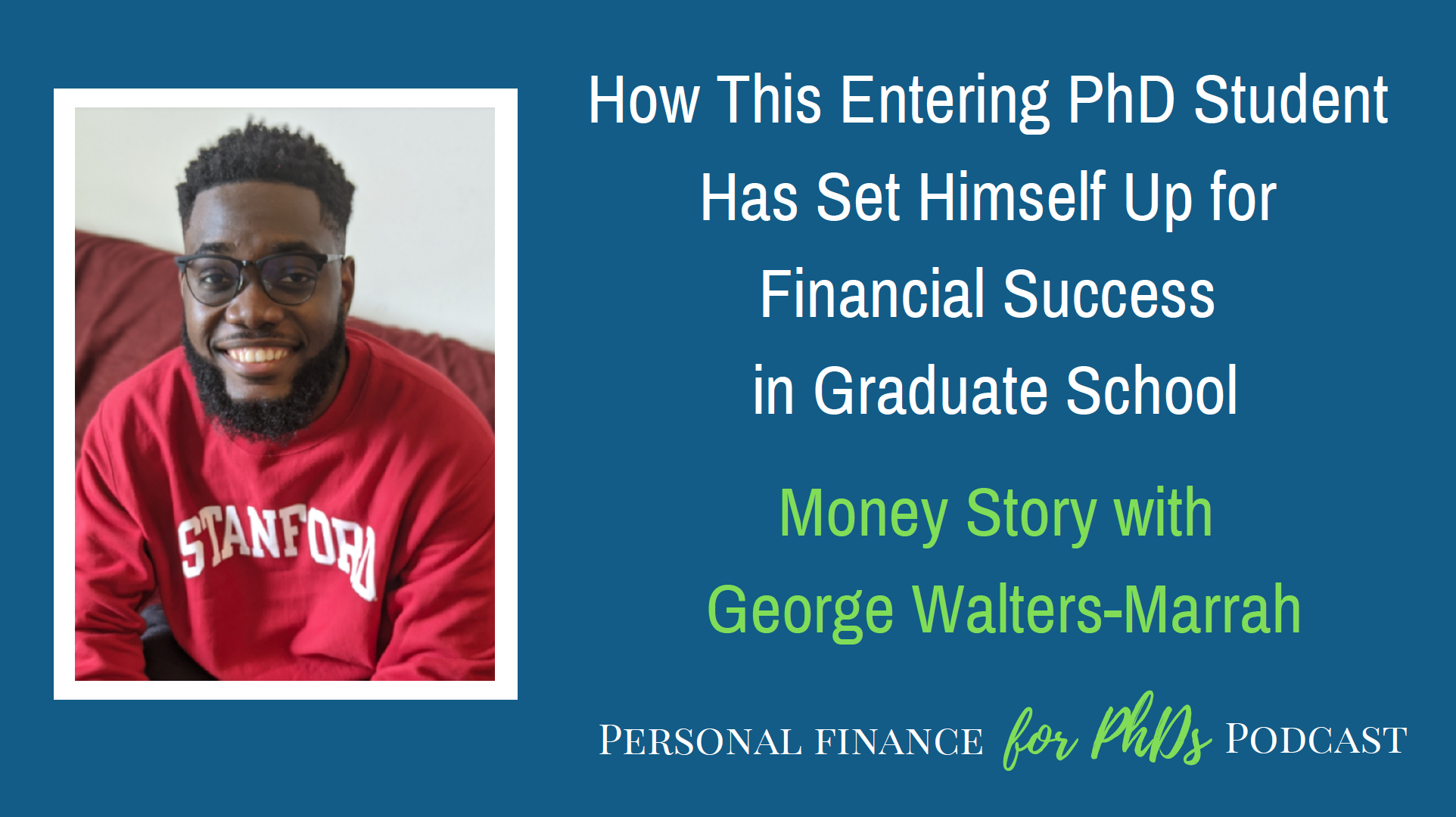
How This Entering PhD Student Has Set Himself Up for Financial Success in Graduate School

August 10, 2020 by Emily

In this episode, Emily interviews George Walters-Marrah, a rising first-year PhD student in biophysics at Stanford. In the last year, as George has been applying to and preparing to attend graduate school, he’s been on a financial journey as well. We walk chronologically through the financial steps he’s taken this year, from applying for fellowships last fall to taking a personal finance course this past spring to drafting a budget this summer for how he plans to use his stipend in Palo Alto. Additionally, Emily and George have an insightful conversation on what George learned about investing in his personal finance course and how he’s already implementing some of the strategies.

Links Mentioned in the Episode

  • PF for PhDs Podcast Grad Student Fellow Examples
    • Home Purchase as a Grad Student Fellow (Jonathan Sun)
    • NDSEG Fellow (Lourdes Bobbio)
    • Grad Student Fellow Investing in Retirement, Estimated Quarterly Taxes (Lucia Capano)
  • List of portable fellowships
  • PF for PhDs Community (Discount Until August 15th, 2020!)
  • George’s Personal Finance Document
  • MIT Living Wage Calculator
  • PhD Stipends Resource
  • Quarterly Estimated Tax Article
  • Quarterly Estimated Tax Workshop
  • PF for PhDs: Podcast Hub
  • PF for PhDs: Subscribe
grad school financial success

Teaser

00:00 George: I’ve been investing for a while now. And it’s like, it’s not really time-consuming at all. I kind of like check it at least once a day just because I like looking at it. But other than that, it’s not like I’m constantly fidgeting with my stuff. And I think the more you fidget with it, the more fees you get. So, it’s like, it’s kind of like passive investing. It’s kind of like a win-win.

Introduction

00:21 Emily: Welcome to the Personal Finance for PhDs podcast, a higher education in personal finance. I’m your host, Dr. Emily Roberts. This is season six, episode 15, and today my guest is George Walters-Marrah, a rising first-year PhD student in biophysics at Stanford. In the last year, as George has been applying to and preparing to attend graduate school, he’s been on a financial journey as well. We walk chronologically through the financial steps he’s taken this year, from applying for fellowships last fall to taking a personal finance course this past spring to drafting a budget this summer for how he plans to use his stipend in Palo Alto. Additionally, we have an insightful conversation on what George learned about investing in his personal finance course and how he’s already implementing some of the strategies. This is a perfect episode to listen to if you are near the start of your financial journey, whether that’s at the beginning of graduate school or further on in your career. Without further ado, here’s my interview with George Walters-Marrah.

Will You Please Introduce Yourself Further?

01:26 Emily: I have joining me on the podcast today George Walters-Marrah. He is a rising PhD student. We are recording this interview in July, 2020, and within the next month or two, he’s going to be starting his PhD program at Stanford. And he’s already been on a financial journey. So, we’re going to talk through about the last year, how he’s been preparing financial aid to go into his PhD program, as well as he’s done an awesome amount of career preparation to get to that stage as well. So, George, it’s a real pleasure to have you on the podcast. Would you please introduce yourself to the listeners?

01:58 George: Thank you for having me. So, I just graduated with my bachelor’s in molecular microbiology, and I have a research interest in interdisciplinary sciences. But I’ve also been kind of really obsessed with personal finance over the last year. So, I’m glad to be able to talk about it. Because whenever I get the chance, I kind of get excited because I’ve been so involved and kind of like consumed with it for a while. So, thanks for having me.

Financial Preparation Before Grad School

02:28 Emily: Well, it’s really exciting for me as well. And the way we actually met was over Twitter, and you prepared this fabulous document of personal finance resources and included a lot of mine in there, which I’m really grateful for and you shared it. And I happened to see it and was just so flattered that you did that, and it was a fantastic document. So, I’m really excited that you have been sharing this material with your peers. We’ll get into that, why you’re doing that during the course of the interview. So, let’s take it back to almost a year ago. How were you starting to prepare financially for graduate school even, you know, well, well, before you finished your undergrad degree?

03:05 George: Yeah. So, about a year ago I was like kind of oblivious to personal finance. But what I did know was that there were things called fellowships and scholarships and stuff that I could apply to. So, like about a year ago during the summer, I was looking into scholarships and fellowships and I applied, I was starting to apply to the NSF GRFP, the Ford Fellowship, and other things like that. So, I started that pretty early and I would suggest to start that over the summer, if you can. If not, start it at the beginning of the fall, because I was able to get a couple of fellowships and I think a really big reason I was able to do that was because I started so early, kind of like reaching out to my letter writers and starting my personal statement and kind of like collecting the different, like papers that I would need to write my research proposal.

Balancing Coursework with Grad School Applications

03:54 Emily: Yeah. We’ll link in the show notes because I’ve done a couple other interviews with fellowship winners and that was a common thread of advice: start early. So, even right now, you know, July for the people who are going to be applying in the upcoming, you know, starting about six months from now, they need to really be working on this, you know, the preparation process getting started now. How did you–so I applied for graduate school and all of these fellowships after I finished my undergrad, I had a post-bac year–how did you manage sort of balancing your coursework, your thesis work, I assume, with doing these, you know, intensive applications?

04:30 George: So, full disclosure, I was a fifth year student, so I graduated in five years. So, I had most of my class requirements done. So, I had the luxury of kind of decreasing the amount of classes I had. So, I still had 12 credit hours, but I was able to kind of like pick and choose classes that weren’t like super intensive. So, I kind of did that. And I also had the luxury of having a class that could be like a placeholder and I could use that time to do my personal statement and prepare to apply to graduate school and fellowships. But I would say that, try to decrease the amount of classes that are super intensive. Try to kind of pick classes that, you don’t have a lot of, like, time-consuming, like it doesn’t consume a lot of the your time, and kind of learn how to say no to things.

05:25 George: If you can kind of just say no to a few things so you can use that time to kind of work towards your fellowship applications, work towards your grad school applications. I think that would kind of like, it builds up, like when you keep saying yes. So, if you kind of learn how to say no to things that may not be helpful to you in the future, or may not be worth the time, I think that would kind of really be helpful with allowing you to find that time to kind of complete all that you need to do that last semester.

Which Fellowships Did You Win?

05:54 Emily: Yeah. I think it’s a great idea that you actually had space in your core schedule for doing these applications, because that’s really how you need to treat it. You need to treat it as at least one class, if not multiple classes. That’s the amount of time it’ll take. So, you were successful in winning some of these fellowships. Which ones did you win?

06:12 George: So, I was able to get like three fellowships. It was kind of like three different types of fellowships. So, I had got an external fellowship and two internal fellowships. So, I got the NSF GRFP, which was external, it kind of followed me wherever I went. And then I got an internal Stanford fellowship, which is, they kind of reviewed my application and you kind of get considered for this just by applying. And they gave me that fellowship based on my application. And then my last fellowship is one I got actually pretty recently. And it was a fellowship that I got by applying to a program, a first year program, after I got accepted and after I decided to come. So, it was kind of like the first one, I applied to it way before I applied to grad school, and then I got the external one. The second one, like they considered me just by applying, and I got that one. And the third one, I applied to it after I actually got into the program. And it was like a separate first-year program at Stanford. So, like, there are kind of several different ways that you can try and get these fellowships, which I think is like really nice.

07:16 Emily: Yeah. So, the fellowship applications did not stop, you know, just after the fall of your application season. That’s awesome that you won so many different ones. I have a post that I’ll link to in the show notes where I list a bunch of these portable external fellowships, like the NSF GRFP. So, I’ll put them in the show notes if people want to kind of peruse through. A lot of people know about the NSF fellowship, but there are some other ones that are a little bit less known. You mentioned Ford earlier. That’s another great one. So anyway, there’ll be a list there, several ones you can probably apply to, you know, in the year that you’re applying to graduate school and then in a few years after that, but you’re taking care of for a few years. So, that’s amazing.

Lessons Learned from Undergrad Personal Finance Course

07:53 Emily: Okay, so now we’re going to fast forward, you know, that was kind of the fall of your last year of undergrad. And then I believe in the spring semester you took a personal finance course. So, tell me a little bit about that course. Like why did you elect to take it, and maybe like two to three big takeaways from the course that you think would be really instructive for other PhDs to know?

08:14 George: Yeah. So, my school like offers this course called Personal Finance and Investments. I actually learned about it the fall that I was applying to graduate school. And I always wanted to take a personal finance class because I didn’t really know anything about personal finance. I didn’t know how to invest. I didn’t know how to make a budget. I didn’t know any of that stuff. And in my first few semesters, I thought of like, “Oh, maybe it’s microeconomics or macroeconomics or something like that,” but I read the summary and it didn’t make sense. So, I finally found this class and that’s like, “Oh, this is the class.” So, I took it and it was a great class. Like, it was a kind of a learning curve. You had to kind of learn the language of personal finance. Like what’s a dividend and all these different stuff.

Lesson 1: You Don’t Have to be an Expert to Invest

08:55 George: But after I got the hang of it, it kind of went very smoothly and I got like way more invested in it. And if I was to say to like three things that I thought that I learned from that class that were very helpful to me, the first big one is that to invest, you don’t really need to like follow the stock market and be like an expert and kind of like, look at it every single second of every day. There are like a lot of different kinds of innovative ways that allow kind of like people who are super busy or people that are kind of inexperienced to actually have a good experience investing.

09:29 Emily: If I can summarize that first point or what you were starting to say, it’s that, I mean, I love the way you phrased it. Like investing does not have to be something that you are paying attention to all day long every day in and out. I think that is an image that we have in our culture of what investing is, maybe from like, I don’t know, the eighties or the nineties or something, like it’s kind of archaic at this point. Because index funds, which I think was what you were starting to talk about there. They’ve been around for, I don’t know, four or five decades at this point, but only have really been gaining in popularity in the last couple of decades. But index funds, like you were saying, just are a diversification. Like you get a lot of different investments, stock investments often in one bucket and it’s representative of kind of the whole market or an entire sector of the market. And so you can buy, you essentially buy everything when you buy an index fund and it’s in a given market sector. That means you’re buying the winners. It means you’re buying the losers. But it turns out that that’s a more effective strategy than trying to pick the winners and avoid the losers. Is that what you were learning through your course?

10:31 George: Yeah, so, it was big because like, I think like a lot of people think they have to beat the market, but if you match the market, you kind of avoid that pitfall of like losing to the market. Because it either could go really bad or really good, or you could just match it. And then the market kind of like trends up. So, I decided to go that way, kind of like passive investing. So, that’s like the one, the first big thing that you don’t have to, it’s not a full-time job to invest, which is really nice, since as a grad student, I’ll be very busy.

11:04 Emily: Actually, if I could expand on that for one more second. So, I also tell people like investing should not be your side hustle. Like you should not be spending a ton of time working on your investments. And I always say to them, like, if you want a full-time job doing investing, get a full-time job as an investor, be a hedge fund manager or go do that kind of thing. Like, make a ton of money off of this. Don’t just play around with your own money. If you’re going to be, you know, actually investing that kind of time into the process, which again, I don’t think is necessary or a good idea. So to me, investing is kind of like learn about it for a little while, you set up what you need to set up, and then you just let it run and you just do maintenance and you don’t have to, you know, mess around with it a whole lot.

Lesson 2: Make an Emergency Fund

11:45 George: Yeah. I totally agree, because like, I’ve been investing for a while now and it’s like, it’s not really time-consuming at all. I kind of like check it at least once a day just because I like looking at it. But other than that, it’s not like I’m constantly fidgeting with my stuff. And I think the more you fidget with it, the more fees you get. So, it’s like, it’s kind of like passive investing. It’s kind of like a win-win. But I guess two more points that I would say that are really nice that I got out of it is that kind of making an emergency fund. I never really thought of that. Kind of like before, an emergency happens, you just have the money in your savings account. So, I’ve been trying to get my emergency fund kind of like they say at a minimum is three months but I’m hoping to get it like higher, maybe to nine months, if possible.

Lesson 3: Time Value of Money

12:29 George: And I’m kind of slowly building towards that. And another thing that I learned that was pretty interesting is that, kind of like this thing called, I think it’s called time, money value, a time value of money. It’s kind of like a dollar today is worth more than a dollar a year from now. So, if you can get money today and kind of put it in your investments or put it into your savings account, maybe like a high yield savings account, that will be worth more than kind of like $50, maybe a year from now, that you weren’t able to get that interest off of by having it in your account. So, I never really thought of it that way. I kind of, I always thought that like, “Oh, if I have a thousand dollars today, it’s the same as having a thousand dollars in 10 years.” So, those are kind of like the three big things that I would think of that I got from the class.

13:15 Emily: Yeah. I think the time value of money is also just a, it’s a mind-blowing concept. Like once you kind of understand like compound interest and how much your money can work for you. And I think the point that, you know, graduate students especially should take away from that is it’s okay–it’s great–to start investing now with a very small amount of money. It will not be a small amount of money decades from now when you actually reach retirement. So, what I like to say is that graduate students should not dismiss whatever tiny amount of money they might be able to start investing right now. Maybe it’s $10 a month. Maybe it’s $50 a month. That money will add up over time with this factor of compounding with the time value of money applied to it. And so, yeah, it’s not something that you should just say, “Oh, well, I can’t really save that much, so I’m not going to bother. Like, it’s still something you should pursue, even if it’s a small amount of money today.

14:05 George: Yeah. Totally agree.

What Financial Changes Did You Make?

14:08 Emily: And so, what did you actually, you know, you took this fabulous course, you learned a lot from it. What changes did you actually make? So, you’ve already mentioned that you started investing. Can you talk a little bit about how you started down that road?

14:20 George: Yeah, so I started investing well, like the first thing I did was I tried to get my financial life together, trying to get like my financial health in order because I didn’t really know anything. So, I started tracking my finances. So, I got the Mint app. I started tracking how much money I spend in a month. And the first month I wasn’t really trying to make a budget. I was just trying to understand my money habits and see what I could change. See what I wanted to keep. And then I started thinking about budgeting. And then after that I started my emergency fund. I also started collecting all of my important documents, like my birth certificate and my social security number and putting them in one place. They were kind of like scattered around. So, I wanted to put them in one place and kind of like, just get all of my stuff, like organized, like the first few months.

15:05 George: And then after I got myself situated and kind of like knew what was going on financially, that’s when I started investing. I decided to do a Robo Roth at the start until I get kind of like experienced with the stock market. And then I plan to transfer it over to a manual one to kind of like start my own Roth. So, my manual Roth–I mean not my manual Roth, my Robo Roth, I’m kind of like, “invest stuff for me,” and it’s kind of in the safest way possible. So, I don’t kind of like put it in something that kind of like blows up in my face and I lose all my retirement money. And my brokerage account is kind of just, it’s a tax account, but I only put money in there that I put in there so I can kind of gain experience with buying stocks and selling stocks and stuff like that.

15:50 George: So, and now that I think about it, one other thing that I learned from my class is that, when I’m looking at stocks and stuff, there are these things called like target-date retirement kinds of funds, which is like kind of nice. And I plan when I make my manual Roth, I actually planned a large part of it to be a target-date fund, which will kind of like change based on how close I am to retirement. And so after I did all of that, I kind of like started thinking about like different things that I learned about in my class that I should think about when I’m kind of like investing my brokerage account. Like don’t invest what I’m not willing to lose. And like, if you don’t understand it, don’t invest in it. And I started kind of like building up my portfolio and now I have like a pretty decent nest egg. So, I’m pretty proud of how I’ve gotten so far in the last few months.

Choosing a Robo-Advisor

16:42 Emily: I know, you haven’t even started graduate school yet. I mean, which is arguably I guess not a job, and you’re just getting out of undergrad, and I don’t know, it’s a fabulous amount of progress that you’ve made in this time. Which robo-advisor did you choose to start with?

16:57 George: Oh, so I actually chose Betterment. So, there are several different websites, I think there’s NerdWallet, that kind of review all these different things. Something else I learned from my class is don’t take it from one source alone, kind of go to multiple different sources and then based on all the sources together, make a decision. And kind of like across the board people suggested Betterment. So, I kind of went with Betterment since it had such great reviews all across the board.

17:31 Emily: Mhm. I think, I don’t know specifically, this is true for Betterment. It might be because you chose them. But one of the advantages that robo-advisors have is that they often have $0 minimums to start investing. So, it’s a great place like you’re doing when you’re just at the very, very start of your journey to use something like that, as you were saying, sort of some more familiarity, get some experience. And then you can switch over as you were planning on doing to a Roth IRA that you manage yourself through one of like the discount brokerage firms, like Vanguard, Fidelity, Schwab. I’m sure you’re looking at one of those three, if not something similar, for once you switch, but those often have some kind of minimum. So, I know like my strategy when I started my Roth IRA was I started with Fidelity because they, at that time, they waived their minimum if you had a $50 per month automated investing plan. So, I did that until I had $3,000 and then I switched over to Vanguard, because that’s where I really wanted to be, once I had the Vanguard $3,000 minimum. So, it sounds like you’re probably doing something similar with your robo-advisor to, you know, a Roth IRA that you’ll manage yourself strategy. Is that right?

18:34 George: Yeah. And there are like multiple different reasons as well. Like a big one is like the minimum so that like I could start investing now so that even if it’s a little bit, I could still start growing my investments. And also, when I get to a decent amount, I’ll be able to get, like, I think there are minimums in mutual funds as well. So, it’s like in order to invest in mutual funds, you need to have a certain amount of money. I’m not there yet. So, I think I’ll keep it in my Robo fund, which is kind of very low expense. Very kind of like, easy to, well, not low expenses–you can put as little money there as possible, and then it starts going in investments. But I feel like with the robo-advisors, I don’t want to keep it in there too long because they have these expense ratios. And if I have a large amount of money, I kind of start eating at my investments. But I think early on in the process that this was the best decision for me.

19:25 Emily: Yeah. And expense ratio, for those in the audience who haven’t started investing yet, is a representation. It’s a percentage representation of the total cost of owning whatever the investment is. So, with something like a robo-advisor, they usually add to the expense ratio of the underlying funds that you buy. Maybe about a 0.25% fee, which is sort of low. It sounds like pretty low. But you can get quite a bit lower if you just manage it yourself. Like you’re planning on doing, you know, in a few months or a year or whatever. You can get down under like 0.1%, 0.05%, even down to 0% expense ratios. So, there are very, very low expense ratios out there, even though the robo-advising fee doesn’t sound very high. Over time, as you were saying, it really does add up. Whatever you’re paying in expenses compounds, as we were talking about earlier, and it could end up being quite a bit of money over your entire investing lifetime. But your plan sounds really great to me. It sounds like you’ve gone about it in a totally intelligent way. So, that’s awesome.

Commercial

20:27 Emily: Emily here, for a brief interlude. I am just bursting with this news. I have launched a Community for Personal Finance for PhDs. The Community is for PhDs and people pursuing PhDs who want to level up their practice of personal finance by opening and funding an IRA, starting to budget, aggressively paying off debt, financially navigating a life or career transition, maximizing the income from a side hustle, preparing an accurate tax return, and much more. Inside the Community, you’ll have access to a library of financial education products I’ve made in the past. And I’m going to add new trainings to that library every month. There is also a discussion forum, monthly live calls with me, a book club, and progress journaling for financial goals. Basically, the Community is going to help you reach your financial goals, whatever they are. Go to pfforphds.com/community to find out even more. If you’re listening to this in real-time, you have the opportunity to become a founding member of the Community at a discount. The price is going up on August 15th, 2020, so don’t delay. Go to pfforphds.com/community for all the details. I can’t wait to help propel you to financial success. Now, back to the interview.

George’s Financial Resources Document

21:47 Emily: Could you share like why you created the document that you did? Because I think it came out of the course, right? What you were learning from the course?

21:57 George: Yeah so, I was learning all the different stuff and I started kind of looking up all these different, like websites and I found your website and many other websites and I started bookmarking them. And then, since I was kind of so engrossed with it, I would talk about it. So, I’m a McNair scholar at University of Central Florida, and we’re in this kind of like community together. And I always talk about it to other McNair scholars, and they ask me for advice, they ask me, “Oh, what can I learn about this?” And then I would kind of like blow them up with links. And I didn’t think it was kind of the best way to go about it. So, I decided to make an easy to read document with like the links, kind of like embedded in words.

22:36 George: So, you can read through it in kind of a relaxing way, and then click a link if you want to learn more about what I was talking about. And then I posted this in our McNair group chat. But then I thought it would be nice for other people to use this as well as they wanted to. So, I posted it on my Twitter, and I think a few people were able to like use it to learn more about personal finance.

22:58 Emily: Yeah. And we’ll link to the document in the show notes as well because I thought it was really well put together. So, thank you for doing that. Thank you for that, like, community service.

Factors in Choosing a Graduate School

23:06 Emily: Okay. So, now we’re in the spring semester, you have, you know, you have applied to your fellowships, you’ve applied to graduate school. You’re being admitted to different programs. And of course, you know, we’re considering a lot of things when we choose a graduate program, the quality of the research, the mentor that you might work with, maybe overall the program, the structure of it, where it’s located and so forth. But you know, the stipend, I think should be one of those considerations. Did you factor in the finances when you were choosing which graduate program to attend, or were you able to make the decision based on those other factors?

23:41 George: So, I applied to like nine graduate schools, and I think from eliminating the first ones, it was mostly based on like the research and like the faculty and the resources and stuff like that. But then when I got to the end, it was kind of hard to decide. It was a very hard decision. And when I was down to two, like based on cost of living of the two areas, the stipends were very similar, the research interests were really similar. Like everything was very similar. So, it was kind of hard to kind of make that decision. So, I think what it came down to was kind of two things. The first thing was that one school was kind of like calling me and checking up on me, answering my questions and that kind of like had a really good impact on me.

24:27 George: But then the last thing is that the school that I decided to go to, which is Stanford, they offered transitioning costs. So, like transitioning funds. So, I think transitioning to grad, I mean, I haven’t done it yet, but I’ve heard that transitioning to grad school can be really expensive. So, that they offered kind of some funds to allow me to kind of like take that stress off of me was kind of like, I think that’s what kind of pushed me to choose Stanford since it was a really hard decision.

24:58 Emily: I think that’s an excellent, I mean it’s a really, really good insight into your decision-making process. It sounds like, you know, these final two schools, it was really close. What tipped you over was, you know, people at Stanford were really attentive to you, checking up on you, and then they offered you this moving fund. And I mean, that’s something that graduate programs should know about. If something that minor, a few thousand dollars I assume?

25:19 George: It was actually $500.

Consider Stipends AND Cost of Living

25:20 Emily: Oh, $500? Okay. Right. So, $500, which is like nothing to the graduate programs, could tip an excellent candidate like you, you know, you won this outside fellowship, you’re bringing in money. If something like offering you $500 could tip the scales in their favor, that’s something that they all should be doing, frankly, at this point. So, I think you mentioned something in there really quickly, but I believe you said something like after you factored in the cost of living of the two different places, the stipends were similar, is that right? So the stipends themselves weren’t actually the same, but they were similar to another, once you factored in the cost of living, is that right? Can you talk about how you did that?

25:57 George: Yeah. So, like the cost of living at Stanford is much higher. So, the two schools, I guess, were Stanford and Cornell. So, the cost of living in Palo Alto is much higher than the cost of living in Ithaca, New York. So, the Stanford stipend was much higher than the Cornell stipend, but there are different websites where you can put in the location. I think it’s a cost of living calculator. You could put in the location where you plan to live and then the money that you’ll be bringing in, and there are also like tax calculators, because there are different tax rules. So, you can calculate how much tax will be coming out of your stipend. They can calculate how your stipend compares if you were to live in another area. And I kind of compared the two stipends and they were very similar, like almost identical, once you took into consideration cost of living. So, I couldn’t really use that as a reason to choose one over the other.

26:53 Emily: Yeah. Thank you for pointing that out. Like, I mean, even, you know, I also was sort of getting into personal finance in the year that I was applying to graduate school, and I didn’t even do that step that you did of taking that into consideration. I was just kind of looking at, “Oh, the stipends are all sort of similar. I don’t know. I assume the cities are different, but I never sat down and like actually did that little, little bit of math that you did. So, it’s a great idea just for the audience, anyone else going through this. I really like to use the MIT Living Wage database or calculator, livingwage.mit.edu. And it shows you what the living wage is for every, you know, county or metro city area in the U.S. And so, that’s the factor that I like to use.

27:31 Emily: That’s what we use in phdstipends.com, which is my database website where people enter their stipends and then we do this little division, like you were just saying, of divide the stipend by the local cost of living from this database and spit out this like factor, you know, is it more than one? Is it less than one? So, exactly what you were doing, maybe using a different calculator, but I think it’s really, really smart.

Housing Budget and Taxes

27:51 Emily: So, okay. You’ve chosen to go to Sanford, and you already were just mentioning some of the basic building blocks of the budget that you’ll have once you start graduate school. Like you were talking about taking into consideration how much your taxes are going to be. And I know that you’ve been preparing a budget over this summer before you’re moving to Palo Alto. So, can you talk about that process a little bit, and also about your decision around housing?

28:12 George: Yeah. So, I started my budget already. So, the first thing that I kind of took out of my budget was taxes. Because what I kind of like found out that was pretty surprising is that they don’t take taxes out of fellowships. So, like your income tax will be kind of just like given to you and you’re expected to know that it’s supposed to be paid back in taxes.

Quarterly Taxes on Non-W-2 Income

28:34 Emily: Okay. Let’s pause there because I think we need to emphasize that. At most universities, it sounds like it’s Stanford included, if you’re receiving a fellowship, which is what I call non-W-2 income. So, fellowship, training grant, this kind of income. Very likely, they will not be withholding income tax for you, as a domestic student. For international students, they do. So, let’s emphasize that again. You are receiving your entire paycheck, but that does not mean that you get to keep all of that. Part of that is going to go back to the IRS in the form of income taxes, which you may have to pay quarterly. I’ll link in the show notes to my resources on that. It’s probably ones that you found, George, as you were doing this research. But yeah, please keep going. I just wanted to, like–we don’t want to gloss over that. Like, you will probably end up paying income tax and you have to do it yourself. It’s not done for you. And it’s a process that a lot of people just completely miss and they have an ugly surprise when they get to their taxes after their first year of graduate school.

29:30 George: Yeah. And actually, I plan to do quarterly taxes as well. So, I was kind of like putting it together so that every month, like I kind of calculated how much taxes I would owe at the end, and then I divided that by 12. And then I would kind of like save that amount of money every single month. So, when it comes to that time, when I have to pay my quarterly tax, I already have it in my savings account and I can just pay it. But that’s the first thing I kind of put away. And then I went to my housing. So, at Stanford, they have housing on campus which is subsidized. So, it’s kind of nice that I was able to kind of apply to housing at Stanford.

30:06 George: So, I kind of looked at all the housing options, and out all of the ones that I liked, I kind of picked the highest monthly rent, and I put that in my budget. And I was thinking that, if I get a lower one, I could just change that in my budget. It will be easier to change to lower than to higher. So, that was kind of my thought process on that. And then with my budget, I tried to make it so that it’s not a budget that I kind of don’t like looking at. So, I kind of like, as I said before, like I tried to find out how I spend my own money and I tried to make a budget that I can comfortably live within the budget, and I gave myself some breathing room.

30:44 George: I wanted my budget to be kind of pleasant to live on so I don’t kind of like break my budget. So, I kind of was thinking like, “Okay, I spent this much on food. Let me give myself a little breathing room since I can kind of like afford to do that.” And then I also put some money in there for shopping. I put some money in there for transportation because I don’t plan to bring my car with me my first year. And then I also put like 20 to 25% away for investments. So, kind of like putting stuff into my savings accounts, putting stuff into my Roth IRA. And then for my brokerage account, I don’t plan to put monthly in there until I have a good amount in my savings account, but then I plan to start putting monthly into my brokerage account. For now, I’ll just kind of like, if I have some money from the money I put away for shopping and for like kind of random stuff, I’ll buy some stocks if I feel like I want to, but it won’t be like a monthly thing that I put money specifically away for yet. But that’s kind of like what I decided to put in my budget.

Ranking Housing Options

31:53 Emily: I want to go back just to the housing point for a second, because I think you’ve made a really good decision, which was like, okay, so you’re applying for all this, you know, subsidized on-campus housing. You account in your budget for the highest possible rent you would be paying. But is that actually how it turned out? Like what housing did you, when you were saying where you wanted to live, was that the one that you put at the top of your list? Or like how did you rank order that list and what did you actually get into?

32:18 George: So, I ranked the list, so there’s like really new housing that’s coming out. It’s going to actually debut this fall semester. So, I put that at the top of my list and that was actually the most expensive, and I was able to get it. So, I didn’t change my budget, but I also had these different ones that were a little bit older, but they had good amenities. They would have good spacing. And I actually got the tour it when I was at my interview. So, I would be fine living with it. It’s not like I would be like, “Oh, I can’t live here and I’ll have to live somewhere else.” So, that’s how I ranked it.

32:53 George: But, there were other options that were really, really expensive. So, I kind of listed those. They say to list everything, so I listed them, but they were like in 30th place, like it was kind of ridiculous how much they cost. So, I tried to kind of combine quality, but also the cost of living because I feel like housing, I think when I was reading my budgeting you should try to keep housing as close to 50% as possible. My housing is a little bit, it’s still over 50%, but I think it’s kind of difficult to kind of get 50% or lower as a grad student. So, I tried to get as close to that as possible. And with some of the other housing, it was like well over 50%. So, I tried to take into consideration that I should try to be close to 50%, if at all possible.

33:43 Emily: Yeah, I think I don’t know exactly what you were learning in the course, but according to the balanced money formula, which is a framework that I like to reference, you should keep all of your necessary expenses below 50% of your net income, which is really, really challenging to do on a graduate student stipend and also on a graduate student stipend in a high cost of living area, which is what you’re doing. So, it’s not surprising at all to me that even you, you know, making a prudent housing choice, it’s still over 50% of your income. That is pretty common for graduate students in high cost of living areas. But yeah, so it sounds like you were, you know, really thinking through both the finances and the lifestyle that you wanted to have with that housing decision. So, super happy that you were, you know, really intentional about that.

Long-Term Emergency Savings Goals

34:29 Emily: And you were mentioning just now, like some of your financial goals for your finances in graduate school. You mentioned that you were going to be saving/investing 20 to 25% of your income and then possibly doing a little bit more investing if you wanted to at any particular time. And I think you also mentioned earlier that you wanted to save up an emergency fund of nine months of expenses. Is that right? Is that your ultimate goal?

34:54 George: Yeah, I’m trying to, one day I hope to get to nine months. So, I would say my kind of goals for personal finance and graduate school, in particular, are kind of modest. I’m not looking to have like a huge, huge thing by the time I graduate. I hope to kind of like build habits and get into the habit of kind of like investing, get into the habit of staying on my budget, getting into the habit of putting money away monthly. Because like in undergrad, I didn’t have any of those habits, and I think that’s something I’m going to have to kind of build. And also, have at least like three months, hopefully nine months, of my emergency fund. Because I know that emergencies are emergencies and I doubt I won’t have any emergencies in graduate school.

35:37 George: So, hopefully by the time I graduate, I’ll have at least three months, hopefully nine months. And then kind of have a decent amount in my kind of Roth IRA as well as in my brokerage account, and that I’ve kind of stayed consistent throughout the five, six, or maybe seven years that I’ll be doing my PhD of monthly, always, putting some money away and not falling into blowing money on stuff. But also giving me that kind of flexibility to have fun and to do things that I find kind of amusing so that I don’t get too stressed through graduate school.

36:13 Emily: I think that’s such an excellent point that you made. Like yes, it would be great to come out of graduate school with savings, with investments, with a nice nest egg. That’s what happened for me. My husband and I defended with quite a good nest egg, and it was really fabulous for our subsequent life. But, the more important thing, actually, is the habit formation. And it’s sort of changing your–like becoming a person who budgets, becoming a person who invests. Now, I know I said earlier that it matters a whole lot. Like if you do that with a small amount of money, it’s great, and yes, that’s true. But, even more powerful is the habit. And so, when you have that nice post-PhD salary, and you’re already in the habit of investing or you’re in the habit of saving, you can then apply those habits to that fabulous higher income and really make some fast progress with your, you know, financial goals.

Any Other Goals for Grad School?

37:02 Emily: So, I think that was such a good point that you made, and even for people who aren’t able to do what you plan on doing, which is still, you know, saving and investing during graduate school. Even getting into the habit of budgeting, like that can be a great goal for your time during graduate school is just to make those changes in yourself and who you are. Even if you aren’t able to come out with more savings, again, once you have the post-PhD income, you’ll be able to keep applying those habits and really make some fast progress. So, such an excellent point, George. Any other goals you have for graduate school, aside from the ones that we just talked about?

37:37 George: I guess like, I mean, there are like nonfinancial goals, like kind of building like skills and kind of building my network and traveling and learning all the different stuff from different people. But financial-wise, I just hope to kind of pay as little in taxes as possible, learn how to file my own taxes. Kind of learn like all the financial things that I need to know to kind of like succeed. I think for my brokerage account, I’ll be kind of investing. I think the money in there is probably going to be used as a down payment on a house in the future. That’s kind of like, well far off, but I’m kind of thinking, “Oh, I’m investing in my brokerage account. I’ll probably use it to kind of buy a house or have some money towards a house.” Kind of things like that. Those are kind of like the goals I’m thinking of, but I don’t really have like super hard, concrete stuff yet. But those are kind of the things I’ve been thinking about.

38:30 Emily: Yeah. I think it’s great that you identified like, “Okay, I know it’s important to have an emergency fund.” You’re going build that up. “I know it’s important to save for retirement. I’m going to build that up.” And then, “Okay, whatever else comes, I have this other brokerage account, you know, other savings I can use for that. If it’s a house down payment, if it’s something else.” I think that’s a great way to structure your finances when you have a lot of unknowns in the future, as is very, very common for PhDs, because we never know where we’re going to live. You know, after, it’s a lot of uncertainty that we live with kind of longterm.

38:59 Emily: But George, it was a real pleasure to talk with you today. Thank you so much for coming on the podcast and sharing this beginning part of your journey. I hope that we’ll catch up with you again in maybe a few months or a year and see if it’s all panning out the way you thought it would. Thank you so much for sharing your insight.

39:15 George: Yeah, no problem. It was a pleasure to be able to talk about it.

Outtro

39:17 Emily: Listeners, thank you for joining me for this episode. Pfforphds.com/podcast is the hub for the Personal Finance for PhDs podcast. There, you can find links to all the episode show notes and a form to volunteer to be interviewed. I’d love for you to check it out and get more involved. If you’ve been enjoying the podcast, please consider joining my mailing list for my behind-the-scenes commentary about each episode. Register at pfforphds.com/subscribe. See you in the next episode! And remember you don’t have to have a PhD to succeed with personal finance, but it helps. The music is Stages of Awakening by Podington Bear from the free music archive and is shared under CC by NC. Podcast editing and show notes creation by Meryem Ok.
How to Financially Manage a Once-Per-Term Fellowship Paycheck

June 24, 2020 by Emily

In some PhD programs, graduate students on fellowship are paid only once per semester or trimester, between 2 and 4 times per year. This pay frequency engenders unique challenges and opportunities for those PhD students. The less frequent your pay, the more dire the consequences can be if you don’t manage it satisfactorily. This article will walk you through all the areas of financial management that you need to consider when you only receive one fellowship paycheck every three to six months.

financially manage once per semester trimester fellowship

The Good News

Fellowship (and training grant) income is different from most income. I call it “awarded income” as it is technically not given in exchange for work. On the other hand, “employee income” is what you receive for work, such as research (a research assistantship) or teaching (a teaching assistantship).

Some universities use these terms differently, but at the end of the day the way to differentiate them is by what tax form you do or do not receive at tax time. Employee income is reported on a Form W-2, and awarded income is not.

In a typical employer-employee relationship, the employee works and then receives their pay after the pay period has ended, whether that is weekly, biweekly, semimonthly, or monthly.

Because fellowship income is awarded and does not have to follow a period of work, it can be awarded at any time.

Since your fellowship income is awarded once per term, the good news is that you’re receiving that income up front, in a sense. You receive the income near the start of the multi-month period that it is intended to fund, which I’ll call the budgeting period in this post.

That’s the good news: You receive your income at the start of your budgeting period in a sense, instead of at the end of a pay period. That makes the transition onto fellowship income much easier since you do receive a lump sum up front. However, the corollary is that coming off of this type of income can be very difficult—more on that later.

When Exactly Will Your Paychecks Arrive?

As soon as you find out that you are switching to a once-per-term pay frequency, you should inquire about the date on or by which you can expect to receive your paycheck and whether you have to do anything to trigger its payout.

Often, the answer will be vague, for instance a range of a couple weeks or even a month. If it is specific, ask if fellowship pay has ever been doled out late—this is a good question to ask the administration as well as your fellow PhD students.

Then, no matter the information you are given, build into your plans that the pay might come at the end of the stated range or some time after the stated date.

I have heard horror stories from graduate students whose once-per-term fellowship income arrived weeks later than the date they were told, and sometimes that the student had to request a “refund” from the Bursar’s office before it was paid (of which they were not informed in advance).

It’s quite unlikely that an employer would issue their employee’s paychecks late. But again, this is awarded income, so the same rules are necessarily in place.

When it comes to your paycheck dates, play “offense” by being proactive about finding out the above information and taking any steps you are supposed to, but also play “defense” by reserving within your own finances the ability to pay for your expenses for an extra few weeks or month in case your next paycheck does arrive after you expected it to.

In What Amount(s) Will the Paychecks Be?

When you found out that you won your fellowship, you were certainly told its value, i.e., how much money you would be paid over the course of a year.

However, your fellowship award might not be distributed to you evenly throughout the year. If nothing else, it’s common for the summer term to be paid at a lower (even zero!) or higher level than the academic year.

Another consideration is whether you are responsible for paying any fees or similar out of your pocket. In the case of fellowship income, those fees might be automatically deducted from your award before it is distributed to you, which can be jarring if you are not expecting it.

Income Tax

With this type of once-per-term fellowship income chances are good that your university/institute is not withholding income tax on your behalf. (If it is, you can disregard this section!)

If no income tax is withheld from your fellowship paychecks, you have two important money management tasks to accomplish:

  1. Calculate and set aside the right amount of money to pay your eventual income tax bills.
  2. Determine if you are required to pay quarterly estimated tax.

Basically, in step 1, you’re estimating the amount of tax you’ll have to pay, and in step 2, you’re figuring out when you have to pay it (quarterly or yearly).

The best way to accomplish both with respect to your federal tax (you may also be responsible for paying state tax!) is to fill out the Estimated Tax Worksheet on p. 8 of Form 1040-ES. If that seems intimidating to you at all, please check out my resources to assist you and provide workarounds:

Step 1: Estimate Your Tax Bill

Sign up below to receive by email a spreadsheet that helps you with estimating your federal tax due for the year and how much you should save from each of your paychecks. You’ll receive follow-up emails explaining more about how taxes work for fellowships and then be subscribed to my mailing list!

Step 2: Determine If You Must Pay Quarterly Estimated Tax

It’s very common for fellowship recipients, if they are on fellowship for a full calendar year, to be required to pay quarterly estimated tax. Basically, instead of your employer (if you had one) sending the IRS a slice of each of your paychecks automatically, you receive your full pay and have to make manual payments to the IRS.

The Estimated Tax Worksheet on p. 8 of Form 1040-ES will definitively tell you if you are required to pay your estimated tax quarterly or if you can pay your full bill when you file your annual tax return.

If this is daunting to you, I recommend that you sign up for my workshop, which assists fellows in exactly your situation. It walks you through how to fill out every single line of the Estimated Tax Worksheet and covers several special scenarios that are common to PhD students, such as what to do when you switch on or off of fellowship midway through the calendar year. I even outline a shortcut method that allows you to skip filling out most of the form and still avoid being penalized by the IRS!

How to Manage Spending

The most common question I hear regarding once-per-semester or once-per-trimester fellowship income is, “How do I budget with this infrequent income?”

Yes, it is a good thing that this money is paid in a lump sum up front, but it does put a lot more responsibility on the graduate student than they may have bargained for.

Budgeting Regular Expenses

A robust budget is even more vital for a fellow in this situation than it is for a person receiving more frequent paychecks. While Americans living paycheck-to-paycheck might experience a few days of austerity when it turns out there is “more month than money,” in your case overspending could require weeks of austerity, which is rather infeasible.

What I mean by a budget in this case is to predict very well the expenses you will incur over the course of your budgeting period plus an extra few weeks or month.

Those expenses include all your regular and necessary fixed expenses (e.g., rent, fixed-rate utilities, insurance premiums, subscriptions) and variable expenses (e.g., groceries, utilities billed by usage). They also include what you project that your regular discretionary expenses will be (e.g., eating out, entertainment, shopping).

Budgeting Irregular Expenses

Irregular expenses are expenses that you incur once per year or a few times per year.

Examples of irregular expense categories are:

  • University bills, e.g., tuition, fees, health insurance premium, textbooks, parking permits
  • Insurance premiums paid yearly or every six months
  • Car maintenance/repairs
  • Travel
  • Electronics
  • Moving expenses
  • Household furnishings
  • Tax

Irregular expenses end to trip up graduate students for two reasons:

  1. The expenses tend to be large relative to a graduate student’s cash flow.
  2. Graduate students are often relatively new to budgeting and managing money, so they don’t have past experience to rely on to predict these expenses.

If a graduate student identifies this kind of expense as a budgeting issue, I recommend that they create a system of targeted savings accounts to help predict and save up in advance for the irregular expenses in their life.

You can read more about how to create this type of system in this podcast episode: How to Solve the Problem of Irregular Expenses.

Essentially, you create a unique savings account for each category of expenses and save regularly into that account, pulling money from it only when you incur a related expense.

The advantage that you have in receiving your income for several months up front is that you can also fund your targeted savings accounts up front, at least for the several-month period that your paycheck covers.

Account Structure

I really believe in setting up checking and savings accounts to serve your needs, not simply following the crowd—hence the system of targeted savings accounts I just reviewed.

While I imagine some people can keep all of their fellowship income in their checking account and draw it down over the course of the semester or trimester without running out of money or making sub-optimal financial decisions… I wouldn’t risk it!

Many graduate students I speak with who have once-per-term fellowship income use a separate savings account to hold the bulk of their paycheck and pay themselves a salary of sorts with a once-per-month automated transfer.

While this system simulates a monthly paycheck, it doesn’t take advantage of the unique property of receiving the large paycheck up front.

Instead, what I would do is set up several accounts (you might need to use two banks for this!):

  • One checking account for your monthly expenses that are fixed or only vary slightly with usage, e.g., rent, utilities, subscriptions. You should set up auto-drafts to pay these bills directly from this account.
  • One checking account for your variable and discretionary spending, e.g., groceries, eating out, entertainment, shopping. You can spend directly from this account and/or use it to pay your credit cards.
  • One savings account that holds the part of your fellowship paycheck that you will draw down.
  • Your set of targeted savings accounts.

Here is how I propose that you use this set of accounts:

  1. When you receive your fellowship paycheck, deposit it into your ‘monthly bills’ checking account.
  2. Calculate using your budget the amount of money you will spend on those necessary monthly expenses throughout your budgeting period; round up or leave some buffer. This amount will stay in this checking account, and all those monthly bills will be paid from this account.
  3. Transfer the rest of the income to the savings account for holding it over the budgeting period.
  4. Fund your targeted savings accounts according to your calculations for your irregular expenses.
  5. Above a certain buffer amount of money, divide the balance in your holding account by the number of weeks in your budgeting period. Set up an auto-transfer to move this amount of money from savings to your variable and discretionary spending checking account. That is the amount of money you can spend that week on the categories it covers.
  6. Pull money from your targeted savings accounts into your checking account as needed to cover your planned-for irregular expenses.
  7. Repeat every time you receive a fellowship paycheck.

While somewhat complex, the advantage of this system is that it helps you make spending decisions across three time frames: yearly (for the targeted savings), monthly (for the monthly bills), and weekly (for the variable and discretionary spending), which are otherwise difficult to synthesize.

Reaching Long-Term Financial Goals

In the budgeting exercise I outlined above, I did not include any line items for saving or repaying debt. While these steps are out of reach for graduate students who are paid only enough to survive (or not even that much), as a fellowship recipient, you might have more financial wherewithal.

If you are being paid above the local living wage or more than your peers who are not on fellowship, I encourage you to set a monetary financial goal so that you come out of graduate school with more money to your name than you went in with.

If you don’t yet have any emergency savings, make a ‘starter’ emergency fund your #1 goal! Open up yet another savings account and nickname it ‘Emergency Fund.’ Contribute money to it until you reach at least $1,000 and perhaps up to two months of expenses. When you are just getting started with savings, this Emergency Fund can double as your in-case-my-paycheck-is-late fund, but as you create more financial wherewithal, they should add on top of each other.

After that, your goal might be to increase your emergency fund to 3-6 months of expenses, pay off debt, or invest for retirement or other goals.

You can still accomplish these goals with infrequent fellowship income. As you catalog your expenses, write in a savings goal to your budget as well. You can put money from your paycheck toward this goal shortly after you receive it if you’re confident you won’t overspend the money you keep in cash. Alternatively, you can put the money toward your goal near the end of your budgeting period once you’re sure you won’t run out of funds! A combination of the two might be even better: contribute a minimum amount first and set aside another amount as a stretch goal that you can contribute once you near the end of the budgeting period.

Switching Off of Fellowship Income

Just as you looked into the dates of your expected paychecks when you switched onto infrequent fellowship income, you need to ask about the frequency and pay dates of the assistantship or other type of income that you are switching onto when your fellowship ends.

Again, you can expect to be paid at the end of or after the pay period rather than at the beginning. That means you will have to pay for your living expenses for an extra couple of weeks or a month off of your fellowship income before your assistantship income arrives.

For example, if your fellowship was for an academic year and summer, September through August, and you switched onto assistantship pay at the start of the following September, it would be typical for your first assistantship paycheck to come at the end of September or beginning of October. That’s 13 months of living expenses that your fellowship needs to fund, not 12.

How to Manage Income Tax Payments for Your Fellowship or Training Grant Stipend

June 23, 2020 by Emily

Title: How to Manage Income Tax Payments for Your Fellowship or Training Grant Stipend

Format: Live workshop (in person or remote)

Intended Audience: Graduate students and postdocs receiving stipends/salaries not reported on a Form W-2 (i.e., fellowship, training grant)

Length: 90 minutes

Timing: Year-round

Summary: This workshop shows graduate student and postdoc fellows exactly how to handle paying income tax on their stipends/salaries, whether through the quarterly estimated tax system with their annual tax returns. Every participant should leave the workshop knowing whether they are required to pay quarterly estimated tax to the IRS in 2020 and in what amount and how to repeat this calculation in subsequent years.

Outline:

  • How the IRS views fellowship/training grant income
  • Best practices for saving for your tax bill
  • What is quarterly estimated tax
  • Who does not have to pay quarterly estimated tax
  • Special scenarios: married filing jointly, switching on or off of fellowship, under age 24
  • Walk-through of Form 1040-ES’s Estimated Tax Worksheet
  • How to pay quarterly estimated tax if required
  • How Q1 and Q4 are different
  • State estimated tax

Back to Speaking home page.

How and When Will I Receive My Stimulus Check?

April 16, 2020 by Emily

In this episode, Emily explains how and when the stimulus checks from the CARES Act will be sent to qualifying individuals. She points to new IRS tools to help you track your payment and ensure that your payment arrives in a timely fashion. A minority of citizens and residents may need to submit their 2019 tax returns or other information prior to receiving their checks.
 
Links Mentioned in the Episode
 
  • IRS Economic Impact Payments
  • IRS Get My Payment
  • IRS Non-Filers: Enter Payment Here
  • PFforPhDs Tax Center
  • [Webinar] The Coronavirus Crisis and Your PhD Finances
  • PFforPhDs Podcast Hub
stimulus checks PhD
Welcome to the Personal Finance for PhDs Podcast: a higher education in personal finance. I’m your host, Dr. Emily Roberts.
 
This is Season 5 Bonus Episode 2, and in this episode I will answer the question: How and when will I receive my stimulus check?
 
I’m recording this on April 15, 2020. The Coronavirus Aid, Relief, and Economic Security Act aka the CARES Act was signed into law a little less than three weeks ago, and one of the major components of the bill was economic impact payments aka stimulus checks sent to qualifying individuals.
 
Stimulus checks have just started arriving in people’s bank accounts this week. In fact, my family’s stimulus check showed up this morning.
 
If you are expecting a stimulus check but it hasn’t arrived yet, you are probably quite anxious to know when it will come and if there is anything that you need to do to hasten the process, so that is the subject of this podcast episode.
 
For most Americans, the stimulus check will be delivered automatically, without having to take any action. However, some people do need to take steps to receive the payment or to receive it sooner.
 
While you’re listening to this episode, I suggest you go to the URL IRS.gov/coronavirus/economic-impact-payments. That link will be in the show notes for this episode as well.
 
On that page you will find a link to the Get My Payment tool, which was launched earlier today. That is where you can check on the status of your stimulus check so you know when it will arrive. You can also provide the IRS with your banking information to enable direct deposit.
 
If you received a tax refund last year by paper check, chances are the IRS does not have the ability to directly deposit your stimulus check into your bank account. The same goes for if in the last two years you paid additional tax along with your tax return, which is common for fellowship recipients who don’t have automatic income tax withholding. In that case, you should use the Get My Payment tool to submit that information. If you’re eligible for a stimulus check but don’t have that direct deposit information on file, you’ll likely wait several months to receive your paper check rather than just days or weeks for the direct deposit.
 
Further reading: The Complete Guide to Quarterly Estimated Tax for Fellowship Recipients
 
If you were not required to file a tax return in 2019 or 2018, you should go to the other link on the webpage I referenced, which is called Non-Filers: Enter Payment Info Here and fill out the application. It is a very short form to collect your information so that IRS can issue the payment. You do not need to take this step if you receive Social Security retirement, disability, or survivor benefits or Railroad Retirement and Survivor Benefits.
 
For some of the younger members of my audience, perhaps 2019 was the first year in which you were ever required to file a tax return. In that case, according to the Get My Payment webpage, you do have to file your 2019 tax return to get your stimulus check. If you need help doing that, you can find all my best resources at PFforPhDs.com/tax.
 
Now, let’s say you qualify for a stimulus check but for some reason you don’t receive it or the one you receive is not as large as it should have been. You can rectify this on your 2020 tax return.
 
The stimulus money is technically a new refundable credit for 2020 paid out in advance of the tax filing season. Therefore, on your 2020 tax return, you can show that you should have received more of this stimulus money, and the IRS can add the missing money to the tax refund you receive in spring 2021.
 
If you are not sure if you are eligible for a stimulus check or have other CARES Act-related questions, I recommend purchasing the webinar I gave last Saturday, April 11. You can find the webinar page at PFforPhDs.com/CARES.
 
I’ll leave you with one final note about scams. IRS scams have run rampant in recent years, and the stimulus checks are an enormous opportunity for scammers. Please be vigilant against phishing or scam attempts both for yourself and your elderly loved ones, who are particularly vulnerable. The IRS will not ask you for your personal information via phone, text, email, or social media. Don’t open unexpected emails that appear to be from the IRS. Please report phishing attempts directly to the IRS.
 
That’s it for this episode! I’ll catch you again on Monday for our next regularly scheduled interview.
 
Listeners, thank you for joining me for this episode!
 
pfforphds.com/podcast/ is the hub for the Personal Finance for PhDs podcast. There you can find links to all the episode show notes and a form to volunteer to be interviewed. I’d love for you to check it out and get more involved!
 
If you’ve been enjoying the podcast, please consider joining my mailing list for my behind-the-scenes commentary about each episode. Register at PFforPhDs.com/subscribe/.
 
See you in the next episode, and remember: You don’t have to have a PhD to succeed with personal finance… but it helps!
 
The music is “Stages of Awakening” by Podington Bear from the Free Music Archive and is shared under CC by NC.

How to Improve Your Finances While Social Distancing

April 11, 2020 by Emily

Now that we’re a few weeks into our new normal of social distancing / isolation / quarantine, you may find yourself with the time, ability, and willingness to work on your personal finances*. Below are my top suggestions of activities you can engage in while social distancing that are highly likely to improve your finances in the short or long term, helping you to save money, pay off debt, and invest more money.

*If this sounds preposterous to you, this article isn’t for you right now! Keep taking care of yourself, your loved ones, and your community. If you want to know how I’m getting on without my regular childcare, listen to this podcast episode.

This is post contains affiliate links. Thank you for supporting PF for PhDs!

social distancing finances

Read a Personal Finance Book

Reading (or listening to) a book is the most time-efficient way to consume high-quality, curated personal finance content. I started my personal finance journey with a few cornerstone books (some of which appear on the list below) before moving on to blogs and podcasts. Reading a book is a great way to get a firm foundation—if you choose the right book.

In normal times, I would suggest that you check your local or university library first for the books you are interested in before considering purchasing. Personally, I know my local library branches are closed, but ebooks are still an option.

The list below includes some of my personal favorites and suggestions I received in response to a Twitter prompt. The knowledge you’ll glean from any one of these books is worth incalculably more than you would pay for them if you do decide to purchase!

  • A Random Walk Down Wall Street by Burton G. Malkiel
  • Broke Millennial by Erin Lowry
  • I Will Teach You to Be Rich by Ramit Sethi
  • The Automatic Millionaire: A Powerful One-Step Plan to Live and Finish Rich by David Bach
  • The Laws of Wealth by Daniel Crosby
  • The Millionaire Next Door by Thomas J. Stanley and William D. Danko
  • The One-Page Financial Plan: A Simple Way to Be Smart About Your Money by Carl Richards
  • The Simple Path to Wealth by JL Collins
  • The Two-Income Trap: Why Middle-Class Parents Are (Still) Going Broke by Elizabeth Warren and Amelia Warren Tyagi
  • You Need a Budget by Jesse Mecham
  • Your Money or Your Life by Vicki Robin and Joe Dominguez

Catch Up on a Podcast

For fascinating interviews with financially successful people and in-depth discussions of particular financial strategies, I turn to podcasts. (Podcasts are the one thing I have more of in my current life than I do in my regular life!)

Personally, I am a Completionist, so I prefer to listen through the full archives of most podcasts that I decide to subscribe to. Now that you have the time, here are a few of my favorite personal finance podcasts and other popular ones in the space. Listen to a couple of the recent episodes; maybe you’ll decide to commit to the archive!

  • Bad with Money
  • Choose FI
  • Gradblogger
  • How to Money
  • Journey to Launch
  • Personal Finance for PhDs (I course I have to include my own!)
  • So Money
  • The Fairer Cents
  • The Mad FIentist

File Your Tax Return

I am a major tax return procrastinator. My husband and I usually start working on our tax return in April and submit it barely under the deadline. Confession: This year, with the filing deadline extension to 7/15, we haven’t even started yet.

I do think that preparing your tax return is a good social distancing activity if you have the capacity. You can put an evening or two’s worth of uninterrupted time blocks to work with your tax software or even manually prepare your return (that’s our preferred method).

If you are expecting a refund, file ASAP to receive your refund ASAP. It’s your money! It should be working for you, either by paying expenses if you’ve experienced an income drop or going into savings, debt repayment, or investing if you income has stayed steady.

My tax workshop, How to Complete Your PhD Tax Return (and Understand It, Too!), comprises videos, worksheet(s), and live Q&A calls. Please consider joining through the appropriate link:

  • Grad student version
  • Postdoc version
  • Postbac version

Network

One of the upsides of physical social distancing for some people is the chance to connect remotely with a different set of people than usual. (I am highly envious of this! I had high hopes to reconnect with old friends during this time… My children’s insistence on derailing all adult conversations has dashed those hopes.)

Instead of limiting your Facetime/Zoom calls to your family and friends, consider reaching out to people in your professional network.

In a general sense you should be networking like this all the time, but the motivation intensifies if you are coming up on an expected transition point in your PhD career or you think your job/position is at risk and you might need to look for another soon.

An excellent, low-risk group to network with right now is people who graduated from (or otherwise left) your PhD program in recent years. You can reach out over email to see what they’re up to and schedule a call if that is mutually agreeable.

If you reach out to someone and don’t receive a response, don’t take it personally! People are dealing with a lot right now. Just cast a wide net, and appreciate the people who are able to give you some of their time right now.

Oh, and always ask at the end of an interesting conversation if the other person can recommend one or more people for you to connect with next!

Explore Career Options

As a spin off of networking, right now is also an incredible time to work on exploring your career options. Yes, the academic job market looks abysmal right now, but—upside?—it’s been trending that way for decades, so there are lots and lots of PhDs established in non-academic careers that might be of interest to you.

A great first place to go for resources is your university’s career center. (Check on this even as an alum—you may have access to resources from all the universities/colleges you’ve graduated from.) The robustness of their resources for PhDs in particular might be strong or weak, but some of their resources for undergrads will still be helpful.

The career center may have assessment tools, instructional resources for job seekers, recordings of past live events, and opportunities to meet one-on-one with staff. If you know they have a resource that is not currently available online, submit a request that it is made available.

Two platforms for PhD job seekers in particular are Beyond the Professoriate (Aurora) and Versatile PhD. If your institution has a subscription, access the platform through its login mechanism, but if not you can sign up as an individual. Beyond the Professoriate has an upcoming online career conference as well.

To combine networking with exploring career options, set up informational interviews with people in careers you’d like to learn more about. From my experience on both sides of informational interviews, they can be quite enjoyable and beneficial for both parties!

Invest in a Frugal Strategy

Most of us are practicing forced frugality these days in a few areas of our budget. I’d wager that your discretionary spending was down in March from where it was February and that April will be lower than March. There are lots of possible uses for that freed-up cash flow, but consider one more: investing in a frugal strategy.

One of the major, legitimate complaints about frugal practices is that they take some capital to get started with. I’ve heard “Frugality is only for the rich,” for example. This is not the case for every frugal strategy, but it is for some. Well, now that you have some capital, what frugal strategies can you ‘invest’ in that you know will pay off with decreased spending over the long term?

I’ll give you one tiny example: Last December, I ‘fessed up—to myself—that my family (which includes two tiny children, one of whom is still in a high chair) was consuming paper towels at a positively alarming rate. We were buying the huge packs from Costco for $20 each half a dozen times per year. This didn’t sit well with me from a financial or an environmental perspective, so I purchased these microfiber cloths (12 for $12—now I wish I had doubled it!). They work far better than paper towels, our paper towel consumption rate dropped like a rock (we’ve probably made up for that initial investment twice over by now), and they haven’t substantially added to our laundry load. (Again, two tiny children—we already do a ton of laundry, including cloth diapers.) These towels were absolutely a frugal investment. Bonus: Not having the pressure right now of needing to buy this particular paper product before we run out when it is in short supply is a load off my mind!

Ask yourself: Are there any frugal strategies I’ve wanted to try but haven’t yet because of the up-front investment of capital? Can I use my newfound cash flow right now to establish one of the strategies? And if it wasn’t money but rather time was your limiting factor before: What frugal strategy did you never have time to initiate, but you can put in the time now to make it a habit?

Here are a few ideas for similar frugal/environmental investments, gleaned from this Twitter thread:

  • Bee’s Wrap as an alternative to plastic wrap
  • Silicone Reusable Food Bag as an alternative to sandwich bags
  • Silicone Baking Mats as an alternative to parchment paper/foil/cooking spray
  • Reusable Facial Cleansing Pads as an alternative to disposable cotton pads
  • Wire Mesh Coffee Filter as an alternative to paper coffee filters
  • Wool Dryer Balls as an alternative to dryer sheets

Sign Up for More Awesome Content

I'll send you my 2,500-word "Five Ways to Improve Your Finances TODAY as a Graduate Student or Postdoc."

Success! Now check your email to confirm your subscription.

There was an error submitting your subscription. Please try again.

We won't send you spam. Unsubscribe at any time. Powered by Kit

Clear Out Your Closets, Etc.

My mother, a retired empty nester, has undertaken as her social distancing project clearing out the basement storage area of the home my parents have lived in for 30 years. It’s a massive project, and it is made more difficult by the closure of some of the places you might normally go to resell, donate, recycle, or trash your old possessions.

I do think a spring cleaning/clearing out is a good activity for right now. This might positively affect your finances if you are willing to hold on to the valuable items long enough to resell them. (You might be able to resell currently, but I suspect the demand will be relatively low.) If nothing else, it will benefit your mental health and will reduce the amount of work you’ll need to do leading up to your next move.

Close Old Financial Accounts (and Open New Ones?)

Spring cleaning can apply to your finances as well as your home!

You may very well have old banking or credit accounts that you no longer use or have need for. If you can close the old bank accounts without going anywhere in person, do so! Some people like to keep old credit card accounts open because length of credit history and utilization ratio play into your credit score. However, if you have a high credit score already, you should consider closing the accounts you don’t need; maybe just keep the single oldest account open. The suggestion to close old accounts goes quintuple for any accounts that charge you a fee.

In the same vein, now is a great time to join (aspects of) your financial accounts with your spouse or partner if you have decided to keep joint money. My husband and I decided to join as much as we could after we got married, and the months-long process involved researching and opening new accounts, waiting for money to transfer, and closing old accounts. Again, it’s a great social distancing activity as long as you don’t have to go anywhere in person. (Another reason online-only banks are my preferred institutions!)

If you’ve never looked into it before, you could put your free time into figuring out how to generate extra income from credit card or banking rewards. Please keep in mind that offers might be somewhat different during social distancing than they were before (or will be again). Before you open any new accounts, triple-check that you can meet the minimum spending requirements or transfer amounts given your (presumed) lower level of current spending.

Further Listening: How to Make Money without Working: Credit Card Rewards and 529s

Plumb Your Values/Dream

If you’ve been able and willing to slow down and reflect, this pandemic might have granted you new insight into what you want for your life. I don’t think you should be making any life-altering decisions in this stressful period, but lean into your different perspective and deepen your introspection.

What is truly important to you? What are the aspects of your life that make you feel fulfilled? What can you change about how you manage your finances to better support those aspects?

Further Reading: Determining Your Values and Financial Goals While in Graduate School

Get Coaching, Take a Course, or Join a Community

One way you can invest in yourself right now is to establish a relationship with a coach, join a community, or take a course focused on an area of personal or professional development. Spending money on this kind of endeavor makes it much more likely that you will actually take the necessary steps to ensure your financial success.

If your chosen area is finances, consider how you and I could work together. I offer one-on-one financial coaching, and I am also going to open up the doors to my program, The Wealthy PhD, in May 2020. Through both avenues, you will have individualized access to actionable knowledge, inspiration, and accountability. If you feel confident in your income security, this is the perfect time to firm up your financial plans and even take advantage of the unique opportunities this period affords.

If finances aren’t your preferred area of focus right now, I also recommend checking out the services offered by my colleagues:

  • Dr. Jen Polk coaches PhDs on their careers
  • Dr. Katy Peplin’s community Thrive PhD supports graduate students around the mechanics of graduate school and their mental health
  • Dr. Katie Linder offers podcasts with actionable tips, coaching and courses for academics on productivity and related topics
  • Dr. Echo Rivera offers courses and coaching on effective presentation design & presenting with data for academics, scientists, and researchers (grad students through PhDs)

If you do commit to working on your professional or personal development in one of these other areas, I’m confident that there will be an indirect positive effect on your net worth! Perhaps at that point you’ll be ready to directly work on your finances with me.

How have you improved your finances while social distancing?

  • « Go to Previous Page
  • Go to page 1
  • Interim pages omitted …
  • Go to page 4
  • Go to page 5
  • Go to page 6
  • Go to page 7
  • Go to page 8
  • Interim pages omitted …
  • Go to page 43
  • Go to Next Page »

Footer

Sign Up for More Awesome Content

I'll send you my 2,500-word "Five Ways to Improve Your Finances TODAY as a Graduate Student or Postdoc."

Success! Now check your email to confirm your subscription.

There was an error submitting your subscription. Please try again.

We won't send you spam. Unsubscribe at any time. Powered by Kit

Copyright © 2026 · Atmosphere Pro on Genesis Framework · WordPress · Log in

  • About Emily Roberts
  • Disclaimer
  • Privacy Policy
  • Contact