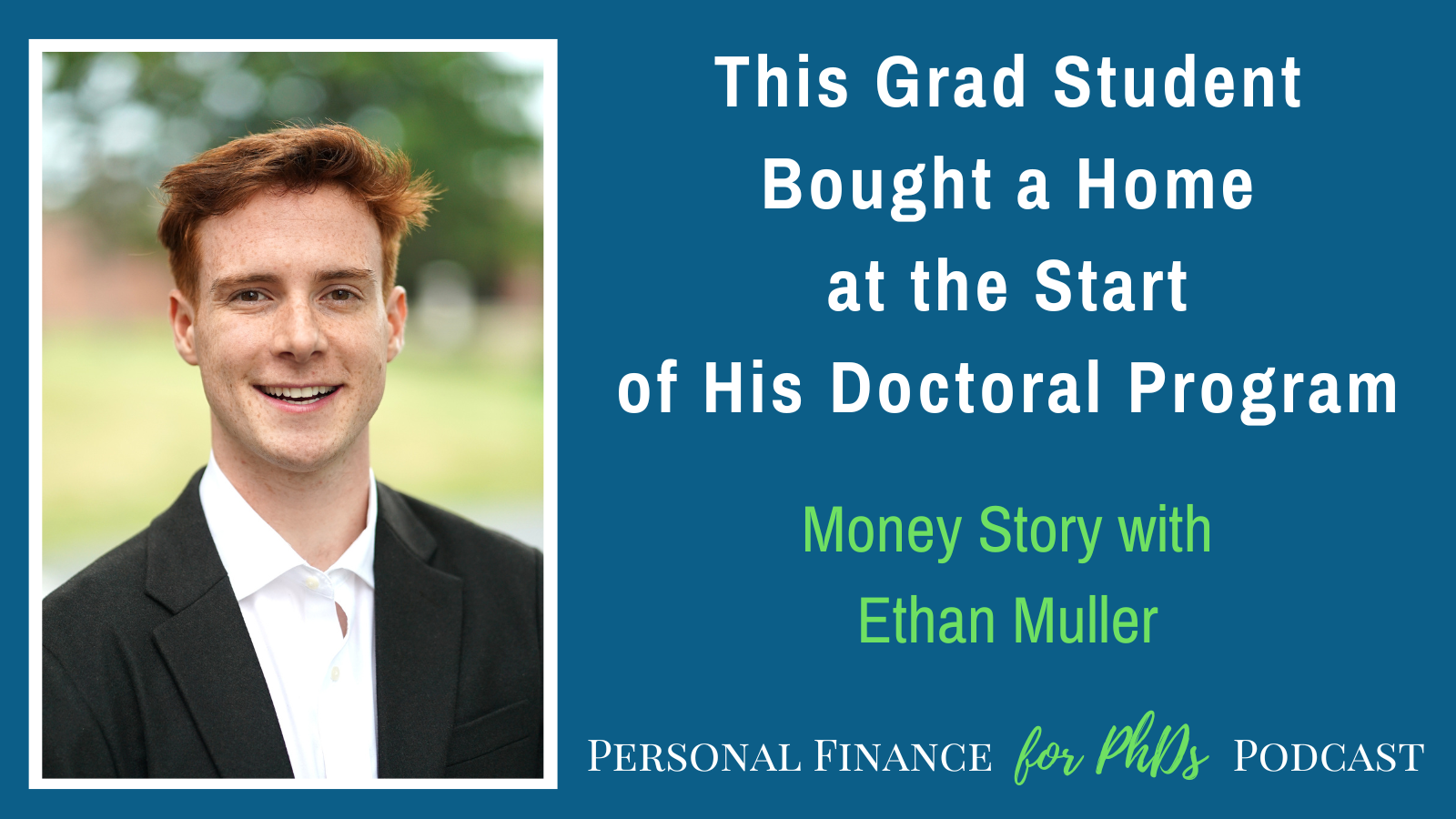
In this episode, Emily interviews Ethan Muller, a first-year doctoral student in theology at Villanova University. Ethan and his wife purchased their first home outside of Philadelphia at the start of his six-year program. Ethan shares the details of his and his wife’s financial profile, their emotional readiness to become homeowners, and their plans for the home once he finishes his program. After local mortgage lenders were unable to work with him due to his student status and 9-month stipend, Ethan connected with Sam Hogan, who knew exactly how to make the lending process much faster and easier. Ethan and Emily close the conversation by discussing which other PhD students should consider home ownership.
Links mentioned in the Episode
- PF for PhDs AMA on the PhD Home-Buying Process
- Host a PF for PhDs Tax Seminar at Your Institution
- PF for PhDs Tax Center for PhDs-in-Training
- First-Time Home Buyer by Scott Trench and Mindy Jensen
- PF for PhDs Subscribe to Mailing List
- PF for PhDs Podcast Hub
Teaser
Ethan (00:00): Especially in the shifting landscape of being an academic, you know, you could apply for something and get in, what does that look like with your house, and what equity did you have time to build? Which is also why before the program, it felt like a big deal to us to just simply attempt to buy a home.
Introduction
Emily (00:24): Welcome to the Personal Finance for PhDs Podcast: A Higher Education in Personal Finance. This podcast is for PhDs and PhDs-to-be who want to explore the hidden curriculum of finances to learn the best practices for money management, career advancement, and advocacy for yourself and others. I’m your host, Dr. Emily Roberts, a financial educator specializing in early-career PhDs and founder of Personal Finance for PhDs.
Emily (00:53): This is Season 23, Episode 3, and today my guest is Ethan Muller, a first-year doctoral student in theology at Villanova University. Ethan and his wife purchased their first home outside of Philadelphia at the start of his six-year program. Ethan shares the details of his and his wife’s financial profile, their emotional readiness to become homeowners, and their plans for the home once he finishes his program. After local mortgage lenders were unable to work with him due to his student status and 9-month stipend, Ethan connected with Sam Hogan, who knew exactly how to make the lending process much faster and easier. Ethan and I close the conversation by discussing which other PhD students should consider home ownership.
Emily (01:40): By the way, I’m hosting an AMA with Sam Hogan on Thursday, February 19, 2026, so that he can answer all your mortgage and first-time homebuyer questions! Sam is a mortgage originator specializing in early-career researchers. Anyone who is considering buying a home is welcome to attend, whether that’s in the near or far future. Register for the event at P F f o r P h D s dot com slash mortgage.
Emily (02:09): The tax year 2025 version of my tax return preparation workshop, How to Complete Your PhD Trainee Tax Return (and Understand It, Too!), is now available! This pre-recorded educational workshop explains how to identify, calculate, and report your higher education-related income and expenses on your federal tax return. Whether you are a graduate student, postdoc, or postbac, domestic or international, there is a version of this workshop designed just for you. While I do sell these workshops to individuals, I prefer to license them to universities so that the graduate students, postdocs, and postbacs can access them for free. Would you please reach out to your graduate school, graduate student government, postdoc office, international house, fellowship coordinator, etc. to request that they sponsor this workshop for you and your peers? You can find more information about licensing these workshops at P F f o r P h D s dot com slash tax dash workshops. Please pass that page on to the potential sponsor. Thank you so, so much for doing so! You can find the show notes for this episode at PFforPhDs.com/s23e3/. Without further ado, here’s my interview with Ethan Muller.
Will You Please Introduce Yourself Further?
Emily (03:45): I am delighted to have joining me on the podcast today, Ethan Muller, who is a first year PhD student at Villanova University. And Ethan is here with a home ownership story, and you all know how much I love a home ownership story for graduate students. So that’s our topic for today. We’re gonna get into all the dirty details. So Ethan, welcome to the podcast. Will you please introduce yourself a little bit further for the audience?
Ethan (04:08): Yeah, thanks for the kind introduction. My name is Ethan. I’m a first year doctoral student at Villanova, Pennsylvania, which is wonderful. It’s right outside of Philadelphia. I spent most of my time before this doing grad work in the Boston area with my wife and went through the incredibly hard process of applying to PhD programs and was lucky enough to, uh, wind up, I guess at Villanova. Yeah.
Emily (04:35): Can you tell us just a tiny bit more in that background question about maybe the timeline on this? Like when did you finish undergrad? What were you doing between then and when you applied for doctoral programs and also when you got married?
Ethan (04:48): Yeah, that’s a great question. My then girlfriend and I decided that we did not wanna go to grad school, um, as, uh, anything other than a married couple. So in the, I guess it was early spring of 2023, we both applied, um, to graduate programs. She got into Northeastern University and I got into a seminary on the north shore of Boston. So we got married in the spring of 2023 and went to grad school from 2023 to 2025. I applied to PhD programs the fall of 24 and heard back in the spring of 25.
Emily (05:27): Great. And what is your wife doing now? Is she also doing more school or has a job?
Ethan (05:32): My wife works in marketing. She has training in clinical psychology. She’s worked previously as an ABA therapist, wanted to switch it up, wanted to do something different. So now she’s in the field of marketing, which is great, expanding her CV a little bit. Um, we both during our grad school days, worked at Whole Foods Market, which is our claim to fame. It was our <laugh>, our our era to save a little bit of money while we lived on campus and, um, that kind of let her see some different experiences in different fields and corporations. So.
Why Buy a Home as a First Year PhD Student?
Emily (06:01): I love that story actually. It’s, it’s so often that I find that work experience itself is what opens our minds to other possibilities for how, you know, areas in which we might work or apply our education and so forth. So that is awesome. Thank you so much for that, um, backstory. And so when you’re, you know, you’re into this PhD program and you’re moving to Philadelphia, what made you interested in buying a home at that stage?
Ethan (06:24): Yeah, uh, it’s quite rare, especially as an academic to, there’s only a certain few places you can really go for school, depending on the field. I mean, sometimes people are limited to, Hey, I’m moving to the west coast. Other times it’s Chicago. It, it’s really rare. So I’m in a very niche field of theology where I knew that Philadelphia was a place where I could go one, because I was born and raised in Pennsylvania. So it became a very intentional part of my pitch to being accepted, um, that Pennsylvania was a place not only that I loved dearly, but wanted to return to. Um, so my wife and I really pushed hard to get into Villanova. I was very honest with the faculty there. Reached out, uh, quite a few times in order to make strong connections to put my best foot forward. Pennsylvania was the place for us. One, because this is not just a me decision, it was my wife as well. But two, the cost of living was much different than Boston. We loved the Boston area, it was brilliant. There’s so many wonderful opportunities and connections, but Pennsylvania really offers a good access to many different areas of the country, while also having a lesser cost of living, which for people who wanted to own a home, uh, that, that was pretty key for us.
Emily (07:39): So, but why, even though, you know, you’re, you’re sure you wanna put roots down in Pennsylvania and you, you know, you’re presumably there for the length of your doctoral program at a minimum. Um, why buy? Because renting is obviously the default and easier decision.
Ethan (07:52): Yeah, that’s for sure. We rented all up until that point, uh, most of the rhetoric that was given to me was, you can’t buy unless you have a certain amount of time, which I’m not sure how accurate that is or how many times other people have heard that. Like, oh, you need to have five years or 10 years when you buy. Um, and we had some people come alongside us and say, Hey, maybe that’s not so true. If you have time to save money while living on campus as a grad student, even if you’re in a next place for three to four years, no matter where we were gonna go, we felt like we had a enough of our debt covered to really put a foot forward into buy to make an investment. It just felt like something we were ready for.
Emily (08:34): I heard the same thing, um, the same rule of thumb around five years, or it could be even longer in some cases. Um, and I agree that that is off-putting for a lot of people starting a PhD program because they don’t, it could be only five years or it might be a little bit less or maybe a little bit more and we just don’t know. But I agree with you that it’s, it’s actually much more nuanced in that first, I mean, as a rule of thumb, it’s fine, but you always have to take a rule of thumb and then go into your specific market and your specific situation and really drill down into that. And the other thing is that that rule of thumb really comes from the transaction costs of buying and selling within a short period of time. And how likely it is that the appreciation of the value in your home is going to overcome those very high transaction costs. Very legitimate question, but the kind of corollary to that is like, well, maybe you don’t need to sell the home just because you finished your doctoral program. Like one, maybe you’ll stay in the area, you’ll still use the home. Two, maybe you’ll decide to rent it out. Like just because you finished your program doesn’t mean you actually have to sell and incur those transaction costs anyway. Probably some things that you were also thinking about when you were making this like evaluation.
Ethan (09:37): Yeah, one of the things for us was it’s whether you’re there for three years or four years, it doesn’t have to three to be a three or four year investment. The, the, the investment of the house can last much longer than that. And I think in the shifting world of academics is we saw, especially with Zoom, there was capacities to have an academic role while being in a singular area. So even though, uh, you know, who knows what’s happening with education as a whole nowadays, we knew that my wife and I could, she could find a job that was remote. I could find an academic job that was remote. So putting down those roots and investing in the house seemed more probable than let’s say 10 years ago.
Emily (10:11): Hmm. I totally agree. Yeah. Thank you for bringing up the changing work norms that we’re dealing with <laugh> and yeah, you’re not the first person as an academic who I’ve spoken to who is either working remotely or open to working remotely. Um, you know, within their roles. You mentioned that you had been in a master’s program, you were also working at Whole Foods, um, you of course have your wife’s job and your like stipend offer from your doctoral program. So putting that all together, like what was your financial profile that you kind of like presented as like a prospective homeowner?
Financial Profile as a Prospective Homeowner and Grad Student
Ethan (10:41): Yeah, I’m, the biggest aspect to my wife and I’s homeownership profile was that we didn’t have any school debt. That was one of the biggest things for us. We went to grad programs where there was open funding for us where we, we really went to the places where we got the most scholarships and we could pay off the debt as quickly as possible. Um, along with that, we had some strong savings in a couple investments, but really the thing I think that spoke the loudest was we had good credit. We had years of credit history and we had no debt and no student loans. Um, which really I think every lender we talked to was really happy with that. Um, because you don’t realize that the common norm, at least for a lot of academics and a lot of my friends has been there, is so much, there’s so much debt and there’s so many things that can get in the way, uh, of putting down a down payment or even just paying for an appraisal and things of that nature. So my wife and I went into the graduate season knowing that if we wanted to buy a house, we had to focus on debt. So we’ve started paying off our debt while we were in grad school working at Whole Foods. That was, we worked alongside that probably 30 hours a week just to supplement and slowly pay that off. So when two years was up, um, we wouldn’t have any student loans.
Emily (11:58): So if, if I, if you don’t mind, um, when did you acquire the student loans? Was it only from undergrad and you managed to, you know, okay, so just from undergrad, so that’s great. So you were in your master’s programs, you had your offers from there, whatever the funding packages were, plus you were working 30 hours per week on top of that, and that’s how you managed to repay the prior debt.
Ethan (12:20): Yes. Uh, it’s a hard road <laugh>, it’s a hard road that I’m sure many other people in grad school and in doctoral programs feel as well. Um, but I also think it’s really important that when you’re in these big metropolitan cities for academics, there are part-time jobs that are really accessible. Whole Foods has a great starting rate. They started me off at $18 an hour with zero experience and gave a discount. So there’s ways that you can make things work.
Emily (12:44): Then tell me a little bit more about your income, if you don’t mind. ‘Cause you have a two income household and we’re talking about Philadelphia, so yeah. How much are you guys making together or individually?
Ethan (12:55): Yeah, so my stipend is a nine month stipend. I know each school does it differently. I, these things fluctuate, but I’m at $30,000 for nine months and then the summers, there’s still coursework and things of that nature. But you do have a capacity to go and get a job or just internships, different funding at the school. My wife works in marketing. She’s around 45, I would say 40 to 45 depending, because you know, there’s incentives in different, um, qualifications for that. So all around we’re probably $70K a year, uh, on a good year. So it’s, we are a little bit outside the Phil- City of Philadelphia. That’s one of the beautiful things. Um, I go on the turnpike for a little bit and I can get to school, which is very, very nice. Uh, one of the benefits to doctoral work, so we are in a more rural area that has, uh, less living costs than, uh, downtown Philly would.
Emily (13:51): Hmm. Let’s talk about that. Home selection and the location is certainly part of it a little bit. So you have, you know, around $70,000 a year able to demonstrate on your paperwork that you’re gonna be earning um, in a year. And so like what, like price, because I, I haven’t even kept up with, I know interest rates are kind of like shifting now. So what price range does that enable you to buy in? And then what did you like ultimately select and, you know, share whatever you would like to about the home that you actually purchased?
Ethan (14:17): Most of the homes in our area, which is central Pennsylvania’s a very interesting real estate area because it’s low inventory, but high demand. So things go very quickly and they’re normally listed at a premium, which is similar to a lot of places nowadays. Um, we were looking in the, our, our top number was 330,000. That was the max that we could do. And now things depend, are you working to, is the price more loose? Are they, is it gonna sell quickly? There’s all these things that go into it. We ended up buying at that price, which was good for us, but it was also a place where if we were going to spend the extra money, it had to be move-in ready and it wasn’t necessarily a flip sort of investment. We were able to secure a house within a day. It was only up for a day. Very competitive market. We had to see it the day of for 330,000. So.
Emily (15:09): Yeah. So of the down payment, you don’t have to gimme the exact figure, but was it in like the 3 to 5% range of like the minimum for a conventional loan? Or was it like higher than that?
Ethan (15:19): It was very interesting. So the sellers of the house wanted a really high earnest money deposit, so it felt larger on the earnest money deposit end. I think the earnest money deposit was somewhere around 3%. Um, and the total down payment ended up being I think 7%.
Working With Mortgage Lenders as a Grad Student
Emily (15:40): Interesting. I understand that you ended up working with my brother Sam Hogan, um, for your loan and that’s how we got connected. But I’m wondering, you know, you told us you make, um, $30,000 over nine months. Is that W2 income or is it fellowship or like what’s the reporting like nature of the stipend?
Ethan (16:00): Yeah, that’s a great question and something I had to figure out early on when I reached out to lenders. It is, I am an employee of Villanova University, which is very helpful, I would say to anyone who’s applying to programs or once you get in, you can immediately reach out and ask ar what your HR, what your status will be. Um, Villanova’s really student focused and friendly, where they made sure based on doctoral students complaints and questions so forth, that they were employee status and not just independent contractors, um, which was very helpful. So it, it is W2.
Emily (16:35): Okay. I know that makes it so much simpler for lenders, so much simpler. But I’m wondering why you ended up working with Sam who kind of has like a specialty in this area. Did you have trouble working with local lenders? Like what went on on that front?
Ethan (16:47): Yeah, local lenders were incredibly friendly, but not always well versed in my situation. Uh, I didn’t run into any bad people, but I was forced to go online and somehow, you know, find this podcast and then find Sam and Sam was incredibly helpful and knew exactly what he needed from me. A lot of other lenders, I spent a lot of time trying to say, this is the situation, these are the documents I have, this is what I’m trying to qualify myself as. And they were wanting to reach out to the school. Would reach out to different people in my program and reach out to me a lot of the day. Sam already had a checklist of what he needed and how he was gonna get it done, and it went very smoothly. So the local, local agents and lenders were great, but it was, it was quite complicated with them.
Emily (17:33): Hmm. So you were kind of having to educate them about what the situation is, whereas Sam already deals with this day in and day out and he, he knows what’s going on. Um, was it the nine month stipend that was like giving people some pause?
Ethan (17:46): Yeah, a lot of people because it wasn’t 12 months and because it wasn’t medical. That’s one of the things I ran into as well. I’m in a humanities field, which I think some lenders rightfully so see as a bit more, uh, volatile. Um, it was brought up at one point that it was an issue that it wasn’t for a MD or a medical doctor that they wouldn’t be able to sponsor or help with. So there was a, a slew of things that I ran into in which people were hesitant to lend
Emily (18:19): Yeah. They didn’t have like a box that you fit in like neatly, but Sam Sam’s very familiar with all this, so yeah. I’m really glad to hear that he had like the checklist. He was able to like move quickly and everything. Is there anything else you wanna say about the process of like securing the loan or like any of the, the, you know, the contract period or just anything about else about the home purchasing process
Ethan (18:41): With the home purchasing process, I think sometimes, especially as an academic where most people are tight on money, I would say make sure you know what you have. Uh, it was often for me where your agent is asking you, are you okay with this? Are you okay with that? And if the home buying process is quick, know what your yes lines and no lines are, know what’s uncomfortable, know what is uncomfortable. Um, even with Sam, Sam was great helping us wait for a good rate, just waiting for a good rate nowadays is incredibly hard and, and can be very stressful. So knowing for you, this is the last day I wanna lock my rate, this is the last day I wanna worry about this. It just sort of having a strategy and not, um, it can be just really stressful to look at the lack of money that you have instead of what you’re comfortable with. So I would just offer the encouragement to be okay with what you have and, and plan for, um, using that in the most appropriate way.
Emily (19:35): Yeah, I totally concur as, especially in like a fast moving market, like what you’re describing, you really have to have given thought in advance to like what is a boundary, what is a yes, what is a no, what is a need, what is a want? Like all of that stuff when you’re, um, yeah, selecting the home that you’re gonna be living in for at least a few years.
Commercial
Emily (19:54): Emily here for a brief interlude! Tax season is in full swing, and the best place to go for information tailored to you as a grad student, postdoc, or postbac, is PFforPhDs.com/tax/. From that page I have linked to all of my free tax resources, many of which I have updated for this tax year. On that page you will find podcast episodes, videos, and articles on all kinds of tax topics relevant to PhDs and PhDs-to-be. There are also opportunities to join the Personal Finance for PhDs mailing list to receive PDF summaries and spreadsheets that you can work with. Again, you can find all of these free resources linked from PFforPhDs.com/tax/. Now back to the interview.
Initial Experiences With Homeownership
Emily (20:46): So you’ve been a homeowner for like, we’re recording this in November, 2025, so a handful of months now. Um, how have you found the experience? Has there been any like surprises, like positives, negatives?
Ethan (20:59): As far as negatives, I can’t say there’s a whole lot. We’re still very new. We moved in in September, so there’s not a whole lot that we can say that has gone wrong, thankfully, because that’s not always the case. Positives is there’s always things to learn. So if you’re an academic, you’re in a good spot because you must like learning and owning a home is a learning process. One of the things that we found really beneficial about having a home and making this step has been the sort of accomplishment of it, of it can feel so difficult to finding a home in this market that there is a real relief that once you get into a home you maybe haven’t even thought about what you’re going to do with the home. You’re just so happy that you have one. And I think one of the positives is once you get into the home, it really is, uh, an anchor and something to be proud of and something to hang your hat on that you went through the process because it’s so multifaceted and a lot of it was out of my vernacular interest rates and, and I, I didn’t know what an earnest money deposit was if you asked me 12 months ago. There’s a lot of that that you can accrue and I think it makes you well versed to help other people, but also look whether it’s time for your next house, I feel so much more capable, uh, in reaching out to lenders and agents and even with my own finances, it makes you dive deeper into sort of your whole inventory of knowledge.
Emily (22:24): Yeah, that’s very true. And we touched on this a little bit earlier, but do you anticipate this home to be something that you live in just while you’re in graduate school? Um, or so do you definitely see yourself moving at the end of it? Do you definitely not see yourself moving it? Are you open to multiple possibilities? It certainly sounds like you wanna stay in the area, but what about like this specific home?
Ethan (22:45): For the specific home we, it is a four bed, three bath, now, it’s technically two and a half bath. Um, I think they bump that number up on Zillow for the, for the looks of it, but it has space. So one of the things that we’d always consider is this could be more of a investment property in the sense of it was not perfect, but it could use some cosmetic updating. So when we sell it, we certainly could do some things in that realm. We’d love to stay in the house. I’m in a six year program, so at least for that long, um, outside of that, Pennsylvania’s a good area for postdoc research as well. I’m not gonna try and predict where I’m going, but it’s in a good area. It’s in a growing area. We felt like if we bought this house in six years, this area, we’ll still have a lot of people looking for a home, especially a single family residence. So we feel comfortable that no, no matter which way it goes, we’re just gonna put as much cosmetic work into the home as possible and move on from there.
Emily (23:43): So it sounds like you have a happy, happy scenario. Like if you end up staying longer than six years, that’s great. You’ve made a choice that probably will work for that situation or if you end up leaving after six years, that’s all you also thought through that scenario. This is something I was exposed to when I read, um, the First-Time Home Buyers Handbook, I believe is the title, and it’s by Mindy Jensen and Scott Trench over at BiggerPockets. Just even, it’s like in the introduction of chapter one, first thing I learned in the book was like, think through the possible outcomes. You live in the home forever, you sell the home, you move, but rent out the home. Are you going to be, are you making a selection that you are happy with, no matter which of those scenarios it ends up being. So if you know for sure that one of them’s out, that’s okay, but are the other couple of possibilities like you’re set up to do that. Because obviously, like you said, there are some properties that would not make a good rental property that you would pretty much have to either stay in forever or sell, and that does of course limit your options. So it sounds like you were thinking through all those possibilities.
Ethan (24:42): Yeah, the versatility to us was a really big deal. We wanted something that if it is an investment, it’s gonna have the widest exposure to helping us in the future as possible. Especially in the shifting landscape of being an academic, you know, you could apply for something and get it in in New York. What does that look like with your house and what equity did you have time to build? Which is also why before the program it felt like a big deal to us to just simply attempt to buy a home.
Homeownership Considerations and Advice for Grad Students
Emily (25:07): Yeah, absolutely. I mean if your finances are ready like yours were, you know, you had repaid the debt, you had some savings you had on paper, your offer letters and so forth like that is ready. Of course, not everybody, even if they wanna buy a home during graduate school, would be ready to do so right at the beginning. But I agree, like as soon as you are able to, the more time you give yourself, the better. As you’ve been entering into your graduate program and meeting other people, have you met any other homeowners in your graduate program or in other programs at Villanova?
Ethan (25:35): There are a couple, you know, graduate programs, there’s, there is a nice mess of people from different stages in life. Um, there are a few, yeah, there’s a few my, I would say in my generation to keep that as <laugh> as uh, classy as possible. But there are not a lot. And I think a lot of the times when I’ve talked to people about buying a house, they’ve, the question isn’t necessarily how did you do it? It’s how did you start? Because I think people feel really intimidated by the idea of doing so, and it’s not that they have a lack of capacity to do so, it’s just, oh, you know, it is a really overbearing process and having someone else who has done it can just feel like a good encouragement to them. So not a lot of people, but definitely people that are interested in doing so.
Emily (26:27): Hmm. Well I’m glad you’re, you know, available as a resource of course to your peers to give them your tips and what you learned through the process. And I’m glad that you’re, you know, you came on this podcast to, um, cast a wider net of like, hey, maybe it’s possible for you, like it, it is a project, but it’s not, not like too onerous. It just depends on whether you’re financially and emotionally kind of ready for that, which definitely sounds like you were. So maybe to add on to the discussion we’ve already had, but are there any, like, what are the circumstances under which other PhD students or doctoral students should consider home ownership?
Ethan (27:00): This is really basic, but one of the first instances is look at the institution that you’re at. I know that Villanova has a couple economic fail safes for its students that if something really negative were to happen, let’s say your car breaks down, your expensive MacBook breaks, right? And you were planning to buy a house that can take a real hit into your dreams of owning a house. Villanova at my institution has resources where they will cover that for it’s graduate and PhD students. So if you’re an at an institution that has these things to back you up one that’s really helpful. Two, I would say it’s exactly what you said, make sure you’re emotionally ready for it because looking for a house alone can be an emotional rollercoaster. It’s a wonderful coaster that you get off at the end and it’s awesome, but during it it’s a little frightening. And then third, I would say, if you feel that you can keep up with your debt, that’s the biggest thing. If you can continue to make payments, if it’s dwindling, if you feel comfortable with the payment, what, what kind of payment you’d be comfortable with. Those would be the big three things. Your institution, your emotions. Are you ready to buy a house? Is that something you want? Is that what the people around you want? And then third, what is your capacity to have a down payment? And also what’s your monthly gonna look like?
Emily (28:15): And I would say to that third question, um, if you really are considering home ownership, you can reach out to a lender. Like you can reach out to Sam for example, and just be like, this is the financial picture at the moment. Uh, yes, am I ready to buy in what price range, what I qualify for? And a lender of course will give you that information, but they might also say to you, Hey, your, your application’s gonna look a lot stronger if you clear, you know, your credit card debt. There may be some things they can suggest you of like maybe work on this first. Um, student loans, I know you paid yours back. Student loans are less of a heavy weighted consideration. Especially if they’re currently in deferment. So I would say if your only debt is student loans, like go for it, get what the picture is. But like that may not hold you back as much as an equivalent amount of another type of debt. I guess I’ll put it that way. Um, like if you had a car loan or you know, some other things going on like that. So like yeah, it’s never too early to just say, what would I qualify for right now? Okay, if I cleared my credit card debt, if I did this, then what would I qualify for? And maybe come back in a year, whatever, when you’ve had a chance to work on those items within your financial profile.
Ethan (29:27): Yeah, that’s a great point and thanks for the clarification. I think with that, I would say reach out to multiple lenders. One of the first lenders I reached out to said, Hey, you’re not gonna be able to buy a house in the central PA area for at least two years. And I, it was very defeating and very strange and I just felt the need to maybe get a second opinion. So I would say reach out to maybe if you don’t find an answer completely satisfactory and you wanna double check where you stand with a certain lender, reach out to a different one, see what they say and if you get similar feedback, go from there.
Emily (30:00): Yeah. I would say especially if those early answers are, um, limiting or like telling you you can’t reach your goal, like keep asking. Because frankly some PhD students will receive the answer of we don’t lend to people with your type of income or with, or we don’t lend to students or, you know, kind of what you were hearing. Oh, well if you were a medical student it would be different. But in this scenario we don’t do. So you may hear some of those answers. So like you said, always get, I would say minimum three, talk to at least three different lenders, get three different quotes. Um, let Sam be one of them because he does have a specialty in this area if you are a grad student or a postdoc, that kind of thing. But uh, still, you know, there is always a possibility that in your local area, maybe you will find a lender that deals with students or deals with postdocs all the time and like they have that checklist like Sam did, like they may be more familiar. It just very much, you know, could be dependent on your individual housing market.
Ethan (30:48): Yeah, yeah, absolutely. And Sam, again, just to speak to Sam, Sam was wonderful and not only that, but Sam immediately took the pressure off me to try to validate my situation and he could speak the language and immediately asked, Hey, I know you’re gonna have a statement from your acceptance letter of how much you’re gonna make each year. Can you send that to me? And in my head I was thinking, well how does he know that? Like he, he just read, read my mind. That’s wonderful. So having someone with that expertise is really helpful.
Emily (31:16): At least, yeah. One area of the buying process that doesn’t have to be like, quite so onerous. Like, like working with an experienced real estate agent who loves working the first time home buyers, like that’s another real huge like asset in your corner if you can find someone like that.
Ethan (31:30): Yeah. Finding a good real estate agent, they are worth their weight in gold. And I think you hit the nail on the head. There is a lot I didn’t realize, some real estate agents do not enjoy working with first time home buyers and that is more of a burden to them because first time home buyers are going to look at more houses and investigate different things and not know what they want. So that, I think that’s a great point.
Emily (31:49): Well, Ethan, is there anything else that you’d like to add about this whole journey, um, before we ask our final question?
Ethan (31:57): Yeah, I would just a I just wanna echo something you said earlier, which I think was really sound advice, which is just keep asking if, even if you don’t feel like you’re prepared to buy a house, but you have that desire to reach out to a lender, ask them what your situation is, that that’s very similar to what we did. Yes, we didn’t have a lot of debt, but we also did not have a lot of income during the summer and I wasn’t working, I hadn’t worked for a while. Um, my wife and I had never worked two jobs at the same time until this fall when we bought the house. So at that time we were on one income and it was not, uh, an exuberant amount of money, but it was still possible. So I would just offer an encouragement ask and you don’t know what doors could open or close
Emily (32:38): And just, we sort of touched on this, but like you can go to a lender with your offer letter, like you don’t have to wait for your first paycheck to arrive. Um, I’m trying to remember, I know Sam and I have talked to this before. It’s either two months or three months in advance of your start date. You are, you could get a loan based off of your offer letter, so it’s not too early if it’s, you know, the summer before you’re gonna start, you know, a PhD program in the fall. Like if you have that offer letter in hand, you can start those conversations for sure.
Ethan (33:03): Yeah, that’s a great point.
Best Financial Advice for Another Early-Career PhD
Emily (33:05): Okay, Ethan, I, we will wrap up with the final question that I ask of all my guests, which is, what is your best financial advice for another early career PhD? And it could be something that we’ve touched on in the interview already, or it could be something completely new.
Ethan (33:18): I would say reach out to your schools for as many financial opportunities as possible. One of the reasons that I had this opportunity was I bugged my school to see whatever funding I could receive at any moment. And I think as much as we wanna focus on buying the house, there are opportunities at the university you’re at where there are dollars that are waiting to be used no matter what field, what department there are opportunities. And I think having that just a season where maybe you get a scholarship you don’t, you didn’t know was coming, can really, really help your chances to get a house and make you feel more confident in going through that process. So I would say reach out to your institutions about funding, funding that may be available to help you in any way, shape or form, whether it’s health insurance subsidy, whether it’s, uh, a reimbursement for classes or textbooks. Use those tools to your advantage and while you’re looking to buy a house,
Emily (34:08): Love that advice. And I know I, I’ve, I talk with a lot of administrators and it really is the case that there is funding available that sometimes goes unallocated just because they didn’t know where to direct it to. So like ask your advisor, ask your director of graduate studies, anybody on your committee, just like all the appropriate people within your orbit, is there something I could be applying for? Is there money available? Like what do you think I’m a good candidate for? Um, especially if you are anything below fully, fully funded as a graduate student. I mean even if you are, you can still ask, but if you’re below fully funded, then for sure have those conversations. Then they, they should be expecting them frankly because if you’re not fully funded, then they should be expecting that you’re looking around for more opportunities. <laugh>.
Ethan (34:51): Yeah, absolutely. They, especially if you’re not fully funded, there’s a honor system there where they should be bringing you funding opportunities, I would think.
Emily (34:59): Yes. Okay. Well Ethan, thank you so much for joining me on the podcast today and congratulations on your home purchase.
Ethan (35:06): Thank you so much. I appreciate all you do for people who are in precarious academic situations looking for houses. We really appreciate your encouragement and the wealth of knowledge you bring. So thank you.
Emily (35:14): Awesome. Thanks
Outro
Emily (35:26): Listeners, thank you for joining me for this episode! I have a gift for you! You know that final question I ask of all my guests regarding their best financial advice? My team has collected short summaries of all the answers ever given on the podcast into a document that is updated with each new episode release. You can gain access to it by registering for my mailing list at PFforPhDs.com/advice/. Would you like to access transcripts or videos of each episode? I link the show notes for each episode from PFforPhDs.com/podcast/. See you in the next episode, and remember: You don’t have to have a PhD to succeed with personal finance… but it helps! Nothing you hear on this podcast should be taken as financial, tax, or legal advice for any individual. The music is “Stages of Awakening” by Podington Bear from the Free Music Archive and is shared under CC by NC. Podcast editing by me and show notes creation by Dr. Jill Hoffman.
Join Our Phinancially Distinct Community

Receive 1-2 emails per week to help you take the next step with your finances.

Leave a Reply