• Skip to main content
  • Skip to footer

Personal Finance for PhDs

Live a financially balanced life - no Real Job required

  • Blog
  • Podcast
  • Tax Center
  • PhD Home Loans
  • Work with Emily
  • About Emily Roberts

money mindset

This Postdoc from a Low-Income Family Evolved Her Financial Attitudes and Practices During Her PhD Training

September 14, 2020 by Lourdes Bobbio

In this episode, Emily interviews Dr. Fushcia Hoover, a postdoc at the National Socio-Environmental Synthesis Center. Fushcia grew up in a low-income family and graduated from college in 2009. Unable to find full-time work, she accelerated her plans to pursue graduate school, ultimately earning a PhD from Purdue University and winning an NSF Graduate Research Fellowship. Fuschia’s background imparted her with certain financial attitudes and skills that influenced her financial journey through her PhD and postdocs. On the positive side, she already knew how to keep her expenses low and she had enough discretionary income from her stipend to pay off her undergrad student loans, even while sending money home to her mother. On the negative side, she was unfamiliar with investing and understandably gun-shy after witnessing the stock market crash. Fushcia and Emily discuss how her financial attitudes and practices evolved during her PhD and first postdoc and why and how she negotiated her salary for her second postdoc position.

Links Mentioned in the Episode

  • Find Dr. Fushcia Hoover on Twitter, Instagram, and her personal website
  • Resource: PostDocSalaries.com
  • Resouce: PhDStipends.com
  • Personal Finance for PhDs: Financial Coaching
  • Personal Finance for PhDs: Podcast Hub
  • Personal Finance for PhDs: Subscribe to the mailing list

Teaser

00:00 Fushcia: As a graduate student, postdoc, there’s this expectation that we just kind of have to accept things as they are. And, certainly in some cases, yes, that’s true. But I think in a lot of cases, there are always things that are negotiable and that are malleable. And I think a lot of that comes down to recognizing how valuable you are, not just as a person, but also as the work and your contribution.

Introduction

00:35 Emily: Welcome to the Personal Finance for PhDs podcast, a higher education in personal finance. I’m your host, Dr. Emily Roberts. This is season seven, episode two, and today my guest is Dr. Fushcia Hoover, a postdoc at the National Socio-Environmental Synthesis Center. Fuschia grew up in a low income family and graduated from college into the depths of the great recession. Those experiences, and parted her with certain financial attitudes and skills that influenced her financial journey through her PhD and postdocs. On the positive side, she already knew how to keep her expenses low, and she had enough discretionary income from her stipend to pay off her undergrad student loans. On the negative side, she was unfamiliar with investing and understandably gun shy after witnessing the stock market crash. Fushcia and I discuss how her financial attitudes and practices evolved during her PhD and first postdoc, and why and how she negotiated her salary for her second postdoc position. You absolutely do not want to miss her concluding words of encouragement for all PhDs, but especially those in marginalized groups. By the way we recorded this interview in October, 2019. Without further ado. Here’s my interview with Dr. Fushcia Hoover.

Will You Please Introduce Yourself Further?

01:54 Emily: I have joining me on the podcast today, Dr. Fushcia Hoover, tnd she’s going to be Talking to us about her background, coming from a low income family and ultimately entering graduate school and a couple of different postdocs. And what she has picked up and learned about finances along the way and the work she’s done on her own mindset. I’m really excited about this episode. Fushcia, thank you so much for joining me, and will you tell the audience a little bit more about yourself please?

02:17 Fushcia: Thank you so much for having me I’m happy to be here. I am a engineer by training. My graduate degrees are all from Purdue University, Ag and Bioengineering, but I actually got my degrees from an interdisciplinary program, the ecological sciences and engineering program at Purdue. And so a lot of my research that I do now, as well as my dissertation work, looks at both social and ecological aspects of storm water management and the way green spaces and green infrastructure can be used to reduce runoff during rainfall events, but then what are the different environmental justice potential impacts. Then recently I have also started incorporating black geography theory, which looks a bit more at the way that people and places are connected and the historical and cultural connections between those two, and what that means in terms of storm water management planning and where we place green spaces and green infrastructure. That’s kind of where I’m at now, so I like to call myself, well, it always changes, but currently I call myself a socio-ecological systems hydrologist.

03:45 Emily: That is so fascinating, that the arc of your work has gone in that direction, from the technological to the more sociological. Okay, great. And so you said you have your all degrees from Purdue, bachelors through PhD, is that right?

04:00 Fushcia: No. My bachelor’s is actually from the University of St. Thomas, which is based in Saint Paul, Minnesota, where I originally am from and grew up. That degree was mechanical engineering, as my bachelor’s. And then I also had a minor in Middle Eastern studies. I’ve always been interested in balancing my science and the technical work that I do with more social and cultural components. That’s where I started and I’ve just been traveling the Midwest sense, but now I’m on the East coast.

04:34 Emily: Yeah. So tell us about your positions that you’ve had since you’ve finished.

04:39 Fushcia: Yeah, so I finished in 2017. My first postdoc was through the National Academy of Sciences. And that’s called National Research Council graduate fellowship, or post graduate fellowship, I believe. That was based at the Environmental Protection Agency in Cincinnati, Ohio. I was there for a year and eight months, so almost two years. Then, my contract for that ended, and my boss and I weren’t sure if there was going to be additional funding, so I had been applying to other postdocs, one of which is the one I’m currently in, which is with the, this is very long, so bear with me, the National Socio-Environmental Synthesis Center, um, or SESYNC for short, and that’s in Annapolis, Maryland. So both very research focused. All I do is research. At the time I wasn’t interested in going into academia. Things have changed since. Then I worked in this position with Sarah Moreau, who is a faculty at Arizona State University.

05:52 Emily: Gotcha. So interesting that you just dropped in there that you’re now more interested in academia than you were before. People don’t usually go in that direction, but not the subject of our interview today. I’ll have to follow-up about that another time.

Growing up in a Low-Income Family

06:05 Emily: Let’s take a step back even further to your childhood and then basically your time going through college and up until you entered graduate school. Just really briefly, what was your financial experience during that time?

06:18 Fushcia: My mom is a single parent and I have a twin sister as well, so it was the two of us and our mom. We grew up in a single parent households and we had been low income for the duration of my childhood into early adulthood. Certainly for anyone that is from, I think either one of those demographics, there was a lot of like coupons and buying things either on sale or clearance or discount. On and off throughout growing up, we would have access to food stamps, depending on what my mom’s specific financial situation was at the time. The great thing about growing up in Minnesota was that there were and are amazing social services. In terms of basic needs like healthcare, we were on the free and reduced lunch program, we always had all those things. So it actually took me a very long time to realize that we were low income because of that. It was, I think until seventh grade, when I realized that lunch wasn’t free. I just thought that was a service everybody got and people who brought their lunch, that was just a preference. I really grew up in that environment of saving and being very conscious about spending.

07:53 Fushcia: My mom was also very open with us in terms of explaining why we could only get things on sale, but I think the child, part of me was still like, well, if she wanted to, we could get this, but she’s just being a mom. You know, “parents are mean” type of childhood mentality. It wasn’t until I got older, I was like, “Oh yeah, that makes sense.”

Loans and Scholarships During Undergrad

08:21 Emily: Yeah. Thanks for telling us about that. Then, when you got to college, what was the situation then? You mentioned the school that you went to, but was it private or public, and how did you fund it?

08:34 Fushcia: It’s the largest private university in the state of Minnesota, and I was fortunate there was a college access program and I was part of in high school called College Possible. I made my sister join as well, so we were both part of the program and it helped teach us about scholarships, applying for college, doing college visits, as well as like practicing the ACT, which is what most of the Midwest takes as the college entrance exam. I think I had applied to between 20 and 30 scholarships as a senior, and then the ones that I was awarded, combined with, I received a full tuition scholarship from the University of St. Thomas based on my academic record and I’d done a lot of community service as a high school student as well. So through that, I was actually receiving refund checks, which is pretty rare.

09:45 Fushcia: A big part of the conversation my mom had with us in terms of college was that she could not afford to send us to college and she could not afford to co-sign on a loan. So my sister and I were very diligent about then seeking out money and applying for scholarships and finding resources that could help us pay our way, or in my case get paid, through college. I took out two loans, one for my last semester of college, and then for a January term study abroad. When I finished, I had about $7,000 in debt and that was all within Sallie Mae at the time, so one was subsidized and one was un-subsidized.

10:40 Emily: That is really good. I mean, to have access to that program, first of all, maybe that was part and parcel with the general great services you had access to in Minnesota, but yeah, that set you up amazingly and to of course then put in the work and get the scores and do the scholarships and everything that, I mean, it’s clear why that happened and why you ended up in that position. So your tuition, you had a scholarship. You had enough scholarships coming in to cover the room and board and so forth, so that you’re actually receiving at sometimes a little bit of money back. Then you took out some small student loans for part of that experience. So coming out of college, about $7,000 worth of student loans and you didn’t go immediately to graduate school, is that right?

11:19 Fushcia: Yeah, that’s correct. And I actually forgot, I did have, I think it was maybe like a $3,000 loan from Wells Fargo, which, well, maybe I can save this for the end as one of my pieces of advice, but at the time I didn’t know about kind of self-loans or just the loan system. My checking and savings were through Wells Fargo, and I was like, “okay”, not knowing that that doesn’t allow you to defer your loan and that the rates are higher.

11:52 Fushcia: When I graduated, in 2009, which if you remember, was kind of the peak of the financial crisis.

12:03 Emily: Yeah, the worst year to be graduating.

12:05 Fushcia: Yes, it was a horrible year to graduate. I didn’t have a job. I had started working part time for a program that I was a part of while at St. Thomas. And then I had transitioned into working for a program called AVID or the Advancement Via Individual Determination, which was located in the public — well, it’s a national program, but I specifically worked within the Saint Paul public school system. Tthat was part time as well. So I was doing that, I had moved back home, I was living with my mom and barely able to pay my $50 a month minimum for my Wells Fargo loan. I had been able to put it into forbearance for six months. That was the only thing that they would allow me to do. It was actually a very…I was very stressed. Thankfully, living with my mom helped cut down on a lot of expenses, but it was a lot of penny pinching. I think my income was maybe $500 a month, before taxes. So, trying to give my mom something and then basically pay for my cell phone and basic expenses and then this loan. That was my financial situation upon graduating.

Starting Graduate School in the Midst of the Great Recession

13:39 Emily: And did the difficulty in finding work of that year, the peak year, did that play in your decision to go to graduate school or had that always been the plan?

13:48 Fushcia: I’d always wanted to go to graduate school. I did not want to go right away. I was really mentally and emotionally exhausted after undergrad.

13:59 Emily: I know that feeling.

14:01 Fushcia: Yes, and I think a lot of us have those feelings even after grad school as well. I think the only difference was that I went to grad school sooner than if I would have had a full time job. I worked part time for almost two years before going back to grad school, because I also wanted to make sure that I wanted to go back and I didn’t know what I wanted to go back for quite yet. I knew I wanted to stay within engineering, but I didn’t know…I knew a lot of what I didn’t want to do. I took that time to figure out the programs and the schools of interest and what my potential research interests could be.

14:49 Emily: Gotcha. So when you entered graduate school, was that actually an increase in your income from working, I guess it’s still part time technically in graduate school, but was your income higher than at that point?

15:02 Fushcia: It was. It’s funny, a lot of people talk about how poor graduate students are and how we’re going to pay, and we are. I certainly agree that for the work that we’re doing, all graduate students should be paid more. But it was such a jump in income for me. I think especially going into an engineering program at Purdue, I think my monthly income was about $2,500 per month. All of a sudden, not only did I have a higher income, but I also had a dependable income. And it was an income that I was going to be getting, regardless of my hours that I put it in. That was the first time being on a salary, and having something that I was like, “okay, wow, I can pay my bills, I can pay my loans, and that’s not something that I’m going to have to worry about. Where’s this money going to come from? Am I going to make my minimum payment this month?” It was a big relief for me in a lot of ways.

16:13 Emily: Yeah. And I would imagine that stipend goes pretty far in Lafayette, Indiana, does it not?

Employing Frugal Strategies in Grad School

16:19 Fushcia: Oh yes, it does. And I very much…I had two roommates, I didn’t have a car either. I had a bicycle, so I was pretty much biking or Lafayette, if you’re a student, or basically if you are affiliated with Purdue and you have a Purdue ID, then you get to take the public transportation system for free, so I wasn’t having to spend money there. It was really just groceries and utilities and rent split between three people. I found a lot of ways to reduce the amount of expenses that I had because then I had also then started sending money back to my mom. I was sending her about $300 every month. Definitely trying to funnel resources and reduce costs.

17:09 Emily: Yeah. It sounds like you took a lot of the the strategies that you’d been using prior to that point, and also some of the mindsets you’d had to that point. That was what you applied right then. You found the low cost living situation, you used the public transit instead of owning a car, so you really reduce your expenses right off. But it sounds like still, even with sending your mom money, you probably had a good bit of discretionary money to be working with, above the bills that needed to be paid. What did you start doing in your personal finances at that point? What did you have to learn about since you now finally have this discretionary money to do what you want with? What did you learn about what did you apply in your life?

Paying off Student Loans During Graduate School

17:49 Fushcia: It’s funny, I had taken a financial literacy workshop before I started graduate school, and that was more focused on like budgeting and saving and negotiating whether you pay off credit card debt first, or if you have student loans and how you prioritize your debts. The biggest thing, aside from sending money home to my mom was that I started making monthly payments on the undergraduate loans that I had. I targeted the Wells Fargo private loan first, and then —

18:28 Emily: I just have a follow up about that. Were those loans, at least maybe the federal ones, in deferment at that point?

18:34 Fushcia: They were, yes.

18:36 Emily: And what about the Wells Fargo one? Was that in deferment?

18:38 Fushcia: No, the Wells Fargo, my forbearance had ended after the first six months, from me finishing my undergrad degree. I had only been making $50 a month payments, so you can imagine on a $3,000 loan, that’s not very much. So I kicked that up and I think I started making either between $150 and $200 loan payments every month. So about $500 every month was going to this one particular loan and then my mom. Then the rest that was remaining after bills and rent, I was just putting into savings or using for other expenses like going out to eat or going home for the holidays, things like that.

19:34 Emily: What I like to call irregular expenses.

19:37 Fushcia: Yes, irregular expenses.

19:38 Emily: The ones that can really mess up your cashflow if you try to pay for them in just one month. How long did it take you then? Did you just keep working in paying down those loans straight before adding any other goals to the picture and how long did it take you to pay them off?

19:50 Fushcia: I did. I had paid off my Wells Fargo loan by the end of my masters, so just under two years, and then my government loans, it took about two and a half. I don’t remember if it was two and a half or three years. I think part of the decision why, even though those loans were in deferment, one of them was unsubsidized, so it was gaining interest. And I think because of coming from low income background, and even though I was in this position where I had a steady paycheck, I was still really worried that it would end. Certainly, I knew the degree would end and I wasn’t sure what my income would look like after that, and I didn’t want to have that stress. I think I might’ve been the only one I knew of my friends with loans from undergrad who was actively paying it down.

20:54 Fushcia: That was my goal, was to have zero debt by the time I graduated from Purdue. Pretty much all of the focus was on paying off those loans. Then I would typically have anywhere from like $200 to $400 that I would just put into savings every month.

21:17 Emily: I will say, in my contact with graduate students, some people do, but it’s on the rare side to be working on paying down student loans while in graduate school. I think yours because they’re relatively small, might…I think some people get really defeatist about student loans. Especially if you have more than a hundred thousand dollars or multiple tens of thousands of dollars of student loans, it can feel really, really daunting, and why even bother like getting started on your low salary during graduate school. But I think yours, they were a fraction of what you made in a given year, and so it felt like something that you could tackle, probably. And like you were saying, you had that fear of, well, what if your program ends for whatever reason? Well, then the loans are coming out of deferment, you have to make at least minimum payments, and then what’s your income going to be? You don’t know. That decision definitely makes sense to me.

Commercial

22:12 Emily: Hey, social distancers, Emily here. I hope you’re doing okay. It took a few weeks, but I think I have my bearings about me in my new normal. There is a lot of uncertainty and fear right now about our public and personal health and our economy. I would like to help you feel more secure in your personal finances and plan and prepare for whatever financial future may come. You can schedule a free 15 minute call with me at PFforPhDs.com/coaching to determine if financial coaching with me is right for you at this time, I hope you will reach out, if only to speak with someone new for a few minutes. Take care. Now back to our interview.

Personal Finance Mindset Shift During and Post-PhD

22:58 Emily: Did you do anything else within your personal finances during graduate school, aside from paying off those loans and then also building up savings?

23:06 Fushcia: No. I had conversations, I talked with a couple of friends who were working about IRAs and investments, but it was all very intimidating. I think for me, at the time, it was easier to just put my money in savings and then I could also see it, and there wasn’t like a fear of losing it. With investments, I think particularly because of being an adult through the stock market crash, and also remembering when Enron went under and people’s entire pensions were lost. I have a, I wouldn’t say a strong distrust, but I would say I’m very kind of apathetic and very wary of different financial institutions. Even Sallie Mae and Freddie Mac and all of those. For me, I was like, “nope, I want to have my money with me, so I’m putting it in my savings account.” By then I had also transferred to a credit union, so I felt a lot more secure about credit unions as financial institutions, int that I’m an owner in this. And I have amplified checking, so then I was getting, I don’t remember what the return is, but it’s a couple percent return. I was like, “okay, I like this. I can make money from my own money.” Even though I had those conversations with a lot of friends who had higher income backgrounds or whose families did, and so these were conversations that they had. It still wasn’t something I felt comfortable really digging into because I think part of me still felt like I didn’t have the financial security yet to start investing.

25:05 Emily: Yeah. It’s interesting. I graduated from college in 2007, so two years before you did, so before the crisis hit and I was safely in graduate school, by the time everything went down. But I took away like a different kind of financial trauma from that whole period, which is that I’m very gun shy about the housing market. I’ve still always been a renter. I have yet to buy my first home. And that’s partially because, while I didn’t personally experience, all the media coverage is about people losing their homes and foreclosures. So while I was very gung ho about getting into the stock market and I was able to experience the rise right after the crash, it’s still is something that lingers with me regarding the housing. It’s just interesting to talk to someone near a similar age who had some witnessing and some stake in everything that happened and what’s lingering.

Investing

25:58 Emily: Actually, maybe you’ve turned this around since then. You were talking about during graduate school, you were nervous to start investing. And I think it actually is really smart to build up the cash savings to get the debt paid off before embarking on that. At what point did you, or have you started to invest?

26:14 Fushcia: I started a few months, maybe six months into my first postdoc. By the time I finished at Purdue, I had about a four month break where I was job searching and then preparing for a move, and I had saved up about maybe $5,000 to $6,000 in savings. One of things that I did start doing was also using credit cards as a way to prepare for high cost expenses. I had opened a card, um, just before I graduated so that it allowed me to have 18 months of 0% APR because I knew I’m not going to have a job. I was at a part time job that I got to cover basic things, but in terms of, I have to move, that card held all of those expenses. Then once I started my postdoc and getting paid, I worked on paying that down, and since I had 18 months, there was no rush. But then, because I was like, “Okay, I have a job.” As an engineer coming in for an NRC, my stipend was $69,000 for the year, which certainly is very high compared to a lot of postdocs, but I think most of the federal agencies, you’re going to see a higher salary, that’s closer to what a full time federal employee would be making

27:55 Emily: And for you in particular that’s over double what you had been making her in graduate school.

27:59 Fushcia: Yes. Well, and I should say that my first year of my master’s I applied for and was awarded a National Science Foundation GRFP, so I think that also really allowed me to focus on my debt because then I was making $30K. I still had to account for the taxes, which was not fun, but compared to my friends in college of liberal arts, who were in English or social science making $13K, that’s a big difference. One of the things that I actually learned from you was while I was in my first postdoc, I joined the National Postdoc Association, and you were a guest. This would have been a couple of years now. I watched your webinar, when you gave a presentation. From that point, I looked more into kind of the difference between an IRA and a independent tax account and figuring out, okay, with NRC, it’s the same thing. They don’t take out taxes. And so then —

29:19 Emily: I’ll jump in there and say, because you were on fellowship, because you were not technically an employee, I’m just explaining for the listener, you wouldn’t have had access to the workplace based retirement account, whatever that would be, that they would offer to their full time employees. So you’re still dealing with a stipend, you still have to handle the taxes manually, and you’re really only tax advantaged retirement option would be an IRA. Nothing was being offered through your employer, because you didn’t have an employer.

29:47 Fushcia: Yes. I was a contractor. I did a little bit of…well, I should say I did a lot of research trying to figure out then where I wanted to open an account. I actually ended up going with an online system called Betterment because I did not have the time to actually look into managing my own investments. I think because so much stuff is online, it also made it easy for me, so then I didn’t have to find an office location to go into. In my postdoc now we are considered faculty of the University of Maryland and the University of Maryland is a state run system, so we actually have mandatory investment portfolios and the portfolio that I chose is through the I don’t remember the, the full meaning, but it’s TIAA.

30:53 Emily: Yeah. I don’t know what it stands for either, but TIAA or TIAA CREF.

30:57 Fushcia: I still have my betterment accounts and I haven’t decided how much I’ll be putting into it. They take out just over 7% from my salary for the TIAA account, so I need to figure out what that balance is going to look like. Now I was like, okay, it’s probably about time. I was a little bit nervous about being older, like 31, and just starting to invest. But I think because I don’t have any debts and because, well I have a little bit of credit card debt, but I also just moved for this postdoc. I think that’s why I was finally at a point where I feel confident that I will have a job and I will continue to have income and that’s not going to be something I’ll be lacking anymore. And so now I can fully invest having confidence in, well the system is still problematic, but I at least have confidence that I’m not going to wake up and be without a job.

Learning Debt Management Strategies

32:12 Emily: You said earlier there were maybe some things that you brought out of your childhood that you had an aversion towards debt. A smart one. But you also maybe weren’t exposed to conversations around investing and IRAs, maybe like some of your peers were. Was there anything else that you kind of felt maybe you were a little bit out of step with other people during graduate school, or during your postdocs regarding personal finance. And anything you had to learn or mindsets to change or overcome?

32:44 Fushcia: I think I definitely learned about the healthy ways that you can use credit cards to manage certain debts. I think that that came from conversations with a close friend when I moved for my postdoc. I opened a card to buffer that, and a lot of that helped and realizing that all debt doesn’t have to be bad. That it can help you create a credit score and debt management techniques and strategies, and build out this financial portfolio that can actually then make you have a higher score and more competitive for other loans and things like that. A lot of that came from conversations with friends who had either taught themselves that, or they learned it by proxy from their parents. Just asking about their debt and how they managed it, and then also asking, are you afraid that you won’t pay it off or are you afraid that it’s going to be there forever? Certainly, I remember an ex of mine, she was like, “Yeah, it’s just going be there, and it’s just this thing that I have, and I’ll make payments, and it sucks, but also I have the education that I wanted to get and I’m in the job that I I think through those conversations, it definitely helps release some of the anxiety and like intense fear around debt.

34:48 Fushcia: Listening to webinars or reading your blog, for example, and just trying to educate myself more, so that I’m more informed and that’s definitely alleviated a lot of the fear and anxiety, but I think I still like coupons, I still like things on sale. It’s still really hard for me to pay full price for clothing or a pair of shoes that’s a hundred dollars. I’m like, no, can’t do that. Like you, I’ve been a renter this whole time and I don’t know if I want to buy property or a home. I did buy a car when I moved to Cincinnati, and so I’m making those monthly payments now. Part of it is also okay, well, I’m going to make these payments and pay off my car and then maybe see where I’m at in terms of, if I’m in a permanent position that then I feel more comfortable buying a home. I think some of the approaches I still have to managing that is to have one type of debt at a time. Take on debt, pay it off and take on a new debt, pay it off.

36:10 Emily: Yeah, it sounds like you really have learned much more about, as you were saying earlier, debt management or how you can use debt as a tool, especially to avoid large expenditures of cash. Because it sounds like you still have cash savings to a degree, but it’s more about not wanting to let go of that and using debt to help you basically just hold both to have the cash and to have the debt, so that you can feel, feel more secure around it. Is that right?

36:39 Fushcia: Yeah. I think that’s a really good way of kind of summing that up.

Negotiating a Post-Doc Salary

36:44 Emily: Yeah. And then the other thing that you mentioned that you wanted to talk about in this interview was negotiating your salary, which is also kind of another mindset leap, right? Like not only, maybe from someone coming from the kind of background that you have, but also just being in academia where like with your first postdoc, negotiation is not really an option, but it sounds like you did at your first opportunity, negotiate. Can you tell us how that worked?

37:09 Fushcia: Yeah. To be honest, a lot of it was just like, I know I need to practice this because I know I’ll have to do it at some point, so let me just practice it now because it’s lower stakes.

37:21 Emily: Yeah. Good point.

37:25 Fushcia: Part of that came from in your webinar you had been talking about kind of how you plan for transitions. So either going from your degree to a postdoc, postdoc to a full time permanent position, and managing the moving costs and change in expenses. I had sat down and looked at essentially the cost of living for Annapolis and estimating what my costs are now, and what’s expected to grow. The majority of that, it’s about a 300% increase in housing expenses from Cincinnati to Annapolis. I started there and then looked at how much would I want in savings or investments, and then worked with the business office at SESYNC to then figure out is there a parking cost? Learning about the exact percentage rate that they take out for retirement or investments. Trying to find what are all the other hidden costs and expenses that come with this position so that I could factor that into my budget and then know what would my minimum salary need to be, because I know my minimum payments for my car. I know my cell phone payments. Those are things that I know and then wanting to make sure that it had wiggle room.

38:54 Fushcia: Then I think on top of that, I also wanted to try and stay as close as possible to what I was already making. Certainly, it can be challenging to do that with a different type of postdoc, particularly because this one’s affiliated with the University of Maryland, academic post docs are much slower. But I didn’t want to have this $20,000 drop, because the great thing about the NRC was that they gave a $1,500 increase every year. I came in at $69,000, but then the next year I was making $70,500. So it’s like, okay, well, how close can we get to this?

39:38 Fushcia: Again, a lot of it was using my network, and talking to in particular, a good friend who is now at Cornell. She had just finished her PhD, and she had negotiated her position. Asking her for advice and resources and how you frame what you’re negotiating for and the language that you use so that it’s still appropriate and respectful, but that you’re still firm, in terms of, these are my skills, particularly because I was coming out of a postdoc. I already have almost two years of experience post-PhD, and I’ll have all these other publications, and knowing different questions to ask.

40:22 Fushcia: I wrote up this letter, had a few people review it. Ironically, when I asked my former PhD advisor, she was like, “We don’t do that. If someone were to do that, maybe I’d give like a two to 3000 increase.” But when I had looked up other negotiation strategies on Inside Higher Ed, I used a lot of their articles. They mentioned, I think it’s 15% to 22% is typically what you negotiate as your range, particularly if it’s not a lateral position, if you’re moving up. So I was like, “Okay, we’re going to go for 15%.” And they did not give it to me, but they came close. From there I went back and said, “Okay, based on this salary, could I make it work?” And I could. It’s going to be tight, which is a bit frustrating to have a point where you have more flexibility and you have more expendable income and now it feels a little bit more like being a grad student again where it’s a smaller salary. I have to be more conscious of where my money is going and not spending as much as I was, particularly now that I have a car and all the expenses that are associated with that. But I know that I have the skills to make it work. And at this point I’m also looking for a permanent position after this postdoc. I don’t anticipate after this two year position, being in a situation where I have to kind of penny pinch and reduce costs elsewhere.

42:23 Emily: Yeah. It sounds like you approach that — I mean, it’s clear that you did a lot of research and preparation through that process, not only taking what you learned from the webinar that I gave, but also this research you did with the articles in Inside Higher Ed and in speaking with your friend. You really prepared for that and kind of the best way possible, so it’s a great, it’s a great model for the listeners to hear, especially because you knew that you were going into an almost guaranteed income drop and also a cost of living increase. Both of those factors just highlight the need for being really careful around this. And if your academic advisor said, well, this isn’t done, I mean, it is, it is done sometimes, in some places. Maybe no one’s ever attempted it with her.

43:06 Emily: I want to point the listeners to one of my resources, which is postdocsalaries.com. And there’s also another one PhDstipends.com, for those in graduate school. It’s kind of like a Glassdoor, but for those types of positions, for postdocs and for grad student positions. That’s just another resource out there, if people want to get benchmarks on what is reasonable to be paid for different kinds of postdocs in different areas of the country. And I also ask questions about negotiation on that survey. I think the last time I looked in the database, it was around 25% or maybe a third of the people who had answered the questions had said, yes, I at least attempted to negotiate salary or benefits for the postdoc position. I think it’s becoming more and more popular, as people realize that this is a standard thing you do in most jobs, and why don’t we at least try it in these academic or nonacademic postdocs. That was great story.

43:58 Fushcia: Well, and I think too, salary, while I think it is very important, isn’t the only thing that you can negotiate. You can negotiate moving expenses and you can negotiate time off. I also negotiated my start time because I wanted to finish through my contract at the EPA before coming to SESYNC. That was something that I successfully negotiated. I had picked my top three things of these are the things that I would like, so we’ll see where they can meet me. There’s another postdoc who negotiated because he also was coming out of a previous postdoc and then everyone else who we’ve talked to, we were having a conversation and they were like, I didn’t know that you could do that. And we were like, all they can say is no, especially once they offer you a position, if they want you. If you don’t ask, you’ll never know.

45:02 Fushcia: I would also say for all the listeners that if you are going to any type of public institution, you can look up everyone’s salary, that’s all publicly accessible information. And that was something that I did to give me a sense of what are the ranges for the people that are employed within the center. I had an idea of what their budget is to figure out do I ask for the 15% or I do I ask for the 20% to 25%.

45:29 Emily: Yeah, that’s a great advantage when you’re going to those types of places, that there’s a large degree of transparency around salary there. That’s an amazing thing to look up, if that’s where you’re applying.

Best Financial Advice for an Early Career PhD

45:41 Emily: Last question here, Fushcia, as we wrap up — what is your best financial advice for another early career PhD? And that could be something that we have touched on in this interview, or it could be something completely else.

45:53 Fushcia: I think my first piece of advice would be to do as much research as you can. As grad students, we’re training basically how to do research and conduct research. I think we already have a lot of the skills to be able to access these resources and information and find ways or people to help us get there. I would say that most of the way that I have navigated my finances has been through talking to friends, talking to people who are in positions where I see myself going, and just doing the research and using the academic online journals that are available or financial journals, blogs, anything, and everything that you can capture to try and help inform what the decision that will be best for you, or rather the best decision for you.

47:00 Fushcia: The second thing that I would say is to give yourself more value and credit than what you would default to. I think as a graduate student, postdoc, there’s this expectation that we just kind of have to accept things as they are. And certainly in some cases, yes, that’s true. But I think in a lot of cases, there are always things that are negotiable and that are malleable. I think a lot of that comes down to recognizing how valuable you are, not just as a person, but also as the work and your contributions and that the majority of the people in this country do not have PhDs, so you’re bringing in a very valuable skillset, which, when you’re going into a space where everybody has PhDs, it may not seem like that, but I think it’s important to remind yourself of that.

48:05 Fushcia: I think especially, I say this to women postdocs, women of color, black women postdocs, we are already underestimated in many way. We are already underpaid in many ways, thinking about your initial salary offer or associated benefits. I think because of all the work that’s coming out from the national academies and other research centers about this still huge discrepancy across all fields, I think I use that as a way to empower me to ask for more. Because now it’s not just valuing my work and what I bring, but also recognizing that I’m already going to be undervalued, because of what I look like when I come in the room. I think that would be the last piece of advice that I would say for all the postdocs out there. And this includes folks who are femme or femme-identified. If you’re any type of on the marginalized periphery, ask for more, because again, all they can say is no. And if they take back that offer, then that’s probably not a place you want to go in the first place. Because you want to go where you’re going to be celebrated and valued. Give yourself more value than what you default to.

49:39 Emily: I think you put that so well. That was great. I have nothing to add there. Just everybody go back and listen to that again, listen to it a few more times, especially if you’re in one of these groups that Fuschia just identified. Absolutely.

49:50 Emily: Well, thank you so much for this wonderful interview and it was really a pleasure to speak with you today.

49:54 Fushcia: Yes. Thank you so much. This was really fun. I hope that whoever’s listening has been able to take something away, even if it’s just to know that you’re not the only one that’s in grad school who’s from a low income background or is having anxiety or fear around debt or salary. That’s that’s normal and also you will be okay. Everything will be fine.

50:23 Emily: Love that. Thank you so much.

50:25 Fushcia: Yes. Thank you.

Outtro

50:27 Emily: Listeners, thank you for joining me for this episode. PFforPhDs.com/podcast is the hub for the personal finance for PhDs podcast. There you can find links to all the episode show notes, and a form to volunteer to be interviewed. I’d love for you to check it out and get more involved. If you’ve been enjoying the podcast, please consider joining my mailing list for my behind the scenes commentary about each episode. Register at PFforPhDs.com/subscribe. See you in the next episode, and remember, you don’t have to have a PhD to succeed with personal finance, but it helps. The music is stages of awakening by Poddington Bear from the Free Music Archive and is shared under CC by NC. Podcast editing and show notes creation by Lourdes Bobbio.

This New PhD’s Salary Tripled But Her Scarcity Mindset Lingered

September 7, 2020 by Meryem Ok

In this episode, Emily interviews Dr. Samantha Snively, a PhD in literature who recently transitioned to a non-academic job at the University of California at Davis. Samantha tells the story of her financial and logistical transition out of graduate school with an emphasis on the unexpected emotions that arose upon receiving a much higher and steadier income. Samantha and Emily also discuss how to shed the scarcity mindset imparted by academia and the distinction between lifestyle inflation and lifestyle catch-up.

Links Mentioned in the Episode

  • Dr. Samantha Snively’s LinkedIn Page
  • Blog Post About Emily’s Husband’s Salary Offer
  • PF for PhDs: Speaking
  • Interview with Dr. Lucie Bland (Part 1)
  • Interview with Dr. Lucie Bland (Part 2)
  • Interview with Cortnie Baity
  • PF for PhDs: Subscribe to the Mailing List
PhD scarcity mindset

Teaser

00:00 Samantha: And you get so used to doing a lot of work as a graduate student for very little pay that it does distort your sense of what you’re worth, what your skills are worth, what anyone wants to pay for your skills.

Introduction

00:16 Emily: Welcome to the Personal Finance for PhDs podcast, a higher education in personal finance. I’m your host, Dr. Emily Roberts. This is season seven, episode one, and today my guest is Dr. Samantha Snively. Samantha transitioned out of graduate school last year and into a nonacademic job at her Alma mater. Samantha’s income tripled and became much more reliable upon taking the job which brought forth some unexpected emotions. We discuss the mental shifts that Samantha is working through, such as healing her scarcity mindset, as well as processing the difference between lifestyle inflation and lifestyle catch-up. I highly recommend listening to this very insightful conversation. Without further ado, here’s my interview with Dr. Samantha Snively.

Will You Please Introduce Yourself Further?

01:06 Emily: I have joining me on the podcast today, Dr. Samantha Snively. I’m very excited to have her on. She’s going to be talking to us about kind of the emotional and financial rollercoaster of transitioning out of graduate school and into a professional career. So, Samantha, I’m so delighted to have you on. Will you please introduce yourself a little bit further for our listeners?

01:27 Samantha: Absolutely. Thank you for having me, Emily. I am delighted to be talking about this topic with you. My name is Samantha Snively. I am currently working as a proposal writer in higher ed development for the University of California Davis, but just this past June, I received my PhD from UC Davis, a PhD in English literature, and I focused on and wrote a dissertation on experimental culture and scientific knowledge-making in 17th century England, particularly focusing on women’s writing and women’s work in the household. So, I finished that and moved pretty quickly into a nonacademic job in service at the university, but not on the tenure track.

Transition Out of Grad School

02:08 Emily: Gotcha. So this is actually really fresh for you. We’re recording this interview in January, 2020. So, it’s only in the last six, nine months. Can you tell us a little bit more details about the timing of your transition out of graduate school and those sorts of other logistical details?

02:24 Samantha: Absolutely. So I realized in my second to last year in graduate school that I didn’t want to make a tenure track run. More importantly, that I did want to work in a job where I could advocate for the importance of research and the importance of universities and higher ed and the importance of the humanities. So, I started looking for jobs in November, 2018 because I wasn’t in a position financially to not have a job after graduation. So, I wanted to start that search early. I started my search in November with the goal of having a job by June, 2019 graduation time.

02:59 Samantha: And just very briefly, I think I had my first phone interview for a job in late December. My first in-person in early January. And then in the job I’m working in now, that moved pretty quickly. I applied back in November, had no sense of what was happening. I had thought they’d forgotten about me. And then I got a surprise phone screen in late January from the person who’s currently my boss. And from there, it moved really quickly. They asked for writing samples. I sent them in. They sent a writing test. That was a model of what we do on a day-to-day basis. They seemed to like that, so I had an in person interview, another writing test. They called me back for another in-person interview and a conversation with leadership. And I think I had a job offer by mid February, 2019. So, I started the job this past April, and I got my degree in June.

Was this Good Timing for You?

03:55 Emily: I see. It’s actually, it’s so hard to get the timing of this right, right? When do you apply? When do you reasonably think you will get a job offer and then what your start date is going to be? All of that against already the complications we have of timing a defense date and writing the dissertation. And there are a lot of moving parts at once. And so I’m wondering was that a good timing for you the way it worked out for you? Or if you had your ideal world, would it have been a little bit different?

04:23 Samantha: That’s a great question. Yes and no, this job search has been an exercise in getting what you need and not necessarily what you want. So, I think in an ideal world, I would have liked to finish the dissertation, graduate, and then start a job. But the way it worked out ended up working well for me, because it avoided the anxiety of being unemployed after finishing the degree. And I intentionally made the choices I did to avoid some of that anxiety. So, I’m very happy with the way it turned out, because it alleviated a lot of my biggest worries, but also the job search taught me that sometimes you have to compromise. I targeted my search in Seattle where my longterm partner lives. And I am not in Seattle. I am working in Sacramento. So, it works out in a way that is good for you, but perhaps not the way you originally envisioned. So, I’m very happy now, but I don’t think that this is where I thought I would be like a year ago.

Negotiated Start Date

05:23 Emily: It is really hard to see, especially with your transitioning to a job outside of academia, if you don’t have prior work experience, it’s really hard to know all these things, but that’s why we tell these stories, right? Because it’ll help people coming along behind. You mentioned that you weren’t in a financial position to have a lapse in income. Did your paycheck from the university, the one part of the university end over here on a Friday and Monday it’s going to pick up in this other part of the university, or did you actually have a little bit of a gap? Did you take any kind of a break, or what was the situation?

05:57 Samantha: The answer to both is no. But again, I was grateful for that. So, I got the job offer in February. I negotiated to be able to start a bit later than they would have liked. So, I had to finish out the quarter. UC Davis is on the quarter system. I had commitments in the quarter. I had a couple of part time jobs I needed to transition out of. And so I finished up the last week of the quarter, which was the second to last week of March. I took a break for the final week of March and then started the first day of April. And so there was no gap financially because I think the March paycheck from grad school got me into April and then the next pay cycle got me into May. I don’t know that I’d recommend that fast of a transition if you are able to do it, but it was anxiety-relieving for me. And it helped me focus on other things rather than stressing about money.

06:50 Emily: Yeah. And you just mentioned negotiation there. You negotiated the start date. Did you attempt, or were you successful in negotiating any other aspect of your package?

07:00 Samantha: I did attempt to negotiate. But because I work for UC Davis, which is part of the state of California, the salary bands are all set and were publicly posted. So, I did know the range that I would be going in. And so there was, I suspected there was not a lot of room to negotiate and I was correct. But I did ask for the practice, and I’m glad I did, but no, I did not have the opportunity to negotiate. But the financial compensation package was, I was very happy with it. So, the negotiating start date with what I needed.

Emotional Response to the Salary Offer

07:34 Emily: You mentioned you have a little bit of financial precarity. You receive this job offer, you receive the salary offer, you’re looking at it, what’s running through your mind? What are you feeling?

07:44 Samantha: Frankly, shock at first. The posted salary band was part of the reason I originally thought I wouldn’t be qualified for the job because it was almost three times what I was making as a graduate student. And you get so used to doing a lot of work as a graduate student for very little pay that it does distort your sense of what you’re worth, what your skills are worth, what anyone wants to pay for your skills. So, at first I couldn’t believe it. It’s like, is there a number of extra here? Is something going on? And I think perhaps the second emotion was relief because I realized I didn’t have to worry about the things I’ve been worrying about for the past several years. Honestly, where is the next paycheck coming from? Will I be able to ever take a vacation? Will I ever be able to live in the same city as my partner? Will I ever be able to save for further than six months down the road?

08:38 Samantha: So, relief was a big part of it. It allowed me to settle in to my new life and to have a bit of space to breathe and to really reflect on what I wanted to be doing and who I was and who I had become after graduate school. So, that was good. And I think the next big emotion that I noticed was guilt. Surprise, surprise. You spend six years in a graduate program, working continuously and in a culture of overwork that can often be toxic. And so when I moved into a job that was an eight to five schedule with a very generous boss, everyone was very flexible about their hours. I started to have feelings of guilt about taking a lunch break because I thought, well, if the, if the pay is so high, surely I must need to work enough to meet that pay. And it took me a while, several months, and it’s even still lingering today, to realize that it is okay to take a lunch break. It is okay to have a doctor’s appointment, period. You know, working through those feelings of guilt because the value of my labor is suddenly so much higher than it was a year ago, even though I’m doing very much the same kinds of things, that was an adjustment as well.

09:56 Emily: This is so interesting. I want to comment on both of those emotions. If you don’t mind, I’m going to tell a slightly lengthy story. It’s actually not about myself, but it’s about my reaction when my husband got his first post-PhD job offer. I’ll link in the show notes to a blog post where I wrote about this, but basically what happened is my husband was in Seattle interviewing for the job that he ultimately took. They offered it to him and he took it. And while he was actually flying from Seattle back to Durham, I knew the flight times and knew he was in the air, I was using his computer and I saw an email come into his inbox that was from the company that he had been interviewing with. And it was the job offer, and it included the salary. And, you know, listeners are probably pretty familiar with my story, like my husband and I worked very hard and we’re very fortunate. And actually were in a very good place with our finances for graduate students during the time when we were in graduate school, especially by the time we finished. We had cash in the bank. We had investments. We had very little debt that was very manageable.

11:01 Emily: But still, when I opened up that email and I saw that salary offer–and we knew the ballpark of what it was going to be–I started bawling, and I felt this huge sense of relief. And I thought to myself, we don’t have to struggle anymore. And I thought, I didn’t even know that I thought we were struggling. I thought we were succeeding. And we were succeeding definitely by external measures, but still I had that emotion somewhat, that feeling somewhere inside that sort of erupted out of me when I saw that that salary offer. And so, it was a great deal of relief, shock as well, and shock at my own response to it, I guess, and relief seeing that number. So, I think we’ll come back to the actual transition of well, does that salary turn out to be what you think it’s going to be once you actually move out of your grad school mindset and so forth, but that’s the first story I want to tell.

Money Mindset: Overcoming Feelings of Guilt

11:52 Emily: The second one is I find this guilt emotion so interesting. And I guess I can understand where it’s coming from because it’s almost like, how much harder can you possibly work? Like you’re in graduate school and you’re working yourself to the bone for a very low salary or pay or cobbled together funding or whatever it is. And then I can see you going into this job and making about three times as much and thinking, “I just can’t work three times harder.” And, you know, you can’t work three times harder, but “Oh my gosh, I’m not even expected to work three times harder? It’s actually okay to have all this flexibility and I can leave my work at work and go home.” We haven’t said that you actually do that, but you know, that’s the case for some people. What a rollercoaster ride and what a shift. Right? At that point. So, do you want to elaborate on that any further?

12:45 Samantha: Absolutely. You are describing spot-on things. I think it was certainly an adjustment. And it was the realization moving into something in a work environment that was more normal. And that allowed me to leave my work at work and, you know, to be able to have weekends, to be able to spend time with friends and family and settle into it made me realize how toxic and draining–and I use toxic mindfully–that that culture can be that expects incessant production from people who also have families and have, you know, the right to rest and to care for their bodies who are doing intense intellectual work, which is, you know, it is not physical labor. And so it is a certain kind of privilege to do intellectual work, but also to keep it up all the time is draining.

13:42 Samantha: And it is only increasing in academia, the pressure to do more and do more. And for less, especially for people from marginalized groups or minoritized groups, a lot of that labor is put onto them by a structure that just exists to extract as much value with as little pay as possible. And so, it did help me realize how erroneous my own thinking had gotten, because I’d internalized a lot of academia’s self-valuation. As I started to transition out, I started to withdraw from that feeling a little bit. It got to a point where I heard a colleague gleefully tell us that she had worked from 10:00 PM to 2:00 AM last night, as if it was something to be proud of. And that’s when I realized, I don’t want this. Something is terribly wrong if we have gotten here.

14:33 Samantha: And it’s not the only field in which this happens, right? There are other work cultures where this sort of overwork is valorized, but yeah, it was simultaneously realizing that I didn’t want it. I didn’t choose it. And yet it was in my mind still. It still affected the choices I made and the way I thought about my own work. But it was honestly very healing to take a nonacademic job. It allowed me, as I said earlier, to rethink what I’ve been taught by the Academy and from my familial background. And it allowed me to think about what my values actually were.

15:09 Emily: Yeah. I can definitely see how that increase in pay and also the more work that has better boundaries around it and more reasonable expectations can, you finally have a chance to breathe, take some space for yourself. Take some time for reflection. Yeah. When you’re in graduate school and in some kinds of jobs, this training period, it’s just push, push, push, push, push, and you can end up going quite off course and in a weird direction, if you don’t take that time periodically to reassess.

Appreciating and Using Privilege to Help Others

15:37 Emily: Okay. So, you’ve talked about the initial shock of the salary offer and this feeling of guilt that cropped up, but then realizing that your mindset was also changing as you were moving out further away from the graduate school experience. Were there any other emotions that you wanted to bring up along that path?

15:54 Samantha: I think another thing that surprised me was how quickly people started to say things like, “Oh, well, you can afford it now.” And how often that was my fellow graduate students. So, I think it was, you know, this is not a critique, but more of an illustration that this mindset affects us all. So, that was surprising. I didn’t expect that to come or to come so quickly. That would be a big one. And I think, now that I am almost a year through the new job and I’m navigating this transition, I’m thinking a lot more about the ways in which even, as I came out of graduate school, that all the different ways in which I’m privileged and the fact that I have landed on my feet and landed in a space of calm and restoration only motivates me more to want to change things and to use the fact that I am being paid decently well to help others and advocate for others who still are not. So, that’s something that’s been coming up more often is realizing like I am in an interesting position in the university and I have a lot of privilege. How can I use that to improve things moving forward?

How Would You Describe the Scarcity Mindset?

17:06 Emily: Mhm. That’s awesome. So, you’ve brought up some aspects of your mindset that you have started to shed as you’re putting more time between yourself and the end of your degree. And you use the term with me scarcity mindset. I think some of those ideas around scarcity have come up so far. We haven’t used that term yet. How would you describe the scarcity mindset that is developed in academia by many people?

17:30 Samantha: That’s a great question. I understand it, knowing that there are others who actually study it and have a much better understanding, but I understand it as the scarcity mindset is a combination of not making enough. So, not making a living wage. I live in a part of California that is lower cost of living for California, but high cost of living compared to anywhere else. It’s not in the major cities of the U.S. So, realizing that the money you earn through hard work does not go as far as you need it to. And there’s nothing you can do about that except work more. So, there’s that, you’re not being paid enough, but also realizing as grad students do, that you might not be paid continuously. And so, if you make enough money one month where you can pay all your expenses, the scarcity mindset is knowing that you might not be paid for four months out of the summer, which we were not. We don’t get paid from July to November. Hurray. So, it’s that too. It’s knowing that no matter what you do, you may have to weather the summer, a health crisis. You could be one blown tire away from having to take loans. So, that’s how I understand it. And it creeps into everything. It affects health, it affects community function, all sorts of things.

18:51 Emily: Hmm. So, what I have been interested in lately is I’ve been learning about scarcity mindset as well, almost from like an entrepreneurial, like side of things. And then it has caused me to think a little bit more about it in the academic setting. But there’s scarcity mindset, and there’s like actual scarcity that sort of objectively is going on in your life. And graduate students often have both of those things overlapping, but they can also exist independent of each other. You can have a scarcity mindset and not actually be experiencing scarcity. Maybe it’s something that happened in your childhood. Maybe it’s something that was going on during graduate school, but you’ve moved past it. You have a higher salary now, but the mindset can still follow you. Likewise, you can have a very tight financial situation and not have a scarcity mindset around it, even if it is pervasive in the community around you. I think that academia itself tries to impart upon us a scarcity mindset, even if not every member in that environment is actually experiencing scarcity. So, I’m wondering for you, as your income has gone up even though, okay, you’re still living in a high cost of living area. I’m sure there are still financial challenges associated with it, but have you been able to move past or sort of work to heal the scarcity mindset that you developed during your time in academia?

Moving Past the Scarcity Mindset Developed in Academia

20:14 Samantha: I’m starting to, and that’s a wonderful way of expressing it. That it can be both from the way you were raised and an environment that cultivates it, sometimes artificially. We think about how grants work. Grants and the publish or perish culture is the artificial scarcity mindset. From my own experience, I definitely felt it coming up when I transitioned to a nonacademic job, and in surprising ways. The first place I noticed it was with my own health. I suddenly had the means and the health insurance to be able to get new glasses, for example, and deal with a couple of health things that my parents could not afford to deal to treat as a child. And I couldn’t afford to treat in graduate school. And even though I knew on paper, I had the funds, I still felt like it was indulgent, which is ridiculous.

21:09 Samantha: Not that I thought it, but the fact that taking care of your health could be ridiculous ever, but it popped up there. It pops up even still, and as I’m working through this, but it pops up now in the difference between cost and value. So, what something costs versus how much you will get out of it. And for me, the big test was my car. I could not afford a car in graduate school. And so, I needed to buy a car for this new job and for the next phase of my life. And I found myself, you know, I had saved in grad school and, like you and your partner, had done okay, asterisk for graduate students. So, I had some savings that I had earmarked for a car, but I found myself as I researched thinking like, “Well, why don’t I just save as much money on this car as possible, buy the cheapest thing I can find?” And only through the advice of some friends realize that, yes, it might be upfront cheaper, but what about increased maintenance costs? I could buy a jumper, and for many people that’s what you can do. And so you do what you can. But I was on the verge of making a decision where I spent as little as possible, but would incur greater costs down the road. And so thankfully, through some wiser people in my life, I ended up spending all of my budget, but got a 10-year-old car with 44,000 miles on it. And so, it has saved me in gas and insurance and maintenance costs. And that’s not something that was intuitive to me coming out of grad school. I was looking for the lowest bottom line and not thinking about the future.

Pro Tip: Get Comprehensive Car Insurance

22:48 Samantha: And that is, I think, also part of the scarcity mindset is not having the means to be able to plan for the future. If you cannot afford to save, you cannot make longterm financial decisions. It’s as simple as buying what you need in the moment versus buying bulk. And many people are not able to do that. So, it shows up there. It shows up with health, and it showed up when I took my first vacation, again, something I’d saved up for, I split costs with my best friends, had a wonderful time. It was the first vacation I’ve ever been able to take, and it was wonderful. But when I got back, found out someone had stolen my catalytic converter out of my car, and that is a $2,600 repair. So, one of my tips to your listeners will be, if at all possible, get comprehensive car insurance.

23:37 Samantha: Again, something I didn’t do because I thought it was a way to cut costs. And it was at the time. And then not. But when that happened, I didn’t think, “What a terrible thing that someone has committed a crime.” I thought, “How stupid of me. I shouldn’t have gone on vacation. This was a terrible decision. I never should have taken time to take pleasure and enjoy time with friends.” And that’s messed up, too. So, I’m trying to remind myself that that’s what savings are for. That’s what insurance is for. That’s what the fact that the next paycheck is coming is for. You save money precisely to weather things, not that something you weather is a moral stain against you. And if you have to spend money, you’ve saved, you have somehow messed up. It does me no good if I hoard it.

24:31 Samantha: So, that’s been a little bit healing. Is remembering that I am saving, I am managing my money. I have people who will help me, either through advice or through the loan of a car at first, or a tip about a cheaper flight, or something like that. And people who are gentle about money. And also to remember that at least for now there will be another paycheck. And that’s something that is still not intuitive to know that I won’t have to be saving for when June hits. So, it’s a slow process, and it’s been kind of an expensive lesson to learn. So, if that answers your question.

25:12 Emily: Yeah, it definitely does. Your comments are reminding me of a distinction that we tend to draw in the personal finance community between frugal and cheap. And cheap is, it sounds a bit, you know, pejorative, but when you’re in that scarcity mindset and the actual scarcity in your life, you don’t have any other choice, right? There’s no choice to be frugal. There’s only the choice to be cheap, unfortunately. This is a big complaint kind of around frugality actually, is that it does take a little bit of upfront capital to be frugal sometimes with certain like verbal tips or strategies that you might use. Like you just mentioned buying in bulk. That’s one where it takes some upfront capital to be able to spend more over the longer term. But when you’re stuck in this very short-term cycle, you can’t even make those little mini investments in your future of a frugal tip or something like that. So, it’s a position that people are forced into. If you cannot do it in some way, you will eventually sort of snowball. You can eventually start to snowball frugal tips together and overall be spending less money, but like you have to get it started somehow. And that’s really a difficult thing to overcome. Thank you so much for sharing those anecdotes.

Commercial

26:25 Emily: Emily here for a brief interlude. I bet you and your peers are hungry for financial information right now, especially if it’s tailored for your unique PhD experience. I offer seminars, webinars, and workshops on personal finance for early career PhDs that can be billed as professional development or personal wellness programming. My events cover a wide range of personal finance topics, or take a deep dive into the financial topics that matter most to PhDs like taxes, investing, career transitions, and frugality. If you’re interested in having me speak to your group or recommending me to a potential host, you can find more information and ways to contact me at pfforphds.com/speaking. We can absolutely find a way to get this great content to you and your peers, even while social distancing. Now, back to our interview.

Change Financial Attitudes with Positive Self-Talk

27:24 Emily: Something I’ve been learning about, and actually, I’ve had a couple other interviews have been published, one with Lucie Bland, one with Cortnie Baity, kind of around how to change your financial attitudes. And something that I have, again, been learning more from the entrepreneurial community is the use of affirmations, is what they’re called. Which the first time I heard about–the first dozen times I heard about affirmations–I was like, “Whoa, that is a weird, like, I don’t want to get into this,” but really what it is, is it’s just, self-talk. Like, it’s just kind of, if you notice yourself saying, like, you just mentioned a few things, you’ve said yourself, “Oh, I don’t deserve to have a rest or pleasure,” when you notice yourself saying something like that, just having something there to yourself to counter it. “But no, I do deserve periodic rest. I work very hard and I earn enough money that I can invest in my future.” Like whatever it is for you that needs to be there in that self-talk can be really useful in starting to combat this mindset. I’m wondering, do you use that strategy or has it been something else that you’ve been using to work through this mindset?

28:27 Samantha: I mean I will always plug the value of therapy, not necessarily as a specific answer to your question, but more as you know, the chance to have someone else to talk to and to reflect on the ways in which you’ve been trained to think, and to have someone else say, “You don’t have to do this all the time.” So, if at all possible, find affordable affordable therapy. I don’t know that I use affirmations specifically, but I do receive affirmation from my community, from my partner who will say as I’m in tears after having the car parts stolen, like, “This is not your fault.” Or people who say, “It’s okay to have these questions about how do I manage my finances? What is the best form of insurance?” I don’t know that I repeat them to myself, but I’m trying to have more gentleness towards myself and to everyone else around me. And to understand that you don’t know where everyone is coming from. You don’t know what the background might be. And so, you don’t know the ways in which someone’s actions are a production of years of training and experiences.

29:37 Samantha: I’m very much still learning. So, I think that’s probably the answer. I haven’t figured out everything that works. Still seeking advice. A lot of it is experiential and realizing, “Okay, if I do this, what happens? If I try this, what will happen? Will I be okay if I have to weather a large expense?” And then experience does teach you, you will be okay. No one will shun you. Your worth does not diminish as a human being because you take a weekend off. These sorts of things. A lot of it is just learning by doing.

How to Combat Lifestyle Creep

30:10 Emily: Yeah, I’m really glad that you mentioned the supportive people you have around you to try to help you counter the residual scarcity mindset. But you mentioned earlier that you’ve also heard from people, “Oh, you can afford it.” And so something that I try to talk about when I have the opportunity is combating lifestyle inflation or lifestyle creep. When, you know, we come out of the PhD or out of a postdoc and you finally have that three times higher salary or whatever it is, you, maybe yourself, or maybe people around you, start to say, “I can afford this now.” And that’s potentially true, but you know, maybe there are some other reasons, other financial goals you might want to work on. So, what’s been your experience with lifestyle creep with this job transition?

30:55 Samantha: Great question. Absolutely, I have felt it. I mean, no one is buying diamonds and furs here, but certainly the realization that I could buy the nice olive oil and also get work pants when I needed them, was new to me. And so, I certainly experienced a certain amount of pushing the boundaries of my budget. Not necessarily intentionally, but suddenly just realizing, “I can afford this. I can afford these modest things.” For me, I think the danger is that the modest things add up. And so, I have to, you know, be mindful and ask myself if I need it and also pace out my consumption.

31:39 Samantha: I think the other thing that happened was there were a lot of high ticket purchases all at once. So, I moved, I had to purchase a car. I did a lot of health things. And that very much, I suppose you could think of that as lifestyle creep. You could also think of it as catch-up. So, a lot of, you know, health catch-up. Moving to a space where you feel safe and comfortable, moving out of a town that is rapidly outpricing all of its student inhabitants was one of the things that I decided to do. So, definitely there was some lifestyle expansion. Also, to be gentle to myself, I have to think about what is the startup cost of a new light versus, you know, going to the grocery store and buying the fancy stuff that you don’t need or luxury goods. So, thinking about what was important, what I needed. I needed to fix certain things about my health.

Think About Needs vs. Wants

32:42 Samantha: I probably could have gotten away without a car, but it would have made life incredibly difficult and sometimes unsafe. So, thinking about needs versus wants and realizing that it is okay to have expensive needs if you can meet them. That’s also an obligation to make sure that other people can meet their needs, but that it’s still important to temper your wants. So, just because I can afford it, doesn’t necessarily mean I need it in my life. And so, I’m trying to acknowledge the fact that I’m building a new life and catching up from years of not being able to take care of certain things, but also keeping an eye on the expansiveness of my wants and trying to make sure that I’m not spending to create a feeling. So, do I want this because I will use it a lot and it fills a need and might give me joy? Fine.

33:40 Samantha: Am I using this to create a feeling of joy? That’s a different question for me. So, those are sort of the things I’ve discovered so far for combating it. Prioritizing financial goals is, as you say, a lot of the grad school skills that I learned have helped so far, you know, shopping second-hand, being a coupon pro, repurposing or reusing, reflecting on how you spend your money, that has all been useful. But I think in this new phase, I’m also allowing myself to experience joy. And the more I do that, the more I realize actually you don’t need necessarily to spend money to experience joy. If I have the freedom from financial anxiety, I am finding that I am finding joy in things that don’t require me to outlay money. So, that was was unexpected.

34:38 Emily: So, so insightful. Thank you so much for that. Listeners, I want you to go back a couple of minutes and listen to that whole section again, because I think it was just amazing. And there were actually multiple things I wanted to pull out, but I think the couple most important ones were one, I love this distinction between lifestyle creep or lifestyle inflation, but then also lifestyle catch-up, because sort of the whole idea behind lifestyle creep and it being a negative thing is that it’s mindless. Like, “Oh, I got a raise. That means money’s going to disappear. I’m just going to spend it on whatever, and it’s not very intentional.” And this can happen when you are living an okay lifestyle to begin with that you’re comfortable with. But what you’re talking about is when you have been living for an extended period of time, well below what is to you a reasonable lifestyle, like many graduate students are during training. And once you have the means to step out of that, it’s not unintentional at all.

Mindfulness with Long-term Financial Commitments

35:40 Emily: You need to increase your spending in certain areas because you’ve been artificially deflating it prior to that point. So, that’s perfectly fine and no one will fault you for that. Another kind of point I’d like to make, and you talked around this a little bit, I think, is that one of the real dangers with lifestyle inflation, especially something where like you have three extra incomes, some large jump like that, is getting yourself into big long-term commitments, like housing and transportation. Maybe there are some others in there, that you didn’t really realize that you were biting off so much because you were so giddy from seeing that high salary. And those are the really dangerous ones, right? So, that’s the part to be really careful is these fixed expenses. When you inflate those really rapidly, or without a whole lot of planning, but you know, to do what you were saying and just have like some startup costs, okay. They’re sort of one-off things. Even if you have a few of them at once, as long as your budget can absorb them, like that’s not going to hurt you in the longterm. It’s really those fixed expenses, especially the contracts that you’re in, that you need to be careful about.

36:49 Samantha: Something you said about, you know, suddenly the mindless spending, got me thinking it is scary how quickly it happens, too. And I think this has been instructive for me, realizing how it is possible to be, you know, the stories you hear about. Someone making $300,000 a year and saying that they don’t have any disposable income. It’s the lack of mindfulness. It’s the lack of, you know, checking yourself, checking your privilege. But I’ve learned enough in these past nine months to realize those patterns can transfer. If you don’t have contentment or if you don’t have the reflective mindset at 60, $70,000, I understand how you can get to be a rich person who thinks the same way. And not in an empathetic, like “Let’s all pity the rich,” but in a, “Oh, we really need to be checking at every level.”

37:49 Emily: And it’s part of human nature rather than necessarily a character flaw. It’s just kind of present in all of us. It’s something we all have to combat a little bit.

37:59 Samantha: And time as a graduate student doesn’t exempt you from that. Like you have to do the work no matter where you are.

Best Financial Advice for Another Early-Career PhD

38:04 Emily: Yeah. I agree. Last question here. What is your best financial advice for another early-career PhD?

38:11 Samantha: I think the advice works the same for many people and will scale. Save what you can, always, and that does not have to be a certain amount, right? What you can, can be $20, $10, $5, a quarter. It’s more about prioritizing your future in whatever way you can. And also high yield savings accounts are pretty great. I did not discover them until a few years ago, and it’s wonderful. The rates right now are pretty great. So, save what you can and put it in a place where it will work for you, but you will also be able to access it. Another tip would definitely be, if you can afford it, get comprehensive car insurance. I think it was like $5 extra a month for me. And if I’d had it, I would not have to spend multiple thousands of dollars to fix someone else’s crime.

39:05 Samantha: So, I did not know that going in. I want to share that with your listeners because sharing financial knowledge is how I got to where I was. And there’s a lot I still don’t know. So, I want to pass that on. So, I think the biggest one though, and we’ve been talking around and about this, is to think about income and personal value in the ways in which they are divorced in graduate school, the ways in which if you step into a non-academic career job, they can suddenly become linked. And so, I think my biggest piece of advice would be to make time to ground yourself and to think about what you value and what your values are. So that even, you know, no matter what income bracket you’re in, especially if you jumped tax brackets, that you are always in touch with what matters to you, the non-monetary things that are of value, your worth as a human being, your rights as a human being, all of these things are not tied to the income you make.

40:02 Samantha: And that it’s okay to return to that. You can remind yourself of this. It can be difficult if you’re in a workplace or in an environment or a culture where suddenly you see a lot of conspicuous consumption. If you jump out of graduate school to an industry where that’s the norm, the industry I work in, we will use phrases like, “Oh, that’s only a million dollars,” all the time. And that was a shock. So, I think, keep returning to the fact that your personal value is not connected to your income. It wasn’t in grad school, and that was the problem. And that is a problem that should be fixed, but that also means that it’s not in the world beyond academia as well. Money is something you use to pay your bills, to care for your family, to build a better world, to save for your future. It’s a tool and not a marker of value. And so, just finding ways to return to that and to reflect on what you value, how you express your values through consumption, if that’s something you decide you want to do. How you can use your income and your consumption to build a better world for others. If you have the financial freedom to do that, that’s some advice that I’m starting to learn, and I would like to encourage our listeners to do. I’m sure they’re already doing it.

41:26 Emily: Thank you so much for that Samantha. Thank you so much for this delightful interview. I am so glad to have your voice and your perspective and be able to share it with the listeners.

41:36 Samantha: Well, thank you for having me. It was a pleasure to talk. I wish we could talk more.

Outtro

41:40 Emily: Listeners. Thank you for joining me for this episode. Pfforphds.com/podcast is the hub for the Personal Finance for PhDs podcast. There, you can find links to all the episode show notes and a form to volunteer to be interviewed. I’d love for you to check it out and get more involved. If you’ve been enjoying the podcast, please consider joining my mailing list for my behind-the-scenes commentary about each episode. Register at pfforphds.com/subscribe. See you in the next episode! And remember, you don’t have to have a PhD to succeed with personal finance, but it helps. The music is Stages of Awakening by Podington Bear from the free music archive and is shared under CC by NC. Podcast editing and show notes creation by Meryem Ok.
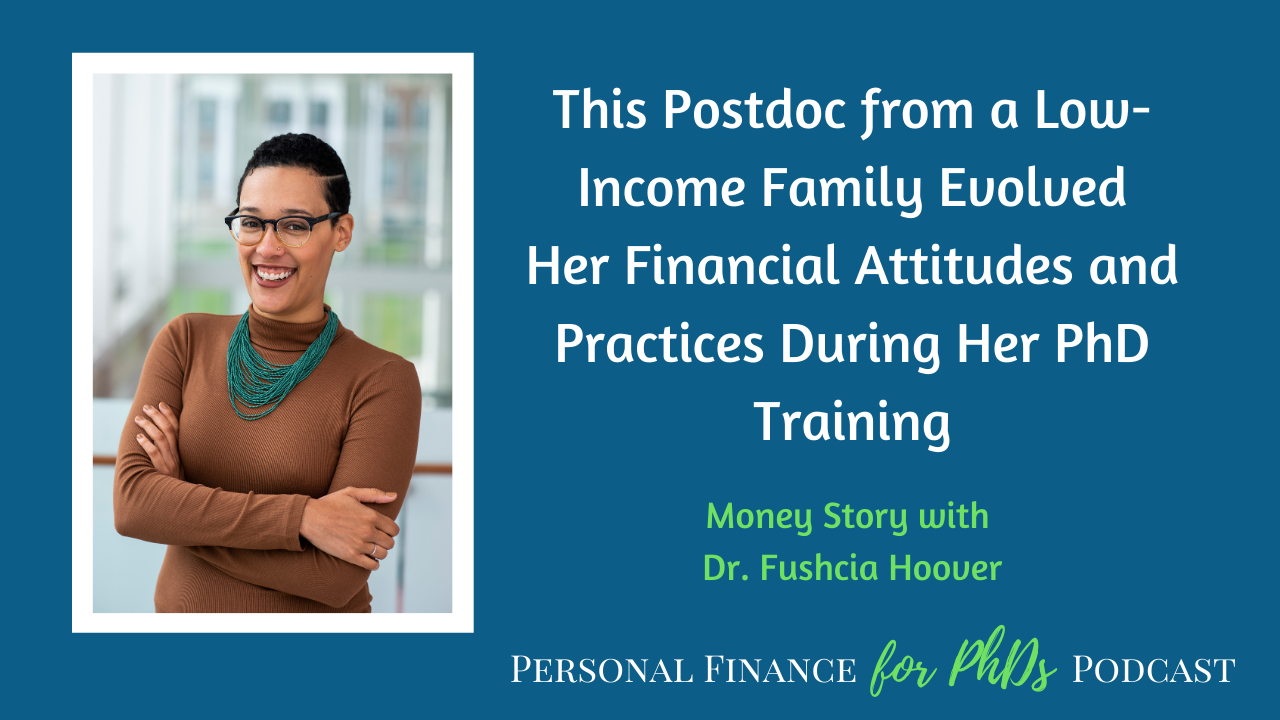
This Muslim Graduate Student Found Halal Investing and Now Teaches It to Her Family and Friends

July 27, 2020 by Meryem Ok

In this episode, Emily interviews Joumana Altallal, a Muslim graduate student at the University of Michigan. Joumana began investigating personal finance in the summer before she started graduate school to prepare to manage her stipend. In just her first year on a stipend, she has saved a full emergency fund, established credit, and funded a Roth IRA. Joumana shares what she’s learned about Halal investing, a strain of socially responsible investing for Muslims that has become much more accessible in recent years with the rise of robo-investing. Joumana’s enthusiasm for personal finance and halal investing, in particular, has spilled into her relationships with her family and friends. At the end of the episode, she gives a wonderful articulation of the role her finances play in the world.

Links Mentioned in the Episode

  • UMich Helen Zell Writers’ Program
  • PF For PhDs Episode 8: This PhD Government Scientist Is Pursuing Financial Independence: Part 1 (Dr. Gov Worker)
  • PF for PhDs Episode 9: This PhD Government Scientist Is Pursuing Financial Independence: Part 2 (Dr. Gov Worker)
  • George Hayward Household Budget YouTube Video 
  • George Hayward Household Budget Excel Template
  • Halal Investment Companies, e.g.,
    • Wahed Invest: https://wahedinvest.com/
    • Amana Mutual Funds: https://www.saturna.com/amana
    • Azzad Funds: https://www.azzadfunds.com/
  • PF for PhDs: Speaking
  • PF for PhDs Episode 13: Combatting Climate Change with Your Finances, Individually and Collectively (Jewel Tomasula)
  • PF for PhDs Podcast Hub 
  • PF for PhDs: Subscribe 
Halal investing Muslim grad student

Teaser

00:00 Joumana: I think taking a halal approach to investing and saving money is always really grounding for me in that it acts as this constant reminder, that at the end of the day, my finances are meant to serve an ethical role in the world. So, they’re not just a fulfillment for my own needs and desires, but that they also function in this greater, sort of just way in the world.

Introduction

00:28 Emily: Welcome to the Personal Finance for PhDs podcast, a higher education in personal finance. I’m your host, Dr. Emily Roberts. This is season six, episode 13, and today my guest is Joumana Altallal, a Muslim graduate student at the University of Michigan. Joumana began investigating personal finance in the summer before she started graduate school to prepare to manage her stipend. In just her first year on a stipend, she has saved a full emergency fund, established credit, and funded a Roth IRA. Joumana shares what she’s learned about halal investing, a strain of socially responsible investing for Muslims that has become much more accessible in recent years with the rise of robo-investing. Joumana’s enthusiasm for personal finance and halal investing in particular has spilled into her relationships with her family and friends. You won’t want to miss her wonderful articulation of the role her finances play in the world. Without further ado, here’s my interview with Joumana Altallal.

Will You Please Introduce Yourself Further?

01:28 Emily: I’m delighted to have joining me on the podcast today, Joumana Altallal. She is a current graduate student and also a Muslim graduate student. So, we’re going to be talking about a particular version of socially responsible investing today, which is halal investing. So, Joumana, thank you so much for coming on the podcast today. And will you please introduce yourself a little bit further to the audience?

01:49 Joumana: Hi, Emily. Thanks for having me today. My name is Joumana Altallal. I’m a second-year master of fine arts student in poetry at the University of Michigan. My family and I immigrated to the U.S. In 2003 and were resettled in Charlottesville, Virginia. So, that’s actually where I grew up since I was about six years old. And I would say my journey with personal finance has definitely been informed by my identity as both a refugee and a Muslim.

02:17 Emily: Yeah. Thank you so much for that. And tell us where you are now and what you’re studying.

02:21 Joumana: Yeah, absolutely. So, I’m at the University of Michigan at the Helen Zell Writers’ Program. So, it’s a creative writing program that is two years with a fellowship year third year. I am a poet, so I’m spending all of my time in writing workshops

02:37 Emily: Sounds fantastic. And you and I actually met when I was speaking at the University of Michigan in 2019, I guess it was, right?

02:46 Joumana: Yeah.

Personal Finance Journey

02:46 Emily: Yeah. So, I met in person, actually, you came up to me with this question about this particular version of investing, and I said, “I have no idea about that. Will you please come on the podcast and teach me and my audience about this?” So, I’m really happy to have you on today to talk more about that. So, kind of first step, more like background stuff before we get to that particular topic. So, what have you been learning about personal finance and also applying since you started graduate school?

03:15 Joumana: Yeah, absolutely. So, I actually came to graduate school immediately from undergrad. So, I didn’t have much experience budgeting or tracking money in a sort of systematic way before. And although I’d been obviously working throughout high school and college, I was still primarily supported by my parents. So, my financial decisions were definitely limited in that scope. But my interest in personal finance kind of grew out of a hobby that I had. The summer before moving for grad school, I was kind of introduced to the financial independence and early retirement movement through Reddit forums of all places. And I found myself sort of accidentally spending a lot of time reading people’s posts and advice to each other. So, I think part of what’s so great about personal finance forums, I guess, is that they don’t really assume a starting place for anyone, which was really helpful for me. You can ask questions as a beginner or share advice on an experience that you just went through. So, as someone coming from like an immigrant background, I saw my parents really struggle with understanding what things like 401ks were even. And I believe a huge part of that is because workplaces don’t use accessible language to really explain what these investment opportunities are. So, a huge group of people end up being like absolutely excluded from personal finance conversations despite having a right to them.

Financial Independence, Retire Early (FIRE)

04:49 Emily: So, I love that you were sort of introduced to personal finance inspired by the FIRE movement, something I’ve also been kind of getting into recently. FIRE, Financial Independence and [Retire Early]. I’ve actually done a couple, a pair of interviews with a PhD who’s pursuing FIRE in season three of the podcast. So, if people want to check that out, we’ll link that from the show notes. And also some of my other guests have sort of incidentally mentioned being inspired by the movement as well. Would you say that you are pursuing FIRE or going to be pursuing FIRE, maybe once you’re done with graduate school? Or are you just like, “No, I’m just using some of the principles for like general personal finance stuff”?

05:27 Joumana: I think right now I’m using the general principles for personal finance. It feels a little scary to say that I’m pursuing FIRE as a 22-year-old grad student. But that is absolutely something that I would love to one day be a little more stringent in following.

05:45 Emily: Yeah. So, for listeners who aren’t yet familiar or haven’t listened to the other podcasts on the subject. I think the reason why, you know, Joumana and I do not say we’re part of the FIRE movement is probably because we do not have savings rates that top 50% of our income, which is not a requirement to be part of the movement, but definitely something that many people within the movement do. And that’s how you get that, you know, really fast acceleration towards retirement. So, very difficult to carry out that particular aspect of it on a grad student kind of salary, but you can definitely use the broader principles, start using the broader principles that also apply to personal finance. That was really something that came out of my previous interview with Dr. Gov Worker, is that he really sees the FIRE movement as like an entrance into just good personal finance practices. It’s just a particular way to like inspire people to follow through on the stuff that everybody talks about, you know, from decades ago. So, yeah. What have you actually, like maybe things you’ve put into practice within your finances since last summer?

Building Credit and Budgeting

06:44 Joumana: Yeah, absolutely. So, the summer before grad school, my sort of first step into the journey was opening a student credit card through Discover which is something that prior to that I’d never had. So, beginning to build my credit was really important to me. And then obviously knowing that I would be receiving a monthly stipend once I began my MFA, I knew I needed some sort of system to track my income and expenses. So, I know there are apps like Mint that do this automatically, but I actually rely on a sort of extensive Excel spreadsheet that allows me to type things in manually the particular template that I’ve been using for the past year and a half just comes from George Hayward’s YouTube channel. But any, and all can achieve the same thing really.

07:31 Emily: We’ll track that down and put that in the show notes as well.

Emergency Fund and Roth IRA

07:35 Joumana: And the most important step I think after that was really focusing on building an emergency fund that I knew could last me for at least two months, but now I’ve brought it up to six months. And that’s actually advice that my parents have always followed. So, it didn’t feel too strange to me to begin doing. And after that, opening a Roth and beginning to stash away a monthly amount into my savings.

What is Halal Investing?

08:01 Emily: Yeah. Those are a fantastic number of steps to be taking just in like your first year or so of graduate school, especially that six month of expenses emergency fund. Very, very impressive. You must be living well below your means there in Ann Arbor. So, for those of us who like me, had never heard of halal investing before you brought it up. Can you tell us some of the differences between halal investing and maybe, you know, what your average American might be doing for investing?

08:28 Joumana: Yeah, absolutely. So, to kind of backtrack a little bit, in Islam, the word halal just means permissible. So, halal investing is just a faith-based approach to investment management that’s both ethically and socially responsible. Halal investing really just tries to eliminate placing money in interest-based investments and highly leveraged company stocks or in securities of companies whose profit is typically earned from things like firearms, alcohol, or gambling, for instance. So, as you can tell, it’s not just as easy as opening a Roth through Vanguard, for instance, and beginning to save. However, doing the research has really helped me understand what it is I’m doing with my money and how the process works.

09:17 Emily: Yeah. So, maybe to explain like, just a little bit further for the listeners. So, what you’re basically saying is no bonds, right? Because bonds are a debt-based product. So, stocks are okay. But you mentioned that you can’t use companies that are very highly leveraged, so that requires some additional degree of research. So, it sounds like some company stock would be okay, some wouldn’t. And then nothing in these certain categories of “the sin stocks” as they might be referred to. Okay. So, that gives us a basis there. Does that also mean that you don’t use like interest-bearing checking or savings account? Is that correct?

09:55 Joumana: Yes. So, typically I actually won’t put my money into the savings portion of my bank account and I just have it all stashed in terms of the like six-month emergency fund, I just have it in my checking account. Because interest isn’t necessarily something that I’d want on my money, the same way that most people would.

10:18 Emily: Yeah. Gotcha. When I read up about the subject a tiny bit before our conversation, I read that many who are pursuing halal investing actually will end up not investing in stocks at all because of that additional degree of research that’s required. Can you expand on that a little bit?

Halal Investment Companies

10:37 Joumana: Yeah, absolutely. I think for the average person, it can seem a little bit overwhelming to have to do all of this research all of a sudden. But I do think that there are actually a lot more solutions now than there were even just a few years ago. So, there are actually investment companies like Wahed Invest, Amana Mutal Funds, or Azzad and others that kind of facilitate the process of halal investing so that it’s not all entirely on the Muslim investor who doesn’t necessarily always know where to go or where to put their money. So, the way this works is that these companies essentially screen investments and identify companies that meet ethical standards based on halal investing. So, they also do things like help you calculate your annual Zakat percentage, which is just an obligatory charitable payment that has to be made on your earnings every year. And really the good thing with using these companies is that they have tickers that you can use to still invest through places like Schwab or Vanguard. So, realistically your Roth could still be with Schwab like I have it. But these companies by using tickers, these companies just screen all of the investments that you could have and provide you with places that you could potentially invest in.

Compromise: Higher Expense Ratios for Greater Flexibility

12:05 Emily: Okay. So, let me see if I have this right. So, basically, as I said earlier, this is sort of a particular version of socially responsible investing. So, this is a similar process that other socially responsible investing funds would go through, right? There’s a higher degree of screening of the companies that are included according to whatever the principles are that the fund operates under. And so it sounds like these companies that you just mentioned, they have created mutual funds, is that right? That then you can invest in maybe directly through them, but also through, as you just said, you know, other companies just by buying that particular mutual fund. And something that often happens with other SRI funds is that, due to that increased basically degree of work that’s required, the expense ratio is a little bit higher than you might find if you were doing like a standard index bond. Is that correct for like the investment that you chose?

12:54 Joumana: Yes, that’s typically correct. Although I know that companies like Wahed Invest, for instance, rely kind of heavily on robo-investors. So, the percentage is probably a lot lower. But yes, there are some kind of compromises that you make in terms of these investments that you choose to follow.

13:17 Emily: Yeah. So, one of the principles, let’s say, of the FIRE movement that you might come across, and also personal finance more generally, is this ruthless pursuit of low expense ratios on investments. And what expense ratios are for the listener, it’s basically just an expression of the cost of owning a particular fund. It’s expressed as a percentage. So, you know, at Vanguard with ETFs or something, you might get an expense ratio down in the 0.05 or less percentage. So, five basis points or less. They could be as low as that.

13:52 Emily: And then higher expense ratios are like 1%. Like 1% would be like pretty high. And there are many, you know, in between. And usually, with robo-advisors, you would have the underlying expense of the actual fund that you buy. So, like maybe 0.1% or less, plus a fee that the robo-advisor would tax on top of that to basically be managing your investments for you. But it sounds like even within this, you know, halal investing, even among these options, there are various expense ratios that you could be sort of pursuing and choosing among. Yeah, I think it’s one of the downfalls of the FIRE movement that SRI, socially responsible investing, is not talked about that much. And it’s very important to certain people for various different reasons. And so it’s something that is definitely worth, you know, maybe sacrificing a little bit on the low expense ratio side of things to, of course, in your case, be able to invest according to your principles at all. And for other people just being able to invest according to their general values and what they want to be supporting in our economy and so forth.

Commercial

14:54 Emily: Emily here for a brief interlude. I bet you and your peers are hungry for financial information right now, especially if it’s tailored for your unique PhD experience. I offer seminars, webinars, and workshops on personal finance for early-career PhDs that can be billed as professional development or personal wellness programming. My events cover a wide range of personal finance topics, or take a deep dive into the financial topics that matter most to PhDs like taxes, investing career transitions, and frugality. If you’re interested in having me speak to your group or recommending me to a potential host, you can find more information and ways to contact me at pfforphds.com/speaking. We can absolutely find a way to get this great content to you and your peers, even while social distancing. Now, back to our interview.

Halal Investing is Growing and Increasingly Accessible

15:53 Emily: Anything else you want to add about the products or the solutions that are available for halal investing?

16:00 Joumana: I would say that they are definitely doing a better job of reaching out to the Muslim population now. So, I think there’s a growing movement really of young Muslim students, or even young Muslim workers who are really active in the investment community, which is always lovely to see.

16:21 Emily: Yeah, absolutely. It seems like, you know, as you said, robo-advisors are now being involved and robo-advisors are a relatively recent phenomenon in the last five or 10 years. So maybe, you know, the last generation when they were looking into investing they probably saw that, well, the burden was completely on them, right? To do all this research that we were just talking about and that can be, you know, prohibitive, right?

16:44 Emily: For even going that route at all. Like for instance, before mutual funds came on the scene, everyone was like calling up their brokers, buying more of this stock or selling more of that stock. Like that’s a lot of work to be putting in. And we’re so fortunate now to be living in a time when, you know, index funds are available to us. When these highly curated mutual funds are available to us that are, you know, relatively not that expensive. And as you just said, you know, there’s been more and more attention being brought to this. And so, these particular funds exist for your community and that’s really great to hear and very encouraging.

17:17 Joumana: Yeah, absolutely.

17:19 Emily: One other thing that I read about in this article was that, for some Muslims, again, who were avoiding stock investing entirely and of course, bond investing as well they basically had their money just in cash and real estate. Was that the case maybe in generations past?

17:36 Joumana: Yeah, absolutely. I actually still think that it’s overwhelmingly the case for most folks who identify as Muslim in the U.S. And I think so much of that is just the lack of really accessible information about the kinds of investments that are available for adherence of the Muslim faith. And I think most Muslims, especially of an older generation, have this lack of trust in banks or in investment companies generally for various totally rational reasons. But I also think so much of it is just a lack of understanding of what actually your money is doing and how you can still adhere to a principle of halal investing while having your money in places like Schwab or Vanguard, for instance, or in a 401k or a Roth, whatever that may be.

Helping Family and Friends with Halal Investing

18:32 Emily: And have you been, now that you’ve been learning this stuff from Reddit and other places, have you been kind of turning around and spreading that message like to your parents or other family members or other people in your community?

18:42 Joumana: Yeah, absolutely. Once I started learning about it, I would honestly annoy my parents all the time by being like, “Hey, let’s talk about this now, let’s talk about this.” So, I actually ended up helping my mom, once she left the job that she had been working in for about 15 years, to roll over her 401k there into an IRA, actually. And that was sort of a defining moment in my journey throughout personal finance is being able to actually like implement and apply the things that I’ve been learning. Especially when it came to someone like my mom, who I felt like was always on that journey alongside me somehow. So, I’ve definitely been bringing it over to my family. And then in terms of friends, I’ve actually been reaching out to a lot of my Muslim friends and being like, “Hey, let’s have like meetups where we talk about our finances, let’s talk about like our stipends or how we’re dealing with just being in grad school and even just budgeting if we’re not ready to talk about investing really.” So, it’s definitely been a way for me to kind of understand what other people are doing in terms of their grad stipends or the ways that they’re organizing and negotiating the budgets that they have for themselves.

20:08 Emily: That sounds amazing. Has this group gotten much traction?

20:13 Joumana: Yeah, absolutely. So, a lot of the people that I speak to are actually in totally different places. So, we’ll FaceTime occasionally and just kind of touch base about what we’re doing on any like new information that we’ve learned in terms of halal investing, any kinds of opportunities that have opened up. So, it’s definitely something that I’ve been really happy about keeping up with. And it’s definitely been just an absolutely amazing learning opportunity for me as well. Now that I can take it from those Reddit forums into the real world.

20:49 Emily: Yeah. It sounds like you’ve created, I think in the entrepreneurship community, we call this a mastermind, right? A group of people, same people who regularly meet and talk about a certain topic and sort of hold each other accountable and push each other forward towards meeting your goals. That sounds absolutely brilliant. And something that I hope that other people replicate in their own communities or among their own friend networks. Are there any other ways that you would say that your practice of personal finance is different than that of your peers?

21:19 Joumana: Hmm. I don’t know that there are any huge differences really, but I think taking a halal approach to investing and saving money is always really grounding for me in that it acts as this constant reminder that at the end of the day, my finances are meant to serve an ethical role in the world. So, they’re not just a fulfillment for my own needs and desires, but that they also function in this greater sort of just way in the world. And I don’t know, I don’t know if that’s the kind of relationship that many of my peers have been able to cultivate with their finances. I know that many do, I know that many are very interested in socially responsible investments. But yeah, at the end of the day, that is deeply important for me to know about my own finances.

22:11 Emily: Yeah. I think you articulated that very well. It’s very inspiring to hear. I’ve actually recorded another interview on socially responsible investing. I’m not sure if that’ll be published first or if this one will be published first, but in any case, I’ll, I’ll try to link from the show notes to the other one, which is on sort of environmentally focused, socially responsible investing approach. So, these two complement each other very well, I think, in talking about those principles.

Best Financial Advice for an Early-Career PhD

22:34 Emily: So, final question here, Joumana, as we wrap up. What is your best financial advice for another early-career PhD? And that could be something that we’ve touched on already in the interview, or it could be something completely else.

22:46 Joumana: Yeah. I think it’s incredibly easy to become overwhelmed when it comes to tracking money, especially as a grad student who is already not earning that much. But really, finding a system that works for you and supports your own mental health is way more important than applying every single piece of advice you read. So, really, the best financial advice that I can give to any other grad student is to do what works for you. To find a system that is helpful to you, and to explore all the options that exist out there. Because what works for someone might just be a terrible use of resources for you.

23:27 Emily: Yeah. I totally agree with that. These systems that we use for managing our money should absolutely be, you know, supporting and complimenting our lives and not be a super heavy burden or some onerous thing that we feel is like externally put on us. It definitely has to come from like within and be, of course, in adherence with your own values and your own priorities. It really should be something that makes you feel good and augments your life instead of, you know, feeling the reverse way. So, I hope that everyone can get to that point with their finances. And thank you so much for coming on the podcast and giving this interview. And you’re obviously, you know, very thoughtful about the subject and I’m so glad that you’ve learned about it and now you’re, you know, turning back around and helping your family and your community learn these principles as well. So, thank you very much.

24:14 Joumana: Thank you, Emily.

Outtro

24:14 Emily: Listeners, thank you for joining me for this episode. Pfforphds.com/podcast is the hub for the Personal Finance for PhDs podcast. There, you can find links to all the episode show notes and a form to volunteer to be interviewed. I’d love for you to check it out and get more involved. If you’ve been enjoying the podcast, please consider joining my mailing list for my behind the scenes commentary about each episode. Register at pfforphds.com/subscribe. See you in the next episode! And remember, you don’t have to have a PhD to succeed with personal finance, but it helps. The music is Stages of Awakening by Podington Bear from the free music archive and is shared under CC by NC. Podcast editing and show notes creation by Meryem Ok.
How This PhD Student’s Budgeting Practice Enabled a Hawaiian Vacation

July 20, 2020 by Lourdes Bobbio

In this episode, Emily interviews Sean from Authentically Average, a fourth-year PhD student at a university in Houston, TX. Sean and his wife have very intentionally set up their budget to reflect their values, and now live and die by their budget. Their top three budget priorities are retirement savings, tithing, and travel. Sean’s budget helps him say “no” to certain areas of spending or opportunities for spending so that he can say “yes” to his travel aspirations. Sean describes a wellness vacation he and his wife took to Hawaii and why travel is such a high priority right now.

Links Mentioned

  • Find Sean on his blog, Authentically Average, and on Twitter, Instagram, and Pinterest
  • Find out more about Sean’s leadership coaching
  • Blog Post: Put Your Money In What You Value
  • Blog Post: Travaasa Hana Highlight Reel
  • Personal Finance for PhDs: Financial Coaching
  • Personal Finance for PhDs: Podcast Hub
  • Personal Finance for PhDs: Subscribe to the mailing list
budgeting for travel on a grad student stipend

Teaser

00:00 Sean: If you aren’t budgeting yet, try to get there as soon as possible. Tracking expenses is great and it’s helpful to get you in the right mindset. But until you are, I think, front end saying this is the money I will have coming in, here are the places it’s going to go, you can’t really capture your values fully and where to invest unless you’re doing it upfront.

Introduction

00:26 Emily: Welcome to the Personal Finance for PhDs podcast, a higher education in personal finance. I’m your host, Dr. Emily Roberts. This is season six, episode 12. And today my guest is Sean from Authentically Average, a fourth year PhD student at a university in Houston, Texas. Sean, and his wife live and die by their budget. And they have put a lot of effort into making sure that their budget reflects their values. Their top three budget priorities are retirement savings, timing, and travel. Sean describes a vacation they took to Hawaii and the ways they minimize spending in lower priority areas of their life so that they can spend more on vacations and other types of experiential living. By the way, we recorded this interview in September, 2019. Without further ado, here’s my interview with Sean from authentically average.

Will You Please Introduce Yourself Further?

01:18 Emily: I am delighted to have joined me on the podcast day Sean, from Authentically Average. Authentically Average is the name of his blog. And Sean, I’ll just let you introduce yourself to the listeners.

01:28 Sean: Sure. Thanks Emily for having me. My name is Sean. I run the authentically average blog. I characterize myself as a PhD student, husband, chef, pretty much all of the above kind of general life stuff, and that’s the focus of the blogs, every day kind of living. I’m a PhD student in the 3D printing space. I just started my fourth year, so I’m hopefully approaching the light at the end of the tunnel. I live in Houston with my wife, Allie. We have nine children, and by children, I mean plants and most of them are still alive. I’m doing a PhD in 3D printing space. I got my bachelor’s in chemical engineering before that, went directly to grad school, and still trying to figure out what I’m looking for afterwards. I’m thinking like medical device route. That’s a really interesting space for me and the community in Houston is really kind of exploding right now, so I’m really passionate about trying to see that grow.

02:36 Emily: Yeah. Sounds really good. And I understand that your wife is a graduate student as well.

02:41 Sean: She is. My wife is getting her MBA currently. She’s super woman. She’s working full time and getting her MBA on the weekends. A lot of school at our house.

02:50 Emily: Yeah, that’s a full plate. I guess you might not be the busiest one in the household.

02:57 Sean: I think it goes both ways. The nicety of being a PhD student, sometimes, is depending on your advisor, the work schedule is not necessarily lighter, but more flexible. I tend to do a lot more of the, I talked about this briefly on my blog, but like, I tend to do a lot more of the household activities, like the cleaning and cooking and stuff, just because I’m the one that has the time for it. It’s like not always super sexy to talk about sometimes, but if I don’t cook, we don’t eat. Somebody’s got to do it. But we like to share. I mean, she’s got a lot on her plate right now from a professional capacity, so I’m happy to take on those other roles.

Translating Life Values to Your Budget

03:45 Emily: Yeah. And I guess that’s one of those things that you can talk about on a blog that is named Authentically Average. You can talk about your everyday experiences. And money of course, is among those. You recently published a post that was kind of talking about your financial values, which is something that I love to talk about. It’s the foundational concept in personal finance, yet not one that gets a lot of airtime, I feel like, unfortunately, so why don’t you go ahead and tell us about how your values inform how you use your money.

04:20 Sean: Sure. Thank you for that. A couple of weeks ago, the focus of that post was, and we can talk about this in a little bit, but I had gone on a vacation and some people were like, “Oh wow, this is great” and some people were kind of like, “okay, great, you went on this really nice vacation, but your blog is authentically average, how do you reconcile those?” I started thinking about it. I said, okay, I should probably take a step back. The value focus, like you said, is I think central to personal finance and making “smart” decisions with money, but not one that’s talked about a lot. Primarily the goal for that was “here are my values, here’s what I try to invest my money in, and by extension a little bit my time.”

Retirement Savings

05:10 Sean: For me and my wife, we have three top tier values, and then beyond that, everything kind of falls into place. The first one is financial security, so saving for retirement, making sure that we are doing the things we need to do now so that we can live comfortably later. I think that sometimes people get really caught up in this concept of like, I’m doing what I gotta do right now, and that’s fine. And sometimes they are not saving for retirement because they feel like they can’t and that there’s a lot there to kind of go through. And sometimes because they simply don’t think about it. The first time that I kind of understood the concept of like retirement savings and compounding interest and all of that, I started to notice, Oh, wow, there’s a lot of ground that I can make up here in my late twenties and set the stage for how my thirties and forties are going to go. That’s the first piece. The second piece is —

06:14 Emily: Actually, I want to make one offshoot comment to that because of course, saving for retirement is something that I love to talk about. One point that I really like to make when I’m speaking with graduate students or other sort of people on the younger side, younger and lower income side of things, is that if you look at those compound interest calculators, the time is what matters. I mean the time and the amount of money you save, of course they both matter, but the time — you wouldn’t believe what a little bit of extra time will get you in terms of increased returns. And so I always say, whatever amount…like if you feel like you can’t save anything okay, maybe that’s true, but if you can even find like $10, $50 a month that you can start putting away for that purpose, it’s unbelievable what a huge difference that makes on the back end of things, just to have those few extra years. Don’t be discouraged if you can’t save like a thousand dollars a month. That is a very large and unreasonable amount of money for a graduate student level of income, but a smaller amount of money makes a really, really big difference too.

07:18 Sean: Yeah, definitely. And just to kind of keep going on that thread, the stereotypical thing that people give of why you should start investing as early as possible is they talk about if you invest for 10 years from 20 to 30, the amount of money that you make during that time, by the time you retire, will outpace starting from 30 and moving forward. You can’t possibly catch up. Just like you said, sometimes I think people get like, Oh no, I can’t do that much., and that’s okay, but if you can do something, that’s great.

07:55 Emily: Yeah. I think one of the really difficult things that people run into early on is that they’re dealing with debt loads and they might have to clear those first before they can even touch the investing for retirement side of things. But since you’re already starting to invest retirement, I take it you’re either debt-free or you have debt that does not concern you.

08:14 Sean: We are debt free. I would say that my wife and I are very blessed, lucky, strategic, however you want to look at it, I guess. We paid our last debt off last year. I had an outstanding car note that I paid off. We again are very fortunate, I think, to be able to cash flow her MBA. That’s something that I think is a challenge, especially in higher education. I know that the finances for PhDs vary pretty drastically depending on field. In my PhD program, it’s tuition free, and we collect a stipend for working here. When I think about my PhD, I think about it more as job than I think an education of being a student. And I think collecting a paycheck helps me keep that association clear. So yeah, we are debt free. We are investing some. I’d like to be investing more, but also, you know, like you just said, there are different things that we’re trying to take care of and trying to keep all the balls in the air at the same time.

09:23 Sean: Yeah, definitely. Okay. So that is one of your top priorities, is saving for retirement. What’s the next one?

Experiential Living

09:30 Sean: So there’s two more. The second one would be, we have a really big focus on, I call it experiential living, but in the current case it’s travel. I joked about having plant children. Allie and I don’t have any kids yet. We have plans to have kids, but we just don’t have them right now. We have this focus on like, if there are things that would either be impossible or significantly more difficult to do when we have kids and when we’re older, we’d love to do them now. That post that you mentioned earlier about our travel, we went to Maui for a week over the summer. That was born out of like, “Hey, this is a great time to just go and spend a week in Hawaii and just, you know, live it up.” I mean, responsibly, but this is great. After saving for retirement, our next focus is, Hey, we want to have a good time, and for us having a good time looks like going out and exploring.

10:33 Emily: So I was really curious about this term, you just used — experiential living. Right now you said it looks like travel. What are the other things that might fall under that category for you?

10:42 Sean: I guess one thing is I know that some people, their focus is they want this nice X or Y. I think Allie and I, we would much rather save up money for a few pay periods and go to a nice concert or go see a play or a musical or something than buy a new TV or buy something else for the house. We do live in a nice apartment and we’ve decorated and all of that, but we would much rather do something that’s I think a little bit more like out and active. There’s not anything good or bad about that, or any other way. That’s just our preference.

11:24 Emily: Okay. So is this basically boiling down to the personal finance experiences versus stuff debate where everyone has kind of come down to the side of experiences? Is that what I’m hearing

11:36 Sean: Somewhat, yeah. I think that the stuff thing, depending on what the stuff is, is very valuable, in terms of having stuff and, and that’s all fine. But also I know just from, we did the like whole KonMari thing a couple months ago and realized, Oh, I have a lot of stuff. It was nice at the time, but in hindsight I would rather, I think have spent the money that I spent on that stuff on doing something.

12:06 Emily: Yeah. I actually heard this really great thing on a podcast recently. It was on the ChooseFI podcast and the, one of the people that they were interviewing, I can’t remember who the guest was said, something like he strives to have one memorable moment per month, some new thing that he’s never tried before. Travel would certainly fall under that, but it could be like a cooking class or like just doing something different out of your routine, once per month, he has that goal to make a memory, basically, with his wife. And actually it can be the same moment or they can have two different moments, one that each one prefers more per month, but that was his goal. And I thought that was amazing, and I really want to implement it in my life now, because I do feel like months can go by where it’s like, yeah, what happened that was great or notable or important, I’m not even sure.

12:59 Emily: Okay. So experiences, concerts, travel, that kind of stuff. And so right now your focus is doing the things that you would have a harder time doing once you have children. And I will have to say that when I read your post about your vacation, I was like, how do I get rid of my kids for a week, so I can do this. It sounds awesome. What is your third top priority?

Tithing

13:20 Sean: Again, so saving for retirement, travel and experiential living. The third one, honestly, is giving back and tithing. My wife and I tithe every pay period. I know sometimes as graduate students that can seem like a tumultous topic. We already do not make all that much money —

13:45 Emily: Actually, Sean, let’s pause there because some of the listeners might not be familiar with the term “tithe”, could you define that?

13:51 Sean: Sure. In a traditional tithe you would be giving, donating a 10th or some amounts. I mean, tithe literally is “10th”, but giving some amount back to your church family. My wife and I are Catholic. We give back to, we split between the church that we currently go to and then we also support a couple of students through the FOCUS program. They do ministry on college campuses throughout the United States. Good clarification. We give back to our church. For us, we do a traditional 10% tithe. That’s just, I think how we have decided that that’s where we want to put that value at. Does that kind of answer that?

14:39 Emily: Yeah. It’s not something that’s come up on the podcast hardly at all, but we also tithe and have for throughout graduate school, a long time. And it definitely, while I knew other graduate students from our church who also did that practice, it wasn’t something that I felt like was really widespread or something that graduate students could really get a handle on that large percentage. The 10% is a very, very large chunk of your income, but, I feel like tithing for me in terms of like the budget actually pushed us towards what I call percentage-based budgeting. If a 10th of your gross income is going towards that, we also did a certain percentage, it changed over time, starting at 10%, for like saving for retirement and then now we’re up to like 20%, so we’ve increased that over time. And I’m trying to remember, well, taxes are also sort of, not exactly a percentage, but you can convert them to a percentage of your income, so for us, it was like these different goals scale with the amount of money that we make, which I really liked that there was like this flexible percentage. The percentage is fixed, but the amount of money is changes depending on what your income is.

15:51 Emily: I really liked that way of thinking about budgeting, that you should have percentages going towards different things. And it actually goes pretty well with the balanced money formula. I don’t know if you’re familiar with this at all. It basically says that you should keep your necessary expenses below half of your take home pay. And I really liked that as well because, I think for graduate students, there’s this phrase that Dave Ramsey uses that I really like, not for graduate schools, but for people in general, which is something like “act your wage”, something along those lines. I think this percentage-based budgeting, I think, is really appropriate for people who have incomes that they expect to change a lot, like graduate school. Hopefully it’ll be going up alive later on, but if you have those percentages it can keep you really grounded and something can be consistent through those fluctuations in income basically.

16:44 Sean: Right. Definitely. Yeah. We do a similar thing in terms of trying to make sure that we’re doing a percentage breakdown on our budget. One small detail, we do typically everything on net pay, and then also when we get a tax return, I mean, ideally our tax return is zero, right. But if we do get a tax return, then we’ll do the same thing on whatever the return is. But I think it basically shakes out to be the same thing. I have found that to be really helpful. I feel like it helps us recognize where are we essentially overspending in our lives, and conversely, where could we be giving more attention, certainly.

Living and Dying By Your Budget

17:32 Emily: A phrase that I read in your recent post was we live and die by our budget, and that really stuck out because you talked about, I guess, that your budget is a plan for how you’re going to spend your money. And if opportunities arise after you’ve made the, you oftentimes say no to those opportunities, you stick with your original plan. I just wanted to ask you about that. How did you guys put together your budget, and how do you find the fortitude to stick with it?

18:02 Sean: I mentioned this very briefly before, disclaimer, this is not an ad, wish it was an ad, but it’s not, my wife and I use it’s called YNAB, or You Need A Budget. It’s a budgeting tool online that you use, to keep everything in order. One of the, I think, nice things about living and dying by your budget is it tells you how much money you’ve budgeted and allocated to every, whatever category you want to put it in. And if you overspend, the color of the money bar goes from a nice, pretty green to a very angry red color. And that’s just like, I think, maybe potentially a little bit of an immature way, but it’s really reinforcing for me of like, Hey, you made your money angry because you spent more than you allocated.

18:56 Sean: I joke about that sometimes living and dying by our budget. Really, it’s taken a lot of discipline to get to the point that we are now and give yourself grace and patience to get there as you’re working through things and things come up, of course. But we’re in a space right now where we have a set of goals, like I talked about, and a set of values. Sometimes things come up that don’t align with those, or potentially detract a little bit from them and we have to make a mature decision on like, Hey, is it worth us to do this? So one of the things I talk about in that post is, a friend of ours came to us and said, Hey, we want to go to this football game, last minute. Allie and I are huge college football fans, I went to a big football school for undergrad. Great, right, in terms of an interest standpoint, I think that’s great.

19:55 Sean: We started to look at the finances and said man, this is going to be like a thousand dollar trip just out of the blue. And I think at the beginning of the year, had we started the year and said, Hey, we want this to come up and we want to plan for this — great, okay, we’ll budget for it. But a few weeks out, we had to say, no. I mean, first of all, based on our budget, we literally did not have the money to do it without taking money from other standpoints. I really struggle with the idea of pulling money that we had saved for retirement out of retirement to go to a football game. But more than that, I think it’s sometimes difficult when you…This is always a challenge when you have very diverse friend groups is like, everybody has their own different set of values. And I want those people to understand, like friends of mine, that sometimes I to turn things down. Like, hey, I love you guys. You’re great, I appreciate everything about you, and I appreciate our relationship, but just understand that me not wanting to come out, or me not wanting to do this last minute, isn’t a reflection on like our relationship and is a reflection on I just don’t have the money for it according to what my wife and I decided it was important to us.

21:11 Emily: Yeah. There’s another blogger, content creator in the personal finance space, Paula and her brand is Afford Anything. And so her tagline is kind of like, “you can afford anything, but you can’t afford everything.” She’s really, like you were just saying, you have to get really clear about what’s important to you because you want to be able to say yes to the things that are at the top of your list. And that does mean saying no to the things that fall further down and that’s hard. But you can’t say yes to everything. If you say yes to everything, you’ll end up saying no to the things that are most important to you, if you accept every opportunity that comes your way.

21:52 Emily: I have to say though, your story reminded me of when I was in graduate school. I went to Duke and Duke won two championships while I was there 2010 and 2015. 2015 was technically after I defended, but I was still enrolled as a student and I still had tickets to games and stuff. So anyway, in 2010, of course you never know, going in to the tournament, how it’s going to turn out. And at the last second, we had an opportunity to go to the Final Four. Duke went, and my husband and I had the opportunity to attend. They were giving away tickets for students. It was actually free. The tickets were free. All you had to do was get there and stay there. And we really deliberated, and I don’t know that it came down to mostly a financial decision. There were other time reasons why we decided not to go. We had already traveled actually the previous year to see them play and they hadn’t advanced, and so we already had like, kind of that disappointment. So we decided against going, and of course in 2010, they ended up winning, same story in 2015. That’s just one of my major regrets from when I was in graduate school, because I was a fan, that I let anything stand in the way of like attending those events. So I do think that my main regrets from graduate school, in terms of my personal life were things that I didn’t do that money played into why I didn’t do it. It probably wasn’t the whole situation, but yeah, there’s two times I can point to an opportunity came my way and I said no to it, a very reasoned decision, and I really think that was the wrong way to go.

23:27 Sean: Yeah. And sometimes I think that that’s a struggle because we’ve done a couple of things too, where it’s like, Oh, this is such a good opportunity to do this thing. Sometimes, and I say this with a mountain of salt, occasionally we will not live and die by the budget. And the only way that that works is to have intentionally over allocated somewhere else, so that the total amount of money is still there, like the money to cover a different decision is still there. It’s not like we’re living outside of our means, but we do give ourselves a little bit of grace. Sometimes I’m like, this is a really big deal. That trip to Hawaii was pretty much entirely planned for, but there were a couple of things once we got there, that was like, you know what, we’re here, I think we’ll regret this thing if we don’t do it, let’s do it and we’ll figure it out.

24:27 Emily: Yeah. I think that strategy of over saving or just saving for things that you don’t know quite what you’re saving for — at some point a friend will invite you to do something, at some point you’ll have an opportunity to come your way that you’ll want to say yes to at the last second. And I think the way that most people who are not on top of their finances would handle it would just say, okay, I’m going to put it on a credit card, I’ll worry about how to pay for it later, which is not a great strategy. But if you save in advance and you’re just not totally sure what that money is going to go for, but you’re pretty sure something’s going to pique your fancy along the way then you can be able to say yes again to those opportunities, knowing that it’s still within everything you’ve allocated for an advance,

25:08 Sean: Just a small insight, we have a category in our budget called “stuff we forgot to budget for”, and we put a small amount, however much, in there every pay period just because inevitably something comes up. Now, if it’s an emergency, we have separate money set aside. You mentioned Dave Ramsey earlier — we have a separate emergency fund set aside for that kind of thing. This is more like your friend asked you to do something, you have an opportunity to go watch Duke win a championship, whatever.

25:44 Emily: Yeah, exactly.

Commercial

25:48 Emily: Hey, social distancers, Emily here. I hope you’re doing okay. It took a few weeks, but I think I have my bearings about me in my new normal. There is a lot of uncertainty and fear right now about our public and personal health and our economy. I would like to help you feel more secure in your personal finances and plan and prepare for whatever financial future may come. You can schedule a free 15 minute call with me at PFforPhDs.com/coaching to determine if financial coaching with me is right for you at this time, I hope you will reach out, if only to speak with someone new for a few minutes. Take care. Now back to our interview.

Frugal Tips for Experiential Living

26:34 Emily: So I’m wondering if you have any ways, any sort of frugal things that you’ve done in your life that help you have these experiences that you want have. Either minimizing the money that it takes to do those things or minimizing other areas in your budget so that you can free up more money for your top priority. Are there any like really good strategies you use in that vein?

26:58 Sean: I think the stereotypical student might fight this a little bit. I’ll start with the like ways of like daily life first. We cook 99% of our meals. That’s just the way it is. For me that’s two reasons. That post that I wrote is primarily about investing your money in what you value, but there’s also a small segment on investing your time in what you value and no question about it, cooking for yourself takes it takes time. It costs money to go buy groceries and it takes time to cook those meals. I think it’s easier to go out to eat, from a time perspective or pick up quick ready meals and that kind of thing, but from a time perspective, like at that point, I’m investing in my health. It’s almost exclusively healthier for you to cook for yourself than it is to go out to eat, and it’s almost exclusively less expensive to cook for yourself too. In that post I talk about, Allie and I have been discussing potentially giving ourselves a little bit more room on this and kind of grace on this for when we want to go out. We don’t go out to eat ever. Like once every couple of weeks and the reasoning for that is, whatever amount of money I would spend on going out to eat a couple nights a week is better suited towards saving for Hawaii, or, we’ve been married for just over a year, for our honeymoon we went to Italy. We spent two weeks there. That’s not an inconsequential trip size, and the only way that that works is you’re making cuts, so to speak, elsewhere in your life.

28:37 Sean: The other thing for us has been we’re busy people. She’s in school part time, well, no she’s in school full time and working full time, and I’m working full time and doing things at home. And so it’s really important for us to invest in our marriage. Regular date nights are important, but it doesn’t always have to be this five star restaurant. Those types of things are nicem, but I think I also get 90 plus percent of the relationship building component from that type of date from going to somewhere kind of casual, hole-in-the-wall, or going on an experience. We talked about this this morning, actually. It’s been a couple weeks since we had a formal date, and one thing that we’re going to do next week is we’re going clothes shopping and we’re going to Marshall’s-hop. There’s like seven of them within a 10 mile radius of us and we’re just gonna — we found that when we hit, we really hit there, but they’re very hit and miss, but there’s a lot of them, so we can kind of hop between and see. I think that that might sound somewhat silly to some people, but for us, we like investing in clothes that makes us feel good and feel professional, but also not breaking the bank and this “adventuring”, so to speak, and helping each other try things on — that I think is a fun relationship building activity that literally the travel aspect only costs the gas, and then we would have budgeted for the clothes. There’s that aspect on like life-hacking.

30:11 Sean: From a travel hacking standpoint, honestly, it’s just time. You have to decide how much your time is worth, but we always look for great deals on hotels and flights. Google has a flight tracker that you can use. It’ll send you alerts when your flights fall. I do the same thing for a lot of the hotels. A lot of third party websites are great. For Italy, actually this, this is a great story. For Italy, the flights were going to be like, I don’t remember like $1800 a piece or something, like a lot of money. We went in May, so like the beginning of high season, I get it. Then, the day before I was going to buy, because they weren’t falling, I said, “Oh, let me just look on another website.” I went on, I think it was Priceline or one of the third party website and it was like half that, together. I was like, “Yes, I’m absolutely doing this. We’ll take a weird layover to save half the cost. You could write a book about that, but that’s the things that I think of.

31:15 Emily: Yeah. I think when your goal is to have experiences and make memories and so forth, I guess there’s been research on this that like the anticipation of the experience is a big component of your satisfaction with it. And so taking the time to plan, and do whatever travel hacking and price comparisons and all of that, it actually enhances like your ultimate experience when you put a lot of effort into it upfront. I don’t know, to me it’s a little bit counter-intuitive, but yeah. So pursuing these travel hacking strategies, um, in addition to saving money can actually make you feel better about the whole thing. I guess what I was thinking about when you’re talking, especially about like the food and not spending so much money on eating out and so forth. That was a strategy that we used also. We cut out basically all kinds of convenience food, in favor of cooking for ourselves. And that is like a little bit of a sacrifice because yeah, you have to plan it a little bit more and all that, that goes into cooking. But for us, like for you, the money that we were not spending on convenience eating went towards our travel fund. And so when we knew exactly where the money that we would’ve spent on one thing was going to go, if we didn’t actually carry through with the eating out or whatever it was, that makes the whole thing a lot more palatable. It makes the whole thing go down easier if you know, okay, yeah, I’m sacrificing a little bit in this moment right here, but that is going to enable something really fantastic later on.

32:43 Sean: Right, right, right, right.

32:45 Emily: Any other frugal strategies around those things, either minimizing expenses on things you really want to do or cutting expenses and things that are not such a high priority?

32:54 Sean: I think the only additional thing that I’ll add is — it’s especially common, I think because like I, as a PhD understand or PhD student, rather, my time is limited. I think that my time is a little bit larger than some other people’s because I just try to make a point of, I’m only working X hours this week. Like this is my job and I’m putting this much into it. And that sometimes works for people and sometimes doesn’t. But I see a lot of, because we have such little free time, convenience buying and convenience spending somewhat to kind of what you, you mentioned earlier. And I think in some ways you do have to give yourself a little bit of that because the amount that you stress over not making convenient spend is also a use of resources, maybe not for the best. Just watch it. I always go back to “live and die by the budget”. Until I had a budget that I like actually did religiously every week and every pay period, I didn’t have a clue. And I started to look at my spending habits and said, man, I didn’t realize I was spending this much on snacks, or this much on cable and this other thing that I don’t even use. It just, it never occurred to me because I was always tracking my spending after the fact that never really looking forward any further than the next couple of weeks.

34:20 Emily: Yeah. I mean, tracking your spending is an amazing thing to do as like a first step. It actually does start to change your behavior in many cases. But if you’re just tracking it as a passive activity and it’s not actually balancing, okay, well, where do I want my money to go? And do I prefer it here? Or do I prefer it there? That’s what you have to do with your budgeting. They’re both really useful, um, activities, but I guess once the shock of the tracking wears off and you make whatever sort of subconscious changes you’re going to want to make from that, you need to start budgeting to get that further of value add from the activity.

When Budgeting Pays Off: Sean’s Trip to Hawaii

34:54 Emily: So we’ve teased this enough. Tell us about your trip to Hawaii, that made me so jealous.

35:01 Sean: We went to Maui specifically. We went to Hana, which is a very small town on the East coast of Maui. Allie was really into this idea of like a wellness retreat. And I did, I think the stereotypical husband thing that I hate and I was like, what are you talking about? No. And then I started to look into it. I was like, Oh, this actually sounds pretty awesome. So I was like, okay, yeah, let’s go for it, sure. There was a resort there called the Travaasa, just right in the town. Hana is not really the type of place that you go to and stay at unless you go to this hotel. There’s not a city center. It’s people that live there and this hotel and that’s it.

35:45 Sean: So we went and we said, okay, you know, let’s do it. This sounds great, let’s go. The only thing I’ll say about traveling to Hana is getting to the airports, great, but there’s a very famous road there called the road to Hana and it’s like 90 degree turns the whole way. It’s 40 or 50 miles and it took us three hours. You’re crawling and it’s crazy. But scenery is amazing and beautiful. The little food stops on the way are great. And then once we actually got there, it was just like paradise. It’s still the States, so there is cell service, but there’s no wifi available. The cell service is kind of shaky, we turned our work phones off, and just lived, and it was awesome.

36:34 Sean: There’s there was a lot to do there. They have a spa on site. I’m not a huge massage/spa person, but I was the most relaxed I’ve ever been in my whole life that week. The food was awesome. There was waterfront yoga and like paddle boarding and horseback riding and just like all of this stuff that we don’t ever do in our daily lives. It was really awesome to just for once I think go and just exist. My wife and I, in particular, but I think more generally PhD students and other graduate students, you’re just going nonstop all the time, and there’s not really any moment where you kind of just sit back and you’re like, “Hey, I’m not thinking about anything about tomorrow, except whether I want to do this cool thing or that cool thing.” I don’t know, I think that was a nice refresher for us.

37:34 Sean: Everything about it was super chill. The only not super chill thing about it is, there was actually a wildfire on the West side of the island while we were there. We went back to catch our flight and all the planes are delayed because they’re trying to get people that live there, like out of danger. Things are, I don’t want to say fine because you know, wildfires are extremely dangerous and there was a lot of damage there. People are generally fine. There were a lot of people that got helped. Everybody was safe. I don’t recall seeing any reports of fatalities, which is incredible. But for us, we’re literally there with our bags in a very small airport on Maui and we’re just like, “all right, guess we’ll chill.” I think a small price to pay, obviously relative to potentially losing your home in a fire, of course. But for us, nobody told us anything. Our airline didn’t give us any updates. We just got there and they were like, we’ll see what happens. Like I said, there’s a much longer post about it with pictures that are describing it way better than I can tell it, but highly recommend. Would definitely do it again. It was great.

38:54 Emily: What really struck me about the, your description of this vacation was that I didn’t do anything like that when I was in graduate school, except for my honeymoon. The honeymoon was relaxing. I mentioned that we saved a lot for travel before, but it was all obligation travel, all of it. We were usually traveling domestically to either see our families, or go to weddings, or attend reunions. Other stuff where somebody else was dictating the schedule, the timing, the place, all of that. I’m not trying to say that was a…We wanted to do it. We wanted to do all that obligation travel. Going to weddings is really important to us. That’s a high value for us, but it just kind of squeezed out any other possibility of taking a vacation that was just for us and just for the purposes of recuperation. There were always other purposes for the trips — seeing certain people, or witnessing certain events. Looking back on it, I did not give myself a proper amount of rest, throughout that process. And it’s still something that I struggle with, so I’m really glad that you guys, made it a priority, made the time for it. Hopefully you’ll do it a few more, maybe not the same vacation, but something similar, a few more times during graduate school so you guys can finish strong and finish healthy. So that sounds amazing, and yeah, we can point people to the post from the show notes.

Financial Advice for Early Career PhDs

40:23 Emily: As we finish up here Sean standard question that I ask all my guests — what is your best financial advice for another early career PhD? And that could be something related to what we’ve talked about today, or it could be something entirely different.

40:36 Sean: Sure. Just because we’re towards the end, I’ll give two quick ones, because I think they’re both very important. The first one we’ve touched about a few times is if you aren’t budgeting yet, try to get there as soon as possible. Like you said, tracking expenses is great and it’s helpful to get you in the right mindset. But until you are, I think front end, saying this is the money I will have coming in, here are the places it’s going to go, you can’t really capture your values fully in like where to invest unless you’re doing it on the front end. So that’s the first thing that I recommend.

41:12 Sean: The other thing is, depending on your program, especially for PhD students on grants and fellowships, so kind of take that with a very specific niche market in mind, sometimes you will be allowed to pursue other things outside of your degree and have side jobs and side hustles. I know, recently talked to another student, here in Houston who, I think was baby-sitting or dog-sitting. Am I remembering that right?

41:39 Emily: Pet-sitting.

41:39 Sean: Pet-sitting, right. And like, okay, great. So she had a side hustle and that’s awesome. Sometimes you can and look around for what things are available because the extra cash is really useful. Sometimes you can’t, on paper. They expect you to be in the lab, and if you have time that you could be giving to another job, you should be spending it in the lab. And I think my recommendation for that is more of a career-related one. You’re a graduate student and you’re contributing to the academic space. That’s beneficial to the field. It should also be beneficial to you, and so I think that I always recommend that students take opportunities that they find, when they become available, in stride, because it may be a value add to their career or to their finances, that isn’t necessarily a value add to their academic education. And that’s okay. I think sometimes we get this feeling of guilt of like, I’m not working hard enough in the lab. And if that’s true, okay, work harder in the lab, but if it’s not true and you can be doing other things that are beneficial for you, it’s okay to do things outside of lab. And I really struggled with that when I first got to graduate school, and I see that as a common struggle now.

42:55 Emily: Yeah, I guess, so I’ve been reading a lot about like time management, recently, to work on my own time management practices, and I guess one thing I’ve learned, I’ve been reading and listening to a lot of Laura Vanderkam’s stuff, and so she references research that’s on…First of all, that people don’t work as much as they say they do. Like people who are reporting that they work 80 hour weeks, almost always are never working more than like 55 hours a week. They may be at work for 80 hours a week, and that’s not a good return on your investment of time, is just to be around more. You should be resting or doing other things instead of that. But another part of that is that there’s sort of an optimal amount of work that you can put into something in a given week, and once you start going beyond that, your returns for the amount of time you’re putting in decrease and decrease and decrease. After 40 or 45 hours, you may be putting in more time, but you’re not necessarily getting that much more of it. It’s kind of this like 80/20 principle.

43:51 Sean: Yup, definitely.

43:52 Emily: Yeah. So I’ll just say like on that time management component, that it can really be beneficial for you if you don’t consider research to be like a black hole, you just throw more and more and more and more time into, that’s not necessarily the best way to approach it, but rather more like managing your energy and managing your time as well. And if that gives you time to pivot to a side hustle or hobby or, you know, exercise or whatever it is you want to do, that’s probably going to end up giving you more energy rather than taking away from your work. Do you know what I mean?

44:22 Sean: Right, definitely.

44:22 Emily: Just like taking vacations, you don’t do it necessarily for the reason of being more productive, but you probably are more productive when you come back from it.

44:29 Sean: Absolutely.

Where to Find Sean Online

44:33 Emily: Where can people find you if they want to read your blog or follow up with you elsewhere?

44:37 Sean: Sure. I’ll send these over so you can put them on the show notes as well. The name of the blog is Authentically Average. It’s authenticallyaverage.com. No hyphens or spaces. On Instagram and Pinterest I’m @AuthenticallyAverage, one word. Twitter was a little weird and I have @AuthenticAvg. That’s where you can find all of the different ways to connect with me. The two posts that we talked about today are up as pins on Pinterest. I can send those over and people can look at them if they want to. I love using Pinterest, just as a side note, I think it’s been really fun. If you are in the 3D-printing space and see me at an academic conference, come and say hey. I’m not shy. If you happen to recognize me, I’m happy to talk and all of that.

43:33 Emily: Yeah. Well, thank you so much for coming on the podcast and having this great discussion with me, Sean.

45:37 Sean: Yeah. Thank you for having me

Outtro

45:39 Emily: Listeners, thank you for joining me for this episode. PFforPhDs.com/podcast is the hub for the personal finance for PhDs podcast. There you can find links to all the episode show notes, and a form to volunteer to be interviewed. I’d love for you to check it out and get more involved. If you’ve been enjoying the podcast, please consider joining my mailing list for my behind the scenes commentary about each episode. Register at PFforPhDs.com/subscribe. See you in the next episode, and remember, you don’t have to have a PhD to succeed with personal finance, but it helps. The music is stages of awakening by Poddington Bear from the Free Music Archive and is shared under CC by NC. Podcast editing and show notes creation by Lourdes Bobbio.

This PhD Got a Late Start Financially But Is on Track to Retire Early

June 22, 2020 by Lourdes Bobbio

In this episode, Emily interview Dr. Sean Sanders, Director and Senior Editor for Custom Publishing for the journal Science and Program Director for Outreach. Sean came to the US for a postdoc position with little savings. Living in the DC area on a postdoc salary was financially challenging; he didn’t start to make real progress with his finances until he left his postdoc for an industry job, which more than doubled his salary. Sean and Emily discuss the strategies he has used to build wealth in the last decade, from moving to reduce housing expenses to retirement investing to purchasing real estate. They go into great detail about Sean’s passive investing strategy and the mistakes he made in the past. Sean lists his favorite books and podcasts on personal finance that he has used to improve his knowledge over the years.

This is post contains affiliate links. Thank you for supporting PF for PhDs!

Links Mentioned

  • Find Dr. Sean Sanders on LinkedIn
  • Fiscal Fitness for Scientists
  • The Stock Series by JL Collins
  • The Simple Path to Wealth by JL Collins
  • A Random Walk down Wall Street by Burton Malkiel
  • The Four Pillars of Investing by William Bernstein
  • The Seven Habits of Highly Effective People by Stephen Covey
  • Afford Anything Podcast
  • Financial Independence Podcast with the Mad Fientist
  • The White Coat Investor Podcast
  • Planet Money from NPR
  • The Indicator Podcast
  • ChooseFI Podcast
  • So Money Podcast
  • Personal Finance for PhDs: Financial Coaching
  • Personal Finance for PhDs: Podcast Hub
  • Personal Finance for PhDs: Subscribe to the mailing list
PhD early retirement

Teaser

00:00 Sean: When I was thinking about being a scientist, I always had the impression that scientists are poor. We never make money, and that you did research because you loved it. You know, when I moved over to the USA, I really didn’t have much in savings, so I didn’t really think about it very much. I had to learn from scratch once I moved to the US and once I had a little bit of income to invest, that’s really when I started thinking about what I wanted to do with it.

Introduction

00:33 Emily: Welcome to the Personal Finance for PhDs podcast, a higher education in personal finance. I’m your host, Dr. Emily Roberts. This is season six, episode eight, and today my guest is Dr. Sean Sanders, director and senior editor for custom publishing for the journal Science and program director for outreach. Sean came to the US for a postdoc position with little savings. Living in the DC area on a postdoc salary was financially challenging. He didn’t start to make real progress with his finances until he left his postdoc for an industry job, which more than doubled his salary. Sean and I discuss the strategies. He is used to build wealth in the last decade or so, from moving to reduce housing expenses, to retirement investing, to purchasing real estate. We have a particularly involved and enjoyable discussion of Sean’s passive investing strategy and the mistakes he made in the past. We also swap recommendations of personal finance websites, books, and podcasts. Sean is now on track to retire early, and I’m sure his story will give hope to other PhDs who have, or will enter their thirties without any appreciable savings. Without further ado, here’s my interview with Dr. Sean Sanders.

Will You Please Introduce Yourself Further?

01:50 Emily: I’m delighted to have joining me on the podcast today, Dr. Sean Sanders. Sean works for AAAS and actually we met recently and did an event together at the end of 2019, Fiscal Fitness for Scientists. We’ll link it up from the show notes is a great event that Sean moderated and I was part of the panel. That’s how we first connected, but as we talked more and more at that event, I realized that Sean has an amazing story of his own to tell with respect to his own personal finances, so that’s what we’re going to be discussing today. Sort of how his career has evolved and also his finances, alongside those. Sean it’s really a pleasure to have you joining me here, and will you please introduce yourself further for the audience?

02:29 Sean: Hi, Emily. Thank you so much for inviting me, for the opportunity to talk to your audience. It really is a great pleasure for me to be here. I think we had some fantastic conversations when we met and I’m so pleased to share a little bit more of my story. I’m currently the director and senior editor for custom publishing at Science, here in Washington, DC. I’ve been in this position about 13 years now, but I actually started out as a research scientist. To give you a very overview of my career arc is I started my studies in South Africa. I grew up in Cape Town. I did my undergrad at the University of Cape Town. I then did a one year what we call an honors degree, which is equivalent to a one year masters. I took a break for a while and then I did a PhD actually at University of Cambridge in the UK. I was very fortunate to get in there. Following that, I moved over to the US to do a postdoc at national institutes of health, doing cancer research. I then moved on to a second postdoc at Georgetown University. I was there for about a year and a half, and then a few things happened, which we’ll probably get into a little bit later in the podcast, and I ended up moving into industry, into a small biotech company where I was for about three and a half years. Then got laid off from that, and that’s another story in itself. Then I moved into publishing and I joined the journal BioTechniques for a couple of years. Then, I finally got an offer at Science and I’ve been here for 13 years now. It’s quite a convoluted journey, but it’s been really interesting. And obviously I’ve learned a lot of things along the way.

Early Career Money Mindset

04:09 Emily: Yeah, love it. We’ll be hearing about a few of those as we go forward. Going back to your days in training during your PhD and your postdoc, was your plan to stay in academia and that changed during that second post doc. And then alongside that, with your plan to be in academia, how were you handling your finances at that time? And what was your view of finances generally?

04:29 Sean: When I was thinking about being a scientist, I always had the impression that scientists are poor. We never make money and that you did research because you loved it. And that’s what I wanted to do. I really had just a great passion for research. I really enjoyed investigating. So that’s what I wanted to do. When I was doing my undergraduate, I didn’t really think about finances. I didn’t have much money, even when I moved over to the US I, I really didn’t have much in savings. I didn’t really think about it very much. I had to learn from scratch once I moved to the US and once I had a little bit of income to invest, that’s really when I started thinking about what I wanted to do with it.

05:15 Emily: You’re referencing your move to the US, is that a thing in and of itself, your move to the US, or is it more that you were just advancing in your career and it was a later stage and you were earning more money?

05:26 Sean: I think it was a little bit of both. I was a student through the time that I was in the UK at Cambridge University. As a student, I had a very generous scholarship from the Welcome trust, and I actually managed to save a little bit of money to bring over to the US, but it wasn’t more than a few thousand dollars, so I really was starting from scratch. I didn’t have any income to save and at that point, I didn’t even know what a retirement account was.

05:54 Emily: Yeah. I mean, the transition to the US also comes getting used to a whole other financial system, which I think we’ll talk about more in a moment. So your view was that scientists are always poor. That was your plan. Did you think that would even be the case once you got the tenure track job? You just really thought that was going to be your whole life?

06:13 Sean: Yeah. I didn’t think that scientists earned more than like $70,0000 or $80,000. And, you did it for the love of it. You were working off grants, so you never really made a lot of money. I didn’t ever think that I would be able to retire any time before 65, 70.

Changes in Finances Leads to Changes in Money Mindset

06:31 Emily: Got it. But you mentioned earlier that sometime during your second postdoc, something happened, something changed. Can you tell that story please?

06:38 Sean: Sure. As I said, I was at NIH for about three and a half years, and then I moved to Georgetown University. One thing that I should share with everyone is coming from South Africa, when I moved to NIH, I was on a J-1 visa. I’m not sure if your audience are familiar with this, some probably are, but it’s a training visa. While you’re on a training visa, you’re essentially like a student. You don’t pay taxes like a worker does, and you don’t pay social security. You don’t pay Medicare. Any of that. Now, the advantage of that is there’s more money in your pocket. The disadvantage is you don’t have that social safety net. When I moved to Georgetown University, I got into an H visa, which is what I wanted, because that’s a working visa and enabled me to stay in the country for longer and also progress to a green card, which I eventually did. But what comes along with that is all these other taxes. I had to pay federal tax. I had to pay state tax. I even had to pay county tax in Montgomery County, which was a huge surprise. When I was thinking about this job and looking at the finances and seeing what they would pay me, I didn’t even think about all these additional taxes and I didn’t do my due diligence, and that really came back to bite me.

07:53 Emily: I want to add in there that this is not even necessarily a story that’s unique to someone switching visa types or anything, or becoming a resident. This is something that can happen. I think even moving from graduate school to the postdoc level, or postdoc to another type of job. The reason is not regarding income tax, but regarding payroll tax. As graduate students, generally speaking students, don’t pay payroll ta, that is for social security and Medicare. They have a student exemption. Also anyone who’s not receiving wages, so anyone on fellowship, non W2, they also aren’t paying payroll tax. So getting out of those kinds of training stages, that payroll tax can be, it’s like 7.65% on the employee side, so if you weren’t expecting that, it can be a shock. For you the shock was bigger, because it is not only payroll, but it’s also income taxes and other things, but just wanted to point out like other people need a little heads up about this as well.

08:45 Sean: Right. I wasn’t completely ignorant to the federal taxes I’d had have to pay, but it was just everything at the same time. On top of that, I found out that I had to pay for parking on campus, which I didn’t know about and that was an extra hundred dollars a month or something. All of these things sort of piled on top of each other and then I’d been there for about a year and I read a story in the local paper about what garbage collectors or sanitation engineers, I guess they call them, were being paid, and it was actually a couple of thousand dollars more than I was being paid as a postdoc. Not to take anything away from any kind of employment, it’s all honest work, but I felt that with all the work that I put in to get these higher degrees, I really wasn’t doing myself any justice by being in a position where I wasn’t getting paid, what I thought I was worth.

09:39 Sean: I made a decision at that point to start looking around and I started doing a search for a job in industry, and I was very fortunate to find something up in Massachusetts. The thing is it’s something that probably affects a lot of your listeners is that you can’t always make easy moves, geographically. Some people have families, they have kids, they have spouses. I was in the fortunate position that I could, so I looked very broadly around the country. I looked on the West Coast, I looked up in New England, and I found a great position in Massachusetts, and almost instantaneously I’m more than doubled my salary. I’ve heard of some people calling this geographic arbitrage where you’re willing to move to a different place for our highest salary, and that’s what I did. And although I didn’t love living in Massachusetts, the snow was horrendous, but it was worthwhile for me, and it really set me off on a new financial path, where I could actually save some money and invest in my future.

Making Lifestyle Changes to Increase Savings

10:38 Emily: Yeah. Please elaborate on that. What were the changes that you started making in that time with the higher salary?

10:45 Sean: Well, I think probably the biggest thing was just starting to put away money in savings. As I’m sure you’ve talked about, the first thing I did is I started an emergency fund. I brought up about three months of savings. I also put money into my company’s 401k, immediately. It was as soon as I could, I think it was six months before I could vest. There were also some stock options, which ended up not being worth anything because the company to go under, but it was, it was things that I needed to think about and learn.

11:18 Sean: I started really focusing on living below my means because actually when I was at Georgetown University, I actually found that from the numbers that I looked at, I was actually losing money. So I was spending more than I was earning. Part of that was living in Montgomery County, which was expensive.

11:37 Emily: If you don’t mind, just how were you financing that. If you were actually losing money, was it savings previously built up that you’re drawing down or were you accumulating consumer net?

11:47 Sean: No, it wasn’t debt. I just couldn’t come out on what I was earning. At the time was paying about $800 or $900 a month in rent and that was about 40% or 50% of my income. I didn’t go out that much, but you want a little bit of spending money and I was paying all these other things. I was paying for parking. And I was managing to save a little bit, but really not much. It just made it clear to me that I needed to find some way to focus a bit more on my financial future and get the kind of position where I could actually save and have something in retirement.

12:27 Emily: Yeah. One thing that I discuss during the seminars that I give at universities, one of the points I try to make is that there’s a lot that you can do within your finances while in training, regarding frugality and finding the low rent place to live or what have you. But ultimately, the best thing you can do for your career is to finish that training, be out of graduate school, be out of the post doc, and get that your full salary. The point that I’m trying to make is, although I love to talk about frugal strategies and I love to talk about side hustling and all that stuff, none of that should distract you from just progressing in your career and moving on and getting that higher salary. When you did that, when you achieved that, and you decided, okay, we’re ending this postdoc, I’m getting another type of position, you said that you were focusing on living beneath your means, but I wonder how that compared to your lifestyle when you were at Georgetown. When you got the new job, did you consciously increase your lifestyle in any way, yet still live beneath your means, or were you trying to keep it pretty much feeling like you had during your postdoc?

13:30 Sean: No, I was very focused on saving as much as I could because, at that point I was in my thirties already and I really had very little savings to speak of, and I knew that I really had to start doing something, because I didn’t want to reach 35 or 40 and not have any savings. I’ve always focused on living beneath my means. I can tell you, just an interesting story. When I was up in Massachusetts, I had a coworker who I remember was talking about leasing a car with her husband, and they turned in their previous car. They were paying something like $500 a month or something exorbitant like that. They turned in the car and they could’ve got a cheaper car, but instead they got a better car, a fancier car for the same payment. And that made absolutely no sense to me. Why wouldn’t you get the same car or similar car that’s cheaper and pay $350 a month. That was a mentality that I never understood and I didn’t want to fall into that trap. The way I looked at it is I’m going to get the cheapest car I can. I buy a second hand car, drive it into the ground. I’m going to spend as little as possible on rent. And in fact, what I did is I moved three times in five years while I was up in Massachusetts, both to get closer to work, so my commute was shorter, but also to save on rent. The one move that I made was into a new condo unit that had just been refurbished and they were giving a special for the year and two months of free rent. I stayed there for the year and then I moved. Again, if you’re able to do something like that, you can save quite a lot of money. And I mean, it probably saved me about $5,000.

15:08 Emily: Yeah. This is a strategy that I also try to mention because it’s one I used during graduate school. For example, I moved a couple of times specifically because okay, our rent is increasing, we know what else is around, that’s available. Can you talk about how you actually executed that though? Because it is a really daunting thing to both research a new place to live and then actually execute the move, and it can be expensive too. How did you do this, and still come out ahead financially?

15:32 Sean: As far as moving, you just got to have very patient friends who are willing to help you move. And I always depended on them. I tapped into my network and I’d hire a U-Haul and throw everything in there and move to the next place. Actually, just to add a little bit to the story, once I I’d been at this company for about three and a half years, the company ran out of funding, we were venture capitalist funded, and I got laid off along with the rest of most of the rest of the business. I decided I’d have to move. I couldn’t afford the apartment that I was in. I moved from a two bedroom apartment to a one bedroom, a little bit away from the main part of the city, so it was cheaper. The commute was a little bit longer, but it was definitely worthwhile. Again, I saved quite a lot of money that way. To your question about how I did it, I would just always be keeping a lookout for new places. Both as I drove around and online, I’d constantly be researching, see if there were any deals. And to this day, I do things like that with for instance, CD rates. I look every couple of months just to see where the certificate of deposit rates are, see if I can get a better deal some way. If there’s a good savings account that I can move my money into, my emergency fund, just to get maybe a half a percent or percent more.

16:55 Emily: Yeah. It sounds like you’re just kind of keeping a pulse on the market. Whatever markets you’re involved in, you’re keeping an eye on it to see if there’s a better deal available.

New Financial Goals

17:03 Emily: Okay, so when you increased your salary, you moved to Boston, eventually, of course, you found yourself back in the DC area, you mentioned using the 401k available to you through work, you mentioned living beneath your means consciously. It sounds like you didn’t have any debt or no significant debt to work on. Were there any other financial goals that you’ve set for yourself, with this higher salary?

17:31 Sean: Not really. I’m not much of a goal setter, and that’s probably one of my downfalls. I don’t have a budget. I feel that I just spend as little as possible. I would do things like I would eat out very seldom. I’d rather get takeout or cook at. I was not married, I didn’t have kids, and I know that definitely adds complications to everyone’s stories. I was very fortunate, from that point of view. And I really just wanted to build up as much savings as I could and put the maximum into whatever retirement funds that I could, just to really build up a nest egg for myself in retirement. And also, my parents were aging at that point and I wanted to make sure that if necessary, I could provide for them.

18:20 Sean: Then the other thing that I had in mind is that I did eventually want to buy a property to live in. That was sort of one of my goals. I wasn’t saving consciously towards that as in, I didn’t set aside a separate bank account and put in money for a down payment, which some people say is a good way to do it, sort of use the bucket mentality. I was thinking about the future, but not in any specific way, but I did know that eventually I wanted to be a homeowner and have a place that I could call my own, that I knew I couldn’t get kicked out of because somebody wanted to raise the rent.

18:57 Emily: And has that happened? Have you purchased a home?

18:59 Sean: I did. When I moved back to Washington to my, my position at Science and AAAS, I decided…well, actually my thought process was, I think you’re old enough now you should get a place of your own, so I bought a condo in an area called Columbia Heights, which is an up and coming area in DC. I was quite strategic in doing that. I wanted an area that had recently been revitalized and that was not too expensive, but that I saw some opportunity. Also DC, as you probably know, is a city that will always have people coming to live there. It’s a huge itinerant population that are coming to work for government, for law firms, et cetera. I thought having a place there would be good because when I eventually upgraded or got married or moved out, I’d be able to rent it. That’s actually what I’m doing. I lived in the unit for eight years and I’ve been renting it now for five years, and basically my rent covers my mortgage payment and the condo fees with a little bit of extra. It’s worked out really well.

20:01 Emily: Nice. Have you bought another property or are you renting again your primary residence?

20:05 Sean: No, I actually, I got married, and I moved into my now wife’s house, up here in Silver Spring. I’m looking to possibly buy another rental property, an investment property, but this area is really, really expensive and you need to find just the right place to make it worthwhile, and it’s really tough. I’ve been looking for over a year now and it’s very difficult.

Commercial

20:34 Emily: Hey, social distancers, Emily here. I hope you’re doing okay. It took a few weeks, but I think I have my bearings about me in my new normal. There is a lot of uncertainty and fear right now about our public and personal health and our economy. I would like to help you feel more secure in your personal finances and plan and prepare for whatever financial future may come. You can schedule a free 15 minute call with me at PFforPhDs.com/coaching to determine if financial coaching with me is right for you at this time, I hope you will reach out, if only to speak with someone new for a few minutes. Take care. Now back to our interview.

Financial Strategies and Advice

21:20 Emily: Okay. Yeah. So I think we’ve gotten a good landscape of the goals that you had — saving cash, using your 401k, buying property, and some of the strategies that you use, but were there any other strategies that you’d like to throw out there for the audience? Anything you’ve tried and found works really well for you?

21:37 Sean: As I mentioned, I’m as frugal as I can be. I try to live below my means and save as much as I can. The other thing that I learned in the last few years is that…Well, let me take a step back. When I moved to the NIH and I started investing, I had a little bit of extra money, I got advice from the banker who was at the local Crest Star branch, which is, I think became SunTrust eventually. There was a little bank at the NIH and he recommended some stocks that I could invest in, some mutual funds, and I didn’t know any better, so I put some money into that, but I learned over the years about what kind of fees are involved, especially with mutual funds.

22:21 Sean: I started reading and listening to podcasts, and my strategy now really is all index fund investing. I invest in ETFs, exchange traded funds. They have very low expense ratios, usually less than 1%, and I have no doubt on your show, you’ve talked about the power of compounding. If you start early and save, by the time you get to retirement, you’ll have a good nest egg. The same applies for expenses, sort of in reverse. If you have very high expenses on your investments, you’re going to lose a lot of that money. I recognized that I had not done my due diligence on the type of funds that I was investing in. There’s a few people that I follow that I’ll maybe mention some of the podcasts that I listened to who talk about index fund investing and how much more efficient it is than investing in especially managed mutual funds, where you’re paying 1%, 2%, sometimes 3% or 4% in the expense ratio.

Investing Strategies and Tips

23:22 Emily: Yeah. I do want to elaborate on that because investing and the specifics, like this, are not something that we talk about on the podcast, as much as I would like to, because I love the subject. Expense ratios, for those who don’t know, it’s just kind of a catch all number representing how expensive it is to own that fund. And basically whatever amount of return you’re getting, you have to subtract those fees, those expenses right off of it. So if over the long-term, you might expect like an 8% average annual rate of return, if you have a 1% fee that you’re paying, it knocks you down to 7%. And while that doesn’t necessarily sound like a lot, like 1% doesn’t necessarily strike you as very high, I’ve seen calculations on this, where it can result in a net worth decrease over the decades of hundreds of thousands of dollars ,for just paying something like a 1% fee, where you could have gotten with an ETF or an index fund, maybe 0.1%, maybe 0.05%, maybe 0% in some cases. So there are much less expensive funds out there, and the expense of owning an actively managed mutual fund is one of the reasons why index funds and ETFs are actually, in the long-term, better investments in the sense that you end up with more money in your pocket, usually, when you invest in those kinds of vehicles, rather than actively managed mutual funds. Expenses are one of the big reasons why that is the case. Do you agree, would you like to elaborate at all?

24:40 Sean: Absolutely. I think we’re singing from the same hymnal. I completely agree and for the scientists out there, as much of your audience is, there is a lot of good research that shows that investing in managed mutual funds is not beneficial to you. You actually end up making less money than if you invest in exchange traded funds. The reason is that the management of the funds will sometimes be good for a few years, but then they always going to have downtimes, and the success of the fund really has very little to do with the manager. There are very few people in this world who actually know how to invest well in the stock market, and maybe just a few people like Warren Buffet and Jack Bogle are ones that maybe it would come to mind. But really for the majority of us, we don’t have the time or the resources to really understand every single stock that we invest in.

25:39 Sean: Just to talk a little bit more about ETFs, essentially what you’re doing with an ETF is similar to a mutual fund, where you are investing in a basket of companies. So instead of just investing in a single stock, so say I buy Amazon or Apple, I invest in the broad market. Say I have a Vanguard total stock market ETF, and that basically encapsulate the entire stock market, and that way it protects you against volatility and risk. You’re not going to make the same returns as if you invested say in Facebook 10 years ago, and now it’s worth 20 times as much as it was, but slow and steady wins the race as far as I’m concerned. You’re not going to lose your pants by investing all your money in a company, or in Bitcoin, or something scary like that.

26:27 Emily: Yeah. Lots of good long-term investing principles and philosophies that we’re throwing out there. Anything more that you’d like to say about investing or other strategies you’ve been using?

26:37 Sean: Maybe I’ll just talk a little bit about some of the other ETFs invest in. I will mention before the end of the podcast, a few resources that I really like. But from the advice that I’ve read, really the methodology that I follow is to get broad market funds. I invest in the total stock markets. Then I have a little bit of money in small cap and medium cap ETFs, or mid cap ETFs. Then I also have some in an international equity ETF, and all of these actually are through Vanguard. I did want to mention this because you did mention that there are some expense ratios that are zero, and there are companies now, including Vanguard and Fidelity that are offering some of their ETFs at a zero expense ratio, which is fantastic. And a lot of them also offer free investing so that there’s no charge to purchase these ETFs, and I think that’s a great deal.

27:37 Sean: Then the other two areas of the market that I do invest in are a total bond market ETF, as well as a REIT which is a real estate investment ETF. Basically, it’s very similar to the other ETFs that invest in companies that are invested in real real estate. And the reason I do that is just to diversify. Generally, REITs don’t move with as much volatility as the rest of the markets, so they’re a little bit more stable, but they’re not quite as as low return as bonds are. They’re kind of between stocks and bonds. I have it a little bit, maybe about 10 or 15% of my portfolio in that.

29:19 Emily: I think what you’re describing, it might for the uninitiated listener, sound a little bit complicated. You’ve thrown out maybe five, half a dozen different ETFs you’re invested in, but to my ear, what this is, is a well diversified and an appropriate asset allocation for you and your investing goals. And you need a few different ones of these buckets to make those two things happen. But the actual investments that you’re in are all in themselves well-diversified and across market sectors. You are not for example, picking individual stocks. As you mentioned, you had done that in the past, or your advisor was telling you how to do that in the past. You’re also not picking market sectors. I didn’t hear you say, Oh, well, I’m invested in a special biotech ETF, or a special some other one. You’re going for something that’s representative of full market sectors. You are really avoiding the kind of psychological traps that we can easily fall into around investing, of thinking we know where the market’s going or one segment of the market, so I appreciate that approach. Are those kinds of things that you’ve done in the past and that you’ve learned from and changed your approach, or did you avoid some of those pitfalls entirely?

29:23 Sean: I think it’s been an evolution over the years that I’ve sort of moved more and more towards ETFs as I’ve become more comfortable with them. Really, I went from investing in individual stocks to investing in mutual funds and then into ETFs. I did want to make the point though, that I don’t want to tell you shouldn’t invest in individual funds or in more narrow market ETFs, but just do your due diligence. And also, one of my mantras is I don’t invest money that I can’t afford to lose. If there is money that I need say in the next couple of years, that is not money that’s going to be in the stock market. I’m investing long-term. In fact, in my investment account, I’ve sold very few of my stocks. I’ve sold some of the original ones that were high expense ratios and some of the individual stocks, but I really haven’t sold much except to rebalance. I’m investing for the long-term. I’m putting money in, I’m not taking much money out. If you think you’re going to need to buy a house in the next five years, that money shouldn’t be in the stock market, that should be in something safer.

30:30 Emily: Yeah, I totally agree with you. You mentioned earlier using your 401k — are all of your investments inside that 401k, or do you use other kinds of vehicles as well, like an IRA or a taxable investment account?

30:42 Sean: I try to max out my 401k. I actually have a 403b, which is essentially the nonprofit version of a 401k because I work for a nonprofit, AAAA. I do also put as much money as I can, as I’m allowed, into a traditional IRA. There’s also a Roth IRA that’s available to some people. There is a cap on your income where you can no longer invest in a Roth IRA, but if you are able to I’d recommend that as well. And then I also have just a straight brokerage account where I put in after tax money. Anything that’s left over goes into that.

31:24 Emily: I do want to mention, because this is a conversation about investing, at least it’s part of it, that earlier, 2019 and prior, graduate students and postdocs who are on fellowship, who did not have W-2 income, they were not able to contribute that non-W-2 fellowship income to IRAs, but starting in 2020, that law has changed and you are now able to contribute non-W-2 fellowship income to IRA. So anyone who had learned about that old system, but hadn’t yet heard about the update, I want to throw that out there for them, that you are able to now use that kind of vehicle, even if you have non-W-2 fellowship would come during graduate school or your post doc.

32:01 Sean: That is great news.

Financial Literacy Resources

32:03 Emily: What we’ve come to, I think is kind of a very…I don’t necessarily want to see sophisticated because it’s also simple, but a well-tuned practice of your personal finances. You’ve mentioned a couple of times, maybe you can take a little bit more time now to say, how did you actually come to this point? How did you learn about all these different strategies and start to implement them? Because it’s not something that many of us would get from our mother’s knee, for example.

32:33 Sean: When I moved to this country, I was very fortunate to meet somebody who already worked at the NIH, who kind set me on the right path. His name is Chi Kang and he’s still a good friend of mine. We’ve known each other for more years than I can count. He gave me some really great advice to start off. One that I remember is as soon as you come to the country, start building up a credit history. Even if you don’t need credit, take out a small loan for a car or something like that, because you really need that later on in life, if you plan to stay in the country.

33:03 Sean: Really, I just enjoyed reading articles, online reading books. I’m something of an autodidact, so I like to learn myself. I don’t necessarily like being taught things. I just love to read as widely as possible. I kind of got into a little bit of the wrong track early on when I started reading magazines like Money. They used to make my head spin because they’re always jumping around from the latest thing to the next latest thing that you need to invest in. And I realized when I learned a bit more, that they’re really just selling a magazine. I don’t think there’s really good information there. Once more articles started getting online and more podcasts became available, that really became my primary source. There’s a really fantastic series that it gets quite deep into the weeds, but you can take away what you want from it. But there’s a guy named J.L. Collins who you’ve probably heard of, Jim Collins, who did a fantastic series on stocks, it’s called the stock series and it’s available at jlcollinsnh.com and I’m sure you’ll link to that in the show notes.

34:10 Emily: I will. It’s a very famous, very well-known stock series.

34:13 Sean: Yeah. I’m probably about three quarters of the way through that, and it is quite dense, but you get so much information from that. It’s really amazing. That could be your single resource for investing for the rest of your life, and you’d probably be just fine. He actually has a couple of really nice, different types of investment portfolios from a single ETF through to, I think, a seven or nine ETF portfolio. And that’s actually one of the portfolios that I followed. I sort of took the four stock portfolio and I’ve based my investing on that. I didn’t come up with all of this myself, just so that everybody knows. As I think Einstein said, “we stand on the shoulders of giants.”

34:55 Emily: Just to add, J.L. Collins published a book based on that stock series called The Simple Path to Wealth in either 2018 or 2019. We’ll link to that as well in the show notes, if you prefer book over blog post form.

35:08 Sean: Yep, that’s a great one as well. And then a few other books that your listeners might be interested in is The Four Pillars of Investing, that I’m sure you’ve heard of, that’s William Bernstein, and A Random Walk Down Wall Street, which is also a really great book. Right now I’m actually reading for the first time in my life, The Seven Habits of Highly Effective People by Stephen Covey, which isn’t necessarily about investing, but it’s a really great book about how to think about your life and how you’d like to be in your life. It definitely can be applied to your investment strategy.

35:45 Sean: Then if I can, I’d love to mention some podcasts that I listened to.

35:50 Emily: Of course, I am a great podcast lover!

35:54 Sean: Of course. I’m sure you’ve heard of, of a number of these. One of my favorites at the moment is Afford Anything with Paula Pant. She covers quite a broad range of investments and investment strategies, but what I like about it is it’s just very accessible. The way she talks about these things, she explains things really well. Every other week, she has a guest and on the alternate week, she answers questions from her audience. I always come away from every single podcast with some nugget of information that I can apply. Another one that I like is the Mad FIentist. That’s like scientists with an F instead of the S-C. It’s called the Financial Independence Podcast. I haven’t seen any new podcasts since October last year, but I think he’s still going.

36:44 Emily: He has an irregular publishing schedule, but what he does is everything he publishes is so high quality. It’s fantastic. Yes.

36:53 Sean: Yeah, no, he’s great. And I also love the graphic that he has for his podcast. It’s a crazy guy in a lab coat. Then the other one is The White Coat Investor with Dr. Jim Dahle. Now this is actually specifically for medical doctors, but I think a lot of what he talks about is applicable to everybody and also specifically to scientists. And then of course there’s Planet Money and The Indicator from NPR, which I think are just really great podcasts about the broader macro economic principles and really very interesting, accessible content that can help you learn about sort of how the financial world more broadly works.

37:32 Emily: I like those two. They’re not exactly well, The Indicator more so, but they’re not exactly like breaking news, but it sort of keeps me up to date on what’s going on the economy more broadly without being overwhelmed by daily content. I used to listen to Marketplace, for example, when I had more time, and I liked it, but it’s a lot every day to take all that information. Not all shakes out to be really that important in the long run, so I really like Planet Money and The Indicator for that.

37:59 Sean: And I like the way that they sometimes take a different look at the economy, or they’ll take something that you think has nothing to do with the economy and apply economic principles.

38:10 Emily: I think I cut you off a little bit, but I think you were going to mention ChooseFI, as well.

38:15 Sean: Yes. ChooseFI was the last one. So this is a new one to me. I haven’t really had much of a chance to listen to it. I’ve binged on a few episodes. I find that I have too many podcasts that I want to listen to, but I get to it when I can. They also really have some fantastic information and if folks don’t know this FI term refers to financial independence. Some people call it the FIRE movement, financial independence retire early, and this is something I’ve only started learning about it in the last few years, but it really resonates with me. Sort of harking back to what I said previously about thinking that I would just have a straight career path and retire when I was 65 or 70, this really gave me some insight into how I can change up that story, and I’m actually on the path and intending to retire hopefully within the next five years. So I’m hoping by the age of 55, which will give you a clue to how old I am. It gave me some confidence to look at my finances and say, you know, maybe I can do this.

39:21 Emily: Yeah, I’m glad you mentioned the FIRE movement, because as you were talking and telling your story, I could tell that you would find a home within that movement, if you hadn’t already, which it sounds like you have, as it’s become more popular. You were on this path before it really exploded. I also really love ChooseFI. We’re recording this in March 2020, and I just a couple of weeks ago, finished listening through their entire archive, which was like an eight month project as I was, of course, listening to new episodes as well. It was a big thing to tackle, but I think it was really worthwhile. Even though I don’t necessarily consider myself part of that movement, I got a ton out of all of that content. And actually what you said earlier reminded me of one of the hosts, Brad Barrett’s little mantras, which was, he basically says he doesn’t keep a budget either. He just says, “well, I just default to not spending money. I’m just going to save a hundred percent until I decide that something is worth spending on.” So that reminded me of sort of your philosophy as well.

40:16 Sean: Yeah, absolutely.

40:16 Emily: Since we’re swapping podcast recommendations, I will add one more, which is So Money with Farnoosh Torabi. She does three episodes a week. Her Friday episodes are Q&A’s ,and then she has guests on Mondays and Wednesdays. She has a little bit more of a women in money and women in entrepreneurship spin on the personal finance content, but still very strong in personal finance. So I really love that one, as well.

Final Words of Advice

40:38 Emily: I think we’re now down to our last question, which is what is your best financial advice for another early career PhD?

40:46 Sean: I think we’ve probably touched on all of these. I would say that the top four that I have is, remember the awesome power of compounding. Start early, save as much as you can. I know there’s, there’s plenty of calculators out there that you can play with online and see if you save even $20 a month, or $50 a month, when you you’re doing a PhD, and I know it sounds like a lot, but if you just save whatever you can, when you get to retirement age, you will have a good nest egg.

41:19 Emily: The way that I like to phrase that in my seminars is never discount whatever small amount of money it is that you can put towards investing when you’re early on in your twenties or your thirties. Never discount that because it will add up and compound being just a startling amount of money.

41:36 Sean: Yeah, absolutely. And I completely agree. The other one is educate yourself and do your homework. We all make mistakes. I certainly made my share, but I guess I’ll add to that, one of my other mantras, which is that the perfect can be the enemy of the good. There’s never going to be a perfect investment strategy. Things are going to change. You’re going to learn as you go, but just start, do something, start investing, even if it’s very small. There’s plenty of apps out there now, like Robinhood is a really great way to just start investing in small amounts of money. So yeah, start now. Don’t wait until you know everything.

42:14 Sean: Then the last one is really just live below your means. It’s kind of like if you’re trying to lose weight, you’ve got to take in fewer calories than you expend, and your body will lose the weight. It’s the same — if you spend less money than you bring in, you will save. It’ll be automatic.

42:32 Emily: Yeah. And I like to turn that on its head a little bit. I think this is probably a strategy you use, although we haven’t articulated it, is to pay yourself first. That old personal finance chestnut, but to live beneath your means, give yourself less means. Save first, give yourself less means to live on, if you are tempted to spend your checking account down to zero, as I am. What I have to do is get that money out of my checking account, out of my mind first, and then I know that I can safely spend the rest if I want to.

43:03 Sean: Right. And there’s so many ways to do that now. Even my bank will do automatic sweeps from my checking account into a savings account. I just set the amount and it does it automatically every month, so you don’t even see the money.

43:14 Emily: Absolutely. Well, Sean, I enjoyed this conversation so much and I think the listeners will have gotten a lot out of it, especially our discussion about investing, so thank you so much for joining me.

43:22 Sean: Oh, it’s such a pleasure. I really appreciate the invite and hopefully we’ll stay in touch and swap some more podcasts

Outtro

43:30 Emily: Listeners, thank you for joining me for this episode. PFforPhDs.com/podcast is the hub for the personal finance for PhDs podcast. There you can find links to all the episode show notes, and a form to volunteer to be interviewed. I’d love for you to check it out and get more involved. If you’ve been enjoying the podcast, please consider joining my mailing list for my behind the scenes commentary about each episode. Register at PFforPhDs.com/subscribe. See you in the next episode, and remember, you don’t have to have a PhD to succeed with personal finance, but it helps. The music is stages of awakening by Poddington Bear from the Free Music Archive and is shared under CC by NC. Podcast editing and show notes creation by Lourdes Bobbio.

The Necessity of Both Economic Justice Advocacy and Personal Financial Responsibility

May 25, 2020 by Lourdes Bobbio

In this episode, Emily interviews Dr. Ian Gutierrez, a PhD in clinical psychology and former union leader at the University of Connecticut. While in graduate school, Ian served on the bargaining committee for the newly formed graduate student union, and viewed a higher income as the solution to his personal finance challenges. During his internship year, despite earning about what he had as a graduate student, Ian challenged himself to live within his means and pay down his previously accumulated debt and in the process reformed his practice financial attitudes and practices. At the end of the episode, Ian and Emily discuss the importance of both advocating for economic justice and, to the extent possible, having good personal finance practices.

Links Mentioned

  • Find Dr. Ian Gutierrez on Twitter
  • Related Episode: Healthy, Wealthy, and Wise: Choose a PhD Program That Will Support Your Personal and Professional Development
  • Personal Finance for PhDs: Financial Coaching
  • Personal Finance for PhDs: Podcast Hub
  • Personal Finance for PhDs: Subscribe to the mailing list
grad student union

Teaser

00:00 Ian: It was about at that time when all of the failings of my financial planning became extremely evident. Suddenly I realized that I had to live within my means, which was sort of embarrassing to say 29 or 30 year old.

Introduction

00:23 Emily: Welcome to the Personal Finance for PhDs podcast, a higher education in personal finance. I’m your host, Dr. Emily Roberts. This is season six, episode four, and today my guest is Dr. Ian Gutierrez, a PhD in clinical psychology and former union leader at the university of Connecticut. While in graduate school, Ian served on the bargaining committee for the newly formed graduate student union and viewed a higher income as a solution to his personal finance challenges. During his internship year, despite earning about what he had as a graduate student, Ian challenged himself to live within his means and pay down his previously accumulated debt. And in the process reformed his financial attitudes and practices. At the end of the episode, Ian and I discuss the importance of both advocating for economic justice, and, to the extent possible, having good personal finance practices. Without further ado, here’s my interview with Dr. Ian Gutierrez.

Would You Please Introduce Yourself Further?

01:23 Emily: I have joining me on the podcast today, Dr. Ian Gutierrez, and Ian and I first connected actually when I was looking for guests for my “Healthy, Wealthy, and Wise” episode that came out season five, episode two. That was the one that was a compilation episode, with a lot of people and had a couple of guests talking about unions. Ian and I connected and we had such a great conversation that I was like, “Can we just have a whole episode, just your own interview instead of trying to cram all you have to say into just this little tiny spot. So that’s how this episode came about. So Ian, will you please introduce yourself a little bit further to the audience?

02:01 Ian: Sure. Well, first of all, thank you for having me on the podcast. This is very exciting for me. My name is Ian Gutierrez. I have a BFA from New York University in recorded music, which was actually my first love. And then I got my Master’s degree in psychology from the New School, prior to becoming a doctoral student at the University of Connecticut, where I was enrolled from 2012 to 2018 when I defended my dissertation. So I now hold a PhD in clinical psychology from UConn. Shortly following the completion of my clinical training at the Veterans Affairs Medical Center in Cleveland, Ohio, I was very briefly a postdoctoral fellow at the Uniform Services University of the Health Sciences in Bethesda, Maryland. And I am currently a research psychologist with Tech Works LLC in the Washington DC area, where I conduct psychological research on mental health and resilience in support of our nation’s service members.

The Intricacies of Unionization for Graduate Employees

03:03 Emily: It sounds like a fascinating career path, something that would be great to explore at another time, but we’re actually going to go back to your graduate school days at UConn. And of course you were involved at that time with the union. Can you talk a little bit about what the climate was UConn at that time and why you got involved with the union movement?

Impetus for the Union

03:22 Ian: Sure, absolutely. I would actually say, first and foremost that it was one of the best parts of my graduate school experience was being involved with the graduate student unionizing effort. I often tell people that the experience that I had negotiating our first contract after we unionized was one of the best classes I ever took in graduate school. I first got involved with the unionizing effort in 2013. I was serving on our university’s graduate student government, and at the time the university was moving, or attempting to move graduate students over from a state-based employee health insurance plan into a student health insurance plan. Some people call it a SHIP. And bottom line was that we were getting worse health coverage for a higher price. Within the graduate student government we tried to advocate as best we could, but parallel to that, a number of other students thought that maybe unionizing was the way to go.

04:37 Ian: Now, personally, I grew up in a union family. All of my parents are union members in the theater business, actually. So that naturally struck me as the far more effective way to go about advocating for what we needed. I joined the organizing committee for our nascent union at the time and we, after interviewing a number of international unions, where you talk to the Communication Workers of America, Service Employees International Union, AFT, the American Federation of Teachers, we ultimately decided to organized with the United Auto Workers, which had had a lot of success in the area, unionizing graduate students, for instance, just up the road at the University of Massachusetts, Amherst. So we organized our union in 2013 we ran a membership drive, a card counting campaign, to get legal recognition for our union, and that it was a very successful campaign. Very exciting. The state of Connecticut recognized our union in April of 2014, and from that point we moved into the bargaining process with the university administration. At that point, ran to be one of the six members of the bargaining committee, and then over the course of the following year from starting about August of 2014, up until June of 2015, we met with the university administration, I don’t remember exactly, a dozen times, maybe more, as we negotiated our first contract. We were fortunate enough to successfully negotiate our first contract with the union in 2015.

Issues at Play in Union Negotiations

06:29 Emily: Thank you so much for giving that context. I’m wondering when you, when you went into negotiate that first contract, was it mainly the health insurance issue that you all were focusing on, or were there some other issues that also came into play?

06:42 Ian: When we went into negotiating our contract with the administration, of course health insurance was a major issue for graduate students. Of course, it wasn’t the only one. I think actually the university was quite surprised by the litany of issues that we brought up and the many things that we wanted to negotiate over. Healthcare, in the end, turned out to be a remarkably, I won’t go so far as to say easy, but there was a very equitable solution that we were able to come to. In this particular case, the state of Connecticut had what they called the Connecticut Partnership Plan, where the state would work with local governments to work out affordable health care plans for local employees, and so that provided a very nice rubric that could be applied to graduate employees at the university.

07:39 Ian: But that was again, not the only issue that we covered. I think the biggest issues that really came up for us were fee waivers, and then a lot of the rights and protections for the union itself. One of the major differences from being a graduate employee who’s not unionized to being graduate employee who is unionized is that there’s a clear grievance procedure, which in my opinion is actually one of the strongest components, one of the most important components of being unionized as an employee anywhere, is that there’s some kind of legal recourse when something comes up in the workplace, and there’s very clear rules about who to go to, who to raise the issue with, and how the difference can be resolved.

08:34 Ian: But second to that, of course money talks, right? Fee waivers for us was, I very clearly remember, was sort of the last issue that we negotiated over it at some great length and turned out to be the hardest thing for us to come to an agreement on. We ended up coming to a resolution where, what the university called it’s infrastructure fee, which was a $460 per year fee, ended up being waived for graduate assistants. And then the university provided GAs with a hundred dollar credit every year, that ramped up by a few dollars over the course of the contract, to help offset the cost of fees. So those were some of the major issues that came up. I think that barely scratches the surface and certainly we could talk for a long time about the, the 30 to 40 provisions in the contract, but healthcare, tuition and fees, and a grievance procedure where, I think, some of the biggest issues that we really cared about.

09:45 Emily: Yeah, I think all of those are also really common ones to come up in these negotiations across many universities. And I really appreciate your point about the grievance procedure being one of the most important components because it is like the wild west out there in academia. I mean, there’s all these power structures and imbalances and just lack of clarity, and so that actually sounds really great that you would have that in place after that point. Something I wanted to ask you about is from your position at the bargaining table, how did you come to understand that the university, or at least that university, that administration, the people who you were talking with, how did you understand that they viewed graduate students and especially around their financial issues?

Grad Students vs. the Administration

10:27 Ian: Yeah, really interesting question. That to me was one of the more shocking components of the experience. You know, university administrators talk a lot about how important students are to the university, and will say things about how the student body is the lifeblood of the university and the reason that it exists, of course, and there’s a whole political rhetoric around the way in which administrators talk about students. And I think a lot of that comes primarily from their dealings, especially with undergrad, what the undergraduate population, where things are a little bit cleaner. Undergraduates are the public consumers of the education that the university is providing. And they also make up the majority of the student body at almost almost any university.

11:20 Ian: With graduate students, it’s a little bit more complicated because on the one hand graduate students are students. We are receiving an education, but in our roles as research assistants, teaching assistants, graduate assistants, generally, we’re also employees. So things get a lot murkier there and they’re very comfortable talking about us as students. They’re much less comfortable talking about us as employees and at the bargaining table where we’re really presenting fully and in that context only as employees, a lot of that kumbaya rhetoric about us being students really falls away remarkably quickly.

12:03 Ian: At the same time there’s a lot of nostalgia that comes up for a lot of these administrators because most of them, not all of them, but most of them, were graduate students at one point, too, but a lot of their touchstones to what the graduate student experience was like, is what it was like in the sixties, seventies, the eighties, the nineties. And they were looking at a much different financial picture then, than graduate students are looking at now. Not only that, but the demographic of graduate students has in many cases shifted pretty dramatically as well. So it’s not like you’re getting…I mean, who’s ever heard, nowadays of somebody getting out of school through PhD at the age of 24 or 25. Impossible? No, but pretty rare. A lot of folks are getting their PhDs, I know at least in clinical psychology, the average age is about 31. So we’re talking about folks who might already have kids, maybe elderly parents to care for, potentially. Possibly chronic health problems.

13:08 Ian: We’re looking at a much different, a much more complicated picture of who we are, and for the administrators to come to the table and understand who we are, I think was a leap for them, in as much, to be perfectly frank as it was for us to understand the complicated financial picture that the university has to deal with. And I want to be clear in saying that, well certainly there are many acrimonious relationships between graduate employees and administrators at many institutions. I actually came away from the process being more proud of being a graduate of the University of Connecticut, because I think that, while we didn’t always see eye to eye, the administration was really fair in their dealings with us, and I think that we returned that to them in kind. It was certainly a learning experience for us, and I like to think of what’s a learning experience for them as well.

14:11 Emily: So fascinating. Thank you so much for adding that. And I am glad to hear that it wasn’t totally an adversarial relationship there at the table. I actually thought you might’ve been going in a little bit of a different direction when you mentioned the shifting demographics of current graduate students versus maybe some decades ago. Because I’m thinking about more like first generation students getting to graduate school and earning their PhDs. Also people who don’t necessarily come from families that can provide them financial support in the case of an emergency or just on an ongoing basis. I don’t know the stats on this, but I would assume that’s more common now than it was some decades ago, as you know, diversified who’s earning a PhD, which is a great thing, but it certainly comes with different sets of issues and problems then maybe people who got their PhDs some decades ago were facing

14:59 Ian: Just to jump in on that point, I think it’s also really important and one of the other really key components of what makes me proud to have been a part of that union too, was the union’s strong focus on diversity and representation. I understand full well that as a white man, receiving a PhD at a university that I come to the table with a lot of privilege and a voice that some other people might not have. But one of the things that really struck me in the way that our union organized is that the people who in my personal view really made it happen were the student employees of color, and the women who were in our organizing campaign. And it was really actually two women in particular who really made our union possible, and in many ways, to the extent that I was a part of it, I think I sort of rode on their coattails. And when we were negotiating at the table, equal protection policies for our students who might have green cards, or students of color, making sure that there was bathroom access for the trans community at the university — all of these things were a very large component of what our union was about. And I’m very proud of that.

Commercial

16:35 Emily: Hey, social distancers, Emily here. I hope you’re doing okay. It took a few weeks, but I think I have my bearings about me in my new normal. There is a lot of uncertainty and fear right now about our public and personal health and our economy. I would like to help you feel more secure in your personal finances and plan and prepare for whatever financial future may come. You can schedule a free 15 minute call with me at PFforPhDs.com/coaching to determine if financial coaching with me is right for you at this time, I hope you will reach out, if only to speak with someone new for a few minutes. Take care. Now back to our interview.

Personal Finances in Grad School in Relation to Unionization

17:21 Emily: Okay, so you’re in graduate school, you’re at the bargaining table, you’re working for better benefits, better processes, higher stipends, fee waivers and so forth. That’s one aspect of personal finance, right? What income is coming in, what your benefits are and so forth. What was going on with you? How were you handling the money that you actually received at that time?

17:43 Ian: Oh man. I would say that despite my heavy involvement in the union, I would mostly describe my practice for personal finance in graduate school as primarily relying on some degree of magical thinking. I didn’t really have a theory of the case regarding my personal finances really in any sense. I had a big picture sense that “more money, good, less money, bad,” but I never had any kind of robust plan on how I was going to move away from debt and towards wealth. I think the implicit thought process that I had was, well, I’m a graduate student and I’m poor and I’m in debt now, and somehow it all kind of come out in the wash after I get my degree and get a real job.

18:40 Emily: I think that’s super common. That sentiment is everywhere in graduate training.

18:47 Ian: And for me, even thinking about personal finances, a component of my life was…I engaged in a lot of avoidance around my own money management. And I think, as I have read into more financial guidance, you know, your Dave Ramsey or your Suze Orman’s or whoever — where do they start? They always start with, in a budget you want to first take a look at how much money you think you have coming in every month. Well, personally, speaking personally about my family background, my family worked in theater and even though you might be a part of a union, how much money you’re making in a month, you don’t know how much money you’re necessarily making in the next week or two weeks. You don’t know when your paycheck is coming and when it comes, you don’t necessarily have the best idea of how large it’s going to be. I never really had a financial budget education from my family background. But then sort of even more strikingly, I never had it in high school. I never had it in college. I never had it in graduate school. I just never had it, which, for being a pretty well educated person, still kind of leaves me. floored. Talking about money, it was almost like talking about sex. It was like everywhere and defining the culture, but you couldn’t actually get a grasp on what was going on.

20:34 Emily: That’s a great analogy.

20:34 Ian: Really striking. I think it really is because money is so personal and it’s such a component of who we are that we all have a lot of the feelings — good, bad, otherwise — around what it says about who we are and our understanding of what our life is and where our lives are going. Long story short, I just really engaged in a lot of avoidance around it, and I also think that part of the way that my own income from graduate school was structured led me into some poor practices as well. For one example, I received half of my income from a GA stipend that I received every two weeks, like a paycheck, but then the other part of my income I received from a fellowship check, which came in these two big checks every year. What it sort of led me to believe was that, well, as an adult, twice a year, you’re just going to received this huge windfall, so I can just spend up a lot of money on a credit card, and, well, no big deal because I’m going to get this big windfall every August and every January. Come to find out, at the end of this golden brick road, that’s actually not what happens in the course of typical adult living. Suddenly, after graduate school, I had this student debt and the cavalry’s not charging over the hill anymore.

22:18 Emily: That’s so interesting. I haven’t interviewed anyone before who’s spoken about the pay frequency, which I mean what you described as maybe a little bit unusual, but there’s plenty of people who deal with a couple of times per year, big checks coming in, or maybe just a pay frequency that they were unfamiliar with, like monthly instead of biweekly, or just any kind of shift. It’s interesting just to hear how that impacted actually the way that you handled your money. Of course there are many budgeting techniques to deal with this and that’s a conversation with me for another time. But I’m really curious now to hear about what actually caused you to change these attitudes in this behavior. Was it getting out of graduate school and realizing that you had a steady paycheck and it wasn’t ever going to be these windfalls? What was your motivation to start exploring the subject area?

23:05 Ian: Well, the one thing that I did decide, and this is a little bit particular to the way that graduate education is structured in clinical psychology, is that if you’re pursuing a doctorate in clinical or counseling or school psychology, you have to complete a year long internship. Most people move for this year long internship and the internship pays a stipend that is roughly similar to what you would get paid as a graduate assistant, depending on locale. It’s anywhere from $20 to $30 grand a year. When I made this move, I knew that I wasn’t going to be enrolled in enough course credits to access loans and I can either fork up a bunch of money to take on six credit hours or whatever it was, so that I could have access to student loans, or I could not sign up for those credit hours and not be eligible for loans.

24:03 Ian: I chose to not sign up for the credit hours and not be eligible for loans. I sort of took the cold turkey approach to student loans. And it was about at that time when all of the failings of my financial planning became extremely evident, because now I wasn’t receiving my windfall fellowship twice a year and I had cut myself off from student loans and a lot of my credit card balances were fairly high. Suddenly I realized that I had to live within my means, which is sort of embarrassing to say as a 29 or 30 year old, but that’s part of the reason I’m here on the podcast saying it, is because I know that my assumption in life is that if it’s affecting me, it’s probably affecting someone else. I can only imagine that there is a silent, I don’t know that it’s a majority, but a silent plurality, of current or former graduate students out there who have also suddenly realized at the ripe age of 30, that they know nothing about financial planning, have been behaving, you know, somewhat irresponsibly, and now they’re in a bad situation.

25:26 Ian: I never really took myself as someone who lived wildly outside of my means. I bought and paid off and used car and sure, my wife and I would go out dinner from time to time, but I wasn’t living the high life by any stretch of the imagination. And yet still, after all of that, I realized that I just didn’t have any scheme for how I was going to manage any of this. To keep on with the language of addiction, and there’s certainly many parallels to be drawn between credit cards and addiction, to be sure, I had sort of hit a rock bottom, where I suddenly realized that I need to come up with a plan, not only so I can pay this stuff off, but so that I can build and save for the future.

26:20 Emily: Yeah. Thank you so much for sharing that because I think you’re absolutely right that many people are waking up at some time or another to realize that in the same way that you did. So first of all, average American kind of thing, a lot of people don’t live within their means or they do in some aspects of their budgeting and they don’t in other. Like they are racking up credit card debt and then occasionally will pay it down, and there’s this cycle there. That’s pretty common. But I think that the graduate student experience sort of exacerbates that mentality. I think academia tells us that well, while you’re a graduate student, even to some extent while you’re a postdoc, you’re excused from the general financial responsibility that you might feel at another stage or at another time in life because well, you know that your pay is going to be low and so what expectations can you really have of yourself when your pay is so low. That’s one aspect of it. The other one is, as you mentioned, the access to student loans, which I think that if people aren’t necessarily using them, they may kind of forget that they do have access to them all the way through graduate school really. But it is there as a backstop, as a good decision or as a bad decision to take it out. You really are given an out all through graduate school that you don’t have to live within your means, unless you choose to, because the culture is telling you you don’t have to do, you have student loans there if you need to take them out. It kind of just contributes to that overall problems. I definitely don’t think you are at all alone.

27:46 Emily: I really think about myself going into graduate school. I very intentionally told myself I’m going to live within my means. And I actually thought about it that way at that time, for various reasons. But that was partially because I had a break between undergrad and grad school, where I had to live within my means. I didn’t have access to student loans, and so it was like, okay, I’m just going to carry forward into my graduate degree with what I learned when I was out of school. But if you don’t have the same attitudes that I do or didn’t have exposure to the same stuff, or you went continuously from college to graduate school, you may not have had the wherewithal to even think about it that way.

Personal Finances After Grad School

28:22 Emily: Okay, you’re getting into your internship year, you don’t have access to the loans, you have the high credit card balances, you’re realizing you actually have to live within the paycheck — what did you do? How did the story evolve?

28:36 Ian: Well, let’s see. I would say that I didn’t start by coping with it in a very…I mean, despite my training in clinical psychology, I want to say that I dealt with it like in a very logical or sensible way. I think mostly I felt terrified, and then anxious, and then afraid, and then hopeless, and then angry, and I cycled through all of this stuff. That was my first reaction, and of course none of that was really particularly helpful. Eventually, I took out a Dave Ramsey book from the library. And I would say that I have mixed feelings about his guidance. I certainly have mixed feelings about prosperity gospel, for sure. But I think the basics, like the super, super basics of what he, or I mean really anyone — him, or Suze Orman, Gaby Dunn — any of these folks out out there, is that the 101 clearly gets you on the right path of figuring out how much money you have coming in every month, determining your expenses, and figuring out what you need to do to balance that equation. There were some other components that I found particularly helpful, where my feeling was, I had heard about this thing called debt snowballing with credit cards and I knew that I wanted to do that, but reading, at least based on Dave Ramsey’s recommendation, that if your finances are really a hotness, which that’s me, the first thing you want to do is save $1000. Save enough money so you have some kind of stop gap if car breaks or unexpected medical bill or what have you.

30:41 Ian: I think that’s what really got me started with it, but I do also want to say that what also got me started with it was after graduate school, having an income that gave me enough hope that I could pay down some of these debts, which I think brings me sort of full circle to a point of balance in my own way of thinking about finances, where I personally believe that true financial responsibility is not just about managing your own finances, but also advocating for greater economic justice. That they’re not separate. Blaming all of your financial problems on the world and the way it is, is not the healthiest way to look at things. Viewing your finances as a personal responsibility that you, yourself need to carry like Atlas to the end of time, come hell or high water, no matter what else is going on out in the world, I also don’t think it’s particularly healthy.

31:52 Ian: There needs to be a balance where we can say to ourselves that the world can be a cruel and unfair place. We have to do whatever it is that we can to live a financially healthy life now, while advocating and fighting for a better future for ourselves and for our children. Even in sort of tying it back to my time in the graduate students union, if I have two legacies that that I left at university of Connecticut, one is my dissertation, which is going to metaphorically collect dust on a server, because the likelihood that anybody will read it except for figuring out how to format own dissertation is pretty low. But the legacy of knowing that we have left, that I and all of the other students who worked together, hand-in-hand, to create a union so that future students could have a more prosperous future while they were in graduate school, that’s something that I can really look back on with pride. I think coming to that sort of healthy balance for me is where I’m currently at in my own thinking about financial health.

33:15 Emily: Yeah, thank you so much for that articulation, that was absolutely fascinating. And I think I also am going on a similar journey to come to the same place, but starting from the opposite side of, okay, just keep your head down, focus on your own business, and not necessarily look up at the wider picture as much. I’m sort of emerging from that viewpoint. Thanks to a lot of these interviews that I’m doing through the podcast, it’s been really a big growth experience for me.

33:45 Emily: What I wanted to ask you about though is in coming to that healthy place of being able to do both of these things, what you think about the idea of the necessity of having your own personal finances in the best shape that they can be in as enabling you to go out and do that good work in the world and advocate for others. I won’t say it’s impossible to do the latter without the former, but I think if you come from an area of personal strength, that it just further enables you to do that work. What do you think about that?

34:17 Ian: I like that idea. I think it resonates with this idea that to help others you need to help yourself, like on the airplane where you’ve got to put the oxygen mask on yourself before you help somebody who’s sitting next to you. I think that that can be true. I don’t think that one needs to preceed the other, however. I think that it’s important that we have a broader conversation, both within higher education, but within society as a whole, about the relationship between economic justice and the economic structures that we’re embedded in, and our own personal financial health. I think, actually, that unions could be a really nice and really good nexus at which students can find that, because at least to me, if a university administrator who’s making $200,000, $300,000 a year comes and lectures me about financial responsibility, my response is not going to be, Thank you, I appreciate that. As a graduate student, my response to that would be, go take a hike, to put it politely.

35:46 Ian: However, I think if unions can sell this idea that a stronger union, a more just economic society is one in which its advocates and its members and its stakeholders are able to responsibly manage their own finances, I think that’s really important. While, at the same time recognizing that there are some situations in which financial responsibility is not itself always the primary problem for someone who’s having financial difficulties. A few examples that come to mind are if you have a child or a loved one or yourself who has had a severe medical emergency and suddenly you have a six figure bill put on your doorstep, the problem there is our healthcare system, and not necessarily how you’ve managed your own money. Of course you still have to come up with a solution and that’s important, but let’s not lose sight of the big picture.

36:59 Ian: I think it’s also important that we recognize the impact that mental health can have on a person’s finances. While I was in graduate school, one of the things that I studied was gambling disorder, for instance. The processes that underly gambling disorders, I mean, I’m sure there are graduate students out there who have issues with gambling, but sort of more broadly just than gambling, if you think about shopping addiction, any kind of mental health problem that might lead to episodes of irresponsible financial behavior. Bipolar disorder would be another one that would fall very neatly in that category. We have to make enough room within our economic justice advocacy to recognize that there are people for whom their financial problems are not primarily caused by a lack of what you might call personal responsibility. I think we can come at it from both directions, but part of getting folks who are able to be financially responsible, to be financially responsible is to have the right vehicle for learning about that, that says the world can be a terrible and unfair place, but in light of that, in recognition of that, let’s help give you the skills to thrive to the best of your ability, financially, in spite of that adversity.

Best Financial Advice for Graduate Students and PhDs

38:27 Emily: I’m so glad you put that in the larger context. I’m really glad that we took the time for that. So as we wrap up the interview, what is your best financial advice for maybe a graduate student or another early career PhD, perhaps something that you’ve learned, post this transformation after you’ve reformed your own practice of personal finance?

38:50 Ian: Sure. I would say that I have three small pieces of advice. The first is keep track of everything that you spend. And this is just personally, I think if you keep track of every little thing you spend, you really understand where your money is going, and it starts to sort of become like a fun game of saving money, where you can go “Oh, well, you know, I could spend, you know, $4 at Starbucks or I could buy a bag of beans and make a cup of coffee at home for 25 cents.” That’s sort of my simple suggestion.

39:29 Ian: Number two is forgive yourself and it’s never too soon to start. Again, sort of having worked in the world of recovery, it’s never too soon to start. Whether you’re 22 and just thinking about graduate school or whether you had gone back to graduate school and you’re 37 and you have two or three kids and you’ve never really seriously considered how to build wealth, it’s never too soon to start.

40:07 Ian: And then number three, my final point would be make economic justice advocacy a core component of your own financial responsibility. Really own the idea in your heart, that taking care of others is taking care of yourself, and taking care of yourself is taking care of others. And in that spirit, hopefully, all of us can create a more economically just life for graduate students in higher education and more broadly, in society at large.

40:45 Emily: Thank you so much Ian. I’m so glad to learn from you and to have your perspective here on the podcast. So thank you so much for giving this interview.

40:53 Ian: Thank you so much. If you would like to, you can follow me on Twitter at @ianagutierrez and it’s been a real pleasure to be here.

Outtro

41:02 Emily: Listeners, thank you for joining me for this episode. PFforPhDs.com/podcast is the hub for the personal finance for PhDs podcast. There you can find links to all the episode show notes, and a form to volunteer to be interviewed. I’d love for you to check it out and get more involved. If you’ve been enjoying the podcast, please consider joining my mailing list for my behind the scenes commentary about each episode. Register at PFforPhDs.com/subscribe. See you in the next episode, and remember, you don’t have to have a PhD to succeed with personal finance, but it helps. The music is stages of awakening by Poddington Bear from the Free Music Archive and is shared under CC by NC podcast editing and show notes creation by Lourdes Bobbio.

  • « Go to Previous Page
  • Go to page 1
  • Interim pages omitted …
  • Go to page 4
  • Go to page 5
  • Go to page 6
  • Go to page 7
  • Go to Next Page »

Footer

Sign Up for More Awesome Content

I'll send you my 2,500-word "Five Ways to Improve Your Finances TODAY as a Graduate Student or Postdoc."

Success! Now check your email to confirm your subscription.

There was an error submitting your subscription. Please try again.

We won't send you spam. Unsubscribe at any time. Powered by Kit

Copyright © 2026 · Atmosphere Pro on Genesis Framework · WordPress · Log in

  • About Emily Roberts
  • Disclaimer
  • Privacy Policy
  • Contact