• Skip to main content
  • Skip to footer

Personal Finance for PhDs

Live a financially balanced life - no Real Job required

  • Blog
  • Podcast
  • Tax Center
  • PhD Home Loans
  • Work with Emily
  • About Emily Roberts

career

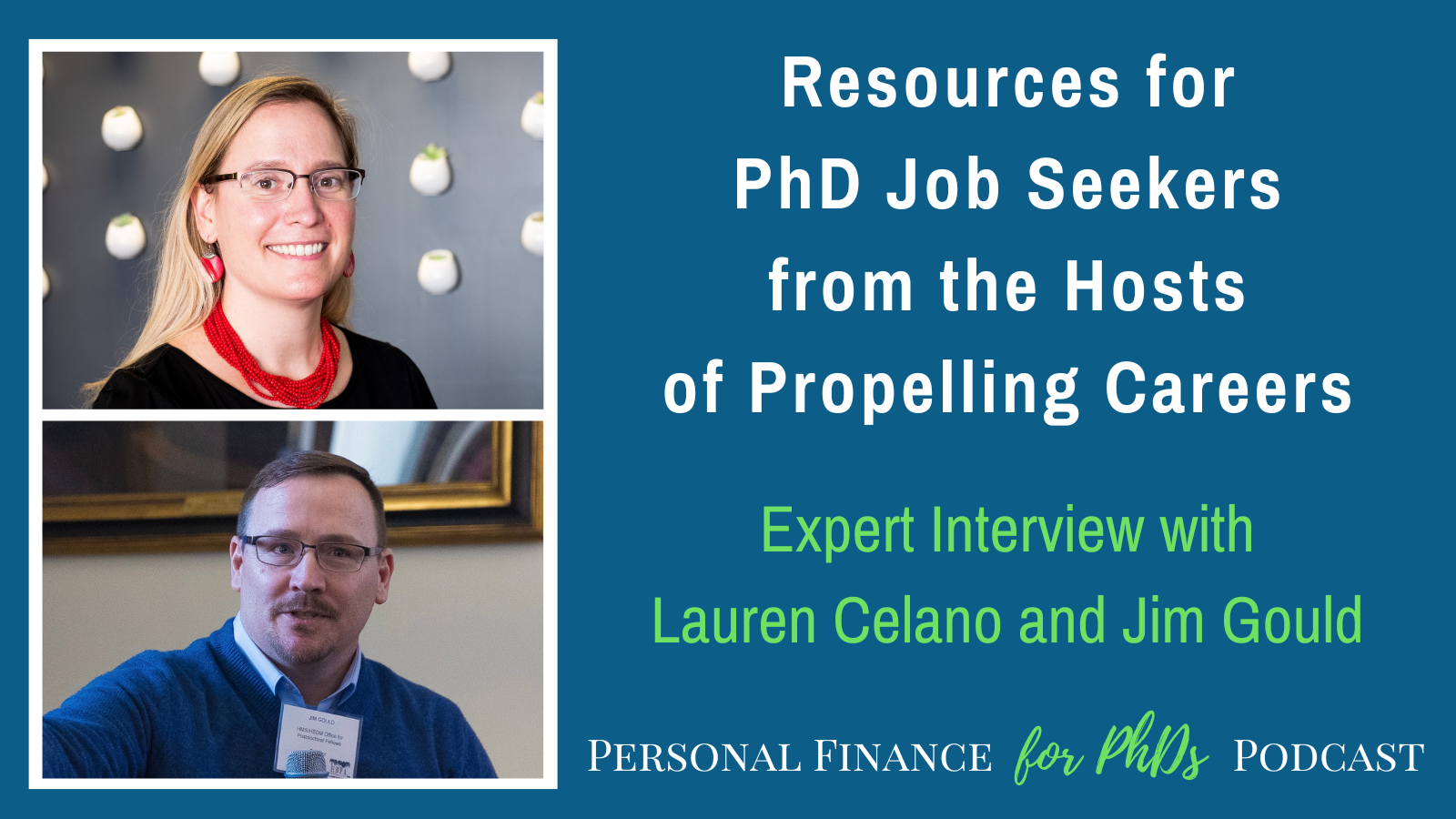
Resources for PhD Job Seekers from the Hosts of Propelling Careers

January 12, 2026 by Jill Hoffman Leave a Comment

In this episode, Emily interviews Dr. Jim Gould and Lauren Celano, the co-hosts of Propelling Careers, about strategies for PhD job seekers, starting with an update on the PhD job market. They discuss how PhDs can figure out the salaries of various careers and particular jobs, including where they might fall within a posted salary range, and what benefits are offered at a company. They review where job seekers can go for both free and paid assistance. Finally, both Jim and Lauren give excellent financial advice related to job transitions.

Links mentioned in the Episode

  • PF for PhDs Quarterly Estimated Tax Workshop
  • The Propelling Careers Podcast
  • The Propelling Careers Podcast Episode 82: Help me help you…
  • The Propelling Careers Podcast Episode 73: Steps in the job search process
  • PF for PhDs S22E5: Money Is a Good Enough Reason to Leave Academia
  • PF for PhDs Tax Center for PhDs-in-Training
  • Science Careers Individual Development Plan (myIDP)
  • PF for PhDs Subscribe to Mailing List
  • PF for PhDs Podcast Hub
Resources for PhD Job Seekers from the Hosts of Propelling Careers

Teaser

Jim (00:00): But it’s not productive to panic and say, oh my gosh, let me send out a whole bunch of of resumes or applications without actually going through the process. The process might end up being expedited time-wise, you know, instead of three to six months or nine months of exploration, job application, and interviewing, you might have a couple weeks, but you still have to go through the steps of doing that, and you have to fight off that panic.

Introduction

Emily (00:33): Welcome to the Personal Finance for PhDs Podcast: A Higher Education in Personal Finance. This podcast is for PhDs and PhDs-to-be who want to explore the hidden curriculum of finances to learn the best practices for money management, career advancement, and advocacy for yourself and others. I’m your host, Dr. Emily Roberts, a financial educator specializing in early-career PhDs and founder of Personal Finance for PhDs.

Emily (01:01): This is Season 23, Episode 1, and today my guests are Dr. Jim Gould and Lauren Celano, the co-hosts of Propelling Careers. Our topic is strategies for PhD job seekers, starting with an update on the PhD job market. We discuss how PhDs can figure out the salaries of various careers and particular jobs, including where they might fall within a posted salary range, and what benefits are offered at a company. We review where job seekers can go for both free and paid assistance. Finally, both Jim and Lauren give excellent financial advice related to job transitions.

Emily (01:42): These action items are for you if you switched onto non-W-2 fellowship income as a grad student, postdoc, or postbac last fall and are not having income tax withheld from your stipend or salary. Action item #1: Fill out the Estimated Tax Worksheet on page 8 of IRS Form 1040-ES. This worksheet will estimate how much income tax you will owe for 2025 and tell you whether you are required to make manual tax payments on a quarterly basis. The next quarterly estimated tax due date is this Thursday, January 15, 2026. Action item #2: Whether you are required to make estimated tax payments or pay a lump sum at tax time, open a separate, named savings account for your future tax payments. Calculate the fraction of each paycheck that will ultimately go toward tax and set up an automated recurring transfer from your checking account to your tax savings account to prepare for that bill. This is what I call a system of self-withholding, and I suggest putting it in place starting with your next fellowship paycheck so that you don’t get into a financial bind when the payment deadline arrives. If you need some help with the Estimated Tax Worksheet or want to ask me a question, please consider joining my workshop, Quarterly Estimated Tax for Fellowship Recipients. It explains every line of the worksheet and answers the common questions that PhD trainees have about estimated tax. The workshop includes 1.75 hours of video content, a spreadsheet, and invitations to at least one live Q&A call each quarter this tax year. This quarter’s Q&A call is on Wednesday, January 14, 2026 at noon Pacific Time. If you want to purchase this workshop as an individual, go to PF for PhDs dot com slash Q E tax. You can find the show notes for this episode at PFforPhDs.com/s23e1/. Without further ado, here’s my interview with Dr. Jim Gould and Lauren Celano, the co-hosts of Propelling Careers.

Will You Please Introduce Yourself Further?

Emily (04:05): I am delighted to have joining me on the podcast today, the host of the Propelling Careers podcast, Jim Gould and Lauren Celano, and they are gonna take the time to introduce themselves to you, but I just wanna say, if you’re a PhD, you need to go right now and subscribe to their podcast because it’s really, really valuable whether you’re in a job searching, you know, time or not. Although that is a subject of the podcast still something we need to keep up all the time. So go subscribe. Also, Jim, why don’t you go ahead and introduce yourself first.

Jim (04:32): Thanks, Emily for the invitation and thanks for the plug to our, uh, podcast as well. So, I’m director for postdoc affairs and program director for Responsible Conduct of research at Harvard Medical School, where I’ve been for almost 15 years now, providing programming and coaching and policy implementation for our postdocs here. I’ve received my bachelor’s in molecular biology from Clarion, University of Pennsylvania, my PhD in biochemistry at University of Louisville in Kentucky, and did my postdoc training in two different laboratories at the National Cancer Institute at the NCI in Frederick, Maryland.

Emily (05:05): Excellent. Lauren, how about you?

Lauren (05:08): Alright, well, currently, uh, the co-founder of a company called Propel Careers, and I do a lot to be able to help support PhDs and postdocs and early career people in their career journey. Um, but I’ve been in the life sciences sector now about 24 years, the first 10 of which was more drug discovery focused. And since about 2009 I’ve been working really closely with a whole range of postdocs and PhDs and early career people to help them navigate their careers.

Emily (05:34): My next question may have started to be answered by your, uh, background information there, but I’m, I’m curious how you developed this expertise, particularly in PhD careers. Um, Jim, why don’t we start with you because we know how you got your PhD, but then how did you get into this work?

Jim (05:48): Alright, so, you know, I I I was experiencing academia and research training firsthand as, uh, you know, in my bachelor’s. You know, I did a, uh, research stint, uh, summer undergraduate research fellowship actually at Ohio University and went into a PhD program trying to figure out what to do career wise with my molecular biology background. Uh, it seemed like it made sense going to graduate school, getting a PhD, struggled a little bit as a student, trying to figure out what it actually meant to, to do research and, and be successful there. And then, as I was a graduate student, realized that there’s an entire community and my peers and colleagues and fellow students who also needed help. And there wasn’t a ton of infrastructure for the development of professional skills, tons of research happening and, you know, we were able to, you know, show presentation skills, but it wasn’t a professional skill set.

Jim (06:42): And it was one of those things where we started ourselves building those skills and, and pulling groups together. And then the next step is like, okay, I don’t have enough experience to go on the job market directly from a PhD. So I did postdoc and not fully understanding what postdoc means ’cause there weren’t a ton of postdocs when I was a graduate student at U of L. There are more now. And just having been in that process in the training and struggling in each one of those stages and then figuring out things for myself, but also figuring out things to help my, my peers and colleagues. So that gave me a lot of just sort of on the ground practical experience and helping others. And then I realized I could probably do this for a career, but didn’t know what it looked like, didn’t know what it was, what it would be called.

Jim (07:28): I was looking at education and outreach, but it was running a, um, a postdoc association running seminar series, just being invited to sit on committees and panels and get questions asked of me like, well, what’s the postdoc experience? Where we’re faculty, we’re appointed, we, we don’t know exactly how postdocs are, are, are being treated or what they need or what the trainees need. And I was like, well, we need this, we need this. And it just sort of snowballed building a reputation, doing that, and then realizing I can make a career out of it. And at the same time, as I was in the middle of my, my postdoc, finishing my postdoc, there was a proliferation of postdoc offices growing, you know, and there are still institutions that are still starting postdoc offices. So I went from being a postdoc doing research, but also helping my, my fellow postdocs to running a postdoc.

Jim (08:20): And then I needed to learn the administrative aspect of policy development, of implementation, of learning how to coach. But doing this sort of day to day, week to week, growing and building my own portfolio of presentations, of skills, of coaching, I, I’ve been able to just build that expertise and now working with maybe even thousands of postdocs and PhDs and other trainees. So being able to then share that experience through my workshops, through my trainings and, and whatever else other people invite me to talk about. But also through that podcast that we have Propelling Careers.

Emily (08:56): And how many years has it been since you devoted yourself full-time to this

Jim (08:59): Full-time? It’s been 15 years. So I started this job in 2011, June, 2011. So June, 2026 will be 15 years on the dot.

Emily (09:08): Amazing. And I can see so many parallels actually between your story of, you know, needing this information for yourself and struggling through it, and then starting to teach other people with my own story. Of course, you decided to do this from within academia, <laugh>, and I’ve decided to do it from external academia, but still a lot of parallels in the motivation there. Um, Lauren, how did you come to, you know, decide to focus on this particular population?

Lauren (09:31): So, I, I have a scientific undergrad. I have biochemistry, molecular biology is what I focused on in college, and a lot of my friends decided to go to graduate school, so I started to get to know people that were doing their PhDs and some of them decided to also do postdocs. I also had moved to Boston in 2003 and, uh, started to be surrounded by people <laugh> with advanced academic training from the biotech activities I was involved in, but also just from my friend network and that sort of thing. And I started to notice that a lot of people had these amazing skills, but didn’t always know what to do. And in my working world, before Propel, I was, uh, getting to know a lot of different people in biotech companies and across a whole range of different roles and that sort of thing. And when I ended up, uh, going back for my MBA, I started to see that there was this need to be able to help people think about their future, to think about what are they doing and how are they leveraging their skills.

Lauren (10:25): I was giving advice to a lot of friends of mine, and then I realized that maybe this is something that could be applicable to other types of people. So I kind of fell into it, to be honest. But it’s been really fun to be able to help all these motivated people that really just wanna do great work and they wanna change the world through their research and activities and, uh, and so forth. So it’s been really nice. So for me, it’s been about 16 and a half years, so it’s funny, Jim, to think about like, when I started interacting with you, that was shortly after you came to HMS. So it’s really a small world, but I’m so happy that we got to kind of grow up together, <laugh> in this space.

Jim (11:00): Yeah, being able to, to do this straight out of postdoc, there was a huge learning curve. And one of the things that I wanted to point out with, with what Lauren and I were, were talking about with our relative path is that it wasn’t, we had to explore it, we had to find it, it wasn’t just laid out in front of us, okay, you have an MBA, now you go do this, you have a PhD, now you go do this. And I, I know that for our audiences, relative audience is yours and ours, it’s, it’s very similar. Like, okay, I’m going to undergraduate, I could do these things. I could go pre-med, I could go to graduate school, but we don’t know what’s happening two or three, even five years down the road. So being able to figure that out while still being productive as a student, as a trainee, as a postdoc, you know, it, it’s almost like you have two jobs. You need to figure out what your next job is, but also you have to be productive in, in your fellowship as well.

Emily (11:51): Absolutely. I totally agree. Um, I I think about it the same way of having the academic training aspect of your job and then the professional development and perhaps even job search and pursuit of careers aspect of your job. Um, you just mentioned, Lauren, that it’s a small world and I had the pleasure of meeting both of you in person. Um, within the past year, Jim and I saw one another at NPA, the National Postdoctoral Association Annual Conference. Then Lauren and I saw one another at the graduate career consortium annual meeting, and after that I wanted to set up this podcast interview. But I’m so glad for that timing because right now is a really interesting and critical moment for PhDs in terms of their, anyone who’s looking for a job. Right? <laugh>

Current State of the PhD Job Market

Emily (12:30): We have heard overall in the media that the job market is so difficult right now. And so I want to get an update from you two on how the PhD job market in particular is doing. Because I know from looking at BLS data that, you know, PhDs overall have a really, really low rate of unemployment. And as of the last update, which I looked at, and now we had a government closure in between, but the last jobs update I saw that PhD unemployment has ticked up a little bit, but still very low overall. But Jim, you said to me earlier this year when we met that PhDs are more likely to be underemployed than unemployed, which is also not a great, uh, image. So take this how you will, but I want to hear from each of you like your assessment of the job market right now for PhDs.

Lauren (13:13): Yeah, I I can start on this one and then Jim can, uh, can add, so the job market’s really hard. We actually have a podcast that we put out a few months ago about reasons why the job market is so challenging. There’s financing challenges, all sorts of things that we go into. Uh, it’s a really hard time, especially in life sciences and in high tech in particular. It’s very challenging for people. There’s been a lot of layoffs and reorgs for different reasons. So for people that are currently looking for roles right now that are finishing up graduate school or finishing up their postdoc, there’s so many people on the market, which is making the job market really hard. It’s taking people longer to find roles. People have to be even more persistent in terms of the job search process to find opportunities. And sometimes, you know, at a practicality, people just need a job. And so there’s some cases where people just take a job just to be able to pay rent and things like that as opposed to their ideal job because they just need something. So it’s a, it’s a complicated, we could probably spend like three hours just on that topic, but, but Jim, what, what else do you have to add there

Jim (14:16): For the reasons that you just explained Lauren, but also there are, um, there’s, there’s relative safety and, and that might not be so true nowadays, but traditionally, historically there’s relative safety in academia for many PhDs and postdocs. And they tend to remain in those positions longer or maybe go on the, the job market multiple times, at least historically. Now it is changing because of, of just funding constraints and, and changes in the NIH and and, and changes in indirect costs. And, you know, it costs more now to keep a postdoc and graduate students. But the, the idea is that they stay in positions longer. They might extend their PhD, they might extend their postdoc a year or two, so they don’t go, they don’t finish a fellowship and then go unemployment. So they extend a fellowship. And that’s what I meant by underemployment, where they stay in a position where they’re not advancing. There’s no sort of promotion structure within academia right now, at least for postdocs to continue to advance, uh, within that structure. They’re also may be even under appointed as I as sort of just explains like they, there’s no path of advancement. And then the other thing that, that Lauren kind of hinted at is sometimes they end up taking jobs out of need rather than sort of matching skill sets and advancement that are, tend to be below their skill set or experience level, because again, the fellowship funding is over and they need to find a job rather than launching their career. So there, there tends to be a little bit of underemployment and that it ended up catching up eventually. But there is, you know, there, there is this aspect of academia is this kind of warm, cozy, at least it used to be this warm, cozy place where you could take your time doing research and being productive and getting publications out, and then there’s a kind of a soft launch and or, or whatever on your, your next step of your career. It just sort of extended a little bit. So it’s not, you don’t lead to unemployment ’cause you don’t just lose postdoc jobs. It’s, you end up staying longer and you end up being under, under appointed and underemployed,

Emily (16:19): Except that some postdocs are losing their jobs now. Um, I mean because of funding changes, I actually worked with a university this fall who in the midst of me working with them, they conducted layoffs of their postdocs. So it’s unusual <laugh>. It’s, it’s different than at other times. And I wonder if, I know we could spend so much time on this, but if you had any advice for how PhDs can meet the moment, and I’ll say that in the financial realm, when people are experiencing job loss or financial emergency or anything like that, the advice is kind of like, well, it’s just more important to do all those classic things that you were told to do anyway, right? Like, have the emergency fund and diversify your sources of income and, and be able to cut your expenses if you need to. So I’m wondering, in your sphere, is there any different advice or is it just like, yeah, go listen to all of our podcast archives and just do all the stuff we’ve already been talking about <laugh>

Advice for the Current PhD Job Market

Lauren (17:12): One thing Jim and I say all the time is don’t do this alone. So find resources at your institution, reach out to your network, may- have your materials together, right? You need to have a resume or a CV depending upon what you’re applying to. It needs to be up to date. So if you do have to look for a job quickly, you’ve got something you can share. Otherwise you lose time trying to put it together, cultivating your network, you know, again, like reaching out to people. But when you do that, uh, we did an episode recently in the podcast called Help Me Help You, which was all about if you’re gonna be engaging your network, help them help you, what do you say to them? How do you share information? How do you make it easy for people to help you, especially if you might be in a time crunch due to layoffs, reorgs changes that are unexpected and things like that.

Jim (18:02): Yeah. And, and in, in addition to what Lauren was just talking about, we have to fight the urge or we advise fighting the urge of panicking because, you know, panic is not productive for the most part. Being able to understand the landscape. There’s, there’s e- there’s a, a grieving process that happens, especially if you lose a job. We’re not downplaying that, but it’s not productive to panic and say, oh my gosh, you know, let me send out a whole bunch of, of resumes or applications without actually going through the process. The process might end up being expedited time-wise, you know, instead of three to six months or nine months of exploration, job application and interviewing. You might have a couple weeks, but you still have to go through the steps of doing that. And you have to fight off that panic and realize in the grand scheme of things, a a three month gap or a one month gap or even a six month gap in your employment record is relatively meaningless, especially in academia and moving into industry because those now, you know, industry is, is relatively, there’s, there’s high turnover, you know, and you’re, you’re going to have multiple jobs, maybe even multiple careers. And now in academia, we are now feeling that, as you pointed out, Emily, you know, postdocs are losing their jobs. We are, you know, downsizing in academia, especially in the, the research realm. So we need to remain nimble, but you need to fight off that, that urge to panic and just remember your resources and your network and community.

Emily (19:27): I like that encouragement of just like, there is a process here. Like work the process, like work the steps. Um, you don’t have to reinvent the wheel. Okay, <laugh> like resources like yours and others that maybe available to people are, are excellent to be accessing at this time.

Lauren (19:40): Well we did a podcast episode recently about the 26 steps in the job search process. <laugh>, I mean, not not to overwhelm people, but it’s a lot of work. It’s a lot of work to be able to effectively engage in this. So I would say check that out because it could help people start to get a feel for things they could do to help them be productive in the side.

Jim (20:00): Yeah. And, and that list it, it could have been a hundred things and we, we were able to sort of pull that list and, and you know, glean it and, and, and call it. But the idea is that there, the, that there might be, um, maybe healing in that process. Just doing the thing also helps you able to control the controllables. So again, fight the urge of panic but also re remember that there are many things outside of your control in this, in this world and in this process. You, you, you can’t control somebody interviewing you or hiring you, but you can control doing the process. You can control, you know, engaging your, your network. You can control putting out quality applications.

Emily (20:38): I love that. And all the episodes that you mentioned, Lauren and Jim, by the way, will be in the show notes. So anybody looking for that, go to pfforphds.com/podcast. Find this episode and you’ll get all the links to the Propelling Careers podcast.

Pay Transparency Laws and PhD Salary Ranges

Emily (20:51): Okay. I wanna talk a little bit more about finances, specifically within the job search and job application process. Uh, I learned from your podcast that there have been all these new like pay transparency laws in various states that have come into effect. So I want you to explain a little bit about what that means and how PhDs can figure out what is an appropriate, um, salary or salary range for a career that they’re looking for. And also in a specific location. ’cause obviously cost of living is gonna massively change this as well.

Lauren (21:19): So I’ve had the fortunate, uh, nature. So part of what I do in my career is I do recruiting with a few companies and, uh, I’ve had opportunities hands on to actually be a part of some of these pay transparency activities. And so for example, in Massachusetts, October 29th, 2025, the pay transparency law went into effect, which means companies of more than 25 people are supposed to have salary ranges for each role that they post. In California, this went into effect January 1st, 2023. I was recruiting with a company at the time in California. So I was involved in actually posting the salary ranges and I was so nervous to actually put it out there. But it’s been great actually for candidates to have a little more transparency around where they may fall. Now it’s a range, right? So you have, you have, you know, let, let’s say the range might be a hundred to $120,000 for a certain role. Typically people pay kind of in the middle of that range. ’cause you wanna allow people opportunities to be able to grow once they come into an organization. So as a candidate, I would anticipate probably like middle of the range is probably where you should fall for that. As you’re looking at opportunities though, it can be helpful to see the ranges. ’cause then you can start to get a sense of which roles could align to your financial considerations. ’cause there could be some situations where a certain type of role just isn’t gonna align and that’s fine. You can then focus your efforts on ones that are out there. Washington and New York also have pay transparency laws. And you know, one thing that’s helpful to keep in mind is that maybe you live in a state that doesn’t have pay transparency laws. Well, you can still look at states like California, Massachusetts, New York, Washington and start to get an idea potentially of what ranges could be. It may differ a little bit in, you know, the Midwest or the South or something, but at least you may start to see kind of ballparks in certain ranges. The other thing I would say is, you know, when you’re doing informational interviews you can ask people like, do you have an idea of what the salary might be for this particular role? But not just that though, what are the other benefits, right? And we’ll talk more about that, but it’s like the whole package. Don’t be afraid to utilize your network. There’s a few other ideas I have, but I know Jim has some thoughts on this too, in terms of advice he’s given.

Jim (23:37): Yeah, there, there, you know, if in academia, uh, you know, Laura was talking a lot about industry and, and just outside of academia, but there are public institutions, public colleges and universities that have to pay, have to post their salary. So you can get an insight on relative salaries. They’re usually a year or two, sometimes even three years behind. So you can get a a sense, you know, and I know, you know, inflation is, is increasing. So tho those salaries may not be as accurate, but you get a sense of what the range might be depending on, you know, full professor, assistant professor, associate professor, or even, you know, scientific staff or you know, administrators within university. The other thing is, you know, um, the American Association for Medical Colleges, it produces for a fee, a a booklet of salaries across medical schools and medical colleges. So you can get an insight into that. You know, depending on if you are more, more biomedical research and you’re going into a a private medical, um, research institution, you can, you know, basically purchase those, um, you know, those ranges and salaries. But one of the things that, that Lauren already mentioned that’s really effective is when you’re out there gathering information, meeting people and networking, you do these informational interviews and you collect that kind of information, you don’t want to necessarily ask them specifically how much do you make in your role. That is, that tends to be rude, but you can say, how much can I expect in a, you know, in an introductory role or a, a scientist one role at, at your company or in your sector. And they should be able to give you a, a relatively accurate range as well. So, but you, you have that more direct information that, um, you, you could probably trust a bit more than finding stuff on the internet, uh, in indeed.com or Glassdoor or, or salary.com as well.

Lauren (25:28): To build on Jim’s point, some of the other professional organizations have salary guides. So American Chemical Society every couple years does a salary guide. So if you wanna be a chemist in a certain place, you can probably find a range. Uh, the Association of University Tech Transfer Managers also has salary ranges. So maybe some of you listening to this are involved in professional associations. Well ask that association, do you do a salary survey? Because maybe they do and that might help you. And also universities oftentimes collect this information. So if you wanted to move to California, you could do a search of some universities out in California and maybe they’ve compiled a, a information about recent PhD graduates and recent master’s graduates in their location in different sectors. It’s not gonna be perfect, but it may give you an idea of ranges just to be able to help in terms of that information. There’s a lot of information out there, but the source of the information, that’s the important part to make sure that you are seeking sources that are credible. That’s why sometimes Glassdoor and LinkedIn and so forth, sometimes it’s self-reported or made up in other capacities. So you just wanna be careful in terms of where you’re getting that information from.

Jim (26:42): You. You also wanna be careful with, again, the information you gather and you are moving in, in a different geographic area because cost of living varies across the United States and, and obviously the world. So if you gather information about salaries in the Boston area, but you’re moving to Pittsburgh, those numbers are gonna be inflated. Uh, Pittsburgh is generally gonna pay lower, but the cost of living is is cheaper, so your dollar might go a little bit further. So thinking about those aspects as well.

Emily (27:11): This, this is great information, thank you so much. And I, I love that you mentioned like different sort of categories of places that people can go to find this information. And I love the idea of someone starting this very early on like years or more, you know, a year more before they’re actually engaged in a job search process to try to figure out like maybe their own financial expectations and what sectors and what titles kind of align with that. Like for example, I did an interview recently with Dr. Gabrielle Fil- Filip-Crawford, who actually also met at GCC and she was talking about how pay transparency talking with our colleagues about pay helped her understand that she was never going to make enough money inside academia on her faculty track that she was on to satisfy her lifestyle needs and wants. And so it helped her leave that sector entirely and find more remunerative work that was, you know, still in line with what she wanted for her career. And so I just think that’s really, really important that we have realistic and grounded expectations about what different types of careers pay, what different titles pay. Because frankly, as a PhD you have a lot of transferrable skills that are kind of flexible. And so if you could fulfill the, you know, the requirements of roles with a few different titles, like you should look into what those different titles pay and the tracks that they’re on, um, to see, you know, what best aligns with your financial desires as well.

Lauren (28:29): 100%. Exactly. And of course it’s not always just about the money, but the culture and the kind of career trajectory. There’s a lot of things to factor in in terms of taking a role, uh, or not, but finances come into play and you wanna make sure that people are realistic so you can, whatever quality of life you need that you’re able to meet that.

Jim (28:50): Yeah, I agree. Quality of life is, is, is front and center, especially nowadays. We want to be able to, to work, to be able to live, not necessarily live to work for a lot of, a lot of different people.

Commercial

Emily (29:03): Emily here for a brief interlude! Tax season is in full swing, and the best place to go for information tailored to you as a grad student, postdoc, or postbac, is PFforPhDs.com/tax/. From that page I have linked to all of my free tax resources, many of which I have updated for this tax year. On that page you will find podcast episodes, videos, and articles on all kinds of tax topics relevant to PhDs and PhDs-to-be. There are also opportunities to join the Personal Finance for PhDs mailing list to receive PDF summaries and spreadsheets that you can work with. Again, you can find all of these free resources linked from PFforPhDs.com/tax/. Now back to the interview.

Learning About Benefits Information During the PhD Job Search

Emily (29:55): Okay, so we’ve talked about how to work out what kinds of salaries are on different careers and where to locate yourself on a range that you might see. Um, I wanna ask about benefits as well because, you know, certain benefits can be really, really important to people, especially related to like health insurance stuff. Like does this company offer parental leave? Does this company offer, um, you know, a specific medication that I need for a health condition that I have? Um, you know, different things like that. And how can someone who is looking or applying for jobs understand like, is this company even gonna meet, like benefits wise, my expectations? I understand you could probably ask about that very late in the process, like after you’ve gotten an offer, but is there any way to get that information earlier so that you don’t like waste your time maybe pursuing something that is not ultimately gonna work out?

Jim (30:44): So is because of the, the job market being so, um, so difficult at the moment, they want really good candidates and, uh, universities, colleges, um, companies, so on and so forth. If they, they usually put the benefits first and foremost at maybe at the bottom of the job description. They’re very proud to say, we offer, you know, uh, unlimited paid time off. We offer childcare subsidies, we offer commuting subsidies. So there are a lot of things that you can just find in the job description. And if it’s not in the job description, they probably have a why work here website or webpage where you land on. It’s more HR oriented, but you can find a lot of the different types of, of information and benefits, you know, from the job description, the job ad. Usually towards the end you’re like, we are very happy to be family oriented and all of these other things because, you know, the, the audience that, that Lauren and I tend to to work with are early career researchers and mid sort of midlife, mid thirties early or late twenties, early thirties, building their families as well. So the, I think companies are now understanding more than ever that they’re hiring not just the perfect candidate, but also a a a whole person that likely has a family with them.

Lauren (31:57): Yeah. And to, to add to that, I would say, I mean there’s some companies that literally have their entire benefit guide on the website. You can download it, it’s, you know, 45 pages with all the healthcare options, the 401k match, the vacation, the holidays, the cell phone reimbursement, et cetera, et cetera. But you know, also to plug the informational interview, when you talk to people at certain companies, it’s fair to ask, can you share some insights about benefits? Because this is something when I counsel people, and I’m sure Jim, you do too, and Emily for sure, you know, people look at the sal- the base salary and they’re either happy or sad depending upon what their expectations were. But then I always advise people, make a list of everything, right? The base salary is a hundred grand, okay, is there a bonus? Is there cell phone reimbursement? Is there commuter reimbursement? Is there like lunch provided a couple times a week, uh, et cetera, et cetera, et cetera. So I’ve had situations where the base salary is a hundred thousand dollars, but the total package is actually like $135,000 because of the extra things associated with the offer. So that’s where it’s really helpful as a candidate to make sure you’re looking at the entire package. Plus, of course, what’s the culture like, what’s the work-life balance like, what’s the enjoyment of the role? Those are a little bit intangible, but also super important as you consider what’s gonna be the next best fit for you?

Emily (33:27): Is it appropriate to ask generally? Can you tell me about the benefits? ’cause obviously people probably in the interview process don’t necessarily wanna reveal oh yeah, I’m thinking about having a baby soon. Like yeah, I have a chronic medical condition, or, you know, whatever the case is. 

Lauren (33:40): I think it’s fair to ask and, and I, I know, so in the recruiting work I do, typically after the first discussion, I’ll send people a summary of the details, but if, if you don’t get sent that I would ask it because these things are important. You don’t wanna get to the end of the interview and realize that the company doesn’t have things you need because then you just spent a lot of time and a lot of their time interviewing for a role that then is not gonna be a fit. So I love just being open and honest <laugh> and just asking for what you need and hopefully the organizations you are interviewing with will be able to provide information.

Jim (34:11): Yeah, it may not be your leading question. Be like, you know, when you first get in, what are the, what are the benefits? And it may not be the central question, but when given the opportunity, or maybe as you’re rounding out the interview or the discussion, be like, would you mind sharing, you know, the, the benefits package or, or a more information about benefits as well? Because during the interview it’s more about fit and work and, and connection and, and sharing your experience and credentials, but benefits will play a huge part in the actual decision if an offer is tendered.

Free Career Search and Career Development Resources for PhDs

Emily (34:43): You all mentioned earlier, um, graduate students and postdocs accessing resources related to career search and career development at their own institutions. Um, I’m wondering for people who have already, maybe they’re aware of that resource or maybe they’re no longer affiliated with institutions, so they don’t have access to those kinds of offices anymore. Um, what kinds of free resources are available? I mean, we know about your podcast, but anything else? And then is there ever a point when a person should consider paying for professional services or a course or anything like that?

Jim (35:16): So I, I know Lauren and I, we tend to align with, with some of this, uh, this interaction and, you know, the feedback and advice. But I do want to reiterate, even though, you know, people might not be still affiliated with in-, with institutions or schools or colleges, they are still alums of those schools and colleges and can go back as an alumni to maybe access career services, career offices. So you, you can still have some access, it might be limited, but there are also other offices that, you know, like mine, you know, especially, you know, if a postdoc is transitioning out and their end date is, um, I don’t know, a week from now, I’m not gonna turn them away in seven or eight days after their, their appointment ends. They can continue to come back as they’re transitioning out. So there, there’s also workforce development. Again, thinking about if you’re transitioning out, you can really leverage and access all of those resources. If you’re being terminated or you’re actually on your way out, you can tool up. But don’t forget that you are an alum of schools and universities where you paid probably thousands upon thousands of dollars. They still, you know, give you access to their, their, you know, uh, alumni office as well as their, the career services office. Other resources that I really like are kind of like, you know, um, communication, leadership, you know, emotional, uh, intelligence assessments. Those tend to be free. You, you can go to a, a coach and a professional and pay for those services and get, you know, um, some help unpacking some of those things. But there are a lot of those are free and the explanations are pretty clear and straightforward and it allows you to understand how you communicate and how others communicate and how things land for you. Where you can then stretch yourself into different personality types or with different personality types. Uh, I, so those are kind of the, some of the free stuff that you can get into, but you can pay to do some of those things like strengths finders or Clifton strengths. You, you, you have to, you know, buy the book for strengths finders and then you have access to like your top five strengths, but you could pay someone to sort of coach you on those things as well. And I know Lauren has a lot more information and insight as well.

Lauren (37:26): Totally. I mean, one, uh, one free thing that I often suggest to people is the myIDP by Science Careers. It, it was a tool, uh, meant mostly for biomedical and biosciences, uh, graduate students, but it could be used by other people as well. These, some of these things are transferable to other disciplines, physics and, and, and others. Uh, but you know, you put in your interest skills values and then it rank orders one of 20 career paths that could be a fit. Doesn’t mean you have to do patent law if that comes up first, but it can be a nice way to start to understand, oh wow, if I have these interests in skills, those writing careers or outreach careers or entrepreneurship careers or whatever seem to be a fit. Sometimes people just need a little bit of insight and then it can launch this whole new area that’s out there. Um, on the, you know, on the paid, uh, coaching side. I mean certainly some people need a ton of help in terms of tailoring the resumes, interview prep and things like that. So there are coaches out there that can help. The key is make sure you find a coach that’s appropriate in terms of background, expertise, even level of people that they’ve engaged with. I, I’ve had a few people recently that have come to me ’cause I do some coaching work with people and they may have gone to someone that just coaches like executive level people and here’s someone that’s just coming outta their PhD, that coach may not have the right type of advice ’cause they’re not used to working with people at more of the entry level. They’re used to working with people that are more seasoned or I’ve had people that have gotten career coaches, but they coach people in different industries. And so like the cosmetics industry is definitely way different than life sciences, which is way different than data science. So it can be really helpful to do your due diligence to make sure if you are paying for coaching services and career advice services, that you are paying for the right, the right information and the right, uh, the items to be able to make sure it’s actually useful for you.

Jim (39:20): And, and it might be helpful in the short term, very near term, you might, you might pay someone for a couple of sessions and then you, you’re on the path to, to success or you might buy a subscription for a month or a couple weeks to, uh, job, job listings or even like LinkedIn, you know, uh, uh, you know, high level. So, but it should not be a long term or, or a forever type of situation. But you know, there are times where you might need that extra help and you can’t find it for free and you need to reach out and have someone or some, some, uh, resource that actually is a paid resource, but it should not be necessarily a long-term commitment.

Lauren (39:59): I know in Massachusetts there’s even these like mentorship networks. I’ve been a mentor for at least 10 of the last 15 years for the Massachusetts chapter of Association of Women in Science. So they have a year long mentorship program. You pay a small amount of money to be a part of it, but then you get someone like me giving you advice every month about, you know, your career, how do you navigate things, how do you build resumes, how do you job search? So just I would say be resourceful. ’cause there could be a lot out there. It’s just sometimes you don’t always know where to begin. So that’s where ask your network, you know, engage with people so that way you’re not doing this alone.

Emily (40:33): Yeah, I just wanna underline that, that like, clearly there are so many either free or near free or hey, you already paid for this in the past, so let’s just keep using it, uh, resources available, go to those first by all means. But I can imagine there are some people who, like this job searching has gone on for like a long time and anything that they need to do to truncate the end of this and just get into a position might, you know, might be worth the investment. Is there anything else that you’d like to tell us about the financial side of job seeking and job interviewing?

Additional Insights About the Financial Side of the PhD Job Market

Jim (41:03): There is a cost, time and financial and resource when going on the market. You might have to invest in new interview materials, like maybe a printer or a new laptop or professional clothing or outfits, maybe microphones or, or you know, you know, headsets for phone interviews or, or zoom interviews. But also you might want to understand how if you’re traveling for the job or traveling for the interview, how that reimbursement or payment or upfront, you know, scheduling will, will impact your finances because sometimes you are, you don’t have a ton of money and they want you to pay for the flight and they’ll reimburse you afterwards. Or the pay for the hotel and flight, they’ll reimburse you afterwards that, that could be two, $3,000 very quickly where they reimburse you 30, 60 or 90 days later. So, uh, again, just understanding that there’s an actual cost, not just your time because going on the job market is a timely cost. It’s a almost a second job, but there are these, you know, these little purchases that tend to add up that, that you could be in a thousands of dollars just going on the market, buying new clothes, buying new materials and, and actually traveling.

Emily (42:17): Great point that in the event of job loss, your emergency fund is not just there to pay for your ongoing living expenses, but you may have increased expenses to engage in this as well. Thank you.

Lauren (42:27): And I know we touched briefly on this, but I, I just wanna reinforce this point. When you look at the actual salary, just don’t look at the actual salary <laugh>, look at the benefits, the entire package because that will help you get a better understanding of if you end up having a few job offers, which one’s going to be the best fit. I just, I urge people make a spreadsheet, I’m sure Emily, you probably love spreadsheets to keep track of things so you can really compare apples to apples if you’re lucky enough to get a few offers and know you have to know what your like turn, turn away point is, right? If, if you need a certain amount of money to be able to live, then you need to know that. So then if a job doesn’t cover that, then you may have to say no, even though the role could be amazing, you don’t wanna take something knowing that you’re going to be in a negative financial situation starting from day one. So these are sometimes really hard discussions to have with people, but it’s really important to be honest so that way you can find a role and be able to focus on the role and not be stressed out about not being able to have proper finances.

Emily (43:33): And this may be a concept that is unfamiliar to people coming out of graduate school or the postdoc that you should feel financially supported in the role that you’re in. Absolutely. Thank you so much for those, um, concluding words. Where can people find Propelling Careers?

Lauren (43:48): We have our podcast on Spotify and Apple podcasts, and again, our podcast is free <laugh>, we have at the end of 2025, we’ll have 88 episodes. We have a ton of content and hopefully all of you find it valuable as you peruse.

Best Financial Advice for Another Early-Career PhD

Emily (44:04): Excellent. And I wanna end here by asking each of you the question I ask of all my interviewees, which is, what is your best financial advice for an early career PhD? And that could be something that we’ve touched on in the interview already, or it could be something completely new,

Jim (44:17): Right? It for me, it’s a combination of what we, we, we’ve already talked about is it it, and it’s a two-parter. Don’t do this alone. Use all of your resources to understand the, the cost, uh, of, of transitioning finding jobs and being successful in your career, but also understand and know the true cost of living in an area that you might be moving to. And that was, you know, Lauren, you know, talked about, you know, moving to a job and, and not realizing how much it cost. And and that’s something that actually happened. It, we got sticker shock when we moved up to here from Frederick Maryland to Boston. Uh, uh, it was a, a jump in salary, but it was not actually enough. And I didn’t realize that until after the fact. And it set us back several years in our finances to then catch up. And I think I still feel that we are actually behind where we would’ve been if we did actually just stayed in Frederick, uh, at points.

Lauren (45:08): And from my standpoint, so I see some people, they finish their PhD or postdoc and they get a job offer from a large pharma company and they go out and buy a new car, they get a nicer apartment maybe in the seaport of Boston and it’s like, don’t blow all your cash <laugh> right away. Like it could be really helpful to still live below your means so you can save some money so you can have a rainy day fund. You never know what might happen in the future. So it’s just as much as you may want to buy when you see your first check, like buy all this nice stuff, try to hesitate on that <laugh>. So, so that way it just allows you a little more freedom in the future.

Emily (45:48): There’s a big difference between splurging on a one-time purchase and splurging on something that’s gonna cost you some more money every single month going forward. So you’re absolutely preaching to the choir here. I love it. Thank you so much for this wonderful interview. I hope everybody goes and checks out your podcast. Thank you so much for joining me.

Jim (46:05): Thank you Emily.

Lauren (46:06): Thank you Emily.

Outro

Emily (46:17): Listeners, thank you for joining me for this episode! I have a gift for you! You know that final question I ask of all my guests regarding their best financial advice? My team has collected short summaries of all the answers ever given on the podcast into a document that is updated with each new episode release. You can gain access to it by registering for my mailing list at PFforPhDs.com/advice/. Would you like to access transcripts or videos of each episode? I link the show notes for each episode from PFforPhDs.com/podcast/. See you in the next episode, and remember: You don’t have to have a PhD to succeed with personal finance… but it helps! Nothing you hear on this podcast should be taken as financial, tax, or legal advice for any individual. The music is “Stages of Awakening” by Podington Bear from the Free Music Archive and is shared under CC by NC. Podcast editing by me and show notes creation by Dr. Jill Hoffman.

How to Improve Your Finances While Social Distancing

April 11, 2020 by Emily

Now that we’re a few weeks into our new normal of social distancing / isolation / quarantine, you may find yourself with the time, ability, and willingness to work on your personal finances*. Below are my top suggestions of activities you can engage in while social distancing that are highly likely to improve your finances in the short or long term, helping you to save money, pay off debt, and invest more money.

*If this sounds preposterous to you, this article isn’t for you right now! Keep taking care of yourself, your loved ones, and your community. If you want to know how I’m getting on without my regular childcare, listen to this podcast episode.

This is post contains affiliate links. Thank you for supporting PF for PhDs!

social distancing finances

Read a Personal Finance Book

Reading (or listening to) a book is the most time-efficient way to consume high-quality, curated personal finance content. I started my personal finance journey with a few cornerstone books (some of which appear on the list below) before moving on to blogs and podcasts. Reading a book is a great way to get a firm foundation—if you choose the right book.

In normal times, I would suggest that you check your local or university library first for the books you are interested in before considering purchasing. Personally, I know my local library branches are closed, but ebooks are still an option.

The list below includes some of my personal favorites and suggestions I received in response to a Twitter prompt. The knowledge you’ll glean from any one of these books is worth incalculably more than you would pay for them if you do decide to purchase!

  • A Random Walk Down Wall Street by Burton G. Malkiel
  • Broke Millennial by Erin Lowry
  • I Will Teach You to Be Rich by Ramit Sethi
  • The Automatic Millionaire: A Powerful One-Step Plan to Live and Finish Rich by David Bach
  • The Laws of Wealth by Daniel Crosby
  • The Millionaire Next Door by Thomas J. Stanley and William D. Danko
  • The One-Page Financial Plan: A Simple Way to Be Smart About Your Money by Carl Richards
  • The Simple Path to Wealth by JL Collins
  • The Two-Income Trap: Why Middle-Class Parents Are (Still) Going Broke by Elizabeth Warren and Amelia Warren Tyagi
  • You Need a Budget by Jesse Mecham
  • Your Money or Your Life by Vicki Robin and Joe Dominguez

Catch Up on a Podcast

For fascinating interviews with financially successful people and in-depth discussions of particular financial strategies, I turn to podcasts. (Podcasts are the one thing I have more of in my current life than I do in my regular life!)

Personally, I am a Completionist, so I prefer to listen through the full archives of most podcasts that I decide to subscribe to. Now that you have the time, here are a few of my favorite personal finance podcasts and other popular ones in the space. Listen to a couple of the recent episodes; maybe you’ll decide to commit to the archive!

  • Bad with Money
  • Choose FI
  • Gradblogger
  • How to Money
  • Journey to Launch
  • Personal Finance for PhDs (I course I have to include my own!)
  • So Money
  • The Fairer Cents
  • The Mad FIentist

File Your Tax Return

I am a major tax return procrastinator. My husband and I usually start working on our tax return in April and submit it barely under the deadline. Confession: This year, with the filing deadline extension to 7/15, we haven’t even started yet.

I do think that preparing your tax return is a good social distancing activity if you have the capacity. You can put an evening or two’s worth of uninterrupted time blocks to work with your tax software or even manually prepare your return (that’s our preferred method).

If you are expecting a refund, file ASAP to receive your refund ASAP. It’s your money! It should be working for you, either by paying expenses if you’ve experienced an income drop or going into savings, debt repayment, or investing if you income has stayed steady.

My tax workshop, How to Complete Your PhD Tax Return (and Understand It, Too!), comprises videos, worksheet(s), and live Q&A calls. Please consider joining through the appropriate link:

  • Grad student version
  • Postdoc version
  • Postbac version

Network

One of the upsides of physical social distancing for some people is the chance to connect remotely with a different set of people than usual. (I am highly envious of this! I had high hopes to reconnect with old friends during this time… My children’s insistence on derailing all adult conversations has dashed those hopes.)

Instead of limiting your Facetime/Zoom calls to your family and friends, consider reaching out to people in your professional network.

In a general sense you should be networking like this all the time, but the motivation intensifies if you are coming up on an expected transition point in your PhD career or you think your job/position is at risk and you might need to look for another soon.

An excellent, low-risk group to network with right now is people who graduated from (or otherwise left) your PhD program in recent years. You can reach out over email to see what they’re up to and schedule a call if that is mutually agreeable.

If you reach out to someone and don’t receive a response, don’t take it personally! People are dealing with a lot right now. Just cast a wide net, and appreciate the people who are able to give you some of their time right now.

Oh, and always ask at the end of an interesting conversation if the other person can recommend one or more people for you to connect with next!

Explore Career Options

As a spin off of networking, right now is also an incredible time to work on exploring your career options. Yes, the academic job market looks abysmal right now, but—upside?—it’s been trending that way for decades, so there are lots and lots of PhDs established in non-academic careers that might be of interest to you.

A great first place to go for resources is your university’s career center. (Check on this even as an alum—you may have access to resources from all the universities/colleges you’ve graduated from.) The robustness of their resources for PhDs in particular might be strong or weak, but some of their resources for undergrads will still be helpful.

The career center may have assessment tools, instructional resources for job seekers, recordings of past live events, and opportunities to meet one-on-one with staff. If you know they have a resource that is not currently available online, submit a request that it is made available.

Two platforms for PhD job seekers in particular are Beyond the Professoriate (Aurora) and Versatile PhD. If your institution has a subscription, access the platform through its login mechanism, but if not you can sign up as an individual. Beyond the Professoriate has an upcoming online career conference as well.

To combine networking with exploring career options, set up informational interviews with people in careers you’d like to learn more about. From my experience on both sides of informational interviews, they can be quite enjoyable and beneficial for both parties!

Invest in a Frugal Strategy

Most of us are practicing forced frugality these days in a few areas of our budget. I’d wager that your discretionary spending was down in March from where it was February and that April will be lower than March. There are lots of possible uses for that freed-up cash flow, but consider one more: investing in a frugal strategy.

One of the major, legitimate complaints about frugal practices is that they take some capital to get started with. I’ve heard “Frugality is only for the rich,” for example. This is not the case for every frugal strategy, but it is for some. Well, now that you have some capital, what frugal strategies can you ‘invest’ in that you know will pay off with decreased spending over the long term?

I’ll give you one tiny example: Last December, I ‘fessed up—to myself—that my family (which includes two tiny children, one of whom is still in a high chair) was consuming paper towels at a positively alarming rate. We were buying the huge packs from Costco for $20 each half a dozen times per year. This didn’t sit well with me from a financial or an environmental perspective, so I purchased these microfiber cloths (12 for $12—now I wish I had doubled it!). They work far better than paper towels, our paper towel consumption rate dropped like a rock (we’ve probably made up for that initial investment twice over by now), and they haven’t substantially added to our laundry load. (Again, two tiny children—we already do a ton of laundry, including cloth diapers.) These towels were absolutely a frugal investment. Bonus: Not having the pressure right now of needing to buy this particular paper product before we run out when it is in short supply is a load off my mind!

Ask yourself: Are there any frugal strategies I’ve wanted to try but haven’t yet because of the up-front investment of capital? Can I use my newfound cash flow right now to establish one of the strategies? And if it wasn’t money but rather time was your limiting factor before: What frugal strategy did you never have time to initiate, but you can put in the time now to make it a habit?

Here are a few ideas for similar frugal/environmental investments, gleaned from this Twitter thread:

  • Bee’s Wrap as an alternative to plastic wrap
  • Silicone Reusable Food Bag as an alternative to sandwich bags
  • Silicone Baking Mats as an alternative to parchment paper/foil/cooking spray
  • Reusable Facial Cleansing Pads as an alternative to disposable cotton pads
  • Wire Mesh Coffee Filter as an alternative to paper coffee filters
  • Wool Dryer Balls as an alternative to dryer sheets

Sign Up for More Awesome Content

I'll send you my 2,500-word "Five Ways to Improve Your Finances TODAY as a Graduate Student or Postdoc."

Success! Now check your email to confirm your subscription.

There was an error submitting your subscription. Please try again.

We won't send you spam. Unsubscribe at any time. Powered by Kit

Clear Out Your Closets, Etc.

My mother, a retired empty nester, has undertaken as her social distancing project clearing out the basement storage area of the home my parents have lived in for 30 years. It’s a massive project, and it is made more difficult by the closure of some of the places you might normally go to resell, donate, recycle, or trash your old possessions.

I do think a spring cleaning/clearing out is a good activity for right now. This might positively affect your finances if you are willing to hold on to the valuable items long enough to resell them. (You might be able to resell currently, but I suspect the demand will be relatively low.) If nothing else, it will benefit your mental health and will reduce the amount of work you’ll need to do leading up to your next move.

Close Old Financial Accounts (and Open New Ones?)

Spring cleaning can apply to your finances as well as your home!

You may very well have old banking or credit accounts that you no longer use or have need for. If you can close the old bank accounts without going anywhere in person, do so! Some people like to keep old credit card accounts open because length of credit history and utilization ratio play into your credit score. However, if you have a high credit score already, you should consider closing the accounts you don’t need; maybe just keep the single oldest account open. The suggestion to close old accounts goes quintuple for any accounts that charge you a fee.

In the same vein, now is a great time to join (aspects of) your financial accounts with your spouse or partner if you have decided to keep joint money. My husband and I decided to join as much as we could after we got married, and the months-long process involved researching and opening new accounts, waiting for money to transfer, and closing old accounts. Again, it’s a great social distancing activity as long as you don’t have to go anywhere in person. (Another reason online-only banks are my preferred institutions!)

If you’ve never looked into it before, you could put your free time into figuring out how to generate extra income from credit card or banking rewards. Please keep in mind that offers might be somewhat different during social distancing than they were before (or will be again). Before you open any new accounts, triple-check that you can meet the minimum spending requirements or transfer amounts given your (presumed) lower level of current spending.

Further Listening: How to Make Money without Working: Credit Card Rewards and 529s

Plumb Your Values/Dream

If you’ve been able and willing to slow down and reflect, this pandemic might have granted you new insight into what you want for your life. I don’t think you should be making any life-altering decisions in this stressful period, but lean into your different perspective and deepen your introspection.

What is truly important to you? What are the aspects of your life that make you feel fulfilled? What can you change about how you manage your finances to better support those aspects?

Further Reading: Determining Your Values and Financial Goals While in Graduate School

Get Coaching, Take a Course, or Join a Community

One way you can invest in yourself right now is to establish a relationship with a coach, join a community, or take a course focused on an area of personal or professional development. Spending money on this kind of endeavor makes it much more likely that you will actually take the necessary steps to ensure your financial success.

If your chosen area is finances, consider how you and I could work together. I offer one-on-one financial coaching, and I am also going to open up the doors to my program, The Wealthy PhD, in May 2020. Through both avenues, you will have individualized access to actionable knowledge, inspiration, and accountability. If you feel confident in your income security, this is the perfect time to firm up your financial plans and even take advantage of the unique opportunities this period affords.

If finances aren’t your preferred area of focus right now, I also recommend checking out the services offered by my colleagues:

  • Dr. Jen Polk coaches PhDs on their careers
  • Dr. Katy Peplin’s community Thrive PhD supports graduate students around the mechanics of graduate school and their mental health
  • Dr. Katie Linder offers podcasts with actionable tips, coaching and courses for academics on productivity and related topics
  • Dr. Echo Rivera offers courses and coaching on effective presentation design & presenting with data for academics, scientists, and researchers (grad students through PhDs)

If you do commit to working on your professional or personal development in one of these other areas, I’m confident that there will be an indirect positive effect on your net worth! Perhaps at that point you’ll be ready to directly work on your finances with me.

How have you improved your finances while social distancing?

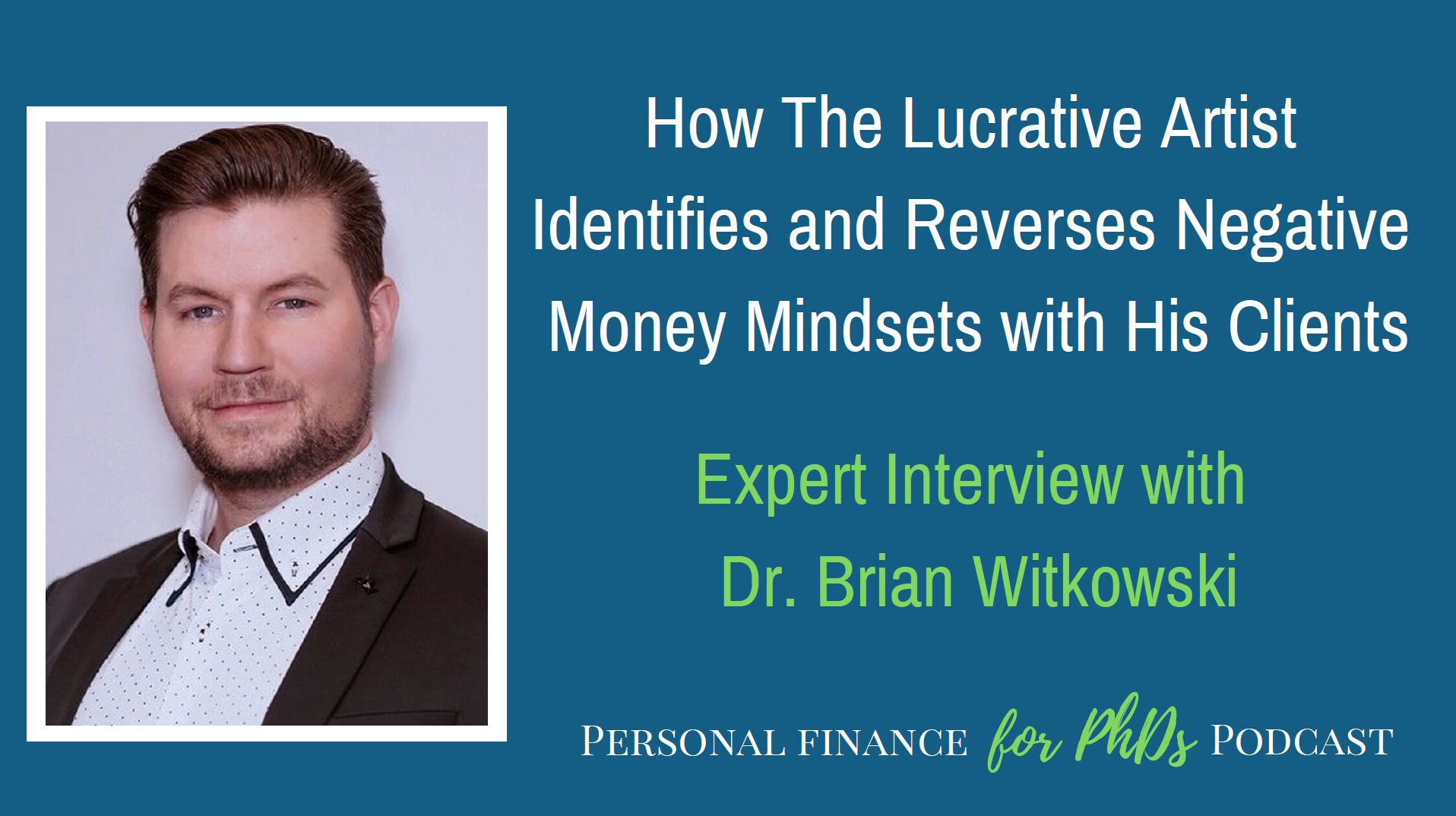
How The Lucrative Artist Identifies and Reverses Negative Money Mindsets with His Clients

February 24, 2020 by Meryem Ok

In this episode, Emily interviews Dr. Brian Witkowski, a Doctor of Musical Arts and the founder of The Lucrative Artist. Brian serves as a business and leadership development coach for artists and teachers. Brian often sees money mindsets in his clients that don’t serve them well, and these mindsets are common among PhDs as well. If left unchecked, these mindsets have detrimental effects on our finances. Brian and Emily discuss how to reverse negative money mindsets and how entrepreneurship is often the most lucrative and satisfying career for a PhD with a transformed money mindset.

Links Mentioned in the Episode

  • Personal Finance for PhDs: Tax Center
  • Self-Employed PhD Website
  • Beyond the Professoriate Website
  • Dust Safety Science
  • The Lucrative Artist Website
  • The Lucrative Artist Facebook Page
  • The Lucrative Artist Twitter
  • The Lucrative Artist Instagram
  • Personal Finance for PhDs: Podcast Hub
  • Personal Finance for PhDs: Subscribe to Mailing List

toxic money mindset academia

Teaser

00:00 Brian: When you’re starting out just by yourself, you don’t have to do all that. It’s just a matter of figuring out what’s your actual service, and who are the people you’re going to serve, and then what kind of value exchange you’re going to be creating that you can reasonably get paid pretty well for it, from the right people, in the right way.

Intro

00:20 Emily: Welcome to the Personal Finance for PhDs podcast, a higher education in personal finance. I’m your host, Dr. Emily Roberts. This is season five, episode eight and today my guest is Dr. Brian Witkowski, a doctor of musical arts and the founder of The Lucrative Artist. PhDs, like many artists, tend to have certain money mindsets that do not serve them well, such as a scarcity mindset. Brian and I discuss how negative money mindsets can detrimentally affect our finances and how to reverse them. For many PhDs, and Brian’s clients, the most lucrative and satisfying career path forward might be through entrepreneurship. Without further ado, here’s my interview with Dr. Brian Witkowski.

Will You Please Introduce Yourself Further?

01:06 Emily: I am delighted to have on the podcast today Dr. Brian Witkowski, and we’re going to be talking about mindset work and entrepreneurship and other fascinating topics like that. So, I’m really looking forward to this conversation and learning a lot from Brian. Brian, will you please introduce yourself a little bit further for our audience?

01:23 Brian: Yeah, so I’m originally from Michigan. My grandparents immigrated from Poland. My dad grew up in a very poor area of Detroit and kind of aspired to a much higher middle-class life and worked his way up and eventually became a professor and then raised me to someday want to be a professor, too. Obviously, the world is a lot different today than it was for the generation back then. You know, I’ve had to explore how else, where I can take my teaching and my work and what I really want to do. And so, when that tenure track job, after I finished my doctorate eight years ago, didn’t quite come up, I started exploring other opportunities. I started to really think what else is not being taught that we all could be taught and how can I better serve people. So, I started studying more about business and finance and looking to see where we can help people. Especially as myself, I have a doctor of musical arts degree, and especially in music and the arts, we know nothing about finance or financial literacy.

02:13 Brian: There’s so much to be learned and needs to be learned. So, you not only can just, you know, understand about money and know how to conduct yourself in life. And because we can’t just expect those few jobs we’re trained for, we have to be entrepreneurs, we have to come up with multiple streams of income, and come up with other opportunities and open our minds up to creating new opportunities as opposed to competing for just a few things that less than 1% actually end up having. So, basically, entrepreneurship is kind of the new golden age for higher education in some ways, is what I like to say. Because we can take our expertise and leverage it in new ways and recreate different learning opportunities, not just for the people in the college classes but for the lifelong learners. So, that’s kind of where I’ve taken my teaching nowadays.

Unhealthy Money Mindsets

02:56 Emily: Oh, that’s fantastic. I’m so excited to dive more into all of that, and I’m really excited to have you on as a guest because a lot of my audience, I think, is currently still in PhD training as graduate students or postdocs or maybe closely following that. They may still be competing for that tenure-track job or not sure what they’re going to do if it doesn’t work out. And so I’m really glad to have you on as someone who’s several years further down that line and has a lot more life experience and career experience in that way. One of the things that we said that we would talk about during this interview was money mindset. Because I think the people who you work with through The Lucrative Artist and also the people who I see through Personal Finance for PhDs have some troubling mindsets around money. So, can you talk a little bit more about the mindsets that you see your clients that also maybe overlap with mine? The money mindsets that they have that don’t serve them very well?

03:48 Brian: In some ways, one thing that doesn’t serve a lot of people is just that mentality that we don’t have enough and there’s never enough there. And we always think that it’s a scarcity mindset complex that so many of us have. Even my own father did, even though his adulthood was phenomenally better than his childhood, he was still struggling financially as a professor just putting it all together. There’s a book called Rich Dad, Poor Dad* by Robert Kiyosaki. More or less, he talks about how his poor dad actually worked his way up in higher education and became the administrator in the state of Hawaii, and so forth. Back in the fifties and sixties, when his “poor dad” was his friend’s dad who didn’t have any college training and just focused on acquiring real estate and thinking about owning a business and trying to earn money that way. And so, he more or less points out how we’re not taught about how to actually earn money other than to expect the job. So, part of the mindset is having your mind open to the possibilities of where you can create new income opportunities and new sources of revenue, and so forth, for your personal life using all you have to offer.

[* This is an affiliate link. Thank you for supporting PF for PhDs!]

04:52 Emily: Yeah, I can definitely see how the scarcity mindset–if you’re thinking only that, again, that tenure-track job is the only one for you and the only thing that’s worth doing after after a doctorate–there is scarcity in terms of that actual career path. That’s not imagined. That’s perfectly real. But I guess the mindset that doesn’t serve you is thinking of course that that’s the only or the best option for you following finishing your higher education. So, to think a little bit more broadly about your career track would be, I guess, the way to combat that scarcity mindset. Any other kinds of mindsets that you see in those populations?

Aim High: Raise Your Anchor Point

05:30 Brian: The only thing is, I guess we’ve focused so much like on student loans and the cost of higher education. It’s like we let the four-figure, accruing interest, to get in the way of thinking how we could maybe use that same energy toward, “How can I create maybe six figures of income or more later on?” We don’t open our minds up to the possibility of earning way more than what certain salaries we’re used to or what our parents or colleagues are earning. In a lot of different ways, if we package our expertise and services in the right way, you can find that clientele or that other startup, that kind of business that can easily make you enough money to more than pay off your debt and then some. And sometimes we get so bogged down with getting depressed over having a big student loan sum and we don’t realize that yes, it’s not that great, but it’s better than some other forms of debt that are out there.

06:19 Emily: Yeah. So, I think that’s like having an anchor point, right? So, like you in your mind around the amount of money you can make, you have anchor points, whether it’s what you were earning as a graduate student, if you had a stipend or as a postdoc or what you expect to earn as a faculty member or another kind of professional. Or, like you were just saying, the balance of student loan debt that you have or maybe the living expenses that you have to cover each month. These are anchor points that float around in your mind as, “Okay, I need to make this much money.” But really there’s no limit to that. Like, why are you anchoring yourself there? Go ahead and anchor yourself at 10 times that amount or a hundred times that amount, maybe.

06:55 Brian: Yeah, definitely. And there’s one interesting exercise that I sometimes give the clients to consider. Okay, what are you earning right now? What would you have to become to suddenly earn double that? Like who are some role models out there? Because there’s always going to be somebody out there we can imagine who’s already making more than what you’re making that you could easily–sometimes not even actually do a whole lot more, but just adjust the way you’re presenting yourself and to the right audience, and so forth. And then figure out how we can double that from there. If all else fails, at the end of this exercise, people usually say they’re going to be Oprah or Tony Robbins or something, which is great. You’ve got to not be afraid to think big like that.

07:32 Brian: Too often we think small, we don’t think we can be these celebrities and these great leaders, but anyone can really grow themselves to be more than just what they thought they could. And sometimes we’re not taught enough of that in our school. My father taught leadership courses when he was a professor. So, those are classes where I’ve kind of avoided anything that he taught when I was in school. Hence, I’ve got a doctor of musical arts degree. His degree was in criminal justice. And so, I wanted to make sure I wasn’t just recreating everything I absorbed by osmosis as a child. I guess you could say it was part of my motivation to make sure I picked a very different degree program. But there’s so many of these things that my father taught in his classes that are not taught to people in the arts and so many other fields as far as management skills, how to interact with people, and what kind of personal growth is out there. We’re too conditioned to just do the exact training for the exact skill to get specific sets of jobs and not necessarily create the jobs instead.

Challenges in a Culture of Volunteerism

08:29 Emily: Mmm, yeah. Great point. So, anything else on your observations around detrimental money mindsets and then how they translate to ill effects in our finances?

08:42 Brian: Yeah, I think partly the scarcity mindset that sometimes starts with just the job market and the opportunities for earning money. Another problem is, especially in the arts and education fields, it’s almost like there’s a nonprofit aspect to it or more if you’re working for a religious institution or, in my case as a professional singer, getting paid to sing in churches and so forth. There’s that guilt trip kind of situation where some people who are cutting the checks kind of make you think you shouldn’t be earning as much as what you should be. And there are other situations too where it’s kind of like the negotiation turns into a coerced charitable contribution in some ways, but not in one in which you can actually get a tax deduction for your time in a concrete kind of way. So, it’s another situation we have to deal with, whether we’re in the arts or in education. There’s that mindset, “Wait, I’m not supposed to get paid this much. I’m supposed to do it for the children and do it for God or whoever, whatever the cause is, basically.” So, that kind of keeps people from realizing their potential. And then I try to tell people to be in a position where you can actually tithe or donate that 10% back as we all ideally should later in life.

09:49 Emily: Yeah, I agree to great, great extent. There’s this, I guess I call it kind of a toxic culture of like compulsory volunteerism in academia and in other similar fields. Exactly as you were saying. When the high level institution has some kind of nonprofit-like status that somehow translates to, “We don’t pay people what they’re worth or we don’t pay people to do work for us. We expect a degree of volunteerism.” I encounter this myself sometimes with institutions who want me to work without pay or with much less pay than I’m asking for. They can kind of use that, “Okay, well we’re a nonprofit,” as like an argument, somehow. But it’s just something that it’s hard to combat because as you said, when you’re sort of indoctrinated into that culture, you think, “Yes, well I’m supposed to be giving back. I’m supposed to be doing this for X, Y, Z. What about the people who won’t benefit from receiving my talents if I don’t take this opportunity?” But at the end of the day, you have to feed yourself, right?

Finding Balance in Value Exchange

10:54 Brian: Yeah. And that’s the other thing. I also tell people that, at the very least, it’s a two-way street. How can they serve me in return if there’s an imbalance in the actual value of exchange that’s taking place? At the very least, maybe that institution could give you a referral for another service you’re providing, or they might allow you to advertise something else. Or, like I tell people who are performing artists, maybe they can sell CDs or trade their mailing lists. There are other ways to at least get some kind of fair exchange of value if you open your mind to those things. I try to help people think about those things and make that happen so that at least if they’re not getting necessarily the actual money, maybe they’re getting a leisurely vacation out of it if it’s a traveling musical gig or something like that. They’re getting something that makes it still worth their while to otherwise feel like they’re volunteering their time.

11:41 Emily: Yeah. Something that can be mutually beneficial instead of just beneficial going one direction. Okay. So let’s say, you know, someone in our audience has identified, “Okay, well I do have that scarcity mindset,” or “Yeah, my anchor point is 10 times lower than it should be,” or what have you. Any of these money mindsets we’ve been talking about. How do you actually go about changing a money mindset that doesn’t serve you well once you’ve identified it?

Changing Your Money Mindset: Self-Talk

12:05 Brian: For me and for people who I work with, sometimes I give meditative exercises. You have to think positively. Positive manifestation-type statements, saying to yourself, “Your bank account may be empty,” but rather than say it’s empty, say, “It’s wide open and ready to receive.” It sounds silly, but you have got to think, “Okay, the money is going to come to me eventually.” You can’t think that you’re never going to get it. It’s just a matter of figuring out the right way to find the right people willing to give you that money, basically, for when you willingly deserve it and earn it.

12:37 Emily: So, it’s kind of about self-talk, then, I guess is what you’re saying? Like it’s about, “Okay, I’ve identified my bank account is empty. Oh, it’s always going to stay empty.” That’s the toxic mindset.

12:48 Brian: So, it’s reinforcing that negative stuff. And before you know it, you’re staying on the floor at the bottom and not working your way up. And then another thing is, there’s the song “Love is in the Air,” but also you could say money is in the air, too. The way the global economy works, the way money compounds everywhere, there’s always going to be enough. You know, sometimes we think, “If I take this job then suddenly somebody else is not going to have any money,” and that’s not how the world works, actually. When we keep getting all that we’re supposed to earn, then there’s more to give around and more to grow the pie.

13:22 Emily: Mhm, yeah. So, it’s not like a fixed pool of money, right, that we all are trying to grab a little bit of a piece of,  it’s about growing the entire economy–the entire pie for everyone. Is that what you’re saying?

13:34 Brian: Yeah, exactly.

13:34 Emily: Yeah, so we aren’t thinking, “Me gaining something is someone else losing something.” That’s not how it is.

13:40 Brian: Yup.

13:41 Emily: Yeah, great.

13:42 Brian: It’s how the markets work. If you notice, if you had invested a dollar a hundred years ago, it would probably be who knows how much now. It’s partly a result of that.

13:51 Emily: Mhm. Yeah. Anything else that we can do to change the money mindset aside from turning things in a more positive way and reinforcing that by self-talk?

Open Your Mind to New Revenue Streams

14:02 Brian: The other way probably: be open to thinking of new ways to earn, and be open to new revenue streams. Don’t be afraid to think outside the box as opposed to how you can make a living. Because we all get so caught up trying to apply for the exact same jobs and thinking these are the only ways to earn. There are so many different audiences out there and clientele that we could actually be serving that we don’t even think about. Especially for myself. People, my colleagues mostly, aspire to teach students who are college students and aspiring professional singers. And it’s kind of like we subconsciously only focus on the clientele that is like ourselves. And we don’t realize there’s another whole clientele out there that might be willing to pay way more, or you could actually set up scalable situations where you could easily earn way than you otherwise are used to earning. So, you’ve got to let go of that in one direction and think 360 every way around you, there’s something more you could probably do.

15:00 Emily: Yeah, I think this kind of relates. For people who are still in academia, they might not feel very special because everyone they’re surrounded by also has crazy advanced degrees. Very smart, very talented, very trained in a similar way. But if you can turn and look outside of that immediate environment like you’re talking about, you can see that there are many, many other opportunities to serve different groups of people or to leverage your skills in a different kind of way. And once you do step outside the ivory tower, your skills are going to be regarded in a way that you’re not used to. Right? They’re going to be much more highly looked upon because you are special. There’s only like 2% of the population or less or something that has doctoral level degrees. So, it’s not actually that common if you find the right group to serve. So, this translates really well once you’ve opened your mind to these other types of clients and other types of work that you might be able to do. At that point, why is self-employment more attractive than a job? Or why does self-employment serve you better with a different kind of money mindset than a job would?

You Can Be Self-Employed and Still Have a Job

16:07 Brian: It’s not necessarily mutually exclusive from having a job. And I think sometimes people get caught up thinking they have to quit their job and suddenly be a sole business owner right away. Not necessarily, although sometimes there are situations where you just need to get out of a toxic environment that doesn’t pay you enough. Then you easily find that one client and you can easily–or a few clients–you can suddenly afford to just say farewell to the job that wasn’t really serving you. But I think when you’re stuck in a job, you’re stuck with a cap on your income. Whereas if you start a business, you could think owning your own business, being self-employed, you’re open to more possibilities and there’s no limit necessarily. So, it’s like you’re removing an artificial cap and you’re also giving yourself more freedom once you get it going, you find the right clientele to serve, and so forth.

16:51 Emily: Yeah, I think this goes back exactly to that Rich Dad, Poor Dad book or idea that you were talking about earlier. The poor dad, right, has a job and his income is, as you were just saying, capped and scaled by the employer. It’s sort of out of his hands, right? But the rich dad is an entrepreneur and–well, Robert Kiyosaki’s really into real estate, so lots of different ways to be an entrepreneur–and in that case, the income streams are unlimited. And each income stream itself is unlimited in how much money you can actually bring in. So, there’s a downside to that, but there’s a big, big, big upside too, if you choose to walk away from a job. Which, like you said, it doesn’t have to be all or nothing. So, some people in my audience, again, are still in training. Self-employment is something that they can do on the side while they’re still in graduate school, while they’re still in a postdoc for now, as long as it’s permitted by their visa and their job and everything. But it’s something you can dip your toe into and see how it’s going, and you don’t have to just take the leap, like you said, right away.

17:53 Brian: Yeah, definitely.

Commercial

17:58 Emily: Emily here for a brief interlude. Tax season is upon us, and while no one loves this time of year, it’s particularly difficult for post-bac fellows, funded grad students, and postdoc fellows. Even professional tax preparers are often thrown for a loop by our unique tax situation. And don’t get me started on tax software. I provide tons of support at this time of year for PhD trainees preparing their tax returns, from free articles and videos to paid at-your-own-pace workshops to live seminars and webinars for universities and research institutes. The best place to go to check out all of this material is pfforphds.com/tax. That’s P F F O R P H D S.com/T A X. Don’t struggle through tax season on your own. Visit my website for the exact information you need in the most efficient form available. Now, back to the interview.

Pay Attention to What is Not Being Taught

19:01 Brian: The great thing is, while you’re still in grad school, it’s your perfect opportunity to realize what is everybody doing the same? Where do you feel like you’re literally just in “the Matrix,” and what’s not being done? I stress to people that it’s the perfect time to really observe and reflect and take notes for what’s going on and what’s not being taught that still needs to be taught in real life. Because there’s just so much of that that still needs to be taught. Whether it’s with finances or just personal development or other aspects of just knowing how to live. Too many aspects of our degrees are just kind of geared to train us for specific jobs but not for creating jobs. So, one strategy is to just observe what’s not being taught. And then how could you actually teach that? I like to joke with people who are getting their terminal degrees, their PhDs, that they could actually create something in which those same people who may not hire you for a faculty job might actually hire you to do their professional development. Because you never know. That fresh perspective of being young, just finished your degree, and offering a different viewpoint is something that’s going to be valuable to them.

20:07 Emily: You’re exactly describing my own journey into Personal Finance for PhDs, because what was going on for me in graduate school was, I was learning about personal finance because I had to apply it in my own life, or felt that I had to, right? So, I was learning how to apply it and then over some time sort of looking at the way my university was or was not supporting that growth and that journey. And I should say that Duke, which is where I did my PhD, actually does a great job with personal finance in comparison to many, many other institutions. But even so, I could see that there was more that could be done there. And that’s exactly how I stepped into my business was seeing, “Okay, well no one is teaching personal finance from the perspective of a graduate student or a postdoc or a PhD. They’re teaching personal finance from the perspective of a CPA or a financial advisor who deals with very, very wealthy clients.” And this is just completely foreign to the people that I was coming out of. And so, I decided to turn around, right? And teach the people who are coming up behind me those principles. So, exactly what you described. And as you said, I never applied for jobs, universities, or faculty positions, but I am now hired by plenty of universities to do professional development in this area. So, it’s totally, totally, exactly what you said.

Different Business Models for PhDs

21:22 Emily: So, what are the different business models that you can see with PhDs or other people with doctorates that are successful, that are easy for them to access, given the skills they’ve been learning throughout their higher education?

21:35 Brian: Yeah. One thing is just to simply think, “What kind of professional development services could I offer? Are there businesses, are there organizations or clients where what I have to offer with my knowledge and expertise can be valuable to them?” And sometimes it’s not necessarily just regurgitating the same content, but how can you repackage it in a way that is more meaningful to them. Sometimes, with my work, I stress that you can kind of integrate some personal development, leadership growth, using your content as the vehicle, so that people are thinking not just that they’re learning more about a certain thing about history, but they’re realizing how their own life embodies that same historical thing you’re trying to reinforce. Find something like that.

22:19 Brian: It personalizes it more and really fits the clientele or the audience that you’re serving. So, there’s that. Sometimes you can do something as simple as different kinds of coaching, whether it’s life coaching, business coaching. There are so many forms of coaching out there that still people need to hire people. That’s not enough just to go about life waiting for the job or expecting your business to take off. We always need more people to help us in different ways to give us different perspectives, different viewpoints to push us in different ways. In the arts, even though I have my degrees, I still take voice lessons. My voice is an evolving instrument. I’m always learning how to use it in different ways. And the older I get, the different kind of repertoire I suddenly get to sing. So, it’s a never ending thing. And there are other aspects of life where it’s the same way. So, people with PhDs and other graduate degrees, just that background alone gives credibility with certain types of audience members.

Self-Employed PhD and Beyond the Professoriate

23:11 Emily: Yeah, absolutely. So, I’m part of a community called Self-Employed PhD, which is underneath the Beyond the Professoriate umbrella program. And so, what Jen Polk and Maren Wood do, who run that program, is they are career coaches for PhDs. And there are many other people who have stepped into the same area. Seeing again like we were just talking about that a lot of universities don’t prepare PhDs well for knowing the possibilities for their careers outside of academia or being prepared to actually apply for those jobs or network for those jobs or get those jobs. Many people have decided to become career coaches in this area because there is a lack of support from many universities in that area. So, exactly what you’re just saying. Any other business models that you see as very accessible for this audience?

Think Big, Think Lifelong Learning

23:56 Brian: Sometimes it can just be simply, create your own school. It might even rival your university. Don’t be afraid to think big like that. Or something else to that effect. Some kind of supplementary, after-school program for elementary kids or high school. Really any age group. I read an article that there is going to be an enrollment crash in higher education soon where suddenly, because there’s going to be way more retirees than young people, not as many young people enrolling in college. So, more job cuts and other drama might be around the corner. But at the same time, we have a retirement population that is just growing, and they’re bored. There are ways to serve them. So, rather than think higher education, think lifelong learning or higher learning and other things you can offer that can serve any kind of population.

24:45 Emily: Hmm. Yeah. If what you really wanted to do when you were pursuing that faculty position was teach–I mean there are so many different audiences and different ways that you can do that. Even within the subject matter that you were highly trained in, if you want to stay in that area.

24:59 Brian: If you’re willing to leave the country, there are 7.6 billion people in the world. There’s going to be somebody out there who will pay you to teach them something.

25:06 Emily: Yeah. Or work online, and have access to everybody in the world. Yeah. Any other business models you want to add to that list?

Other Business/Teaching Models

25:14 Brian: Yeah, one-on-one coaching, teaching, offering professional development seminars or other workshops, and so forth, using your expertise. Also, you don’t necessarily have to not teach the same students you’re expected to teach that you went through school. You just need to be offering them something that’s different from what they’re used to. So, that’s why I also, with my own business, I help people specifically in the arts figure out how can I do this likewise? How can I create something different and empower myself to have control over my career and do more of the things I actually authentically want to do? Because one thing, especially in the arts, there’s a lot of interesting toxicity that goes on when it comes to career expectations. Especially with professional singers. We have a lot of people who started their careers in the last century and sometimes they just went about teaching as if that last century way of life was still going about and everybody could easily have the same career they had. Or at least that’s how they’d go about, conduct themselves, and just kind of otherwise disregard your actual career and what you’d be doing.

26:16 Brian: You have to really be more of an entrepreneur nowadays as a performing artist if you’re not going to suddenly get some of those few jobs that are still out there. So, position yourself to help those same people who are in your field, not getting the help they probably should have had.

26:29 Emily: Mhm. Yeah. And you mentioning actually using the specific skill you’re trained in, singing. But I’m thinking about–so I have a colleague named Chris Cloney who has a business doing research. He has an independent research company, specifically translating the research that he did as a PhD student into basically another way of delivering it to the world. So, we’ve talked about teaching and coaching and speaking and so forth, which is what you and I do. But there are other ways to translate even more precisely what you were doing in graduate school into the entrepreneurial sphere instead of just going after a job. So, you brought up what you’re doing through The Lucrative Artist. I would love for you to tell us a little bit more about that. Maybe a couple of minutes on how you came to this point. We’ve already heard some of that journey, and then what you do for clients right now.

Brian’s Work with The Lucrative Artist

27:16 Brian: Yeah. So, what I do is I help clients literally figure it out. Sometimes, the biggest barrier that we need to break through is figure out what else we can do other than those few jobs we were conditioned to expect to get. And so I help people think, “Okay, how can I assess all your skills and your strengths, your weaknesses? What’s something that you can synthesize that can actually become a viable product or service that you could give to other people? And you’re more or less in a position where you’re not having to worry about competing against other people and you’re serving the audience that really wants you to serve them and so forth?” And so helping people really package that together. We do authenticity training where we think, “What is it we really, truly want to do?”

27:57 Brian: Like, “What is your purpose? What really drove you to want to teach? And how can you get more to that?” Like for me, it wasn’t really necessarily about the actual content, but it’s about helping people really actually change their lives. Like I’ve witnessed my father as a child, growing up. He did the same thing with his students, seeing people who were, likewise like him, grew up really poor, had no idea what they’d be doing later in life. Then finally they realized, “Oh, I can learn this. I can do this.” And suddenly they have great jobs or they have their own businesses, they’re making a great living, and so forth. So, helping people realize there is another way out there, and anyone’s capable of doing it. And then basically once people figure out what ideal business would be for them, what kind of service they’d be providing–sometimes there’s not a specific service, it’s like a bunch of different services related to themselves through their art form. So, for people in singing, for example, sometimes it’s teaching lessons, sometimes it’s teaching speaking lessons, presentation lessons, helping people patch together other skills related to their singing. So, they’re not just performing, but they’re also providing expertise and educating the public more about the works to bring awareness and you know, make that same connection between a certain classical work and you know, what its audience is going through right now.

Combat Limiting Beliefs and Imposter Syndrome

29:12 Emily: That sounds like, based on what we were kind of talking about earlier, you help people identify the limiting beliefs they have, the mindsets they have around their career, for example, and then coach them in how to combat that within themselves. I guess I just think about this as related to imposter syndrome, right? There’s nothing that we are trained for to do outside of academia. All we can do is teach. And if we can’t get that job, we’re like worthless, right? That’s a horrible thing to think about yourself. But I think it’s indoctrinated into so many of us who go through academia to have that imposter syndrome that “I’m not worthy of another kind of job. I’m not worthy of being able to start a business. I don’t have translatable skills into these other areas.” And so, once people see, “Okay, well this is what’s holding me back. I’m going to engage Brian,” you help them turn those mindsets around in a very practical way. Because you can say, “No, here is what you need to be telling yourself instead of what you have been thinking.” And then they do the work, right? To actually uproot those mindsets.

30:14 Brian: Yeah. And then once they get through there, once they realize what they want to do, then I coach them through step-by-step, “What can I do to actually make a viable business take off the ground.” And it’s not always necessarily too scary or confusing. Some people, you tell them you’re helping them grow a business, they want to see all these weird numbers and other things. And when you’re starting now just by yourself, you don’t have to do all that. It’s just a matter of figuring out what’s your actual service and who are the people you’re going to serve and then what kind of value exchange you’re going to be creating that you can reasonably get paid pretty well for from the right people in the right way. And it’s a matter of figuring out how you can package that and who you’d be serving.

Growing a Business is a Gradual Process

30:52 Emily: Yeah. I think some people when they hear like starting a business, they think about the startup world and where you have to have a highly refined business plan you’re pitching to investors and so forth. And it is really important to have this high degree of models and understanding of what you’re going to be doing in that world. But just to dip your toe into self-employment is much, much, less than that. You don’t have to do all that. You have to try out some things, see what people aren’t going to pay you for it, see what you like to do. It’s a lot of experimentation at the beginning and it’s not really high stakes.

31:21 Brian: Yeah, exactly. I love helping people, walk them through that and realize, “Oh, I can do this.” And yes, there’s actually a demand. One interesting exercise to really take people through is just called hot or not. What are some ideas that can work, and we talk them out. And then we also might contact some other people and see what they think about that if it’s a totally new thing that they hadn’t heard of before. And just a matter of, you need an opportunity to just test the waters and you openly be in a safe environment where you can express ideas without somebody thinking you’re stupid or whatever. There’s no stupid idea. There’s, you know, millions of ideas everywhere. And it’s a matter of figuring out how to piece together to create something viable as far as the business goes.

Origin of The Lucrative Artist

32:00 Emily: Mhm. Yeah, that gives me a good idea of what your services are. But I wanted to ask you about your name, The Lucrative Artist, which is very provocative. So, can you tell us a little bit how you came to that?

32:09 Brian: It’s fascinating. It’s a provocative word. It’s a word they say all the time on CNBC and all the other finance channel for other businesses. But for some reason we’re conditioned to think we have to starve as artists. And it’s not necessarily the case. So, I try and help people realize, “No, actually if you’re getting paid what you deserve and what you should be, you’re actually in a position to make even higher quality art and you’re serving people even better.” So, it’s actually an empowering mindset that better serves them later on.

32:39 Emily: Yeah, I love that. Oh my gosh. Well, where can people find you?

32:42 Brian: Well, my website, thelucrativeartist.com, the lucrative artist, three words there, .com or there’s facebook.com/thelucrativeartist where I’m active on a Facebook page. I also have a Twitter and an Instagram where I try to be accessible to as many people as possible through all those platforms, wherever the world’s taken me. There’s a Self-Employment in the Arts conference taking place in Chicago in February that I’ll be presenting at. And also some universities here and there. I’ll be doing some presentations and masterclasses and so forth. So, I try to be all-around.

Best Advice for an Early-Career PhD

33:13 Emily: Sounds awesome. So, final question. This is a standard one that I ask all my guests, which is what is your best advice for another early-career PhD or another early-career doctor? And this could be something related to what we’ve talked about today or it could be completely other.

33:30 Brian: Yeah, I think as far as the best advice, always keep a mind open to creating new sources of income and having multiple sources of income coming in. And think of ways you could create some passive income for yourself as well as the active income. And then, when you’re in your PhD, look and see what everybody else is doing and then think, “What is everybody not doing they should be doing?” And realize that might be a gold mine of a business opportunity just waiting to happen. So, just to open your mind up to that possibility and not being afraid to go for it.

34:03 Emily: Thank you so much, Brian. Thank you so much for the interview. I’ve learned a lot. I hope the audience has as well.

34:07 Brian: I really appreciate it.

Outtro

34:07 Emily: Listeners, thank you for joining me for this episode. Pfforphds.com/podcast is the hub for the Personal Finance for PhDs podcast. There, you can find links to all the episode show notes and a form to volunteer to be interviewed. I’d love for you to check it out and get more involved. If you’ve been enjoying the podcast, here are four ways you can help it grow. One, subscribe to the podcast and rate and review it on Apple podcast, Stitcher, or whatever platform you use. Two, share an episode you found particularly valuable on social media or with your PhD peers. Three, recommend me as a speaker to your university or association. My seminars cover the personal finance topics PhDs are most interested in like investing, debt repayment, and taxes. Four, subscribe to my mailing list at pfforphds.com/subscribe. Through that list, you’ll keep up with all the new content and special opportunities for Personal Finance for PhDs. See you in the next episode. And remember, you don’t have to have PhD to succeed with personal finance, but it helps. The music is Stages of Awakening by Podington Bear from the free music archive, and is shared under CC by NC. Podcast editing and show notes creation by Meryem Ok.

Healthy, Wealthy, and Wise: Choose a PhD Program That Will Support Your Personal and Professional Development

January 13, 2020 by Lourdes Bobbio

This episode comprises seven audio clips from PhDs and PhD students who are advocates for PhD students’ professional and personal development. They each answer the prompt: “What aspects of a PhD program – beyond academics and research – should a prospective graduate student consider when deciding among offers of admission and why? How should they investigate and evaluate the strength of a program in this area?” The contributors are Dr. Emily Roberts of Personal Finance for PhDs on finances, Mr. Kevin Bird on unionization and advocacy, Dr. Emily Myers on unionization and advocacy, Dr. Jen Polk of Beyond the Professoriate on career development, Dr. Katy Peplin of Thrive PhD on mental health, Ms. Susanna Harris of PhD Balance on mental health, and Dr. Katie Wedemeyer-Strombel on work-life balance. Please share this episode with all the prospective PhD students in your life!

Links Mentioned in This Episode

  • Find the contributors on Twitter:
    • Dr. Emily Roberts
    • Mr. Kevin Bird
    • Dr. Emily Myers
    • Dr. Jennifer Polk
    • Dr. Katy Peplin
    • Ms. Susanna Harris
    • Dr. Katie Wedemeyer-Strombel
  • Personal Finance for PhDs: Podcast Hub
  • Personal Finance for PhDs: Subscribe to the mailing list
  • Finance: Calculate the Living Wage
  • Finance: How to Read Your PhD Program Offer Letter
  • Finance: Additional Financial Factors to Consider Before Accepting an Offer of Admission
  • Unionization and Advocacy: Find out more about unions in Washington and California
  • Career Development: Beyond the Professoriate
  • Mental Health: Thrive PhD
  • Mental Health: PhD Balance
  • Work-Life Balance: More from Dr. Katie Wedemeyer-Strombel

PhD personal professional development

Introduction

00:05 Emily R.: Welcome to the Personal Finance for PhDs podcast, higher education in personal finance. I’m your host, Dr. Emily Roberts. This is season five, episode two and today I have a very special episode for you. I have invited six other PhD advocates to contribute their voices to this episode and you’ll hear from myself and each one of them in turn. The questions I’ve asked each of these contributors to answer are: what aspect of a PhD program, beyond academics and research should a prospective graduate student consider when deciding among offers of admission, and why? How should they investigate and evaluate the strength of a program in this area?

00:45 Emily R.: If you’ve already matriculated into or completed a PhD program, you probably appreciate what an important topic this is. Will you take a minute to please share this episode with prospective PhD students in your sphere of influence? Please tweet your thoughts on the episode using the hashtag #PhDfactors. In this episode, we’re going to hear from me, Dr. Emily Roberts of Personal Finance for PhDs on finances, Mr. Kevin Byrd on unionization and advocacy, Dr. Emily Myers on unionization and advocacy, Dr. Jen Polk of beyond the professoriate on career development, Dr. Katie Pepin of thrive PhD on mental health, Ms. Susanna Harris of PhD balance on mental health and Dr. Katie Wedemeyer-Strombel on work life balance. Without further ado, let’s hear from our contributors.

Finances with Dr. Emily Roberts

01:43 Emily R.: Naturally, my contribution to this episode revolves around your finances, specifically how to evaluate whether you will be sufficiently supported by the stipend or salary provided by the program. You may or may not end up using this factor when you choose your PhD program, but either way you should go into graduate school well aware of the financial realities. When I was applying to PhD programs, I didn’t pay much attention to the stipends in the offer letters. I naively trusted that every program I was accepted to would support me financially to a reasonable degree. The PhD program I picked based on only the research opportunities and location actually did pay a decent stipend, but that was blind luck on my part. I know now that graduate students often do experience a great degree of financial stress and ill effects. Approximately 50% of PhD students take out student loans, prior to graduation and many also accumulate credit card and other types of consumer debt. Some PhD students qualify for snap benefits and a few experience food insecurity. Think about the difference it would make to your mental health alone to attend a graduate program with a stipend that allows for a comfortable standard of living versus a program where you have to pinch every penny, side hustle like mad, and still be in the red every month. Do you think you will be able to perform well academically if you’re experiencing chronic financial stress?

03:08 Emily R.: There are long-term financial effects to think about as well. If you currently have student loans, will your stipend allow you to start to repay them? If they are un-subsidized, they will accrue interest all through your graduate school deferment period and you’ll have an even larger balance to tackle post-PhD. What if you were able to start investing with your stipend? If you’ve never played around with a compound interest calculator, pause this episode and spend a few minutes doing so now. With reasonable assumptions, investing $250 per month throughout only five years of graduate school can turn into nearly $1 million in your retirement years. That’s $1 million of wealth in retirement that would not exist if you accepted a stipend that didn’t afford you that ability to save.

03:56 Emily R.: Are you sufficiently motivated to pay attention to the stipends in your offer letters? Good. I’m going to tell you how to evaluate the single most important factor in your funding package. The number that I want you to find in each of your offer letters is your stipend or salary net of fees. Some of your offer letters might state this number clearly and some might obfuscate it. To compare apples to apples across all your offers, you need to know how much money is actually going to end up in your bank account after your tuition, insurance premiums, and all fees have been paid. If your offer letter doesn’t make it clear to you what financial obligations you will have to pay to the university from your stipend, it’s worth a follow-up email to clarify.

04:39 Emily R.: Next, we need to put this net stipend number in the context of the local cost of living for the university. I like to use the MIT living wage database for this. The living wage is basically the amount of money it takes to pay for basic living expenses like housing and food in that local area. It doesn’t include discretionary expenses like travel or putting money toward financial goals. Go to livingwage.mit.edu and click on the state and county of the university you’re considering scroll until you see the amount of money that constitutes a living wage, including income taxes for a single person. If you have a child, or someone else who depends on your income, you may need to scan over to the amounts for larger family sizes. Take the living wage number you found and compare it to the stipend after all education related expenses have been paid. Ideally, your stipend will be higher than the local living wage. Personally, I felt I was able to live comfortably during grad school and save a good amount of money and my stipend was about one third higher than the local living wage. The number that represents your stipend, net of fees divided by the local living wage is the number that you can compare across all of your offer letters.

05:54 Emily R.: Now, what should you do with this information? My advice, which you can take or leave, is to eliminate from consideration all of the PhD programs that will pay you less than the local living wage. If you choose to go to a program that pays you poorly, steel yourself for the likelihood that you will take out student loans or consumer debt during your PhD or have to devote a lot of time to side hustling. You may decide that this is worthwhile, but at least now you’ll go in with your eyes open. If you have two or more offers that are above the local living wage, if you like, you can continue to factor in financial considerations as you make your decision. In fact, I’ve made a list of a dozen additional factors you should evaluate before committing to a PhD program. The stipend divided by the local living wage actually just scratches the surface. You can download the PDF of the full list by going to pfforphds.com/offerletter and signing up for my mailing list.

Further reading: 10 Ways to Combat Financial Fragility Beyond Grad School

Unionization and Advocacy with Mr. Kevin Bird

07:00 Kevin: Hi, my name is Kevin Byrd. I’m a PhD candidate in the department of horticulture at Michigan State University and I’m also the current president of the graduate employees union in Michigan State and I’ll be covering how and why to take graduate unions into account for your graduate school decision. Graduate unions are important to consider because I think they’re central to a safe, secure, and equitable experience in graduate school. If you have a graduate union, it means there’s a system in place to combat harassment, discrimination, overwork, and other workplace mistreatments, independent from these university institutions. It also means there’s more power to pushing universities to provide living wages, comprehensive health insurance to all graduate assistants and to keep university fees low. When we were looking at other universities at Michigan State for our last contract campaign, we found a pretty stark pattern that the highest stipends in terms of cost of living were held by unionize universities and the lowest by non-unionized. In fact the only universities that had stipends less than half the cost of living were non-unionized universities.

08:03 Kevin: Additionally, through collective bargaining, there is something that holds institutions to their word and maintains benefits and services graduate assistants are entitled to receive. When I was an undergraduate at the University of Missouri, there was a moment when graduate assistants lost their health insurance with two days notice. Without a binding collective bargaining agreement, these students were largely left powerless to get back the benefits they were promised upon signing. Meanwhile, at Michigan State after several contract campaigns, we have some of the most comprehensive health care on campus with low deductibles and low co-pays, even after the university tried to reduce those benefits in the last contract cycle. It’s this sort of stability and progress that unions help maintain and build upon year after year. Hopefully the benefits of unions are at least partially clear right now and we can move on to how to evaluate unions at universities that you’re looking at.

08:52 Kevin: One of the first things to look at is whether the university is public, private, public universities are governed by state labor law, while private universities are governed by federal labor law. Given the latest ruling by the national labor review board, most private university unions are fighting for a struggle to be recognized by universities, whereas many state labor laws allow for graduate students to be unionized. Knowing whether university is public or private is one of the easiest ways to figure out if there is an established union or if there is a union currently fighting for recognition. Right now at Harvard University, the University of Chicago, and Loyola, all private universities, there are unions but they are not officially recognized by the university and they have not been able to participate in collective bargaining.

09:33 Kevin: The next move would be some internet sleuthing to look at the website of the union at the university you’re looking at first see if they have their last collective bargaining agreement posted. This would tell you the benefits that graduate assistants currently have with the university, especially important things like the minimum stipend the university can pay you, the pay increases every year, and the current health insurance plan the graduate students currently enjoy.

09:54 Kevin: Next, would be the current campaigns the union’s currently working on. What sort of things need to be addressed in the university? What’s the union doing to address them? And what does progress look like over the last few years? All of these things will help you get a landscape of what issues are facing a campus and how a union is working to address them and how successful they’ve been in the past. Additionally, you can look at media presence to see how the news covered the last bargaining cycle that a union undertook. Did they have to shut down streets with a march? Did the hold rallies? What sort of actions were they able to take that eventually led to the progress that they got in their latest contract? These things in particular can tell you how well organized a union is and how they can use their power to make changes on progress for graduate assistance.

10:34 Kevin: You can also look for other benefits that unions provide to their members. At Michigan State, we have something called the solidarity grant where members can apply to the union in times of financial need and receive a couple of hundred dollars or a thousand dollars to address major crises that have occurred in their life, from a flat tire to burst pipes. One final thing to consider is whether the university website talks about the union on it. This could be an indication of labor relations between the union and the university. It’s probably best to be at a university that acknowledges and at least recognizes the union and works to distribute information about contract benefits to prospective and current students.

11:07 Kevin: All these things considered, I would personally recommend prioritizing universities with strong unions in your decision. A graduate degree can take many years and the political and economic landscape can change rapidly. An established union is capable of increasing and maintaining current benefits, while also fighting off rash decisions by university administrations. If you’re committing to live somewhere for five years and you’re embarking on an ambitious academic project, it’s good to have someone on your side fighting for your benefits and maintaining a quality of life that you deserve while you’re working on this degree. While these conditions may exist anywhere, I think they’re much more likely to occur in universities with strong graduate unions.

Unionization and Advocacy with Dr. Emily Myers

11:50 Emily M.: Hi, my name is Dr. Emily Myers. I, very recently, as of last week, have a PhD in pharmacology from the University of Washington, here in Seattle. I am also an executive board member with UAW 4121, which is the union that represents about 6,000 postdocs and academic student employees, like teaching and research assistants, here at the University of Washington. I am going to give some insights into what I wish I had known when I was looking for a PhD program, and how important unions can be for your graduate student experience beyond stipends and student fees, which unions have also won major victories for graduate students.

12:31 Emily M.: So I chose my program for my science interests and because I loved Seattle, but I really didn’t have the depth of knowledge about how institutions work that I do now that I’m on the other side of my PhD. I was fortunate that I chose a university where the graduate students had been unionized and had been building power since 2001 and we had stronger workplace protections than most other schools, because academia is a strict hierarchy, with power dynamics that do not favor trainees, like grad students. In tandem with these power structures are institutional structures, where harassment and discrimination are widespread. In fact, the National Academies of Science, Engineering, and Medicine put out a report last year showing that women in science face rates of harassment second only to the military, and that this was for white women, and so fails to capture any sort of intersecting identities. And it’s important to understand that harassment and discrimination are about power, and who has power, and who maintains access to that power. Unions are a fundamental way to change power structures, through bottom up grassroots organizing, and gives graduate students and other trainees more of a voice in their workplace. As union members, we have access to third party neutral arbitration, which is the only scenario where the university does not have final control over the outcome of a harassment claim. This is a huge step in rebalancing power and that’s one of the top things that grad students at Harvard are on strike over and are fighting for right now.

14:07 Emily M.: In addition, unions can be a phenomenal source of community in graduate school, because graduate school can be extremely isolating. And so finding folks outside of your discipline is huge and the unions can also offer resources that are not dependent on university approval, which can be critical for international students on visas. And I think that enthusiasm and recognition for the need to change these power structures is reflected in how we are seeing a huge spike in graduate students and postdocs forming unions across the country at all kinds of schools.

14:43 Emily M.: So to give an example of this, towards the end of my time as a PhD student, I made a complaint about a professor in my department who notorious for making sexual jokes for harassing young women and saying racist things. And the university investigated and said while they believed us, but it wasn’t bad enough, meaning it didn’t cross the legal definition of harassment, and so the university was not liable and would not take further action. And it was through working with my union, we were able to get this professor removed from supervision of grad students, even after the university failed to take action. So I am not sure that without my union community and allies, I would have felt safe enough to say anything in the first place, let alone get results from speaking out about harassment.

15:32 Emily M.: As always, I hope anyone listening here won’t face harassment and discrimination in their time as a graduate student or in general. But I also strongly encourage anyone who comes from a marginalized background or is concerned about their future work environments to consider the status of a graduate student union in their decisions about choosing a program. So you can find out if a university has a union by either asking current graduate students. Or universities typically will have a labor relations office and you can check their webpage to see what workers are unionized on campus and you’ll want to look for a name and local number. Like for example, UAW 4121 is United Auto Workers four one two one. Because student senates and associations are not the same thing. And you can always reach out to current graduate unions like mine at UAW4121.org for more resources or resources or information. Or for example, if you’re in California, it would be UAW2865.org. And with that I just want to say congratulations on your PhD programs and good luck.

Career Development with Dr. Jennifer Polk

16:50 Jennifer: My name is Jennifer Polk and I’m co-founder of Beyond The Professoriate. I earned my PhD in history from the University of Toronto and now work full-time helping graduate students and doctoral degree holders build awesome careers. It’s crucial to actively attend to your career while pursuing a PhD. This might seem counterintuitive. After all, isn’t the PhD itself the thing that will help your career? While that may occasionally be true, it’s only true if you build into your experience activities and accomplishments that matter to employers, both within and beyond academia. That building is usually something you need to do for yourself. You can’t rely on your advisor or graduate program to do it for you.

17:44 Jennifer: Most PhD students live on minimal stipends and it’s common for folks to take additional paid work, if they’re able, to pay their way. An awful lot of folks have significant student loans too, of course, and if you’re a regular listener of this podcast, you know all this very well. All of that is to say that you might need a decent paying job pretty quickly once you graduate. Since it could take months to find work, even for the most successful among us, you’ll need to put in the groundwork over the years of your PhD to build experiences, gain skills, and cultivate a professional network that spans a variety of fields. That’s so you’ll be in a good position to get hired when it’s time to start applying for jobs. Ideally, your advisor will be supportive of your career no matter where it takes you. A good match with your primary advisor is incredibly important. That’s true beyond career concerns, of course. Advisors have a lot of influence over your experience, much more than you might expect, and there are academic studies that show this. I’m not just making it up.

19:01 Jennifer: Beyond your advisor, ideally, your department and the graduate program specifically will actively create opportunities for you and your fellow students to gain professional experience and grow your networks. Maybe you can do an internship with the full support of your department or attend regular lunch and learn or other networking events that they organize. Pay attention to academic and nonacademic resources. The default in many academic disciplines is to privilege scholarly careers above all others. Avoid, please, avoid departments that give you that vibe. They are not living in reality and you very much will be.

19:46 Jennifer: The bottom line here is to make sure your advisor will treat you with respect always and support you doing what you need to do to build career-relevant experiences and skills for both academic and nonacademic careers. You can absolutely ask your prospective advisors pointed questions about what kinds of career support you can expect. This is your career, your life, and you want to make sure you’ll get the support and resources you need for success during and after your studies. Graduate school is hard enough without all this added stress.

20:21 Jennifer: As you’re exploring your options, learn about programming and other opportunities available to you via the institution’s career center or graduate school. Look, for example, for a robust series of workshops, for career consultants, you can make one on one appointments with. Maybe they focus specifically on graduate students, even just PhD students. That’s awesome. You can also investigate what’s being done at the association level, so to check on what your academic discipline is up to. For example, some of the larger scientific societies host regular webinars and program multiple career-related sessions during their annual meetings. That’s great. Do take a proactive approach before you accept an offer and enroll. This is not the time to be shy. If you don’t find a good fit, you might be better off not doing a PhD at all or not this year. Your bachelor’s or master’s degrees are absolutely good enough to help you create an awesome career and life for yourself. One filled with all the creativity, intellectual rigor and challenging problem solving that drew you to want to do a PhD in the first place.

21:36 Jennifer: Learn more about Beyond the Professoriate on our website beyondprof.com and you can find us on social media too. You can also follow me, Jen, on Twitter at @FromPhDtoLife. I’d love to see you there. Thank you.

Mental Health with Dr. Katy Peplin

21:58 Katy: Hello, my name is Dr. Katy Pepin and I am the founder and head coach of Thrive PhD. Thrive PhD is a community for graduate students. It’s also individual coaching, courses, a Twitter presence, and Instagram all at that handle. Why I care about this aspect, mental health, of PhD programs is because it was one of the things that was so hard for me when I was a grad student. I have been dealing with a brain that tends toward anxiety, that can have some depression issues. My diagnoses aren’t as important as the fact that I knew early on in my PhD program that if I didn’t take care of my brain, as well as my career and my publications, I wasn’t gonna make it through.

22:48 Katy: So some of the things that I think it’s important to consider when you’re looking at a PhD program are first of all, the resources that are available for your mental health, through the university and hopefully at no cost or little cost to you. Some questions to ask: are grad students allowed to be seen in the on-campus mental health facilities? Sometimes those are undergraduate student only, so that’s important to know. Whether or not the health insurance that you’ll be offered covers mental health services or medications? If so, is there a limit to how many sessions you can have per year or per semester? Do you have the ability to be seen by providers outside of that insurance network or are you limited to a handful of people inside of the area? All really good questions to ask for your insurance.

23:41 Katy: Secondly, it’s important to kind of ask some questions around the mental health culture in the department. Some of the sure sign tells for me are: one, do graduate students stay enrolled? Do they have a high dropout rate? Sometimes that can indicate a mental health climate problem. Do people openly and excitedly talk about their non-PhD, non-grad school lives in the program? Do they talk about how they go rock climbing? Is it encouraged to work out? Do people have the ability to flex their schedules based on how they’re feeling on any given day? Is the opportunity available for you to work remotely? And if people are struggling, do people feel comfortable asking for help around those areas?

24:29 Katy: It can be really difficult to find that out on a prospective visit or even from an email as you’re evaluating, as you’re not a student. But it can be very important to find ways to ask that question. So some of the questions that I have asked to get around the mental health climate without directly saying, does your faculty support or not support the idea of graduate students having robust mental health resources and support, are to ask things like, do people feel comfortable talking about their personal lives? Do any graduate students have different family structures? Do graduate students have kids? Is anybody a parent? Is anyone a caretaker? What kind of relationships do people have? And are those things supported? Another great question to ask are how are the boundaries around breaks? One of the sure fire tells of a department that has a kind of problematic culture around mental health is that students either don’t feel comfortable taking breaks or they only take them in between the semester when their grading is finished or when the university is otherwise shut down. So ask graduate students, you know, what are the PI’s policies around weekends and evening work? What are the policies if you need to go home unexpectedly or if you’re not from here? Is it flexible enough for you to work remotely if you need to? Are there opportunities for graduate students to tweak the conditions of their work in order to best support themselves?

26:02 Katy: It can be really hard to ask those questions and it definitely can be worrying to say, I want to know what these resources are in advance because some graduate students might feel like that makes them seem like they’re already a problem and they’re not even there. So I would embolden you and encourage you to ask as many questions as you feel comfortable, but know that there are always ways to build support around yourself, whether that is through what the university provides or supplementing it from an outside perspective or place. I’m wishing you a happy new year. And again, my name is Katy Paplin. I am the founder of thrive PhD. You can find me on Twitter or Instagram @ThrivePhD or thrive-phd.com

Mental Health with Ms. Susanna Harris

26:58 Susanna: Hi everyone. My name is Susanna Harris and I am a PhD candidate at the University of North Carolina in Chapel Hill. I am also the founder and CEO of the PhD Balance. PhD Balance is an online community dedicated to talking about those difficult challenges and problems we face while we’re in our graduate programs. I founded this group because we really wanted to make a space to talk about certain things like dealing with difficult advisers or understanding what to do after graduation, but most importantly we wanted to talk about the struggles that students have with their mental health and with dealing with mental illness throughout their programs. I really care about this because I myself have depression and anxiety and I realized that a lot of other people around me did as well, but we just didn’t talk about it.

27:48 Susanna: For this reason, I think it’s really important to look at graduate programs and understand how they will support students’ mental health. You can get a good idea of this based on what kind of resources they have, as in, can you go to campus health? How long does it take to get an appointment? What kind of treatments are covered and can you see a therapist outside of those treatment options? This might include how does the department respond to when there is a mental health crisis or when a student divulges to someone that they are struggling with some sort of mental illness. You can even understand what is the culture surrounding the discussion of mental illness. Does the department actively provide resources? Will the lab group that you’re joining be open and accepting of someone having a difficult time? Does the university provide mental health days or access to other kinds of literature? This is really important because although a lot of us, myself included, go into graduate school thinking we are prepared and we will somehow get through it faster and easier than the average, we have to remember that the average is made up of people just like us and I’ve quickly realized that the challenges I faced in the PhD were just as hard as people before me had said.

29:06 Susanna: So what are the best ways to go about seeing if your new program or your new lab will take care of your mental health, no matter what kind of challenges arise? The best way to do this is to just ask people directly. Say, “this is something that is commonly talked about. I know that others have expressed difficulties with dealing with their mental health. How does it work in where you are?” It’s better to ask things about how or what or when rather than just asking, “is the mental health culture good or is mental health supported?” You can ask things like what has happened in the past when someone has talked about these things or you can say, are you aware of what resources there are and can you show me where to find them? Even understanding if a faculty member or a lab member or department has or knows about these resources tells you a lot about how important this topic is to them.

29:57 Susanna: If you want to understand more about my perspective, you can find me on Instagram and Twitter at @SusannaLHarris and I would love for you to check out PhD Balance. We have a website that’s www.phdbalance.com or you can follow us on Twitter and Instagram to hear other people’s stories of dealing with these really hard challenges in graduate schools and sharing resources about how to get through a program. That’s at @PhD_balance. So thank you so much. Bye.

Work-Life Balance with Dr. Katie Wedemeyer-Strombel

30:39 Katie: Hi, I’m Dr. Katie Wedemeyer-Strombel and if you follow me on Twitter it will be no surprise that I’m here to talk about the importance of considering work-life balance when choosing a PhD program. This is a subject I’m passionate about because I chose a PhD program without considering things like departmental culture and the recreational opportunities in the area. Both of these ended up being a pretty bad fit for me and in hindsight I wish I would have more strongly considered the nonacademic factors as seriously as I considered the academic ones. As a PhD student, it’s very easy to lose yourself to your program, to your work, and it’s critical that you’re able to rest and recreate regularly in ways that fuel you. As I say frequently, rest is not just a reward for hard work, but a critical component to working hard. Making sure that the university you attend and the surrounding area can provide enough resources for your well-rounded life and interests is important.

31:33 Katie: When you become a PhD student, generally you will work for the university as a teaching or research assistant in addition to conducting your own research and while will take up a lot of your time and energy, it should not and does not have to be all that you are. You are allowed to be a whole person, not just a research robot and finding a departmental culture and location that fit your interests is important.

31:57 Katie: Let’s first talk about departmental culture. What do I mean by this? Let’s say for example, if you don’t drink alcohol but learn that a department you’re considering regularly encourages binge drinking as a reward for working hard, then perhaps that’s not a great fit for you. If it’s important for you to see your family for certain holidays, make sure that the department you’ll be joining encourages or at the very least does not reprimand students for taking time to spend with loved ones.

32:25 Katie: Now about location of the program. This is something, again, I mistakenly did not consider when choosing my program and it made falling into the bad habits of overwork and over-drinking too easy, as my usual hobbies and recreational activities were hard to come by in the area. For example, do you like to hike and camp? Then a university in a flat state with few nature exploration opportunities may not be a good fit. Do you enjoy seeing or performing in live theater? Google the area and make sure there’s an outlet for this nearby. Does seeing the ocean or other body of water help calm you down when you’re stressed out? If so, maybe only consider schools that have natural features that fit these needs.

33:04 Katie: So how can you look into the work life balance factors as a perspective student? Well, the best thing you can do is ask current students in the department, preferably over the phone or in person, questions about the local culture within the department and the recreational opportunities nearby. Preferably, you’ll be able to talk to this current students over the phone or in person, and I specifically recommend asking over the phone or in person so that the current students will feel more open to answering honestly, as they don’t have a written record of their answers. If you are unable to ask in person, say on a recruiting trip, you can email and ask for a quick phone call. In my experience as both the perspective student and the current student in this scenario, most folks are happy to chat and share their own experiences. Some questions that I recommend asking are: are current students able to comfortably take time to spend with loved ones? Can they travel for holidays? Are they encouraged or reprimanded for working reasonable hours and taking time away when needed? What do they do for fun that’s not related to their work? What do they like most about the location of their program? And what do they like most about the departmental culture that they’re in? If you’re a minority, I’d also recommend asking others who share similar backgrounds with you if they feel that their way of life feels welcomed and safe within their department and local culture. And one of the most important questions I think you can ask is if the current student would choose the same program again, knowing what they know now about it.

32:42 Katie: So now that you’ve talked with the current students about the departmental culture and the location of the university, what do you do with this information? Seriously consider their answers and allow those answers to help you decide between programs. If you get an off feeling from a program’s culture or worry that you won’t be able to do your favorite hobby, trust your gut and find a program that best suits your needs, both the academic and your personal work life balance needs. As my amazing advisor, Dr. Tarla Rai Peterson once told me, “We are all better off when we give ourselves permission to know one another as whole people.” Your PhD research is going to be important, but who you are as a person is even more important and I encourage you to consider your own personal needs in addition to your academic ones in choosing a program. For more on work life balance as a graduate student, you can read some articles I have in the Chronicle of Higher Education or follow me on Twitter at @krwedermeyer. Thanks for listening and best of luck as you choose your program.

Outtro

35:58 Emily R.: It’s Emily again as we close out this episode. I’d like to emphasize two themes I heard from the contributors. First, grad school is your real life. It’s not reasonable to try to ignore or suppress your personal life or what makes you happy and healthy for the five or so years you’ll spend in your PhD program. Choose a PhD program that enables you to live a full life and succeed academically. Second, you can find a good amount of information online, but nothing can replace personal real time conversations with current graduate students. The best time and place for those conversations, and your other observations, is during campus visits. I encourage you to attend as many of those as you possibly can and participate in them fully, asking all the questions the contributors suggested in this episode. You can follow up over the phone, as needed, as decision day approaches. I wish you all the best in choosing the PhD program that will foster both your professional and personal development. Please share this episode with all of the prospective PhD students in your life.

37:12 Emily R.: Listeners, thank you for joining me for this episode. PFforPphDs.com/podcast is the hub for the Personal Finance for PhDs podcast. There, you can find links to all the episode show notes and a form to volunteer to be interviewed. I’d love for you to check it out and get more involved. If you’ve been enjoying the podcast, here are four ways you can help it grow. One, subscribe to the podcast and rate and review it on Apple podcast, Stitcher, or whatever platform you use. Two, share an episode you found particularly valuable on social media or with your PhD peers. Three, recommend me as a speaker to your university or association. My seminars covered the personal finance topics PhDs are most interested in, like investing, debt repayment, and taxes. Four, subscribe to my mailing list at PFforPhDs.com/subscribe. Through that list, you’ll keep up with all the new content and special opportunities for Personal Finance for PhDs. See you in the next episode, and remember, you don’t have to have a PhD to succeed with personal finance, but it helps. The music is Stages of Awakening by Poddington Bear from the Free Music Archive and is shared under CC by NC. Podcast editing and show notes creation by Lourdes Bobbio

How Effective Presentations Advance Your Career and Improve Your Finances

December 23, 2019 by Lourdes Bobbio

In this episode, Emily interviews Dr. Echo Rivera, a PhD in community psychology and founder of Creative Research Communications. Echo is an expert in effective presentation, and she teaches these skills to other academics and researchers. Emily and Echo discuss the various ways effective presenting can improve an early-career PhD’s finances, such as through career advancement and networking in person and online. Effective presentation design can even help you feel more confident and move past a fear of public speaking, as it did for Echo.

Links Mentioned in This Episode

  • Creative Research Communications
  • Find Dr. Echo Rivera on Twitter, Instagram, LinkedIn, and YouTube
  • Personal Finance for PhDs: Sign up for personal finance coaching
  • Personal Finance for PhDs: Wealthy PhD group program sign-up
  • Personal Finance for PhDs: Podcast Hub
  • Personal Finance for PhDs: Subscribe to the mailing list

effective presenting PhDs

Teaser

00:00 Echo: Try to invest in yourself as soon as you can. Especially for something like effective communication skills, effective presentation skills, the earlier you can get in on some type of professional development, it’s going to pay off more in the long run.

Introduction

00:21 Emily: Welcome to the Personal Finance for PhDs podcast, a higher education in personal finance. I’m your host, Dr. Emily Roberts. This is season 4, episode 19 and today my guest is Dr. Echo Rivera, a PhD in community psychology and expert in effective presentation design. During graduate school, Echo began teaching herself effective presentation design to help her move past her own anxiety around public speaking. Through her business, Creative Research Communications, she teaches academics and researchers how to present effectively. We discuss the various ways effective presenting can improve your career prospects and financial bottom line. Without further ado, here’s my interview with Dr. Echo Rivera.

Will You Please Introduce Yourself Further?

01:05 Emily: Joining me on the podcast today is Dr. Echo Rivera, and I’m so pleased to have Echo on. We’ve been in each other’s circles for a number of years now, but this is actually the first time that we’re talking together live. I’m really excited to have a conversation with her about what she does and how it can improve early career PhDEs finances. So Echo, thank you so much for coming on the podcast.

01:26 Echo: Thank you so much for having me. I’m really excited to be here.

01:29 Emily: Awesome. So please tell us a little bit more about yourself.

01:33 Echo: Yeah, so just real briefly, I have a PhD in community psychology from Michigan State University and immediately after finishing my PhD, I got a job as a research associate at a nonprofit research and evaluation center and that’s in Denver, Colorado. I worked there for three years and then quit so that I could pursue my own business full time. That’s called Creative Research Communications and I’ve been doing that for about one and a half years. That’s the nutshell.

02:09 Emily: So one and a half years full time, but you started this sometime before you left your job?

02:14 Echo: Yeah, it was the side hustle. Something I worked on on the weekends or when I got home after work.

02:20 Emily: Yeah, we talk plenty about side hustling on this podcast. Echo and I met through the self employed PhD community originally, which now is part of Beyond the Professoriate run by Jen Polk and Maren Wood. If any of you are self employed in your side hustle or your full time thing, or interested in that, that’s a great community to join to have more conversations with me and people like Echo and others who are pursuing the same kind of thing, so definitely want to plug that.

More About Creative Research Communications

02:48 Emily: All right. So awesome. You’re now self-employed. Tell us a little bit more about what your business is, like what do you actually do?

02:56 Echo: Yeah, so I help academics and researchers and scientists and basically people in this higher education world, I help them communicate their work more effectively and creatively. So that’s mostly through slide presentations, like PowerPoint, Keynote, Google Slides, stuff like that, because it’s just a great place to start for a lot of people, but it also includes things like comics and infographics and visual abstracts and just things that are beyond a standard conference presentation or publication. Today I’ll be focusing on presentations, but a lot of it’s about creativity.

03:36 Emily: Gotcha. What inspired you to go into this line of work?

03:40 Echo: In undergrad I was really torn between going into graphic design for my major or psychology for my major. I had already transferred universities and it was already going to take me five years to get my bachelor’s degree and it would have taken even longer if I switched my major to graphic design. So I basically just went with psychology and I enjoyed research. My degree is in research, not clinical psychology, so I just kind of went with it. But I never really left that graphic design world. I took classes, I learned on my own, and in grad school, I just kind of started merging those together, using graphic design for things like participant recruitment flyers and toolkits, presentations, obviously. I did comics for a blog. It just kind of always was merged for me, and I really loved it, so I made it my business.

04:37 Emily: Yeah. Well, it is kind of a leap from applying your talents and doing something for your own work, to teaching others how to do it or doing it for other people. Now which one do you do or is it both?

04:49 Echo: It’s both. I do design presentation slides or comics or things like that for others. I also train people to do it and I have sort of different options, like an online course or one-on-one sort of more mentoring style. I try to help everybody where they’re at, and what their available time and resources look like. So I offer that that wide range.

05:13 Emily: Gotcha. Very, very exciting. I had another interview recently in season three with Dr. Gaius Augustus who told a similar story, I’m sure you know Gaius, of how he also was an artist and a scientist and over time has found a way to combine both of those two passions. So yeah, really cool that we’re having another episode around that same idea.

Effective Presenting and Finances

05:35 Emily: But Echo, why are you here on a personal finance podcast talking about effective presenting? How can the skills that you teach people, if people are able to present more effectively, how can that actually affect their bottom line?

05:52 Echo: I’m so excited to talk about this, especially because I haven’t really talked about this on my blog, yet, so this is kind of the first time I’m really out there telling people this, but I need to, because effective presenting it can help you in some pretty obvious ways, but also some more indirect ways that you might not have thought about. The things I want to talk about today are how effective presenting can help you with the obvious thing, which is a job talk. Pretty important. And some of the less obvious things, like networking and promotions, once you have a job.

Situation #1: Job Talks

06:29 Emily: Excellent. Yeah, let’s get started with the obvious one. If you are finishing up your PhD, finishing up a postdoc, finishing up a job, you’re looking for something new. Pretty common. If you’re going to another research position, certainly within academia, but also outside of academia that you’re going to have to give a job talk or research talk in some capacity. So you’re presenting your past work, maybe you’re even presenting a proposal for future work at that particular institution. That’s kind of the context of what we mean by a job talk. So what can people do when they’re preparing for a job talk to make it killer? And why would it matter if they did a great presenting job with that? How would that actually affect whether or not they get the position?

07:10 Echo: Yeah, yeah. Let’s talk about all of that. So why does this matter? I’ll start there. The reason why this matters is because once you get to that point, once you’re invited for an interview, the job talk is probably one of the most important things. I have even a couple of quotes for you. Karen Kelsey, from The Professor Is In, who is amazing and if you don’t know about her website definitely check it out. In one of her webinars about job talks, she had a quote, this is sort of like a loose quote, but she said “you cannot bomb the job talk and still get the job.” She just came right out and she just said it. You’re not going to get an offer if you bomb the job talk. That’s how important it is. And even Rick Reis, I might be saying his name wrong, from Stanford, he’s called Tomorrow’s Professor, he said the job talk is, quote: “Perhaps the single most important thing you’ll do during an academic interview.” So you know that’s a lot of pressure. I mean a lot rides on this job talk and —

08:22 Emily: I just want to jump in there, because it’s a little bit almost counterintuitive to think that it would matter that much, right? If you can’t do this one thing, you are disqualified from this new position. Because maybe giving presentations is not going to be a huge part of that actual job. Maybe doing the research is what it is or maybe it’s teaching, which is a little bit different from a presentation kind of scenario. The one-on-one interviewing that you do over the course of the interview visit, all that stuff matters as well. And maybe why is the job talk important in particular? I mean, we’re not asking why, we’re just saying it is really, really important. It’s a little bit counterintuitive because maybe you’re not thinking that that’s a huge part of what you do. I mean, what percentage of your time do you actually spend presenting, as like a researcher or an academic? It’s pretty small ,yet a lot rides on those singular moments, right?

09:17 Echo: Yeah, absolutely. And I think part of it is…I don’t know how it was 10, 15 years ago, but we all know how much more competitive the job market is now. It’s an ultra competitive situation and it is one way where you can set yourself apart from other people who are also there or doing a job talk. So that is one reason I think it’s so important. But I’m sure it’s a complex combination of reasons too.

09:50 Emily: That was the obvious thing, right? You’ve got to nail the job talk, of course, and the skills that you teach are going to help the candidate do that. Outside of the job talk scenario, what are some other ways and other scenarios where effective presenting can really help your finances?

Situation #2: Networking

10:08 Echo: Networking is one of the ones that might surprise people, because it is a little more indirect. This is something that will help just about everyone. I know we were just talking about a job talk and an academic interview, which mostly applies to academic jobs, but in terms of nonacademic jobs, as well as academic jobs, your network is crucial. It’s crucial for getting opportunities, whether it’s for publications or projects or grants or jobs even — your network is really crucial at pretty much any stage of your career. So how do you network? There’s a lot of tips out there, there’s a lot of suggestions, and one way is through presentations. So how? If you think about it, conferences are actually an excellent opportunity for increasing your network, which I think a lot of people already know. I don’t think that’s new and surprising. What people might not think about is that if you have a visually engaging, effective presentation, one that is organized, one that is easy to follow, that people understand that doesn’t feel overwhelming, isn’t just all text, isn’t just bullet points, it doesn’t have word clouds, doesn’t have all the data, it’s an organized narrative — people will be more likely to come up to you and talk to you after your presentation and you’re going to stand out more. If you think about it, one hard part about networking is just making that introduction. When you want to meet someone new but you’re nervous, you don’t know how to break the ice, you don’t know what to say — if you have a presentation, you’ve given that to people. People can now come up to you and they know what they want to say — “your presentation was great, your slides were great, I loved your presentation” — and it breaks the ice and people have already connected with you because you presentation was great. It speeds all that up along and encourages ways to build your network.

12:17 Emily: I totally, totally agree with you. Obviously as someone who presents as part of my living, I agree with you that it’s, it’s a wonderful way to start networking. Another thing, a little bit to take a step back from maybe an individual presentation that you give, if you as a researcher, as a PhD, increase your confidence around presenting because you’ve learned how to create effective visuals, you’ve done some practicing of your actual delivery of presentation, wouldn’t you be more likely to put your name in to do this sort of thing more and more and more, if you build up your skills and you feel competent. It’s kind of a stereotype, but public speaking is people’s number one fear, right? It’s like the worst, most intimidating thing that you would possibly do. Many, many people think that. So instead of shrinking back from those opportunities, if you have confidence around that, especially if you’ve been trained in some capacity, then you can again, put yourself out there, put yourself forward, and be increasing your network, because you’re just having more and more of those opportunities, where maybe you wouldn’t, if you weren’t feeling so confident about it.

13:23 Echo: Absolutely. I’m really glad that you actually brought that up because I’ve really started all of this — my own personal training for effective presenting, because I was terrified of public speaking. I was scared. I was nervous. I would throw up before a presentation. I was really high on that anxiety scale. I started doing visual presentations and storytelling and academic presentations almost as a way to distract from myself and help myself just get up on the stage hoping people would look at my slides and not mean. Then, just over time people would compliment me and I would be surprised and not believe them at first, but then, over time, it really did build up my confidence and now I love it. Now I love public speaking and giving presentations because I know people are going to engage with it. It’s going to resonate with them, they’re going to be able to understand it and it goes really well.

14:23 Emily: Yeah, and this ties into the job talk part of it as well. If you’re feeling confident about giving that job talk, you’re going to come off that much better in the interview. Something I’ve also seen, and this is sort of regarding networking as well, in the past few years since I’ve been giving presentations at universities, I see people pull out their phones or their iPads and take photos of my screen. I’m assuming it’s usually for their own like future reference or something like that. But if you, and I’m not saying I do, but if one has really beautiful visuals up on that screen, that’s a sharing opportunity, in terms of social media. We’ve all seen, if you follow a conference on Twitter, people are posting images of slides from presentations and so forth, so if you have a particularly beautiful, engaging, clear, as you were saying earlier, slide, that’s something that could even expand that network beyond the people in the room.

15:18 Echo: That’s such a great idea. Yeah, that is so true. I definitely see people sharing slides from conferences they’re at all the time on Twitter and the ones that get a lot of engagement and excitement are definitely the ones I would say are more well-designed compared to the ones that are all text, small text, bullet points, that kind of thing.

15:38 Emily: Yeah. The text ones might be getting some photos in the room because they’re like, “Oh, I can’t read all of this and the amount of time it’s going to be up, I need this for future reference”, but the shareable ones are definitely going to be the more beautiful and clear ones.

Commercial

15:53 Emily: Emily here for a brief interlude. As a listener of this podcast, every week you hear strategies that another PhD has used to improve their financial picture. But listening and learning does not automatically translate into action in your own financial life. If you are ready to change how you think about and handle your money, but need some help getting started, I can be of service. There are two main ways you can work with me to create and implement a financial plan tailored for you. First, I offer one-on-one financial coaching, either as a single session or a series, as you make changes over the long term. You can find out more at PFforPhDs.com/coaching. Second, I offer a group program called The Wealthy PhD that is part coaching, part course, and part community. You can find out more and join the wait list for the next time I open the program at PFforPhDs.com/wealthyPhD. I believe it’s possible to succeed with your finances at every stage of PhD training and throughout your career. Let’s figure out together how to make that happen for you. Now, back to the interview.

Situation #3: Promotions

17:07 Emily: Okay, so what was the third way that effective presenting can affect one’s bottom line?

17:13 Echo: The other way was promotions. This works for academic context, but also nonacademic context. A lot of people think that, okay, so presentations are great for a job talk, itt helps me get the job, but once I have it, now it’s time to worry about tenure. And that is all about publications and that’s not a good time to learn how to present effectively. And yes, publications are important. I’m not trying to diminish that at all, but I think people don’t realize how presentations can help with the other part of the tenure package. So for example, I just had a student in one of my online courses, she’s an assistant professor. She just did her third year review letter, which she called, a mini tenure package and she wrote in there in her section about teaching effectiveness, she talked about the professional development that she took, how it helped her teach her undergrads and how she was evidenced based principles that she learned in my course for learning and memory and that kind of thing. And she had quotes from her student evaluations and her students even said things like “the PowerPoints were the best part of the class” — is a loose quote. But it was something like that where they said PowerPoint slides were the best part of this course. And so it can help you in that area. It can help you with maybe the broader impact, if you have to talk about that. It can help you with those other areas if you just frame it that way.

18:49 Emily: Yeah, absolutely. I mean, this all again goes back to effective communication of which presenting and visuals and all of that are components of that. But just effective communication in general, of course that’s going to help you maintain the job you have, get promotions at the job that you’re in, not just in a new job scenario. Yeah. Great point. And again, I actually want to go back to the confidence aspect that we were talking about earlier because I’m thinking, okay, we’ve been talking a lot about landing a job, keeping a job, and that’s career-related, which is obviously within the scope of personal finance. But I’m also thinking about like negotiations. I don’t know if you’d necessarily be using visuals in a in a negotiation session with your potential supervisor or boss, or your existing one, b,ut again around the confidence, if you’re just building up your confidence in talking in front of people, in presenting a case to other people, that is an enormous asset to have with you when you go into a negotiation situation.

19:53 Echo: Yeah, and I would actually agree with that. Part of effective presenting, a lot of people are thinking probably about design, about typography and text and text size and colors and that kind of thing, which is definitely part of it. The other part is also the story-boarding, which is just the word I use to describe organizing your content, what order are you going to say things, what are you going to say, what level of detail. And learning that for presentations is a great place to start, but then it starts helping you just to make good arguments in other areas. I’ve heard this from my students that it even helped with things like grant applications because you learn how to set up your argument and maybe it’s not an argument, but you still learn how to hook the audience from the first thing that you say. So yeah, if you want to negotiate for a promotion or a raise, you’ll have more skills to do that in a more narrative, storytelling kind of way. A lot of academics were trained to do fact, fact, fact, like just a list of facts, just a data dump. And that’s not an effective way to communicate. That wouldn’t be an effective way to communicate for a promotion, probably. You would want to start with more of an engaging opening, so to speak.

21:23 Emily: Yeah. I’m really seeing how, I mean, we started talking about effective presenting, but how these skills that you’re talking about are permeating so many different areas of professional life.

21:35 Emily: Okay, I think we’ve made a good case. People care about the skill set, they want to get better at it. Really quickly, what are some tips that you have for people to do a better job in this area that they could implement right away?

Presentation Tips You Can Implement Today

21:52 Echo: Yeah. I think there’s some things that you’ve heard before so I won’t spend too much time on them. I’ll just reinforce them a little bit. Less text. Yes, even academics want less text on your slides and you want to use bigger font sizes. A lot of people they have too small font sizes. The other thing that I wanted to mention, because a lot of people feel like the problem is PowerPoint, and that they have to spend a lot of money on a fancy program like Prezi, or they have to take a lot of time to learn a new program. I have good news and the good news is that you don’t need to do that. PowerPoint is actually fantastic. You can absolutely make visually engaging presentations with PowerPoint or with Keynote. So if you’re an Apple user, Keynote is great as well. Google Slides is okay. It has fewer features, and most people have PowerPoint anyway. So PowerPoint is great. You can totally use PowerPoint.

22:53 Emily: Yeah. So it turns out the tool was not the problem, it’s our usage of the tool.

22:59 Echo: Exactly. And the other thing I wanted to mention was habits. You probably also know that you should be practicing your presentation and that you should be starting your presentation earlier than say, on the plane ride to the conference. I know —

23:16 Emily: You don’t say?

23:17 Echo: I know it happens, I’ve done it, so I totally get it, I’ve totally been there. But if you start earlier, it doesn’t have to be a lot of time, but if you start earlier and give yourself time in between revisions, you’ll be surprised at how much better your presentations turn out, because I think a lot of presentations are ineffective because people are cramming in it at the last second.

23:40 Emily: Yeah, it’s just something that hasn’t been thought through well yet.

23:44 Echo: Yeah, exactly.

Final Words of Advice

23:46 Emily: The final question that I like to ask everyone who comes on the podcast is what is your best financial advice for another early career PhD? And that could be related to what we’ve been talking about today or it could be something totally different.

24:00 Echo: Yeah, I think, partly related to what we’re talking about is try to invest in yourself as soon as you can. Especially for something like effective communication skills, effective presentation skills, the earlier you can get in on some type of professional development, it’s going to pay off more in the long run. For example, if you learn it now, then you’re going to have those skills when it comes time to make your job talk presentation, you’re teaching demo. You’ll already know how to make good slides for that and a good presentation from start to finis,h rather than trying to do all of that at the last second. And the earlier you learn it, the sooner your presentations will be better and more effective, and then you can sort of continue to improve on that over time. That’s sort of a tip I wanted to share.

24:53 Emily: Yeah, totally, totally agree. And the thing is, the listener might be thinking, especially if they’re still in training, “I am investing in myself right now, I’m taking this huge pay cut to like be in grad school or be doing a postdoc, that is investing in myself.” But the unfortunate reality, as we mentioned earlier, is that a lot of essential skills for the workplace, and even for the job you have right now, are not being taught by universities or by advisers or by departments. Maybe they are in some pockets, I don’t want to say that’s a universal thing. Maybe you at your university have a course on public speaking. Maybe there’s something available to you, that’s awesome if you can take advantage of that. But probably most places it’s not available, or it’s not really a good time investment, maybe you have to put way too much time into it than what would be effective for you. So I totally agree that it’s oftentimes very necessary to go outside the university environment to pick up these skills. And the earlier you do it, of course, as you said, the more and more you can deploy those skills over the years and hone them and continue to develop them.

Find Dr. Echo Rivera Online

25:58 Emily: Speaking of which, Echo, how do people get them to get you to teach them some of these skills that we’ve been talking about?

26:06 Echo: Yeah, so I hope that I’ve excited people about learning presentation design and how to be an effective presenter because I have tons of stuff on my website. I have free courses, I have tons of blog posts, I have some download-ables in my blog posts, I have a YouTube channel. All of that you can find at echorivera.com so it’s just my name, Echo Rivera dot com. I’m also really active on social media. I’m on Twitter and Instagram and my handles are @echoechoR. Find me on social media, check out my website. I’d love to connect and I’m just kind of curious what people thought of this podcast and if they learned something new or just want to chat, so don’t hesitate to reach out.

26:59 Emily: Yeah, absolutely. When this episode comes out, I’ll be tweeting a bunch of times that week and tagging Echo and certainly reply to any of those and tell us like what you thought about this. Maybe this is a surprising thing for us to talk be talking about on a personal finance podcast, but as you can see, it plays into your finances in so many different ways and these skill sets are so essential. Echo, thank you so much for, for being my guest today.

27:24 Echo: Thanks so much for having me.

Outtro

27:26 Emily: Listeners, thank you for joining me for this episode. PFforPphDs.com/podcast is the hub for the Personal Finance for PhDs podcast. There, you can find links to all the episode show notes and a form to volunteer to be interviewed. I’d love for you to check it out and get more involved. If you’ve been enjoying the podcast, here are four ways you can help it grow. One, subscribe to the podcast and rate and review it on Apple podcast, Stitcher, or whatever platform you use. Two, share an episode you found particularly valuable on social media or with your PhD peers. Three, recommend me as a speaker to your university or association. My seminars covered the personal finance topics PhDs are most interested in, like investing, debt repayment, and taxes. Four, subscribe to my mailing list at PFforPhDs.com/subscribe. Through that list, you’ll keep up with all the new content and special opportunities for Personal Finance for PhDs. See you in the next episode, and remember, you don’t have to have a PhD to succeed with personal finance, but it helps. The music is Stages of Awakening by Podington Bear from the Free Music Archive and is shared under CC by NC. Podcast editing and show notes creation by Lourdes Bobbio.

This Part-Time PhD Student Needs Her Full-Time Income for Her Financial Goals

November 25, 2019 by Lourdes Bobbio

In this episode, Emily interviews Patrice French, a PhD student in adult education at Texas A&M. Patrice has a full-time position at her university and is pursuing her PhD part-time. She is paying for her degree through her employee benefits and a small grant she won after searching and applying for over 50 external scholarships and grants. Emily and Patrice discuss her path to the PhD, her decision to maintain her full-time job while in her program, and what she expects the PhD to do for her career going forward. Along the way, they touch on Public Service Loan Forgiveness, repaying consumer debt, side income, investing for retirement, and the positive steps Patrice has taken with her finances over the past few months.

Links Mentioned in This Episode

  • Personal Finance for PhDs: Sign up for personal finance coaching
  • Personal Finance for PhDs: Wealthy PhD group program sign-up
  • Personal Finance for PhDs: Podcast Hub
  • Personal Finance for PhDs: Subscribe to the mailing list
  • Find Patrice French on Twitter
  • This Grad Student Defrayed His Housing Costs By Renting Rooms to His Peers
  • How the Promise of Public Service Loan Forgiveness Has Impacted This Prof’s Career and Family Decisions

part time PhD in TX

Teaser

00:00 Patrice: The reality at the PhD level is that there’s not a lot of funding for part time students and that’s just something that I had to contend with. I’ve scoured the internet, I’ve looked throughout all of our university. I looked at regional associations tied to my degree and it’s just not a lot out there for part time students, so being prepared to really fit the cost of your education is something that you have to think seriously about because there’s not going to be a lot of financial support for you as a part time student.

Introduction

00:35 Emily: Welcome to the Personal Finance for PhDs podcast, a higher education in personal finance. I’m your host, Dr. Emily Roberts. This is season four episode fifteen and today my guest is Patrice French, a PhD student in adult education at Texas A&M. Patrice has a full time position at her university and is pursuing her PhD part time. She’s paying for her degree through her employee benefits and a small grant she won after searching and applying for over 50 external scholarships and grants. Patrice and I discussed her path to the PhD, her decision to maintain her full time job while in her program, and what she expects the PhD to do for her career going forward. Along the way, we touch on public service loan forgiveness, repaying consumer debt, side income, investing for retirement, and the positive steps Patrice has taken with our finances over the past few months. I’m very excited to share her perspective here on the podcast. Without further ado, here’s my interview with Patrice French.

01:39 Emily: I have joining me on the podcast today, Patrice French and she will be telling us about her journey to the PhD as a part time student and a full time worker. So Patrice, thank you so much for joining me today.

01:52 Patrice: Thank you for having me Emily.

Will You Please Introduce Yourself Further?

01:54 Emily: Please tell us about yourself — where you’re in school, who your employer is, where you live, all those kinds of.

02:01 Patrice: Sure. Well, I am currently at Texas A&M University. I’ve been here a little over three years and this is also where I am pursuing my PhD. I am finished with my second year in my program, which is educational human resource development with an emphasis in adult education, but I like to call it adult education for short because the degree name is a little bit long and people often don’t know what that means. Texas A&M, the main campus is located in College Station, Texas, which is approximately a hundred miles northwest of Houston, Texas. So we’re not too far aside from some major cities in Texas.

02:44 Emily: Yeah, that sounds great. I actually have a little bit of a personal connection, I guess, to your field because my mother-in-law made her career in adult education and ultimately rose to the level of principal of an adult school. So yeah that’s what she’s been up to. Tell us your backstory, maybe from high school or college and what you were studying and what brought you to your current point.

From Social Work to Adult Education

03:12 Patrice: Sure. I have a background in social work actually. I have my bachelor’s and master’s in social work. I went to Texas Christian University in Fort Worth, Texas for my undergrad and I got my master’s degree at the University of Michigan, also in social work. So for a little bit of time I was licensed to practice social work in the state of Texas, but while I was pursuing my master’s degree, I learned that my focus on social work was pretty much in the minority because I was more focused on policy analysis, whereas most of my colleagues really wante to work inter-personally with families, children, things like that. I made a strategic decision to build my skill in a way that would support the efforts of social work, but at a macro level. While I was at my master’s program, I was a research intern at a social justice education program and my experience there basically just led me to an opportunity in higher ed doing social justice and multicultural education and basically led to my switch from social work to higher ed, which is where I’ve been for the past 10 years.

04:23 Patrice: My first job outside of my master’s degree, I would definitely say parallels different areas of social work, but I’ve transitioned in some ways to being more entrenched in higher ed where I wouldn’t consider my work to be social work. I did diversity and multicultural education work for four years and I was in St. Louis. I moved from University of Michigan to St. Louis in Missouri. I did that work for four years and then I transitioned to doing academic student success and retention work, where I oversaw unit that was tasked with supporting students who are transitioning to make sure they have their tools and things to be successful for retention, et cetera.

05:11 Patrice: I moved back to Texas about three years ago and some of that was precipitated by a major health event with my father. I was searching at the time, but by happenstance I happened to apply right around the time my father became ill. While I was in Houston, which is where I’m from, being with him, I basically got a really quick offer from Texas A&M. and I said, “well, I guess it’s meant to be that I’m back in Texas.” And a couple months later, I was back and that was in 2016 and I’ve been back since.

05:45 Patrice: As far as my trajectory to pursuing a PhD, I had been thinking about that really since I was in my master’s program and thought that I would work for three years and go back to school and become a social work researcher. But since I’ve kind of floated around outside of social work for so long, I didn’t think that was a good fit anymore, but I really was still interested and ended up exploring different programs either in psych or communication or an education for probably two or three years. I decided to take a break from looking at it because I thought it’d be more advantageous to work. I was not willing to sacrifice my income, and with my father’s health, I just put that on the back burner so I can be closer to him and my family to make sure that they had what they need. I was back at A&M and learned that they had an adult education program in my university and I actually work in the college that also hosts my program. I did some research and just decided to apply and got in. So a year into me working at A&M, I started my doctoral program and I started part time and have been pursuing the program part-time since 2017. It’s been a bit of a journey. I will say that I don’t know if I would recommend working full time and being in a doctoral program part-time or even, I know some colleagues that do it both full time. For me, I don’t really have any major life commitments to where I can’t balance it. I have a dog, but I am child-free, I don’t have a partner. Outside of going to visit my family, which is about an hour or 40 minutes drive away from me, which I usually go twice a month, I don’t have those huge commitments to where that it would make it harder to balance outside of just the commitment of supporting myself and making sure I’m doing what I’m meaning to do with my main employment position. And then just figuring out life and making sure I take care of myself, health wise and things like that. It’s been a lot.

Deciding on a Part-Time PhD

08:11 Emily: I can definitely see how you got to the PhD though. It’s clear from the point when you were in your master’s that the more academic kind of work and training was going to be a good fit at some point and you got there in a slightly different field than you were expecting. That’s great. I think you mentioned a little bit earlier that you didn’t want to sacrifice your income, but was that the main reason to do what you’re doing this way, with full time work and part-time PhD, rather than doing the PhD full time or are those programs not like well-funded or how did you come to that decision?

08:48 Patrice: I believe the year I started at A&M as an employee, they just started a new benefit where staff employees who could pursue a degree and get some tuition assistance. You had to work at the university for a minimum of one year to be eligible for that. The way that it was marketed at the time, I thought it was only $2,000 maximum for your pursuit of your degree or maybe between $2000 and $5,000 just for one year. So I was under the impression that I would be funding most of it myself and my program funds traditional full time students that are able to serve in TA, GA, or RA positions. Funding was not an option for me through my program nor was it at the larger university level because most of the graduate funding and fellowships were full time students. Or all of them actually. I haven’t seen any part time student funding fellowships at the university level. Financially, it would not have worked for me to go back to school full time because I think our average GA/TA salary is about $1,900 a month and most of them fund just traditional fall and spring hours, and the summer. My amount of bills and needing to be available if it was necessary to support my family. It just really wasn’t an option for me and I just didn’t want to sacrifice getting to a place where I was sort of comfortable. I didn’t want to struggle like I had been in graduate and undergrad and so I just decided not to do that.

10:31 Patrice: Up until the time when I got admitted, I was searching furiously for funding opportunities and I think I applied for over 50 external scholarships. I have a very detailed spreadsheet that tracks all of that and I didn’t get anything. I was applying to $500 scholarships from law offices or foundation repairs. It was just everything that didn’t have a stipulation for what a student should be, I applied for, and nothing. Right into the start of my program, I talked to our benefits people at the university and that’s when I learned that the benefit actually is as long as I’m employed at the university full time, I will get up to $5,000 a year in tuition assistance, which breaks down to $2000 for the fall, $2000 for the spring and $1000 for the summer. That, in combination with some fee waivers, which I think equate to about $300 a semester, really covers about 80% of my overall tuition fee costs. That ended up being way more affordable for me to have to come up with maybe $400 or $500 a semester in comparison to $2,600. In my college, our tuition and fees, excluding some of the fees that I don’t have to play as an employee , the tuition is about $2,547 per semester if I’m taking six credit hours. It sounds really inexpensive in comparison to some other institutions and I’m in state as well, so that makes a big difference, but still it wouldn’t be affordable on my salary to pay out of pocket without pursuing any external aid or scholarships or loans.

12:25 Patrice: I made a very intentional decision not to pursue any more student loans because I have them now and they are continuing to accrue interest and things of that nature, based on the payment plans I’m under because I am pursuing the public service loan forgiveness and have been under the income based repayment plan for four years. Now I’m on the pay as you earn, but my balance has increased and although I’m in school, I have chosen to waive my deferment so I can continue to make payment towards my loan so I can increase my qualifications sooner than later. I just didn’t want to occur any more debt and so I decided either I’m paying for this out of pocket as much as I can, so that might mean that it takes me 10 years to finish my degree, or I’m going to try to find some aid. Gratefully, I have been able to cover all of my costs for my program. I also found a small grant that I have to apply for annually, but I’ve gotten each year, that is for $1,500 for the fall and the spring.

13:36 Patrice: My net costs for my degree program has been negative for me out of pocket, meaning that in many cases between the grant and my tuition assistance, I actually get a little bit of a refund that I’m able to put towards books and supplies, software and other general living expenses. It’s actually worked out very well and I’m very grateful that I’m able to pursue my degree pretty aggressively. I think two courses per semester is a lot to be doing while working full time. And I do one in the summer. So far it’s been a very affordable degree. And even with that, I have a very detailed spreadsheet to the penny where I’m able to project how much my total degree is going to cost with fees, tuition, even diploma fee, the dissertation fee, even the regalia, I already haven’t an estimated a cost of total attendance. I’m being very diligent towards those costs, even though they have primarily been covered by my institution.

14:43 Emily: This is a very thorough explanation. Clearly you are on top of all of these different areas, in terms of the, and I’m, I’m glad that you mentioned pursuing all of those like scholarship applications that you did. I mean, only one grant has come of it, which is good, it’s what you needed, but not more than that because it was such a limited pool for part-time options. But it definitely sounds like you’ve been funded to the degree that you need to be and you just have to keep working your full time job and time to do the graduate work on the side. It’s different to work a full time job than to be like a TA, because a TA, tt’s only a 20 hour week per hour per week commitment and you have a presumably 40 hour per week commitment, but also as a professional, you’ve been doing this for a while, you’re very efficient. I can see how this would work out like pretty well, definitely financially, and also how you can manage your time. Before we move on from this, what does the future look like for you? What are your career goals with the PhD?

Post PhD Career Goals

15:56 Patrice: I always wanted to get a PhD for the credentials and that is still my primary goal. When I was admitted to my program, since Texas A&M is such a huge research institution, I wanted to open myself up to opportunities that would expose me to the academy, to what a tenure track faculty position could be for me. Is this something that I can see myself doing? So I’ve been building my experiences to both pursue the degree itself and also build my CV to give me opportunities, through publications, research experience. I’m still on the fence about whether or not I’m interested in an academic career and I’m leaning towards that not being for me and I do feel like I have a lot of skill and I’ve gotten some really positive feedback from my professors and peers in the field at conferences I’ve attended, but I don’t know if it’s for me in terms of the work with the writing and a lot has changed in the academy with how competitive it is. And quite honestly, based on my research, I would likely be taking a pay cut and would essentially be transitioning to a new career track that would take me maybe five to seven years to recoup the my salary that I had built thus far. And I don’t know if I’m willing to sacrifice that. I don’t really foresee myself getting a partner anytime soon, that may contribute to making a change in that decision. Aafter this, I do foresee myself staying in higher education. My current role right now is that I’m in an academic administrative position overseeing a program assessment that’s tied to some accreditation needs. It’s very much an administrative role, but there are lots of opportunities in higher ed that with the PhD specifically will open up opportunities. So I’m not too worried about where I’m going to land. I’m just gonna hold on for dear life for right now so I can finish my degree and then make some decisions about that. I’m crossing my fingers, I should be finished by the end of 2021 with everything. I have a year and a half left of coursework, so I should be done fall 2020, and my goal is to devote 2021 to writing. By 2022 I should be at a place to evaluate where I am and make some decisions, things like that. I don’t know, we’ll see.

18:30 Emily: You anticipated my next question because you had offhandedly said earlier, “Oh, might take me 10 years to finish,” but that definitely does not sound like the plan that you see yourself on, so that’s really, really good to hear.

Commercial

18:45 Emily: Emily here for a brief interlude. As a listener of this podcast, every week you hear strategies that another PhD has used to improve their financial picture. But listening and learning does not automatically translate into action in your own financial life. If you are ready to change how you think about and handle your money, but need some help getting started, I can be of service. There are two main ways you can work with me to create and implement a financial plan tailored for you. First, I offer one-on-one financial coaching, either as a single session or a series, as you make changes over the long term. You can find out more at PFforPhDs.com/coaching. Second, I offer a group program called The Wealthy PhD that is part coaching, part course, and part community. You can find out more and join the wait list for the next time I open the program at PFforPhDs.com/wealthyPhD. I believe it’s possible to succeed with your finances at every stage of PhD training and throughout your career. Let’s figure out together how to make that happen for you. Now, back to the interview.

Side Hustling for Extra Income

19:59 Emily: So in terms of funding your PhD, we’ve talked about you have your salary. Thankfully you haven’t, it sounds like, had to use your salary directly to fund the PhD. You have your tuition assistance from your employer. You have this grant that you won. But you told me that you also side hustle, so can you tell me about that?

20:16 Patrice: Yes, I am trying to find multiple ways to supplement my income even though I feel like I’m pretty stable. I did buy a home a couple of years ago and so there’s some costs that I’m looking to cover in terms of maintenance and repairs that are eating away at my salary more than I anticipated and I’m trying to recoup my savings. I have done a number of things. I have done freelancing editing work. I am renting out a room in my house with a colleague and friend of mine. I have done a lot of freelancing stuff as well, mostly editing. And something that’s more towards my student loans, I am partnered with an organization that basically connects nonprofit organizations with freelancers that have a level of skill that the organization needs and upon successful completion of a project, that organization will pay my student loans directly in the form of a stipend. And so I’ve done a couple projects. I haven’t done that many because I’m super busy, but that is another way that I’ve tried to indirectly try to pay down some of my debt with my loans even though I still plan on pursuing public service loan forgiveness, but I don’t know if I will continue to pursue that because it’s counted as income. So I did get a miscellaneous 1099 and it’s taxed, so I don’t know how advantageous it is for me to not see those costs directly, and how it affects my taxes. That’s pretty much what I’ve done. I don’t have a lot of time to do a lot of freelance stuff. Before I started, before I moved here, I did Ubering for a while, which was more lucrative for the drivers than it is now, hearing what I’ve heard, because I do still have some peers that drive for it. But I’m pretty busy so I don’t have a lot of times to do work that takes a lot of time, so any way that I can make free money, that’s where I’m kind of looking at now. The rental income is an easy way to do that and it works out both for myself and my friend because she gets to save money because she’s also in a doctoral program and is really looking to save on costs from renting her own apartment. And I’m able to get a little bit extra income that can go to other things.

22:45 Emily: Yeah, I was going to say the rental income sounds like the perfect solution in your situation because a full time job plus being a PhD student plus trying to side hustle where the side hustling involves trading your time for money, that is a lot on your plate and as you said, you’re visiting your family and so forth. The rental income is really just leveraging another asset you have, not your time, but your home, in a new way. That sounds like a really a really good fit. I’ve published an episode on the podcast before about a homeowner who rents out, who at the time was renting out rooms to his friends and how it was really just, while interpersonally challenging in a couple of ways, really overall very beneficial, mutually. So a good situation when you are able to rent to someone that you know and like and want to be around and trust to pay the rent on time and so forth.

Student Loan Repayment as a Part-Time PhD Student

23:38 Emily: You’ve mentioned your student loans a couple of times and your pursuit of PSLF. I meant to say earlier, it actually makes a lot of sense to me if you are into PSLF to not, I guess go to graduate school full time because I think that would have stopped the clock on that, I’m assuming.

23:56 Patrice: Yes. As long as I’m have my employment verified for full time employment, it would not. It still defers my loans automatically, but there is a one-time option to submit for a waiver of the deferment. You have to either stick with it or you don’t, they’re not going to give you the option to go back and forth, so I made that decision before I started, so I never had a lapse in my qualifying payments for that reason. I’m just sticking very diligently to and really connecting with the loan servicer in regards to where I am and I’m making my minimum payments and just chugging away.

24:37 Emily: And I think you may have mentioned earlier, are the student loans totally from your master’s degree or also from undergrad?

24:44 Patrice: They’re a combination. My undergrad degree was, my first two years were fully funded by scholarships and due to some transition and changes, a part of that was there was an increase in tuition of about up to 7% per year. And TCU is a private institution, so that 5-7% on $19,000, it makes a difference. My last two years of my undergrad, I think I took a total out of, I think, $14,000 and my master’s degree, I took out $24,000 and my master’s funding was only to cover my living expenses because I had a scholarship that covered all of my tuition and fees. While I tried to find employment while I was at Michigan, it was getting really tricky, so I just decided to take out the loans. I was only there for a 13 month program anyway, so I figured, let me just focus on my education and get out and just deal with the loans later. Total for both my degrees it’s about $36,000, but my balance is about $37,500 now eight and a half years later due to the accrual of interest and capitalization since I’ve been on the income based repayment plan instead of the standard option. So it’s just sitting there.

26:01 Emily: I’ve also done other other episodes where we discuss PSLF, very common in our community to be either pursuing it or considering it. What do you think about that decision now, eight and a half years in? Was PSLF the right route for you?

26:17 Patrice: I think it is. My salary when I was right out of my master’s degree was about $30,000 a year and it was in a state that took out state and local taxes, so my take home was about $1,800 per month. I think my standard payment at the time would’ve been about $400. That is a little bit under a quarter of my salary, and so I was really intentional about thinking about the options. I know I’m likely going to stay in nonprofit higher ed. That really wouldn’t be too much of a challenge to pursuing other employment options in lieu of a public service option. Really the salary and then my employment options were my main decisions behind that. I’m a little bit antsy about it given the challenges that I’ve been hearing about, but I think by the time that I’m qualified for forgiveness, there will have been…One, I think that any changes they make will affect new borrowers and not existing borrowers. Let’s say they take it away. I think that it won’t affect me. I think a lot of the hiccups that have happened with the borrowers that are qualifying now will have been remedied by the time that I qualify, which honestly should be in 2022, but I have some payments that are under review that I’ve not gotten a straight answer on in over a year. So my date is September 2023. So within 2022 or 23, I should have a qualification for forgiveness. I’m trying to stick to my decision. That’s why I’m on the fence whether or not I’m going to ambitiously start paying them down, or if I should just stick to the minimum payments because it really aggravates me to see my balance to staying. Because I’ve also been able to maintain a taxable adjusted salary that is, that keeps my payments pretty low. I have a very good accountant that’s able to, with my freelance income, to reduce my income a lot to where what’s reported helps to keep those payments low, which is a goal of mine since I am still covering a lot of other things. But I don’t know. We’ll see. If it happens that it no longer is advantageous for me, then I will make plans to pay them down because I am on a pretty ambitious consumer debt plan right now to where I should be done with all of my consumer debt, excluding my mortgage and my student loans, by next year. And so that should free up a lot of salary, especially if I continue to get some supplemental income through renting my room or stuff like that. So if it happens that I want to change my mind, I’ll just start ambitiously paying it down and will get rid of it.

29:19 Emily: You sound, overall, pretty optimistic about the program. I share your optimism.

29:25 Patrice: Cautiously, I’m cautiously —

29:27 Emily: Yeah, very good point. And really since you’ve been on the plan for eight years, it makes sense to hold out for that last 20% and just see it through and hope for the best.

Other Financial Goals

29:40 Emily: Tell about your other financial goals. You mentioned other debt repayment.

29:45 Patrice: Yes. So my goals right now are to really get a hold on my consumer debt. I have a little bit of credit card debt. I have a car that I have a year and a few months left back on that. I actually have been listening to a lot of your podcasts and reading the blog and have put together a debt plan where I think I’m using the avalanche method to really just target one area of debt at a time. I’m targeting the highest interest rate and then just tackling it and then going to the next. I have a pretty robust plan that if I stick to it, I should be done with everything by the end of June. I have a couple of credit cards and I have a car payment that I think has about $6,000 left on it. I had a really good interest rate on that. It has 2% interest on my car. Really, it wouldn’t save me that much. I have a loan for doing some home repairs and I would pay off a year early, a little bit under, maybe 10 months early on my current plan. I’m really just focused on getting the consumer debt down.

30:57 Patrice: I also want to build up my savings because partially me buying a house, there were some unanticipated expenses of repair really early on to me purchasing them. Since I had done so much on the down payment, I didn’t have the savings to do the repairs, so that was part of the reason why I have a loan for doing some of their repairs. By paying off all of this debt, it will free up a lot of my income so I can start saving, which is a big goal. I’d really like to have more of a cushion than I have right now. Besides that, some larger goals are to just do a lot better at my mid-term and long-term planning. I usually would just plan month to month and all my bills are really the same, so they’re on auto repayments. Any overspending I’m doing or not planning ahead is my fault, quite honestly, unless there’s an unexpected expense, like if my tire blew out or something. But a part of it is just me just being too social and liking to go out and drink and eat out when I can easily just eat at home. It’s just being more fortuitous on my budget so that I could meet some of these financial goals and I’m being less reliant on overspending and really trying to plan out.

32:19 Patrice: I actually have a spreadsheet that is between now and 2020 that kind of plans out how much I’m expected to spend on all my bills, which really shouldn’t change. And then as those debt balances go down, I anticipate that my salary is going to go up so I can start planning for more savings and planning around travel because that’s a big thing that I don’t do a good job at. If I’m traveling for a conference, which a lot of that is self funded, or I’m just going to visit friends and stuff, I kind of just figure it out, and usually me figuring out is putting on my credit card and paying it off later, which isn’t the best approach. I’ve actually applied for a credit card that has a really good mileage rate. There are no airports that are really close to me where I have a preferred airline and so I’m really focusing on putting my recurring bills on that card to build up points, so that I can use that for more of my travel instead of just relying on just any old card. I’m trying to be a little bit more savvy with things. I definitely think when I get through with my debt, I won’t really have to worry about trickling back to my credit cards since there will be so much more flexibility in my salary or my take home anyway. That’s about it.

33:40 Emily: Yeah. It sounds like you’re tackling now the personal finance side of things with the same kind of diligence and energy that you were in these other earlier areas that we discussed more related to your career. That sounds amazing. There are so many wonderful strategies that you just laid out and so I hope that everyone caught them the first time around. Great stuff that you’re doing right now. How are you doing on long-long-term, like retirement stuff? Does your employer already do a lot of that?

Retirement Savings

34:10 Patrice: Yeah. My previous employer, I worked at and institution in St. Louis, I forget what they matched up to, but after the year I was able to contribute at a matching rate up at least to 5%, but I think I might be wrong.I have a 403b that is sitting, that I haven’t touched, I’m just letting it accrue. And then I have a separate retirement plan since I worked for the state of Texas. They take a little bit longer to get vested in, so they’re contributing an equal amount, which is 7.6%, that I’m contributing each month. But after five years I’ll be fully vested as an employee. Um, so if I ever leave I can just let it stay there, I can come back and it’s a really robust retirement system. I will definitely be here long enough to get vested. Those are my main two things and because of that, I haven’t really pursued any other retirement options such as a Roth IRA or things like that, because I’m well-matched at my institutions and I think it’s the equivalent of a pension retirement with the state of Texas. I don’t think it’s your traditional investment fund. I think it’s fully funded and that my eligibility I think is at 55 years age or the equivalent of I think 20 years of service or something. If I wanted to, if I ended up staying in the state of Texas or at this institution, I would have the option to retire at 55 because I’ve been working here since before I was 30. I think it’s a good option. That’s something I’m paying attention to more readily, but I’ve been contributing to my retirement since I was 22, at a minimum of at least 2.5% of my salary, which was not a lot at the time because I was making $30,000 or $33,000 or whatever. But definitely at a point now I’m maxing out the full contributions and maybe if my salary is freed up once I start paying off my debt and have a more sizable savings and I might take out in a Roth IRA to maximize their savings as well. Or I think I’m also looking into some investments, but that’s kind of a long-term thing. I would feel more comfortable pursuing investments once all of my debt is free, so I’ll have a lot more pocket money to play with, assuming that I’m in the same role I’m in now, making the same salary that I am.

36:41 Emily: Yeah. I can definitely see this as one of the advantages of doing the PhD part-time while working full time is that not only do you have the higher salary, but you have these benefits that graduate students never receive. That’s awesome. And it seems like over the next two, three, four years, a lot of different pieces of your finances are going to get a lot easier, right? That’s going to be paid and PSLF will either come through or you’ll have to focus on paying off in another way. Other consumer debt will be gone. It really seems like…And of course when you finish your PhD and your salary hopefully will change, it’ll really be a pretty nice rosy picture at that time and you’ll be able to pursue the IRA or other types of savings, or whatever lifestyle stuff, whatever you want at that point.

37:29 Patrice: Yes. Yes. That’s my goal. Something I neglected to mention is hat my tuition benefit that the university is actually really smart in this because if you’re pursuing graduate level work, and you get tuition assistance from your employer in excess of $5,250 in a calendar year, anything over that amount would be taxed as income. And my previous institution gave a hundred percent tuition remission, but it was a private institution and tuition was about, I think $25,000 a year. So even if you were pursuing part time, most of my colleagues that were pursuing degrees, they would actually end up owing taxes annually because of that. Then our employer worked out a deal where you can just pay the taxes out of your salary, so it wouldn’t feel like such a big hit. But I don’t have to worry about the tuition assistance being a taxable benefit because it’s right under that mark in a calendar year, which is fantastic.

Financial Advice for Part-Time PhDs

38:32 Emily: Yeah, because I mostly deal with full time students, it’s something that I’m like, “Oh yeah, I remember those numbers, I remember being aware of that,” but it’s not something I’m intimately familiar with, so I’m glad you can tell us about that on the podcast. As we wrap up here, what is your best financial advice for another PhD student? Perhaps a part time student.

38:54 Patrice: I would definitely say, look and find as many resources as you can to fund your education. Depending on your program, there may be funding through grants. For example, I’m on a research project right now, that I’m not being funded on, but they got a little bit of money to fund graduate students for extra work. I know that it may be something to consider between the time you’re already spending working, but there is funding out there within your programs, through a lot of the research that’s being done. It’s really just being proactive to ask for it and also don’t feel like you have to rush to graduate and get it done. That’s something that I had to reconcile with, and I had to keep asking myself, why am I really pushing to get this done by this date? And there’s no real answer to that. So if you are reasonable with your time, that is something to make it really affordable, in terms of whether or not you’re going to pursue self funding or program funding or even things like loans and stuff like that. I have a colleague of mine that she and her husband actually bought an RV and we are a huge tailgating community at Texas A&M and she actually rents out her RV during our football season and that is partially how she’s able to fund her cost of her program. And so I’ve heard of some really creative things in addition to just the taking out loans or paying out of pocket that have helped support them.

Patrice: Unfortunately the reality at the PhD level is that there’s not a lot of funding for part time students and that’s just something that I had to contend with. In doing my exhaustive internet search, I was on some premium scholarship websites where you pay a fee to look in databases. I’ve scoured the internet, I’ve looked throughout all of our university. I looked at regional associations tied to my degree and it’s just not a lot out there for part time students. So being prepared to really fit the cost of your education is something that you have to think seriously about because there’s not going to be a lot of financial support for you as a part time student, even if your program gives a lot of flexibility in the pursuit of your degree, which my program does by offering a number of courses online and then in the evening. So it doesn’t really conflict with my nine to five, eight to five work schedule, but it just is hard. There’s just no way around it , there really isn’t. Maybe for some people that are in a partner relationship that it’s more feasible for them. Thankfully through my benefits I am able to not really worry about my cost, but if I wasn’t, I definitely would be taking a lot more time to pursue my degree because I am very much committed to not incurring any more student loan debt.

41:45 Emily: Yeah, I think the listeners can pretty well trust what you’re saying, when you say I have scoured the internet because you’re obviously very thorough in your work and so it’s disappointing to hear that, but better to be realistic about the situation than to go into it hoping that you’re going to win something that’s just not available to you. Thank you so much for joining me on the podcast. I am so glad to have your perspective here.

42:08 Patrice: Thank you so much Emily. I’m glad I’m able to share.

Outtro

42:12 Emily: Listeners, thank you for joining me for this episode. PFforPphDs.com/podcast is the hub for the Personal Finance for PhDs podcast. There, you can find links to all the episode show notes and a form to volunteer to be interviewed. I’d love for you to check it out and get more involved. If you’ve been enjoying the podcast, here are four ways you can help it grow. One, subscribe to the podcast and rate and review it on Apple podcast, Stitcher, or whatever platform you use. Two, share an episode you found particularly valuable on social media or with your PhD peers. Three, recommend me as a speaker to your university or association. My seminars covered the personal finance topics PhDs are most interested in, like investing, debt repayment, and taxes. Four, subscribe to my mailing list at PFforPhDs.com/subscribe. Through that list, you’ll keep up with all the new content and special opportunities for Personal Finance for PhDs. See you in the next episode, and remember, you don’t have to have a PhD to succeed with personal finance, but it helps. The music is Stages of Awakening by Poddington Bear from the Free Music Achive and is shared under CC by NC. Podcast editing and show notes creation by Lourdes Bobbio.

  • Go to page 1
  • Go to page 2
  • Go to page 3
  • Go to Next Page »

Footer

Sign Up for More Awesome Content

I'll send you my 2,500-word "Five Ways to Improve Your Finances TODAY as a Graduate Student or Postdoc."

Success! Now check your email to confirm your subscription.

There was an error submitting your subscription. Please try again.

We won't send you spam. Unsubscribe at any time. Powered by Kit

Copyright © 2026 · Atmosphere Pro on Genesis Framework · WordPress · Log in

  • About Emily Roberts
  • Disclaimer
  • Privacy Policy
  • Contact