• Skip to main content
  • Skip to footer

Personal Finance for PhDs

Live a financially balanced life - no Real Job required

  • Blog
  • Podcast
  • Tax Center
  • PhD Home Loans
  • Work with Emily
  • About Emily Roberts

outside job

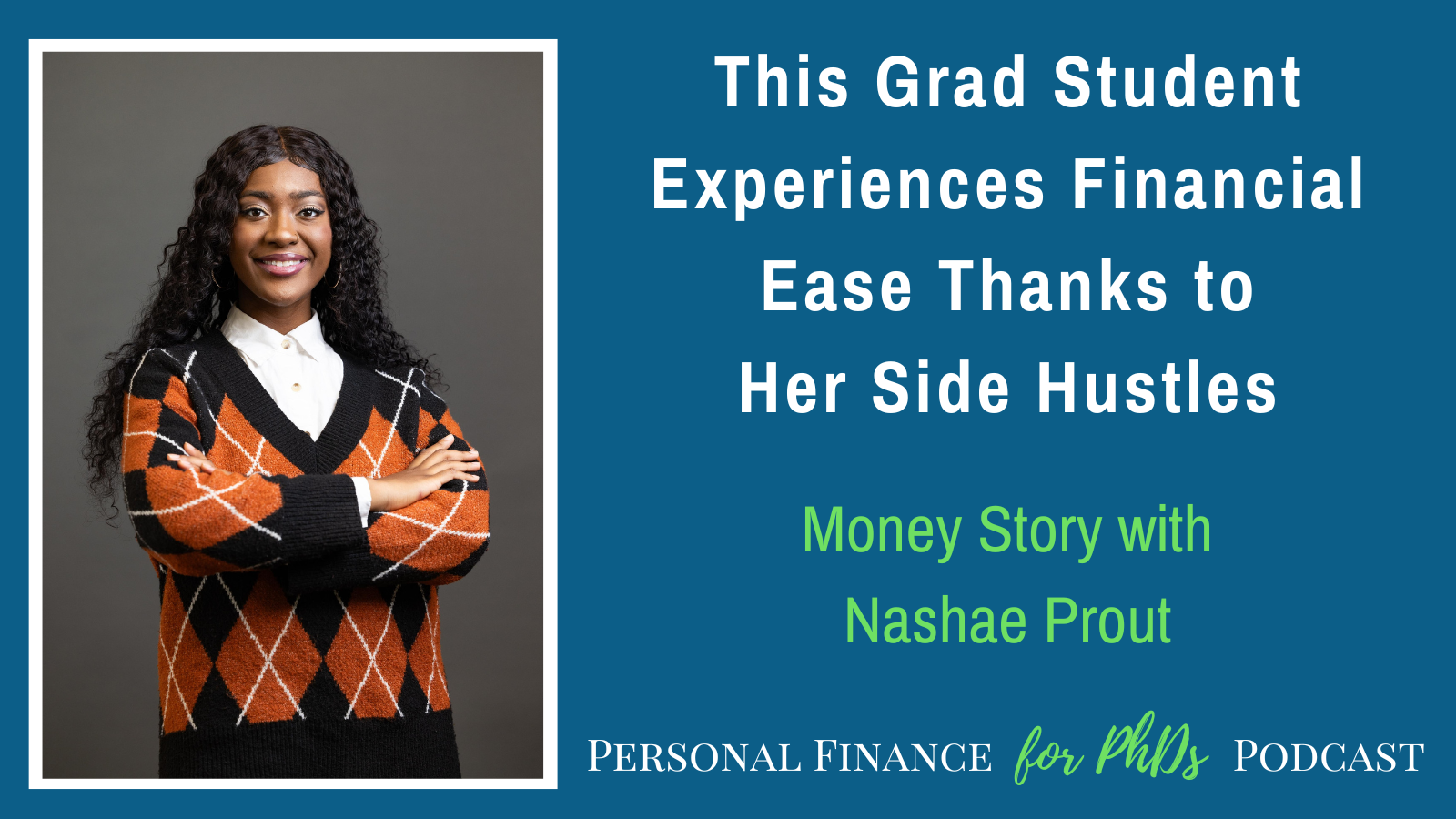
This Grad Student Experiences Financial Ease Thanks to Her Side Hustles

January 26, 2026 by Jill Hoffman Leave a Comment

In this episode, Emily interviews Nashae Prout, a 5th-year PhD candidate in toxicology at the University of Rochester. Nashae’s first year of graduate school on a $28,000 stipend was financially challenging, so she now maintains two side hustles. She serves as a graduate community assistant for graduate housing, an up to 10 hour per week position that gives her a 55% reduction in rent. She also adjuncts for a nearby university with the support of her PI. Between these two side hustles and her disposition toward frugality, Nashae can comfortably max out her Roth IRA and spend in areas that matter to her, experiencing financial ease. She concludes the interview with excellent advice on time management and prioritization.

Links mentioned in the Episode

  • Nashae Prout’s Instagram
  • Host a PF for PhDs Tax Seminar at Your Institution
  • PF for PhDs Tax Center for PhDs-in-Training
  • PF for PhDs Subscribe to Mailing List
  • PF for PhDs Podcast Hub
This Grad Student Experiences Financial Ease Thanks to Her Side Hustles

Teaser

Nashae (00:00): I know how hard it is. My first year, I definitely had to have a very strict budget in what I spent my money on and how much of it I did spend. And so it like just takes some of that stress off your shoulders and I have to think about, okay, I can’t do this ’cause I have to pay rent and I can’t do that ’cause I have to pay off this card bill.

Introduction

Emily (00:32): Welcome to the Personal Finance for PhDs Podcast: A Higher Education in Personal Finance. This podcast is for PhDs and PhDs-to-be who want to explore the hidden curriculum of finances to learn the best practices for money management, career advancement, and advocacy for yourself and others. I’m your host, Dr. Emily Roberts, a financial educator specializing in early-career PhDs and founder of Personal Finance for PhDs.

Emily (01:02): This is Season 23, Episode 2, and today my guest is Nashae Prout, a 5th-year PhD candidate in toxicology at the University of Rochester. Nashae’s first year of graduate school on a $28,000 stipend was financially challenging, so she now maintains two side hustles. She serves as a graduate community assistant for graduate housing, an up to 10 hour per week position that gives her a 55% reduction in rent. She also adjuncts for a nearby university with the support of her PI. Between these two side hustles and her disposition toward frugality, Nashae can comfortably max out her Roth IRA and spend in areas that matter to her, experiencing financial ease. She concludes the interview with excellent advice on time management and prioritization.

Emily (01:56): The tax year 2025 version of my tax return preparation workshop, How to Complete Your PhD Trainee Tax Return (and Understand It, Too!), is now available! This pre-recorded educational workshop explains how to identify, calculate, and report your higher education-related income and expenses on your federal tax return. Whether you are a graduate student, postdoc, or postbac, domestic or international, there is a version of this workshop designed just for you. While I do sell these workshops to individuals, I prefer to license them to universities so that the graduate students, postdocs, and postbacs can access them for free. Would you please reach out to your graduate school, graduate student government, postdoc office, international house, fellowship coordinator, etc. to request that they sponsor this workshop for you and your peers? You can find more information about licensing these workshops at P F f o r P h D s dot com slash tax dash workshops. Please pass that page on to the potential sponsor. Thank you so, so much for doing so! You can find the show notes for this episode at PFforPhDs.com/s23e2/. Without further ado, here’s my interview with Nashae Prout.

Will You Please Introduce Yourself Further?

Emily (03:32): I am delighted to have joining me on the podcast today, Nashae Prout, who is a fifth year PhD candidate at the University of Rochester. And we’re gonna be talking about increasing income and making your budget work on a grad student stipend. So Nashae, thank you so much for volunteering to come on the podcast and will you please introduce yourself a little bit further?

Nashae (03:51): Yeah, um, happy to be here. My name’s Nashae Prout. I am from Washington DC and I am a fifth year PhD candidate at University of Rochester’s Toxicology Training program.

Emily (04:01): Excellent. Now, uh, let’s take it back a little bit ’cause I wanna set up what your fin- your finances and your financial life were like coming into graduate school. So I understand you graduated from college debt free. Can you tell us like how that happened?

Nashae (04:16): Yes. So I have a three-pronged approach in how I, uh, got through undergrad debt free. So one, um, I started off at community college. Uh, a lot of people don’t always do that, but it’s a really viable option, especially if you don’t have that much money to, you know, go right into a four year institution. So that was number one. Number two, I did have a lot of financial aid. Um, I qualified for the Pell Grant. Um, we also have a tuition assistance grant in DC because there’s no public colleges in DC um, where, sort of this in between we’re out of state everywhere else, but where we’re in state, it’s only private institutions that cost a lot more money. And so because of that, the DC government provides students with a $10,000 grant for each year of college. I think up until five years they cover you for the, for five years, um, for any four year institution that you join.

Nashae (05:11): And so I got that every year. I made sure to put in my application each year to renew it because I needed that money once I started at Morgan State University, which is where I did my undergrad. And then on top of that I also was an NIH BUILD scholar. Um, NIH BUILD is, it’s an acronym Building Infrastructure Leading to Diversity. We were one of 10 sites in the United States. Um, and so it was a two year, um, traineeship where I got partial tuition coverage as well as money each month, um, after working a certain amount of hours. Um, and I will say, um, at that point I was breaking even if not give or take about a hundred dollars. So by the end of it I did pay for my college myself, so maybe a couple hundred. But in those first two years when I was at community college, my parents did, um, help me out tremendously and thankful to them every single day for paying for my uh, community college.

Emily (06:05): Yeah, well even with parental support to, you know, for a certain period of time, that’s still a huge accomplishment to get through college without debt. Did you go directly to graduate school or did you take any time in between?

Nashae (06:18): No, I went directly into graduate school. I, that summer I didn’t do any work. I was working since I was 14 years old every summer and it was the first summer I did nothing and I quickly realized there’s a reason why I always had a summer job because I got really bored of watching daytime TV really fast. 

PhD Offer Letters and Funding Sources

Emily (06:35): Um, okay. So tell us more about like maybe your offer letter and like how, how you were funded throughout, you know, up to this, you know, fifth year of your PhD program.

Nashae (06:47): Yeah, so, um, I actually had two offers for a PhD program, one at Rochester and the other one at a school in Texas. And I, and while Texas does not have um, income taxes, that that was a good selling point, however, I decided to go for the Rochester offer just ’cause it was a bit closer to home and I loved the culture of the program as well. And so that offer letter, I think, um, I wanna say it was maybe like 28 K, but they also gave me a relocation assistance, um, fund, I think it was like a thousand to $2,000, which I, um, was really grateful for in terms of, you know, having to move, uh, six, seven hours away from my family. Um, so that did sweeten the pot. Um, the first year we’re all funded underneath the, uh, dean scholarship. So all first years, um, at my school are funded by that scholarship. Um, after that I was on a T32 grant with my program. And then currently, um, yes, so that was second and third year I was on the T32 and then fourth year and onwards I am covered by a grant with my PI.

Emily (07:52): Okay, so you’ve switched kind of from fellowship to training grant to assistantship, um, but has that 28K pretty much stayed stable or like gone up a little bit?

Nashae (08:01): Yeah, it goes up, um, what is it, I think 3% every year. So it’s gone up a little bit every year to like match inflation.

Side Income: Graduate Community Assistant

Emily (08:08): Okay. And I know where we’re going with this is that we’re gonna talk about your side income. So that 28k plus, you know, 3% growth each year. Has that not really been sufficient to pay for at least what you want your living expenses to be?

Nashae (08:21): I am never, I’d just say this, I’m never just satisfied with what I’m getting. I’m always gonna wanna challenge myself and get more, um, my parents are immigrants to the United States. They’re both from Jamaica and so they’ve always instilled in me to work hard. Um, my dad, he’s a construction worker, but he’d also always do side jobs. So I always saw him, he’d be, you know, done doing this, but he’d go into this person’s house to do the side project to get extra money. And so when I saw the opportunity, um, to start a side job, I took it. And that first one was with, um, graduate housing. Um, they had a GCA position, which is a graduate community assistant position open. I actually applied for it twice the first time I didn’t get it and the second time I ended up getting the position. Um, and it’s, it didn’t seem like it was out of the realm of what I’d be comfortable doing. It’s a lot of, you know, putting on events, um, greeting residents. I’m a yapper so I like talking with people anyways, so it’s not, um, it wasn’t too much of a deviation from like what I’d be comfortable doing on the side for a couple hours every week.

Emily (09:25): Okay. So let me ask, do you, did you have to live in the housing to have this job or were you able to live elsewhere?

Nashae (09:33): No, so you have to live within graduate housing for at least four months before being eligible to become a graduate community assistant. You also have to live in that graduate area that you’re going to be working in. So I live in my complex and because of that I am over, um, I’m responsible for um, I think the 700s and 800s like apartment blocks in this complex. If I was a GCA at one of the other complexes, I’d have to be a resident there for four months. I think I could transfer, but there’s a transfer fee and I didn’t wanna pay that ’cause there was another position open, but I would’ve had to move there to be eligible for it and I did not wanna move. I like my apartment.

Emily (10:14): I see. So you had already chosen your housing anyways, just like what you personally wanted for your time in graduate school and then, then you saw these open positions and were like, oh, I can add that into my life right now. That seems manageable, is that right?

Nashae (10:27): Yeah, because you’re only eligible to live here if you’re a trainee or a medical student or anything like that. And so everyone else that’s also GCA is also either an MBA student, a PhD student, or they’re a med student.

Emily (10:40): Okay. And you told us a little bit about the nature of the job and about the time commitment. Um, but what are you getting? Are you getting paid? Are you getting like a, a reduction in your housing costs or like how does the compensation work?

Nashae (10:51): Yeah, so because a lot of the programs don’t allow for us to be, um, paid or at least to a certain extent, we can’t get paid depending on what grant you’re on. What, um, graduate housing does is that they don’t pay us. What they do is they give us a rent reduction every month on our rent. So I get 55% off of my rent costs.

Emily (11:09): Nice. Yeah, that, I mean you said it was maybe like two hours per week. That seems like a great trade off. What, what dollar amount does that equate to?

Nashae (11:17): I’d say it depends on the week. So some weeks are a lot more intensive, especially in the summertime. We do have a lot more residents coming in, so we have to make sure that we greet them all. We have to make three attempts to greet them. Um, so that’s just knocking on their door, seeing if they’re home, if they’re not, okay, if, if they are then we have to chat with them for a little bit. Um, so it, I think it’s technically 10 hours per week, but it ebbs and flows throughout the semester. So middle of fall semester, I am doing less hours technically, but in the summertime I am doing more, but this is mostly stuff on the weekends and I, I, um, am responsible for hosting one event per month. Um, which I think the hardest part is just advertising the event. So you know, sending out those flyers, printing it off and posting it in like the laundry room and stuff like that. So it depends on for like the hours, like some are just, some seasons are more busy than other seasons are, like winter time. We don’t technically have much to do from the end of the semester to the start of, um, the spring semester in Ja- in like the end of January. So that’s like a pretty lax time where we’re not doing anything. So it ebbs and flows I’d say. So more than two hours, but some weeks it is more so like two hours. Like especially in the wintertime there’s zero hours technically.

Emily (12:33): Awesome. And you said it’s a 55% rent reduction, so I’m imagining this is a benefit worth at least several hundred dollars, is that right?

Nashae (12:40): By this year it’s at least a reduction by like five to 600.

Emily (12:44): Very nice. Very nice. Helps a lot.

Nashae (12:46): Yes, it makes like very affordable

Emily (12:49): Yeah. And so it sounds like you, you’ve, you still continue to hold this position, is that right? You started in maybe like your second year-ish and then you still have it?

Nashae (12:57): Yeah, I started in my second year. I was eligible in my first year, but again, I interviewed for it and I didn’t get it that first round. Um, still in my second year and it’s been smooth sailing ever since. I’m, uh, one of the OG GCAS in the position, so everyone else in my complex is currently newer than I am, so I sort of help them sometimes with like, oh, who do I contact for this or who do I chat with for that?

Emily (13:20): Nice. Um, well it sounds, I, I don’t know the, it sounds like a great position. I I am always a little bit like regretful when I look back at grad school and like I never even thought about like, or you know, considered doing this type of position yet. It seems like yeah, pretty good amount of financial benefit for like the work you need to put in, especially if you find the work like pretty pleasant, you know, overall. 

Nashae (13:42): I have a shopping problem so I love shopping with the school’s money to host the events anyways. Like it’s, it’s a win-win situation in my opinion.

Emily (13:50): Yeah, I would say for, certainly for current graduate students, if you would like <laugh> a rent reduction, you know, look, look into this.

Nashae (13:58): Free rent is, yeah, yeah. Free rent is worth it if you wanna do that side, but 50% off is also very reasonable.

Emily (14:04): Yeah, it’s, it’s more compensation but it’s more work, right, for, for that type of position. But I would also say for like maybe even prospective graduate students who are concerned about the cost of housing in like the city that they’re considering moving to look for this kind of opportunity sooner rather than later. It could even be part of your like decision of where you go, like whether, if it is a position that you’re willing to take on whether those positions are available because it can be a massive help, 50%, a hundred percent kind of rent reduction in a high cost of living area would matter a lot for a graduate student. Um, so I really appreciate you telling us about the position. Seems like a good fit for you.

Nashae (14:40): Yeah, I personally love it. I am hoping that other people that you know need it can also get a position similar to this, especially if you’re in a high cost of living. I wouldn’t consider Rochester very high cost of living. Like the original rent is about maybe a bit over a thousand dollars for a rent one bedroom. So it’s not, it’s very reasonable. So it’s just helps me even more in terms of like this like moderate cost of living area.

Side Income: Adjunct Faculty Member

Emily (15:04): Yeah. And I understand you have another side job, um, maybe not surprising given your description of like who you are and like just you wanna be busy and wanna be working a lot. So like what’s your other side position?

Nashae (15:16): Yeah, so my other side position is being an adjunct faculty member at Nazareth University. Um, it’s a local liberal arts college here in Rochester.

Emily (15:24): So how did you first come, well I guess tell us what you teach and like is it all the time year round or in certain semesters?

Nashae (15:33): Yeah, so I teach um, biology lab, so it’s um, a one credit course and then I also last spring semester taught science communications or sorry, intro to science communications and that was a three credit course. Um, it’s, they’re both, um, in person on campus, um, classes that I teach, I do the lab courses in the fall and then I do in the spring I did science communications. Um, it’s pretty reasonable in terms of time commitment. I do one evening class and one afternoon class for my lab sections and I only do, I only did one science communications class since that one did take a lot more time grading wise. Grading wise, since it is a, uh, writing class. So you know, you’re doing papers and continual uh, edits on people’s like work

Emily (16:23): And were you like the instructor of record for either one of those?

Nashae (16:28): Yeah, so I am the listed instructor for all the courses that I teach at Nazareth.

Emily (16:32): Nice. And did you have to prepare a curriculum as well?

Nashae (16:36): No, so, um, I do have leeway with the science communications class, however, for the science laboratory class, because it is standard across all lab sections, that one is predetermined. So I have leeway in terms of how I get the material across, but the experiments that are laid out are laid out in a scheduled fashion and it’s the same for all faculty teaching the course.

Emily (16:58): And did you pursue this position purely for more money or was it for teaching experience or like what were your motivations?

Nashae (17:06): Yeah, so, um, I got the position actually because a lab member of mine was already an adjunct there and through word of mouth I was able to apply for some of their extra adjunct positions. Um, I I would say it was 50% wanting more money and 50% wanting to pad my CV with an experience. Um, I’ve done volunteer work with teaching, um, but I want to have the experience of actually being the actual instructor for a class, you know, having to take high level science stuff and break it down into something digestible for a freshman under undergraduate.

Emily (17:41): How do you feel it’s been working for you in, in terms of, let’s take the, the career development, the CV padding as the first point, like you think it’s been worthwhile, has it been rewarding for you? Has it, you know, opened up any other opportunities?

Nashae (17:53): I definitely feel like it’s been rewarding. I really do like teaching. The worst part about teaching is just the grades. Honestly. I hate, um, having to grade <laugh> but other than that I like going in, I like interacting with the students. Um, honestly they’re all really great. I would also say that it’s good for my CV because I’m getting experience and it helped me determine whether or not I did wanna pursue education at the moment. You know, with funding crazy as it is. Um, I’m not putting all my eggs in the academia basket, but I do have the experience and it is something that if the right opportunity, you know, occurs, then I would pursue it further. Especially if it was for either liberal arts college or a health professions college, like a pharmacy school because um, I like when students are really engaged. My favorite ones are the, the, the super nerdy ones because they ask the most questions and they’re the most engaged with the course material.

Emily (18:48): Did you not have an opportunity through your regular graduate program? I mean I guess you described your funding path didn’t involve TAing at all and so it sounds like you, you sort of had to go outside your university to find these kinds of opportunities, is that right?

Nashae (19:02): Um, so yeah, my program does not require any type of TAship. We’re only, um, required to do research. So I did become a TA for one semester for one of our courses, but they don’t pay you for the, for being a ta, it’s purely a volunteer type of of um, thing. I did put it on my CV of course and there is good experience there but for me, if I was going to take my time three days out of the week to go sit down in a class and be there for the entire duration, I wanna be paid for my time. And so to me it’s worth it to, you know, go off campus twice a week or once a week to teach and get paid for it versus staying on campus which eats your commute just to walk down the hallway to the um, classroom. But I’d much rather be paid for my time than not be paid for my time. And it looks better on the CV to have like you are actually the instructor your name is on the syllabus versus just being the TA for a course at your own institution.

Emily (19:58): Yeah, for sure. Um, and do you mind sharing your pay rate for those two classes?

Nashae (20:04): Yeah, so it’s around $3,000 per class per semester. So the more classes you teach the more you can get. However, as an adjunct I am limited to a maximum of three classes per semester.

Emily (20:17): Oh three per semester. Well that, yeah, that’s quite a bit more than you’re doing at the moment.

Commercial

Emily (20:23): Emily here for a brief interlude! Tax season is in full swing, and the best place to go for information tailored to you as a grad student, postdoc, or postbac, is PFforPhDs.com/tax/. From that page I have linked to all of my free tax resources, many of which I have updated for this tax year. On that page you will find podcast episodes, videos, and articles on all kinds of tax topics relevant to PhDs and PhDs-to-be. There are also opportunities to join the Personal Finance for PhDs mailing list to receive PDF summaries and spreadsheets that you can work with. Again, you can find all of these free resources linked from PFforPhDs.com/tax/. Now back to the interview.

Impact of Side Income on Finances During Grad School

Emily (21:15): From these two different side jobs, which you’re holding them both now, right? So this is probably like the most money slash the least rent, you know you’ve had to pay uh, during your course of time in graduate school. What would you say has been the overall effect on your finances? Like more high level?

Nashae (21:29): I would say for me it’s one being able to comfortably max out my Roth IRA every year. Um, I didn’t open it until I was like a second or third year in my PhD, but I was able to max it out for the past couple years, which I think is great because I don’t think I would’ve been able to afford to do that otherwise without maybe surviving on ramen noodles and air for <laugh>, the, all my meals and my PhD. So that is I think the biggest one. Secondarily, I’m able to comfortably like travel to see my family every year. Um, I don’t ask them for any money. I’ve been financially independent from them since I’ve moved out. I don’t wanna put that burden on them. My dad just retired, um, so I’m able to go fly to them or drive whenever I feel the need to.

Nashae (22:15): I also, um, treat myself, I do one musical festival each year. Um, I did uh, I’m doing Camp Flog Gnaw this year, so, uh, very excited for that. Um, I am splitting the hotel costs with my um, friends because I am, I like treating myself but I’m not crazy. I will not stay in LA for my own self for a hotel room. Um, we are splitting it. All four of us are spliting the hotel room. So I also do that and I also uh, like taking care of myself uh, and not having to think too much about what I’m buying. Like I definitely do, I’m very much a budget oriented person, however I’m able to like go thrifting and it was within like my allotted 30 to $50 budget for a outing. I’m able to comfortably do it. Sometimes I have gone overboard, but for the most part I’m able to save quite a bit of money every year. Just just less strain.

Emily (23:08): Yes, exactly. So like not only are you like building for your financial future through the Roth IRA, but just in your day-to-day decisions around money, you just have more ease and less stress and like you said, you’re not going like overboard as a graduate student. It’s kind of hard to go overboard in in any area, but just the additional income that you’re bringing in and the rent reduction allows you that. Um, yeah, just not to be stressed about these like more like low level purchases which absolutely characterizes, you know, the the grad student experience.

Nashae (23:37): And I don’t do like a lot of those like small purchases but like for example, I make my coffee at home. I don’t go out to get my coffee. I, I pack my lunches most days. I rarely go out to eat. Um, I will go out to drink on the weekends or something with friends or like go have a dinner here and there. But like for the most part I live like pretty frugally like my entire outfit right now it is all thrifted clothing. The outfit is under $10. Um, I love saving money where I can but because I get extra income I’m allowed to like splurge where I want to.

Emily (24:07): Yeah, and it sounds like you have a very high level of awareness of your budget too. Like you know that your spending is under control in these certain areas so that you have the more ease in the other areas that seems like they provide more like value to you.

Nashae (24:21): Absolutely. I love being able to like I think about all my purchases of course, but I’m able to comfortably pay off my credit card bill every month. I always use my credit card ’cause it’s a cashback credit card and so I never spend more than what I have anyways. Um, but even if I spend over a thousand dollars on a month on my credit card, I’m always able to comfortably cover that without going into the red.

Emily (24:44): Do you see any differences between you and your peers at Rochester in this regard or are most of your peers also working side jobs so that they can have you know, similar financial freedom?

Nashae (24:54): I would say most of my peers aren’t working side jobs. I’d say maybe 30 to 40% perhaps. Um, I have some friends that were also GCAs. I’ve had some friends that work in the graduate um, affairs office. I’ve had some friends, um, teach on the side. I know at least one other person from my school that teaches at Nazareth. Um, I definitely would say I wish more people would take more opportunities because I know how hard it is. For my first year, I definitely had to have a very strict budget in what I spent my money on and how much of it I did spend. And so it like just takes some of that stress off your shoulders to not have to think about, okay, I can’t do this ’cause I have to pay rent and I can’t do that because I have to pay off this card bill or that um, car insurance note. Or whatever it is. Um, I definitely feel like I wish more people like took more opportunities like this ’cause there are opportunities to get teaching and not have it, um, be for free. I will say the other side of our campus, like the, like the arts engineering school, they do get paid for, um, being a TA. However, for my campus we don’t. And so that is something that I know a lot of graduate students do. It’s part of their, um, funding package. But at least for my school and my program, we do not get paid for a TA ships, which is why I stopped doing it after that first semester.

Academia Approved Side Hustles

Emily (26:16): Yeah, and I, I neglected to ask this earlier, but um, does your advisor know about your adjuncting position or like is it all like sort of out in the open or is it something that you do kind of quietly?

Nashae (26:27): No, he definitely knows. Um, I actually talked with him about like how many courses I should or should not teach. I’ve never gone above two courses because we both agree that that was the maximum ’cause it’s like one evening I, it’s a 6:00 PM course so it doesn’t interfere with my studies and my work. Um, ’cause I’m able to do nine to five and then the earliest course I’ve ever taught was, uh, 1:00 PM which I, we always have our meeting directly after the course anyways, so it doesn’t impact my work negatively, I’m still meeting my milestones as I should.

Emily (26:56): I I’ve started using the term academia approved, like academia approved side hustles and like adjuncting is usually an academia approved side hustle because obviously it’s in the wheelhouse. Everybody knows even if it’s at a different institution, like everybody gets, you know, uh, why you would wanna do it and what the requirements are and the time commitment and all that sort of thing. So like as long as it’s sort of like legally permitted by everybody’s visa and like the terms of your funding and all that, um, it’s pretty likely like with your advisor that they would be encouraging of this kind of thing as long as of course you have scheduled it so that it’s not gonna interfere with your primary work.

Nashae (27:31): Absolutely, yeah, I know when I was on the T 32 I wasn’t allowed to, I think it was either 10 or 15 hours of external work per week. But even with both of my jobs, um, I teach like a one, I teach one to three credits every semester at Nazareth, so that’s not impacting it there. And then for my GCA position I, it oscillates between maybe like five to 10 hours per week. So I’m still well within or below that 15, um, that 15 hour minimum maximum, um, that’s allotted with um, T 32 grants.

Emily (28:06): Yeah, and it’s really just good to know as a student, like that sort of rule on the backend. Like especially if you got pushback from your advisor, like, oh no, I’d actually don’t think you should take that other position. You say, well, you know, my funding technically allows for this amount and this is how I’m going to balance it. You have to still convince them, but like you have a little bit of support by just it being the policy. Okay. Don’t go above 15 hours per week.

Nashae (28:28): Yeah. And I’m very happy that, love my PI, he is great and he supports me doing this because he wants me to have that breadth of experience because my, again, my uh, program does not require any type of, um, TAship or adjuncting or what have you. So this is extra opportunity for me to gain experience in something that isn’t traditionally offered in my program of study.

Emily (28:50): Excellent. I can definitely see why your advisor would be encouraging of that. Is there anything else you wanna add on that point before we move to our final question?

Nashae (28:58): I would say, uh, just my one thing about, uh, teaching philosophy. I think a lot of people, this is like the soap, this is the soapbox me. I think we should strive to be, um, servant leaders, hearing what the people that we’re serving need from us and then working to provide them with what they need instead, instead of, you know, internally thinking, oh, okay, this is what I’m going to give instead of asking what do you need? That’s my one, um, thing that I I would just like want people to, to um, have and just spread as information. Like if you’re in a leadership position, make sure that you’re serving the people that you’re leading.

Emily (29:34): I can see how that applies both to your teaching position and your position with graduate housing. Definitely.

Nashae (29:39): Exactly. Yeah, I always wanna listen to feedback and listen to requests, um, and then work to achieve that.

Best Financial Advice for Another Early-Career PhD

Emily (29:45): Awesome. Well let’s wrap up with the final question that I ask of all my guests, which is, what is your best financial advice for another early career PhD? And it can be something that we’ve touched on in the interview already or it could be something completely new.

Nashae (29:57): Yeah, I would say my advice for any early career PhD is to time manage very well. And if you can time manage very well, then you can do a side hustle. I would never want someone to prioritize their side hustle over their PhD. Um, I’m here to get my PhD, that’s what I moved here for, so I’m always gonna put that on top. But if you have the time management skills to do a side hustle or do two like I’m doing, um, then do it. I think it’s one of the best financial decisions I’ve made as an adult, um, is having these side jobs that, um, one are not very hard. Really the only thing I dislike is the act of grading because it’s very tedious to grade each student, but my class is never more than 16 students, so it’s not that much in the grand scheme of things. I’m not doing a 100 plus person lecture where I’m grading it’s maximum 30 students that I’m grading for an assignment at a time. So if you can time management, if you have the time management skills, then do it. If you can’t, then focus more so on your, on your studies and look for opportunities within your university so that it’s a bit easier for you to potentially add something else onto your plate.

Emily (31:06): I totally agree. You have to like get your, you have to have your time management house in order, as you were saying before you can pursue these other financial opportunities because like you said, you have to keep the main goal in mind. The main goal is to finish that PhD and get a great job afterwards. And if you get distracted by side hustles, especially side hustles that like, you know, your job as an adjunct, like that’s still career building, um, most likely. And so especially if you get distracted by a side job that has nothing to do with your career, it can really add a lot of time, which is ultimately detrimental financially to you. So these two are like very, very intertwined. So I’m really glad you brought that up. Thank you.

Nashae (31:44): Absolutely. Yeah.

Emily (31:45): And thank you so much for volunteering to come on the podcast. It was great talking with you.

Nashae (31:49): Absolutely. I am happy to be here and I’m happy if at least one person takes my advice or falls in my footsteps and is able to save more money than they would have and be a little bit set up, you know, better for the future considering like the crazy economy we have going on right now.

Emily (32:05): Absolutely.

Outro

Emily (32:15): Listeners, thank you for joining me for this episode! I have a gift for you! You know that final question I ask of all my guests regarding their best financial advice? My team has collected short summaries of all the answers ever given on the podcast into a document that is updated with each new episode release. You can gain access to it by registering for my mailing list at PFforPhDs.com/advice/. Would you like to access transcripts or videos of each episode? I link the show notes for each episode from PFforPhDs.com/podcast/. See you in the next episode, and remember: You don’t have to have a PhD to succeed with personal finance… but it helps! Nothing you hear on this podcast should be taken as financial, tax, or legal advice for any individual. The music is “Stages of Awakening” by Podington Bear from the Free Music Archive and is shared under CC by NC. Podcast editing by me and show notes creation by Dr. Jill Hoffman.
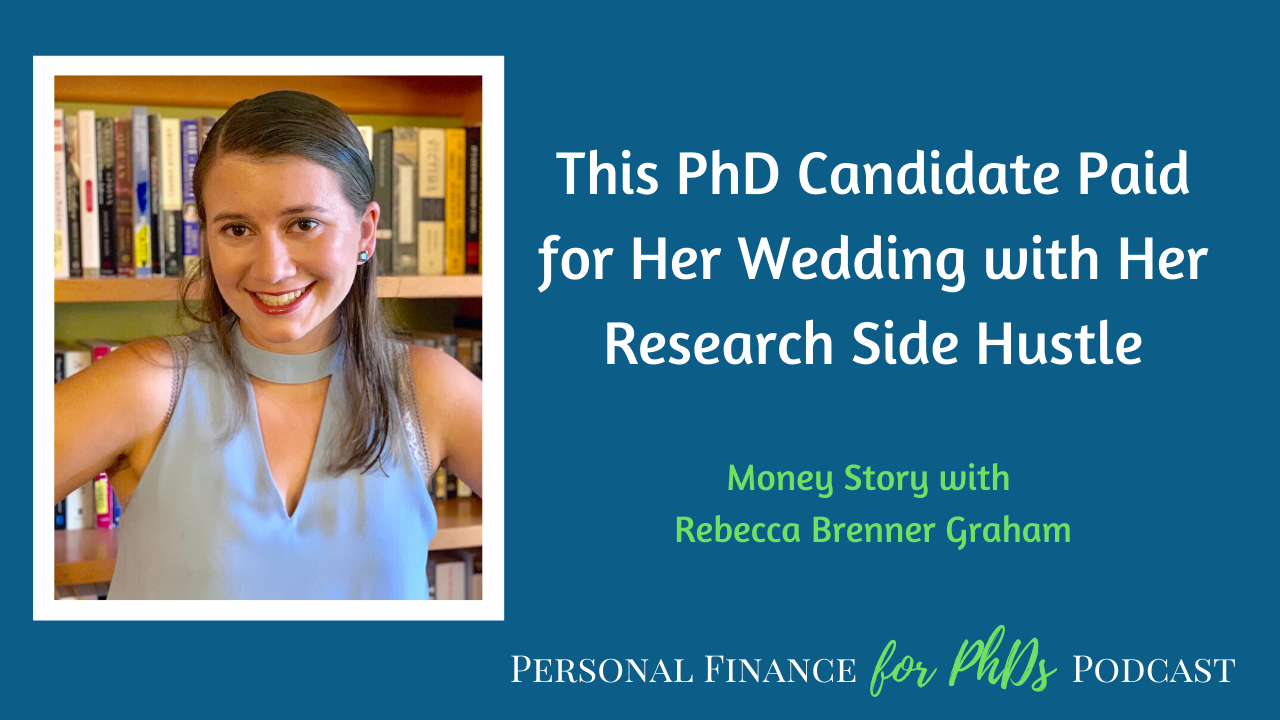
This PhD Candidate Paid for Her Wedding with Her Research Side Hustle

August 3, 2020 by Lourdes Bobbio

In this episode, Emily interviews Rebecca Brenner Graham about side hustling to pay for her wedding while a PhD candidate in history at American University. In addition to working on her own dissertation and serving as a teaching assistant, Rebecca used her skills as a history researcher in a self-employment position assisting an economics professor at another university. Rebecca had to quickly learn how to manage her time and energy well across all her different professional roles and her personal life. If you are planning a wedding as a graduate student, you’ll also enjoy hearing wedding planning and budgeting tips from both Rebecca and Emily.

Links Mentioned

  • Find Rebecca on her website and on Twitter
  • Personal Finance for PhDs: Community
  • Personal Finance for PhDs: Podcast Hub
  • Personal Finance for PhDs: Subscribe to the mailing list
side hustle wedding

Teaser

00:00 Rebecca: The piece of advice that I’m just learning and wish I had known sooner was that unpaid opportunities are almost always not worth it. Full stop.

Introduction

00:20 Emily: Welcome to the Personal Finance for PhDs podcast, a higher education in personal finance. I’m your host, Dr. Emily Roberts. This is season six, episode 14, and today my guest is Rebecca Brenner Graham, a PhD candidate in history at American University. Rebecca has always side hustled to supplement her stipend, but she kicked it up a notch in her fourth year to pay for her wedding. We discuss how Rebecca balanced her time and energy among her own dissertation work, her teaching assistantship, her self employment gig as a researcher for an economics professor, wedding planning, and the rest of her life. Listen through to the end here, how Rebecca’s wedding went and some wedding planning tips from both of us. Without further ado, here’s my interview with Rebecca Brenner Graham.

Will You Please Introduce Yourself Further?

01:07 Emily: I am so delighted to have joining me on the podcast today Rebecca Brenner Graham, who is going to be discussing with me, her wedding, her recent wedding, and how she ended up paying for that on her Grad student stipend, and actually on more than just her grad student’s stipend. So Rebecca, thanks so much for joining me on the podcast today and will you please tell us a little bit more about yourself?

01:27 Rebecca: Thank you so much for having me, as I was telling you. I’m a long time listener and it just occurred to me that I might have something useful to add. I went to college at Mount Holyoke in Western, Massachusetts as a women’s college. There, I double majored in history and philosophy, and then I went straight into my history graduate school. I’m now starting my fifth year of the PhD. I was able to do the public history master’s combined with my doctoral coursework, which is one of the reasons that I love my department at American University. My dissertation, if anyone’s interested in that, is on Sunday mail delivery from 1810 through 1912 as a lens into religion, state relations. Because I got my masters in public history, I’ve also had some museum gigs on the side, on top of working as a TA in the American University Department of History. That’s about it.

Side-Hustling as a History PhD

02:27 Emily: Yeah. Is that typical for people in your department to be taking on museum jobs or outside gigs like that.

02:33 Rebecca: It’s typical in the sense that being atypical is typical. So there’s not one way to do it. There’s not one way to make it work. Like one of my classmates does a bunch of oral histories of basketball players for money. Some of them are like older and married or have houses. For me, especially brcause I came straight from undergrad, in order to have enough money to not be worrying about it constantly, I have had part time work every year on top of the TA-ing.

03:06 Emily: Okay. That’s good to know. So basically what you’re saying is the stipend that you’re receiving is not sufficient across the board. No one is doing this on just the stipend. They either have outside sources of income from a spouse or something, or maybe past savings, or they’re currently taking on side hustles. Right?

03:22 Rebecca: So I can think of two classmates who, and this is not a coincidence, they’re the two in the department that are younger than me, that haven’t had that much part time work. One of them is extremely frugal and the other one decided to take out loans on top of the stipend. I adore my department, like I am so happy to be there, at the same time we do have the second lowest stipends of all history departments in the greater DC area.

03:49 Emily: Okay. Yeah. Glad to hear that balance of like, Hey, it’s worth it, we’re doing it, but this is what it takes to get it done. Side hustling for you, other solutions for other people, but glad to hear that.

Getting Engaged During Grad School

04:01 Emily: Okay, you’ve given us a little bit of a brief career history, coming straight from college into graduate school, doing your master’s and PhD right in a row. Where does your relationship factor into this?

04:12 Rebecca: Going way back for a second, we actually met in a summer program in Washington, DC when we were 16, like for high school students. We ended up at college near each other. His name is Brandon, and Brandon went to UMass Amherst. We were together for the first half of college, and then we broke up, just seeing other people, didn’t think or know that we’d get back together. We ran into each other a couple of years later and the summer after graduation, we ended up getting back together. Then six months after that, he moved from New York to DC in order to be with me. And even before Brandon and I got back together, I had to facetiously told friends that I need to pass my dissertation proposal, even before I get an engagement proposal. And this was even before I was in a PhD program, this is when I knew I wanted to do a PhD.

05:04 Rebecca: So third year of graduate school, toward the end of the year, I was about to become all but dissertation, ABD, and we had already gone ring shopping. I thought we might be getting engaged soon. And then I ended up getting engaged a few weeks before my prospectus defense. So at the end of my third year of grad school, I was ABD and also engaged.

05:30 Emily: Yeah. I really love that you were, I know you said facetiously, but you were thoughtful about this, right? You had an idea of how you wanted your career to play out and also how your relationship, whoever that was with, how you wanted that to play out. And it’s good to hear really that, um, your husband made that sacrifice when he was your boyfriend of moving to where you were so that you could prioritize your career and he was going to figure it out and it’s not necessarily common story. I’m really glad to hear that.

06:00 Emily: I’m reminded of when I got engaged which was also during graduate school. My husband, we had sort of decided together that we were going to get married, moving towards that direction, but he wanted to wait to propose until he also achieved candidacy. So I was further away from that. That actually didn’t happen for me until my fourth year of graduate school, I think, just the way my department works. But he was like, no, I got to get, I have to get my prelims out of the way, and then I can think about the engagement. So he had the same thought process as you, but from the opposite perspective, in our case.

06:34 Rebecca: I think it’s an autonomy of time thing because even if it’s the same work across the board, you have, I think in most programs, you have more autonomy of time after that ABD mark.

06:45 Emily: Yeah. I think for my husband, it was that, but also just the stress of preparing for the prelim and writing whatever he had to write and doing whatever we had to do, like oral defense or something, I don’t remember the details for him, but just to get past that stressful thing, he wanted it off his plate, so he could enjoy the process of being engaged and planning the wedding and not having to juggle those two things simultaneously and know that, yeah, there’s going to be a few more years here until we have to repeat that process for the dissertation and ultimate defense. With respect to your actual timing of your wedding, like how long were you guys engaged for?

07:25 Rebecca: We got engaged in March, 2018. For about a month, we were actually planning with my parents, and my mom in particular is quite traditional and they were generously willing to pay for it, but it became clear, especially to me very quickly that coordinating with them and negotiating priorities was more labor, and especially more emotional labor, than actually making money myself and working towards paying for it. We also decided in between that March and April period that the things that we cared most about relating to our wedding were not that expensive. Like making the ceremony go how it was important to me was a higher priority than venue or the number of people who were coming. So eventually, I guess around April, when we started planning and paying for it ourselves, we got a date on the calendar. We got married a year and I guess two or three months, not great with numbers, I guess a year and three months later on June 30th, 2019.

08:43 Emily: Okay. So yeah, we are recording this in August, 2019, so this is really fresh for you and that’s exciting. This is definitely a tip for other people who are going into the wedding planning process of anyone who contributes gets a say. If you don’t want that party to have that say in that particular way or whatever, if there are strings attached to that gift, sometimes it is easier to simply take on all of the finances on your own. That’s the decision that you made.

Paying for the Wedding through Side-Hustling

09:12 Emily: We’ve already kind of gone over that your stipend was not really enough to live on, at least in the lifestyle that you want, and you were already side hustling. Did you have a plan for like how much more money did you need to bring in either in total or on a monthly basis to be able to pay for the wedding?

09:28 Rebecca: We looked at it a little backwards, in retrospect. It was more like however much money we have to delegate toward this, that is how much that we could pay. Brandon and I split it almost exactly evenly between us with a few exceptions. If there was something that was really important to him or really important to me. I paid for Ketubah the Jewish marriage contract. I paid for our pre rabbinical counseling. He paid for our entire rehearsal brunch because that was not something that I was tied to doing. On my end, my stipend from American when I started was $19,000 per year, and now currently thanks to our union it’s $22,000 per year, which is actually a huge difference just in the four years or whatever that I’ve been a TA. I really didn’t give it that much thought about, will I be able to afford this? It was more if I can’t afford it, then I won’t do it, and we love each other, and we want to get married, and that’s the most important thing. I have another classmate in my program who literally eloped at one, but I don’t really know the details on that. Also around this time, I was reading those books by Jen Sincero, have you ever read her books? The first one is called “You Are a Badas” and the second one is called “You Are a Badass at Making Money” and they’re —

11:00 Emily: Actually, I’ll interrupt you just for a second. I literally just finished “You’re a Badass At Making Money”, like last week. So I’m a little late to the Jen Sincero game, but I did read it and enjoyed it. I’m trying to figure out what I want to incorporate. So yeah, please go on.

11:15 Rebecca: Oh, that’s so exciting. I’m glad you liked it. In spring 2018, this was when her money book came out, the green one. She’s a little bit more, I don’t know if the word is capitalist than I am, but she’s also in line with my feminism. A central takeaway from Sincero’s work is that sometimes you have to jump and then create the net for yourself. That’s what happened when we decided to pay for our own wedding. So around the time that we had made that decision, I was reading a bunch of Jen Sincero. A major advantage of doing a history program in DC is that a lot of people email the department to offer work opportunities. So then in May, 2018, I heard about a summer job working for an economics professor at George Mason to do research on 19th and early 20th century labor history. My dissertation is on 19th century and early 20th century religion-state relations, and there was a lot of overlap with that labor history. I ended up working for her over the summer and then she offered for me to stay for the coming school year, like this past school year 2018-19. My advisor helped me negotiate a 50% salary increase for that, so that was my side gig that took a lot of time and essentially paid for my wedding. But it was also a completely pleasant experience working for this economist.

12:55 Emily: Yeah. I want to hear more about the logistics of how this side hustle worked. For you with American, because you’re a TA, does that mean that you’re not working/not being paid over the summer?

13:07 Rebecca: Oh yes.

13:09 Emily: Okay, so you’re already dealing with an academic year only stipend. So —

13:13 Rebecca: Last year I had a fellowship from my department for summer research. This year I did not, which was my why my reaction was “Oh yeah”, because that was the situation. But last summer I had a $3,500 fellowship from my department and then $5,000 from this professor George Mason.

13:35 Emily: Okay, so in your summers, at least last summer, you had a balance of working on your own dissertation and also doing this other work for this other professor, but I’m wondering, because you guys are at different universities, what was the actual relationship between you and this professor or the grant? Were you a W-2 employee or was this a self-employment situation?

13:58 Rebecca: It was a self employment situation, so I got taxed on it pretty heavily.

Researching as a Side-Hustle

14:04 Emily: Yeah. So that’s definitely a couple of things I want to talk further about with that, because I don’t really know that well, how this works. I think you’re the first person I interviewed for the podcast who has done research, like very similar skill set and everything to what you’re doing for your dissertation, and as a graduate student, but as a self employment project. Can you just talk to me a little bit more about what the differences are between that self-employment gig and maybe what you typically do as a graduate student?

14:36 Rebecca: In terms of the content itself, it was really just teaching versus researching. This past year I TA-ed class about the presidents and then I TA-ed History of Memory, and that whole time I was researching 19th century labor history. The biggest difference in terms of how much it affects me is that the side gig did not withhold any taxes. So as a graduate student, I’m cobbling together a bunch of opportunities to approach like 40[K per year, which is really great for grad school, I paid $4,000 in taxes last year, and that was most of my money.

15:23 Emily: I’ll make a couple elaborations on that for anyone who is looking into self-employment, which, if you’re going to do a side hustle, I kind of think self-employment is the way to go, because you have a lot more control over your schedule over how much you’re going to work. But the flip side of that is you have to take a lot more responsibility yourself when it comes to the financial side of things. One of the main things is that you need to pay a lot of tax and no one is withholding that tax for you, so two notes there. The first is that, with self-employment stuff, it’s not like income tax and you know that, so I’m speaking to the audience, but it’s not like income tax where you’re not taxed on the first chunk of income you take in, then you’ll have a low tax rate on the next chunk, then you’ll have a higher tax rate on the next chunk. That’s the graduated income tax system. You will still pay income tax as a self employed person, so just add that on top of whatever the rest of your income is. It’s going to be in the 12% or maybe even the 22% bracket, depending on how much money you make. But in addition, you have self employment tax, which is, I believe 15.3% on everything. The first dollar that you make as a self employed person, 15.3% of everything. So it’s not like that graduated system. It ends up feeling like you pay a lot and you do pay a lot in tax because of these two different types of tax that you end up paying income tax and self employment tax.

Emily: For anyone who is making a significant self employment income like you did, you have to set money aside for tax. You have to prepare for that. You have to do the calculations because you don’t want to be surprised at the end of the year with…I mean, you can be very pleased that you made all this money through selling employment, that’s amazing, but you have to be prepared for the tax side of things. One thing I’ll recommend actually for anyone who is either self employed or who has a fellowship who doesn’t have income tax withheld, I have resources on my website about paying quarterly estimated tax. You can go to the site and search for quarterly estimated tax. You’ll come up with like my main article on that. It’s designed for people who have fellowship income, but people with self employment income can take a lot out of that as well. And if you want a little bit further help I’ll link from the show notes, actually have a workshop on helping people pay quarterly estimated tax. Again, to not be surprised at the end of the year with a huge tax bill. It helps you estimate the amount of tax you’ll have to pay and also pay through it quarterly.

17:37 Emily: Okay, so Rebecca, that was a little bit of a diversion just because this is my wheelhouse about taxes.

17:41 Rebecca: That’s very helpful. Yeah.

17:44 Emily: I actually was a little bit for curious, because I think what I was asking, I didn’t phrase quite right earlier, was about, so the difference between your dissertation work, which you are either receiving a fellowship for, or maybe not being explicitly paid to do in your primary role as a graduate student versus the self employment relationship, this contractor relationship you have with this professor. I guess what I’m asking about is like intellectual or academic ownership over that work. Are you going to be on papers? Just because it’s an unusual way to be doing research, as a self employed person, but still in an academic setting, but it’s at a different university. So that’s why it was sort of interesting and complex.

18:24 Rebecca: I find it to be really common, particularly in Washington DC where we have a lot of federal archives. Since I started grad school in 2015, I’ve honestly lost track of the number of professors who’ve emailed the department literally from as far as Australia and asked our grad students to do work for them. Now I don’t do it unless it’s $30 per hour, but I used to do it for like $12, $15 per hour before I knew better. And as far as I know, we never get even an acknowledgement because we’re a human in the right location who has used archives before, and isn’t going to mess it up when researching.

19:12 Emily: Gotcha.

19:13 Rebecca: For my dissertation, I am the author.

19:16 Emily: Right. So it’s really just by virtue of where you’re attending graduate school and the skill set that you have,that you have access and people, as you were saying from all of the world want some access and they’ll use you, hire you to be a conduit for helping them with that work. But in terms of the academic ownership, because you’re being paid and again, as a contractor, it sounds like you sort of relinquish that. They’re going to be completely in control of the scholarship side of things. You’re not apparently even getting an acknowledgement, which I feel like it definitely deserves an acknowledgement at minimum, but okay.

19:50 Rebecca: That’s just the random people from California or whoever who can’t fly into DC.

19:54 Emily: Yeah, totally. Okay. So now I have a better idea about this.

19:57 Rebecca: It’s not even taxed sometimes, because it’s not enough money to be taxed, but I’ve done that a lot of times. And then my research gig at George Mason, I have a relationship with this person now. I don’t know when her book will be done, but I’ll be in communication with her. And I definitely felt like I was a part of the project, even though for the argument of the book, that’s entirely her argument, I’m just providing the facts that she then integrates into her analysis.

20:29 Emily: Yeah. I guess I’m also wondering like maybe you know for her situation, why wasn’t she working with a graduate student at our own institution? Like her advisee or something like that.

20:39 Rebecca: She wanted a historian. She’s in an economics department and she specifically reached out to history departments because she wanted reviews of historical literature by historians. And then also just that change over time analysis that my department trains me to do.

21:01 Emily: Gotcha. Okay. Yeah. This is really, really interesting to me.

Commercial

21:06 Emily: Emily here for a brief interlude. I am just bursting with this news. I have launched a community for personal finance for PhDs. The community is for PhDs and people pursuing PhDs who want to level up their practice of personal finance by opening and funding an IRA, starting to budget, aggressively paying off debt financially navigating a life or career transition, maximizing the income from a side hustle, preparing an accurate tax return, and much more. Inside the community, you’ll have access to a library of financial education products I’ve made in the past, and I’m going to add new trainings that library every month. There is also a discussion forum, a monthly live calls with me, a book club, and progress journaling for financial goals. Basically, the community is going to help you reach your financial goals, whatever they are. Go to PFForPhDs.com/community to find out even more. If you’re listening to this in real time, you have the opportunity to become a founding member of the community at a discount. The price is going up on August 15th, 2020, so don’t delay. Go to PFForPhDs.com/community for all the details. I can’t wait to help propel you to financial success. Now back to the interview.

Research Side-Hustles and Career Advancement

22:29 Emily: I guess the other sort of big picture question I wanted to ask you about side hustling is, so the side hustling is necessary financially — for the wedding, for living your life — do you think it’s giving you more than that? Like is this actually advancing your career in some way?

22:46 Rebecca: That’s a fantastic question and I really hadn’t thought about it. I mean, the economics people at George Mason, like their department is a completely different environment than mine, so it’s educational, just in that sense to meet more people in different places. Overall, the research work definitely was not expanding my skillset. It probably expanded my content knowledge a little bit, but it wasn’t that much more than whatever I had to be familiar with for comprehensive exams, because I did all of that time period. For the George Mason people I earned, what was it? For the whole year it was $15,000. And the previous year, before I was engaged, my side hustle, during my third year of graduate school paid $1,500, so literally take off a zero, and that was writing an exhibit for a museum. That was fantastic experience that definitely advanced my CV/resume and what I know how to do.

23:56 Emily: Gotcha. So there may be a little bit of a trade off there. This is not surprising that the things that benefit you more as an individual, there may be a trade off on the money there. You’re being paid more, but —

24:06 Rebecca: In my experience, that is correct.

24:08 Emily: Yeah, so I mean, hopefully that’s not the case. I wish for everyone to have a side hustle that pays really well and advances your career and all that, but sometimes you may have to trade off one or the other, but it sounds like at least at the very, very minimum you’ve expanded your network, right? You’ve met more people. You’ve worked closely with this one individual. So maybe that’ll come into play later on. Who knows about that.

Time Management and Side-Hustling

24:31 Emily: So I want to move now to talking about how you, how you manage your time. You’re obviously a long time side hustler, but it sounds like you really maybe stepped it up, maybe stepped up your hours to make this additional money in this past year to be able to fund the wedding that you wanted. Can you talk to me a little bit about how you balanced your dissertation work, your TA role, the side hustle, maybe multiple side hustles, if you’re still doing other ones, and then of course, just the rest of your personal life.

24:59 Rebecca: I have noticed for a while that it comes down to two things. One is time management, which I’m sure seems pretty straight forward. And the second is the kind of energy that the opportunity is giving you. I have felt for a long time, this is also just my personality, that if an opportunity is giving me a lot of positive energy and genuinely feel like I can do anything, but if it’s not, and sometimes things take away from my energy, then that becomes a real challenge. I remember at the beginning of last school year, last fall, actually around this exact time, last year, I majorly had not figured out how that balance was going to work. I was so stressed that I ended up giving up caffeine for several months, even though coffee is my favorite thing, because I was just so energized and stressed all the time that it was just miserable. And just not knowing how I was going to balance my time all year.

26:03 Rebecca: Also, the way that we ended up doing our wedding, and I’m sure we’ll talk about this later, it ended up working out great, but we accepted a lot of favors from people. Like a friend did the photography, a friend did the flowers, a family friend officiated our service. And when you rely on people, even if they’re really close friends and family, it’s just really stressful to maintain the relationships. I never wanted to feel like I was a burden on people. That created a lot of stress and the most challenges very early on, but over the course of the year, I think I just adjusted. Also second semester, I had this past TA assignment for a fantastic, really supportive enthusiastic professor. She’s Eileen Finley at American University and she was just a breath of fresh air twice a week, and that made a huge positive difference in my ability to find positive energy and manage my time well.

27:08 Emily: I think that’s an excellent, excellent point that you’re making. I wonder to make it any more applicable for the listener, can you tell in advance what kinds of activities are going to give you energy? So you can kind of filter, like I’m not gonna accept this opportunity because it seems like it’ll be draining. Have you figured out any kind of framework around that or is it just have to try it and then see?

27:31 Rebecca: I’m definitely not an expert on that in the sense that I am still figuring that out. So this is not what you asked, but I could break down what an average week was like. I think both semesters my TA at AU, that was Tuesday and Friday, so then I would often go to George Mason where they gave me a desk, which was nice. And that way I felt like I had community there. I almost always went once a week. I didn’t go more than once a week, very often, but it was typically on a Monday, Wednesday or a Thursday really. And then one or two days I would actually get to do my own work on my own dissertation. And I ended up, um, drafting one chapter out of six first semester and one chapter out of six second semester, but I really have much higher hopes for this coming academic year when I’m not planning and paying for a wedding. I hope to be able to draft more than one chapter each semester.

28:31 Emily: That actually does sound like really good progress to me. I take it you are going to take the side hustle down some. You’re not trying to make as much money in the upcoming year as you did last year.

28:41 Rebecca: I ended working for George Mason at the end of the school year, because it was an academic school year position, but also during second semester, I allocated some time toward applying for fellowships just because everyone told me that that’s what you do when you’re going into fifth year. I actually got three out of four of the ones that I applied for. One of them is through the same people at George Mason, so that ties into what you said about like making connections helps. One is from Mount Holyoke College where I did my undergrad work. It’s specifically from the history department. There that’s the biggest fellowship. They’re basically paying my rent for the coming year. And that will hopefully really allow me to focus on my actual dissertation work. Then the third is a research grant from my department at American. I’m really trying not to take on side hustle work like I did last year. Though, I did have a potentially paid opportunity fall into my lap for this coming year, but it hasn’t fully developed yet and I need to prioritize my dissertation because I wasn’t always able to work on it as much as I wanted to this past year.

29:58 Emily: Yeah. Congratulations on winning those three fellowships. Are you continuing to TA in addition to accepting those fellowships?

30:05 Rebecca: This coming year is my last year of TA-ing.

30:08 Emily: Yeah, it’s a great point for anyone who is looking to side hustling during graduate school and especially for you where your progress on your dissertation is up to you. You’re ABD, it’s at your own speed. There is a danger of devoting too much time to making money on the side and not enough time to actually progressing through your current career stage so that you can get a full time job and have an actual salary.

30:33 Rebecca: It’s a balance to strike for a few reasons. One is I get the most work done when I can take myself out to the pizza place next to my apartment and buy my favorite pizza, or get coffee and a bunch of different coffee shops, or buy a nice new planner for myself to organize my life. You have to have some cash flow, at least in my experience in order to be your best student.

31:00 Emily: Gotcha.

31:01 Rebecca: And I think the other reason is that I actually want to go into public history and museum work rather than academia. So in order to get more relevant job experience, that’s also a balance to strike for me.

The Financial Side of Wedding Planning

31:15 Emily: For sure. Yeah. Thanks for pointing that out. So we’ve been talking about the side hustles and the wedding you added, you know, $15,000 to your wedding fund. It sounds like more or less for this past year and it just was a month or so ago. So how was it, how did the wedding go?

31:30 Rebecca: We got married at the Hamilton Restaurant in downtown Washington, DC. It’s around the corner from the White House and it’s both a restaurant and a concert venue. And I would highly recommend to anyone looking to have a great wedding at a minimal cost to get married at a restaurant that has a concert venue because under one contract we had our venue, the food, they provided the cupcakes, they included the open bar. There was a guy that was — so, I thought we had a lights guy and then a sound guy, and I just realized when I was telling my husband about this interview, that those were actually the same person. So it came with a lights guy and the sound guy. The venue was really great.

32:18 Rebecca: I was really happy with my dress. I found it for $130, which I’m really proud of. One of my bridesmaids asked me what I was envisioning and I described sort of a shorter dress, but also a sun dress, but also beautiful. And she pulled up one on Pinterest and was like, “do you mean like this?” And I was like, “yes, that’s exactly what I’m looking for.” Then, a few days later she texted me that it was 75% off online. So that’s how I got my dress from $130. A different bridesmaid took me veil shopping and I got one for $30. I would say for any brides out there, don’t spend a lot of money on the veil because you’re only going to wear it once. One of my aunts bought my shoes for me at Macy’s or something as a gift.

33:09 Rebecca: The most important part of the whole wedding experience to me was the ceremony and it’s hard to describe why that is. I guess, I mean, it’s a Jewish life cycle event and I did not have the traditional bat mitzvah, but I identify very strongly with Judaism, and my husband’s one of his parents is Jewish, but he didn’t grow up with a lot of religion, so I would describe it as Jewish with an interfaith twist. The way I think back on our ceremony is that there are a few events in life that are really deeply, very important, and for one of those to go so well, I appreciate that it went flawlessly so much. I think the ceremony itself, which we have a link to the video, actually that I can send you if you’re interested, I’m just so happy with how it went. We had a family friend officiate and play guitar and sing. My cousin, who is also a bridesmaid, did the Hebrew. An aunt and uncle made our chuppah for us as a gift to us. My dad sang a song during it, actually. It was like everything I could have imagined, and I’m so grateful for that, and we made it happen ourselves.

34:31 Emily: Yeah, that’s something to be really, really proud of, obviously. What I’m hearing, as someone who has also planning a wedding, is that it sounds like you DIY-ed, in terms of accessing your community and asking people to contribute, the parts of the whole experience that were most meaningful to you, but also the ones that their contribution was particularly, again, meaningful or personal, like singing a song, for example. And also not particularly a ton of work, versus your choice of venue, where you combined the restaurant and the venue and all the staff is there and everything is, as you said, under one contract. That was a way that you made a really simple decision that made the planning a lot, lot easier. I did the opposite thing with my wedding, so I know that it’s a lot of work and a lot of money to do things the other way. So anyone who’s thinking about planning a wedding, I think that you went about this in a very positive and thoughtful and way that paid off, it sounds like, really well.

35:34 Rebecca: What was your wedding venue, if you don’t mind me asking?

35:36 Emily: Yeah. So we had two, first of all, because one, we got married in the church and two the reception was at a different location. So it’s already dealing with two different locations, right? We actually had our reception at a museum of natural history in Raleigh, North Carolina, which was awesome.

35:52 Rebecca: I’ve been there, actually.

35:55 Emily: Yes, it’s a fantastic museum. I was so excited. I grew up outside DC, so I’ve been in love with the natural history museum as part of the Smithsonian forever, so to have a chance to do that in a similar museum in Raleigh was so much fun. The venue was really, really fun, but it was an outside caterer. It’s a lot of work. Rentals were a whole separate thing. Getting it all done in one place, I think, was really smart. It saves a lot of time, saves a lot of money. And as I said, then you chose to DIY the parts where people could actually really contribute instead of, for example, asking for people to contribute on the food or, you know, there’s other ways to do this kind of thing that could be a little bit more work for everyone rather than just, oh, I’m giving you this wonderful gift of a song or the shoes or whatever it turns out to be. I appreciate hearing that. And it sounds like you had a wonderful time and I’m happy that everything worked out with the side hustle and everything. Any final comments on the wedding and the side hustle?

36:50 Rebecca: Just a quick, funny thing that came to mind is that one of my closest friends who did our flowers, she was literally a few days away from getting her doctorate. Her name’s Arlisha and she got her doctorate in history a few days after my wedding. Her final year of dissertating, she literally texted me and was like, I’m taking up flower arrangement as a hobby while I finished my dissertation, can I do this for your wedding? And I had not previously cared about the flowers, but I was like, yes, if you want to, go for it. She did an amazing job. Just the aesthetics of the room, I think looked so much better because Arlisha’s dissertation side hobby was flower arrangement.

37:34 Emily: Yeah. I think in the academic space, we talk a lot about mental health and self care and so forth, and that’s a really fun, healing, stress-relieving thing to potentially do that, hey, can also help out a friend or even become a side hustle , if you want to. I had an interview recently with someone who decided to turn her baking hobby, as a graduate student, into a business. So it’s the same kind of thing, right? You have something you enjoy doing, it’s a stress reliever for you, why not turn it into something a little bit bigger?

Final Words of Advice

38:02 Emily: Final question here, Rebecca, which is, what is your best financial advice for another early career?

38:08 Rebecca: The piece of advice that I’m just learning and wish I had known sooner was that unpaid opportunities are almost always not worth it. Full stop.

38:20 Emily: Yup.

38:20 Rebecca: Also, as a PhD student, you have to do your doctoral requirements and dissertation, but there’s really nothing else that you have to do. And if you have different wedding preferences from your parents, just do it your own way. And if some customs from your religion are meaningful, just stick to those. If others aren’t…our wedding was really a growth opportunity for me and I’m proud and thankful for how it went.

38:50 Emily: Wonderful. No need to elaborate any further on that, Rebecca. Thank you so much for sharing the story on the podcast with me.

38:56 Rebecca: Thank you so much.

Outtro

38:58 Emily: Listeners, thank you for joining me for this episode. PFforPhDs.com/podcast is the hub for the personal finance for PhDs podcast. There you can find links to all the episode show notes, and a form to volunteer to be interviewed. I’d love for you to check it out and get more involved. If you’ve been enjoying the podcast, please consider joining my mailing list for my behind the scenes commentary about each episode. Register at PFforPhDs.com/subscribe. See you in the next episode, and remember, you don’t have to have a PhD to succeed with personal finance, but it helps. The music is stages of awakening by Poddington Bear from the Free Music Archive and is shared under CC by NC. Podcast editing and show notes creation by Lourdes Bobbio.

Work

December 12, 2014 by Emily

Teacher at Chalkboard
source

It is very common for graduate students to work to generate income for their living expenses. The students may work for their universities as research assistants, teaching assistants, or in some other role to receive compensatory pay. Students may have an outside part-time or full-time job or “side hustle,” if permitted by their programs. Before you begin your program, you should find out if it is typical for students to work as research assistants or teaching assistants and how proactive you have to be about finding assignments.

Assistantships

Students will often work directly for the university as a research assistant (RA) or teaching assistant (TA) in exchange for a stipend and scholarships that go toward paying tuition and fees. RA and TA positions typically have a maximum time commitment of 20 hours per week to allow for dissertation progress in the remaining time. An RA will work directly for a faculty member doing research, which could be identical to her dissertation research or on an unrelated project. A TA will assist a faculty member in teaching a course by lecturing, grading, running a lab, holding office hours, etc. There may be other types of graduate assistantships (GAs) available at some universities, in which a grad student will perform duties that are not research or teaching. In some programs, grad students will automatically be assigned an RA or TA position, but in other programs the he will need to find and apply for positions independently. Since these expectations are field- and university-specific, you should find out what is common for your programs during the application process. (RAs and TAs receive compensatory pay.)

Further reading: Graduate Assistantship Positions: Trading Time for Money, Make Money in Graduate School: Working as a Research or Teaching Assistant

Outside Jobs

Programs that provide full financial support will often disallow or frown upon students from having outside jobs because the student’s full attention should be on her classes and research progress. However, in programs that do not provide full financial support, it may be typical to work an outside job or take out loans or both. If you do take on outside work, you should try to find a job that still allows you sufficient time to work toward your degree, either because it will allow you to work simultaneously or because it has a high pay rate so you can limit your hours.

Jobs with Tuition Benefits

Some employers will offer to pay part or all of their employee’s tuition while they pursue a degree, usually on a part-time basis. Many universities offer this benefit to their staff and staff’s families, so you could strategically choose to work for a university so that you can attend for free or reduced cost. There is often a waiting period before this benefit kicks in, so if you are choosing a job expecting this benefit, be sure to read the fine print of your contract.

Further reading: That Time I Went to Grad School for Free*; Free Ivy League Degree; Employer Tuition Reimbursement: Ask Your Company to Pay

Side Hustles and Complementary Work

Programs often turn a blind eye to a side income if it doesn’t interfere with dissertation progress or even encourage work that complements the student’s research such as starting a company, consulting in the field, or doing an internship.

Check out our seven-part series on side incomes!

Footer

Sign Up for More Awesome Content

I'll send you my 2,500-word "Five Ways to Improve Your Finances TODAY as a Graduate Student or Postdoc."

Success! Now check your email to confirm your subscription.

There was an error submitting your subscription. Please try again.

We won't send you spam. Unsubscribe at any time. Powered by Kit

Copyright © 2026 · Atmosphere Pro on Genesis Framework · WordPress · Log in

  • About Emily Roberts
  • Disclaimer
  • Privacy Policy
  • Contact