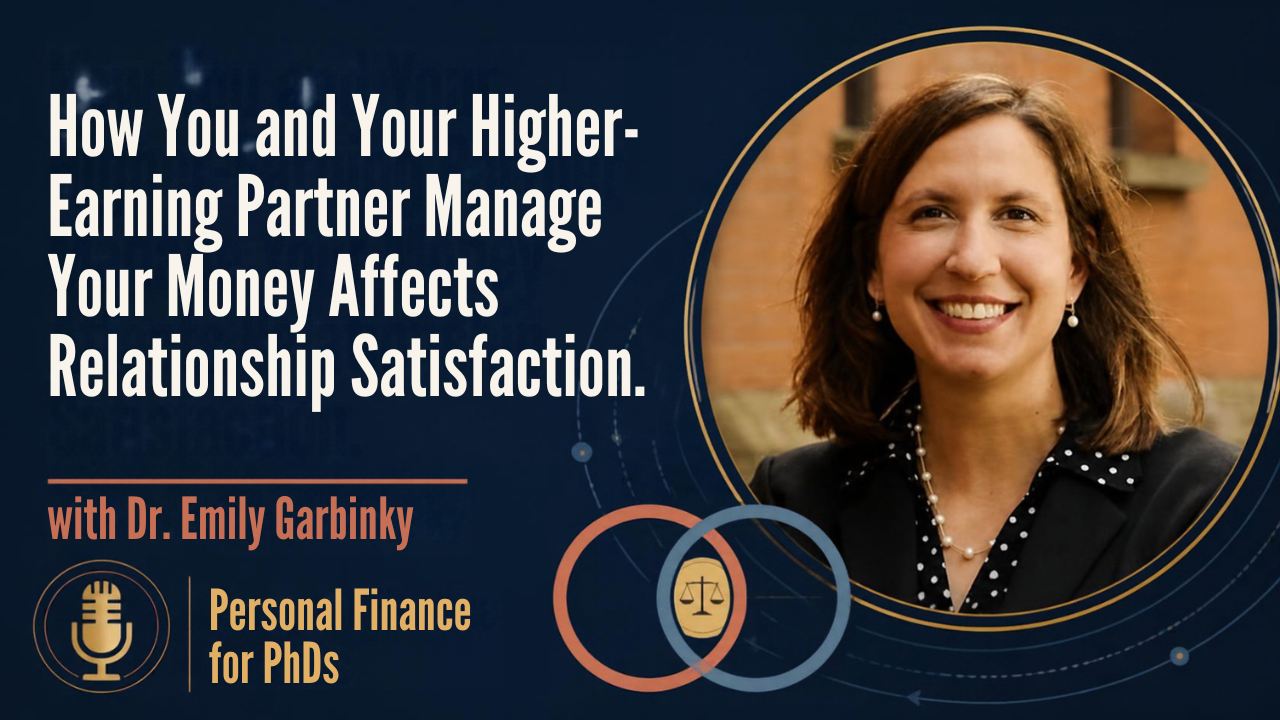
In this episode, Emily interviews Dr. Emily Garbinsky, an associate professor of marketing at Cornell who studies how couples behave with their money. Emily first reviews the common models for structuring money within couples and the surprising effect the choice has on relationship satisfaction. Emily and Emily then discuss income disparities, such as those between a PhD trainee and a higher-earning partner, and how power dynamics can affect how couples choose to split expenses. Finally, Emily shares her thoughts about how to adapt when an income disparity shrinks or even flips and the unique career challenge facing academics and their partners.
Links mentioned in the Episode
- Register For a Free PFforPhDs Seminar
- Dr. Emily Garbinsky’s Website
- Dr. Emily Garbinsky’s LinkedIn
- Dr. Emily Garbinsky’s Podcast Episode on the So Money Podcast
- Host a PF for PhDs Seminar at Your Institution
- Emily’s E-mail Address
- Happier Hour by Cassie Mogilner
- Money for Couples by Ramit Sethi
- PF for PhDs Subscribe to Mailing List
- PF for PhDs Podcast Hub
Teaser
Emily G (00:00): Based on the science that’s out there, I don’t think we can make a claim that joint finances lead to objectively better financial decisions, but we do know that it helps to get couples on the same page, so it at least helps with more transparency and can help them achieve their goals.
Introduction
Emily (00:18): Welcome to the Personal Finance for PhDs Podcast: A Higher Education in Personal Finance. This podcast is for PhDs and PhDs-to-be who want to explore the hidden curriculum of finances to learn the best practices for money management, career advancement, and advocacy for yourself and others. I’m your host, Dr. Emily Roberts, a financial educator specializing in early-career PhDs and founder of Personal Finance for PhDs.
Emily (00:50): This is Season 25, Episode 3, and today my guest is Dr. Emily Garbinsky, an associate professor of marketing at Cornell who studies how couples behave with their money. Emily first reviews the common models for structuring money within couples and the surprising effect the choice has on relationship satisfaction. Emily and I then discuss income disparities, such as those between a PhD trainee and a higher-earning partner, and how power dynamics can affect how couples choose to split expenses. Finally, Emily shares her thoughts about how to adapt when an income disparity shrinks or even flips and the unique career challenge facing academics and their partners.
Emily (01:34): This fall, I’m presenting four virtual seminars on personal finance topics for prospective and current funded graduate students in the US. The first two are practice rounds for presentations I’m giving at ABRCMS in November, titled The Grad Student Financial Checkup and Will the Stipend Be Enough?. The second two are chapter topics from my book, titled Increase Your Income Inside or Outside of Academia and The Most Effective Frugal Strategies for Grad Students. I invite you to participate in these seminars for free in exchange for your feedback on the material. The seminars will be on four consecutive Fridays between October 23rd and November 13, 2026. I’m unlikely to ever offer this content again in this format, so grab your spot now! Go to PFforPhDs.com/FreeSeminars/ to register. You can find the show notes for this episode at PFforPhDs.com/s25e3/. Without further ado, here’s my interview with Dr. Emily Garbinsky.
Will You Please Introduce Yourself Further?
Emily R (02:47): I am delighted to have joining me on the podcast today Dr. Emily Garbinski, who is an associate professor of marketing at Cornell in the SC Johnson College of Business. I actually heard Emily on an episode of So Money, which is one of my favorite podcasts. It was published back in February of 2026, if you wanna go back and listen to that episode. Farnoosh Torabi is the host of that podcast. It’s an excellent episode and it just got me thinking about how we could leverage Emily’s expertise for the topics that I and you care about as funded graduate students and postdocs and early career PhDs. And specifically, we’re gonna be talking about couples and money and how couples handle finances. And specifically, we’re gonna get down to when there are income disparities, as you might be experiencing in your own relationship if you’re in one, and even what happens when those income disparities flip polarity. So we’ll get to that by the end of the interview. Emily, I’m so excited that you agreed to join me on the podcast. Would you please introduce yourself a little bit further for the listeners?
Emily G (03:45): Yes. Thank you so much for having me. I’m really excited to be on the show. So as mentioned, my name’s Emily Garbinski. I’m an associate professor of marketing at Cornell. Just some background on me. So I did my undergraduate education, Carnegie Mellon University, and I got a bachelor’s in decision science. From there, I moved to west coast best coast and spent five years getting my PhD in marketing from Stanford. My first academic job was at the University of Notre Dame. I spent six years on the faculty there, and then I moved to Cornell, and I’ve been here for five years.
From Decision Science to How Couples Manage Their Finances
Emily R (04:22): Excellent. Thank you so much for elaborating there. Just based on what you’ve mentioned so far, decision science and marketing, I’m not hearing personal finance, I’m not hearing relationships in that yet. Like how did you specifically come to this research topic? And what exactly is your research topic?
Emily G (04:37): Yes. So when I was working on my PhD, at that time I was really interested in consumer financial decision making. And so I was really focusing on questions like how can we help people save more money for the future and how can we make sure that people are prepared for retirement? And to my surprise, a lot of work in the space focused on individual decision making, right? So how can we help individuals make better choices with their own money? But as we all know, our relationship partners play a really big role in the extent to which we decide to spend versus save our money. And I kind of noticed that there was this, this gap in the literature. There wasn’t a ton of people doing research in this space. And so I started working on one project, looking at how couples manage finances and just realized that it was my favorite project that I was working on and then another project followed and another. And now I would say it’s my primary focus and where I feel like my biggest contributions have been in personal finance literature.
Three Models for Structuring Your Financial Accounts as a Couple
Emily R (05:45): Very exciting and one of the reasons I’m so excited to have you on the show today. So when I was first becoming interested in personal finance, and this might have been back around 2010, something like that, I remember reading a few papers on how couples structured their money and the papers were probably even older than that. And I remember there being like three basic models, and you can tell me if there’s any updates to this, of fully joint finances, we pool everything together, fully separate, nothing is pooled whatsoever, and a hybrid model, a yours, mine and ours model where there’s some joint, some pooling, and some separation. And at the time that I was reading about that, again, probably 15 plus years ago, it was very much the most common model to have a complete pooling. And so I’m wondering what are the updates on this? Are those the models that are still being used? And specifically for my audience, which is likely Gen Z or younger millennials, how are young couples today structuring their finances on a population level?
Emily G (06:45): Sure. I’ll answer this sort of in two parts. With your first part about sort of account structure, you’re absolutely right that this is a three-part model, pool everything, have a partial pooling approach, keep everything separate. And so this is also where I started when I began investigating how couples manage finances. So the first question I had is like, how should we be pooling our finances, if at all? And perhaps most importantly, are there consequences to how you pool your finances with your partner? And so I’ve looked at this from, I would say two different angles. And so the first angle or the first question that I wanted to tackle is how does the decision to pool or not affect how you decide to spend your money or the types of things that you’re spending your money on? As you can imagine, since I’m in marketing, I was very interested in consumption related consequences. And so what my co-author and I found is that when you spend money from a joint bank account, you experience a much higher need to be able to justify how you spend that money to your partner. And because we experience a higher need to justify, we’re more likely to buy products that we consider to be responsible or utilitarian, and we’re much less likely to buy products that are associated with sort of happiness or what we call hedonic products. And so we see this very consistently over and over again, that people are purchasing or leaning towards purchasing different types of things depending on the account from which they’re spending from. And so that sort of led me to this question of how does account pooling affect how satisfied you are with your relationship overall? And so something that both I found and another wonderful co-author, Jenny Olson, has an amazing paper where she actually randomly assigns newlywed couples to either merge their finances or keep all of their finances completely separate. And she followed them over a two-year period and found that over the course of the two years, couples that had their finances completely pooled experienced much higher satisfaction in their relationship than couples that kept everything completely separate.
Emily R (09:10): That is fascinating. And how rarely do you get to do an experiment like that where you actually get to assign people randomly to groups? Amazing. I’m curious, were there any follow-on questions about not only relationship satisfaction, but maybe life satisfaction overall or perhaps net worth growth? Like how did it actually not just affect their feelings, but their, yeah, their wealth?
Emily G (09:33): So it’s very difficult actually to look at objective net worth differences just because there’s so many different factors that would affect that over time. But if you think about something like life satisfaction, we know, for example, that relationship satisfaction is a really big part of. And so I would imagine we would see increases in life satisfaction through one satisfaction with their relationship. But I think based on the science that’s out there, I don’t think we can make a claim that joint finances lead to objectively better financial decisions, but we do know that it helps to get couples on the same page, so it at least helps with more transparency and can help them achieve their goals.
Emily R (10:18): I guess I just had that question because when you were phrasing it of buying more utilitarian type products from a joint account and not so much the hedonic products or services, I was just thinking that like some people need that accountability to meet their financial goals, for example, and so that actually might result in more savings or higher net worth. But maybe by buying fewer of those hedonic products, they might not have as much life satisfaction. Maybe they do it, but they’re not happy about it, even if they’re happy in their relationship. But I understand it’s very difficult to study those kinds of things and you answered the questions that you’re able to.
Emily G (10:54): My intuition is actually the same as yours. I thought we were gonna find opposite. <laugh> So I though people that are buying these products associated with happiness and using separate accounts might actually be happier and even more satisfied in their relationship because they feel like they’re purchasing whatever they want. But it actually seems that overall, a greater input into our relationship satisfaction is just feeling like we’re a team, right? So these hedonic products can increase short-term happiness, but if we think more about long-term happiness and life satisfaction is very much a proxy for long-term happiness, it seems that we see the flip such that joint accounts lead to greater relationship satisfaction and potentially life satisfaction.
Emily R (11:38): Yeah. And I just wanted to note, I think you said for that particular study, this was married couples, newly married couples. So they had already made that decision. They’d come to that point of that legal commitment, right? And so we’re not necessarily talking. We don’t know if we would see the same results for a, a couple at a different stage in their relationship.
Emily G (11:55): Yes. The study that was done looked specifically at newlyweds.
To Pool or Not to Pool? How Life Events Influence Shared Finances
Emily R (11:59): Yes. And then I guess to take it back to, that was a study done relatively recently, presumably on newlyweds. Do we know overall statistics about how younger couples are choosing to pool or not pool?
Emily G (12:11): Yes. So younger couples are actually much more likely to keep their money separate and they decide to merge when there’s some sort of big life event that necessitates. And so when I say big life event, this could of course be getting married as, as was done in the study, but it could also be something like just deciding to move in together and thinking about how you’re going to pay for your joint rent in your new apartment or your new place together. And so when that happens, what we see is that these couples tend to engage in this partial pooling practice where they’ll open, for example, a joint account where they can put money for their rent, for their groceries, for any shared expenses that they have together.
Emily R (12:56): And you just said that younger couples are much more likely to keep their money separate. Are you saying that’s relative to older generations or absolutely they are keeping things separate, perhaps with some exceptions of these life events? And then if those life events occur, what’s kind of the balance between people who stay fully separate and who do partial pooling or full pooling?
Emily G (13:17): Yeah. So this is relative to older couples that tend to be more likely to be married. And so once you marry, this is when people start to just merge more of their finances over time. But we are starting to see some shifts because couples are putting marriage off later and later, and so people are coming into a marriage with more assets than they had before compared to couples that were getting married young where it kind of made sense just to pool everything together when you had less.
Emily R (13:47): And I wonder, is the arrival of children one of those big life events that pushes couples more towards pooling?
Emily G (13:54): Absolutely.
Commercial
Emily (13:57): Emily here for a brief interlude. Would you like to learn directly from me on a personal finance topic, such as taxes, goal-setting, investing, budgeting, or designing your financial life, each tailored specifically for graduate students and postdocs? I offer live workshops, asynchronous online courses, and cohort-based programs on these topics, and I’m now booking for the 2026-2027 academic year. If you would like to bring my content to your institution, would you please recommend me as a speaker or facilitator to your university, graduate school, graduate student association, medical school, postdoc office, or postdoc association? My workshops are usually slated as professional development or personal wellness. Ask the potential host to go to PFforPhDs.com/financial-education/ or simply email me at [email protected] to start the process. I really appreciate these recommendations, which are the best way for me to start a conversation with a potential host. The paid work I do with universities and institutions enables me to keep producing this podcast and all my other free resources. Thank you in advance if you decide to issue a recommendation! Now back to our interview.
Advice for Couples With Significant Income Disparities
Emily R (15:26): Now I wanna think specifically about a situation that a lot of PhD trainees may be in, which is that they are in a relationship, but there is a significant income disparity. Maybe a grad student partnered with someone who has a full-time permanent job, same thing for postdocs. What does the research show or what advice would you have for a person, the lower earning person in that situation? Are there any best practices that you’ve uncovered?
Emily G (15:52): Yeah, so I can tell you first what I see in the data, and then I can talk a little bit about just some insights or some advice that I have from it. So with one of my PhD students, she’s specifically interested in heterosexual couples with an income disparity. And so one of the things that we’re looking at together is how do couples that have an income disparity choose to split shared expenses? And so as you can imagine, there are two common ways in which couples can split shared expenses. So they can either pay for something proportionally to income, which means that the higher earner would pay more because they make more, or they can split something equally, right? Split it right down the middle, fifty fifty split. And so one of the things that we find over and over again in our data is that the way in which couples choose to split shared expenses seems to be driven by the gender of the higher earner. And so what we find is that when the higher earner is the man, couples are much more likely to split proportionally the income. But when the higher earner is the woman, couples are much more likely to split equally. And so the question, of course, that we’re asking ourselves is, okay, why? Why do we see this over and over again? And it seems to come down to the idea of power and financial decision-making power. And so what seems to be happening is in relationships with income discrepancies, the higher earner sort of by default has more financial decision-making power, right? They are earning more of the money, and so they kind of feel like if there’s a shared expense, they should have more say because they’re bringing in more money to the relationship. And so what we see is that because men on average just tend to be more agentic, they really struggle with this idea of having their power be reduced. And so they’re trying to reclaim some of their decision-making power by offering to pay their fair share, which some would argue would be the fifty fifty split.
Emily G (18:06): But women, on the other hand, because women are much more communal, they don’t really mind as much if they have less decision-making power. And so they’re perfectly happy to just let the man pay for more and go with the proportional split if the man earns more. What does this mean for couples with income discrepancies? What, what advice would I give? I think what I would say is that just to be cognizant of the fact that if you are splitting a shared expense in which the higher earner does tend to have more weight, I think it’s important to realize that the shared expense is gonna be used by both of you. And so I think even if you are the lower earning PhD student, you should feel free to speak up and voice your preference, right? It’s your apartment too. It’s your car too. It’s your vacation too. And there’s no real reason why you shouldn’t have as much of a say in something that you are in fact contributing your own money to help, right?
Emily R (19:02): So I like that extension of your observation about this because you’re not really coming down on, “Oh, it’s better to do fifty fifty. It’s better to do proportional split.” You’re just saying, “These are the tendencies that people have. Let’s take a step back from that and understand the motivations.” And if you just use your voice as the lower earning person, you could be in either situation and you’re still trying to be heard equitably in your relationship. So that’s an amazing observation. Thank you.
Emily G (19:29): Yes. We don’t have, from the data, a clear finding of, “Oh, couples should split this way or they should split this way.” But what we do know is that people are upset if they feel like they don’t have a voice and they feel like they’re not being heard. And so this is a case where, I guess it’s different from what we found with the joint account data where it’s very clear pooling finances increases relationship satisfaction. Here, it’s just we see these descriptive differences between couples and we’re trying to wonder or ask ourselves why this is happening. And what we do know from decades of research at this point on power is that when people feel powerless, that’s a really aversive state. And so making sure that people feel power in their relationship is gonna be really important. And oftentimes we link power to money, and that doesn’t always necessarily have to be the way it’s done or handled in the relationship.
Emily R (20:23): And I guess I’ll also note for listeners wondering about this, the, the practice of pooling, like if you’re listening and saying, “Oh, I want greater relationship satisfaction, maybe I’ll bring up pooling with my partner.” The pooling can be fifty fifty. It can be proportional income. You can do it either way. That’s. Or somewhere in between. It’s not prescriptive in that way you can still pool in either one of those scenarios.
Emily G (20:43): Yes. And I think another thing that’s important for me to communicate is the fact that what does pooling do? It essentially increases transparency and it forces couples to get on the same page and have conversations about where they are with their finances. And this is something that you can do even without pooling, right? Pooling is just one way to facilitate that, but there’s a lot of apps and a lot of tools out there like Monarch, for example, or Honey Do is another app that’s specifically made for couples that can increase financial transparency and help you get on the same page. So if you’re someone that’s not fully comfortable with the idea of merging accounts or opening a joint bank account with your partner, you can still achieve higher financial transparency or financial intimacy just by being open about your financial status.
The Complexities of Academic Life: Major Income Changes and Relocation
Emily R (21:38): Yeah. Thank you for adding that. That’s another great observation. Um, okay. Let’s think about a further evolution of the scenario we just talked about, which is we have a couple with income disparity, one person is in PhD training, maybe one person’s in that full permanent job, and then things switch. The PhD comes out of training, they receive a massive income increase. Woo-hoo, everybody’s so excited about that. But then what changes in their relationship and the power dynamics that you were just talking about? Has this been studied at all? And again, are there best practices around this?
Emily G (22:10): Yes. To the best of my knowledge, this hasn’t been studied specifically in the literature, but I am happy to talk about what I think would happen and also just give some anecdotal observations. And what we know is that change is hard, and it’s also really difficult to prioritize two careers equally. And so I think what happens in a lot of couples is that people just naturally tend to prioritize the career of the person who makes more. And so if there is some sort of flip in the relationship, it’s gonna be quite difficult for the person who was once the breadwinner and no longer is to maybe take a back seat. And I think PhDs in particular, and especially PhDs that go into academia, have a really difficult time because not only might the breadwinner within the relationship flip, but oftentimes we don’t have a lot of say in where we have a job or where we have to move. And I think it’s really hard for the partner that has to suddenly pick up and relocate and move potentially to a location where they don’t wanna move, but it might be the only academic job that their partner got. And so this is really, really complicated relationship dynamics.
Emily G (23:28): And so I’ve seen this go both ways. I’ve seen examples where couples thrive and they have a partner that says, “You go out and you get the best academic job you can get and I’ll make it work.” I’ve also seen couples where they’ve fallen apart because the partner doesn’t wanna move where the spouse got a job. And so now they’re doing long distance because the other spouse just didn’t wanna make it work or couldn’t, or to some extent couldn’t make it work. Maybe it wasn’t their fault. And so one thing that I think is really important for PhDs in particular is just to be super open with your partner about your career trajectory, your career plans. If your partner’s not able to accommodate a move to anywhere in the country, I think targeted job searches are really important. One thing that drives me crazy in both jobs I’ve had in Ithaca at Cornell and in South Bend at the University of Notre Dame is you interview people and you get excited and you make them an offer and then they say, “Oh, my spouse can’t move here.” When it’s like, I feel like you should have had that conversation before you applied to the job about would it even be realistic for them to pick up and move here? And so I think sort of the general theme of all of this is just that conversations around your job and your career plans are also financial conversations. I don’t know if we always think of them that way, but salary and salary transparency in your career goals and your hopes for the future are all things that you should be talking about. And yeah, so I think just being open and honest about the fact that you might not have a say in where you move and it’s just a very different career and lifestyle, I think is something that is really important for your partner to be aware of.
Emily R (25:19): Yes, I totally agree. And I’m thinking now even about specifically because you mentioned an academic, a PhD who’s continuing on in academia, that may not result in being the higher earning partner. The person who was earning more before may still be the breadwinner in that relationship, and then you really have more power dynamics to deal with if it, we have to move for this job, but it’s not gonna even increase my salary as much as yours is. That is really tough. And obviously within academia, we- There’s a lot of ink spilled about the two-body problem and so forth. And so we have ways of handling that if it’s two academic partners, but not so much if it’s one person in academia and one person not, and certainly not if it’s two people outside of the academic system who are trying to navigate this. So I totally agree. Really?
Emily G (26:02): Yeah. The two-body problem is real. And there, once again, there’s no right answer, right? You can’t say, “Oh, you should clearly do this or you should clearly do that.” Each couple has to have the conversation and figure it out for themselves. And I think the conversation also needs to be ongoing, because I also know instances where maybe a spouse agreed to one thing, and then they move and they start their respective jobs, and then they realize that it’s just not working for them. And I think, once again, just being open and honest about these things is really important.
Emily R (26:31): Yeah. I’m so glad you brought up the particular difficulties of having a career in academia, or we might say overall, just a very specialized career where there might be very limited number of places that you could live in the US or around the world to do your particular unique niche thing that you do. Absolutely.
Emily G (26:48): And I’ve mentioned this a few times, but really excited to be on this podcast for PhDs because it always blows my mind to how people outside of academia don’t really realize, for example, that if you are denied tenure, you have to move. And just having gone through the tenure process recently and telling people like, “Oh, I hope I get it. I hope I get to stay.” And they’re like, “What do you mean?” <laugh> And yeah, these are things that I think are very idiosyncratic to our careers.
Emily R (27:16): And I know I was just mentioning geographical limitations, but academics are spread out, let’s say, across the US. You might land in a town that doesn’t have an industry that’s compatible with your partner’s career track. And thankfully, there is so much more opportunity for remote work now. My husband and I both work remotely and are very happy about that, but not every job is- lends itself to that kind of arrangement. Emily, this has been so insightful. Thank you so much for coming on sharing your research and what you’ve learned from the literature and the studies that you’ve done about couples and money and this income disparity. So fascinating.
Best Financial Advice for Another Early-Career PhD
Emily R (27:50): I want to wrap up with the final question that I ask of all my guests, which is what is your best financial advice for an early career PhD? And this can be something we’ve touched on in the interview already, or it can be something completely new.
Emily G (28:02): Okay, great. So I think my best advice is if I think back to my early career as a PhD, and we’re talking about sort of these, these income disparities and these changes in income, I just remember thinking basically overnight, you go from getting used to making a relatively small amount of money for five to six years, and then you wake up the next day and you’re doing much better, right? You get your first job out of the PhD and you’re making a lot more money. And I, I remember feeling like I could just buy whatever I wanted. Like I had so much money now, and it was so much more than, than I had been used to. What we know from the literature is that when income goes up, spending also tends to go up as well. And this is a finding that’s referred to as lifestyle creep.
Emily G (28:53): And so I think my best advice would be to think about maybe some ways to avoid lifestyle creep, and your spending doesn’t have to go up in everything. And so one of the things that I like to do is think about what types of things bring me the most joy, and then I increase my spending on those things. But then other things, I held my spending constant, and I still spend similarly to when I was a PhD student. And so if you think about, for example, other books that are out there, like Cassie Mogilner’s book on Happier Hour teaches us to think about what things help you find the most joy, or Ramit Sethi’s book on Money for Couples and finding your rich life, right? What is your rich life? And so I think that when you get these big boosts to your income, I guess my advice would be to increase spending on things that bring you the most joy, but it’s okay not to splurge on other things.
Emily R (29:54): Absolutely. The way that I phrase that when I teach on this topic, and it’ such an important one for being mindful in those career transition points is that, yeah, we should avoid lifestyle creep or lifestyle inflation, but you absolutely should indulge in intentional lifestyle increases in those areas that matter most to you, as you were saying. And as a follow-on, let’s be real careful about those fixed expenses, okay? Let’s be careful about the housing that we commit to, the car that we commit to, because those are a little harder to change once you’ve made that initial decision and you might have been riding high and not realizing, “Oh, there’s a lot of taxes I have to pay, and oh, there’s a lot of other increases.” So love that advice, very relevant for this audience. Thank you so much. Emily, again, this is a wonderful interview. Thank you very much for coming on.
Emily G (30:39): Thank you so much for having me. It was a real pleasure.
Outro
Emily (30:44): Listeners, thank you for joining me for this episode! I have a gift for you! You know that final question I ask of all my guests regarding their best financial advice? We have collected short summaries of all the answers ever given on the podcast into a document that is updated with each new episode release. You can gain access to it by registering for my mailing list at PFforPhDs.com/advice/. Would you like to view transcripts or videos of each episode? We link the show notes for each episode from PFforPhDs.com/podcast/. See you in the next episode, and remember: You don’t have to have a PhD to succeed with personal finance… but it helps! Nothing you hear on this podcast should be taken as financial, tax, or legal advice for any individual. Podcast editing by me and show notes creation by Dr. Jill Hoffman.