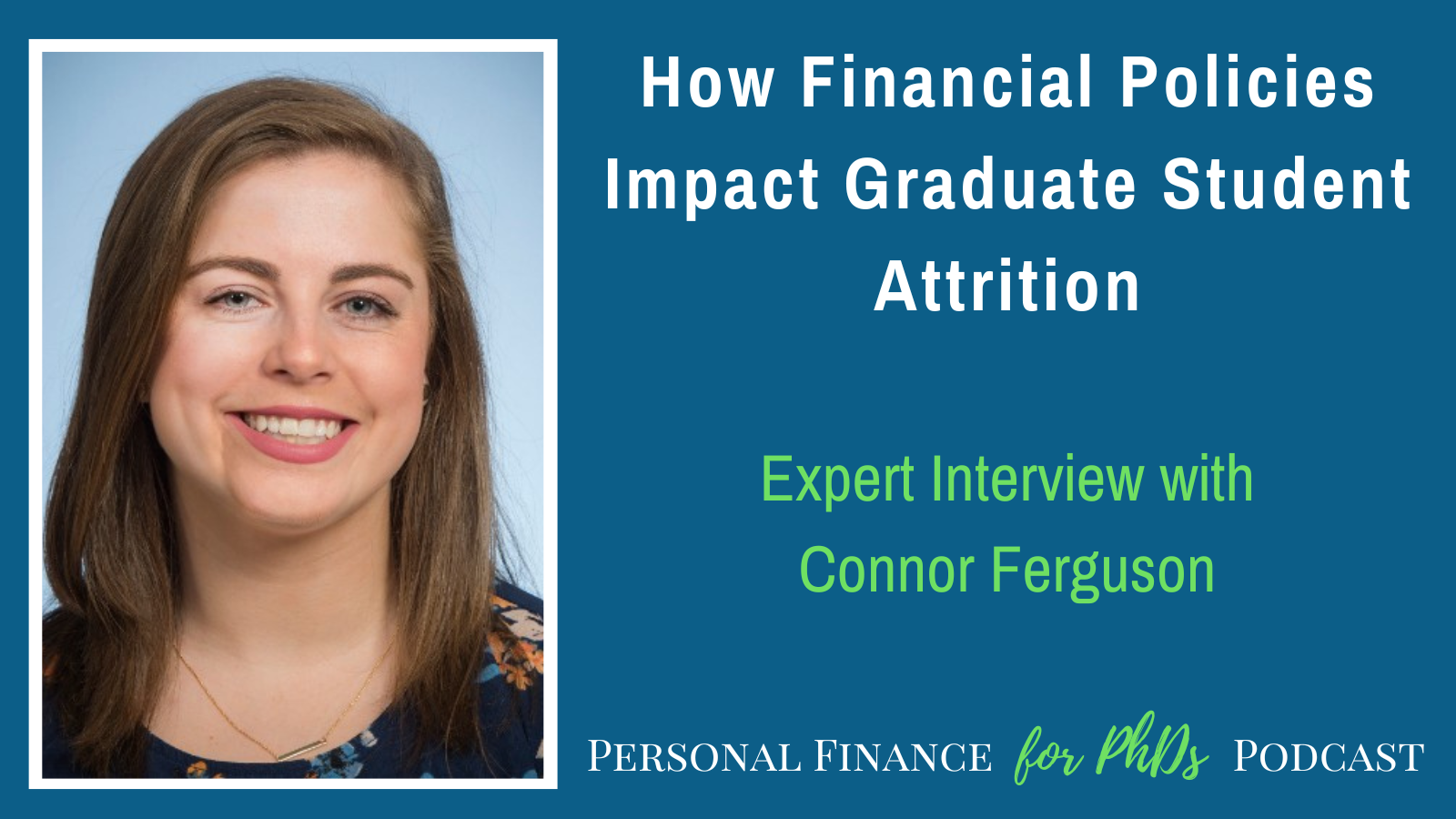
In this episode, Emily interviews Dr. Connor Ferguson, a postdoc at the University at Buffalo studying how professional development and student success initiatives influence the graduate training environment. While pursuing her PhD in higher education at West Virginia University, Connor worked full-time as a student affairs professional supporting health sciences graduate students, which has given her multiple perspectives on how to support graduate students. Connor and Emily discuss the best practices that universities and programs can implement to reduce graduate student attrition and strengthen the workforce development pipeline, including how to raise stipends and provide for basic needs.
Links mentioned in the Episode
- Dr. Connor Ferguson’s LinkedIn
- Dr. Connor Ferguson’s Google Scholar
- Emily’s E-mail Address
- PhD Stipends
- Host a PF for PhDs Tax Seminar at Your Institution
- PF for PhDs S22E5 Money Is a Good Enough Reason to Leave Academia
- PF for PhDs Subscribe to Mailing List
- PF for PhDs Podcast Hub
Teaser
Connor (00:00): You don’t want the students to be overwhelmed. You don’t want them to burn out. But at the same time, if they’re not able to make a wage to sustain a healthy living environment, they’re gonna be overwhelmed and they’re gonna burn out.
Introduction
Emily (00:21): Welcome to the Personal Finance for PhDs Podcast: A Higher Education in Personal Finance. This podcast is for PhDs and PhDs-to-be who want to explore the hidden curriculum of finances to learn the best practices for money management, career advancement, and advocacy for yourself and others. I’m your host, Dr. Emily Roberts, a financial educator specializing in early-career PhDs and founder of Personal Finance for PhDs.
Emily (00:50): This is Season 22, Episode 8, and today my guest is Dr. Connor Ferguson, a postdoc at the University at Buffalo studying how professional development and student success initiatives influence the graduate training environment. While pursuing her PhD in higher education at West Virginia University, Connor worked full-time as a student affairs professional supporting health sciences graduate students, which has given her multiple perspectives on how to improve the graduate student experience. Connor and I discuss the best practices that universities and programs can implement to reduce graduate student attrition and strengthen the workforce development pipeline, including how to raise stipends and provide for basic needs.
Emily (01:34): If you want to bring one of my live tax workshops to your university next tax season, get in touch with me ASAP! Between now and the end of the year, I’m populating my calendar, especially early February, with in person and remote speaking engagements. My workshops are typically hosted by graduate schools, postdoc offices, and graduate student associations, and sometimes individual departments. Whether you are in a position to make those arrangements or simply want to recommend me, you can get the ball rolling by emailing me at [email protected]. My tax workshops, both live and pre-recorded, are my most popular offering each year because taxes are such a widespread pain point for graduate students, postdocs, and postbacs. You can find the show notes for this episode at PFforPhDs.com/s22e8/. Without further ado, here’s my interview with Dr. Connor Ferguson.
Will You Please Introduce Yourself Further?
Emily (02:45): I am delighted to have joining me on the podcast today, Dr. Connor Ferguson. She is a postdoc at the University of Buffalo, and we met last summer 2025 at the Graduate Career Consortium annual meeting, and during the poster session, we got deep into a discussion on grad student stipends and advocacy and Connor’s particular interest in attrition in graduate among graduate students. And Connor told me about this upcoming study that she’s working on. It was just so fascinating. I knew I had to have her on the podcast, so I’m very excited. Connor, welcome to the podcast. Um, and will you please introduce yourself a little bit further for the audience?
Connor (03:22): Sure. Uh, thanks Emily. Thank you for having me. So I received both my master’s and doctorate in higher education from West Virginia University. I also have a graduate certificate in university teaching. My doctoral work specifically examined the influence of faculty mentorship on graduate student self-efficacy development, but also while I was pursuing both of those graduate degrees, I worked full-time as a student affairs professional, specifically supporting health sciences graduate students at my institution. Uh, my professional role was to support the graduate education environment through mentoring, strategic recruitment, and the implementation of professional development programming. And during this experience, I formed individual connections with students and I really got to learn about what they loved about graduate education and the research, but also I really learned about what made it a struggle, um, and how I could try to help them. So during that practical experience, I identified areas in which practitioners could shape programming or initiatives to support the needs of the graduate student population. And that objective has been pretty consistent. It’s a consistent theme across all of my work efforts. And I’m currently a postdoctoral researcher at the University of Buffalo, where our lab focuses on culting-, cultivating and retaining the future STEM workforce through the implementation of some evidence-based practices that emphasize equality of access. And I’m specifically looking at how professional development and student success initiatives influence the graduate student training environment.
Emily (04:57): Those of you watching the video could see that I was just nodding, nodding, nodding, nodding along with everything that Connor just said. I love this like dual or at least like multiple perspectives, um, that you have, you know, personally and professionally on the graduate student population.
How Do Stipends and Benefits Impact Grad Student Attrition?
Emily (05:10): This is amazing. And so as you know, and as all the listeners know, this is a finance podcast. So let’s take what the framing that you just gave all your background, you know, what your lab is currently doing, and let’s talk more specifically about money. So how have you observed or how are you hypothesizing that stipends and benefits and other monetary, you know, things that affect the graduate student population, um, and their own personal finances, how are they contributing to this, um, overall problem of attrition? You know, and you also phrased this as workforce development, right? So broad broadly, workforce development maybe more specifically attrition at the graduate student level.
Connor (05:49): Sure. So, um, at a more general level, research has shown that students choose to withdraw from graduate programs for many reasons, including program fit, uh, personal reasons, departmental issues, but also financial challenges. Um, before I dive fully into the financial component, my professional experience and research is placed in the biomedical and health sciences graduate student realm, of which these programs tend to be on the upper end of those stipend and benefit ranges, um, compared to students in the humanity and social sciences. So just that overarching perspective, I am in the biomedical realm, but overall across disciplines, financial instability is a serious concern for graduate students. So when stipend and benefits don’t support a living wage, students can face a chronic financial stress that impacts both their academic performance and their overall wellbeing. And we see more and more students reporting that they are being paid at, at or near the poverty level. And with some of these graduate programs, they’re also expected to essentially work full-time in the labs that they’re in. So there are limited opportunities for students to pursue additional employment elsewhere. Some programs are also discouraging students from pursuing additional employment. They state that this is because graduate studies and research makes up a full-time commitment. And I can see that coming from a place of care, right? You don’t want the students to be overwhelmed, you don’t want them to burn out, but at the same time, if they’re not able to make a wage to sustain a healthy living environment, they’re gonna be overwhelmed and they’re gonna burn out.
Emily (07:25): Not to mention the international population, right, who are legally barred from having virtually any source of income outside of their stipend.
Connor (07:33): Yes, that’s an incredibly important point. Thank you for bringing that up. So for example, I had spoken with a student who worked full-time as a PhD student, right? But they also worked overnights as an EMT, and they were incredibly exhausted and incredibly tired, and that weaves its way into all aspects of their life. But they felt that they needed to do that in order to support themselves and their family. So when students are discouraged from pursuing supplemental employment but are in need of a supplemental income, they could feel trapped between the institutional expectations and financial survival. And that tension can contribute to burnout and attrition.
Emily (08:17): And I also just wanna say, I mean all, all your points are perfectly well taken, but like I also firmly believe that it’s not just about basic needs and survival, it’s also about having a satisfactory and fulfilling life. Especially if we’re talking about PhDs, like that’s a long time to be living at the poverty level, for example. So like for me, I just wanna encourage everyone listening like, it’s okay also to want more for your financial life than just baseline survival, although that is the discussion that we’re having in certain kinds of programs at certain places,
Connor (08:49): Right. Yeah. Uh, baseline living wage is the bare minimum <laugh>. Um, but unfortunately we do have to start at the bare minimum in some of these discussions, um, in order to get this going. And stipend ranges are really variable across programs, disciplines, institutions. Um, in my previous employment I collected stipend data for comparable institutions because our students were consistently, and if this was good that they were consistently bringing up that the stipend wasn’t enough. Um, oh my gosh, now make, now I’m thinking about why it’s usually student led efforts, but maybe we can loop back to that. Um, I know that there was a broader graduate student effort called PhDstipends.
Emily (09:31): That’s actually my website.
Connor (09:33): Okay, perfect. Well, it’s still ongoing. Um, and that was collected student reported data, so prospective students can check that out to see if the stipend and the, I think they’ll probably connect probably to the MIT living wage calculator.
Emily (09:49): We actually used to link the MIT living wage database, but more recently I could not secure permission from the owners of that database to do so. So it’s no longer there. Although I highly recommend it. I highly recommend visiting the living wage database. I find it to be a very useful resource.
Connor (10:04): Yeah, absolutely. I mean, also when you’re thinking about getting a new job and trying to understand what your salary here versus in a new location, what that all translate to the really helpful resources. I guess another point that I feel, um, I should discuss is that there’s more to the graduate student financial package than just the stipend. Um, a lot of times we forget about the value of the tuition waivers. So for doctoral research assistantships, for many PhD programs, they’ll receive a stipend tuition waiver and health insurance. And that tuition waiver is a substantial amount of money that the student’s not responsible for while they pursue their training. Ultimately though, the stipend, so the take home salary is often not supportive of a living wage. Um, but I myself was not in a stipend supported position, so I feel like I would be really grateful for a tuition waiver. So that’s why that little caveat perspectives in there.
Emily (10:58): Yeah, I definitely find that graduate students feel different ways about this. Um, some put a high value on that tuition waiver or scholarship, whatever the form is, um, because they really are considering, wow, I would be paying that, you know, to pursue that degree. Um, if this wasn’t offered and others are like, this is funny money and it is meaningless to me because whatever the number is, you would pay it for me. So I really just care about the stipend. So I definitely see, you know, those different, um, perspectives there. I wanna actually sort of double click on something that you said a few minutes ago, which is about, um, that the students at West Virginia were coming with their concerns around the stipend to the administration. And that was very helpful to you and your position to hear, you know, all of those concerns and then start doing that research of, okay, what are our, you know, peer programs offering? Are we competitive with them? So I just wanted to reemphasize that to the listeners of like, this is an effective strategy. Like if you have concerns about the stipend that’s being offered, bring it up and get your peers to bring it up at every, you know, reasonable opportunity. Um, especially actually at the prospective student stage. Um, it may not, I mean, hopefully it’ll, you know, enhance your offer that you try to negotiate. Maybe it won’t, but the people who you’re voicing this to are taking notes and they will eventually respond if they’re hearing over and over again that their stipend is just not competitive with other programs.
Connor (12:30): Yeah. And we did in fact, get some feedback once from an applicant who chose to go a different way. And it is really helpful to see that one of the reasons was that the financial package was not comparable to another opportunity because ultimately, uh, graduate programs are seeking to recruit those students. So they want to be competitive. And being vocal on all avenues is how we can create change. Um, if we’re quiet, then the administration either doesn’t know or they’re gonna choose not to know about these challenges.
Why Should Universities Care About Grad Student Attrition?
Emily (13:01): Absolutely. We’ve just spoken quite a bit about the effect of, you know, insufficient stipends or low stipends on graduate students’, um, wellbeing, their ability to progress in their programs and perform well and all of that. Let’s flip the perspective to the university side. Why <laugh>? You know, we, we talked about attrition, we talked about graduate students withdrawing from their programs. Why do universities, uh, care about that? It’s kind of a silly question, but what’s your framing on that?
Connor (13:31): So, universities should be concerned with graduate student attrition at multiple levels. Um, so it can be considered a failure to support the student. It could also be viewed as a disruption to the research enterprise. Um, and it could also demonstrate financial inefficiency within the institution itself. So kind of like three different perspectives. Um, and so my student affairs background leads me to center the individual. So I’ll start here with the, the student perspective. So looking at the student as individuals and supporting them through the attainment of their educational goals and the pursuit of their desired career pathways. And here I’ll emphasize that not all attrition is negative. Sometimes leaving a program is the right choice for the student’s goals, but my research focuses on attrition that occurs because of structural barriers, not personal fit. So when students leave under those conditions, it can reflect a failure of institutional support and could also signal some broader inequities in how we prepare and sustain our students. So from that student affairs perspective, attrition can represent, represent like an unfulfilled promise between the institution and the student.
Emily (14:49): I’m so glad you started with that framing ’cause that’s exactly where I would, um, sit as well. But because I spend so much time there, I’m curious about your other approaches as well to this issue.
Connor (15:00): Sure. So in order to get some stakeholder buy-in, um, it’s really helpful to kind of frame these issues from the broader research enterprise or from the business perspective. So in general, um, graduate students are significant contributors and leaders within the academic research enterprise, uh, both in terms of advancing science within their academic research team, but also as they progress into their future careers. And these students are active members of their research teams. And when research teams as a whole encounter a challenge or a setback, those setbacks can pose a considerable cost to the research institution and their team. So we look at graduate student nutrition as a specific type of challenge to that research progress. And you could also consider more of the ripple effects of graduate student attrition. Um, graduate students become active members and leaders of the broader scientific community or the scientific research community. And so attrition within graduate programs for reasons outside of the student’s personal motivations could impact the quality and viability of the overall research enterprise.
Emily (16:10): That approach to it is something that I’ve become more and more concerned about as the more work that I do in this area. And starting to see that bigger picture of you as you phrased it earlier, workforce developments. Go on. What’s that third way that, uh, that you frame the issue for, for universities?
Connor (16:26): That third way is framing it within the business realm of higher education, um, because much of the United States higher education system functions within a business structure now. So we frame attrition around this concept of waste. And we’re not using waste to devalue the student experience or to devalue the student, but to make that problem legible to those in- institutional decision makers who are viewing this as a business. Um, so in general, supportive doctoral programs requires a significant, uh, commitment of institutional, state and federal resources. So we have a lot of stakeholders, um, at play here, and the costs increase when cases of attrition occur. And so more specifically, training doctoral students requires a substantial investment of many layers. This includes the stipends support, but also through student and faculty recruitment in training students. And also if you consider time as a financial resource, which it should be considered a financial resource. So when a student leaves those resources are partially lost. And university stakeholders can view such attrition as a sign of institutional waste and inefficiency. And we are in a time of tightening budgets and a real pressure on accountability metrics. So attrition then becomes a point of concern specifically related to institutional inefficiency. So I suppose when I talk about attrition as waste, it’s really a call for universities to invest wisely into efforts that promote greater retention. So investing in financial stability, but also mentorship, programming and supportive climates. Those are effective strategies to yield positive training outcomes and reduce financial inefficiency.
Emily (18:17): And the way that, you know, you approach that really is sort of turning around saying to the institutions, there is a degree of waste happening here. As you said, it’s not because of the, the fit issues that aside, maybe people leave programs because their career goes no goals, no longer aligned. That’s that’s totally fine, that’s a separate issue. Um, but if you see that you’re not, uh, that money is being wasted, uh, because you’re not supporting the graduate student population sufficiently in x, y, z areas, well address those x, y, z areas, reduce the waste, like win win, win win for everybody. Right. Um, so I’m so glad that you took the time to explain like the, sort of those different perspectives, um, on the issue and, and put that term waste, you know, in, in some context for the listener. So I appreciate that. So when we met last summer, uh, you were telling me that you were putting in a grant and that you have, um, some ongoing and also some upcoming studies around this issue. So can you tell us more about, um, what you’re planning?
Other Attrition Related Research: Lab Switching and Master’s Degrees as Career Exploration
Connor (19:17): Sure. So the study that we spoke about, uh, last summer was specifically about the phenomenon of switching labs. Um, sometimes referred to as changing mentors depending on the discipline and whether it’s bench work or not. So in my study, I’m proposing that the biomedical sciences education community specifically just to frame the balance of my case view, switching labs as a type of attrition to be studied and prevented when appropriate, uh, to promote positive student outcomes and support the significant financial investments made when matriculating doctoral students into pro- um, programs. It’s a little different than fully withdrawing from the program, but we have less knowledge about switching labs. We know that it, it can increase the time to degree. So at a, you know, far back lens, we can see that an increased time to degree means more financial commitment. Um, but we don’t formally know about the phenomenon. And so we don’t know about the factors that influence the decision to choose to switch labs. And we also don’t know about the corresponding impact on the training experience for both the student and the faculty member, but also training outcomes and the overall institutional financial commitment. So I’m implementing a mixed methods approach to capture institutional metrics, but also the student and faculty narratives of lab switching.
Emily (20:46): Anecdotally on my end, I remember from graduate school that some lab switching preceded withdrawal, right? It sometimes the issues can be resolved by changing mentors and sometimes it’s just indicative of graduate school not being a good fit for that, um, individual. So just from my own like observations and experience, I can see that this is definitely merits, you know, further investigation. Would you like to share anything else about other sort of questions you have, um, or that you’re trying to ask that are cir- circling around, you know, the topic we’ve discussed?
Connor (21:20): Yeah, I have, I have one that I can share about. One study that we’ve wrapped up and we’re working on submitting a manuscript at this time is examining master’s programs specifically, um, with students that seek out master’s programs as precursors to professional or doctoral level degree programs and students viewing those as strengths to build their application resume. But they’re also perceiving those as significant financial investments into the opportunity to pursue an additional graduate degree. So we’re looking to understand maybe what can we do to, uh, supplement some training that these students are seeking at the master’s level within their undergraduate programming, such that they might not need to make such a significant financial investment. Um, a lot of the times a master’s degree is necessary, um, or important towards their career goals, but for those students that were in our particular study, it may not have been the most financially necessary decision. And ultimately we want our students to be financially stable. It’s better all around for their productivity, their wellbeing in this uncertain job market and uncertain economic climate. So we’re just looking to see what interventions can be done at the undergraduate level to maybe help students go straight to where they want to go instead of using master’s programs as career exploration tools.
Emily (22:52): Absolutely. This is a population that I’m also highly interested in, and whenever I get the opportunity to teach rising or prospective graduate students, I absolutely relish it because so much trouble financially that graduate students get into, you know, years into a PhD program. A lot of that could be headed off, um, earlier if they understood the culture of different programs better or if they did, you know, um, weigh finances maybe more heavily among the factors when they were choosing their graduate program or if they had attempted to negotiate or, or there’s a lot of different ways that that could play out. Um, but I think oftentimes prospective graduate students kind of related what you were saying as like using the masters as, um, a tool for, you know, further career, you know, further educational attainment, um, down the line. Sometimes undergraduate students, um, aren’t yet making the best decisions around. They don’t understand the context and the meaning of all these numbers that are being thrown around in front of them, um, yet in a way that they will start to appreciate multiple years down the line. So the more we can get information in front of them and context in front of them, the earlier the better in my opinion.
Commercial
Emily (24:09): Emily here for a brief interlude! I’m hard at work behind the scenes updating my suite of tax return preparation workshops for tax year 2025. These educational workshops explain how to identify, calculate, and report your higher education-related income and expenses on your federal tax return. For the 2025 tax season starting in January 2026, I’m offering live and pre-recorded workshops for US citizen/resident graduate students, postdocs, and postbacs and non-resident graduate students and postdocs. Would you please reach out to your graduate school, graduate student government, postdoc office, international house, fellowship coordinator, etc. to request that they host one or more of these workshops for you and your peers? I’d love to receive a warm introduction to a potential sponsor this fall so we can hit the ground running in January serving those early bird filers. You can find more information about hosting these workshops at P F f o r P h D s dot com slash tax dash workshops. Please pass that page on to the potential sponsor. Now back to our interview.
What Steps Can Universities Take to Reduce Attrition?
Emily (25:27): Okay. So going back kind of to the beginning of our conversation, um, and also, you know, the, the studies that you’ve been talking about, what ways do you, what steps do you think universities and programs could take to reduce attrition among their graduate student populations to reduce this waste, you know, aspect of their expenditures? Um, this doesn’t have to be super well supported by evidence yet, but, you know, drawing on your professional expertise and your observations, what are your thoughts? What are some best practices?
Connor (25:57): My thoughts might be like big dream ideas that would require a lot, a lot of work, but I do think that reducing graduate student attrition would require a multifaceted approach. So one that would support students before they enter graduate school. So prospective graduate students, uh, one that provides strong onboarding once they arrive into their graduate programs, and then one that focuses on interventions when challenges arise. So we had just kind of started talking about this, so I’ll start, I’ll really dive into preparing before graduate school. So some graduate student attrition happens because students realize mid grad program that the degree doesn’t align with their goals. And that could be seen as a gap in earlier career preparation, which is not necessarily the fault of the student, but it is definitely an area in which institutions can target interventions. So how can, right, we kind of spoke about this, how can institutions educate undergrads about the variety of careers available with a baccalaureate degree or about the pathways that would necessitate a graduate degree? So I personally pursued a master’s degree right out of undergrad because I wasn’t sure what I wanted to do next. And I was like, I’ll just take out loans. And I, it’s not, I would say it wasn’t the most financially responsible decision I’ve ever made. Uh, specifically because I used the master’s program as a career exploration tool. Um, I stand by the program, I’m happy where I am now. It led me to my PhD program, it led me to my research, it worked out. But I am drowning in student loan debt. And I do feel that this is a problem that other students face as well. And that personal experience shapes how I view career exploration at the undergraduate level. So what can we be doing at the undergrad level to appropriately educate students on the values and purpose of graduate degrees as they relate to their broader goals?
Emily (27:58): I’m sure you’re absolutely aware, but you know, this issue is not an individual issue only, it’s not a university level issue only. It’s now like in the spotlight for the federal government with the changes that have just been implemented to the federal student loan program.
Connor (28:12): And students are anxious about that. Students are uncertain if they’ll be able to pursue their graduate programs or continue their graduate programs. It’s just we don’t need more question mark, question marks in an otherwise stressful time for students..
Emily (28:28): And the financial implications are gonna become stronger, right? For, you know, people who have to access the private loan market instead of being able to use federal loans, et cetera, et cetera, interest rates, repayment options, like there’s just gonna be even more weight on this decision. So it’s very timely <laugh> that you’re looking at this. Yeah.
Connor (28:48): So that was focusing at the undergraduate level, right? Because if we can reduce the number of students who realize mid grad program that this wasn’t the pathway for them, we could also be saving both the students and institution the time and the resources. But most of my like passion projects, my efforts and research tend to examine the onboarding programming of graduate students like orientation, um, because I’m particularly interested in strengthening mentor mentee relationships and the graduate student training experience. So structured onboarding efforts can help normalize graduate student expectations and also prepare students for the transition to this new environment. And these programs are more and should be more than just presenting logistics, uh, and instead provide opportunities to help students be successful in graduate studies and beyond. And so these are perfect places to begin exposing students to resources that will help them, like topics around financial literacy or, you know, advertising podcasts like these during orientation. It would require consistent reminders throughout their training that these resources and support systems exist. Because I know students experience an information overload when they start their program, but being aware of these resources early can be so beneficial because then you’ll know where to look when a challenge arises. Um, it’d be nice if you were prepared in advance, but I think many of us seek out resources when we need, when we’re in a time of need.
Emily (30:21): Um, and I’ll just put a plug in there that, I mean, ideally during orientation, yes, graduate students would be introduced to their, uh, financial wellness offices, which I don’t know, they aren’t always called that they might be housed in financial aid or other areas around the university, oftentimes in, um, student affairs or student services. But somewhere on your campus, there are people who can help you with your financial matters that arise. Not just taking out student loans like you might think that’s all financial aid is therefore, but these offices do many, many other things. Um, and so in case you didn’t hear it anywhere else, access your financial wellness office at your university, they will probably be delighted to see a graduate student because they normally see a lot of undergrads. Um, but the more, like we were talking about earlier, you know, the more you bring up financial issues to administrators, well the more you and your peers visit the financial wellness office, the more they will start to pay attention to your population and your specific questions.
Connor (31:13): Absolutely. It raises awareness to other institutional leaders as well of the significance of those programs and departments. Um, looking at it like a customer service base, right? You see a rise in customers, let’s pour more resources into that support service. Um, and those professionals, like you said, would love to see a student. They’re there for a reason. So let’s use those resources
Emily (31:35): Using that same framing of like, okay, we, you know, we, we talked about, um, graduate student attrition as a waste issue for universities. You just talked about seeing students through certain offices, you know, maybe, um, could in one light, view students as customers to their office, to their small business within the university. Um, hey, go use those resources more because that will bring more resources to that office that serves you, um, and your peers. I actually make the same argument about basic needs. I wonder if you agree with this that like, go use that food pantry on campus if assuming you are eligible for it. Don’t think someone else needs this more than me. No, you are the one who needs it. <laugh>. Go there and use it and then they’ll get more resources and there’ll, there’ll be a bigger pie available for everybody who needs it.
Connor (32:21): No, absolutely. I, food pantries are so significant and I understand why students might not wanna go to a food pantry. I do think there’s a, an unfortunate negative stigma surrounding food pantries or like students can feel embarrassed is what I’ve heard. It’s there to help, it’s there for you. It’s there as a resource. I’ve seen some institutions do some more creative approaches to try to alleviate some of those feelings of embarrassment, right? Like, so you don’t necessarily need to sign your name or log in to use the food pantry. So it’s just removing some barriers to make those things easier, uh, to access.
Connor (32:58): And I actually think that ties into my interventions when a challenge occurs idea. So starting big picture here, attrition can follow an unresolved conflict. So there could be conflict, um, with a mentor within a research team. Um, attrition can also follow conflicts that lead to personal or financial challenges. So an institution can make a real difference by focusing on these interventions. So in- interventions that would support students in a financial crisis, right? Beyond increasing stipends could include robust leave of absence policies that are easily shared with students so they know that they’re there before a crisis occurs. Um, or expansive food security services. So food pantries that are accessible to students that are on various points of campus, uh, food pantries that are inclusive of a variety of dietary needs, um, and food pantries that are responsive to changes in the landscape that impacts food security benefits. So when we see a rise based on benefit changes, um, food pantries that rise to that occasion to be accessible to the students that are no longer receiving other support services that they were previously receiving.
Emily (34:14): Yeah, I don’t think we need to talk around it. So we’re <laugh> recording this episode on November 13th, 2025. So, uh, the, the federal shutdown has, has just ended and SNAP benefits, um, allegedly have been or will be restored, but it’s obviously the timelines are different on like a state by state basis. So the SNAP benefits should be coming back, uh, or, or have been back depending on where you are. Um, but absolutely in total agreement. So like I’ve of course have been thinking a lot about SNAP, um, supplemental nutrition assistance program of food stamps, um, of course during this shutdown, especially as it loomed, you know, towards the beginning of November. Um, and I was also thinking about how some universities, like I believe at least in some University of California campuses, I don’t know if it’s like all of them, they have people on campus who help students enroll in SNAP benefits. Like they know that enough of their population qualifies, that they have dedicated people at least periodically, um, who help students enroll. So that is another one of those, like it’s, it’s not necessarily responding in a crisis, but it’s, it’s preventing a crisis from occurring by there being more visibility around, hey, there’s, you know, federal, state, local benefits that graduate students may qualify for. Let’s help you, let’s help you get past that barrier of paperwork. And maybe that barrier of, um, shame or like self-selecting out by just kind of normalizing it. I mean, okay, I don’t love that graduate students in some places are paid so little that they do qualify for SNAP on a regular basis. Like let’s, that is a problem. Um, given that that is the situation, it is helpful to get them past the paperwork hurdle, um, of, of that, you know, particular being able to enroll in that benefit. So anyway, is there anything more that you’d like to say about like accessing federal, state, local benefits as a graduate student or how universities can tie in with these other resources that are available?
Connor (36:06): Yeah, I mean I think a huge factor is just educating, like you mentioned the students one, that they’re eligible for these services and two, that it’s not bad to use these services. Like they’re there for you, they’re there to support you, and we have limited social services that are available to us compared to other countries. And so we should really be using the ones that we do have because as we’ve seen, we can lose those very quickly. But as institutions, let’s educate our students because they might not be aware of these resources and services available so they can pursue those if needed.
Emily (36:39): One other resource I wanted to bring up that you didn’t explicitly mention, but was in kind of the theme that you just brought up of like, you know, sort of helping in a time of crisis. I mean, I totally agree about the leave of absence policies. It also doesn’t have to be crisis. We can talk about parental leave medical. Like, you know, all, all under that category. Um, but a lot of universities have started offering emergency loans or emergency grants. I mean, the grants is the most helpful <laugh> thing there, but sometimes it’s in the form of a loan. Um, this is outside of, you know, the federal student loan system or whatever. This is something that the universities themselves provide. Um, it’s a growing trend that I’ve seen across, you know, the financial wellness, um, operations at universities. And so that’s another resource that again, is a best practice universities should be providing and making it obvious to students when they qualify or what kinds of things qualify for, you know, being able to take out those grants or loans. Um, so that, yeah. And, and students also being more aware of this, like on your side. Yeah. If you’re experiencing something and it’s going to affect your ability to perform in your graduate program, just reach out and see what your university can do for you. It might be something like a grant or a loan.
Connor (37:44): Yeah, I think the key factor there is that students sometimes need to reach out to learn about these resources. So I suppose in a preemptive intervention is to just kind of really make sure those resources we tell them to students right out the gate. So we don’t lose any students who encounter a challenge and then just get sucked into this, this bubble of trying to navigate the challenge that they don’t ask their student affairs professionals. But I agree it was something that my previous employer was starting up, um, like a, a grant fund for students in emergency need, uh, before I left the position. And I think it’s, it’s a wonderful resource when our students are aware of it.
Emily (38:23): Anything else you’d like to add on this topic of, you know, um, once a student is, is a continuing student in the university, um, best practices for helping them navigate through financial challenges?
Connor (38:35): I think there is tremendous strength in being open in the dialogue surrounding financial challenges. Uh, we see this with successful, you know, student efforts that lead to stipend increases. Just building that sense of community amongst your peers, um, offers the chance to learn from others about what they’re doing, but also provides opportunities for collective action. So I think really focusing on open dialogue is just, it’s, it’s a gift and we should be leveraging it.
Emily (39:05): Hmm. Yes, I’ve absolutely heard that from other interviewees who have been involved with unions or involved with unionization movements or not even an official union situation. Just as you said, collective action, Hey, talking with your peers and bringing up financial concerns to your department chair and like maybe there is something that that person can do or that they can forward onto, you know, the person of the chain from them. Um, it doesn’t have to have a formal name like a union to be helpful. Um, like you said, it starts with building community. So yeah, thank you for adding that. Well, Connor, it’s been so wonderful to talk with you. I’ve learned a lot from this conversation, so thank you so much for being willing to come on the podcast after just meeting me one time briefly at a conference. I really appreciate it.
Best Financial Advice for Another Early-Career PhD
Emily (39:46): Um, I’d like to ask you the question that I end all my interviews with, which is, what is your best financial advice for another early career PhD? And that could be something that we’ve touched on in the interview already, or it could be something completely new.
Connor (39:58): My best financial advice for early career PhDs I think will stem from what we just spoke about, about open dialogue, uh, but specifically being proactive and transparent around conversations about salaries and benefits, which I’m sure people hear a lot, but it’s for a reason. So I think a lot of confusion and anxiety around career decisions. I’m, I’ve experienced this myself, I’m experiencing it now as I looked to transition to other jobs about, it comes from this secretive nature about money that we’ve been taught in the past. And we often don’t know what a fair salary looks like for our field and what benefits we should expect, but also what benefits we could ask for in addition to a package. So it’s just incredibly important in an uncertain job market where so many are also managing student loan debt and that lack of information really creates a sense of vulnerability.
Connor (40:54): We also tell students to follow their passion, and I, I love that, but passion alone won’t pay rent and it won’t pay off the student loans. So hopefully emphasizing financial transparency will allow students to make career choices that will be fulfilling, but also sustainable. And we are seeing some employers being more transparent upfront with pay ranges, but we’re also seeing that many still aren’t. So graduate and early career professionals, um, are kind of left to scavenge for this information when employers could easily bridge this gap by providing that information upfront. So my advice is to don’t, don’t be afraid to ask, um, ask about salary ranges early in the interview process. Uh, talk with peers about what they’re earning, be open about what you are earning. That way we can normalize these conversations and we can collectively push back against this culture of salary secrecy that is really creating a disadvantage for folks that are starting out.
Emily (41:58): Absolutely. Who does this culture of secrecy benefit? Who is perpetuating it? Um, exactly examine that. I actually, I’ll point listeners to a recent interview I did with Dr. Gabrielle, uh, Filip-Crawford of recovering academics where we talked around the same theme of, um, openness around financial, you know, salaries, benefits, all those kinds of things as well as, you know, you just used the word sustainability and in the light of like our broader conversation around workforce development, like we as a world country state, et cetera, we need people who are highly trained in these specialized areas to perform work functions that are beneficial to society. And so it just makes sense for all of us to be concerned about people persisting in those career paths and ultimately getting to the place where they can have a great job where they’re, you know, contributing, using their training and so forth and, you know, benefiting our society as a whole.
Emily (42:55): And so these earlier investments like we’ve been talking about throughout this, um, interview, um, only ultimately help towards, you know, sustaining that pipeline and getting people to that end result that we all benefit from. So I love this framing around how do we invest just a little bit more to get these people to the finish line of their PhD and into, you know, the career that they desired and they went to training for. So I love it. Thank you so much Connor for agreeing to come on the podcast and it was great to talk with you.
Connor (43:23): Yeah, thank you for having me.
Outro
Emily (43:35): Listeners, thank you for joining me for this episode! I have a gift for you! You know that final question I ask of all my guests regarding their best financial advice? My team has collected short summaries of all the answers ever given on the podcast into a document that is updated with each new episode release. You can gain access to it by registering for my mailing list at PFforPhDs.com/advice/. Would you like to access transcripts or videos of each episode? I link the show notes for each episode from PFforPhDs.com/podcast/. See you in the next episode, and remember: You don’t have to have a PhD to succeed with personal finance… but it helps! Nothing you hear on this podcast should be taken as financial, tax, or legal advice for any individual. The music is “Stages of Awakening” by Podington Bear from the Free Music Archive and is shared under CC by NC. Podcast editing by me and show notes creation by Dr. Jill Hoffman.