• Skip to main content
  • Skip to footer

Personal Finance for PhDs

Live a financially balanced life - no Real Job required

  • Blog
  • Podcast
  • Tax Center
  • PhD Home Loans
  • Work with Emily
  • About Emily Roberts

investing

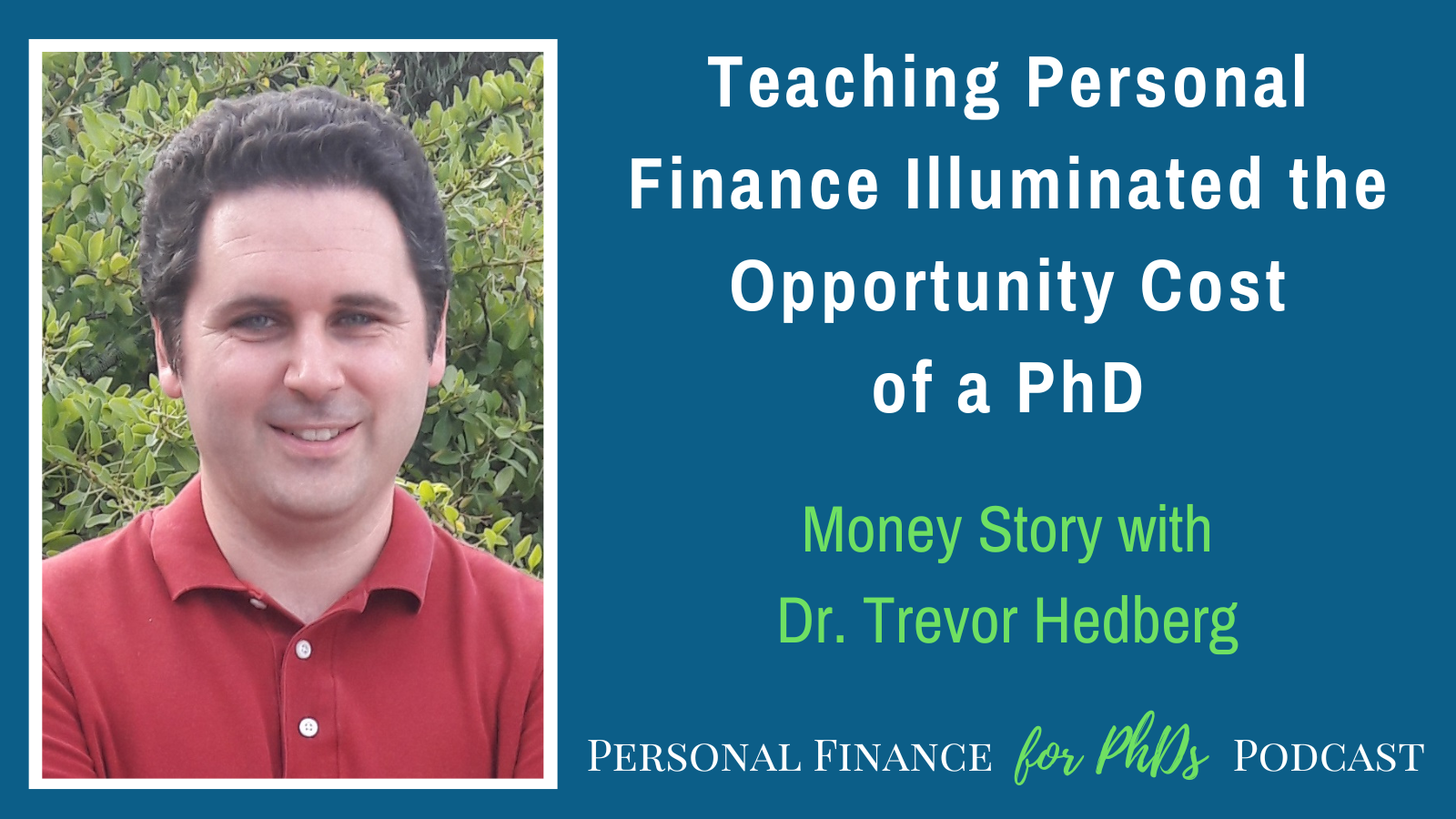
Teaching Personal Finance Illuminates the Opportunity Cost of a PhD

March 23, 2026 by Jill Hoffman Leave a Comment

In this episode, Emily interviews Dr. Trevor Hedberg, an assistant professor of practice at the University of Arizona who teaches a seminar on personal finance to undergrad students based on Morgan Housel’s The Psychology of Money. Trevor is a repeat podcast guest, and he shares how teaching the course has made him think differently about finances during his PhD and postdoc, including the financial opportunity cost of grad school and lifetime wealth killers.

Links mentioned in the Episode

  • Dr. Trevor Hedberg’s Website
  • Learn more about Dr. Trevor Hedberg’s research
  • PF for PhDs Tax Workshops (Individual Purchase)
  • PF for PhDs Tax Workshops (Sponsored)
  • PF for PhDs S8E14: A Low-Cost Lifestyle Can Be Both Necessary and Enjoyable During Grad School
  • The Psychology of Money by Morgan Housel
  • The Art of Spending Money by Morgan Housel
  • PF for PhDs Tax Center for PhDs-in-Training
  • PF for PhDs S22E4: The Importance of Financial Student Services to Graduate Students on Stipends
  • Millionaire Mission by Brian Preston
  • PF for PhDs Subscribe to Mailing List
  • PF for PhDs Podcast Hub
Teaching Personal Finance Illuminates the Opportunity Cost of a PhD

Teaser

Trevor (00:00): Because I think that the actual mechanisms for building wealth over time are really pretty simple to understand, but remarkably difficult to put into practice. And I think also as academics, like we’re primed to think that problems in the world sort of correlate in difficulty with their complexity. But it’s not always the case that problems are difficult because they’re complicated. Sometimes it’s just that there are psychological and behavioral things that kind of sabotage us in, in what we’re trying to do.

Introduction

Emily (00:38): Welcome to the Personal Finance for PhDs Podcast: A Higher Education in Personal Finance. This podcast is for PhDs and PhDs-to-be who want to explore the hidden curriculum of finances to learn the best practices for money management, career advancement, and advocacy for yourself and others. I’m your host, Dr. Emily Roberts, a financial educator specializing in early-career PhDs and founder of Personal Finance for PhDs.

Emily (01:07): This is Season 23, Episode 6, and today my guest is Dr. Trevor Hedberg, an assistant professor of practice at the University of Arizona who teaches a seminar on personal finance to undergrad students based on Morgan Housel’s The Psychology of Money. Trevor is a repeat podcast guest, and he shares how teaching the course has made him think differently about finances during his PhD and postdoc, including the financial opportunity cost of grad school and lifetime wealth killers.

Emily (01:37): The tax year 2025 version of my tax return preparation workshop, How to Complete Your PhD Trainee Tax Return (and Understand It, Too!), is now available! This pre-recorded educational workshop explains how to identify, calculate, and report your higher education-related income and expenses on your federal tax return. Whether you are a graduate student, postdoc, or postbac, domestic or international, there is a version of this workshop designed just for you. I do license these workshops to universities, but in the case that yours declines your request for sponsorship, you can purchase the appropriate version as an individual. Go to PFforPhDs.com/taxreturnworkshop/ to read more details and purchase the workshop. You can find the show notes for this episode at PFforPhDs.com/s23e6/. Without further ado, here’s my interview with Dr. Trevor Hedberg.

Will You Please Introduce Yourself Further?

Emily (02:50): I am delighted to have a repeat guest on the podcast today, Dr. Trevor Hedberg, who is currently an assistant professor of practice at the University of Arizona. Trevor was first on the podcast in season eight, episode 14, way back in 2021 when he was a postdoc, and we’ve had five years of time pass. Um, and there’s been a lot of changes and Trevor has a lot of new insights for us today. So I’m very excited to dig into that, um, both on the professional and personal front. So Trevor, will you please introduce yourself and tell us what’s been going on professionally in the last five years?

Trevor (03:26): Sure. Thanks Emily, and thanks for having me back on the, uh, podcast after all this time. So, um, I’m, I’m now as, as you said, an assistant professor of practice. Uh, my primary affiliation is with W.A. Franke Honors College. Uh, I also have a partial affiliation with the philosophy department. Um, the last time I was on, I was a postdoc at Ohio State. Um, and in the, a year or so after that, uh, I landed this job here at the University of Arizona and have been, um, continuing to teach undergrads, do my research, and, um, and most recently I’ve started teaching a personal finance, um, seminar here in the Honors college.

Teaching Personal Finance Seminars Using the Psychology of Money

Emily (04:03): And that is what prompted us to revisit and have another interview. And I’m so excited about this. Um, but yeah, tell us how you went from, you know, doing philosophy for your PhD to teaching personal finance at this point.

Trevor (04:16): Yeah, well, if, if anybody remembers five years back, I did, I did talk a bit about, uh, when I was in graduate school, the, the challenges associated with managing to live on such a small stipend. And so I had some personal interest in issues in personal finance because I had been grappling with some of them, uh, in my own, in my own life, just to kind of, you know, make it as a graduate student, uh, without having to take out additional loans. Um, when I got here to the University of Arizona, it was not part of my original, you know, teaching load. Uh, I was mainly hired to teach applied ethics courses, which is what my main research area is. Um, but there was a personal finance seminar that was being offered in the Honors college, but it was being offered by an out of house faculty, a faculty member in a different department that we were paying, um, to teach that seminar once a year.

Trevor (05:03): And these little honors seminars are one credit classes that, um, all honors students have to take one of them in order to graduate with the honors distinction on their transcript. So, and that happened to be one of the most popular classes, but it was only offered once a year. And the course caps on these seminars are pretty small, like, you know, low twenties in terms of the number of students. And so they were interested in, you know, this, that course was always maxing out. It’s, it had tons of people on the wait list and just, there was a lot of student demand, so it just came up in an administrative meeting. Um, you know, is there, is there someone else who might wanna teach like a course in this area? And I said I could take a crack at it. And, um, about a year later, um, we, you know, we piloted the first, and of course that course filled to capacity.

Trevor (05:53): Um, I used a, uh, I used the primary text Morgan Housel’s, the psychology of money, um, because my way of teaching the course is not just the nuts and bolts of personal finance, you know, what’s a credit score? What’s an IRA, how do you save for retirement? How do you design a budget? It’s also about the psychological and behavioral elements of, of money management and trying to familiarize the students with the, the obstacles that get in the way ’cause I think that the actual mechanisms for building wealth over time are really pretty simple to understand, but remarkably difficult to put into practice. And I think also as academics, like we’re primed to think that problems in the world sort of correlate in difficulty with their complexity. Um, because almost all the things, especially in philosophy, like all the stuff I write about, these are super complicated moral issues with all kinds of, you know, things changing empirically.

Trevor (06:44): All kinds of assumptions being made in the background about effects of, you know, emerging technologies and things like that. But it’s not always the case that problems are difficult because they’re complicated. Sometimes it’s just that there are psychological and behavioral things that kind of sabotage us in, in what we’re trying to do. And history is littered with examples of people who came upon or accumulated vast amounts of wealth at some point in time and managed to lose all of it in a very short span of time. Um, and, and my hope is that the students that come outta my class won’t follow that life trajectory.

Emily (07:20): Well, I love that you mentioned Morgan Housel’s book, and actually at this moment I’m on the waiting list for his next book or whatever his most recent book is. I’m, I’m at the library. I’m gonna be getting it soon. I’m really excited about that. Um, I’m wondering, is that the same, uh, core text that the previous, um, professor who was teaching this course was using? Or was that a shift that you made?

Trevor (07:41): So, interestingly, it was the same primary text that he was using, but I did not know that when, um, when I was like, I was essentially just looking at different books that, trade books that were written for, you know, a general audience in this area. And that was the one that kept coming up, uh, as a, a very popular source. I mean, the, the way the book is structured, each chapter essentially has one key lesson or idea, and the chapters are only, you know, eight to 10 pages long and there’s 20 of ’em. And so for a one credit course, um, where, you know, you don’t want to really overburden the students in that kind of class with a ton of a ton of reading, um, or assessments. It was just a good fit. Uh, I didn’t, now I have this semester, um, this is my third time teaching the course. I have cut out a couple of chapters of the book that I had previously assigned and replaced them with other material covering the same stuff. Uh, ’cause you know, some chapters seem to resonate more with students than others. And so I’m, I’m trying to, you know, kind of keep, keep tweaking the, the course content to a, to adapt to what works best, um, for the students, uh, Housel’s like new book is called The Art of Spending Money, and I actually do have a chapter from that book that I’m, that I’m gonna use, um, this semester. There’s a lot of overlap in his ideas in the art of spending money and in the psychology of money. But I did find, uh, I haven’t read the entirety of the art of spending money, but like probably two thirds of it, I have found the prior book, the Psychology of Money, I, I thought it was superior. Um, the, and I think like there’s overlap between the ideas. It’s clear to see that the artist spending money is an extension of some of the things he says. But, um, certainly as a teaching tool, I think the psychology of, of, of money has is, is a very good text and, and works well for, for these purposes.

Final Project: Creating a Long-Term Financial Plan

Emily (09:33): Yeah. And certainly a credit to it that you and your predecessor both independently chose it for this particular course. Um, it is a very easy and entertaining read and almost like filled with anecdotes and yeah, it’s a very, um, it moves along very quickly and it teaches you a lot in a very effective way, I think. Um, is there anything else that you wanna tell us about the course itself?

Trevor (09:55): Probably the, um, the final project that I’ve had the students do in the class the previous two times is I, I have made them actually design and outline a personal financial plan from their current age, which for most of ’em is about 20 all the way up to retirement age at 65, uh, operating at about five year intervals. Now doing that, uh, that is challenging for anybody to do regardless of, of, of your, of your age or your, um, financial situation. But I think that a lot of these students have never, they’ve never imagined like their, their wealth building journey on this long time horizon. And so I got a lot of feedback the first semester I taught the course where like everybody was like, this is a really valuable thing to do. And also, this was really, really hard and I would like some more direct guidance and more resources.

Trevor (10:40): Um, so I spent more of an effort last semester, um, showing them in class how to use retirement calculators and, um, and where to look to get information about like what their expected income is in their anticipated career at different life stages. And, uh, and also pointed some things out about like, you know, what commonly goes wrong over the course of a lifetime in trying to, because I, I required them in their timelines to incorporate some negative life events that, not saying that those things will happen, but basically like, don’t design your plan operating where, oh, I’m never gonna have any health emergencies. I’m never gonna have a, be in a car accident. I’m never gonna, you know, have any period of unemployment or decide to make a career change or go through a divorce. Like these are not realistic. Something bad will happen to you over 45 years of your life. You just don’t know exactly what it is. So plan for some of those things. Imagine that those things alter what your plans are and, and adjust your goals, um, accordingly, or like build in that preparation into how you structure your emergency savings or, or, um, or what you end, you know, what, what career decisions you make earlier in your life.

Emily (11:50): I think that exercise is so valuable. And actually I don’t think I’ve ever done that, like, to that level of detail, like projecting that far out. But I did want for our audience to take it down to a, a smaller timescale. Um, and just emphasize this principle of don’t assume everything is going to go perfectly financially, um, especially as you’re entering into a new position as you’re entering graduate school, as you’re entering a postdoc later on in your career. Um, if you’re pro projecting your budget and trying to figure out, okay, can I make it on this stipend? Can I make it on this postdoc salary in this city? You have to build in some of those shocks and prepare your finances for them because the length of term you’ll be in, you know, your PhD program, the length of time you’ll be in a postdoc way too long to assume that nothing is gonna go wrong. And so if your plan relies on everything going perfectly and you’re living on a razor’s edge, it’s not a good enough plan at that point.

Trevor (12:43): Yeah. The, the one, um, the one change that I am making this semester to that final kind of project is I am giving them an alternative option because a number of students kind of seemingly wanted to do this in previous courses, which is I’m gonna allow them alternatively to spend 12 weeks during the semester tracking their spending. Um, and then essentially the, the personal financial plan has two components, like the timeline that I’ve kind of described, and then a narrative that syncs up the timeline with like the course content and material. Like, why did you pick the strategies you did? How is it influenced by the, um, the stuff that we’ve read? Uh, it’s the same thing, but it’s like the information you’d be using is like, what did you learn about your spending over these 12 weeks of tracking your interactions with money? What do you spend money on? How is that consistent or not consistent with the things that we have, uh, covered in the, in the class? You know, what changes might you make in light of what you’ve learned to how you are, uh, to how you’re spending money or what you’re spending things on. Um, now whether or not students will actually like do this project, ’cause this requires you to get started like week three or week four, I’m gonna outline for them next week like how to use a template that I’m giving them for tracking, you know, your spending over time. So it’s an experiment. We’ll, we’ll see how many people actually do it. Um, but, but the idea behind both of these is just, you gotta have a certain level of intentionality and forethought with respect to how you manage your money. It does not magically happen in, in some way. And, and, and for I think virtually every student who takes this class, they’ll not have done either of these things, either this long-term kind of mapping things out to retirement, at least hypothetically, or just let me see what I’m spending money on for three months and see if I am okay with my behaviors. Uh, and if not, what am I gonna do to make a change?

Emily (14:38): I’m just loving this. I hope the audience is as well. And you know, I’m sure they’re all wishing they had the opportunity to take this course, uh, when they were in undergraduate or in graduate school. Um, it sounds incredible, uh, but I understand that you, you know, this is now your third time through teaching the course. It’s caused some reflections and, um, you know, rethinking in you about, you know, decisions you’ve made in the past and so forth. So I’d love for us to kind of, yeah, with this new information and deeper knowledge that you have in this area. Like, let’s speak to, you know, your time as a graduate student and as a postdoc, and how your thoughts about that have changed.

The Opportunity Cost of Grad School

Trevor (15:12): Yeah, so one of the things when, one of the, the basic pieces of advice you always get if you go to grad school in the humanities is like, don’t take out any loans to pursue because of the career prospects are uncertain and you don’t wanna take on additional debt, so on. That’s a totally fair point. It’s actually very understated, um, how important that is. But there’s also, like, there’s a really high opportunity cost to going to graduate school in, in, in any humanities field in your early twenties because the, you’re, you’re de you’re depriving yourself of, of a financial resource that we don’t talk about that much. Um, so a lot of people will point out like, well, if you, if you got an even just an entry level job where you were making, I don’t know, $50,000 a year to start out, you’d not only be working towards having a higher income, you would also be potentially, you know, paying off your debt sooner or, you know, uh, accumulating, you know, $50,000 a year instead of 15 or $20,000, whatever your graduate student stipend was.

Trevor (16:09): Um, that’s all fair. But the real resource that you’re depriving yourself of is time, uh, and specifically time for your money to grow via some kind of investment mechanism. So the, the alternative where you’re making 50 or $60,000 a year in your early twenties as opposed to try just trying to get by, not take out any more loans and, but not in a position to really save anything, um, when you’re in graduate school, that time is disproportionately more valuable than time in your thirties and forties and so on. Because if you put that money even in just like a basic index fund, um, it’ll, we have to make some assumptions about like, you know, based on past performance of how like the market does, but it’s reasonable to think that whatever money you put in will double somewhere between seven and 10 years after you put it in.

Trevor (17:00): So if you were to spend your twenties, even if it was just, I don’t know, $10,000, $15,000, put that in. By the time you are in your, you know, mid sixties and looking to retire, that money is going to have, have doubled four to six times. And so you’ll be in a position where if it was say, $10,000 and even if it only doubled four times, 10,000 goes to 20,000, 40,000, 80,000, that’s $160,000 by the time you get all the way down there. This is the, just the basic concept of compound interest, which I spend about two weeks trying to drill into my students in, in this class because all of them are typically 18 to 20 year olds. And so for them, the greatest resource they have is, is their time. So I think, I think this is an element of going to graduate school, uh, and being in graduate school for a long time with a relatively modest salary, uh, that isn’t properly appreciated because you’re, you’re not just depriving yourselves of like income in the short term. You’re also taking away like essentially one doubling cycle on money that you could save. And that, that, that cycle that takes place during the twenties, so and so if you, if you lumped all this money in instead, like when you’re 30 instead of when you’re in your early twenties, you’ll only wind, you’ll only have about half as much at the end of this process as you would’ve had, um, using that same money if you just put it in eight to 10 years earlier.

Emily (18:27): I, I wanna make sure the audience is really picking up on this because, um, as you’re saying, it’s not just the lost wages, it’s the lost time for the investments. You, we can presume in our scenario, you would’ve been doing had you not been in graduate school, and it’s not just a few thousand dollars or 10 or $20,000 that you could have invested, let’s say in your twenties, if we’re talking about a traditional PhD student, what we’re really talking about is the last doubling that occurs on your money. Your career itself is let’s say seven years longer if you start it after your bachelor’s degree instead of starting after your PhD. So to make up for that last lost doubling, which could be worth, it could be worth a million dollars. It could be worth hundreds of thousands of dollars easily. You have to earn more on the backside of the graduate degree and save more on the backside of the graduate degree, invest more, um, to make up for the lost time.

Emily (19:24): And so, as you know, from your perspective as someone in the humanities, um, that’s something that you have to be very, very cognizant of, careful about, like if you, how much is the premium going to be on your salary if you have the PhD versus not? What’s the expected outcome there if you get the tenure track job versus you have to take some other kind of job because it didn’t work out in that respect. So you have to make so much more money to make up for this. Now we can all make lifestyle decisions, like it’s okay if you just want to have a PhD, but to be aware of the financial, you know, implications from that decision. Um, really it should be taught before you make these decisions about where you’re, you know, if you go to graduate school, where you go to graduate school and so forth. So I’m really glad you brought this up. I just wanted to put another like kind of underline under there that’s not just a few thousand dollars, it’s the last doubling that you’re missing out on.

Trevor (20:18): Yeah. Now, as a disclaimer, I should note that like, I don’t think this is in itself like a decisive reason to never go into any graduate program or pursue any professional training. Um, most people who go into graduate school in philosophy or any humanities field like I did, uh, you’re probably making that decision primarily for non-financial reasons. I would hope, I would hope that that is the primary motivation for, for doing that. So it’s not like I look back and I say, oh, it was just a total mistake to go to graduate school in philosophy because I, because, you know, my 65-year-old self could have, I don’t know, $500,000 more than I would’ve had, uh, in, in the, in the timeline that I’m currently in. It’s more like knowing what I know. Um, if I could go back in time, one of the things I would’ve done, I was able to still save a, a significant chunk of money while I was in grad school.

Trevor (21:06): And I used some of that to pay off, um, a couple of stu of, of the student loans that I had from undergrad. Um, but I had enough money at, at a couple of points in time where I could have opened a Roth IRA and it wouldn’t have been a huge sum of money initially if I did it as a lump sum, it would’ve only probably been like a couple thousand dollars. But I think what I would’ve liked to do is open a Roth IRA around the age of maybe 23 or something like that, and put in, you know, a hundred dollars a month or something like that. Uh, just get into the hab- even if it was only $50 a month, right? Just build a habit of just putting money in investing in this vehicle. And I just, it did not occur to me, uh, at that time, uh, to do that. So that’s probably the biggest, the biggest change I can look back on and say I would’ve made, um, in grad school. The-

Emily (21:52): Absolutely. So to take that scenario that I just said, okay, you’re starting a career, let’s say seven years later because you decided to do a PhD and you couldn’t save in that meantime, um, that’s true under that set of assumptions that we were just talking about. But what you just pointed out is if you can start to invest a little bit, then you have started that clock, then you’re not missing out entirely on the last doubling, you’re missing a fraction of it because you’re able to invest much less than you would if you had a different kind of job during that period. But you’re, you’re lessening the damage, right, of that lost time just by getting started a little bit. And as you said, a hundred dollars a month, $50 a month, this is still a significant amount of money once you project it forward, you know, as you said, four to six doublings later.

Emily (22:34): Like, this is a significant and effective amount of money. And so it’s not, um, something that you should disregard just because, oh, I can only save $50, I can only save a hundred dollars. No, go ahead and do it if, if you’re financially ready for it. And as you just mentioned, it not only is the effect of the money itself, but the, it’s the effect of the habit. It’s the effect of you having your identity as I am someone who invests even in difficult life circumstances. I still invest, you know, and so that’s very, very valuable as well.

Commercial

Emily (23:03): Emily here for a brief interlude! Tax season is in full swing, and the best place to go for information tailored to you as a grad student, postdoc, or postbac, is PFforPhDs.com/tax/. From that page I have linked to all of my free tax resources, many of which I have updated for this tax year. On that page you will find podcast episodes, videos, and articles on all kinds of tax topics relevant to PhDs and PhDs-to-be. There are also opportunities to join the Personal Finance for PhDs mailing list to receive PDF summaries and spreadsheets that you can work with. Again, you can find all of these free resources linked from PFforPhDs.com/tax/. Now back to the interview.

Financial Changes After Grad School

Trevor (23:54): Yeah, so once I got out of grad school and, and got into kind of, you know, making like a reasonable, like closer to that $50,000, you know, hypothetical income we were talking about, um, the things I did after that was like, I immediately paid down, you know, my high interest student loan debt. Uh, I had never had any, I’ve never had any credit card debt. I’m one of those, uh, what they call in the industry deadbeats who uses credit cards, but just pays off the balance in full every single month. Uh, so that wasn’t an issue. And then I, um, now I, I didn’t really look into, it took me about two years to pay off that debt and to pay off my car. And then I started my postdoc at Ohio State, and it was really that moment, like early, like I believe I was 31, um, when I was actually like, okay, I have some retirement money from, you know, that was just being pulled from my paycheck at South Florida.

Trevor (24:45): Let me convert that into a Roth IRA and, and let’s, let’s actually now start, start like taking this, you know, seriously, not because it’s like, I didn’t care about it previously, but it’s like I actually have money now. I actually am saving a significant chunk of, of my income because one thing I did manage to avoid and have continued to manage to avoid is I have not really had the lifestyle creep problem that, that some people experience, where as your income goes up, your, your lifestyle and the cost of it proportionally increases so that you, you know, you’re making $10,000 more a year or $20,000 more a year, but you’re not actually saving any more money than you were when you were making less. Um, that has not been a, I I haven’t been tempted, um, to, uh, just start to live lavishly, um, once, once I had like a real income

Emily (25:39): Listeners. I have, I need to be very disciplined still <laugh>.

Trevor (25:43): Yeah, so I, I think, I think once I got into like doing the stuff in the postdoc, like I don’t really think there are a lot of choices I would’ve made differently given that, but I, I do, as I said, wish I had kind of set myself up, um, a little bit better. One thing I have learned in teaching this class and just investigating kind of the trends in among, you know, my, the, these people in their late teens, early twenties, folks who are just starting to manage their money. Um, there are certain kinds of well-known like wealth killers, and it’s amazing how often if you just, if you just, if you read some books on the subject or if you, uh, just browse like YouTube videos or other social media for like, from financial advisors or other people, the same kinds of problems just surface over and over again in this in different ways.

Four Common Financial Wealth Killers

Trevor (26:27): Credit card interest, I think is the most well known like wealth killer because the interest rates are so high, you do not wanna ever be carrying a balance month to month on a credit card. Um, student loan, um, interest if, if the, particularly if you’re taking out like private student loans with real high interest rates and not being very aggressive and paying those off. Um, historically there have been cases of people who spend 10, 20 years paying down a balance, and because they were paying so little on the balance, the amount they owe is actually more than the amount they started with because they’re not, they’re not paying off any of the principal money they borrowed, they’re just paying off the interest. Um, that’s a disastrous situation that I, you know, emphasized to my students, you gotta avoid.

Trevor (27:11): And then the two things that, so I knew about those, but there were a couple other things I did not know about, um, teaching this course, one of which is just dubiously financed auto loans. Um, this is sort of a combination of a couple of things. Buying, buying a car you can’t afford, uh, but also buying it on terms that I didn’t even know existed. Uh, I, you know, I, I’ve heard now that there are apparently 84 month and 96 month car loans, which I didn’t know that was a thing. Um, and the interest rates, um, the car I have right now is a 2.9% interest rate, which is pretty good. I think I’ve seen interest rates of like between 11 and 16%, uh, in, in some, in some instances that get talked about in some of these videos. And that’s, um, that’s sort of nightmarish. Uh, and granted, I know like, you know, having a good credit score is what qualifies you for interest rates. Not every people are in different circumstances, but you gotta be cognizant of what kind of car you can afford given your financial situation.

Trevor (28:07): And you’ve, you’ve, you’ve gotta, you’ve gotta find a better, better situation with that. You cannot take, if you’re, if you’re paying 11% interest on $80,000 car, uh, by the time and it’s 84 months, by the time you pay that off, you’re probably paying double what the car’s value is. And it’s a depreciating asset. So if you, you know, get, if you get caught in a situation where you have to get rid of the vehicle or it’s totaled out or something like that, uh, you may have to roll negative equity into your next, which is another thing that I didn’t even know was like an option for, for vehicle purchases. So I don’t know if, like, I was just naive about how people buy cars or, or what, but seeing like all of the ways you can sabotage yourself in that area has been somewhat enlightening for me teaching, um, teaching the class.

Emily (28:51): I totally agree with you, and this is really great stuff to know when you’re going into like your first car purchase or maybe your first financed car purchase or new car purchase or something along those lines. Um, but zooming back out to that like sort of lifetime timeline that we were talking about earlier, one of those other wealth killers related to cars is just always having a car loan. Like never keeping a car <laugh> much, much long, you know, much, much longer past the time period when you’re done paying off the loan. A lot of people do get in a cycle of, they’re just accustomed to it. They’re just accustomed to always having a car loan when their car is paid off, they get another new or they finance another car. And that, that habit alone makes a massive difference for your wealth over your lifetime.

Emily (29:36): I mean, easily a million dollars if we’re talking about like more expensive like kinds of cars, it’s incredible what that habit is. Now, there are structural reasons why this happens, okay? Like we live most of us in very car dependent cities. Absolutely. And so cars are a necessity for a lot of people. And the other thing, sorry, this is a little bit of soapbox for me, but like the types of cars that are being produced now are much, much, much more expensive than types of cars that have been produced in the past. So people feel like they’re kind of forced into a very expensive car just because they’re very limited options on the lower end of the price range. So that is a structural issue that’s kind of pushing people in this direction that’s also very worth, you know, pointing out. But the more, as you’re doing with your students, you know, the more awareness you have about these, um, influences around you, the more that you can try to work against them when you’re making your own individual decisions.

Trevor (30:28): Yeah, and I, I definitely empathize with the point about, um, not wanting to be in a state where you don’t have a car payment every month. So when I came to Arizona, I was driving, um, a Hyundai Elantra that had been fully paid off for several years, but a few months into being here in Arizona, uh, it was one of those older models of vehicles that, uh, unbeknownst to me did not have what is known as a key immobilizer, which means that if you knew what to do, uh, and unfortunately, yeah, so there was a, a TikTok trend about this that was going around under the hashtag Kia Boys, where it was basically a series of tutorials about how to steal Kias and Hyundais that had been manufactured without key immobilizers. And essentially if you strip off the steering column and know what to look for and have like a large blunt object, uh, like in, in this case, I believe it was a, just a screwdriver, um, a flathead Phillips flathead screwdriver that was used. You can, um, you can get the car to start without having any of the keys, right? And so overnight, uh, my car was stolen outta my apartment parking lot and crashed and totaled out in, uh, in like 25, 30 minutes outside of town. Um, and this is apparently just what these people were doing. Um, so somewhere on TikTok, there may be a video in, in the archives of someone driving my Elantra and just crashing it out in the Catalina Foothills of Arizona. Um, but I had two off-, just two. I was woken up by two police officers knocking on my door at 7:00 AM and be like, sir, do you have the keys to your vehicle? Do you know where it’s located? You know, et cetera, et cetera. So we eventually figured out what had happened. Someone had broken out the back window, uh, of the car climbed in, stripped off the steering column. There was a screwdriver in the vehicle that was not mine. That was a very long, you know, uh, there had been a bunch of stuff that had been, you know, it, the vehicle had been totally trashed. It was totaled. Um, so I had to buy a new car here in Arizona. Like that wasn’t my financial plan. This is one of those things that can go wrong, right? We were talking earlier about you can’t, you can’t, like that was a completely unanticipated event. Um, my insurance gave me a very good like, payout for the vehicle, but I had to get a new vehicle right when it wasn’t, it wasn’t part of the plan. Um, so I’m looking forward to, in about a year where I will have this current car paid off and not, um, and not, not have, hopefully not have that car payment for a lot, for a lot longer. I know my new car does have a key immobilizer, so at least won’t be destroyed in the same way.

Trevor (32:53): So the, the one other thing I learned that that was not, this was definitely not a thing when I was growing up, is, um, there’s, so one of the great advantages we have now compared to the past when it comes to like building wealth, is you can manage your investments and other stuff like online. You don’t have to go through like a broker at a brick and mortar bank. Um, and, and you can, you can get a snapshot of like how things are going, what you’re doing, et cetera, way more easily. But the downside of that is it’s now also possible to engage in dubious investment practices or what we would just describe as outright gambling, um, with your money. Some of that is in investment formats. People who are doing, like, they’re, they’re pretending sort of to be day traders, uh, and, and doing, doing things with their money. That’s, I think just basically indistinguishable from gambling, especially if they’re doing things like investing in these, these crypto meme coins where occasionally something hits it big, but the vast majority of the time these things just crash zero over over time. Um, and, and the other big one is sports betting, which is just everywhere now.

Trevor (33:56): And, uh, used to be a very niche thing, uh, that that very few people did. And if they did, it was really just kind of a novelty, like, oh, I happen to be in Vegas, so whatever I, I, I bet on a horse race or something like that, I, but now it’s everywhere and you can access it on your phone. Lots of, lots of, and, and it disproportionately affects young men. Um, the vast majority of, of sports bets are men, uh, and they’re, they skew really young. Um, that, you know, age range of 18 to 25 seems to be like the, the largest, um, growing demographic of that. So I’ve been trying to caution my students many times about not doing these things, these behaviors where you’re ex the expected value is not that you gain money over time, right? And that’s why FanDuel and DraftKings and these, um, why they give you these promotional benefits, you know, that $5 get $200 in bonus bets or, or these, these profit boost tokens they give out where, oh, if your bet hits you get 1.5 times the payout on this. You know, it’s all designed to just keep you there placing bets because they know the longer you’re in the game, the more likely it is that eventually you’ll lose and they’ll make money off of you.

Emily (35:10): Absolutely. I was just explaining to my daughters a few days ago, the concept of gambling. Like they don’t even know what it is. They’re very young, and I, the first thing I said to them is, the house always wins. Remember that <laugh>, like, do not let go of that lesson. The house always, always wins. As we’re recording this interview, um, in January, 2026, it happens to be that I listened to a podcast episode yesterday of deep questions with Cal Newport where he covered sports betting and gambling and the new technology around that and how prevalent it is, as you were mentioning. And this also came up for me in previous conversations with Dr. Zach Taylor, who’s been a repeat guest on the podcast as well, who works with undergraduate students too. And so the stat that I heard in that episode with Cal Newport was that, um, 70% of young men who live on a college campus have a sports betting account, right?

Emily (35:55): We don’t know how much they’re using it, but they have an account, they have access to it. Um, and so to me, I don’t address gambling much. I think this is maybe the first time it’s come up on the podcast, but to me, I struggle with, um, helping to teach how <laugh> entertainment and spending money on entertainment might be okay, and it can be part of your budget, but how gambling, you know, obviously taken too far, it becomes very addictive and very financially damaging and damaging to relationships. And like, how do you find yourself on that spectrum and sort of for your own personal self, your own personal values, decide what you’re comfortable with and what you’re not. How, how do you address this with your students?

Dr. Hedberg’s Experience with Sports Betting on FanDuel

Trevor (36:37): What I tell the students about gambling, whatever form it takes, is that you need to approach what you’re doing. That money that is not savings money, that’s not money that you’re, you know, putting aside for emergency savings. It’s not money that you’re investing for retirement. This is money that needs to be in the same category as like, I’m going out to a nice restaurant, or I’m, I’m going to the movies with some friends, or I’m, I’m, I’m buying some, you know, decorative item from my home or whatever. Um, it needs to be money that you are okay if there is zero return on investment, if it is all, if it is all lost. Um, and that’s how I approached, um, I did a couple of years ago, um, use FanDuel, uh, which is one of the major sports betting apps, uh, for one year. And I basically took a fixed sum of money, which in my case it was like a thousand dollars.

Trevor (37:23): And I said, this is what I got for the whole year. If I lose all of it, that’s it. If I, whatever I, you know, and, and, and we’ll just see what happens. I mostly bet on NBA games as a sport I’m the most familiar with in that, in that kind of context. I actually wound up making $50 over the course of this whole experiment, but it was incredibly tedious, um, and did not make me enjoy watching basketball more. Um, for me it was very much the opposite. I could have made more money just putting that a thousand dollars into, uh, a brokerage account or even like a high yield savings account probably. Um, and so that, that was not, uh, ’cause the other factor is like the gambling earnings or taxed in kind of a weird way. So like, I’m, I’m not sure I actually made $50.

Trevor (38:09): I don’t know what the positive value was, but it was negligible is the, is the point. I neither made nor lost a meaningful sum of money doing that. Um, but if I had lost all of that money, nothing about my financial future would’ve hinged on that. There was no expected amount, rate of return. It was just an experiment. Wanna see how this app works? Want to see what, what this experience is like because so many people are doing it. Um, I don’t really regret doing the experiment, but I also like have deleted my account. Will never go back. So, um, I encourage, you know, my students to, if they are going to do any kind of gambling, to approach it that way, like set aside a fixed sum of money that is just your, and, and have it budgeted in that way. Don’t put more money into your account and do not anticipate or make projections about your financial future based on anticipated earn earnings or gains. Um, that, that’s a recipe for disaster.

Emily (39:06): And I think that, um, paired with this extra, this optional exercise that they have of tracking their spending over the course of the semester is really valuable because some people may be adding money all the time to these kinds of accounts, and it’s one of those like small transaction things that can kind of get overlooked unless you’re really, really in your numbers and adding them up over the course of the month or what have you. And so that could be really valuable. Oh, I’m actually spending this many hundreds of dollars per month on gambling, and maybe that’s not, that’s more than entertainment budget than I need to be spending at this point. Right?

Trevor (39:38): Yeah, I, we’ll see, I I, since I have done that activity before, um, I don’t know what to expect for what, what, how many students will do it or what I’ll, or what I’ll learn about it. But, um, but I do think that if they, if they really did it for the full 12 weeks, that’s three months, that’s enough of a time slice that they would get some idea of what some of their habits were, and they might get some insight into, um, where they might want to make changes, uh, in, in, in the future. Or maybe they would discover like, oh, I’m, I’m doing better in this than I thought, you know, it’s possible.

Dr. Hedberg’s Future Financial Plans

Emily (40:11): Absolutely. Uh, you mentioned the future, so I wanted to ask you if your own plans for your life, your finances have ch- and you know, forward looking have changed at all from your experience teaching this course?

Trevor (40:25): I think for the most part, I mean, I think some of the habits that I have had, had, had developed, um, I, I, I feel are a little bit more vindicated given, you know, like the avoidance of high interest debt and a and a few of the other things. Uh, as I mentioned earlier, I do kind of wish in the past and maybe I had developed an investing habit a little bit earlier. Um, but the, the one thing that is different now is that when I was a postdoc, I was always operating on basically 18 month time horizons with everything in my life because, you know, what’s the next job? What, what am I doing to make myself competitive for that next cycle? And that included the fi- the financial stuff too, right? I mean, there, there was, you know, there was an expectation that at some point that would stretch out longer term, but it’s really hard to like, feel like you’re prioritizing re- retirement outcomes when you don’t even know whether you’re gonna be employed the next academic year.

Trevor (41:18): And once, once I got here at Arizona and once, like, after a year or so, I kind of got the sense that this could be a fairly stable and permanent, you know, appointment, you know, and I liked living here and liked the people I work with. Um, then it became easier psychologically to say like, okay, we’re gonna, I’m gonna overhaul some of the things I’m doing and we’re gonna really, we’re gonna be maxing out that Roth IRA, the university has a, has an HSA as as well that you can use as a kind of retirement investment vehicle. So I’m maxing that out also. Um, and then, um, I also opted in actually to the university’s pension, uh, options. So they give you two options at the University of Arizona, and you have to decide pretty early in your, when you start your job, what you’re taking.

Trevor (42:00): One of ’em is a 403B, which is structured like a 401k, and the other one is a defined benefit pension plan where if you, there’s a formula where like you get a certain percentage of your highest five income earning years in the state of Arizona based on how many years you worked. And, um, so if you work, like, I don’t have the table in front of me right now, but if you work around 25 to 30 years in, in, in the state of Arizona, uh, while you’re eligible for the pension and are putting in the amount of, you know, it’s mandatory, they just deduct it, you know, pre-tax from your, um, from your paycheck, uh, you will get like something like 70% ish of your, of that salary every month, you know, for the rest of your life until, until you die. Uh, so the hope is that between like my Roth IRA, which is like a, like something that I’m maintaining on my own and which started with funds from Ohio State and University of South Florida, like the retirement stuff I had done in those places before getting here between that and the HSA and then having a pension hopefully between those three things, you know, in tandem. Um, I’ll, I’ll be all right when I, when I get into my sixties. Um, right now the short term goal is I’m, I’m, uh, I’m, I’ve got some m- money that I’m growing to potentially make a down payment on a house or, or maybe buy a condominium or something like that.

Emily (43:27): It’s amazing. I’m so glad to hear that, um, that you chose the pension. I mean, obviously the numbers are different for different people, but just to have that perspective, um, for the podcast audience of like, yeah, pensions actually do still exist, um, in higher education at certain types of institutions. And so this may be a choice that you are faced with and you, it’s really a combination of a career and a financial decision. And it’s also, I also would be very tempted by the pension just for the aspect of the guaranteed income. And as you said, you can still do some retirement investing on your own. Maybe you consider it optional, maybe you consider it necessary, I don’t know. Um, but you still have those other vehicles that you know, you can use for that purpose as well. So anyway, it’s just very interesting and as I’ve gotten, um, well closer to retirement, I guess you could say time keeps passing. Um, I find that idea of guaranteed income to be very attractive and possibly worth, you know, paying a premium for in some ways. So, super interesting.

Best Financial Advice for Another Early-Career PhD

Emily (44:23): Um, I wanna end with the question that I ask all of my guests, which is, what is your best financial advice for another early career PhD? You answered this the first time you’re on the podcast, so let’s get a, a refresh on that. And it can be something that we’ve touched on already in the interview, or it could be something completely new.

Trevor (44:40): The thing that I’ve learned, like I’ve mentioned here earlier, that the one thing I would go back and change is that I would’ve started, I would’ve opened a Roth IRA and I would’ve started investing, even if it was a tiny sum of money every month, just to build that, just to get that habit. Like this is just the thing I do. Um, I think that is something that is not on a lot of 22, 23-year-old PhD students radar. And that’s something that I would definitely, uh, tell people. Now, if I was, if I was advising, uh, an undergrad student who’s gonna go to grad school, this is, this is something that I would make them, um, privy to because, uh, you know, there are all these, um, calculators you can use on in online space to figure out how much money it’s worth. The most common figure that I’m familiar with, which, uh, originates from a guy named Brian Preston, who, who runs like a, I think it’s like called the the Money Guy Show, or the Money Guy podcast or whatever.

Trevor (45:33): He has a book called Millionaire Mission. He’s got this chart, uh, based on, it’s basically how much is a dollar worth at the age of 65 invested at different ages. And, and it assumes a declining rate of like investment returns as you get closer to retirement because you make your, you make your portfolio a little more conservative to make sure that that money doesn’t fluctuate dramatically right before you retire. And essentially $1 invested at age 20, at least according to his calculations, is worth about $88 at the age of 65. Now, again, there are some assumptions built into how that’s calculated, but on any plausible estimate, in my view, the minimum is it’s gonna be like $64 and it could be higher, it could be over a hundred, depending on, again, what background assumptions you’re making, how aggressive your portfolio is, and what actually happens in the market.

Trevor (46:23): So getting even just a small amount each month when you’re 21, 22, 23 years old into these kinds of accounts is just such an incredibly powerful thing. But you don’t get that money for 40 plus years. So there’s a trade off, you know, and, and I know as a graduate student, I was always weighing like, how much emergency savings do I need in the event that I’m unemployed for six months after I get my PhD? And it’s easy to look back now and to say like, oh, I really wish I’d invested, you know, 10,000, $20,000, uh, of, of that, of that money I had on hand now because I didn’t have that period of unemployment. But that’s very much a hindsight bias because certainly if things had gone a little bit differently, there could have been a gap of some sort where I would’ve been very glad to not have a bunch of money tied up in a retirement account. So this has to be, these things have to be weighed, but a small amount, $20 a month, $50 a month, whatever you can scrounge away, like just building that habit and knowing like this is, when you were in even I think once you get to your thirties and you see how much it’s grown in just that short time, you, you will not regret building that habit early and and making those choices.

Emily (47:31): Very well said. Trevor, thank you so much for giving this interview. Thank you for coming back on the podcast and giving us all an update. It was wonderful to hear from you.

Trevor (47:39): Yeah, thanks for having me back, Emily, it was great to see you again, chat about this stuff. And, uh, I, you know, I’ve, I’ve, I have enjoyed teaching about it and I, I expect I’ll keep doing that here in the Franke Honors College for quite some time.

Outro

Emily (48:02): Listeners, thank you for joining me for this episode! I have a gift for you! You know that final question I ask of all my guests regarding their best financial advice? My team has collected short summaries of all the answers ever given on the podcast into a document that is updated with each new episode release. You can gain access to it by registering for my mailing list at PFforPhDs.com/advice/. Would you like to access transcripts or videos of each episode? I link the show notes for each episode from PFforPhDs.com/podcast/. See you in the next episode, and remember: You don’t have to have a PhD to succeed with personal finance… but it helps! Nothing you hear on this podcast should be taken as financial, tax, or legal advice for any individual. The music is “Stages of Awakening” by Podington Bear from the Free Music Archive and is shared under CC by NC. Podcast editing by me and show notes creation by Dr. Jill Hoffman.
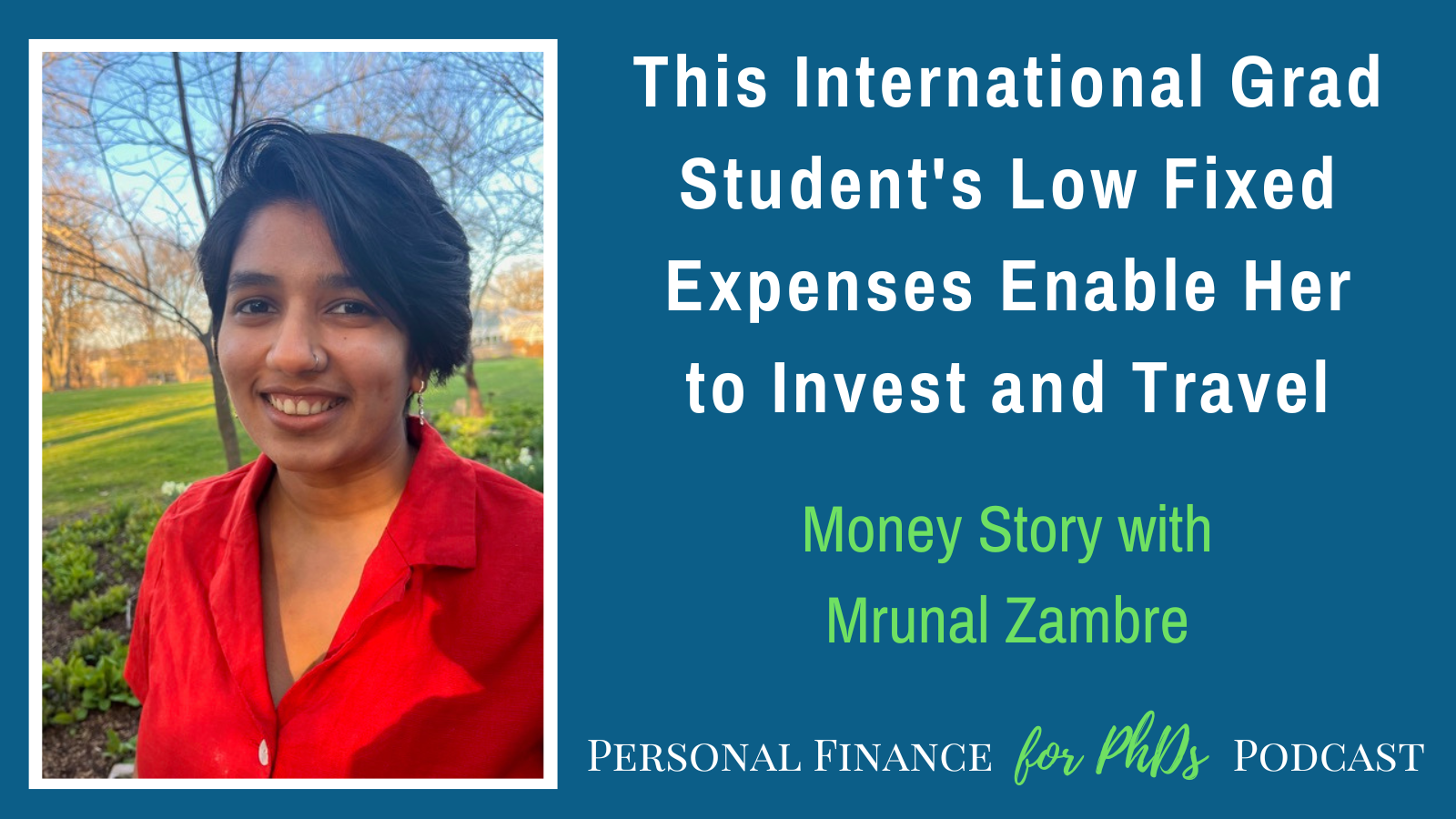
This International Grad Student’s Low Fixed Expenses Enable Her to Invest and Travel

March 9, 2026 by Jill Hoffman Leave a Comment

In this episode, Emily interviews Mrunal Zambre, a 4th-year international PhD student at the University of Pittsburgh. Mrunal details her money management system, from her checking and savings accounts to credit cards, and how she and her grad student partner split expenses. She focuses on travel credit cards and the Bilt card to reduce the cost of international travel. Thanks to her stipend—recently increased to over $40k—and low fixed expenses, Mrunal maxes out her Roth IRA annually and invests in a taxable brokerage account, even though she’s not sure if she’ll live in the US long-term.

Links mentioned in the Episode

  • PF for PhDs Tax Workshops (Individual Purchase)
  • PF for PhDs Tax Center for PhDs-in-Training
  • The Simple Path to Wealth by JL Collins
  • Friends That Invest by Simran Kaur
  • PF for PhDs S4E17: Can and Should an International Student, Scholar, or Worker Invest in the US?
  • PF for PhDs S22E1: The Simple Way to Invest as an International Grad Student or Postdoc
  • PF for PhDs Subscribe to Mailing List
  • PF for PhDs Podcast Hub
This International Grad Student's Low Fixed Expenses Enable Her to Invest and Travel

Teaser

Mrunal (00:00): Time is of the essence at this age. And instead of kind of being on the fence about whether to not do it or you know, whether to just keep the money in a savings account, it kind of costs you. Um, so if you wait to figure that out till later when you have more money or more income, you might have already lost amount of money that you could have grown over time.

Introduction

Emily (00:34): Welcome to the Personal Finance for PhDs Podcast: A Higher Education in Personal Finance. This podcast is for PhDs and PhDs-to-be who want to explore the hidden curriculum of finances to learn the best practices for money management, career advancement, and advocacy for yourself and others. I’m your host, Dr. Emily Roberts, a financial educator specializing in early-career PhDs and founder of Personal Finance for PhDs.

Emily (01:03): This is Season 23, Episode 5, and today my guest is Mrunal Zambre, a 4th-year international PhD student at the University of Pittsburgh. Mrunal details her money management system, from her checking and savings accounts to credit cards, and how she and her grad student partner split expenses. She focuses on travel credit cards and the Bilt card to reduce the cost of international travel. Thanks to her stipend—recently increased to over $40k—and low fixed expenses, Mrunal maxes out her Roth IRA annually and invests in a taxable brokerage account, even though she’s not sure if she’ll live in the US long-term.

Emily (01:44): The tax year 2025 version of my tax return preparation workshop, How to Complete Your PhD Trainee Tax Return (and Understand It, Too!), is now available! This pre-recorded educational workshop explains how to identify, calculate, and report your higher education-related income and expenses on your federal tax return. Whether you are a graduate student, postdoc, or postbac, domestic or international, there is a version of this workshop designed just for you. I do license these workshops to universities, but in the case that yours declines your request for sponsorship, you can purchase the appropriate version as an individual. Go to PFforPhDs.com/taxreturnworkshop/ to read more details and purchase the workshop. You can find the show notes for this episode at PFforPhDs.com/s23e5/. Without further ado, here’s my interview with Mrunal Zambre.

Will You Please Introduce Yourself Further?

Emily (02:59): I am delighted to have joining me on the podcast today, Mrunal Zambre, a fourth year PhD student at the University of Pittsburgh. And we are gonna be talking through a lot of high level elements of her finances from how she manages cash flow to, you know, long-term investing strategies to how do we do some travel as a graduate student. So I’m really excited for this conversation. Mrunal, welcome to the podcast. Would you please introduce yourself a little bit further for the audience?

Mrunal (03:25): Yes. Yeah, thank you Emily. Yeah, happy to be here. Um, so I guess, yeah, I came to the US I’m an international student, so I came to the US in 2016. Um, I came here for my bachelor’s. Um, I did, I majored in neuroscience, did minor in computer science from, uh, university of Minnesota. I graduated in May, 2020 amidst the raging pandemic that was happening. Um, and after graduating I stayed, um, I stayed on, stayed in Minneapolis, working in a lab that I joined in my senior year. Um, so I stayed on as a research technician, worked in the lab till 2022 on OPT and then, um, throughout 2021 was applying to grad schools, um, for PhD in neuroscience and, um, am now at University of Pittsburgh since August, 2022.

Emily (04:19): Fantastic. Thank you so much for that, um, background. So let’s talk about the money. What’s your stipend? 

Mrunal (04:26): The exact number is 41,199k annually, which comes out to be around 3,180 per month after some taxes taken off, um, in 2022. It started at 33K when I first first admitted. And about a year later, um, the school of Medicine, which is where in which is, uh, which school my program is part of, um, they decided that um, all school of medicine grad programs get a stipend of 40K. So it was a big jump, uh, early on and I think it’s a privileged position to be in to get that big of a jump. Um, and after that year it’s been kind of increasing like two to 3% for inflation. Um, yeah,

Emily (05:09): Love to hear that story. Yeah. Do you know any like precipitating factors, like why they made that decision?

Mrunal (05:15): I’m a hundred percent not sure actually. Um, I don’t know. It was a new dean that had just started. I dunno, maybe there was, uh, some built up about cost of living related expenses and stuff. So maybe that played a role, but I’m not, I’m not sure actually. It was kind of surprise to me as well.

Emily (05:33): Yeah. But a, a wonderful surprise accepting at 33 and getting a jump up to 40. That’s awesome. Especially because, my understanding is Pittsburgh’s sort of a moderate cost of living city, right?

Mrunal (05:43): Yeah, exactly. It is. Uh, it’s not, it’s, you know, people think of it as East Coast, but it’s not really that close to East Coast. So pretty, pretty affordable I would say. And I think the stipend goes a long way, luckily.

Housing, Transportation, & Grocery Costs in Pittsburgh, PA

Emily (05:56): Amazing. Well, I wanna ask you about savings in a moment. Um, but first can we go over just like baseline expenses about how much you spend on housing, how much you spend on transportation, those kinds of things.

Mrunal (06:06): Mm-hmm. Mm-hmm. Yeah. Uh, so yeah, speaking of affordability, our rent is pretty, has been pretty good in Pittsburgh. Um, I am living with my boyfriend in a one bedroom apartment right now, and the rent right now is around 940. Um, my boyfriend is also in grad school at Carnegie Mellon, so he has, he does, he, we share the rent. Uh, and because he doesn’t have a stipend, my share of the rent is around 620 per month.

Emily (06:34): Oh, I’m sorry. I just assumed that that 900 something was your part of the rent. Oh, okay. Sorry, I have to, to like reconfigure. Okay. So you’re paying 620 and he’s paying, that would be something like a third, right? Um, okay. Wow. Alright. Some points for Pittsburgh here. Um, awesome.

Mrunal (06:52): We are lucky.

Emily (06:53): Glad to hear that. Yeah. So give do the, do the math for me. That’s around 20% ish of your take home pay.

Mrunal (07:01): Yeah. Let’s see. 600, around 600 out of, yeah. 3000 around there. Yeah. 

Emily (07:07): That’s really great. I mean, with other, you know, you’re definitely not rent burdened like we hear from so many other graduate students, so that’s amazing. What do you do for transportation?

Mrunal (07:15): The University of Pittsburgh gives us, um, our ID counts as a bus, uh, pass. So there is the bus system. Um, there’s also a train system, but I don’t really use that for my day-to-day. Um, so that is free for me. I use the bus to get into lab and come back from lab, um, like five days a week. And I also have, uh, a 2012 Honda Civic. Uh, I bought it in 2021 in cash, so no car payments there, but there is an insurance payment, which is about $90 per month. And because it’s the Honda Civic, we get pretty good mileage. Um, and we fill up gas and because we don’t drive to work every day, uh, we fill up gas around like once every three-ish or so, three-ish weeks or so. So that comes out to be like $38 per per filling <laugh>.

Emily (08:08): Yeah. Incredibly minimal transportation expenses. Awesome. I feel like, is there a story around the purchase of the car? ’cause that was a very difficult time period for purchasing a car. Um, so how did you find such a, well, great vehicle, reliable vehicle, nine years old at the time that you bought it? Like, tell me about your decision around purchasing that car.

Mrunal (08:28): Yeah, I mean, um, at that point I was I guess a year out of, uh, college and, you know, I was in Minneapolis, a very cold winter, snowy city. You know, I managed throughout college not having a car because we pretty much spent most of our time on campus. Um, but I think I had just moved out of campus and was like, yeah, I need some way to like move around. And yeah, I think the US is a very car centric place. And so I started looking and it was at that point a tougher market. Um, it took quite a bit of time to like come across this deal. I mainly used Craigslist, um, as my source of looking for cars. I did try going down the dealership route. Um, but I didn’t really like that culture because I think it was very sales focused and the salespeople were just telling me that anything they had was a very good deal and they might’ve been, but it felt very pressuring.

Mrunal (09:27): And I guess on Craigslist, um, you, you, you know, you have to sort through the listings over there. Um, and there were some that I, I met a few times, uh, some good cars, some were, some were no shows. So I think I kept looking and at one point I was like, um, maybe not worth it. ’cause I was also going through grad school applications at that point. Um, so I was like, I’ll just keep an eye once in a while on Craigslist, see what comes up and, but focus on grad school applications. But luckily this, this came up and I kind of jumped on it pretty quickly because I knew I wanted, like, I think because my family, my family has a history of driving Honda cars, I knew that they were pretty reliable and this was a pretty good deal in terms of like how, how much mileage it had.

Mrunal (10:20): Um, so I jumped on it, met with a person, seemed like in a good-ish condition, like some rust spots. And I kind of used that to bring down the cash a little bit, uh, bring down the, the price a little bit and kind of jumped on it like, like once it looked good, like checked all the boxes and just spent with it. And I’ve been happy with it so far. It’s pretty reliable. Um, no, huge like, problems with the car, like the money goes into maintenance, but yeah. So I guess that was kind of the decision process. Sorry, it was long-winded.

Emily (10:54): Well, the reason I asked about, it’s because I know a lot of graduate students who are looking at a car purchase are nervous to buy something as old as nine years old. Um, I purchased a car when I started graduate school was six years old, which is also, you know, a lot of depreciation had also happened. It was a good deal. Similar to you. I was very patient, I knew what I wanted, I waited. Um, so there’s, you know, a big advantage if you can take that into the purchasing process. Um, but I’m just glad to hear that there hasn’t been like majorly anything that’s gone wrong. We’ve done a little bit of maintenance that’s to be expected. Um, but I do think it just, it’s nice to share a story about someone buying an older car that turns out to be reliable and very inexpensive.

Emily (11:32): Right? Because you pay cash up front, the insurance cost is less when you have. A less expensive, an older car and so forth. Um, like you said, particularly with the Honda Civic, it’s great gas mileage, so on that front. Um, so yeah, just, I’m glad to hear about that like positive story and just wanna kind of assure other people, like if you do your homework as best you can about the make and model and then wait for, you know, one that seems reasonable to come up in terms of mileage and everything. Like don’t be afraid <laugh> of buying a car that has some years on it.

Mrunal (12:00): Yeah, exactly. Like I think the only, like, I did get pieces of advice from like my brother and my dad, um, and the only like, major thing that I can pass on is like, if it is around 100K in miles, that’s, that’s okay. And I think the car has still a lot of life left in it. So it’s okay to get a slightly the older car,

Emily (12:20): Especially because it doesn’t sound like you’re putting a lot of miles on it now. Like so if you’re not using it for your daily commute, what do you use the car for? 

Mrunal (12:29): Um, so right now it’s kind of been like for groceries on the weekend, uh, if we wanna go somewhere for a restaurant or see friends and stuff, so, and take any weekend trips, uh, we want to, we used the car when we were moving from Minneapolis to Pittsburgh, so that, that, that was a trip. Um, and at one point my partner, he was working and early on like in 2022, um, and he was using the car, so we kind of share it right now. Um, so I think so far we’ve accumulated about another like 45K miles on it and I think we still have good amount of time left on it. So right now it’s mainly for leisure and for our wants rather than our needs.

Emily (13:14): Yeah. And it’s also great when you have that setup of being able to share a car with someone like, oh, we only need light usage, and hey, the two of us together are using it lightly, like not very expensive. 

Mrunal (13:24): Yeah. Yeah. I, I think it’s been been great. I’m pretty happy with it so far.

Emily (13:29): So aside from housing and transportation, do you have any other like major structural expenses that are kind of worth mentioning with your budget?

Mrunal (13:36): Let’s see. So yeah, housing, transportation. I think groceries definitely, again, because my partner and I share, um, I think in total it comes around to be like 500 per month. I think we budget for a little bit and then we always kind of go a little bit extra because I think we both enjoy cooking at home and we enjoy, uh, we prioritize having, uh, fruits, vegetables, snacks. So it 500 is okay for us, even though it might seem a little much. Um, health insurance, thankfully is covered by the program for me. Um, I only pay for dental and vision, which comes out to be $25 per month. Yeah, those are the major ones. Yeah.

A 25% Savings Rate & Money Management

Emily (14:14): And pretty much everything else sounds like it could be just discretionary types of spending. So I’ll come back to the question that I asked you earlier, which is how much are you able to save? Do you have like a regular fixed savings, savings rate or how do you calculate that?

Mrunal (14:27): It’s taking a bit of budgeting, um, like looking at where my money’s going and what I have room for. And uh, currently I’m keeping aside around 880 per month, um, which comes out, I did the math comes out to be like around 10.5k per year and I think that’s around 25%. Um, it was a little higher. It, it varies. It’s not always consistent. Um, but that is how much I’m able to save <laugh> right now. Yeah. Yeah.

Emily (15:00): Awesome. Um, let’s talk a little bit more about the money management then. Like what accounts do you have? What purposes do you have for them? How do they interact with one another?

Mrunal (15:10): So in terms of like what accounts I have, um, there’s definitely a checking account where my paycheck comes into. I keep another savings account, which I keep for, um, irregular expenses. And it is also a high yield one through Capital One. Uh, and that I keep, um, around, I’m, I’m building on it, uh, but I’m ke I keep around like 2K in there. And I also have a high yield, another high yield savings account through Marcus, which in which I keep, um, a travel fund, a four month emergency fund and a car fund and for a car maintenance stuff. So in terms of management, yeah, paycheck goes into a check checking account. I move whatever money I wanna save right away into like the savings accounts or investment accounts will come to that. And, um, yeah, some additional into the higher yield irregular expenses account.

Emily (16:17): So why are you splitting some of that targeted savings between the two different banks?

Mrunal (16:23): Um, just for I think ease like mentally. Um, ’cause I, I keep my travel, emergency fund, and car fund together in that Marcus account, just so that it’s building the interest and compounding on a bigger amount. The irregular expenses I could keep in there, but I think I like to see it in my, the same app as my checking account kind of as a buffer. Like, okay, I don’t wanna touch my emergency bigger account as much, but let me, let me use this kind of as an in between of um, pull into it as I need, but also like put money back into it as I use it up. And like, you can make these like bigger savings goals for like emergency fund, but then things like medical expenses sometimes, like, I think those can be irregular and not consistent that you can’t like really look like budget for every month. So this allows me like, okay, this is just chunk of cash that’s sitting for things that come up. Um, and if I do have like a, something I really wanna buy like a, a nice sweater for myself, I can use that money, uh, because I’ve, I’ve been putting money away into it.

Emily (17:38): Let me see if I’m, I’m hearing this correctly. So it sounds to me like the the three types of money that you keep in the Marcus account, probably you withdraw from it less frequently, right? Emergencies, ideally it’s never, but maybe it’s sometimes and then travel, however frequently travel is probably not that often and then car maintenance again as little as possible, right? Um, and then the other account it’s has more flow, right? More going in, more coming out because you’re probably making withdrawals on a monthly basis for a variety of different purposes from that account. Is that right?

Mrunal (18:09): Yeah. Yeah. It can be monthly, semi-monthly, like every other month. Like it, it just, it’s, it’s not regular and that’s why irregular expenses

Emily (18:16): Yeah, that makes total sense to me. Um, and then within that Capital One, the smaller account, um, do you have it delineated? Like, it sounds like you have an idea of the types of things. It’s for like medical expenses or like purchasing of clothes, things like that. Do you have like this chunk of money is for this, this is for this? Or is it just like, oh, I kind of just keep it pulled together and I have a sense for how much I can spend in different categories?

Mrunal (18:40): Yeah, I don’t, I’ve not been delineating delineating it. I, I guess I’ve not figured out a way in the app to like make those little buckets within the account. I don’t know if there is one, if you can. If there is, I would, I would love to use it. Uh, but no, I don’t think I’ve budgeted, I’m not that strict on, uh, allocating that amount, um, into different little buckets. It’s more as it’s giving me some room to breathe in terms of, okay, I have some money I can spend it. Yeah.

Emily (19:11): This may be like a really nitpicky question, but I love talking about targeted savings, so um, if you had like a clothing expense that you wanted to purchase, would you for sure take the money out of that account? Or would you like kind of see if you can cash flow at that month and only withdraw if you like needed it?

Mrunal (19:30): There have been times where I’m like using my monthly cash flow to like make those purchases. Like I’ll, you know, try to cut back on certain things on a monthly basis if like on, on a given a month if I’m, if I know I wanna make this, uh, sweater purchase for example. Um, but sometimes I guess it depends, like it depends on if I feel confident that I’m able to cut down my expenses that month to make a slightly bigger purchase towards something else. Or if I’m still kind of building my irregular expense account, you know, maybe I’m prioritized building it so I cut down my monthly expenses. But you know, if it’s looking at, if it’s fitting at a good amount, I can maybe make advantage of, take advantage of having saved up that pool. And so not worry about my cash flow, but just pull, pull some money out of there.

Mrunal (20:22): I think it’s important, you know, like as you learn to like save, I think it’s also important to know and be okay with when to spend it and like be okay with spending it. So, um, I think that’s how I think about it. Like, all right, if I have saved it, you don’t wanna be too restrictive. Then that can feel like you’re not doing anything for yourself, uh, even though it might be, might feel nice to see your number grow. Um, but I guess, yeah, I do get a dopamine hit. I, I study, you know, I study neuroscience so I understand that it’s good to <laugh> find pleasure in some ways and use money, which you have worked hard to save.

Credit Card Usage

Emily (21:04): I definitely find pleasure both in saving and in spending <laugh>. So it’s like great when it goes into savings, great. When you get to pull it outta savings, like both ways feel good. Um, okay. Let’s talk about credit cards as well as kind of another layer on this. So do you use credit cards? How many, you know, you don’t have to tell us exactly, but like roughly, you know, how many, what kinds of cards are they and then um, how do they play into your cash flow management?

Mrunal (21:28): I do use credit cards. Uh, it has been a journey of slow learning experimentation. Um, I started in my senior year I think with just a discover like the student credit card with, with their 5% whatever, cash back on rotating categories. Um, so I started with just one. I learned very quickly that minimum payments that they say are not really minimum payments. Um, and you know, I was building interest and it kind of, and it was not very detrimental. Um, but I think just seeing that helped me like learn that okay, I do have to pay it off every month <laugh> if I don’t want to build interest. And so yeah, managing this card alone helped build credit. Uh, and then after that I got another travel card, uh, through a recommendation, um, around the time that we moved to Pittsburgh and that was that, that’s the Chase Sapphire preferred card.

Emily (22:22): I have it as well. I love it.

Mrunal (22:24): Yeah, I love it. And um, I used it so I put, because we were moving, there were some big expenses in terms of the U-Haul and stuff. Um, so we were able to put it on that card and then make, um, and then avail the 65K bonus points that they provide for new card members. And yeah, these points I was able to like eventually use towards like flying back to Indonesia, which is where I’m from that winter. Yeah. So I use that Chase Sapphire preferred card. Um, and because they kind of gives more points for like restaurants and travel related purchases. I use it at restaurants and like coffee shops. I love coffee. And so that is one card. Then another card is that I opened recently with my partner. It’s like, it’s a Capital One Venture Card is another similar to Chase Sapphire.

Mrunal (23:17): Um, so because it’s shared, both my partner and I put expenses on it and also used it to get their um, kind of bonus and it kind of, it helped us a lot. Um, the past year when my brother got married and he was having like a wedding in Ireland and back home in India and you know, lots of international travel, lots of clothes purchases and it actually helped a lot with the flights. We didn’t spend that much like maybe $200 on those flights. So it helped a lot then. So that is another card we now use it mainly for, uh, purchasing like groceries and like household stuff because it gives two times points on all kinds of transactions. The third card that I use, uh, is Bilt, which, uh, you can use for paying rent. Um, it, you know, it creates this account for you and then you, but you’re kind of putting it on a credit card.

Mrunal (24:17): Um, and I get like one times points for my $600 that I pay every month. It doesn’t accumulate that much because rent is thankfully not that bad. Um, but once in a while, once it accumulates to a certain point, I’ll maybe use it for like a hotel or something, uh, for like a getaway. Uh, so it’s not a big priority, it’s just there just to make use of the six, $600 that I do spend on rent. And so these are my major cards. I still keep the Discover one active since it’s my oldest account and keeps the credit score nice and big. So yeah, I think these four are the main credit cards that I have.

Emily (24:56): I like how, um, selective you were about the cards to open. I don’t remember if I’ve talked with another podcast guest who has the Bilt card. It’s something I’ve been very curious about for a while. Um, it seemed great. I understand they’ve been through kind of a transition recently. Is it still one that you would recommend even with the new terms or whatever is going on?

Mrunal (25:16): Yeah, the transition, I think the process has just started and I still have to go through the details of like what is happening. Like I think they’re still offering a Bilt card, um, despite changing the main like bank that they’re working with. And I think like obviously like I, I still have to do my research on it. Um, my plan is to like look at it and I think I’ll still keep or make use of whatever rent payment credit card that they’re offering. Um, just because I think it doesn’t hurt. You know, you’re paying the amount, paying the rent, the rent every month anyways. Um,

Emily (25:57): Yeah, just be clear, at least under the old terms there was no like fee or anything associated with doing this, like you pay the exact same amount in rent, they, they cut a check to your landlord or they go through whatever system you’re supposed to be using. Um, and then you just get points that, like you said, you can eventually transfer somewhere else and and use somehow. So it’s kind of like there really wasn’t a downside before. I’m again not clear on what the new terms are, but hopefully it will still be a similar like deal of just like, hey points on a purchase that you normally don’t get any kind of points on.

Mrunal (26:26): Exactly. Yeah. 

Emily (26:28): As long as they still pay your rent on time, <laugh> it’s gonna work.

Mrunal (26:30): Yes, exactly. You just have to make sure that, you know, it’s another auto thing that you set up like all right, pay this card off and that’s your rent card, you know, um, so as long as you do that, I don’t, I don’t think it’s more work or more fees or anything, so why not? Exactly.

Emily (26:45): Yeah. And the other two travel cards you mentioned also ones, like I said, I, I still hold the Chase Sapphire. We’ve used the venture card in the past and yeah, really great for travel and other types of purchases. Um,

Commercial

Emily (26:58): Emily here for a brief interlude! Tax season is in full swing, and the best place to go for information tailored to you as a grad student, postdoc, or postbac, is PFforPhDs.com/tax/. From that page I have linked to all of my free tax resources, many of which I have updated for this tax year. On that page you will find podcast episodes, videos, and articles on all kinds of tax topics relevant to PhDs and PhDs-to-be. There are also opportunities to join the Personal Finance for PhDs mailing list to receive PDF summaries and spreadsheets that you can work with. Again, you can find all of these free resources linked from PFforPhDs.com/tax/. Now back to the interview.

Sharing Expenses With Your Partner

Emily (27:50): And let me ask about the, the shared expenses with your partner. ’cause I know some listeners will be interested, um, in this. So it sounds like you have a credit card that is joint or you know, both of you’re on it, um, but you don’t have any common bank accounts. Am I reading that correctly?

Mrunal (28:04): Yeah. Um, just the credit card that is shared.

Emily (28:08): Okay. And then so you each pay like a portion of the card for example, and then it sounds like you have the rent split, like you have your portion, your partner has their portion.

Mrunal (28:16): Yeah, so yes, exactly. So what we, we’ve done, we have had to figure out a good system for ourselves. Uh, but what now that we’ve come to decide on is that that shared card will include like groceries, household and any other shared, um, expenses and we’ll pay that in half and whatever that is our personal. Um, so I see, I forgot to mention one addition to my credit card is, um, the venture one. So it has no fee. Um, and it has like I think 1.25 points for all purchases. But what I’ve done is that if I have an expense that is not, you know, restaurants, because you know, if, if it was restaurants I would put it on my chase ’cause that’s where it’s most beneficial, but I don’t wanna put it on my shared because I don’t want Peter to pay half of it. Peter’s his name, um, then I’ll put it on this third card and I’ll just pay that off. So it kind of accumulates points as well and can and accumulates along with the points that I get from the shared card. So in the end it helps, it just helps kind of manage <laugh> the money a little bit. We could go in and, you know, split transactions and you know, only select certain and do the math there of like how much we wanna split, but we wanna make it a system that works for us and is easy. So this is our in-between <laugh>.

Emily (29:44): Yeah, I, I really like that. I, I’ve been reflecting recently about managing expenses. It could be between two different people. It could be just as you do within yourself of like regular monthly spending. Non monthly spending and about how I so much prefer to use account differentiations for those different purposes instead of like, I’m just keeping a massive spreadsheet and I’m figuring out within the spreadsheet, this goes here, this goes here, this goes here. I would much rather do what you’re doing, which is like this is a credit card for this kind of purpose. This is a credit card for this kind of purpose, this an account for this purpose. Um, it makes it more complicated in terms of like the number of accounts that are open, but much more simple in terms of figuring out who pays for what or what account is drawing for what money. Like that part of it is much, much easier.

Mrunal (30:26): Exactly. Like there was a point where we were, you know, at the end of the month we would go through and, you know, make literally like a sheet of our expenses and categorize like is this the shared one? Is this a personal one? And then do the math to figure out who’s paying how much on that card. But it got a lot, it was tiring. Uh, we would not look forward to doing them and doesn’t help, right? Like we have to pay the credit card. So this is our system that I think, um, we’re both happy with. 

Investing as an International Grad Student

Emily (30:54): That sounds great. Thank you so much for telling us about that. Another question that I know people will be very interested in is how are you investing as an international graduate student?

Mrunal (31:03): I do invest, um, I started in around 2022. My partner was the one who kind of encouraged me and I think initially it was like, oh, should I invest or not? Like I don’t know about a Roth IRA, like I don’t know how long I’ll be in the country and I don’t want the money to be locked up. Um, but I think what I’ve learned through like learning about personal finance is that yeah, investing early and consistently is more important. Um, this like early, like the younger you are and even if you don’t know like where you’re gonna go or like what it’s gonna be like, it’s just good to have this money growing and instead of thinking about the decision point when you’re, you know, are finally at that stage of like figuring out what you’re doing with your life after you graduate or whatever.

Mrunal (31:54): So yeah, I do invest. I opened a Roth IRA account in 2022. I only started by like putting in a hundred dollars every month ’cause I, you know, it was new to me. Um, so I still started with just that and then after a few months I would start putting in like more like 500. Um, and since 2023 I’ve maxed out my Roth IRA, uh, every year, you know, after I figured that out because it’s a tax advantage account. Um, and I learned through, you know, some personal finance books about other ways to get tax advantages like 401k and stuff. But I think as a grad student, as an international grad student, we don’t have access to those kinds of benefits. And so there’s no 401k, no HS HSA. So the next best thing for me to do was just using a taxable brokerage account despite having to pay taxes on it.

Mrunal (32:50): Eventually. I think I just realized that, yeah, again, time is more important in the market. So I just started putting, putting money into it. And so besides the Roth IRA, I’ve been putting money into the taxable brokerage account since September, 2023 and been putting a little over like $200 into it whenever, whenever monthly I think. Um, so, and if some months I have some extra cash, um, I’ll add it to it whenever I can. So, so that, that’s what makes it so most of my savings right now, which is around like 800, a little over $800, most of it is investing and I’ll put some into the irregular expenses ’cause I’m pretty comfortable with where my savings and sinking funds are right now.

Emily (33:37): Awesome. Again, very simple. Exactly the decisions that I would’ve done at the same stage. I was not able to max out my Roth IRA when I was in graduate school, so that’s fantastic. But yeah, using the taxable brokerage account right after that makes a ton of sense. If you don’t have access to the other types of accounts as you mentioned, 401k, 403B, HSA, all these things are great. Not typically offered to graduate students. So we have to work with what is available to us. Let me ask briefly about your investing strategy. Like how did you choose what to invest in within the Roth IRA and within the taxable brokerage account,

Mrunal (34:10): I think it was a lot of reading. So I read these two books. Um, one was recommended to me by my brother, it’s called, I think written it down Simple Path to Wealth. I think by JL Collins. And the other one is, uh, it’s titled Friends That Invest by Sim Simran Kaur.

Emily (34:34): Haven’t heard of that one.

Mrunal (34:36): Yeah. So it started off as girls that Invest a podcast that I started listening to and their name has now changed for some, um, legal reasons. Some law, some, I don’t know, they changed their name <laugh> to friends that invest. So I, I came across like, I think I was first listening to personal finance podcasts. Um, and yeah, what I’ve learned has been through those two. Uh, what I’ve learned is that yeah, it’s, it’s better to do just broad index funds. The stock picking does not always work. I mean it could work but you know, it’s too much effort. Um, and not in the long term your money grows just as much with uh, broad index funds. So in my Roth IRA I’ve put in, I’ve put in my money mostly in the total US stock market. Um, which is I think VTSX if I’m correct.

Emily (35:30): I think that’s correct.

Mrunal (35:32): Um, and then I’ve dabbled a little bit into, I’ve put a little bit into the international market, so I put it, I think my split currently is like 85, 15%. So 85 domestic, 15% international. Um, just divers- my attempt at diversification, I’m not doing any more than this. And then in my taxable, um, it’s very similar. I half of my money in the s and p 500, um, and a little bit into like a Vanguard Growth Fund. It’s like VUG. Um, yeah, I’m not trying that hard. Uh, I’m just putting my money into these, uh, broad index funds and just watching it grow <laugh>

Emily (36:15): Sounds lovely. 

Mrunal (36:16): They do grow a lot. Yeah,

Emily (36:18): Yeah, exactly. What I would expect for someone at your like age and stage. Um, and it sounds like for the taxable brokerage account, you also have a very long-term time horizon, right? Like multi decades?

Mrunal (36:32): Uh, yeah, I mean I don’t, like, I don’t have uh, certain specific plans for any of these investments at the moment. Like I think the Roth IRA is definitely super long term unless I find the need to like withdraw my contributions early. Um, but I don’t plan on anything right now. Broker my brokerage account, no plans yet either. Perhaps maybe towards like real and real estate, like, you know, purchasing a house or something down the road. But yeah, I think what I’ve, what I’m just focusing on in terms of investments, just like letting it grow, letting it be like giving it time at the moment and yeah, I don’t know. I don’t have specific plans for it, so as long term as it needs to be.

Emily (37:16): Great. Um, and then you mentioned earlier, maybe I’ll stay in the us maybe I’ll end up moving elsewhere. Have you given any thought or planning to what happens with those investment accounts if you were to leave the country?

Mrunal (37:28): Let’s see, if I was to leave the country, I think like the taxable brokerage account is easy ’cause I can just like, you know, I think I don’t even know if I would take my money out because you know, people outside of the US also stay invested in the US market and you know, being in the US you are getting dollars, you know, you’re getting paid in dollars, it’s, it’s worth it to just remain invested even after you leave. Um, I mean it might change logistics in terms of what brokerage platforms you can use. Like currently I use Vanguard. I don’t know if I can still use it if I leave the country that would, I would have to figure that out. But I still think I was, I would stay invested or, you know, keep the money in the US market. Um, the Roth IRA, I’m not a hundred percent sure.

Mrunal (38:17): Like I think, you know, if I need to, I could take out my contributions and just leave whatever capital gain. If I’m using the term correctly, I would leave in it and take it out when I am eligible, which I think is some 59 years old or something like that. So I don’t know what the implications are. If you leave the country and you have this money sitting in the Roth ira, I think it’s doable. Like I think, I think it’s possible to just have it sit and you just take out your money once you can. In either case, I think I would still remain invested in the US market ’cause I think it’s the one that has more pot most potential for growth at the moment

Emily (39:01): For more discussion on that topic. Um, I’ll refer the listeners to, I have done two interviews with Hui-chin Chen [S4E17 and S22E1] who’s a an expert on investing in taxes for international professionals who, you know, cross borders in the course of their careers. Um, but I mean, what you were saying earlier very much echoes what she said, which is just like, get started.

Mrunal (39:19): Yeah.

Emily (39:19): Work out the details later, <laugh>, you know because first of all, the situation may not come to pass that you have to leave. Like maybe you will end up living in the US long term if it does come to pass. You can work out how to transfer, when to transfer, what the tax implications are, all that stuff at that time. And you can use professionals, which is of course as a professional what she would recommend. Um, but yeah, like you said, the, the important part is just getting started and I’m so glad to hear that like you didn’t allow these questions that we still have, um, to stop you from starting to grow your wealth because it, it sounds like it has been significant even only in the past, you know, few years.

Mrunal (39:55): Yeah. I think, uh, I think education around this is important. Like, I think everyone is gonna come in a little nervous, but I think like, which is why I think you, what you do with your platform is very important, right? Like spreading financial information, especially for grad students who don’t have a lot of access to them. So yeah, I think, yeah, I think educating around this is important and I think like the end lesson is like time is of the essence at this age because people, when, you know, people who are doing PhDs are kind of in their maybe like twenties or thirties, you know, so, which is I think a very important time for money to grow. And instead of kind of being on the fence about whether to not do it or you know, whether to just keep the money in a savings account, it kind of costs you. Um, so if you wait to figure that out till later when you have more money or more income, you might have already lost amount of money that you could have grown over time.

Emily (40:55): And I think especially for a grad student, like in your situation, so sometimes I’m so gung ho about investing and sometimes it’s really not appropriate for some graduate students. They really don’t make enough money. They have other debt they need to deal with. Um, so I don’t wanna come across as like investing is always the right choice and you have to get started and you’ll be doomed if you don’t start in your twenties and all of that stuff. Um, but for a grad student like you who has a very nice stipend in a moderate cost of living area, your, you know, fixed expenses are on the lower end. Like it really would be squandering the time if you weren’t investing right now. So you’re doing exactly, you know, the right thing for your finances for where you are. That’s not the same for everybody else everywhere else.

Emily (41:36): Um, but yeah, just imagine if, if you had led those questions, you know, hold you back from getting started and, and if you hadn’t taken that step and like what would you be doing with this money? Like yeah. Would be building up in savings or like maybe you’ll be spending a little bit more, but it sounds like you’re okay with how much you’re spending. So I’m so glad that you took that step and that you had like these other people in your life who were like encouraging you in that direction. You obviously did a lot of your own research as well, so I’m just so, just so pleased with this description and I’m so happy to share this conversation, um, with the audience and hopefully it’ll be encouraging, um, to some people and inspiring. So thank you so much for volunteering to come on the podcast.

Best Financial Advice for Another Early-Career PhD

Emily (42:11): Um, and I wanna end with the question that I asked of all my guests, which is, what is your best financial advice for another early career PhD? And it can be something that we’ve touched on already in the interview or it could be something completely new

Mrunal (42:22): I’ve been preparing for this. What I’ve written is that, um, the early, the first thing you should probably do with your stipend is understanding it’s the taxes around it <laugh>. Um, and yeah, so that you know when to pay your taxes so that, you know, down the road the government does not hold that against you, you know, especially if you’re international. The next thing I would just say is like, yeah, budget your money. Um, keep some money aside for savings if you can and build focus on building those emergency and sinking funds first. And when you are comfortable and in terms of your emergency and sinking funds, you should start investing. And even a little goes a long way in terms of time. So yeah. And the other advice I think I would give alongside this is automating your transactions or transfers so that you’re paying yourself first, you know, in the, in that <laugh> very cliche statement, but you know, so that you’re not thinking about at the end of a month, you know, after doing your needs and wants, like, okay, how much money I have left? Just put that money initially, like start small, you know, see if you are comfortable, try it out. You can change that amount, you know, on a month to month basis, but do that in an automated fashion just so you don’t have to think about it or alleviate these decision, um, points and don’t have to spend that much energy making those decisions.

Emily (43:45): Yeah. Couldn’t have said it better myself. Um, Mrunal thank you so much for volunteering again to come on the podcast and it’s been a pleasure to speak with you.

Mrunal (43:52): Yeah, this has been super fun. Thank you for having me.

Outro

Emily (44:04): Listeners, thank you for joining me for this episode! I have a gift for you! You know that final question I ask of all my guests regarding their best financial advice? My team has collected short summaries of all the answers ever given on the podcast into a document that is updated with each new episode release. You can gain access to it by registering for my mailing list at PFforPhDs.com/advice/. Would you like to access transcripts or videos of each episode? I link the show notes for each episode from PFforPhDs.com/podcast/. See you in the next episode, and remember: You don’t have to have a PhD to succeed with personal finance… but it helps! Nothing you hear on this podcast should be taken as financial, tax, or legal advice for any individual. The music is “Stages of Awakening” by Podington Bear from the Free Music Archive and is shared under CC by NC. Podcast editing by me and show notes creation by Dr. Jill Hoffman.
Financially Thriving as an International Scientist in the US

November 17, 2025 by Jill Hoffman 1 Comment

In this episode, Emily interviews Dr. Sonali Majumdar, the assistant dean for professional development in the graduate school at Princeton University. Sonali is the author of the recently published book Thriving as an International Scientist: Professional Development for Global STEM Citizens. Sonali and Emily discuss the various financial challenges that international graduate students, postdocs, and researchers face when coming to the US, including the start-up expenses and relative financial dependence on their advisor’s grants. They also touch on the learning curve that international scientists experience in the areas of immigration, taxes, and investing.

Links mentioned in the Episode

  • Dr. Sonali Majumdar’s Book: Thriving as an International Scientist
  • Emily’s E-mail Address
  • Host a PF for PhDs Tax Seminar at Your Institution
  • PF for PhDs S22E1: The Simple Way to Invest as an International Grad Student or Postdoc
  • PF for PhDs S4E17: Can and Should an International Student, Scholar, or Worker Invest in the US?
  • PF for PhDs Subscribe to Mailing List
  • PF for PhDs Podcast Hub
Financially Thriving as an International Scientist in the US

Teaser

Sonali (00:00): And what happens as a result of that is we sort of start, um, falling prey, um, to what could be called deficit thinking or scarcity mindset, which is focusing more on the problem and planning our life around the problem and not around possibilities. And so that, that’s a problem, not just for the individual, but also for science in general.

Introduction

Emily (00:35): Welcome to the Personal Finance for PhDs Podcast: A Higher Education in Personal Finance. This podcast is for PhDs and PhDs-to-be who want to explore the hidden curriculum of finances to learn the best practices for money management, career advancement, and advocacy for yourself and others. I’m your host, Dr. Emily Roberts, a financial educator specializing in early-career PhDs and founder of Personal Finance for PhDs.

Emily (01:05): This is Season 22, Episode 7, and today my guest is Dr. Sonali Majumdar, the assistant dean for professional development in the graduate school at Princeton University. Sonali is the author of the recently published book Thriving as an International Scientist: Professional Development for Global STEM Citizens. Sonali and I discuss the various financial challenges that international graduate students, postdocs, and researchers face when coming to the US, including the start-up expenses and relative financial dependence on their advisor’s grants. We also touch on the learning curve that international scientists experience in the areas of immigration, taxes, and investing.

Emily (01:44): If you want to bring one of my live tax workshops to your university next tax season, get in touch with me ASAP! Between now and the end of the year, I’m populating my calendar, especially early February, with in person and remote speaking engagements. My workshops are typically hosted by graduate schools, postdoc offices, and graduate student associations, and sometimes individual departments. Whether you are in a position to make those arrangements or simply want to recommend me, you can get the ball rolling by emailing me at [email protected]. My tax workshops, both live and pre-recorded, are my most popular offering each year because taxes are such a widespread pain point for graduate students, postdocs, and postbacs. You can find the show notes for this episode at PFforPhDs.com/s22e7/. Without further ado, here’s my interview with Dr. Sonali Majumdar.

Will You Please Introduce Yourself Further?

Emily (02:58): I have a really special podcast interview for you today. Dr. Sonali Majumdar is with me. She is the assistant Dean for Professional Development at Princeton University and the author of the newly released book, thriving as an International Scientist Professional Development for Global STEM Citizens. We are recording this interview just a couple days after the book launch date in late October, and so we’ll get this interview right out so that all of you can enjoy the book if you think that it applies to you. Um, so Sonali and I have, uh, been in, you know, collaboration and correspondence for several years now. Um, she hired me a few years ago as a speaker back at UVA and we see one another at conferences on and off. And so it’s just a great opportunity for me to speak with her in this format on the podcast and get to introduce you all to her. So, uh, Sonali, would you please introduce yourself a little bit further to the audience?

Sonali (03:47): First of all, it’s really nice to talk to you again, Emily. We just saw each other last weekend, uh, but it’s always a pleasure to get to collaborate with you. I really appreciate the topic that you’ve been working on for PhDs on financial literacy. Um, okay, so a little bit about me. Um, my name is Sonali Majumdar, like you said. I am born in India. Um, I identify as an international scientist, um, and in some ways this is my third career path. So I started after my undergrad and master’s in microbiology and biotechnology in India. My first job and career path was in healthcare entrepreneurship. I, with a team of physicians and clinical embryologists, started an IVF clinic in a hospital in Calcutta, India, and did that for about three odd years. Um, and that’s when I got excited about doing PhD. Someone told me in the middle that you actually get paid, um, and, you know, to do research. And I thought, wow, that’s great. And as has been the theme of my career so far, um, I get bored every few years. I when I, there are moments in my life when I feel like I’m using my hands more than my head, and that’s sort of been the indicator of a change in my career path. And that’s how I kinda moved into the US in 2007 for PhD in, uh, earned in biology at University of Georgia, um, and spent the next decade as a PhD and a postdoc, uh, scientist.

Sonali (05:11): I did my postdoc in Sloan Kettering studying RNA protein complexes, um, first in CRISPR biology or like, you know, bacterial immunity systems. And the second in understanding the role of RNAs in brain development and different forms of cancer. Um, but it was, again, when I was a postdoc that I got, um, interested and in a different problem, which was how were we really training our scientists? We were all kind of stumbling into different career paths. That was also around the time that NIH had really started looking at data for PhDs and postdocs in the sciences. Um, and we realized that vast majority of postdocs don’t go into academic fields, but we weren’t getting intentionally trained, uh, for the dynamic careers that we could be, you know, beneficial and adding value to society. And, and so that’s where I started doing a lot of volunteering work, um, in New York City, um, to, uh, for equitable access for professional development for postdocs primarily, and got involved in National Postdoc Association, uh, did a leadership program in Genetic Society of America, and did a lot of work with, um, the, um, Sloan Kettering’s Postdoc Association, as well as, um, started, I was on the founding board for this organization called New York City Postdoc Coalition. So doing all of that with working on professional development and science communication kind of work, I thought, again, I was being more creative outside the bench then on it. And so that was my, uh, you know, thought of moving my career. But I was on visas, and this was around 2018. It was a very different time in terms of, uh, you know, similar to now the, uh, immigration climate was tense, um, and changing fields was hard and there wasn’t a lot of precedence for immigrants to do that, but I made it work, and we can kind of talk about that in a bit. But over the last seven or so years, I’ve, uh, been building professional development program for PhDs and postdocs. Um, like, uh, you said I was at University of Virginia there before for about four years, building a new program called PhD Plus. That’s where we got the opportunity to collaborate. And since 2022, I’ve joined the graduate school of Princeton University building out, um, this program called Grad Futures here, um, focusing more on science engineering graduate programs.

Sonali (07:28): So, yeah, I, I’ll stop right there. Um, it’s generally been my own experiences, my friends’ experiences, many of whom are immigrants, and then like advising our graduate students and postdocs in two different universities and as well as nationally. Um, if I were to put a number, it’s possibly more than 500 or so trainees that I’ve advised in the last seven odd years, um, that I’ve seen similar themes, especially among immigrants, um, that I thread into this book called Thriving as an International Scientist. Um, and then also it’s kind of came through someone in our professional community who said that there was a need for this book, someone I’ve looked up to who started talking a lot about, um, support for international scientists, um, when I was a postdoc myself. And so this was a good time to kind of like write about some of the things I’ve learned, um, and also ground the challenges of international scientists, um, and thread best practices of professional development in a more customized manner, um, and also make the stories of international scientists visible. Um, we are way more than our immigration challenges or, um, minority, um, you know, um, myths that we have in terms of getting the job done.

Dr. Majumdar’s Book: Thriving as an International Scientist

Emily (08:46): Beautiful. Thank you so much for that introduction and the backstory about how you got to this point. Um, and thank you for, you know, telling us a little bit even about the book already. I actually had a new appreciation for the position that international scientists are in here in the United States, actually at the conference that we were both at this past weekend, um, which was, what can you be with a PhD hosted at NYU Langone. Um, and I went to a session on, I think it was titled like, Can You Stay or Should You Go? And I was a little bit of a fish out of water, right? Because as a, you know, native born US citizen, I did not experience any of these things, but obviously I’ve had many peers and collaborators over the years who have been, um, part of this system. And I <laugh> got, uh, just from that session, a new appreciation for all the complexity and all the strategy and all the decision making that has to go into, um, as you put it in, you know, the title of your book, like Thriving as a Scientist across borders and in different, you know, contexts.

Emily (09:43): Um, is there anything you’d like more to tell us about, like the themes of the book? And actually I’m curious, maybe we’ll start here. Um, is the book written for, um, let’s say international grad students, postdoc scholars in the us or is it a even more global context of a any country of, you know, presence?

Sonali (10:02): Um, there’s definitely, um, more specific, um, chapters for international graduate students, postdocs and in fact scientist- early career scientists or scientists at any stage. Um, the chapters on Visa, et cetera are definitely more contextual for those who are in the United States, but there are def- uh, broader chapters, um, which might be resonant for international scientists globally in any country who might face similar challenges setting up life in a new country on trying to understand the culture or communication norms, et cetera, that are pretty broadly applicable here.

Emily (10:36): Okay. Thanks for clearing that up. Um, and yeah, any other themes you’d like to share from the book before we start really talking about the financial aspects?

Sonali (10:44): So I’d like to say that, you know, when, when you ask me about the central theme, and I’ve been giving talks about this, this is becoming more and more visible to me that somehow our lives as international, whether it’s grad students, postdocs or scientists, we face a paradox. Um, on one end we sort of drive cutting edge research innovation, um, in our professional lives, um, while operating in sort of like a restrictive environment in our personal lives, mostly driven by the immigration landscape, um, and policy, so to speak. And what happens as a result of that is we sort of start, um, falling prey, um, to what could be called deficit thinking or scarcity mindset, which is focusing more on the problem and planning your life around the problem and not around possibilities. Um, and so one example of that is choosing sort of your career paths and planning your future based on visa, visa feasibility rather than your ambition and your interests. Um, and so, and that could also have a bearing on, you know, the lack of creativity one might filter into their professional life, um, after operating in this restrictive, you know, sort of environment. And there could be repercussions to one’s future in the research as well. And so that, that’s a problem not just for the individual, but also for science in general because we are not, we are trying to train like more holistic thinkers. Um, um, and that’s a barrier. And so what, uh, this book is trying to also do outside of foregrounding the unique needs of immigrant scientists, um, is really helping them push beyond, first of all, acknowledge when they might fall prey into a scarcity or deficit thinking. Um, and then push beyond that by really, um, harnessing some of the skills they’re learning in this research. Uh, whether it’s creative thinking, whether it’s curiosity, growth mindset, and giving them more actionable strategies, um, to look beyond the restrictions, to navigate their lives, to think expansively within and beyond the sort of rules made in their immediate environment.

Emily (13:00): Yeah, and, and actually just again, thinking about this session from this conference this past weekend, that was kind of what I learned from that session. I think some people in the audience did as well, like the presenter was going through different visa options and of course, maybe, you know, the H-1B is kind of prominent in people’s minds, but he was saying there’s so many different ways to like, to have a visa that allows you to work in the United States, depending on your exact situation, exactly what you were thinking you were saying, just use curiosity, look into all the options, everybody’s situation’s different. So it has to be pretty personalized. Um, but it just opened my mind quite a bit to the possibilities, um, in this space as well. And so, yeah, you’re not locked into like one single path. Um, there’s a lot of different ways that this can branch, and I admit that I did not, I was not aware of how, um, restrictive things could get in terms of your career, uh, options through the immigration process. Like how, as you were saying earlier, like pivoting a little bit or changing fields, like in some cases you’re not permitted to go too far from, you know, the original reason why you were, um, admitted.

Sonali (14:05): I think the thinking is, and one of the reasons for this is a lot of these immigration rules and policies haven’t changed in 30 odd years, right? Like there have been some improvements made in the past decade or two decades, but the thinking is if the United States is investing in your training in X area, you should work in that X area, that that’s what you are good for. But the reality of the job market and careers and such is a lot more dynamic. Um, and so it is with scientists as well, by and large, more and more, a lot of scientists are not just working in the research field that they did their PhD or postdoc, and they’re also working outside academia. They’re working outside research all altogether, like whether it’s in business of science, whether it’s in science policy and communications. Um, and that’s where, you know, it can be done. Um, there’s a, a lot of storytelling aspect to show how you are training and aspects of the, the broader skill sets you’ve learned as scientific think, uh, thinking can be applied to many different career paths. I mean, I’m an example of that, that where I could show that my PhD training is just as applicable in administration and understanding graduate education. Um, but it’s, again, folks don’t know about it as much, whether they are the international students or their employers. There needs to be a lot of education and clarity on both ends so that we can start building those narratives, um, and trying to explore the options. So that’s definitely something that we have to kind of collectively work toward. 

Startup Expenses as an International Scholar

Emily (15:36): And absolutely your book furthers that cause your, um, you know, your current position furthers that cause professional development broadly in this area can pay attention to this and help, um, scientists in, in this area as well. So I’m so glad about that. Let’s talk more about money though. So, um, you know, we were kind of chatting together and we figured out a few different areas where, um, certainly we can give a little bit of guidance from the book on how, um, international scientists can thrive financially while they’re in the us. So let’s start with like when they first arrive, what do you see as like the common way that, you know, grad students or postdocs, um, or early career researchers pay for the moving costs, the startup expenses associated with moving to a new place, getting the rental set up, um, how are they typically doing that? And then how <laugh> might we suggest that they could do it in a better way?

Sonali (16:27): Um, I mean even before that, right? Like, and when I look back around my own life, I was, I was working at the time, um, and so I could actually use part of my salary, whether it was paying for GRE preparation or the taking the test, the fees required for that. The multiple universities you make applications to like that is a limitation, right? You know, I mean, especially for a lot of internationals coming from countries where the conversion rate to US dollar is pretty steep. So in, I was from India and from Indian rupees to US dollar back in the day, it was actually half of what it is right now. Um, and so 2007, I think it was around 45, um, rupees was a dollar. Now it’s over 70, right? Um, and so that limits the number of applications you can even send because, uh, you know, a lot of people take out loans even from that stage, um, um, or depend on family.

Sonali (17:21): Um, and then you have the set of costs, like you said about the flight tickets, um, coming and paying for like, you know, even reserving, um, an apartment, uh, if you’re living there you have to pay a security deposit, the first month’s rent, setting up all the utilities, um, you know, phones and other expenses before you’ve seen the first paycheck even, right? Um, and so all of these you have to kind of like have, um, figured out and hopefully you are thinking, but like a lot of people are kind of figuring it out as they go along. Um, the other thing is during visa interviews, when you are being looked at to come to the United States, they ask you for financial documents on your savings in your home country to make sure that you can actually sustain yourself, um, before your financial support assistantship, whatever is your form of finan- income comes in.

Sonali (18:17): Um, and so from the beginning there’s that, right? Like from my own life, you know, this is where, um, university international offices, even student associations were really helpful. And so the Indian Student Association at University of Georgia, actually one of the most fundamentally important things they did was recognize this housing issue. So they had like, you know, started negotiating with properties on, um, helping, you know, immigrant international students find accommodation, doing roommate matching, negotiating for rent and security deposit issues, informing, um, the students when they got in. So they would work with the international office on just collaborating on that. And since I’ve then I’ve learned a lot of international offices actually do that in terms of like sending more information to graduate students. So congratulations for coming to Princeton. You know, these are things you have to look into as you would also pay-, file your paperwork, just start looking into this is what expenses would look like.

Sonali (19:19): And then social media has clarified a lot of things like, you know, I came pre-social media time where a lot of things were not, um, clear for us, visible for us. Now there’s so many tutorial videos, other international scientists kind of talking about these things. Um, and by and large now departments and graduate schools are also recognizing this. Um, and I might be kind of talking about a lot of these elite urban institutions, but some of them do also have financial support in helping out for a setup costs, um, or just like financial funding and support to support the tuition or, you know, so, um, before they actually come in here. Um, and so there’s that. I also talked to, um, in terms of what can be done to help.

Sonali (20:07): Like, the other thing is there are a couple more things. One is you don’t have a car when you’re coming. You have to take a test to show that you can drive, maybe even take a driver trainer, training. So many internationals don’t necessarily get a car in the first year. They have to figure out the public transport option. And so I was talking to, um, a faculty, um, his name is Harmit Malik, he’s in Fred Hutch. He, I interviewed him as part of the book and we were discussing on this specific aspect of setup costs. And he suggested this idea that he’s been discussing in his institution of maybe, uh, frontloading some of the, the stipend, maybe taking part of the stipend from say, December or some other month and front loading and paying them before they come. Um, you know, that could be one idea where when they need the money, they have some, um, and the second is also seeing if there can be vouchers or, uh, discounts for Ubers, right? Like if, if someone got like a per month X amount of dollars to use toward Uber or carpooling, that could also be very helpful, uh, for those who don’t have, they’re not, who are not living close to campus and cannot use, uh, campus transit or public transit. Um, and so those, those are like some creative ways that we can go around. But unfortunately with the, uh, current budget climate and higher ed, this is not a problem that is at the forefront of everyone’s mind. Um, but we definitely, these are unresolved issues that we have to think about. Um, and I mean, speaking of like the national organization, I think National Postdoc Association has done a great job. They have an onboarding guide for all postdocs with a specific section for international postdocs, and they also have like a separate resource for guide for international scientists and international postdocs. Um, and so some of these organizations are doing a lot of work in kind of clearing and, uh, expectations and making some of these things visible from the beginning.

Emily (22:12): I think it’s so important to share best practices like what you were just doing in this interview and also I’m sure in the book as well, so that we can create more systemic helps for, you know, based probably at each institution for the scholars coming into that institution. I love the ideas that you shared already. And actually I was recently, I visited, um, university of Texas Southwestern Medical Center to give a workshop there, and I was introduced to, um, someone in the international office whose job is like, I think her title is like relocation specialist, which you would think is very, I thought, oh, that’s common at the faculty level, but no, like, it’s actually accessible to postdocs and grad students as well. So like kind of an even more specialized version of what you were just talking about with, you know, uh, what the international offices are doing and what the, you know, student groups are doing to help this, you know, transfer of information and transfer of best practices to the incoming, um, people.

Navigating the Hidden Financial Curriculum of Life in the US

Sonali (23:06): I mean, some of these things have been improvements over time, right? Since I started PhD in 2007, but even during my time there were like small things that the international, which looks like small, but it was foundationally important, uh, was doing an orientation, which many uni- uh, international offices do for a weekend. But during the orientation they actually had, um, you know, the social security administration office come on campus and set up our social security accounts. Um, so we didn’t have to go somewhere to their offices not knowing where they’re at. During that week we were told, if you want to open up your social security account, you can do it here. If you want to open up your bank account, you can do it in the orientation. And so bringing them all to you, and I remember I took advantage of all of those <laugh> just so I didn’t have to figure out how to go to, which bank to go to, where to go to. Um, and yeah, we, those kind of smaller things, but um, um, they did was really helpful over the long term.

Sonali (24:09): But like even then, I mean, there’s a lot of these hidden curriculum which are like unwritten rules, which I feel like maybe this generation knows a little bit more about than we did was the idea of credit history, which took me a while to figure out, right? Like one of the first hurdles I faced was getting a phone, like getting a like cell phone. Um, and many of the providers have these requirements for having a, uh, established credit history, but how do you have that as it’s a chicken and egg problem? Same thing with cars and stuff like, but those are different, like more, um, established investments you’re making down the line. Um, and so while you couldn’t open up a credit card until you’ve been in this country for about like six or so months and you’ve established some amount of, uh, financial statements, um, and so there, there were one or two companies back in 2007 phone companies that would let you, um, and they recognized this market, the immigrant market <laugh>, um, and a lot of folks actually ended up getting those phones in the first year until they could build up their credit history and move to a different provider that where they could show that.

Sonali (25:13): And so things like this, um, those are hard things that you kind of learn through practice. Um, but this is where the community, um, senior international students, um, who had been through this experience in the recent past were really helpful in helping us figure out. And so we each had a peer mentor when we started, um, through the international office, through the Indian Student Association, who would talk about these issues and they would take us around. Um, and we also had like some, uh, local families, um, from, you know, India who would help us on, you know, grocery shopping or just taking us to a grocery store every weekend, um, before we had a car and such and such. So yeah, I mean there’s also a lot of help around from just the community. Um, but these are just even systems like, you know, to learn in a new country, those kind of take some time. 

Emily (26:07): Absolutely. And just to bring it back around to the money, like I feel I started graduate school in 2008, so similar timing to you. Um, and I am getting the impression that in the, you know, decade and a half since then, um, that graduate student graduate schools have more and more recognized what I at that time was calling the problem of the long first month, which you mentioned is like, okay, or for me, for example, orientation started in mid-August, but I didn’t get my first paycheck till the end of September, right? The long six weeks of the long first month before you get paid, I feel like there’s been more and more action on getting paychecks sooner to graduate students. Um, but even better

Sonali (26:45): Biweekly, the biweekly thing is amazing.

Emily (26:47): Yes. Or more frequent pay. Yes, exactly. Um, but even better is getting a bonus upfront to help pay for these startup expenses or like you said, less ideal but also helpful an advance on, you know, a, a later paycheck just to have access to that bulk amount of money that you need right up front. But this is also something that people can ask. Like you said, it’s a difficult climate for funding right now, but it doesn’t hurt to ask, you know, as you’re looking at your offer letter, whether it’s for a grad student postdoc position, something later, if it doesn’t include information about a startup bonus or a moving stipend or anything similar, just ask. It absolutely does not hurt to ask. And you may actually get some money out of it,

Sonali (27:25): And especially as a postdoc, you probably will <laugh>. Um, ’cause postdocs are weird, right? Like in terms of some of them are actually employees and staff. And so those are part of staff benefits. So if you don’t ask, you won’t get. I I definitely got, um, these benefits as a postdoc moving into New York City. Um, and so yeah, that’s, as a postdoc you should be asking about all of these things

Emily (27:48): For sure.

Commercial

Emily (27:50): Emily here for a brief interlude! I’m hard at work behind the scenes updating my suite of tax return preparation workshops for tax year 2025. These educational workshops explain how to identify, calculate, and report your higher education-related income and expenses on your federal tax return. For the 2025 tax season starting in January 2026, I’m offering live and pre-recorded workshops for US citizen/resident graduate students, postdocs, and postbacs and non-resident graduate students and postdocs. Would you please reach out to your graduate school, graduate student government, postdoc office, international house, fellowship coordinator, etc. to request that they host one or more of these workshops for you and your peers? I’d love to receive a warm introduction to a potential sponsor this fall so we can hit the ground running in January serving those early bird filers. You can find more information about hosting these workshops at P F f o r P h D s dot com slash tax dash workshops. Please pass that page on to the potential sponsor. Now back to our interview.

Learning US Systems: A Time-Consuming Endeavor

Emily (29:08): And you just mentioned also that it takes some time to figure out the new system that you’ve just moved into, the financial and legal and otherwise system. So let’s talk a little bit more about that. Like how are international scientists affected by this, you know, learning curve that they have to be on when they move to a, a new country in terms of the financial system?

Sonali (29:29): Yeah, and like I said, it’s uh, helpful when you have mentors and folks you can talk to. Um, but even like with that, some of these systems are so convoluted, um, you know, I am thinking primarily about the healthcare insurance and, you know, the healthcare system in the United States. I still don’t have a complete grasp over it and I’ve been here for 17 years. Um, and so, you know, I mean, uh, the other part of it is the number of options, right? Like I don’t even, sometimes it’s easier to say, oh, as a student you only have that option. I’m like, okay, <laugh>, I guess I’m just gonna enroll in that. But when you have multiple different options, you’re constantly trying to figure out which one’s good or not. But now with like, there’s a lot of online calculators, whether it’s with your benefits package or with your, and even with within the, you know, the package that you’re getting through your university, they have this virtual assistance that can help you kind of figure out, given your circumstances, given your family circumstances, which package might be a better situation. Back in our time there were human beings that you had to like, take appointments from and go get some of these ideas.

Sonali (30:32): So the benefits healthcare, um, all of that like takes time and it’s, the rules are becomes a little different by visa type, right? Like, so, and this is where things get complicated on a student visa, you have x amount of options as a J-1 scholar, you might have a completely different portfolio of options for your health insurance, for your be-, you know, benefits, if any. Um, and so those are things like, and the other thing is the time, right? Like not time to learn, but like the time to invest in learning, um, because you are also, you know, busy doing research or setting up credibility, um, in your lab.

Sonali (31:10): Um, and that’s the other thing that I talk about in the book. It’s like there are chapters for faculty advisors, for administrators where I discuss at, ’cause I know through my own experiences, through friends and talking to a lot of people that many have faculty who just think, you know, taking care of immigration status, et cetera. People can do all their own time in the evenings, weekends. But no, that like takes a lot of time. Like you need to give them grace to actually take care of the amount of paperwork there is to maintain your immigration status. Um, they could be spending some of that in their weekday, but like many of them don’t feel like they can. And so they basically spend their weekends. And so that’s the other part of the work-life balance on when you have all of these systemic things that you have to maintain in your life. Um, there’s the financial burden of it, but there’s also the time burden of it because you may or may not feel like that you have the flexibility to spend your weekday or any portions of your weekday taking care of that.

The Financial Costs of Maintaining Your Immigration Status

Sonali (32:12): Um, and speaking of the financial burden, I wanna make another point on immigration. Um, so although your university or employer would petition on your behalf, whether it’s for a student visa or a postdoc scholar, scholar visa or work visa, every time you that gives you the permit, you get the approval on the petition to with the permission to work a study. And that has is a document type, but to actually get the stamp on the visa on your passport, you have to either go to an embassy or a consulate in your country and there’s a separate set of fees for that. And, and they may give it to you for the entire time that your permit is on for like, whether it’s four years or five years, or they may only give it to you for two odd years and then you had to renew it. And so even as a student visa, I had to renew my student visa a few times. You have to incur whatever, a hundred dollars, $200, $500, that is the visa fees to get that stamping in the consulate. And so even maintaining your immigration status, there is a recurring cost beyond the employer’s, you know, petition cost that they’ve paid for your application. And so there’s that too that you have to know, um, and have money set up for, um, as something that for discretionary that you might have to spend every once in a while and then flight if you wanna go home, those are expensive. Um, um, the farther you live, um, it’s not just time, it’s how much money you can spend to go out. And so some internationals don’t even go home every year to save that money. And so there’s different aspects of our life. It’s not just sort of like the new systems that a lot of it has these other financial sort of costs to it. 

Emily (33:59): Yeah, I definitely remember my lab mates in graduate school having once or once every two years, some of them at least needing to go home for these immigration, you know, purposes. And as you said, the flights are very expensive, time cost, monetary cost. I also recall, and I’ve gotten this question from grad students and postdocs over the years, that there’s, I would say a four to five figure cost to the process of getting your green card right, to moving to that stage of the immigration process. And so that’s something that people start saving up for, um, well in advance of when the, you know, the date and the timing actually comes because it’s a very significant cost on that kind of salary.

Sonali (34:36): Yeah. So there are few tracks on the permanent residency, primarily called EB1A or the national interest waiver, which is under EB-2, where you can self-petition. Um, and in that scenario you have to pay both for the application or petition cost, which is a few thousand dollars, and the lawyer fees, which can be substantial. Um, and uh, and if you wanted the decision within 15 days, you can expedite it for an additional cost on top of that. And on a very sort of, if I were to put a number on it, and I had looked into this too, <laugh>, I mean I, I was stubborn where I at some point decided if this country needed me, I would not spend my own money on it <laugh>. So I’ve only gone through employer, that’s how stingy I am. I, I only, I have only gone through employer sponsorship and they’ve mostly paid my way through, uh, keeping my careers here.

Sonali (35:28): Um, but I looked into actually applying on my own and how um, how much any of these like lawyers et cetera costs. Like, so I would have at some point saved close to 10,000 odd dollars for just like the lawyer petition and the expedited fee. It comes down to something like that, uh, for one petition. And then some lawyers have schemes on if it’s, they will guarantee it if they like your case enough and if they’ll give you 50% of the money back if you don’t, your petition isn’t moved for like approved. Um, and so some of those law firms have these, but in today’s climate, I don’t even know what they’re doing because the rules are changing every day. And now with this like new proposal of adding a hundred thousand dollars for the new H1B visa petitions, which may not like most likely don’t apply to our student visa or the J-1 scholar visa category because that’s a transferring from one visa to another. But for anyone who is abroad and starting off as a faculty or any other role which would require a new H1B petition, employers have to incur that additional cost on top, which would make them even less, uh, inclined to recruit someone who is outside the us. And so yeah, there’s, um, it’s becoming harder in the immigration landscape in terms of financially how much money there is, um, involved in this. 

Emily (36:51): Yeah, I’m glad you brought that up because I also got clarity during the session that that new H1B fee, which was all, you know, all the news was more for people coming from outside the US if you’re already here, just to reassure audience members, if you’re already here for grad school or your postdoc and you’d be doing a change of visa type, the new fee does not apply in that scenario. Um, but I’m thinking of some other systems that can cost time and money to, you know, figure out which are the tax system and the investing system in the us. Do you wanna make any comments about either one of those?

Understanding U.S. Taxes as an International Student

Sonali (37:22): Yeah, I’ve mostly used the automated, um, taxed, uh, sort of calculator to figure out. And that’s also where there are differences between how much you’re taxed when you are on what’s called a non-immigrant alien or non-resident alien category, which is typically most visas. Um, once you’ve lived about five years in the country on any visas you are identified or as an resident for tax purposes, although you are not a permanent resident. And so at some point, I think by the end of my PhD, I was a resident my tax purposes, and that’s when in the next year’s filing I saw a difference <laugh> in how much like my returns were. I was like, oh. So I was actually paying more as, um, as a so-called non-resident alien in the category that I was at. Then there’s other differentiation about, there’s some countries that have agreements, trade agreements and other tax treaties, um, where you might get some deductions, uh, based on if you’re coming from that country, which some other countries don’t have. And so it’s very disparate in terms of how much your tax is withheld in your monthly stipend. And then the other issue is with the, um, whether you’re on assistantship versus fellowship on how you actually pay the taxes. Um, I wish I could give more like details about that, but I’m probably not the best person I’m to talk about it, but it’s quarterly versus annually is at least what I know 

Emily (38:57): For residents for tax purposes, don’t worry. I talk about that plenty in other episodes. We don’t need to cover it here.

Sonali (39:03): And so yeah, there’s definitely that, uh, bit of you can see, um, how your tax filing and, um, the returns change, um, based on, you know, your visa status or your type of visa, uh, whether you are, and then there’s like compounding factors, like I’ve been single the entire time in the United States, so you know, I, I feel like I get tax taxed a lot more, um, than folks who might be with families. Um, and then you also have the local city, and that’s the other thing that I learned around the time that the federal taxes and state taxes are not the only taxes that in places like New York City <laugh> in Manhattan district, your local tax is pretty exorbitant as well. Um, and so when I started looking at how much of my monthly stipend was being withheld, I was like, wow, like this is not just your, um, health insurance or other benefits. These are sort of like state and city taxes that are also getting withheld. So my advice would be to like pay attention to those line items, um, and at least if you are gonna, if you have the ability to make any sort of enrollment changes in your benefits in the next year, doing it accordingly based on how much is being withheld from your monthly salary or stipend.

Emily (40:15): And in addition, as kind of you mentioned earlier when you were getting up to like a, a status change, like when you go from non-resident to resident for tax purposes, as you said, depending on what was going on before your taxes could go down, they could go up, they could stay similar. All different kinds of things are possible, uh, depending on what country of residence you had and what your type of income was as you mentioned fellowship versus, um, you know, W2 type employment. So really good to pay attention to that stuff. Um, something that I get questions about a lot, I’m sure you do as well. Uh, basically the question is, okay, I am an international scientist. I’m living in the US right now. I don’t know what the long-term future is. Should I start investing while I’m here in the US? And of course I have a way that I answer that, but I’m curious how you would address that or what you would get people to think about for that question.

Investing While in the US as an International Student or Postdoc

Sonali (41:02): I mean, and this, this is hard, right? Like, ’cause you may not get benefits on a, um, on a student visa or a J-1 scholar visa. Um, but I still think that you should be at least whether it’s your Roth IRA, um, that’s post tax, right? Um, that you should be putting in some money into a Roth, um, and you know, it’s building wealth. It’s just not just savings. And so as it is, there is um, um, what do we call it? The, the salary tax on how long you are training as a PhD and postdoc, the amount of years it takes for you to catch up with the market, uh, wages for someone with a lower educational level or at the same educational level. So you, they have a premium, a salary premium, um, you’re taking a hit in the number of years you are training.

Sonali (41:52): And so the only way to even equalize or think about this is how I think about is like only way for you to kind of catch up is if you are building wealth savings and, uh, rather than having your savings sitting around in the, um, in the bank, which you can, through a higher yield savings account, at least it’s adding some more to it. I would say at least putting some percent of that in the, into a Roth IRA every year. Um, my dad taught me this pretty early on, um, emergency funding on how much you should have in your bank account and that, I know there’s like metrics on what percent of your salary should have as sort of like just disposable sort of, uh, discretionary funding for yourself. But my father was like, just look at, make sure you always have in your bank account a return flight round, round way flight from India to the US as your emergency.

Sonali (42:49): Um, because you might have to come at any point, whether it’s for family emergency, whether it’s for other situation. So just think existential first what is. So the the way that I started thinking about is like, what is the worst case scenario where I might have to leave or do something? How much money will I need, whether it’s to wrap up my life and move somewhere else and do something, do I have that amount sitting around in a bank account that I can just, you know, uh, leverage right away? And then the additional amount of money that I’ve saved over time can go into building wealth through investments. Um, it gets better. You get more financial advice once you are like an employee and you have benefits packages and stuff, but it’s harder to do as a student because, and cost of living is so high, you know, um, you know, renting is so high.

Sonali (43:37): Um, and so I think in some ways in the beginning to like coming into the United States, I had, I think most way through my PhD I shared my apartment with people I never lived alone. And that was sort of like an, um, cost effective way in terms of like back then the rents weren’t as high. Um, but that’s something you could think about. Like, you know, folks could think about on how do you save money, whether it is more on, you know, the rent or other lifestyle choices you’re making and putting that money, parts of that money into investment. Um, and some of it is post tax, so you should be able to take it out when, when you want to. 

Emily (44:17): Yeah. I I answer the question very similarly. Just go ahead, get started. As, as you said, it’s, it’s one of the only ways to kind of compensate for those low salary years to not come out so far behind. Um, you, you know, your similar peers

Sonali (44:30): And I’ve, I’ve learned from mistakes myself, right? Like, ’cause I wish I had asked the question, what was the alternative? The alternative’s not doing it and you’re not making building wealth at in those years. And so I’m already kind of like, you know, behind on that, those, some of those, uh, student years. Yeah. 

Emily (44:46): Yeah. Well, I guess another alternative that sometimes people think about is investing in their home country instead of investing through the US financial system. And I’ve done a pair of interviews actually with a previous guest named Hui-chin Chen that I would recommend to anyone listening who’s in this situation where we talk about, um, you know, investing as a non-resident, let’s say, um, in the, in the US and why she encourages people to do it through the US systems. Um, ’cause they’re relatively more open, um, transparent, lower cost than many other countries. Not all, but compared to many other countries.

Funding Challenges for International Scholars

Emily (45:18): The other thing that you brought up that I thought was a really, really good thing to talk about during this interview was the fact that there’s, um, funding available in the US that is restricted only for US citizens, or let’s say permanent residents. And so relatively, if you’re an international scientist in the US you have access to perhaps fewer funding options. And so what are the implications of that? Um, well I don’t wanna call it scarcity mindset ’cause you mentioned that earlier, but like that reality of like the fund

Sonali (45:46): Yeah. So there’s actually data around that. So, um, NSF has this survey called the Survey of Foreign Doctorates where they, um, assess the landscape of those who’ve just got their PhDs, um, science engineering as well as humanities, all programs, uh, across US universities. And one of the questions they have in that survey is, what was the source of your doctoral stipend or income, um, in, in the, during your PhD and the numbers, I actually have it in front of me. It’s uh, uh, approximately 50. In 2022s results, 52% of visa holders who were PhD students, uh, were on, uh, faculty directed research assistantships or institutional teaching assistantships compared to 34% of their domestic PhD, um, counterparts. There’s multiple sort of implications of this. The most obvious one is the, if you apply for an independent PhD fellowship, the earlier and the more frequently you do, you can show that you have fundability of your ideas, you can pursue your own ideas and you are more competitive on the faculty job market, right? So that’s sort of the most, uh, obvious one.

Sonali (46:58): Um, the sort of like the indirect implications are when you’re tied to a faculty directed research, you’re also tied to how their career is moving. You are more likely to take the stress that they are bearing on like kind of their grant cycle or grant cycle. Um, you are also reliant on them, um, on their freedom, uh, or their flexibility on you pursuing a independent idea. Many students I talk to ha- are scared that their faculty perceived or real will not be supportive, supportive of them investing time in professional development outside their labs in doing an internship or a CPT, um, all of those decisions that you have to make are tied to faculties uh, whims or, you know, mindset about any of those. And so one way to kind of course correct that is having those conversations early on, knowing that you are kind of going to have more of an employee status with them in seeing how they feel about most of these and having clear expectations before you start working for someone in their lab.

Sonali (48:04): Um, and that the sort of least obvious one, which I’ve talked to a few people in the book who talk about it, especially as a postdoc, is the, um, sort of like the attrition and layoff situation. So if fa- faculty loses a grant, um, they might have to lay off people and if your complete income is dependent on them getting a grant, you are more likely to have your contract terminated mid cycle, um, because they lost money. Like they don’t have money to support you. And given the kind of climate that we are in with, um, shrinking research funding, um, and also the domestic candidates who are applying for these federal fellowships, those are shrinking. They’re gonna also compete for the non-federal, smaller, you know, fellowships that were open to internationals. So there’s higher competition in the smaller amount of fellowships that are, uh, available.

Sonali (48:57): And then there’s like the market changes and sort of like the flux and the mass layoffs that are happening both on the private sector as well as in the academic sector, um, that makes it like, you know, the internationals are very vulnerable to it. Um, the other sort of constraints with that is if you’re on a visa, you have a time cycle time clock typically called like grace period, which is typically 60 day on a work visa. Um, when you have to find another employment within those two months if you wanna maintain your immigration status. If not, you have to wrap up your life and leave. Um, and so those are like kind of a lot of different constraints that make internationals pretty vulnerable to the labor market changing as rapidly and you know, as it is now and with the impacts of AI and all of the other reasons that people have been talking about, I think our international colleagues and students are in a very highly vulnerable place.

Emily (49:54): And that’s why, I mean, I know that you finished writing this book over a year ago and you did not have a crystal ball as to what the situation would be looking like upon publication, but it’s a good time for this kind of resource to be out, um, for this kind of community.

Sonali (50:07): Yeah, and some of these challenges have been persisting for many, many years. It has nothing to do with, it’s come to a head now, it’s been amplified now with the current changes, but we had to collectively like have conversations and make progress and improvements in some of these systems and some of the choices our advisors and employers are making, and at least minimally make things visible. If you’re not gonna sponsor a position, keep, make that very visible in the job description, right? Have more grace and flexibility and empathy where your students can like, be more explicit in saying, I don’t mind you spending some time in a professional development. Uh, don’t keep it sort of hanging so they assume the worst. And so the, in this climate, like I hope that each of us as mentors, as employers, as managers have a role to play where we might not be able to make systemic changes, but we can improve the lives of our international colleagues and trainees every day by making small choices. 

Emily (51:05): I think that’s a wonderful place to end our discussion. Um, if people are curious and want to read the book, where can they find it?

Sonali (51:12): This is how it looks. It’s a very pretty color <laugh>. Um, but yeah, you’ll find it in every you know, place where you can find books, Barnes and Nobles, uh, Amazon, as well as I’d recommend going into the University of California press site and you’ll get a 30% discount if you actually buy through the press site.

Best Financial Advice for Another Early-Career PhD

Emily (51:30): Beautiful. Um, okay. Final question that I ask of all my guests. Uh, what is your best financial advice for an early career PhD? And that could be something that we’ve touched on already in the interview or it could be something completely new,

Sonali (51:44): Um, like I said, like, you know, definitely saving and creating some wealth, whether it’s through investments. Um, and the other thing that I’ve learned is diversifying to the extent possible, um, your investment portfolio, um, so that you are not very sort of, um, vulnerable to any sort of like market changes. And so whether that’s equity or other sources of investment, think about that. So yeah, my best financial advice would be actually getting an advisor and seeing how you can even in small ways build your wealth. Um, there’s a lot of financial literacy resources, financial advisors who are free of cost at universities. That’s the best thing about universities. A lot of these things that cost you outside in your life actually come as free resources at universities. So take advantage of that. Um, even if it’s once a year, schedule that time in your calendar maybe every summer to just check in with your financial advisor and talk to them about how do you improve your portfolio.

Emily (52:43): Mm, very good point. Yeah, it’s very popular now for universities to have financial wellness offices or something titled similar to that. So that would be a great, um, first stop in addition to the international house actually, or international office, um, in yeah, getting some of these financial issues sorted that we’ve touched on in the interview. So Sonali, thank you so much for giving this interview. Congratulations on the book. Um, I hope it’s a wild success and thank you so much for sharing your insight with us.

Sonali (53:10): Thank you so much, Emily. This is always a pleasure talking to you.

Outro

Emily (53:23): Listeners, thank you for joining me for this episode! I have a gift for you! You know that final question I ask of all my guests regarding their best financial advice? My team has collected short summaries of all the answers ever given on the podcast into a document that is updated with each new episode release. You can gain access to it by registering for my mailing list at PFforPhDs.com/advice/. Would you like to access transcripts or videos of each episode? I link the show notes for each episode from PFforPhDs.com/podcast/. See you in the next episode, and remember: You don’t have to have a PhD to succeed with personal finance… but it helps! Nothing you hear on this podcast should be taken as financial, tax, or legal advice for any individual. The music is “Stages of Awakening” by Podington Bear from the Free Music Archive and is shared under CC by NC. Podcast editing by me and show notes creation by Dr. Jill Hoffman.
The Simple Way to Invest as an International Grad Student or Postdoc

August 25, 2025 by Jill Hoffman

In this episode, Emily interviews Hui-Chin Chen, a Certified Financial Planner specializing in advising globally mobile professionals. Hui-Chin is a managing partner and financial advisor with Jade & Cowry, and she is a repeat podcast guest. Her first interview from 2019 is required listening for international graduate students and postdocs prior to starting this episode. Hui-Chin gives us a bird’s-eye view of a simple investing strategy for nonresidents in the US if using a tax-advantaged retirement account proves too complex. Hui-Chin and Emily review the IRA eligibility criteria for nonresidents with respect to fellowship income and married filing separately. They discuss whether and when someone moving out of the US should engage a tax advisor. Finally, Hui-Chin answers one investing and one tax question submitted by subscribers to the Personal Finance for PhDs mailing list.

Links mentioned in the Episode

  • Hui-chin Chen’s Company Website
  • Hui-chin Chen’s Blog
  • Hui-chin Chen’s LinkedIn
  • PF for PhDs S4E17: Can and Should an International Student, Scholar, or Worker Invest in the US?
  • PF for PhDs Quarterly Estimated Tax Workshop
  • Host a PF for PhDs Seminar at Your Institution
  • Emily’s E-mail Address
  • PF for PhDs Subscribe to Mailing List
  • PF for PhDs Podcast Hub
The Simple Way to Invest as an International Grad Student or Postdoc

Teaser

Hui-chin (00:00): Probably a lot of people have that decision fatigue and just, I don’t know what the first step should be. So if you’ve been thinking about this for a year plus and you haven’t taken action, I would say just take that action and that would you know your future self will thank you.

Introduction

Emily (00:25): Welcome to the Personal Finance for PhDs Podcast: A Higher Education in Personal Finance. This podcast is for PhDs and PhDs-to-be who want to explore the hidden curriculum of finances to learn the best practices for money management, career advancement, and advocacy for yourself and others. I’m your host, Dr. Emily Roberts, a financial educator specializing in early-career PhDs and founder of Personal Finance for PhDs.

Emily (00:55): This is Season 22, Episode 1, and today my guest is Hui-Chin Chen, a Certified Financial Planner specializing in advising globally mobile professionals. Hui-Chin is a managing partner and financial advisor with Jade & Cowry, and she is a repeat podcast guest. Her first interview from 2019 is required listening for international graduate students and postdocs prior to starting this episode. Hui-Chin gives us a bird’s-eye view of a simple investing strategy for nonresidents in the US if using a tax-advantaged retirement account proves too complex. Hui-Chin and I review the IRA eligibility criteria for nonresidents with respect to fellowship income and married filing separately. We discuss whether and when someone moving out of the US should engage a tax advisor. Finally, Hui-Chin answers one investing and one tax question submitted by subscribers to the Personal Finance for PhDs mailing list.

Emily (02:00): Let’s talk fellowship taxes for a minute here. These action items are for you if you recently switched or will soon switch onto non-W-2 fellowship income as a grad student, postdoc, or postbac; you are a US citizen, resident, or resident for tax purposes; and you are not having income tax withheld from your stipend or salary. Action item #1: Fill out the Estimated Tax Worksheet on page 8 of IRS Form 1040-ES. This worksheet will estimate how much income tax you will owe in 2025 and tell you whether you are required to make manual tax payments on a quarterly basis. The next quarterly estimated tax due date is September 15, 2025. Action item #2: Whether you are required to make estimated tax payments or pay a lump sum at time tax, open a separate, named savings account for your future tax payments. Calculate the fraction of each paycheck that will ultimately go toward tax and set up an automated recurring transfer from your checking account to your tax savings account to prepare for that bill. This is what I call a system of self-withholding, and I suggest putting it in place starting with your very first fellowship paycheck so that you don’t get into a financial bind when the payment deadline arrives.

Emily (03:25): If you need some help with the Estimated Tax Worksheet or want to ask me a question, please consider joining my workshop, Quarterly Estimated Tax for Fellowship Recipients. It explains every line of the worksheet and answers the common questions that PhD trainees have about estimated tax. The workshop includes 1.75 hours of video content, a spreadsheet, and invitations to at least one live Q&A call each quarter this tax year. The next Q&A call is on Thursday, September 4, 2025. If you want to purchase this workshop as an individual, go to PF for PhDs dot com slash Q E tax. You can find the show notes for this episode at PFforPhDs.com/s22e1/. Without further ado, here’s my interview with Hui-Chin Chen.

Will You Please Introduce Yourself Further?

Emily (04:30): I have a real treat for us today. I have a returning guest, Hui-chin Chen, who is the managing partner and financial planner at Jade and Cowry. Hui-Chin was first on the podcast in season four, episode 17, and by all accounts, this is one of the most popular episodes of this podcast, if not the number one most popular. And it is definitely the episode that I get the most thanks and compliments about. So I want to thank and compliment Hui-chin for the excellent interview that she gave last time, and for the listener we are going to build on that interview. We are not gonna go back and rehash all the points that we made in the first one, and I would say it is a must listen if you are an international graduate student or postdoc or worker or similar in the us, go back and listen to that episode, then listen to this one because we are building on top of it. Um, we are, we’re not going back and asking all the same questions. So Hui-chin, thank you so much for agreeing to come back on the podcast. Thank you for your previous contribution and the contribution you’re about to make. Um, is there any, is there any further introduction you would like to make to give us background on what you do and who you are?

Hui-chin (05:39): Uh, sure, uh, of course. Thank you Emily for inviting me back and thank you for all the compliments, <laugh> from, from you and the listeners. I definitely heard from some of your listeners reaching out, uh, in the past. So in addition to my work at Jade and Cowry, so I’m a cross-border financial planner. Uh, I work mainly with globally mobile professionals and multinational families, which a lot of you are. I also started a, a professional network called the CIGA Network. It’s for, uh, cross border financial planners from a lot of different jurisdictions outside the US so we can collaborate on work for clients better to provide cross-border financial planning better. So, um, so for, for those of you who are not planning to stay in the US or have, uh, plans to go around the world in the future, um, that could be a resource as well.

Investing While Living in the US as an International Grad Student or Postdoc

Emily (06:28): I know both of us reviewed that prior episode, which is published back in 2019 before jumping into this one, and you observed that we approached that interview, we got very quick into the tactics, how do I do this? Where do I do that? And I know you want to take a little bit of a step back and give us kind of a bigger picture about investing while living in the US as an international graduate student, postdoc, et cetera. Can you give us that perspective?

Hui-chin (06:56): Of course. Um, so now I have I, I guess five or six years more experience working with more people from walk all walks of life. All the commonality is that they have some kind of international background coming from different countries. We’re going to different countries. You realize that there are a wide range of possible tax situation, wide range of what people want from their life wide range of family situations, wide range of how many nationalities are in the household. Eventually, those are like Emily, like you said, and those are important considerations when you go down to the weeds. But if you’re new to investing, take a step back. The question if you’re asking, should I be investing while I’m studying in the US or I’m working in the us? I don’t answer a lot of questions with a hundred percent yes, but that’s probably a question I would give you a hundred percent yes, <laugh>, um, just do it.

Hui-chin (07:53): If you’re considering, um, you know, I have extra money, I have saved up my emergency fund. I want to prepare for my future. Should I be investing in an account in the US which I can right now open with no problem. And I say, yes, go ahead and do that. Don’t worry too much about, um, the future tax situation yet. Um, of course then there’s the, okay, if my situation’s a little bit more complicated, I want to know what kind of accounts to use. We’ll talk about that later. Um, but the big picture is investing for your future is important. If Emily hasn’t told you that, you know, in the past, I’m sure she, I’m pretty sure she has, and she probably repeat that over and over. And that’s one thing we really want to drill in. Don’t get bogged down down into your particular situation and just not do anything because you don’t know what the best way to invest is in terms of accounts. Just, you know, open the most simple accounts, uh, taxable brokerage accounts and start investing

Emily (08:55): Could not agree more. And I think that is actually a really good kind of summary of the highest level takeaway from that previous episode, which is, if you are financially ready to start investing, you have the emergency fund and so forth, as you mentioned, do not let your status in the US hold you back from engaging in this process if it’s right for your finances at this time. And the way that I’ve heard this phrase before, maybe from the US perspective, is like, don’t let the tax tail wag the financial decision dog, right? So like the taxes can be worked out <laugh>, there’s nothing to work out if you don’t just start investing, right? You just need to start, you know, if you’re ready. So thank you so much for that like high level, and I really, I’m glad that you added, Hey, if, if the account situation is so complicated and, and you don’t know if you wanna use a tax advantage retirement account and all of that, hey, a brokerage account is available to you, a simple taxable brokerage account, normal kind of account that you could open at a brokerage firm that is always available to you. Again, there may be tax implications, but it’s the simplest level. And so that is an appropriate way to get started investing. If that’s all you wanna do at that time, that that’s perfectly fine. Am I hearing that right?

Hui-chin (10:07): Correct. I, I know probably a lot of people have that decision fatigue and just, I don’t know what the first step should be. So if you’ve been thinking about this for a year plus and you haven’t taken action, I would say just take that action and that would, you know, your future self will thank you.

Taxable Compensation and IRA Eligibility for Non-Residents

Emily (10:25): Absolutely. Just get off the starting line, just do something. I I tell the same thing to, um, the people who I teach as well. It’s like you have a lifetime of investing ahead of you and it’s a long journey and you can expect that you will make mistakes or at least have to take steps that you’re not a hundred percent sure of along the way. And that’s okay. You have time to course correct, you have time to fix things later on. Getting started is the most important step here and then you can make some adjustments as you go along. Now I’ve gotta take us into the weeds. Okay. We got a lot of weeds questions. I had some weeds questions. I asked for questions from my mailing list. They submitted some down in the weeds questions. So, okay, we’re gonna go there. Now that we’ve gotten the high level, let’s assume that someone is ready to invest, uh, while they’re in the US and, and they have those questions about what kind of account should I use. Okay, I wanna go beyond the taxable brokerage account. So when we last spoke, um, it was right before the secure act passed and we did discuss the change that was coming in the secure act. So as a review for the listener, um, it used to be that income from fellowships, so like non-employee type positions, but given inside academic, you know, graduate student and postdoc positions, um, this was initially not eligible to be contributed to an IRA, an individual retirement arrangement. Um, the secure act changed that for graduate students and postdocs. So now even if you have fellowship income, not from an employee position, but you are a grad student or a postdoc, that income became eligible in terms of it being compensation from this term taxable compensation. But what we talked about is, okay, well is it taxable? Because that is what someone who’s a non-resident in the US needs to consider. Okay, yeah. If you’re a US citizen or resident, it’s gonna be taxable, we know this, but if you’re a non-resident, well, we have the questions about what is the tax treaty that applies and so forth. So can you elaborate on that anymore? How can someone who’s a non-resident in the US tell whether they have taxable compensation, whether they have income that is eligible to be contributed to an IRA?

Hui-chin (12:30): That’s a question I, I don’t know. I have a hundred percent answer to that. Obviously the, the original distinction be before like there was a confu, not the confusion, but before secure act, the distinction is if it’s W2 reported on W2 versus the income that you’re getting either from school or organization, that’s non W2, right? So that’s the fellowship income and things like that. Now it’s clarified or added in the legislation that those non W2 income that may, may be reported as miscellaneous income on 1099, those can be counted as fellowship income, but those supposedly would be reported, uh, taxable. Meaning when you file your tax return in the us it’ll be added depending on um, your tax, whether you’re already a resident past your exempted uh, uh period, or if you have, um, that the tax treaty like you mentioned so that you know not fall into the normal exempt period.

Hui-chin (13:37): My take is if it’s not listed on your tax return when you report as a taxable income, then you cannot use it to contribute to, uh, an IRA or Roth IRA or 401k for that matter. Of course, if you don’t have, uh, W2 income is unlikely, it’s 401k, it’s most likely your own IRA or Roth IRA. But the idea is that taxable means not, doesn’t mean that you didn’t pay tax on it because you have the standard deduction, you have potential other things to reduce how much become taxable income, but that income must be listed on your tax return to begin with for it to count as taxable compensation.

Emily (14:22): Yeah, I like that you pointed out that that’s a very clear resource that one can go to after you’ve filed one type of tax return. Um, in the US like a non-resident can see, okay, I had taxable, potentially taxable income, and then I have maybe some income over here that’s listed as tax exempt. You can see they’re in different, they’re different boxes, different sections. So did I have any in this taxable column? Um, then okay, then that’s taxable compensation. Um, and I like that you pointed out that just because income is taxable doesn’t mean it ends up getting taxed, but it has to be eligible to be taxed. Yes. So I think that makes total sense.

Married Filing Separately as a Non-Resident: Implications for Roth and Traditional IRA Eligibility

Emily (15:06): This next question comes from me actually because as I’ve been learning more about non-resident taxes, I realize that it’s pretty common for non-residents to file married filing separately. Can you explain why or in what circumstances non-residents would file married filing separately and then what implications that has for their Roth IRA or traditional IRA eligibility?

Hui-chin (15:29): Well, to clarify, there is no married filing jointly on 1040NR <laugh>. So you’re either single or you’re married, you know, and each filing as an individual. So I know a lot of countries like that in the world, like they don’t have filing joint option anyway, so you might feel like, oh yeah, it’s normal. But in the US the default when you’re married as a resident is filing jointly and they usually get better tax treatment than if you do married filing separately.

Emily (15:59): And this is one of those examples, is this Roth IRA eligibility? So if someone does is married and they’re filing separately as a non-resident, then what happens to their IRA eligibility?

Hui-chin (16:11): Yeah, so for the Roth, IRA, um, there is a income, uh, limit. Obviously if you are doing the normal single or married filing jointly, the income limit is much higher. But the married filing separately, because it’s not a, um, I should not comment, but it’s a, a specific thing that when they put in their legislation, they don’t want the people with married filed separately to have the same benefit as married filing jointly. So they set that limit very low at $10,000, I believe. And um, and that’s the one that doesn’t index by inflation. All the other are indexed by inflation. So right now, if you’re married filing jointly, the income limit would be like 200 something thousand. Yeah. And it, it changes every year. So I always, whenever I tell people, you just Google <laugh>, you know, Roth, uh, Roth IRA contribution can limit that year, like this year 2025 will show you a chart that clearly laid it out.

Emily (17:11): And then I also read something about there’s a difference if you never lived with your spouse during the course of the year

Hui-chin (17:17): For international student. Yes, I can see if you come here on your own and your spouse is not even here yet. I think that’s just this, the, the married filing separately distinguished between if you’re truly, you have basically you’re truly two households, right? So that they set that limit to be the same as what if you’re single.

Emily (17:35): Okay. So let’s take a couple scenarios here. So one, you’re a married non-resident and you and your spouse are living in the us you’re living together then for a Roth IRA, your income ceiling to be able to contribute is $10,000 and that’s the taxable in the US $10,000, right? Okay. Um, then let’s say you are married and you and your spouse live separately. Maybe you are going to two different universities for your graduate degrees. You do not occupy the same household, then the eligibility is is if you were single, is that what you’re saying?

Hui-chin (18:08): Correct, because the, the two uh, different sections are single head of a household or married felling separately as the, the same category. And you did not live with your spouse at any time. So the, I the basically the distinction is that if you’re clearly married, living in the same household, they want to kind of, I shouldn’t call it penalize you. They don’t want to afford you the same benefit of why not you could marry filing jointly, but obviously if you’re non resident then you cannot, so it’s not an option. Um, but for just because this, uh, specific rule applies to residents and non-residents. So the idea is that if you’re truly just, you know, even you’re married, you are in two different households, like you’re single, so they give you that same limit as if you’re single.

Emily (18:58): And same kind of logic if your spouse is in another country, not even living in the us correct?

Hui-chin (19:03): Yeah. So you would still have to file married filing separately unless you want to tell the world that you are single <laugh>. Again, the, the idea is that we’re into the weeds. If you are contributing so little and you just want to make sure you’re investing, don’t worry about Roth IRA, you know, traditional non-deductible, IRA, open a normal account, invest the same amount, that’s totally fine too.

Emily (19:30): Hmm. I’m glad you took us back there. I was gonna do the same thing. <laugh>. Um, if this is all getting too complicated, if you have question, like if you’re listening to us talk about the married filing separately stuff and you’re like, I’m just confused, I don’t know what my eligibility is anymore, don’t worry about it. You don’t have to use that type of account. You can just use a regular taxable brokerage account and that’s perfectly okay. <laugh> for the time being.

Building an Investment Portfolio as an International Postdoc Residing in the US

Emily (19:54): Now I received this question actually, uh, from someone who was at, I gave a webinar recently for the National Postdoctoral Association, um, overall, and then someone who, uh, is an international postdoc asked me this question as a follow up and I said, submit this to my upcoming interview because I’m gonna be asking question these questions. Okay. So her question was, given the high mobility rates of postdocs and balancing long-term investment with liquidation of assets, what are medium risk investments that international postdocs residing in the US can take advantage of?

Hui-chin (20:30): It’s a good question, but also, um, a question I think needs a little bit more, um, explanation from the person we’re asking what that means, right? So first of all, I wouldn’t say there’s one investment you can find is just medium risk, right? The idea is that when we’re talking about risk spectrum, so this is going back to investing 101, like how do we build a portfolio that’s appropriate for your risk tolerance and risk capability? Meaning a lot of times I deal with how long you can invest. This usually is come from a portfolio construction of different investments, and that’s what diversification is. It’s not just, oh, I’m buying a hundred percent stock, but you know, a hundred stocks in my a hundred percent stock portfolio. That’s diversified, that’s diversified within your stock, but your portfolio is not diversified across risk spectrum, right? So without going into, you know, like going into inve investment philosophy and basics, the idea I would say is looking at the asset allocation of, of your portfolio, are you, um, investing across stock and bonds, which is the two main building blocks of, um, the publicly traded portfolio.

Hui-chin (21:49): Usually if you go look at, um, for example, target date funds or, um, some other kind of life strategy funds, so like target date funds is based on risk capability. So how long you have to invest. So if you say, see a target date fund of 2050, that means they don’t expect you to need the money until you are in 2050. But if you get one that’s 2025, that means, oh, I need the money now. So you can see how those two funds have different stock versus bonds asset allocation, and that gives you an indication for your time horizon, right? So when you’re talking about you’re globally mobile and you know, you wanna balance liquidity, it sounds like in your mind there’s a chance you might need to take the money with you, you don’t wanna keep it here, but then, um, it doesn’t necessarily mean that’s your investment timeframe, right? If there’s an account, you can leave it there forever, you might. So again, like your balancing act might be different from other people’s balancing act. So you might in your mind, decided what my investment timeframe is, and that’s your, um, sort of risk that you are able to take. So I would suggest that without going into, you know, looking at everybody’s risk tolerance and how to build the proper portfolios, a starting point, when you’re looking, you, you can go look at, you know, Vanguard, fidelity, all of those companies, target date fund, and see how they have the different asset allocation and pick the date that matches yours. It doesn’t mean that you have to buy that exact fund because a lot of them are mutual funds. So for, um, non-residents, you can’t buy them <laugh>. And for people who are residents, uh, but you might eventually leave, but want to keep the account open. Um, mutual funds not the best option. So I don’t re recall if we discussed that in the last episode. So you might want to see, okay, how can I replicate this asset allocation with this kind of investment timeframe, um, by buying the ETFs myself. So for example, Vanguard, if you go to their target date fund, they will tell you exactly how, what other individual Vanguard funds or ETFs they use to build that target date fund, so you can replicate that strategy yourself.

Emily (24:15): Thank you so much for that explanation. And this is news to me about the mutual fund. So we’re gonna put a pin in that and come back to it in a minute. When I was conversing with this person who, who posed this question, I was asking her, what is your actual timeline on your investments? And not necessarily how long you think they’re going to stay in the us but overall do you think you’re going to be investing from now until you’re in retirement, you know, many decades from now? And so I, I think even someone, you can correct me if I’m wrong, but I think even someone who is planning on moving their money, let’s say in the next decade to a different country, they still may have a very long investment horizon and their choice of investments, how much risk to take on would probably still reflect that total view, not just the time period that they plan on keeping the money in a US type account. Is that correct?

Hui-chin (25:08): I think the main issue is, um, if they need to move the investments overseas, most of the time if you’re buying a US domiciled, um, investment, it may not be possible for them to move, move the investment in kind, meaning not sell them, right? If you need to sell your investments, then that’s what your investment timeframe is.

Emily (25:29): But wouldn’t, couldn’t you just sell and rebuy something similar?

Hui-chin (25:34): Correct. But the, the risk of your selling at a loss is the, is the same. So is the, so technically you’re right. If you like, they can come a hundred percent replicate their existing strategy and rebuy in a different jurisdiction. It’s kind of like when we’re talking about tax loss, harvesting <laugh> type situation where you can sell and rebuy and technically you are not losing out. But when you’re talking about transition, usually there’s a slightly longer timeframe. So I would say you are, you’re correct in that too. Like if you can, if you know that your likely will be able to create a strategy after it’s just a brief time outta the market to transition into that, you might take a loss, kind of like non-deductible loss or something. But the idea is when you repurchase the investment, it’s still at the low point, so you’re not really taking a full loss

Emily (26:34): So it could go either way. It depends on where you think you’re gonna move the money to the investment options that are there. So there’s again, a lot of considerations. We, it’s hard to simplify it down super, uh, super a lot. So as ever, it’s gonna depend on the specifics.

Commercial

Emily (26:52): Emily here for a brief interlude. Would you like to learn directly from me on a personal finance topic, such as taxes, budgeting, investing, and goal-setting, each tailored specifically for graduate students and postdocs? I offer workshops on these topics and more in a variety of formats, and I’m now booking for the 2025-2026 academic year. If you would like to bring my content to your institution, would you please recommend me as a speaker or facilitator to your university, graduate school, graduate student association, or postdoc office? My seminars are usually slated as professional development or personal wellness. Ask the potential host to go to PFforPhDs.com/financial-education/ or simply email me at [email protected] to start the process. I really appreciate these recommendations, which are the best way for me to start a conversation with a potential host. The paid work I do with universities and institutes enables me to keep producing this podcast and all my other free resources. Thank you in advance if you decide to issue a recommendation! Now back to our interview.

Investing as a Non-Resident: Mutual Fund Restrictions and ETF Options

Emily (28:12): I just learned that non-residents can’t buy mutual funds, but they can buy ETFs. Did I hear that? Can you expound on that a little bit more?

Hui-chin (28:21): Yeah, so in essence, mutual funds and ETFs are two different financial products. Mutual funds are when you are buying the shares, you’re buying directly from the mutual fund companies. So once they get your money, they go out there and buy more stocks and bonds that represent part of their funds. The ETFs are in a sense also a mutual fund, but the shares are traded on the exchange. So when you’re buying a share, you’re most likely buying from another investor from the fund. And because it’s treated on an exchange like a stock, um, there’s no restrictions on who you can, uh, who who can own those shares versus mutual funds. Because the us um, regulations or the compliance situation, they do not let non US resident tax resident, um, become a shareholder in that mutual fund company. So that’s the, the main difference. So a lot of times it’s, it’s not always like you cannot hold them. Like for example, I know, um, Vanguard in the past would let, um, if you say, oh, I no longer live in the us, they would just say, okay, we won’t sell it, but you can’t buy anymore. So the only, the only thing you can do is to take it, to sell it eventually. But there are some mutual funds that would say, we just don’t, we cannot have non-US tax resident as, um, a shareholder. So they would, um, ask you to sell.

Emily (29:57): Okay. So is it then up to the policy of the firm that you’re working with, whether they would allow you to buy and it’s just a widespread com common policy that you wouldn’t be able to buy mutual funds? Is, is that what I’m hearing?

Hui-chin (30:10): Correct, that’s on the custodian side. If you started your account as non-resident, most likely you’re not having access to mutual funds. You would just buy ETFs. If you started as a tax resident and you have mutual funds, when you change, um, your tax residency, they may ask you to sell all of your mutual funds, but technically it’s a mutual fund site, uh, decision, not the custodian decision.

Emily (30:37): All of this is, again, we’re getting down into the tiny little weeds there because in terms of investor strategy and behavior and so forth, mutual funds, index funds, ETFs, they can be very interchangeable in a sense. There, there are differences, but the differences are not super material for a basic investor, right? So it’s perfectly fine hearing this go ahead and buy an ETF that reflects, you know, the index fund that you wanna be in or the set of index funds. That’s all good, right?

Hui-chin (31:04): Correct. And Mutual fund has a benefit of, normally all you do is you send the money and you say, I want to put my $3,000 on Vanguard Total index mutual fund Admiral Shares, right? They would just take it, okay, you don’t even need to think about it in order to buy the same ETF class, you need to do it when the market is open and then, you know, between nine 30 and four eastern time, and then you go to the custodian and say, I wanna buy this number of shares. So it, it is a calculation <laugh>, it’s a change of mindset and I, I know a lot of people, you know, who start started investing previously when it’s more like a mutual fund, you know, uh, time before ETF’s prevalent, it’s used to like, I’m just throwing this money into mutual fund, I don’t have to do the actual purchase, right? It’s just saying, I’m giving you $3,000, I own the share, versus I need to actually go on the exchange. Meaning the market has to be open and to decide how many shares to buy. Like you would decide how many shares of Apple you want to buy, and then you own the shares. So it’s a, it is just a different, uh, type of investment process, but once you’ve done it, you’ll be more familiar with it.

Emily (32:24): Yeah, so slightly different buying process, but presumably we’re buying and holding <laugh>, so you just need to buy once per month or whatever your, you know, dollar cost averaging frequency is and then just hold it from that point. Uh, beautiful. Thank you so much. I’m glad I learned <laugh> something. Well, several things so far from this interview. Thank you.

Leaving the US After Investing as a Non-Resident

Okay. Let’s say we have a, uh, international grad student postdoc or other kind of worker in the US and they’ve been investing while they’re in the US and then they decide they’re gonna be moving to another country and they don’t know yet should they leave the money in the US in the US funds, should they, uh, be moving it at the time that they move. Is it appropriate to engage some kind of financial or tax professional with this decision perhaps about making the decision and perhaps about executing the decision?

Hui-chin (33:15): Correct. Um, I would say both. Um, it depends on what, um, at what point of decision you are, you are at, right? It’s usually a series of decision. I’ve worked with clients in like, uh, from, from the very beginning or they only engage me when, you know, we’ve decided we’re moving to this country because we get a job and we’re definitely going there at this date. So just tell me what do I need to do before I leave? Right? So that happens. And there’s also the, hey, I got three job offers in three different countries with three different packages. Which one should I choose? Right? Then that’s more at the beginning of the process. So depending on where you are or what you need, like a financial planner, cross border financial planner or people at least uh, familiar with international planning aspects should be able to do that kind of strategizing with you. Like if your decision is upfront or if your decision is just, okay, I have money, I have like, I have investments, I’m definitely going there at this time, what do I need to do? Gimme a checklist, that kind of thing. And we, we’ve also, you know, done that. So I would say definitely talk to someone before you move because there are are quite a few things that’s just easier, like most from a process perspective and also from sometimes tax savings, um, perspective because you, depending on whether you’re moving to a higher co, higher tax or lower tax jurisdiction, um, sometimes the jurisdiction has, you know, some exemption period upfront. So you want to, um, for example, we know that when, when you’re a true non-resident from US perspective, you can sell without paying taxes on your capital gain. So a lot of people plan to do that right when they leave, so they can cut off any US tax, but depending on where you move to, you might be paying the higher tax in the other jurisdiction anyway. So that’s one consideration. But if you’re moving to somewhere where they don’t tax foreign income, then that’s a perfect time to consolidate, uh, to, to sell. Then there’s also the, or there are countries where there’s exemption period or you know, the exemption period can be only six months or it can be four years, right? So it’s helpful to know in advance so you can, um, do the things, the right sequence and timing.

Emily (35:40): Okay. So let’s say we have someone who is planning that move, but it hasn’t happened yet and they engage someone like you to for help with this, are, are they gonna be able to know and do everything that they need by engaging someone, let’s say from the US side or do they also need to hire someone in the country that they’re moving to perhaps, or, or would you for example, be able to handle things on both ends

Hui-chin (36:07): Depending on the kind of structure that you’re working with the advisor. Some advisor, they specifically are cross country of those we call it um, country, country payer advisors. So they only deal with US Canada for example, or US UK. So they know everything they, you need to know <laugh> about those two countries. You can engage in one of them and then they can help you on both sides technically in terms of knowledge, right? So not all of them are registered to practice on both sides, like having their company on in two countries that requires, you know, heavier capital investments obviously. So some companies do they, they are just like two, like they have both US branch and UK branch, so they can like take you over. Um, but also there are just people who are deal who who are used to deal with the situation in a cross country, uh, sense. Uh, so they can do the planning part and they have people they can work with after you’re on the other side to um, do the implementation if needed. Um, but not necessarily have to redo your entire planning part. So it depends on, um, the type of professional you engage with, obviously there’s, you know, Canada and UK is the two most common places, you know, us uh, residents go for international students you can like that. It opens up the range quite bit. Um, especially I know a lot of, uh, people, um, come back to Asia where I am at right now. So for my company, what we do is, that’s why I started the CIGA network where there are people who p practice in different jurisdictions that can pull into, do a collaborative, um, type of consultation or um, project. So that’s kind of a short way of saying, you know, well maybe not too short <laugh>, you know, a a sort of a generalized way of saying like there are different options. So you can do find, try to find one person can do both or you can find one person who knows the scene that can collaborate with other people. But either way, um, make sure you’ve talked to someone who knows at least about the exit or the inbound because people who are only dealing with US tax residents, they don’t even know what you need to look out for when you leave. ’cause they’re not expecting to work with people who are ever, you know, renounce their US citizenship for example. So they don’t know what the exit entails. That’s the one big, um, drawback of working with someone who’s never dealt with exit or inbound.

Emily (39:01): For sure. And the CIGA network, which I believe you said you started, um, is that something that advisors use to find each other or is that something individuals could use to find an, an advisor or an advisor pair?

Hui-chin (39:14): So it’s sort of like how, it’s not like a technically a client facing thing, although we have our advisors listed. Um, it’s more for advisors to kind of collaborate with each other.

Emily (39:28): So then how does an individual go about finding someone to help them with this?

Hui-chin (39:34): Um, you can find our members on the website so that you can tell like what countries they have worked, um, listed has worked before, uh, the situation. So you don’t all have to come to me for me to do, make a referral. Like they, they are listed, um, but obviously it’s, if you’re thinking about a more complex situation, it takes a little bit digging. It won’t be able to say, oh, this, if you’re talking to talking, um, with me, then I can probably give you some solutions like who you can talk to. But it’s diff i, I understand it is difficult for someone who doesn’t know the playing field and try to find the right person to, to answer a question, especially when a lot of them do still work with high net worth individuals.

Emily (40:24): Hmm. Yes. Yeah, I was actually just going to ask, so I think the reason this question comes up is because graduate students especially, and also postdocs have been low income for so long that the idea of hiring a financial professional might be kind of daunting. Um, but I, I think what you said earlier emphasizes that it’s really necessary, um, because it’s, it’s, it’s an investment <laugh> like so that you don’t lose out on a bunch of, you know, tax advantages. You could have, you could have used had you known about them. So it sounds like a worthwhile cost.

Hui-chin (40:57): Correct. And also it has to do with how much, um, general income or asset you are thinking, thinking about planning for, right? So if you have only made one contribution to your account and you’re leaving, so it’s a very small amount in your account and you just want to know what to do with it, it might be slightly higher cost <laugh> than if that’s your only question and you need to find someone to answer that question, it might feel to you that, you know, the cost is more than the benefit that you’re gonna get from it. So listen to Emily <laugh> and whatever, you know, information you can get and make a decision if you don’t think the cost is worth it. I think for everything it is a cost benefit, but obviously for people who’ve lived here for 10 years, you accumulate it enough, you might even have a home, you might have to sell your home. All of those things have implication whether you’re a resident or non-resident before you do it. So definitely talk to, even if it’s not a investment advisor, if you feel like, oh, I know my investment, I just want tax help. Um, find a person who understands, um, the tax transition from resident to non-resident and do a consultation with them.

Managing the Fear of Making Mistakes on Your Taxes as a Non-Resident

Emily (42:18): Mm, very good. And going back to what we talked about at the top of the episode, hey, just start investing <laugh> right when you get here if you can. So you’ll have a lot of, uh, years of, of contributing behind you and hopefully it’s a significant sum that you’re then, um, getting some advice on. Okay, down to our last question, also submitted by a subscriber. This person says, I’m terrified of messing something up with my taxes. How do I make sure that I do everything correctly? I don’t wanna have mistakes on my record. How would you respond to this person?

Hui-chin (42:51): It’s a common fear, unfortunately for even for us tax residents or people who grew up here and need to file their own tax returns, it’s the US tax return is complex. It’s how, how it’s, you know, laid out for taxpayers. It just feels like it’s a form that people shouldn’t know how to fill out. That if you need to read through all the instructions, but I would say be like, I, I can understand being an immigrant myself, you feel like anything you messed up will become something that mess up your chance of saying or, you know, have other implications. So beyond talking, like beyond working with someone who knows what they’re doing, um, I don’t have like a really good, um, solution for that. But I would say, and I i, given the current political climate, I don’t wanna come out and say, oh, you don’t have to be afraid. You know, it’s a simple mistake and you know, it cannot be used to, you know, in other aspects of life, I cannot feel, I, I feel like I cannot say that ’cause I don’t know what the future will bring, but the, the main thing is make a good effort of understanding your tax return. Even if you, after you hire someone to do it, don’t just assume that, oh, I hire someone they know what they’re doing and just sign whatever giv- they give in front of you. If you, if it is the first time or the first few years you’re doing your tax return, um, it should be fairly simple. Like there should be like three, four lines with actual numbers, right? Like on your tax return, make sure you understand why they’re reporting. Make sure you, it matches whatever tax form you have gotten before. Whether it is W2, 1099, you know, I’ve seen people, you know, like professional tax preparers enter the wrong number because, just because, um, so I would say the only thing to combat the fear is actually knowing, um, not just thinking about it as, oh, I will never understand it. I’m just afraid it will get messed up and there’s no solution. It will, I think the, the, the more it get, the more events you are like into your career and things like that, the tax return will only become more complicated. So start from the very beginning, understand when it was really easy <laugh>, right? Like when you only have one W2, like, oh, this is what it does and oh, like at the first year you become a tax resident. Oh, I need to report all my foreign accounts. You know, I hope everybody already know at this point. If you’re reporting as a tax resident or the foreign accounts or the foreign income interest dividend from your bank account from when you were a child overseas starting the day, you become tax residents. You need to start reporting them. So make sure like that, that first year you really know what you’re reporting and if you feel like you don’t want to take on the burden of doing it alone, obviously then you hire someone. But kind of being a partner with that, someone to make sure everything is correct.

Emily (46:16): I I agree with you, no surprise there. I don’t think this person should be terrified. Um, like you said, just make that good faith effort to either prepare the return. Most people are using software, right? They’re using sprintax or something similar. Um, make the good faith effort to prepare it accurately to understand everything, to double check it. Like you said, if you’re working with someone else or software, double check it. Don’t assume they did everything perfectly because sometimes there are errors in communication and so forth. Um, not to be too self-promotional, but I do have a workshop called, um, how to complete your PhD trainee tax return and understand it too. Emphasis on that part. It’s like a big explainer, not just about getting through the process, but about, um, understanding what, what everything means and, and verifying and checking that that it’s, it’s done properly. It makes sense. Um, maybe you can corroborate this, but I know on, at least on the citizen resident side, our obligation is to faithfully report our income. And if you don’t take every single deduction you are eligible for or don’t take every single credit, they’re not too worried about that. What you really need to report is your income accurately. Is that the same on the non-resident side?

Hui-chin (47:27): Correct. So if you report all of your income and you don’t report deduction and you pay more tax, the government would be, you know, unhappy about you wanting to pay more tax, right? But from my experience, there are like simple checks, even though IRS system is still a bit arcane, there are checks that they do automatically. For example, the first year I did my own, um, when I had my first paycheck W2 paycheck and as a US resident tax resident, I didn’t take the correct personal exemption when there was still a personal exemption when before they were taken out. Um, I remember, uh, getting a kind of like IRS notice saying, oh, you didn’t take the exemption, we adjusted it, we’re giving you a refund. So that happens too, right? As long as you put all your income on there, um, and tax at whatever the ordinary tax rate, right? So don’t put your dividend, ordinary dividend into capital gains, right? Then that’s, you know, you’re trying to avoid tax. So as long as you’re putting all the income in the correct category, then it should yeah, be good.

Emily (48:39): I too have made mistakes on my tax returns over the years, some of which the IRS caught right away, some of which they didn’t. But like you said there, there are very simple checks that are automatically done. And so I’ve done the same as you. I’ve messed something up both in my favor and the IRS’s favor. It’s happened both ways and they’ve caught it both ways. <laugh>. So, you know, do your best. <laugh> is all we’re saying. Please don’t panic about this. 

Hui-chin (49:01): Yeah, and the, I think a lot, a lot of the, the thing is people may not a hundred percent understand what is income. I encounter people, a lot of people asking can I, you know, my, my mom’s giving me this gift $5,000. Do I have to report it on a tax return? Right? So that’s a, that, that is a gift that is not income. So when in doubt, I’m not saying just put the 5,000 gift as income so you can pay more taxes. But if you feel like, okay, it’s, I don’t know whether this is income or not, that’s when you need to talk to a tax professional.

Best Financial Advice for Another Early-Career PhD

Emily (49:42): Yeah. That’s really great. Hui-chin, thank you so much for another fantastic interview. I wanna leave with the question that I ask all of my guests, which is, what is your best financial advice for an early career PhD? A grad student, a postdoc, someone who’s recently finished their PhD training. Um, can you give us any insight there?

Hui-chin (50:00): I think we’ll, um, come back to the first point we made, um, in this podcast is just, um, decision fatigue is real. And I think in the academia especially, people are used to doing research. So even when the personal finance side, we, we tend to want to do it, you know, understand everything and we’re just talking about you need to understand your tax return, right? So we all have the research mindset of like really understand what we’re doing doing, but at some point you need to, you know, make a decision and not just a decision. You need to actually carry out your decision. So if you’ve been thinking about investing, coming back to the same point, if you think about investing for a year and you’ve met your, you know, emergency fund, you’ve met your cash cushion, you’ve met all your other goals, you know, you need to invest for the long term now and you are just getting bogged down on, I don’t know which account to open <laugh>, I don’t know which investment to buy. You know, just use a normal taxable brokerage account that you can open and then look up the most common target date fund, see like Vanguard ones and see how they’re breaking down their stock and you know, bond allocation based on your risk tolerance and just buy it,

Emily (51:15): Buy a couple of ETFs and you’re good to go. You’re on your way. Um, Hui-chin, thank you again for coming on the podcast. It’s been a pleasure to have you back.

Hui-chin (51:25): You are welcome. Thank you for having me.

Outro

Emily (51:37): Listeners, thank you for joining me for this episode! I have a gift for you! You know that final question I ask of all my guests regarding their best financial advice? My team has collected short summaries of all the answers ever given on the podcast into a document that is updated with each new episode release. You can gain access to it by registering for my mailing list at PFforPhDs.com/advice/. Would you like to access transcripts or videos of each episode? I link the show notes for each episode from PFforPhDs.com/podcast/. See you in the next episode, and remember: You don’t have to have a PhD to succeed with personal finance… but it helps! Nothing you hear on this podcast should be taken as financial, tax, or legal advice for any individual. The music is “Stages of Awakening” by Podington Bear from the Free Music Archive and is shared under CC by NC. Podcast editing by me and show notes creation by Dr. Jill Hoffman.
Campus Resources to Improve Your Finances

July 28, 2025 by Jill Hoffman Leave a Comment

In this episode, Emily shares the microinterviews she recorded at three conferences this year. The conference attendees, all of whom either work at universities or have PhDs themselves, responded to this prompt: “What resource on your campus could graduate students and postdocs access to benefit their finances?” You’ll hear the responses in order from the attendees of the National Postdoctoral Association Annual Conference, the Graduate Career Consortium Annual Meeting, and the Higher Education Financial Wellness Summit. You should be able to detect the transitions among the conferences as there are strong themes within each set. As a bonus, listen for a two-time contributor! While these are all real examples from individual universities, you can search for, inquire about, or request similar resources on your campus.

Links mentioned in the Episode

  • National Postdoctoral Association Annual Conference
  • Graduate Career Consortium Annual Meeting
  • Higher Education Financial Wellness Summit
  • University of Texas at Arlington Graduate School Website
  • Host a PF for PhDs Seminar at Your Institution
  • Emily’s E-mail Address
  • UNC Charlotte Niner Finances
  • PF for PhDs Subscribe to Mailing List
  • PF for PhDs Podcast Hub
Campus Resources to Improve Your Finances

Teaser

Tharangi F (00:00): Our Gamecock Community Shop, which is our basic needs school supply closet. It does food meals, it does clothing, um, basic needs of any type, like hygiene, and I think that really does help our graduate student population and they’re actively using it.

Introduction

Emily (00:24): Welcome to the Personal Finance for PhDs Podcast: A Higher Education in Personal Finance. This podcast is for PhDs and PhDs-to-be who want to explore the hidden curriculum of finances to learn the best practices for money management, career advancement, and advocacy for yourself and others. I’m your host, Dr. Emily Roberts, a financial educator specializing in early-career PhDs and founder of Personal Finance for PhDs.

Emily (00:53): This is Season 21, Episode 5, and today I’m sharing the microinterviews I recorded at three conferences this year. The conference attendees, all of whom either work at universities or have PhDs themselves, responded to this prompt: “What resource on your campus could graduate students and postdocs access to benefit their finances?” You’ll hear the responses in order from the attendees of the National Postdoctoral Association Annual Conference, the Graduate Career Consortium Annual Meeting, and the Higher Education Financial Wellness Summit. I think you’ll be able to detect the transitions among the conferences as there are strong themes within each set. As a bonus, listen for a two-time contributor! While these are all real examples from individual universities, you can search for, inquire about, or request similar resources on your campus.

Emily (01:52): At the start of every academic year, fellowship recipients need to know that if they are not having income tax withheld from their paychecks, they should start self-withholding and possibly make a payment by September 15th. Otherwise, they are in for a nasty surprise when they file their tax returns next spring. If your university is not providing adequate messaging and resources regarding estimated tax, would you please recommend me as a workshop facilitator? I offer both live and asynchronous versions of a workshop that guides US citizens and residents in filling out the Estimated Tax Worksheet in IRS Form 1040-ES and managing their money to seamlessly meet their tax obligations. These workshops are typically considered professional development or personal wellness. I would very much appreciate you cc’ing me when you recommend me so I can follow up with additional information for the potential host. Thank you very much! You can find the show notes for this episode at PFforPhDs.com/s21e5/. Without further ado, here’s my compilation episode on financially beneficial resources for graduate students and postdocs.

Harvard Medical School: Credit Union, Financial Advising, & EAP

Jim G (03:22): I am Jim Gould, director for Postdoc Affairs at Harvard Medical School, and a resource our postdocs could use to help with their finances are, are a couple that we have a, a credit union at Harvard that they could use for banking and, and credit cards and savings, as well as, uh, a retirement benefits like TIAA CREF offers financial advising. We also have an employee assistance program that our postdocs and many of our, um, employees could actually use for finances and many other things.

Oklahoma Medical Research Foundation: EAP

Joel S (03:48): My name is Joel Solís. I’m with the Oklahoma Medical Research Foundation with our HR team as an HR associate. And I think one of the resources that is highly beneficial to everyone at our foundation is our employee assistance program. Where basically the employee has the ability to contact, um, uh, free, uh, assistance when it comes to health, uh, uh, mental health or even financial, um, awareness or legal assistance. Um, it’s basically six free counseling sessions that occur every year, and it’s not only open to them, but also to their families. Um, and like I said, it’s something that renews every year.

George Washington University: 401K/403B Retirement Match & TIAA CREF/Fidelity Partnerships

Ruchi G (04:26): My name is Ruchi Gupta and I work with George Washington University, and I think we have the benefit of having the 401k and 40- 403B, um, with my university and the university matches 1.5 times of that. So that’s a good benefit. Uh, and the university invests have the partnership with the fidelity and the TIAA, and you can either choose or they choose on your behalf. They help you with that. Uh, and not many people are aware of that, and they kind of lose on that benefit. So I think it’s a good idea to be aware and take advantage of the resources available to you.

Penn State: TIAA CREF Consultant

Jennifer N (05:03): Jennifer Nicholas, director of Postdoctoral Affairs at Penn State, and my answer is the TIAA CREF consultant because postdocs could benefit from more mindful planning of how they would save for retirement at this stage of life, and they can often use those services for free, um, because those services are available to those who work at Penn State.

University of Michigan: TIAA CREF/Fidelity Wealth Managers

Mark M (05:27): Hi, I’m Mark Moldwin, the director of the Office of Postdoc Affairs at University of Michigan. And the resource I would recommend is that they would contact, uh, either TIAA, CREF or Fidelity, the two financial service providers for their 403B. Uh, so they would have a, uh, wealth manager help set up, uh, their goals for investing in retirement and get them thinking about, um, how valuable it is to start early.

Massachusetts Institute of Technology: Communication Lab & Teaching + Learning Lab

Alex Y (06:01): My name is Alex Yen. My pronouns are she, her, hers. I am the program director for postdoc Career Advising and Professional Development at MIT, so Massachusetts Institute of Technology. So in terms of resources on my campus that I always encourage my postdocs to know more about and use are services outside of my own office that really emphasize written and verbal communication, which are skills that they can take with them even after they leave MIT. For us, that’s the communication lab. That’s their writing and communication center. That’s the Teaching + Learning Lab. And I encourage postdocs to go and see where can I learn how to improve that grant application I’m putting in? How do I refine the data and the graphs that I’m putting on slides? Is there some type of teaching certificate that postdocs can, um, can get? So that’s what I encourage. Go find those other resources beyond just your career resource center and also your office of Postdoc Services.

University of Michigan Medical School: Therapists

Michele S (07:05): Hi, Michele Swanson, director of Postdoc Office at University of Michigan Medical School. I’m very proud that our Office of Graduate Postdoctoral Studies now has two licensed therapists, counselors, um, who are available to meet with our pred docs and our postdocs for up to six sessions at no cost confidential to describe any kind of personal or work related challenge. And then they can introduce them to resources in the community if they, if longer term, uh, relationship is important.

University of Michigan: Centralized Shared Services

Kaylee S (07:35): My name is Kaylee Steen. I work at the University of Michigan. I’m the Associate Director of Professional Development and Trainee Support, and I would say one of our resources on campus is our centralized shared services. So if you have expenses and you need reimbursement, it’s all a one stop shop to submit a ticket to make sure you get all your money back.

Massachusetts Institute of Technology: Welcome Session

Bettina (07:54): I’m Bettina, I’m a postdoc at MIT, at the Brain and Cognitive Sciences Department, and, um, I happen to be a current president of the PDA and, um, resources on campus. I think looking back into three years of being in a postdoc at MIT I think the resources are there. It’s just that the point in time when you have the bandwidth to access them is way too late because we have the community at MIT is incredibly international, and when you change countries, con- continents, social spheres in starting a postdoc, it’s just too much to adjust to to spend. Any thoughts on your 401k and now looking back? I wish I had the bandwidth back then because I, I’m aware now at I lost money, but also I’m aware now that I’m out in a year, so it’s not even worth putting in the effort anymore, which is unfortunate. What I’m recommending everyone I meet now being a new postdoc is take the welcome session when you, when you arrive, and then take them again six months in because the info out there, it’s just a matter of how much you can digest at a time.

Massachusetts Institute of Technology: 401K and Reimbursement Resources

Expery O (09:04): My name is Expery Omollo. I’m a postdoc fellow at MIT. There are a few things that, uh, a few resources on campus that can benefit postdocs at MIT. One of them is the benefits, uh, and to be specific, the 401k, I feel like it’s very useful for postdocs to be educated on the power of compounding interest. Um, I feel like most people tend to wait until they get a real job before they start investing, and in that time, they’re wasting five years is enough to, let’s say, make a few thousand dollars that they didn’t know about. Um, so that’ll be one thing. Another thing is, um, there are other aspects of saving money when it comes to transit. For example, MIT has a free, uh, transit across Boston to use the public transit system. Uh, if you use your bike to go to campus every day, you can get reimbursed. Um, if you, the MIT health, if you go to the gym, you can apply to get reimbursement from the health provider as well. And most people don’t know this, but this is a free 150 to $300. Um, and another thing is they do have a pension. But it’s very hidden and there’s a lot of, uh, it’s so hard to find that information. But MIT offers it. I think there’s a, you have to be at MIT for limited for some time before you can apply for it. But it’s somewhere there. I saw it recently. And, um, maybe as Bettina was saying, having all of this information during orientation may be the solution and maybe reiterating it over time through email or, you know, in other postdoc meetings, just mentioning it so that people can know about all of it.

Medical University of South Carolina: Library Rental System

Lyndsay Y (11:04): Hi, I’m Lyndsay Young. I’m a postdoctoral fellow at the Medical University of South Carolina. And I think a resource that, um, our postdocs need to know about is actually our library rental system. So you can rent laptops, speakers, uh, projectors, screens, anything technology-wise from our library that for a certain amount of time it’s for free and you can utilize that for your own personal benefit, for your events, for anything really that is that you wanna do. So I think it’s a really underutilized resource that our people should be more knowledgeable about.

Argonne National Lab: HR Resources

Evelyna W (11:38): Hi, uh, my name is Evelyna Wang . I’m a postdoc at Argonne National Lab, and our HR department actually provides a lot of good resources about personal financing and benefits that are available to postdocs. However, I think postdocs need to access and attend some of these seminars and really gain the information that’s being shared with them.

Salk Institute for Biological Studies: Financial Advisors

B. Bea R (12:01): Morning, my name is B. Bea Rajsombath from the Salk Institute for Biological Studies, and I think our postdocs need to take advantage of the onsite financial advisors to schedule one-on-one appointments, so they have access to, to that in understanding how to invest their portfolio.

Massachusetts Institute of Technology: 401K App

Alex Y (12:19): Hello everyone. My name is Alex Yen pronouns, she, her and I am the Career Advising and Professional Development Program Director at MIT Massachusetts Institute of Technology. So the resource that I really like, and I do think this is a resource many, many postdocs I work with postdocs have, is if you have a, if you have a 401k with your university, you should download whatever app that is associated with. So for MIT, that’s fidelity, and there you can actually plan out and do projections of what would it look like, say if you put aside the certain amount of money and they can project, what will that look like to get to your retirement goal? So look at that. It’s nice graphs, it’s nice numbers and data, and I really, really like this resource for helping you understand why it might be helpful for you to put money into a 401k

Fidelity Student Programs

Emily (13:19): Emily here. Adding on Fidelity actually has amazing financial education resources around investing. They have a special program for college students, but it’s rolled out at certain campuses, and I’m guessing it’s also available to graduate students. Not sure about the postdoc side of things, but please check that out if you have access to it.

Villanova: Lifelong Career Resources and Services

Casey H (13:37): Hi, my name’s Casey Hilferty. I’m Associate Director for Career Management at Villanova University. Um, one thing that we would love to remind our grad students of is that we offer lifelong career resources and services, um, including lifelong career appointments. So they don’t need to contract a career coach. If they ever need one, they can always return back to Villanova.

University of Texas at Arlington: Fellowships, Grants, and I-Engage Mentoring Program

Leah C (14:01): My name’s Leah Collum. I’m the program manager for graduate student Academic and professional development at the University of Texas at Arlington. And on our campus, we have several resources that graduate students should be aware of. We have, uh, dissertation fellowships, we have travel grants, we have writing group grants. We have the I-Engage mentoring program, which offers a stipend and all kinds of other internal funding opportunities, um, that graduate students should be aware of, and they can find them all on our website, which is uta.edu/gradschool.

UNC Chapel Hill: Impact Internship Program

Patrick B (14:36): My name’s Patrick Brandt, and I’m the director of Career Development and Science Outreach at UNC Chapel Hill. So one of the programs that I run is called the Impact Internship Program, and it’s a short term internship, uh, local to the RTP or to the triangle area of North Carolina. And it gives the UNC grad students a chance to be able to do an internship and gain some, um, some hands-on skill, uh, development so that they can be more competitive as a candidate, uh, for whatever career they’re interested in.

Georgia Tech: Campus Closet

Megan E (15:09): My name’s Megan Elrath and I’m a online Career Services manager at Georgia Tech. And a resource on our campus that grad students or postdocs should know about that would help their finances is our campus closet, where students can access professional attire for interviewing, um, presentations, maybe even to defend their dissertations or proposals so that they can have that professional look and feel confident when they go into those high pressure settings.

Commercial

Emily (15:35): Emily here for a brief interlude. Would you like to learn directly from me on a personal finance topic, such as taxes, goal-setting, investing, frugality, increasing income, or student loans, each tailored specifically for graduate students and postdocs? I offer seminars and workshops on these topics and more in a variety of formats, and I’m now booking for the 2025-2026 academic year. If you would like to bring my content to your institution, would you please recommend me as a speaker or facilitator to your university, graduate school, graduate student association, medical school, postdoc office, or postdoc association? My workshops are usually slated as professional development or personal wellness. Orientations, postdoc appreciation week, or close to the start of the academic year would be a perfect time for tax education or general personal finance content. Ask the potential host to go to PFforPhDs.com/financial-education/ or simply email me at [email protected] to start the process. I really appreciate these recommendations, which are the best way for me to start a conversation with a potential host. The paid work I do with universities and institutions enables me to keep producing this podcast and all my other free resources. Thank you in advance if you decide to issue a recommendation! Now back to our interview.

George Washington University: Alumni Network

Autumn A (17:12): My name is Autumn Anthony and I serve as the Assistant Director of Graduate Postdoc Affairs at George Washington University. And one way that we’ve been investing in financial success and career development for our students is within the presidential fellowship, um, which I have the privilege of directing, and it’s a small group, so hopefully in the future we can expand this out to more students. But we’ve been tapping into our alumni network and finding those individuals who have established careers, um, in managing your financial portfolio. And we’ve been able to set up some really great, um, mini seminars and workshops where these folks will come and, and present on how to make the most of your finances and set yourself up for success. And it’s been low cost so far. So that’s something that, um, I would recommend people tapping into their alumni network.

UT Southwestern: Internships

Leah B (18:06): My name is Leah Banks and I’m the director of Graduate career, uh, development at UT Southwestern in Dallas, Texas. Uh, and a resource that I feel would be really helpful for grad students and post-docs, um, is, um, having the opportunity to do internships. And so we recently were able to change the policy in which would allow for them to do research internships. Um, before that they were only able to do consulting venture capital type internships, but this allows for them to really build out their toolkit to tap into those resources outside of UT Southwestern to, um, be more exposed to, um, technical type internships that could really help them to be more, um, marketable when they, you know, leave grad school and their postdocs.

University of Michigan: Career Services and Clothes Closet

Maggie G (18:59): My name is Maggie Gardner. I’m the Senior program manager for STEM Professional Development in the Rackham Graduate School at the University of Michigan. Generally speaking, resources that I believe grad students and postdocs should take advantage of while they’re at Michigan that would help them financially are broadly our career services, but more specifically taking advantage of cv, resume, cover letter review, interview preparation, negotiation workshops. All of these are available to them free of charge while they’re at the University of Michigan. And these are services that they’ll have to pay for, um, if they choose to, to seek them out outside of the university. Um, so these are long-term very beneficial to their financial wellbeing. Um, we also have a clothes closet at the University Career Center that graduate students can take advantage of. Uh, they’re allowed to pick out, I think, two items per semester for interviews or networking events, whatever it is that need, they need professional attire for. Uh, we also have a, um, a food pantry that students are eligible or able to take advantage of. Um, they can stop by every day, every week, whatever it is they need, you know, when they need just a little bit of extra help to, to get by and to, to sustain themselves.

University of Buffalo: Internship Equity Fund

Gina B (20:25): Hi, this is Gina Bellavia, graduate career design consultant at the University of Buffalo. And one thing that would help graduate students improve their finances that we offer is our internship equity fund. So if you were to get an internship that was unpaid, uh, and with either a government agency or a nonprofit organization, you could apply to be paid through through this fund. And usually we have it available each semester and then in the summer as well.

Vanderbilt: Beyond the Lab Podcast

Aubrie S (20:53): Hi, my name is Aubrie Stricker. I am a part of the Vanderbilt Biomedical Career Development Office. And the resource that I think our campus provides for our students is the Beyond the Lab podcast, where it provides informational interviews to give our trainees insights as to how the, uh, alumni got to the positions that they’re in and along the way, they share their career advice, including the financial advice they may have to help the trainees get to where they want to be.

University of Illinois Urbana-Champaign: Campus Web Store

Derek A (21:19): I’m Derek Attig, Assistant Dean for Career and Professional Development in the graduate college at the University of Illinois, Urbana Champaign. And a resource on our campus that I, I think grad students and postdocs could take advantage of that could improve their finances is the campus web store, which has a wide variety of free or, uh, reduce costs software, uh, to, you know, support your work, help you develop new skills, right? And often people don’t know it’s there.

Boston University: PF for PhDs Podcast and Campus Workshops

Béné (21:50): Hi everyone. My name is Béné. I am the Director of Professional Development at Boston University in the Graduate School of Medical Sciences. And I think a resource that has been very inspiring for me is your podcast, Emily, because you’ve been able to actually meet with postdocs who having the same financial constraints as what I had as a postdoc were still able to really think their finances through, we’re able to decide, okay, this is how much I want to invest, this is how much I want to learn about investing. Um, and they’ve stuck with our goals and they were able to actually achieve things that they wouldn’t have without having done so. So I’m looking forward to having you on my campus to talk with our students and helping them really take a step back and make set important financial and budgeting goals.

University of Minnesota: Student Legal Services

Amelia C (22:34): Hi, my name’s Amelia Casas. I’m a one-stop counselor at the University of Minnesota. And one resource to look for on your campus is student Legal Services for help with any sort of renters disputes, immigration, things like that. It’s like having a personal lawyer on retainer for the cost of your tuition and fees.

UC Berkeley: Center for Financial Wellness

Anne X (22:59): Hi, my name is Anne Xiong. I manage the Center for Financial Wellness at UC Berkeley. Um, so the resources I want to introduce to our grad students are actually the Center for Financial Wellness. I encourage all grad students at uc, Berkeley to advantage of this free service. Go to our website, we have online resources, and then we have our peer coaching and workshops.

UNC Chapel Hill: Carolina Cupboard and Bus Passes

Sara L (23:23): My name is Sara Lorenzen. I’m the Assistant Director of Financial Wellbeing at the University of North Carolina at Chapel Hill. Um, and a resource on our campus, um, that I think a lot of students don’t know about is we have a food pantry network, um, called the Carolina Cupboard, um, which is four food pantries on campus that are available, but also, um, UNC students get and employees get a free bus pass through our bus system. And the Chapel Hill Bus system is free to everyone in Chapel Hill. So I think people don’t utilize that nearly enough to save money.

University of South Carolina: Gamecock Community Shop

Tharangi F (23:59): Hi, my name is Tharangi Fernando. I’m the peer consultant manager for the Student Success Center at the University of South Carolina. Our Gamecock community shop, which is our basic needs, um, like school supply closet, it does food meals, it does clothing, um, basic needs of any type like hygiene, and I think that really does help our graduate student population and they’re actively using it.

University of Chicago: Webinars

Emmy (24:21): I’m Emmy, I’m the Communications Manager at the Office of Bursar at the University of Chicago. Our main resource that would definitely be a benefit to our grad students and postdocs would be our webinars. Um, we offer a webinar series for new students, including grad students, and over the course of the year, we offer a ton of webinars that educate on financial wellness in general, but also just the services that our office provides.

University of Utah: International Student and Scholar Services

Katie D (24:46): Hi, my name is Katie DeSau. I am the case manager for the International Student and Scholar Services on the University of Utah campus. Um, my job is to connect students to campus services and the resources that we have for grad students and postdocs, especially international students, would be the International Student and Scholar Services or the IS office. And you can come talk to me about any problem that you have, uh, financial or otherwise, and I can help coordinate contact with, uh, campus resources, especially Financial Wellness Center, where they have options for credit counseling, one-on-one counseling, budgeting, and also finding other financial resources for you. Um, you can also come to me to get connected to the basic needs, uh, collective. Um, they’re all about basic needs. We also have a Feed you pantry. Um, so there are resources that you’re already paying for in your student fees, so please come see us and get help.

New York University: Stern Graduate Financial Aid Office Website

Tina B (25:45): Tina Bird, I’m the Assistant Director of the Stern Graduate Financial Aid Office at NYU. Um, and, uh, some of the great resources that we have is our website. Um, we have a lot of information on our website about, uh, external scholarship sources, um, teaching our graduate fellowships, um, and, you know, veteran assistance. Uh, so yeah, our, our website is specifically designed to help out our students.

University of Missouri: VITA Program

Alex E (26:11): My name is Alex Embree and I’m the interim manager at the Office for Financial Success at the University of Missouri in many communities and on many campuses, uh, there will be a VITA IRS tax resource where students can receive free tax preparation in addition to some tax education, so they can learn about how their, uh, assistantships or how their other funding sources are taxed and can make more, um, knowledgeable decisions about how they’re preparing for their tax burden, um, or how they’re saving for that, how they’re, um, establishing their financial security around their funding sources. And I’ll just add these VITA clinics are for both citizens, residents, and non-residents, depending on the certifications of the people involved. So don’t think it’s not for you if you’re an international student.

UNC Charlotte: Niner Finances

Nicole B (26:57): Hi, I am Nicole Benford. I’m the director of Niner Finances at UNC Charlotte. And to answer the question, what resource on your campus could grad students or postdocs access to improve their finances? I would say that’s my office. Uh, we offer workshops, presentations, and one-on-one coaching, and we also have self-study material on our website at NinerFinances.charlotte.edu. Um, but we are happy to help.

Oregon State University: Student Legal Services

Rebekah H (27:23): Hi, uh, I’m Rebekah Hahn and I’m a graduate assistant at the Oregon State University Basic Needs Center. We have a student legal services team, um, and they’re able to provide free legal services on a variety of issues. Um, I actually completed my divorce, transferred a house, and, uh, made new advanced directives with them all at no cost. And legal services are extremely expensive, so I think that all schools should have something like this.

University of Tennessee Knoxville: Financial Wellness Coaches

Philippa S (27:53): Hi, I’m Philippa Satterwhite. I am the coordinator, uh, for the Center of Financial Wellness at the University of Tennessee. Knoxville. And my answer to be, to make an appointment with, uh, our financial wellness coaches, a one-on-one appointment. Every student can make one. It’s free where we can sit down and help you think of through like your cost, but balancing of budget, thinking about life after grad school, thinking about, uh, you know, the job search. So all those things that we do at a one-on-one counseling, you can make as many appointments as you want. As many if few or as many, um, you’re there to help.

Washington University in St. Louis: Emergency Assistance Fund, Grad School Prep Funds, and iGrad

Andrea S-D (28:24): Hi there, I’m Andrea Stewart-Douglas, director of Financial Wellbeing at Washington University in St. Louis. The resources on my campus to help graduate students, um, we actually have a fund that provides emergency assistance to graduate students. Um, we also have funding available to undergraduate students who are looking to go on to graduate school. So we support their studies for things like the mcat, the lsat, the GRE. We will provide funding to help them purchase their study materials, to cover their test exams, to even cover their fees, um, as they’re applying. We’re also supporting them by providing them with funding. If they do a visit, if they are interviewing at the school and need to travel to that college or university will provide the funding to purchase their plane ticket, cover their hotel fees. We also, um, have a online platform called iGrad, and that’s available to not only graduate undergraduate students, but our graduate students as well. And so we’re encouraging all graduate students to check that platform out. It has tons of great information, uh, for budgeting, uh, planning for retirement, if they’re interested in buying a home. Um, there’s great information on that. So it’s a really, really, uh, robust resource, uh, articles, um, courses, videos, um, pretty much every way of uh, or mode of, um, learning is available on that platform. So, um, we’re also available in our office to provide one-on-one support if students want to come in and just talk about their situation, maybe sit down with us to do a little goal setting. And we’re gonna do our best to provide whatever support we can. And if we can’t do this internally, we have places people that we can connect them to outside of the university as well.

UNC Chapel Hill: Carolina Financial Wellbeing Center

Gilbert R (30:23): My name is Gilbert Rogers. I’m the Director of Financial Wellbeing at UNC Chapel Hill. One resource that I’ll highlight is the Carolina Financial Wellbeing Center. We are a fairly new resource to campus where graduate and professional students, uh, can come and ask questions about personal finance. We can get them connected to outside of the community resources that can help them increase their overall financial knowledge or, uh, get help with, uh, specific situations that graduate students need support with.

University of Oregon: Financial Literacy Workshops

Tennille W (30:52): So my name’s Tennille Wait. I’m the assistant director at the Financial Wellness Center at the University of Oregon. Um, the resources that we have for grad students, uh, recently what we’ve had happen is one of our grad students reached out, uh, to find financial literacy information. So they got hooked up with me. Um, from that we have put together a whole series, or I should say a three part series of workshops for specifically for grad students, um, kind of based around financial literacy, budgeting, um, learning how to make, what their financial aid they’re receiving work for what they’re doing. Um, there’s gonna be a tax component on making sure that they understand any tax implications with the funding that they’re receiving. Um, and then we are also working with, um, you know, other, other campus partners to just make sure that, uh, if they have travel expenses and things like that, how to make sure that all of those things, um, how they impact their financial aid, but then also how to budget for those and make sure that it’s fitting into their financial plan.

Outro

Emily (32:09): Listeners, thank you for joining me for this episode! I have a gift for you! You know that final question I ask of all my guests regarding their best financial advice? My team has collected short summaries of all the answers ever given on the podcast into a document that is updated with each new episode release. You can gain access to it by registering for my mailing list at PFforPhDs.com/advice/. Would you like to access transcripts or videos of each episode? I link the show notes for each episode from PFforPhDs.com/podcast/. See you in the next episode, and remember: You don’t have to have a PhD to succeed with personal finance… but it helps! Nothing you hear on this podcast should be taken as financial, tax, or legal advice for any individual. The music is “Stages of Awakening” by Podington Bear from the Free Music Archive and is shared under CC by NC. Podcast editing by me and show notes creation by Dr. Jill Hoffman.

This Grad Student Channeled Her Financial Exuberance into Teaching and Coaching Her Peers (Part 1)

October 21, 2024 by Jill Hoffman Leave a Comment

In this episode, Emily interviews Elle Rathbun, a 5th-year PhD candidate at UCLA. Elle shares her financial origin story of growing up in a low-income family, becoming a QuestBridge scholar during undergrad, and working for two years before matriculating at UCLA. During those years, Elle developed her financial acuity and prepared financially for grad school, including investing for retirement and saving up cash. This energy carried forward into grad school, where within her department Elle started a group to chat about money and created resources to help her peers navigate the financial aspects of their fellowship and UCLA’s bureaucracy. Tune in to the next episode for part two of the conversation!

Links mentioned in the Episode

  • PF for PhDs 15 Minute Introductory Calls
  • Host a PF for PhDs Tax Seminar at Your Institution
  • PF for PhDs Subscribe to Mailing List 
  • PF for PhDs Podcast Hub
This Grad Student Channeled Her Financial Exuberance into Teaching and Coaching Her Peers

Teaser

Elle (00:00): I think a lot of undergraduates and techs and PhD students are like, oh, I’m not making money yet, um, to any real degree. Like, I’ll just wait. Um, and I think that’s one of the worst things you can do is to wait. Um, and I think even if you have five extra dollars to put into a Roth IRA, I think that is worth doing.

Introduction

Emily (00:25): Welcome to the Personal Finance for PhDs Podcast: A Higher Education in Personal Finance. This podcast is for PhDs and PhDs-to-be who want to explore the hidden curriculum of finances to learn the best practices for money management, career advancement, and advocacy for yourself and others. I’m your host, Dr. Emily Roberts, a financial educator specializing in early-career PhDs and founder of Personal Finance for PhDs.

Emily (00:54): This is Season 19, Episode 5, and today my guest is Elle Rathbun, a 5th-year PhD candidate at UCLA. Elle shares her financial origin story of growing up in a low-income family, becoming a QuestBridge scholar during undergrad, and working for two years before matriculating at UCLA. During those years, Elle developed her financial acuity and prepared financially for grad school, including investing for retirement and saving up cash. This energy carried forward into grad school, where within her department Elle started a group to chat about money and created resources to help her peers navigate the financial aspects of their fellowship and UCLA’s bureaucracy. Tune in to the next episode for part two of the conversation!

Emily (01:41): This fall, I’m opening my calendar for 15-minute introductory calls! This is a chance for you and me to meet one-on-one. I want to hear your current financial questions and challenges. If I can provide some quick value by answering a question or pointing you to a resource I absolutely will. These calls are a way for me to keep a pulse on what’s going on financially in our community so that I can address whatever comes up through my seminars for universities and the free content I create. I would love to meet you, so please sign up today at PFforPhDs.com/intro/. You can find the show notes for this episode at PFforPhDs.com/s19e5/. Without further ado, here’s part 1 of my interview with Elle Rathbun.

Will You Please Introduce Yourself Further?

Emily (02:40): I am delighted to have joining me on the podcast today, Elle Rathbun, who is a, an entering fifth year PhD candidate at UCLA and Elle and I actually met last spring when I was giving an in-person seminar at UCLA, and she was there because she was part of the financial wellness office, so she was there with a booth so the students in attendance could get some extra resources after my presentation was done. And she came up to me after the presentation introduced herself, which I love it when people do that. So podcast listeners, if you ever have the opportunity, please, please introduce yourself. We had an amazing conversation right then and there, and I immediately invited her on the podcast. So we’re gonna have a really good time today learning about Elle’s story, how she came to work for the financial wellness office, everything she’s done in her personal finances, in between. So Elle, I’m absolutely delighted to have you on the podcast today, and would you please introduce yourself a little bit further for the listeners?

Elle (03:30): Absolutely. Thank you so much, Emily. I am so excited to be here. First of all, I am a long time listener, even before I started graduate school. This is really something that, um, this podcast kicked off my, my interest in personal finance as a PhD student. Um, and so yes, I was, uh, raised in Durango, Colorado, so a very small rural mountain town. Um, and my parents always sort of, um, struggled to keep things afloat in terms of, in terms of finances. Um, and so I was able to get the QuestBridge Match scholarship to the University of Chicago for my undergraduate degree. So that meant that I got a full ride, uh, uh, to to University of Chicago where I majored in neuroscience and biological sciences. Um, and I was really, really grateful for, for that opportunity. Then I stayed at the university, uh, for two years in a biophysics lab. So I was a tech there. Um, and that sort of is really when, uh, things started coming together for me in terms of what I wanted to do academically, but also when it came to personal finances. And, um, and then I ended up at UCLA’s graduate program in neuroscience. Um, and that’s where I am now.

QuestBridge

Emily (04:39): Okay, fantastic. Now I wanna talk more about your, um, interest in personal finance, your passion for the subject. And you mentioned this QuestBridge program, so maybe we should start there. Can you tell us more about that program?

Elle (04:51): Absolutely. I’m happy to. So QuestBridge is a phenomenal nationwide program that basically helps match high achieving low income students with some phenomenal, uh, undergraduate universities. So I think at the time I applied, I, we had 35 partner colleges and now we’re way above that. Um, and essentially what it is, is it’s an application on its own. You apply as a high school senior before in the fall, um, and then the people at QuestBridge look through those applications, figure out who qualifies, uh, both financially and academically, and then helps match those students to a partner college. And it’s a phenomenal program. You rank which colleges you would want to go to, and the deal is whichever one you rank the highest that accepts you, you have to go there, but you get a full ride. And so for me, that also included a stipend for housing and included money for books and for travel, um, and for food and board. And so it was just, it was a phenomenal experience. Um, and it allows me to not have the burden of student loans, which I have come to learn more about. Um, and it’s, there are thou- now thousands of, of QuestBridge alumni, um, and I’m continuing to work with them, uh, in terms of guide, sort of guiding Questees for, um, preparing for graduate school, whether that’s law school or medical school or PhD programs, um, and sort of things that people from, especially from low income backgrounds, don’t necessarily know or not are not, uh, privy to, especially since so many of them are children of immigrants, first generation students, college students, um, et cetera.

Emily (06:27): What an incredible program. I had no idea that it was both, you know, the, the tuition and fees and everything and all that plus the stipend and your living expenses. I mean, it’s a very analogous situation to, um, being in a funded graduate program, really. And so that’s a very interesting kind of like, um, twist on this in that you had some experience prior to starting graduate school with managing that kind of budget, right? The stipend kind of budget. Um, it’s just incredible that you had that opportunity and that you’re giving back now to like, you know, help shepherd, you know, other people interested in the path that you’ve taken, uh, along that same route. Okay, awesome. So college, no student loan debt. Um, great. And talk to us a little bit about that, um, interim time period before you started graduate school and like what was going on with your finances, and it sounds like you started listening to this podcast, maybe looking at other resources too during that time. Tell us that story.

Financial Journey From Childhood To Grad School

Elle (07:12): Um, I started working when I was very young. I started, uh, selling rocks by the train, uh, in Silverton, Colorado. So if you’ve ever visited Silverton, um, or took the drain from Durango to Silverton and saw kids selling rocks, I used to be one of those kids. Um, and so it was very sort of my personal finance story started very young. I I always thought about money, not necessarily always with a negative connotation or a positive connotation. It was just a reality. Um, and I knew how many rocks I had to sell in order to buy the grilled cheese sandwich that I needed, that I wanted at the end of the day. And so, um, when I entered college, I had some savings from the rocks, from working in multiple restaurants, um, in my parents’ shop, et cetera. Um, and so you’re Yeah, exactly right. That was sort of my emergency fund going into undergrad where a lot of things were paid for, but I had some flexibility and I knew I had to be very careful with that stipend. So coming out of undergrad, I was able to, I had about, I was, my net worth was about the same as going into undergrad. Um, and then I realized, okay, I need to start saving money. One of my reasons for staying in Chicago, um, for those two years before my PhD was because I knew the lay of the land. I knew that it was affordable. I knew I could get cheaper housing here than I could in LA for instance, or New York or Boston. And so, but I knew that in order to be stable and to feel, uh, like I had flexibility, um, and to be able to help my family if they needed it, I needed to really get my stuff together, um, and, and understand where I was, where I wanted to go, and how I could get there. Um, especially before starting, uh, graduate school. And so I started listening to this podcast. Um, I think this is the main podcast that I’ve just continued listening to. Um, and I think I fangirled out when I met you <laugh>, um, just because I’ve listened to like almost every episode. Um, and, uh, but I also start, I listened a little bit to Dave Ramsey, uh, which I think is fine for people with credit card debt, but that wasn’t necessarily my case. Um, the Dough Roller Money podcast Money Girl, um, I read Beth Kobliner, uh, Get a Financial Life, um, in your twenties and thirties, um, and then sort of just hodgepodged a lot of podcasts, resources, pamphlets, booklets, webinars, um, and, and try to figure out, okay, what do I need to prioritize? What do I need to do? And when can I apply to graduate school? Because applying to graduate school isn’t necessarily cheap. Um, and so, so that was sort of what, what came to be over those, over those two years.

Emily (09:48): So it sounds like you, um, knew that you were probably headed to graduate school at the, even coming out of undergrad, right? But you wanted to take some time to get your feet under you, figure out where you wanna do that. Exactly. I have the same story for my, you know, between undergrad and grad school kind of time period. Um, were you intentionally then working on like building up savings to have maybe a more robust emergency fund? Were you working on investing because maybe you knew that would be more difficult, you know, once you started graduate school? Like what, what sort of goals did you set during that time period?

Elle (10:16): At first, I was just like, okay, just figure out where I am, like, figure out how many credit cards I have, figure out how much I have in savings, figure out what those savings are for, um, how much I feel a need for a comfortable emergency fund. Um, so the first goal was just to understand where I was. And then the second goal was me looking at my benefits and being like, what is a 403B? I have never heard of that. I’ve heard of a 401k. Um, and that’s sort of it. And so it became pretty apparent that I needed to educate myself further because I knew, okay, if this is taking a good sum of my paycheck, I wanna know what that’s going into. Um, and also in my junior year, senior year, one of my, uh, older friends who worked at the university told me, just open a Roth IRA, just trust me. You won’t regret it, just open it, throw a couple dollars in, um, and, and then educate yourself on it. And so I had done that as well. And, but I had, I had put it in there, um, but didn’t invest it, uh, just was sort of sitting in that, in that cash account. And so that was my, my second goal. So after I understood where I sort of was coming from and what I had, um, I wanted to learn more about invest investing. Um, and so a lot of my youth was, uh, I was told, don’t invest. That’s fake money. Like the stock market isn’t real money. Um, and so I sort of had to reeducate myself, um, in, uh, sort of the risks, but also the benefits of investing in the stock market and the bond market, um, and what a retirement account was, why it existed, um, advantages of, of those and, and tax laws and things like that. And so, um, so that was my next step was to just sort of understand and start investing.

Resources For Learning How To Invest

Emily (11:58): You’ve already listed a few different resources, like podcasts that you listen to. Was there anything that you found, well, is there anything you would recommend to the listeners who are at a similar stage and wanna learn what investing is and how to do it and what a Roth IRA is and what a 403B is and all of that? Any books or, or any resource that you enjoyed?

Elle (12:15): Yeah, I think that Get a Financial Life book was a game changer for me in reading that. Um, and also this podcast and Money Girl, I think, um, oh, I forget the host’s name currently, but, um, the, the host does a phenomenal job breaking down everything. Um, and also, uh, if you can by Bill Bernstein, um, just sort of it, because that especially takes, really takes into account like not everyone can do this, um, but a lot of people can do at least a little bit. And that’s where to start. It’s so important to start building that habit. So once you can contribute more to a retirement account, you already know what that is and how to do it. Um, and also just your local hr,

Emily (12:55): I’m really glad to hear these resources, some of which are new to me, like the Bill Bernstein book that you just mentioned. Um, I’m gonna check those out because I found that a lot of the maybe most popular personal finance, or maybe now it’s financial independence material is much more geared for high income earners who have a different set of financial things to deal with than lower income earners. Um, I’m not at all surprised that you mentioned Dave Ramsey because even though his philosophy is maybe at odds with mine or other people’s at certain points, he does try to speak to people who are lower income at times. And so yeah, I’m just, I’m really glad to hear these resources and, and yeah, to have you speak to this because it’s a different set of things that you need to handle when you’re not quite in graduate school yet or, or in graduate school than you would, you know, later in your career.

Financial Goals Before Applying to Grad School

Elle (13:42): Yeah, absolutely. And I think, um, that, that’s something to, to keep in mind as well for, for listeners, for people who I coached, which we’ll get into later. Um, but in terms of just building the habit, um, right, I think a lot of undergraduates and techs and PhD students are like, oh, I’m not making money yet, um, to any real degree, like, I’ll just wait. Um, and I think that’s one of the worst things you can do is to wait. Um, and I think even if you have five extra dollars to put into a Roth IRA, I think that is worth doing. Um, just to, to figure out what it is. I had, I think I had $500 sitting, sitting in my Roth IRA for like two years before I figured out what that actually was. Um, and, and then as soon as I realized, oh, okay, I need to invest this, um, that sort of just took off flying. And so that was, that then became my main goal because I didn’t know when I was going to start a PhD program. I didn’t even know, even know what PhD program I was going to apply to. Um, I was deciding between, uh, neuroscience or biological sciences or even biochemistry. Um, and so while figuring out all my academic stuff, um, I decided, okay, I will apply to graduate school when I am comfortable, uh, with the idea of maxing out my Roth IRA for five years. Um, and so I didn’t necessarily need to have all of that money in cash right away, but I needed to have a plan to max out my Roth IRA for five years. Um, and that’s, that was sort of my, my threshold for, for applying to graduate school.

Emily (15:13): Hmm. That’s a really interesting goal. I mean, I definitely see the merits of it, of course. Um, now I’m wondering when you were applying to graduate school, how much you had the stipend and the cost of living, um, in mind since it had been such a focus for you over the past couple of years?

Elle (15:26): Very much in mind, um, the first, the first job was to get into graduate school. And so, um, so I sort of, I, when I applied, I didn’t consider it. I think I had looked at what graduate housing options were in all of those areas, but, um, I knew I didn’t necessarily have to go, uh, even if I applied. And then once it came time to decide, um, I was basically, it, it, it got narrowed down eventually to just two options. One was UCLA, which is, um, in a very high cost of living area, um, but it would be new to me. And they offered me basically a recruitment, um, scholarship, which was a large enough sum of money to make me feel comfortable matriculating in this program. But the other option was to stay at UChicago. Um, and there I had cheap slash uh, cheap housing essentially. Um, I was living in a house where I would be taking care of the dogs and I didn’t necessarily have to pay rent. Um, and so, but I, so that would mean that I could essentially keep the majority of my stipend and continue saving. And so in that regard, I decided that UCLA was the better career move, um, and even the overall better financial move, I could make more connections. I would have more opportunities, and I would be studying precisely what I wanted to study. Whereas UChicago, which just wasn’t as good of an academic fit.

Emily (16:47): I think that’s the ideal position to be in when you are, um, applying to graduate school and you are keeping an eye on the personal finance side of things is just the decision is not gonna be completely determined by the finances, but you least need to set some kind of bar of, like, anything above this bar I’m gonna be able to say yes to, and I can decide based on the academics or whatever other factors are important to you. But you just know that anything below that bar is, is really just not a viable option. And a lot of times you don’t really, even though it’s great to check out what the stipends are, what the, you know, what the base stipends are, what the cost of living is, et cetera, in advance, a lot of times you don’t know until you get into admission season exactly what they’re going to offer you. Because like you said, with UCLA, they could come up with an extra scholarship or fellowship that you weren’t aware that they were going to offer you. And that can completely change the calculus of the situation.

Elle (17:32): Oh, absolutely. I had, I had my mock budgets of whether I stayed or at U Chicago, whether I continued living in that house or whether I came to UCLA and lived in graduate housing versus with, without roommates. I had all the mock budgets just because, um, it’s, it’s a commitment. It’s like a five plus year commitment, um, for, especially for the biological sciences. Um, and so I knew that like, okay, this is a financial decision as much as it is a educational and, uh, career decision.

Current Housing Situation

Emily (18:03): And I’m really glad to hear that you had those different like scenarios modeled out too, because sometimes, okay, so I don’t know. So are you living in graduate housing now?

Elle (18:12): No, I, I started, uh, because I matriculated in 2020 and then, um, and so I lived my first year here in graduate housing and then I moved to a, a private rental.

Emily (18:23): Okay. Was that the plan all along or was there a possibility that you could have stayed in graduate housing?

Elle (18:28): UCLA offers three years of graduate housing. Um, and then after that it’s really hard to stay in it unless you move to family housing. And so, um, I think my plan was always like, okay, start in, uh, graduate housing, um, and then maybe go live with friends, sort of get a lay of the land <laugh> after Covid is over and, and then, um, move somewhere cheaper because graduate housing is in West la. Um, but that’s not necessarily where I needed to stay. So currently I live in Studio City, in the Valley.

Current Financial Goals

Emily (18:56): Okay. So we’ve talked about kind of the lead up, you know, your decision to go to UCLA now that you’ve been in graduate school for four years. Um, what kinds of goals have you been working on? You mentioned the Roth IRA earlier. Have you been able to do that? Anything else? Just let us know how your finances have been going

Elle (19:11): In graduate school. Yes, I’ve been keeping up with the, the Roth IRA, I’ve been learning more about different retirement, um, options. Um, and I’ve sort of stuck with the same strategy, just index funds, putting extra savings into, uh, different account types and, um, keeping up with my budget, I budget with YNAB or you need a budget, which is a phenomenal budgeting service. Um, and just sort of making sure that my finances and how I spend my money align with my goals and my priorities. So that absolutely includes, uh, investing for retirement, but also, um, I am also investing in, uh, a taxable account just for an eventual down payment on a home. And, um, making sure to spend, spend, uh, enough money on, on funds, so things like travel and seeing different sites in la. Um, and then I also, on the non-money side of things, um, sort of just created a lot of resources for myself and for others where I could sort of track my net worth because that is very motivating to me just to be able to see progress over time. Um, but also getting things in order. Like I, uh, I signed up for life insurance term life insurance, uh, when I was a first year graduate student, just because I am sort of my family’s overall retirement plan. And so if anything were to happen to me, I would want to make sure that they, um, are at least somewhat stable financially. And so, um, so sort of putting that into place, getting a feel for, um, what’s su- what is sustainable in terms of credit cards. I’m big on credit card bonuses and rewards. Um, and so that’s something else that I’ve sort of made sure that I was good to go, um, and, and to sign up for more credit cards, um, while still maintaining a good, uh, credit score and, but being, being able to take advantage of, of that, that as well.

Emily (21:10): So exciting. I love all of those. Um, I love that there’s a variety of goals in different areas, right? It’s not just about increasing the net worth, it’s also about increasing your own financial, um, education you could say, or just your, um, acuity and also like some budgeting stuff. I love that you mentioned Y-, uh, YNAB you need a budget and you know, the credit card stuff. I’m curious, um, about how your spending is overall. ’cause you mentioned that you, you wanna spend on fun things on discretionary items. You may have heard me mention on the podcast before, like the balanced money formula. It’s probably something you’re familiar with. Um, I’m curious how your overall budget conforms or doesn’t conform with the balanced money formula, because it can be so challenging to achieve that on a grad student stipend in a high cost of living area. So go ahead and have you made that comparison before?

Current Budgeting Process

Elle (22:00): Not explicitly. So I think the sort of, the way I approach things, especially in YNAB is the, I still stick with the whole pay yourself first thing. So, um, I, um, have a specific set amount that I put aside for the Roth IRA that’s just determined by the federal maximum, um, every month. And then, and I always, I save up throughout the year and then deposit it right at the beginning of the year. So I try to get it in there as, as soon as possible just so I can forget about it, um, and not have to like, keep such an eye on it or figure out when I want to, to invest it or not. And so, so that’s my strategy for that. And then I also have specific amounts for, um, a home down payment and a car down payment. Those aren’t necessarily massive funds, but they are goals of mine. And so I just make sure that every month I put in, um, that set amount. And um, and then after that I figure out, okay, like how, how am I doing, uh, and where are my finances? And then I go ahead and distribute throughout the rest of the categories, starting with, with needs. So of course, like rent, utilities, groceries, uh, gas, those are basically my big ones. Um, and I, I have a monthly goal of how much to budget, so not necessarily how much to spend, um, but how much do I wanna allocate to each category? Um, and usually I don’t really know how much I spend in a month because that varies all the time. And also if I go get car maintenance and it costs $1,500, that kind of offsets my monthly spending, but it has almost no impact on my monthly budgeting, um, because I save for that, I know I eventually need car maintenance. I know I’ve eventually want to buy an expensive plane ticket. And so, um, so my, I don’t focus too much on the spending. Um, I just make sure that I spend whatever I have available in my budget and if I don’t, I sort of just reallocate, um, when I’ve called it rolling with the punches. Um, and so, um, and then after I reach sort of that amount that I am comfortable with budgeting, if I have any leftover, then I just start putting it in next month’s categories. Um, and then if I get more than two months out ahead, um, then I just, everything else just goes straight to, um, my home down payment fund.

Emily (24:15): So I’m not a YNAB user, but I’m a longtime wine nab admirer. Does the software en enable you and, and sort of teach you how to do all the things you just mentioned? And I’m specifically wondering if the software makes any suggestions on where you house these different pools of money? Like does the software think it’s okay to all stay in your checking account? Does the software want you to have like a single separate savings account? Like sort of mechanically? How do you communicate between the software and like how you structure your accounts?

Elle (24:42): Uh, great question. Um, I love YNAB because it is so flexible, it doesn’t necessarily give information as to whether it’s something should be checking or savings, um, or a cd. Um, that’s sort of for you to completely decide. Um, and so, and then I just write it in the account name. So I have like an ally cd and that’s where I house my emergency fund because if I need, if in case of emergency, um, break glass, I don’t really care about the interest that I might lose, um, if it’s like fairly short term. Um, but they do separate things into budgeting versus tracking accounts. So basically anything that looks that is within budgeting is for spending. And if you move something from budgeting to a tracking account, it looks, it comes up in your spending reports. So I love this feature because it allows me to make saving look like spending. So if I pull up my spending reports, um, and I don’t filter out anything, it, I see exactly how much I put aside for my home down payment for my car down payment, um, and for retirement, and I can always filter those out to get my actual spending. Um, but it sort of removes it mentally and within the software of, okay, <laugh> no touching, this is for these goals only. Um, of course in reality, if I really needed those funds, I can, I can pull from them, but I also would have to go through the hassle of adding them back into my budget where it would look like income. And so, um, in terms of, of checking and savings, it doesn’t really matter. So I think you’ve talked about ally buckets before, um, and I love those. And so for me, my ally buckets are listed as different accounts within YNAB even though in reality they are one actual account with one account number one routing number. Um, and so there’s a huge amount of flexibility in that. Um, and YNAB has like several, like four main rules, um, that, uh, really just help you figure out how to approach things. Um, and yeah, it’s a great software. Highly recommend it

Emily (26:40): Since you’re highly recommending it. Um, I, if I remember correctly, it’s free for one year for students, but then after that you pay for it. Um, can you tell people where to find this, how to sign up <laugh>?

Elle (26:53): Absolutely. Um, and so this is actually one of the many resources in, uh, a folder that I share with, um, UCLA students and my friends. Um, but yes, you can actually get 13 months for free. So YNAB offers all users a 34 day trial. So what I recommend to, especially students, unless you’re about to graduate, is sign up for the 34 day trial, then you just email them saying, hi, like, I did a 34 day trial, um, I’m still really interested, but I am a student, um, and I would like to sign up or I would like to get the year, uh, free that you offer students. Um, and, and then they say, no problem. They just need a proof of enrollment or acceptance. So I started mine even the summer before I matriculated, but at that point I had already had on my paperwork from U-C-U-C-L-A, so they accept that as well. So if you’re like a tech or about to reenter school, you can still, um, get away with that as long as you can have proof of being a student or about to be a student.

Emily (27:50): Oh, perfect. Thank you so much for the detail on that. Sometimes people really need like a what exactly when exactly,

Commercial

Emily (27:58): Emily here for a brief interlude! I’m hard at work behind the scenes updating my suite of tax return preparation workshops for tax year 2024. These educational workshops explain how to identify, calculate, and report your higher education-related income and expenses on your federal tax return. For the 2024 tax season starting in January 2025, I’m offering live and pre-recorded workshops for US citizen/resident graduate students and postdocs and non-resident graduate students and postdocs. Would you please reach out to your graduate school, graduate student government, postdoc office, international house, fellowship coordinator, etc. to request that they host one or more of these workshops for you and your peers? I’d love to receive a warm introduction to a potential sponsor this fall so we can hit the ground running in January serving those early bird filers. You can find more information about hosting these workshops at P F f o r P h D s dot com slash tax dash workshops. Please pass that page on to the potential sponsor. Now back to our interview.

Talking to Peers About Money

Emily (29:15): You obviously have, you know, a great deal of passion, a great deal of knowledge about the subject area. You’re working on your own finances. I understand that you then started talking to your peers and started having more sort of interpersonal interactions around money. So can you tell us how that got started and, and what you were talking about with your peers?

Elle (29:33): Absolutely. So I, as soon as I started educating myself, um, about finances and personal finances and sort of really building up that confidence, um, and then starting graduate school, um, I wouldn’t really shut up about money. And so I would have, um, I would host these discussions just among my cohort about, um, finances. And everyone was coming in from different places. You know, some people were coming in straight through undergrad, um, and then some were married, some had been already been in the workforce for the better part of a decade. Um, and so it was really nice just to be able to see, um, how’s everyone doing? Um, right, how are we figuring out stipend housing? Um, how are we saving for retirement? Um, is anyone doing any side hustles gig work? Um, TA ships and, and sort of just opening the floor for those conversations. Um, and so that was really useful. And we also have to take a presentation class, um, as a first year and, but we can pick anything. So, um, I talked about finances, um, and, uh, and I think that really made me realize how much I loved educating people and just having a discussion and being educated. Um, I don’t necessarily, it’s not a one-way conversation most of the time. I learn a lot from everyone I talk with. Um, and so before graduate school, I, I started realizing this about myself and I was familiar that, um, or I knew that UCLA has a financial wellness program. So actually before I started graduate school, um, I reached out to financial wellness and talked with the, uh, then and still current director, um, Sara Potter-Gittelson. And she just sort of reaffirmed what I was doing. She said, she told me my options in graduate school. Um, we just sort of talked about retirement investing and, and aspects of being a student at UCLA, um, and how it impacts my finances and my financial wellness.

Emily (31:22): What are the specific kinds of like issues or questions that came up during like these money talks, money groups, conversations with your peers? Um, because I understand eventually you started creating some resources. So there, there must have been, you know, certain topics that came up over and over against certain questions or certain issues.

Elle (31:38): A lot of it was based on your podcast. And so one massive thing was taxes. Like how do we pay quarterly taxes? Do we have to pay quarterly taxes? Um, what, what’s the step by step for doing that? How, how well do they need to be calculated, et cetera. So, um, taxes were a big thing. Uh, payment schedule thing, scheduling was another. Um, and so just because UCLA, they, they’ve restructured the whole system, they just restructured it again. But when I started, we got paid pre-work. So our, um, our September stipend would disperse mid August, um, which was really nice. But once you join a lab and start being employed by your PI’s department, then it goes post work and it becomes a W2 income. And so just making sure everyone was sort of understanding what, um, that situation is. Um, making sure that if sometimes issues would arise with, uh, with how we got paid. So with our stipend, which also is how we paid our housing. So, um, if we got, if we got underpaid with our stipend and then housing just took that back up, we now have no disposable income and have to use like something like credit cards or loans if we don’t, um, have an emergency fund. And so, so those are things that I think came up a lot. Um, some people were, uh, uh, thinking about tutoring. Um, so a lot of like gig work. How do we manage that? Um, is it possible to do, um, and, and sort of all the implications that come with that. Um, and yeah, yeah, I think that’s the, the majority of it. And then of course I was just saying like everyone should open a Roth IRA and I got multiple people in my cohort, uh, to open a Roth IRA, um, which I am very, very happy about <laugh>.

Emily (33:24): Uh, honestly, I mean this is something that I get to hear through my work from time to time, but I, if they haven’t already said it to you, like, that literally changes people’s lives like five years from now, 10 years from now. Like if they haven’t said it already, like they’re going to think back on that and like, really, really appreciate that they ran into you that they were, you know, had the good fortune of just being in your circles and, and hearing that. ’cause they probably wouldn’t have gotten it, you know, from many other sources at that time. So, um, that’s amazing. So tell us more about the resources. Were they about taxes? Were they about these crazy bureaucratic pay schedule things like, um, I love how specific this gets to be, right? UCLA certain fellowships your program, like, let’s talk about that.

Financial Resources for Grad Students

Elle (34:01): Um, the resources, it’s just a, it’s just a folder where I’ve put everything that I’ve created. And so, um, I think one of the, the main things that I have the pleasure and privilege of doing is the orientation finance presentation, um, just to the program, just to the first year cohort, um, sort of orienting them on, okay, this is how we get paid, um, taxes are a thing, but also, um, I have a couple slides on credit and credit cards just to make sure that everyone’s sort of on the same page and we can have a discussion about that. And if you’ve never really considered credit or if you’ve never checked your credit report, I am available to go through it with you just because I think that is so incredibly important. Um, and I also just give, I cannot give tax advice. I am by no means qualified to do that, but I do provide links. Like this is exactly where you go to get your 1098T this is exactly our site ID that you enter. Um, here are the links to the California Franchise Chat tax board that is create an account, make your tax payments. These are the dates. Um, so just sort of links to things that are kind of hard to find sometimes. Um, and that’s even when you know you need to find it. And, and I think the major case with graduate school is that, especially at a place as big as UCLA is that it’s really easy for communication to sort of, um, be looked over, right? Like we get so many emails, we’re just inundated with all this information, especially while starting a graduate program, um, that I sort of try to synthesize the main key points of information, um, and, and, uh, communicate it to the incoming cohort. I also go through pay schedules. So I say, okay, this is our stipend, but also if we’re getting paid in May for June work and then we get paid in August 1st for July work, that means you have no more income coming in between May 20th and August 1st. Um, so sign up for direct deposit to make sure that your check gets, or that your, uh, uh, income gets to you in time. Otherwise they will mail you a check and you won’t get it till August 5th. And if you rent is due August 1st, you need that money. Um, so sort of just going over things to, so that people can either approach me about it if they have any questions later. Um, right. Roth IRAs and investing are a multiple day long conversation. Um, but uh, just sort of putting things on people’s radar. Um, I tell them, uh, oh, just put it in your calendar right now, um, or set aside money or this is where to go get a loan if your, uh, payment doesn’t come through, um, et cetera. Just so they have like a go-to uh, person and also a go-to presentation that. And then I give them the link to the presentation, um, that is just full of notes and links <laugh>. So, um, those, that’s the main, uh, resource that I, uh, created. And then every year the, the presentation changes, just depending on how long the presentation is and, and what changes the university has undergone.

Emily (37:04): Your program is so lucky to have you honestly <laugh>, um, because a lot of the things you just listed, um, I actually have, I I even use the same like phrasing that you do, but I created a new workshop this year called Your Financial Orientation to Graduate School. Um, and so it’s got a lot of, it has credit, like I never talk about credit, but I decided to put it in there because I was like, this is the best time, like right at the start of graduate school to be, you know, reassessing, rethinking, um, starting to build credit if you haven’t before. Uh, but my main point though is that like, even when I’m brought in by a client to give this presentation for like a specific university, and I do look into some policies, like I try to figure out, um, about their tax policies and I try to figure out about their pay schedules and, and all that stuff, but it’s not honestly not the same as having the lived experience of and knowing all those details.

Emily (37:49): And so I honestly can’t get to that level right without working through across many different clients. So your program, UCLA more generally is very lucky to have you have put this together because these resources are needed and they are really hard to find. And until you have, um, walked through it, it’s, it’s hard to know everything that you need to know, right? Until you’ve been through it. So they’re lucky this is not happening at other places. Although by the end of this interview we’ll get to how can this be happening at more places. Um, but that is just awesome and amazing. So next phase of this is, you already mentioned that you would approach the financial wellness office, you know, sort of as a, as a, as a client. Um, but then at some point you started working with them. So can you tell us why you took that step?

Working For the Financial Wellness Office at UCLA

Elle (38:33): Definitely. So, um, at the end of my third, third year of graduate school, I had applied to an NRSA an F31 diversity. Um, and so it’s just a, a grant. Um, and I had completed my qualification exams, um, and I was sort of just looking for more whether that was, um, volunteering and I, and I signed up for some volunteer opportunities. Um, and then in the fall, um, one of the two financial graduate consult financial wellness graduate consultants, um, was no longer able to maintain the position. And so they put out like a mid-year, like hire, um, job posting. And so I said, great, I already know that this is a great office. I’ve already met with Sara, um, and I wanna be a part of this because I’m already doing so much of this work and I’m spending so much time on Reddit giving people financial advice, um, or to, uh, redirecting them to, to resources. And so, um, so I sort of wrote out a whole thing to my, to my PI saying, this is not a zero sum game. Like, this is how I will make sure that I maintain my hours in lab, because that still is my priority, but also this is a huge passion of mine and I feel like I can absolutely really help people to an even greater extent. Um, and so it was really nice just because that was all in like October of, of 2023, um, and I got my PI’s approval, which I, uh, needed, um, on a practical and moral level. Um, and, uh, so I applied the interview was, was great. And when I was, uh, being onboarded, um, things went really smoothly and they had me sort of just go through a lot of their, their training that they typically do with consultants over the summer. Um, but we were sort of working on a, on a condensed timeline. Um, but fortunately I had been able to educate myself a lot, um, in regards to personal finances and, uh, so a lot of the stuff I was just able to like reaffirm, um, and I think it was mostly like student loans that was, uh, I was mostly unfamiliar with just because I don’t have personal experience with those. Um, but then we just dove right in. Um, so after a few weeks of, of training, um, I was signing up for, for workshops and for appointments. And so those are the main aspects of my job is giving, uh, workshops and the slides were already created to undergraduate students and graduate students. Um, so clubs or organizations within UCLA could ask us to come and talk to them. So these were like resident assistants, um, who wanted us to talk about credit to their, uh, to their residents, um, in the residence halls or, uh, more specific like biology PhD students who wanted me to talk about, um, graduate school and investing. And so, um, they could request that we go and talk to the group, um, and, and just be, be available as a resource and really just tell them like, Hey, if you want to dive more into your personal situation, you can make an appointment with us. So that was the other aspect of my job was one-on-one coaching, um, just sort of helping people figure out what resources were available to them, um, just to, you know, and it kind of motivated them to put a little thing together, just say, this is where I am, this is where I wanna go, help me get there. Um, and so, um, that was a phenomenal opportunity and I got to speak to, um, not just PhD students in the Biosciences, but also PhD students, um, in, you know, the humanities and in education and also, uh, law students, medical students, um, master’s students who are about to enter, uh, some really high paying jobs, but they didn’t know what to look for in their offer letters or, um, how to talk about like, uh, restricted stock units. And so I, I really was able to get, um, a whole breadth of, of people to talk to and I was able to educate myself. So we would have the coaching appointment, um, and, and then I would follow up with, with actual links and sort of an outline of what we talked about, an action item list if we created one together. Um, and, and I think with almost every single followup email, um, I think I included one specific, uh, uh, uh, episode from your podcast, like Emily talks about it here. And so, um, especially for, for uh, students who were expecting parents or who had just had a baby, um, or living in family housing, I think those episodes were incredibly useful. Um, and so yeah, so that was sort of my experience with financial wellness.

Emily (43:13): So exciting. Again, what a credit you are to this office, <laugh>, um, coming in with a great deal of like knowledge and, and, um, experience talking with your peers and so forth.

Outtro

Emily (43:32): Listeners, thank you for joining me for this episode! I have a gift for you! You know that final question I ask of all my guests regarding their best financial advice? My team has collected short summaries of all the answers ever given on the podcast into a document that is updated with each new episode release. You can gain access to it by registering for my mailing list at PFforPhDs.com/advice/. Would you like to access transcripts or videos of each episode? I link the show notes for each episode from PFforPhDs.com/podcast/. See you in the next episode, and remember: You don’t have to have a PhD to succeed with personal finance… but it helps! Nothing you hear on this podcast should be taken as financial, tax, or legal advice for any individual. The music is “Stages of Awakening” by Podington Bear from the Free Music Archive and is shared under CC by NC. Podcast editing by Dr. Lourdes Bobbio and show notes creation by Dr. Jill Hoffman.

  • Go to page 1
  • Go to page 2
  • Go to page 3
  • Interim pages omitted …
  • Go to page 6
  • Go to Next Page »

Footer

Sign Up for More Awesome Content

I'll send you my 2,500-word "Five Ways to Improve Your Finances TODAY as a Graduate Student or Postdoc."

Success! Now check your email to confirm your subscription.

There was an error submitting your subscription. Please try again.

We won't send you spam. Unsubscribe at any time. Powered by Kit

Copyright © 2026 · Atmosphere Pro on Genesis Framework · WordPress · Log in

  • About Emily Roberts
  • Disclaimer
  • Privacy Policy
  • Contact