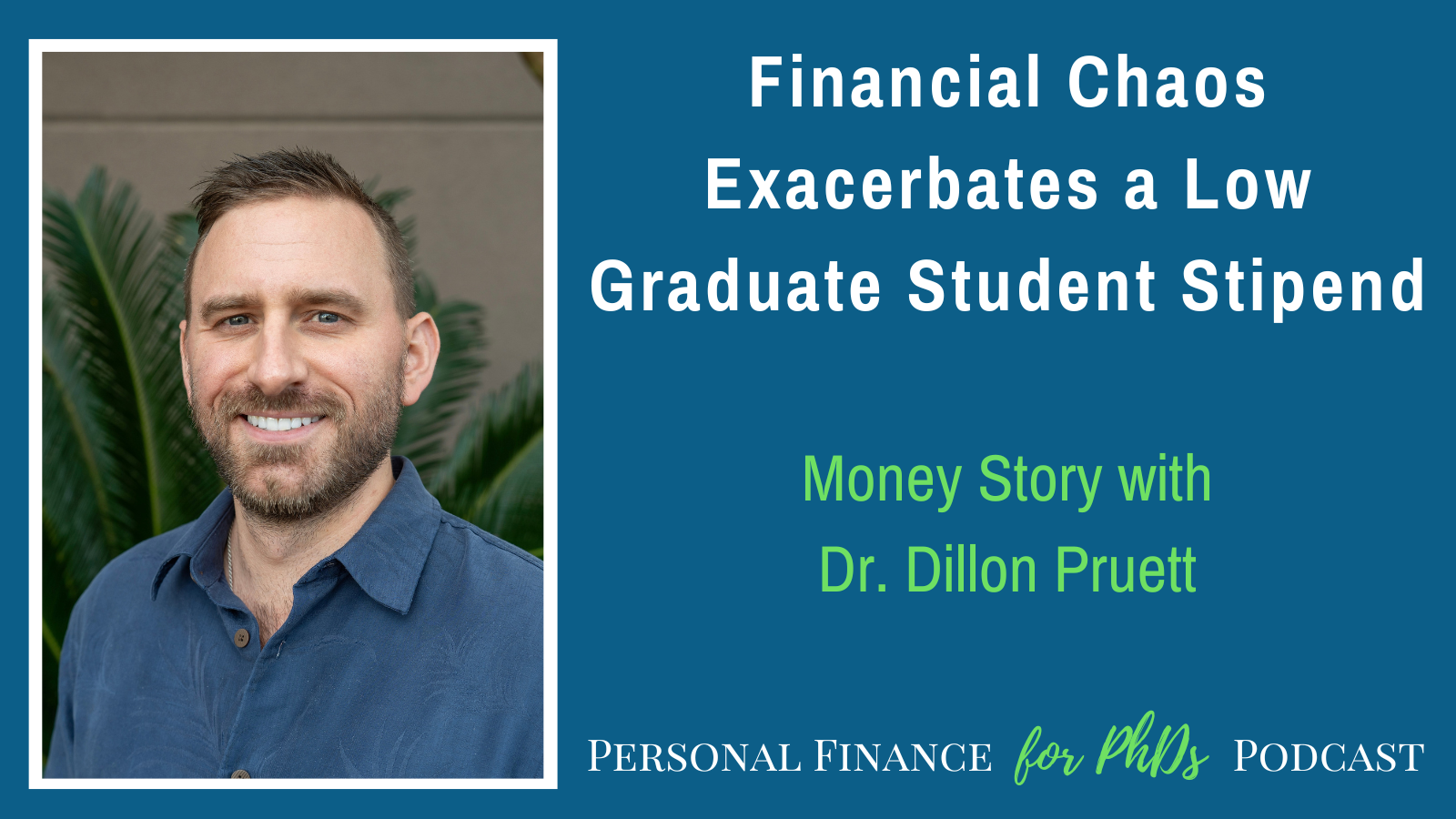
In this episode, Emily interviews Dr. Dillon Pruett, an assistant professor in the School of Communication Science and Disorders at Florida State University. This is the first part of a two-part interview in which we discuss Dillon’s financial journey through his PhD and postdoc at Vanderbilt University. Dillon tried to keep his eyes on his own financial paper, but the pay disparity between himself and other graduate students and postdocs was repeatedly brought to his attention. Still, he managed to make it through without accumulating debt and even building modest assets, despite financial setbacks. Dillon’s candor during this conversation is laudable, and his experiences are likely to be both relatable and a cautionary tale for prospective and early graduate students.
Links mentioned in the Episode
- PF for PhDs Tax Workshops (Individual Purchase)
- PF for PhDs Tax Center for PhDs-in-Training
- PhD Stipends Database
- PF for PhDs Subscribe to Mailing List
- PF for PhDs Podcast Hub
Teaser
Dillon (00:00): So literally to this day, every single payday I log in the morning of to see that it hits because I am just scarred from this, from not getting paid. And my wife thinks I’m crazy because she’s like, why are you so obsessed with this payday thing? I’m like, you don’t understand how crazy that was to to deal with.
Introduction
Emily (00:30): Welcome to the Personal Finance for PhDs Podcast: A Higher Education in Personal Finance. This podcast is for PhDs and PhDs-to-be who want to explore the hidden curriculum of finances to learn the best practices for money management, career advancement, and advocacy for yourself and others. I’m your host, Dr. Emily Roberts, a financial educator specializing in early-career PhDs and founder of Personal Finance for PhDs.
Emily (00:59): This is Season 23, Episode 7, and today my guest is Dr. Dillon Pruett, an assistant professor in the School of Communication Science and Disorders at Florida State University. This is the first part of a two-part interview in which we discuss Dillon’s financial journey through his PhD and postdoc at Vanderbilt University. Dillon tried to keep his eyes on his own financial paper, but the pay disparity between himself and other graduate students and postdocs was repeatedly brought to his attention. Still, he managed to make it through without accumulating debt and even building modest assets, despite financial setbacks. Dillon’s candor during this conversation is laudable, and his experiences are likely to be both relatable and a cautionary tale for prospective and early graduate students.
Emily (01:49): The tax year 2025 version of my tax return preparation workshop, How to Complete Your PhD Trainee Tax Return (and Understand It, Too!), is now available! This pre-recorded educational workshop explains how to identify, calculate, and report your higher education-related income and expenses on your federal tax return. Whether you are a graduate student, postdoc, or postbac, domestic or international, there is a version of this workshop designed just for you. I do license these workshops to universities, but in the case that yours declines your request for sponsorship, you can purchase the appropriate version as an individual. Go to PFforPhDs.com/taxreturnworkshop/ to read more details and purchase the workshop. You can find the show notes for this episode at PFforPhDs.com/s23e7/. Without further ado, here’s my interview with Dr. Dillon Pruett.
Will You Please Introduce Yourself Further?
Emily (03:03): I am delighted to have joining me on the podcast today, Dr. Dillon Pruett, who is an assistant professor at Florida State University. And today we are getting a financial journey, starting at undergrad, going through grad school, through postdoc into this first faculty position. And Dillon’s gonna tell us about his experiences and um, maybe some things that didn’t match with his expectations in each one of those stages. So, Dillon, thank you so much for joining me on the podcast today. Will you please introduce yourself further for the audience and give a little bit of your academic background?
Dillon (03:34): Sure. I am Dillon Pruett and I’m an assistant professor in the School of Communication Science and Disorders at Flori- at Florida State. Um, I study stuttering and I also stu stutter. Um, my main area of research is the genetics of, of stuttering. Um, so yeah, I’m happy to kinda just walk through my experiences in undergrad, graduate school, postdoc through my tenure track job now.
How College Costs Shaped Dr. Pruett’s Undergrad Choices
Emily (04:06): Great. And we’re gonna leave this pretty open-ended kind of at each one of these stages I wanted to talk about what was your income like, what was your, what were your assets and liabilities like at each stage? Um, how, how was your lifestyle? What was your money mindset? Um, did you have any goals or did you have any financial habits at each stage? So really we’re gonna leave it kind of open ’cause I would imagine there’s gonna be an evolution across these different stages. But take us back to undergrad and tell us about your finances at that stage.
Dillon (04:33): Yeah. Um, I attended the University of Washington in Seattle. Um, and finances really were a dri a driving factor in that choice. Um, both of my parents grew up in, uh, blue collar house holds. Um, they both attended a regional state school, uh, at a time when you could work a part-time job and mostly pay your tuition, um, with not a lot of loans. Um, and so growing up my parents, you know, uh, repeatedly said that they would do what ef- effort they could to support me, um, in going to my dream school. And, um, that was really awesome that that was their orientation. Uh, but they didn’t really have a lot of understanding of the costs of college. Um, and so I was accepted to UCLA and Cal Berkeley, uh, soon after the financial crisis of 2008, uh, when a lot of those large state schools were increasing their out-of-state enrollment, uh, but not offering a lot of merit or need-based, uh, scholarships for out of state students. Um, and so my parents were, uh, pretty appro, appropriately shocked by the cost and essentially forbade me from taking out, uh, these massive loans to go to school. Um, and that was really disappointing at the time. Uh, but the University of Washington was, uh, affordable and my parents were really pushed for that. Uh, and so looking back, I can really see the logic of the decision. Um, but at at that age in time I was, I was kind of bummed.
Emily (06:14): And were you living in Washington? Is that where you’re from?
Dillon (06:17): I was, yeah. So, um, I’m from Puyallup, which is maybe, uh, 45 miles south. Um, so it felt like I wasn’t really truly getting away from home. Um, a lot of students that I went to high school with were going there as well. Um, so honestly I wasn’t in like the best, you know, mindset going into undergrad just because of the disappointments that kinda led up to that stage. Um, but again, like in hindsight, I really have come to appreciate, um, how things have unfolded and the fact that I didn’t take out massive loans at at at that time.
Emily (06:57): I have to say, I had a very similar experience growing up. My parents both went to like, you know, public universities, um, and they told me, go wherever <laugh> we’ll help you. And they weren’t prepared for that, you know, for actually what the sticker price was for my generation. Right. Um, and I’m doing something different with my children. I live in California, and so I’m really talking up the uc system, like, whoa, it would be amazing to go to one of these schools. So like, I’m setting their expectations in that direction.
Dr. Pruett’s Career and Research Interests During Undergrad
Dillon (07:28): Yeah. Yeah, I mean it’s, it’s interesting just the difference that a generation made and the costs. And you know, like I said, my parents had a great experience. They didn’t take out these massive loans. They really, um, did what, what what they could to, um, put themselves through school. Um, I don’t know. There was a whole lot that I could do personally to replicate that, um, in this day and age. Um, but so I started college around the time that the movie, the King’s Speech came out, which if you’re not familiar, um, the movie is a historical drama that details, uh, great Britain’s King George, the six and his struggle with stuttering during the time of World, world War II. And, uh, that movie really marked the first time that I confronted Stu Stu stuttering and came to the terms, uh, there was something I was gonna have to deal with for the rest of my life and not something that I could just ignore.
Dillon (08:25): Uh, and I had also started, um, working in a research lab at the university that was looking at genetics. Um, and so I was kind of interested in like, the idea of applying gen gen, gen gen genetics to s to stuttering. One of the known facts was a risk factor for stuttering is if you have family me members who also stu stutter. So that kind of hints at the idea that there might be specific genetic factors in, in involved. Um, so I reached out to a professor at the university who specialized in stuttering and said, Hey, you know, this, uh, is kinda a new area for the field, um, but there’s not a lot of people that are specializing in, in in it. And so that kind of sparked my interest that this could be a way for me to pursue a career and contribute to the field and try to answer, you know, some of these ques questions that I had growing up as a kid.
Dillon (09:28): Um, and so that kind of set my path from about my, uh, sophomore year on and, um, I would meet with my college advisors to make sure that I was taking coursework in both hearing and speech sciences and in biology to kind of get a comprehensive grounding in what I was hoping to pursue. And for the most part, my advisors were very complimentary and, you know, thought it was great that I had, um, such a specific interest and a drive to do it. And, um, they always said, oh, well, there’s really no, no wrong way to pursue this. And I was kinda like, uh, you know, maybe there’s no right way to do it, but there’s probably some, some wrong ways to go about it. Um, but moving forward to the end of my undergrad, I was making a decision whether I wanted to get a master’s in speech language pathology, which is a more clinical degree, versus going, uh, right into a PhD, which of course is more research oriented.
Dillon (10:37): And, um, after kinda weighing the options and talking to, to some people, I opt, I opted to go into the PhD route. Um, and then I had this debate about whether it was gonna be something that I was focused specifically on, uh, stuttering kind of more in a niche communication sciences and disorders field, or if I was gonna be, I’m a little bit more broad and do something genetic specific. And, um, again, after talking to some people in, in the field, um, I felt that like if I could be in a position and I could sort of do both at the same time, that would be really, really, really great. So, um, I applied to three different pro programs for my PhD. Uh, Vanderbilt was my top choice, and they did a really awesome job of making me feel like I could pursue this research even though it wasn’t necessarily my mentor’s area of expertise. Um, and their program was part of a, like biomedical sciences umbrella where there were a lot of resources that were shared that were available to students that really made me feel like this was a doable path to pursue. Um, and so that was kind of my path that led me into my Ph, PhD.
Finances During Undergrad and Grad School
Emily (11:59): Okay. I wanna talk about this transition point into the PhD, but I wanna catch us up on what was going on financially during undergrad. We talked about the decision to go to an in-state public university. That makes sense. Did you end up taking on student loan debt, for example? Or like what was the mix of funding that you ended up with for your undergraduate degree?
Dillon (12:16): Yeah, I had a lot of private scholarships, um, totaling probably nearly $20,000. That went quite a long way in, um, paying for my tuition. Um, my parents were able to help with the rest. Um, I also worked throughout undergrad, so I had a couple different jobs. Uh, one was in the research lab where I was paid, um, hourly for, uh, a variety of of jobs. Um, I also worked in a medical clin clinic. Um, I also worked as a tutor. Um, so I was always kind of looking for ways to make money, but that was really just to provide for spending money. So I wasn’t, I wasn’t saving, I wasn’t investing. Um, it was really like, Hey, can I go out on a Friday night and have fun with my friends? Awesome. Um, and so yeah, I, I didn’t have a lot of discretionary money, but uh, it didn’t feel I was in a, a peer group where that was pretty common. You know, we’re all, we’re all college kids. We all don’t have a whole lot. So, um, it wasn’t necessarily, um, an issue at that point.
Emily (13:35): So it sounds like you were cash flowing, right? You weren’t taking out debt, you weren’t building up savings or other types of assets, but between the scholarships and your parents’ support and your jobs, you were just making it semester to semester, is that right?
Dillon (13:48): Yeah, yeah, that’s what I would would say.
Emily (13:51): Yeah. That makes total sense. Tons of college students live that way. And then in that transition to graduate school, were you thinking about the finances? Were you thinking about the stipend that you were offered? Obviously you just, you know, said why you picked Vanderbilt because of, you know, the research considerations, but were, were there any financial considerations at that stage?
Dillon (14:09): Yes. Um, the program at Vanderbilt offered a stipend that was the highest. And so that combined with the program really made it seem like that was far and away the best choice. Um, the stipend was for roughly $23,000 a year. Um, and that was from university funds. Um, and there was nothing written that said that it was restricted for any number of years. There was some language that said that as long as you’re making progress and doing well in the program, you will be supportive. And we have a track record of supporting our students through gradu- through through graduation. So that, um, was really great to, to see and to hear, because that’s not always the case, even in funded PhD programs, sometimes only for four years, sometimes only for five years. Um, and so that, that felt like, oh, all right, like this is gonna be something that I can depend on.
Dillon (15:20): Um, but I will say that, um, it became apparent pretty quickly that there was some discrepancies in the stipends that were offered. Um, so as I mentioned before, the hearing and speech sciences program at Vanderbilt is part of the larger biomedical sciences umbrella. And so at the beginning of the PhD, um, they have essentially like these onboarding workshops where they’re introducing you to how to be a PhD student. And one of the presentations was on personal finance. And they essentially took, um, a month, a month, a month, a monthly stip stipend and broke it down into all of the amount that you could be expected to pay for housing, food, insurance, all of that. And they kind of like zeroed it out and they’re like, all right, like, see, it looks like you can live within your means if you’re following this. Well, the stipend amount that they had on this giant screen in front of the auditorium was like five grand more than what our program was being paid.
Dillon (16:33): And so it was sort of like, oh, okay, yeah, great. I guess if I’m in these other programs, I can make it do, but we’re just supposed to go into debt if we’re getting less money. Um, and so that I understand the different programs had different compensation, there’s a variety of reasons why, but that was, it felt a little bit like it was getting thrown in in our face in that moment that we were, we, we were less than. Um, so wasn’t great. Um, but that being said, I was still in a very privileged situation where I did have more support than I would’ve had at other places. So I’m grateful for it. Um, but there were also just all kinds of other sort of financial issues that popped up in the first few years.
Emily (17:24): That’s a good lesson for me as a financial educator to take away. I do normally ask or look up what the stipends are before I give example numbers or speak somewhere. But, um, yeah, that’s interesting. I’ve, I’ve never done that approach of like, here’s your budget. Um, I’m more like, ask the audience like, what are you spending in these areas? Or like, what do you think is reasonable or what have you, but I can totally see how that would not have been helpful or encouraging for you at that stage. Um, but I wanna know for one more second about, um, this 23K that you were starting with your first year stipend. Remind us what year that was.
Dillon (18:01): So that was 2015.
Emily (18:02): Okay. Um, so you’re starting at 23K and you said it came from university funds. Um, does that mean that you had an assistantship of some type? Does that mean you were on like fellowship? Were there work requirements tied to this? Or like what was the nature of the funding?
Dillon (18:16): Yeah, so I think it was technically called a research traineeship. And I don’t know if that’s a common term that’s shared across different programs or that’s sort of unique. Um, it didn’t seem to come with many strings attached as far as certain number of hours. I had to meet I think 20 hours a week, um, of work within my research lab. But that was sort of like something you talked about with your PI, and it was really just kind of set as the bare minimum number of hours that as a PhD student you should be putting in. Um, and it was flexible in a way that’s like, if you’re studying for finals, you’re not gonna be putting in those same amount of hours. Or if you have, um, and especially busy week with research participants, you might just have to do that. You know, you’re not gonna nec necessarily say, oh, I’m at my 20, I can’t come in.
Dillon (19:13): Um, so I had other peers that had a lot more strings attached to their funding. And some of that was because it wasn’t university funding, it was, um, from particular grants that, um, like for instance, if they, they were getting paid and they needed to go into some kind of, um, public interest type field or else they would have to forfeit some of their, um, stip like stipend back in the future. I, I wasn’t privy to all of the different funding streams and all of the different, um, I don’t know, stipulations. Um, but I just know that that mine was pretty unrestricted and flexible.
Emily (20:05): And was that a 12 month stipend, the 23k, or was it meant to be like just the academic year or anything like that?
Dillon (20:12): Yeah, so that is another, uh, aspect that I didn’t appreciate at the time, but I certainly do now is that was 12 months and so it was just divided into 12 paychecks. And um, that’s, that’s how you paid rent. That’s how you paid for groceries. There was not supposed to be any interruptions. Um, but as I’ll explain, we did have several occurrences of times when things kind of went awry and we had some things to work through.
Emily (20:45): I wanna get there, but one more question. You’re sitting in that orientation and you’re looking at this example with 5K more in stipend than what you’re actually receiving. Did you make a plan? Like, was your plan, okay, I need 5K in student loans, or was your plan, okay, I need a side hustle for 5K? Or was your plan I need to live on less than what they’re saying up there? Like how did, how did it strike you as like, how were you gonna move forward?
Dillon (21:08): Yeah, I think immediately I went too, like I need a side hustle. And then second to that it was, okay, I’m gonna have to live on less than what they say I can. So that means spending less on groceries than they say that means less on, um, miscellaneous expenses and they say it means I might have to work harder to find a place that’s acceptable, that is less rent. Um, so all of those things.
Emily (21:36): I wanna ask about the rent for a second. ’cause one of the, I guess I’ll say issues I have with this kind of presentation in orientation, and I’ve done these kind of presents during presentations, during orientations, is that you’ve already made some decisions, <laugh>, you’ve already made your housing decision at least probably for a year lease. You’ve probably made your transportation decision if you own or whatever, you know, with your car. So like what’s immediately changeable is already like restricted, you know what I mean? So when you were looking at that like pie chart or whatever they showed you, was your rent already less than what they were accounting for? Like, how were you even doing at that? Like, you’re off the starting block already.
Dillon (22:12): So thankfully, yes, my rent already was less. Um, I was fortunate to find, find a house that was less expensive, but that came with some trade offs. So it was not a nice place. Um, I was in like a little Harry Potter room with a shared bathroom. Um, at various points in time. We had mice infestations, we had cricket in infestations. Um, but it, it was enough. And as a a young grad student, I wasn’t particularly bothered by it. It was in a very nice neighborhood. Um, it was close to campus. Our house was just kinda like the black sheep of the block. Um, but we, we made it work and at that point in time, I think I was probably paying about 550 a month in rent. And, um, I mean there’s, it’s really hard to find a place in Nashville for less than a thousand now. So, um, that was a, a, a huge help in that first year with feeling like, okay, um, you know, I’m not paying for one of the nicer places with a pool and other amenities. I’m, but it also wasn’t, um, a place that you would, you know, have your parents stay for very long or, uh, want to be in for extended periods of time.
Emily (23:41): Okay, I get the picture.
Commercial
Emily (23:45): Emily here for a brief interlude! Tax season is in full swing, and the best place to go for information tailored to you as a grad student, postdoc, or postbac, is PFforPhDs.com/tax/. From that page I have linked to all of my free tax resources, many of which I have updated for this tax year. On that page you will find podcast episodes, videos, and articles on all kinds of tax topics relevant to PhDs and PhDs-to-be. There are also opportunities to join the Personal Finance for PhDs mailing list to receive PDF summaries and spreadsheets that you can work with. Again, you can find all of these free resources linked from PFforPhDs.com/tax/. Now back to the interview.
PhD Funding Issues at Vanderbilt University
Emily (24:33): Well go on and tell us about these, these issues that you’ve alluded to that kind of cropped over up over the next few years.
Dillon (24:43): Yeah, so, um, I wanna say it was probably 2016, um, where Vanderbilt University decided to legally separate from the medical center and ba basically create two distinct legal entities, even though there’s a lot of overlap between them, um, and being in the biomedical sciences program, um, there’s really not like a fine line that divides them. It, it’s, it’s, it’s messy. You have professors that are appointed through the medical program, but then the graduate students are through the university. And then so it was, it was, it was just messy. Um, but the end result that really impacted students was that, uh, stipends were not dispensed when they should have been. So we’re all waiting, uh, you know, the first of the month for this paycheck to hit and it didn’t. And so, you know, that means that people can’t pay rent, they can’t pay for groceries.
Dillon (25:51): And that was a really big deal and there didn’t seem to be an appropriate outcry from the university to be like, oh my God, we need to solve this. There were students who were literally sitting in the office of the dean and they were not gonna move until they got paid. And so in that period of of time, um, you know, I was on my stipend each month, there’s no savings and so I had to take out, you know, loans for my parents just to pay, pay the rent. Um, and it was sorted out after a couple of weeks, but that’s still a really long time for students to wait when they’re expecting it and relying on it. Um, and in the process of me trying to like personally figure it out, um, I was talking to some people in ad in administration that were in the larger biomedical science sciences umbrella, and when they saw my stipend, they were like, oh, like you, you should be getting paid more than that because that’s below like our floor.
Dillon (26:53): And I was thinking like, mm, no, I don’t think so. I mean, sure, if you wanna pay me more, go ahead, but like that money comes from somewhere. And so, um, lo and behold, when I did get paid, I had a few hundred dollars that were added to what I was supposed to get. And so I was like, oh, okay, awesome. Um, and I used that extra money to pay down some of my credit cards and thought, well, great, some, something about this, you know, bifurcation has leveled things out. Well, I got a notice like a week or two later saying that I was actually overpaid and that I owed that money back to the university and I needed to write them a check to pay them back. And so I was like, are you kidding me? Not only is my stipend late, but you told me I was gonna get paid more.
Dillon (27:50): I didn’t believe you, then you paid me more and then I spent it, and then you’re telling me that was a mistake. So it was absolute chaos and I’m just grateful that I had a family that I could rely on for help in this time, but that is in no way the way that grad school should work. That you should have to have your students be taking out money from family in order to get their living expenses met. Um, and so literally to this day, every single payday I log in the morning of to see that it hits because I am just scarred from this, from not getting paid. And my wife thinks I’m crazy because she’s like, why are you so obsessed with this payday thing? I’m like, you don’t understand how crazy that was to, to deal with. And so it was probably, you know, four to five weeks before it was all sorted out. But, um, I don’t know. I feel like in, maybe in, if that had happened maybe five or 10 years later, I think like Twitter would’ve just like lit on fire with the, with the problems.
Emily (29:00): That is, um, one of the more egregious stories I’ve ever heard on the podcast that is saying something, uh, because universities are often disorganized. Um, but it, it seems to go a little bit even beyond the disorganization, like yeah, planning for that legal split, but not planning for the continuity with your, now I don’t know if I wanna say that, were you actually an employee? ‘Cause it’s even more egregious if you were actually an employee. Were you on W2 income or was it like non W2?
Dillon (29:32): That was another transition. Is that prior to that split? Um, I did not have any taxes withheld. I did not have a W2 and we were kind of told, yeah, this is like, we can’t give you advice on it, but it’s a legal gray area. Um, my mom’s an accountant and she had some people look into it and we’re like, okay, yeah, I think we’re fine ’cause it’s an educational disbursement, blah, blah, blah. Not gonna get into all of that. But following the switch, it did start, I, I did start receiving a W-2 with tax withholdings and that I think was actually helpful because it made it not this like gray area obscure, do I, do I not kind of thing. And it would’ve looked really weird if I didn’t file like a real return for years and years. Um, so, but that meant that like my kind of take home pay once you take away taxes decreased from what I was used to.
Emily (30:37): Okay, we’ll leave that there. Longtime listeners know how I feel about this. Um, but yeah, I, I guess I can understand the disorganization a little bit more because there was not actually a legal obligation to pay y’all on time if you were not on W2 yet. Not that that should have happened at all, but it’s just something I’ve heard of at other places of like, you have more protections if you’re like a legal employee, like W2 type employee. Obviously if there’s a union involved, there’s more protection. So like, just something to keep in mind, <laugh>, when you’re figuring out where your stipend is coming from that like sometimes problems do arise with fellowship income that wouldn’t ari- or what I call fellowship income, which wouldn’t arise if you were on like W2 income either way, terribly sorry that that happened to you <laugh>. And like, and like you were saying, because you were on such a low stipend in the first place, it, you didn’t have the ability to build up the financial security for yourself to prepare for, you know, adverse events, whatever they are. But for the adverse event to come from your funder, uh, it’s terrible. Okay, so the end result of this is that you’re on W2 income, your income has stayed the same, but you’ve started paying income tax, so your take home pay is less, is that right?
Dillon (31:48): Exactly, yes.
Emily (31:50): Ugh. After the chaos of those few, uh, those handful of weeks, I don’t blame you for having residual trauma over this. I would do the exact same thing. <laugh>.
Dillon (31:57): Yeah, well that was actually another, um, disparity between the different departments in the larger umbrella program because they actually received, uh, cost of living increases each year, and they also received, um, boosts when the incoming classes would get boosted up. So, um, a lot of my peers in the other department, you know, they were gradually making more and more money each year. Not that that actually, you know, as the cost of living went up, it’s not like they’re making a whole lot more, but it was enough to offset it just a bit. Um, whereas our department did not do that. And we had what whatever was in your contract that you signed when you started was what you would make all the way through.
Emily (32:45): Oh, so incoming classes were making more, but you stayed the same.
Dillon (32:50): Exactly. There were people heard that were entering after I started in my department that eventually were making more because the university made a conscious eff effort to boost PhD stipends. And so as all of this chatter is going on, I’m like, oh, we wanna get to 30K for all students. I was like, well that’s, that’s not impacting me. Like that’s, that’s great that the new students get that. Um, so another sort of instance where I felt like we were not, um, compensated in the ways that other students were. Um, and sort of just one more example of that, um, the sort of field of communication sciences and disorders, um, depending on what you study can be very interdisciplinary. So, um, there was a research lab that was focused on autism and you could enter that research lab either through sort of the more clinical hearing and speech sciences route, or you could enter through neuroscience and go that route.
Dillon (34:01): So you’re working the same research lab doing very similar work, but depending which route you took to enter the lab, you could get paid five or 10 grand different per year. And that is something that students learned and something that the PI learned. And so it was sort of like, oh, well, if you want to do this research, maybe you should enter through neuroscience and we’ll accept you through that way. Um, and I don’t know the details of it and how I think it was a point of contention within the department. I’m not privy to all of the details, but, um, I know that for students that was something that, that mattered. Um, and I don’t know what the, I don’t know what the current state of that is, but it was sort of like, well, I, I get it because individually it helps you to go through this route and you just get paid more. But if you’re trying to, you know, recruit for your own department and, um, you know, feel like that’s what’s, you know, kind of funding a lot of their research, um, you could see why, you know, the, the, the chair would feel that maybe you should do it a certain way.
Emily (35:13): You are presenting all of this in a fairly dispassionate manner. I mean, you have the, uh, the benefit of time having passed since these events, but like what was the effect on your emotions around your money? Were you feeling incredibly discouraged? Were you like doubling down? Like how did this, yeah, how did you feel about it as you discovered and as you went through these various events?
Dillon (35:37): Um, I really just tried as best I could to have the mentality of I was keeping my eyes on my own page because I knew that if I, I could get so wrapped up into this stuff, but I had so little ability to change it that I just didn’t even wanna focus on that. So I was sort of like, Hey, you know what I’m getting by. I’m doing what I want to do. I’m going to try to do what I can to make it through best I can. And um, if there were opportunities to offer feedback, I would certainly engage in that, but I wasn’t going out of my way, um, to, you know, negotiate on my own behalf or to really get too, too invested in these other areas. And you know, I think there’s, even though I feel like we maybe had some very visible examples of that in our department, um, it’s pretty common even within programs that don’t have these bigger issues, they have students that get a topper on their stip on their stipend, and they don’t want other pe- people to know that. Or maybe they do want other pe- people to know that. And, um, I, I don’t know. I just have always thought that money is, is a tough thing in especially the PhD space because there’s not a lot of it, and it’s all people that are trying to establish themselves. And I always thought it was better to just push that out and try to, you know, think about relating as, as, as peers and not having that be a barrier. Um, it’s obviously frustrated me enough where I’m now speaking that out on podcast 10 years later. Um, but uh, the way I tried to deal with it at the time was to ignore it as best as po- as best as possible.
Emily (37:28): I definitely understand that as like a self-protective instinct. Like, like you said, it’s actually pretty healthy. Like keep your eye on your own page. That’s great. It’s a great mindset in personal finance generally, it’s harder when you’re being paid so little that like survival, you know, comfortable life is, uh, on the line there with that distinction, but it just, for me, reemphasizes not, not at all that I’m criticizing you, I totally understand why you took that self-protective route, but it reemphasizes for me that anybody who has the ability to do any advocacy or any kind of privileged position, um, from which to do any advocacy, um, please do it if you’re able to, um, and advocate on behalf of your peers. Because this is something that’s tricky about individual negotiation is like, okay, like you should advocate for yourself. Yes. Um, but is it ultimately going to, you know, lift all boats with a rising tide?
Emily (38:21): Like we need to make sure that everybody, even people who aren’t able to advocate for themselves, can benefit when people do ask for more. Um, one of the huge benefits of the larger unionization movement going on among graduate students, and I just wanna also make a plug for pay transparency, um, through, for example, my website, PhDstipends.com. Um, if you’re able to have these conversations, if you’re able to advocate, please do not everyone is able to, in your case, you are such on the lower stipend end of that spectrum. I totally understand why you took, you know, why you had the reaction that you did of just like, I gotta get through this. I’m investing my career. I can’t, you know, be distracted by all these pay disparities that I’m seeing. Is there anything else that you’d like to share with us about this graduate student stage of your financial journey?
Dillon (39:11): I guess that, you know, I, I did constantly feel like I was making these tough trade-offs that, you know, as I was getting into 26, 27, 28 years old, I had peers who had been working in their jobs for, you know, five, six years or making pretty good money. And I had to say no to things. And it was tough. You know, I had a friend who had a bachelor party in Vegas that I had to say no to because I just couldn’t afford to have that put entirely on a credit card. I didn’t have $3,000 to spend. Um, and that’s kind of a life event that, um, you know, I would’ve loved to have been there for. Um, and I kept telling myself, I’m in this investment stage, you know, this is just kind of the way that things are. Um, but as you get farther along in your PhD, um, it’s almost like it gets harder to keep that mindset because when you’re really gung-ho you’re just starting your 22, 23, 24, a lot of your peers are just starting out too.
Dillon (40:23): And so you’re just, you know, doing the cool thing to get your PhD, but towards the end when you’re older, um, you just feel that weight a little bit more of like, man, I, I got to get this done. I’m still not at the point where I want to be as a independent young adult. Um, and so, you know, it, it did weigh on me having to, you know, make these decision and not even like the big ones, right? Like even the decisions about going out to dinner with, with friends or something like that, you know, I couldn’t always afford going out to a $75 dinner because that meant that the end of the month I wouldn’t have money for groceries. Um, and then socially, you know, just dating wise, I know there’s a lot of, uh, people, people who might, you know, you know, really scoff at the idea of like a coffee date or a happy hour date is being cheap, or it doesn’t show your initiative or doesn’t show your seriousness.
Dillon (41:30): Um, and that just like hurt me so much because I was like, oh, well, like, I don’t know. That’s, that’s the most that I can do in a situation where I’m just trying to get to know you. And that is, even, even for, for those things is, is something that is gonna impact what I can do down the road for this this month. Um, so yeah, it, it, it’s, it’s those types of choices that, um, you get kind of like used to, but it still is something that that hurts. Um, and I feel like I did a pretty good job of balancing that, um, as best I could. Like I, I did go out in Nashville and would go to Broadway and, you know, we’d go to concerts, so it wasn’t like I was just, you know, in the lab studying or at home the, the whole time, but I had to be very kind of strategic about how I did it and when I did it. And, um, that was kind of what helped me get by.
Emily (42:35): I think what you’re saying is so relatable, and I really hope that your message gets to prospective graduate students and early on graduate students that like, like you said, like at the beginning, you’re living a little bit on your enthusiasm <laugh>, and then as the years draw by the sacrifices that you’re having to make small or large are just like piling up on top of each other and you’re like, okay, when is this stage going to be done and when am I going to be done with this lifestyle that I have at the moment? Um, I wanna get to that transition point between, um, graduate school and your postdoc. Tell me about your balance sheet as it was. Had you built up any savings over the course of graduate school? Had you built up any debt over the course of graduate school? Um, what was your kind of ending financial picture?
Buying a House in Nashville During Grad School
Dillon (43:27): I really did not build up much savings or debt, so I was really living pretty much paycheck to paycheck. Um, I started a Roth IRA, um, partway through grad school and was putting in like 50 or a hundred bucks a month in months where I could afford it. Um, and, you know, didn’t really amount to much. Um, I, I had a bit of credit card debt, but through the kind of COVID years, um, I really focused on, okay, well, I’m not going out, I’m not doing these things. Um, so I was able to pay that down to basically zero. Um, so that, that was, was huge. Um, sort of the, the side bar to this story, um, is that I knew when I started my PhD that Nashville real estate was, was going crazy. And so I was like, well, hey, if I’m gonna be here for at least five years, maybe more, um, this seems like something that I should take advantage of.
Dillon (44:40): And so I convinced my parents that this was doable without too much of a down payment and that this would be an investment both for myself and for them. Um, and so through an FHA loan, um, with my parents, I, uh, bought like a little condo, um, in this little old building, and the plan was that I was going to have a roommate with me all throughout my graduate school, and the roommate and I together would pay that mortgage. Um, and so that was in hindsight, you know, a really good move. Again, I had the support of my family that that enabled me to do that, that I couldn’t have done alone. Um, but wrapped up into that was some expenses that like a renter wouldn’t have to pay. So, uh, we had to replace the hot water heater, we had to replace the hvac, um, had to replace the microwave, um, had some issues with plumbing, all of that.
Dillon (45:45): Um, and so that is kind of where any kind of extra cash that I would’ve had, um, was put towards. Um, but I think that the end result was that, um, when I ended up selling that before I moved, you know, I was getting a good chunk of change back that if I hadn’t bought a place, um, would’ve just been lost to, to rent. And so, um, my wife and I have not purchased a house yet, but the profit from that is gonna be our down payment. And so we, we’ve kind of flipped, you know, the condo into a down payment, uh, for our next home. And so, um, that’s not really advice that I could recommend to anyone anywhere, um, but at, at, at the time, that is in hindsight, a pretty important move that I made. Um, so I’m, I’m grateful that it worked out because that’s not a guarantee.
Emily (46:49): Yeah. So it sounds like you, you were again, cash flowing, just kind of making it month to month, and yet you had these small investments that you even discounted at the start of our conversation, but, you know, you had the Roth IRA occasional contributions that you had, um, the ownership of a home, which cashflow wise, you know, maybe that’s helpful or maybe it’s not, but eventually over the long term, you can expect some kind of equity from that which you’ve received. So that’s really great. And like you said, um, I think graduate students and PhDs at any stage just have to look frankly at their situation. What’s the real estate market, the rental market, the buying market, what’s the income? What assets do you have? What resources do you have? Like you had your parents you knew that you could at least pitch them on, you know, making an investment in this with you. Um, and just look at all those factors and, you know, keep your mind open as to what might be possible in terms of home ownership or, or renting, whatever it is. Um, I, I don’t sort of dismiss home ownership out of hand for graduate students. It just, like you said, at certain times, certain places, certain people, it can, you know, be a possibility, but it’s a, the stars kind of have to align to make it happen.
Dillon (48:01): Sure. Yeah.
Emily (48:07): That is the end of part 1 of this interview! Tune in next time for part 2 in which we discuss Dillon’s faculty job search and financial transition to Florida State University.
Outro
Emily (48:22): Listeners, thank you for joining me for this episode! I have a gift for you! You know that final question I ask of all my guests regarding their best financial advice? My team has collected short summaries of all the answers ever given on the podcast into a document that is updated with each new episode release. You can gain access to it by registering for my mailing list at PFforPhDs.com/advice/. Would you like to access transcripts or videos of each episode? I link the show notes for each episode from PFforPhDs.com/podcast/. See you in the next episode, and remember: You don’t have to have a PhD to succeed with personal finance… but it helps! Nothing you hear on this podcast should be taken as financial, tax, or legal advice for any individual. The music is “Stages of Awakening” by Podington Bear from the Free Music Archive and is shared under CC by NC. Podcast editing by me and show notes creation by Dr. Jill Hoffman.
Join Our Phinancially Distinct Community

Receive 1-2 emails per week to help you take the next step with your finances.

Leave a Reply