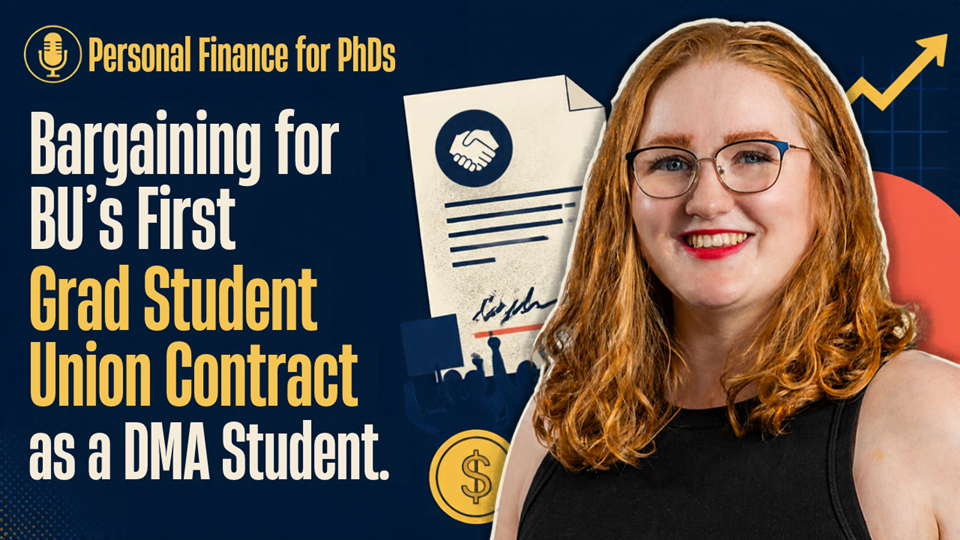
In this episode, Emily interviews Dr. Sophie Lewis, who recently completed her DMA in Music Education at Boston University. Sophie served on the bargaining committee for the BU grad student union through their first contract negotiation, which included a nearly 7-month-long strike. She shares the incredible accomplishments of the union over that period as well as what didn’t make it into the contract and how the strike finally ended. Sophie’s own pay rate and personal finances radically changed for the better through that same period, both because of the union’s efforts and her personal actions.
Links mentioned in the Episode
- Dr. Lewis’s Website
- Dr. Lewis’s LinkedIn
- Volunteer to be a Guest on Season 26 of the PF for PhDs Podcast
- Host a PF for PhDs Tax Seminar at Your Institution
- PF for PhDs S24E3: This Grad Student’s Social Spending in Boston Pays Dividends
- Anonymously Share Your Stipend Information at PhDStipends.com
- PF for PhDs Subscribe to Mailing List
- PF for PhDs Podcast Hub
Teaser
Sophie (00:00): Our argument the entire time we were in bargaining was that you should be able to afford to attend the institution that you’re working for based on only the job that you do for the institution that you attend. Um, and I think we’ve gotten a lot closer to that. Obviously, Boston is an expensive city, but it’s nice to know that we played a part in making it a little bit more affordable for people at BU.
Introduction
Emily (00:31): Welcome to the Personal Finance for PhDs Podcast: A Higher Education in Personal Finance. This podcast is for PhDs and PhDs-to-be who want to explore the hidden curriculum of finances to learn the best practices for money management, career advancement, and advocacy for yourself and others. I’m your host, Dr. Emily Roberts, a financial educator specializing in early-career PhDs and founder of Personal Finance for PhDs.
Emily (01:00): This is Season 25, Episode 5, and today my guest is Dr. Sophie Lewis, who recently completed her DMA in Music Education at Boston University. Sophie served on the bargaining committee for the BU grad student union through their first contract negotiation, which included a nearly 7-month-long strike. She shares the incredible accomplishments of the union over that period as well as what didn’t make it into the contract and how the strike finally ended. Sophie’s own pay rate and personal finances radically changed for the better through that same period, both because of the union’s efforts and her personal actions.
Emily (01:41): I’m looking for interviewees for Season 26 of this podcast! This is your official invitation to volunteer to be interviewed. I love that on this podcast I get to feature PhDs and PhDs-to-be who are almost exclusively regular people and learn and share their real-life stories and strategies. If it’s been in the back of your mind to volunteer, please go to PFforPhDs.com/podcastvolunteer/ and fill out the quick form, and I’ll be in touch over email. I look forward to interviewing you this fall! You can find the show notes for this episode at PFforPhDs.com/s25e5/. Without further ado, here’s my interview with Dr. Sophie Lewis.
Will You Please Introduce Yourself Further?
Emily (02:38): I am delighted to have joining me on the podcast today, Dr. Sophie Lewis. She recently completed her doctorate in music education at Boston University, and we actually met a few months ago. We’re recording this in September 2026. We met over the summer at the Graduate Career Consortium annual meeting, and I was just so taken with Sophie and the way she spoke about finances and specifically her experience with the union, the Grad Student Union and unionization movement at BU. And so I invited her on the podcast to tell us much, much more about that. So, Sophie, thank you so much for agreeing to come on, and would you please introduce yourself a little bit further?
Sophie (03:16): Yeah, absolutely. Uh, so nice to be back. My name’s Sophie. I just graduated in August with my doctorate in music education, technically a DMA. I’m one of those, uh, professional doctorates, as they like to call us in higher ed. Um, and I researched, uh, career preparation for music students in higher education and how, uh, post-secondary policy shapes the way that students feel prepared for careers after they graduate, and how they understand the value of the work that they do. Uh, unionization was a really big part of how I came to understand the value of what I do, and so it was really cool to bring those two things together. I also worked as a graduate assistant for the graduate and postdoctoral success department at Boston University, which is how we met at GCC. Uh, and my role was to help to administer the professional development micro-credential series online that Boston University runs. Um, happy to be graduated and, uh, speaking about my experiences at BU as someone who’s no longer at BU.
A $5,100 Annual Stipend as an International Student at BU
Emily (04:28): Absolutely. And so we’re kinda in this interview gonna go through your journey in graduate school and kind of parallel that with how the union changed or what shifted and what you learned and so forth over the course of that time. So let’s start with your arrival at BU. What was going on with, you know, your own employment and what was going on with the union when you first arrived?
Sophie (04:50): Yeah. So I came to BU in September of 2022, and I remember vividly right across… I played the cello, and I had a instrument locker in the basement of the music department. And across the hall from where my cello locker was, there was this poster about BU Grad Workers Union, and I was so excited, uh, because I’m from the UK where unionization is super common, and I was entering BU as a graduate research assistant in the College of Fine Arts on a salary of about $5,100 for the year for a 10-hour position. So I was like, any opportunity to get involved with a union that might help me to advocate for better pay was really, really welcome. You know, you’re used to low pay in the arts, but, uh, I was paying rent with loans for my first year of my doctoral studies. It was, it was a fun time.
Emily (05:57): Pause on that for a moment because… So were you an international student that’s – Like were you on an F1 visa?
Sophie (06:03): I sure was.
Emily (06:05): So to come to the US as an international student, my understanding is that you have to show that you can provide for yourself financially. Um, so did this… Did you arrange the student loans beforehand or like how did your funding in particular work with respect to being an international student?
Sophie (06:22): Yeah. Uh, I had organized the loans in advance of coming to BU. Uh, I’m really lucky to have an aunt and uncle who are US citizens, uh, who were able to co-sign loans for me for that first year. Um, and a lot of, like, what proves that you have the money is just that you have access to it. It doesn’t need to be liquid. Uh, so my family were able to show that we had access to that money, but they weren’t willing to pay my rent, uh, because I’m 27 and was paying my own rent. Uh, so <laugh> that was kind of how that balanced out, was we were able to use a combination of loans and family money to get my visa. Um, and I just ended up paying my rent with loans once I got to BU.
Emily (07:15): So you just told me a shockingly low number for your stipend. And tell me, was that just, like, strict, like, hourly pay for that 10-hour week position? Did it come with any benefits like tuition waiver or, like, how did that part of it work?
Sophie (07:28): Uh, it did not come with any other benefits. So part of being a professional doctoral student at Boston University means that you are not eligible for the five-year funding package like a regular PhD student is. Um, and this was really one of the main reasons why I wanted to get involved in unionization, was that we were doing the same jobs as our peers and PhD programs, uh, and those students were receiving tuition waivers and health insurance benefits and vastly higher pay than we were receiving in the music department. Uh, this was common for all of my colleagues in the music education doctoral program. Uh, so I actually was also paying for my health insurance and paying tuition, uh, for my doctoral program, um, which is uncommon and, uh, not something I would do again. <laugh>
Emily (08:26): Well, what was, like, the plan? Like, coming into this, you didn’t know about the union yet, right? Or what changes might be coming. So was your plan like, “Yep, I’m gonna keep this assistantship position 10 hours per week, this is my pay, and everything else is on loans?” Like you were comfortable with that for the duration of your program?
Sophie (08:42): I wasn’t super comfortable about it for the duration of my program. My plan was always to be applying for more scholarships and fellowships and see what I could do to kind of increase my funding package. I was planning to appeal my financial aid. That’s something that I’d done, uh, in my master’s program, which I did at the University of Denver. And I’d managed to increase my funding package to cover my tuition for that. So I kind of knew that that was an option to negotiate with the university for my funding. So I’d kind of gone in with a plan to, to take on a second job, uh, and to do some negotiation alongside applying for fellowships and scholarships and other sources of financial aid.
Emily (09:26): Okay. You just mentioned a second job, but how does that work with the visa situation?
Sophie (09:30): As long as you’re under 20 hours a week, you can have on-campus –
Emily (09:33): So it’s like an on-campus job.
Sophie (09:34): Yeah. Yeah, yeah, yeah.
The Formation of the Boston University Graduate Workers Union
Emily (09:36): Gotcha. So that’s so interesting that you came in with a plan of obviously finding another job to get up to 20 hours a week, and then also an individual negotiation plan. But this obviously morphed into… Or maybe you did, still did that, but it obviously also became a collective negotiation, uh, plan. So we understand what your status was when you started. <laugh> What was the status of the union? When did it form? What contract were you in?
Sophie (09:59): So we, uh, had not yet voted to be recognized as an official union yet when I arrived. Um, the union students had been organizing things for a long time before I arrived at BU, and I kind of arrived just at the right time as we were getting ready in the spring of 2023 to vote on whether we wanted to start bargaining for a contract. So I connected with some members of the union in advance and asked how I could become involved, what it would look like in my department. Um, and through that, I participated in the vote to, uh, recognize the union officially. Uh, and then I was elected to represent the College of Fine Arts on the bargaining team. So I got very heavily involved pretty quickly in, uh, writing the contract and organizing my department and speaking on behalf of my department at the bargaining table, uh, which kind of started in the summer of 2023 and went through to 25, might have been the end of 2024, 25.
Emily (11:18): What kind of mandate was the vote? Like, at what percentage did it pass? And, like, what were the key issues that were motivating graduate students to take that step?
Sophie (11:26): Yeah. Uh, I, I’m pretty sure we were a really high percentage that voted to form the union. Like, I think it was, um… I’m sure I could find this information somewhere on Instagram, but, uh, as far as I remember, we voted in the high 80%s to form the union. And then, um, most of the issues we were organizing around was a cost of living adjustment and tying wages to the cost of rent in Boston. Um, so our, our main priority was to alleviate all graduate workers from rent burden, which is around, you should be spending less than a third of your income on rent, I think, was the number. Um, and so that was the main things we were organizing around, because I think at that time, the lowest paid PhD student was getting around $23,000 a year, um, which in Boston is not, not really enough to, to pay rent in Boston. Um –
Emily (12:35): Yeah, you, you could pay rent.
Sophie (12:37): And nothing else.
Emily (12:37): And nothing, nothing else. <laugh>
Sophie (12:39): Um, so I think it was primarily the, the movement was centered around that cost of living adjustment, and we were also campaigning for better childcare provisions for, uh, working parents, uh, and just other supports for international students and students with disabilities as well. That was a big part of the movement.
Emily (13:03): All right. So you’re on the bargaining committee. <laugh> Tell us about a view that not many people get to have directly, right? So, like, just tell us about that experience.
Sophie (13:13): Yeah. Uh, so I worked really closely with a lot of the non-PhD students, so people like master students who held hourly jobs on campus, people in other professional doctoral programs like I was in, that includes, like, the doctor of physical therapy and ed students, um, a lot of the programs that make up a lot of the student body but aren’t covered by a five-year funding program. Um, and we did a lot of research into how much would the hourly wage have to be in order for us to be non-rent burdened in Boston University dorms, because that’s, that’s where I was living at the time. I was, like, living in a campus dorm. Um, and so we did the math on how much money we’d have to make in order to afford a BU dorm, and we ended up with an hourly wage of around $45 an hour. So that was kind of where we entered into our negotiations, was everybody on an hourly job needs, uh, this much an hour.
Emily (14:24): Our – But sorry, going back to the, the rest of your funding package. Was that considering how much would be paid towards tuition, et cetera?
Sophie (14:31): No, that was purely looking at how much would it cost to live in Boston and attend the institute, like, to, to live in the city where you go to school. Um, we had a separate group working on tuition remission, uh, which was the biggest, uh, from my perspective, the biggest sticking point, uh, when we went into negotiations with the institution, um, mostly because we thought that if you were working for the institution, you should receive the same benefits as anyone else, uh, but the institution argued back that it would be too difficult to track master’s students who, like, came in and out, um, and that that tuition remission was too high of a benefit. So that was one of the things that we kept putting back into the, the contract, and the university kept asking us to take it out, um, and it ended up not making it to the, to the final contract, um, which is still one of my, like, my bugbears if I was on the, if I was on the union again, I’d go back and really fight even harder for that tuition remission, especially for professional doctorates who are doing, you know, research the same as any other PhD student. Um, it’s kind of tough to, to be paying to write your dissertation. Um –
Emily (15:58): Something that I hear often and, and, and say from time to time is, like, the university, you know, they view these student workers… It’s a, it’s a dual thing, right? When it’s convenient to the university the student worker is a student, and when it’s convenient to the university, the student worker is a worker, and they kinda get to dictate how the relationship is viewed. Um, so it sounds like they were really trying to keep, um, those of you outside the PhD programs still students um, as more of a worker and… But a part-time worker. Not like a full-time worker who gets full-time type benefits, which would include things like tuition reductions. But rather this, like, part-time worker, but really just a worker kind of status, and really viewing you in a different category from the PhD students. That is what I’m hearing.
Sophie (16:47): Yeah. And I, I would say that that’s how it felt as well. Like, I gradually, throughout my time at BU, transitioned away from working as a research assistant at CFA to being employed, uh, full-time per international student regulations at the GPS office. Um, and those two worlds were completely separate for me. Like, my job at GPS had absolutely nothing to do on paper with my, my status as a student at the CFA, um, the College of Fine Arts. And a lot of the time, those two things never crossed paths. Um, so what I was doing in the provost office was completely separate from what I was doing as a student in the music education department. Um, and certainly, like, I, I left and went to GPS because there was more opportunity for better pay and better opportunities for progression in that position than working as a research assistant. Um, but it, it really did feel like I was doing a second job on top of writing my dissertation because there was no overlap. It wasn’t like I was, you know, doing research for my dissertation that got paid. I was doing a dissertation and working 20 hours a week for a different position.
Emily (18:14): I think that’s a really important thing, especially for prospective graduate students to understand about how money <laugh> works in graduate school. It’s like having a research assistant type of position when, as you just said, your research goes into your dissertation, it’s very holistic. You get to spend your 40 hours a week or whatever, you know, however much you’re trying to do, um, on all things that are furthering your own professional development and progression towards, you know, graduation. Whereas if you have… Like what I would say, like, I would put a umbrella term over your position as like a graduate assistantship, like it’s more administrative type work, um, and also to some extent teaching assistantships. Those are things that you have to spend time on that don’t directly contribute to your research. Now, maybe if you’re lucky with the teaching especially, there could be some degree of overlap, but for those kinds of positions, you really have to be more like looking that you’ve found something that is furthering your own professional development so that it’s helping you in that next stage of your career, even if it’s not directly helping you write your dissertation.That’s the way that I think about it. Is that also similar to how you think about it?
Sophie (19:18): Yeah. I think I developed a completely different set of skills working for GPS. Like, I, I got to speak at conferences about graduate student professional development. I helped to initiate completely new systems at the university that are now being, you know, used after I’m gone. And I got to see how administrative positions work in higher education, which was worth way more than anything I was doing in a research assistant capacity, um, because I got to be in the room where those conversations were taking place. Um, so that… Like I don’t regret having that job, but it… There’s nothing I did there that I could then take into my dissertation. Um, and it’s, it’s a different set of skills that I can put on my resume and my CV now, and I’m looking for jobs in administrative positions. Um, but it also isn’t like I can show a university a teaching role and say I taught undergrads this position. Like, I’ve definitely got to work harder to communicate how those skills transfer into what traditional faculty positions are looking for.
Emily (20:33): Well, let’s go back to the, the bargaining, um, table, the bargaining experience. So you shared what didn’t make it into the final contract that was most relevant for you and your peers. Um, can you share with us some things that did change, um, through that bargaining process, and also maybe some other things that ended up not making it in that you were attempting?
Sophie (20:52): Yeah. Uh, so I think our biggest win overall, something that I’m so proud of and have got to see really make a difference to a lot of my colleagues’ lives was that we raised the minimum PhD stipend from, as I said earlier, like $23,000 for the lowest paid to the mid – 40s. I think it’s around $45,000 now. So we’ve effectively doubled the lowest paid PhDs salary, um, which made a huge difference. I have friends who were like, “Oh, I can breathe now and I don’t have to work an additional job outside of my PhD. And like, I can afford to maybe go home and see my family every now and then.” Um, and that was, that’s made a huge difference, uh, across our student body, I would say. And I think that’s something I’m really proud of, is that we managed to get that, that quality of life improvement for so many students.
Commercial
Emily (21:55): Emily here for a brief interlude! I’m hard at work behind the scenes updating my suite of tax return preparation workshops for tax year 2026. These educational workshops guide you in identifying, calculating, and reporting your higher education-related income and expenses on your federal tax return. For the 2026 tax season starting in January 2027, I’m offering live and asynchronous workshops for US citizen/resident graduate students, postdocs, and postbacs and non-resident graduate students and postdocs. Would you please reach out to your graduate school, graduate student government, postdoc office, international house, fellowship coordinator, etc. to request that they host one or more of these workshops for you and your peers? I’d love to receive a warm introduction to a potential sponsor this fall so we can hit the ground running in January serving those early bird filers. You can find more information about hosting these workshops at P F f o r P h D s dot com slash tax dash workshops. Please pass that page on to the potential sponsor. Now back to our interview.
Unionizing and Striking for Higher Stipends
Emily (23:16): I happened to interview, um, a PhD student at Boston University a few months ago. It came out in season 24, episode 3. Richard Coca’s my guest. And I believe he was in like a neuroscience type field. And he shared that, um, his stipend didn’t change too much. It went up, I think, a little bit, um, but his program was already paying close to that, um, what became the new minimum. Um, so I just wanted to point out, like, it wasn’t like everybody across the whole university was being paid at that 23. There was a huge disparity um, in the stipends. And I think that, you know, absent a unionization push, like, I don’t really see universities, you know, equalizing their stipends or, or setting a higher minimum, like, across the board. Um, I, I’ve seen it happen very successfully under the unionization conditions or the, or the threat of unionization, um, but not without it. So yeah, what, what’s your insight about that? Like, was there any motivation for those programs to raise their stipends, like, absent y’all’s efforts?
Sophie (24:17): I don’t think so. And it, it actually became a little bit of a sticking point within the university was that, like, people whose departments were already paying above that minimum, uh, were not as incentivized to keep going for the students and workers who were below that minimum. Uh, so one of the areas of pushback we got when continuing to hold the strike on was that, you know, a lot of students were not, were happy with the concessions that had already been made, and so they didn’t wanna be on strike anymore, whereas we had some people in lower paid programs who were like, “No, this, this is still a big difference in my quality of life if we keep the… If we don’t push to get the minimum raised.” Um, so it’s certainly, like, it’s not all sunshine on the union side of things either where, like, the membership was in such a diverse space where you’re trying to convince people who already have a relatively good salary to hold out until the people who are far- farther behind can catch up to them. Um –
Emily (25:28): But it did happen. So tell us more about, um, the strike and how you all motivated the students to, you know, see it through.
Sophie (25:36): Uh, it was tough. That was a really long strike. And I, I think we might still be the longest grad worker strike in US labor history, which is, uh, something to be both proud of and a little bit, like, sad about, uh, because it was tough. I think everyone missed their jobs. Like, a lot of our people were teaching and they loved to teach. Um, and it was kinda sad, but we actually got a lot of good buy-in from the undergrads. Like, when, uh, when undergrads told their parents that, like, we were on strike and this is what the university was doing to try and, like… There was a, there was a moment where they tried to replace us with AI. The university encouraged, uh, professors to use AI to lead discussion groups instead of the grad students. Uh, and when that got out to parents, there was a lot of backlash. Um –
Emily (26:35): Boy, I can imagine. <laugh>
Sophie (26:37): It was, like, that was maybe not the best move that the university made. It was a really special moment for me to see people from all over the institution and our alumni network come together to support us and recognize that a rising tide lifts all boats. Like, the, the lecturer’s union was there to support us. We had local politicians and, uh, Ayanna Pressley, our member of Congress, came out as a BU alum to support the strike. Um, we had a, um, like a GoFundMe situation that we were using to, uh, support s – workers who were losing wages, uh, and that raised a lot of money. A lot of people in our alumni network, and, again, parents of current BU undergrads were really supportive, and other graduate workers’ unions from across the country donated to our strike fund to help to support students who needed to pay rent, even while they were on strike. Um, and SEIU were great as well with that. They had a strike fund as well, so as long as you came to the picket, um, or participated in other strike-related activities, like phone banking or, um, other kind of online… We had online opportunities as well, you were eligible for strike pay, um, which was another great way to just support people while they were engaging in the strike. So, um, it was long, it was tense. Uh, I think a lot of people, um, felt a little bit betrayed by the university just with all of the tactics that went on to try and figure out who was on strike and how they, they could dock wages for being on strike. Um, but I think it was effective, and we really… I felt really heartened to see how people came together to support one another, and all of the big community cooking sessions, and, um, being together through a really cold March. It was really, really cold, uh, every day to pick it outside on the campus. It was just, uh, a really unique experience.
Emily (28:58): So tell me a little bit more details about the strike. I don’t think I’ve interviewed anyone who’s participated in one as a graduate student. Um, h- how long did it go on for overall?
Sophie (29:07): Uh, nine months, I think.
Emily (29:09): Nine months. Yeah. That’s what I was… I was thinking it was, like, most of an academic year or something around that. So were people then, some graduate students, not being paid during that period of time? So, you know, you’re just mentioning other sources of funding. And how does that work for people who are… Do they still get to progress in their programs? Or, like, how, how does it functionally work maybe for, you know, you mentioned TAs, that’s, like, obvious thing of not participating in your TA activities. How would that work for, like, a research assistant?
Sophie (29:38): Uh, it was kinda complicated because we definitely encouraged people to keep working if they were… If it would s – if it would affect their progress to a degree. Uh, so a lot of the people that were on strike were people in TA positions, uh, administrative positions. Um, there was a distinction between what was considered like service and non-service, um, which I can’t honestly remember the exact detailing of, but it was, that was kind of how the distinction was drawn both in the contract and within the union. So if your job was considered, uh, service, then you would strike. And if you were non-service, uh, which like my position within graduate and postdoctoral affairs, as we used to be known, uh, was non-service because it wasn’t related to my degree. Um, so I was on strike as a research assistant at CFA, but not from my position within GPS, um, because those two were considered different types of positions. It was really weird and complicated. And, uh, it was complicated as someone in the union that kind of played into a lot of people’s favor because the university also couldn’t tell between who was service and who was non-service. And so a lot of people didn’t have their wages withheld because they couldn’t tell who was service and non-service and it just, uh, it became quite messy. Uh, yeah.
Emily (31:22): That is so interesting. And did you also, was there also support coming from the faculty, either like overtly or subtly?
Sophie (31:31): Um, sometimes it depended a lot on the department. Um, so like in my department, none of the faculty are tenured either. So there was, uh, covert support, but not anything as vocal as some of the other departments who had like tenure behind them, who had unionization behind them. Um, and certainly a lot of what we were doing was working with supportive faculty to kind of understand how administration were communicating, what was happening to them, um, how we could communicate what we wanted more accurately to faculty too was really important because a lot of, uh, what was happening in the news was that our, our demands were being taken out of context. Um, and so we tried to keep an open line of communication with faculty too to, to help understand that like if we get better working conditions, you get better working conditions too, because we can better support you. Um, and hopefully that will encourage better treat-, like better pay for faculty members in future as well. Um –
Emily (32:48): Good point. As you said, rising tide lifts all boats, not just across the grad student population, but you can’t have faculty who are making only 10% more than, you know, the graduate students or whatever it might be. Um, okay, so you in the bargaining committee as the strike is going on, are there still conversations happening? Are there breakdowns and, and going back and forth? And what seemed to be, I guess, from your point of view, the university’s reaction to all of this and kind of how it came to a conclusion?
Sophie (33:18): Um, it, it kind of got to a point where we were both at a bit of a stalemate where it was like the university were like, “This is our best and final offer.” We were still, uh, unhappy with a lot of that, especially in terms of like hourly pay. I think we ended up with a minimum pay of $20 an hour where we really wanted 25. I think what eventually ended the strike was that enough of our members saw a significant enough increase to their quality of life that the majority then voted to end the strike. So every time we came back with a new, uh, offer from the university, it was presented to our union members to vote on whether we wanted to accept the offer or not. Um, and it just, I think after nine months being on strike, everyone kind of just wanted to, to get on with life again. Um, and I think there was a lot of really great stuff in the contract. There’s certainly room for growth as they’re currently negotiating the new contract. This was a three-year contract. So they should be negotiating in the next year for the next contract cycle. I haven’t been involved with the union very much since we kind of got that contract through. I was like, “Okay, I have to write my dissertation <laugh> now.” Um, and so I kind of took a step back from union life. I told everybody I’m Weingarten right trained, uh, so I was still very involved within my department as like a union member and if you need anyone to come and help you in any disputes, you know, I’m, I’m around and happy to help out. I’ll be excited to see what the new contract looks like. Like there’s a lot of connections with other schools in the area. I know Boston College, uh, they got a pay raise because of what we were doing at BU. I have a friend who is doing their PhD over at Boston College, and he was like, “Hey, when you guys went on strike and we threatened to unionize, they bumped our pay too, so thanks.” Like it’s nice to know that kind of there’s that, uh, knock-on effect of what’s happening in the community around us.
Emily (35:33): Not just that community. Like it, it ripples out nationally too. I mean, it’s more salient when you can do a comparable, you know, cost of living comparison. Having seen so many graduate student unions formed over the last five, six year, eight years, it’s bolstered everybody’s case that comes after that. And the comparisons with peer institutions doesn’t just have to be local, right? It’s national as well.
Sophie (35:54): Yeah, absolutely. It was huge for us to get those wins, and I’m incredibly proud of what we’ve done in terms of making life better for students at BU. I think our argument the entire time we were in bargaining was that you should be able to afford to attend the institution that you’re working for based on only the job that you do for the institution that you attend. Um, and I think we’ve gotten a lot closer to that. Obviously, Boston is an expensive city, but it’s nice to know that we played a part in making it a little bit more affordable for people at BU.
How Dr. Lewis’s Personal Finances Were Impacted by Unionization
Emily (36:37): Let’s… We, we started the interview talking about your funding situation, how, how you were affording your program. So post, you know, contract goes into place, you’ve already shared you had switched positions, you were working 20 hours a week. Like how were your personal finances impacted or your loan amounts or whatever it is?
Sophie (36:55): Uh, so I was able to negotiate myself into a salaried position at GPS, um, as the contract went on. It… I mean, I, I have a very unique case where, like, a lot of my advisors and supervisors at the GPS office were also people who were on the bargaining team on the university side of the table. And so they kind of saw both sides and, and we learned to, you know, keep unionization at the table and keep my work at work. Um, but they were really gracious in, uh, helping to set up a more sustainable work environment for me at BU. And so, uh, at the end of the summer of 2024, which I think as the contract resolved, uh, I became a salaried worker. So I didn’t have benefits or anything else, but I was making an equivalent salary to a PhD student on the contract, um, which meant that I was, uh, no longer paying tuition because I was down to just paying for continuing education credits to, as I wrote my dissertation. I’d also gotten into, uh, subsidized housing through the university, which was like a competitive scholarship situation, but my rent went down to, like, $500 a month, <laugh> which was insane. <laugh> Um, and my pay doubled, basically. Um, so that change kind of meant I didn’t need to take out any more loans. I was able to save, which has made huge difference, uh, to my financial wellbeing. Um, and I got to keep a job that I really enjoyed doing, um, without needing to, like, find something else to do at BU. So I’m lucky I was able to advocate for myself and have supportive supervisors who were willing to push that through, so.
Emily (39:09): I like presenting that, um, sort of story of hope for other graduate students who come in with a funding package that they’re not… <laugh> It’s like, “Well, I guess I could do this for the duration of the program, but I’m not thrilled about it.” Um, that, you know, once you make those connections at the university and you demonstrate your value, that you can move into different positions and it it can have a better outlook over time. Yeah. Um, so I’m, I’m really heartened to hear that. Sophie, this has been such a lovely interview, and thank you so much for, you know, sharing your experience with this. Um, is there anything you wanna add more about the unionization process?
Sophie (39:43): Talk to your colleagues. That’s, like, the best piece of advice I could have to people, and especially as unionization picks up around the country. Like, talk to your colleagues, understand what’s happening in your department, and know how your pay compares to your colleagues, uh, because knowing that difference makes life a lot easier when you are able to point to someone else and say, “Well, they’re making this. Why am I not making this for the same work?”
Emily (40:12): Totally agree. Salary transparency is one of my, um, big, uh, areas of, of work and promotion within my business. Um, to that end, my website, PhDStipends, is where you can go to anonymously share your stipend information, but it is more powerful if you can do it with the person down the hall or in the next office, um, because like you said, then you can take that as your case to your higher ups.
Best Financial Advice for Another Early-Career PhD
Emily (40:37): Well, Sophie, as we come to the end of our interview here, I’ll ask you the question that I ask of all my guests, which is what is your best financial advice for an early career doctoral, um, recipient? And it can be something that we’ve touched on in the interview already, or it can be something completely new.
Sophie (40:53): I would recommend that everyone know when to expect your pay and who to contact if and when that pay does not come. Uh, one of the things that gets really messy with unionization is just, like, knowing who’s gonna get paid what and when they’re supposed to get paid, and just knowing when to expect it to hit your bank account means that you can fix problems a lot more quickly if and when they come up. And just knowing who to talk to about that stuff is really helpful in a very messy university system.
Emily (41:25): Yeah, it’s actually good advice more broadly for everyone of just, like, know who to go to if you had a certain type of emergency come up, like, “My pay didn’t arrive on time or was the wrong amount or, um, that tuition waiver didn’t post and my bill is due.” You know, just when it’s an urgent situation, already having done the research of knowing who to reach out to, super, super helpful um, if and when that moment arrives. Okay, Sophie, thank you so much again for giving this interview. It was wonderful to see you again.
Sophie (41:55): It was so lovely to see you too, and thanks for having me.
Outro
Emily (41:57): Listeners, thank you for joining me for this episode! I have a gift for you! You know that final question I ask of all my guests regarding their best financial advice? We have collected short summaries of all the answers ever given on the podcast into a document that is updated with each new episode release. You can gain access to it by registering for my mailing list at PFforPhDs.com/advice/. Would you like to view transcripts or videos of each episode? We link the show notes for each episode from PFforPhDs.com/podcast/. See you in the next episode, and remember: You don’t have to have a PhD to succeed with personal finance… but it helps! Nothing you hear on this podcast should be taken as financial, tax, or legal advice for any individual. Podcast editing by me and show notes creation by Dr. Jill Hoffman.