• Skip to main content
  • Skip to footer

Personal Finance for PhDs

Live a financially balanced life - no Real Job required

  • Blog
  • Podcast
  • Beyond the Broke Graduate Student
  • Tax Center
  • PhD Home Loans
  • Work with Emily
  • About Emily Roberts

married joint finances

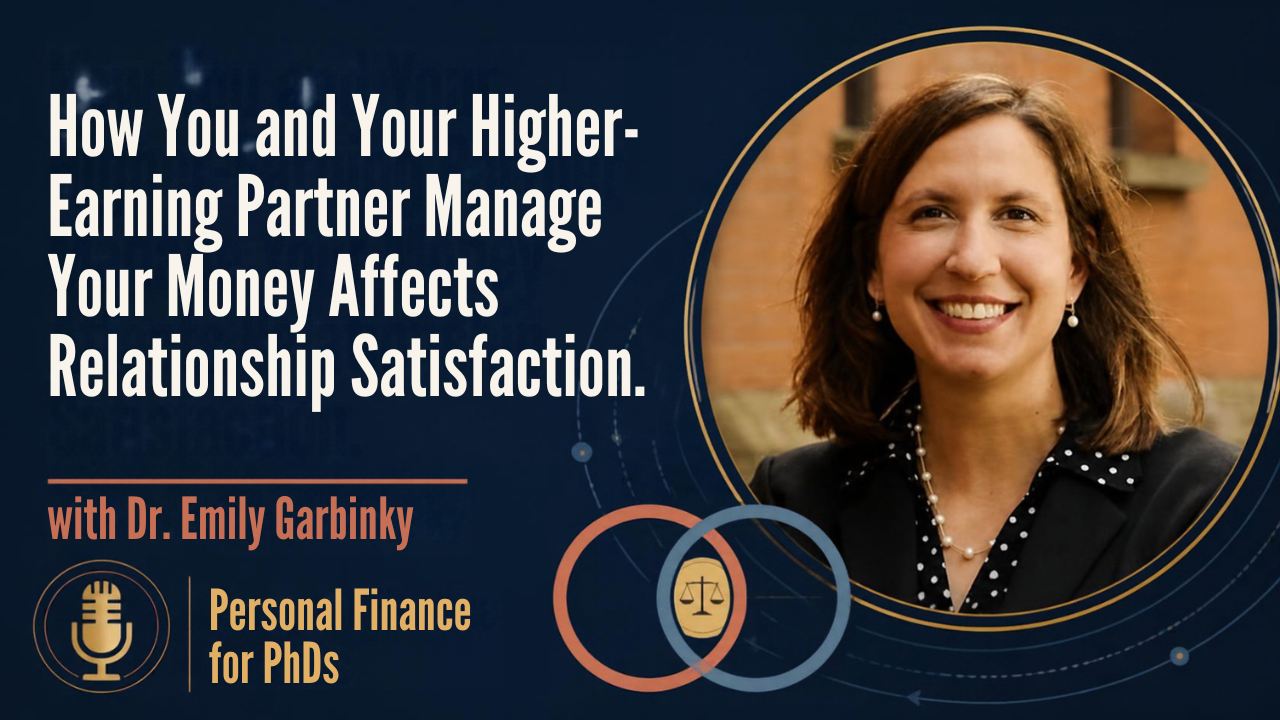
How You and Your Higher-Earning Partner Manage Your Money Affects Relationship Satisfaction

September 28, 2026 by Jill Hoffman Leave a Comment

In this episode, Emily interviews Dr. Emily Garbinsky, an associate professor of marketing at Cornell who studies how couples behave with their money. Emily first reviews the common models for structuring money within couples and the surprising effect the choice has on relationship satisfaction. Emily and Emily then discuss income disparities, such as those between a PhD trainee and a higher-earning partner, and how power dynamics can affect how couples choose to split expenses. Finally, Emily shares her thoughts about how to adapt when an income disparity shrinks or even flips and the unique career challenge facing academics and their partners.

Links mentioned in the Episode

  • Register For a Free PFforPhDs Seminar
  • Dr. Emily Garbinsky’s Website
  • Dr. Emily Garbinsky’s LinkedIn
  • Dr. Emily Garbinsky’s Podcast Episode on the So Money Podcast
  • Host a PF for PhDs Seminar at Your Institution
  • Emily’s E-mail Address
  • Happier Hour by Cassie Mogilner
  • Money for Couples by Ramit Sethi
  • PF for PhDs Subscribe to Mailing List
  • PF for PhDs Podcast Hub
How You and Your Higher-Earning Partner Manage Your Money Affects Relationship Satisfaction

Teaser

Emily G (00:00): Based on the science that’s out there, I don’t think we can make a claim that joint finances lead to objectively better financial decisions, but we do know that it helps to get couples on the same page, so it at least helps with more transparency and can help them achieve their goals.

Introduction

Emily (00:18): Welcome to the Personal Finance for PhDs Podcast: A Higher Education in Personal Finance. This podcast is for PhDs and PhDs-to-be who want to explore the hidden curriculum of finances to learn the best practices for money management, career advancement, and advocacy for yourself and others. I’m your host, Dr. Emily Roberts, a financial educator specializing in early-career PhDs and founder of Personal Finance for PhDs.

Emily (00:50): This is Season 25, Episode 3, and today my guest is Dr. Emily Garbinsky, an associate professor of marketing at Cornell who studies how couples behave with their money. Emily first reviews the common models for structuring money within couples and the surprising effect the choice has on relationship satisfaction. Emily and I then discuss income disparities, such as those between a PhD trainee and a higher-earning partner, and how power dynamics can affect how couples choose to split expenses. Finally, Emily shares her thoughts about how to adapt when an income disparity shrinks or even flips and the unique career challenge facing academics and their partners.

Emily (01:34): This fall, I’m presenting four virtual seminars on personal finance topics for prospective and current funded graduate students in the US. The first two are practice rounds for presentations I’m giving at ABRCMS in November, titled The Grad Student Financial Checkup and Will the Stipend Be Enough?. The second two are chapter topics from my book, titled Increase Your Income Inside or Outside of Academia and The Most Effective Frugal Strategies for Grad Students. I invite you to participate in these seminars for free in exchange for your feedback on the material. The seminars will be on four consecutive Fridays between October 23rd and November 13, 2026. I’m unlikely to ever offer this content again in this format, so grab your spot now! Go to PFforPhDs.com/FreeSeminars/ to register. You can find the show notes for this episode at PFforPhDs.com/s25e3/. Without further ado, here’s my interview with Dr. Emily Garbinsky.

Will You Please Introduce Yourself Further?

Emily R (02:47): I am delighted to have joining me on the podcast today Dr. Emily Garbinski, who is an associate professor of marketing at Cornell in the SC Johnson College of Business. I actually heard Emily on an episode of So Money, which is one of my favorite podcasts. It was published back in February of 2026, if you wanna go back and listen to that episode. Farnoosh Torabi is the host of that podcast. It’s an excellent episode and it just got me thinking about how we could leverage Emily’s expertise for the topics that I and you care about as funded graduate students and postdocs and early career PhDs. And specifically, we’re gonna be talking about couples and money and how couples handle finances. And specifically, we’re gonna get down to when there are income disparities, as you might be experiencing in your own relationship if you’re in one, and even what happens when those income disparities flip polarity. So we’ll get to that by the end of the interview. Emily, I’m so excited that you agreed to join me on the podcast. Would you please introduce yourself a little bit further for the listeners?

Emily G (03:45): Yes. Thank you so much for having me. I’m really excited to be on the show. So as mentioned, my name’s Emily Garbinski. I’m an associate professor of marketing at Cornell. Just some background on me. So I did my undergraduate education, Carnegie Mellon University, and I got a bachelor’s in decision science. From there, I moved to west coast best coast and spent five years getting my PhD in marketing from Stanford. My first academic job was at the University of Notre Dame. I spent six years on the faculty there, and then I moved to Cornell, and I’ve been here for five years.

From Decision Science to How Couples Manage Their Finances

Emily R (04:22): Excellent. Thank you so much for elaborating there. Just based on what you’ve mentioned so far, decision science and marketing, I’m not hearing personal finance, I’m not hearing relationships in that yet. Like how did you specifically come to this research topic? And what exactly is your research topic?

Emily G (04:37): Yes. So when I was working on my PhD, at that time I was really interested in consumer financial decision making. And so I was really focusing on questions like how can we help people save more money for the future and how can we make sure that people are prepared for retirement? And to my surprise, a lot of work in the space focused on individual decision making, right? So how can we help individuals make better choices with their own money? But as we all know, our relationship partners play a really big role in the extent to which we decide to spend versus save our money. And I kind of noticed that there was this, this gap in the literature. There wasn’t a ton of people doing research in this space. And so I started working on one project, looking at how couples manage finances and just realized that it was my favorite project that I was working on and then another project followed and another. And now I would say it’s my primary focus and where I feel like my biggest contributions have been in personal finance literature.

Three Models for Structuring Your Financial Accounts as a Couple

Emily R (05:45): Very exciting and one of the reasons I’m so excited to have you on the show today. So when I was first becoming interested in personal finance, and this might have been back around 2010, something like that, I remember reading a few papers on how couples structured their money and the papers were probably even older than that. And I remember there being like three basic models, and you can tell me if there’s any updates to this, of fully joint finances, we pool everything together, fully separate, nothing is pooled whatsoever, and a hybrid model, a yours, mine and ours model where there’s some joint, some pooling, and some separation. And at the time that I was reading about that, again, probably 15 plus years ago, it was very much the most common model to have a complete pooling. And so I’m wondering what are the updates on this? Are those the models that are still being used? And specifically for my audience, which is likely Gen Z or younger millennials, how are young couples today structuring their finances on a population level?

Emily G (06:45): Sure. I’ll answer this sort of in two parts. With your first part about sort of account structure, you’re absolutely right that this is a three-part model, pool everything, have a partial pooling approach, keep everything separate. And so this is also where I started when I began investigating how couples manage finances. So the first question I had is like, how should we be pooling our finances, if at all? And perhaps most importantly, are there consequences to how you pool your finances with your partner? And so I’ve looked at this from, I would say two different angles. And so the first angle or the first question that I wanted to tackle is how does the decision to pool or not affect how you decide to spend your money or the types of things that you’re spending your money on? As you can imagine, since I’m in marketing, I was very interested in consumption related consequences. And so what my co-author and I found is that when you spend money from a joint bank account, you experience a much higher need to be able to justify how you spend that money to your partner. And because we experience a higher need to justify, we’re more likely to buy products that we consider to be responsible or utilitarian, and we’re much less likely to buy products that are associated with sort of happiness or what we call hedonic products. And so we see this very consistently over and over again, that people are purchasing or leaning towards purchasing different types of things depending on the account from which they’re spending from. And so that sort of led me to this question of how does account pooling affect how satisfied you are with your relationship overall? And so something that both I found and another wonderful co-author, Jenny Olson, has an amazing paper where she actually randomly assigns newlywed couples to either merge their finances or keep all of their finances completely separate. And she followed them over a two-year period and found that over the course of the two years, couples that had their finances completely pooled experienced much higher satisfaction in their relationship than couples that kept everything completely separate.

Emily R (09:10): That is fascinating. And how rarely do you get to do an experiment like that where you actually get to assign people randomly to groups? Amazing. I’m curious, were there any follow-on questions about not only relationship satisfaction, but maybe life satisfaction overall or perhaps net worth growth? Like how did it actually not just affect their feelings, but their, yeah, their wealth?

Emily G (09:33): So it’s very difficult actually to look at objective net worth differences just because there’s so many different factors that would affect that over time. But if you think about something like life satisfaction, we know, for example, that relationship satisfaction is a really big part of. And so I would imagine we would see increases in life satisfaction through one satisfaction with their relationship. But I think based on the science that’s out there, I don’t think we can make a claim that joint finances lead to objectively better financial decisions, but we do know that it helps to get couples on the same page, so it at least helps with more transparency and can help them achieve their goals.

Emily R (10:18): I guess I just had that question because when you were phrasing it of buying more utilitarian type products from a joint account and not so much the hedonic products or services, I was just thinking that like some people need that accountability to meet their financial goals, for example, and so that actually might result in more savings or higher net worth. But maybe by buying fewer of those hedonic products, they might not have as much life satisfaction. Maybe they do it, but they’re not happy about it, even if they’re happy in their relationship. But I understand it’s very difficult to study those kinds of things and you answered the questions that you’re able to.

Emily G (10:54): My intuition is actually the same as yours. I thought we were gonna find opposite. <laugh> So I though people that are buying these products associated with happiness and using separate accounts might actually be happier and even more satisfied in their relationship because they feel like they’re purchasing whatever they want. But it actually seems that overall, a greater input into our relationship satisfaction is just feeling like we’re a team, right? So these hedonic products can increase short-term happiness, but if we think more about long-term happiness and life satisfaction is very much a proxy for long-term happiness, it seems that we see the flip such that joint accounts lead to greater relationship satisfaction and potentially life satisfaction.

Emily R (11:38): Yeah. And I just wanted to note, I think you said for that particular study, this was married couples, newly married couples. So they had already made that decision. They’d come to that point of that legal commitment, right? And so we’re not necessarily talking. We don’t know if we would see the same results for a, a couple at a different stage in their relationship.

Emily G (11:55): Yes. The study that was done looked specifically at newlyweds.

To Pool or Not to Pool? How Life Events Influence Shared Finances

Emily R (11:59): Yes. And then I guess to take it back to, that was a study done relatively recently, presumably on newlyweds. Do we know overall statistics about how younger couples are choosing to pool or not pool?

Emily G (12:11): Yes. So younger couples are actually much more likely to keep their money separate and they decide to merge when there’s some sort of big life event that necessitates. And so when I say big life event, this could of course be getting married as, as was done in the study, but it could also be something like just deciding to move in together and thinking about how you’re going to pay for your joint rent in your new apartment or your new place together. And so when that happens, what we see is that these couples tend to engage in this partial pooling practice where they’ll open, for example, a joint account where they can put money for their rent, for their groceries, for any shared expenses that they have together.

Emily R (12:56): And you just said that younger couples are much more likely to keep their money separate. Are you saying that’s relative to older generations or absolutely they are keeping things separate, perhaps with some exceptions of these life events? And then if those life events occur, what’s kind of the balance between people who stay fully separate and who do partial pooling or full pooling?

Emily G (13:17): Yeah. So this is relative to older couples that tend to be more likely to be married. And so once you marry, this is when people start to just merge more of their finances over time. But we are starting to see some shifts because couples are putting marriage off later and later, and so people are coming into a marriage with more assets than they had before compared to couples that were getting married young where it kind of made sense just to pool everything together when you had less.

Emily R (13:47): And I wonder, is the arrival of children one of those big life events that pushes couples more towards pooling?

Emily G (13:54): Absolutely.

Commercial

Emily (13:57): Emily here for a brief interlude. Would you like to learn directly from me on a personal finance topic, such as taxes, goal-setting, investing, budgeting, or designing your financial life, each tailored specifically for graduate students and postdocs? I offer live workshops, asynchronous online courses, and cohort-based programs on these topics, and I’m now booking for the 2026-2027 academic year. If you would like to bring my content to your institution, would you please recommend me as a speaker or facilitator to your university, graduate school, graduate student association, medical school, postdoc office, or postdoc association? My workshops are usually slated as professional development or personal wellness. Ask the potential host to go to PFforPhDs.com/financial-education/ or simply email me at [email protected] to start the process. I really appreciate these recommendations, which are the best way for me to start a conversation with a potential host. The paid work I do with universities and institutions enables me to keep producing this podcast and all my other free resources. Thank you in advance if you decide to issue a recommendation! Now back to our interview.

Advice for Couples With Significant Income Disparities

Emily R (15:26): Now I wanna think specifically about a situation that a lot of PhD trainees may be in, which is that they are in a relationship, but there is a significant income disparity. Maybe a grad student partnered with someone who has a full-time permanent job, same thing for postdocs. What does the research show or what advice would you have for a person, the lower earning person in that situation? Are there any best practices that you’ve uncovered?

Emily G (15:52): Yeah, so I can tell you first what I see in the data, and then I can talk a little bit about just some insights or some advice that I have from it. So with one of my PhD students, she’s specifically interested in heterosexual couples with an income disparity. And so one of the things that we’re looking at together is how do couples that have an income disparity choose to split shared expenses? And so as you can imagine, there are two common ways in which couples can split shared expenses. So they can either pay for something proportionally to income, which means that the higher earner would pay more because they make more, or they can split something equally, right? Split it right down the middle, fifty fifty split. And so one of the things that we find over and over again in our data is that the way in which couples choose to split shared expenses seems to be driven by the gender of the higher earner. And so what we find is that when the higher earner is the man, couples are much more likely to split proportionally the income. But when the higher earner is the woman, couples are much more likely to split equally. And so the question, of course, that we’re asking ourselves is, okay, why? Why do we see this over and over again? And it seems to come down to the idea of power and financial decision-making power. And so what seems to be happening is in relationships with income discrepancies, the higher earner sort of by default has more financial decision-making power, right? They are earning more of the money, and so they kind of feel like if there’s a shared expense, they should have more say because they’re bringing in more money to the relationship. And so what we see is that because men on average just tend to be more agentic, they really struggle with this idea of having their power be reduced. And so they’re trying to reclaim some of their decision-making power by offering to pay their fair share, which some would argue would be the fifty fifty split.

Emily G (18:06): But women, on the other hand, because women are much more communal, they don’t really mind as much if they have less decision-making power. And so they’re perfectly happy to just let the man pay for more and go with the proportional split if the man earns more. What does this mean for couples with income discrepancies? What, what advice would I give? I think what I would say is that just to be cognizant of the fact that if you are splitting a shared expense in which the higher earner does tend to have more weight, I think it’s important to realize that the shared expense is gonna be used by both of you. And so I think even if you are the lower earning PhD student, you should feel free to speak up and voice your preference, right? It’s your apartment too. It’s your car too. It’s your vacation too. And there’s no real reason why you shouldn’t have as much of a say in something that you are in fact contributing your own money to help, right?

Emily R (19:02): So I like that extension of your observation about this because you’re not really coming down on, “Oh, it’s better to do fifty fifty. It’s better to do proportional split.” You’re just saying, “These are the tendencies that people have. Let’s take a step back from that and understand the motivations.” And if you just use your voice as the lower earning person, you could be in either situation and you’re still trying to be heard equitably in your relationship. So that’s an amazing observation. Thank you.

Emily G (19:29): Yes. We don’t have, from the data, a clear finding of, “Oh, couples should split this way or they should split this way.” But what we do know is that people are upset if they feel like they don’t have a voice and they feel like they’re not being heard. And so this is a case where, I guess it’s different from what we found with the joint account data where it’s very clear pooling finances increases relationship satisfaction. Here, it’s just we see these descriptive differences between couples and we’re trying to wonder or ask ourselves why this is happening. And what we do know from decades of research at this point on power is that when people feel powerless, that’s a really aversive state. And so making sure that people feel power in their relationship is gonna be really important. And oftentimes we link power to money, and that doesn’t always necessarily have to be the way it’s done or handled in the relationship.

Emily R (20:23): And I guess I’ll also note for listeners wondering about this, the, the practice of pooling, like if you’re listening and saying, “Oh, I want greater relationship satisfaction, maybe I’ll bring up pooling with my partner.” The pooling can be fifty fifty. It can be proportional income. You can do it either way. That’s. Or somewhere in between. It’s not prescriptive in that way you can still pool in either one of those scenarios.

Emily G (20:43): Yes. And I think another thing that’s important for me to communicate is the fact that what does pooling do? It essentially increases transparency and it forces couples to get on the same page and have conversations about where they are with their finances. And this is something that you can do even without pooling, right? Pooling is just one way to facilitate that, but there’s a lot of apps and a lot of tools out there like Monarch, for example, or Honey Do is another app that’s specifically made for couples that can increase financial transparency and help you get on the same page. So if you’re someone that’s not fully comfortable with the idea of merging accounts or opening a joint bank account with your partner, you can still achieve higher financial transparency or financial intimacy just by being open about your financial status.

The Complexities of Academic Life: Major Income Changes and Relocation

Emily R (21:38): Yeah. Thank you for adding that. That’s another great observation. Um, okay. Let’s think about a further evolution of the scenario we just talked about, which is we have a couple with income disparity, one person is in PhD training, maybe one person’s in that full permanent job, and then things switch. The PhD comes out of training, they receive a massive income increase. Woo-hoo, everybody’s so excited about that. But then what changes in their relationship and the power dynamics that you were just talking about? Has this been studied at all? And again, are there best practices around this?

Emily G (22:10): Yes. To the best of my knowledge, this hasn’t been studied specifically in the literature, but I am happy to talk about what I think would happen and also just give some anecdotal observations. And what we know is that change is hard, and it’s also really difficult to prioritize two careers equally. And so I think what happens in a lot of couples is that people just naturally tend to prioritize the career of the person who makes more. And so if there is some sort of flip in the relationship, it’s gonna be quite difficult for the person who was once the breadwinner and no longer is to maybe take a back seat. And I think PhDs in particular, and especially PhDs that go into academia, have a really difficult time because not only might the breadwinner within the relationship flip, but oftentimes we don’t have a lot of say in where we have a job or where we have to move. And I think it’s really hard for the partner that has to suddenly pick up and relocate and move potentially to a location where they don’t wanna move, but it might be the only academic job that their partner got. And so this is really, really complicated relationship dynamics.

Emily G (23:28): And so I’ve seen this go both ways. I’ve seen examples where couples thrive and they have a partner that says, “You go out and you get the best academic job you can get and I’ll make it work.” I’ve also seen couples where they’ve fallen apart because the partner doesn’t wanna move where the spouse got a job. And so now they’re doing long distance because the other spouse just didn’t wanna make it work or couldn’t, or to some extent couldn’t make it work. Maybe it wasn’t their fault. And so one thing that I think is really important for PhDs in particular is just to be super open with your partner about your career trajectory, your career plans. If your partner’s not able to accommodate a move to anywhere in the country, I think targeted job searches are really important. One thing that drives me crazy in both jobs I’ve had in Ithaca at Cornell and in South Bend at the University of Notre Dame is you interview people and you get excited and you make them an offer and then they say, “Oh, my spouse can’t move here.” When it’s like, I feel like you should have had that conversation before you applied to the job about would it even be realistic for them to pick up and move here? And so I think sort of the general theme of all of this is just that conversations around your job and your career plans are also financial conversations. I don’t know if we always think of them that way, but salary and salary transparency in your career goals and your hopes for the future are all things that you should be talking about. And yeah, so I think just being open and honest about the fact that you might not have a say in where you move and it’s just a very different career and lifestyle, I think is something that is really important for your partner to be aware of.

Emily R (25:19): Yes, I totally agree. And I’m thinking now even about specifically because you mentioned an academic, a PhD who’s continuing on in academia, that may not result in being the higher earning partner. The person who was earning more before may still be the breadwinner in that relationship, and then you really have more power dynamics to deal with if it, we have to move for this job, but it’s not gonna even increase my salary as much as yours is. That is really tough. And obviously within academia, we- There’s a lot of ink spilled about the two-body problem and so forth. And so we have ways of handling that if it’s two academic partners, but not so much if it’s one person in academia and one person not, and certainly not if it’s two people outside of the academic system who are trying to navigate this. So I totally agree. Really?

Emily G (26:02): Yeah. The two-body problem is real. And there, once again, there’s no right answer, right? You can’t say, “Oh, you should clearly do this or you should clearly do that.” Each couple has to have the conversation and figure it out for themselves. And I think the conversation also needs to be ongoing, because I also know instances where maybe a spouse agreed to one thing, and then they move and they start their respective jobs, and then they realize that it’s just not working for them. And I think, once again, just being open and honest about these things is really important.

Emily R (26:31): Yeah. I’m so glad you brought up the particular difficulties of having a career in academia, or we might say overall, just a very specialized career where there might be very limited number of places that you could live in the US or around the world to do your particular unique niche thing that you do. Absolutely.

Emily G (26:48): And I’ve mentioned this a few times, but really excited to be on this podcast for PhDs because it always blows my mind to how people outside of academia don’t really realize, for example, that if you are denied tenure, you have to move. And just having gone through the tenure process recently and telling people like, “Oh, I hope I get it. I hope I get to stay.” And they’re like, “What do you mean?” <laugh> And yeah, these are things that I think are very idiosyncratic to our careers.

Emily R (27:16): And I know I was just mentioning geographical limitations, but academics are spread out, let’s say, across the US. You might land in a town that doesn’t have an industry that’s compatible with your partner’s career track. And thankfully, there is so much more opportunity for remote work now. My husband and I both work remotely and are very happy about that, but not every job is- lends itself to that kind of arrangement. Emily, this has been so insightful. Thank you so much for coming on sharing your research and what you’ve learned from the literature and the studies that you’ve done about couples and money and this income disparity. So fascinating.

Best Financial Advice for Another Early-Career PhD

Emily R (27:50): I want to wrap up with the final question that I ask of all my guests, which is what is your best financial advice for an early career PhD? And this can be something we’ve touched on in the interview already, or it can be something completely new.

Emily G (28:02): Okay, great. So I think my best advice is if I think back to my early career as a PhD, and we’re talking about sort of these, these income disparities and these changes in income, I just remember thinking basically overnight, you go from getting used to making a relatively small amount of money for five to six years, and then you wake up the next day and you’re doing much better, right? You get your first job out of the PhD and you’re making a lot more money. And I, I remember feeling like I could just buy whatever I wanted. Like I had so much money now, and it was so much more than, than I had been used to. What we know from the literature is that when income goes up, spending also tends to go up as well. And this is a finding that’s referred to as lifestyle creep.

Emily G (28:53): And so I think my best advice would be to think about maybe some ways to avoid lifestyle creep, and your spending doesn’t have to go up in everything. And so one of the things that I like to do is think about what types of things bring me the most joy, and then I increase my spending on those things. But then other things, I held my spending constant, and I still spend similarly to when I was a PhD student. And so if you think about, for example, other books that are out there, like Cassie Mogilner’s book on Happier Hour teaches us to think about what things help you find the most joy, or Ramit Sethi’s book on Money for Couples and finding your rich life, right? What is your rich life? And so I think that when you get these big boosts to your income, I guess my advice would be to increase spending on things that bring you the most joy, but it’s okay not to splurge on other things.

Emily R (29:54): Absolutely. The way that I phrase that when I teach on this topic, and it’ such an important one for being mindful in those career transition points is that, yeah, we should avoid lifestyle creep or lifestyle inflation, but you absolutely should indulge in intentional lifestyle increases in those areas that matter most to you, as you were saying. And as a follow-on, let’s be real careful about those fixed expenses, okay? Let’s be careful about the housing that we commit to, the car that we commit to, because those are a little harder to change once you’ve made that initial decision and you might have been riding high and not realizing, “Oh, there’s a lot of taxes I have to pay, and oh, there’s a lot of other increases.” So love that advice, very relevant for this audience. Thank you so much. Emily, again, this is a wonderful interview. Thank you very much for coming on.

Emily G (30:39): Thank you so much for having me. It was a real pleasure.

Outro

Emily (30:44): Listeners, thank you for joining me for this episode! I have a gift for you! You know that final question I ask of all my guests regarding their best financial advice? We have collected short summaries of all the answers ever given on the podcast into a document that is updated with each new episode release. You can gain access to it by registering for my mailing list at PFforPhDs.com/advice/. Would you like to view transcripts or videos of each episode? We link the show notes for each episode from PFforPhDs.com/podcast/. See you in the next episode, and remember: You don’t have to have a PhD to succeed with personal finance… but it helps! Nothing you hear on this podcast should be taken as financial, tax, or legal advice for any individual. Podcast editing by me and show notes creation by Dr. Jill Hoffman.
Fully Joint and Fully Separate Finances in Marriage: Perspectives from Two PhDs

September 21, 2020 by Meryem Ok

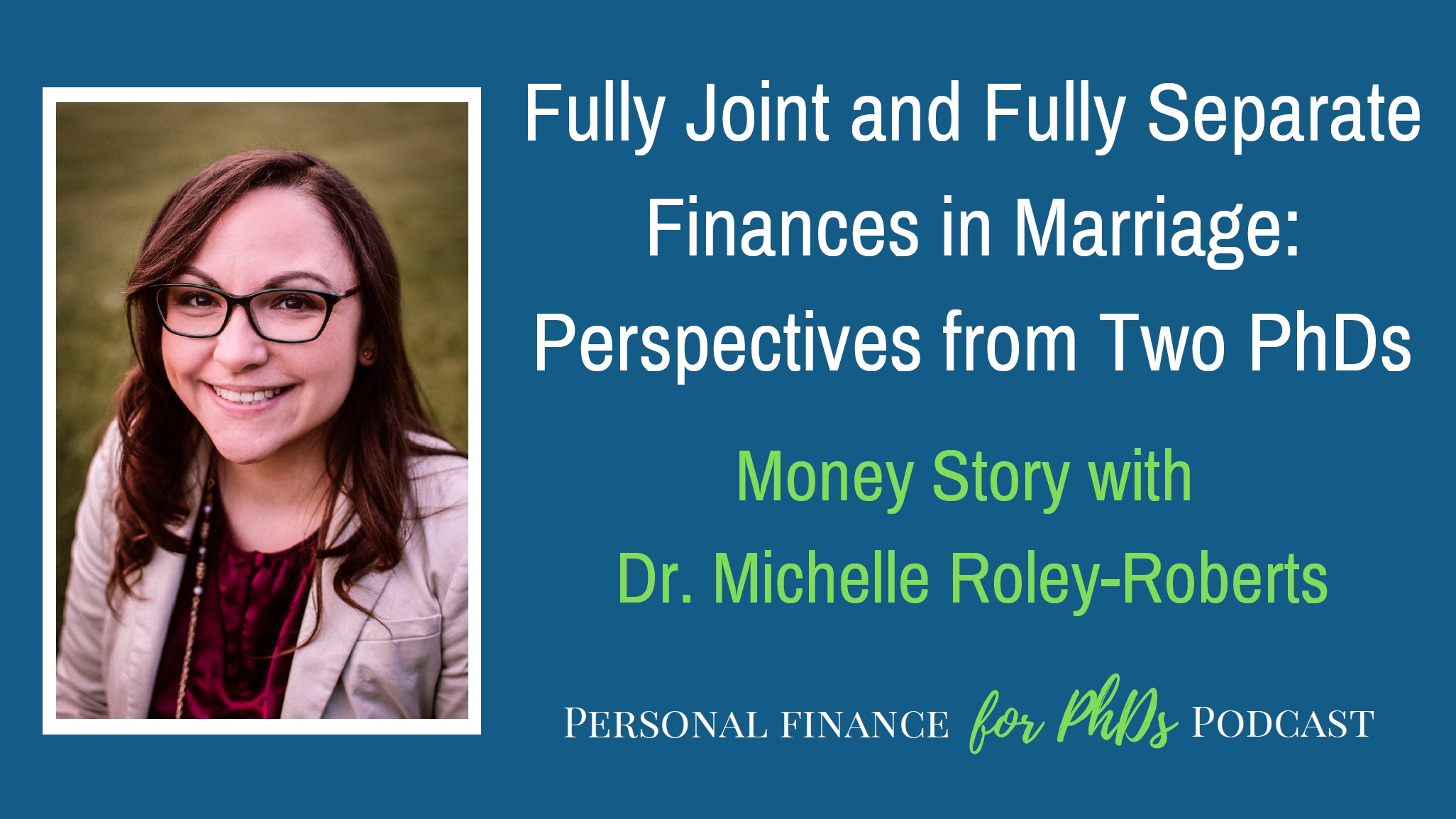
In this episode, Emily discusses marital finances with Dr. Michelle Roley-Roberts, an assistant professor at Creighton University. Emily and her husband keep fully joint finances, whereas Michelle and her husband keep fully separate finances. They detail their respective systems, list the advantages of each approach, consider how the legal realities line up or not with their preferred conceptions, and consider whether they would ever change their methods. They touch on IRS filing statuses, student loan debt, income shifts, living apart, and the addition of children.

Links Mentioned in the Episode

  • Dr. Michelle Roley-Roberts: Creighton Faculty Profile
  • PF for PhDs: Speaking
  • PF for PhDs: Podcast Hub
  • PF for PhDs: Subscribe to Mailing List

Teaser

00:00 Michelle: Every November, I have these two conferences and I know I’m going to be spending more money around that time. He doesn’t have to think about that at all. And if we had a joint account, we would always have to talk about that. And because we don’t, it’s not a thing that we need to discuss, he just knows that I go on these conferences.

Introduction

00:26 Emily: Welcome to the Personal Finance for PhDs podcast, a higher education in personal finance. I’m your host, Dr. Emily Roberts. This is season seven, episode three, and today my guest is Dr. Michelle Roley-Roberts, an assistant professor at Creighton University. Michelle and I discuss our methods for handling finances in our marriages. My husband and I keep fully joint finances, and Michelle and her husband keep fully separate finances. We detail our respective systems, list the advantages of each approach, consider how the legal realities line up with our preferred conceptions, and consider whether we’d ever change our methods. We touch on IRS filing statuses, student loan debt, income shifts, living apart, and the addition of children. Without further ado, here’s my discussion with Dr. Michelle Roley-Roberts.

Will You Please Introduce Yourself Further?

01:18 Emily: I have joining me on the podcast today, Dr. Michelle Roley-Roberts, and we’re doing a little bit of a different format today than my typical podcast interviews. Michelle and I are actually going to have a discussion today. The topic of our discussion is how to handle money in a relationship. And I was looking for someone to discuss this topic with me because my husband and I have our finances completely joint. And I know that that is not necessarily as common as a model as it used to be. And so I wanted to have someone on who would tell me about a different model. So, Michelle volunteered. She and her husband have separate finances. So, we have those two perspectives represented today. And there’s a third model that won’t be represented, which is the yours, mine, and ours model, which is sort of in between these two.

02:02 Emily: So, I hope you’ll get something from this that’ll be interesting to you. If you are in a relationship, if you handle money together as a couple, hopefully you’ll find some common ground with one or the other of us, or maybe you’ll disagree with both of us and say, “Well, I want to handle things completely differently than these two.” But yeah, that’s the topic for today. So, Michelle, thank you so much for joining me and having this discussion.

02:22 Michelle: Yeah, thanks for having me. I’m looking forward to talking about this.

02:25 Emily: All right. So, why don’t we start Michelle with a little bit further introduction to you, like your academic and career background and where you live?

02:34 Michelle: Sure. So, I am a clinical psychologist by training. I’m currently living in Omaha, Nebraska, and I am an assistant professor at Creighton University and I’m a licensed clinical psychologist at CHI Health Initiative. I have a PhD from the University of Toledo in Ohio and my husband and I have been moving all across the country, met in undergrad and have been together ever since then. So, he’s been really following me around through all of my steps to get to where I am now. And I think that really factors into how money has been handled in our relationship because he is not a PhD. So, while I’ve been accruing debts and lots of things, that’s not been true for him. We started out as, you know, dating and as roommates before we were ever married. And so, the roommate piece has always been a factor in how we’ve handled money. And I think as we married that never changed because we had already found a system that worked for us.

Timeline for Michelle and Emily’s Relationships

03:49 Emily: Gotcha. Yeah. Can you put some dates on this? Maybe I’ll share some dates of my own as well. So, like when did you meet, when did you move or change things in your relationship? Going from dating to living together to marry, those kinds of things?

04:05 Michelle: Yeah, so we met in 2004 and we did not get married until 2016. So, I graduated in May of 2008 from undergrad, moved from Ohio to North Carolina and lived for a year on my own while he was finishing up his degree. And then he moved to North Carolina with me. So, I was a postbac at Duke for three years, we, that sort of started our trajectory on roommates. And then he followed me from Duke to Toledo for my PhD. And we lived in Toledo for four years. And then a requirement for clinical psychologists is that we do a year-long APA accredited internship somewhere in the country. And so, I happened to match at the University of Arkansas for Medical Sciences. So, we moved from Toledo, Ohio to Little Rock, Arkansas in 2015. And then we got married in the middle of my internship year in 2016. And then from there, we moved from Arkansas back to Ohio for postdoc, where I was a postdoc for four years at Ohio State. And then from Columbus, Ohio to Omaha, Nebraska, and have only lived in Omaha for about two months.

Separate to Joint Finances vs. Maintaining Separate Finances in Marriage

05:40 Emily: Yeah. Thank you for sharing that. That is a lot of moving, but not too unusual right? In the PhD world. So yeah, I’ll share kind of the counterpoint. There’s actually some points of overlap in our story, which is really interesting. So, my husband and I, before we married, Kyle, we graduated from college in 2007. We started dating in 2006 and we lived in different cities for a year. He started at Duke and I did a postbac at the NIH. And then in 2008 in the fall, I moved and started my PhD at Duke. We lived separately for two years until we got married in 2010. So when we got married, moved in, that’s when we combined our finances. So, we went from completely separate to completely joint.

06:30 Emily: Well, there’s a little bit of a transition, but aspiring to be joint when we got married that was in 2010 and it’s been that way since. So, we did have a small period of living apart for a few months when I did a fellowship after I finished my PhD, but we both defended in the summer of 2014. We lived in Durham for another year. I was in DC for part of that year. And then in 2015, we moved from Durham to Seattle. So, that’s kind of our story. And for the listeners, we’re recording this in September, 2019. So, that’s the perspective there. So, we’ve already heard a little bit about the history of like how the handling of the finances for both of us has changed over the course of our relationships. Is there anything else that you want to add to that as to maybe like philosophically, like why you’ve chosen to maintain the system that you had been using all along? Whereas of course I, as I just said, we changed at some point.

07:23 Michelle: Yeah. So, for me personally, my debt that I was accruing was my debt for my education and my career advancement, wasn’t necessarily my husband’s. And yes, I know legally it’s his debt now because we’re married. By not having our finances joint, it makes me feel like it’s still my debt and I’m still working to pay off my debt. And it actually helps me a lot. So, on fellowship, I got an NIH loan repayment grant and I was able to do that pretty easily because I had not consolidated my loans, and his undergrad loans weren’t part of mine and we didn’t have to deal with any of that. And I was told by NIH loan repayment that our finances were much more straightforward and it was easier for them to give me money because they didn’t have any headache with that. So, it was helpful in that regard. We were not thinking about that when we decided not to join accounts.

Benefits of Filing Taxes Jointly as a Married Couple

08:39 Emily: Yeah, sometimes there are unexpected benefits that come up along the way. So, I’m curious, do you guys file taxes married, filing jointly, or married, filing separately?

08:49 Michelle: Jointly.

08:50 Emily: Okay. Because that also, that sometimes affects like this loan repayment, like loan forgiveness stuff, depending on like what program you’re in. Did you want to add to that?

08:58 Michelle: It’s definitely like, we talked about how we were going to do that. And I think because economically we would benefit more from filing jointly as opposed to filing separately. And so that was pretty much the decision. It was more of an economic decision as opposed to a philosophical one, I guess.

09:12 Emily: Yeah, there’s this really strange thing, I guess, in the tax code that it does matter a lot, whether you’re married or not. Right? That’s the sort of defining line is legal marriage, depending on how you file. And then there’s a real disadvantage to married filing separately. I mean, there are some conditions under which some people choose to do that, but it’s not at all the same to do married, filing separately as it is when you’re not married. Like those are two vastly different treatments under the tax code. So, I find that to be very I mean, I’m sure there are reasons for it, but I find it to be kind of puzzling. So, there are sort of very, very special circumstances where it makes sense to do married filing separately, but they’re kind of rare actually, and actually often involve large student loan debts. And that’s one reason that people do file separately.

Advantages of Separate Finances in Marriage

09:59 Emily: Okay. So, I would say for my counterpoint on that, the philosophy or the reasoning behind us joining our finances when we got married was around our understanding of marriage or our idea of what marriage should be. And so, there are certain attributes of a married couple that we believe in. And one of those is joining finances. That’s not to say that everyone has to do it the same way we do, but that’s how we view our marriage. And so, it was important for us to go from not having anything in common before we were married to, after we were married, deciding that everything would be in common. So, let’s get to talking about, kind of like, what are the advantages of the joint finances model and the separate finances model? And please go first.

10:48 Michelle: Okay. So, advantages that I see are control. Control of your own money and how you spend it. Like, I don’t have to ask my husband and he doesn’t have to ask me to spend money. Because we both know what’s in our respective accounts and we are decent money managers. And so, we’re not necessarily consulting eachother about money all the time. And in fact, it’s very rare for us to have a discussion about money, or I don’t think we’ve ever fought about money because we’ve never needed to. So, I would consider that definitely a pro because finances are a common theme for stress and tension and marriage, and by us having separate accounts, I’m never needing to have that discussion with him because the bills that I pay are paid and it’s on my own volition and what he’s paying is on his and I never have to track that.

11:50 Emily: So, I have kind of a follow-up question about that, which is so at some points you do have to make decisions around money like where to live, for example. So, do you just eat sort of assess your own budgets and so forth and say, “Okay, this is how much I can spend on the next place that we live.” And you both just kind of agree on a number, is that right?

Separate Finances, Shared Vision and Life Goals

12:08 Michelle: Yes. Yeah. In general, we know, so we have, even though our finances are separate, we have shared goals for our life. So, our goal right now is to live like a postdoc, even though I’ve started my career. And with the goal of paying off my student loans and our credit card debt, so that we can then save for a house and just have a better life down the line. And so, we both share that vision, but how we go about getting to that vision is a little bit different because our accounts are separate.

12:46 Emily: Yeah. I’m really glad that you clarify that. That like, the vision is united. And the, as you were just saying, I thought you put that very well. The methods by which you each get there financially could be separate, but you’ve agreed on kind of where you’re headed. And so, you do aspire to own a house together. It sounds like.

13:05 Michelle: I think so. That’s a goal one day.

13:08 Emily: Okay. Gotcha. Any other advantages? I mean, that’s a big one.

13:12 Michelle: I mean, that for me is the biggest one. And just a sense for my just having my own autonomy within my relationship. I think that’s an important value for me as a person. And so, I get to have that. And my husband supports that because we have a very, like our philosophy on marriage is very much partner-focused and that we’re in it together. And that neither one of us is, you know, the owner of the other. We don’t have that kind of philosophy. And I think that reflects true in our finances. And I find that as an advantage.

Advantages of Joint Finances

13:55 Emily: Yeah, definitely. I thought of a couple of advantages to the joint system. So, one is complete simplicity. We have one checking account, both of our names on it. We have a set of savings accounts that both of our names are on. As I said, the credit cards are a little bit more complicated. Some of those, we have both of our names on there’s like one or two on each of our sides that we only have one, mostly because the other one might sign up later to get the parks as well. So yeah, to me, that simplicity is there. Now, I’m not sure how you handle this part, but I know that for some people who, for instance, have the yours, mine and ours model, they end up having a joint checking account, separate checking accounts, joint savings, separate savings, maybe joint credit cards, maybe separate credit cards. And also there’s a lot of transferring going on. So, I don’t know, like when you pay your bills, for example, do you, like one is responsible–like, how do you handle, I guess the transferring that might need to go on? Or do you avoid that?

14:47 Michelle: Yeah, so for bills, I, in fact, up until this move, had handled all of the bill paying, and so I would pay the bills every month and then we would split finances. So, he would literally write me a check, and then I would deposit that into my account and make sure all the bills got paid. This move, because of all the stress and things in my own world that were happening around this move, he actually took some ownership on setting up some of our bills for this new move. And so, now he’s responsible for some bills that I would have previously been paying, and that seems to be working out okay. It’s just what he’s paying and then gets deducted from what he would owe for the rest of his half.

15:35 Emily: Gotcha. Yeah. So there still is some, when you live together and you have shared expenses, you still have to do some of this transferring or somehow decide how to split it up. So, one advantage of joint finances, is the simplicity. Oh, and when we get paid, like all of our money goes into that checking account. Although, you know, come to think of it. My business is something that’s separate, because the business is not in my name alone. But when I pay myself from my business, that goes into our joint checking. And I’m not like spending out of the business for personal stuff, obviously. So, kind of once it is entering into our personal finances it’s joint. So, that’s one advantage is the simplicity. Not having to do the transfers.

Complete Transparency and Agreement

16:14 Emily: And then another one is complete transparency. So, this is not something that necessarily everyone desires, but we do. And so, obviously because everything’s joint, we both have complete access to everything and there’s no, basically there’s no way that any of us could keep a secret from the other without going and opening another account. That obviously could happen. Like, logistically one of us could do that. But in terms of what we know about, we can all see everything. And actually, so in addition to actually like literally sharing the accounts in terms of his name or on them, we also have a Mint account that we share where everything goes into that. And so that was actually helpful. We started that Mint account sort of, you know, as we were getting married and joining everything. So, for the things that were separate, that we didn’t like close down right away, they were all in Mint anyway. So, we could each see what was going on, even if like, you know, that random other account was still open for a little while. So, I liked that aspect of transparency a lot. To me, another feature of joint finances is that you have to agree on everything. But of course the corollary to that is that if you don’t agree, then there’s friction, then there are problems. As you were just saying, by keeping things separate, you really minimize kind of the, the level.

17:30 Emily: Like if you agree on the big picture, like the details, whatever it’s separate, who cares as long as you’re both adhering to the shared vision, I really liked how you phrased that. But for us, it’s sort of a feature that we have to agree about everything. Like I know other people view that as like a downside, but we do have to agree on everything or agree to disagree. Right? And agree to let one another have some autonomy in our decision making and just not care. And of course we’ll still see it. As I said, with the transparency. I think this was more important to us, or it was more of a factor like us having to agree on things earlier in our marriage, because we were both in graduate school. So, we weren’t earning as much money as we are now.

18:12 Emily: And our expenses, we were just a lot more like strict around budgeting and so forth. I mean, by necessity, right? We had to be, so the incomes were lower. So, we had to agree there wasn’t really, there wasn’t really a lot of fat in the budget. Right? And so everything had–not everything, because we agreed on a lot of things automatically–but if there were any points of disagreement, we had to force ourselves to come to an agreement. Or again, agree to disagree and just spend what we will.

Both Spending Models Encourage Conversations About Finances

18:36 Emily: So, I remember like early on in our marriage, I’m a bit of a natural spender. It’s something I’ve had to kind of curb over time, especially during graduate school. And my husband could not understand. We were going to all these weddings, right? Because we were in our mid twenties, we had just gotten married. We were going to a lot of weddings. My husband could not understand why I needed a new dress for, not like literally every event, but like a lot of events. I was like telling him, “I need to buy a new dress for this.” He was like, “I’m wearing the same suit to every single one of these events.” And I was like, “Well, this is a day wedding. And this is an evening wedding. You have to consider the season and the temperature and like the fanciness level.” And so I was trying to tell him all these reasons why I had to like buy all these new dresses. And he ultimately like, did not really understand it, but he just had to like, kind of accept it for a while. And so, that was an example of sort of an ongoing, not like fight, but just like sort of puzzlement on his side of why I was making these decisions.

19:27 Emily: But what that did though, is it kind of forced him, I think, to understand something about women and women’s fashion and the constraints and the expectations that we’re under. And it also forced me ultimately, you know, I didn’t keep up that dress-buying habit for more than a few years. And so, it also kind of forced me to be like, “Well,” rethink, like, “Do I really need all these new clothes for all these new events?” And so, it was a reason for us to kind of evolve our, I guess, thinking or understanding of each other and that kind of thing. So anyway, some short-term conflicts sometimes, but I liked that we are ultimately forced to agree and work things out. So to me, that’s a feature. And then the last feature, did you want to add anything there?

20:08 Michelle: I think just, as a counter perspective, by having separate accounts, it’s actually forced us to talk about finances more than if we had a joint–and maybe not more, but in a different way. So, I like you, Emily, am more of a spender and I have to really be conscientious about saving. Whereas my husband is very frugal and he would never spend money if he could get away with that. And so, it’s more like I’m talking to him as a confidant about money and, “Okay, so I’m really, I’m considering, you know, I love shoes and I think I need a new pair of tennis shoes,” and then he’ll reflect back and say, “Well, do you really? And how are these shoes going to help you with whatever?” And sometimes I’ll listen and I’ll say, “Okay, yeah, you’re right. I probably don’t need these shoes.” And it’s more of a partnership piece as opposed to a necessity. Like, I don’t need his opinion or his approval for me to buy this thing, but I I’m seeking it because I value his input. And in some ways that’s strengthened our relationship.

21:26 Emily: Yeah. So, even though you don’t have to, at the end of the day, you do choose to, I mean, you said earlier, you don’t talk about money much, but it sounds like maybe you talk around it a little bit. Like money affects a lot of things in our lives. And so, it’s kind of hard to go without discussing it at all, at least in an oblique manner. But what I like about what you’re saying is that like you’re still bringing it up and bringing whatever the decision is out into the open. And ultimately at the end of the day, it’s still your decision, but you are seeking his opinion or his counsel. Yeah. I really like that.

Advantage of Joint Finances: Navigating Income Disparities

21:57 Emily: The last advantage that I thought of for having joint finances is that it doesn’t matter who earns what. So, like when my husband and I were in graduate school, we earned about the same amount of money. So, not really huge concerns there. Right? Two people, two incomes that were pretty much the same feels like equal, right? After graduate school, I became self-employed. My income went down–right?–initially and then has risen over time. But his income increased because he got a proper job, a proper post-PhD job. And so, he saw an income jump, and I saw initially an income decrease. And it didn’t matter, like there wasn’t tension around that. And also the decisions that we had to make, like, for example, when you were saying earlier about, okay, you need to come to an agreement on where to live. So, like had we had separate finances under that situation, it would be like, well, I almost can’t contribute anything like to the household or very little, and he would be contributing a lot.

22:57 Emily: Under the joint model, we don’t concern ourselves with that because the money all just is shared. And so, whatever we can budget and afford on the completely combined income is what is going to happen, you know, for our family. And I guess I should say that basically, had we had separate finances and were committed to both contributing, for instance, equally to the household, then I just wouldn’t have started my business. It just, it wouldn’t have happened that way or wouldn’t have happened at that time. Like I would have gone and gotten a job and had an income more equal to what his was or close to. Yeah. And so, I think that the joint finances model has actually helped me like follow my dream. Right? As starting this business. And likewise for him, like he took a job at a startup, which we know at any point the ride could be over, right?

23:51 Emily: It’s an early-stage startup. And so, I guess of course he could have like saved maybe and provided for him self, I guess, in the event of job loss or something, if that’s what an emergency fund is for. But I guess we sort of have more like peace of mind knowing there’s like two incomes going into this pot and, you know, the expenses would be paid like from those two incomes. And again, it doesn’t really matter who’s earning what. So, that’s, again, our philosophy on that. And, I guess I should also mention, we have two children and especially early on in their lives, I was doing a lot more of the childcare. So, my income was lower. I was doing a lot more of the, sort of the work for the household. Right? That was unpaid.

24:29 Emily: And he was doing more of the earning, like outside the household. And that situation has changed now, like my income has risen and we have more childcare now. So, we might be able to handle things differently if we wanted to. But I feel like at that time joint finances were really necessary because the contributions that I was making the household were not reflected in income as much. So yeah, I guess it depends also on like sort of life stage and if both people are working or what decisions are around that, but there’s, I feel like extreme advantages to the joint finances model in certain configurations of income disparities. Right?

25:04 Michelle: Yeah. And I think it might be helpful to know. So, with every transition and are, and new we’ve always moved for my career. And so, the move I was able to start working and earning right away. My husband has followed me. So, every move he’s had to find a job. And so there’s been periods of time at every step where he’d been unemployed and was living on savings until he found a job. And that is currently true for us as we just moved two months ago. So, he’s still he’s looking and does not have a job. And so, knowing that, you know, he’s set up savings, and also this piece of this transition has been around, “Okay, now my income is a lot higher than what his will be when he gets a job. And so then how do we balance bills?” Yes, jointly we have more money, but what he can contribute is less than what I could contribute. And so, we’ve talked about paying a percentage of whatever our bills are. So, if we’re going for right now, our finances are exactly the same as they were on postdoc. And so it’s easy to do what we were doing previously, but as we transition in the next few years to basically growing and towards home ownership, we might be able to afford a house that he wouldn’t be able to afford on his income alone. And so, then that’ll be a discussion of like how we’re going to handle that.

Commercial

26:52 Emily: Emily here, for a brief interlude. I bet you and your peers are hungry for financial information right now, especially if it’s tailored for your unique PhD experience. I offer seminars, webinars, and workshops on personal finance for early-career PhDs that can be billed as professional development or personal wellness programming. My events cover a wide range of personal finance topics, or take a deep dive into the financial topics that matter most to PhDs like taxes, investing, career transitions, and frugality. If you’re interested in having me speak to your group or recommending me to a potential host, you can find more information and ways to contact me at pfforphds.com/speaking. We can absolutely find a way to get this great content to you and your peers, even while social distancing. Now, back to our interview.

Disadvantages of Joint and Separate Finances

27:51 Emily: So, that was kind of the end of my list of advantages that I see in joint finances. Was there anything that you wanted to add as like maybe disadvantages of your system? Disadvantages of my system, except if they haven’t already been covered by highlighting advantages of one or the other?

28:07 Michelle: I mean, the disadvantage of the separate model is around these transitions when your finances change substantially. And now it’s a matter of us having this discussion. Whereas, like you said, with the joint model, you wouldn’t have to do that if it’s built in.

28:28 Emily: One disadvantage of joint finances that I often see brought up. I don’t personally experience it, but a lot of people will bring up, what do you do about gifts? You know, what do you want to do when you want some secrecy, but it’s for the benefit right, of the other person and for that joy of gift giving? And I don’t experience this as an issue myself and I have some like, ideas about workarounds, basically. Like, sort of in my mind, if your only hangup about joint finances is gifts, there are easy ways to get around that and still have the totally joint model. If gifts are among other reasons why you don’t like the model, then that that’s fine. That can factor in. But like after I receive the gift and I was like, “How did you pull that off?” He’s like, “Oh, I know you check Mint. So, I did it on this random card that I just didn’t update from Mint.” So, that’s very tricky. I think an easier solution is just to use cash. Just take out cash and say, “Oh, I need some cash for some reason, don’t inquire too hard.” Or, “Oh, I’m buying you a gift, but you don’t know what it is yet.”

29:31 Emily: Or go to a place like Target or Amazon where you might be buying any kind of thing and let it be a secret for the time being. So, you might need to get a little bit tricky around gift-giving or at least having an agreement of like, you know, “I won’t look at that for a little while, while you’re getting me a gift.” But to me it seems like a pretty minor, I guess, speed bump in the model for joint finance. But it’s one that comes up a lot. So, I wanted to kind of address that.

29:57 Michelle: Unless, of course, your love language is gift giving and then it’s a very big deal. And so, I could see that being more important or more impactful to defining whether to have a joint account.

30:13 Emily: Yeah, I think that’s probably where, if it was something you were doing on a very regular basis, like every month or something like that, I can see–so, there’s sort of a subset of joint finances which is like joint with allowances. And so, your allowance could come out in cash so the other person doesn’t know what you do with it. Or it could even be two separate checking accounts, but your income goes into joint account. And then the separate account gets the, whatever it is, a hundred dollars a month, whatever your allowance is. And so, that’s a way that you can regularly keep some money from your spouse seeing it while still maintaining the spirit of the joint model. But of course, yeah, the bigger the component of your life this is, the more it argues that you need to have a specific system around figuring this out, which we obviously do not.

Unique Situations for Money Management as PhDs in a Relationship

31:02 Emily: One of the last questions here, Michelle, are there any attributes or situations unique to PhDs that might inform the choice of how to manage money in a relationship? So, I thought about living apart, which I mentioned earlier, my husband and I lived apart only for about three months. So, it was very short period of time a few years ago. But I have had friends, PhDs, sometimes two PhD couples, sometimes just one PhD couple, that have been living apart for years at a time because of training and stuff. You’ve been very fortunate and very supported that your husband has been following you around. Not everyone is able or willing to do that. So yeah, I guess I can see that this might inform the decision, right? Because the more, I guess separation you have like living in one place versus another, I think the more that supports the separate, or at least partially joint, partially separate models. Because as you were saying earlier, like you don’t have to, you do, but you don’t have to consult with your husband on decisions. That doesn’t really affect him, what you do with your own finances.

32:07 Emily: So to me, that model makes a lot of sense when the day-to-day decisions don’t really involve both of you. Right? And only involves one of you. And so, I felt that a little bit. I mean, again, I was only apart from my husband for a few months, but yeah, like what I did on a daily basis, the shopping or the eating out or whatever, like he wasn’t involved in any of that. So, it was a little bit odd that, you know, the money was still coming from our joint account. And so, I think that we did have a little bit less like sort of communication around what was going on. Like he just sort of was like, well, basically by that point, like we knew each other’s spending habits. And as long as we weren’t going outside of that, it didn’t really need to come up that much. But yeah, it was kind of odd to be like living in it in a different place and still withdrawing from that joint bank account. But you know, it was just a short period of time. So for us, it wasn’t, it didn’t warrant like changing the model, but yeah, I can see how there’s a reason to be a little bit more separate if your lives are kind of separate.

33:05 Michelle: I would say that’s pretty true for us. My husband’s not a PhD, not an academic by any means. And the culture around being a PhD and, you know, having to go to conferences and networking and sort of the things we spend money on that we wouldn’t spend money on if we weren’t PhDs, that’s very real for us. Because there are many times where I’m like, “Okay, so every November I have these two conferences and I know I’m going to be spending more money around that time.’ He doesn’t have to think about that at all. And if we had a joint account, we would always have to talk about that. And because we don’t, it’s not a thing that we need to discuss. He just knows that I go on these conferences and I’m still able to pay the bills. And it’s just made things a little bit smoother, I think. And he hasn’t needed to learn the culture of being a PhD because we have these separate accounts around money.

34:08 Emily: Yeah. That’s a really good point that like, especially PhD training and even, I guess, could be as a professor to some degree as well, there are certain demands that are made of your personal finances that would not be made if you were not a trainee or an academic. And that’s super unfortunate, but the reality. And so, like you said, he doesn’t need to be fully indoctrinated in the way that we are into how academia affects your personal finances because you have things separate. Yeah, that makes sense. I didn’t think about that. That we do have to pay for more things out of pocket than maybe somebody else would in another kind of career, wow.

34:53 Michelle: Conferences, memberships for different societies and things like that. But, you know, I can only imagine if we were to actually have a joint account, he would be like, “Why do you need to spend a hundred dollars on this membership, tell me how that’s going to benefit you in your everyday life? And the answer is, “It doesn’t really, but it does help me network and that will help advance my career.” And, you know, we don’t have to have that conversation.

PhD Finances: Handling Changes in Income

35:22 Emily: Yeah. Very, very interesting. The other one that I thought of regarding PhD finances is changes in income. So you, for example, have gone from needing to take out student loan debt and so forth to having a very nice salary, presumably now, and maybe other PhDs have less dramatic swings, but usually the completion of PhD training does involve hopefully a pay raise at some point, probably a big one. So that’s just been, I don’t know how that would maybe affect advantages of one model or another, but it just does affect how you handle your finances in general. And you mentioned earlier living like a postdoc, which is a great sort of mantra to live like a college student, live like a graduate student, live like a postdoc, live like a resident. These are all meaning the same thing of live well below your means and maintaining your prior lifestyle even through income increases.

36:12 Emily: So, it’s just a good kind of personal finance strategy in general. I guess this might play a little bit into what I was mentioning earlier about income disparity. Like between me and my husband, we went from being more equal incomes to be more, at a time, more disparate. And yeah. So, if PhD do experience, let’s say hopefully a jump in income, having the joint model can be helpful, I guess, in the sense that like, you’re, I guess you’re kind of in it to gather because at a point when maybe one person isn’t contributing as much to the household, that can be sort of smoothed out, I guess over time by the other person’s income being more like stable or something like that. And the other thing is that there is an upside usually to PhD finances, which is that jump in income later. And so both people benefit from the upside, like you were talking about earlier, like you’re talking about how you and your husband together, the household might benefit from your now great increase in income by perhaps splitting the percentage a little bit differently with the joint model that sort of comes baked in, right?

37:18 Emily: Like both people enjoy the upside, but they also are together on the downside. So there’s, yeah. There are two parts of that. Just something to think about, I guess, with PhDs and those income swings is what you would prefer. I wouldn’t necessarily say it argues more for one or the other, but just something to consider.

37:36 Michelle: For us, my debt is a detriment to us buying a house, but my income increase is the asset. And so, the way that we’ve kind of balanced that is pay down my debt, which I’m doing and I’m taking ownership of, right? Because it’s mine, it’s, you know, our separate accounts, and he doesn’t ever have to think about that necessarily. While at the same time I’m paying down debt, he can take his income and stack it away in savings. And so, eventually what he’s been able to save will help us buy a house and my income level will help us buy a house.

Would You Consider Changing Your Finance Model?

38:18 Emily: Gotcha. Yeah. So, you’re contributing, but it’s in like different ways kind of in the future. Yeah. That’s interesting. So, Michelle, do you see your model changing at any point? Do you foresee any circumstances that might cause you to reconsider this?

38:33 Michelle: I don’t think so. I don’t think so. It’s been working so well for 15 years that it’s hard to imagine a time when we would need to do something different.

38:46 Emily: Yeah. You guys have you have it down pat now, right?

38:49 Michelle: Yeah.

38:50 Emily: Yeah. I think on our side as I said, kind of earlier, as our income has increased as a household, we have more flexibility. Like, I sort of phrase it as when we had a lower income, we were much more strict about our budgeting and we had to agree a lot more. Now we have a little bit more autonomy because our income is higher. Like, if we want to do more discretionary spending. So, my husband’s really into buying electronics. Before we had sort of a strict budget on that. And I didn’t really care as long as he stayed within the budget, but it was kind of a low budget. Now, it’s more like, “Okay, you want to buy something?” He’ll talk to me about it. But ultimately I’m just like, “Well, if you want it, go ahead and get it.” We have much more flexibility now. And so that’s kind of, I guess, changed like our attitudes about it. I mean, everything is still joint and it’s still sort of a decision, but we just have a lot more freedom, I guess, both of us do to do more spending, should we choose to, or should we desire to.

39:48 Emily: I think that we will probably stick with the joint model because philosophically, it’s kind of like, we’re married, so we’re going to be joint. I’m not really opposed to the yours, mine and ours thing if it’s under the allowance model that I mentioned earlier. If maybe like, “Okay, you have a few hundred dollars a month, you can do whatever you want with and go ahead and I don’t need to know about it.” Like I can maybe see us moving to that at some point, but I don’t know necessarily why it would happen because it’s not something that causes friction for us right now. So, I don’t think it would in the future. But if it did, I’m okay with that allowance sort of system of it. I definitely don’t see us moving to being fully separate at any point, or even to the point where we would have our incomes be like deposited separately.

40:31 Emily: Because I just think, especially now that we have kids, it’s just the family, it’s just the household, like everything’s together. So yeah, I think the model will more or less stay as it is. Yeah. So, you know, Michelle, I appreciate you having this discussion with me so much and I hope the listeners have heard something that they resonated with for your model or for the model that I use or something that they disagree with and it’ll help them decide how things are going. It seems like things are really working well for you. So, I’m super happy about that. And obviously I feel that way about how things are working for us too. So, it just shows that, you know, people are different, relationships are different and how you handle your finances. It might look different. Like we, you know, we started off saying, okay, you do separate an I do joint. This is like, these are extremes on a spectrum. But really we can see that in both cases, the relationship has a shared vision of where we’re going in the future and agrees to a great deal, whether talked about or not, generally is an agreement with how things need to go. And yeah, the mechanics of it look a little bit different, but there’s a lot of commonality here as well. So, I was really happy to hear that. Any concluding thoughts from you?

41:34 Michelle: I would agree. I think both models can be effective and I think it ultimately will come down to what you value in your relationship. And as a person, that’s what’s going to drive your decision-making about what model you choose.

41:52 Emily: Yup, definitely. So, thank you so much Michelle.

41:54 Michelle: You’re welcome. Thank you.

Outtro

41:58 Emily: Listeners, thank you for joining me for this episode. Pfforphds.com/podcast is the hub for the Personal Finance for PhDs podcast. There, you can find links to all the episode show notes and a form to volunteer to be interviewed. I’d love for you to check it out and get more involved. If you’ve been enjoying the podcast, please consider joining my mailing list for my behind-the-scenes commentary about each episode. Register at pfforphds.com/subscribe. See you in the next episode! And remember, you don’t have to have a PhD to succeed with personal finance, but it helps. The music is Stages of Awakening by Podington Bear from the free music archive and is shared under CC by NC. Podcast editing and show notes creation by Meryem Ok.

Footer

Sign Up for More Awesome Content

I'll send you my 2,500-word "Five Ways to Improve Your Finances TODAY as a Graduate Student or Postdoc."

Success! Now check your email to confirm your subscription.

There was an error submitting your subscription. Please try again.

We won't send you spam. Unsubscribe at any time. Powered by Kit

Copyright © 2026 · Atmosphere Pro on Genesis Framework · WordPress · Log in

  • About Emily Roberts
  • Disclaimer
  • Privacy Policy
  • Contact